Feeds:
Posts
Comments

Posts Tagged ‘Bombycilla cedrorum’

It is hard to take good photos when the light is limited. It was heavily overcast on Friday at Occoquan Bay National Wildlife Refuge. In many of my photos, the sky looked white and the subjects looked like silhouettes. I made a few adjustments to my camera to increase the amount of light hitting the sensor, but the conditions were challenging.

I was excited when I came upon a flock of foraging Cedar Waxwings (Bombycilla cedrorum). Recently I had encountered only a few of these cool-looking birds, but this was the first time this year that I have seen a whole flock of them. Some birds are really territorial, but these waxwings seemed to have no sense of personal space and were almost on top of each other as they reached for the hanging berries.

These photos are a little flat and dull, but I like the way that I was able to capture a sense of this foraging activity. In the final photo, you can even see a bit of the waxy red secretion on the wings of the center bird that gave rise to the “waxwing” portion of the common name of this species.

Cedar Waxwings

Cedar Waxwings

© Michael Q. Powell. All rights reserved.

Read Full Post »

Some photographers are always searching for new and exotic species to add to their “life lists,” but I am generally content to photograph familiar species, primarily in my local area. No matter how many times I see these birds, each encounter is unique, and I never know when a photo may highlight one of these birds in a special way. Here is a selection of photos of birds that I spotted on Monday at Occoquan Bay National Wildlife Refuge.

The bright red color of male Northern Cardinals (Cardinalis cardinalis) makes it almost impossible for them to hide completely, but a lot of the time they forage in the dense undergrowth, making it tough to get a clear shot of one. In the first image, the cardinal was partially hidden by the branches, but I managed to focus on its face. If you look closely, you will notice that this cardinal is a bit of a messy eater—he has lots of seed residue on his bright orange bill.

Yellow-rumped Warblers (Setophaga coronata) are one of the only warblers that stay with us during the winter. They tend to stay high in the trees, which means that most of my photos show the underside of the birds’ faces in bodies. In the second photo, the warbler looked down at me and I was able to capture the little patch of yellow on the top of its head, a feature that I do not recall seeing before.

The final photo features a Cedar Waxwing (Bombycilla cedrorum), one of the coolest looking birds that I encounter on a fairly regular basis. I love its rakish black mask and its yellow-tipped tail. I was happy to be able to capture the beautiful wash of yellow on its breast in this shot. Of course, the colorful foliage in the background adds an additional touch of visual interest to this photo.

Northern Cardinal

Yellow-rumped Warbler

Cedar Waxwing

© Michael Q. Powell. All rights reserved.

Read Full Post »

This Cedar Waxwing (Bombycilla cedrorum) had turned its head away from the light when I spotted it last week at Occoquan Bay National Wildlife Refuge, but I love the way that the light coming from the side illuminated the pale yellow color on its belly. I really like the rakish masks and crests of Cedar Waxwings. Normally the tips of their tails are bright yellow in color, but the tail of this one seemed to have a reddish-orange coloration.

Cedar Waxwing

© Michael Q. Powell. All rights reserved.


Read Full Post »

I was thrilled when I spotted a flock of Cedar Waxwings (Bombycilla cedrorum) on Thursday at Occoquan Bay National Wildlife Refuge, because I consider them to be one of the coolest-looking birds in our area. I love their rakish masks, punk-style crests, and yellow-tipped tails. I do not see them very often, but when I do, the Cedar Waxwings tend to be part of a large group.

The Cedar Waxwings moved from tree to tree, devouring berries as they went along. According to the Cornell Lab of Ornithology, the Cedar Waxwing is one of the few North American birds that specializes in eating fruit and it can survive on fruit alone for several months. However, “Because they eat so much fruit, Cedar Waxwings occasionally become intoxicated or even die when they run across overripe berries that have started to ferment and produce alcohol.”

I was hoping to get some shots of these voracious birds in action, but they stayed high in the trees and were mostly hidden from view by branches. I am pretty happy, though, with the shots that I was able to get of these beautiful birds.

Cedar Waxwing

Cedar Waxwing

© Michael Q. Powell. All rights reserved.


Read Full Post »

How are you coping with the pandemic? Most of us give a politely positive response to such a query. It is hard to admit to doubts and fears, so we generally mask our emotions just as tightly as we mask our noses and mouths.

I was in a contemplative, almost poetic mood yesterday as I was walking about in nature with my camera and played around with these words. If you had seen me, you would have noticed me mumbling to myself. (I decided to illustrate my thoughts with a masked bird, an immature Cedar Waxing (Bombycilla cedrorum) that I photographed in early November.) I’m not a poet, but here is where I ended up. (NOTE: The formatting may be messed up in the WordPress Reader, but is correct if you click through to the blog itself.)

A Masked Response

“I’m fine,” you reply
wearing a mask.
But are you really?

Have you been tending
to your mental well-being
or merely pretending?

Is your pretense
in the past tense
or are you still tense
in the present?

Take care, my friend,
I care.

Cedar Waxwing


Throughout this year I have been entertained, intrigued, and inspired by a whole group of real poets, primarily but not exclusively from the United Kingdom and Ireland, who have helped me to maintain my emotional well-being. Two of them, Karen Mooney and Gaynor Kane, recently published a short collection of poems, entitled Penned In, in which they responded to the impact of the pandemic on society and everyday life. It is an amazing work by two wonderful ladies. If you want to know more about the collection or would like to order your own copy, click on the title above.

Here is a link to a video version of one of Karen’s poems in the collection entitled “We’re All In This Together.”

Here is a link to a video version of one of Gaynor’s poems in the collection entitled “Learning BSL During Lockdown.”

Let me conclude with a stanza from one of the poems in their collection entitled “Stilling the World.”

“But think of the cost if you don’t stay home.
You’re not alone, we’re in this together,
won’t be forever, but some will never…”

Stay safe and healthy as we all prepare to begin a new year.

Michael Q. Powell.


Read Full Post »

Not long ago I posted some shots of Cedar Waxwings (Bombycilla cedrorum) foraging for berries. In many of those shots, however, the beautiful birds were partially obscured by vegetation. On Monday this past week I managed to get a clearer view of a Cedar Waxwing at Occoquan Bay National Wildlife Refuge and captured this portrait image.

I really like the fact that this image shows the distinctive shape of this bird and its wonderful coloration. From top of its crested head to its yellow-tipped tail, the Cedar Waxwing is one of the most photogenic birds that I am privileged to photograph.

Cedar Waxwing

© Michael Q. Powell. All rights reserved.

Read Full Post »

Many birds are pretty, but few are as sleek and stylish as Cedar Waxwings (Bombycilla cedrorum). I love their rakish black masks, slicked-back hair, and yellow-tipped tails.

I spotted a small flock of these wonderful birds on Tuesday at Occoquan Bay National Wildlife Refuge, acrobatically snagging berries high in the trees. In the final photo, a Cedar Waxwing was upside-down as it reached for some colorful porcelain berries, a plant that is considered an invasive species in our area.

Cedar Waxwing

Cedar Waxwing

Cedar Waxwing

© Michael Q. Powell. All rights reserved.

Read Full Post »

Recently I served as the assistant for a fellow photographer Cindy Dyer as she shot some portraits in her studio. I had never before participated in that kind of a venture and I was a little shocked by the amount of coaching that the subject needed to ensure a proper head position, body position, and expression. Apparently most of us do not know how to act “naturally” in a way that will yield a goof portrait.

Fortunately many birds do not require these instructions. On Monday of this week, this Cedar Waxwing (Bombycilla cedrorum) took a break from its foraging and seemed to be posing for me.  The bird decided that a profile shot would be good to show of its distinctive eye mask and that any hint of a double chin could be eliminated by slightly elongating its neck. Although the Cedar Waxwing tried to maintain a serious expression, I think I detect the beginning of a tiny smile.

Cedar Waxwing

© Michael Q. Powell. All rights reserved.

Read Full Post »

A small flock of Cedar Waxwings (Bombycilla cedrorum) was active last week at Occoquan Bay National Wildlife Refuge. They stayed high in the trees, but I did manage to get this shot of one of these distinctive and very cool-looking birds as they foraged among the plentiful berries.

Cedar Waxwing

© Michael Q. Powell. All rights reserved.

Read Full Post »

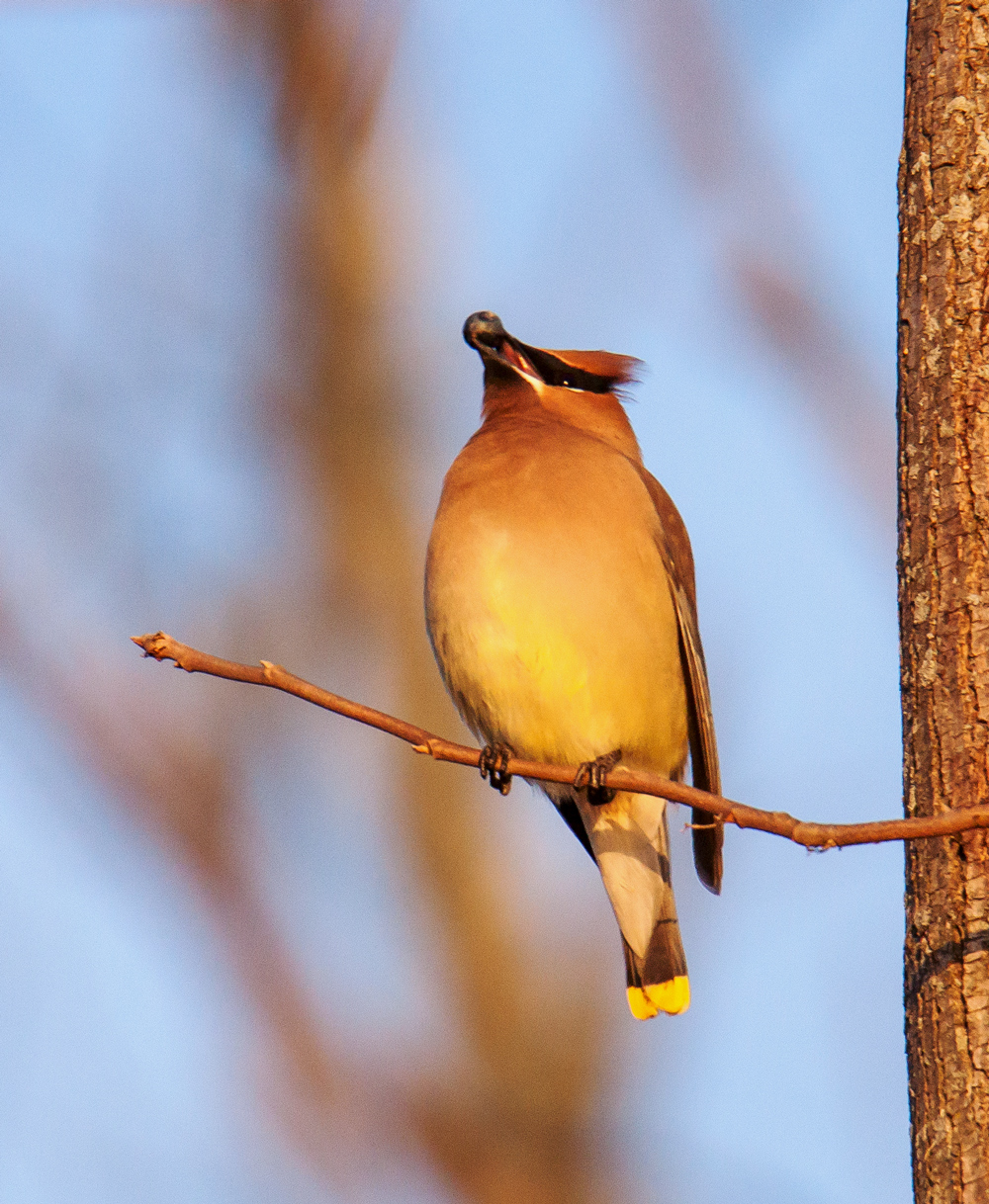
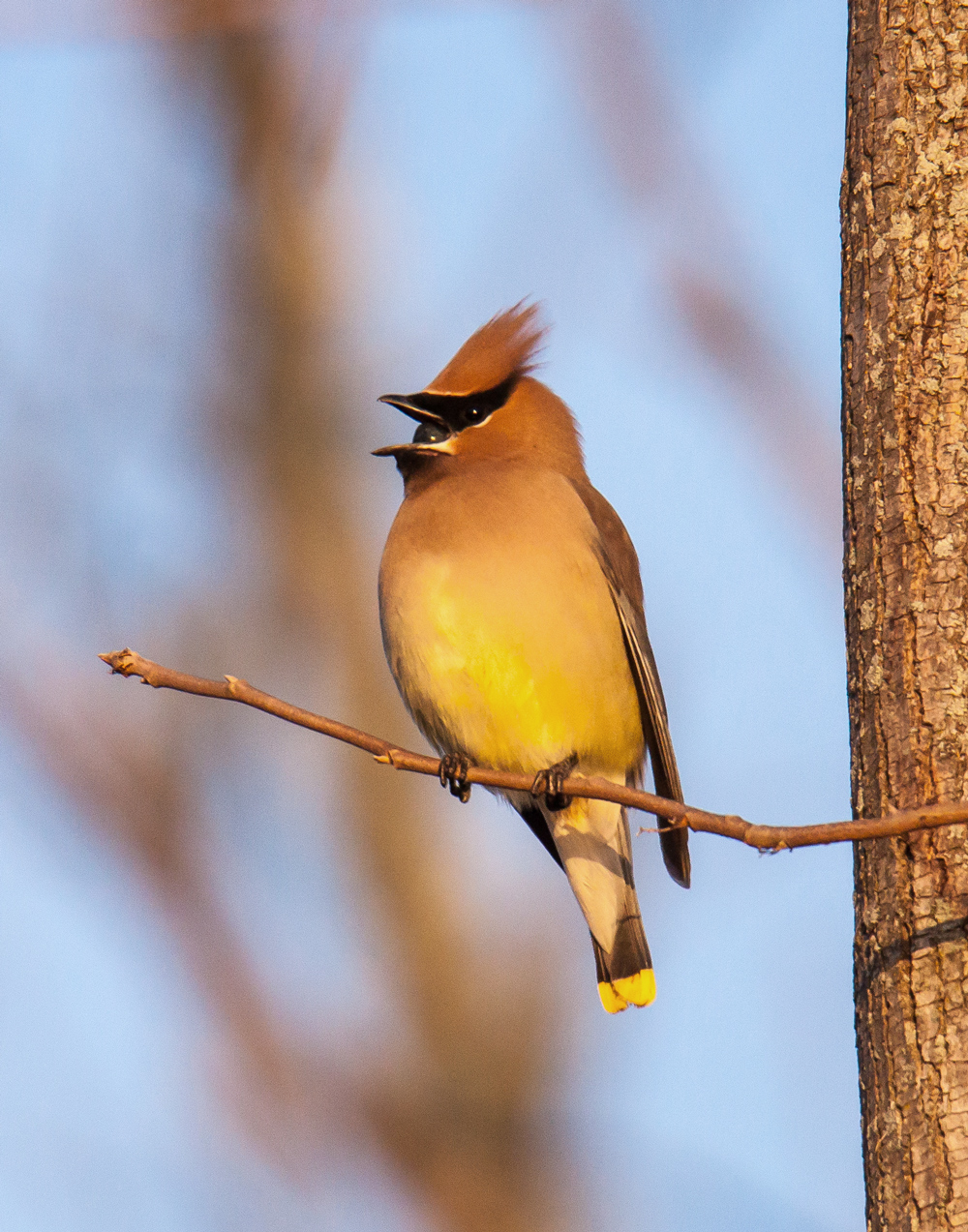
It was pretty cool yesterday morning to see a small flock of Cedar Waxwings (Bombycilla cedrorum) foraging at Occoquan Bay National Wildlife Refuge. One of them was using gravity to help it ingest a berry that it had managed to found. If you look closely, you can see what appears to be the bird’s tongue.

It seemed to take a bit of effort, adjusting ever so slightly the head and mouth, but eventually the beautiful little bird was able to get the whole berry into its mouth. In many ways, it was similar to watching a Great Blue Heron swallow a fish, albeit on a greatly reduced scale.

Cedar Waxwing

Cedar Waxwing

Cedar Waxwing

© Michael Q. Powell. All rights reserved.

Read Full Post »

As I was trekking about at Huntley Meadows Park on Saturday, I was thrilled to spot this Cedar Waxwing (Bombycilla cedrorum), a species that don’t see very often at the park. Normally when I do see one, it is buried in the branches or is far away, but this bird posed for a moment on a branch and I was able to get an unobstructed shot of it. The Cedar Waxwing was in the shade, but its silhouette is unmistakable and I could identify it immediately.

Cedar Waxwing

© Michael Q. Powell. All rights reserved.

Read Full Post »

Today was cloudy, windy, and overcast—definitely not an ideal day for taking photos. Sure, I like to have some clouds to cut down on harsh shadows, but you need sunlight to have shadows, and we sure did not have much of that today.

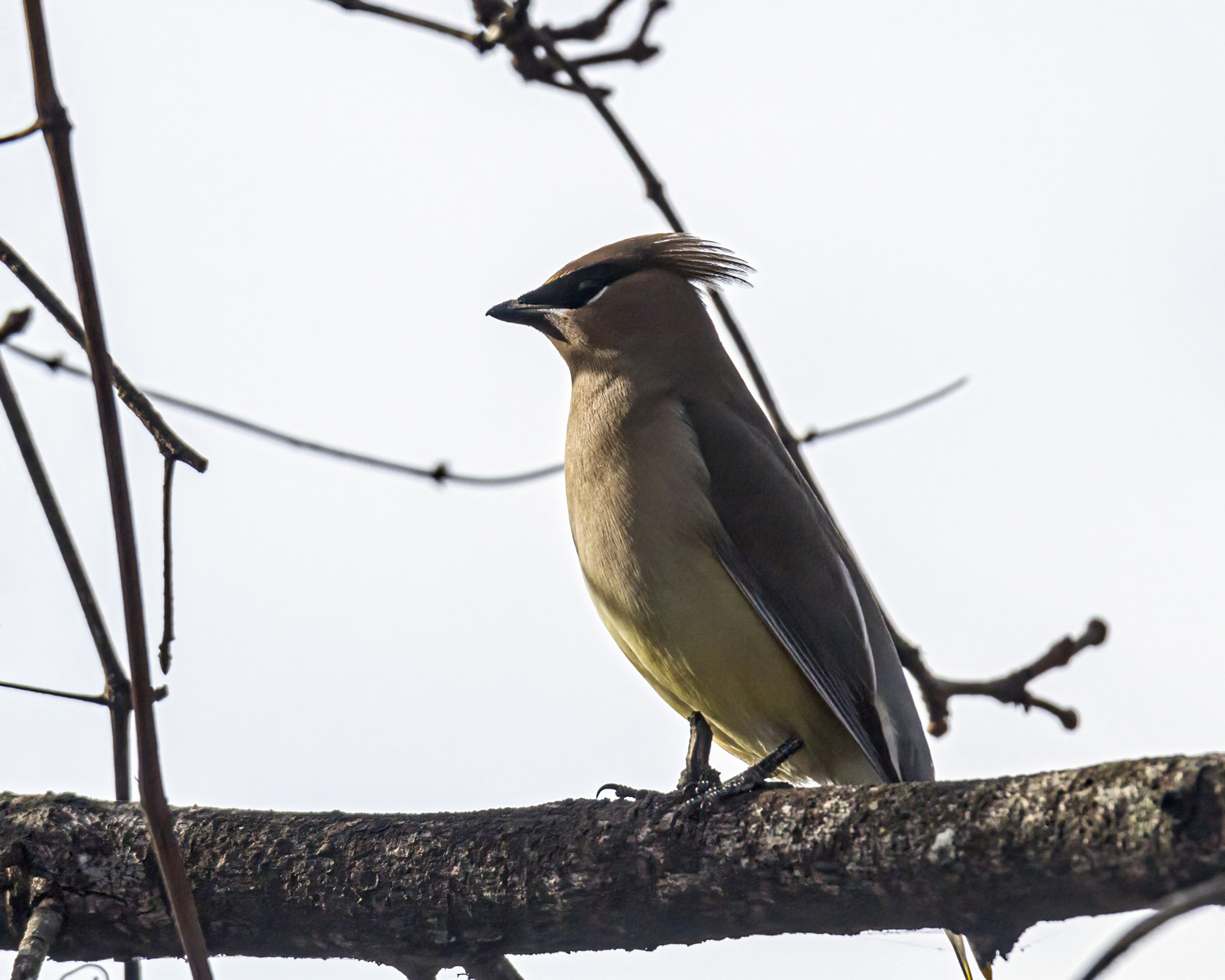
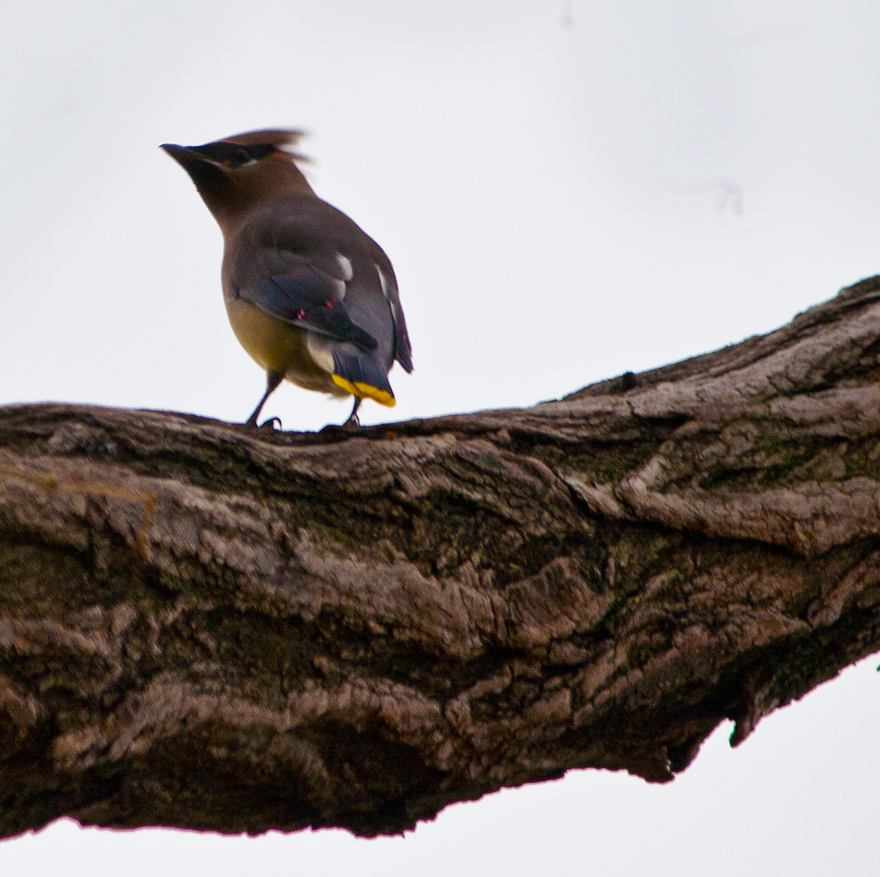
This afternoon I was walking on a path along a creek when small flock of birds flew into some nearby trees. They were pretty noisy and that attracted my attention. Looking though my telephoto zoom lens, I saw that they had an interesting silhouette, so I took some shots. They sky was already really light, but when I tweaked the exposure a little it went totally white and a really cool-looking bird emerged from the shadows. Usually I am pretty bad at identifying birds, but my initial Google search on the very distinctive yellow wing tips was successful in identifying this bird as a Cedar Waxwing (Bombycilla cedrorum).

Cedar Waxwing on a branch

According to the Cornell Lab of Ornithology, Cedar Waxwings feed on mostly fruit year-round, one of the few North American birds that specialize in eating fruit. One of the consequences of doing so, however, is that they sometimes get intoxicated from eating fermenting berries. The range map for this species suggests that they may be present year-round in this area (we are close to the northern boundary), but this is the first time that I have seen one.

This photo is more “artsy” than realistic, but I like its graphic character. It looks a bit to me like an illustration, in part, I guess, because of the white background.

© Michael Q. Powell. All rights reserved.
Read Full Post »