Feeds:
Posts
Comments

Posts Tagged ‘Blue-faced Meadowhawk dragonfly’

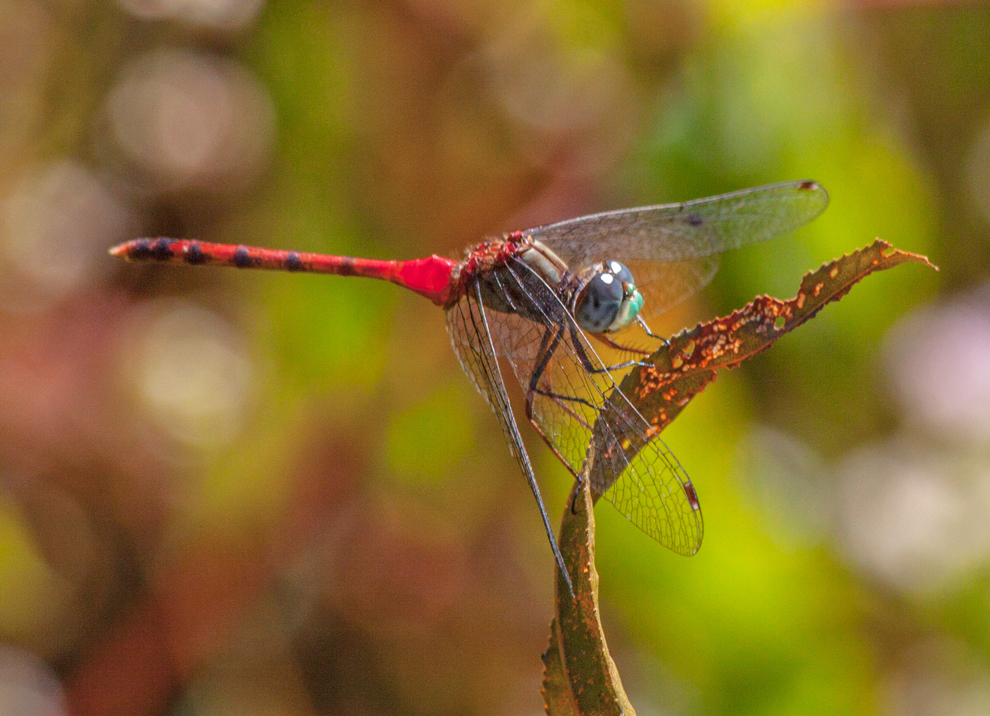
During most of the year the bright red body of Blue-faced Meadowhawk dragonfly (Sympetrum ambiguum) would really stand out, but in the late autumn, it blends in pretty well with the vegetation. However, it is almost impossible to conceal this species’ stunning blue eyes and turquoise face, which cause it to stand out from even a very cluttered background.

Blue-faced Meadowhawk

© Michael Q. Powell. All rights reserved.

Read Full Post »

My concerns about the potential demise of the Blue-faced Meadowhawk dragonflies (Sympetrum ambiguum) were greatly exaggerated and I saw a half-dozen or more yesterday on Veterans Day (Armistice Day).

Normally we stop seeing this species of dragonflies by the end of October, but we have not yet gone below freezing and perhaps that explains their unexpected longevity. Yesterday, for example, the temperatures soared to almost 70 degrees F (21 degrees C).  I have to note too that I am searching for them more diligently and in more remote locations of my marshland park, so that may help explain why I am seeing them more frequently.

As is the case with birds, male dragonflies tend to be more brightly colored and visible. Many female dragonflies are brown in colored and harder to spot. I was thus very happy yesterday to be able to get this close-up shot of a female Blue-faced Meadowhawk. Her body coloration may be a little bit drab, but those blue eyes are simply stunning.

In case you are curious, these dragonflies are small in size, with a body length of approximately 1.5 inches (38 mm), so I had to move in awfully close to get this shot. Surprisingly (and happily), this female tolerated my close presence for long enough for me to take several shots before she flew off into the distance.

female Blue-faced Meadowhawk

© Michael Q. Powell. All rights reserved.


Read Full Post »

We’re almost at the end of the dragonfly season now in Northern Virginia and soon I’ll be seeing only the Autumn Meadowhawks (Sympetrum vicinum), historically the last dragonflies of the year to disappear. This past Monday, though, I managed to find a few Blue-faced Meadowhawk dragonflies (Sympetrum ambiguum), unusually hardy survivors this late in the season.

I really enjoy trying to get close-up shots of these colorful little dragonflies and my favorite shot is this close-up of one of them, perched on a fallen leaf.

Blue-faced Meadowhawk

When you pull back a little, you can see how tough the season has been for this dragonfly—portions of its wings are shredded. Somehow, however, it managed to fly about as though its wings were undamaged.

Blue-faced Meadwhawk

Temperatures last night dropped down into the upper 30’s F (3-4 degrees C) and I doubt that I will see any more Blue-faced Meadowhawks. I am resigned to the possibility that these may be my last shots of the year of these stunning little dragonflies, but that won’t keep me from searching really hard for them later today.

Blue-faced Meadowhawk

© Michael Q. Powell. All rights reserved.

Read Full Post »

Do you ever shoot the same subject at the same time with another photographer and compare the results afterwards? It is fascinating to see how the choice of equipment, individual shooting styles, and angle of view affect the results.

Recently I was walking at Huntley Meadows Park, the local marshland park where I take a lot of my nature photos, with fellow blogger and photographer Walter Sanford when he spotted a mating pair of Blue-faced Meadowhawk dragonflies (Sympetrum ambiguum). Eventually they landed on the ground and Walter and I took up our shooting positions. He was seated on his Coleman folding camp stool facing the sun and I was crouching (and eventually sprawling flat on the ground) on the other side of the mating dragonflies, trying desperately not to cast a shadow on the action.

The dragonflies were surprisingly tolerant of us or were so caught up in the moment that they were oblivious to the outside world. We ended up shooting quite a few images during a lengthy session and couldn’t help but note the remarkable endurance of this couple. 

I started out in a position where I could capture both members of the couple (as you can see in the second photo), but then I started inching forward in an effort to see how close I could get to them, focusing my camera and my attention on the female. When I took the first photo below, I was pretty close to the minimum focusing distance of my Tamron 180mm macro lens, which is 1.54 feet (47cm). In case anyone is curious about the settings for that image, I was at ISO 400, f/13, and 1/20 of a second and used my pop-up flash.

There is no way that I can handhold this lens at 1/20 of a second, in part because it has no built-in image stabilization). It’s virtually impossible to use a tripod that close to the ground. So what I have started doing is using my camera bag as a kind of giant beanbag and resting my camera on the bag.

Walter took some shots of me in action and kindly agreed to let me use one of the resulting photos in this posting. He also circled in red the mating dragonflies to give you a better idea of how small our subjects were. In case you are wondering what the black object is that is underneath me, it’s my tripod bag—my photography mentor Cindy Dyer has influenced me to carry a tripod at almost all times.

In a final fashion note, I would like to point out that this is not the way that I usually wear a baseball cap. I turned the cap around in order to look through the viewfinder at this low angle. You will never catch me with my hat like that in public and I shudder every time I see a teenager with his hat tilted to the side or on backwards.


Blue-faced MeadowhaekBlue-faced MeadowhawkP1270731_Aperture-BFX_psda

© Michael Q. Powell. All rights reserved.

Read Full Post »

When I am trying to take a close-up shot of a dragonfly, I know that I have succeeded when I manage to capture some of the details of the ommatidia. What are ommatidia? Ommatidia are the up to 30,000 hexagonal facets that make up the incredible compound eyes of a dragonfly. For more information and a more scientific explanation, check out a posting entitled “Super-predators” that Sue did in June 2013 in her Backyard Biology blog.

Rather than think about science, today I would prefer to simply bask in the beauty of the blue-eyed Blue-faced Meadowhawk dragonfly (Sympetrum ambiguum) that I photographed yesterday as it perched on a fallen leaf at my favorite marshland park. The color of the dragonfly’s eyes completely captivate me.

As for the ommatidia, I’ve cropped a portion of the image and added it to the posting as a second image to make it even clearer what they look like. I chuckled a little when I examined the cropped image, because this dragonfly, like some others that I have photographed, has the sparsely distributed mustache and chin hairs that never fail to remind me of human teenagers who refuse to shave in a vain attempt to look older.

Blue-faced MeadowhawkBlue-faced Meadowhawk

© Michael Q. Powell. All rights reserved.

Read Full Post »

Many dragonflies species have disappeared by now as we move deeper into autumn, but some especially beautiful ones have taken their place, like these male Blue-faced Meadowhawks (Sympetrum ambiguum) that I photographed yesterday at my local marshland park.

According to the Dragonflies of Northern Virginia website, this species peaks in September to October and is the rarest and hardest to find meadowhawk in our area. I was walking through a meadow at the park with one of my fellow photographers when she spotted the Blue-faced Meadowhawk in the second photo perched on a log. At that moment, I happened to have a 70-300mm telephoto lens on my camera and I was happy  to be able to get a shot that shows the spectacular colors of this dragonfly. Little did I know that I would have an even better opportunity a few minutes later.

As we continued into an area with thigh-high growth, my friend stopped for a moment and said she had spotted a spreadwing damselfly. I looked in the direction that she was pointing and didn’t see the damselfly, but I did spot another Blue-faced Meadowhawk perched atop one of the plants.

In a whispered voice, I asked my friend to freeze and I quickly changed lenses to my 180mm macro lens. Amazingly, the dragonfly stayed in place and I was able to get a number of shots, including the first one below. Given that these dragonflies are less than two inches in size (50mm), I am thrilled with the results. There is something almost magical about the combination of red, blue, and turquoise on this dragonfly.


Blue-faced Meadowhawk Blue-faced Meadowhawk.

© Michael Q. Powell. All rights reserved.

Read Full Post »

I don’t expect to see new species of dragonflies at this time of the year, but one of my fellow photographers, Walter Sanford, has been stalking the Blue-faced Meadowhawk (Sympetrum ambiguum) almost daily and I joined him for a few hours one late September day and got this shot.

I learned quickly that these dragonflies are hard to spot, despite their conspicuous coloration. They seem to like to remain perched down low in the vegetation and wait for their prey, rather than fly around when they are hunting.

I love the combination of colors on the Blue-faced Meadowhawk and I was happy to get a decent shot that shows its blue face. If you want to see more shots of this beautiful dragonfly, check out Walter’s blog posting from yesterday.

I am now in search of the Autumn Meadowhawk, the last dragonfly that I observed last fall. Normally they should be here already, but none of my fellow dragonfly followers has observed any of them yeat.

blue-faced1_blog

© Michael Q. Powell. All rights reserved

Read Full Post »

« Newer Posts