Feeds:
Posts
Comments

Posts Tagged ‘Bald Eagle’

On Monday it was cool and windy and I didn’t expect to see many birds at Occoquan Bay National Wildlife Refuge. I was pleasantly surprised to spot several Bald Eagles (Haliaeetus leucocephalus) flying about. The wind seemed to slow them down a little and gave me a slightly better chance of capturing images of them in flight.

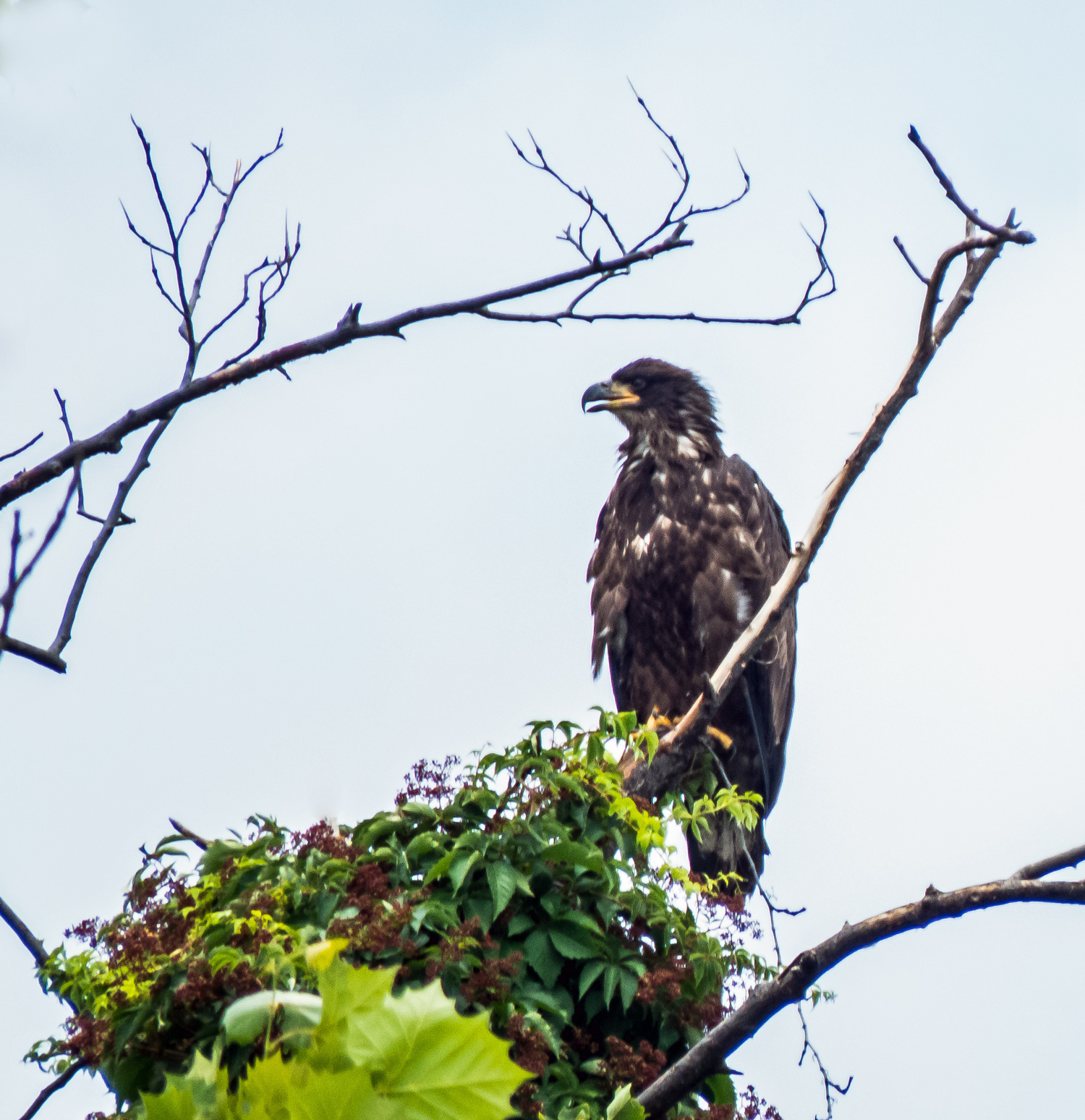
My favorite subject was this juvenile eagle. Sometimes juveniles can look somewhat bedraggled with their multi-colored feathers, but I thought that this one looked quite handsome, especially when the light hit it from a good angle and illuminated its body. One unexpected benefit was that it was easier to get a proper exposure with the juvenile because it does not have the extreme contrasts of the dark body and white head of the adults. In many of my shots of adult eagles, the body ends up underexposed and/or the head ends up overexposed.

juvenile bald eagle

juvenile bald eagle

juvenile bald eagle

© Michael Q. Powell. All rights reserved.

Read Full Post »

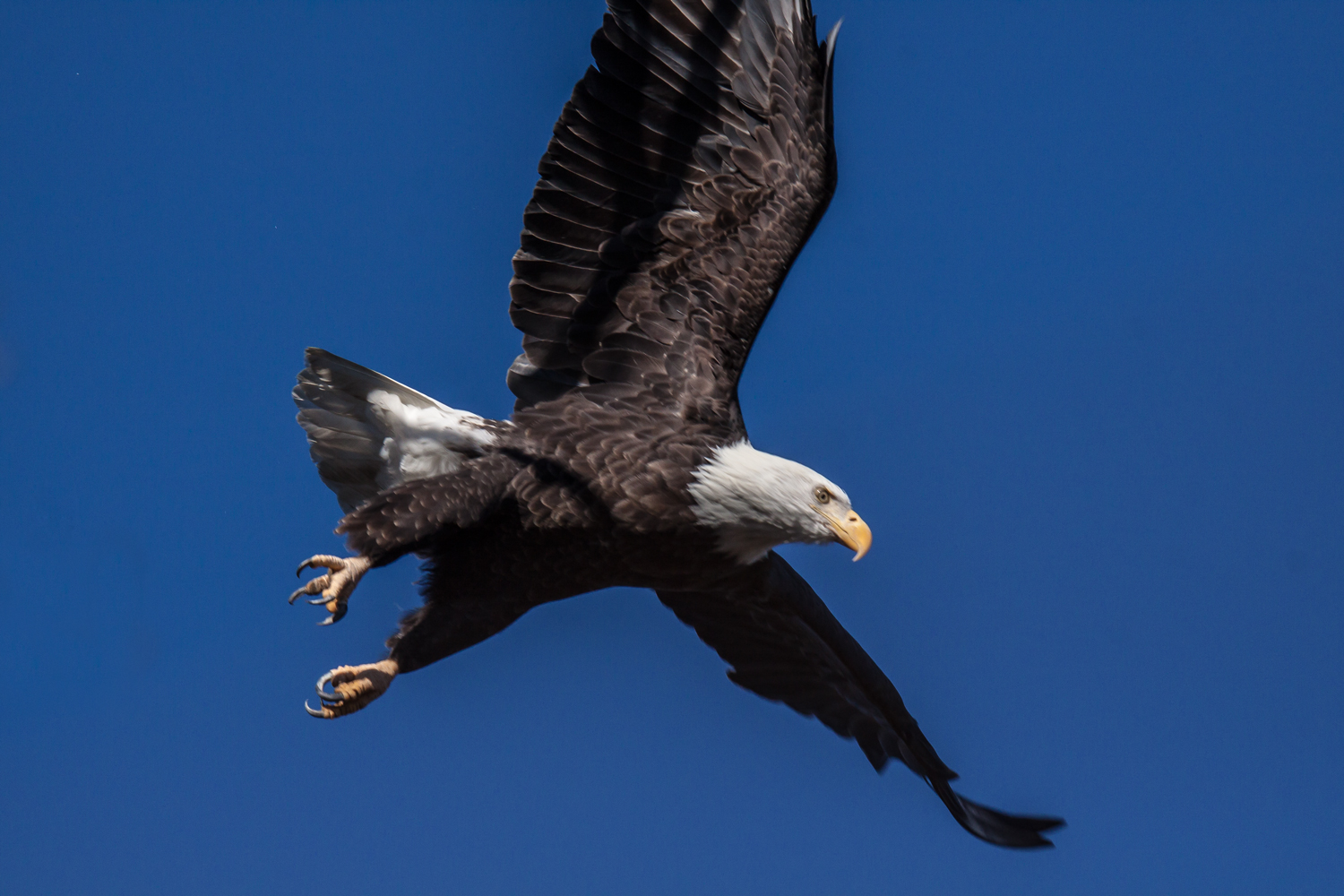
This Bald Eagle (Haliaeetus leucocephalus) dropped more quickly than I anticipated when it took off last Friday at Occoquan Bay National Wildlife Refuge, but somehow I managed to keep most of it within the frame.

Whenever I see an eagle perched in a tree, my mind starts to go into overdrive and my fingers get twitchy. Should I take an immediate shot or should I try to get closer? If I manage to get closer, should I zoom in all the way to capture the perched eagle or leave room in the frame if the eagle decided to take off? I try to anticipate what is going to happen, knowing that I will most likely will have to react to a scenario that I hadn’t predicted.

This eagle, for example, did something unusual—it initially flew towards me. In my experience, eagles almost always fly away from me when they take off. A bird flying right at you is a real challenge to photograph. My focus on the eagle’s eye was off a little bit, but I was very happy to capture an image in which I am looking straight at the eagle’s face from in between the wings.

Growing up, I was a member of the Boy Scouts and the Scout motto of “Be Prepared” serves me well when I am trying to photograph wild creatures like this bald eagle.

bald eagle

© Michael Q. Powell. All rights reserved.


Read Full Post »

Do you ever feel the need to scream at the top of your lungs like this Bald Eagle (Haliaeetus leucocephalus) that I spotted on Saturday morning at Occoquan Bay National Wildlife Refuge? I think that most of us have moments in our lives when our emotions overwhelm us and we feel a need to vent. Why not scream? 

As the old children’s rhyme tells us, “I scream, you scream, we all scream for ice cream.” 🙂

screaming eagle

© Michael Q. Powell. All rights reserved.


Read Full Post »

This Bald Eagle (Haliaeetus leucocephalus) was initially facing away from me on Monday at Occoquan Bay National Wildlife Refuge.  Somehow, though, the eagle sensed me approaching and turned its head slightly to glare at me. The eagle seemed to take a little time to check me out before deciding to take off.

I am presenting the images below in reverse chronological order, starting with the “glare” and working backwards in time to the moment when I first spotted the eagle. I had just rounded the bend of a trail and lookeding upwards was shocked to see that I was almost directly this eagle. It is definitely rare for me to get this close to an eagle and to get such detailed shots of its feathers.

bald eagle

bald eagle

bald eagle

© Michael Q. Powell. All rights reserved.
 

Read Full Post »

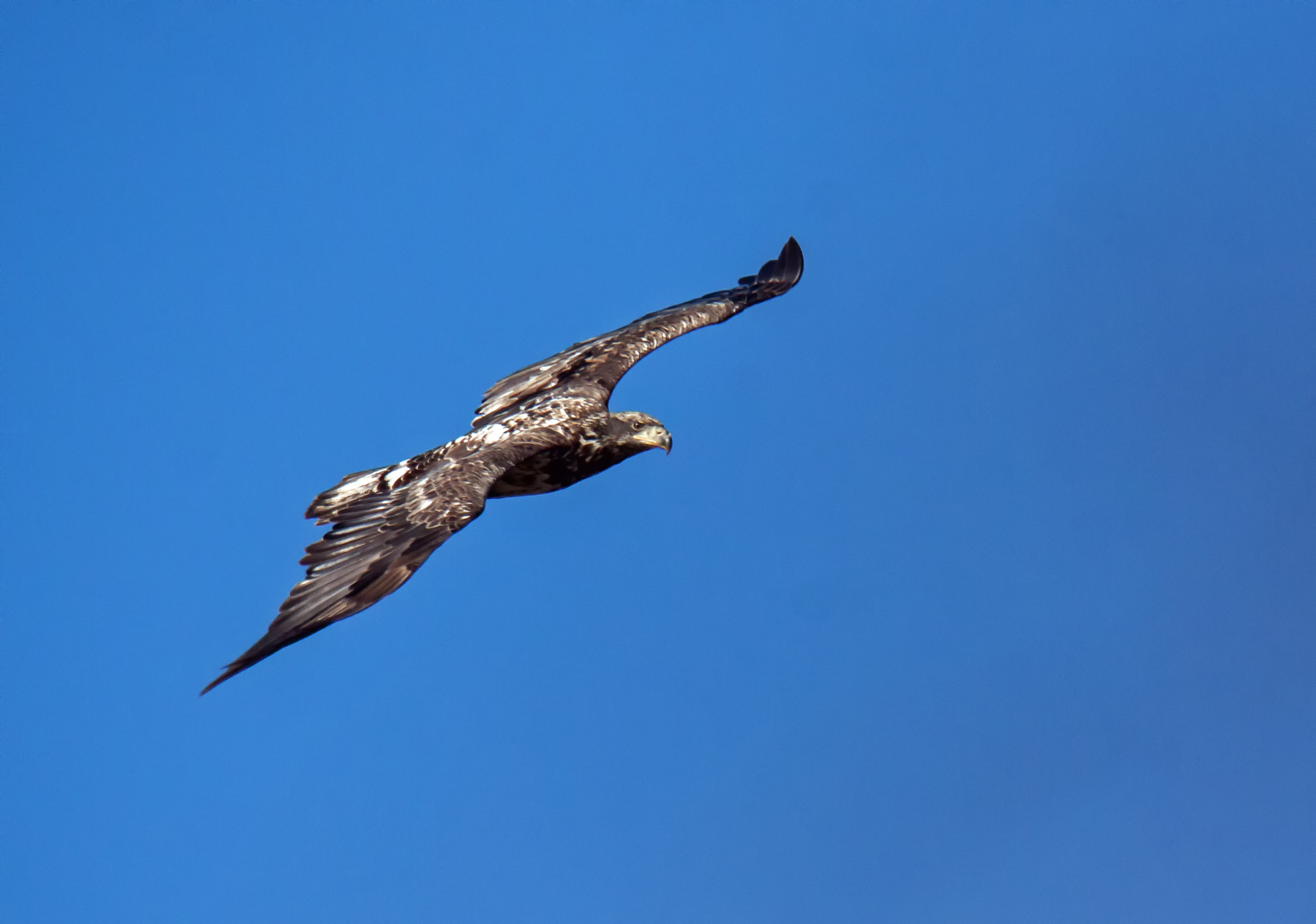
This immature Bald Eagle (Haliaeetus leucocephalus) certainly was aware of my presence on Monday at Occoquan Bay National Wildlife Refuge, judging by the intensity of the stare it directed toward me. I am guessing that the eagle is about three years old—it takes almost five years for its head feathers to turn completely white and for its beak to turn yellow. At this stage of development, bald eagles look a little scruffy and have not yet acquired the majestic look that I associate with this species.

If you are interested in seeing images of the developmental stages of the bald eagle, check out this posting from onthewingphotography.com that shows an eagle’s age progression from one to five years old.

Bald Eagle

Bald Eagle

© Michael Q. Powell. All rights reserved.
Read Full Post »

When I first spotted this bird perched on a distant piece of floating driftwood, I assumed that it was a cormorant. The more I looked at it, though, the more I thought that the body proportions were wrong for a cormorant.

I was a bit shocked when I zoomed in and discovered that it was a Bald Eagle (Haliaeetus leucocephalus). Why was the eagle perched like this? Was it looking for a moment of solitude?

Somehow the solitary eagle reminded me of a shipwrecked sailor, adrift in the vast expanses of the ocean.

Bald Eagle

© Michael Q. Powell. All rights reserved.

Read Full Post »

There are barriers on several roads to protect the nesting eagles at Occoquan Bay National Wildlife Refuge from human interference, but with a long lens I was able to confirm on Tuesday that one of the Bald Eagles (Haliaeetus leucocephalus) was sitting on the nest. With a little luck, we will have eaglets again this year—last year there were two of them at this nesting site.

The two images below are actually different versions of the same photo. Initially I was going to post just the second image, but then decided to crop it a bit to give viewers a slightly better view of the eagle. I have also noticed that images in a landscape format display better in the WordPress Reader than those in a portrait or square format.

nesting Bald Eagle

nesting Bald Eagle

© Michael Q. Powell. All rights reserved.


Read Full Post »

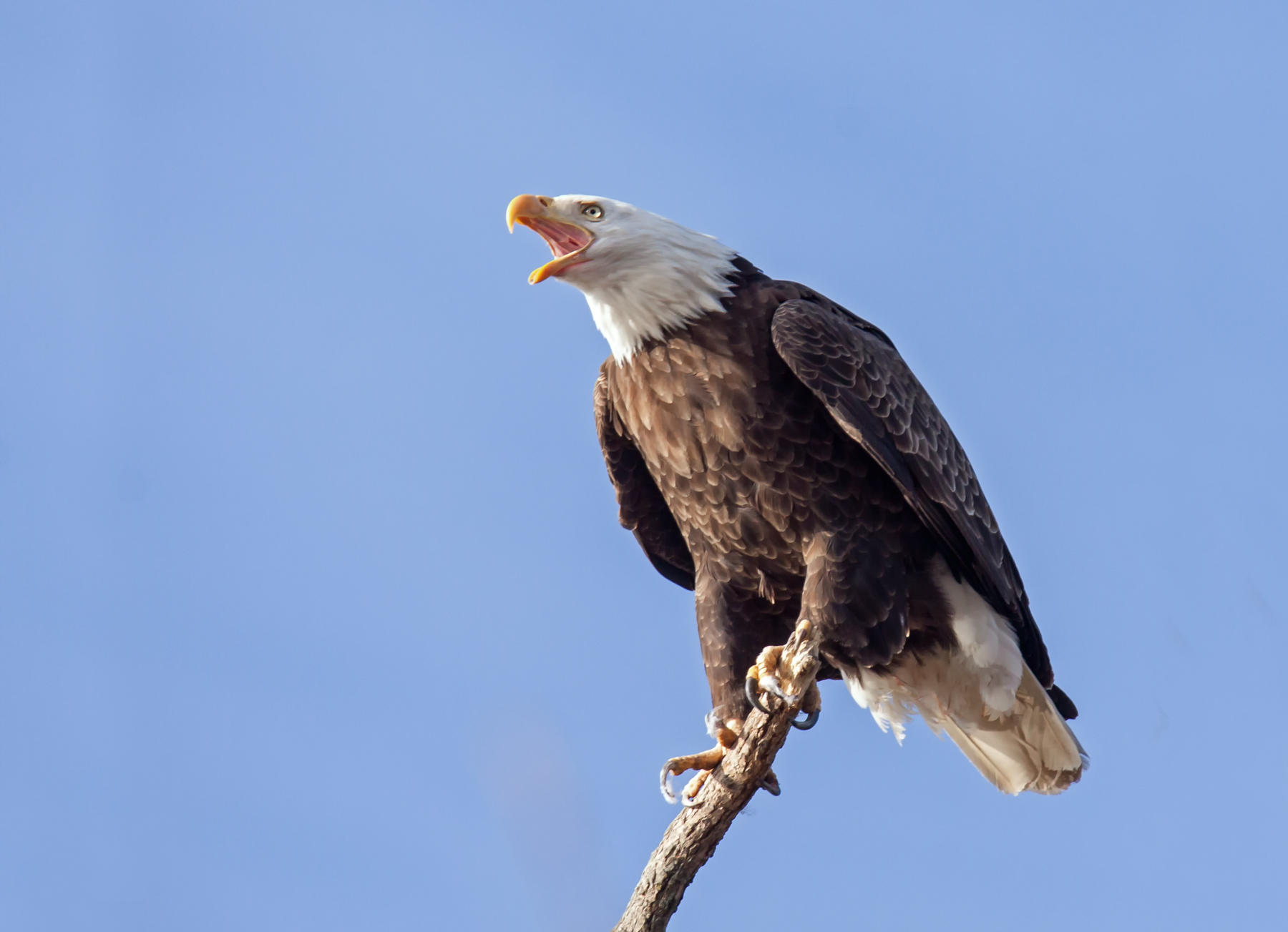
As many of you know, I love to photograph Bald Eagles (Haliaeetus leucocephalus). There is something about the majesty and strength of these birds that never fails to impress and inspire me.

On Tuesday, a beautiful sunny day. there were several eagles flying about in the skies over Occoquan Bay National Wildlife Refuge. I am not sure if they were motivated by love or by competition, but it was definitely fun to watch them in action. I had lost sight of a pair that I had been tracking when suddenly I heard the sound of an eagle’s cry that seemed to be really close. I glanced upwards and saw an eagle on an exposed branch in a nearby tree.

My heart was pumping and I probably was holding my breath, but I managed to capture a few shots that may well be the my best shots ever of a Bald Eagle. I was very fortunate to have been presented a situation and I was thrilled to be able to take advantage of it so well. (If you click on the images, you can see more amazing details, like the pink color of the inside of the eagle’s mouth.)

It is moments like this that help to keep me motivated as a wildlife photographer. These may be my best shots of an eagle so far, but who knows, there may be more and better images in the future.

bald eagle

bald eagle

© Michael Q. Powell. All rights reserved.


Read Full Post »

Do you wait for optimal light conditions when you are taking photographs? This past weekend I watched a number of videos of landscape photographers in action. “Action” might be a slight exaggeration, because it seemed like they spent a lot of time waiting for the perfect lighting conditions before they took their shots. The landscape photographers had pre-scouted their locations and watched the weather forecasts and knew the kind of images they hoped to capture.

Yesterday I did a posting that talked about the importance of shooting with whatever gear you have. My approach to weather and lighting is similar. I go out whenever I can and try to make the best of whatever conditions I find myself in. As I have mentioned before, I also tend to be an opportunistic shooter, so I never know what I will see and therefore can’t pre-plan my shots.

That was the situation early one morning last week as I wandered the trails at Occoquan Bay National Wildlife Refuge. The skies were heavily overcast and the Bald Eagle (Haliaeetus leucocephalus) that I spotted in a tree was far away.

So what did I do? I tried to capture some of the different poses of the eagle from as many different angles as I could. I worked the scene, knowing full well that none of my photos would be great.

Some say that if you want to be a professional photographer, you only display your best work. That may be true, but that is one of the reasons why I don’t particularly aspire to be a professional. As the subheading of my blog suggests, I’m on a creative journey with photography—I am content to share with others the images that I am able to capture.

As a child, I remember begin told repeatedly to do the best that I can and I continue to follow that advice to this day.

Bald Eagle

Bald Eagle

Bald Eagle

© Michael Q. Powell. All rights reserved.

Read Full Post »

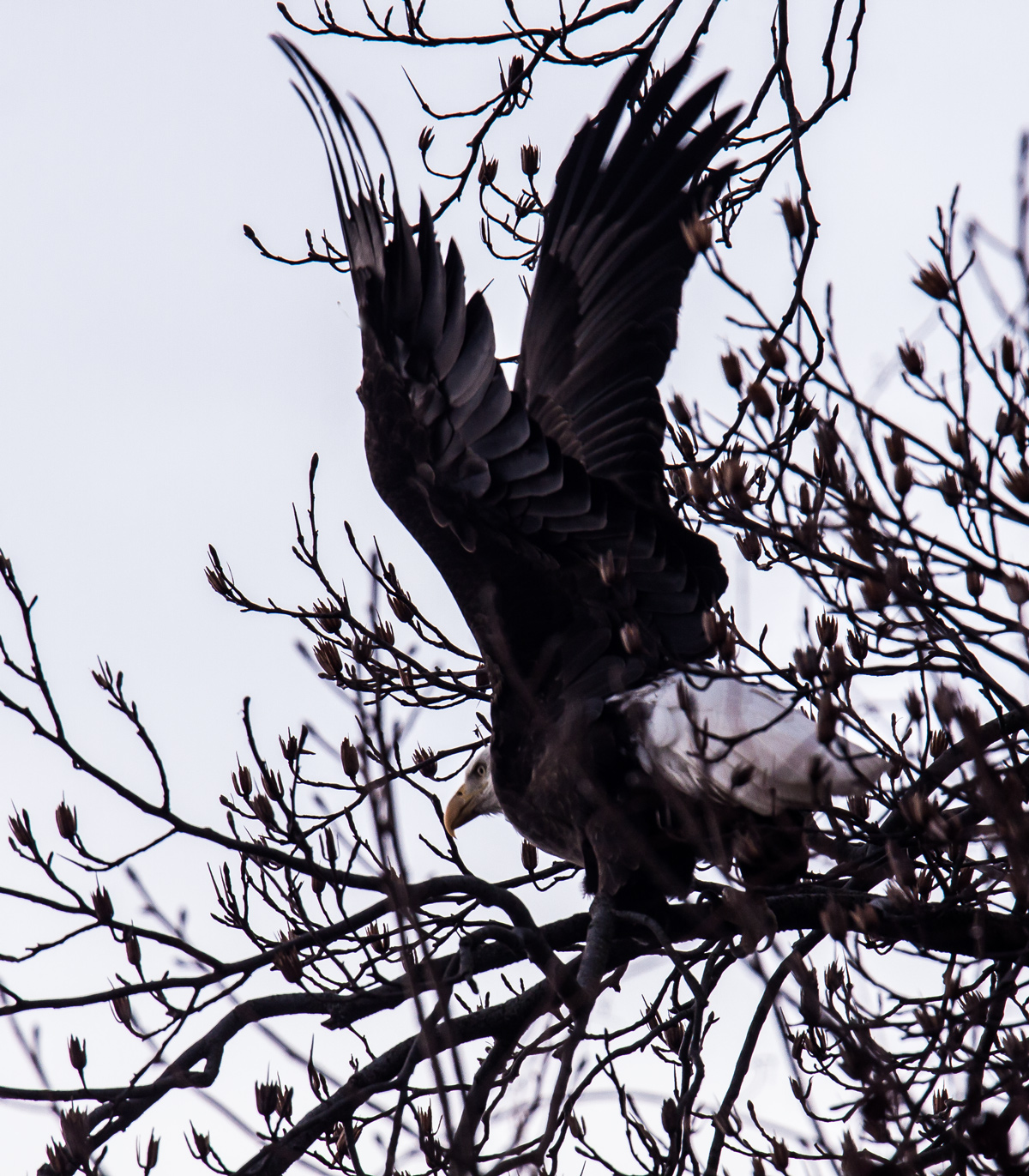
It looks like Bald Eagles (Haliaeetus leucocephalus) follow a pre-flight checklist before takeoff. They stretch their wings, crouch down and lean forward, and then they fully extend their wings and push off with their legs.

I spotted this eagle on Monday at Occoquan Bay National Wildlife Refuge. I had been observing it for quite a while when suddenly it looked like it was going to take off. I am not sure exactly what the signs were, but I correctly anticipated its actions and was able to capture this sequence of shots.

Most of the time birds take off so quickly that we don’t know exactly how they did it—one second they are in a tree and the next second they are in the air. It was nice to be able to get a sense of the process that a bird goes through as it takes off. As I have seen with ducks, however, the process varies by species and is probably affected by factors such as the weight of the bird and the length of their wings.

Bald Eagle

Bald Eagle

Bald Eagle

© Michael Q. Powell. All rights reserved.

Read Full Post »

I watched and waited for an extended period of time yesterday as this Bald Eagle (Haliaeetus leucocephalus) groomed itself in a tree overlooking one of the trails at Occoquan Bay National Wildlife Refuge. I was pretty much in the open at the edge of the trail and did not dare to move forward for fear of spooking the eagle. Fortunately I had my camera and long telephoto zoom lens on a monopod, because I know from experience that I would not have been able to hold it pointed upwards for that long a period of time.

I tried to stay as alert and ready as I could, which can be quite a challenge after a while. Sometimes a bird will signal its intent to take off, but this eagle took off without a warning. Acting on instinct mostly, I managed to capture the first image when the eagle was just clearing the edge of the branches. In the second shot, I clipped off the edge of the wings, but decided to include it to give you an idea of the challenge of trying to track the speed a bird when it first takes off. The final image shows you what the eagle looked like when it was perched in the tree before the takeoff.

bald eagle

Bald Eagle

Bald Eagle

© Michael Q. Powell. All rights reserved.

Read Full Post »

It’s nesting time for eagles at Occoquan Bay National Wildlife Refuge. On Monday I spotted this Bald Eagle couple in a nest that I know has been used the for at least the last two years. The tree is adjacent to one of the main trails at the refuge and is pretty prominent. Shortly after my sighting, I encountered one of the law enforcement officers who was putting up barriers to block access on the roads near the nesting site to protect them from human interference.

Each year they put up the barriers in slightly different locations. I am hoping that this year’s barriers are about the same distance from the nest as last year’s. At that distance, I was able to photograph the eagles from a distance that let me get photos about the same as the first image below and also monitor the eagles. I was fortunately last year to be able to even get some distant shots of the two eaglets after they were born. Perhaps I will be equally lucky this year.

Bald Eagle

Bald Eagle

© Michael Q. Powell. All rights reserved.

Read Full Post »

How willing are you to show others your unedited images? When I first started getting more serious about taking photos six and a half years ago, I used to go out shooting with my mentor Cindy Dyer. When we were finished, we would immediately download my images and she would go through them with me.

It is a very humbling experience to let someone see all of your shots, but in doing so Cindy was able to see what I was attempting to do and how well I was succeeding in things like composition and camera settings. Her view was that I should try to get it as correct as I could in camera and not rely on software to fix my problems.

Earlier today I posted an image of a Bald Eagle (Haliaeetus leucocephalus) in a blog posting that I titled Unexpected eagle. In response to the posting, Liz of Exploring Colour asked me how much I had cropped the image. I answered her verbally, but then realized it would be more effective to show her the uncropped image and then the cropped one that I used in this morning’s post.

I was shooting with a Tamron 150-600mm lens at 600mm for this shot and that was what allowed me to fill so much of the frame with the eagle. It is very unusual for me to be able to get that close to an eagle without spooking it. When I am uncertain of the amount of time that I will have with a subject, I will usually use the center focus point of my camera and I think that is what I did here.

My DSLR is getting a bit long in the tooth and doesn’t have as many megapixels as some of the really new ones, which means I can’t crop as severely as some other photographers can without degrading the quality of my images. I have no objections to cropping, though I usually try to keep it as minimal as possible.

Bald Eagle

Uncropped image

bald eagle

Cropped image

© Michael Q. Powell. All rights reserved.

Read Full Post »

As I rounded a curve on a trail yesterday morning at Occoquan Bay National Wildlife Refuge, I looked up and realized there was a Bald Eagle (Haliaeetus leucocephalus) right in front of me. I reacted pretty quickly and managed to capture this image before the eagle spotted me and flew away.

Most of the time when I have been in similar situations, the eagle has spotted me before I spotted him and reacted before I did. In this case, I suspect that the eagle was either distracted or was looking in another direction when I first came into view.

bald eagle

© Michael Q. Powell. All rights reserved.

Read Full Post »

Do eagles kiss? I am not sure if they do, but these two Bald Eagles (Haliaeetus leucocephalus) were definitely beak-to-beak this morning at Occoquan Bay National Wildlife Refuge.

After a week in the urban confines of Brussels, Belgium, it was nice to get out in the wild again, though I must confess that I was still somewhat jet-lagged. Not long ago I posted a photo of an eagle couple on this same perch and I suspect that this is the same pair. Earlier I had seen another eagle couple near another nesting site. Last year I was thrilled to get a peek at some young eaglets and I am hoping to be able to do the same this year.

kissing eagles

© Michael Q. Powell. All rights reserved.

Read Full Post »

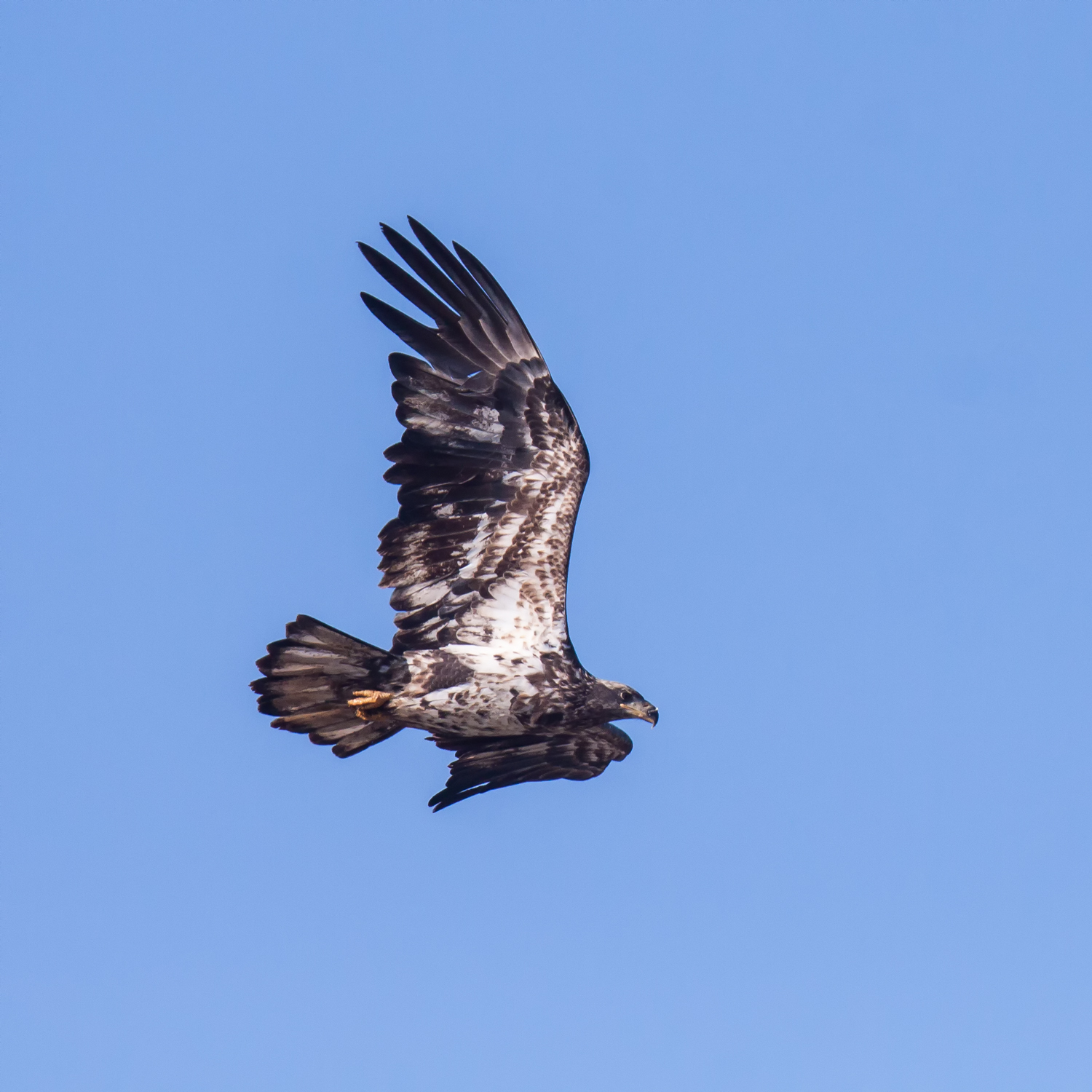
Most of the year I tend to see individual Bald Eagles (Haliaeetus leucocephalus), but recently I have been seeing them in pairs, like this couple that I spotted last week perched on a nesting platform for ospreys at Occoquan Bay National Wildlife Refuge. It will soon be time to occupy a nearby nest.

If you look closely at the two eagles, you will notice that one that the one on the left is smaller in size—I believe that is the male. I do not know if this is the same couple, but an eagle couple successfully raised two eaglets in a nest in a tree that is not that far away from this platform, which housed an active osprey nest last year.

bald eagles

© Michael Q. Powell. All rights reserved.
 

Read Full Post »

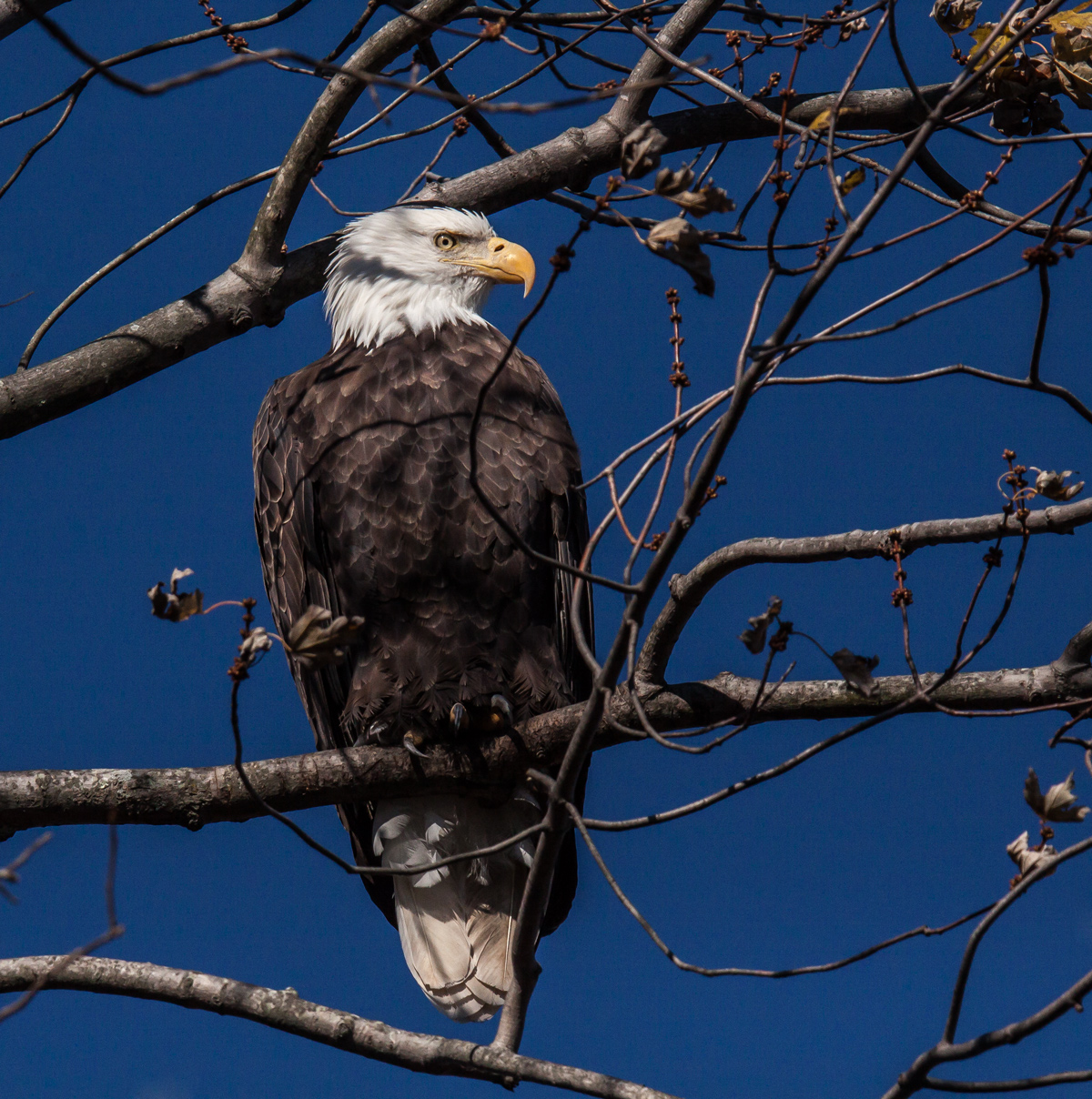
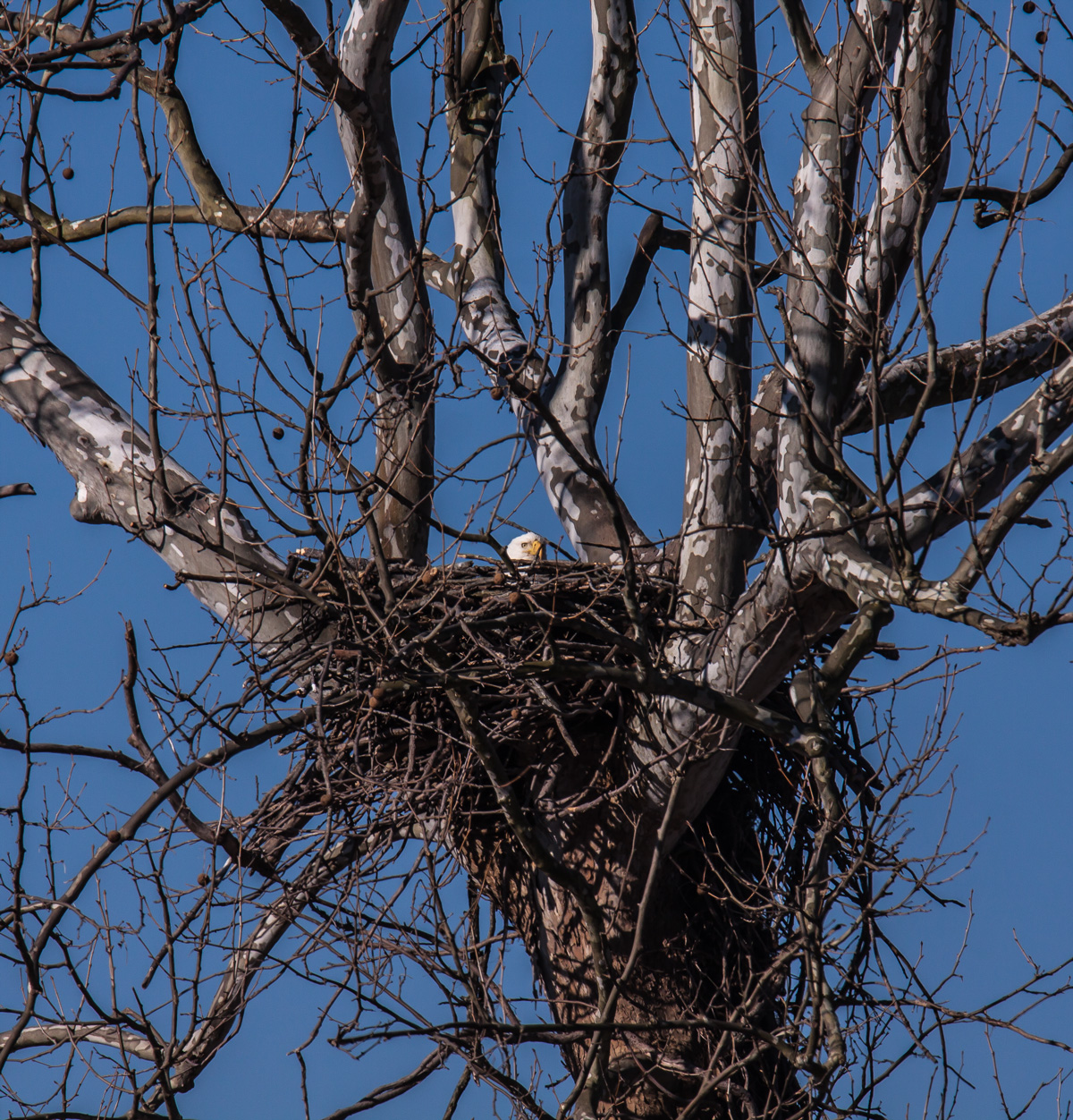
In theory, it is easier to spot a Bald Eagle (Haliaeetus leucocephalus) now that the leaves have fallen from the trees. In reality, however, the eagles often seem to like to perch in locations where they are at least partially hidden by branches.

That was certainly the case this past Monday when I spotted this bald eagle at Occoquan Bay National Wildlife Refuge. There was a lot of tangled vegetation between me and the eagle, so there was no way that I could get any closer. I was happy that I was able to find a shooting angle that allowed me to get a clear view of the eagle’s head and tail.

Bald Eagle

© Michael Q. Powell. All rights reserved.
Read Full Post »

Whenever I walk the trails parallel to the water at Occoquan Bay National Wildlife Refuge I try to stay alert, because I never know when a Bald Eagle (Haliaeetus leucocephalus) will come zooming by, as this one did last week.

I had my camera already set to relatively appropriate settings and my biggest challenge was to acquire the eagle in my viewfinder before it flew out of sight. I was fortunate that the eagle was flying on a level plane, so I did not have to worry about having to zoom the lens in or out. I took a burst of shots and the image below was the one that I liked the best, primarily because of the wing position and the catch light in the eye.

Each opportunity to photograph a bird in flight is unique. I never know when circumstances will work together to permit me to capture a good in-flight image, but it feels almost magical when somehow I do.


Bald Eagle

© Michael Q. Powell. All rights reserved.

Read Full Post »

As I was observing a Bald Eagle (Haliaeetus leucocephalus) earlier this week at Occoquan Bay National Wildlife Refuge, something seemed to catch its eye and without warning the eagle took off into the air.

I was a little slow in reacting, but managed to capture an in-flight shot. The image you see is framed just as I took it. I was already partially zoomed out at 375mm on my 150-600mm, but that was not wide enough to capture the full wingspan of the eagle. When the action happens so quickly, it is hard to simultaneously track the moving subject and use the zoom—it is a bit like trying to rub your stomach and pat your head at the same time.

The second shot shows the eagle just before the takeoff. I like the tension of its body position and and the intense focus of the eagle’s eyes.

The final shot was taken before the other two and gives you an idea of how the eagle was perched as I approached it. There were a lot of branches surrounding the eagle and I tried to move slowly and cautiously to get a mostly unobstructed shot.

For those of you in the United States celebrating today, I wish you a very happy Thanksgiving Day. It is good to pause and reflect on all the blessings in our lives, not just on the one day each year that is set aside for doing so. I thank all of you for your continuous support and encouragement for me as I share my photography and my life in this blog. Over the last six years it has become part of my daily life and I consider many of you to be a part of my extended family.

“In everything give thanks.”

Bald Eagle

Bald Eagle

Bald Eagle

© Michael Q. Powell. All rights reserved.

Read Full Post »

What’s the price of freedom? Today in the United States it is Veterans Day, a day we set aside to honor all of the selfless men and women who have served and continue to serve in our armed forces, often enduring considerable sacrifice and separation for our common benefit.

In many other places in the world, today is celebrated as Armistice Day and 2018 is special because it marks the 100th anniversary of the end of World War I, the war that many hoped would be the war to end all wars. The world is still a dangerous place and military forces, I believe, are a necessary element in ensuring national security.

I served for twenty years in the United States Army, so this posting is as much personal as it is patriotic. I have lived through periods of time when veterans have been reviled and other times when they have been honored.

I hope that you can join me today in thanking and saluting all veterans for their service and it is my sincere prayer that your sense of gratitude will continue long after the parades are over and the celebration are completed.

(I spotted this Bald Eagle (Haliaeetus leucocephalus) last week at Occoquan Bay National Wildlife Refuge and since it is one of the symbols of the United States, it seemed appropriate to feature the Bald Eagle in this posting.)

Bald Eagle

Bald Eagle

© Michael Q. Powell. All rights reserved.

Read Full Post »

As I rounded a curve on a trail at Occoquan Bay National Wildlife Refuge one morning last week, I spotted a fierce looking Bald Eagle (Haliaeetus leucocephalus) almost directly overhead in a tree. I wasn’t sure if the eagle had seen me, but when it looked down and glared at me, I realized it was quite aware of my presence.

In several earlier postings I have mentioned that this is a tough time of the year for spotting birds, because most of the leaves are still on the trees. Often I can hear birds, but I can’t see them. It turns out that the leaves on the trees can also hide me from the birds sometimes. I think that is how I ended up almost directly below this eagle, forced to shot upwards at a somewhat uncomfortable angle.

It wasn’t long before the eagle decided that it had had enough of me and it took off. Alas, I was not able to capture any in-flight shots, but I am definitely happy with the shots I managed to get of the perched bald eagle.

Bald Eagle

Bald Eagle

© Michael Q. Powell. All rights reserved.


Read Full Post »

If its head feathers were not so white, I probably would not have spotted this Bald Eagle (Haliaeetus leucocephalus) amidst all of the leaves still on the trees at Occoquan Bay National Wildlife Refuge earlier this week.

Bald Eagle

A short while later, I spotted a second bald eagle, possibly the same one, in a different leafy perch near the top of some trees.

Bald Eagle

It is rare for me to have the chance to photograph a perched bald eagle at what qualifies as close up (though I was shooting at the long end of my 150-600mm lens) and I was incredibly thankful to have two separate opportunities to do so in a single day.


© Michael Q. Powell. All rights reserved.
Read Full Post »

It has been quite a while since I last got a shot of a Bald Eagle (Haliaeetus leucocephalus), so I was really happy when I saw this young one in the distance earlier this week at Occoquan Bay National Wildlife Refuge. Experienced birders can tell the age of a Bald Eagle by its coloration. All I know for sure that it is less that five years old, the age at which the head feathers turn white, though I have the impression that it is pretty young.

As is often the case, the eagle spotted me right afterwards and took to the air, but I managed to get a shot as the eagle flew off. When it comes to eagles, it is always a challenge to get a shot, because the eagle’s eyesight is so much better than mine and its reaction time so much quicker.  I therefore have to react almost instantly when I see one and then hope that luck is on my side.

Bald Eagle

Bald Eagle

© Michael Q. Powell. All rights reserved.


Read Full Post »

Despite the light rain that was falling, I decided to go on a photo walk yesterday morning at Occoquan Bay National Wildlife Refuge. Most of the smaller birds seemed to have taken shelter in the trees, but I was thrilled to catch a glimpse of a couple of raptors that were perched prominently in the open. It was an interesting contrast to spot an American Kestrel (Falco sparverius), one of the smallest raptors in our area, and a Bald Eagle (Haliaeetus leucocephalus), one of the largest.

The sky was really overcast, so there was not enough light to reveal all of the wonderful detail of these powerful birds. Still, it was nice to be able to capture some images of birds.

Before too long the number of insects will start to diminish and my blog will become increasingly populated by birds. I figure that for another month or so, though, insects will continue to be featured most often, which is good news for some viewers and bad news for others.

American Kestrel

Bald Eagle

© Michael Q. Powell. All rights reserved


Read Full Post »

Six years ago today my photography mentor Cindy Dyer sat me down and told me that I was going to start a blog. She showed me the basics of WordPress editing and navigation and helped me set up my initial pages. I don’t think that either of us anticipated the degree to which I would grow to love the process of blogging, a process that has allowed me to express myself creatively in both words and images

WordPress data show that I have published 2768 posts and have had approximately 170800 views. Those posts have included 429649 words (about 155 words per posting) and well over 3000 photos.

The importance of my blog, though, cannot be expressed merely in numbers. More significantly the blog has helped me to develop relationships with a lot of different viewers, to share with you the different steps on my meandering journey into photography. Thanks to all of you for helping me along the way and sharing your comments, suggestions, and recommendations. I especially owe a debt of gratitude to Cindy Dyer for motivating me throughout this entire period, for pushing me at times when I was hesitant, and for serving as my museThanks, Cindy.

To celebrate this anniversary, I thought I would reprise a few of my favorite photos. These are not necessarily my most popular images or my “best” images, but they are ones that are particularly memorable to me. I am also including links to the original postings so you can read the accompanying text and additional commentary about the circumstances under which they were captured.

Links to original postings: Visible Song (8 March 2016); Fox on a frozen pond (31 January 2016); and Rescue of an injured Bald Eagle (4 November 2014).

Thanks again for all of your support and encouragement over these past six years. The journey continues onward.

Visible song

fox on frozen pond

eagle resuce

© Michael Q. Powell. All rights reserved.


Read Full Post »

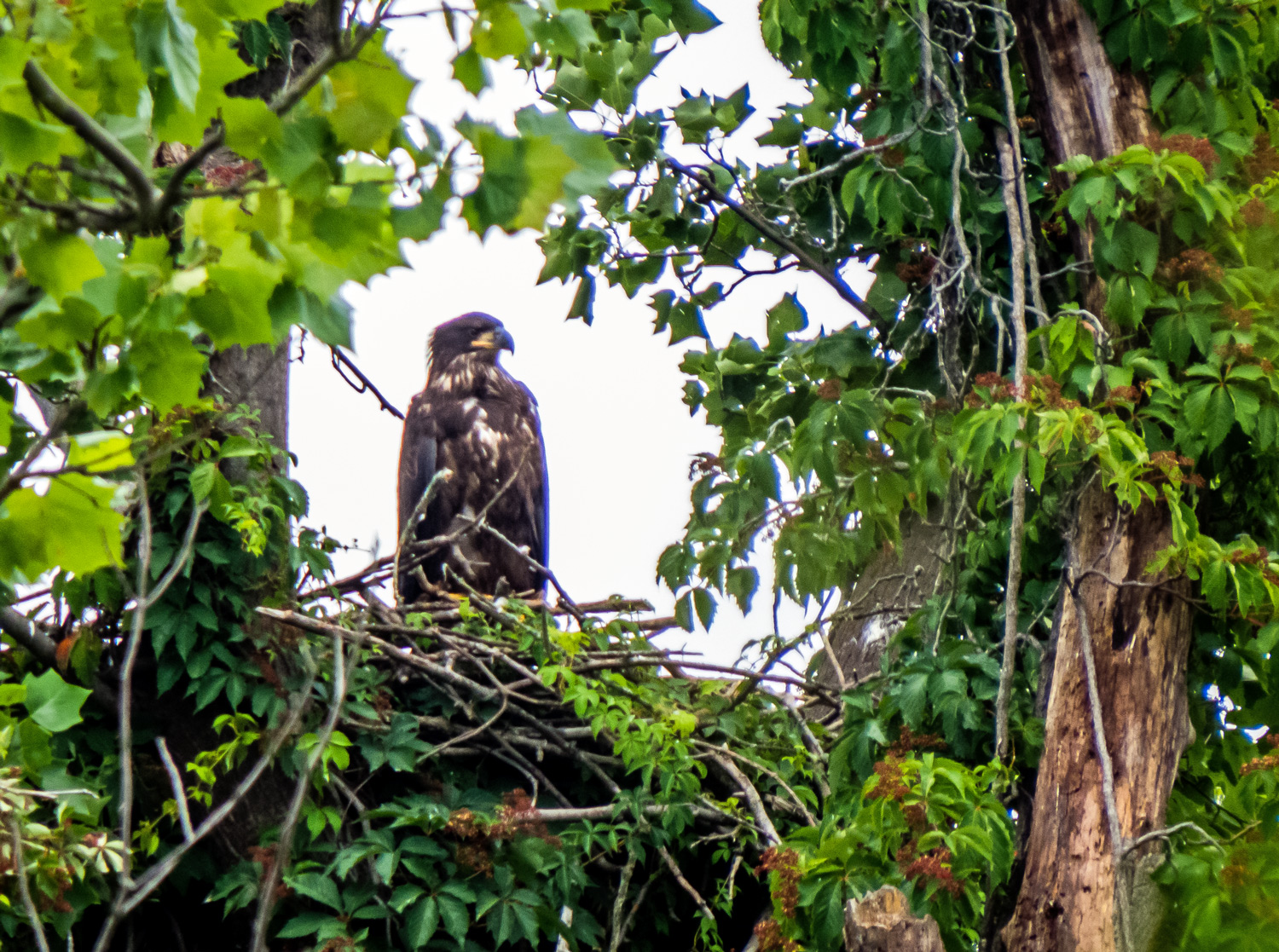
Even from a distance it is easy to see that the eaglets in one of nests at Occoquan Bay National Wildlife Refuge are no longer babies. When I saw them this past weekend, one of them was still hanging around in the nest, but the other had ventured out to a higher limb. I am posting an image of each of the two eaglets as well as a shot that shows their relative positions. As you can see, there are now a lot of leaves on the trees and I suspect that most folks walking by on the trail are not even aware of the presence of the nest.

The little eagles are still mostly brown in color—it will take almost five years for them to acquire the white feathers on their heads and on their tails that we associate with adult Bald Eagles (Haliaeetus leucocephalus).

Bald Eagle

Bald Eagle

Bald Eagle

© Michael Q. Powell. All rights reserved.

Read Full Post »

The eaglets in one of the two nests that I have been monitoring at Occoquan Bay National Wildlife Refuge appear to be almost full grown, but both of the parents were still keeping a watchful eye on them this past Saturday.

On this day I was shooting with my Canon SX50 superzoom camera and was able to zoom out and give you a sense of the relative position of the nest and the branches on which the adult Bald Eagles (Haliaeetus leucocephalus) were perched. I have featured this perch, which appears to be a favorite spot for these eagles, several times in this blog, but to the best of my knowledge this is the first time to show you the nest itself.

As you can see, the leaves have returned to the trees and it is getting harder and harder to get unobstructed shots of the eagle nest. I was hoping to get a shot of both of the eaglets, but the second one remained elusive and was hidden from view the entire time that I observed the eagles.

It would also have been nice to shoot from an angle in which the lighting was better, but essentially there was only a single location from which I had a clear visual path to the nest. I did change position for the shot of the two adults—the lighting was somewhat better, though I was still shooting through a tangle of branches. Sometimes you just have to take what you get and make the best of it.

Bald Eagle eaglet

Bald Eagle

Bald Eagle

© Michael Q. Powell. All rights reserved.

Read Full Post »

I was prompted this morning to read again the challenges to all Americans found in Abraham Lincoln’s Gettysburg Address, challenges that seem so appropriate and relevant as we pause in the United States on this Memorial Day to remember the sacrifices of so many brave men and women.
 “But, in a larger sense, we can not dedicate—we can not consecrate—we can not hallow—this ground. The brave men, living and dead, who struggled here, have consecrated it, far above our poor power to add or detract. The world will little note, nor long remember what we say here, but it can never forget what they did here. It is for us the living, rather, to be dedicated here to the unfinished work which they who fought here have thus far so nobly advanced. It is rather for us to be here dedicated to the great task remaining before us—that from these honored dead we take increased devotion to that cause for which they gave the last full measure of devotion—that we here highly resolve that these dead shall not have died in vain—that this nation, under God, shall have a new birth of freedom—and that government of the people, by the people, for the people, shall not perish from the earth.”
Bald Eagle
(I captured this image of a hyper-vigilant injured Bald Eagle (Haliaeetus leucocephalus) in November 2014 shortly before it was rescued. You can learn more about the rescue and see additional images in a posting from that period entitled “Rescue of an injured Bald Eagle.”)
© Michael Q. Powell. All rights reserved.

Read Full Post »

This Bald Eagle (Haliaeetus leucocephalus) couldn’t seem to decide if it wanted to yawn or scream this past Monday at Occoquan Bay National Wildlife Refuge. Either reaction could have been a response to my presence.

Bald Eagle

© Michael Q. Powell. All rights reserved.

Read Full Post »

The two Bald Eagle eaglets whose development I have been following are getting really big—it looks like they are about ready to attempt to fly. In the upper left corner of the first image, you can see that one of the parents was perched just above the nest. It seems like there is no longer room for either of the parents in the nest, but at least one of them always seems to be nearby, watching over the eaglets

There is a barrier at the Occoquan Bay National Wildlife Refuge near the eagle nest that keeps people from getting close and protects the Bald Eagles (Haliaeetus leucocephalus) from human interference., From that barrier, however, I am able to see into the nest with my 150-600mm telephoto zoom lens, though the leaves on the trees are now making it quite a bit tougher to get an unobstructed shot than a  month ago. For comparison purposes, I am including a shot of the eaglets that I took three weeks earlier than the more recent image that I captured this past Monday.

Bald Eagle eaglets

Bald Eagle eaglets

© Michael Q. Powell. All rights reserved.

Read Full Post »

Recently I have been thinking a lot about the relationship between seeing and taking pictures as I find myself growing more and more acutely aware of the details in my surroundings. The more I shoot, the more I see and the more I see, the more I shoot. I am continually amazed at the things that I see and even more amazed that I am able to capture some of those experiences with my camera.

I have fallen in love with a quotation attributed to photographer Dorothea Lange, “The camera is an instrument that teaches people how to see without a camera.” Even when I don’t have a camera in my hand, I seem to be viewing the world differently than I did in the past. My sensitivity has undoubtedly been heightened by greater knowledge of my subjects and my skills honed by lots of practice and familiarity with my gear.

This past Friday, I spotted a Bald Eagle (Haliaeetus leucocephalus) soaring in the air over the waters adjacent to Occoquan Bay National Wildlife Refuge. That was not very unusual and I was able to capture some shots like the second one below. As the eagle flew out of range, I noticed that it seemed to be decreasing in altitude and circling back, so I continues tracking the bird. Somehow I suspected that the eagle was tracking a fish. Unlike an osprey that drops straight down into the water to catch a fish, an eagle seems to pluck a fish out of the water as it flies by.

I watched in awe and wonder as the eagle caught a fish. My timing was off a bit and my shots of the moment of the moment of the catch were not in focus, but I captured this image of the eagle flying away with its catch, an image that I really liked. As I think back about the experience, I feel absolutely no disappointment that I did not photograph it better. Instead, I feel a kind of joy and exhilaration that I was able to experience a really cool moment in nature.

Photography has opened my senses to those kinds of moments and motivates me to spend hours on end trekking about with my camera in hand. Capturing those experience in images is a real bonus whenever I am able to do so.

Bald Eagle

Bald Eagle

© Michael Q. Powell. All rights reserved.


Read Full Post »

« Newer Posts - Older Posts »