Feeds:
Posts
Comments

Posts Tagged ‘Bald Eagle’

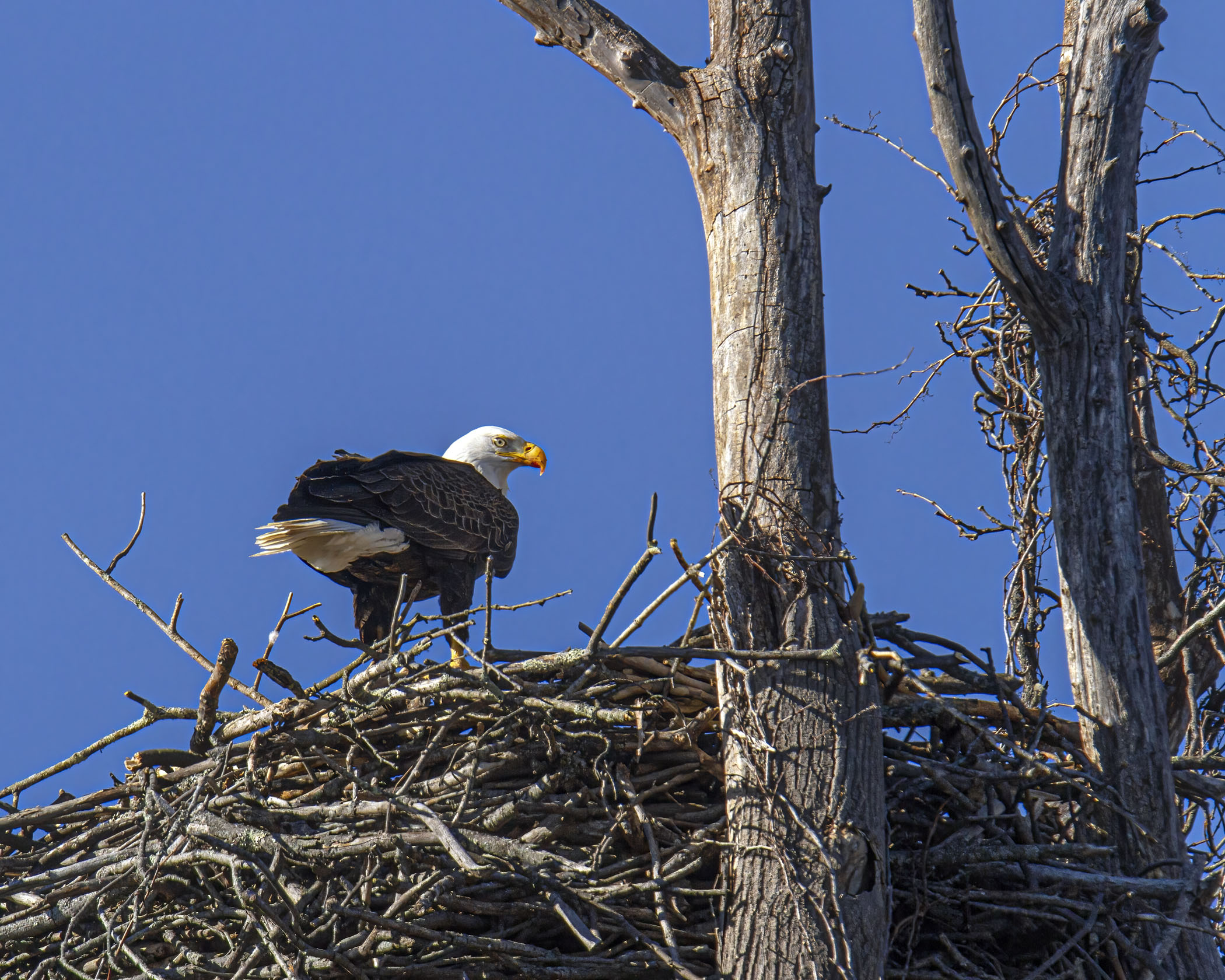
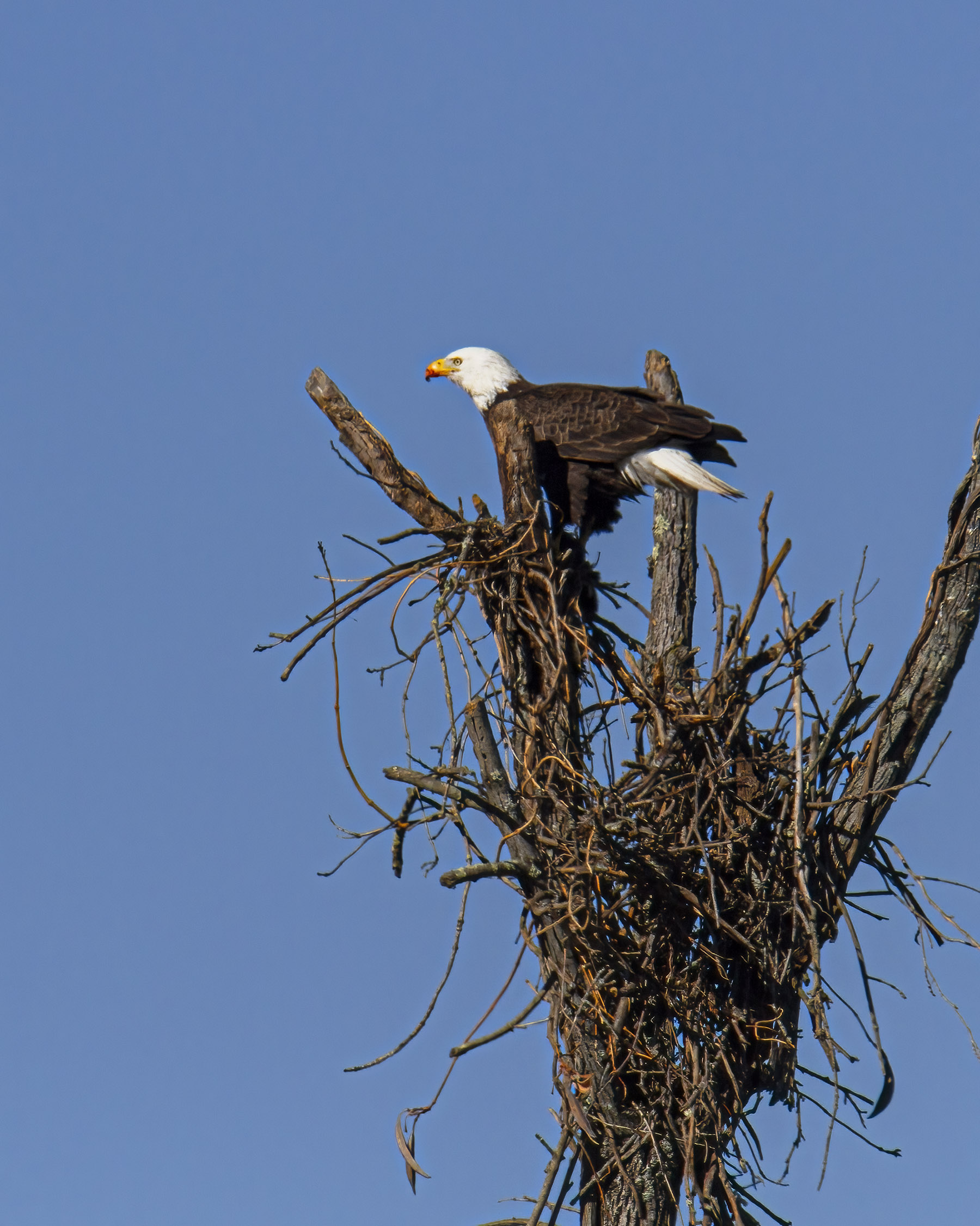
The late afternoon sun was shining low in the sky and softly illuminated the side of a Bald Eagle (Haliaeetus leucocephalus) perched in a tulip tree last Friday at Occoquan Bay National Wildlife Refuge. A short time later, I spotted a Bald Eagle in a sweetgum tree with the sun shining a bit more intensely—it kept going in and out of the clouds as it dropped lower on the horizon—which made the second image feel “warmer” than the first one.

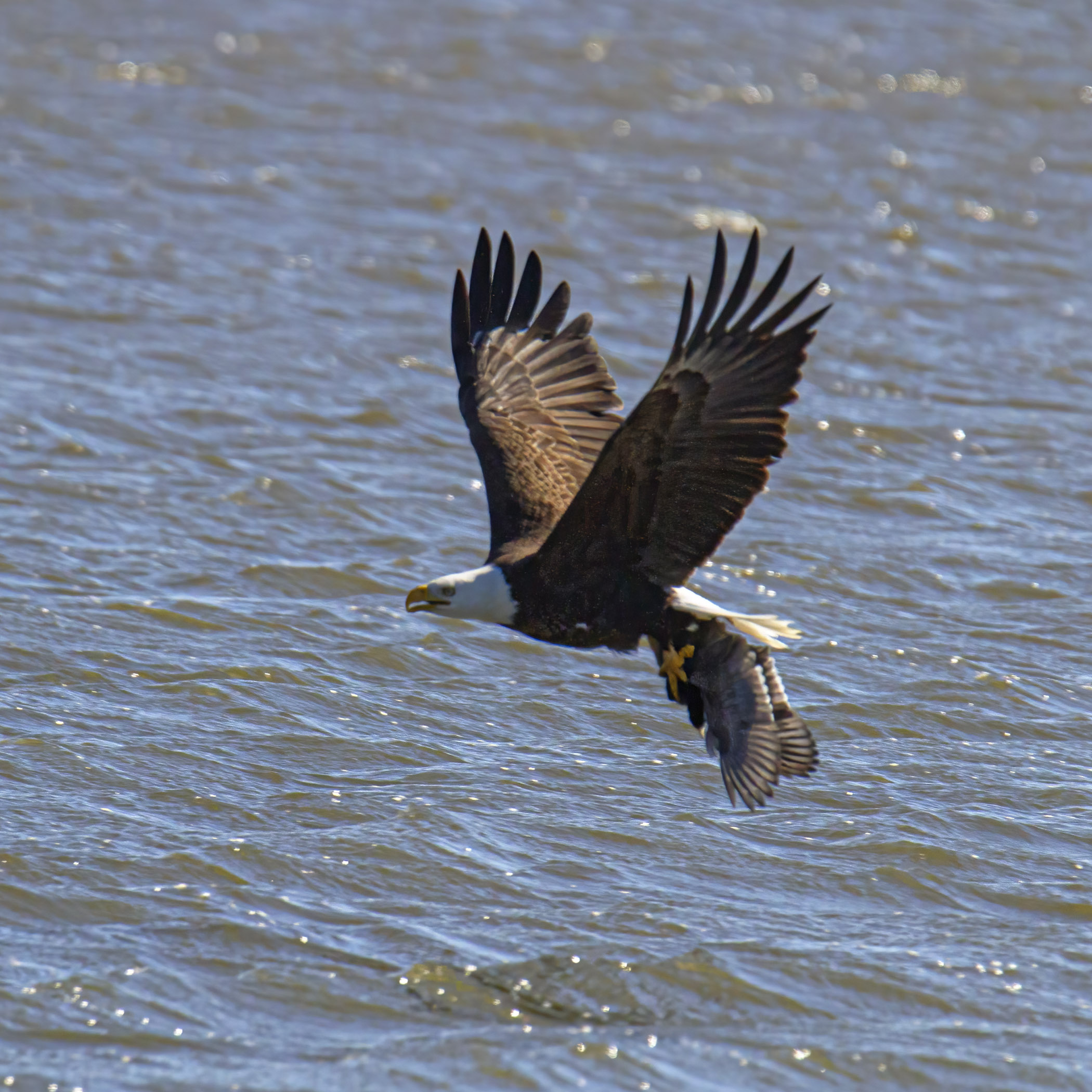
The final image shows a Bald Eagle as it was flying over the water. The sunlight was coming from almost directly behind the eagle and provided some beautiful backlighting of the eagle’s white tail feathers as well as a bit of rim lighting around the edges of its body

Bald Eagle

Bald Eagle

Bald Eagle

© Michael Q. Powell. All rights reserved.


Read Full Post »

As I walking along one of the trails last Friday at Occoquan Bay National Wildlife Refuge, I spotted a Bald Eagle (Haliaeetus leucocephalus) perched in a distant tree. I had a pretty clear view of the eagle across an open, marshy area, but I couldn’t get closer without totally blocking my area. I decided to stop and to observe the eagle, hoping that the eagle would fly across the open area if it decided to take off.

In my experience, eagles generally fly away from me or behind trees, so many of my shots of flying eagles show their tail feathers or a blurry silhouette of the eagle with branches in focus. Getting a proper exposure can be a little tricky, especially when the light is bright, and it is easy to blow out the highlights in the white head or lose feather details in the shadow areas.

I watched and waited and was prepared when the eagle took off in my desired direction, flying across my field of view. Although the eagle initially flew behind some trees, I managed to keep my focus on the bird, as you can see in the last photo—amazingly the eye of the eagle is in focus. (As you can probably tell, the photos are presented in reverse chronological order.)

I continued to track the eagle as it flew into the open sky. In a number of my shots, the eagle’s wings blocked its head or hid it in the shadows—wing positions really matter, so I took a lot of shots. The second shot does a nice job of showing the interplay of light and shadows, which can be a particular problem in the middle of the day, when shadows are harsh, compared with the softer light near dawn and dusk.

This is one of the best sequence of images that I have managed to capture of an eagle in flight, but I will try to do even better in the upcoming months. In YouTube video reviews of some of the new high-end mirrorless cameras, I have seen pro photographers demonstrate amazing focus systems that allow them to lock and hold focus on the eyes of moving birds and animals.

I personally find it hard to justify spending that amount of money on a camera system—the combined cost of a top-end camera and long telephoto lens is about as much as I paid for my car—and am content for now to use a hands-on approach with my more “primitive” DSLR set-up. It’s a challenge, but a fun challenge, to try to photograph birds in flight and it is such a thrill when everything comes together and I am successful.

Bald Eagle

Bald Eagle

Bald Eagle

Bald Eagle

© Michael Q. Powell. All rights reserved.


Read Full Post »

Although it was sunny last Wednesday at Occoquan Bay National Wildlife Refuge, the wind was kicking up quite a bit, repeatedly ruffling the feathers of this perched Bald Eagle (Haliaeetus leucocephalus). It has been a long time since I had hair that was long enough to sport that kind of windblown look.

When I was a child, I had a cowlick in the back of my head that refused to stay in place, despite my lineral use of Brylcreem or a similar product called Groom and Clean. My father, like many men of his generation had a comb over hair style that he somehow fixed in place. When I started going bald, I rejected that style and opted to keep  my hair cut short. Of course, during the 20 years that I spent in the US Army, it was a mandated “choice,” much like the mandatory “fun” that surrounded official social functions.

Bald Eagle

© Michael Q. Powell. All rights reserved.


Read Full Post »

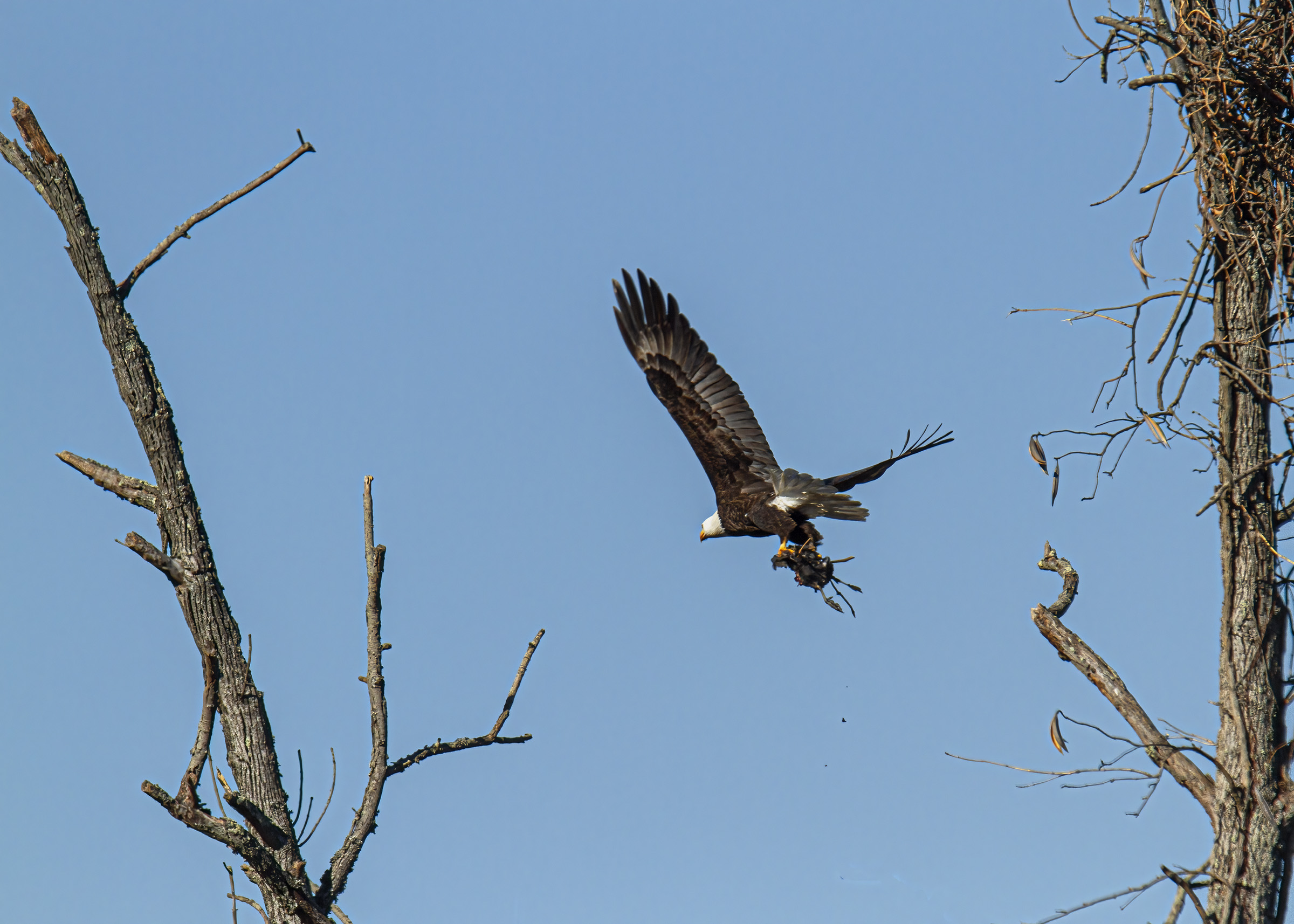
This Bald Eagle (Haliaeetus leucocephalus) must have decided that it wanted to celebrate Thanksgiving with poultry rather than fish. A Wild Turkey would have been too big, so it looks like the eagle settled for a duck.

As I approached the large eagle nest at Occoquan Bay National Wildlife Refuge, I was shocked to see that there was an eagle in the nest. As I watched, the eagle moved about a bit, bobbing its head up and down. I assumed that it was making minor repairs to the nest, but I was wrong.

It was only when the eagle flew out of the nest that I realized that the movement I had observed had been feeding behavior. I did not get a good look at the prey that was dangling from one of the eagle’s feet as it flew away, but assumed that it was a fish. Once again, I made a wrong assumption. When I looked at the images on my compute screen, I could see that the prey was some kind of duck, though I did not get a good enough shot of the duck to identify its species.

I don’t know how often eagles prey on water birds, but this is not the first time that I have seen it happen. Check out my March 2023 blog posting called “Eagle grabs coot” in which I featured some photos of an eagle encounter with an American Coot.

When I looked out on the waters of Occoquan Bay, I noticed that several rafts of ducks were present. They were pretty far away, but I did managed to identify numerous Ruddy Ducks and Buffleheads in addition to a few Pied-billed Grebes. The size of these groupings of birds varies throughout the colder months, but I can usually count on seeing them during late fall and winter months. If the eagles feel lazy or want a change in diet, I suspect that it is much easier for them to grab a duck that a fish.

Bald Eagle

Bald Eagle

Bald Eagle

Bald Eagle

© Michael Q. Powell. All rights reserved.

Read Full Post »

This Bald Eagle was almost hidden in the foliage of a sweet gum tree when I spotted it on Thursday at Occoquan Bay National Wildlife Refuge. Normally I depend on the brightness of a bald eagle’s head to give away the presence of an eagle, but in this case the eagle’s head was in partial shade, making it stand out quite a bit less than it usually does.

The second shot shows a view of the eagle from a different angle. Even though this shot does not show as much detail as the first shot, which was actually taken after the second one, I like the way that it shows how the eagle was nestled on its perch amidst all of the branches.

In the upcoming months, many of the leaves will fall from the trees and it will become marginally easier for me to spot an eagle from a longer distance away. Of course, that will also make it easier for the eagles to spot me and my vision and reflexes are rarely a match for those of the eagles. Often my first indication of an eagle’s presence is when it takes to the air and flies away from me.

Bald Eagle

Bald Eagle

© Michael Q. Powell. All rights reserved.


Read Full Post »

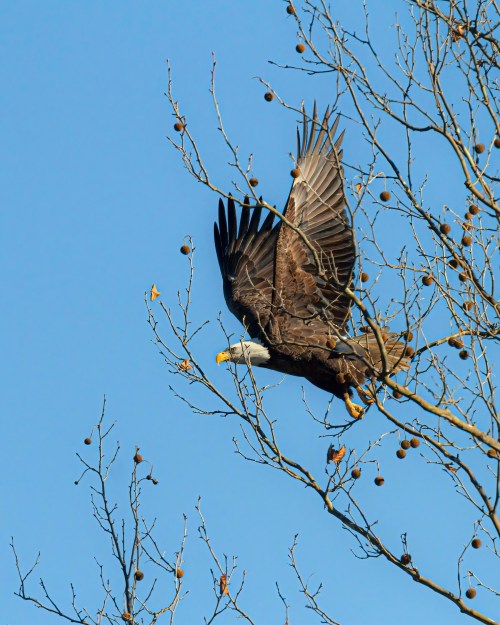
I spotted this Bald Eagle (Haliaeetus leucocephalus) in a distant tree on Tuesday at Occoquan Bay National Wildlife Refuge at about the same time that it spotted me. I reacted quickly and managed to capture this first image as it prepared to take off. As you can see, there is already a bit of color in our autumn foliage, but the colors are relatively muted here in Northern Virginia, compared to what I would see when I was growing up in New England.

The second photo shows the eagle a few seconds after its takeoff as it rose above the trees. At that moment its feet were still dangling, but it raised its “landing gear” shortly after I captured the image.

It has been a while since I last posted eagle photos and it was wonderful to have a couple of sightings of these majestic birds on a beautiful fall day.

Bald Eagle

Bald Eagle

© Michael Q. Powell. All rights reserved.

Read Full Post »

Certain creatures, like Bald Eagles (Haliaeetus leucocephalus) and Monarch butterflies (Danaus plexippus), never fail to thrill my heart when I encounter them. I remember dire warnings from my youth of their threatened extension and I consider it a real blessing that they are still around. The Bald Eagle population has really rebounded, but it is my understanding that the survival of Monarchs is still at risk as a result of the loss of Monarch breeding habitats.

I did not see any Bald Eagles during my visit to Occoquan Bay National Wildlife Refuge this past Thursday, but I was excited to spot this stunning Monarch butterfly. Its colors were bright and vibrant and it seemed to be in perfect condition. I suspect that this butterfly was preparing itself for its upcoming migration flight. According to an article by the National Wildlife Federation, “Beginning in late summer and continuing into early fall, monarchs that emerge from their chrysalides will be behaviorally and biologically different from generations that emerged earlier this year. Unlike their parents and grandparents, these late-season monarchs do not mate or lay eggs. Instead, the insects focus on feeding to fatten up for long migrations to their winter habitats: coastal California for monarchs west of the Rocky Mountains and central Mexico for those to the east.”

The Monarch butterfly was so focused on feeding that it did not fly away as I maneuvered into position to capture this image. I even had the luxury of attempting shots from several angles as the butterfly moved about from flower to flower.

Monarch butterfly

© Michael Q. Powell. All rights reserved.

Read Full Post »

I have gotten so caught up in posting photos of insects and flowers, that I nearly forgot that I had managed to capture this shot of a Bald Eagle (Haliaeetus leucocephalus) a week or so ago during a visit to Occoquan Bay National Wildlife Refuge. I have a really problem spotting small birds because of the abundance of leaves on the trees, but this eagle cooperated by perching in the open on a branch where he was quite visible.

At certain times of the year I worry about oversaturating my blog with photos of eagles, but numerous readers have told me that they never get tired of seeing eagles. My oft-stated view is that any day that I spot a bald eagle is a good day.

Personally, I hold the same view about I dragonflies, which is why they appear in this blog more often than any other creatures during the warm months of the year.

Bald Eagle

© Michael Q. Powell. All rights reserved.


Read Full Post »

In the United States, today is Memorial Day, a federal holiday. For some people this day marks the unofficial beginning of summer, but for me, as someone who served for twenty years in the U.S Army, this day has a deeper meaning, a day to reflect on the lives of the brave men and women who died in the defense of this nation. Yesterday, Facebook reminded me of a posting I made on Memorial Day 2018, and I decided to share it again today in this blog posting.

“I was prompted this morning to read again the challenges to us in the Gettysburg Address, which seem so appropriate today as we remember the sacrifices of so many brave men and women. “It is for us the living, rather, to be dedicated here to the unfinished work which they who fought here have thus far so nobly advanced. It is rather for us to be here dedicated to the great task remaining before us—that from these honored dead we take increased devotion to that cause for which they gave the last full measure of devotion—that we here highly resolve that these dead shall not have died in vain—that this nation, under God, shall have a new birth of freedom—and that government of the people, by the people, for the people, shall not perish from the earth.” ”

For those of you who might be curious, the photo below is from a November 2014 blog posting entitled “Rescue of an injured Bald Eagle” that documented the capture of an injured eagle by an officer of the Fairfax County Animal Control Services at my local marshland park. Some of the photos from that posting were reprised in Washington D.C. media outlets and the posting has been my all-time most popular posting with 3472 views.

Bald Eagle

© Michael Q. Powell. All rights reserved.


Read Full Post »
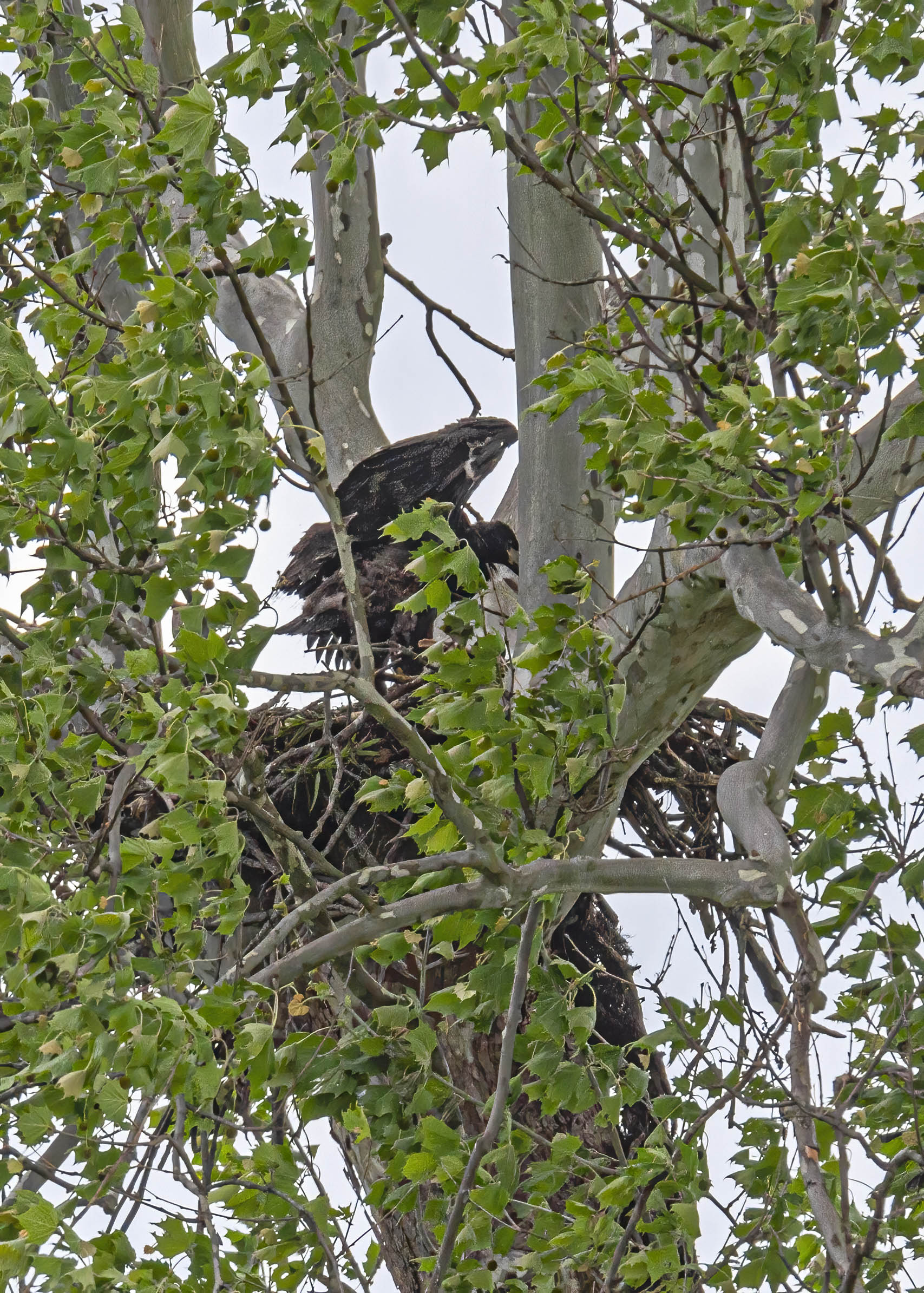
I patiently watched the large Bald Eagle (Haliaeetus leucocephalus) nest last Thursday at Occoquan Bay National Wildlife Refuge and eventually caught a glimpse of an eaglet. As some of you may recall, I have been keeping an eye on three eagle nests at this refuge and have already seen eaglets at the other two nests. This nest is significantly larger than the other two nests, as you can see in the second photo, and it is difficult to see activity in the nest.

I was zoomed in as close as I could with my telephoto lens and still had to crop the image in the first photo quite a bit so you can see the eaglet with its open mouth—I suspect it wanted to be fed. As you can see, one of the parents was in the nest with the eaglet and the other parent was perched in a nearby tree. It is possible that there are more eaglets in the nest, but I was really happy to spot one.

In case you are curious, I did not have my longest telephoto lens with me that day. Normally I use my Tamron 150-600mm lens when I know that I will be photographing birds. I was anticipating that I would be focusing on both large and small creatures, so I was using my Tamron 18-400mm lens on this occasion.  This lens gives me a great deal of flexibility in photographing dragonflies as well as birds and in capturing landscape shots like the shot of the nest—I was standing in the same spot for both photos in this blog posting.

Bald Eagle

eagle nest

© Michael Q. Powell. All rights reserved.

Read Full Post »

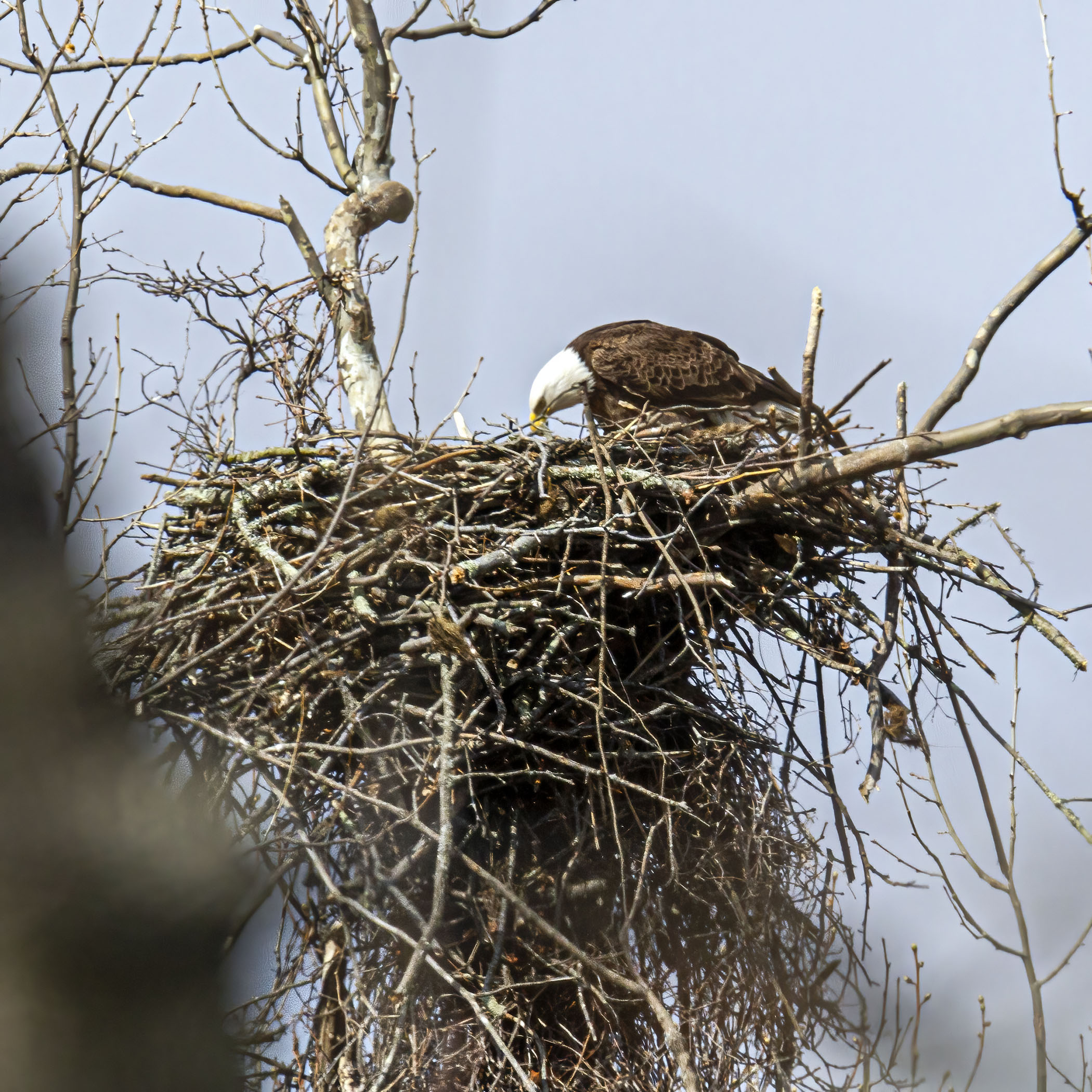
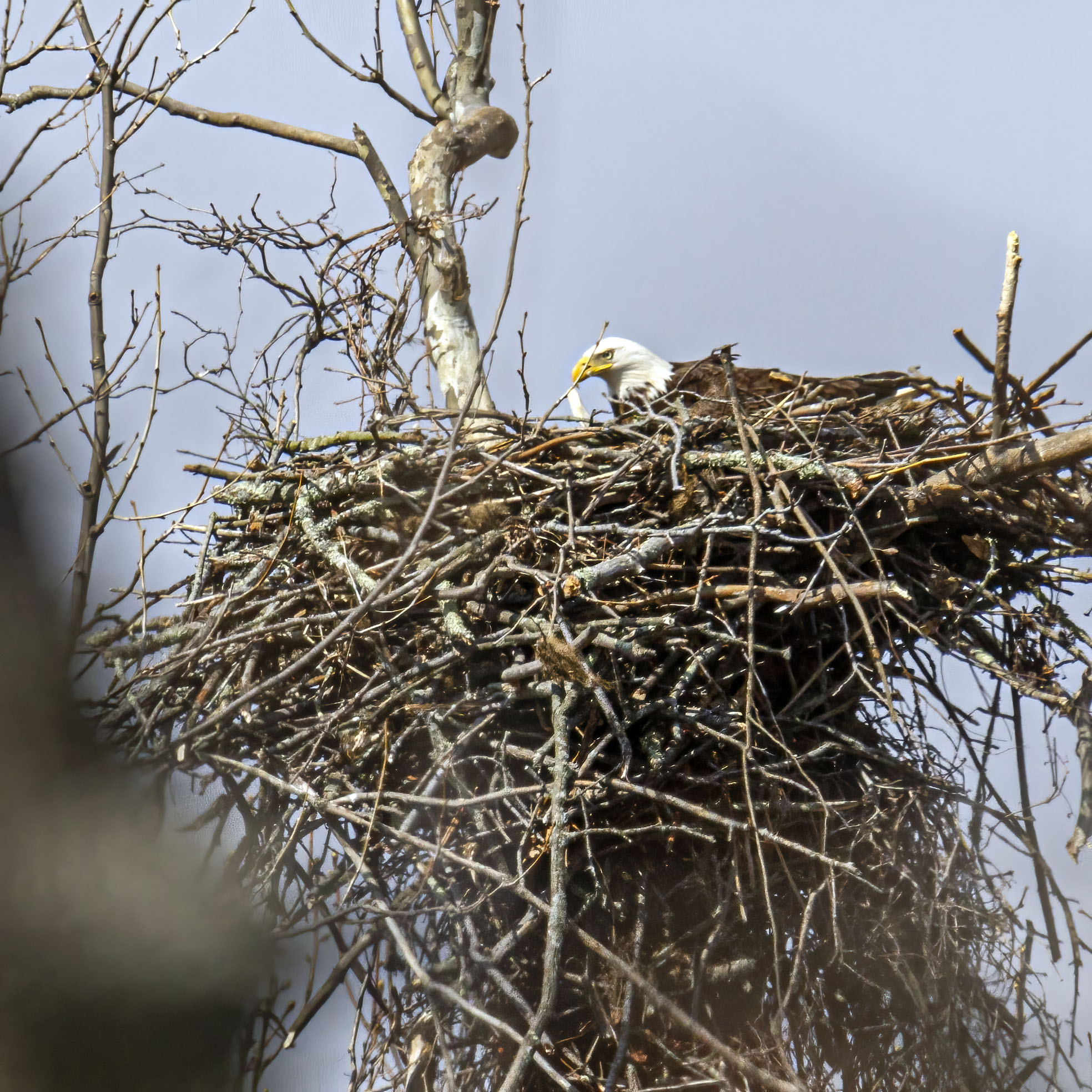
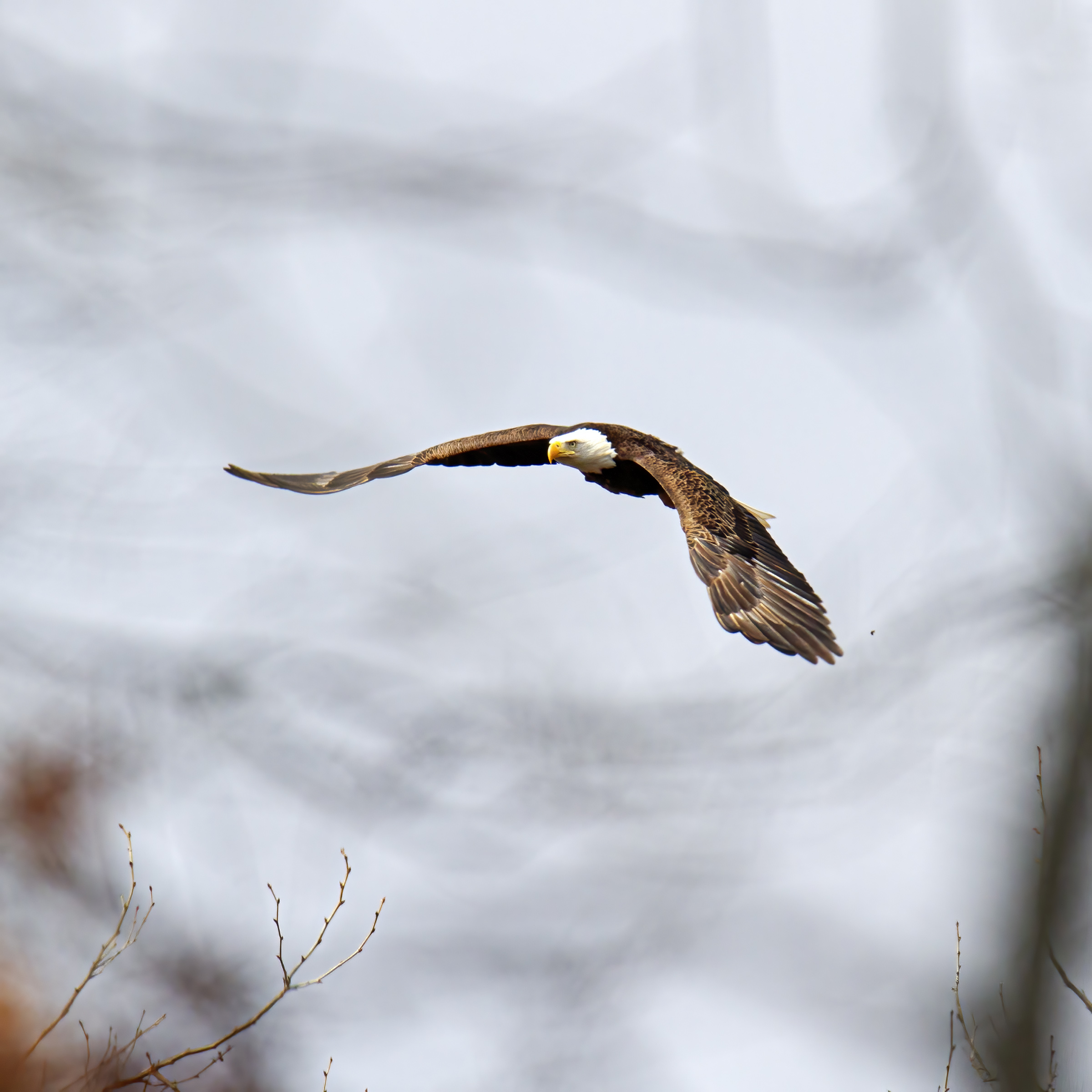
As I was observing a large nest last Friday at Occoquan Bay National Wildlife Refuge, I couldn’t help but notice that the Bald Eagle (Haliaeetus leucocephalus) in the nest was keeping an eye on me. The eagle seemed to be observing me through a gap in the branches at the top of the nest, as you can see in the first two photos.

After getting a few shots, I continued walking down the trail. When I looked back towards the nest, I could see the eagle’s head poking out of the top of the nest and it still seemed to be watching me.

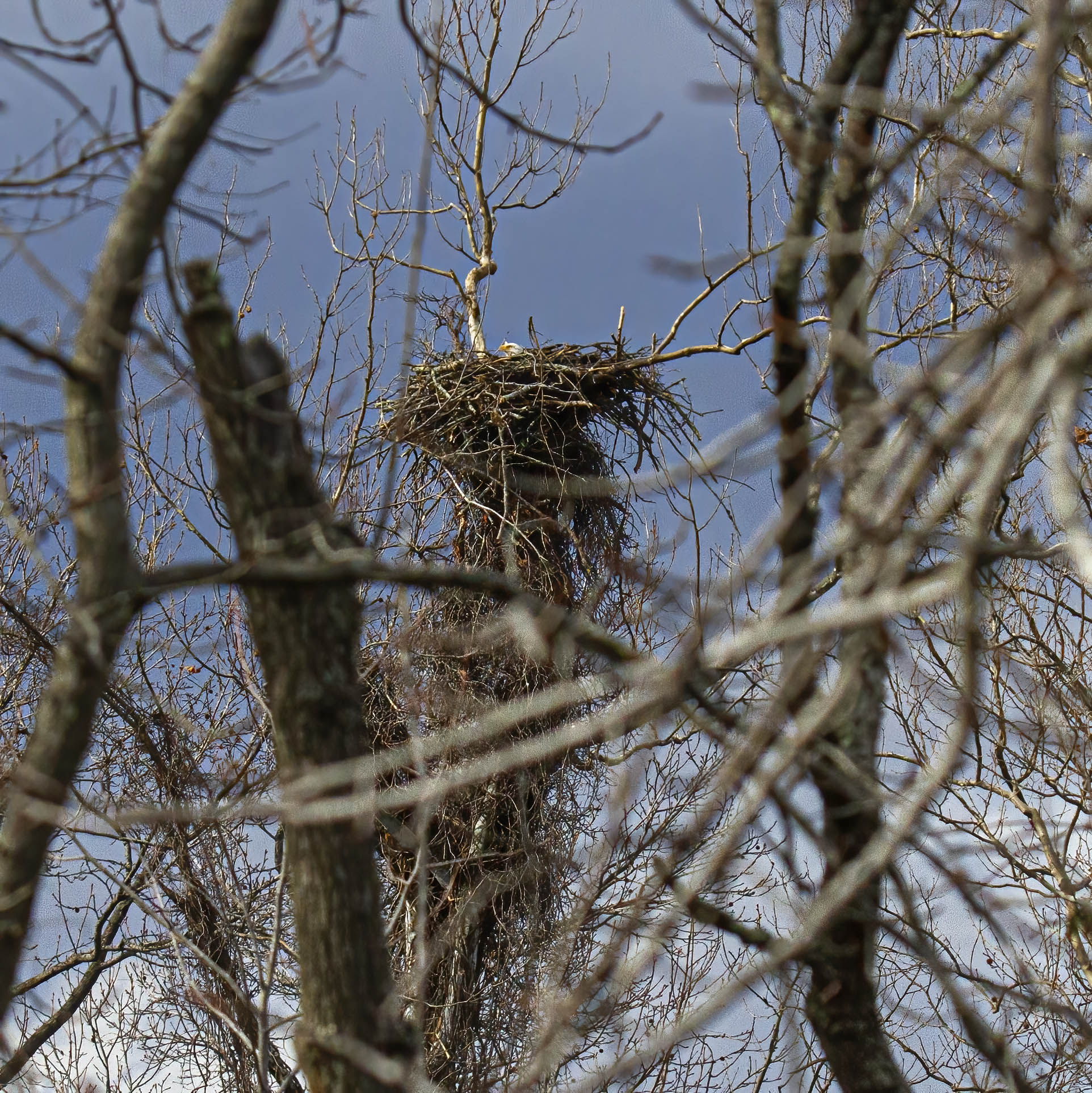
As you can tell from the final photo, this is a really large nest and it is hard to monitor what is going on inside of it. Are there any eaglets yet? In two other nests at the refuge, I have already seen eaglets, but those nests were much smaller, so it was not hard to spot the babies. I’ll continue to monitor this nest and with a little luck I will see an eaglet or two in this large nest.

Bald Eagle

Bald Eagle

Bald Eagle

© Michael Q. Powell. All rights reserved.

Read Full Post »

This juvenile Bald Eagle (Haliaeetus leucocephalus) may not be quite ready to fly, but it was testing out its wings by flapping them vigorously while I was observing the nest on Friday at Occoquan Bay National Wildlife Refuge. The eaglet is so large that there is no longer any room in the small nest for its parents—one of its parents was perched on a higher branch in the same sycamore tree.

A few weeks ago, I observed two eaglets in this nest and I have not had a good look at both eaglets since that time. Has something happened to the other eaglet? When I looked closely at all of my photos, I noticed that I could see the silhouettes of both eaglets sitting side by side in some of the images, as you can see in the final photo. The eagle on the left seems much smaller than the one on the right, which was the one that was flapping its wings in the first two photos.

The foliage in the tree and the barrier across the trail keep me from seeing any better what is happening in this eagle nest, but it looks like the eaglets are growing bigger and stronger, especially the one on the right. It should not be too long before it is time for the eaglet to be making its first tentative attempts at flight.

Bald Eagle

Bald Eagle

Bald Eagle

© Michael Q. Powell. All rights reserved.

Read Full Post »

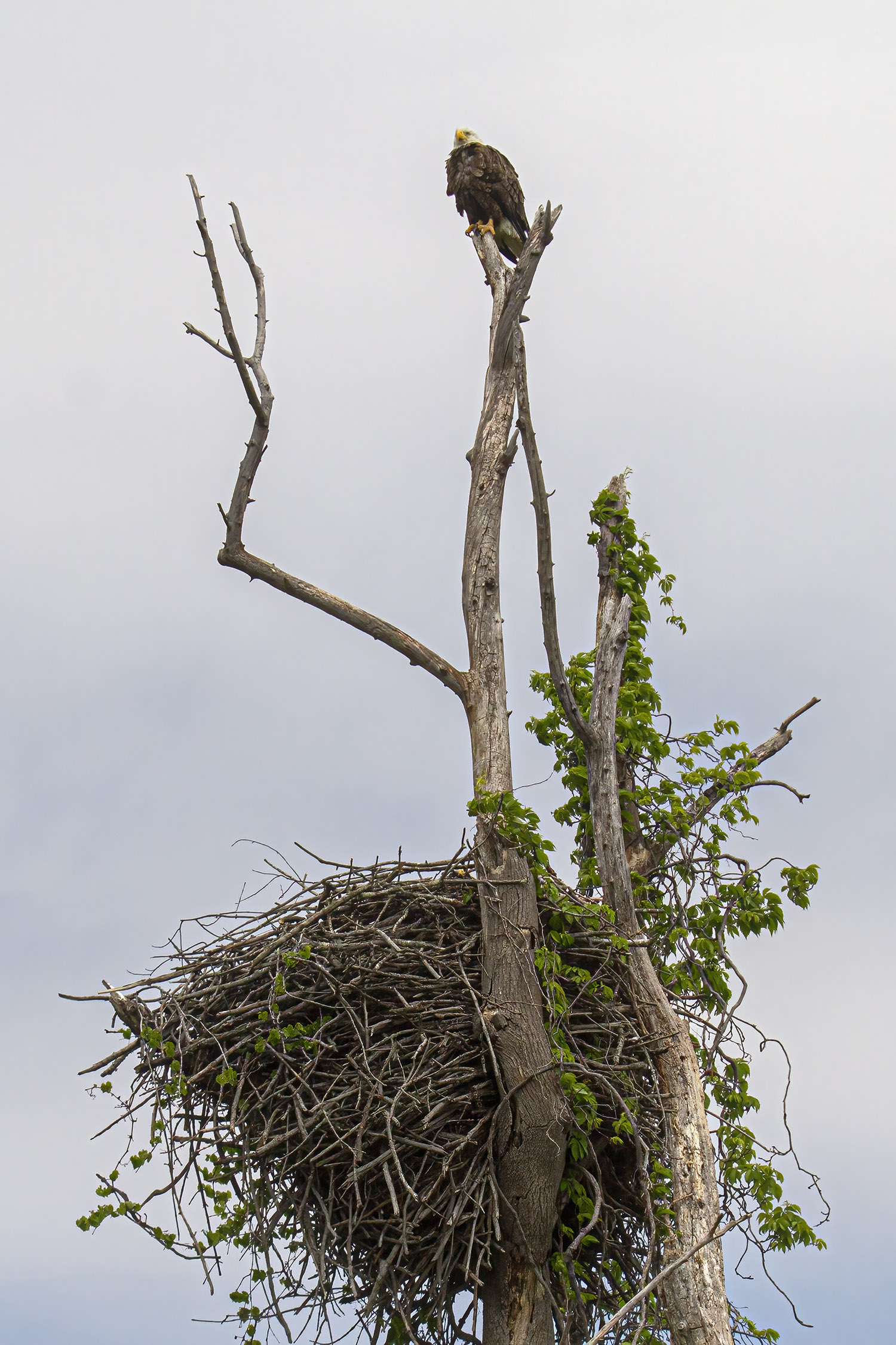
This Bald Eagle (Haliaeetus leucocephalus) remained steadfastly on guard above its large nest on Wednesday at Occoquan National Wildlife Refuge as a jet flew by in the distance. As I was focusing on the eagle, I caught sight of the jet out of the corner of the eye and managed to time the shot pretty well to be able to include the jet in the frame.

Normally I do not like to include man-made objects in my wildlife photos, but in this case I really like the juxtaposition between the wildness of a bald eagle’s flight and the more “civilized” human flight.

Bald Eagle

© Michael Q. Powell. All rights reserved.


Read Full Post »

On Wednesday I visited Occoquan Bay National Wildlife Refuge to check on the eaglets in the nests there.  As the leaves continue to grow, it is becoming harder and harder to observe activity at several of the nests of the Bald Eagles (Haliaeetus leucocephalus). In one of them, though, I managed to find a small visual tunnel and was fortunate to capture the first two images that show some sweet little moments between an eaglet and one of its parents.

The third image shows an eaglet in a different nest. As you can see, the leaves on the sycamore tree hid most of the nest. Previously I spotted two eaglets in this nest, so there may be another hiding out of view.

The final two shots shows the largest eagle nest at the refuge. The nest is so big and so high in the trees that it is difficult to tell what is going on inside of the nest. One eagle was keeping watch and the other adult appears to be in the nest. If you look closely at the nest right below the tree on which the eagle is perched, you can just make out the yellow beak of an adult eagle. The final image is a close-up shot of the nest that I cropped to show more clearly the eagle’s beak. The adult eagle is perched so high in the nest that it is possible that there is an eaglet or two in the nest as well—when an eagle is incubating eggs it tend to hunker down really low to keep the eggs warm.

Bald Eagle

Bald Eagle

Bald Eagle

Bald Eagle

Bald Eagle

© Michael Q. Powell. All rights reserved.


Read Full Post »

On Tuesday I hiked to the farthest Bald Eagle (Haliaeetus leucocephalus) nest at Occoquan Bay National Wildlife Refuge, hoping to determine if there were any eaglets in the nest. During most of the year you can walk past this nest as part of a big loop, but the road is now blocked to protect the eagles, so you have to double back along the trail (a distance of almost two miles (3.2 km) to return to the parking lot.

This eagle nest is in a sycamore tree. Several years ago, one of the limbs gave way and during the off-season almost half of the nest slid to the ground. The eagles have done some repairs each year, but the nest is still relatively small. At this time of the year, there is a good deal of new foliage, so it is a bit difficult to see what is going on in the nest.

When I arrived at the nest, I noticed that one of the adults was sitting completely upright, which was a good sign. When the eagles are incubating the eggs, the tend to hunker down in the nest, with only their heads visible.

As I watched and waited, the adult eagle flew to some higher branches in the tree. My flow of adrenaline and sense of anticipation increased as I waited to see if an eaglet would appear. I was double delighted when two little heads popped up. The eaglet on the left seemed to be a bit bigger than its sibling and was probably the older of the two. In the second image, the bigger eaglet is looking upwards toward the branch where the adult was perched.

I was a long way off when I took these photos with my telephoto zoom lens, so they are not super quality images, but they provide proof that there are at least two little eaglets in this nest. As I noted in an earlier post, there is one eaglet in another nest on the refuge. The third active eagle nest is so large and high up in the trees that it is not yet possible to tell if there are any eagle babies in it—any eaglets will probably have to grow stronger and larger before the climb up to the the edge of that nest.

Bald Eagle

Bald Eagle

Bald Eagle babies

© Michael Q. Powell. All rights reserved.

Read Full Post »

I was delighted yesterday to photograph an eaglet in one of the Bald Eagle (Haliaeetus leucocephalus) nests at Occoquan Bay National Wildlife Refuge. Last week, several photographers posted photos in Facebook of the baby eagle, so I knew for sure that there was at least one in the nest. I have been keeping a close eye on this nest, a small one that was used by ospreys last year, and knew that it would have trouble comfortably accommodating an adult eagle and a growing eaglet.

When I first arrived at the barrier that closes the trail, I could see through the foliage that an eagle was sitting upright in the nest, but I could not see an eaglet. I watched and waited and the eagle eventually flew away. A short time later, another eagle flew in and landed on a tree branch above the nest rather than in the nest. As the eagle approached the nest, a little head popped up and I was able to capture the first image.

The eagle in the tree kept watch over the curious little eaglet and I never did see the adult sit in the tree. After a while, the eaglet disappeared from sight—it was probably time for its afternoon nap.

When I departed the area to check on another eagle nest, the adult was still on duty in the tree. I passed by this nest one last time and noted that an eagle was now sitting in the nest. It may be that one of the parents is small enough to fit into the nest and the other one is simply too large. As the baby grows, I suspect that both parents will be forced out of the nest. I would not see the eaglet until the adult lifted its wing and I was able to capture the final image.

As you can probably see from the blotches of green in the photos, I did not have an unobstructed view of the nest. I am hoping that the leaves on the trees do not fully block my view in the upcoming weeks.

Bald Eagle

Bald Eagle

Bald Eagle

© Michael Q. Powell. All rights reserved.


Read Full Post »

I am not sure what was going on Tuesday in the waters off of Occoquan Bay National Wildlife Refuge, but two Bald Eagles (Haliaeetus leucocephalus) were perched on a structure and an aggressive Osprey(Pandion haliaetus) kept dive-bombing them repeatedly. The osprey would fly by right above them and each time the eagles would rear up with their talons extended as they screamed at the osprey. I took the shot below from a long way away, but it gives you a sense of the action.

Several of my friends on Facebook suggested that this might have been a territorial dispute. Others posited that the eagles had stolen a fish from the osprey and the osprey was angry about it. Another friend provided a link to a fascinating article at Natural Habitat Adventures entitled “Eagles and Ospreys: When Birds of Prey Clash.” According to the article, eagles will sometimes steal osprey chicks and ospreys may attack eagles while they are eating. It is too early for there to be chicks—ospreys have only recently returned to our area—but it is certainly possible that this was a food fight.

eagles and osprey

© Michael Q. Powell. All rights reserved.

Read Full Post »
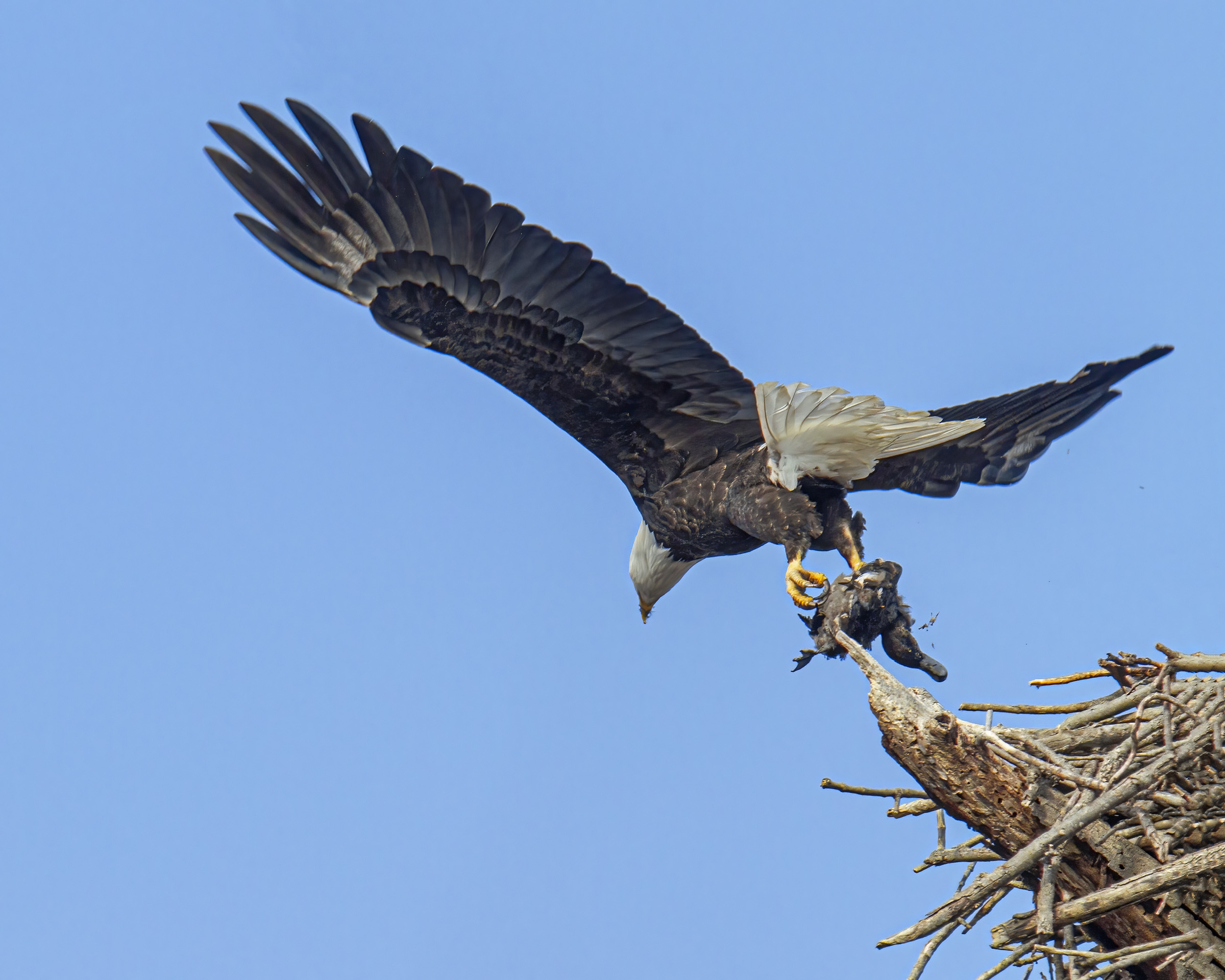
When a Bald Eagle (Haliaeetus leucocephalus) looks directly at me, it feels really intense—there is a sense of ferocity and power in its glaring eyes. Normally I do not like eye-t0-eye photos of birds, because that direct angle causes their bills to look really strange. In this photo, though, I really like the way that the eagle’s beak looks and the way that the color of its beak matches the color of its feet.  The sharpness of the beak also mirrors the sharpness of the eagle’s prominent talons.

I try to get as many different kinds of photos of eagle as I can, and this image has a different “feel” than most of my other images. There is a minimalism and starkness that really appeal to me and a very, but effective composition.

I really feel blessed that I get to see bald eagles so often when I visit Occoquan Bay National Wildlife Refuge, where I take most of the eagle shots that are featured in my blog postings.


Bald Eagle

© Michael Q. Powell. All rights reserved.

Read Full Post »

Most of the time I am an opportunistic photographer—I wander about and react to the the things that I see. During the nesting season of Bald Eagles (Haliaeetus leucocephalus), however, I will hangout at spots where I can observe the eagle nests.

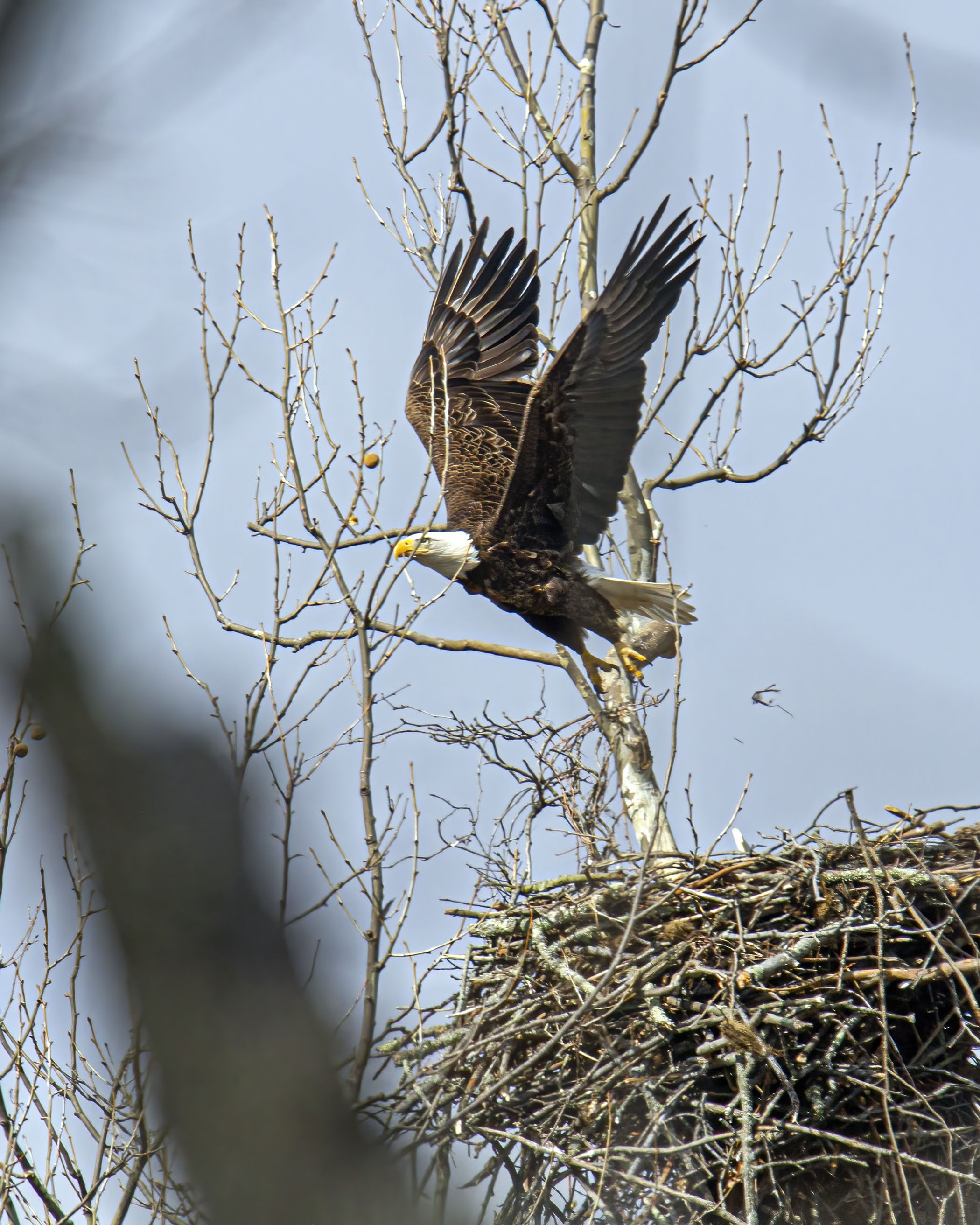
The members of an eagle couple take turns sitting on the eggs, and I love to try to capture the changing of the guard, i.e. when one eagle switches off with the other one. Earlier this month, I observed such an exchange at one of the nests that I watch at Occoquan Bay National Wildlife Refuge.

The first photo shows the departing eagle. If you look closely behind the eagle, you will see some small twigs in the air that were dislodge during the takeoff. I had to look through a lot of vegetation to get a clear view of the nest and the dark smudges in the photo are branches that were partially blocking my vision—fortunately those branches were on the periphery of my composition.

The second photo shows the arriving eagle. The nest is so small that I don’t think it could hold both eagles at the same times, particularly when there are fragile eggs present.

Bald Eagle

Bald Eagle

© Michael Q. Powell. All rights reserved.

Read Full Post »
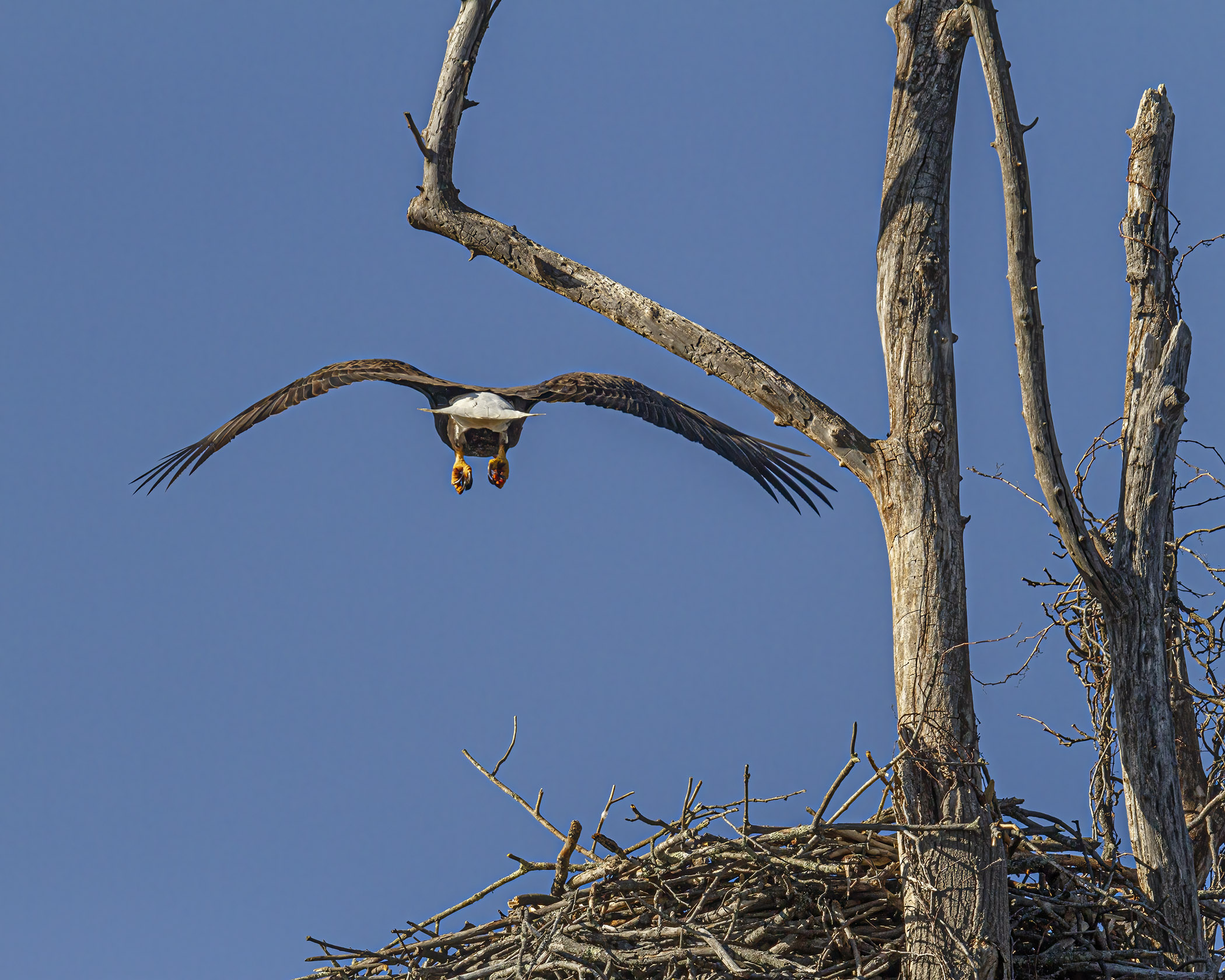
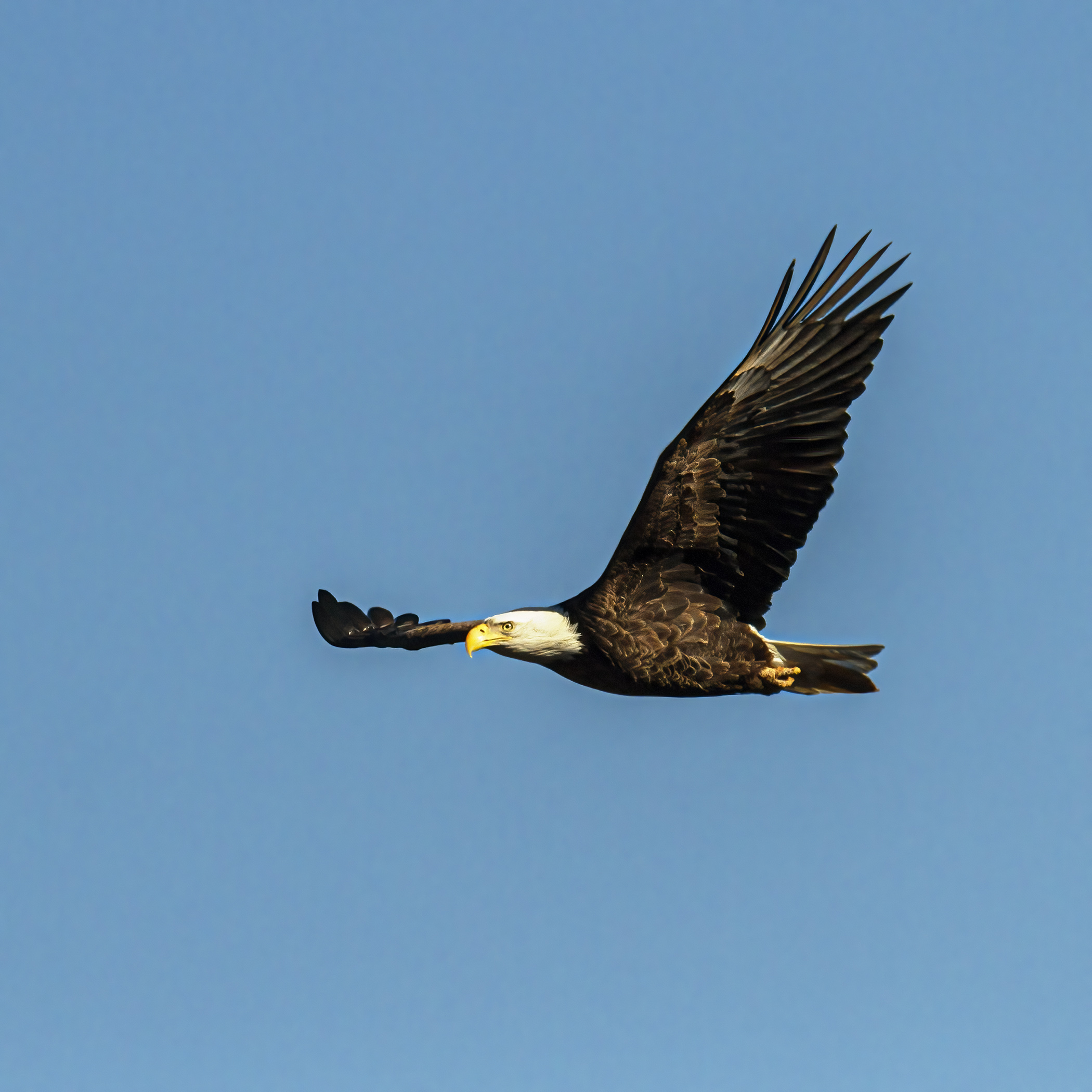
Bald Eagles (Haliaeetus leucocephalus) have impressive wing spans, approximately 80.3 inches (204 cm), according to the Cornell Lab of Ornithology. I was thrilled last week to capture some images of an eagle with its wings fully extended as it flew over me at Occoquan Bay National Wildlife Refuge.

The afternoon sunlight was pretty strong, which caused a shadow on the side of the eagle’s face, but I was happy that I was able to keep the visible eye in pretty sharp focus—you may want to click on the images to get a better look at the eagle’s eyes.

bald eagle

bald eagle

© Michael Q. Powell. All rights reserved.

Read Full Post »

Last Wednesday I watched as this Bald Eagle (Haliaeetus leucocephalus) approached its nest to take the place of its mate, who had flown away a moment earlier. It would have been cooler if the eagle had been coming towards me when it landed, but I like the way that I was able to capture the wing, tail, and talon positions in the first two photos. In the final photo, the eagle had successfully landed at the large nest—the eagle’s head was initially in the shadows, so I was happy when it glanced over its shoulder in my direction and the sunlight hit its eye.

Bald Eagle

Bald Eagle

Bald Eagle

© Michael Q. Powell. All rights reserved.


Read Full Post »

Whenever I see a Bald Eagle (Haliaeetus leucocephalus) in the air, I will try to track it through the lens of my camera. This past Wednesday I was tracking an eagle that was a long way from me at Occoquan Bay National Wildlife Refuge. The eagle was flying quite low, so I figured he was fishing.

I snapped the first photo shortly after the eagle dropped down to the water and grabbed what I thought was a fish. As you can see in the photo, the birds in the immediate area were quite agitated with the eagle flying just above them. When I examined the image on my computer, I realized that the eagle’s prey was probably an American Coot (Fulica americana), not a fish.

The eagle flew low over the water, probably to avoiding alerting any other eagles of its catch. As the eagle flew by me, I was able to capture the second and third images that clearly show the wings of the bird in the eagle’s talons.

The eagle landed in a small tree not far from the shore and proceed to feast on its freshly-caught meal. The bird was wedged in a crook in the tree that helped to steady the prey as the eagle dug into it. If you look closely at the eagle’s beak in the fourth photo, you can see bright red blood from the bird.

When the eagle had partially consumed its meal, it flew to another tree. In the final photo you can see the dangling feet of the prey. Unlike ducks that have webbed feet, coots have lobed feet with long toes and you can see some of those toes in the last image. If you would like to get a closer look at a coot’s feet, check out my December 2014 blog post entitled “Coot feet.”

Bald Eagle and Coot

Bald Eagle and Coot

Bald Eagle and Coot

Bald Eagle and Coot

Bald Eagle and Coot

© Michael Q. Powell. All rights reserved.

Read Full Post »

When Bald Eagles (Haliaeetus leucocephalus) are born, they have brown heads, brown eyes, and a black beak. It takes about five years for them to develop the characteristic white head, pale eyes, and yellow beak that we associate with adult bald eagles. Certain changes take place each year and it is possible to estimate the age of immature bald eagle on the basis of its appearance.

I believe that the eagle depicted in the two two photos is about 3 1/2 years old. There is still a good deal of mottling in the feathers on its chest and some brown patches on its mostly white head. If you would like more detailed information about the developmental stages of bald eagles, I highly recommend an article by Avian Report entitled “Juvenile & Immature Bald Eagles.”

I do not see eagles of this age very often at Occoquan Bay National Wildlife Refuge, where I took these photos last week. Most of the eagles that I see are adults or are a year or two younger than this one. From what I have read, eagles reach mating age at about the same time that they get their white heads and tails, so I doubt that this eagle has already found a mate—in human terms, I guess the eagle might be characterized as a teenager.

Bald Eagle

Bald Eagle

© Michael Q. Powell. All rights reserved.


Read Full Post »

It is hard to tell exactly when eggs are present in the nests of Bald Eagles (Haliaeetus leucocephalus). However, when I see an eagle hunkered down, it’s a pretty safe assumption that it is helping to incubate the eggs.

Last week, an eagle was sitting in one of the nests that I monitor at Occoquan Bay National Wildlife Refuge. As I watched, it took off, and I captured some shots of the eagle flying away that I featured in a blog posting  entitled “Eagles in flight.”

A short time later, another eagle flew to the nest and the photos below show the arrival of that eagle and its subsequent actions. The eagle carefully examined the nest, made a few adjustments, and eventually settled in for its shift of sitting on the eggs.

Bald Eagle

Bald Eagle

Bald Eagle

Bald Eagle

© Michael Q. Powell. All rights reserved.

Read Full Post »

I spotted this Bald Eagle (Haliaeetus leucocephalus) couple on Wednesday as they perched closely together in a dead tree at Occoquan Bay National Wildlife Refuge. At this time of the year most eagle couples are nesting and one eagle is in the nest at all times.  It therefore felt a little strange to see this couple together in the open.

The two eagles were looking at a small pile of sticks in a nearby tree that looked almost like the start of a nest. The tree, though, looked far too small to support the weight of an eagle nest.

There is a bit of mystery and uncertainty about what is going on in this photo, an effect that was heightened by the overcast skie, which gave the image a monochromatic look.

Bald Eagle

© Michael Q. Powell. All rights reserved.

Read Full Post »

Yesterday I observed the “changing of the guard” at one of the Bald Eagle (Haliaeetus leucocephalus) nests at Occoquan Bay National Wildlife Refuge. I was watching the nest and could see the white head of the eagle as it sat in the nest, when suddenly the eagle stood up and took off a few moments later. A short time later, the second eagle landed at the nest to take over nesting responsibilities.

I had a tricky time trying to track the departing eagle, because it flew among the trees initially. The three photos below show different wing positions that I was able to capture during the eagle’s flight. In the final photo, the eagle seems to be glancing in my direction. I thought I was pretty well-hidden by the vegetation, but an eagle’s vision is so sharp that it is quite possible that it could see me clearly.

Bald Eagle

Bald Eagle

Bald Eagle

© Michael Q. Powell. All rights reserved.


Read Full Post »

Over the last few weeks I have been seeing a lot of activity around three Bald Eagle (Haliaeetus leucocephalus) nests at Occoquan Bay National Wildlife Refuge. This past week I finally observed eagles hunkered down in two of the nests, which suggests to me there may finally be eggs in those nests. The third nest is so large and deep that it is impossible to see if there is an eagle (or even two) inside, especially if it is sitting on eggs.

The two nests in the photos below are fairly small, so you can just see the the top of the white head of the eagles. In both cases I was quite far from the nest when I captured my shots, so I really had to look carefully to see if there were any eagles visible in the nests. With a little luck, I’ll see eaglets in those same nests in the upcoming months and maybe I will be fortunate enough to get a few shots of them.

Bald eagle nest

Bald Eagle nest

© Michael Q. Powell. All rights reserved.

Read Full Post »

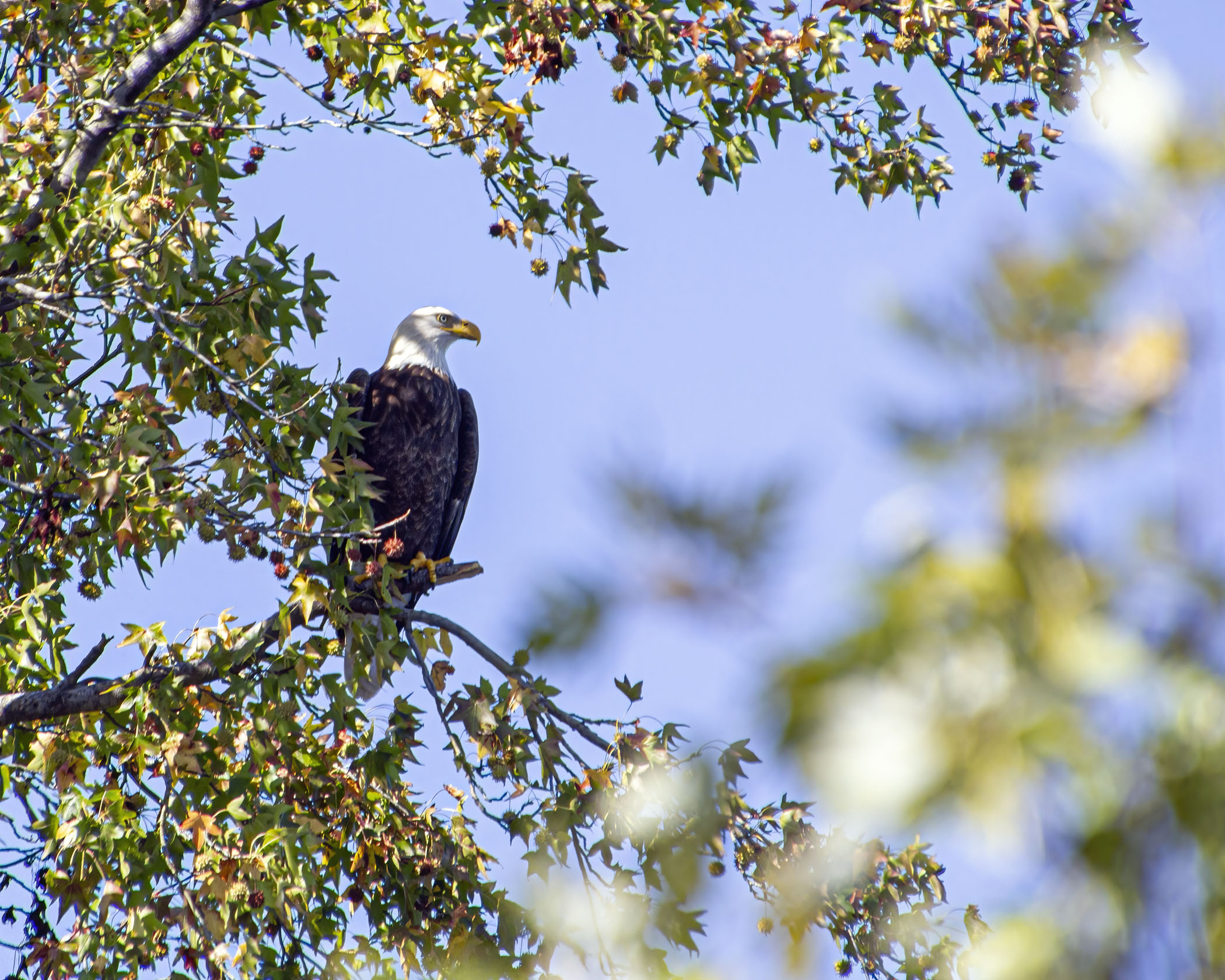
Sometimes I am able to get shots of Bald Eagles (Haliaeetus leucocephalus) when they are perched in the open, but most of the time I have an obstructed view of the eagle when I first spot it. I will then move as slowly and carefully as I can to a spot from which I have a somewhat clearer view of my subject. From that spot I will lean and twist and bend in an effort to find a visual tunnel through which I can see at least the head of the eagle—it is ok for me if the body is blocked by vegetation, but I really want to see the eyes of the eagle.

When you initially look at the two images of the eagle below, you may think that the second one is simply a cropped version of the first one. If you examine the little branches more closely, you will see that I took them from two different shooting angles.

I was a bit farther away when I captured the first image and my goal was to frame the eagle with the larger branches. In the second image, I had moved a bit closer to the eagle and was showing upwards toward it. This second angle provides a somewhat more intimate portrait of the eagle as it is nestled in among the small branches and spiky balls of the sweetgum tree.

I know that I am going to have a limited number of encounters with eagles, so I try to make each one “count” by taking shots from as many different angles as possible, never knowing for sure which photos will have the most impact until I review them later on my computer screen.


Bald Eagle

Bald Eagle

© Michael Q. Powell. All rights reserved.


Read Full Post »

My good luck with Bald Eagles (Haliaeetus leucocephalus) this winter is continuing. Last Wednesday I was able to capture these images of an eagle in flight at Occoquan Bay National Wildlife Refuge. The eagle was flying from a nest to another perch and my camera was at my eye and ready as it flew by me.

I am pretty happy with these shots, but, of course, I’ll be returning to the refuge again and again with the hope of getting even better ones.

Bald Eagle

Bald Eagle

© Michael Q. Powell. All rights reserved.

Read Full Post »

Last Thursday I enjoyed watching some juvenile Bald Eagles (Haliaeetus leucocephalus) chase each other around in the waters off of Occoquan Bay National Wildlife Refuge. They were really far away, but I managed to capture this fun image of them in action, with some Bufflehead ducks in the foreground adding additional visual interest.

It is a little crazy to attempt such long-range shots. The images are not super sharp and the contrast is often lacking. If I were a professional, I’m pretty sure that I would not post images like this one that are not of the highest quality. However, I’m an amateur, which means that I don’t have to worry about reputation or marketablility—I feel free to post images that I judge to fun, cool, or interesting, like these shot of juvenile eagles at play.

juvenile bald eagles

© Michael Q. Powell. All rights reserved.

Read Full Post »
Recently I have featured a number of photos of Bald Eagles (Haliaeetus leucocephalus) and their nests. Some of the photos make it look like I am close to the nests, but in fact I took the photos from quite a distance away with a telephoto zoom lens. In mid-December each year, the authorities at Occoquan Bay National Wildlife Refuge put up barriers to keep people from disturbing the nesting eagles.

The first photo below shows one of the barriers. The tallest tree to the left of the road is where the eagle nest is located. If you read yesterday’s posting entitled Three eagle nests, you make recognize the nest as the one in the sycamore tree in the third photo.

This year, a sign was posted at each of the barriers that explains the potential negative impact of the close presence of humans on the eagles. Hopefully these signs will help deter visitors from walking past the barriers. I have been told that in past years trespassers have in fact been apprehended and have paid hefty fines.

bald eagle

Bald Eagle

© Michael Q. Powell. All rights reserved.

Read Full Post »

« Newer Posts - Older Posts »