Feeds:
Posts
Comments

Posts Tagged ‘Autumn Meadowhawk’

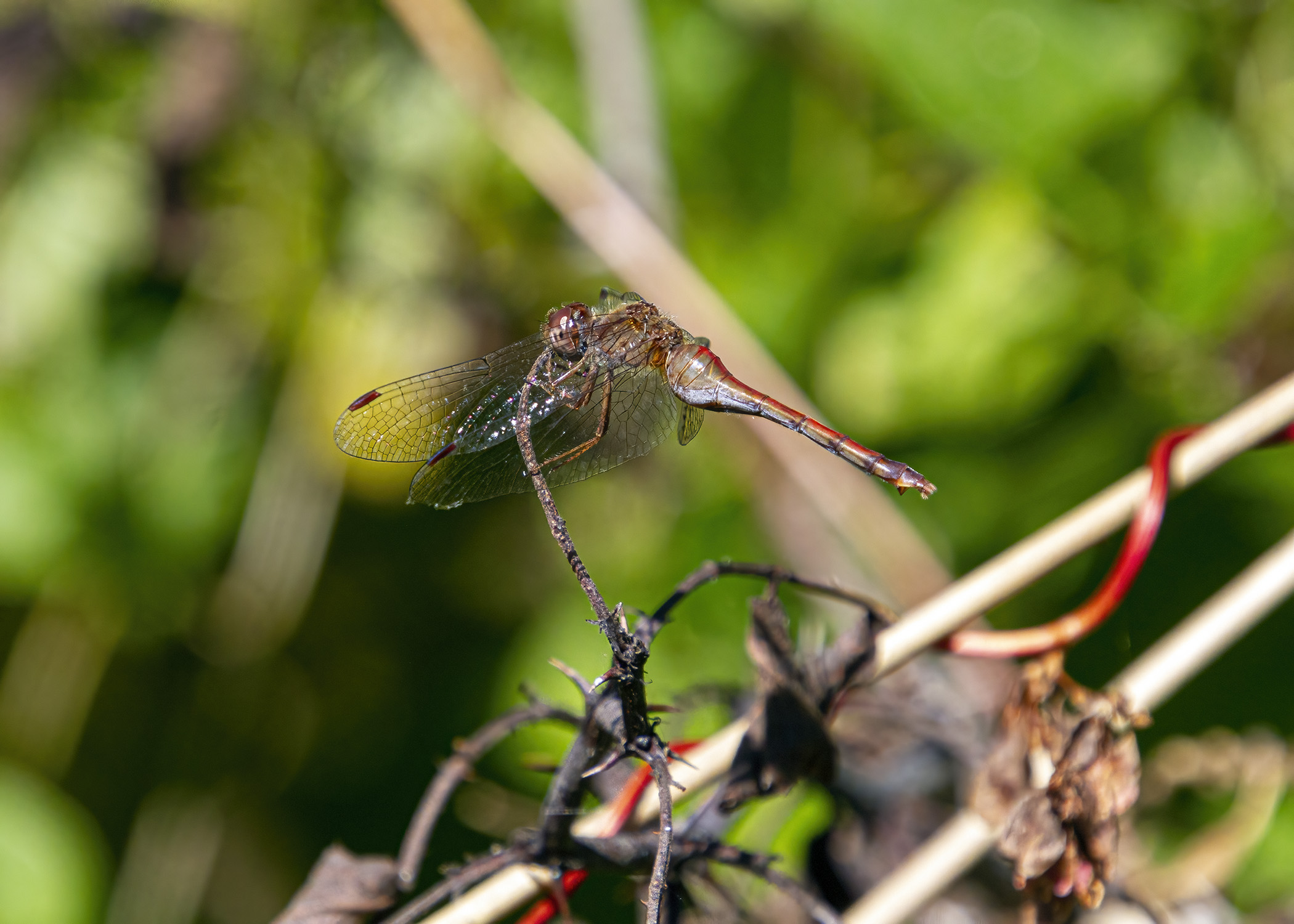
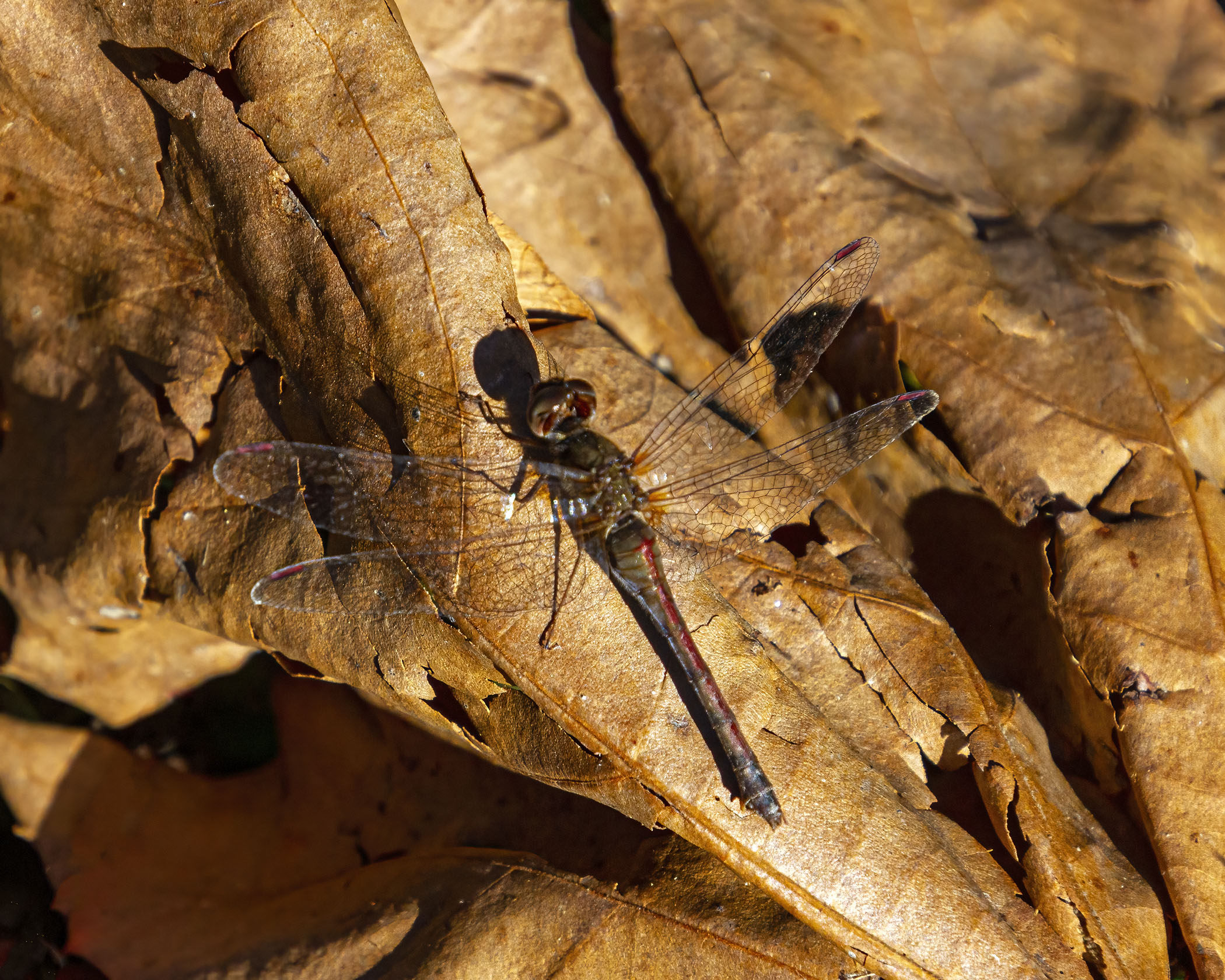
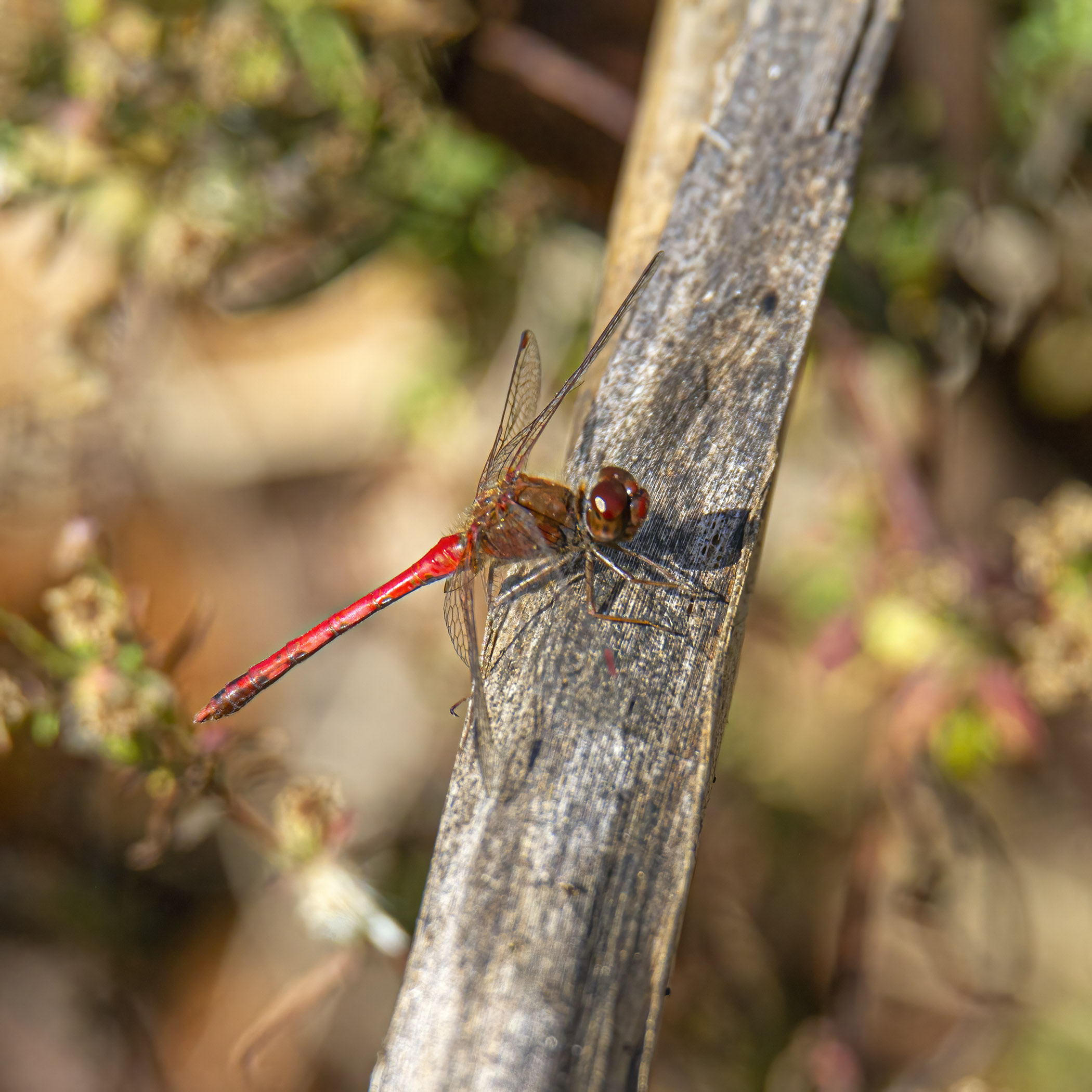
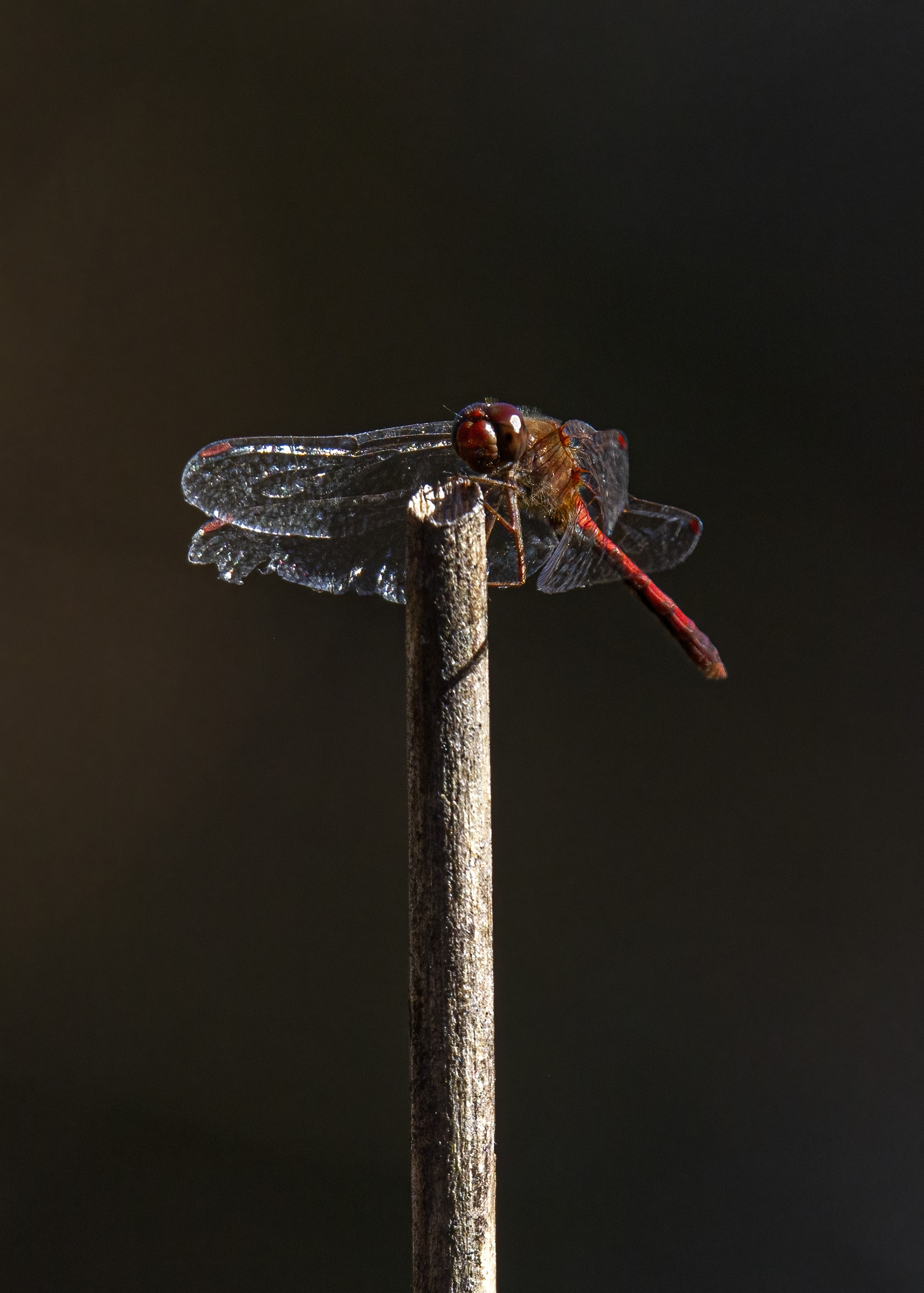
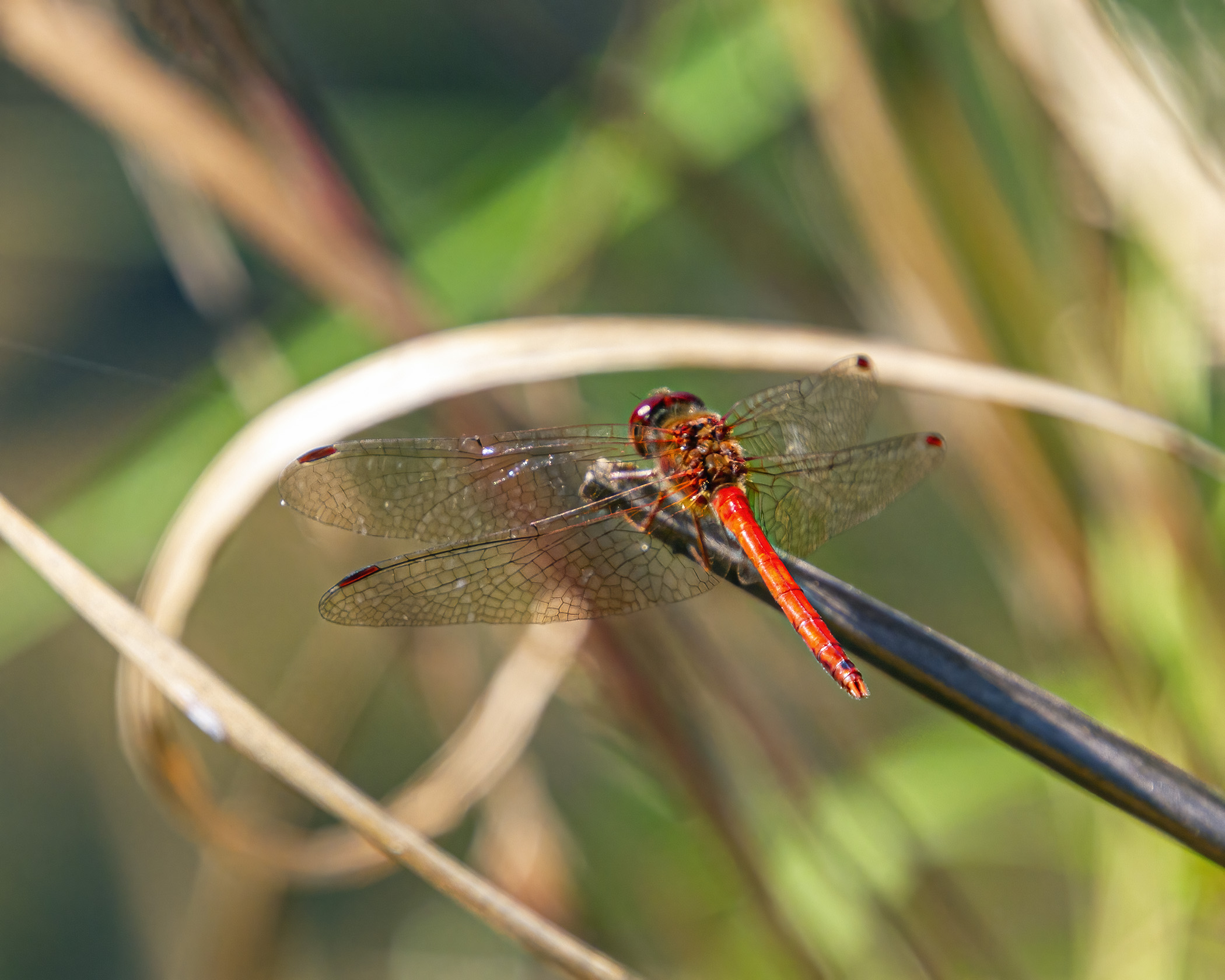
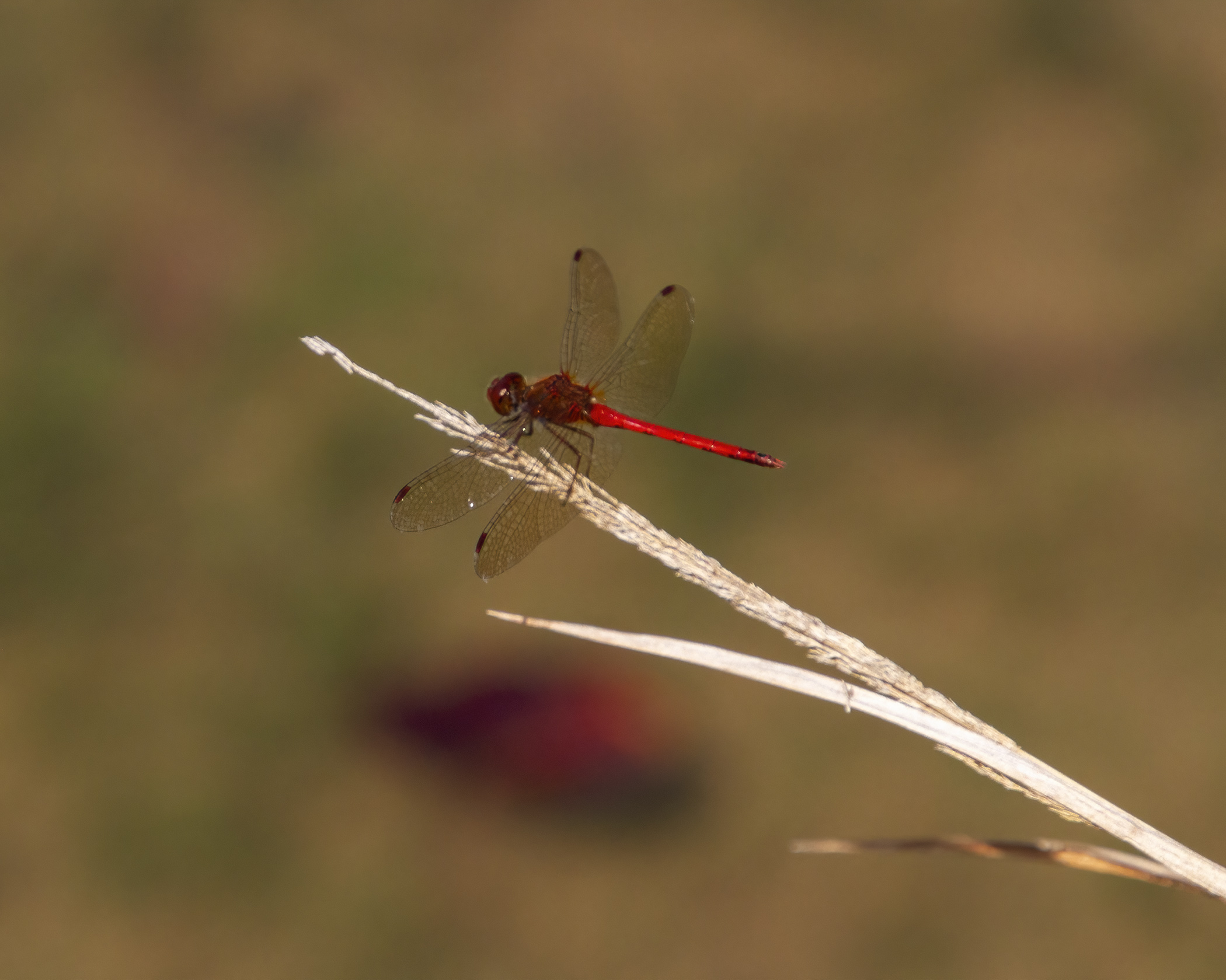
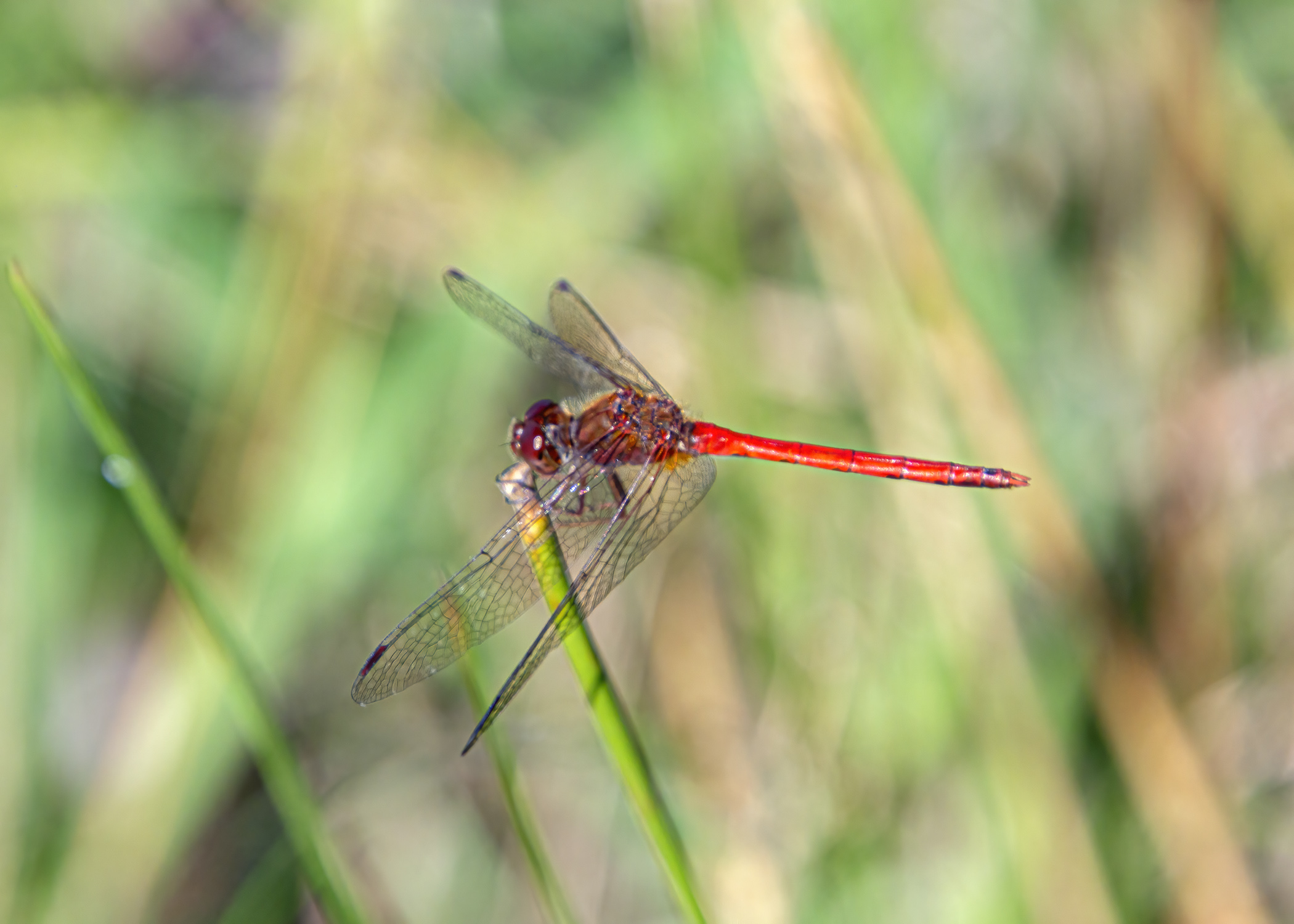
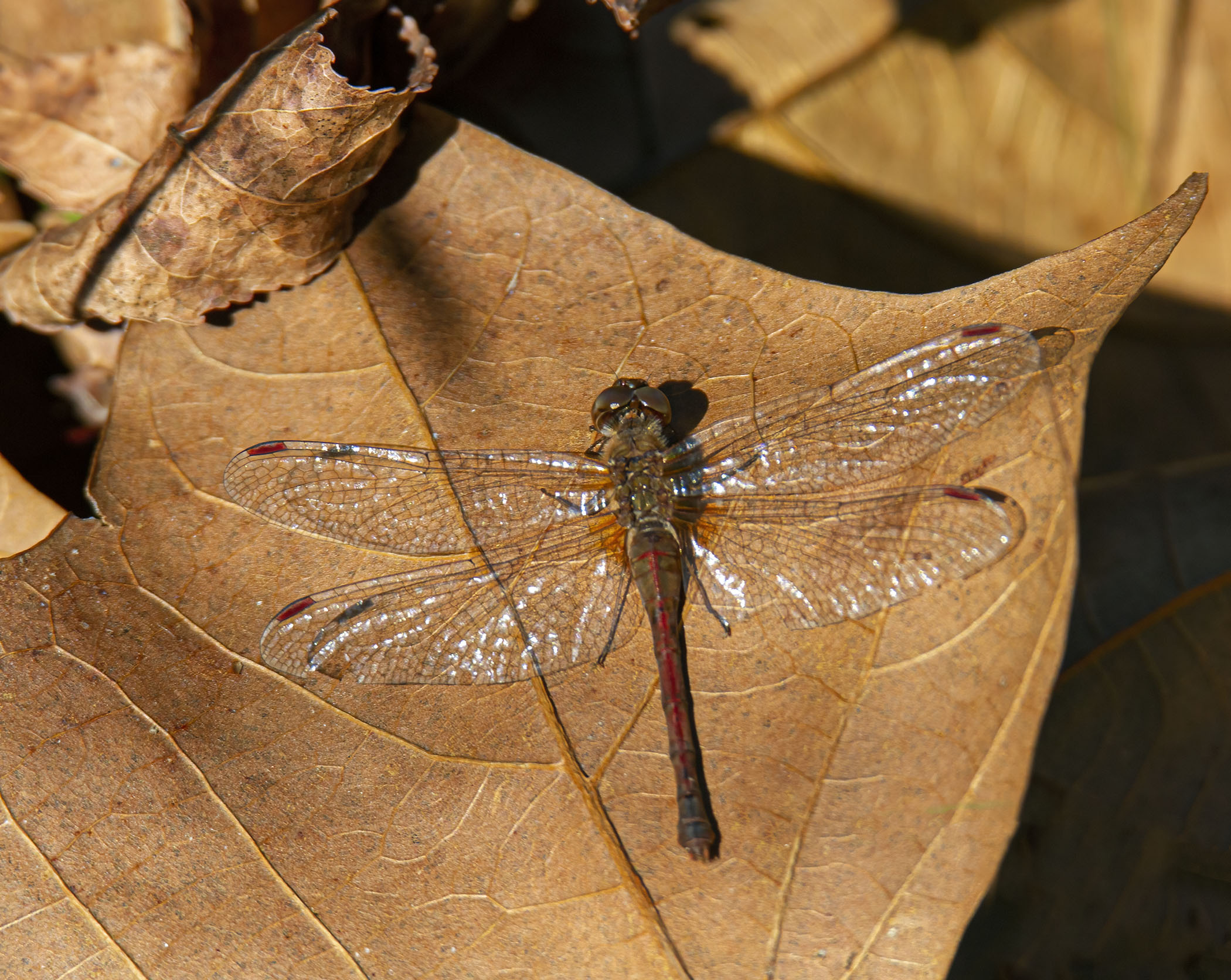
I was delighted to spot this Autumn Meadowhawk dragonfly (Sympetrum vicinum) on Wednesday, 3 December, at Occoquan Bay National Wildlife Refuge. Despite our recent cold nights, many of which have dipped below the freezing level, this hardy dragonfly managed to survive.

It is snowing out right this moment, so I am not sure how much longer I will be seeing these beautiful little creatures, but I’ll almost certainly be out with my camera next week to see what I can find.

Autumn Meadowhawk

© Michael Q. Powell. All rights reserved.

Read Full Post »

I haven’t yet checked this week, but these Autumn Meadowhawk dragonflies (Sympetrum vicinum) that I spotted on 17 November at Occoquan Bay National Wildlife Refuge are likely to be among the last dragonflies that I see this season.

Autumn Meadowhawks frequently perch flat on the ground or on dried leaves on the ground. I was delighted when a male Autumn Meadowhawk perched almost vertically on a colorful fallen leaf and I was able to capture the first image below. By contrast, the female in the second photo chose a less interesting drab leaf on which to perch.

I’ll try to go out later this week to see if I can find some late season survivors, but it is becoming clear to me that this year’s dragonfly season is nearly over.

Autumn Meadowhawk

Autumn Meadowhawk

© Michael Q. Powell. All rights reserved.

Read Full Post »

I think that we may well be down to our last surviving dragonfly species. On 10 November I ventured out to Occoquan Bay National Wildlife Refuge to look for any remaining dragonflies or butterflies. I did not find any butterflies, but was delighted to spot close to a dozen Autumn Meadowhawk dragonflies (Sympetrum vicinum).

Our temperatures this past week have dropped down close to the freezing level, which most dragonflies cannot tolerate. Autumn Meadowhawks, however,  are hardy enough to survive a few light frosts as long as daytime temperatures remain relatively warm and sunny. Once we start receiving a few heavy frosts the remaining population starts to die off.

I was happy to capture some photos of Autumn Meadowhawks as they perched on the colorful leaves that litter many of the trails at the wildlife refuge. The dragonflies appeared to be content to remain in place soaking up the warmth of the sun as I approached and some even posed for me.

Autumn Meadowhawk

Autumn Meadowhawk

Autumn Meadowhawk

© Michael Q. Powell. All rights reserved.


Read Full Post »

For a variety of reasons I did not manage to go out with my camera this past week, so I went through my photos from the previous week and was delighted to find this photo of a Blue-faced Meadowhawk dragonfly (Sympetrum vicinum). As I have noted in previous postings, Blue-faced Meadowhawks have such a wonderful combination of colors that make them one of my favorite dragonfly species.

I was quite fortunate that this particular individual landed on some leaves right next to one of my feet, so I was able to capture this cool image by shooting almost directly downwards. In fact, I had to digitally remove a bit of the boot I was wearing from the lower left edge of the photo to keep the viewer from getting distracted.

Several days ago we had some frost warnings, so I fear that more of the dragonflies will have disappeared for the season. Still, I hope to return to my local wildlife refuge in the next few days to see what I can find.

Blue-faced Meadowhawk

© Michael Q. Powell. All rights reserved.

Read Full Post »

It’s always fun to try to capture a shot of an Autumn Meadowhawk dragonfly (Sympetrum vicinum) with beautiful fall colors in the background, as I did last Friday (31 October) at Occoquan Bay National Wildlife Refuge. Autumn Meadowhawks are invariably the last surviving species of the dragonfly season. In past years I have spotted them as late as the middle of December, and fellow dragonfly enthusiasts have reportedly seen them in our area in early January.

Autumn Meadowhawk

© Michael Q. Powell. All rights reserved.

Read Full Post »

We have now reached a point in the dragonfly season where Autumn Meadowhawks (Sympetrum vicinum) are the dragonfly species that I see most frequently. Most other species have gradually disappeared and I seen only occasional survivors that are still hanging on. There is something about the physiology of Autumn Meadowhawks that allows them to tolerate the cold better than other dragonflies and in past years I have seen them as late as the middle of December.

Last Friday I spotted over a dozen Autumn Meadowhawks at Occoquan Bay National Wildlife Refuge and was able to capture photos of several of them. Autumn Meadowhawks tend to perch flat on the ground, so it can be a bit difficult to spot them, especially when they choose to land on fallen leaves that camouflage them almost perfectly.

Female Autumn Meadowhawks are a mixture of red and brown colors, as you can see in the first photo below, while the males of the species are bright red, as you can see in the final photo. Both genders have beautiful brown eyes.

Autumn Meadowhawk

Autumn Meadowhawk

Autumn Meadowhawk

© Michael Q. Powell. All rights reserved.

Read Full Post »

I was delighted on Monday to spot multiple Autumn Meadowhawk dragonflies (Sympetrum vicinum) at Occoquan Bay National Wildlife Refuge. During the past couple of weeks I saw a few female Autumn Meadowhawks, but until this week I had not photographed a single male—I think that all of the dragonflies that I spotted that day were males. Females are mostly brown with touches of red, while the bodies of males are mostly red, as you can see in the photo below.

Autumn Meadowhawks are only about 1.2 inches (30 mm) in length, so they are difficult to spot, despite their bright coloration. At this time of the year when fallen leaves litter the ground, they tend to blend in pretty well with their surroundings.

I was using my Tamron 150-600mm lens with a monopod, my preferred combination for photographing birds, so it was a challenge to focus on such tiny subjects as dragonflies. I was persistent, however, and was successful in capturing some pretty detailed shots of them.

Autumn Meadowhawk

© Michael Q. Powell. All rights reserved.

Read Full Post »

After a month away on a car road trip, I finally returned home last week. On Friday I ventured out to Occoquan Bay National Wildlife Refuge to see if I could find any dragonflies. It is pretty late in the season for most dragonfly species, but I was optimistic that I might be able to find some Autumn Meadowhawks (Sympetrum vicinum) that are almost always the final dragonflies to disappear in late autumn.

Happily I was able to spot a half-dozen or so Autumn Meadowhawk dragonflies, although I was able to capture images of only a few of them. The female in the first photo was quite cooperative and landed on a colorful fallen leaf. The dragonfly in the second photo is also a female and I am pretty sure that it too is an Autumn Meadowhawk—there is a slight chance that it could be a Blue-faced Meadowhawk (Sympetrum ambiguum), though it would be unusual to see that species so late in the season.

The final image is a long distance shot of another female Autumn Meadowhawk that is almost perfectly camouflaged. You will need to look very carefully at the upper edge of the leaf in order to spot the little dragonfly. I watched it land at that spot, but actually could not see the dragonfly when I took this shot. I will probably be out again with my camera later this week diligently searching for more dragonflies, the final survivors of the 2024 dragonfly season.

Happy Veterans Day to all those who have served or are continuing to serve in the Armed Forces of the United States. As someone who served for 20 years in the U.S. Army, this day is a special one for me. It seems a bit trite to say “Thank you for your service,” but those words reflect my heartfelt thanks to those men and women who voluntarily defend our freedoms.

In other parts of the world this day is celebrated as Armistice Day (or Remembrance Day) and I remember well being in Paris, France on this day several times and observing the impressive ceremonies on the Champs-Élysées to commemorate the armistice that ended World War I. Some thought at the time that it would be the “war to end all wars,” but, alas, those hopes proved to be unfounded.

Autumn Meadowhawk

Autumn Meadowhawk

Autumn Meadowhawk

© Michael Q. Powell. All rights reserved.

Read Full Post »

As we move into December, I am still managing to see a few Autumn Meadowhawks (Sympetrum vicinum), like this dragonfly on the rocks that I spotted on Monday at Occoquan Bay National Wildlife Refuge. Dragonfly on the rocks…sounds like a holiday adult beverage to me.

I suspect that the end is near for these little creatures. Although these dragonflies can tolerate brief periods of cold temperatures, it is difficult for them to survive during an extended cold snap. I will be keeping an eye out for these tiny red dragonflies in the upcoming weeks, but it is clear that the end of the dragonfly season is rapidly approaching.

Autumn Meadowhawk

© Michael Q. Powell. All rights reserved.

Read Full Post »

Autumn Meadowhawk dragonflies (Sympetrum vicinum) are still hanging in there as we approach the end of November. At other times of the year their bright red bodies would stand out, but there are lots of red and brown leaves on the ground now that help to camouflage them when they land. If the dragonflies remain still while on these perches, they are almost undetectable.

I photographed these little beauties on Wednesday at Occoquan Bay National Wildlife Refuge. Amazingly, I used the same telephoto zoom lens for these images that I used to capture shots of a Bald Eagle that same day—check out yesterday’s posting called What’s for dinner? that featured shots of an eagle with a duck that it had captured. The Tamron 150-600mm lens is a really versatile lens that, if I am careful, can capture a wide range of subjects ranging from an eagle in flight to a tiny perched dragonfly.

Autumn Meadowhawk

Autumn Meadowhawk

© Michael Q. Powell. All rights reserved.


Read Full Post »

We have reached the point of the season when the only dragonflies remaining are the hardy Autumn Meadowhawks (Sympetrum vicinum). I try to photograph every one that I see, knowing that it could be the last one that I spot for the year. In past years I have sometime seen Autumn Meadowhawks in December, but their continued presence is dependent on a number of factors, including the weather.

I photographed this Autumn Meadowhawk last Friday at Occoquan Bay National Wildlife Refuge in Northern Virginia—it was one of a half-dozen or so that I spotted that day. The little dragonfly appeared to be staring right at me with a mixture of curiosity and defiance. The dragonfly was perched on a log and I was happy to capture some of the texture of the wood along with a bit of autumn color in the background.

I will continue to keep an eye out for these little red dragonflies, knowing full well that their time is rapidly coming to an end.

Autumn Meadowhawk

© Michael Q. Powell. All rights reserved.

Read Full Post »

I can’t totally exclude the possibility that I may see a hardy survivor of another species, but it is beginning to look like Autumn Meadowhawks (Sympetrum vicinum) are the sole remaining dragonfly species. Last week I spotted quite a few of them during a visit to Huntley Meadows Park, a county-owned marshland not far from where I live.

I tried to capture images of these bright red beauties in as many different environments as I could. Autumn Meadowhawks often perch on the ground, which does not provide a very interesting background, as you can see in the final photo. It is much more interesting if they perch on fallen leaves, or even better if they choose a more elevated perch.

The photos below give you an idea of how I try to “work” a subject. I try to shooting from different angles and distances.  When possible, I try to selectively include or exclude background elements by choosing the appropriate camera settings, as you can see in the fourth photo, where I caused the background to be totally out of focus. Paying attention to the direction of the light really helps too, as you can see particularly in the second image in which the light is so directional that it almost looks like a studio portrait.

Autumn Meadowhawks will probably be around for another few weeks or maybe a month or so, depending in part on the severity of the local weather. At that point, I will rekuctantly turn my focus to birds, landscapes, and other non-insect subjects. I also hope to devote a bit more attention to learning more about creating videos—I have a modest YouTube channel that I have allowed to languish this past year.

Autumn Meadowhawk

Autumn Meadowhawk

Autumn Meadowhawk

Autumn Meadowhawk

Autumn Meadowhawk

© Michael Q. Powell. All rights reserved.

Read Full Post »

And then there was one…

Now that the calendar has turned over to November, we have reached the point in the dragonfly season when there is essentially only one remaining species, the Autumn Meadowhawk (Sympetrum vicinum). There is a chance that I will encounter a hardy survivor from some of the summer species or a migratory dragonfly species passing through our area, but in all likelihood, the only dragonflies that I am likely to see this month are the tiny red Autumn Meadowhawks.

This past Thursday I visited Occoquan Bay National Wildlife Refuge and spotted a total of about ten Autumn Meadowhawks at various points throughout the refuge. Unlike some species that require specific habitats, Autumn Meadowhawks seem to be pretty adaptable and I have found them in a variety of different environments.

The dragonfly in the first photo is a female Autumn Meadowhawk—you can tell it is female by looking at her terminal appendages, i.e. the tip of her “tail.” She was perching more or less in the open, so I managed to capture an obstructed shot of her.

Most of the time, though, Autumn Meadhawks perch low to the ground on fallen leaves and dried-up vegetation, as you can see in the final two shots. Both photos show male Autumn Meadowhawks. I love the lighting in the penultimate shot, although the cluttered background makes the dragonfly a little hard to see. In the final photo, I really like the way that the dragonfly appeared to be looking up at me with a sense of curiosity.

Autumn Meadowhawk

Autumn Meadowhawk

Autumn Meadowhawk

© Michael Q. Powell. All rights reserved.


Read Full Post »

Now that Autumn Meadowhawk dragonflies (Sympetrum vicinum) have become the only dragonflies that I see regularly, I have been paying a great deal of attention to their perches when I am photographing them—when there are a limited number of subjects available, I try to make each encounter count. During a recent trip to Huntley Meadows Park, a county-run marshland park only a few miles from where I live, I managed to capture images of these colorful little dragonflies perching on a variety of different types of vegetation.

Often I have to choose between zooming in close to show the details of my subjects or pulling way back to show the environment in which I found them. In the case of these Autumn Meadowhawks, though, the images balance those competing priorities quite well, in part, I believe, because the dragonflies were so immersed in their environment, i.e. they do not choose high perches that produce “dragonfly on a stick” photos that isolate the subject too much from its surroundings.

Autumn Meadowhawk

Autumn Meadowhawk

Autumn Meadowhawk

© Michael Q. Powell. All rights reserved

Read Full Post »

The red bodies of male Autumn Meadowhawk dragonflies (Sympetrum vicinum) make them relatively easy to spot.  However, when they choose to perch on foliage that matches their coloration, they can sometimes be well camouflaged.

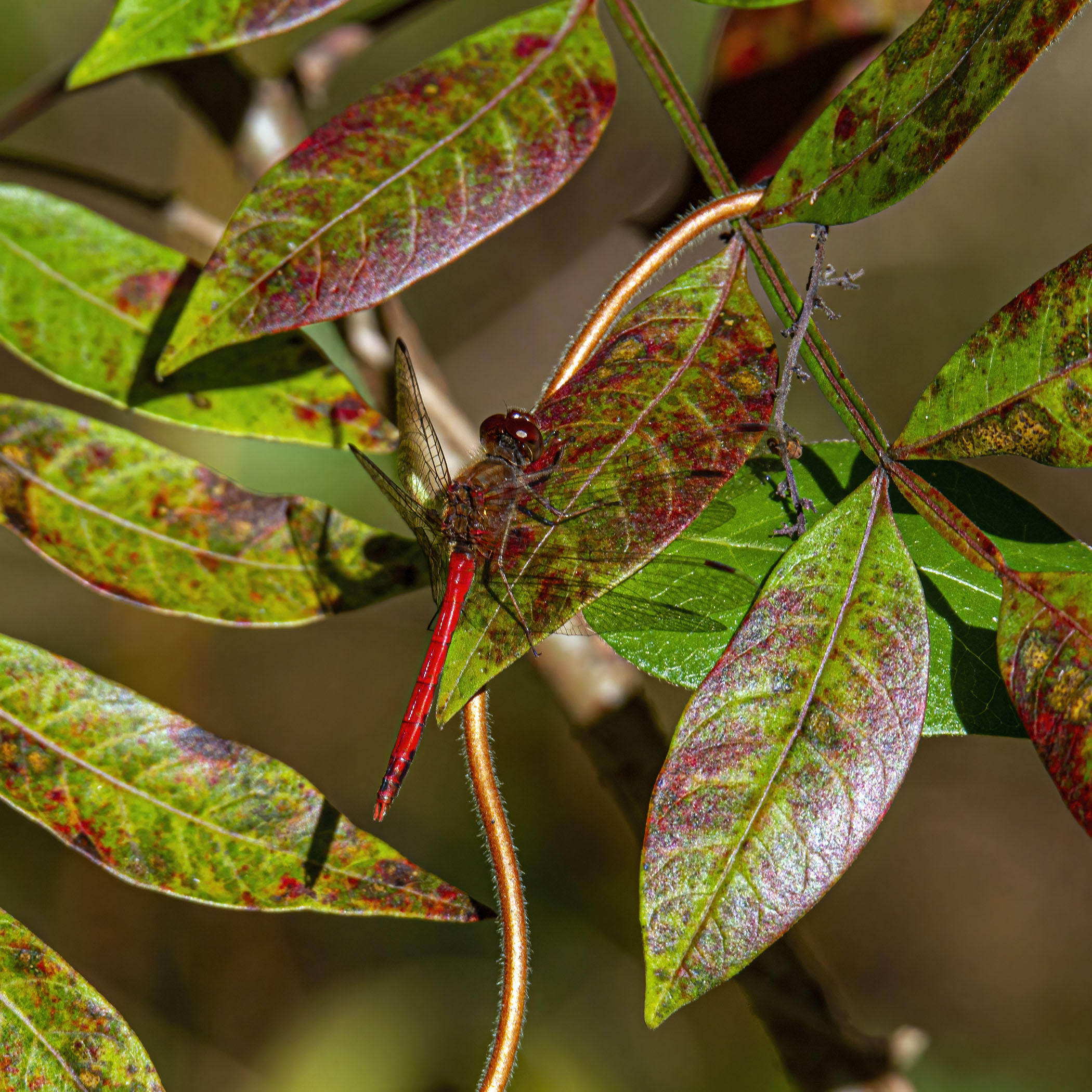
The first photo shows an Autumn Meadowhawk perched on some kind of red vegetation (Virginia Creeper ?) at Huntley Meadows Park last Thursday. The red leaves really help to give the image a feel of autumn.

In the second image, the dragonfly stands out a bit more, but the dying leaves provide an artistically pleasing backdrop for the beautiful little dragonfly—I love this composition a lot.

Autumn Meadowhawk

Autumn Meadowhawk

© Michael Q. Powell. All rights reserved.


Read Full Post »

I walked about for a couple of hours on Wednesday at Occoquan Bay National Wildlife Refuge and visited some of my favorite dragonfly sites, but managed to spot only three dragonflies. Of those three, the only one that I managed to photograph was this pretty little Autumn Meadowhawk (Sympetrum vicinum).

Autumn Meadowhawks are quite small, about 1.3 inches (33 mm) in length, so they are not easy to spot, despite their bright red color. They tend to stay close to the ground, making short flights most of the time, so you have to be looking down to see them. At this time of the year, I focus a good amount attention on birds, so I end up alternating between looking up for birds and down for insects.

I really like the color and texture of the rocks on which the dragonfly chose to perch. Their cool muted tones contrast nicely with the red and brown colors of the dragonfly.

Autumn Meadowhawk

© Michael Q. Powell. All rights reserved.

Read Full Post »

What signals the arrival of autumn for you? Perhaps it is the changes in the foliage, the cooling of the temperatures, or the shortening of the daylight hours. In recent years Autumn Meadowhawk dragonflies (Sympetrum vicinum) have become the harbingers of autumn, visible signs that the end of the dragonfly season is inexorably drawing near.

I spotted my first Autumn Meadowhawks this year on 2 October at Occoquan Bay National Wildlife Refuge. This species usually appears in late September and most years is the last dragonfly species to disappear—I have seen Autumn Meadowhawks as late as December some years and there have been some reports of them in early January.

A number of other dragonflies are still active, but by early November most of them will be gone. I will still be looking to photograph those hardy survivors in the upcoming months, but, as recent postings suggest, I will eventually be shifting a lot of my focus from insects to birds.

Autumn Meadowhawk

Autumn Meadowhawk

Autumn Meadowhawk

© Michael Q. Powell. All rights reserved.


Read Full Post »

Despite our recent frigid weather, some Autumn Meadowhawk dragonflies (Sympetrum vicinum) are still with us, like this handsome male that I spotted on Monday at Occoquan Bay National Wildlife Refuge. Autumn Meadowhawks are invariably the last dragonflies of the season in my area. They are more tolerant of the cold than most other dragonflies and seem to be able capable of withstanding frosts and freezes if not prolonged or severe.

It is a real challenge to find and photograph Autumn Meadowhawks, because they are small—about 1.3 inches (33 mm)—and they tend to perch among the fallen leaves, where they blend in well with their surroundings. One additional challenge for me was the fact that I was shooting them at the 600mm end of my Tamron 150-600mm zoom lens. At that focal length, the minimum focusing distance for the lens is about 8.8 feet (270 cm), which means that I have to be a pretty good ways away from my tiny subject.

I hope to see these little red dragonflies into early December, assuming that the weather does not stay cool for too long a period and we do not have an extended period of cloudy weather—on cool days I tend to find Autumn Meadowhawks in areas where there is direct sunlight.

Autumn Meadowhawk

Autumn Meadowhawk

© Michael Q. Powell. All rights reserved.

Read Full Post »

I have arrived safely in Bastrop, Texas (just outside of Austin) for a family wedding after a long drive from Virginia that turned out to be 1560 miles (2510 km).

I don’t have any new photos to post, but thought I would feature an image of a female Autumn Meadowhawk dragonfly (Sympetrum vicinum) that I photographed a little over a week ago. I spotted this beautiful dragonfly at Occoquan Bay National Wildlife Refuge and was delighted to capture the shadow that the little dragonfly was casting on a colorful fallen leaf.

Thanks to all of you who responded to my recent request to subscribe to the YouTube channel of young UK-based wildlife photographer Toby Wood. He has now surpassed the required level of one thousand subscribers and his channel is now presumably eligible for monetization on YouTube.

Autumn Meadowhawk

© Michael Q. Powell. All rights reserved.

Read Full Post »

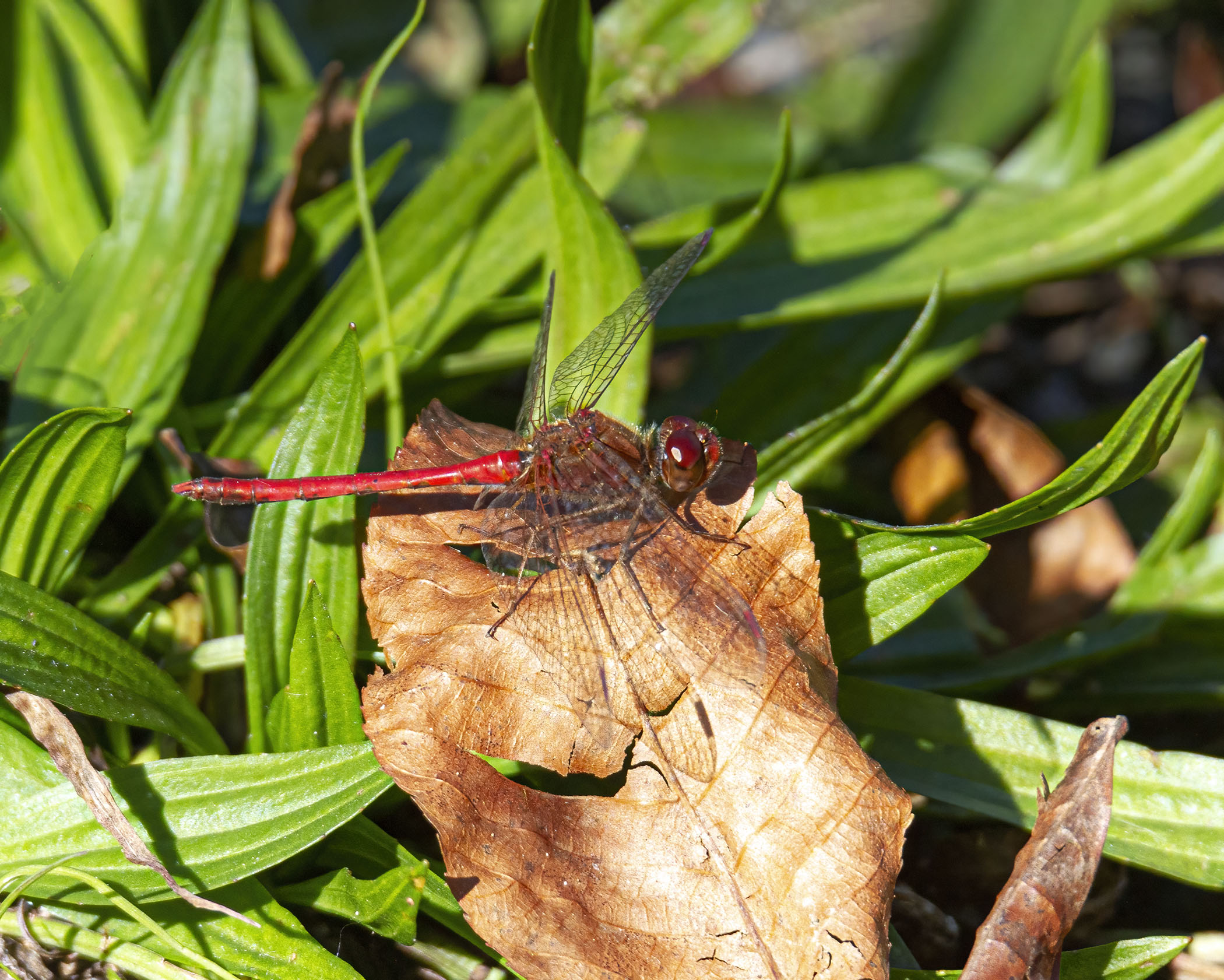
Autumn Meadowhawk dragonflies (Sympetrum vicinum) love to perch on the ground and at this time of the year the ground is covered with fallen leaves in many places. Most of those leaves are brown, which makes for pretty good shots, but I am always hoping that an Autumn Meadowhawk will choose to perch on a more colorful red or yellow leaf. Last Wednesday at Occoquan Bay National Wildlife Refuge, I was fortunate when one of these colorful little dragonflies landed on a yellow leaf and I captured the first image.

Although the second and third images feature brown leaves, I love the textures and shapes of those leaves. I also like the way that the drabness of the leaves helps the bright red of the dragonfly’s body really stand out.

At this time of the year, most of my photographic subjects are likely to be birds, so I tend to walk around with my Tamron 150-600mm telephoto zoom lens on my camera. Although a long telephoto lens my not be my first choice for photographing such a small subject—an Autumn Meadowhawk is about 1.3 inches (33 mm) in length—I can get pretty good results if I am really careful in steadying the lens and paying attention to the focus point. All three of these images, for example, were shot with the lens fully extended to 600mm.

Autumn Meadowhawk

Autumn Meadowhawk

Autumn Meadowhawk

© Michael Q. Powell. All rights reserved.


Read Full Post »

It looks like all of the summer dragonflies are gone. During three treks with my camera this week, I have not spotted any of the species that were common during the summer.

Fortunately, there are a few autumn species that hang on long after the summer species are gone. This week I was pleased to see some Autumn Meadowhawk dragonflies (Sympetrum vicinum), which in the past have been present as late as December.

The dragonfly in the first photo is a male Autumn Meadowhawk that I photographed yesterday at Jackson Miles Abbott Wetland Refuge. Each year when I see them I are struck by their small size—they are only about 1.3 inches (33mm) in length. Mature males are a bright reddish-orange in color and have beautiful brown eyes, a perfect color combination for the season.

Female Autumn Meadowhawks are less conspicuous and have a two-toned tan and red coloration. I spotted the female in the second photo on Wednesday at Occoquan Bay National Wildlife Refuge. Generally I see a lot more male Autumn Meadowhawks than females, so I was happy to be able to photograph this one, which also happened to be my first Autumn Meadowhawk of the season.

Autumn Meadowhawk

Autumn Meadowhawk

© Michael Q. Powell. All rights reserved.


Read Full Post »

In everything, give thanks. I am thankful today for friends and family and for all creatures great and small, including this male Autumn Meadowhawk dragonfly (Sympetrum vicinum) that I photographed last week at Occoquan Bay National Wildlife Refuge.

I will return home in early December and I can’t exclude the possibility that this will be the last dragonfly that I see this season.

Autumn Meadowhawk

© Michael Q. Powell. All rights reserved.

Read Full Post »

We may be down to a single active dragonfly species in my area. Yesterday I went out with my camera to Occoquan Bay National Wildlife Refuge, my favorite location for wildlife photography the last few years, and found only Autumn Meadowhawk dragonflies (Sympetrum vicinum)—the Wandering Gliders seem to have departed from the areas where I had seen them previously during the last few weeks.

The good news is that I saw multiple Autumn Meadowhawks, so the population seems to be still strong. I was planning to return to the refuge tomorrow, when temperatures are supposed to soar to 73 degrees (23 degrees C), but just noted that the refuge is closed all day for one of the annual managed deer hunts. I may have to go to another location to see if the warmer temperatures coax any stragglers or survivors from other dragonfly species to make a final curtain call.

I captured these three photos of Autumn Meadowhawks last week and really like them for different reasons. In the first photo, I love the way that the color and shape of the leaf stems match the body of the dragonfly. In the second shot, I was thrilled to be able to include the sky in the composition when the dragonfly chose a high perch—I also am quite fascinated by the interplay of light and shadows in the image and the shapes that they help to create.

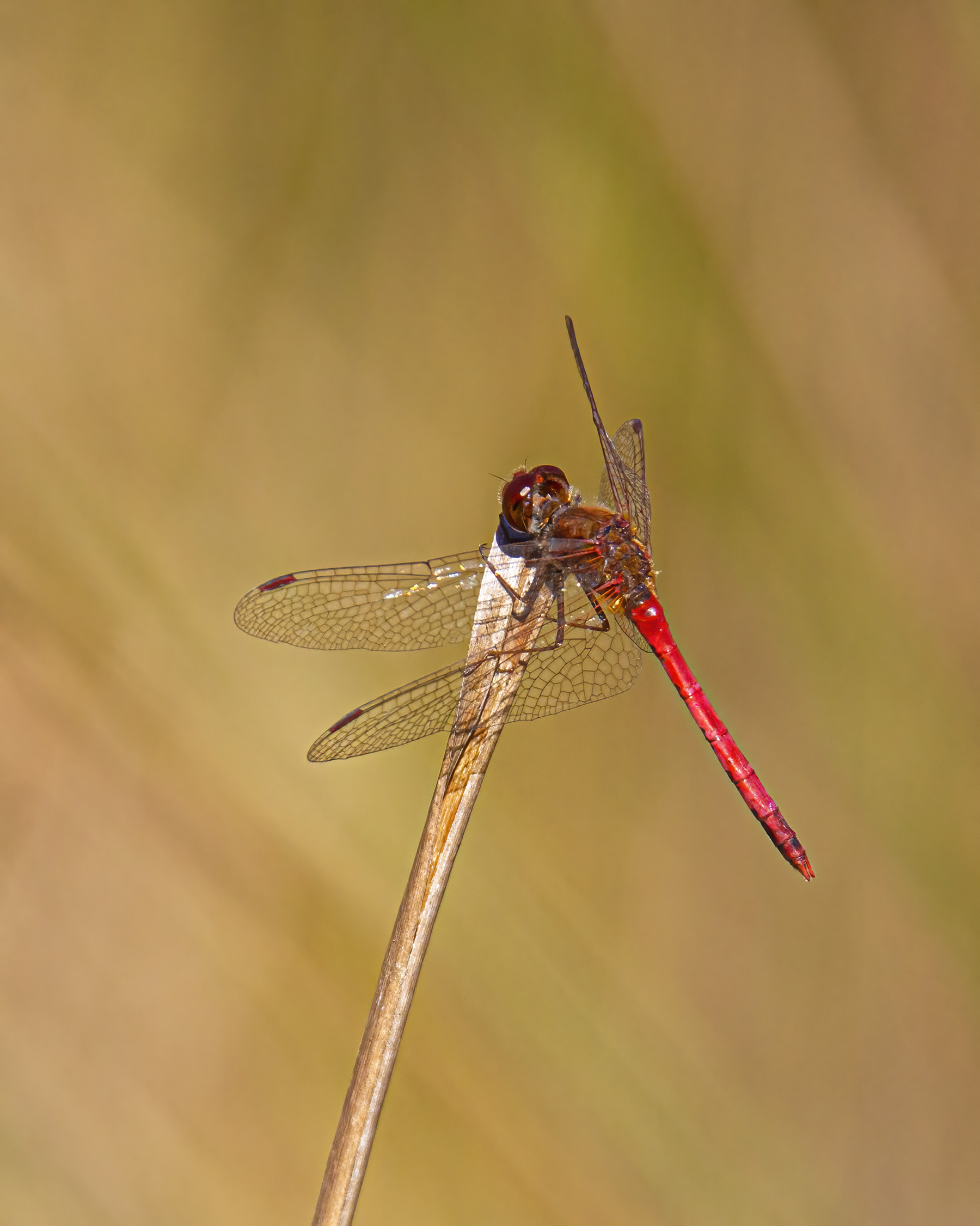
The simple, stark composition of the final shot appeals to me a lot. The monochromatic color palette of the branch and the background really help to draw a viewer’s eyes to the handsome male Autumn Meadowhawk and his bright red coloration really pops.

Autumn Meadowhawk

Autumn Meadowhawk

Autumn Meadowhawk

© Michael Q. Powell. All rights reserved.


Read Full Post »

As I noted in a recent posting, there appear to be only two active dragonfly species remaining in my area—Wandering Gliders and Autumn Meadowhawks (Sympetrum vicinum). Today I decided to feature some shots of Autumn Meadowhawk dragonflies that I spotted last week during a visit to Huntley Meadows Park, a local marshland refuge.

Quite often Autumn Meadowhawks perch flat on the ground which makes it easy for me to get shots of them. However, those shots tend to be relatively uninteresting from an artistic point of view. I am always on the lookout for those dragonflies that choose more photogenic perches, especially those that include colorful fall foliage.

I was quite fortunate that the Autumn Meadowhawks were cooperative last week in helping me to capture images that matched my “artistic vision,” which does not always happen in wildlife photography. Wildlife photography has so many variables over which I have little or not control, including the weather, the lighting, the environment, and the subjects themselves. Success is certainly not guaranteed, but I have found that patience, persistence, knowledge, and a bit of skill can often help to tip the odds a bit in my favor.

Autumn Meadowhawk

Autumn Meadowhawk

Autumn Meadowhawk

© Michael Q. Powell. All rights reserved.


Read Full Post »

When I went out with my camera on Tuesday, I made sure to carry both my 150-600mm telephoto zoom lens, my preferred lens in the cold months, and my 180mm macro lens, my lens of choice during the warm months. As you may have noticed, I have started photographing more birds during the month of October than in previous months, so I really need the additional reach afforded by the long lens. However, I also know that there is a good chance that I will see some dragonflies, and the macro lens helps me get certain photos that are just not possible with other lenses.

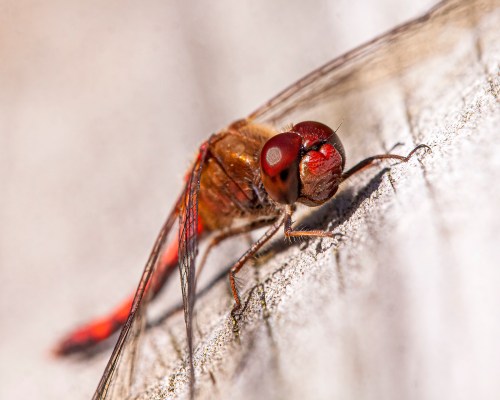
I spent most of my time that day trying to photograph little birds, like sparrows and goldfinches. In the early afternoon, though, I changed lenses when I spotted some Autumn Meadowhawk dragonflies (Sympetrum vicinum) basking in the sun on the wooden rails of a split-rail fence. I have learned in the past that Autumn Meadowhawks are often willing to let me move in close for shots and sometimes they will even perch on me—the perfect scenario for me to use my beloved macro lens.

In the first photo, I was so close to the dragonfly that I was balancing the lens hood on the edge of the rail on which the dragonfly was perched. As you can see, the depth of field was pretty shallow and most of the body is blurry. I am ok with that, because the eyes are in relatively sharp focus—I encourage you to click on the image to see some of the amazing details that I was able to capture, include the hairy “stubble” on the dragonfly’s face.

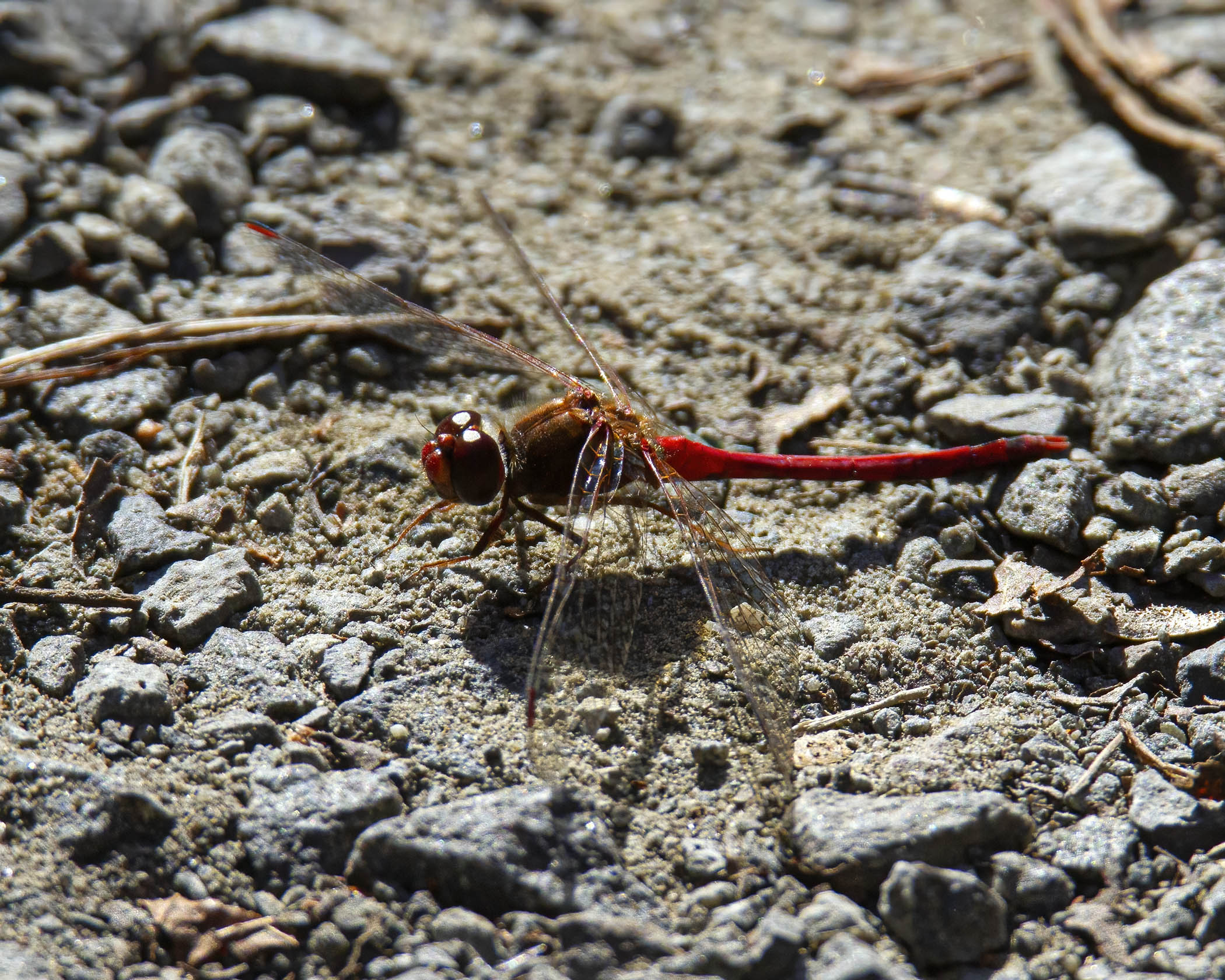
The second shot gives you a better overall view of the body of a male Autumn Meadowhawk. The bright red color of of its body really stands out again the backdrop of the brown fallen leaves and the gray gravel.

We will soon be moving forward to a new month. I am hopeful that November will include additional encounters with these colorful little Autumn Meadowhawk dragonflies.
Autumn Meadowhawk

Autumn Meadowhawk

© Michael Q. Powell. All rights reserved.

Read Full Post »

What marks the arrival of autumn for you? Is it the colorful fall foliage or perhaps the shortening of the daylight hours and the arrival of cooler weather? For me, the reappearance of Autumn Meadowhawk dragonflies (Sympetrum vicinum) is one of the surest signs of the change in the seasons.

It seems like I have had to wait longer this year than in the past, but I am finally starting to see these small reddish-orange dragonflies as I walk the trails at Occoquan Bay National Wildlife Refuge. On Monday I spotted my first male Autumn Meadowhawks of the season, as shown in the first two photos below. The coloration of the males is startlingly bright, but you actually have to look hard to spot them, because they are only 1.3 inches (33 mm) long and often perch on low vegetation or on the ground itself.

The final image showcases the two-toned look of a female Autumn Meadowhawk. She seems to be glancing over at me and smiling, confident in her radiant beauty, her warm coloration a beautiful reflection of the autumn season.

Autumn Meadowhawk

Autumn Meadowhawk

Autumn Meadowhawk

© Michael Q. Powell. All rights reserved.


Read Full Post »

The weather is turning cooler, but there are still some hardy dragonflies around, like this beautiful female Autumn Meadowhawk (Sympetrum vicinum) that I spotted last Thursday at Occoquan Bay National Wildlife Refuge, perched high on a branch as she basked in the autumn sunshine.

Most of the time when I see an Autumn Meadowhawk it is perched on the ground, so it was a treat to see this one on an elevated perch that gave me a really good look at the shape of her tiny body—Autumn Meadowhawks are only about 1.3 inches (33 mm) in length. This dragonfly species is generally the last one that I see each year and several years I have seen Autumn Meadowhawks in December. From my perspective, the dragonfly season is still far from being over.

Autumn Meadowhawk

© Michael Q. Powell. All rights reserved.

Read Full Post »
Each September I look forward to the reappearance of three dragonfly species: the Blue-faced Meadowhawk (Sympetrum ambiguum); the Autumn Meadowhawk (Sympetrum vicinum); and the Fine-lined Emerald (Somatochlora filosa). At a time when most of the other dragonflies are dying off, these species burst onto the scene.

This season, however, “burst” would not be the appropriate verb to describe their activity. At Occoquan Bay National Wildlife Refuge, where I have photographed all three species in the past, I have seen  Fine-lined Emeralds in flight three times, but have not managed to get a photograph of one. I still have not seen an Autumn Meadowhawk and until last Friday, I have not seen a Blue-faced Meadowhawk.

I was thrilled, therefore, when I spotted this female Blue-faced Meadowhawk on Friday. I had my long telephoto zoom lens on my camera, so trying to focus accurately on my tiny subject was a big challenge, but I am pretty happy with the result. Females of this species have relatively subdued coloration—the males have bright red bodies and blue faces—and they are generally harder to find than the males.

I hope to be able to feature a new photo of a male Blue-faced Meadowhawk soon, but if you are impatient or curious to see what one looks like, check out this posting called Blue-faced Meadowhawk (male) from September 2020.

Blue-faced Meadowhawk

© Michael Q. Powell. All rights reserved.

Read Full Post »

It was cold and windy yesterday when I set out for Occoquan Bay National Wildlife Refuge, about 44 degrees (7 degrees C), but I thought that there might be a chance that I could find a dragonfly, because the sun was shining brightly. This late in the season, there is only one dragonfly species still present in my area, the Autumn Meadowhawk dragonfly (Sympetrum vicinum), and its days are almost certainly numbered. I was heartened by the fact that a fellow photographer had spotted an Autumn Meadowhawk this past weekend and the knowledge that fellow dragonfly enthusiast spotted one on 3 January 2016—a new late-date for a dragonfly in Virginia. (Check out his posting for more details.)

I spent most of my time looking for birds, but I would slow down and look closely at the ground whenever I came to a sun-lit patch of ground. Autumn Meadowhawks often perch flat on the ground and love to bask in the sun. I was nearing the end of my normal loop when I finally spotted an Autumn Meadowhawk, the only one that I would see all day.

I had my 150-600mm zoom lens on my camera and it has a minimum focusing distance of almost nine feet (2.7 meters), so I had to back us a bit to get the dragonfly in focus. Autumn Meadowhawks, are pretty small, about 1.3 inches in length (33 mm), so it was a challenge finding the dragonfly in my camera’s viewfinder—fortunately the bright red color of its body helped me to locate the dragonfly. I managed to snap off two shots before the dragonfly flew away.

I am amazed and delighted by the hardiness of these little dragonflies and will search for them again whenever I am out with my camera this month. I decided to include a photo of an Autumn Meadowhawk that I photographed on 16 November, because it really shows off really well the autumn habitat of this species. For the last three weeks, I have put off posting that image, hoping that it would not be my last dragonfly sighting of 2020.

The season for dragonflies is not yet over!

Autumn Meadowhawk

Autumn Meadowhawk

© Michael Q. Powell. All rights reserved.

Read Full Post »

The end of the season has come for most species of dragonflies, with only a few hardy survivors still flying. However, I am delighted that to note that I am still seeing plenty of Autumn Meadowhawk dragonflies (Sympetrum vicinum) and expect to continue see them for at least a number of months. For me, the appearance of these bright red dragonflies is one of the signs of the change of the seasons.

I love trying to capture images of Autumn Meadowhawks perching on colorful fall foliage, but they are rarely as cooperative as the dragonfly featured in the first two photos. I’ll be trying to capture similar shots as the season progresses. The final photo provides a somewhat more isolated view of the stunning brown eyes of this male Autumn Meadowhawk and the beautiful red tones of its body.

The dragonfly season may be winding down, but from my perspective it is far from being over.

Autumn Meadowhawk

Autumn Meadowhawk

Autumn Meadowhawk

© Michael Q. Powell. All rights reserved.


Read Full Post »

As I was going through my photos again from last week I came upon this image of an Autumn Meadowhawk dragonfly (Sympetrum vicinum) that I had spotted at Occoquan Bay National Wildlife Refuge. I already posted another shot of this dragonfly species from that day, but I like this shot even more, because it shows some of the details of the leaves on which the little red dragonfly was perched. I think the leaves help to give a better sense of the environment and emphasize the “autumn” in the name of the species.

Autumn Meadowhawk

© Michael Q. Powell. All rights reserved.

Read Full Post »

Older Posts »