Feeds:
Posts
Comments

Archive for the ‘Winter’ Category

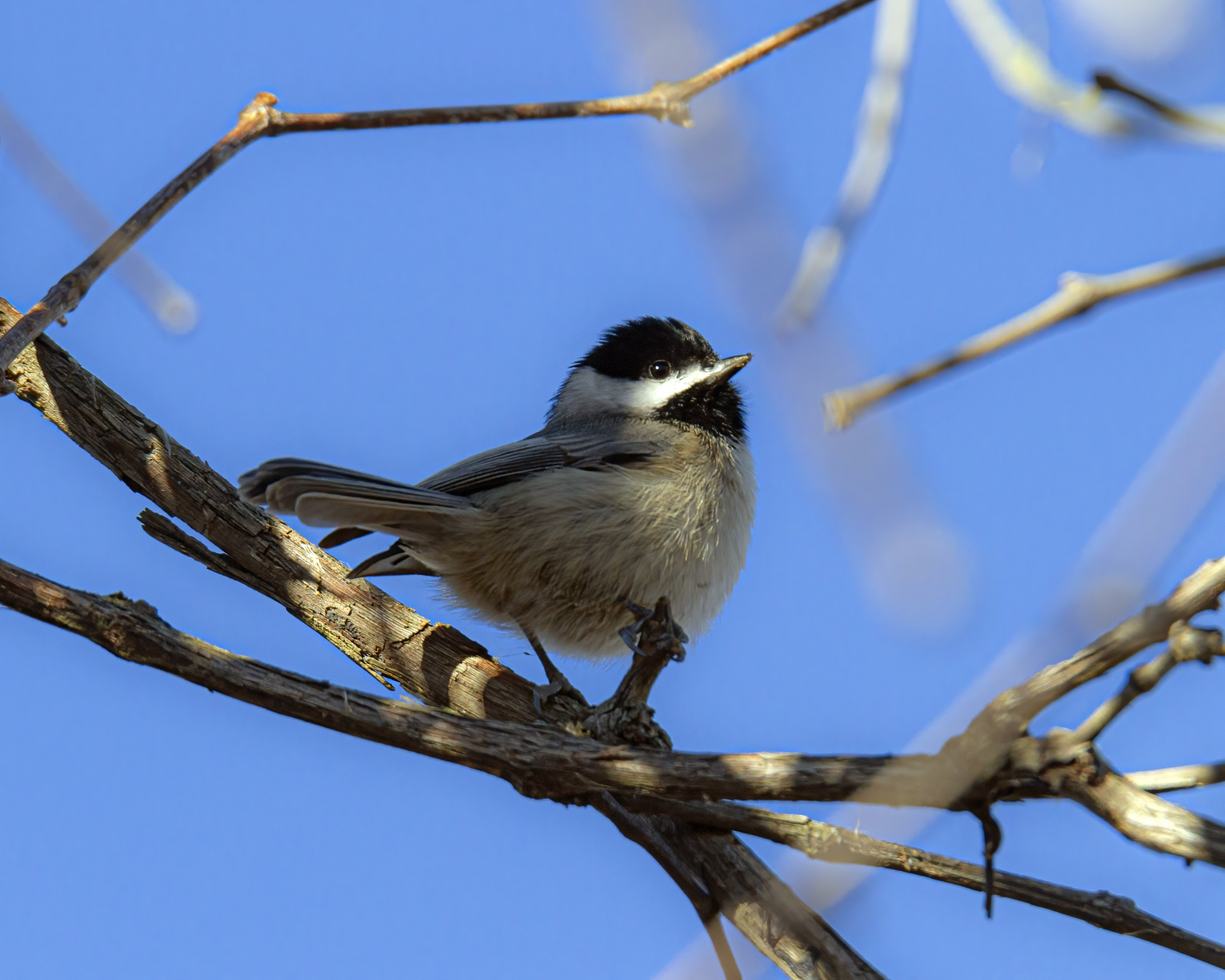
It is always a joy and a challenge to photograph tiny birds, like this cute little Carolina Chickadee (Poecile carolinensis) that I spotted last Friday at Occoquan Bay National Wildlife Refuge.

Even when they are perched, these chickadees are a bundle of energy and seem to be constantly changing head and body positions. As you can see from these two shots, the chickadee was surrounded by branches, so I had to bend and stretch a lot to get a clear shot. Lighting was also an issue, because the little bird often had its head pointed down and was covered with shadows.

I especially like the chickadee’s pose in the first photo, in which he was looking upward and the light was illuminating his face.

Carolina Chickadee

Carolina Chickadee

© Michael Q. Powell. All rights reserved.


Read Full Post »

I was delighted to spot this stunning male Redhead duck (Aythya americana) on Friday in the waters off of Occoquan Bay National Wildlife Refuge. I have seen this species only a few times, so I initially was not able to identify it. However, as I was capturing these shots, I was pretty sure that the duck’s stunning brown head, black-tipped bill, and  distinctive yellow eyes would make it easy to find in my bird identification guide—I was right.

According to the Cornell Lab of Ornithology, Redheads are exceptionally gregarious and gather in large flocks in the winter, especially in the Gulf of Mexico. On this occasion, however, this Redhead appeared to be by himself.

The Redhead was quite far away, so I had limited options for composing my shots as I walked along the water’s edge. I managed to incorporated some of the environmental elements to come up with a couple of images that I really like—although it may appear that the duck is perched on rocks, I think that they may be portions of a waterlogged tree trunk or stump.

Redhead duck

Redhead duck

© Michael Q. Powell. All rights reserved.

Read Full Post »

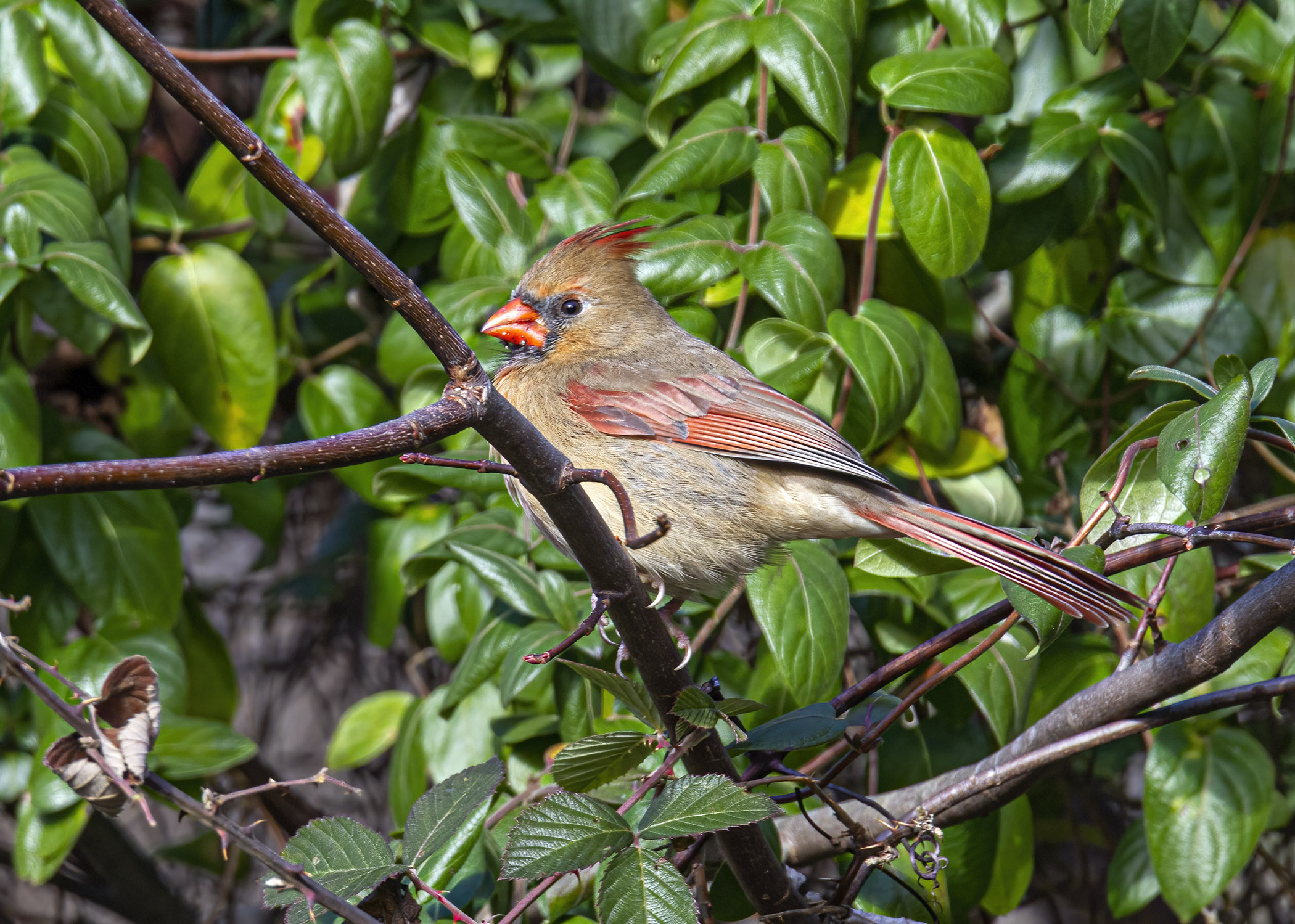
The coloration of female Northern Cardinals (Cardinalis cardinalis) is not as bold and flashy as their male counterparts, but I think they are equally beautiful, like this one that I photographed recently at Occoquan Bay National Wildlife Refuge.

I do love bright colors—I drive an Ignition Orange KIA Soul—but I think there is something more refined and sophisticated when those colors are used in moderation as accents. That is why I really like the way a female cardinal has reddish streaks in her crown and on the outer portions of her wings.

Northern Cardinal

© Michael Q. Powell. All rights reserved.


Read Full Post »

Birds have to work really hard to find food during the cold season. This female Red-wing Blackbird (Agelaius phoeniceus) decided that it was worth her effort to try to extract some seeds from the spiky seed pods of a sweetgum tree earlier this month at Occoquan Bay National Wildlife Refuge.

Some of you may be wondering how this can possibly be a Red-winged Blackbird. After all, this bird is not at all black and her wings are not red. When I first started getting serious about my photography more than 11 years ago, I would often go out shooting with my mentor Cindy Dyer, who loved to photograph flowers and sometimes insects. She rarely photographed birds and I had no experience identifying them.

During one such outing I photographed a bird on a rebar trellis at one a botanical garden. I assumed that it was one of the many types of sparrows that I lumped together as “little brown birds.” When I posted the shots in a Facebook birding forum, I was shocked to learn that it was a female Red-winged Blackbird. (Check out my 27 September 2012 blog posting called “Intense bird” for more details on that adventure, including my first ever shots of a female Red-winged Blackbird. I also remember that 2012 encounter well because I was shooting with a Nikon D300 that Cindy had lent me along with a Tamron 180mm macro lens. I did not switch from Canon to Nikon, but immediately orders the Canon version of the lens, which continues to be one of my favorite lenses.)

I am a lot more knowledgeable about birds now and have reconciled myself to the reality that many species derive their names from the males, who tend to be more colorful in appearance. As most of you know, I love to photograph insects, particularly dragonflies, but they have now completely (or maybe almost completely) disappeared from the scene, so I will be focusing my camera and my attention mostly on birds in the upcoming cold months.

Red-winged Blackbird

© Michael Q. Powell. All rights reserved.

Read Full Post »

White-throated Sparrows (Zonotrichia albicollis) always remind me of Santa Claus. They show up in the winter, have white beards, and are often chubby. I spotted this White-throated Sparrow last Friday at Occoquan Bay National Wildlife Refuge.

I thought that perhaps it was the angle at which I photographed this bird that made it look rotund, but the sparrow looked just as spherical when it changed its pose, as you can see in the second photo.

The bird reminds me of the time when the priest at my church remarked that he used to worry about getting into shape until he realized that round is in fact a shape. More recently I saw a meme that stated that Thanksgiving is the time of the year when many men decide to get in shape—in shape to play Santa Claus.

Have a wonderful day!

White-throated Sparrow

White-throated Sparrow

© Michael Q. Powell. All rights reserved.


Read Full Post »

One of the most distinctive ducks that migrates into my area for the winter is the Hooded Merganser (Lophodytes cucullatus). The male has a curious-looking head that is black and the white and the female has an orange-brown hairstyle that literally sticks out.

Sometimes Hooded Mergansers arrive in groups and I have seen some recent photos by local photographers of males competing for the attention of the females. In this case, cover, I spotted only one couple at the small suburban pond not far from where I live. The ducks dozed a bit and occasionally preened their feathers, so there was not a whole lot of action to capture. I was content to capture a few “record” images and hope I will have some more chances to see these little diving ducks in the upcoming months.

Hooded Merganser

Hooded Merganser

Hooded Merganser

© Michael Q. Powell. All rights reserved.

Read Full Post »

There are almost always a few Great Blue Herons (Ardea herodias) at Occoquan Bay National Wildlife Refuge. Most often I see them patiently fishing in the water, but sometimes I have to scan the tangled vegetation surrounding the ponds to find them, as was the case last Friday. Some herons are very skittish and fly away as soon as they sense my presence, but this heron remained in place while I carefully composed this image and continued silently along the trail.

Unlike the Great Egrets, Green Herons, and Ospreys that leave our area in the winter, Great Blue Herons are with us year round. Now that the weather is getting colder and we have already had our first snowfall (it was less than a half-inch (1 cm) or so), I suspect that it is getting harder for herons to find food. I am sure, though, that I will continue to see herons foraging for food, including in the frigid waters of the ponds and the bay—even when the surface of the water freezes, there is enough movement in the water that there are some open areas.

Great Blue Heron

© Michael Q. Powell. All rights reserved.


Read Full Post »

It is fun to watch the acrobatics of tiny Ruby-crowned Kinglets (Corthylio calendula) as they forage for food, like this one that I photographed last Thursday at Occoquan Bay National Wildlife Refuge. I love the twisting, spiral shape of the little branchlet on which the kinglet is perched so much that I might well have photographed it even if the kinglet were not there. The yellow colors in the background are a huge plus in creating an autumnal feeling in this image.

© Michael Q. Powell. All rights reserved.

Read Full Post »

I spotted this pretty little sparrow on Wednesday at Occoquan Bay National Wildlife Refuge. When I looked through my bird identification guide, I thought that it looked a little bit like a Chipping Sparrow. When I posted the photo below in a birding group on Facebook, however, some experienced birders identified this bird for me as a young White-crowned Sparrow (Zonotrichia leucophrys), a new species for me.

Sparrows can often be hard for me to identify, but the distinctive bill on this one helped me to narrow down the pool of potential species. A mature male White-crowned Sparrow has a black and white head and is easy to identify, but immature males and females of different species are often similar in appearance.

White-crowned Sparrow

© Michael Q. Powell. All rights reserved.


Read Full Post »

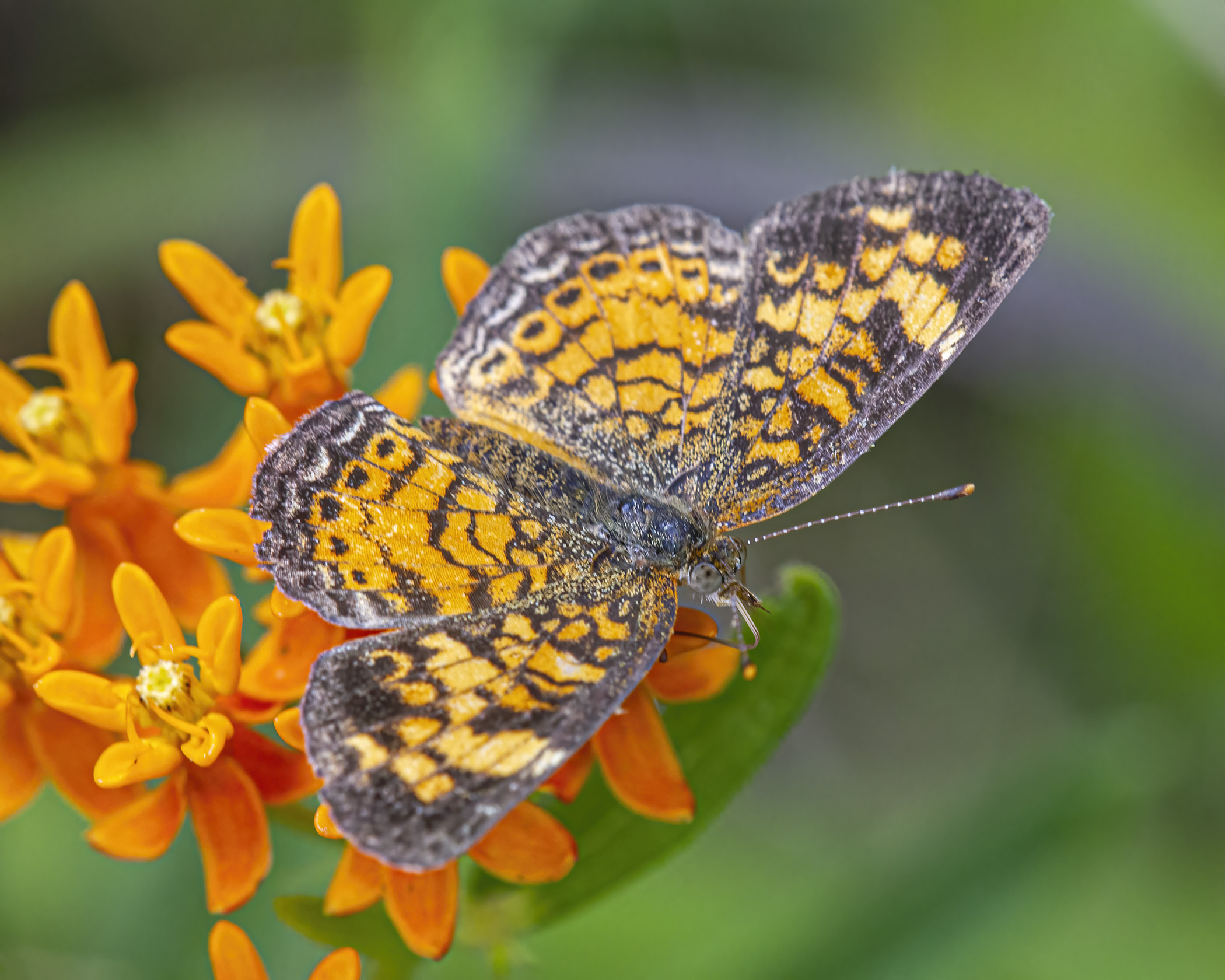
It is always a joy to see butterfly weed (Asclepias tuberosa), a bright orange species of milkweed that is full of nectar and attracts lots of butterflies. On Monday I spotted what I believe is a Pearl Crescent butterfly (Phyciodes tharos) feeding on some butterfly weed at Huntley Meadows Park in Alexandria, Virginia. I spotted some regular milkweed earlier in the day and was hoping to see my first Monarch butterfly of the season, but, alas, I came up empty-handed this time.

I love bright colors and some of you may recall that I drive an Ignition Orange KIA Soul. I was delighted to be able to capture some of the beautiful details and color of the butterfly weed and also some details of the butterfly, including its striking eyes and extended proboscis.

Pearl Crescent

© Michael Q. Powell. All rights reserved.

Read Full Post »

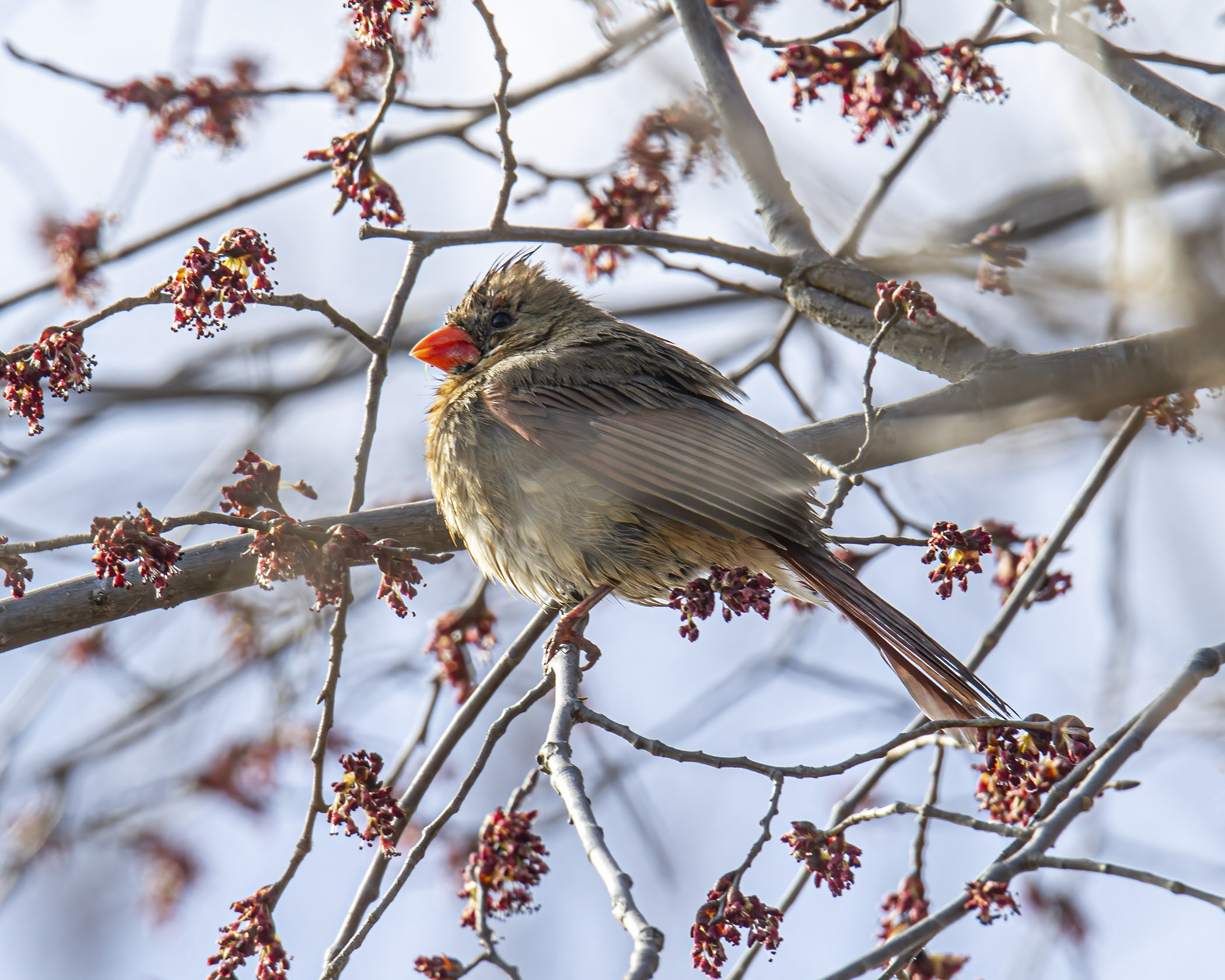
I was delighted to capture some images of a female Northern Cardinal (Cardinalis cardinalis) last Wednesday at Occoquan Bay National Wildlife Refuge. Although the cardinal was a bit scruffy in appearance, I found her to be quite attractive—I have always like the muted tones of the female cardinal, which does not stand out as much as her bright red male counterpart.

As you can see from the two photos, the cardinal was perched in a flowering tree, yet another sign that spring has almost arrived in Northern Virginia. I am not very good in identifying trees, but one of my Facebook friends suggested that it is a maple tree.

If you look closely at the final photo, you will see that the female cardinal was consuming some of the tiny seeds and/or flowers of the maple tree. I encourage you to click on that photo to get a closer look at the cardinal’s feeding activity.

UPDATE: One of my readers, Alan of New Hampshire Garden Solutions, noted that the flowers on this tree are male flowers of the American Elm Tree. Thanks for the help in correctly identifying the tree.


Northern Cardinal

Northern Cardinal

© Michael Q. Powell. All rights reserved.

Read Full Post »

I spotted this Bald Eagle (Haliaeetus leucocephalus) couple on Wednesday as they perched closely together in a dead tree at Occoquan Bay National Wildlife Refuge. At this time of the year most eagle couples are nesting and one eagle is in the nest at all times.  It therefore felt a little strange to see this couple together in the open.

The two eagles were looking at a small pile of sticks in a nearby tree that looked almost like the start of a nest. The tree, though, looked far too small to support the weight of an eagle nest.

There is a bit of mystery and uncertainty about what is going on in this photo, an effect that was heightened by the overcast skie, which gave the image a monochromatic look.

Bald Eagle

© Michael Q. Powell. All rights reserved.

Read Full Post »

This tiny Golden-crowned Kinglet (Regulus satrapa) seemed pretty excited on Wednesday at the appearance of tender young buds on the trees at Occoquan Bay National Wildlife Refuge. The kinglet has probably had to subsist on a diet of dried-up seeds during the winter, so the buds are undoubtedly a welcome treat.

Golden-crowned Kinglets are energetic and acrobatic and I really enjoyed watching this one feeding, who sometimes seemed to defy gravity. The images reflect only some of the varied poses of the kinglet—in most of my other shots the kinglet had its head down or was looking away.

I particularly like the pose in the final shot in which the kinglet is hanging horizontally and looking right at me. One of my Facebook friends thought that I was lying down and looking upward when I took that shot, but I can assure you that I was standing upright at that moment.

Golden-crowned Kinglet

Golden-crowned Kinglet

Golden-crowned Kinglet

© Michael Q. Powell. All rights reserved.

Read Full Post »

Yesterday I observed the “changing of the guard” at one of the Bald Eagle (Haliaeetus leucocephalus) nests at Occoquan Bay National Wildlife Refuge. I was watching the nest and could see the white head of the eagle as it sat in the nest, when suddenly the eagle stood up and took off a few moments later. A short time later, the second eagle landed at the nest to take over nesting responsibilities.

I had a tricky time trying to track the departing eagle, because it flew among the trees initially. The three photos below show different wing positions that I was able to capture during the eagle’s flight. In the final photo, the eagle seems to be glancing in my direction. I thought I was pretty well-hidden by the vegetation, but an eagle’s vision is so sharp that it is quite possible that it could see me clearly.

Bald Eagle

Bald Eagle

Bald Eagle

© Michael Q. Powell. All rights reserved.


Read Full Post »

I love to try to fill the frame with my primary subject by using a telephoto zoom lens or a macro lens. Getting as close to my subject as possible helps me to capture an incredible amount of detail in some of my photos.

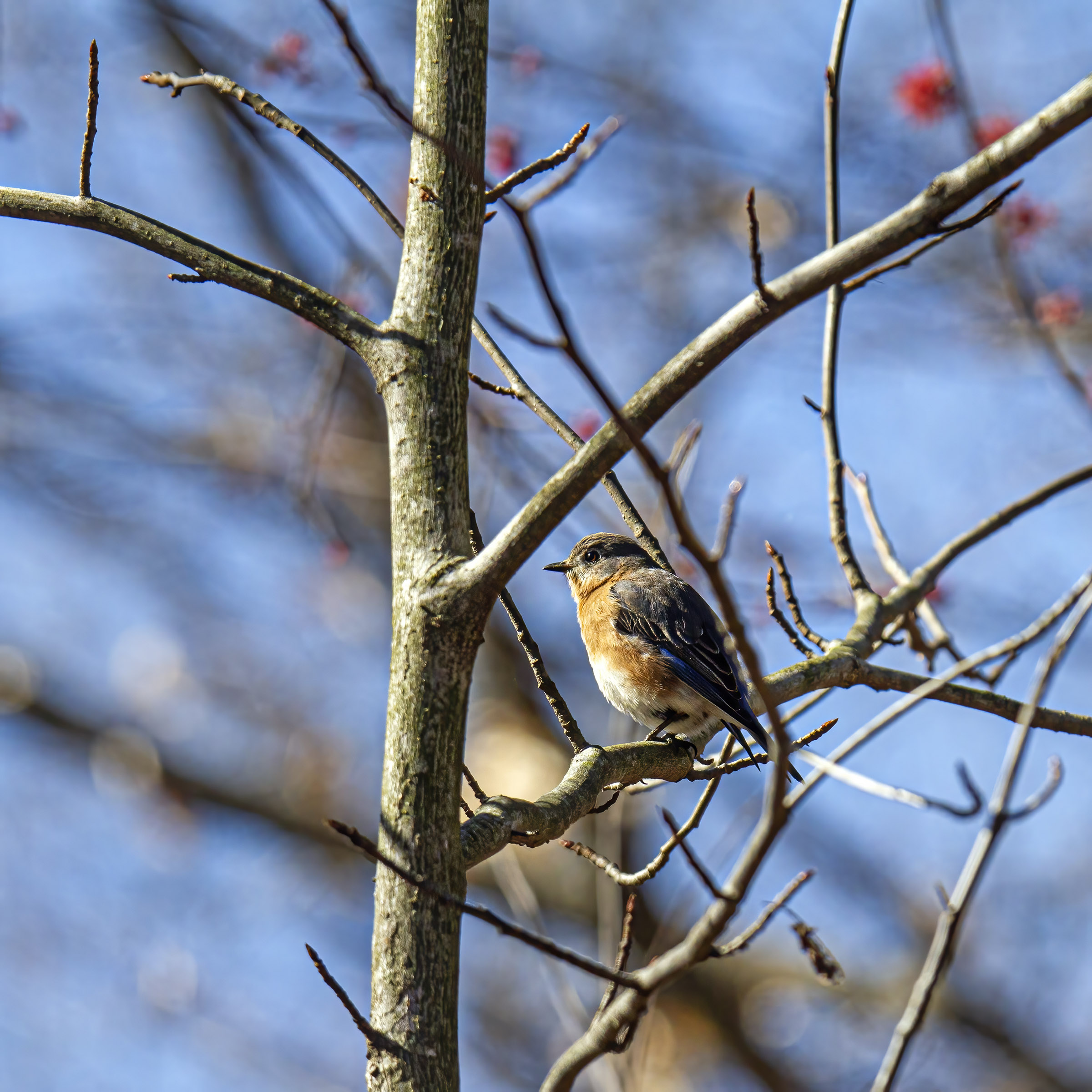
Sometimes, though, it is not possible or even desirable to zoom in on a subject, because I might then lose a sense of its context and environment, i.e. “the big picture.”  Last week I caught sight of a pair of Eastern Bluebirds (Sialia sialis) in the woods while I was wandering the trails at Occoquan Bay National Wildlife Refuge. They were pretty far away and the light was far from ideal, but I decided to try to take some shots anyways.

The first photo shows a female bluebird. When I started to work on the photo, the first thing I noticed was that the eye was nicely in focus, one of my normal goals when capturing images of living creatures. The second thing that really delighted me was the red buds that were sprinkled about in the background—many of the trees are now starting to sprout buds and blossoms.

The second photo shows the male bluebird. He was in the shadows, so his eye is not very visible. However, the blue color of his plumage was very prominent and stood out against a very neutral background. In this image, I tried to take advantage of the natural framing of the tree trunks and branches to draw attention to the bluebird.

Some of my fellow photographers like to shoot only when conditions are ideal, but I am willing to take a photo of almost anything that captures my attention. The resulting photos may not be amazing, but they can be quite pleasing, as was the case with these two images of distant bluebirds.

Eastern Bluebird

Eastern Bluebird

© Michael Q. Powell. All rights reserved.

Read Full Post »
As I was exploring a small pond last week at Occoquan Bay National Wildlife Refuge, I spotted a male Ring-necked Duck (Aythya collaris). Other than a few mallards at the other end of the pond, the Ring-necked Duck was all alone at the pond. I captured this image as the Ring-necked Duck swam up to a weathered mallard decoy and appeared to be trying to interact with it.

After a few moments without response from the mallard, the Ring-necked Duck slowly swam away, looking elsewhere for companionship. Perhaps he will have more luck with the turtles that were sunning themselves on the shore of the pond.

Ring-necked Duck

© Michael Q. Powell. All rights reserved.


Read Full Post »

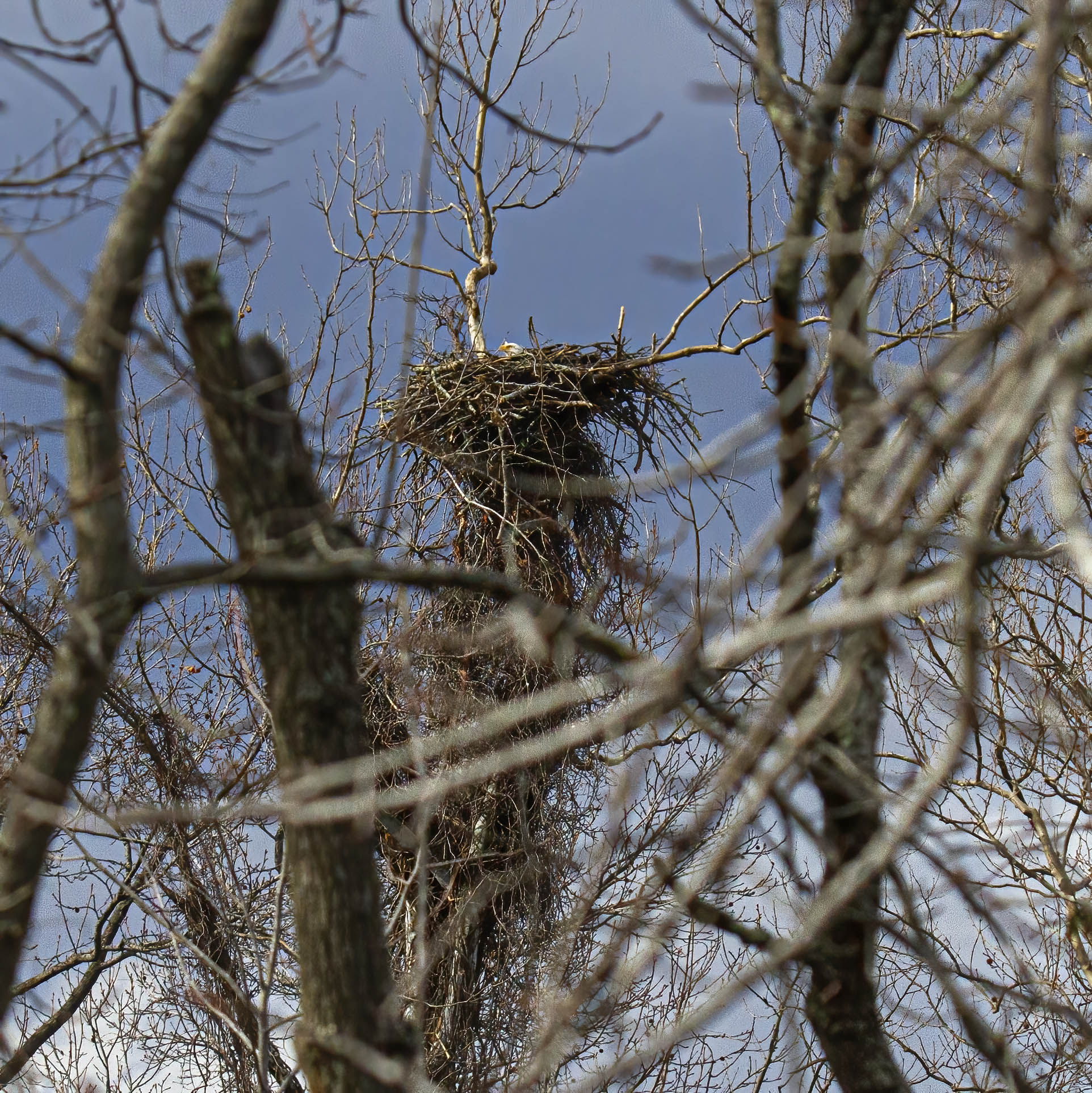
Over the last few weeks I have been seeing a lot of activity around three Bald Eagle (Haliaeetus leucocephalus) nests at Occoquan Bay National Wildlife Refuge. This past week I finally observed eagles hunkered down in two of the nests, which suggests to me there may finally be eggs in those nests. The third nest is so large and deep that it is impossible to see if there is an eagle (or even two) inside, especially if it is sitting on eggs.

The two nests in the photos below are fairly small, so you can just see the the top of the white head of the eagles. In both cases I was quite far from the nest when I captured my shots, so I really had to look carefully to see if there were any eagles visible in the nests. With a little luck, I’ll see eaglets in those same nests in the upcoming months and maybe I will be fortunate enough to get a few shots of them.

Bald eagle nest

Bald Eagle nest

© Michael Q. Powell. All rights reserved.

Read Full Post »

It was only three o’clock in the afternoon, so I was a bit shocked on Thursday when I spotted this North American Beaver (Castor canadensis) at Occoquan Bay National Wildlife Refuge. I have only seen beavers at this wildlife refuge a couple of times in the past and it was always near dawn or dusk.

I managed to snap a few photos before the beaver dove into the shallow water, swam through a culvert under the trail, and disappeared into the deeper waters of the bay.

beaver

© Michael Q. Powell. All rights reserved.

Read Full Post »

On Thursday I was thrilled to capture this shot of a Wild Turkey (Meleagris gallopavo) as he waded across one of the small streams at Occoquan Bay National Wildlife Refuge. Out of the corner of my eye I had caught a glimpse of the another Wild Turkey that had opted to fly over the stream a moment earlier, so I was prepared when this turkey emerged from the woods and slowly made its way across the stream.

During his crossing, the turkey flapped his wings from time to maintain his balance and to generate a bit of extra momentum, I suspect. In the image below, the turkey had almost reached the far bank of the stream. I like the sense of movement in the shot that is heightened by the open wings, the forward lean of the body, and the “beard” hanging away from the body.

Wild Turkey

© Michael Q. Powell. All rights reserved.

Read Full Post »
Yesterday at Occoquan Bay National Wildlife Refuge I had a short portrait session with a handsome male Canvasback duck (Aythya valisineria). When I asked him to smile, he gave me a wide, openmouthed grin, as you can see in the first photo. I like the way that the informal portrait shows his black and white breeding plumage, his chestnut-colored head, and his striking red eyes.

The Canvasback needed a more serious shot for work, so we captured the profile image that you see below. Most of the time I have trouble convincing birds to pose for me, so it was nice to come upon this cooperative Canvasback.

Canvasback

Canvasback

© Michael Q. Powell. All rights reserved.

Read Full Post »

One of my favorite trails at Occoquan Bay National Wildlife Refuge follows the shoreline. In many parts of the trail, vegetation partially blocks my view of the water, but there are also open areas that let me get clear shots of ducks and other waterfowl. As I was nearing one such open area on Tuesday the water suddenly exploded—I had spooked a flock of American Coots (Fulica americana) that had been feeding close to the shore.

I quickly brought my camera up to my eye and snapped off a few photos. When I reviewed the resulting images on my screen, I really liked the sense of motion that I had managed to capture in the coots and in the water. I decided not to crop the two photos below, so you can get a sense of what I was seeing when I looked through my camera’s viewfinder. Neither image is super sharp, but I think that the slight blurriness enhances the almost abstract “feel” of the photos.

What do you think?

American Coots

American Coots

© Michael Q. Powell. All rights reserved.


Read Full Post »

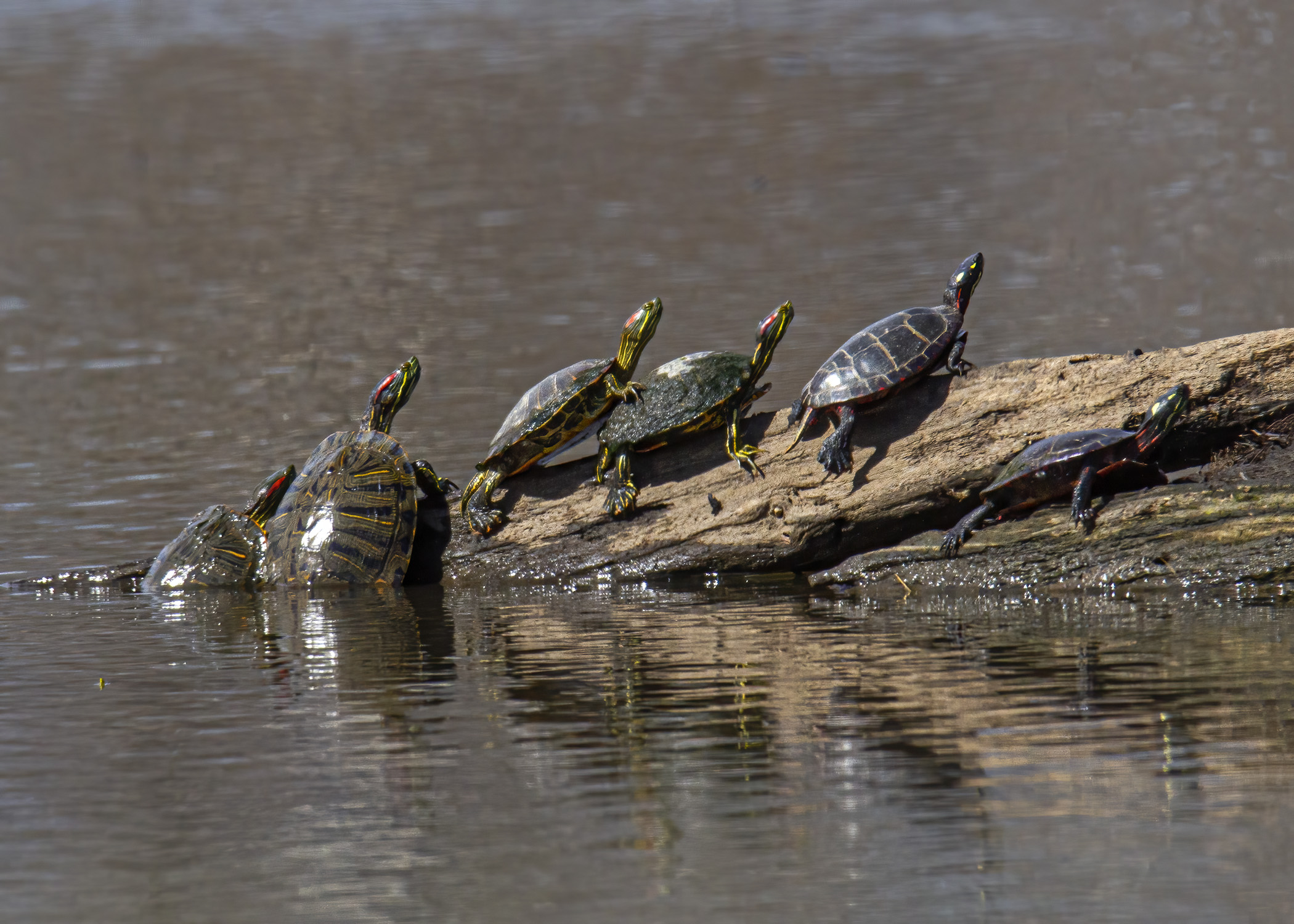
I was delighted yesterday to see that some of the turtles at Occoquan Bay National Wildlife Refuge were taking advantage of the spring-like weather to bask in the sun. I believe that the turtles spend most of their time in the mud at the bottom of the pond during the winter and in you can see mud still caked on the back of at least one of the turtles in the photo.

I think that the four turtles on the left are Red-eared Sliders (Trachemys scripta elegans) and the two on the right may be Painted Turtles (Chrysemys picta). I spotted a few small flies buzzing about yesterday, but it is almost certainly too early for my beloved dragonflies to appear. Several butterfly species, including the Mourning Cloak, overwinter as adults, so there is a chance that I will see one in the coming days.

turtles in February

© Michael Q. Powell. All rights reserved.

Read Full Post »

Sometimes I am able to get shots of Bald Eagles (Haliaeetus leucocephalus) when they are perched in the open, but most of the time I have an obstructed view of the eagle when I first spot it. I will then move as slowly and carefully as I can to a spot from which I have a somewhat clearer view of my subject. From that spot I will lean and twist and bend in an effort to find a visual tunnel through which I can see at least the head of the eagle—it is ok for me if the body is blocked by vegetation, but I really want to see the eyes of the eagle.

When you initially look at the two images of the eagle below, you may think that the second one is simply a cropped version of the first one. If you examine the little branches more closely, you will see that I took them from two different shooting angles.

I was a bit farther away when I captured the first image and my goal was to frame the eagle with the larger branches. In the second image, I had moved a bit closer to the eagle and was showing upwards toward it. This second angle provides a somewhat more intimate portrait of the eagle as it is nestled in among the small branches and spiky balls of the sweetgum tree.

I know that I am going to have a limited number of encounters with eagles, so I try to make each one “count” by taking shots from as many different angles as possible, never knowing for sure which photos will have the most impact until I review them later on my computer screen.


Bald Eagle

Bald Eagle

© Michael Q. Powell. All rights reserved.


Read Full Post »

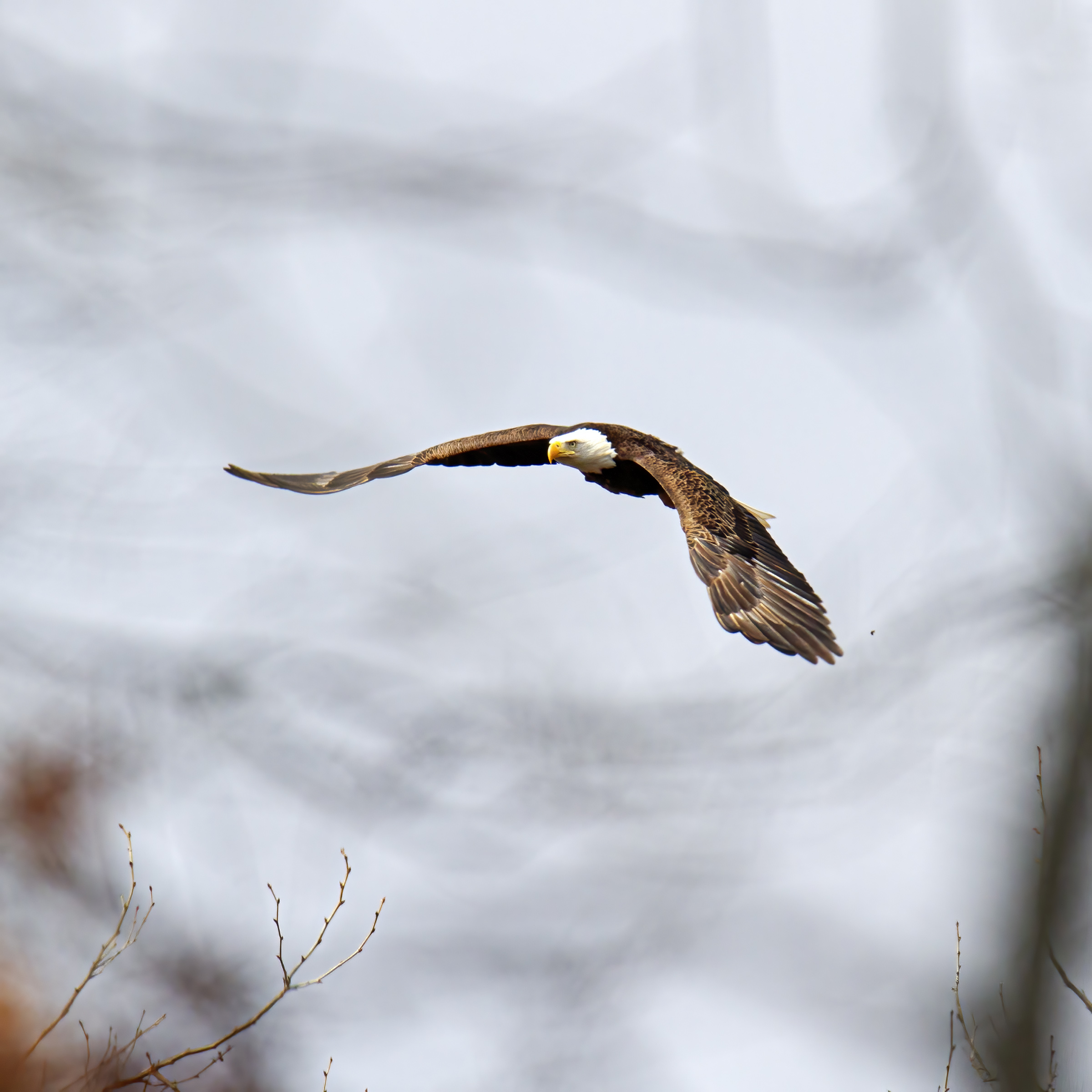
My good luck with Bald Eagles (Haliaeetus leucocephalus) this winter is continuing. Last Wednesday I was able to capture these images of an eagle in flight at Occoquan Bay National Wildlife Refuge. The eagle was flying from a nest to another perch and my camera was at my eye and ready as it flew by me.

I am pretty happy with these shots, but, of course, I’ll be returning to the refuge again and again with the hope of getting even better ones.

Bald Eagle

Bald Eagle

© Michael Q. Powell. All rights reserved.

Read Full Post »

Although there are increasingly signs that spring is on the way, we still are very much in the gloomy grip of winter. Somehow this rather monochromatic image of a Northern Mockingbird. (Mimus polyglottos) is a good match for the “feel” of this time of the year. I spotted this mockingbird last Wednesday as it was perched on a clump of sumac plants at Occoquan Bay National Wildlife Refuge. Most of the berries were already gone this late in the season, but the mockingbird managed to find a few. I captured this image as the mockingbird lifted its tiny prize upwards and prepared to swallow it.

Northern Mockingbird


© Michael Q. Powell. All rights reserved.

Read Full Post »

From time to time I spot a Great Blue Heron (Ardea herodias) in a tree, but usually the heron is perched in a distant tree. On Wednesday at Occoquan Bay National Wildlife Refuge, however, I did not see the heron until I was almost underneath it. The heron was standing high in a tree that was overhanging the trail on which I was walking. The heron seemed a bit jittery, but instead of worrying about me, it kept glancing up in the sky—perhaps it was worried about the eagles that were flying about that day.

I captured a few images through the branches when I was below the heron and then moved past it a bit. I now had a slightly better view of the heron and was able to capture the final shot as the heron began to lift off from the tree.

Great Blue Heron

Great Blue Heron

Great Blue Heron

Great Blue Heron

© Michael Q. Powell. All rights reserved.

Read Full Post »

Last Thursday I enjoyed watching some juvenile Bald Eagles (Haliaeetus leucocephalus) chase each other around in the waters off of Occoquan Bay National Wildlife Refuge. They were really far away, but I managed to capture this fun image of them in action, with some Bufflehead ducks in the foreground adding additional visual interest.

It is a little crazy to attempt such long-range shots. The images are not super sharp and the contrast is often lacking. If I were a professional, I’m pretty sure that I would not post images like this one that are not of the highest quality. However, I’m an amateur, which means that I don’t have to worry about reputation or marketablility—I feel free to post images that I judge to fun, cool, or interesting, like these shot of juvenile eagles at play.

juvenile bald eagles

© Michael Q. Powell. All rights reserved.

Read Full Post »

Although it may look like this Double-crested Cormorant (Nannopterum auritum) was trying to recreate the “I’m Flying” scene from the movie Titanic (with Jack and Rose on the bow of the ship), it was simply trying to dry its feathers. It baffles my mind a bit to think that a bird that spends most of its time in the water has feathers that are not waterproof. According to the Cornell Lab of Ornithology, “They have less preen oil than other birds, so their feathers can get soaked rather than shedding water like a duck’s. Though this seems like a problem for a bird that spends its life in water, wet feathers probably make it easier for cormorants to hunt underwater with agility and speed.”

The little grouping of cormorants that I spotted last Thursday at Occoquan Bay National Wildlife Refuge looks like a family to me, with two parents and a juvenile, judging from their poses. In case you are curious, the little duck in the left-hand corner is probably a scaup.

As most of you know, I like to include the Latin name for my subjects whenever possible. Some of my readers live in other countries and may encounter the same or similar birds and insects, but know them by their names in their own languages. Strange as it sounds, Latin becomes our common language. According to Wikipedia, the Double-crested Cormorant has a relatively new Latin name. “It was formerly classified in the genus Phalacrocorax, but a 2014 study supported reclassifying it and several American cormorant species into the genus Nannopterum. The International Ornithology Committee followed this classification in 2021.”

Double-crested Cormorant

© Michael Q. Powell. All rights reserved.


Read Full Post »

Recently I have featured a number of photos of Bald Eagles (Haliaeetus leucocephalus) and their nests. Some of the photos make it look like I am close to the nests, but in fact I took the photos from quite a distance away with a telephoto zoom lens. In mid-December each year, the authorities at Occoquan Bay National Wildlife Refuge put up barriers to keep people from disturbing the nesting eagles.

The first photo below shows one of the barriers. The tallest tree to the left of the road is where the eagle nest is located. If you read yesterday’s posting entitled Three eagle nests, you make recognize the nest as the one in the sycamore tree in the third photo.

This year, a sign was posted at each of the barriers that explains the potential negative impact of the close presence of humans on the eagles. Hopefully these signs will help deter visitors from walking past the barriers. I have been told that in past years trespassers have in fact been apprehended and have paid hefty fines.

bald eagle

Bald Eagle

© Michael Q. Powell. All rights reserved.

Read Full Post »
It is fascinating to compare the size and construction of these three Bald Eagle (Haliaeetus leucocephalus) nests that I photographed last Thursday at Occoquan Bay National Wildlife Refuge. The first nest is by far the largest and is one that I feature quite regularly in my blog, including in yesterday’s posting. The second nest is new this year and, according to some fellow photographers, may be a converted osprey nest.

In recent months I have not seen any eagle activity at the nest in the sycamore tree in the third photo, so was not sure if it was being used this year. I was therefore delighted when I spotted a bald eagle in the nest last week and watched as its mate also flew in and they both perched on one of the branches of the tree. Although this nest was used in previous years, I believe that there were no eaglets born in it last year. It appears that one of the supporting branches for the nest broke off a year or so ago, dumping part of the nest, which was never very large, onto the ground.

Bald Eagle nest

Bald Eagle nest

Bald Eagle nest

© Michael Q. Powell. All rights reserved.

Read Full Post »
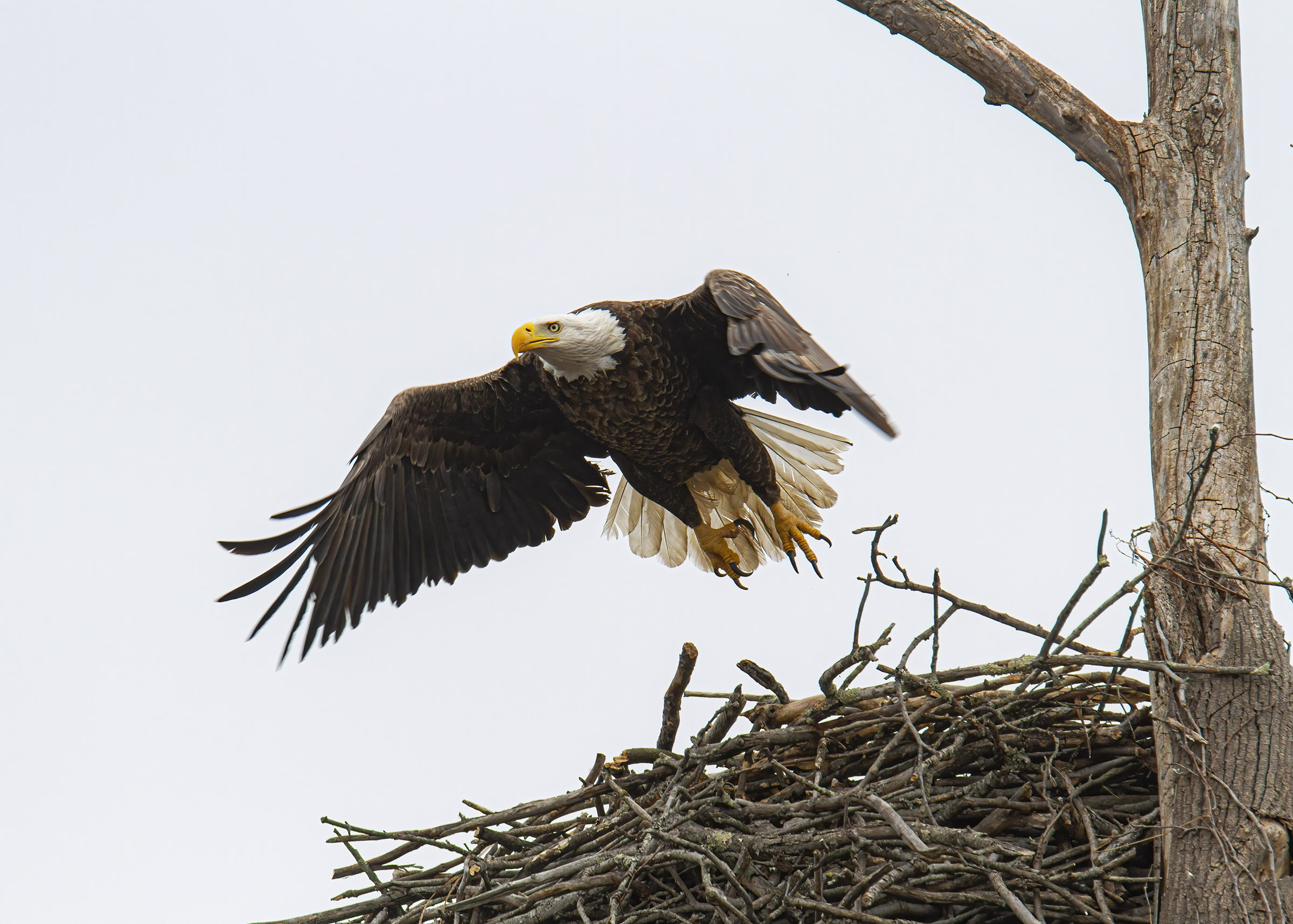
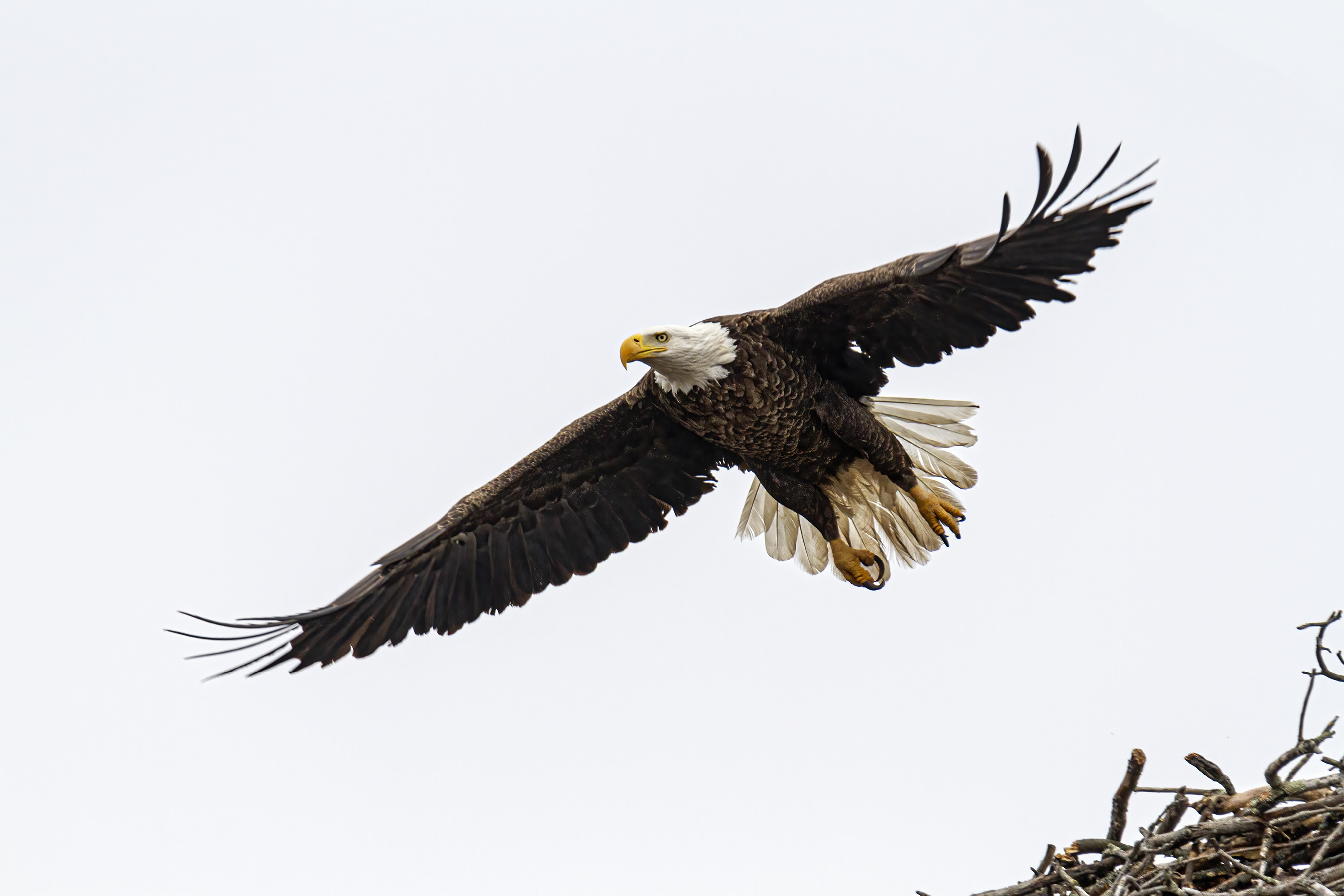
The sky was almost completely overcast last Thursday morning at Occoquan Bay National Wildlife Refuge and looked almost white in my photos, making some of my shots look like they were taken in a studio. Still, the uncluttered backdrop helps to draw the viewers attention to these cool images of a Bald Eagle (Haliaeetus leucocephalus) as it took off from the very large eagle nest at the refuge. The final photo, taken with my iPhone a few days earlier, gives you an idea of the setting in which the nest is located—the photos make it look like I was a lot closer to the nest than I actually was.

I spotted eagles perched on or in three separate nests that day, a clear sign that nesting season is almost here. The fact that the eagles did not remain continuously in the nest suggests to me that they are not yet sitting on eggs. I will continue to monitor the nests and with a little luck I may be able to see some eaglets in the upcoming months.

Bald Eagle

Bald Eagle

eagle nest

© Michael Q. Powell. All rights reserved.

Read Full Post »

« Newer Posts - Older Posts »