Feeds:
Posts
Comments

Archive for the ‘Winter’ Category

There were several groves of trees near the Munich airport hotel that I stayed in prior to my return flight to the United States. I figured there might be some birds to photograph and was happy when I spotted birds flitting about. They reminded me of chickadees, but were much more colorful.

I did a little research on-line and think that the bird in the first photo is a Eurasian Blue Tit (Cyanistes caeruleus) and the one in the second image looks to be a Great Tit (Parus major).  Apparently they are both pretty common, but they seem rare and exotic to me because they are not to be found in the area in which I live.

Eurasian Blue Tit

Great Tit

© Michael Q. Powell. All rights reserved.

Read Full Post »

I spotted this bird on Friday as I explored the area around my hotel near the airport in Munich, Germany. I am not sure of the exact name of the town, but it is one of many airport hotels that are in a relatively rural area adjacent to the airport.

I spotted the bird, which I was sure was some kind of a raptor, from a distance and was able to move a little closer to the mound on which it was perched. My initial thought was that it was some kind of hawk or falcon, but it was different from any of the ones that I have seen in my home area of Northern Virginia.

Thanks to the experts on a Facebook birding forum, I learned that this is a Eurasian Kestrel (Falco tinnunculus). It is somewhat similar to the American Kestrel, the smallest falcon that we have in North America, a species that I have seen a few times.

Eurasian Kestrel

© Michael Q. Powell. All rights reserved.

Read Full Post »

Yesterday I bought a round trip ticket on the Laben Bergbahn, a small mountain cable car in Oberammergau, Germany that took us quickly from 900m to 1684 meters. Some folks, however, bought a one-way ticket up the mountain and used an alternative mode of transportation to come down.

I am not sure if I am courageous or crazy enough to jump off a mountain like that and paraglide to the bottom.

parasailing

paragliding

paragliding

© Michael Q. Powell. All rights reserved.

Read Full Post »

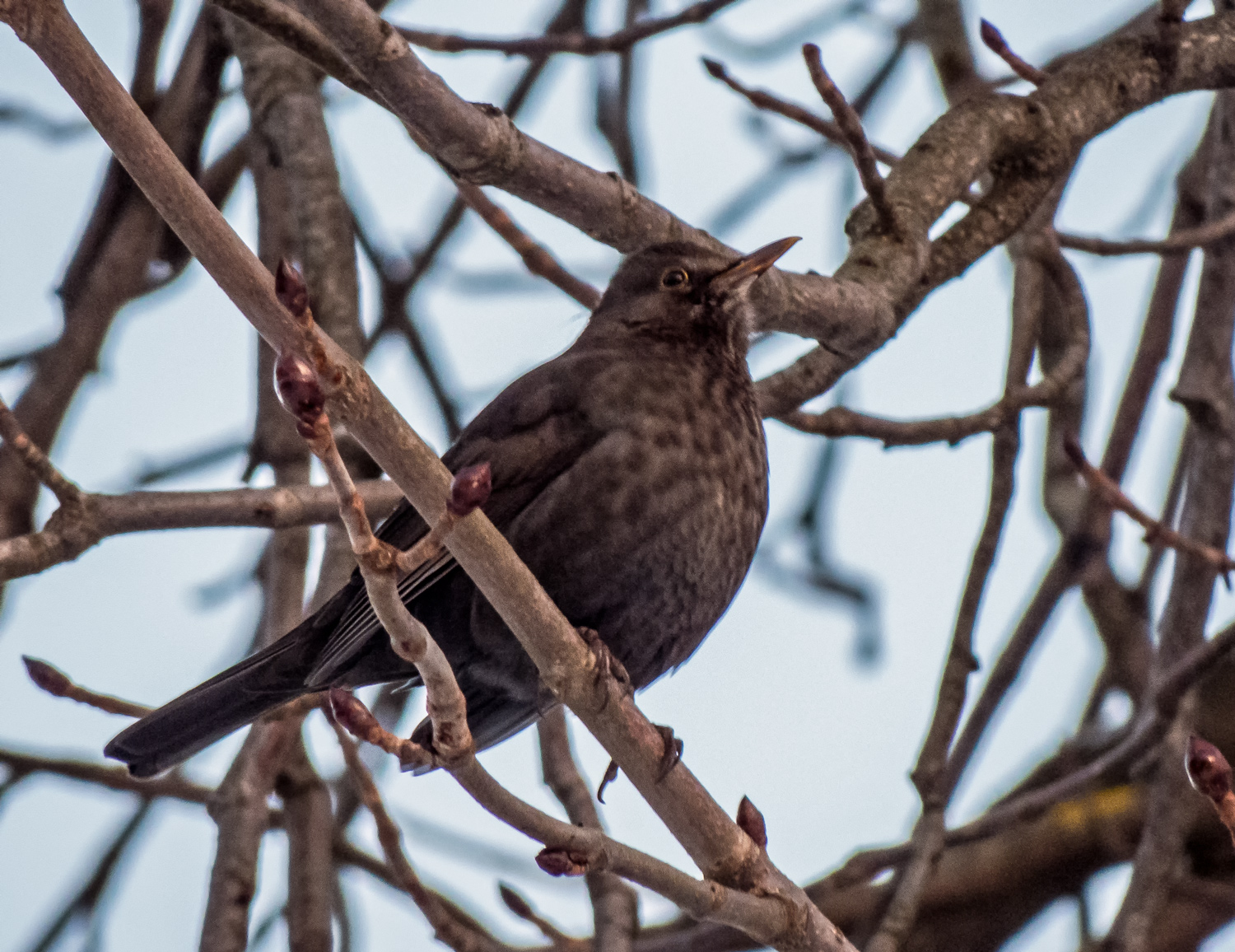
Blackbirds in Germany are more closely related to American Robins (Turdus migratorius)—both belong to the thrush family—than to Red-winged Blackbirds (Agelaius phoeniceus), which belong to an entirely different bird family.

Here is a shot that I took earlier this week of a female Eurasian Blackbird (Turdus merula) in Oberammergau, Germany. In many places this bird species is known as the Common Blackbird or simply as a blackbird. When I first spotted this bird, I was struck by two things. First, the shape of the body and bill reminded me immediately of a robin, even though the red-breast was not present. Secondly, the song that the bird was singing was melodious, unlike the sometimes grating calls of Red-winged Blackbirds.

Eurasian Blackbird

© Michael Q. Powell. All rights reserved.

Read Full Post »

I couldn’t see the sun actually setting on Wednesday in Oberammergau, Germany, but there was a glow in the sky and behind the mountains that was particularly beautiful.

As I rushed around in the fading light, trying to get some shots, I decided to include the Parish Church St. Peter and Paul, one of the most prominent buildings in this small Bavarian village. A few hours later, I captured the second image with a long exposure made by leaning my camera on a parked car. I love the architectural style of the church and included a third image to give you a better sense of the entire church structure.

Parish Church Oberammergau

Parish Church Oberammergau

Parish Church Oberammergau

© Michael Q. Powell. All rights reserved.

Read Full Post »

During most of my travel overseas, I stay at hotels operated by US chains, generally the Marriott. The accommodations are predictable, albeit a bit generic, no matter where I am in the world.

This week in Oberammergau, Germany, I am staying in the Alte Post Hotel, which is almost the antithesis of a hotel chain.  It is old, unique, and charming.

According to information in the hotel, it was initially known as the Lion Inn and was first mentioned in chronicles in 1612. Merchants frequently stopped in as early as the 17th century. In 1851, the first postal station was opened at the inn. In 1864 the inn, minus the postal station was purchased and the new owner renamed it as the Alte Post  (Old Post).

The hotel is a little quirky, but friendly, with lots of wood paneling, as seems to be the style in the region. The first photo below shows the front of the hotel. The second photo shows the view from my room that looks out onto the spectacular mountains.

Alte Post

Alte Post

© Michael Q. Powell. All rights reserved.

Read Full Post »

I spotted this White-throated Dipper (Cinculus cinclulus) on Sunday on the Ammer River in Oberammergau, Germany. This little bird, which is about 7 inches in length (18 cm) is also known as the European Dipper or simply a dipper.

Remarkably this bird walks on the stones on the bottom of a moving stream against the current, with its head downwards to locate prey, according to an article on oiseau-birds.com. According to this report, the current’s force against the bird’s bowed back keeps it on the river bed as it walks, propelled by wing movements. Of note, the White-throated Dipper is the national bird of Norway, according to Wikipedia.

White-throated Dipper

© Michael Q. Powell. All rights reserved.

Read Full Post »

Here is a shot of some of the distant mountains that surrounded me on Sunday afternoon as I wandered about in Oberammergau, Germany. From this small Bavarian town, there are impressive mountain views in virtually all directions.

There was already a significant amount of snow on the mountains and we had almost 6 inches of additional snow on Monday. Unlike in the Washington D.C. area where I live, things functioned as normal with this snowfall, including a surprising number of people riding bicycles.

mountain view from Oberammergau

© Michael Q. Powell. All rights reserved.
 

Read Full Post »

As I was exploring the Ammer River on Sunday afternoon, the day of my arrival in Germany, I spotted these two Common Merganser ducks (Mergus merganser). Initially they were sleeping with their heads tucked under their wings, but eventually they woke up and swam around a little and I was able to get some shots.

I am on a brief trip to Germany for work and am staying in the small Bavarian town on Oberammergau, in southern Germany. It is located in the mountains and at the moment has lots of snow. I did manage to get a few shots of the town and of the mountains on Sunday that I hope to feature later this week. Our work schedule looks to be pretty busy and I am not sure I will have the chance to get out again with my camera before I depart on Saturday.

Common Merganser

Common Merganser

Common Merganser

© Michael Q. Powell. All rights reserved.

Read Full Post »

Most of my readers know that I love to photograph Bald Eagles. (Haliaeetus leucocephalus). When I am lucky enough to catch one in flight, it usually is just as the eagle is leaving the tree or when it is high in the sky. About two weeks ago, I manage to capture this eagle from a different perspective as it flew by at a relatively low level. It is not the sharpest image I have ever taken, but there is something about the outstretched wings and the glimpse of the head under the wings that I really like.

Bald Eagle

© Michael Q. Powell. All rights reserved.

Read Full Post »

These Hooded Merganser (Lophodytes cucullatus) couples appeared to be on a double date when I spotted them earlier this week at a little suburban pond near where I live. It is now getting to be that time of the year when more and more birds are pairing off.

I took a lot of shots these ducks as they swam by and this is one of the few photos in which all four heads are visible and facing in the same direction. No matter whether you are  photographing animals, birds, or people, it is always a challenge to take a group photograph in which all subjects have pleasing poses..

Hooded Merganser

© Michael Q. Powell. All rights reserved.
Read Full Post »

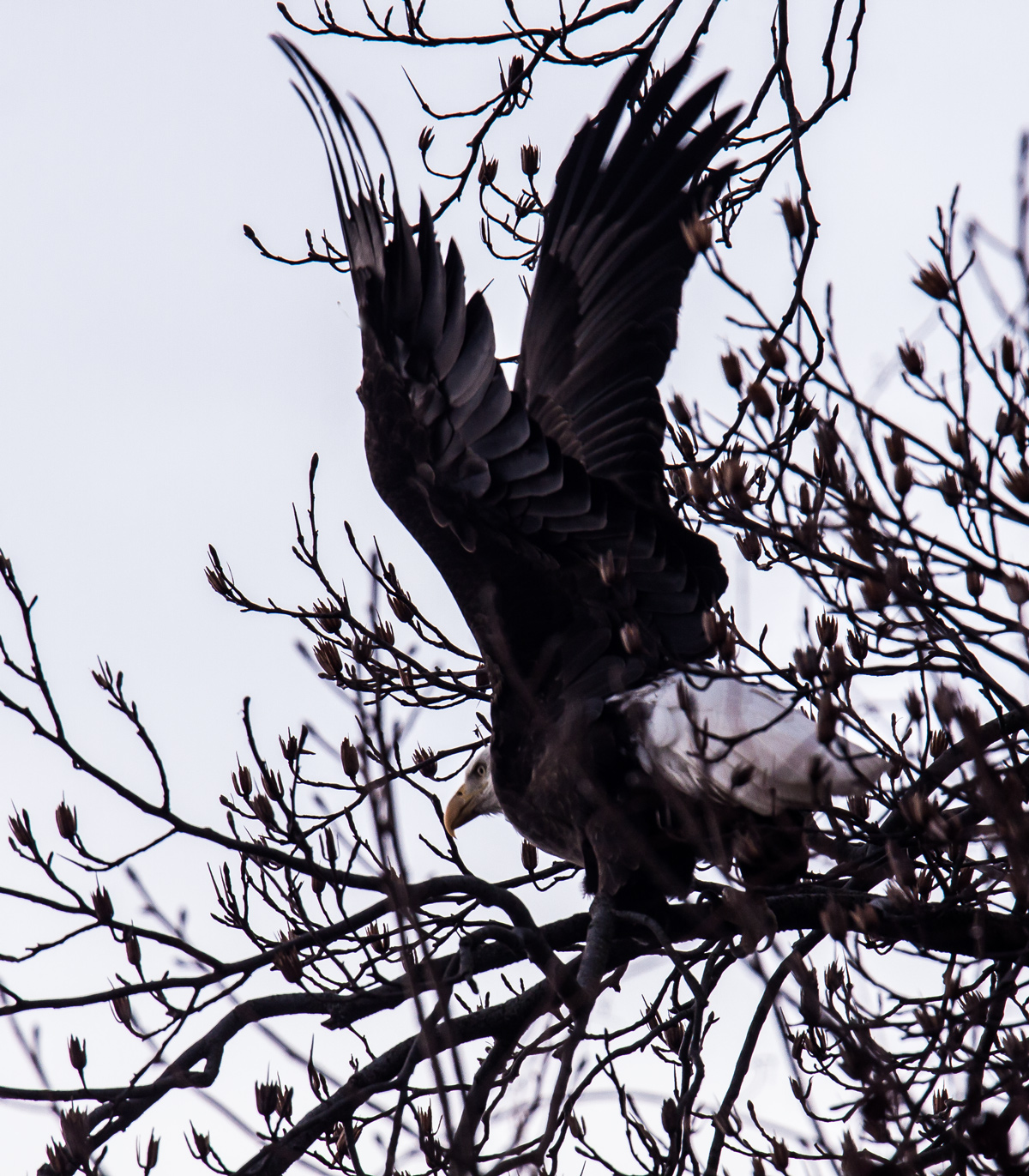
I watched and waited for an extended period of time yesterday as this Bald Eagle (Haliaeetus leucocephalus) groomed itself in a tree overlooking one of the trails at Occoquan Bay National Wildlife Refuge. I was pretty much in the open at the edge of the trail and did not dare to move forward for fear of spooking the eagle. Fortunately I had my camera and long telephoto zoom lens on a monopod, because I know from experience that I would not have been able to hold it pointed upwards for that long a period of time.

I tried to stay as alert and ready as I could, which can be quite a challenge after a while. Sometimes a bird will signal its intent to take off, but this eagle took off without a warning. Acting on instinct mostly, I managed to capture the first image when the eagle was just clearing the edge of the branches. In the second shot, I clipped off the edge of the wings, but decided to include it to give you an idea of the challenge of trying to track the speed a bird when it first takes off. The final image shows you what the eagle looked like when it was perched in the tree before the takeoff.

bald eagle

Bald Eagle

Bald Eagle

© Michael Q. Powell. All rights reserved.
Read Full Post »

This Red-shouldered Hawk (Buteo lineatus) was so puffed up early last Saturday morning at Occoquan Bay National Wildlife Refuge trying to stay warm that I couldn’t even see its feet—it was about 18 degrees (minus 8 degrees C) when I captured the image. The hawk seemed to be hunched over a bit and it looks like some of its lower feathers were draped over its feet.

Red-shouldered Hawk

© Michael Q. Powell. All rights reserved.


Read Full Post »

The sun had risen before I reached the water at Occoquan Bay National Wildlife Refuge this past Saturday morning, but there still was some color in the sky that was reflected by the ice along the shoreline, imparting blue and orange tinges to the ice.

In the second shot, I used the wide-angle capabilities of my Canon SX50 superzoom camera to give you an overall feel for the moment. As you can see, the sun was not yet very high in the sky and the clouds helped to direct the sun’s rays directly down onto the distant water, giving it a kind of shimmer. I am now accustomed to carrying both my DSLR and the SX50 to give me greater flexibility in capturing different situations.

winter sunrise

winter sunrise

© Michael Q. Powell. All rights reserved.

Read Full Post »

The sun was rising as I pulled into Occoquan Bay National Wildlife Refuge early yesterday morning. My view to the east was obstructed, but I did manage to capture this image of the fiery sun through the trees.

It was a fun challenge trying to choose settings for the camera that let me capture both the sun and the shapes of some of the individual trees. In some of my images, the trees became one dark indistinct mass, so I kept making adjustments as quickly as I could, because the sun seemed to be moving amazingly fast.

winter sunrise

© Michael Q. Powell. All rights reserved.

Read Full Post »

It will be a few more months until dragonflies reappear in our area, so for now I have to content myself with this one in my front yard that I photographed yesterday as the snow was gently falling. This metal dragonfly is part of a raised sprinkler that stands about three feet tall (about a meter).

I really like the way that the dragonfly has weathered and acquired various colors. I suppose I could talk of rust and tarnish, but I prefer to think of it as “patina.”

dragonfly

© Michael Q. Powell. All rights reserved.

Read Full Post »

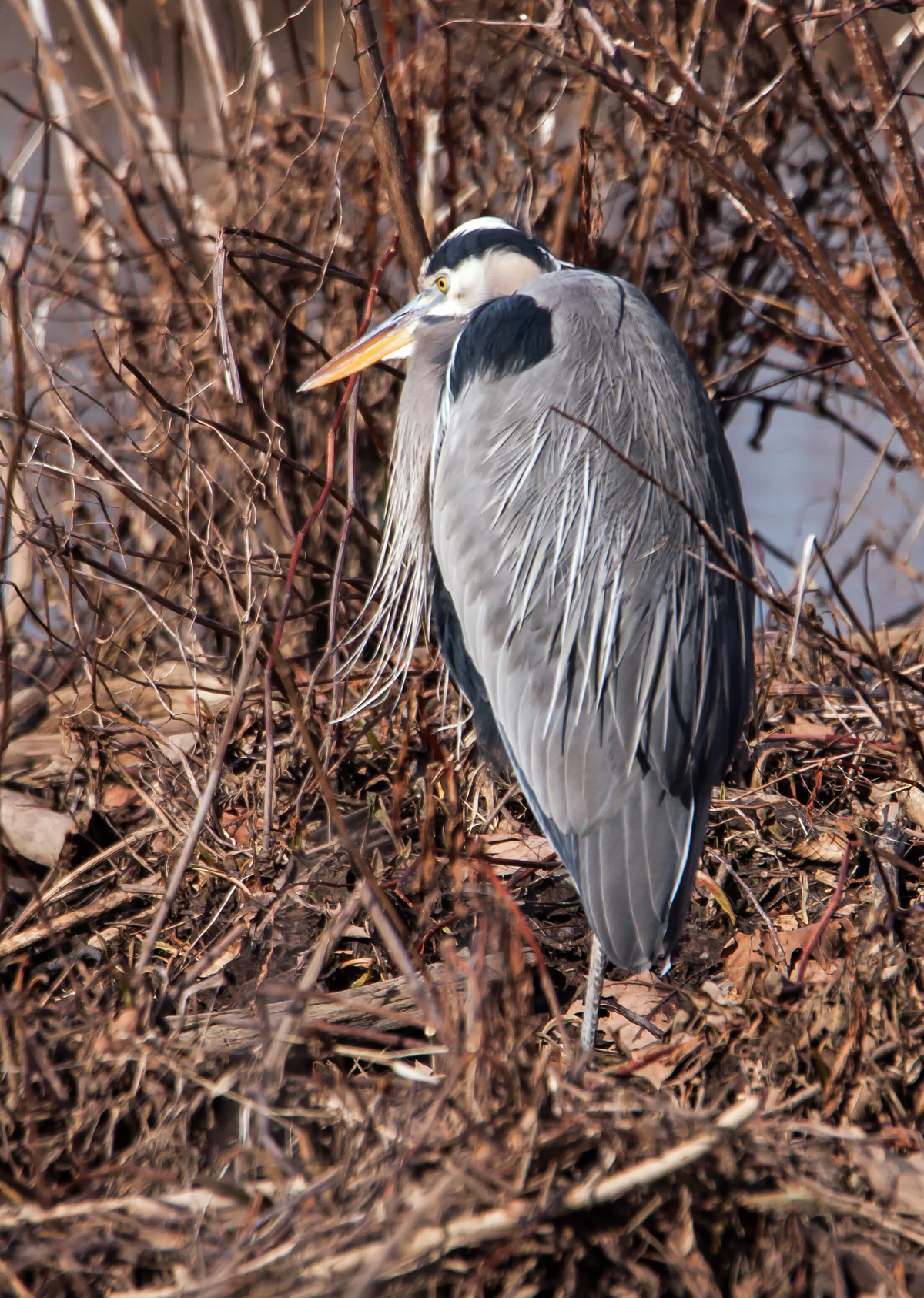
It was not as bitterly cold on Monday as it is today, but this Great Blue Heron (Ardea herodias) nonetheless seemed to be hunkered down at the edge of a pond as it sought to stay warm at Occoquan Bay National Wildlife Refuge. It almost looks like the heron is wrapped in a cloak of fluffed-up feathers with only a minimum amount of its body exposed to the elements.

Great Blue Heron

© Michael Q. Powell. All rights reserved.

Read Full Post »

Brown Creepers (Certhia americana) are tough to photograph as they spiral their way up tree trunks, so I was thrilled when I managed to get a mostly unobscured shot of one of these little birds on Monday at Occoquan Bay National Wildlife Refuge.

How small are Brown Creepers? According to information on the Cornell Lab of Ornithology website, Brown Creepers are 4.7 to 5.5 inches in length (12 to 14 cm) and weigh 0.2 to 0.3 ounces (5 to 10 grams). For the sake of comparison, the birds that I featured yesterday, Bald Eagles, are 27.9 to 37.8 inches in length (71 to 96 cm) and weigh 105.8 to 222.2 ounces (3000 to 6300 grams).

Brown Creeper

© Michael Q. Powell. All rights reserved.

Read Full Post »

How willing are you to show others your unedited images? When I first started getting more serious about taking photos six and a half years ago, I used to go out shooting with my mentor Cindy Dyer. When we were finished, we would immediately download my images and she would go through them with me.

It is a very humbling experience to let someone see all of your shots, but in doing so Cindy was able to see what I was attempting to do and how well I was succeeding in things like composition and camera settings. Her view was that I should try to get it as correct as I could in camera and not rely on software to fix my problems.

Earlier today I posted an image of a Bald Eagle (Haliaeetus leucocephalus) in a blog posting that I titled Unexpected eagle. In response to the posting, Liz of Exploring Colour asked me how much I had cropped the image. I answered her verbally, but then realized it would be more effective to show her the uncropped image and then the cropped one that I used in this morning’s post.

I was shooting with a Tamron 150-600mm lens at 600mm for this shot and that was what allowed me to fill so much of the frame with the eagle. It is very unusual for me to be able to get that close to an eagle without spooking it. When I am uncertain of the amount of time that I will have with a subject, I will usually use the center focus point of my camera and I think that is what I did here.

My DSLR is getting a bit long in the tooth and doesn’t have as many megapixels as some of the really new ones, which means I can’t crop as severely as some other photographers can without degrading the quality of my images. I have no objections to cropping, though I usually try to keep it as minimal as possible.

Bald Eagle

Uncropped image

bald eagle

Cropped image

© Michael Q. Powell. All rights reserved.

Read Full Post »

As I rounded a curve on a trail yesterday morning at Occoquan Bay National Wildlife Refuge, I looked up and realized there was a Bald Eagle (Haliaeetus leucocephalus) right in front of me. I reacted pretty quickly and managed to capture this image before the eagle spotted me and flew away.

Most of the time when I have been in similar situations, the eagle has spotted me before I spotted him and reacted before I did. In this case, I suspect that the eagle was either distracted or was looking in another direction when I first came into view.

bald eagle

© Michael Q. Powell. All rights reserved.

Read Full Post »

With most birds the shape of their heads is a constant, but with Hooded Mergansers (Lophodytes cucullatus), the shape can be wildly variable. I am not really sure how of the bird’s anatomy, but the “hood” appears to be pretty floppy, creating the effect of multiple “hairstyles.” Here are a few of the styles that a male Hooded Merganser was sporting during a brief period last week at a local suburban pond.

Hooded Merganser

Hooded Merganser

Hooded Merganser


© Michael Q. Powell. All rights reserved.
 

Read Full Post »

There was a sheet of ice in the center of the pond, but I had no idea how thin it was until a Ring-billed Gull (Larus delawarensis) that I was watching fell through the ice. I captured this little series of shots as the gull scrambled to regain its footing. Undeterred by its brief contact with the frigid water, the gull continued its solitary march across the ice, although it did seem to move a bit more slowly and cautiously.

Ring-billed Gull

Ring-billed Gull

Ring-billed Gull

© Michael Q. Powell. All rights reserved.


Read Full Post »

How would you dry off after a bath without a towel or a blow dryer? You might have to try the approach of this male Hooded Merganser duck (Lophodytes cucullatus), who rose out of the water and flapped his wings to dry off and fluff his feathers. Afterwards, the little duck spent a considerable amount of time adjusting the feathers with his bill, presumably to maximize their insulation value on a cold winter day.

Hooded Merganser

Hooded Merganser

Hooded Merganser

© Michael Q. Powell. All rights reserved.

Read Full Post »

The blue and gray colors of this male Ring-necked duck (Aythya collaris) seemed to be a perfect match for the cool tones of the icy waters of the suburban pond where I spotted him earlier this week. All of those cool colors also really make the warm yellow of his eyes stand out.

Ring-necked duck

© Michael Q. Powell. All rights reserved.

Read Full Post »

During the winter, there are fewer wildlife subjects to photograph than at other times of the year, so I find myself paying a lot of attention to each and every one. Earlier this week at a small suburban pond not far from where I live, I spent a lot of time watching a male Hooded Merganser duck (Lophodytes cucullatus) diving for food. “Hooded Merganser” is a long multi-syllabic name, so I affectionately refer to these ducks as “hoodies.”

This duck appeared to be the only member of his species at the pond, so he was not distracted by having to show off for the females. The “hoodie” would swim along and suddenly would dive. Initially I thought that there was no way that I could capture an image mid-dive—his actions seemed too unpredictable.

However, I gradually began to detect a pattern. It was fascinating to see how he would extend his neck, arch his back, and then plunge into the water. So, I watched and waited for him to extend his neck and then would start shooting. Most of the shots were not successful, but I did manage to capture a few fun photos of the diving “hoodie.”

Hooded Merganser

Hooded Merganser

Hooded Merganser

© Michael Q. Powell. All rights reserved.

Read Full Post »

One of my faithful viewers, Jet Eliot, commented on a recent posting that she was glad to get some views of the wildlife refuge where I take so many of my photos. (Jet has a wonderful blog that focuses on travel and wildlife adventures that is definitely worth checking out.) The problem is not that I don’t take shots of Occoquan Bay National Wildlife Refuge, it is simply that I get so excited about posting photos of the wildlife that I forget about the more static shots of the land and water.

Here are a few shot of the refuge from this past Monday that help give you a better idea of the environment in which I am operating. The first image shows you what part of the shoreline at the refuge looks like during low tide. The refuge is located where Occoquan Bay meets the Potomac River and during tidal surges, some of the shoreline paths are underwater. Those surges tend to bring lots of debris onto the shore, including trash, like the beer bottle that you can see in the photo.

The second shot gives you an idea of how close some of the trees are to the shore. After big storms, downed trees often block some of the paths. As you probably noticed, there was a full moon visible that morning as the sun was rising and adding a little color in the sky.

The final image shows one of the streams that runs through the refuge. It is not unusual to see herons or ducks in these streams and at certain times, when I am really lucky, I have managed to spot muskrats, beavers, and otters.

So that is a brief introduction to “my” wildlife refuge. I used to most of my shooting at another nearby location, Huntley Meadows Park, but it became really popular and crowded. I prefer the solitude of this location—I am overjoyed sometimes when I arrive at the refuge and find that my car is the only one in parking lot.

Occoquan Bay National Wildlife Refuge

Occoquan Bay National Wildlife Refuge

Occoquan Bay National Wildlife Refuge

© Michael Q. Powell. All rights reserved.


Read Full Post »

I focus my attention so much on photographing living creatures that I feel somewhat helpless when it comes to taking landscape shots. How do you figure out what the main subjects is, assuming that there is a main subject? As a result, I tend to take simplified landscape shots, ones in which lines and shapes take on an almost abstract value.

The absence of color in a cloud-covered sky last Friday rendered the world even more simplified and monochromatic when I took this photograph at Occoquan Bay National Wildlife Refuge. Despite the tire tracks in the snow, I was definitely alone that morning, taking the road less traveled. It was that feeling that I tried to capture with this image.

snowscape

© Michael Q. Powell. All rights reserved.


Read Full Post »

It was frigid this morning—11 degrees F (minus 12 C) when I first got into my car—and windy, but I was out at Occoquan Bay National Wildlife Refuge and captured these images as the sun was rising. It was wonderfully tranquil, with the silence broken periodically by the sounds of cracking ice and the creaking trees.

frigid dawn

frigid dawn

frigid dawn

© Michael Q. Powell. All rights reserved.

Read Full Post »

Even when the weather is bad and other birds are hunkered down, sparrows are invariably active. Most of the time they are at ground level, but occasionally one will perch a bit higher off of the ground and give me a chance to get a decent shot.

That was the case this past Friday at Occoquan Bay National Wildlife Refuge, when a Song Sparrow (Melospiza melodia) took a break and posed for me briefly on the end of a log. I liked the composition when I took the shot and decided to post it without any cropping. I also couldn’t help noticing as I was working on the image that the sparrow’s colors are almost a perfect match for those in the background.

Sparrows are really special to me too because both on my parents loved His Eye Is On The Sparrow, a hymn that reminds us that God cares for each one of us. That is a message I think we all can use right now, at a time when so many of us are stressed out over the situation in our respective countries and in the world in general.

Song Sparrow

© Michael Q. Powell. All rights reserved.

Read Full Post »

Yesterday I finally made my way out into the wilds of Occoquan Bay National Wildlife Refuge for the first time following our recent snowfall. The wildlife refuge is open despite the partial federal government shutdown, but I was pretty sure that the access road had not been plowed, so I waited a few day for road conditions to improve.

It was heavily overcast for much of the day and the wildlife seemed to have hunkered down. Sightings were pretty scarce, so I was really happy when I spotted this duck. It was already a good distance away from me and I think it sensed my presence about the same time as I saw it and started swimming away immediately. I had a pretty good idea that this was a female Common Merganser duck (Mergus merganser) and some friendly folks on a Facebook forum confirmed the identification.

As far as I know, this is the first time that I have spotted this species—I am more used to seeing the Hooded Merganser, whose female sports a similar hairstyle to that of the Common Merganser.

Common Merganser

Common Merganser

© Michael Q. Powell. All rights reserved.

Read Full Post »

Today I decided to feature two of the smallest birds that I spotted in the trees in my neighborhood after our recent snowfall. The first one is a Tufted Titmouse (Baeolophus bicolor), a little bird that is in the same family as the chickadee. The second one, I believe, is a House Finch (Haemorhous mexicanus), a bird that I don’t recall having seen before. I was really drawn to its red coloration and learned from the Cornell Lab of Ornithology website that the red of a male House Finch comes from pigments contained in its food during molt (birds can’t make bright red or yellow colors directly).

tufted titmouse

housefinch

© Michael Q. Powell. All rights reserved.

Read Full Post »

« Newer Posts - Older Posts »