Feeds:
Posts
Comments

Archive for the ‘spring’ Category

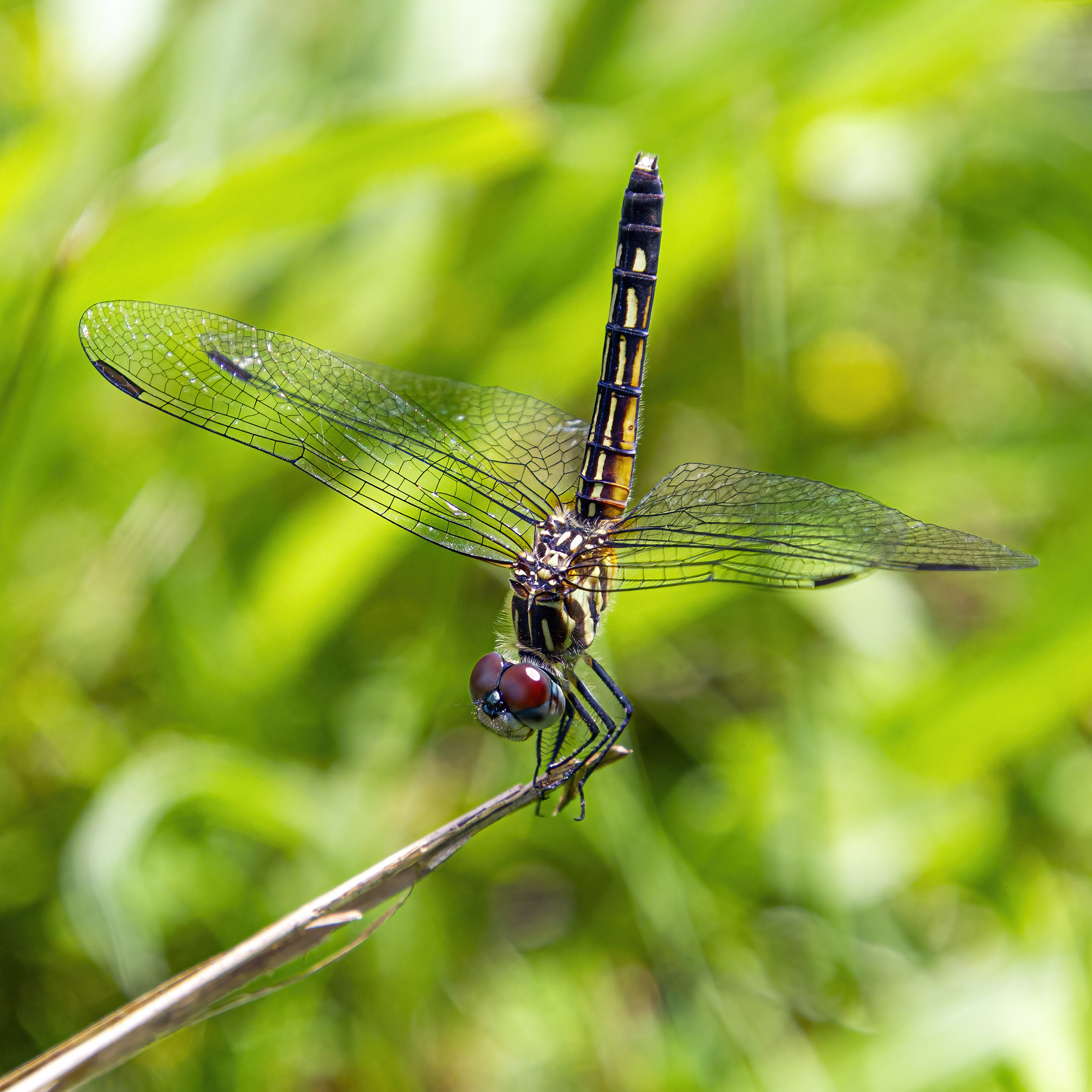
Sable Clubtail dragonflies (Stenogomphurus rogersi) are uncommon in my area. This dragonfly species is generally found only in very small numbers, has a short flight period, and requires very specific habitats, preferably a small, clean forest stream. There is only one location in my area where I have found Sable Clubtails in the past and some years I have not seen a single one.

I was therefore really excited on Monday when I spotted what I thought might be a Sable Clubtail. I was not sure of my identification, though, because this dragonfly was in a different location at the park, not along the stream where I had seen Sable Clubtails in the past.

When I returned home and examined my photos on my computer, I was shocked to see that the dragonfly was a female–I am pretty sure that all of the Sable Clubtails that I have previously seen were males. For the sake of comparison, I have added a photo of a male that was part of a posting I did on 10 June 2024 entitled Sable Clubtail dragonfly (male). If you look closely at the tip of the abdomen (the “tail”) of each dragonfly, you will see different shaped terminal appendages, which are key factors in helping to identify the gender of a dragonfly.

Different dragonfly species have different courting behaviors. In some cases, the males and females are present in the same area, but in other cases, the females remain in a different area until they are actually ready for mating. I looked through my resources and on-line to see if I could find any information about the behavior of Sable Clubtail females, but came up empty-handed.

Where do female Sable Clubtails like to hang out? With a sample size of only one, I certainly can’t come to any conclusions, but I will continue to keep my eyes open and perhaps I will encounter another one.

Sable Clubtail

Sable Clubtail

© Michael Q. Powell. All rights reserved.

Read Full Post »
I love the way that water lilies seem to glow, as though there were a light emanating from their centers. I photographed this pretty pink water lily during a recent visit to Green Spring Gardens, a county-run historical garden not far from where I live. Several white water lilies were also in bloom, but somehow I was drawn to the solitary pink one that was surrounded by lily pads.

Whenever I see Water Lilies in bloom, I immediately think of one of my favorite artists—Claude Monet. During the last thirty years of his life, water lilies (Nymphéas in French) were the main focus of his artistic production.

water lily

© Michael Q. Powell. All rights reserved.


Read Full Post »

Most of the time when I spot Eastern Amberwing dragonflies (Perithemis tenera) they are busily flying about over the water, but this handsome little guy decided to rest a bit in the vegetation at the water’s edge on Thursday at Jackson Miles Abbott Wetland Refuge.

Most of the summer dragonflies have now arrived on the scene, so I may not be featuring any new species for a while. However, I am content to photograph my familiar “friends,” always hoping to capture them in different perches, activities, or lighting conditions. Each moment gives me a new chance to capture something beautiful and/or unusual. Beauty is everywhere.

Eastern Amberwing

© Michael Q. Powell. All rights reserved.

Read Full Post »
Slaty Skimmers (Libellula incesta) have now started to appear at Jackson Miles Abbott Wetland Refuge, signaling to me that summer is almost here. During the hottest months of the year, Slaty Skimmers are one of the commonly seen dragonfly species in my area, in part because they are habitat generalists—you can find them everywhere,

The greyish-blue bodies and dark eyes of the mature male Slaty Skimmers make them easy to identify. The immature members of this species, however, are a lot harder to identify, because they are similar in appearance to the young of several other species in the area. Fortunately for me, the Slaty Skimmers in these two photos, the first that I have photographed in 2024, are both mature males.

Slaty Skimmer

Slaty Skimmer

© Michael Q. Powell. All rights reserved.

Read Full Post »

When I spotted a dragonfly patrolling over the water of a small pond yesterday at Jackson Miles Abbott Wetland Refuge, I knew almost immediately that it was a Prince Baskettail dragonfly (Epitheca princeps). How could I tell? As it flew by, I could catch glimpses of the dark patches on its wings and the Prince Baskettail is the only large dragonfly with patterned wings in our area. (Prince Baskettails are almost three inches (76 mm) in length).

Seeing the dragonfly in flight was easy, but getting a clear shot of it was a considerable challenge. I watched the dragonfly and was able to determine its approximate patrol area. When it flew into that area, I attempted to track it, sometimes using my camera’s autofocus and sometimes focusing manually. Most of my shots were out of focus or did not include the dragonfly in the frame, but I managed to get a few decent shots, with the image below being the best of the lot.

Some of my fellow wildlife photographers marvel at images like this and think that high end gear or special techniques are necessary. The reality, though, is that I use relatively modest equipment and the “secret” to my success quite often is a combination of patience, practice, and persistence.

Prince Baskettail

© Michael Q. Powell. All rights reserved.

Read Full Post »

Most people know that Monarch butterflies love milkweed, but if you move in closer to the plants, you’ll discover a world of fascinating little creatures, like this Red Milkweed Beetle (Tetraopes tetrophthalmus) that I spotted last week at Green Spring Gardens, a county-run historical garden not far from where I live.

I first encountered these little red beetles a dozen or so years ago and became a bit obsessed with them. I am not sure if it is their “longhorn” antennae or the bold pattern on their bodies or the bright color that attracts me most—I just know that I love seeing them in all of their developmental forms (they go through several interesting instars as they grow).

This milkweed beetle was crawling around a lot, so it was hard to get a shot of it. Fortunately, it stopped for a moment when it reached the end of the leaf and I was able to capture this simple environmental portrait..

The next time you see some milkweed, stop for a moment, examine it closely, and prepare to enter a fascinating little world as the scent of the flowers envelops you.

Red Milkweed Beetles

© Michael Q. Powell. All rights reserved

Read Full Post »

I love photographing dragonflies as they perch on lotus flowers and lotus buds. Alas, the lotuses were not yet in bloom last week when I visited Green Spring Gardens, a nearby county-run garden that has a small pond with a few lotuses and water lilies.

Fortunately quite a few dragonflies were buzzing around the pond and I managed to capture this image of a male Blue Dasher dragonfly (Pachydiplax longipennis) as he perched on the tip of a rolled-up lotus leaf. I like the way that the texture of the leaf adds visual interest to the image, something that would be absent if the dragonfly had perched on a bare branch.

I will probably return to the gardens in a few weeks to see if I can get some shots of the lotuses when they are blooming. As I recall, lotuses seem to enjoy the hazy, hot, and humid days that are far too common during the summer in the Washington D.C. area.

Blue Dasher

© Michael Q. Powell. All rights reserved.

Read Full Post »

I love the stunning green eyes of this male Sable Clubtail dragonfly (Stenogomphurus rogersi) that I spotted last week while exploring a small stream in Fairfax County, Virginia. The eyes look like they are made out of malachite or some similar semi-precious stone.

Sable Clubtails are generally found only in very small numbers, have a short flight period, and require very specific habitats—this species prefers small, clean forest streams. There is only one location in my area where I have found this species in the past and some years I have not seen a single one. I was therefore really excited when I manage to get some shots of this somewhat uncommon dragonfly species last Monday.

Sable Clubtail

Sable Clubtail

Sable Clubtail

© Michael Q. Powell. All rights reserved.

Read Full Post »
Do you believe in unicorns? I am always delighted when I manage to spot a Unicorn Clubtail (Arigomphus villosipes), a beautiful dragonfly species in which both sexes have a small hornlike projection between their eyes that gives rise to their common name—you can’t really see the “horn” in these photos, so you’ll have to take my word on it. I spotted the dragonfly in this posting while exploring a small pond in Fairfax County, where I live.

It is fairly easy to identify this species, because of the rusty-edged club at the bottom portion of the dragonfly’s abdomen and its very visible bright tip. Male Unicorn Clubtails tend to fly short patrols and perch quite often on low vegetation.  It is not hard to spot them if I am in the appropriate environment, which is usually a pond or marsh, unlike most other clubtail dragonflies that prefer rivers and streams.

Chasing unicorns and dragons? That is how I enjoy spending my time in the wild.

Unicorn Clubtail

Unicorn Clubtail

© Michael Q. Powell. All rights reserved.

Read Full Post »

When male Eastern Pondhawk dragonflies (Erythemis simplicicollis) are very young, they have green bodies with dark banding on the abdomen, just like their female counterparts. Over time male Eastern Pondhawks are gradually transformed into a duller shade of blue and finally a powdery bluish-grey.

From an aesthetic point of view, my favorite stage of development is when they are young males and their thoraxes are a beautiful shade of green that contrasts wonderfully with their blue abdomens. Eastern Pondhawks of both genders have cool-looking green faces that help to distinguish them immediately from other dragonfly species.

I spotted this Eastern Pondhawk during a recent visit to Jackson Miles Abbott Wetland Refuge, a small refuge that belongs to a nearby military installation. It is not a contiguous part of that installation, however, and is open to the public. The composition of this shot is quite simple, but I like the way that the Y-shape of the forked branch helps to divide up the frame and lead the viewer’s eyes to the main subject.

Eastern Pondhawk

© Michael Q. Powell. All rights reserved.

Read Full Post »

On Monday I photographed this female Widow Skimmer dragonfly (Libellula luctuosa) at Occoquan Regional Park, my first sighting of this species in 2024. Why is it called a “Widow Skimmer?” Someone apparently thought the dark patches on the wings of this species looked like the mourning crepe that historically widows wore and even a portion of its Latin name “luctuosa” means “sorrowful.”

The dark wing patches are quite distinctive and may it relatively easy to identify this species. The males of the species, which I did not see at all that day, have patches of white in addition to the same dark wing patches of the female and their bodies are blue in color when they are mature. Click on this link to see some photos of a male Widow Skimmer from a few years ago.

Widow Skimmer

© Michael Q. Powell. All rights reserved.

Read Full Post »

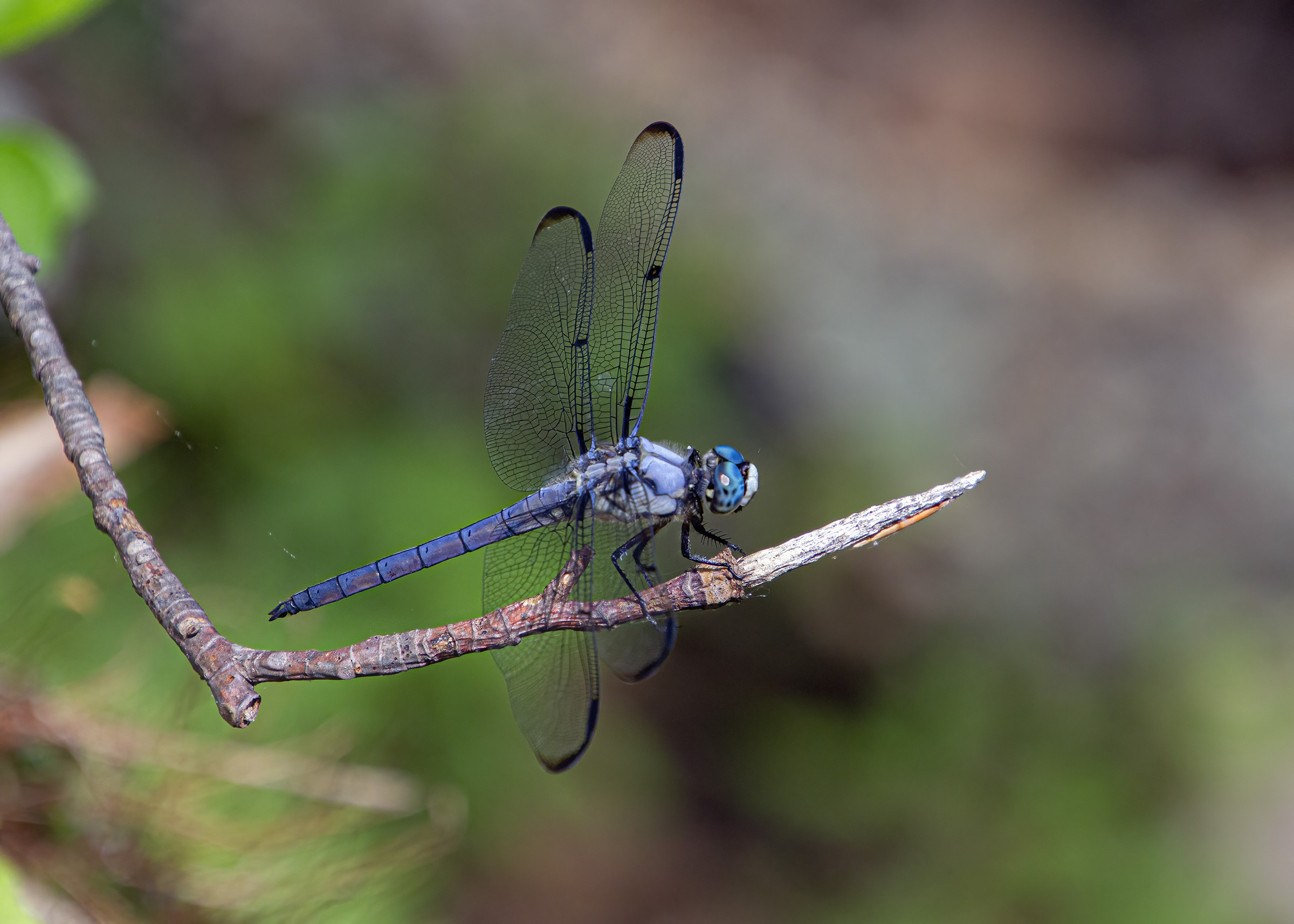
On Monday I played a little game of peekaboo with this Great Blue Skimmer (Libellula vibrans) dragonfly at Occoquan Regional Park. As I approached, the dragonfly hunkered down and was almost hidden from view. I stopped and waited and eventually the Great Blue Skimmer lifted its head, looked right at me, and appeared to smile.

The second shot provides a more traditional view of this species, highlighting its beautiful speckled eyes and white face that help in distinguishing it from other blue dragonflies in our area. Great Blue Skimmers are quite common in my area during the summer, but this was one of first ones that I spotted this year.

Great Blue Skimmer

Great Blue Skimmer

© Michael Q. Powell. All rights reserved.

Read Full Post »

This Gray Petaltail dragonfly (Tachopteryx thoreyi) looked like it was trying to climb a small tree when I spotted it from a distance on Monday at Occoquan Regional Park in Lorton, Virginia. I was happy to be able to capture this shot from the side, because when Gray Petaltails perch flat against a tree, they become virtually invisible—their black and gray coloration causes them to blend in perfectly with the rough bark of a tree.

Gray Petaltail

© Michael Q. Powell. All rights reserved.

Read Full Post »

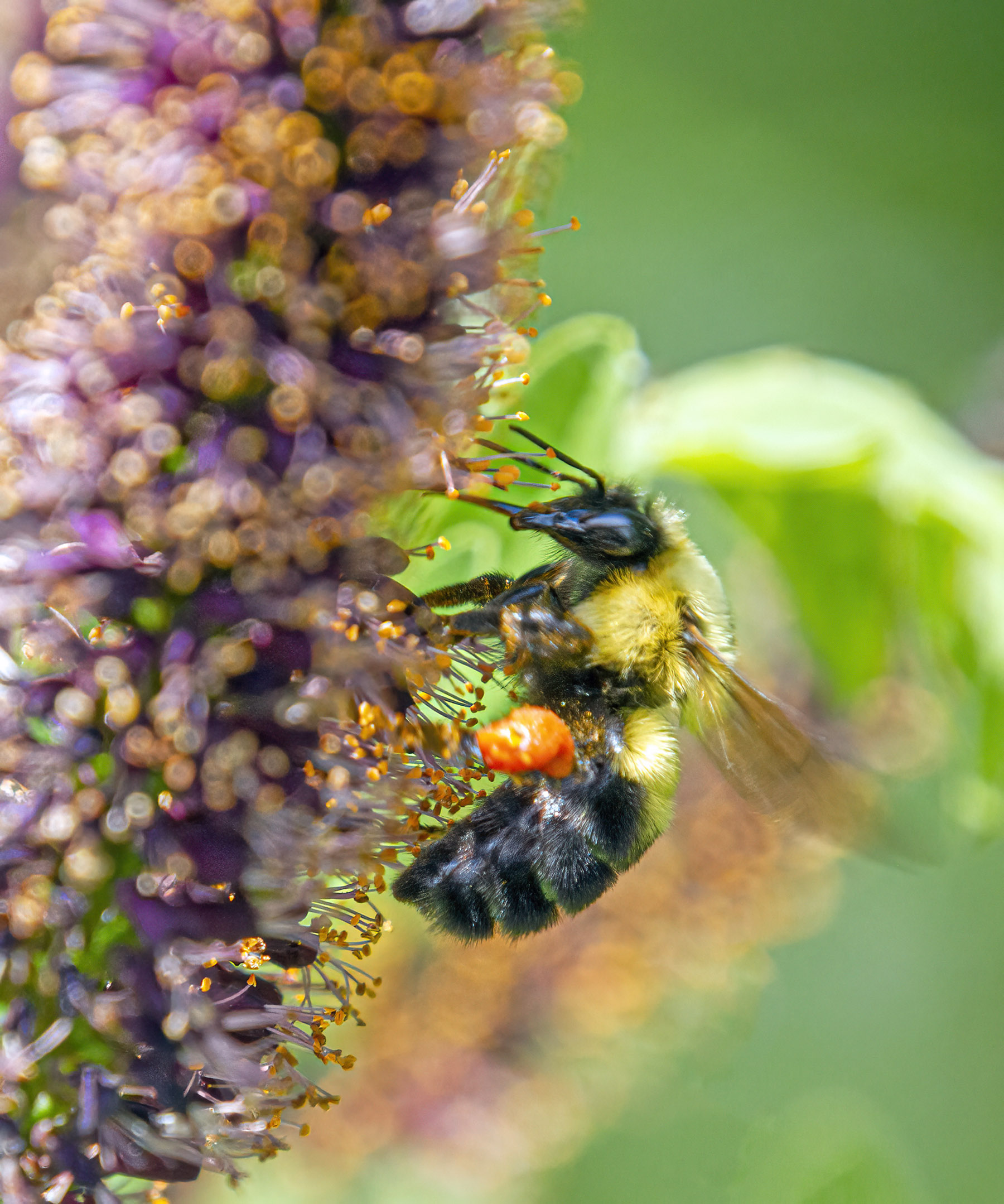
This bumble bee was busily filling its pollen sacs and sucking up nectar when I spotted it recently during a visit to Occoquan Bay National Wildlife Refuge. I cannot identify the plant on which the bee was feeding, but I love its beautiful colors and the blurry bokeh balls that were created in the out-of-focus areas of the plant.

As many of you know, when you move in close to a subject, the depth of field becomes really narrow, which means that only certain elements will be in sharp focus. My goal as a photographer is to try to make sure that the most critical areas, which usually include the eyes of the subject, are in focus. In this case, I was delighted that both the eye and the extended proboscis are relatively sharp.

bumble bee

© Michael Q. Powell. All rights reserved.

Read Full Post »

Dragonfly identification can sometimes be quite difficult—many species, and especially the females of the species, are similar in color and in markings. There are, for example, quite a few blue male dragonflies with females that are yellow and brown, like these Spangled Skimmers (Libellula cyanea) that I spotted last week at Occoquan Regional Park.

Fortunately, however, this dragonfly is quite easy to identify  because of its unique black and white stigmata, the spots on the outer leading edge of each wing. As far as I know, no other dragonfly in our area has bicolor stigmata. The stigmata are not there for decoration, but serve an important role in the flight of dragonflies. I do not really understand the physics of flight, but have read that the stigmata are heavier than the adjoining cells and help to stabilize the vibrations of the wings.

Now that we are into June, I have noticed that most of the summer dragonflies have appeared on the scene. There are a few that I have not yet spotted, but with a little luck I will see (and photograph) them soon.

Spangled Skimmer

Spangled Skimmer

© Michael Q. Powell. All rights reserved.

Read Full Post »

Male dragonflies can be quite aggressive in fighting off potential rivals, but they seem somewhat more tolerant of males from a different species. This past Wednesday I spotted two dragonflies peacefully coexisting and sharing a perch at Occoquan Regional Park.

The dragonfly perched near the top of the branch is a male Spangled Skimmer (Libellula cyanea) and the one perched a bit lower is a male Common Whitetail (Plathemis lydia). I have already seen quite a few Common Whitetails this season, but this Spangled Skimmer was one of the first that I have spotted this yea.

Spangled Skimmer and Common Whitetail

© Michael Q. Powell. All rights reserved.


Read Full Post »
I was delighted this week to spot my first Ebony Jewelwing damselflies (Calopteryx maculata) of the season while I was exploring at Occoquan Regional Park. Members of this species have distinctive dark wings and are generally found in shaded forest streams where the mixed lighting makes it challenging to photograph them.

When things work out, though, I can sometimes get a good shot of one, like this dramatic portrait of a female perched on a sunlit piece of vegetation. Only females have the little white patches (known as pseudostigmas) on their wings that along with their terminal appendages make them easy to identify.

Ebony Jewelwing

© Michael Q. Powell. All rights reserved.

Read Full Post »

I know that summer is almost here when I start to see Blue Dasher dragonflies (Pachydiplax longipennis) at my local ponds and they will some become our the most abundant dragonfly species in our area. Mature Male Blue Dashers are blue, as their name suggests, but females have a black and yellow pattern on their abdomens, like the one pictured below that I photographed on Tuesday at Jackson Mile Abbott Wetland Refuge.

Quite often Blue Dashers perch on vegetation in the “obelisk” pose, with their abdomens raised up into an almost vertical position. It is thought that this pose is a type of thermoregulation, with the raised abdomen reducing the amount of exposure to the direct sunlight and thereby keeping the dragonfly’s body a bit cooler.

Blue Dashers are sentimentally special to me because my very first posting on this blog on July 7, 2012 featured a male Blue Dasher dragonfly in an obelisk pose. In case you are curious, here is a link to that posting that was simply entitled Blue Dasher dragonfly.

Blue Dasher

© Michael Q. Powell. All rights reserved.


Read Full Post »

Whenever I visit Jackson Miles Abbott Wetland Refuge, I never fail to check a spot near a fishing platform where there is a piece of twisted rebar sticking out of the water. In the past, I have seen dragonflies of various species perching on the rebar and it provides a wonderful photographic opportunity, assuming that the dragonfly does not immediately fly away. I generally prefer to photograph dragonflies on natural perches, not on manmade ones, but this is a case when I am more than happy to break that “rule.”

On Tuesday I was delighted to spot a male Eastern Amberwing dragonfly (Perithemis tenera) perched on the aforementioned piece of rebar. I love the contrast between the colors, patterns, and textures of the natural object, the dragonfly, and those of the man-made subject, the rebar. The floating debris on the surface of the pond helps to break up the mostly uniform background without being visually distracting.

I have taken similar shots to this one multiple times, but I don’t mind repeating myself. Each encounter is unique and subtly different. As the Greek philosopher Heraclitus of Ephesus is reported to have said, “No man ever steps in the same river twice, for it is not the same river and he is not the same man.”

Eastern Amberwing

© Michael Q. Powell. All rights reserved.

Read Full Post »

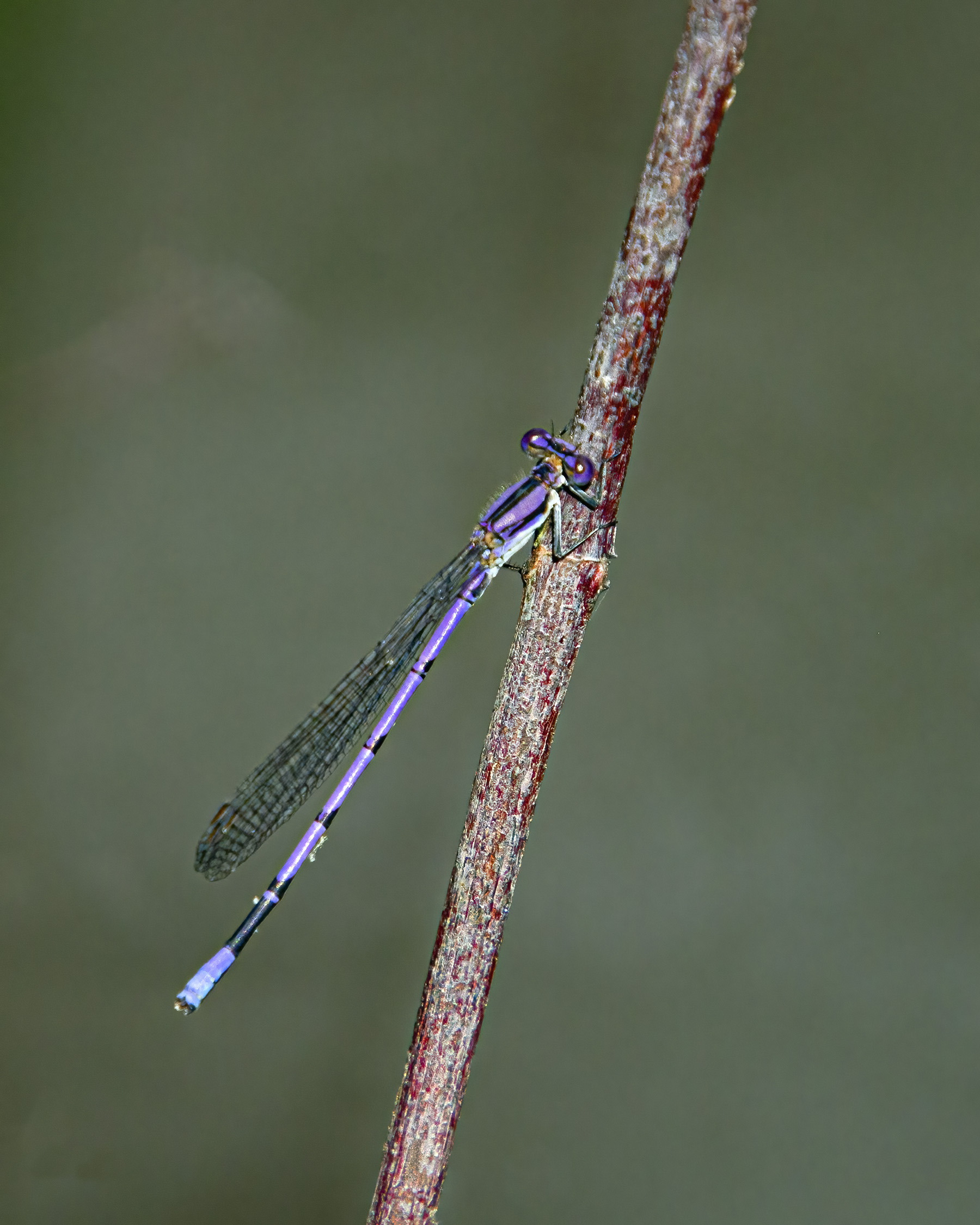
Yesterday at Jackson Miles Abbott Wetland Refuge I spotted some Variable Dancer damselflies (Argia fumipennis), one of my favorite damselfly species. I never fail to be shocked and delighted by the brilliant purple of eyes and body of the male of the subspecies known as the Violet Dancer (Argia fumipennis violacea). Some of you may have even noticed that I have used an image of a Violet Dancer as the banner image for the home page of my blog for a number of years.

Dancers are a genus of damselflies named for the distinctive jerky form of flight they use which contrasts with the straightforward direct flight of many other pond damselflies. I must confess that I don’t pay much attention to the way that particular damselflies fly, but instead rely primarily on their coloration to identify them,

Violet Dancer

© Michael Q. Powell. All rights reserved.

Read Full Post »

I love the light and delicate pose of this handsome male Calico Pennant dragonfly (Celithemis elisa) that I spotted during a recent visit to Occoquan Bay National Wildlife Refuge. Pennant dragonflies, like the Calico Pennant, usually perch on the very tips of vegetation where they sway in the slightest breeze—like a pennant.

The red of the dragonfly’s body and the green of the vegetation help the dragonfly to “pop,” because red and green are complementary colors, i.e. they are directly opposite each other on the traditional color wheel that artists use.

Callico Pennant

© Michael Q. Powell. All rights reserved.


Read Full Post »

I haven’t seen any Monarch butterflies yet this season, but I did spot this similar-looking Viceroy butterfly last week at Occoquan Bay National Wildlife Refuge. Viceroy butterflies are generally much smaller than Monarchs, so I can often tell them apart from a distance. When I get closer though, the most obvious distinguishing feature is that Viceroys nave a thin black line across their hind wings that Monarchs do not have.

Viceroy butterfly

© Michael Q. Powell. All rights reserved.


Read Full Post »

I was delighted to spot this cool-looking Brown Spiketail dragonfly (Cordulegaster bilineata) this past Wednesday at Occoquan Regional Park in Lorton, Virginia. I was hoping to get a closer shot, but the dragonfly did not hang around very long before flying away.

Fortunately I was shooting with a relatively long lens—I was at the long end of my Tamron 18-400mm zoom lens—and was able to capture a good deal of detail of the dragonfly, including its stunning two-toned compound eyes. The dragonfly appeared to be barely hanging on to the vegetation when I took this shot, which may partially account for its swift departure.

Brown Spiketail

© Michael Q. Powell. All rights reserved.

Read Full Post »
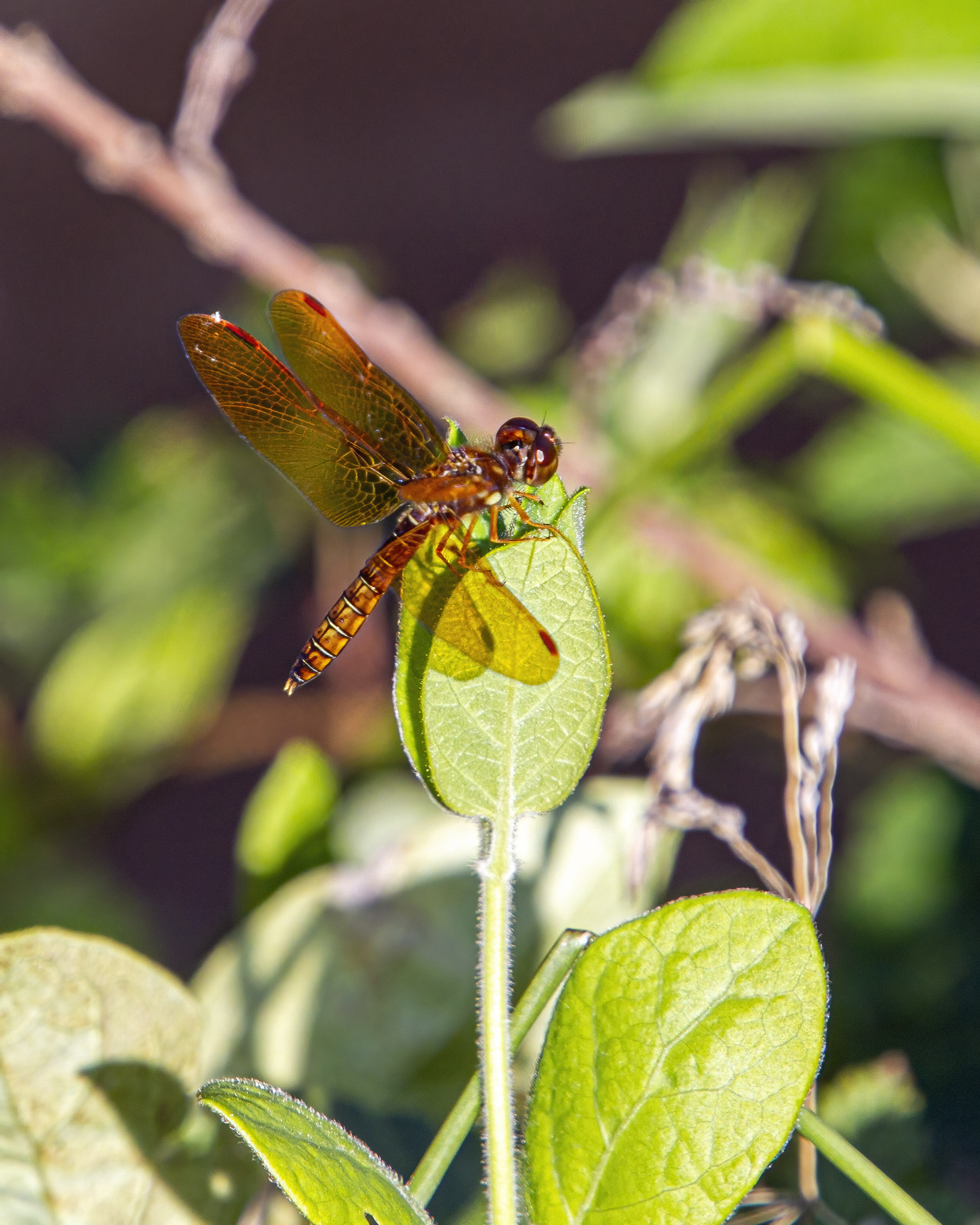
I know that summer is almost here when dragonflies like this male Eastern Amberwing (Perithemis tenera) begin to appear. I spotted this distinctive-looking dragonfly on Tuesday at a small pond at Jackson Miles Abbott Wetland Refuge.

Eastern Amberwings are really small at about one inch (25 mm) in length. According to the Dragonflies of Northern Virginia website, the Eastern Amberwing is “the smallest dragonfly in Northern Virginia, and second smallest in the U.S. (only Elfin Skimmers are smaller), Amberwings are fascinating little insects. No bigger than a horsefly or paperwasp, nature still found a way to pack a lot into this tiny package.”

These little dragonflies are considered to be wasp mimics, “Amberwings may be our only dragonfly that actively mimics a wasp. The markings and shape of their abdomens resemble a small wasp, but they take it several steps further. When threatened, they rhythmically move their wings up and down while pulsing their abdomens. All to imitate a wasp, we think, so as to scare off potential predators that believe they’re about to be stung.”

I love the stunning amber wings that are found on only the males of this species—the females have patterned wings that are mostly clear. As you can see in both photos, the male’s wings are quite transparent despite their darker color. I also really like the intricate patterns and markings on the abdomens of Eastern Amberwing dragonflies.

I look forward to seeing more and more Eastern Amberwings over the course of the next five months or so. Some summer dragonfly species have not yet appeared, but I am seeing more and more dragonflies as the temperatures rise and the hours of sunlight are extended.

Eastern Amberwing

Eastern Amberwing

© Michael Q. Powell. All rights reserved.

Read Full Post »

I spotted this beautiful Black Swallowtail butterfly (Papilio polyxenes) last week at Occoquan Bay National Wildlife Refuge. The orange circle with the black dot in between the wings helps to distinguish this species from several similar-looking dark butterflies in our area.

I chased this butterfly around for quite some time before it finally stopped for a moment on this vegetation—I often get a good workout when photographing butterflies. I am quite happy with the way that I was able to capture the varying shades of green surrounding the butterfly that add a lot of visual interest to this simple composition.

Black Swallowtail

© Michael Q. Powell. All rights reserved.


Read Full Post »

The bright red color of this male House Finch (Haemorhous mexicanus) really caught my eye last week at Occoquan Bay National Wildlife Refuge. For a split second I thought it was a cardinal until I looked more closely at the bird, it was clear that it was a different species.

Later that same day I spotted an equally bright red male Northern Cardinal (Cardinalis cardinalis) that seemed quite pleased with whatever treat it had found. I think it may be plant material, but I can’t exclude the possibility that it is some kind of insect.

From a photography perspective, it is really helpful when a bird is this boldly colored and makes no effort to blend in with its surroundings, especially at this time of the year when there are so many leaves on the trees.

House Finch

Northern Cardinal

© Michael Q. Powell. All rights reserved.

Read Full Post »

I love the sweet little face on this Southeastern Mud Turtle (Kinosternon subrubrum subrubrum) that I spotted last Thursday at Occoquan Bay National Wildlife Refuge. Most of the turtles that I encounter are Red-eared Sliders or Painted Turtles and they generally are in the water or perched on logs floating in the water. Occasionally I will spot a box turtle or a snapping turtle. When it comes to mud turtles, however, I normally see only one or two a year.

According to the Virginia Herpetological Society, “Kinosternon subrubrum occupies a wide variety of aquatic habitats, including ponds, lakes, creeks, swamps, freshwater and brackish marshes, ditches, and boggy areas. They avoid large, deep bodies of water and fast-moving water. Preferred habitat is shallow, slow-moving water, with aquatic or emergent vegetation and a soft organic substrate. This turtle is often seen on land, especially after rainstorms. Mud Turtles may spend a considerable portion of the year on land and often overwinter in shallow burrows.”

mud turtle

© Michael Q. Powell. All rights reserved.


Read Full Post »

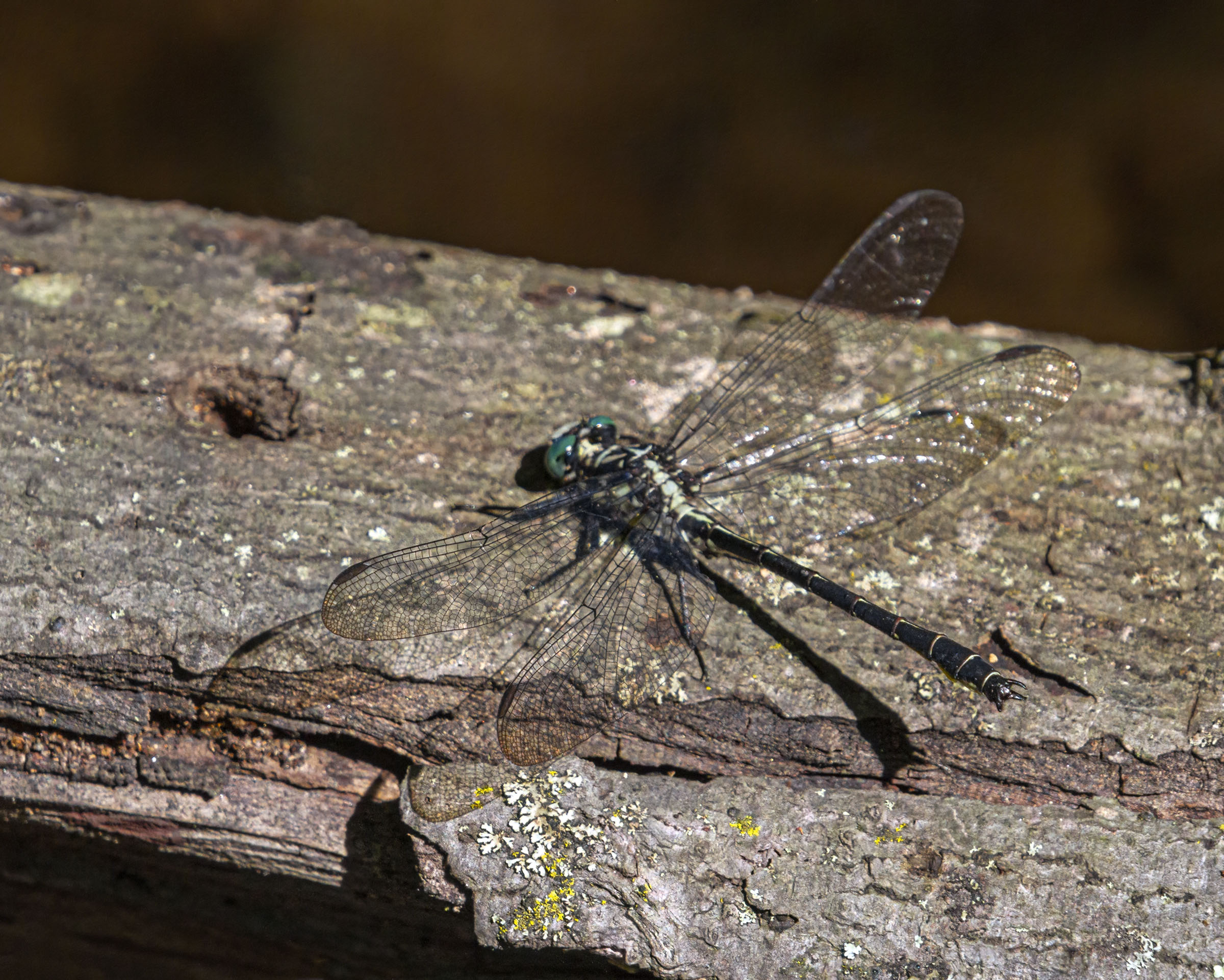
I photographed this stunning Lancet Clubtail dragonfly (Phanogomphus exilis) last Monday on a rotten log in the dappled sunlight as I was exploring an area near a creek in Prince William County, Virginia. Of course, I was excited to photograph this dragonfly, but it was actually the interesting lighting and the rough texture of the log that  mainly captured my attention.

Lancet Clubtail

© Michael Q. Powell. All rights reserved.

Read Full Post »

Some of the species of birds and dragonflies with the word “common” in their names are quite rare in my area. However, Common Baskettail dragonflies (Epitheca cynosura) have been quite common this month and I have seen them at a number of different locations, most notably at the small ponds that I like to visit. At these ponds, I usually spot the Common Baskettails as they conducted repeated low patrols over the surface of the water and I can never resist the chance to photograph them while they are in flight.

As I have noted in the past, it is very challenging to photograph a dragonfly while it is flight. Sometimes the dragonflies will hover a bit, giving me a better chance of getting them in focus, but often they whiz on by and I try to track them in my viewfinder. Occasionally I will manage to use auto-focus, but often I resort to manual focus, which, of course, is tough with a moving subject. I try to determine the flight track they are using and identify likely areas that they will pass through and then pre-focus on that area and wait for them to come by. Needless to say, you have to be very patient and persistent if you want to try this kind of photography.

I captured the first two shots at a small pond in Prince William County and was quite pleased with the images. The two shots were taken as part of a sequence and are quite similar with the exception of the position of the wings. Normally I am so thrilled to get a sharp shot that I am not concerned about the wing position, but in this case I had the luxury of having several variants of essentially the same shot.

The final two shots were taken at the pond at Jackson Miles Abbott Wetland Refuge. There was vegetation surrounding the water at the spot where I was standing and it sometimes would obstruct my view as I tried to track the dragonfly. In the third photo, I used one of the offending pieces of vegetation as a compositional element that makes it look like the dragonfly was approaching a finish line tape.

I included the final photo to give you a sense of the habitat. In several areas of the pond there were patches of lily pads and I tried to capture shots of the dragonfly flying over the lily pads. I was largely unsuccessful, but the photo gives you an idea of what I was trying to accomplish. (If this were a shot of a bird, it would definitely qualify as “butt shot,”but I am not sure that you can really say that a dragonfly has a “butt.”)

Common Baskettail

Common Baskettail

Common Baskettail

Common Baskettail

© Michael Q. Powell. All rights reserved.

Read Full Post »
On Monday I was happy to spot my first Stream Cruiser dragonfly (Didymops transversa) of 2024 in a field of ferns adjacent to a creek in Prince William County. Check out the length of those back legs. Wow!

I do not see Stream Cruisers at most of the usual locations where I search for dragonflies, because they can be found only in specific habitats. According to the Dragonflies of Northern Virginia website, “Stream Cruisers are habitat specialists. Look for them in stable, small to medium, forest streams, with good flow and rocks. The best place to find them is hunting in sunlit meadows near their wood-land waterways.”

Stream Cruiser

© Michael Q. Powell. All rights reserved.

Read Full Post »

On Monday I spotted this beautiful Red-spotted Purple butterfly (Limenitis arthemis astyanax) in a sea of ferns adjacent to a creek that I was exploring in Prince William County, Virgnia. I love the iridescent blue color on the wings and the little red spots that provide a nice accent color. Although I see a slight purplish tint to the wing on the right, I really don’t see very much purple on this butterfly’s body despite the fact that “purple” is a prominent part of the name of this species.

The color and texture of the ferns make for a beautiful backdrop for the butterfly and add a bit of visual interest without being distracting.

Red-spotted Purple

© Michael Q. Powell. All rights reserved.


Read Full Post »
« Newer Posts - Older Posts »