Feeds:
Posts
Comments

Archive for the ‘Reptiles’ Category

This morning I captured this photo of a bullfrog. I was able—with gyrations that would have been hilarious to a spectator—to get almost low enough to look him eye-to-eye. I was happy also to get a reflection of the frog with a considerable amount of detail. As I was reviewing the images on my computer, I noticed the bubbles under his chin (do frogs have chins?), a delightful detail that adds a sense of whimsy to the frog. Blowing bubbles is something that I always associate with being a child, and I remember how much fun it was to blow bubbles in my drink with a straw or to blow soap bubbles with one of those little wands.

Perhaps this bullfrog was blowing bubbles in the water, remembering too when he was little, presumably in a post-tadpole phase.

Bullfrog with bubble (click for higher resolution)

© Michael Q. Powell. All rights reserved.

Read Full Post »

The water level in the marsh at Huntley Meadow Gardens here in Alexandria, VA has been getting lower and lower as the summer has progressed. I suspect that the situation had made it more difficult for some of the inhabitants to find food and may have increased competition for the available food.

Previously I posted photos of a Great Blue Heron catching a fish in the remaining water of the pond of the marsh. Last week I had the chance to watch a series of confrontations between a Great Blue Heron and a snapping turtle. It seemed to start when the  heron grabbed a fish out of the water just as the turtle was approaching him. I had the impression that the turtle might have been pursuing that same fish. The snapping turtle made a series of aggressive runs at the heron, getting really close to the heron’s legs. I have seen pictures on-line of a snapping turtle pulling down a Great Blue Heron, so I waited with fear and anticipation to see what would happen. The heron left the water this time without any bodily injury. (I have some photos of this initial confrontation that I might post later, but their quality is not as good as those of the second round of confrontations.)

The heron eventually went back into the water and it wasn’t long before the snapping turtle came at him again. (I could almost hear the music of the movie “Jaws” in my head as the turtle made a run at the heron.) Like a matador side-stepping a charging bull, the heron awkwardly avoided the turtle who was approaching him faster than I’ve ever seen a turtle move. The heron then turned his back on the turtle and started walking away, perhaps feeling the hot breath of the turtle who continued to pursue him. Finally, the heron took to the air, deciding that he had had enough of the persistent turtle.

I managed to capture the highlights of the confrontation with my camera. I continue to marvel at the wonders of nature as I observe new creatures and see familiar ones act and interact in new ways.

Snapping turtle approaches Great Blue Heron

Great Blue Heron steps to the side as snapping turtle gets aggressive

Great Blue Heron walks away with snapping turtle in pursuit

Great Blue Heron decides to leave his problems behind

© Michael Q. Powell. All rights reserved.

Read Full Post »

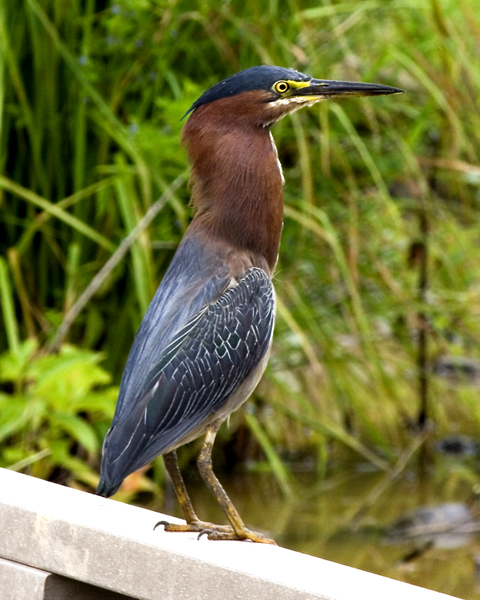
Yesterday I was at a nearby pond photographing mostly dragonflies. After shooting them I decided to make a quick walk around the pond (it’s only a small man-made pond) to see what other subjects I could find. I managed to find a colorful butterfly, a small green heron, and some lotus flowers that I will post later, assuming the photos came out ok.

The subject that really caught my attention, though, was a frog. Really? Yes, really.

I was leaning over the green-colored pond water, gazing at a distant dragonfly when I happened to glance down to my right. There, almost camouflaged in what my friends say is duckweed, was a semi-submerged frog. I was able to get my camera’s lens down pretty low and got in close and captured an image I really like. The frog’s gold-ringed eyes shine out clearly amidst all of the individual particles of duckweed that cover much of his expressionless face.

There are a couple of blades of grass that were partially blocking my view to the frog but they blurred out and are not really much of a problem.  After I took some shots, though, I decided to try to carefully remove one of those offending blades. As I made the effort,  the frog, who had remained motionless up to then, literally leaped into action. He sprung powerfully into the air and skipped across the surface of the water, like a rock throw by a dad showing his son how to skip rocks.

I was so startled by his sudden motion that I almost fell over into the water. Later in the day I did end up getting wet when I belatedly noticed that one foot was planted in the water while I was intently focusing on composing a shot. I guess that’s the price of being a photographer.
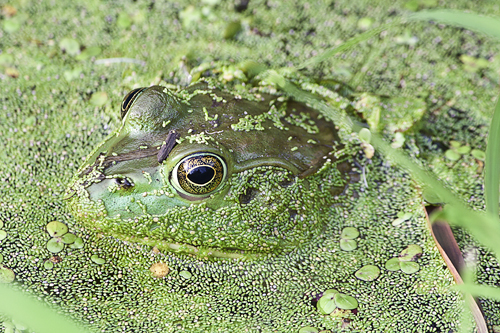
Hiding frog

© Michael Q. Powell. All rights reserved.

Read Full Post »

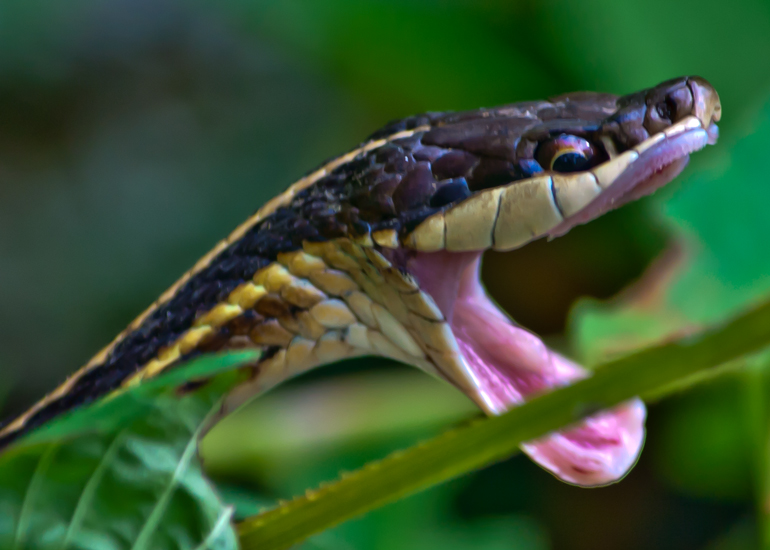
Some days it seems like anything that catches my eye is a potentially viable subject. This was the case last Friday when I was walking in a marsh in a local park and came upon this snake. Much of his body was concealed, but the upper body was exposed enough for me to attempt a head-and-shoulders portrait. Oh, wait a minute, I guess a snake does not really have shoulders, so I guess I was attempting a head-and-neck portrait.

The snake was beautiful in his own way, with wonderfully textured skin and stunning gold accents around his eyes. I thought he was probably a garter snake, but after a bit of research I am now convinced he is an Eastern Ribbon snake (Thamnophis sauritus), not a Common Garter snake (Thamnophis sirtalis). If you are at all interested in the differences, there is a wonderful article entitled “Telling Garter Snakes and Ribbon Snakes Apart” at http://www.gartersnake.info (yes, that’s the actual web address).

As I was admiring his beauty, he may have decided to remind me that he is a predator as suddenly he opened his mouth wide, really wide. I was looking through the lens at him and the effect was magnified because his head filled a good portion of the frame of the viewfinder. My first thought was that he was sizing me up as a potential snack. I had the presence of mind to snap a picture before his mouth snapped shut. A vine covers part of his mouth in the photo, but I decided to include it to show you how wide his mouth really is.

Now I understand how he is able to do things like swallow frogs whole. I’m glad I’m a lot bigger than a frog.

Eastern Ribbon Snake Posing for Portrait

Eastern Ribbon Snake Sizing Me Up

© Michael Q. Powell. All rights reserved.

Read Full Post »

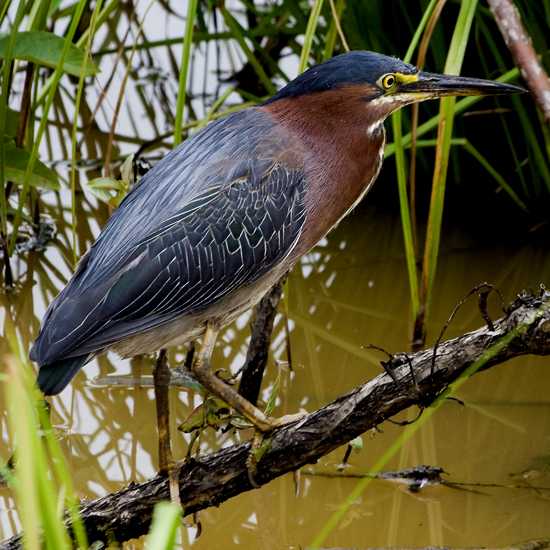
Yesterday’s blog entry featured the adventures of a young green heron catching and swallowing a frog. After the snack was consumed, though, the heron moved from the boardwalk into the marshy area. There he perched on a branch and seemed to pose for me, maybe figuring that his exploits were worthy of a magazine feature.

The resulting photograph is one of my favorite shots of the whole day, because I think it captures well the rugged beauty of this young bird. The background is a little distracting but I like the reflections in the water and the angle of the ranch.

I decided to include two additional action shots from yesterday. The photos seem to show that I probably was incorrect when I stated that the heron had speared the frog when he initially caught it. It looks like the heron was merely holding the frog with his beak as he adjusted its position. Now that I think about it, the process of swallowing the frog would have been complicated if the frog had been speared.

© Michael Q. Powell. All rights reserved.

Read Full Post »

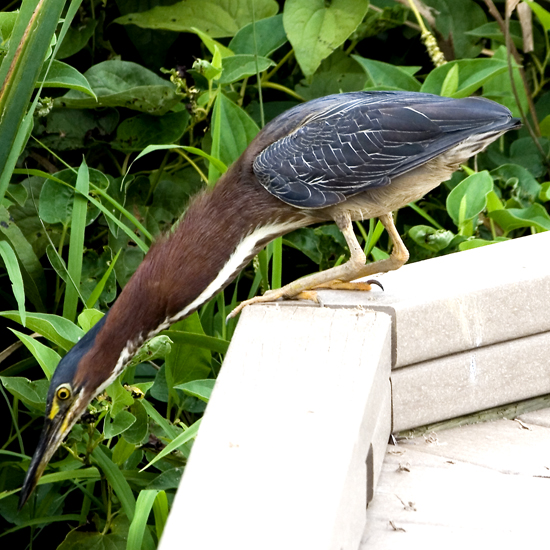
One can only imagine what is going through the frog’s mind as he looks into the crazed eyes of the green heron who has just speared him. Is he looking for mercy? Is he resigned to his fate?

I watched the prelude to this moment unfold this afternoon at Huntley Meadows Park, a marshland park here in Virginia. The green heron was intently scanning the water from the edge of a boardwalk that runs through the march. Periodically he would extend his neck down toward the water.

Several times we heard an excited “eeep” sound followed by a splash, indicating another frog had escaped. After a few more minutes, however, the heron dived into the water and reappeared on the boardwalk with the speared frog you see in the first photo.

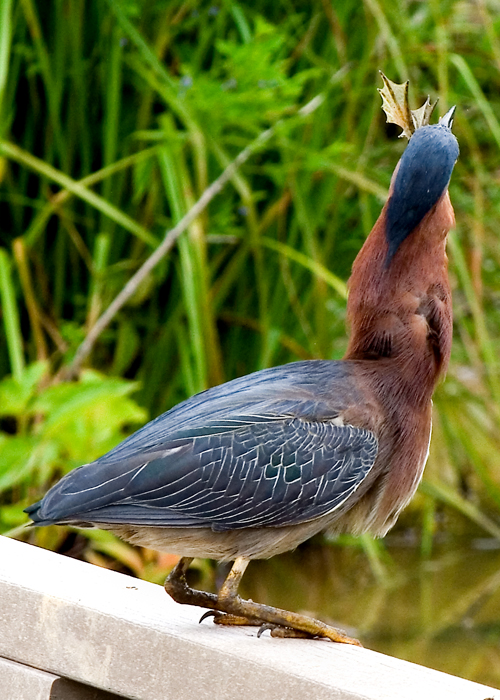
When you look at the comparative size of the heron’s mouth and the frog, it hardly seems possible that the green heron could swallow the entire frog. The heron took his time shifting the position of the frog and then all at once he turned his head, bent his neck back a little, and down went the frog. It happened so quickly that I was able to snap only a single photo that shows the frog’s webbed feet as the only remaining parts that have not yet been swallowed.

In this final photo the heron no longer has a slim neck. I have no idea how long it will take for the frog to reach the heron’s stomach but I am pretty sure he was not yet there when I took this photo.

And don’t try to talk with the heron during this period. Why not? Read the caption of the last photo!

I can’t talk now. I have a frog in my throat.

© Michael Q. Powell. All rights reserved.

Read Full Post »

One evening this past week I was photographing lotus flowers at a local pond in a quasi-meditative state, enjoying the calm after a thunderstorm had passed.

The life cycle of the lotus, from bud to flower to seed pod

Suddenly a woman screamed out in my direction, “Snake, there’s a snake right behind you.” My first reaction was one of disbelief, because I was standing on a flat rock partially surrounded by water that was flowing rapidly between two man-made ponds. All at once I saw the submerged snake swimming strongly against the current. Then to my surprise the snake lifted his head out of the water.

My next reaction was to spring into action to take his picture. My camera was already on my tripod and I swung it around and snapped a couple of shots without having time to adjust my exposure or shutter speed. The image below is far from perfect but it gives you an idea of the cascading water and the snake poking his head above the surface.

Swimming snake lifts its head above water

After that brief photographic opportunity I returned to my peaceful pursuit of the lotus flower.

Sidewards-facing lotus (a variation of the lotus position)

It was only much later that I wondered whether I had encountered a poisonous snake. An article entitled “Snake Mistake” by Christine Ennulat in Virginia Living helps readers distinguish between the harmless brown water snake (Nerodia taxispilata) and the venomous water moccasin (Agkistrodon piscivorus). I am pretty confident the snake I saw was “only” a brown water snake.

Maybe I will react more quickly the next time someone tells me there is a snake right behind me. I might even get a better photograph!

© Michael Q. Powell. All rights reserved.

Read Full Post »

After some thunderstorms yesterday evening I went a local garden with a pond (Green Spring Gardens) and encountered this very large snapping turtle (at least that is what I think he is). He was just lying there on the grass.

I started creeping up on him with one eye in the viewfinder and the other on him. I was pretty cautious because previously I had read what Wikipedia says about snapping turtles, “Common snappers are noted for their belligerent disposition when out of the water, their powerful beak-like jaws, and their highly mobile head and neck.” There were a few blades of grass in front of part of his face and I would have liked to remove them to improve the shot, but there was no way I was going to risk my fingers for a mere photo.

I decided to share this medium range shot because it shows the mud and dried grass that made up his “camouflage.” It reminds me a little of the ghillie suits that snipers wear to blend in with nature. Eventually I hope to do another blog posting showing the progression of my shots as I got closer and closer to him, ending up with shots in which his face alone fills the frame.

Stay tuned for coming attractions!

© Michael Q. Powell. All rights reserved.

Read Full Post »

« Newer Posts