Feeds:
Posts
Comments

Archive for the ‘Reptiles’ Category

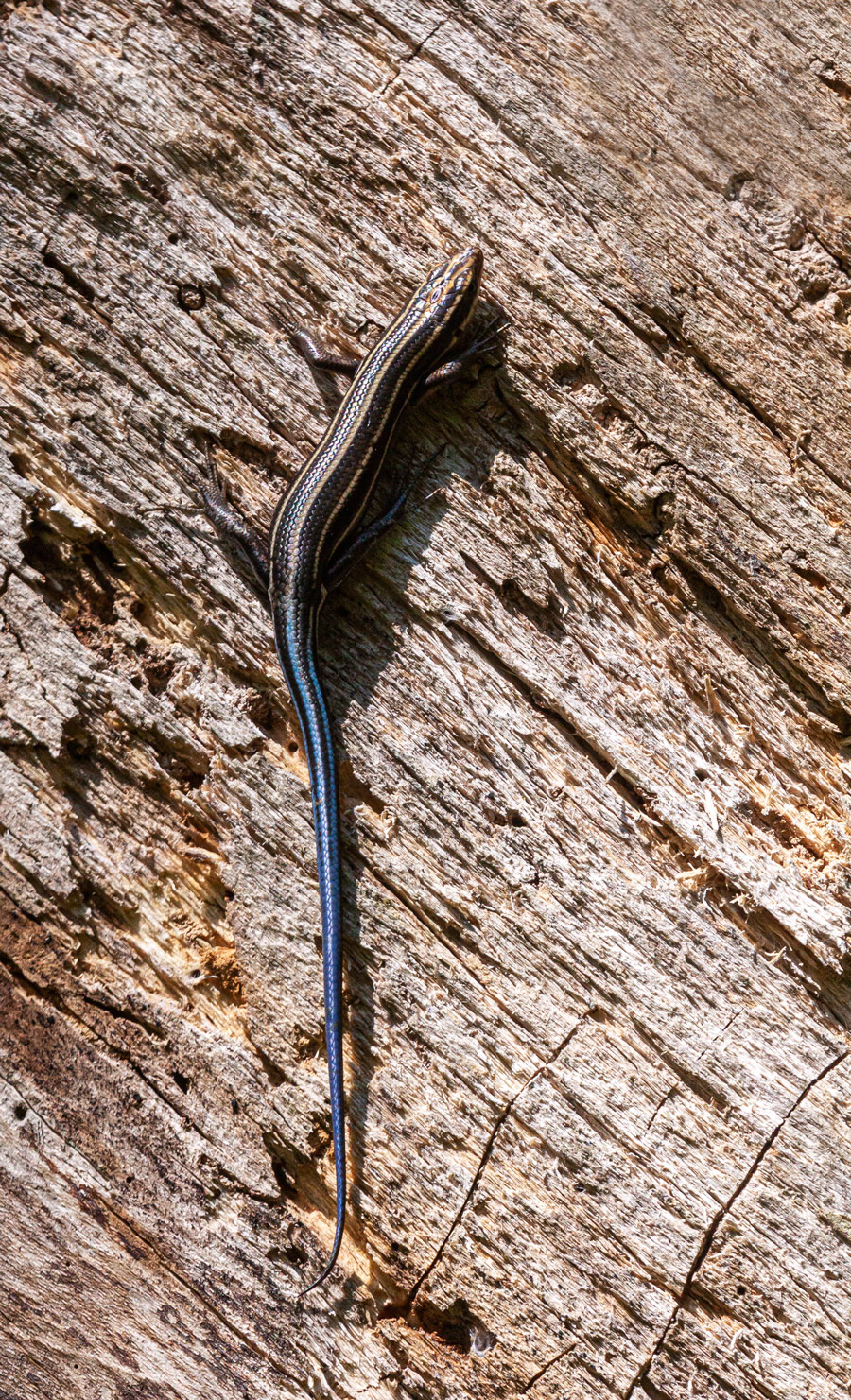
I love to see young Common Five-lined Skinks (Plestiodon fasciatus) with their long, bright blue tails, like this one that I spotted on a dead tree earlier this week in Prince William County, Virginia. There is something so whimsically incongruous about that striking color on the skink’s body that I can’t help but smile whenever I see one.

Common Five-lined Skink

© Michael Q. Powell. All rights reserved.


Read Full Post »

There are not very many species of venomous snakes in Virginia, but I managed to encounter one of them, an Eastern Copperhead (Agkistrodon contortrix), while exploring in Prince William County earlier this week will fellow wildlife enthusiast Walter Sanford. I had just climbed over the trunk of a fallen tree when I looked to the side and spotted the snake about three to four feet away from me (100 to 120 cm).

The first shot is a cropped image that shows the copperhead’s eerie eye with a vertical pupil—I was definitely not as close as it may appear. The second shot shows the view that I had when looking through my 180 mm macro lens. The snake, which is pretty large and well camouflaged, appeared to be fully alert and was facing the tree trunk that I had just crossed.

I have read a lot about copperheads since that encounter. One of the tips for avoiding them included checking the other side of logs before stepping over them—I am pretty sure I will heed that advice from now on.

UPDATE: Check out Walter Sanford’s blog posting that includes his impressions of our encounter with the copperhead and some additional photos.

Eastern Copperhead

Eastern Copperhead

© Michael Q. Powell. All rights reserved.

Read Full Post »

It was quite startling to see the bright orange color on the head of this Broad-headed Skink (Plestiodon laticeps) yesterday at Prince William Forest Park in Triangle, Virginia. We do not have many lizards in our area and they all tend to blend in much better with their surroundings than this one did.

According to information from the Virginia Herpetological Society, adult males of this species are uniformly brown most of the year. However, during mating season in the spring the head of the males becomes enlarged and turns bright orange. The color of their heads gradually fade and the head is reduced in size the rest of the year.

Broad-headed Skink

© Michael Q. Powell. All rights reserved.

Read Full Post »

What is your first thought when you see these three turtles together? Are they just friends or more than friends? The turtles seem to be pretty comfortable sharing a confined space and there is plenty of space in our minds for varied interpretations on the nature of their relationship. According to the old saying, “two’s a couple and three’s a crowd”—is that always true?

Whatever the case, the turtles at Occoquan Bay National Wildlife Refuge have been definitely been enjoying our recent sunny days. My turtle identification skills are not very good, but I think these all may be Eastern Painted Turtles (Chrysemys picta picta), though there is a chance that they might be Red-eared Sliders (Trachemys scripta elegans).

I love images like this one that allow viewers to use their creativity to interpret what they see and to generate in their minds their own mini-narrative of what is going on. Ménage à trois or just friends—you make the call.

red-eared sliders

© Michael Q. Powell. All rights reserved.

Read Full Post »

One of the hazards of exploring creeks and streams at this time of the year is that snakes may be sunning themselves at water’s edge. Last week I was startled when I suddenly realized that there was a snake right in front of me, precisely in the direction in which I had been moving.

I managed to get a shot of the sunning snake, which I believe to be a Northern Water Snake (Nerodia sipedon), just before it set off swimming down the creek. Although the first shot may make it look like I was really close to the snake, I was actually a good distance away—generally I prefer to use long telephoto lenses with snakes.

Northern Water Snake

Northern Water Snake

© Michael Q. Powell. All rights reserved.

Read Full Post »

Why did the Snapping Turtle (Chelydra serpentina) cross the road? It sounds like the opening line of a joke, but I asked myself that question yesterday when I spotted a snapping turtle lumbering its way across one of the trails at Occoquan Bay National Wildlife Refuge. The turtle’s back was covered with mud, suggesting it had only recently emerged from its winter sleep. In the past I have sometimes seen snapping turtles out of the water when they were getting ready to lay eggs, though it seems a little early for that to be taking place.

I have always thought that snapping turtle look like dinosaurs. What do you think?

Snapping Turtle

Snapping Turtle

© Michael Q. Powell. All rights reserved.

Read Full Post »

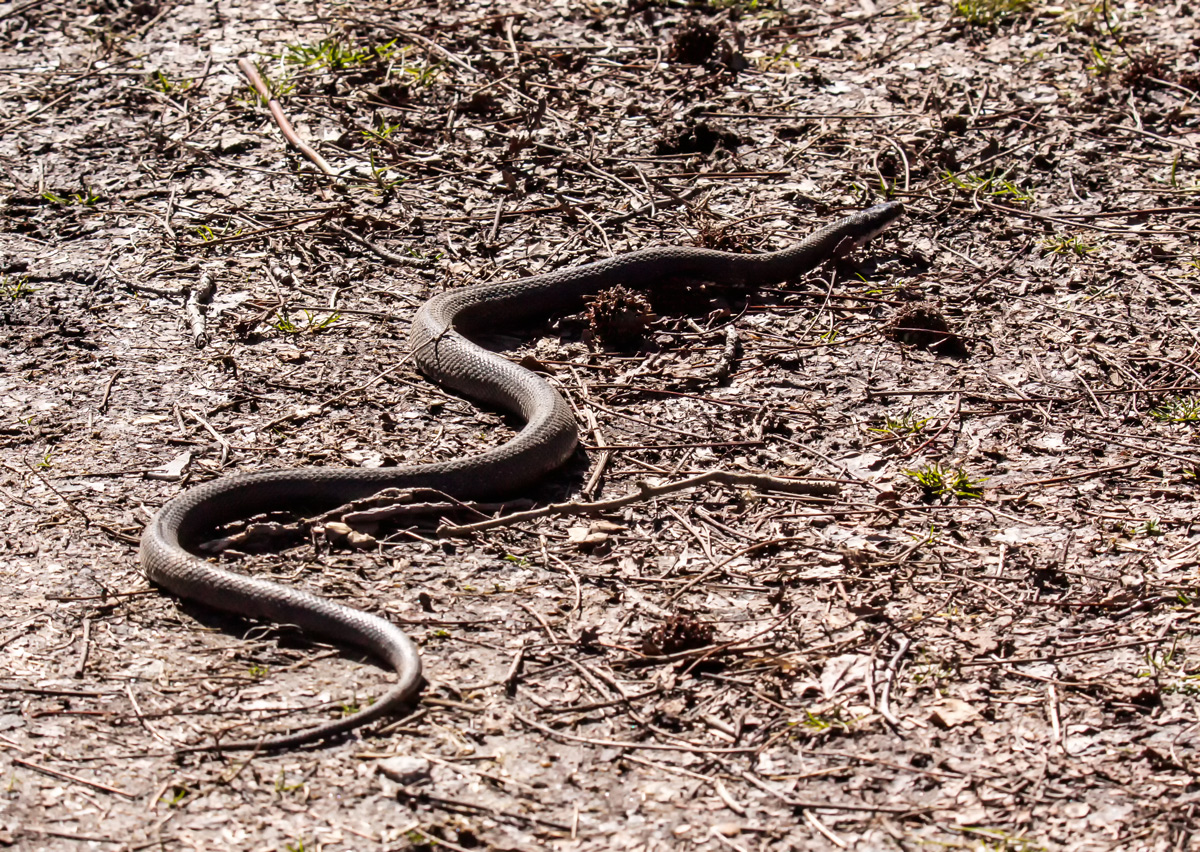
Yesterday was sunny, but not particularly warm—about 48 degrees F (9 degrees C)—so I was shocked when I encountered a snake. My eyes were pointed upwards as I scanned the trees for birds, but a slight movement just in front of my feet caught my attention and when I looked downward, I saw the sinuous curves of a snake (as shown in the second image below).

The snake, which I think may be an Eastern Ratsnake (Pantherophis alleghaniensis), moved to the side of the path and into the brush. It stopped moving long enough, however, for me to capture the close-up image image below. I know that some folks will find the image to be creepy or even frightening, but I like the way that it shows some of the wonderful details of the snake’s markings and its body.

Although it may look like I was really close to the snake, I was actually a good distance away and was shooting with a long telephoto lens.

Eastern Ratsnake


Eastern Ratsnake

Eastern Ratsnake

© Michael Q. Powell. All rights reserved.

Read Full Post »

The temperature today feels so frigid—right about the freezing level—that it is hard to remember that only this past Monday it was sunny and 60 degrees (16 degrees C). While I was enjoying the unseasonably warm weather and exploring Occoquan Bay National Wildlife Refuge, I photographed these sunning turtles, a relatively rare sight in December.

I did not get a good enough view of the turtles to be able to identify them with any confidence, but I think they may be Eastern Painted Turtles (Chrysemys picta picta) or possibly Red-eared Sliders (Trachemys scripta elegans).

Turtles in December

© Michael Q. Powell. All rights reserved.


Read Full Post »

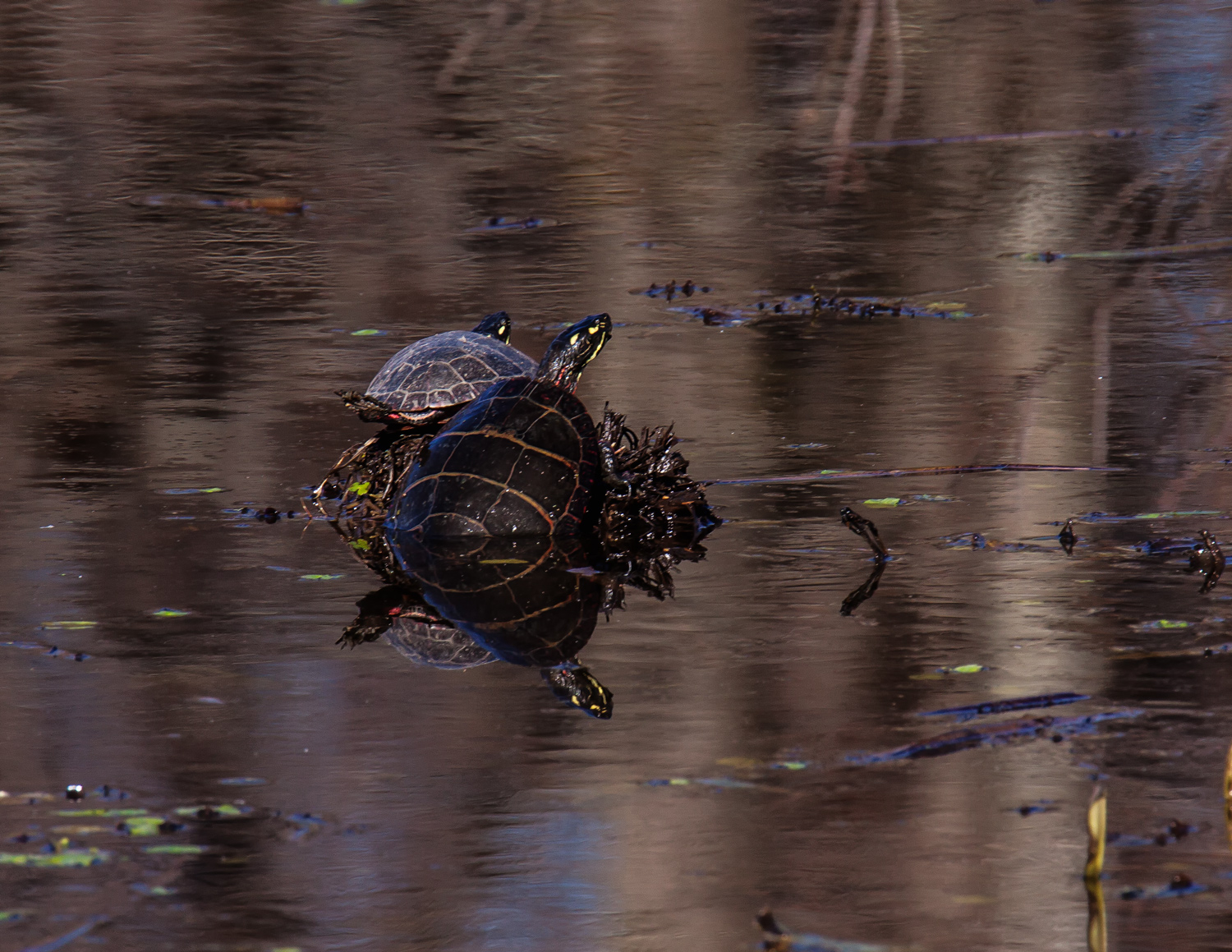
When I spotted this turtle from a distance earlier this week at Occoquan Bay National Wildlife Refuge, it was so elevated that I thought it was standing on a log or a rock. It was only when I zoomed in on this Eastern Painted Turtle (Chrysemys picta picta) that I realized that it was standing on the back of another turtle. Yikes!

You have to be pretty old—probably about my age—if you remember the song whose name I used as the title for this blog posting. No, it was not sung by The Turtles.

Eastern Painted Turtle

© Michael Q. Powell. All rights reserved.

Read Full Post »

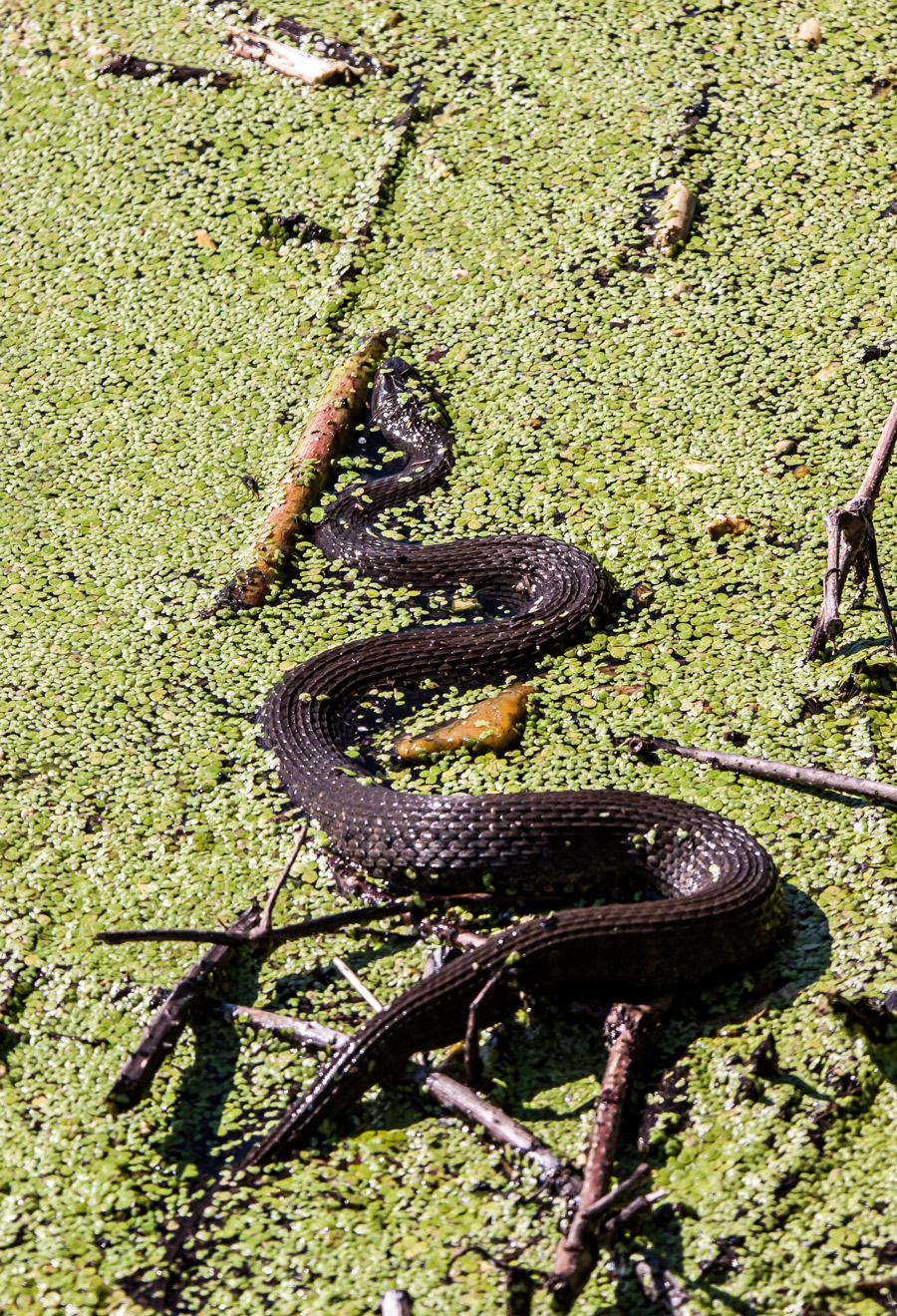
Semi-submerged in the duckweed in the shallow water, this snake patiently awaited an unseen prey yesterday at the pond at Ben Brenman Park, a small suburban park not far from where I live in Alexandria, Virginia. I did not get a really good look at the snake, which dove into the water shortly after I took this shot, but I think it might be a Northern Water Snake (Nerodia sipedon).

In many ways I was more interested in the sinuous curves of the snake’s body than in the identification of the snake’s species. There is an abstract beauty in the colors and the shapes in this image that appeals to me, though I know that some of my viewers are so creeped out by the main subject that they will find it hard to see any beauty whatsoever in the image.

Northern Water Snake

© Michael Q. Powell. All rights reserved.

Read Full Post »

Anyone who has ever gone fishing has a story of “the one that got away.” This Northern Water Snake (Nerodia sipedon) wanted to make sure that it did not have such a story to tell and dragged its prey onto dry land. Then the snake faced the challenge of figuring out how to swallow the large fish. The snake twisted and turned and contorted its body and head as it gradually ingested the fish. When the fish was part way down its throat, the snake appeared to push up against a log for additional leverage.

I captured a sequence of shots that speak for themselves, so I will not bother to explain each of them. Like me, you will probably feel a kind of macabre mixture of horror and fascination as you view them.

snake versus fish

snake versus fish

snake versus fish

snake versus fish


snake versus fish

snake versus fish

snake versus fish

snake versus fish

© Michael Q. Powell. All rights reserved.


Read Full Post »

We have been having so much rain this month that I have taken to carrying an umbrella with me much of the time, including when I am going out with my camera. It’s a challenge to take photos in the rain, because of the juggling required to hold a camera steady while holding an umbrella and also because there are fewer subjects to photograph—most creatures have the common sense to seek shelter when it is raining.

Here are a few photos from a walk I took this past Friday at Occoquan Bay National Wildlife Refuge. They are a different style than most of the photos that I post on this blog, but I really like the way they turned out.

In the first image an Eastern Box Turtle (Terrapene carolina) had a different way for handling the rain than the umbrella I was carrying—it simply pulled its legs and head inside of its shell. In the second image a Tree Swallow (Tachycineta bicolor) decided to brave the rain to get a breath of fresh air while perched atop a nesting box. The final photo shows a hummingbird view of a trumpet vine flower, one of its favorites. Alas, no hummingbirds were flying in the rain.

Eastern Box Turtle

Tree Swallow

trumpet vine

© Michael Q. Powell. All rights reserved.

Read Full Post »

Do you think about your photographic subjects one at a time? That’s the way that I tend to operate. One of my blogging friends, though, likes to organize photos of others around themes that transcend the boundaries of individual species. In this posting, Liz of Exploring Colour focused on the theme of Predators and Prey with photos that capture this reality of nature without becoming gruesome. Be sure to check out her other wonderful postings too that include her own photos as well of those of some other awesome photographers.

Ms. Liz's avatarExploring Colour

The reality of the natural world is that some creatures eat other creatures to survive. Nature photographers spend a lot of time outside and sometimes capture dramatic moments in the struggle for survival. Their photos and stories may shock us but we can learn so much from these encounters – animals seem capable of much more planning, strategy and applied knowledge than what most of us humans ever give them credit for.


** Click on any photo to view large-size version **

Note: Each photographer’s website/blog is listed at the bottom of this blog-post.


snake2_fish_blog

Mike Powell | Snake catches catfish | 20 July, 2017

  • Story plus 5 Photos showing the snake in various positions holding his catch, all the time in the water, until all of a sudden the snake somehow ingests the large fish and the last photo shows the snake with only the fish tail sticking out of…

View original post 409 more words

Read Full Post »

As I was exploring the edge of a small stream in Northern Virginia yesterday, I suddenly noticed a snake slowly swimming upstream. Its head seemed quite a bit lighter than its patterned body and I initially was confused by it. When I examined the photos afterwards, it appears the snake, which I think is a Northern Water Snake (Nerodia sipedon), was in the process of shedding its skin.

Northern Water Snakes are non-poisonous, but I never have a desire to get close to any snake that is in the water. From what I have read, I know that these snakes will bite you repeatedly if you try to pick them and their saliva contains an anti-coagulant that will make the wound bleed a lot.

At the time that the snake appeared, I was shooting with a 180mm macro lens, so any zooming that I was able to do was with my feet. At a certain point in time, the snake became aware of my presence and began to swim away more quickly. I was happy to be able to capture a shot as it was departing that shows more of the beautiful pattern on its body and some wonderful patterns in the water too.

Northern Water Snake

Northern Water Snake

© Michael Q. Powell. All rights reserved.


Read Full Post »

When I spotted this Eastern Snapping Turtle (Chelydra serpentina serpentina) from a distance yesterday at Occoquan Bay National Wildlife Refuge, I thought it might be a fox, because of its reddish-brown color. It was only when I got closer that I realized that it was a snapping turtle covered with mud—I suspect that she had recently been digging a nest to bury eggs. I got low trying to do an eye-level shot and am pleased with the expression that I was able to capture.

snapping turtle

© Michael Q. Powell. All rights reserved.

Read Full Post »

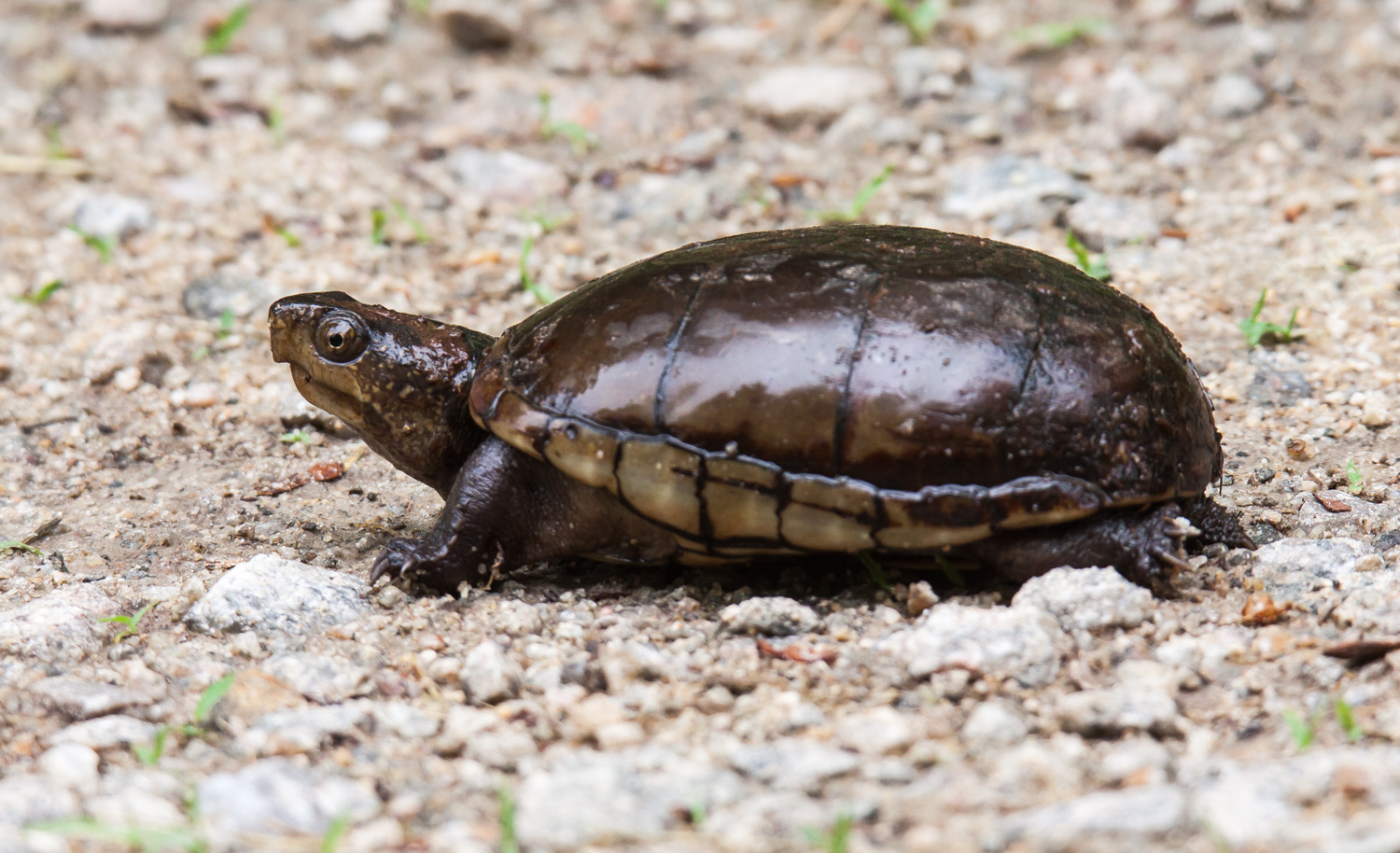
I had no idea what kind of turtle this was when I first encountered it sitting in the middle of a trail at Occoquan Bay National Wildlife Refuge this past Monday. Most of the time that I see turtles they are in the water or are sunning themselves at the water’s edge. This turtle was small and dark and lacked distinctive markings that would have aided me in identifying it.

I noticed that the turtle had a really large head and what looked to be sharp claws, so I initially thought it might be a baby snapping turtle. Uncertain of the identification, I posted a photo to a Facebook group for Nature Lovers of Virginia. The consensus of the group is that this is Eastern Mud Turtle (Kinosternon subrubrum), a new species for me.

I did a little checking on this species in Wikipedia and learned that mating occurs in the early spring followed by egg laying in May to early June. As was this case with a snapping turtle that I recently saw on dry land, I wonder if this turtle was looking for a place to lay its eggs.

Eastern Mud Turtle

© Michael Q. Powell. All rights reserved.

Read Full Post »

Can turtles smile? It is always cool to see turtles in the wild, especially Woodland Box Turtles (Terrapene carolina carolina), like this beauty that I spotted yesterday at Occoquan Bay National Wildlife Refuge. She seemed to be trying to smile when I snapped her portrait. (I think the turtle is a female because of her brown eyes—males usually have red eyes.)

There is something really special for me about seeing the color, patterns, and even the shape of this turtle’s shell, which is quite distinctive and unlike that of any other turtle that I see. These turtles, which are also known as Eastern Box Turtles, can live for a long time, as much as 100 years when in captivity, according to Wikipedia. In the wild, though, their life span is considerably shorter. Why? According to the same article in Wikipedia, “Box turtles are slow crawlers, extremely long lived, slow to mature, and have relatively few offspring per year. These characteristics, along with a propensity to get hit by cars and agricultural machinery, make all box turtle species particularly susceptible to anthropogenic, or human-induced, mortality.”

Woodland Box Turtle

Woodland Box Turtle

© Michael Q. Powell. All rights reserved.


Read Full Post »

I never know what I will see when I visit Occoquan Bay National Wildlife Refuge. I encountered this large Eastern Snapping Turtle (Chelydra serpentina serpentina) right in the middle of one of the paths at the refuge last Friday. I generally see snapping turtles in the water or sunning themselves at the water’s edge. I only recall a single instance when I have seen a snapping turtle this far out of the water and on that occasion it was digging a hole and getting ready to lay eggs. I wonder if that was why this one was on dry land.

The turtle looked like it was relaxing, but I gave it a wide berth after I snapped its photo, wanting to make sure that I was the only one snapping.

Snapping Turtle

© Michael Q. Powell. All rights reserved.


Read Full Post »

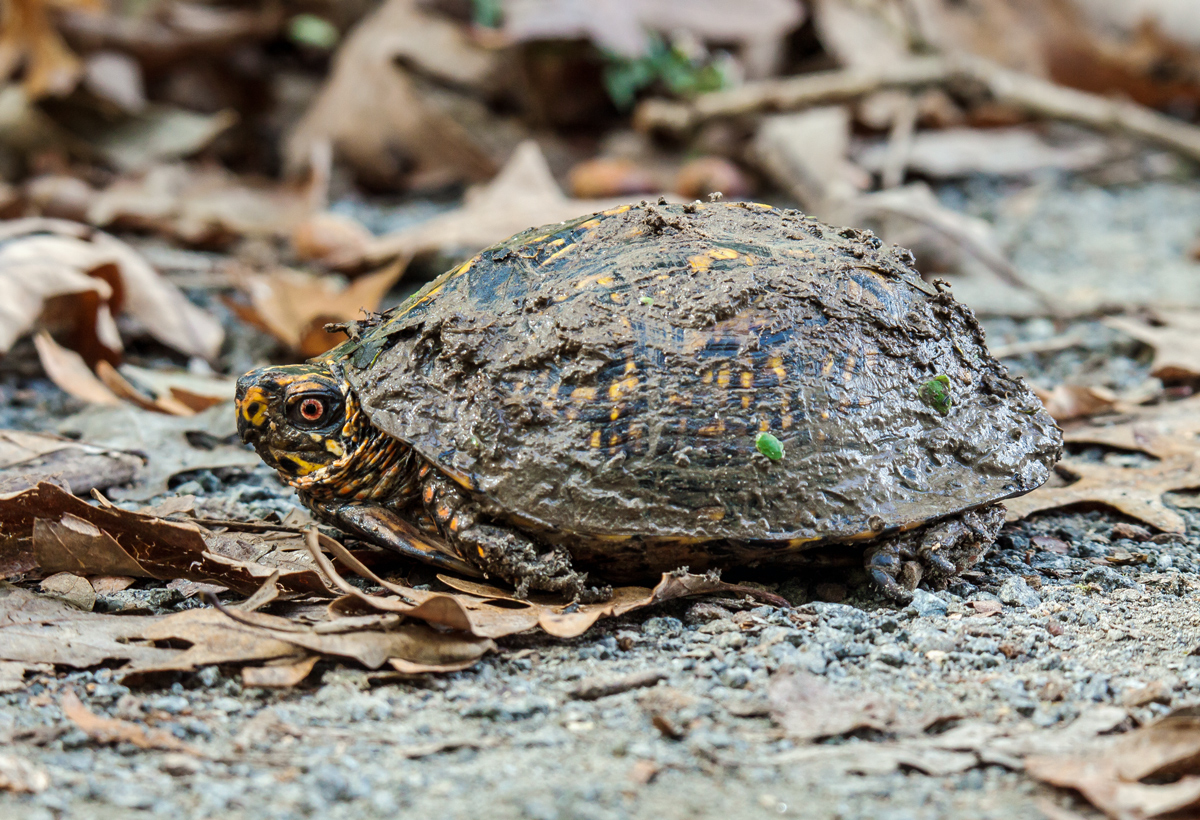
I was moving slowly this past Monday as I sought to get photos of birds at Huntley Meadows Park, but not quite as slowly as this Eastern Box Turtle (Terrapene carolina carolina) that looked like it had just crawled out of the mud. This species of turtle has a beautiful pattern on its shell, but it is mostly obscured by the mud. I think that I might have startled the turtle, because it pulled its head and body inside of the shell for a little while, making it almost perfectly camouflaged, despite the fact that it was sitting right on a path.

Eastern Box Turtle

© Michael Q. Powell. All rights reserved.

Read Full Post »

One of the coolest turtles in our area is the Eastern Box Turtle (Terrapene carolina carolina), also known as the Woodland Box Turtle. Unlike many turtles, this one spends most of its time on land rather than in the water. I spotted this beauty, which is probably a male,  last weekend at Occoquan Bay National Wildlife Refuge as it was slowly making its way across a trail—males generally have red eyes and the females have brown eyes.

As I was doing a little research, I discovered that the Eastern Box Turtle is the official state reptile of North Carolina and Tennessee. Who even knew that states had official reptiles? According to an article in ncpedia.org, the General Assembly of 1979 designated the Eastern Box Turtle as the official State Reptile for North Carolina. Given that this was agreed in a legislative body, debates were held about the relative merits of this reptile versus other potential candidates.

I couldn’t help but laugh as I read the words of the preamble to the legislative bill that cited a variety of reasons why the box turtle was selected:

“Whereas, the turtle is a most useful creature who serves to control harmful and
pestiferous insects, and acts as one of nature’s clean-up crew, helping to preserve
the purity and beauty of our waters; and

Whereas, the turtle is derided by some who have missed the finer things of life,
but in some species has provided food that is a gourmet’s delight; and

Whereas, the turtle, which at a superficial glance appears to be a mundane and
uninteresting creature, is actually a most fascinating creature, ranging from
species well adapted to modern conditions to species which have existed
virtually unchanged since prehistoric times; and

Whereas, the turtle watches undisturbed as countless generations of faster hares
run by to quick oblivion, and is thus a model of patience for mankind, and a
symbol of this State’s unrelenting pursuit of great and lofty goals; and

Whereas, the woodlands, marshes, and inland and coastal waters of North
Carolina are the abode of many species of turtles; Now, therefore. . .”

As an interesting sidenote, Virginia, the state in which I live, has twice considered adopting this turtle as the state’s official reptile, but rejected the legislative proposals in 1999 and 2009. A posting on nbcwashington.com reported that during discussions in 2009, one delegate asked why Virginia would make an official emblem of an animal that retreats into its shell when frightened and dies by the thousands crawling across roads and counterproposed that the rattlesnake be chosen. The fatal blow, according to the posting, might have been the disclosure that the Latin name for the Eastern Box Turtle—Terrapene carolina carolina—implied too close a relation to a Virginia regional rival.
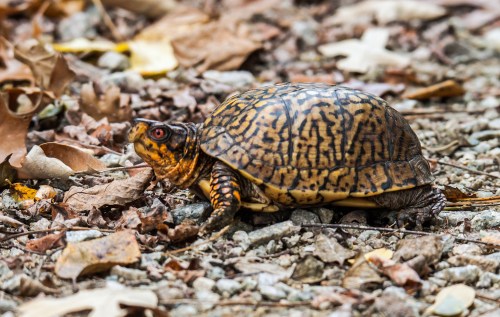
Eastern Box Turtle

© Michael Q. Powell. All rights reserved.

Read Full Post »
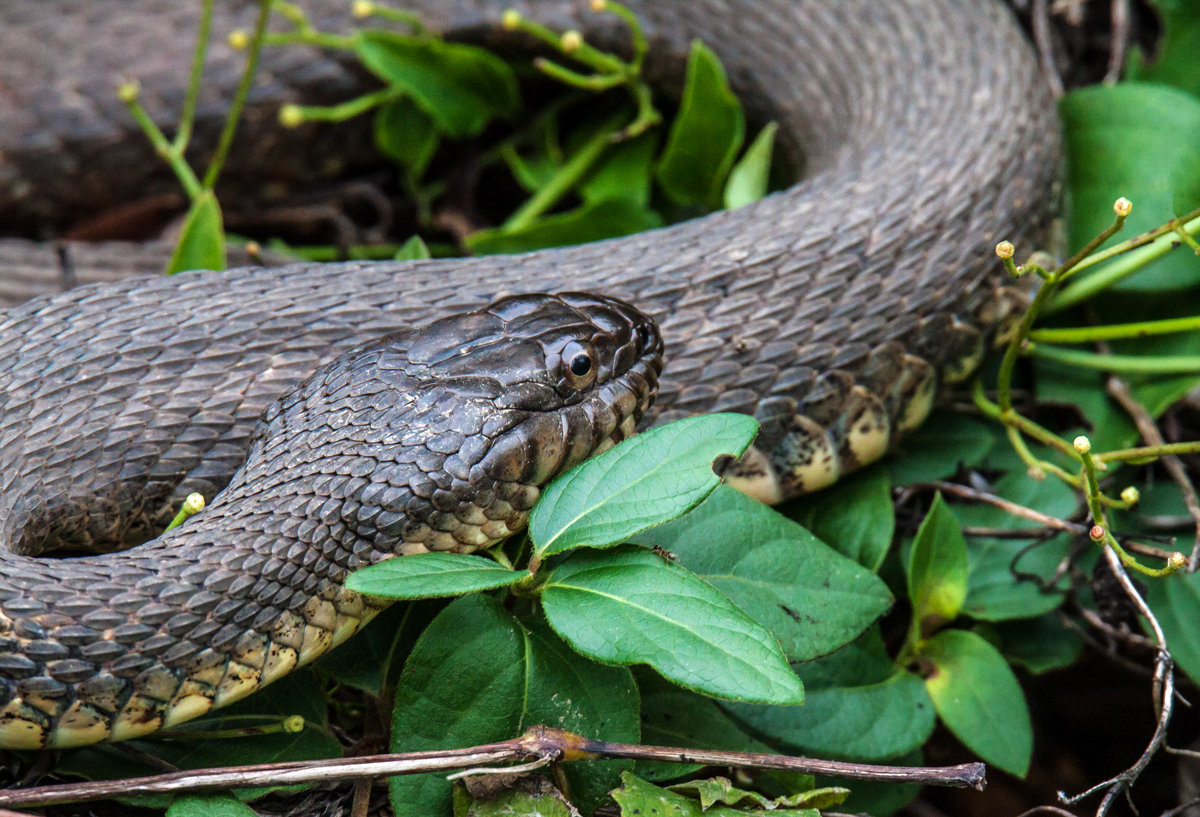
I spent much of my time Friday at Occoquan Bay National Wildlife Refuge scanning the trees for birds. On one of the rare moments when I was looking down, I ended up looking into the eyes of what appears to be a Northern Watersnake (Nerodia sipedon).

Although it may look like I was dangerously close to this snake, I took these shots with my Tamron 150-600mm lens, which has a minimum focusing distance of almost 9 feet (274 cm). Northern Watersnakes are not poisonous, but I have been told that their bites can be very painful and that the snakes inject an anti-coagulant when they bite, so wounds tend to bleed profusely.

I particularly like the way that I was able to capture some of the details of the snake, including its scales and its head. If you look closely, you can even see a miniature landscape in the eyes of the snake.

UPDATE: One of the viewers on my Facebook page commented that this looks more like an Eastern Ratsnake (Pantherophis alleghaniensis) than a Northern Watersnake. I am hoping to get some clarification on the species of this snake and would welcome the views of any readers with expertise in this area.

Northern Watersnake

Northern Watersnake

Northern Watersnake

© Michael Q. Powell. All rights reserved.


Read Full Post »

Creepy or cool? This snake and I stared at each other for a while on Monday at Huntley Meadows Park before it decided that it had had enough and silently slithered away. One of my Facebook friends praised me for winning a staring contest with a snake, but I think that it may have simply gotten bored or had satisfied its curiosity.

I am not sure of the species, but think that it may be an Eastern Ratsnake (Pantherophis alleghaniensis).

Eastern Ratsnake

© Michael Q. Powell. All rights reserved

Read Full Post »

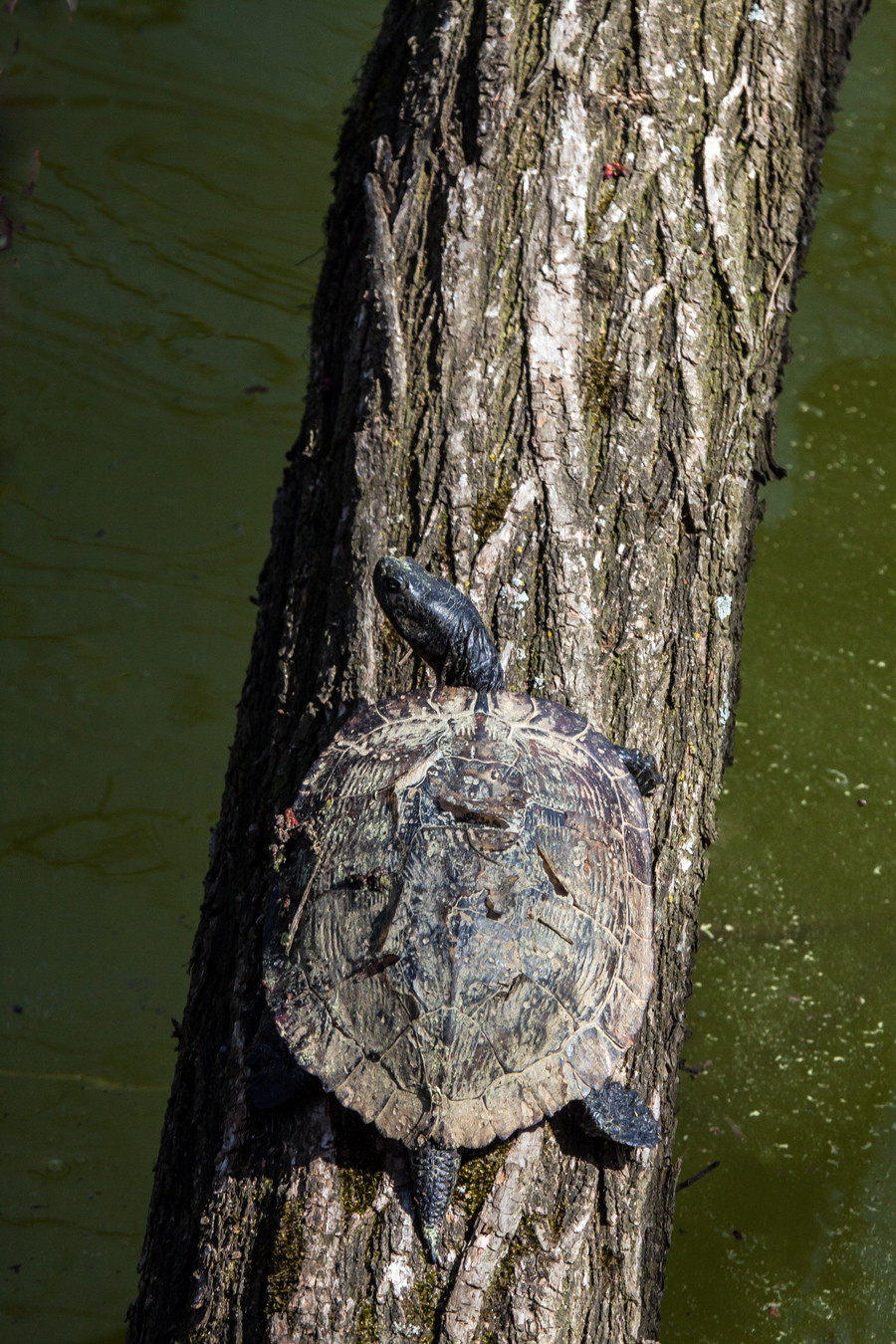
Normally I see turtles at water level, but this intrepid turtle had climbed up the trunk of an overhanging tree at Jackson Miles Abbott Wetlands Refuge on Monday and was perched several feet about the surface of the pond. I love the way that his coloration and texture almost perfectly match those of the tree.

turtle in a tree

A short while later I encountered three turtles perched on the trunk of a tree growing at an angle out of the water. The angle was steep enough that I was not sure how they managed to get themselves into position or how they were able to keep from sliding down into the water.

turtles in a tree

© Michael Q. Powell. All rights reserved.

Read Full Post »

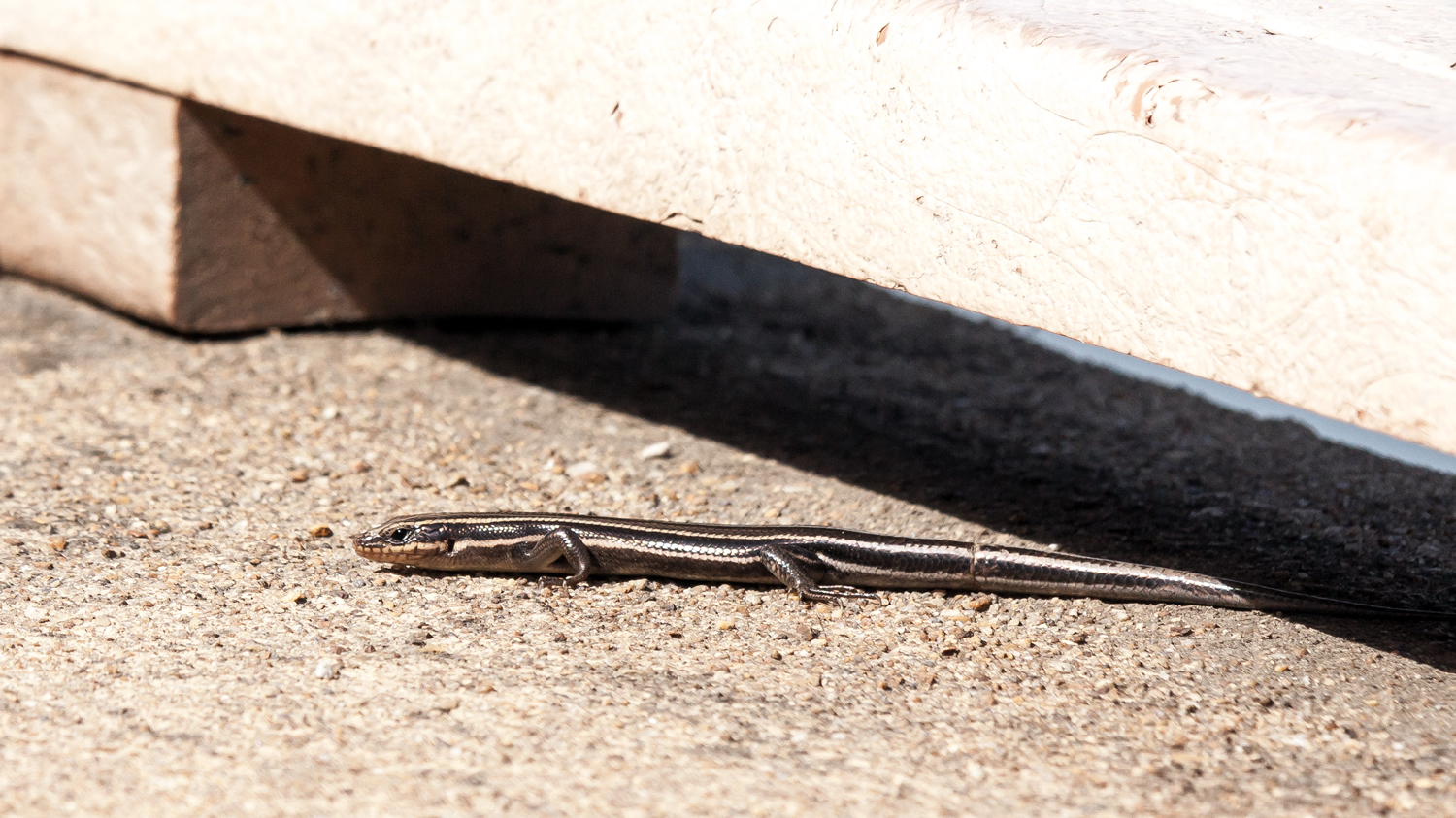
A warm, sunny springtime day caused all kinds of creatures to appear, including this Common Five-lined Skink (Plestiodon fasciatus) that I spotted on a concrete fishing platform at Jackson Miles Abbott Wetlands Refuge in Alexandria, Virginia. This variety of skinks is one of the few lizards in the area in which I live and the skinks tend to be elusive and skittish, so I generally see only the tail of the skink as it is running away.

This skink and I engaged in a protracted game of hide-and-seek as I sought to get close enough for some shots. Although I would have been a bit happier with a more natural backdrop, I am relatively content with the images that I was able to capture.

Common Five-lined Skink


Common Five-lined Skink

Common Five-lined Skink

© Michael Q. Powell. All rights reserved.

Read Full Post »

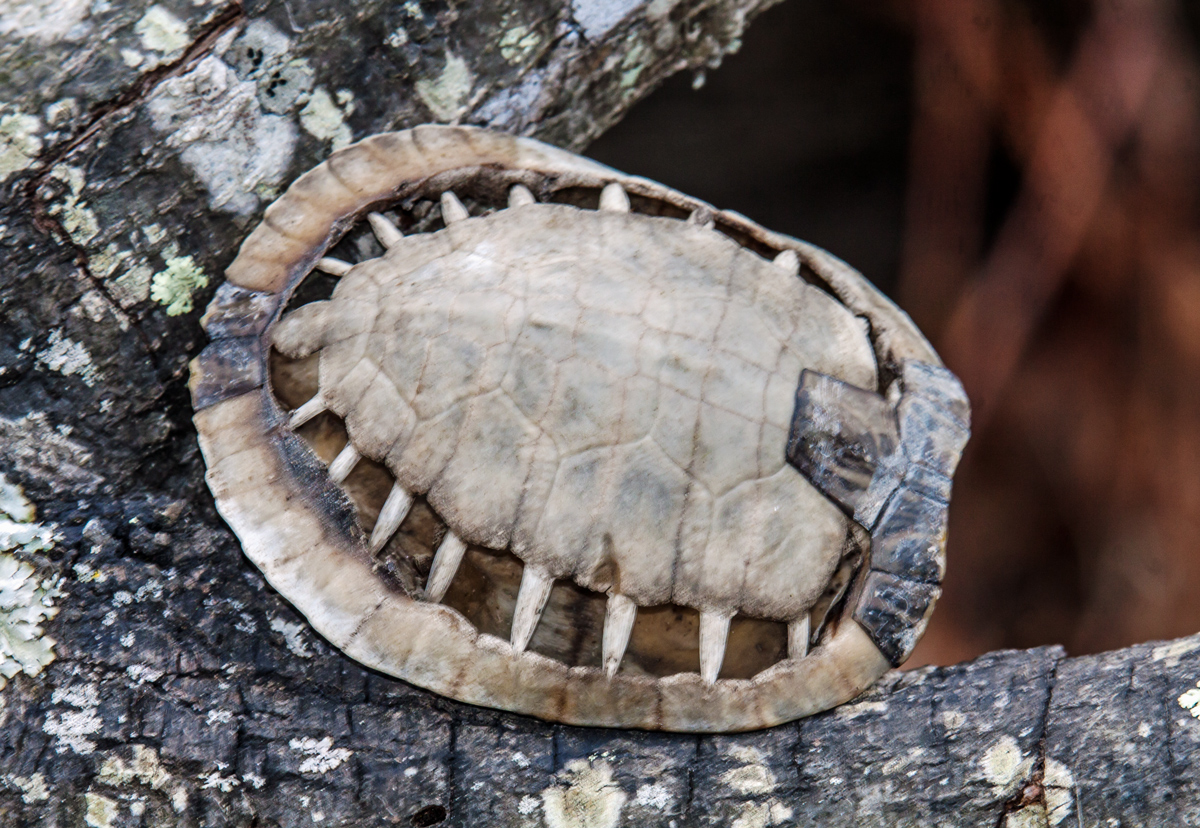
I never quite know what I will see when I wander about in the back areas of Huntley Meadows Park. This past Monday I came upon this partially deteriorated turtle shell. Initially it was in a muddy area adjacent to a beaver pond, but I moved it onto branches of a fallen tree to take the photos.

I just love the organic shapes and designs of the shell and the way that you can see some of its underlying structure.

turtle shell

turtle shell

© Michael Q. Powell. All rights reserved.

Read Full Post »

I made a quick trip to Huntley Meadows Park on Christmas Day to see what creatures were stirring and was surprised to see some turtles had surfaced to bask in the sun. The flash of red on this Red-eared Slider turtle (Trachemys scripta elegans) made its colors seasonally appropriate and it did seem to have sandy claws.

Red-eared Slider

© Michael Q. Powell. All rights reserved.


Read Full Post »

As I was exploring yesterday at Huntley Meadows Park, I came upon this Rough Green Snake (Opheodrys aestivus) stretched out in the thorns at the edge of one of the fields. My first instinct was to move in close, but I actually remembered to take a shot of the entire snake before doing so.  The “wide-angle” shot was taken with my 150-600mm telephoto zoom lens, which gave me a slightly wider view than the 180mm macro lens that I used for the close-up shot.

Rough Green Snake

Rough Green Snake

© Michael Q. Powell. All rights reserved.


Read Full Post »

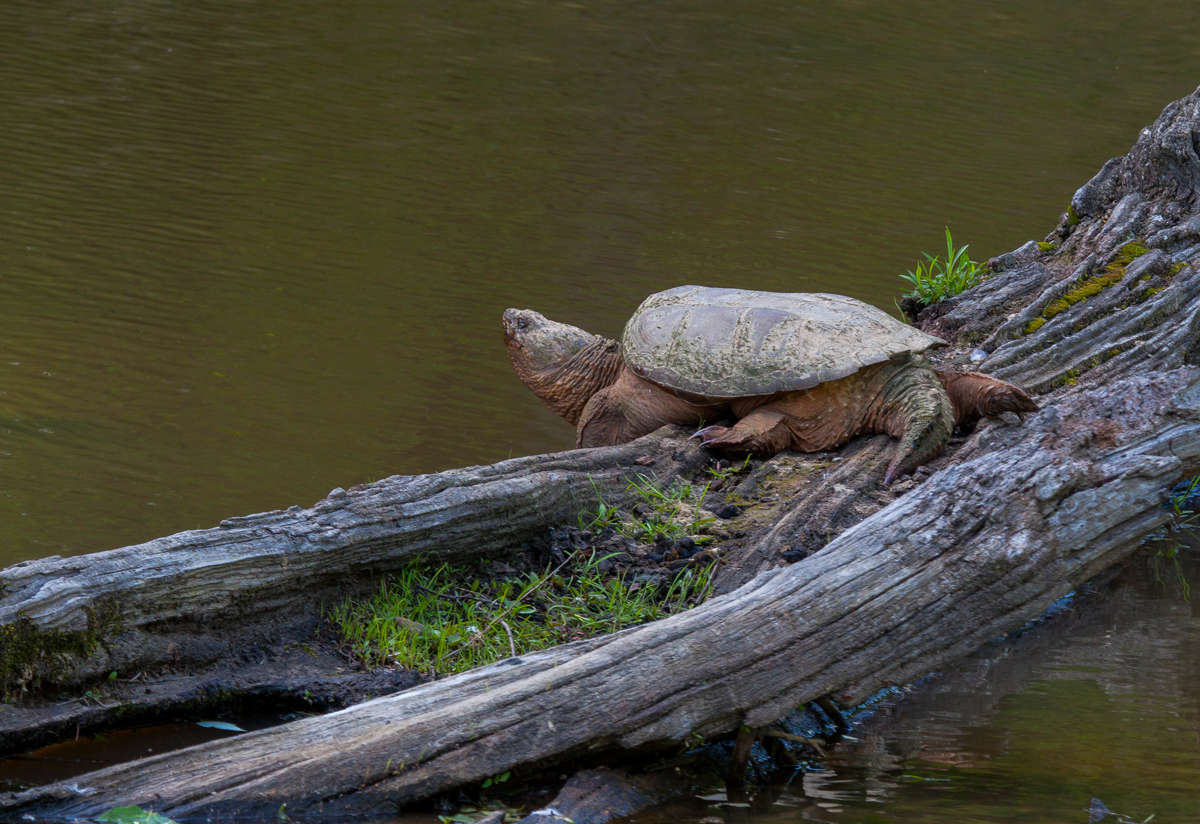
As a child, I remember thinking that turtles could all pull their bodies inside of their shells for protection. Clearly that is not the case with this prehistoric-looking Snapping Turtle (Chelydra serpentina) that I spotted last week lounging on a fallen tree at Huntley Meadows Park in Alexandria, Virginia.

We kept little turtles as pets several times in my family as I was growing up and I remember the clear flat plastic habitat that we used that had a small plastic palm tree. As a product of the suburbs of Boston, I didn’t have a whole lot of experience with wildlife, though I was Boy Scout for a while.

To this day I am amazed by the size and apparent power of snapping turtles, which are pretty common in my favorite marshland park. Most of the time I see them moving slowly in the water and only occasionally do I see one sunning itself on a log as the smaller turtles regularly are wont to do—I imagine that it is quite a chore to haul that massive body out of the water.

snapping turtle

© Michael Q. Powell. All rights reserved.

Read Full Post »

I was a bit surprised recently to spot an Eastern Garter Snake (Thamnophis sirtalis) with blue eyes at Huntley Meadows Park. Normally, a garter snake’s eyes are clear and bright and if I can get close enough, I can sometimes see my own reflection.

As I moved closer, I could see that the bluish covering over the eyes was somewhere between translucent and opaque, looking a little like cataracts. The snake was aware of my presence and flicked its tongue when I got too close, but did not try to slither away. A search on the internet revealed that the eyes turn this blue color when the snake is getting ready to shed its skin, a process that generally takes about a week.

When my macro lens is on my camera I feel drawn to move closer and closer to my subject, as you can see in the first image. This shot gives a good view of the blue eye, but doesn’t give you much a sense of the snake’s environment. When I pulled back to include the snake’s entire body, you get a look at the sinuous curves of the body, but the eye is almost lost. The final image here was a mid-range shot that was a kind of compromise—some of the body shows, but the eye has greater prominence than in the second image.

Which image do I like the most? It’s hard for me to decide, but I think it was a good idea to photograph the snake at different distances to give myself some options. I’m going to have to try that approach more often.

garter snake

garter snake

garter snake

© Michael Q. Powell. All rights reserved.

Read Full Post »

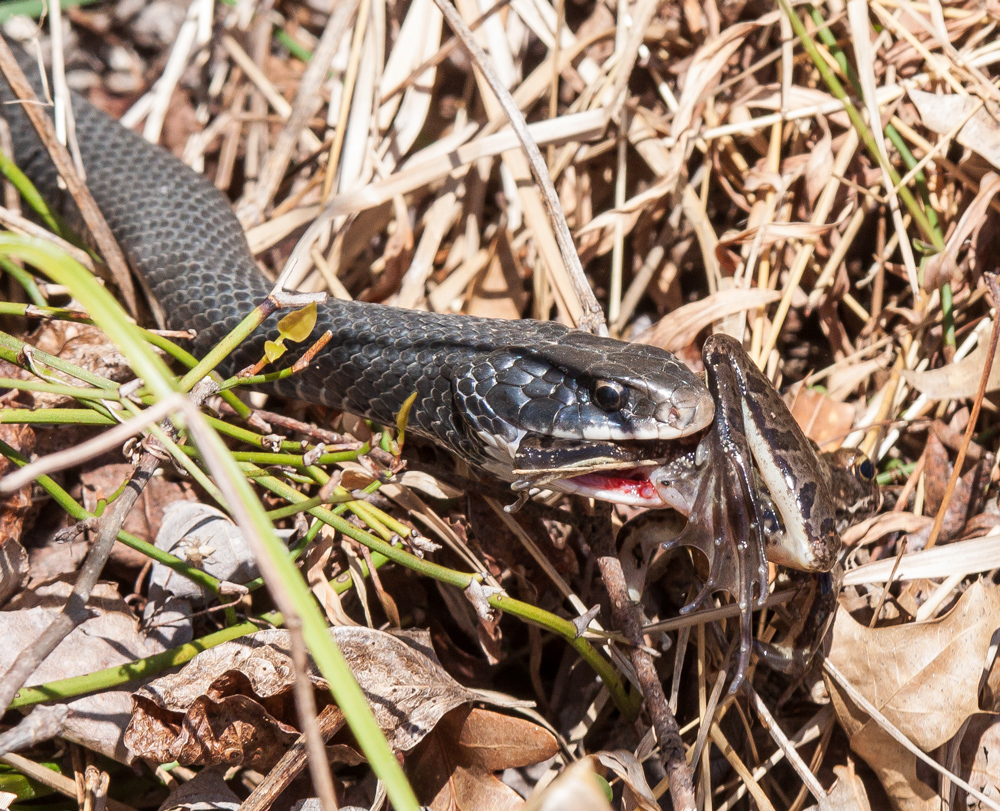
With a mixture of horror and fascination, I watched as a large black snake slowly ingested a Southern Leopard Frog (Lithobates sphenocephalus) that it had caught on Friday at Huntley Meadows Park. The frog was struggling and crying out loudly and then suddenly it was free. The lucky frog hopped away and the snake could only tell its friends about the one that got away.

When I first spotted the snake, it was holding the frog in the air. It appeared to have grabbed the frog by one of its back legs and was trying to adjust the frog so that it could swallow it. Unlike a Great Blue Heron that swallows its prey in a single gulp, the snake has to pull its prey in slowly. Little by little the snake seemed to get more of the frog’s leg in its mouth.

The frog continued to struggle, seeking to get some leverage so that it could pull its way out of the snake’s death grip. I didn’t see exactly how it happened, but all of the sudden the frog was free. It almost looked like that snake had released the frog, though that just seems so unlikely to have happened. Whatever the case, the frog was extremely fortunate—all of the previous encounters that I have observed between snakes and frogs have ended with the frog inside of the snake.

I was shooting with my macro lens, so I couldn’t zoom in closer, but I did manage to capture a sequence of shots that show some of the action.

release2_15Apr_blog

release3_15Apr_blog

release1_15Apr_blog

release5_blog_blog

© Michael Q. Powell. All rights reserved.

Read Full Post »

Be sure to check out Walter Sanford’s narrative and photos of our adventures together this past Monday trying to photograph snakes. Our photographic and writing styles are different and our posts are intended to complement each other by providing alternative points of view.

waltersanford's avatarwalter sanford's photoblog

Michael Powell and I met for a long photowalk at Huntley Meadows Park on 11 April 2016. We spotted (and photographed) a Northern Black Racer (Coluber constrictor constrictor) during the morning and an Eastern Gartersnake (Thamnophis sirtalis sirtalis) in the early afternoon.

Mike’s viewpoint

The following photo shows Michael Powell shooting the snake, up close and personal, using a field-tested technique I refer to as “Sandbagging the Grinder.” Sometimes Mike uses his camera bag for support and stability in order to shoot tack-sharp photos with a Tamron 180mm macro lens. “The Grinder” is my nickname for Mike’s macro lens because you can hear the internal gears grinding when it’s autofocusing — it’s loud, but hey, it works well in the hands of a skilled photographer!

Michael Powell photographing an Eastern Gartersnake (Thamnophis sirtalis sirtalis) at Huntley Meadows Park, Fairfax County, Virginia USA.

My viewpoint

An Eastern Gartersnake (Thamnophis sirtalis sirtalis) spotted at Huntley Meadows Park, Fairfax County, Virginia USA.

The preceding photo is the next shot I took after taking the photo of Mike. I was shooting with a Panasonic Lumix DMC-FZ150 superzoom digital…

View original post 291 more words

Read Full Post »

« Newer Posts - Older Posts »