Feeds:
Posts
Comments

Archive for the ‘Reptiles’ Category

I was delighted to spot this Eastern Box Turtle (Terrapene carolina carolina) yesterday alongside one of the trails at Occoquan Bay National Wildlife Refuge. These beautiful land-dwelling turtles, also known as Woodland Box Turtles, are extremely long-lived and are capable of living over 100 years in captivity, though in the wild they often live much shorter lives due to disease and predation.

The brown eyes of this turtle suggest that that it is a female, though I have read that eye color is not always 100% accurate in determining the gender of a box turtle—males of this species often have red eyes. The shell pattern for each box turtle is supposed to be unique, like a fingerprint, which makes the wonderful patterns of this turtle’s shell especially intriguing.

Eastern Box Turtle

Eastern Box Turtle

© Michael Q. Powell. All rights reserved.


Read Full Post »

Common Five-lined Skinks (Plestiodon fasciatus) are indeed quite common, but they are so skittish that they are tough to photograph. As soon as they see me (or sense my presence), they will usually scamper away to the underside of the logs on which they like to perch. On a recent visit to Jackson Miles Abbott Wetland Refuge, I spotted this skink sunning itself on a log and was able to get this shot because I approached him from behind—this technique does not work as well for dragonflies, which have massive compound eyes that provide them with a field of view of almost 360 degrees.

It is always fun to encounter juvenile skinks that have bright blue tails, but this one appeared to be an adult. I noted too that its tail was intact. Like many lizards, skinks possess the unique defense mechanism of being able to drop their tail to escape predators. The dropped tail continues to wiggle, distracting the predator, while the skink flees. Skinks can regenerate their lost tail, though the new tail may differ in structure and coloration from the original.

As many of you know, I love bad “Dad” jokes and this skink reminded me of one of them. “Where do skinks go to find a replacement for a lost tail? A retail outlet.” Sorry!

Five-lined Skink

© Michael Q. Powell. All rights reserved.

Read Full Post »

Last week I spotted this Northern Water Snake (Nerodia sipedon) alongside a creek during a hike in Prince William Forest Park in Triangle, Virginia. Water Snakes are not venomous, but I remember reading that their saliva contains an anti-coagulant, so I am reluctant to get so close to one that I risk getting bitten.

Most of the Northern Water Snakes that I have previously seen have been a uniform dark color, but this snake has a beautiful striped pattern on its underside that is visible in this photo. This snake seemed to be simply sunning itself, absorbing the warmth of the spring sunshine.

Northern Water Snake

© Michael Q. Powell. All rights reserved.

Read Full Post »

Long telephoto lenses tend to distort your depth perception. On Tuesday I watched this North American Snapping Turtle (Chelydra serpentina) swimming about in a pond at Occoquan Bay National Wildlife Refuge. I was a bit creepy as the turtle got bigger and bigger in my viewfinder when it began to swim directly towards me. One part of my brain objectively knew that the turtle was still a long way off, but it was nonetheless a bit disconcerting when the snapping turtle’s dinosaur-like eyes appeared to be staring right at me.

Spring is here, though the weather has been cool recently and there were some local frost warnings last night, and all kinds of creatures are waking up. I’m still looking for my first dragonfly of the year and will probably continue my quest later today.

snapping turtle

© Michael Q. Powell. All rights reserved.

Read Full Post »

I don’t know if thegroup of Painted Turtles (Chrysemys picta)) was a family unit or merely good friends, but they seemed to be cooperating to maximize their exposure to the warmth of the sun last week at Occoquan Bay National Wildlife Refuge. At some of the other wildlife parks in my area there are large logs on which the turtles will space themselves out as they bask in the sun, but flat dry land is limited at this refuge, so the turtles are willing to share the space with others.

As I was taking the first photo, several more turtles emerged from the pond, as you can see in the second photo below. Their wet shells are much darker than those of the first three turtles that have had a chance to dry out a bit.

Painted Turtles

Painted Turtles

© Michael Q. Powell. All rights reserved.

Read Full Post »

As the weather has warmed up and the sun has started to shine a bit more brightly, Painted Turtles (Chrysemys picta) have emerged from the mud at the bottom of the ponds at Occoquan Bay National Wildlife Refuge. These turtles used whatever objects they could find to pull themselves out of the water and bask in the sunlight. Sometimes their shells are washed clean of mud, but, as you can see in the final photo, some of the turtles were still covered in mud when I photographed them last week.

Painted Turtle

Painted Turtle

Painted Turtle

© Michael Q. Powell. All rights reserved.


Read Full Post »

Do turtles show affection? If so, how do they overcome the obstacle posed by their hard shells?

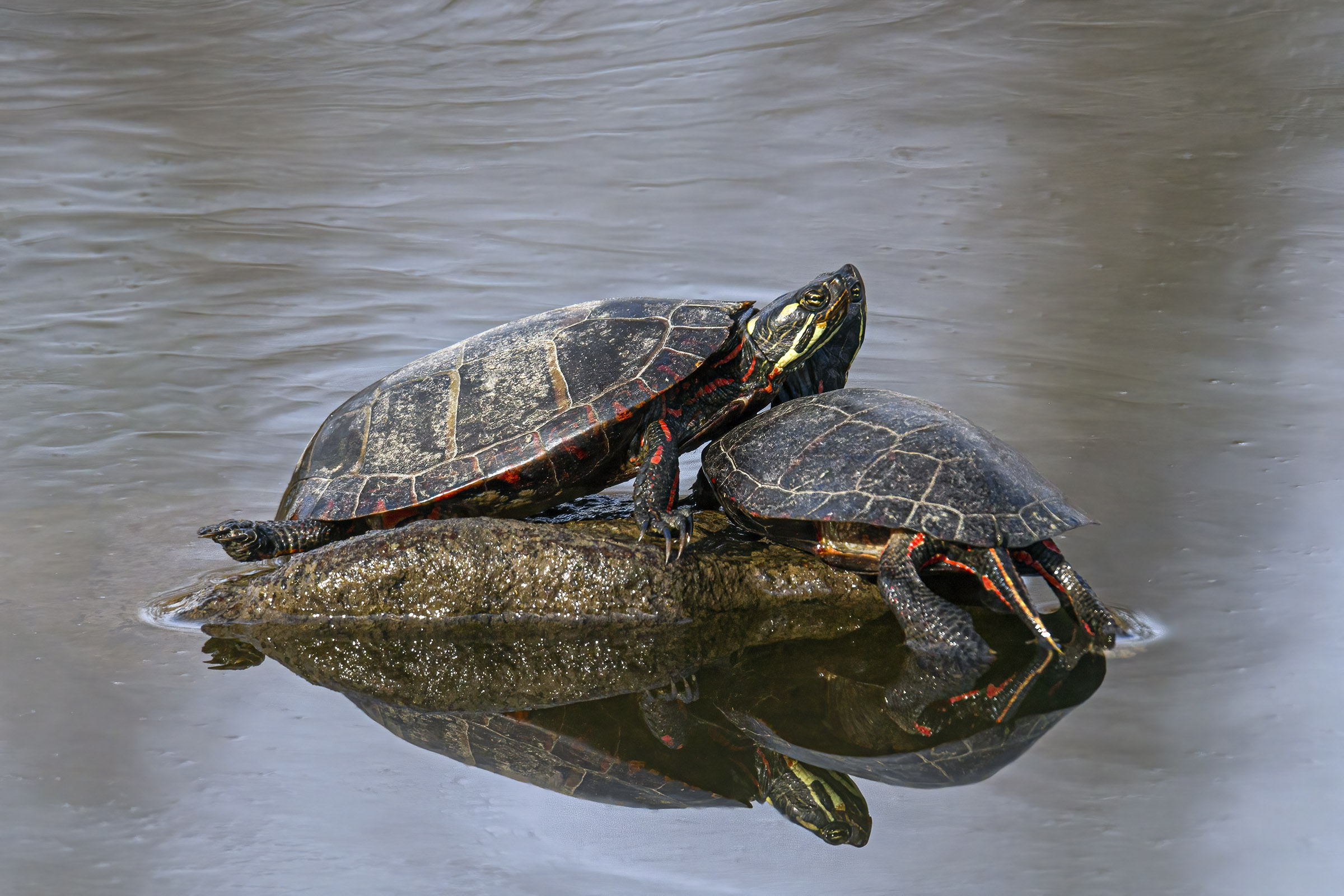
Last week on an unusually warm December day, I spotted two Eastern Painted Turtles (Chrysemys picta) sitting on a log in a small swampy pond at Occoquan Bay National Wildlife Refuge. They were sitting pretty close to each other, which was not unusual given the small size of the log. What really struck me, though, was the way that they appeared to be rubbing the sides of their faces against each other.

Was this a sign of affection? It certainly seemed that way to me.

I’ve met people who appear to have as tough an exterior as these turtles. How do you reach people like that? Persistent small act of unrequited kindness may help to penetrate those barriers. For me, that is what Christmas is all about, an attitude towards others that lasts a whole lot long that a single-day celebration.

A belated Merry Christmas to all of you who celebrated yesterday and best wishes for a happy and healthy 2025 to you all.

Painted Turtles

© Michael Q. Powell. All rights reserved.

Read Full Post »

It was uncomfortably hot for me and I tried to stay in the shade as much as possible during a recent visit to Jackson Miles Abbott Wetland Refuge. A Painted Turtle (Chrysemys picta), however, had pulled itself almost completely out of the water to maximize its exposure to the direct sunlight. For the record, I am not the kind of guy who enjoys baking in the sun on a beach.

I really like the turtle’s pose and the way that it stands out amidst all of the water and the abundant vegetation. The beautiful reflection was a nice bonus, adding a bit of symmetry and additional visual interest to the image.

Painted Turtle

© Michael Q. Powell. All rights reserved.


Read Full Post »

On Wednesday I spotted a skink with a shockingly orange head while I was exploring Occoquan Bay National Wildlife Refuge. Why was the skink’s head so orange? During mating season, adult male skinks get swollen heads that turn bright orange-red in color. I am not sure what biological purpose the color change serves, but it sure is impressive.

I think that this is probably a Common Five-lined Skink (Plestiodon fasciatus), the most common skink species in my area. However, the Broad-headed Skink (Plestiodon laticeps) is similar in appearance and I am not very good at telling them apart. Whatever the case, the males in both species have orange heads during mating season.

Five-lined Skink

© Michael Q. Powell. All rights reserved.

Read Full Post »

What is your first reaction when you see a snake? If you are like many people, you turn and run away as fast as you can. My reaction is generally the opposite one—I move closer to the snake, either physically or with a zoom lens, in order to get a more detailed look at it. Most of the snakes in our area are non-poisonous, but I still remain very cautious, because some of them will strike and/or bite.

On Monday I spotted a large black snake in the vegetation at Occoquan Regional Park. As I started to get a little closer, it began to vibrate its entire body and the dried leaves helped to create a rattling kind of sound. Yikes! I decided that I was close enough to get a few shots. Usually the black snakes that I encounter are ratsnakes, but this one turned out to be a Northern Black Racer (Coluber constrictor constrictor). The two species of snakes are somewhat similar in appearance, but the scales of the black racer are smoother and more shiny in appearance.

I decided to check out the website of the Virginia Herpetological Society for more information on the black racer and was surprised to learn that “Coluber constrictor does not constrict, as the scientific name implies, but pins its prey with body loops and swallows it alive.”

The website also noted that “Coluber constrictor has a catholic diet,” which caused me to do a double take. I grew up in a predominantly Roman Catholic neighborhood and tend to associate the word “catholic” with that church, so I immediately wondered how the snake determined the religious preferences of its victims. When a sense of reality returned to me, I remembered that “catholic” with a small initial letter simply means “universal,” so that statement probably just means that the black racer has a wide-ranging diet.

Ever curious, I wondered why this species is called a “racer.” Do they compete in competitions? The herpetological society provided the following information about the snake’s hunting habits:

“Northern Black Racers are active, diurnal predators that use vision to search for prey. Coluber constrictor actively forages with the forepart of the body raised off the ground and the head held horizontally searching for prey. They will seek escape by swiftly moving to thick grass cover or into a burrow entrance…Because they are active snakes that widely search for prey, they have large home ranges. Movements of up to 1.6 km have been recorded.”

My apologies to those readers who are creeped out by photos of snakes. I find then to be as fascinating as the more traditionally “beautiful” creatures that I often feature.

black racer

black racer

© Michael Q. Powell. All rights reserved.

Read Full Post »

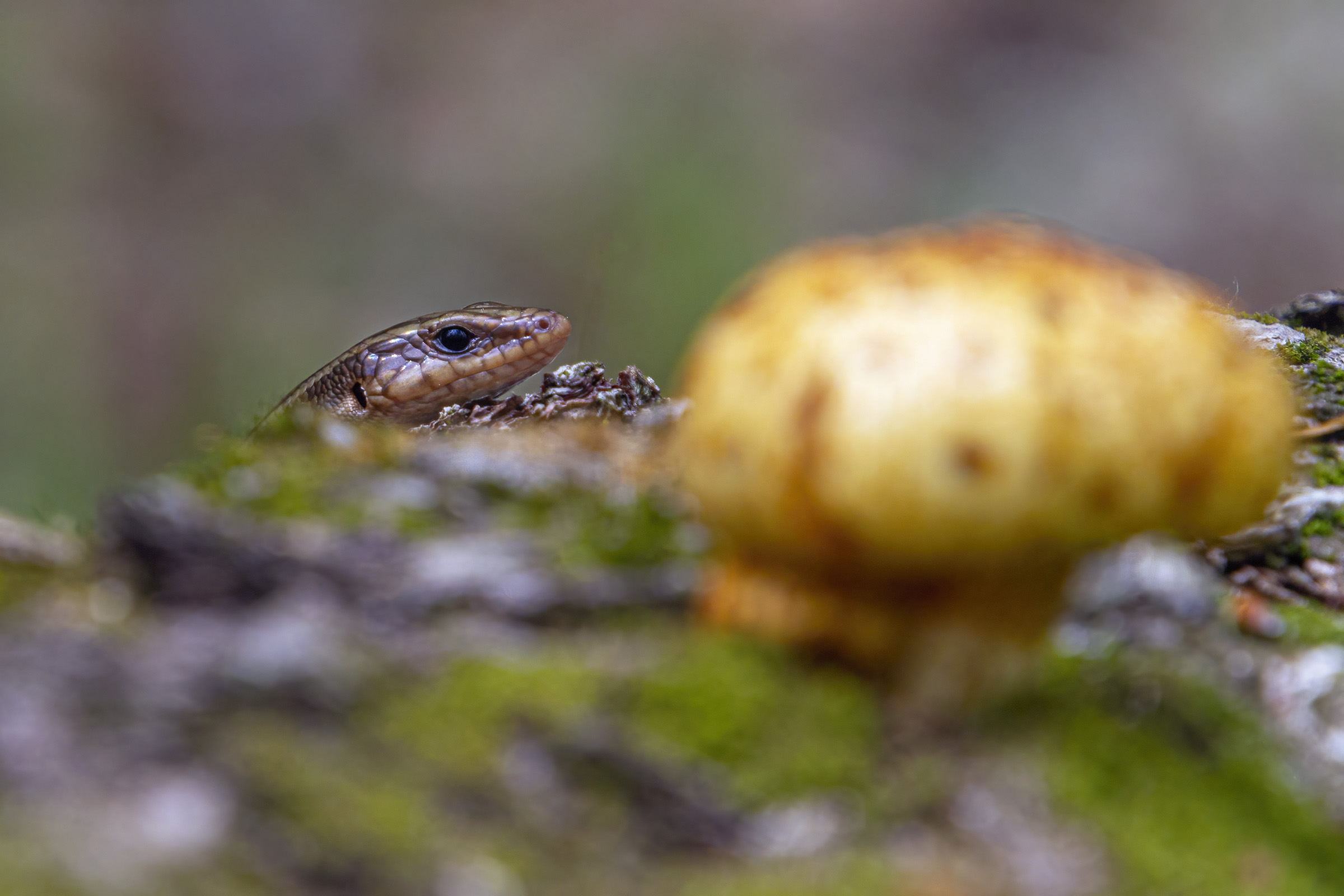
As I was hiking last Thursday in Prince William Forest Park, I spotted a cool-looking mushroom on a moss-covered fallen tree. I crouched low to the ground so that I could capture an eye-level shot of the mushroom. While I was carefully composing a few shots in the camera’s viewfinder, my eyes detected some movement in the corner of the frame and I was a bit shocked to see the head of a Five-lined Skink (Plestiodon fasciatus), one of the few lizard species in Virginia.

Skinks are generally very skittish, so I froze in place and slowly changed the focus point from the mushroom (first photo) to the skink (second photo). Once I knew that I had captured those shots, I moved slightly to the side to see if I could get a better angle on the skink.

I never could not see the skink’s entire body, but really like the final shot that shows a lot of the details of the skink. I am not sure what the skink was doing, but it seemed to be focusing intently on something. Perhaps it was so focused on a potential prey that it was less aware of me than it might otherwise have been.

A small change in focus made a big difference in the final results. Maybe that’s true in other aspects of our lives.

mushroom

Five-lined Skink

Five-lined Skink

© Michael Q. Powell. All rights reserved.

Read Full Post »

When the weather is sunny, turtles at local ponds often bask in the sun in large groups. Sometimes the turtles are packed in so tightly that it looks like a mall parking lot at Christmas time. The turtles seem to have no concept of “personal space and often are leaning against each other.

I spotted a few turtles on Wednesday at Prince William Forest Park and was struck by the fact that all seemed to have chosen solitude over solidarity—they were perched by themselves.

The first one, a small Painted Turtle (Chrysemys picta) was perched on a small log in the shallow part of a marshy area. I really like the limited color palette of this image, made up of mostly earth tone. If you look carefully, though, you can spot a few red markings on the turtle’s neck.

The second turtle, a much larger Painted Turtle, had crawled entirely out of the water and appeared to be napping on dry land. The greenery in this image gives it a much more lively feel than the first image and the bright red markings on the turtle’s neck are much easier to see.

Like these two turtles, I tend to avoid crowds and like to be myself when I am pursuing my photography. Go with the crowd? No, I will leave that to others.

Painted Turtle

Painted Turtle

© Michael Q. Powell. All rights reserved.

Read Full Post »

It won’t be long before basking turtles become a common sight, but they are still relatively rare in early March, when temperatures here dip down below the freezing level some nights. I spotted this Painted Turtle (Chrysemys picta) last Thursday at Occoquan Bay National Wildlife Refuge as it basked in the sun.

I was struck by the way the red markings on its neck stood out, even in the beautiful reflection on the surface of the small pond. Most turtles will try to find a horizontal perch to maximize exposure to the sunlight, but this turtle had to make do with with a steeply sloped spot. I could not see its claws, but I suspect that they were dug in to keep the turtle from sliding back into the water.

Painted Turtle

© Michael Q. Powell. All rights reserved.

Read Full Post »

Can turtles smile? It is probably physiologically impossible for a turtle to smile, but this Eastern Painted Turtle (Chrysemys picta picta) seemed to be doing its best as it posed for me Monday at Occoquan Bay National Wildlife Refuge. Some of our nights are still dipping below the freezing level, but the days seem to be getting progressively warmer.

Most of the turtles are probably still spending the majority of their time in the mud at the bottom of the ponds, but a few adventurous ones have started to come to the surface to bask in the warmth of the sun on sunny days.

Eastern Painted Turtle

© Michael Q. Powell. All rights reserved.

Read Full Post »

Last Friday at Huntley Meadows Park a host of turtles emerged from their winter sleep to bask in the unseasonably warm sun, including this beautiful Spotted Turtle (Clemmys guttata). Unlike most of the turtles where I live that prefer larger, more open bodies of water, Spotted Turtles are found most often in the shallow water of marshy areas and are considered to be semi-aquatic.

As I recall, turtles do not hibernate, but instead enter a period of brumation in which they bury themselves in the mud and slow down their metabolisms. According to the Pee Dee Wildlife Control website, “Brumation is different than hibernation as the animals who brumate can wake up on the random warm days to sun themselves and drink water to avoid dehydration, whereas a hibernating animal will not.”

The temperature last Friday soared to 80 degrees (27 degrees C) at Ronald Reagan National Airport here in the Washington D.C. area, a record high temperature for the month of January. The change in temperature was particularly jolting, because it came just one week after a snowstorm had dropped five inches (13 cm) of snow on us and a protracted period of sub-freezing temperatures that followed that storm.


Spotted Turtle

© Michael Q. Powell. All rights reserved.

Read Full Post »

The days are growing cooler, but when the sun is shining brightly, turtles will still come up from the bottom of the ponds to bask, like this Painted Turtle (Chrysemys picta) that I spotted last Friday on a log at Occoquan Bay National Wildlife Refuge. One of its comrades was lounging nearby with just its head stuck out of the mucky surface of the water.

Neither of these two images is incredible, but I really like the small details that I was able to capture, like the claws on the turtle’s feet in first photo and the bubbles on the water in the second shot. I think that life is often like that—there is amazing beauty in the most mundane, everyday moments if we can manage to look closely enough.

Painted Turtle

Painted Turtle

© Michael Q. Powell. All rights reserved.


Read Full Post »

While I was composing a shot of this turtle at a small pond in Kingstowne, a suburban area only a mile or so from where I live, another turtle popped its head out of the water to photobomb its friend. I am pretty sure that the basking turtle is a Red-eared Slider (Trachemys scripta elegans), though I must admit that turtles are definitely not my speciality when it comes to identifying species.

We are in a transitional time of the year—we have already had some days with frost, but some other days have been warm and sunny. Today, for example, we may be flirting with record high temperatures up to 76 degrees (24 degrees C). Tomorrow, on the other hand, the high temperature is forecasted to reach only 52 degrees (11 degrees C).

turtle

© Michael Q. Powell. All rights reserved.


Read Full Post »

I encountered this Woodland Box Turtle (Terrapene carolina carolina) last Friday on a paved road at Occoquan Bay National Wildlife Refuge. The brown color of the eyes suggests that this is a female—males generally have red eyes. However, according to the Virginia Herpetological Society, “The color of the iris is sometimes considered indicative of a turtle’s sex, but it is not always reliable.”

The turtle was quite small, about the size of the palm of my hand. I normally try not to disturb wildlife, but I worried that this turtle might be hit by a car, so I picked it up and moved it off of the surface of the road. I was concerned that its claws might scratch me, but the turtle drew in all of its legs and its head as soon as I lifted it.

Hopefully this turtle will live to a ripe old age, but it definitely needs to stay out of traffic, according to the Virginia Herpetological Society, “Box turtles are notorious for living as long, or longer, than humans. An adult male with the date 1874 carved in its plastron was found in Rockingham County in August 1985 (Daily News Record, Harrisonburg), indicating an age of >111 years. It is difficult to confirm such sightings, however.” Yikes!

Woodland Box Turtle

© Michael Q. Powell. All rights reserved.


Read Full Post »

I love the way these turtles were lined up on an upward-slanting log as they basked in the autumn sunlight last Tuesday at Jackson Miles Abbott Wetland Refuge. One smaller turtle looked like it was trying to merge into the traffic on the log, but the other turtles, like drivers in the Washington D.C. area where I live, were not letting him in.

The reflections in the water were a nice bonus and few floating leaves add little pops of autumn color.

turtles

© Michael Q. Powell. All rights reserved

Read Full Post »

As I prepared to take a step closer to a pond last Friday at Occoquan Bay National Wildlife Refuge, I suddenly saw that there was a large snake in the vegetation right where my foot was about to land. My mind quickly processed the information and came to the conclusion that it was probably “only” a Northern Water Snake (Nerodia sipedon), a non-poisonous snake that is quite common where I live.

Not wanting to disturb the snake, I backed off a little and captured this shot of the snake that was pretty well hidden in the vegetation. My mission completed, I continued on down the trail and the snake was able to resume its basking in the warmth of the autumn sunlight.

Northern Water Snake

© Michael Q. Powell. All rights reserved.

Read Full Post »

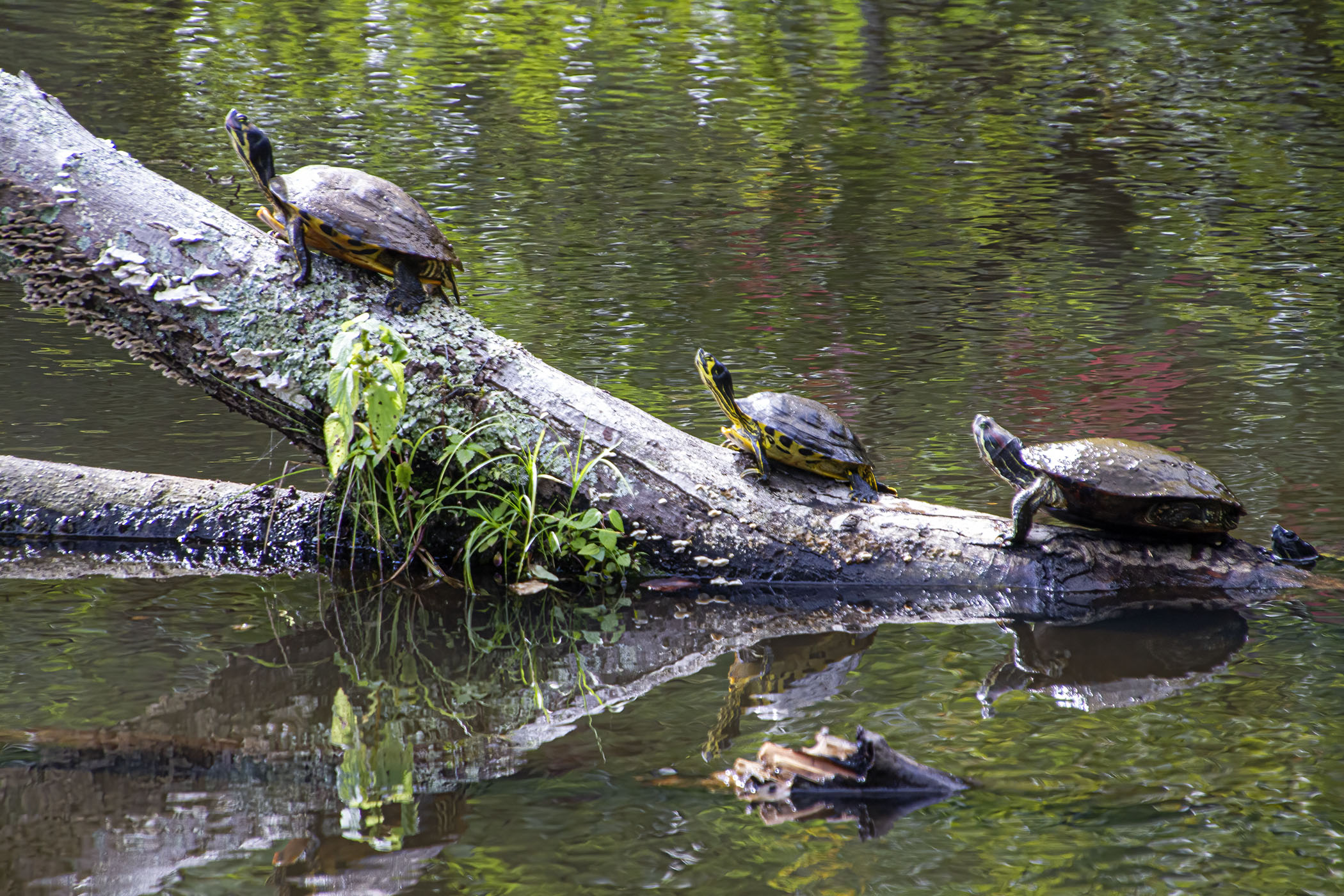
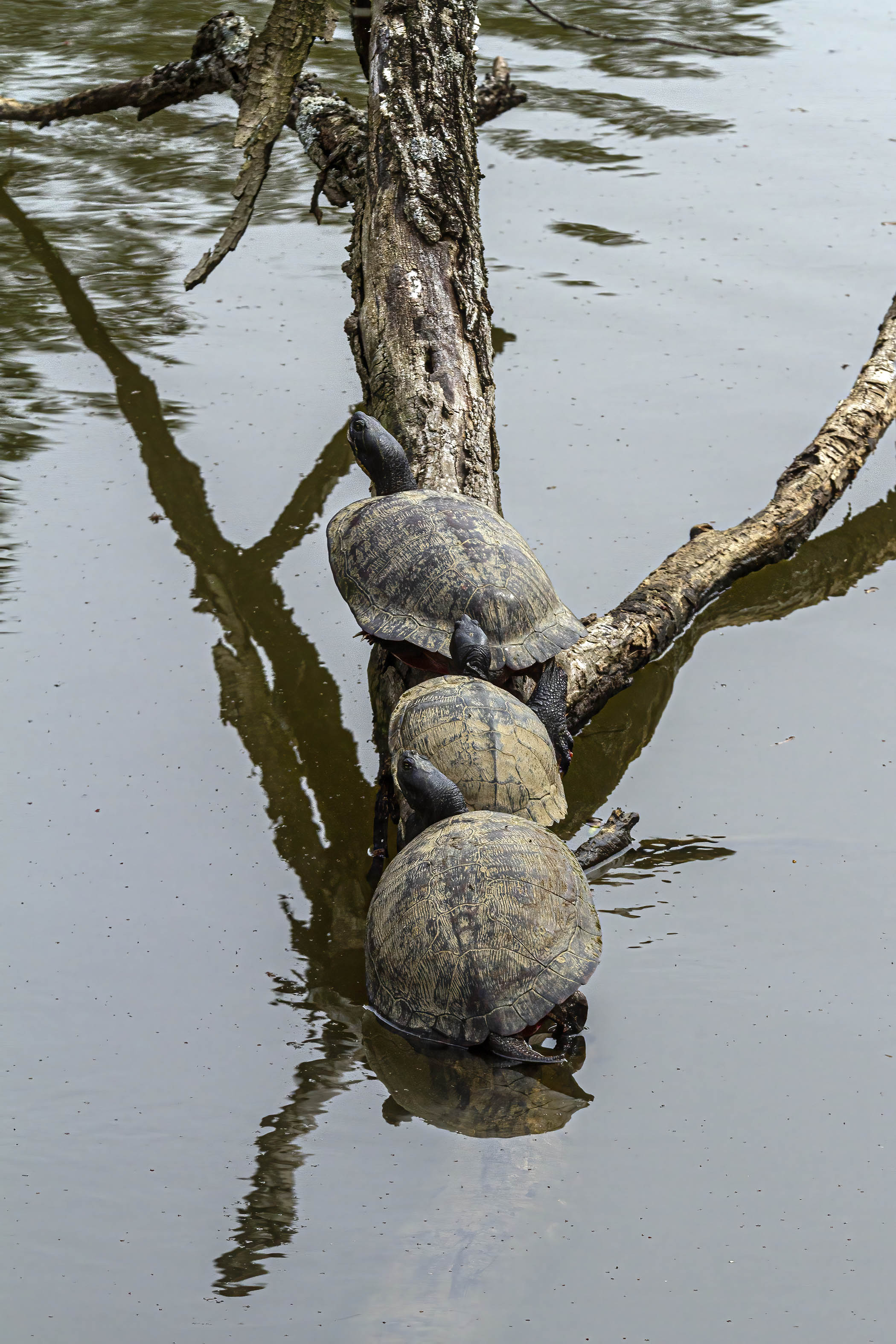
The weather is cooling off, but whenever there is the slightest amount of sunshine, I can count on seeing turtles basking in the warmth of the sun. This past Wednesday, I spotted these three turtles on a partially submerged tree branch in the small pond at Jackson Miles Abbott Wetland Refuge. I am pretty sure that the turtle on the right is a Red-eared Slider (Trachemys scripta elegans) and the other two may be Yellow-bellied Sliders (Trachemys scripta scripta).

I am always a fan of reflections and I love the way that we can see reflections of the turtles on the rippled surface of the water. It was an added bonus to have some patches of red, a sign of the changing season.

turtles

© Michael Q. Powell. All rights reserved.

Read Full Post »

When the weather is nice, many turtles emerge from the waters of the ponds to bask in the sunlight. Often I will see turtles jammed so close together on logs that it looks like a mall parking lot just before Christmas.

During a recent visit to Jackson Miles Abbott Wetland Refuge, I spotted an Eastern Painted Turtle (Chrysemys picta picta) that had found a solitary perch that was just big enough for a single turtle. The only problem was that the tree was sticking out from the water at a sharp angle. I could not tell, but suspect that the turtle had dug the claws in its front feet into the bark to keep from sliding into the water.

I love the serene look on the face of this turtle—it seemed to be in a meditative state, a picture of peaceful contentment.

Painted Turtle

© Michael Q. Powell. All rights reserved.

Read Full Post »

How many views does one of my blog posts need to get for me to consider it “successful” or “popular?” On a good day, my blog receives about 100 views, of which 60 may be related to that day’s post. If a post receives over a 100 views over time, I’ll consider it to be one of my top posts.

However, WordPress has a mind of its own, and the most-viewed postings, in my view, are not necessarily the best-written ones or the ones with my best photos. Some of the posts continue to receive views years after they were written thanks to searches on Google and other search engines. Even then, some subjects seem to go in and out of popularity on the search engines as a result of ever-changing algorithms.

For many years, my most popular blog posting was one from 4 November 2014 entitled Rescue of an Injured Bald Eagle that documented the rescue of the eagle by an a county animal control officer at my local marshland park. I was lucky enough to be present during the rescue operation and my photos (including a link to my blog posting) were picked up by several on-line news organizations in the Washington D.C. area. As a result, that posting has had 3,475 views to date, including 3,290 views during the initial month of the posting.

Bald Eagle rescue

This month, another blog posting has taken over the lead from the posting of the eagle rescue. My new top post is now a 9 May 2016 blog posting called Blue-eyed Garter Snake. Although this posting had only 70 views during its initial month, it now has had 3,512 views, including 438 views in 2023.

garter snake

Another posting may soon overtake the eagle rescue posting. The 3 August 2013 posting entitled Fuzzy White Caterpillar currently has had a total of 3,442, only 72 of which came during its initial month. Neither the writing or the photos in that posting are all that great, but I suspect that the title is so generic that it comes up often in Google searches.

fuzzy white caterpillar

One final contender for the top post is a 31 August 2013 posting entitled Red-footed Cannibalfly. This posting has had 3,169 views, of which 61 came in its initial month. For five years in a row it had over 350 annual views and appeared on the first page of Google results. Something changed, however, and it has fallen in the Google rankings since 2018, though it still appears as the fifth entry in a Bing search of “Red-footed Cannibalfly.”

red-footed cannibalfly

To be perfectly honest, I do not really care that much about views. I use this blog as a means to express myself creatively in my writing and in my photos. I am grateful for the modest success that I have enjoyed and even more thankful for the community of supportive people who have encouraged and supported me over the years.

I made my first posting on 7 July 2012, so I will soon be celebrating an anniversary. According to WordPress, my postings have had 403,801 views to date and I am thankful for each and every one of them and for all of you.

© Michael Q. Powell. All rights reserved.


Read Full Post »

I was a bit surprised at the way that this Eastern Ratsnake (Pantherophis alleghaniensis) had poked its head up high to peer above the vegetation on 6 June at Occoquan Regional Park. It felt like one of the snake charmers that I used to see in movies when I was growing up, although as I recall those snakes tended to be cobras. For the record, I was not playing a flute nor was I trying to hypnotize the snake.

The snake seemed to be alert and inquisitive as it scanned its surroundings. Perhaps it was looking for potential prey. As you may be able to tell, I tried to get down as low as I could to take this photo. I tried to be as stealthy as I could and he snake did not move—it was either unaware of my presence or did not view me as a threat. When I departed, it was still in the same spot with its head and “neck” elevated.

Eastern Ratsnake

© Michael Q. Powell. All rights reserved.


Read Full Post »

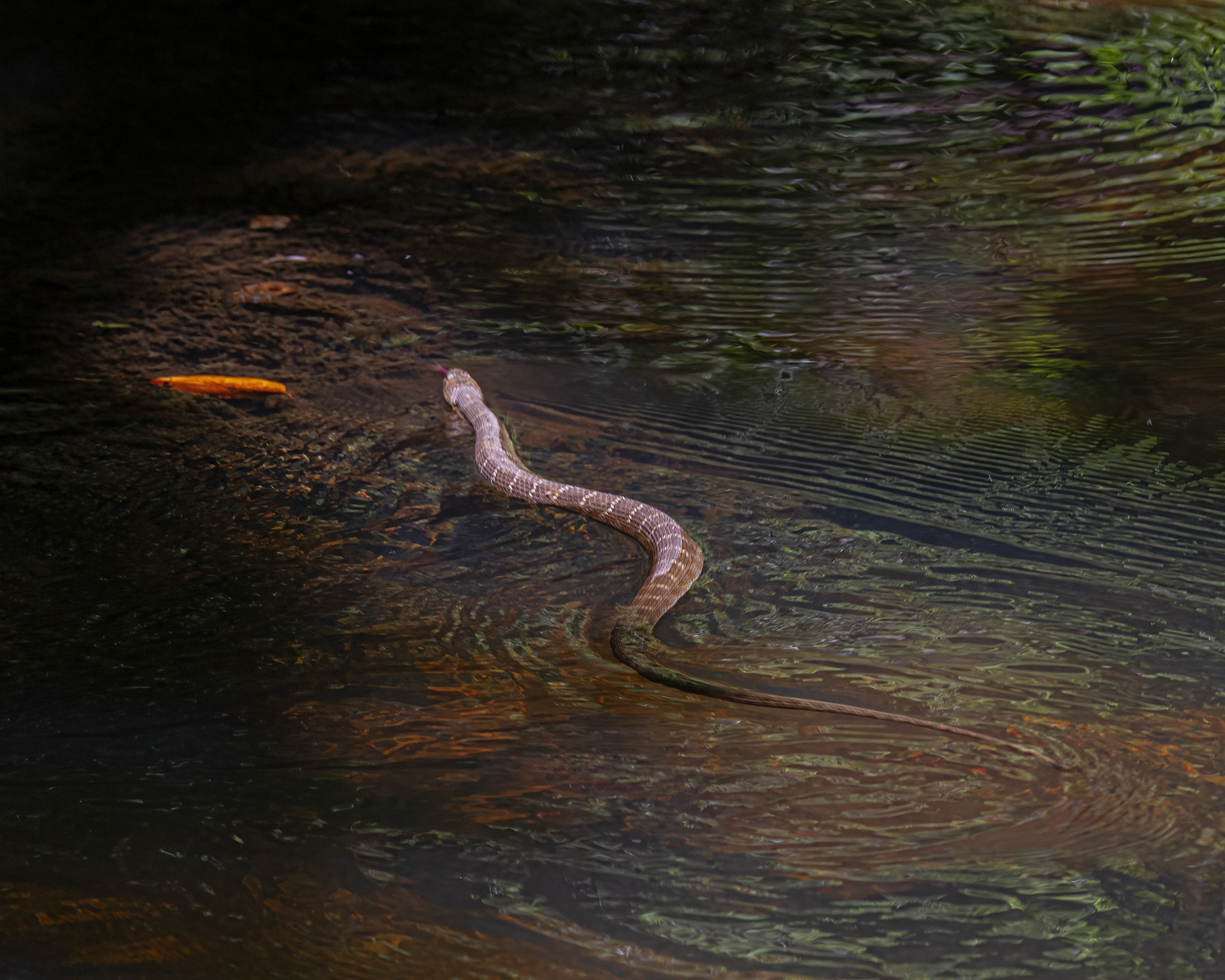
Our recent warm weather has brought out all kinds of creatures, including Northern Water Snakes (Nerodia sipedon). On Wednesday I spotted my first Northern Water Snake of the day as I was sitting on a rock, taking a break alongside a stream. When I spotted it, the snake was swimming vigorously downstream and the first photo captured some of the sinuous movement of the snake’s body. I lost sight of the snake as it approached a series of cascades and was not able to see how the snake handled them

Later that same day I spotted another snake at a small pond. This Northern Water Snake had hidden its body in the debris at the edge of the pond, with just its head visible above the water. This snake was alert and seemed to be in a hunting mode, so I kept my distance and watched the snake carefully as I took the second shot below. Although I know that Northern Water Snakes are not venomous, I remember reading that their bites are painful and that their saliva contains an anticoagulant that causes bites to bleed profusely.

Northern Water Snake

Northern Water Snake

© Michael Q. Powell. All rights reserved.

Read Full Post »

It is not unusual to see turtles in a row on a log, basking in the sunlight. Normally, though, the log is horizontal. In the case of the turtles that I spotted last week at Jackson Miles Abbott Wetland Refuge, the large fallen branch on which they were perched was sticking out of the water at an angle. The turtles, especially the one in the front, had to climb upwards on the branch and secure themselves firmly to keep from sliding back into the water.

I really like the way that this image turned out. I managed to capture the texture of the bark and of the turtles’ shells and the reflections were a nice bonus. The limited color palette allows the viewer to focus on the shapes and textures without being distracted by bright colors. It is a simple, almost abstract image, characteristics shared by many of my favorite photos.

turtles

© Michael Q. Powell. All rights reserved.

Read Full Post »

Most of the turtles that I see are either Painted Turtles or Red-eared Sliders, so I am delighted when I spot a member of another turtle species. Last Wednesday I was thrilled to spot several Spotted Turtles (Clemmys guttata), a relatively uncommon turtle species in my area. Spotted turtles tend to be found in marshy areas rather than in ponds, and it was indeed in a small wetland area at Jackson Miles Abbott Wetland Refuge that I photographed this turtle.

Species names can sometimes feel confusing or inappropriate, but the name of “Spotted Turtle” is perfect for these turtles that, as you can see in the photos below, have small yellow spots on their bodies and shells. For the first time this season I was walking around with my 180mm macro lens attached to my camera, hoping to photograph some butterflies, dragonflies, or other insects, but I came up empty-handed in that regard. I was happy, though, to be able to get a few shots of these little Spotted Turtles, perched on a log as they basked in the warmth of a sunny March day.

Spotted Turtle

spotted turtle

© Michael Q. Powell. All rights reserved.

Read Full Post »

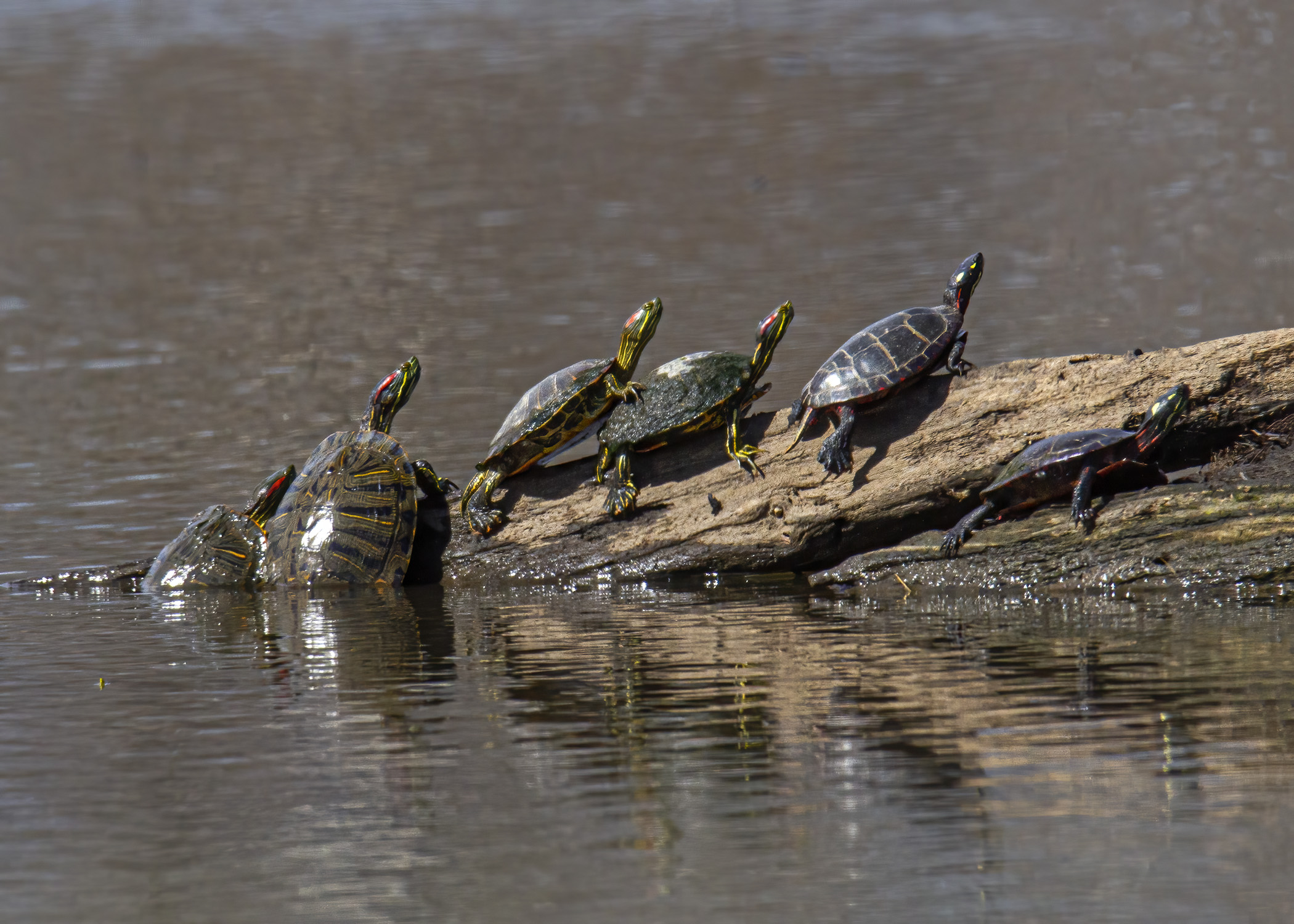
I was delighted yesterday to see that some of the turtles at Occoquan Bay National Wildlife Refuge were taking advantage of the spring-like weather to bask in the sun. I believe that the turtles spend most of their time in the mud at the bottom of the pond during the winter and in you can see mud still caked on the back of at least one of the turtles in the photo.

I think that the four turtles on the left are Red-eared Sliders (Trachemys scripta elegans) and the two on the right may be Painted Turtles (Chrysemys picta). I spotted a few small flies buzzing about yesterday, but it is almost certainly too early for my beloved dragonflies to appear. Several butterfly species, including the Mourning Cloak, overwinter as adults, so there is a chance that I will see one in the coming days.

turtles in February

© Michael Q. Powell. All rights reserved.

Read Full Post »

When the winter weather warms up a little and there is abundant sunlight, turtles will sometimes come up out of the mud at the bottom of the pond to bask in the sun. Last Friday I made a short visit to Green Spring Gardens, a historic county-run garden in Northern Virginia, and spotted this turtle at the edge of a small pond. I think it may be a Red-eared Slider (Trachemys scripta elegans), although the turtle was so far away and covered in mud that I am not sure of the identification.

Turtles enter into a period of dormancy know as “brumation” when the weather gets cold. According to the ReptileKnowHow website, “When red-eared sliders brumate, they do not eat or defecate and they remain almost completely motionless for long periods. Their metabolic rate reduces to a minimum, reducing all vital functions – even breathing to the strictly necessary.” I don’t know all of the technical differences between hibernation and brumation, but I believe that the former term is reserved for warm-blooded creatures and the latter term for cold-blooded ones.

winter turtle

© Michael Q. Powell. All rights reserved.


Read Full Post »

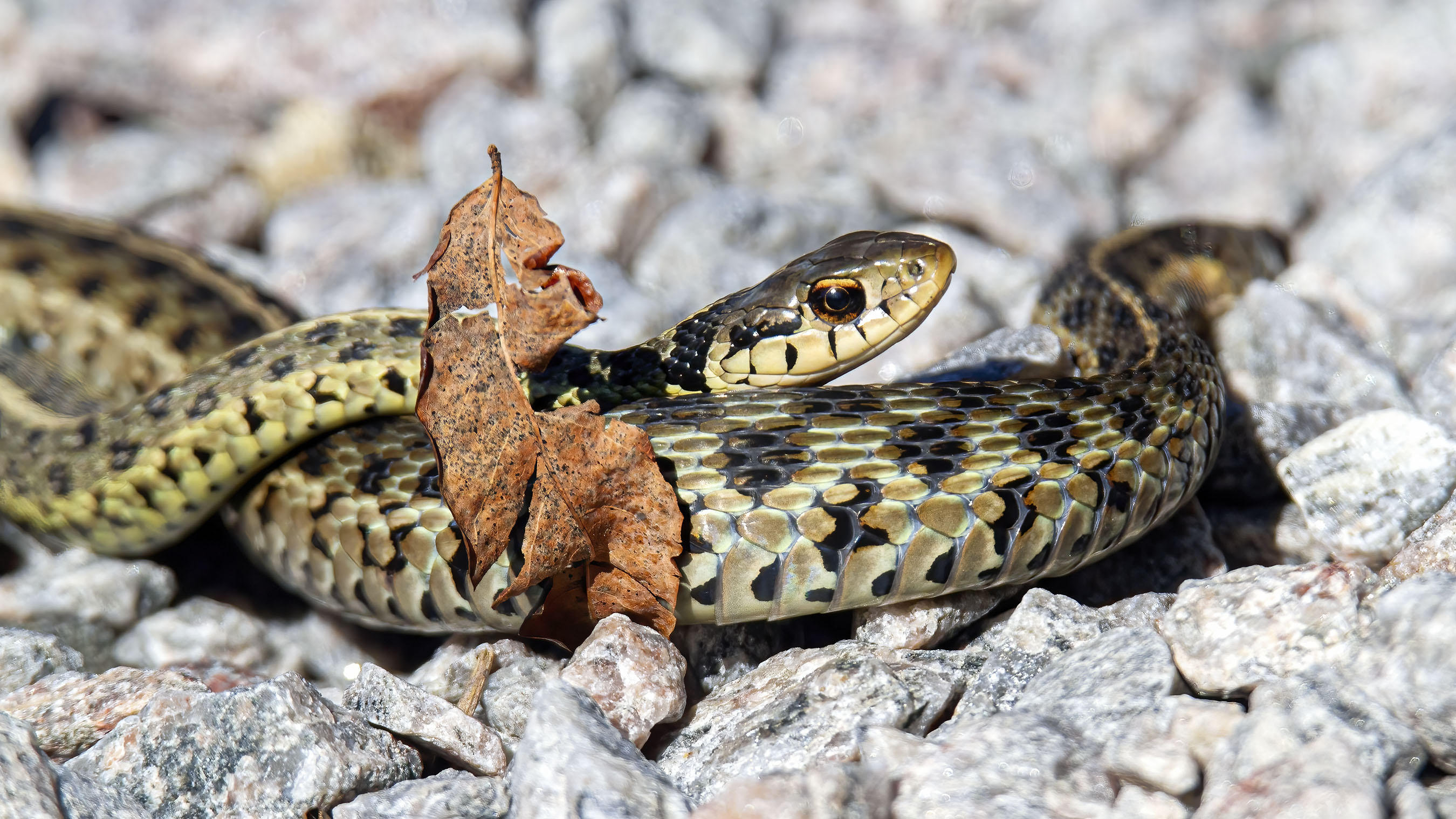
On Monday at Occoquan Bay National Wildlife Refuge I stumbled upon a pair of Eastern Garter Snakes (Thamnophis sirtalis sirtalis). Their bodies were intertwined and were undulating. Now I do not know much about the mating practices of snakes, but I assume that was what they were doing.

I got down really low to take the first shot, which gives a close-up view of the head of one of the snakes that appears to be smiling—I believe that this one, which is clearly the smaller of the two, is the male snake.

According to an article by Sue Pike, “Garter snakes bear live young instead of laying eggs. In fact, in most live-bearing snakes, the females are considerably larger than the males. Since a larger female can carry more babies, and larger litter size mean a greater chance of survival for some of the offspring; natural selection will favor larger females. Females also tend to be more bulky and less active than males since they need to conserve their energy for reproduction. Males tend to be skinnier, more active and smaller than the females because, in the wild, their excess energy is used to chase females.”

The second shot shows the bodies of the two snakes when I came upon them—they look almost like they were braided together. I encourage you to click on the image to get a closer look at the beautiful patterns on the bodies of these snakes.

As I was making a little video of the two snakes, they were joined by a third garter snake. This snake, which I think is another male, slithered along the entire length of the intertwined bodies, looking for an opening. Somehow I thought the new snake would be more aggressive, but he was actually quite gentle. He ended up with his body stretched out as part of the intricate braid.

I have embedded the one-minute-long YouTube video at the end of this posting. In the video you can see the undulating bodies of the two snakes and the arrival and subsequent actions of the third snake. If you cannot see the embedded video, you can use this link  (https://www.youtube.com/watch?v=bgKIKLVeOVg) to access it directly on YouTube.

mating garter snakes

mating garter snakes

© Michael Q. Powell. All rights reserved.


Read Full Post »

When the weather turns warm and sunny, it is not uncommon for me to spot Common Five-lined Skinks (Plestiodon fasciatus), one of the few lizards that are present in my area. Most of the time I see them on the trunks of trees or on fallen logs, but occasionally I will see one on a man-made structure that has crevices and overhangs where they can hide.

Skinks are skittish and will scamper away if they detect my presence, so I have to be super stealthy in approaching them to get a shot. In the case of these photos, I was at the edge of a small pond at Jackson Miles Abbott Wetland Refuge last week looking for dragonflies when some movement on a nearby concrete fishing platform caught my eye. The skink had just crawled out of the shadows and was surveying the area when I captured these images.

Juvenile skinks have blue tails and there appears to be some blue on the tail that is especially visible in the second photo, so I am guessing that it is almost a full-grown adult. Some scientists believe that the blue color functions as a decoy, diverting the attention of predators to this “expendable part” of the body—the tail is detachable and regrows if it is lost. Other scientists propose that the blue coloration serves to inhibit attacks by aggressive adult males, who might otherwise view the juveniles as rivals.

If you are curious and would like to see a photo of the blue tail of a juvenile skink, check out this 2021 blog posting entitled Juvenile Skink in April.


Five-lined Skink

Five-lined Skink

© Michael Q. Powell. All rights reserved.

Read Full Post »

Older Posts »