Feeds:
Posts
Comments

Archive for the ‘Portraits’ Category

Do you prefer the bold color of the iconic male Northern Cardinal (Cardinalis cardinalis) to the more subtle coloration of the female cardinal or are you on the fence?

Yes, I am beginning today’s posting with the same question that I used in yesterday’s posting that featured a fierce-looking female cardinal, but today am featuring a male cardinal. Not far from where yesterday’s female was perched on the fence wire, her male partner was calmly sitting on a green fencepost, seemingly surveying his surroundings.

Some of yesterday’s responses suggested that many viewers prefer the bright red color of the male cardinal, a visible and welcome sight at this time of the year, when the landscape seems to be dominated by shades of gray.

The combination of the red cardinal and the green fencepost give this image a definite feeling of Christmas. Somehow I feel like it would be good to emulate this cardinal during this pre-holiday season and stop all our frantic activity for a moment, take a deep breath, and look and listen, remembering the true meaning of Christmas.

Northern Cardinal

© Michael Q. Powell. All rights reserved.

Read Full Post »

Do you prefer the bold color of the iconic male Northern Cardinal (Cardinalis cardinalis) to the more subtle coloration of the female cardinal or are you on the fence?

“Fierce” is the word that came to mind when I first saw the image I had shot of this female cardinal with the spiky red Mohawk hairstyle and don’t-mess-with-me glare. Although I took this photo at my local marshland park, the simple wire fence gives it a kind of urban feel that seems appropriate for this subject.

I wonder if she has body piercings or a tattoo—it wouldn’t surprise me if she does.

female Northern Cardinal

© Michael Q. Powell. All rights reserved.

Read Full Post »

Normally I see woodpeckers high in the trees, but some of my fellow photographers spotted this Red-bellied Woodpecker (Melanerpes carolinus) pecking about on the ground below a tree and pointed it out to me. The woodpecker appeared to be collecting acorns and then hopped upward onto the tree carrying an acorn in its bill.

Red-bellied WoodpeckerRed-bellied Woodpecker

Initially I was perplexed, because I tend to think of woodpeckers driving their bills into trees in search of insects, not transporting acorns. Then I remembered back to last winter, when I observed some Red-headed Woodpeckers (Melanerpes erythrocephalus) at my local marshland park stockpiling acorns in the hollow of a tree. Is it possible that Red-bellied Woodpeckers do the same thing?

Red-bellied Woodpecker

I checked out the Cornell Lab of Ornithology, my favorite website for information about birds, and it confirmed that Red-bellied Woodpeckers “also use cracks in trees and fence posts to store food for later in the year, a habit it shares with other woodpeckers in its genus.”

Red-bellied Woodpecker

It might be my imagination, but if you look closely at the final shot below, you can see what the outlines of what appear to be several acorns just a bit below the woodpecker’s bill. It’s a mystery to me how the woodpecker remembers where it has stockpiled food and how it keeps other birds from stealing it, but I have to assume that the woodpecker knows what it is doing.

The recent cold weather reminds me that winter is almost here and this bird seems to be preparing for those tougher times to come.

Red-bellied5_blog

© Michael Q. Powell. All rights reserved.

Read Full Post »

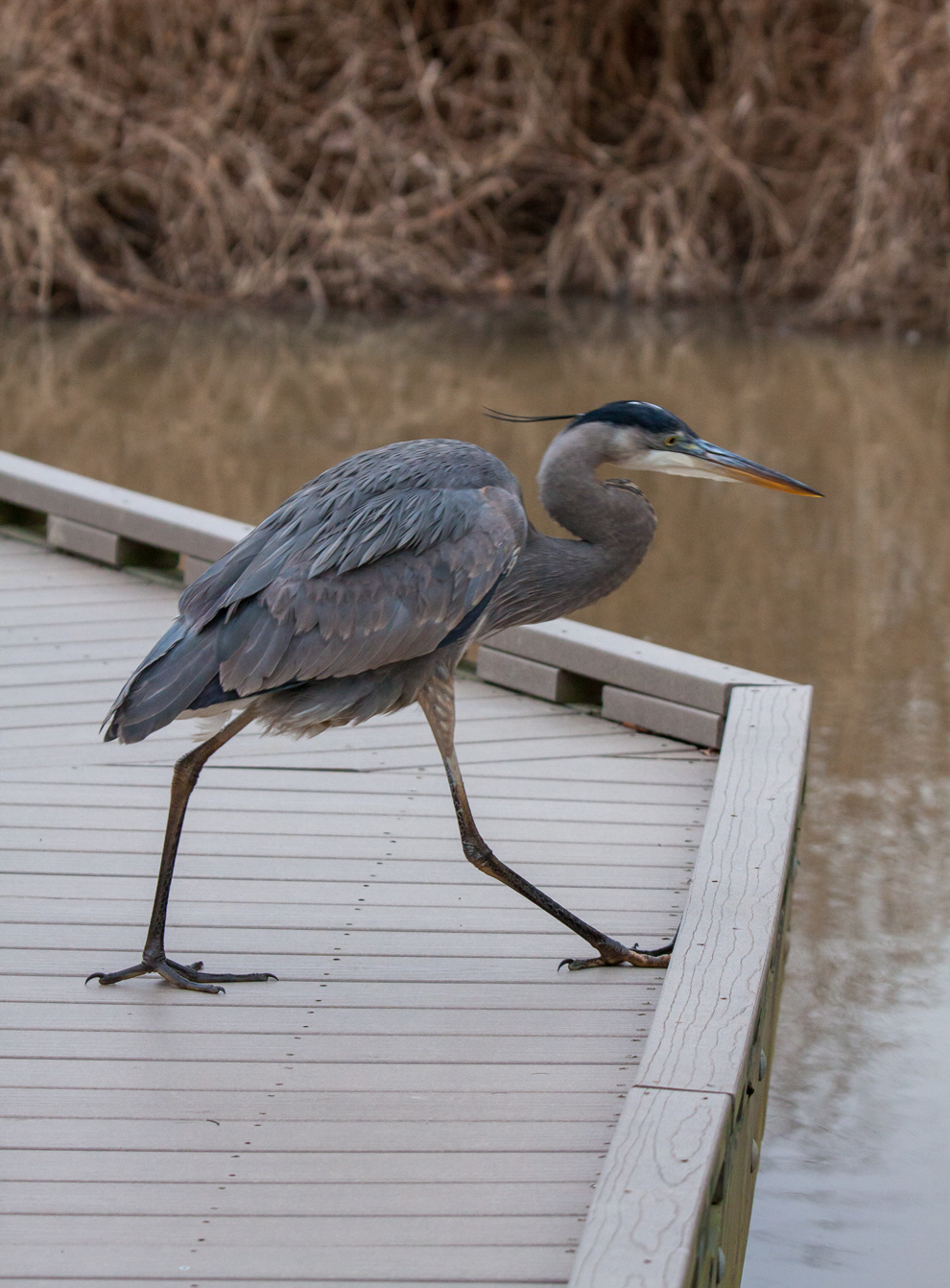
It was cold and gray yesterday afternoon at Huntley Meadows Park and there weren’t a lot of people around. The Chairman of the Board(walk) decided that it was a good time to survey his marsh from a different vantage point.

I just love watching Great Blue Herons (Ardea herodias) and you never know what they will choose to do next. It was unusual, however, taking photos of one using the 150mm end of my 150-600mm Tamron lens and I actually had to back up in order to fit the heron’s entire body in the frame. Shortly after I took these shots, the heron flew off a short distance, back into the water.

Chairman of the Board(walk)Chairman of the Board(walk)

© Michael Q. Powell. All rights reserved.

Read Full Post »

American Coots (Fulica americana) have strange-looking feet. I mistakenly assumed that coots had webbed feet, like ducks, and was shocked recently when I saw one out of the water to see that is definitely not the case.

The Cornell Lab of Ornithology website had this description of their feet ”

“Although it swims like a duck, the American Coot does not have webbed feet like a duck. Instead, each one of the coot’s long toes has broad lobes of skin that help it kick through the water. The broad lobes fold back each time the bird lifts its foot, so it doesn’t impede walking on dry land, though it supports the bird’s weight on mucky ground.”

Recently at the edge of the Potomac River in Alexandria, Virginia, I came upon this coot that seemed to be grooming itself. After a short time, it assumed a pose that reminded me of the crane kick position that featured so prominently in the movie The Karate Kid. Perhaps the coots have their own martial art.

Eventually the coot became aware of my presence and stopped what it was doing and looked in my direction. There was a disapproving look in its intense stare and it almost looked like it was giving me the evil eye.

American Coot

Practicing martial arts

American Coot

Giving me the evil eye

© Michael Q. Powell. All rights reserved.


Read Full Post »

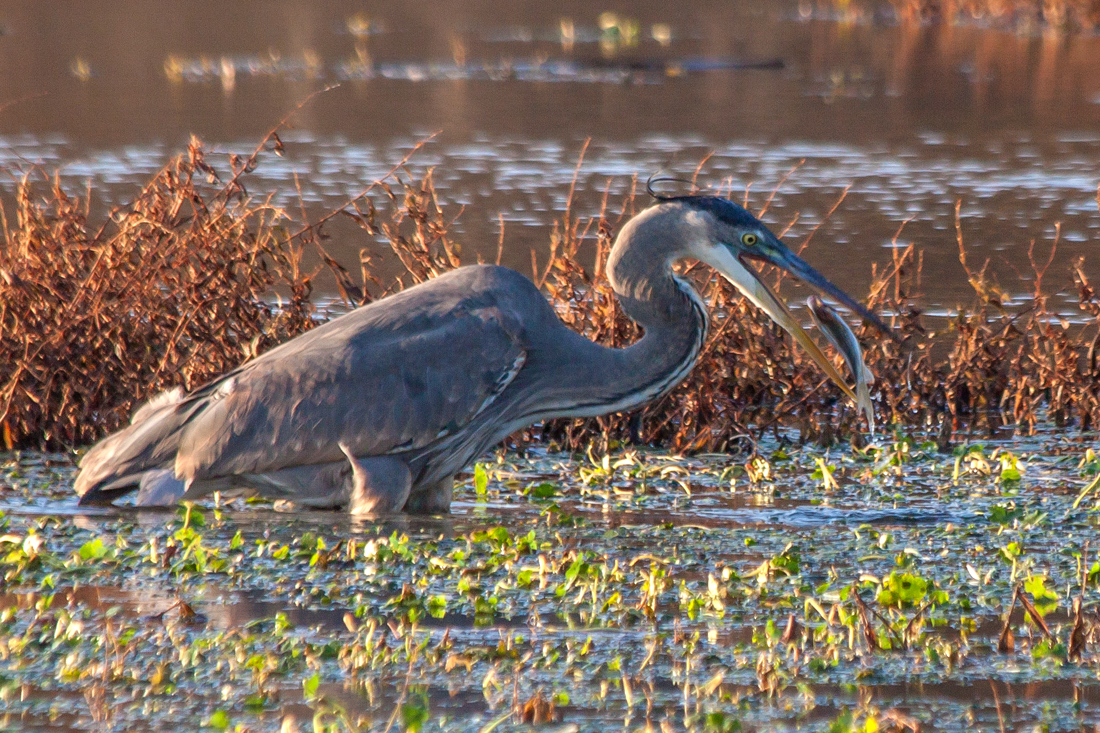
On an unusually warm date late in November I came upon a Great Blue Heron (Ardea herodias) fishing at my local marshland park. In similar situations I will often stop and wait for a little while to see if I can capture a shot of the heron catching a fish, but generally the heron is more patient that I am and I leave empty-handed.

This time, however, I felt unusually patient and I set up my tripod and waited. The sun was bright and was coming from the left, the direction in which the heron was initially facing. It is tough for me to remain continuously alert when waiting for an extended period of time and I did not react quickly enough to get a shot of the heron pulling the fish out of the water. I recovered rapidly and got some interesting shots of the heron with the fish that it had just caught.

Great Blue Heron

Not seeing eye-to-eye


Great Blue Heron

Expelling a drop of water

One of the biggest challenges for the heron is manipulating the fish so that it can be swallowed in a single gulp. Each time that the heron shakes and jiggles the fish, it runs the risk of dropping it. In this case, the heron turned away from the sun and began its maneuvers. It took some time to get the fish into position. In the last two shots, you can see the final steps of the process as the heron dips the fish in the water, presumably to make it slide down the throat more easily, and them flips the fish into the air a final time.

Great Blue Heron

Initial adjustments

Great Blue Heron

Moving into position

Great Blue Heron

Dipping the fish

Great Blue Heron

Final flip

© Michael Q. Powell. All rights reserved.

Read Full Post »

I thought that all of the Great Egrets (Ardea alba) had left this area for warmer locations and haven’t seen one at my local marsh in weeks. However, I encountered one this past weekend on Theodore Roosevelt Island, a small island in the Potomac River opposite part of the District of Columbia.

Great Egret

The egret was initially foraging in a field of high grass in a marshy area of the park, as shown in image below. I tried to be as stealthy as I could as I crept bit closer to the egret, but it eventually sensed my presence and took to the air.

Great Egret

The bird circled around a little, but returned to its initial location after a very short period of time in the air.

Great Egret

I had some trouble getting in-flight shots of the egret. The changing light as the bird circled, combined with the bright white color of its body, made it tough to get a proper exposure. I liked the unusual body position of the flying egret in several of the shots well enough that I included them in this post, though I think the image of the egret on the ground is probably the one in sharpest focus.

During this transitional season, it’s fascinating to see which summer birds are still with us, which birds stop by as they migrate to more distant locations, and which ones arrive to overwinter here.

© Michael Q. Powell. All rights reserved.
Read Full Post »

I don’t know if they are going to stay for the winter or are just passing through, but yesterday, the first day of December, there were a dozen or so Hooded Merganser ducks (Lophodytes cucullatus) cavorting in the water at Huntley Meadows Park, my local marshland park.

I was first alerted to their presence when I heard the unmistakable frog-like croak of one of the males. The Cornell Lab of Ornithology states that these ducks are usually silent except during courtship, when the courting male “makes a deep, rolling sound like the call of a pickerel frog, earning it the nickname of “frog-duck” in Georgia.” Check out this link to hear the call of the courting male Hooded Merganser. It seems a bit early for courting to be taking place, but the males were bouncing around as I have seen them do in the spring.

The Hooded Mergansers stayed pretty far out in the water and this is the best shot I could get of one of the males paddling by. The comic-like appearance of these ducks always makes me smile and I love their shiny golden eyes.

Hooded Merganser

© Michael Q. Powell. All rights reserved.


Read Full Post »

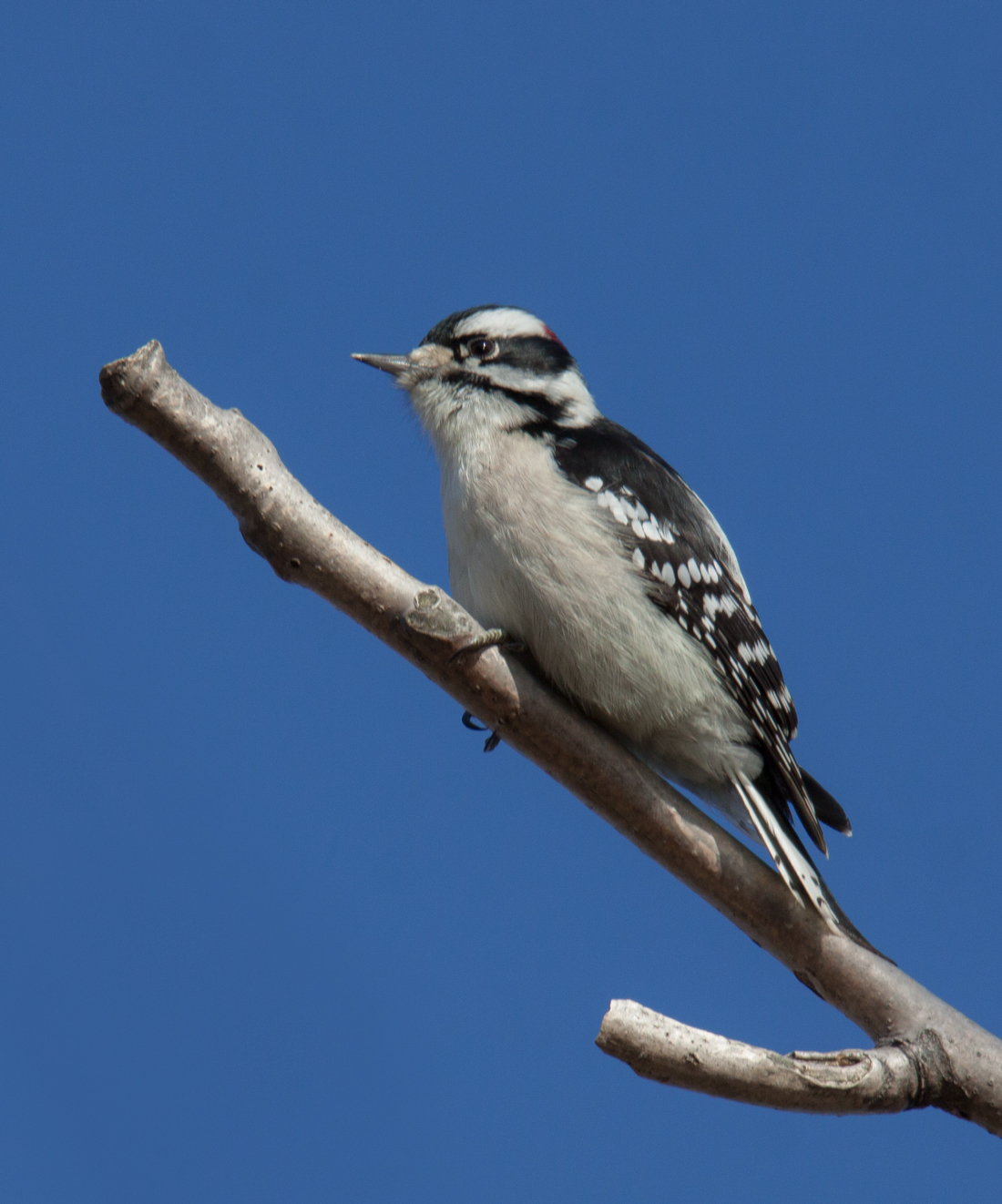
I admire the boundless energy of Downy Woodpeckers (Picoides pubescens). This weekend I watched as this male Downy Woodpecker climbed higher and higher in a tree, pecking along the way, until he ran out of branches.

He turned his body and looked up at a nearby tree and paused, which gave me a chance to get this shot of his downy white abdomen. There is a kind of tension in his position that I really like, as he clutches the branch and focuses intently on his next destination.

Downy Woodpecker

This second shot, which was taken before the first one, shows the Downy Woodpecker in a more conventional pose. He was inching his way up to the end of the branch and I was wondering what he would do next.

One thing that learned from this mini-shoot is that it is tough to hold a lens this heavy overhead for an extended period of time. I haven’t weighed the camera/lens combination, but the lens alone weights 4.3 pounds (1.95 kg).

I may have to start lifting weights to build up my arm and shoulder muscles

Downy Woodpecker

© Michael Q. Powell. All rights reserved.

Read Full Post »

Zooming a long telephoto lens while tracking a flying bird is like simultaneously patting your head and rubbing your tummy—it can be done but requires a lot of practice.

Yesterday as I was observing a Great Blue Heron (Ardea herodias) on the far side of a small pond, he unexpectedly took off. The heron flew towards me initially and then veered off to the side. My 150-600mm lens was fully extended at the start and as the bird approached, I frantically tried to zoom out a little. The EXIF data indicate that I was at 552mm when I took this shot and I just barely managed to keep the heron in the frame—I didn’t crop this image at all.

I’ve often been told to fill the frame with the main subject and this is one of the few times when I have been able to do so with a bird.

Great Blue Heron in flight

© Michael Q. Powell. All rights reserved.

Read Full Post »

Although I frequently catch a glimpse of them, it’s proven tough to get a shot of a Tufted Titmouse (Baeolophus bicolor).  These little birds are in almost constant motion and the Cornell Lab of Ornithology describes them as “acrobatic foragers.”

The coloration of the Tufted Titmice is subdued and quiet, but the spiky crest and huge eyes help them to stand out from the crowd. As I was stalking one of these birds, it flew over to a support piece for a bird feeder and perched for a moment, giving me the opportunity to snap off this photograph. Normally I try to have a more natural setting for my bird images, but the bird’s pose was so perfect that I decided to post the image.

A simple shot of a common subject can often reveal its beauty—photography doesn’t always have to be complicated.

Tufted Titmouse

© Michael Q. Powell. All rights reserved.

Read Full Post »

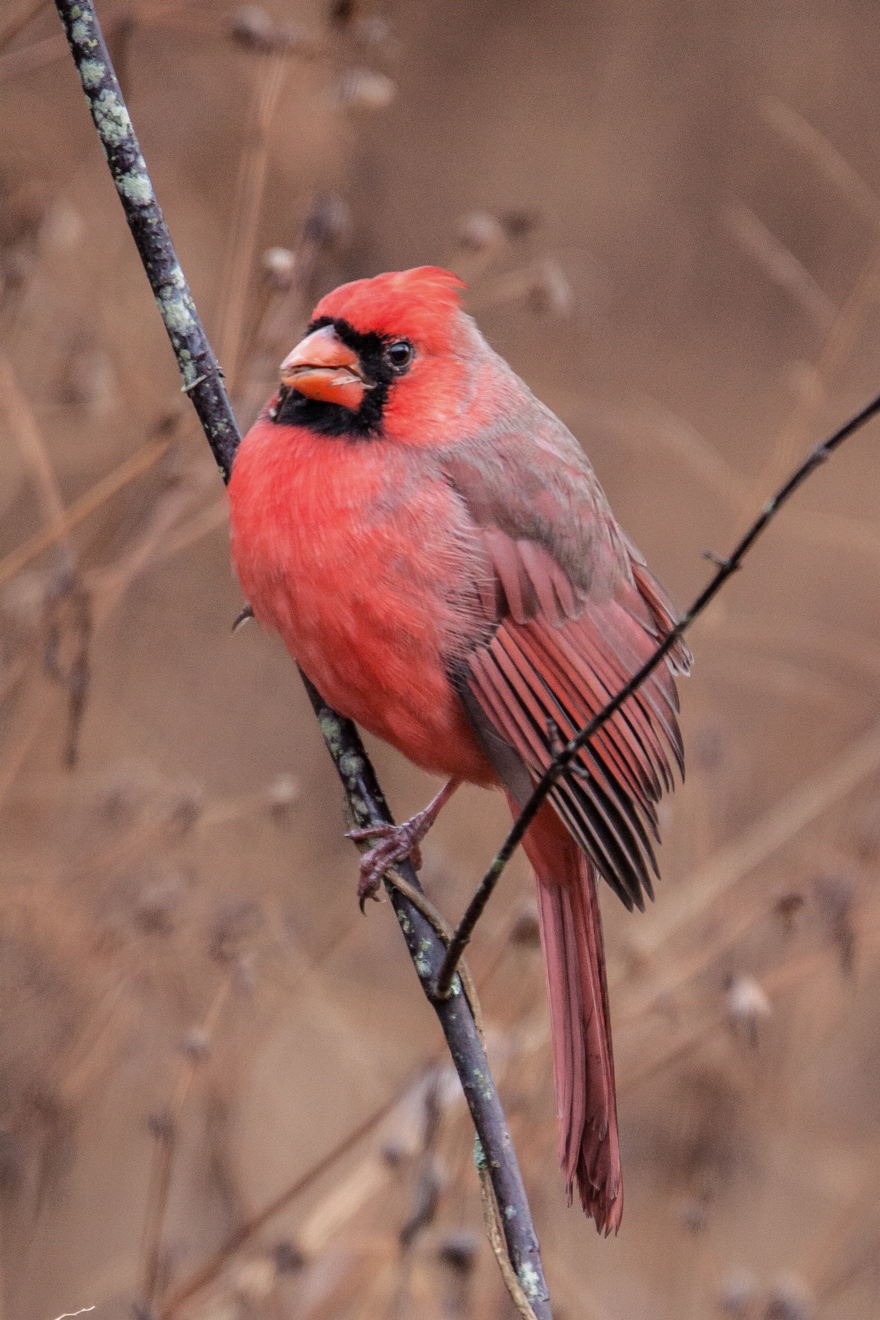
In the early morning mist yesterday at my local marshland park, the bright red color of this male Northern Cardinal (Cardinalis cardinalis) was even more distinctive than usual, shining like a beacon in the limited light.

The white-colored sky and the shadowy shapes of the trees in the distance provide a simple backdrop for this first image that gives it a lot of atmosphere. The wet, lichen-encrusted branch helps to tie the cardinal back to nature and keep this from looking too much like a studio shot, though it does look like the cardinal was posing for me.

When the cardinal moved to a different perch, the backdrop changed and the white sky was replaced by the dried-out vegetation of a field of cattails. Fortunately, the vegetation was far enough away from the subject that it softened up with the aperture wide open. In the second image, the cardinal seems to have become a little irritated with me and is scowling a bit. In both shots, the cardinal looks to have fluffed up its feathers, an indication that it was cold outside when I took these shots.

Northern CardinalNorthern Cardinal

© Michael Q. Powell. All rights reserved.

Read Full Post »

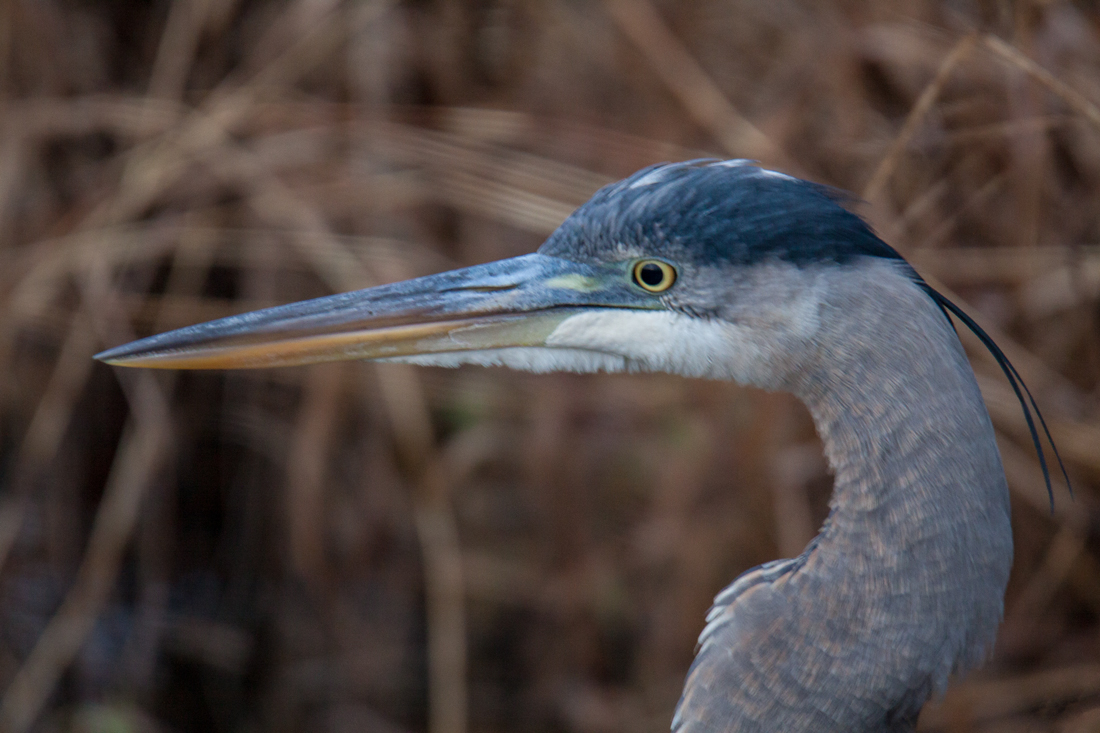
I started my Thanksgiving Day early with a big bird. No, I wasn’t preparing a turkey—I was sharing a quiet moment with this Great Blue Heron (Ardea herodias) at Huntley Meadows Park, the local marshland where I capture a lot of my images.

Happy Thanksgiving to all.

Great Blue HeronGreat Blue HeronGreat Blue Heron

© Michael Q. Powell. All rights reserved.

Read Full Post »

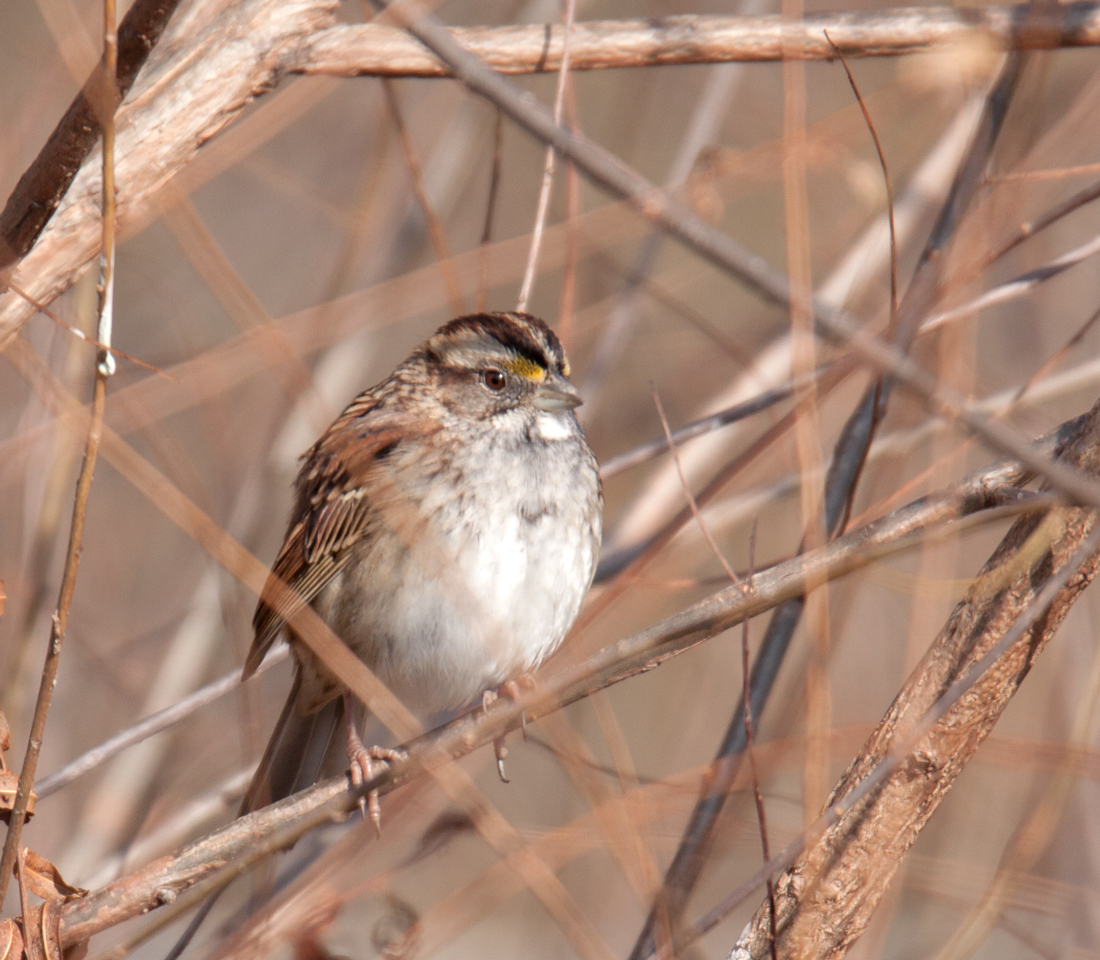
One of my goals in testing out my new Tamron 150-600mm lens was to see how well it did in capturing the little birds that hide out in the underbrush. As we move deeper into the autumn and into winter, I can always depend on hearing and sometimes spotting different kinds of sparrow poking about in the tangled plants and leaves in the marsh. These birds tend to be in constant motion, moving quickly from spot to spot after a few pecks, and this weekend I stalked a few of them to see if I could focus quickly and accurately on them.

We seem to have had a recent influx of White-throated Sparrows (Zonotrichia albicollis) and I think that all three of the images below are of members of this species. However, sparrows have often confounded me in the past, so I apologize in advance if I have misidentified them.

These sparrows seem to have individual personalities and I like the fact that they posed in different ways for me. I used to ignore sparrows and other such birds, but now go out of my way to try to photograph their beauty and individuality. I think my new lens passed the test in being able to capture portraits of these little sparrows.

White-throated SparrowWhite-throated SparrowWhite-throated Sparrow

© Michael Q. Powell. All rights reserved.

Read Full Post »

During this transitional time of the year there is often a thin coating of ice on the pond, especially when the temperature at night drops into the low 20’s F (-5 C).  On Friday morning, the ice was thick enough to support the weight of ducks most of the time, although the Canada Geese kept breaking through the ice when they tried to walk on it.

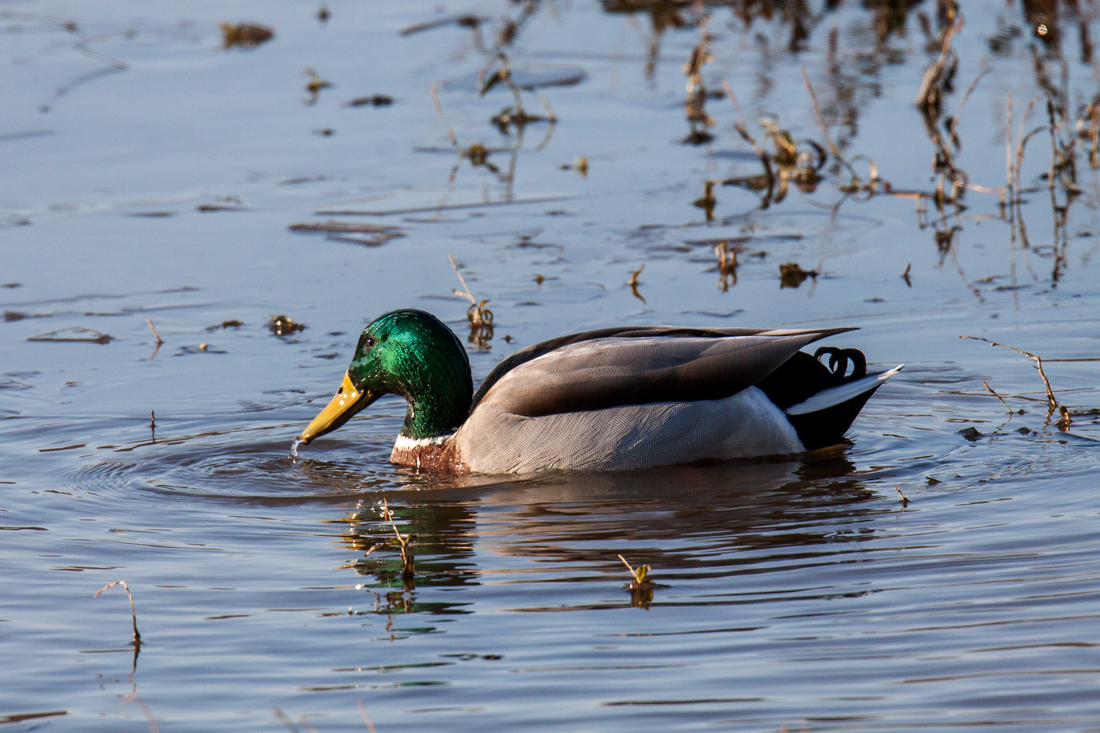
This female Mallard (Anas platyrhynchos) started out strutting confidently across the ice, but stopped for a moment at a place where the water had accumulated. I couldn’t tell if she was assessing the condition of the ice or was merely admiring her reflection—she is quite a beautiful duck after all and perhaps ducks have a sense of vanity.

The male Mallard was more practical, remaining in the area of open water and foraging for food, content to leave the strutting and reflecting to his lady.

duck_walk_blogduck_reflect_blogmallard-male_nov_blog© Michael Q. Powell. All rights reserved.


Read Full Post »

As I wandered along the boardwalk yesterday at my local marsh, birds would periodically pop in and out of the eye-level cattails. Most of them were little sparrows that would bury themselves back down in the underbrush. At one point, though, a male Red-winged Blackbird (Agelaius phoeniceus) emerged and perched near the top of the cattails.

He was so close that I didn’t dare move from where I was standing and I tried to find a visual path through the vegetation to get a clear shot. I cropped this image slightly and made a few minor post-processing, but this is pretty much what I was seeing through the viewfinder as I tried out my new Tamron 150-600mm lens.

The photos were shot handheld at f/6.3, 1/400 sec, ISO 320, and 600mm. Recognizing that the image quality would increase a little if I closed down the aperture, backed off from the maximum focal length, and used a tripod, I am nonetheless pretty happy with the result and it’s definitely cool to more than fill the frame with a bird.

Red-winged Blackbird

Red-winged Blackbird

© Michael Q. Powell. All rights reserved.
Read Full Post »

My concerns about the potential demise of the Blue-faced Meadowhawk dragonflies (Sympetrum ambiguum) were greatly exaggerated and I saw a half-dozen or more yesterday on Veterans Day (Armistice Day).

Normally we stop seeing this species of dragonflies by the end of October, but we have not yet gone below freezing and perhaps that explains their unexpected longevity. Yesterday, for example, the temperatures soared to almost 70 degrees F (21 degrees C).  I have to note too that I am searching for them more diligently and in more remote locations of my marshland park, so that may help explain why I am seeing them more frequently.

As is the case with birds, male dragonflies tend to be more brightly colored and visible. Many female dragonflies are brown in colored and harder to spot. I was thus very happy yesterday to be able to get this close-up shot of a female Blue-faced Meadowhawk. Her body coloration may be a little bit drab, but those blue eyes are simply stunning.

In case you are curious, these dragonflies are small in size, with a body length of approximately 1.5 inches (38 mm), so I had to move in awfully close to get this shot. Surprisingly (and happily), this female tolerated my close presence for long enough for me to take several shots before she flew off into the distance.

female Blue-faced Meadowhawk

© Michael Q. Powell. All rights reserved.


Read Full Post »

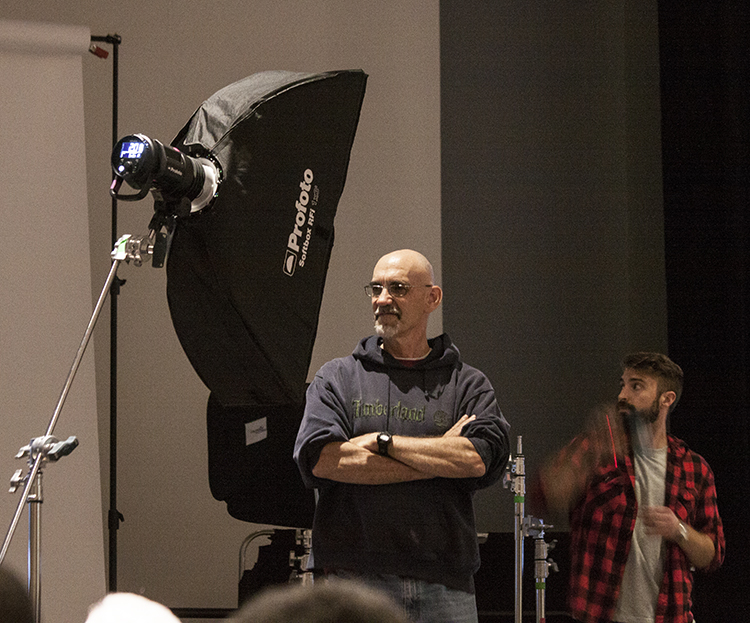
Like most photographers, I feel more comfortable when I am behind the camera, but last Thursday I found myself on stage in front of five hundred other photographers with the lens pointed in my direction.

I was at the Washington D.C. Convention Center with my dear friend and photography mentor Cindy Dyer for a daylong seminar on lighting using flash, taught by Joe McNally, an internationally-known photographer and a great motivational instructor.

During one class segment, Joe pulled me out of the crowd to serve as the model for a mini-shoot. I was more than a little shocked when he pointed in my direction and asked me to come forward. I was a little self-conscious about the fact that I was wearing a hooded sweatshirt and jeans, but at least I didn’t have to worry about how my hair looked.

While I was up on the stage, Cindy decided that she needed to capture the moment and initially took some shots with her iPhone. She was unsatisfied with the results, but didn’t have her camera with her.  Suddenly she remembered that my camera was in my camera bag underneath my chair. Although she is a dedicated Nikon shooter, she grabbed my Canon and got these shots of both the setup and the resulting images from one of the large video projections screens.

In an interesting side note, this is actually the second time that I have been photographed by Joe McNally. In March 2012, when Photoshop World was held in Washington D.C., I was observing one of Joe’s lighting demonstrations at a vendor’s booth. He had just demonstrated beauty lighting with a very photogenic couple and said he needed a subject to demonstrate character lighting—and pointed to me.

IMG_5822 DONE lorezIMG_5831 DONE lorez IMG_5835 DONE lorez IMG_5836 DONE lorez

© Michael Q. Powell. All rights reserved.

Read Full Post »

We all like to believe in happy endings, but unlike fairy tales, real life does not always turn out that way. I was saddened this afternoon to learn that the female Bald Eagle (Haliaeetus leucocephalus) that was rescued on Monday at Huntley Meadows Park had to be euthanized.

The dislocation of her elbow was chronic and so severe that eventual release was not a possibility.  The doctors at The Wildlife Center of Virginia determined that humane euthanasia was the best treatment.

I was happy that the work of the Fairfax County Animal Control Services officer that I chronicled in an earlier posting were featured today in the on-line editions of local media, including the Washington Post, WJLA (ABC television), WTOP radio, and Inside NOVA. The sad ending in no way diminishes my respect and thanks to Officer Kathy Prucnal for her extraordinary efforts to rescue the injured eagle.

This photo that I took during the rescue is how I want to remember the female Bald Eagle, appearing strong and alert.

RIP, beautiful eagle.

Bald Eagle

© Michael Q. Powell. All rights reserved.

Read Full Post »

I am looking for some background information—do you generally prefer creamy smooth backgrounds in your photos or do like there to have some elements of texture?  This is a ridiculous question, of course, and it’s a bit like asking me if I like chocolate or strawberry ice cream. I like them both, but in certain situations I may prefer one over the other.

These musings came to mind when I was reviewing the some photos I took this past week of Autumn Meadownhawk dragonflies (Sympetrum vicinum). These little red dragonflies are perennially the last species to disappear in our area and I am likely to see them well into November and sometimes into early December.

The first image below shows a male Autumn Meadowhawk with the kind of background that I usually try to shoot, blurred and uncluttered. The thorn on the green stem adds an unexpected bit of additional interest for me.

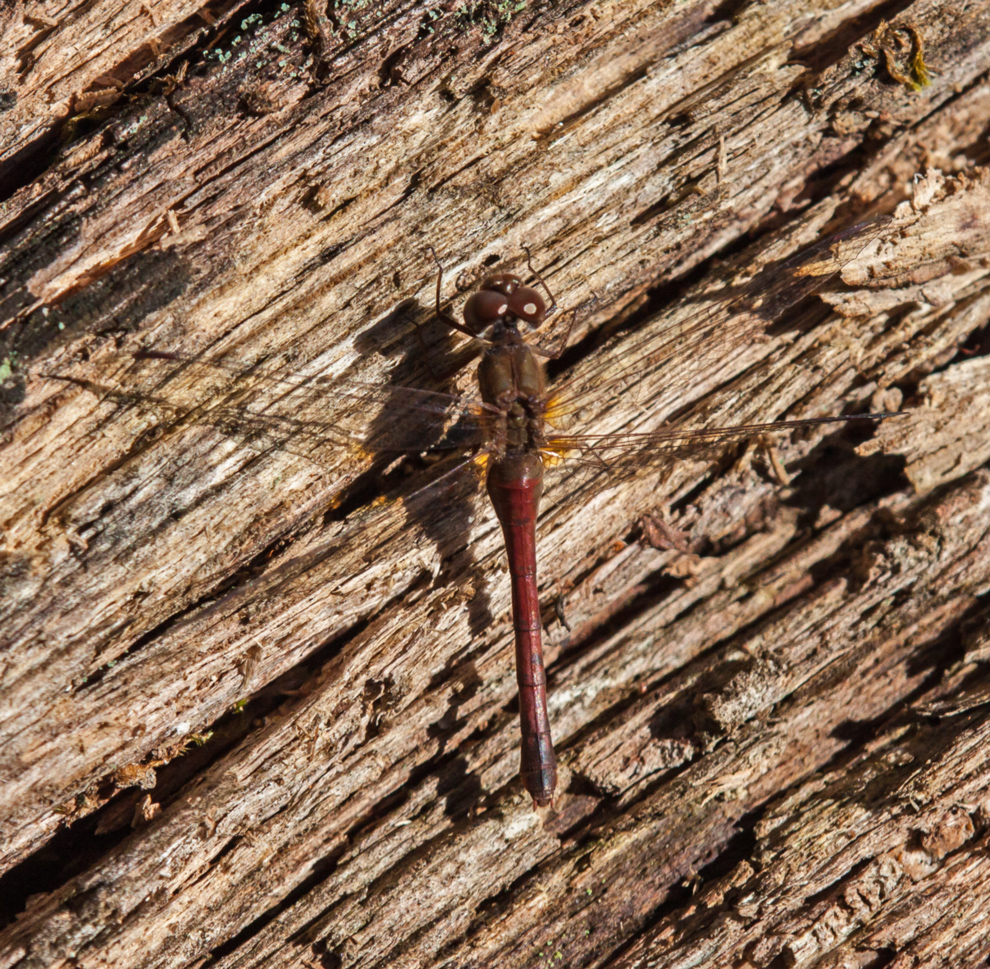
The background of the second image with a female Autumn Meadowhawk is completely different—the lines and texture of the decaying log are very evident. Sometimes when I look at the image I think that the background is too distracting, because I have to look hard to see the details of the dragonfly. At other times, I am drawn in by the organic feel of the wood in the background and I really like the diagonal lines and rough texture.

These two images work well for me in tandem, juxtaposing as they do different genders, very different backgrounds, and radically different angles of view. These kinds of sharp contrasts often prompt me to stop and think as I consider the images—and that is generally a good thing.


male Autumn Meadowhawkfemale Autumn Meadowhawk

© Michael Q. Powell. All rights reserved.

Read Full Post »

The weather may be cooling, but things are still hopping at my local marshland park.

As I was walking through one of the back meadows last Friday, grasshoppers were hopping every which way as I approached them. Most of them settled back down into the grass and I couldn’t get a good look at them, much less a photo. Suddenly one grasshopper jumped up onto a plant and posed for a moment. I used my popup flash because I was shooting directly into the sun, and I was able to capture a good deal of detail of the insect’s body.

grass1_oct_blog

Shortly thereafter a katydid did the same, but chose to perch at a titled angle.  I had time for only a single shot and did not use flash, so you can see some of the light shining through from behind (though I did have to lighten the shadows in post-processing). I especially like the way in which the angles of the insect’s long antennae mirror the shapes of the branches of the plant. I am not sure of the specific identification of this insect, but suspect that it’s a katydid vice a grasshopper because of the extremely long antennae.

grass2_oct_blog

© Michael Q. Powell. All rights reserved.

Read Full Post »

This past Friday I spotted one of my favorite spiders, the Bold Jumping Spider (Phidippus audax), in the reeds adjacent to the boardwalk at Huntley Meadows Park. The spider was pretty active and jumped a couple of times, but I managed to get a shot that highlights its multiple eyes and colorful “fangs.”

“Here’s looking at you, kid.”


Bold Jumping Spider

© Michael Q. Powell. All rights reserved.
Read Full Post »

As their name suggests, Autumn Meadowhawks (Sympetrum vicinum) appear later in the year than most other dragonflies. This past weekend I spotted quite a number of mating pairs, including this couple that I captured in an acrobatic position worthy of the Cirque du Soleil. The dramatic lighting and colorful background added to the theatrical feel of the image, as all the elements worked together to focus our attention on the performance.

Autumn Meadowawk

© Michael Q. Powell. All rights reserved.


Read Full Post »

It has often been said that the eyes are the windows to the soul. I’m not sure what I can say about the soul of this Northern Watersnake (Nerodia sipedon), but I recently had a chance to take a long, close look into one of its eyes.

As I was walking in my local marshland park last week, one of my fellow photographers pointed out the snake to me in the low vegetation. Most of the time that I see this species, it is in the water, where it is almost impossible for me to get a close-up shot. The snake started to move several times as I got closer and closer to it, but then it would stop, thinking perhaps that it would be invisible if it remained motionless.

Most of the time, my view to the snake was obscured by the vegetation, so I waited and tried to anticipate where it would move next, hoping that it would move to a more open area. Finally, I was able to get a relatively clear shot of its eye in a head-and-shoulders portrait, though, of course, snakes don’t really have shoulders.

Northern Watersnake

© Michael Q. Powell. All rights reserved.

Read Full Post »

When I am trying to take a close-up shot of a dragonfly, I know that I have succeeded when I manage to capture some of the details of the ommatidia. What are ommatidia? Ommatidia are the up to 30,000 hexagonal facets that make up the incredible compound eyes of a dragonfly. For more information and a more scientific explanation, check out a posting entitled “Super-predators” that Sue did in June 2013 in her Backyard Biology blog.

Rather than think about science, today I would prefer to simply bask in the beauty of the blue-eyed Blue-faced Meadowhawk dragonfly (Sympetrum ambiguum) that I photographed yesterday as it perched on a fallen leaf at my favorite marshland park. The color of the dragonfly’s eyes completely captivate me.

As for the ommatidia, I’ve cropped a portion of the image and added it to the posting as a second image to make it even clearer what they look like. I chuckled a little when I examined the cropped image, because this dragonfly, like some others that I have photographed, has the sparsely distributed mustache and chin hairs that never fail to remind me of human teenagers who refuse to shave in a vain attempt to look older.

Blue-faced MeadowhawkBlue-faced Meadowhawk

© Michael Q. Powell. All rights reserved.

Read Full Post »

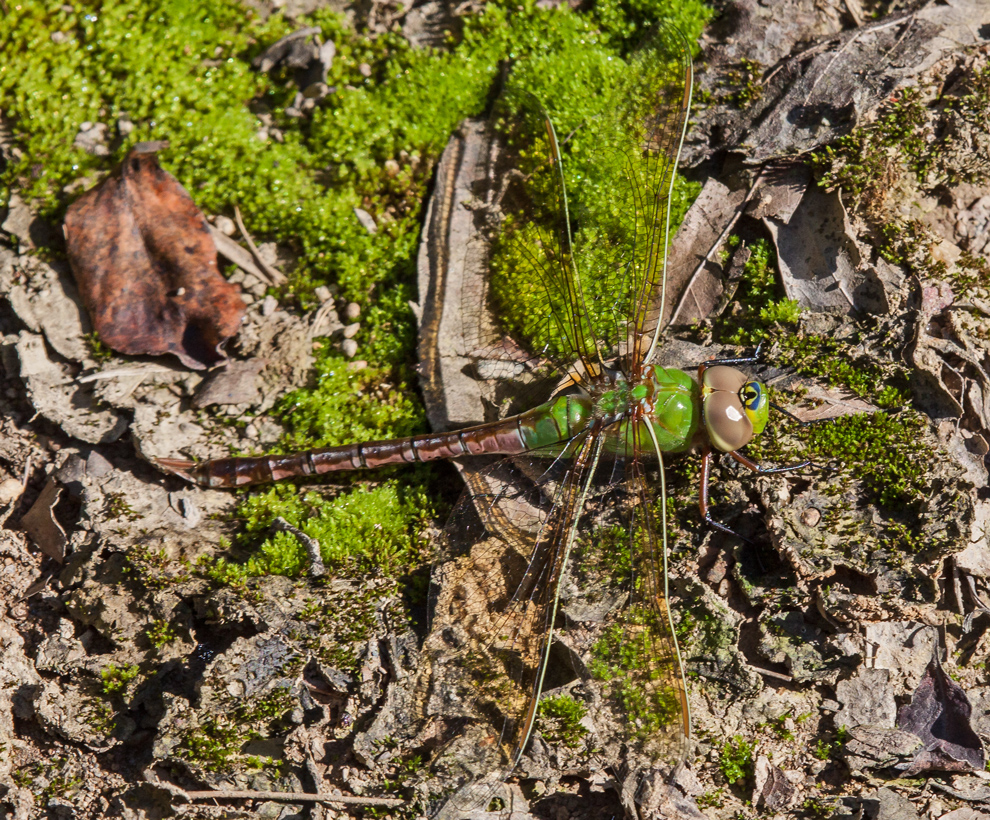
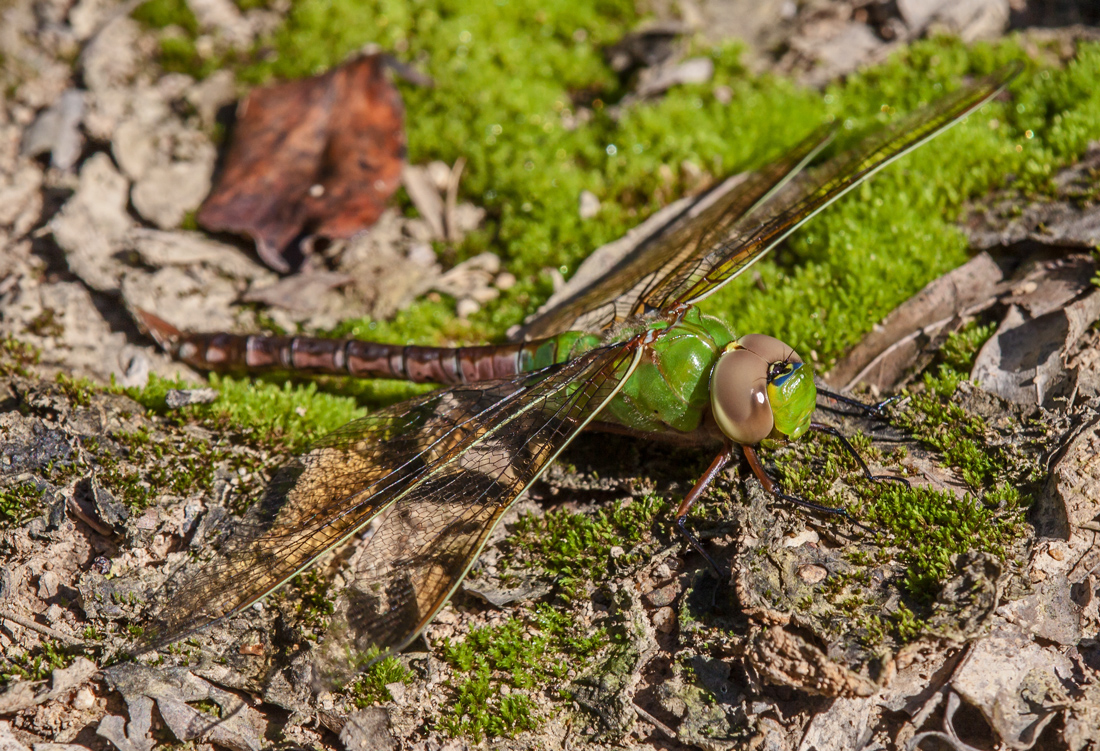
It’s migration time for Common Green Darner dragonflies (Anax junius) and last week one of my fellow photographers, Walter Sanford, reported a small swarm of Green Darners at my local marshland park.

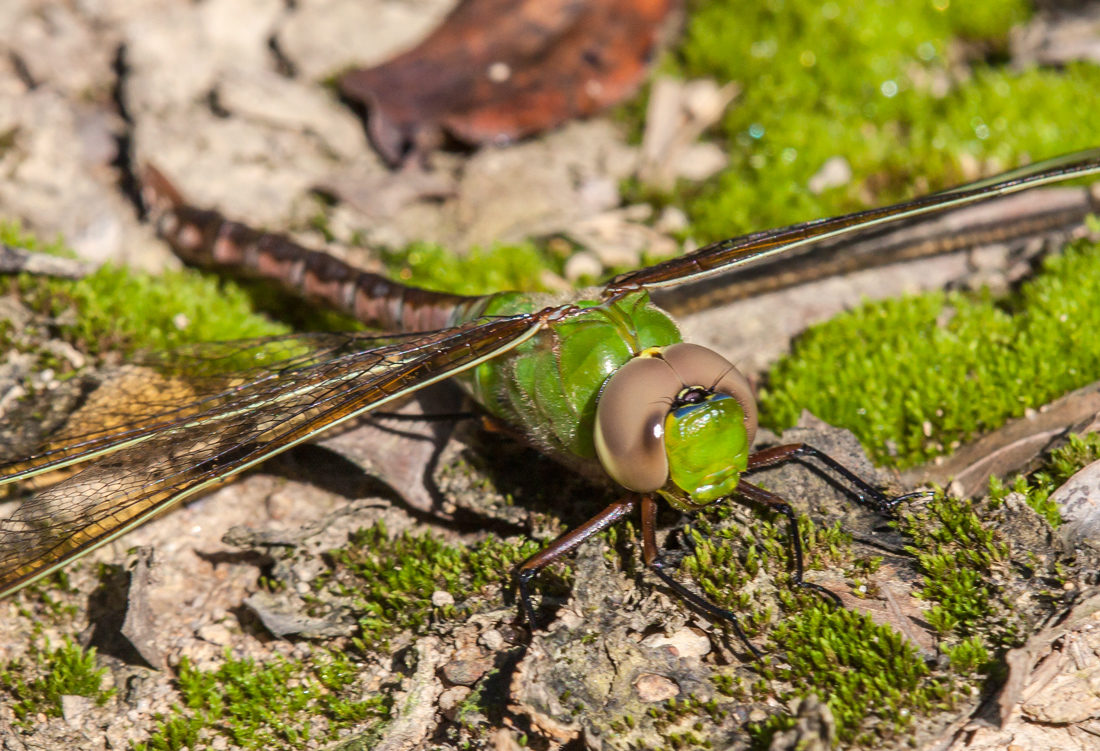
I was walking in an entirely different area of the park from Walter and was surprised to see Green Darners, which are easily recognized thanks to their coloration and distinctive bullseye on their heads, flying up from the ground as I approached them. Rather than fly off into the distance, which is most often the case when I happen to disturb a dragonfly, these dragonflies moved only a short distance and came to rest again on the ground.

I don’t yet have the ability to interpret the movements of dragonflies, but it seemed to me that these Green Darners were conserving energy, as though they were resting in the midst of a long journey. I tried to be as quiet and stealthy as I could and moved closer and closer to one Green Darner perched near some green moss that was almost a perfect match for the color of the forward portion of her body. Judging from her overall coloration, I think this is probably a female.

My subject was amazingly cooperative and I was able to get shots of this beautiful dragonfly from a number of different angles. Although I normally try to have backgrounds that are must less cluttered than those in these images, I don’t find them to be too distracting here and they do help to show how well this colorful dragonfly blended in with her environment.

Common Green DarnerCommon Green DarnerCommon Green DarnerCommon Green Darner

© Michael Q. Powell. All rights reserved.
Read Full Post »

It’s always great to spot a little Green Treefrog (Hyla cinera) in the reeds at my local marshland park, though they are often obscured by the vegetation and are tough to photograph.

I initially spotted this one on a large leaf, as shown in the second shot, shortly after I had mentioned to a fellow photographer how much I wanted to see one on one of these leaves. My wish came true.

As I was taking some shots, someone walked toward me on the boardwalk. I had to stop shooting, because of the vibrations of the approaching footsteps. As I anticipated, the passerby wanted to know what I was photographing and my efforts to point out the frog caused it to move.

Although I was initially a little irritated that the frog had jumped away, I quickly realized that it had not moved far and was in a more precarious and photogenic position. I had to work to shoot through the reeds, but ended up with a nice shot of this really cute frog.

Green Treefrog Green Treefrog

© Michael Q. Powell. All rights reserved.

Read Full Post »

Yesterday afternoon I had a little photo shoot with Freckles, a two year old Cocker Spaniel who is one of my favorite subjects. Freckles belongs to a friend who has been staying with me and I have the pleasure of spending a lot of time with this beautiful little dog.

Freckles was more cooperative than usual, though I still had to chase her around a lot to try to get some shots. The small size of the backyard of my townhouse and the 180mm focal length of my lens guaranteed that all the shots would be close-ups, which means you can easily see her beautiful coloration and expressive eyes.

Freckles1_oct_blog Freckles2_oct._blog Freckles3_oct_blog Freckles4_blog

© Michael Q. Powell. All rights reserved.

Read Full Post »

Many dragonflies species have disappeared by now as we move deeper into autumn, but some especially beautiful ones have taken their place, like these male Blue-faced Meadowhawks (Sympetrum ambiguum) that I photographed yesterday at my local marshland park.

According to the Dragonflies of Northern Virginia website, this species peaks in September to October and is the rarest and hardest to find meadowhawk in our area. I was walking through a meadow at the park with one of my fellow photographers when she spotted the Blue-faced Meadowhawk in the second photo perched on a log. At that moment, I happened to have a 70-300mm telephoto lens on my camera and I was happy  to be able to get a shot that shows the spectacular colors of this dragonfly. Little did I know that I would have an even better opportunity a few minutes later.

As we continued into an area with thigh-high growth, my friend stopped for a moment and said she had spotted a spreadwing damselfly. I looked in the direction that she was pointing and didn’t see the damselfly, but I did spot another Blue-faced Meadowhawk perched atop one of the plants.

In a whispered voice, I asked my friend to freeze and I quickly changed lenses to my 180mm macro lens. Amazingly, the dragonfly stayed in place and I was able to get a number of shots, including the first one below. Given that these dragonflies are less than two inches in size (50mm), I am thrilled with the results. There is something almost magical about the combination of red, blue, and turquoise on this dragonfly.


Blue-faced Meadowhawk Blue-faced Meadowhawk.

© Michael Q. Powell. All rights reserved.
Read Full Post »

As I reached the boardwalk, I glanced to my right and realized that I was eye-to-eye with a snake that was loosely coiled on top of a bush. This Common Ribbonsnake (Thamnophis sauritus sauritus) seemed to have appointed himself as the official greeter of the day at the marsh, though I suspect that not all visitors welcomed his presence so close to them as they walked by.

ribbon_blog

© Michael Q. Powell. All rights reserved.

Read Full Post »

One of Brussels’s notable tourist landmarks, the Manneken Pis, was wearing a different set of clothes today. The costume is that of the Red Knights of Belgium 1, the local branch of an international firefighters motorcycle club. According to a city website, “The costume was offered to honor the many firefighters, but also the American Red Knights, who vanished during the attacks on the World Trade Center in New York on 11 September 2001.”

boy3_blog

© Michael Q. Powell. All rights reserved.
Read Full Post »

« Newer Posts - Older Posts »