Feeds:
Posts
Comments

Archive for the ‘Portraits’ Category

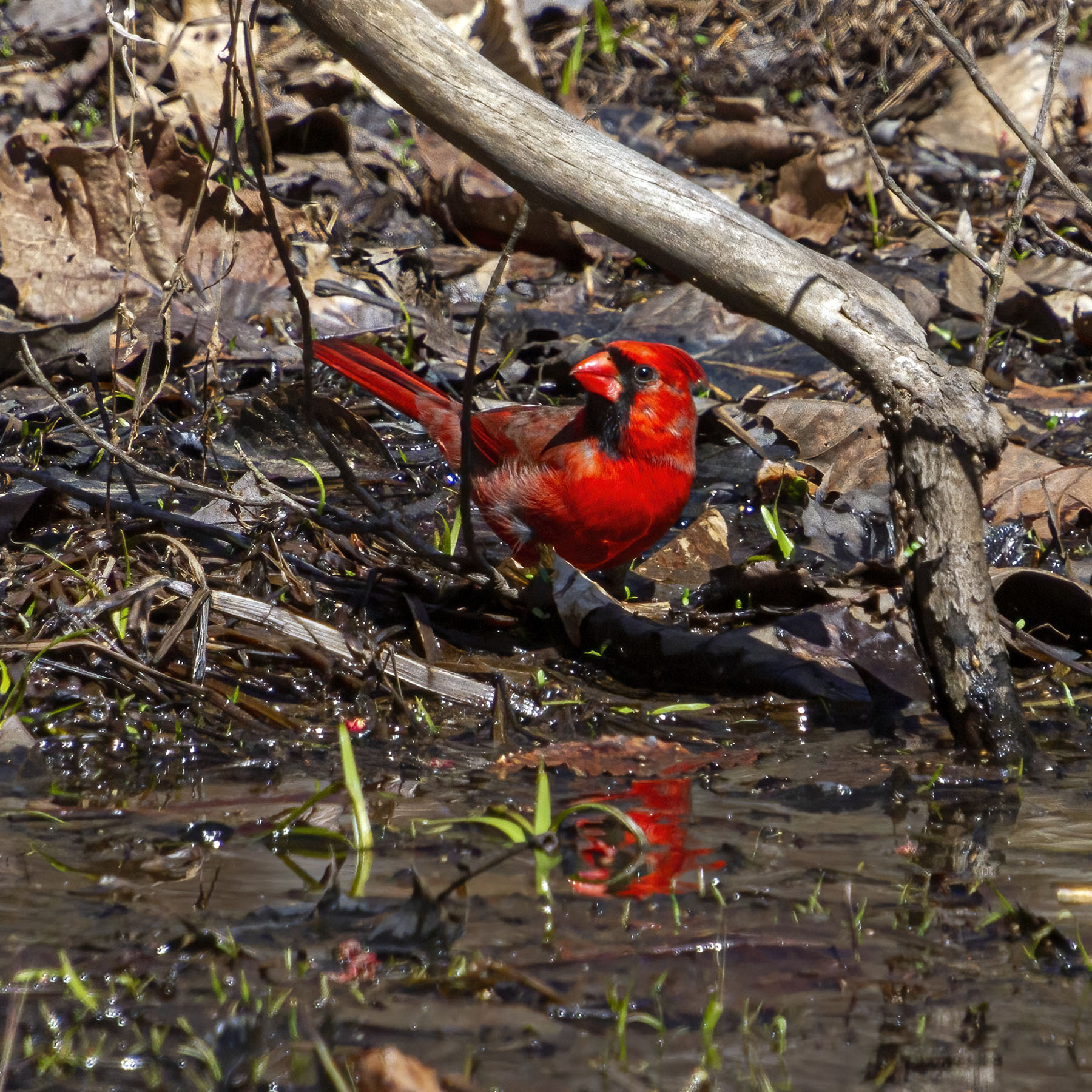
I spotted this male Northern Cardinal (Cardinalis cardinalis) as he was hopping around on the ground near a stream last week in Prince William County, Virginia. I was delighted when the cardinal bent over and drank briefly from the shallow water. In the first photo, I captured the moment when the cardinal lifted his head and dribbled a few drops of water from his mouth.

It seemed like the cardinal suddenly became aware of my presence and realized that my previous photo might not have been very flattering, which is usually the case when you snap a shot of someone eating or drinking. He then struck a profile pose for me to show his better side. Note the slight tilt of the head that helps to present a slimmer neck—clearly this cardinal had some previous experience as a model.

Northern Cardinal

Northern Cardinal

© Michael Q. Powell. All rights reserved.

Read Full Post »

I see Great Blue Herons (Ardea herodias) quite often at Occoquan Bay National Wildlife Refuge, but generally they are far away from me. Last week, however, I was lucky to get close enough to a heron to be able to capture a portrait-like image of the big bird. How did I do it?

The heron was standing in the waters off of the shore of the refuge and was mostly hidden from view by the vegetation. I was walking along a trail parallel to the water and discovered a little break in vegetation that gave me a clear view of most of the heron. I twisted and turned my body, trying to make sure that no branches were blocking my view and zoomed in with my telephoto lens. I had to wait a little while and eventually the heron lifted its head and turned to the side, giving me a perfect profile pose.

Some wildlife photographers are always searching for new species to photograph, but most of the time I am content to photograph the same species over and over, capturing the changing seasons and environments in which I find these beautiful creatures.

Great Blue Heron

© Michael Q. Powell. All rights reserved.

Read Full Post »

Last Friday I was walking slowly along a trail that runs parallel to the water off of Occoquan Bay National Wildlife Refuge when I noticed a Great Blue Heron (Ardea herodias) doing the same thing. Most of the time when I see a heron, it is in the water, though occasionally I have spotted one perched in a tree. It is highly unusual for me to see one on dry land, but this heron seemed to strolling down the path, taking in the sights.

I slowed down a little to maintain my distance from the heron and managed to capture this shot as heron was lifting its long toes to take another step. Eventually the heron became aware of my presence and quickened his walking pace a bit until he reached an opening to the water and flew away. What a fun little encounter with the heron!

Great Blue Heron

© Michael Q. Powell. All rights reserved.

Read Full Post »

I photographed this raccoon on Monday (27 January) as it foraged in an open water area of a small pond at Occoquan Bay National Wildlife Refuge. Although the weather was considerably warmer, i.e. above the freezing level, the water in the small interior ponds and in the shore areas was still almost completely frozen over.

I couldn’t tell for sure if the raccoon had any success in finding something to eat, because I was quite a good distance away from it.  It was fascinating nonetheless to watch the raccoon at work, repeatedly dipping a paw into the frigid water.

The second image below provides a much clearer view of the raccoon’s face, but there is something about the body and head position in the first photo that appeals to be a slight bit more. What do you think? Do you have a preference for the first photo or the second one?

raccoon

raccoon

© Michael Q. Powell. All rights reserved.

Read Full Post »

This last week or so, I have had several opportunities to capture “artistic” shots of Great Blue Herons (Ardea herodias) at Occoquan Bay National Wildlife Refuge. In these cases the heron was not actively engaged in fishing and was standing in the vegetation a bit removed from the water.

In the first two photos, I was struck by the beautiful light that was falling on the heron. I particularly like the heron’s pose in the first image in which the heron has his neck stretched out, giving him a very slim profile. In the final photo, the heron was partially hidden by the reeds and is much more hunched over in an effort, perhaps, to retain his body heat.

Great Blue Heron

Great Blue Heron

Great Blue Heron

© Michael Q. Powell. All rights reserved.

Read Full Post »

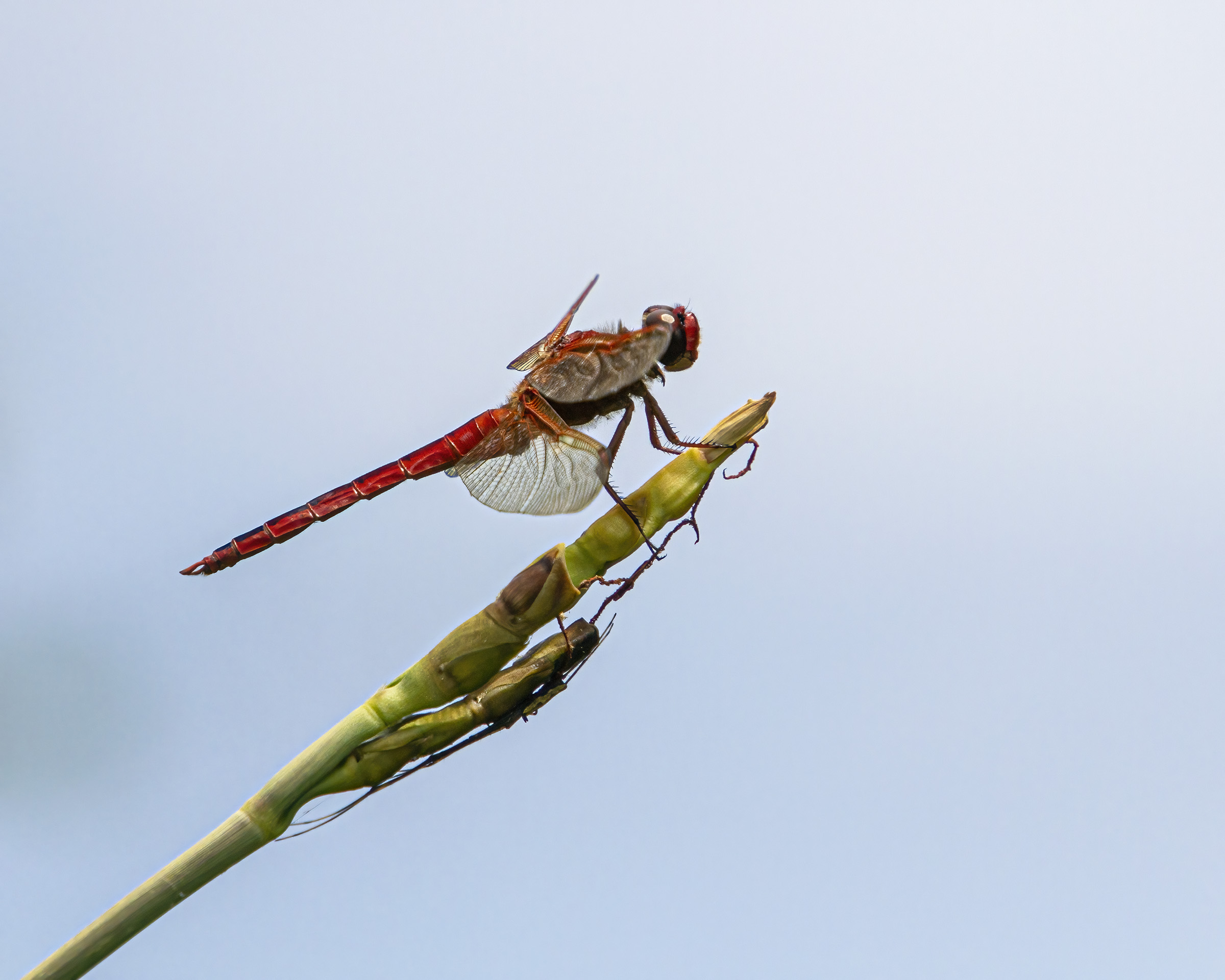
Immature male Needham’s Skimmer (Libellula needhami) dragonflies are yellow and black in color, like the females of the species, but gradually turn into a wonderful shade of reddish-orange as the season progresses. I was delighted to spot this mature male Needham’s Skimmer last Thursday at Occoquan Bay National Wildlife Refuge and captured this image as he perched on a stalk of what appears to be Eastern Gamagrass.

Needham's Skimmer

© Michael Q. Powell. All rights reserved.


Read Full Post »

On occasion I have noticed a dragonfly that seemed to be smiling a little at me. Last week, though, I encountered a female Widow Skimmer (Libellula luctuosa) at Occoquan Bay National Wildlife Refuge that seemed to have an exceptionally toothy grin—she seemed delighted to pose for me. I love the way that the background blurred out, allowing viewers to focus on the details of this smiling dragonfly and hopefully producing smiles on their faces in response.

Widow Skimmer

© Michael Q. Powell. All rights reserved.

Read Full Post »

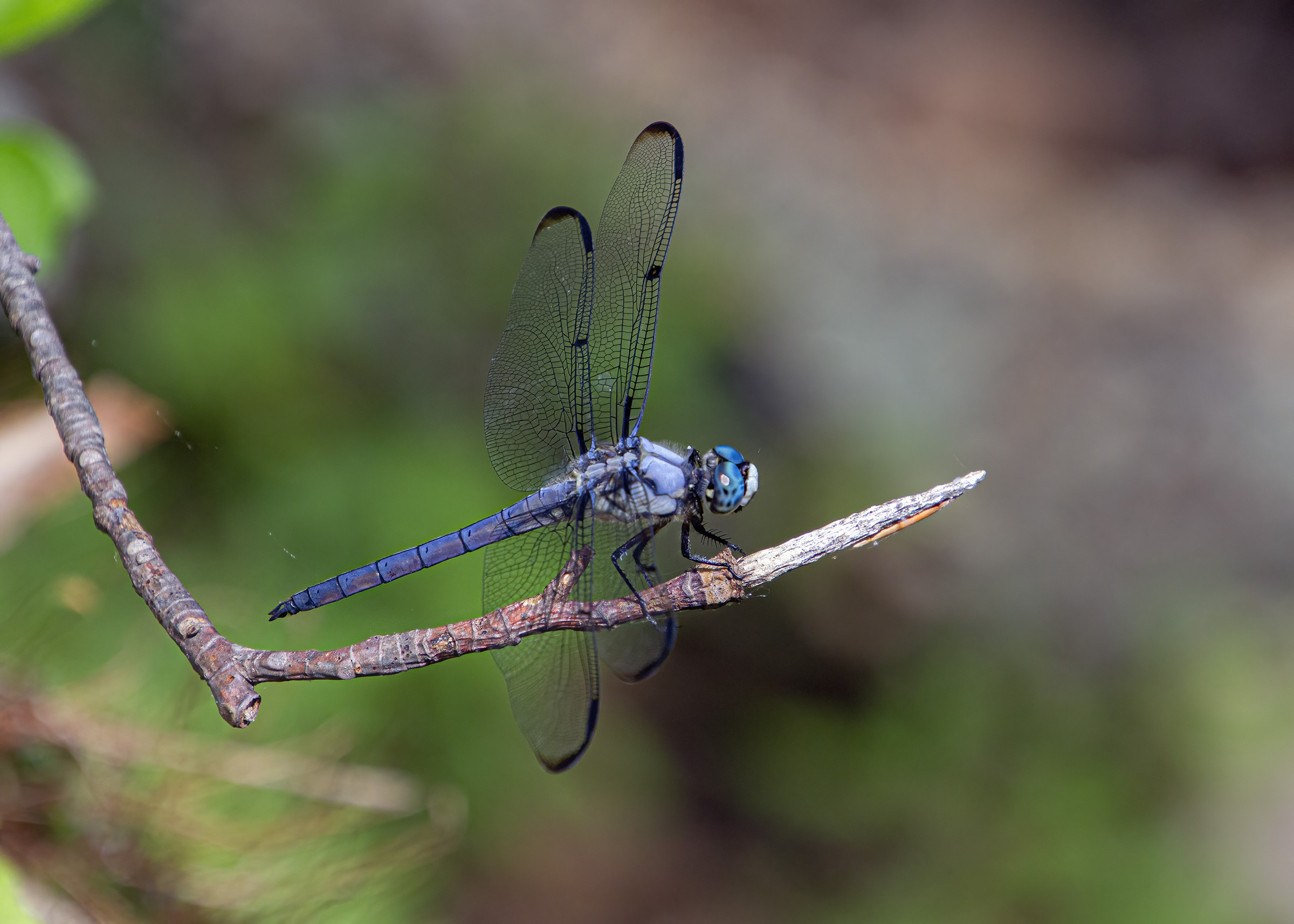
Can dragonflies smile? Although I realize that it is probably an anatomical impossibility, this female Great Blue Skimmer dragonfly (Libellula vibrans) sure did look like she was smiling at me when she posed for this little portrait last week at Occoquan Bay National Wildlife Refuge.

Great Blue Skimmers are quite common in our area during the summer and are relatively easy to identify because of their white faces.

Great Blue Skimmer

© Michael Q. Powell. All rights reserved.


Read Full Post »

On Monday I played a little game of peekaboo with this Great Blue Skimmer (Libellula vibrans) dragonfly at Occoquan Regional Park. As I approached, the dragonfly hunkered down and was almost hidden from view. I stopped and waited and eventually the Great Blue Skimmer lifted its head, looked right at me, and appeared to smile.

The second shot provides a more traditional view of this species, highlighting its beautiful speckled eyes and white face that help in distinguishing it from other blue dragonflies in our area. Great Blue Skimmers are quite common in my area during the summer, but this was one of first ones that I spotted this year.

Great Blue Skimmer

Great Blue Skimmer

© Michael Q. Powell. All rights reserved.

Read Full Post »

Prothonotary Warblers (Protonotaria citrea) are probably my favorite warblers. I just love their brilliant yellow plumage that seems to glow. Many warblers have touches of bright yellow, especially during the spring breeding season, but the Prothonotary Warbler outdoes them all and is almost completely covered in yellow.

I spotted this little beauty yesterday (1 May) at Occoquan Bay National Wildlife Refuge. I initially caught sight of the warbler as it was flitting about in the foliage. I would see flashes of yellow as it foraged, but could not get a clear look at it. All of the sudden the warbler flew across the trail and landed in a bush, momentarily give me a clear shot.

Quite often I strain my neck when trying to photograph warblers, a phenomenon that is colloquially called “warbler neck.” It is so common that the Audubon website has an article entitled, “A Birder’s Workout Guide for Preventing Warbler Neck.” I was very fortunate in this case, though, that the bird was perched below eye level, so I was able to capture a lot of detail without harming my neck, detail that is often hidden when I am shooting upwards at a sharp angle.

Prothonotary Warbler

© Michael Q. Powell. All rights reserved.

Read Full Post »

Can turtles smile? It is probably physiologically impossible for a turtle to smile, but this Eastern Painted Turtle (Chrysemys picta picta) seemed to be doing its best as it posed for me Monday at Occoquan Bay National Wildlife Refuge. Some of our nights are still dipping below the freezing level, but the days seem to be getting progressively warmer.

Most of the turtles are probably still spending the majority of their time in the mud at the bottom of the ponds, but a few adventurous ones have started to come to the surface to bask in the warmth of the sun on sunny days.

Eastern Painted Turtle

© Michael Q. Powell. All rights reserved.

Read Full Post »

As I was walking along a trail on Monday at Occoquan Bay National Wildlife Refuge, I happened to glance to my left  and was shocked to see that I was almost face-to-face with a Wild Turkey (Meleagris gallopavo). This turkey, along with several of his friends, was foraging in the underbrush and apparently had not heard me approaching. I immediately stopped in my tracks, fearful of scaring the turkeys away and contemplate my next steps.

Should I try to move into another position for a better shot? Should I zoom out and try capture the turkey’s entire body that was mostly hidden in the vegetation? The clock was ticking and I knew that the turkeys would soon sense my presence.

I had a pretty clear view of the turkey’s head from where I was standing, so I decided to go for a portrait close-up portrait shot. I carefully focused on the turkey’s eye and was happy to be able to capture quite a bit of detail in a profile shot when the turkey turned his head to the side.

In a funny way I felt almost like I was looking a mirror, because the turkey had a lot of wrinkles and hairs sprouting out of various parts of his head, features that have become increasingly noticeable for me as I have gotten older. When I was younger, I don’t think I realized how much hair would eventually be growing out of my nose and ears.

After I had grabbed a few shots, I move on quietly down the trail and the turkeys continued their foraging .

Wild Turkey

© Michael Q. Powell. All rights reserved.

Read Full Post »

I see and hear crows quite often when I am walking about at Occoquan Bay National Wildlife Refuge. Frequently there are large, noisy flocks of them moving about as a group. In my area, there are two types of similar-looking crows—the American Crow (Corvus brachyrhynchos) and the Fish Crow (Corvus ossifragus)—and I reluctantly admit that I have not yet learned to tell them apart.

This past Wednesday, which happened to be Valentine’s Day, I spotted a single crow all by itself atop a broken-off tree. Apparently it had not been able to get a date for the special day or perhaps, like me, it preferred spending some peaceful moments alone.

I was happy to be able to capture some details of the crow’s eye in this shot. Quite often the eye blends it with the dark feathers and looks like a black, featureless hole.

Have a wonderful weekend.

crow

© Michael Q. Powell. All rights reserved.

Read Full Post »

Usually when I hear some rustling in the leaves and see a flash of rust-colored feathers, I assume that it is an American Robin. I was delighted last Friday at Huntley Meadows Park to be wrong in my assumption. When I zoomed in on the bird that had attracted my attention, I realized that it was an Eastern Towhee (Pipilo erythrophthalmus), a species that I see a lot less frequently than the American Robin,

This colorful little bird proved to be quite skittish and I managed to capture only a few shots of it before it flew deeper into the underbrush. Fortunately I was able to capture enough details that you can see the bird’s beautiful markings and coloration.

Eastern Towhee

© Michael Q. Powell. All rights reserved.

Read Full Post »

I never get tired of photographing Bald Eagles (Haliaeetus leucocephalus)—it always feels special to catch sight of one of these majestic birds. In Northern Virginia, where I live, we are blessed to have a relative abundance of Bald Eagles and I see one or more of them quite regularly. Getting a good shot of one, though, is a bit of a challenge, because the eagles’ eyesight and reaction times are vastly superior to my own. A lot of the time my first indication of the presence of an eagle is when I see it flying away from me.

This past Tuesday I spotted a Bald Eagle perched on a broken-of branch of what appeared to be a small, dead tree at Occoquan Bay National Wildlife Refuge. There was some vegetation between the two of us that hopefully hid me from view. Initially my view of the eagle was partially blocked, but by bending and twisting myself, I managed to find a clear visual tunnel.

When I captured the first shot, the “regal” one, the eagle appeared to be surveying its surroundings from on high, like a royal sovereign. A few seconds late, the eagle seemed to have become aware of my presence and stared directly at me. It is hard to interpret the facial expressions of an eagle, but “fierce” is a descriptive word that often comes to mind.

Although it might have been a little curious about me, the eagle seemed mostly unhappy that I was there. I can imagine the regal eagle thinking, “We are not amused.”

Be sure to click on the second image to get a closer look at the eagle’s face. How do you interpret that expression?

Bald Eagle

Bald Eagle


© Michael Q. Powell. All rights reserved.

Read Full Post »

Have the rules changed or have I simply changed? When I first starting getting into wildlife and nature photography, one of the basic “rules” that I learned was I should try to fill the frame with my primary subject. I acquired longer lenses and worked to become more stealthy so I could get closer and closer to my subjects. My “ideal” shot was a sharp “portrait” image with a soft creamy background.

I still like those kind of images, but I began to realize that I was removing the birds and bugs from their environments. I am now pushing myself to try to include more of the relationship between the subject and its surroundings and ideally the interaction between the two. What that means is that I am growing increasingly comfortable with images in which the primary subject takes up only a small portion of the frame.

In the first image, for example, I could have easily cropped this shot of Song Sparrow (Melospiza melodia) much more tightly to draw the viewers’ eyes to the bird’s feather details. Instead, I limited the cropping in order to show all of the dried vegetation hanging from the branch on which the sparrow was perched.

In the second image, the Great Blue Heron (Ardea herodias) was quite far away. In the past, I might not have taken the shot, because I knew I would not be able to capture a detailed view of the heron. In this case, I instantly knew that I wanted to capture the mood of the moment by showing the heron in its environment. I was happy to be able to convey a sense of the peacefulness of the moments that I shared with this beautiful heron, a time for reflection both literally and figuratively.

Rules and guidelines are undoubtedly helpful for beginners, because they establish a general framework for understanding what makes a “good” photograph. Over time and after spending countless hours with my camera and my computer, I have learned that “good” is a relative term and that “beauty” is often subjective. Most importantly, however, I have developed a greater sense of what types of photos I personally like and become more skilled in creating these kinds of images.

Nothing is static, though, and I know that my tastes and preferences and those of my readers are likely to change over time. Artists of all types are prone to introspection and are more likely than most other people to explore their inner landscape for inspiration and understanding. Whatever output those artists create is often the result of the interplay between their inner world and the outer world—the “environment” really matters in understanding the context of a work.

Song Sparrow

Great Blue Heron

© Michael Q. Powell. All rights reserved.


Read Full Post »

Despite my best efforts, I could not get this White-throated Sparrow (Zonotrichia albicollis) to smile for me during a mini-portrait session on Tuesday at Occoquan Bay National Wildlife Refuge. The sparrow seemed to think that a serious look was more appropriate for his LinkedIn profile photo.

Birds were much more active on Twitter before its name was changed to X, but now are searching for new social media fora. Are postings on X still called “tweets?”

White-throated Sparrow

© Michael Q. Powell. All rights reserved.


Read Full Post »
I observed Song Sparrows (Melospiza melodia) foraging for food on the ground at multiple locations last Thursday at Occoquan Bay National Wildlife Refuge. Most of the time they would fly away as I approached, but occasionally one of them would choose a new snow-covered perch that was still within range of my long telephoto zoom lens.

The two photos below are mostly monochromatic, composed primarily of various shades of brown and white. The warmth of the browns helps to warm up the photos a little, despite the abundance of snow. I think the photos would have felt cooler and more stark if I had converted them to black and white.

Song Sparrow

Song Sparrow

© Michael Q. Powell. All rights reserved.


Read Full Post »

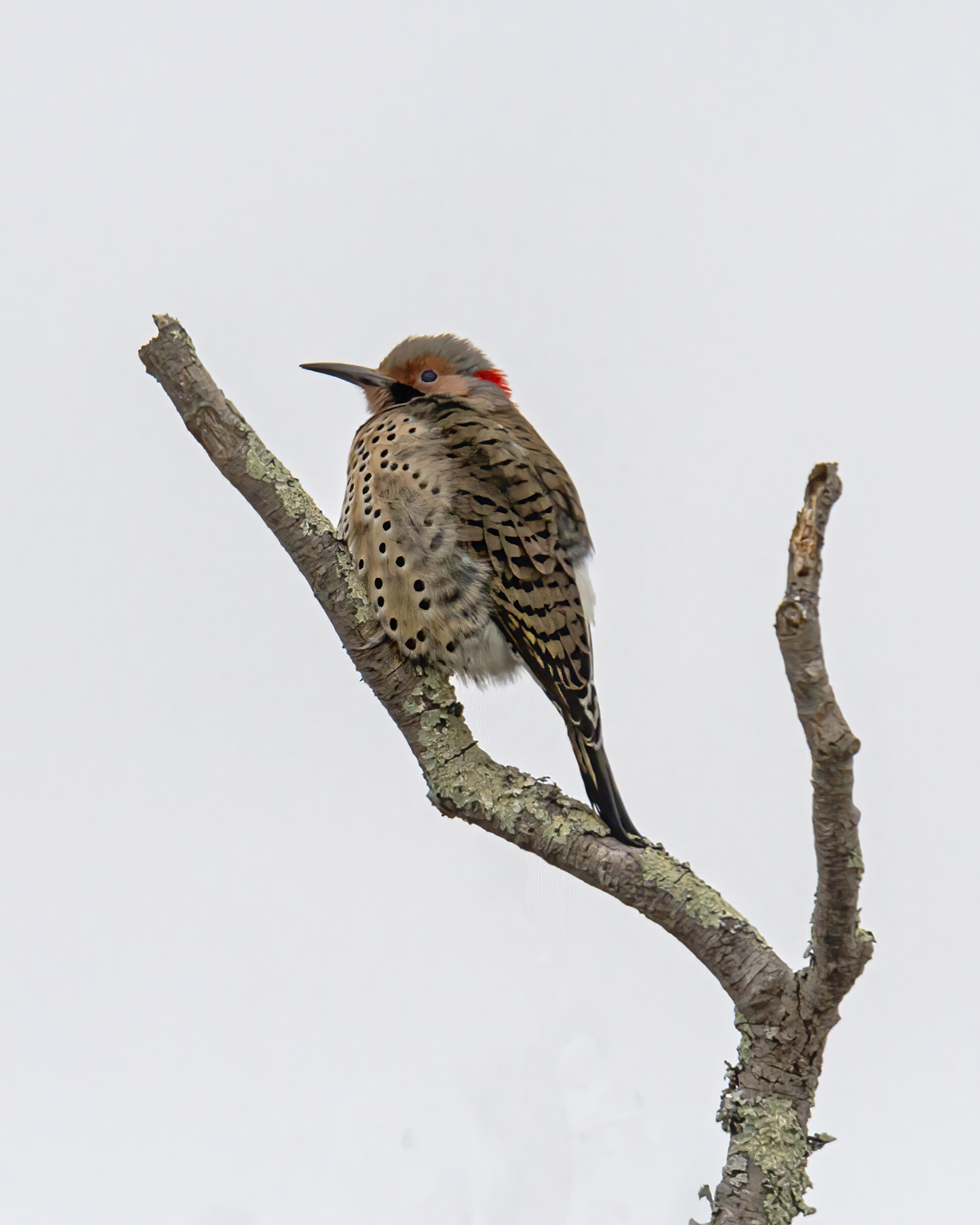
Most of the woodpeckers in my area have black and white feathers in varying patterns, but the Northern Flicker (Colaptes auratus) is a notable and colorful exception to that general rule. I spotted this male Northern Flicker—only males have the black “mustache”—last Thursday perched high in a dead tree at Occoquan Bay National Wildlife Refuge.

The sky was clouded over when I captured this image, so I chose to overexpose the shot to reveal the amazing colors and patterns of the flicker’s feathers. These camera settings caused the background to be almost totally blown out and the resulting white background makes this look like it was shot in a studio.

Like most of the birds that I photographed in our recent frigid weather, the flicker had fluffed its feathers in an effort to retain heat. If you look closely at the image, you may notice that the feathers cover most of the flicker’s feet, with only the tips of the toes visible.

Northern Flicker

© Michael Q. Powell. All rights reserved.

Read Full Post »

This White-throated Sparrow (Zonotrichia albicollis) seemed unhappy about something on Thursday at Occoquan Bay National Wildlife Refuge. Maybe it was complaining about my presence there or maybe it was calling out to its mate or expressing its displeasure about the cold, snowy weather. Who knows?

It is a real bonus when I can capture a bit of action in my photos of birds, even when it is hard to interpret what that action means. In many of my shots of sparrows, their heads are buried and out of view as they forage for food, so it was nice here to see the bird with its head lifted up. In this shot you actually get a glimpse of the inside of the sparrow’s mouth and a tiny tongue—you may need to click on the image and enlarge it to see these details.

We are still in the midst of a frigid spell, well below the freezing level all of today, but by Thursday we are supposed to warm up to 60 degrees (17 degrees C) and rain is in the forecast, so most of this snow will be gone in a week or so.

White-throated Sparrow

© Michael Q. Powell. All rights reserved.

Read Full Post »

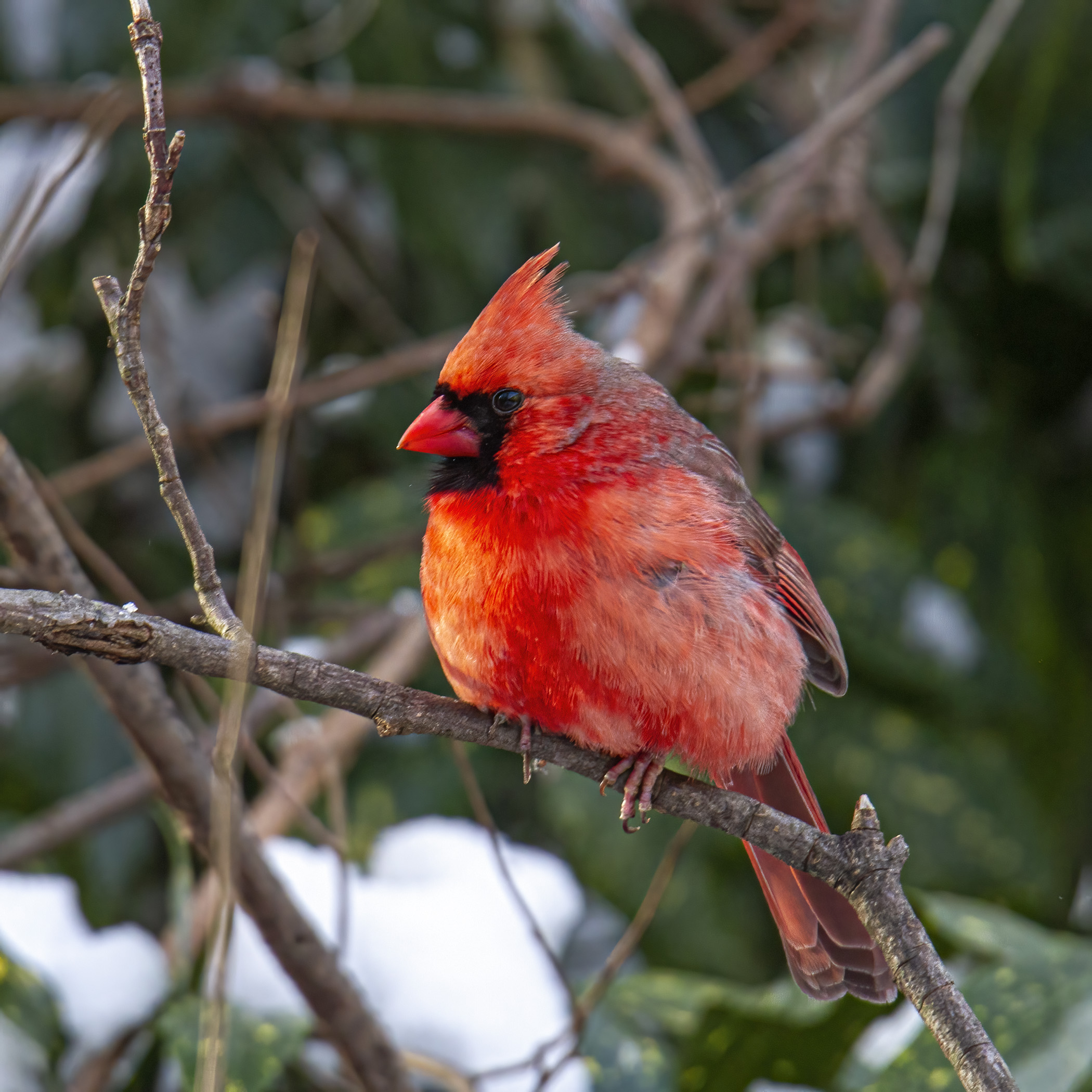
There is something iconic about a photo of a Northern Cardinal (Cardinalis cardinalis) in the snow and every time that we have a snow storm I try to capture images of these bright red birds. Fortunately I did not have to travel far to find some cardinals—I captured all three of these images in the suburban townhouse community in which I live.

Given the bright color their plumage, it is not hard to spot male cardinals, but they tend to be pretty active and don’t sit still for very long, so I had to react quickly when I managed to get an unobstructed view of one. I tried to frame my photos so there was at least a little bit of snow visible in the shot and more or less succeeded in doing so.

The weather forecasters predict that we will have some more snow tomorrow, so I will probably spend a little more time getting acquainted with my neighborhood birds this weekend.

Northern Cardinal

Northern Cardinal

Northern Cardinal

© Michael Q. Powell. All rights reserved.


Read Full Post »

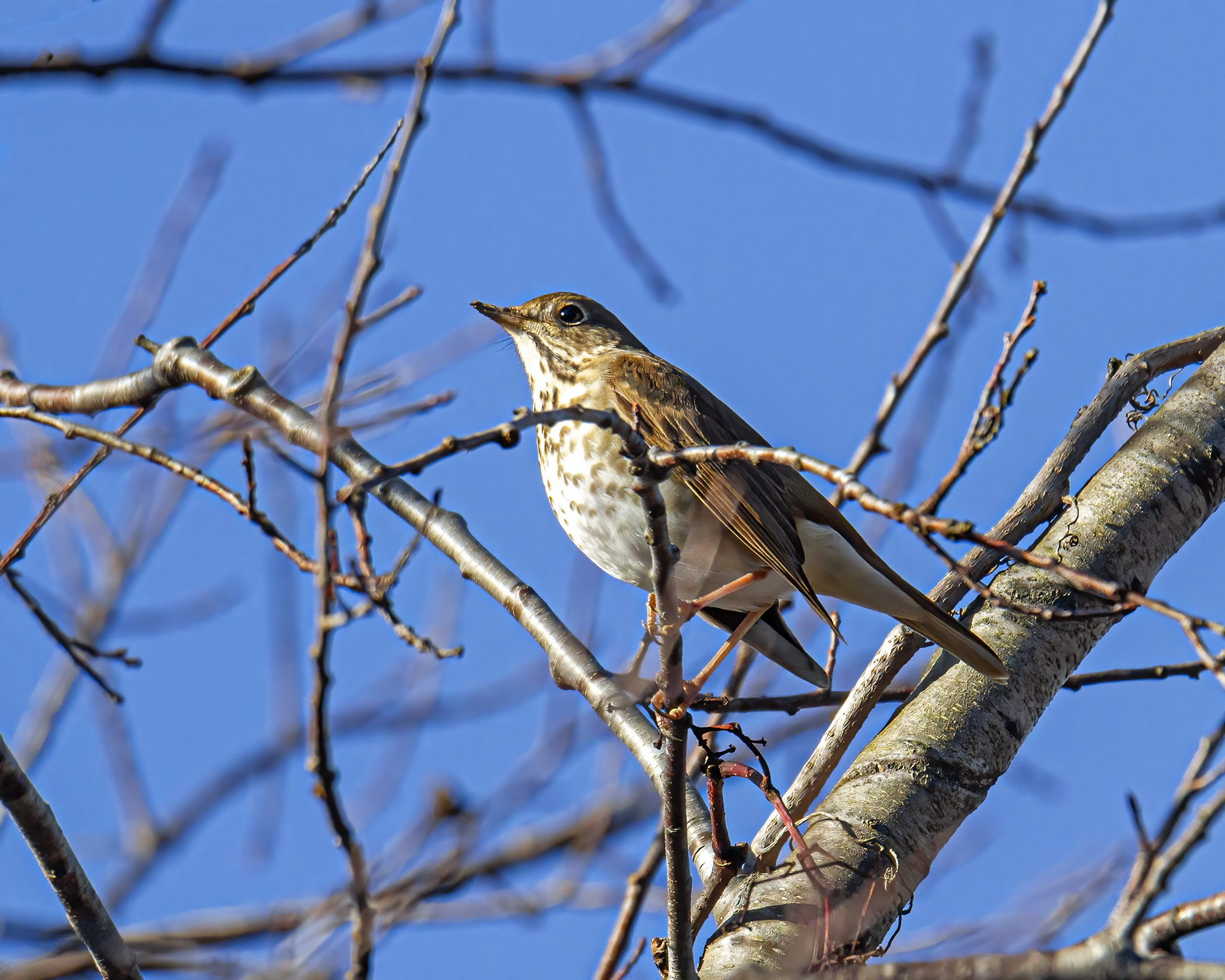
When I first spotted this little bird on Monday as it perched high in a tree at Occoquan Bay National Wildlife Refuge, its shape caused me to think that it was an American Robin. As I got a little closer, though, I could see that the bird’s breast was spotted and did not have the distinctive orange color of “our” robin.

I remembered that the American Robin is a member of the thrush family, so I assumed that this bird was another kind of thrush. (The European Robin, by contrast, belongs to the chat subfamily of the Old World Flycatcher family—check out this November 2019 blog posting to see a photo of a European Robin that I photographed in Paris.) When I returned home and checked by bird identification guide, I was able to determine that this is probably a Hermit Thrush (Catharus guttatus), a species that I have encountered only a few times.

As I was looking up information on the Hermit Thrush, I discovered that this bird played a an important role in “When Lilacs Last In The Dooryard Bloom’d,” an elegy on the death of Abraham Lincoln by noted American poet Walt Whitman. The thrush, along with lilacs and a star, is one of the recurring elements in the poem and seems to represent a kind of reconciliation with death and its song is described as “Death’s outlet song of life.” I am providing a link to the entire poem in case you are interested in reading the beautiful poem in its entirety. As a foretaste, I will leave you with one small section of the poem in which Whitman first introduced his readers to the Hermit Thrush:

“In the swamp in secluded recesses,

A shy and hidden bird is warbling a song.
Solitary the thrush,
The hermit withdrawn to himself, avoiding the settlements,
Sings by himself a song.
Song of the bleeding throat,
Death’s outlet song of life, (for well dear brother I know,
If thou wast not granted to sing thou would’st surely die.)”

Hermit Thrush

© Michael Q. Powell. All rights reserved.

Read Full Post »

Something caught the attention of this Great Blue Heron (Ardea herodias) yesterday at Occoquan Bay National Wildlife Refuge and caused it to momentarily look up towards the sky. The upward tilt of the heron’s head helped it to be better illuminated, allowing me to capture this little environmental portrait of one of the year-round inhabitants of the refuge.

Great Blue Heron

© Michael Q. Powell. All rights reserved.

Read Full Post »

The sun was so low at 3:15 in the afternoon last Friday that I cast a really long shadow as I wandered the trails at Occoquan Bay National Wildlife Refuge with my camera and telephoto zoom lens attached to a monopod. This is my favorite type of selfie, a genre of photos that I do not feel compelled to share daily, unlike several of my younger friends.

Happy Solstice Day! Astronomically speaking, today marks the beginning of winter in the northern hemisphere and of summer in the southern hemisphere. In the north, it is the shortest day and the longest night of the year while in the south it is the longest day and the shortest night of the year. Time moves slowly at this time of the year—the time of sunrise doesn’t change much over the next month, but gradually the time of sunset gets a tiny bit later.

I look forward to days when I see long shadows, for it means the sun is shining. For much of winter the sky is grey here, so moments of light are a welcome reprieve.

shadow

© Michael Q. Powell. All rights reserved.

Read Full Post »

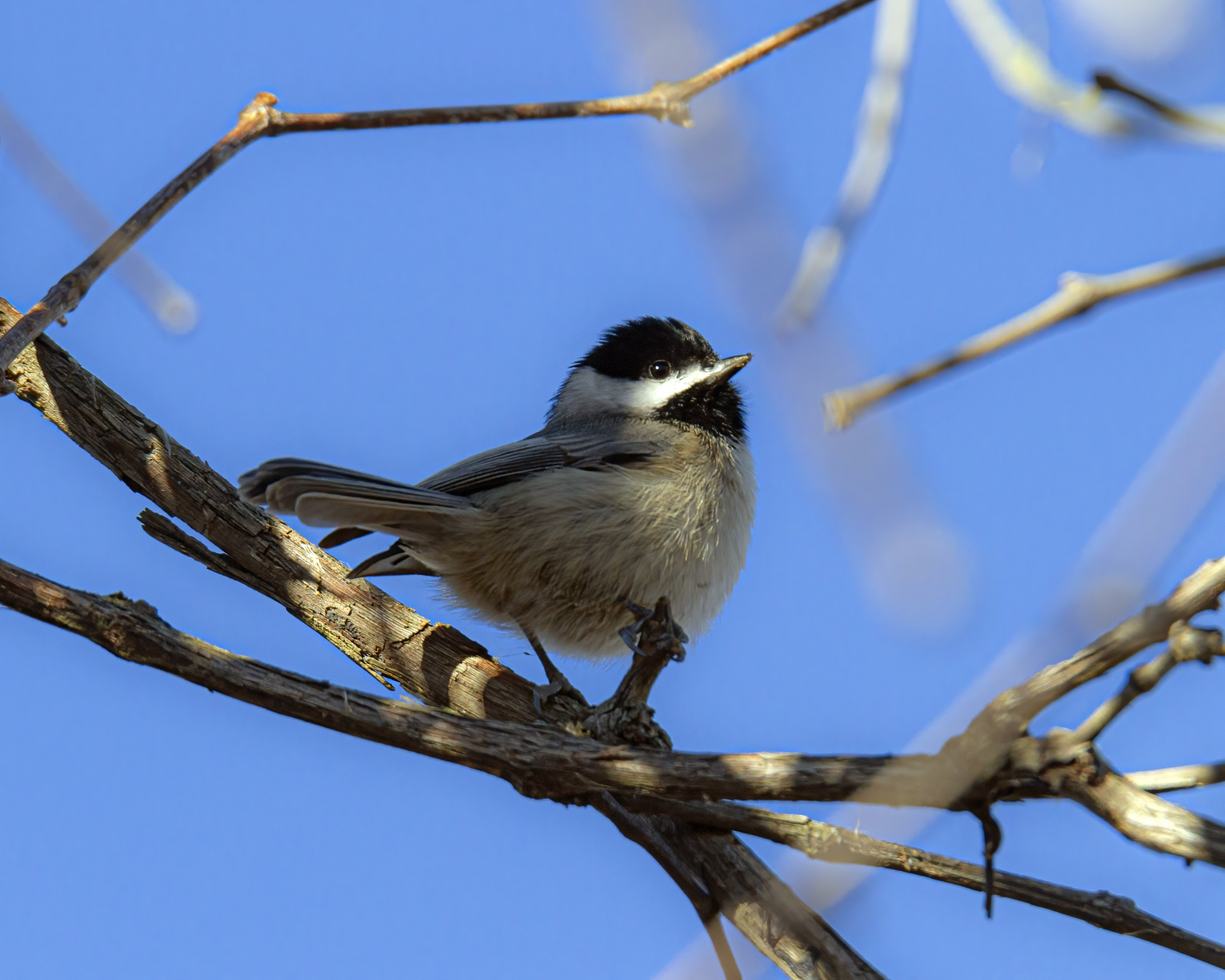
It is always a joy and a challenge to photograph tiny birds, like this cute little Carolina Chickadee (Poecile carolinensis) that I spotted last Friday at Occoquan Bay National Wildlife Refuge.

Even when they are perched, these chickadees are a bundle of energy and seem to be constantly changing head and body positions. As you can see from these two shots, the chickadee was surrounded by branches, so I had to bend and stretch a lot to get a clear shot. Lighting was also an issue, because the little bird often had its head pointed down and was covered with shadows.

I especially like the chickadee’s pose in the first photo, in which he was looking upward and the light was illuminating his face.

Carolina Chickadee

Carolina Chickadee

© Michael Q. Powell. All rights reserved.


Read Full Post »
I was delighted to spot this stunning male Redhead duck (Aythya americana) on Friday in the waters off of Occoquan Bay National Wildlife Refuge. I have seen this species only a few times, so I initially was not able to identify it. However, as I was capturing these shots, I was pretty sure that the duck’s stunning brown head, black-tipped bill, and  distinctive yellow eyes would make it easy to find in my bird identification guide—I was right.

According to the Cornell Lab of Ornithology, Redheads are exceptionally gregarious and gather in large flocks in the winter, especially in the Gulf of Mexico. On this occasion, however, this Redhead appeared to be by himself.

The Redhead was quite far away, so I had limited options for composing my shots as I walked along the water’s edge. I managed to incorporated some of the environmental elements to come up with a couple of images that I really like—although it may appear that the duck is perched on rocks, I think that they may be portions of a waterlogged tree trunk or stump.

Redhead duck

Redhead duck

© Michael Q. Powell. All rights reserved.

Read Full Post »

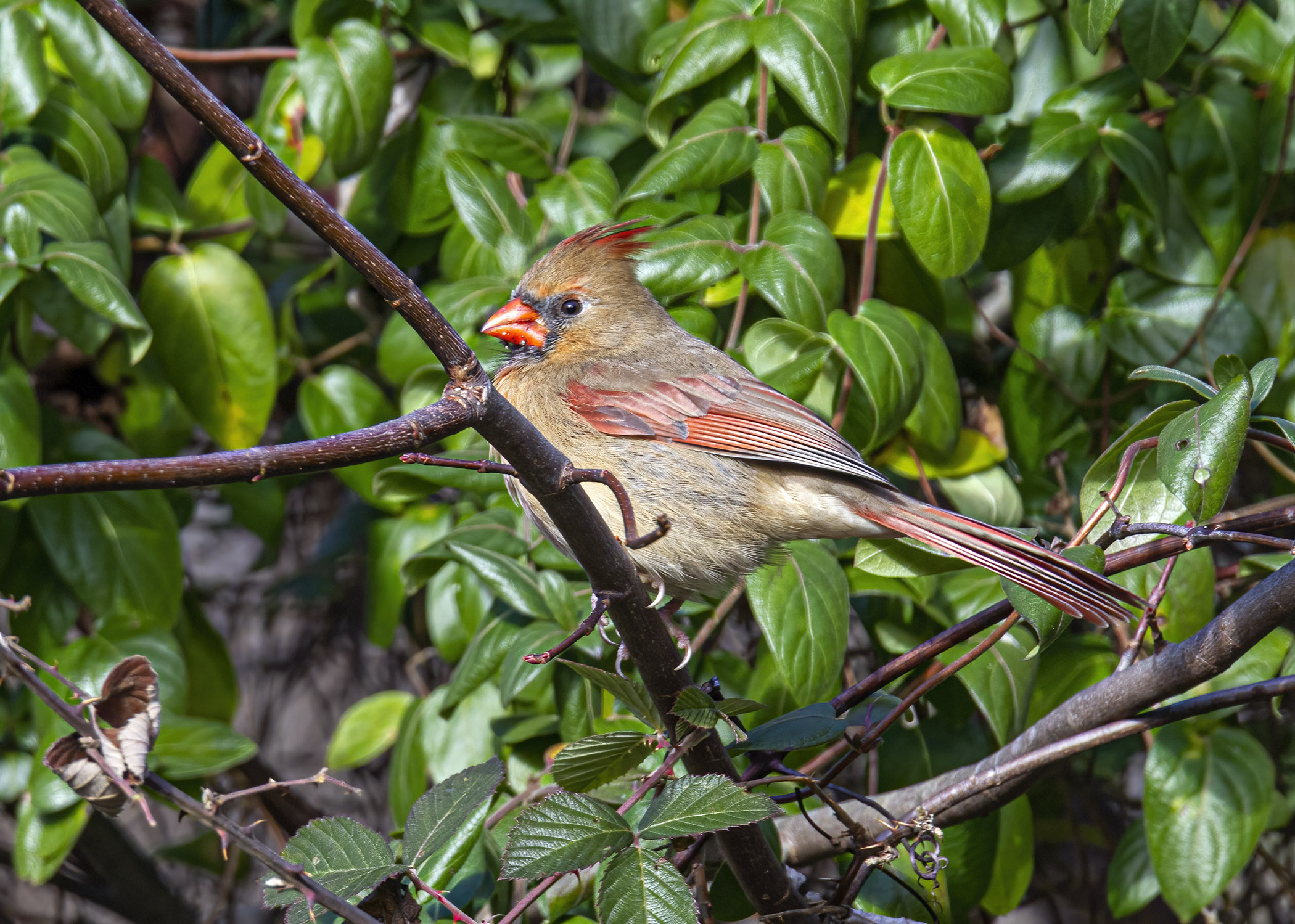
The coloration of female Northern Cardinals (Cardinalis cardinalis) is not as bold and flashy as their male counterparts, but I think they are equally beautiful, like this one that I photographed recently at Occoquan Bay National Wildlife Refuge.

I do love bright colors—I drive an Ignition Orange KIA Soul—but I think there is something more refined and sophisticated when those colors are used in moderation as accents. That is why I really like the way a female cardinal has reddish streaks in her crown and on the outer portions of her wings.

Northern Cardinal

© Michael Q. Powell. All rights reserved.


Read Full Post »

One of the most distinctive ducks that migrates into my area for the winter is the Hooded Merganser (Lophodytes cucullatus). The male has a curious-looking head that is black and the white and the female has an orange-brown hairstyle that literally sticks out.

Sometimes Hooded Mergansers arrive in groups and I have seen some recent photos by local photographers of males competing for the attention of the females. In this case, cover, I spotted only one couple at the small suburban pond not far from where I live. The ducks dozed a bit and occasionally preened their feathers, so there was not a whole lot of action to capture. I was content to capture a few “record” images and hope I will have some more chances to see these little diving ducks in the upcoming months.

Hooded Merganser

Hooded Merganser

Hooded Merganser

© Michael Q. Powell. All rights reserved.

Read Full Post »

There are almost always a few Great Blue Herons (Ardea herodias) at Occoquan Bay National Wildlife Refuge. Most often I see them patiently fishing in the water, but sometimes I have to scan the tangled vegetation surrounding the ponds to find them, as was the case last Friday. Some herons are very skittish and fly away as soon as they sense my presence, but this heron remained in place while I carefully composed this image and continued silently along the trail.

Unlike the Great Egrets, Green Herons, and Ospreys that leave our area in the winter, Great Blue Herons are with us year round. Now that the weather is getting colder and we have already had our first snowfall (it was less than a half-inch (1 cm) or so), I suspect that it is getting harder for herons to find food. I am sure, though, that I will continue to see herons foraging for food, including in the frigid waters of the ponds and the bay—even when the surface of the water freezes, there is enough movement in the water that there are some open areas.

Great Blue Heron

© Michael Q. Powell. All rights reserved.


Read Full Post »
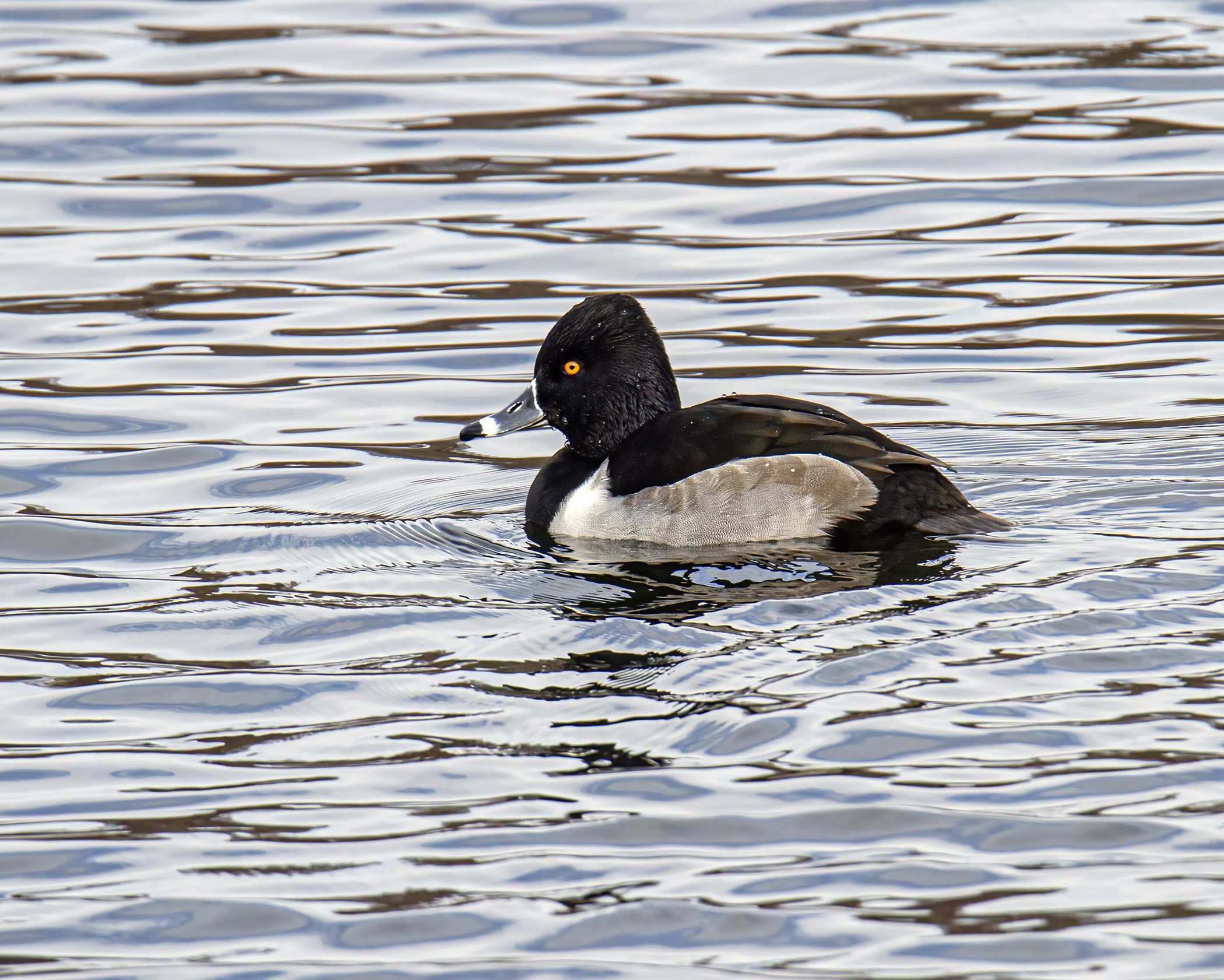
Yesterday I made a quick trip to a local suburban water retention pond, where several migratory bird species overwinter with us. I was shocked to see that no Canada Geese were there, but did spot two Double-Crested Cormorants, a few Ruddy Ducks, and several pairs of Ring-necked ducks (Aythya collaris). All of these are diving birds, so they mostly hung out near in the deeper waters at the center of the pond.

I spent a good amount of time watching one Ring-necked Duck repeatedly dive into the water and would try to guess when and where he would resurface. Male Ring-necked Ducks have a distinctive appearance, with yellow eyes, a striped bill, and a strangely pointed head.

Clouds would drift across the sun from time, causing patterns on the surface of the water to shift and change. I really got caught up in these reflections and these three photos give you a sense of the swirl of colors and patterns that provided an amazing backdrop for these cool-little ducks.

Ring-necked Duck

Ring-necked Duck

Ring-necked Duck

© Michael Q. Powell. All rights reserved.

Read Full Post »

I often find myself returning to the same spot where I have previously seen a bird or a dragonfly. Of course, these are winged species that can fly wherever they want, so there is no guarantee that they will remain in a single location. Perhaps they just happened to be at that spot or maybe there is something about that habitat that suits them well and will cause them to remain.

I revisited a spot at Occoquan Bay National Wildlife Refuge on Monday where I had spotted a few Eastern Bluebirds (Sialia sialis) almost a week earlier. When I arrived there, I was delighted to see that a small group of bluebirds and was even more thrilled when I was able to get close enough to capture some portrait shots of individual birds.

I really like the way that the background in the first photo is an almost perfect match for the colors of the bluebird. In the second photo, the evergreen tree helps to provide a sense of the environment and the berries below the bird help explain why the bluebird chose that tree. I like the framing of the branches in the final photo and the little pops of red on one of the branch and in the background.

I revisited that same spot again on Friday, but the skies were heavily overcast and, alas, I did not find any bluebirds that day.

Eastern Bluebird

Eastern Bluebird

Eastern Bluebird

© Michael Q. Powell. All rights reserved.


Read Full Post »

Older Posts »