Feeds:
Posts
Comments

Archive for the ‘plants’ Category

On Monday I spotted this little Silver-spotted Skipper butterfly (Epargyreus clarus) feeding on a buttonbush (Cephalanthus occidentalis) at Jackson Miles Abbott Wetland Refuge. I love the distinctive spiky flower balls of this plant that have always reminded me of medieval maces.

A few years ago, however, I came to associate the shape of the balls with depictions of the COVID virus. Recently the number of COVID cases has reportedly been on the rise and I fear that they will increase even more when summer ends and people begin to spend more time indoors. Since I am over 65 years old and therefore considered to be “vulnerable,” I hope that I will be able to get an updated COVID shot (and a flu shot too) in the upcoming months. Neither offers 100% protection, but the shots will hopefully lessen the severity of symptoms if I do get sick.

Silver-spotted Skipper

Silver-spotted Skipper

© Michael Q. Powell. All rights reserved.


Read Full Post »

Recently I have featured numerous large, beautiful butterflies feeding on blooming plants, especially thistles. Today, I decided to turn the spotlight to the smaller, more nondescript butterflies, commonly referred to as skippers, that have been equally active and visible in recent weeks.

According to Wikipedia, there are more than 3500 species of skipper butterflies in the world and many of the species are visually similar in appearance. For that reason, I am especially cautious in trying to identify one of these small butterflies. Sometimes I will request assistance in identifying specimens in one of many Facebook groups to which I belong. I have learned the “secret” to getting a response—if I make a misidentification, some experts who might not help me with an identification will feel compelled to correct me.

I spotted the little beauty in the photo below last week while I was exploring a patch of flowers at Jackson Miles Abbott Wetland Refuge. It might be a Peck’s Skipper (Polites peckius), but to me it looks a bit more like a Zabulon Skipper (Poanes zabulon). Whatever the case, I like the way that I was able to capture the butterfly in action, sipping nectar with its proboscis fully extended.

Peck's Skipper

© Michael Q. Powell. All rights reserved.

Read Full Post »

How does the Google search engine work? What causes information that you post to show in the first page of Google results? There are plenty of people on-line who claim to understand the Google algorithm and are willing to sell you there services for something called Search Engine Optimization, but for most of us, Google is a bit of a mystery.

When I do a daily blog posting, I expect that most of my views for that day will be from that posting, primarily from subscribers to my blog, or maybe for postings from the previous few days. Over the past ten years, I have learned that other viewers may be drawn to my site as a result of searches using Google or other search engines. In 2023, for example, 34 percent (14,473) of my 43,661 total views came from Google searches.

In the last couple of months, however, I have noticed a rise in daily views that seems to be driven largely by an increase in Google searches. I have a modest goal for my blog of about 120 daily views and in May and June the daily views have averaged over 200. I’d like to think that my blog postings have been better than average recently, but the numbers don’t bear that out.

So far this month, 59 percent of my 4,074 views came from Google searches, including 562 views of a 2013 posting called Fuzzy White Caterpillar and 217 views of a 2019 posting called Groundhog in a tree. In the case of the latter posting, when I do a Google search of “Groundhog in a tree,” my posting shows up as the first result. Yikes!

I really don’t care that much about the number of views that my blog gets, but my analytic mind is fascinated by the data. As I have noted repeatedly in the past, I use the words and images in my blog postings to share a bit of the world as I experience it, showcasing with a sense of wonder and curiosity the amazing world in which we live, as filtered through my eyes and through my brain.

In case you are curious, this white water lily was one of several that I encountered during a recent visit to Green Spring Gardens. Somehow this simple image conveys a sense of the peace and serenity that I felt as I captured the image. My hope is that we can all experience a bit more of that peace in our daily lives.

As for Google, I am somewhat perplexed and a little amused that Google seems to like me a bit more recently and is sending additional viewers my way and suspect that it is only a passing fancy. As Andy Warhol is reported to have said, “In the future, everyone will be famous for 15 minutes.”

water lily

© Michael Q. Powell. All rights reserved.


Read Full Post »

Most people know that Monarch butterflies love milkweed, but if you move in closer to the plants, you’ll discover a world of fascinating little creatures, like this Red Milkweed Beetle (Tetraopes tetrophthalmus) that I spotted last week at Green Spring Gardens, a county-run historical garden not far from where I live.

I first encountered these little red beetles a dozen or so years ago and became a bit obsessed with them. I am not sure if it is their “longhorn” antennae or the bold pattern on their bodies or the bright color that attracts me most—I just know that I love seeing them in all of their developmental forms (they go through several interesting instars as they grow).

This milkweed beetle was crawling around a lot, so it was hard to get a shot of it. Fortunately, it stopped for a moment when it reached the end of the leaf and I was able to capture this simple environmental portrait..

The next time you see some milkweed, stop for a moment, examine it closely, and prepare to enter a fascinating little world as the scent of the flowers envelops you.

Red Milkweed Beetles

© Michael Q. Powell. All rights reserved

Read Full Post »

I love photographing dragonflies as they perch on lotus flowers and lotus buds. Alas, the lotuses were not yet in bloom last week when I visited Green Spring Gardens, a nearby county-run garden that has a small pond with a few lotuses and water lilies.

Fortunately quite a few dragonflies were buzzing around the pond and I managed to capture this image of a male Blue Dasher dragonfly (Pachydiplax longipennis) as he perched on the tip of a rolled-up lotus leaf. I like the way that the texture of the leaf adds visual interest to the image, something that would be absent if the dragonfly had perched on a bare branch.

I will probably return to the gardens in a few weeks to see if I can get some shots of the lotuses when they are blooming. As I recall, lotuses seem to enjoy the hazy, hot, and humid days that are far too common during the summer in the Washington D.C. area.

Blue Dasher

© Michael Q. Powell. All rights reserved.

Read Full Post »

Mayapples (Podophyllum peltatum) are woodland plants with large umbrella-shaped leaves. Instead of having flowers above the leaves, like most plants, mayapple plants have flowers that grow on the stems below the leaves, like this one that I photographed last week at Accotink Bay Wildlife Refuge.

Mayapples typically grow in colonies that originate from a single root. Most of the mayapple plants that I see have only a single stem and are infertile. The fertile ones, which are fairly uncommon, have a pair of leaves on a branched stem and a single flower grows at the junction spot where the branching occurs.

mayapple

© Michael Q. Powell. All rights reserved.

Read Full Post »

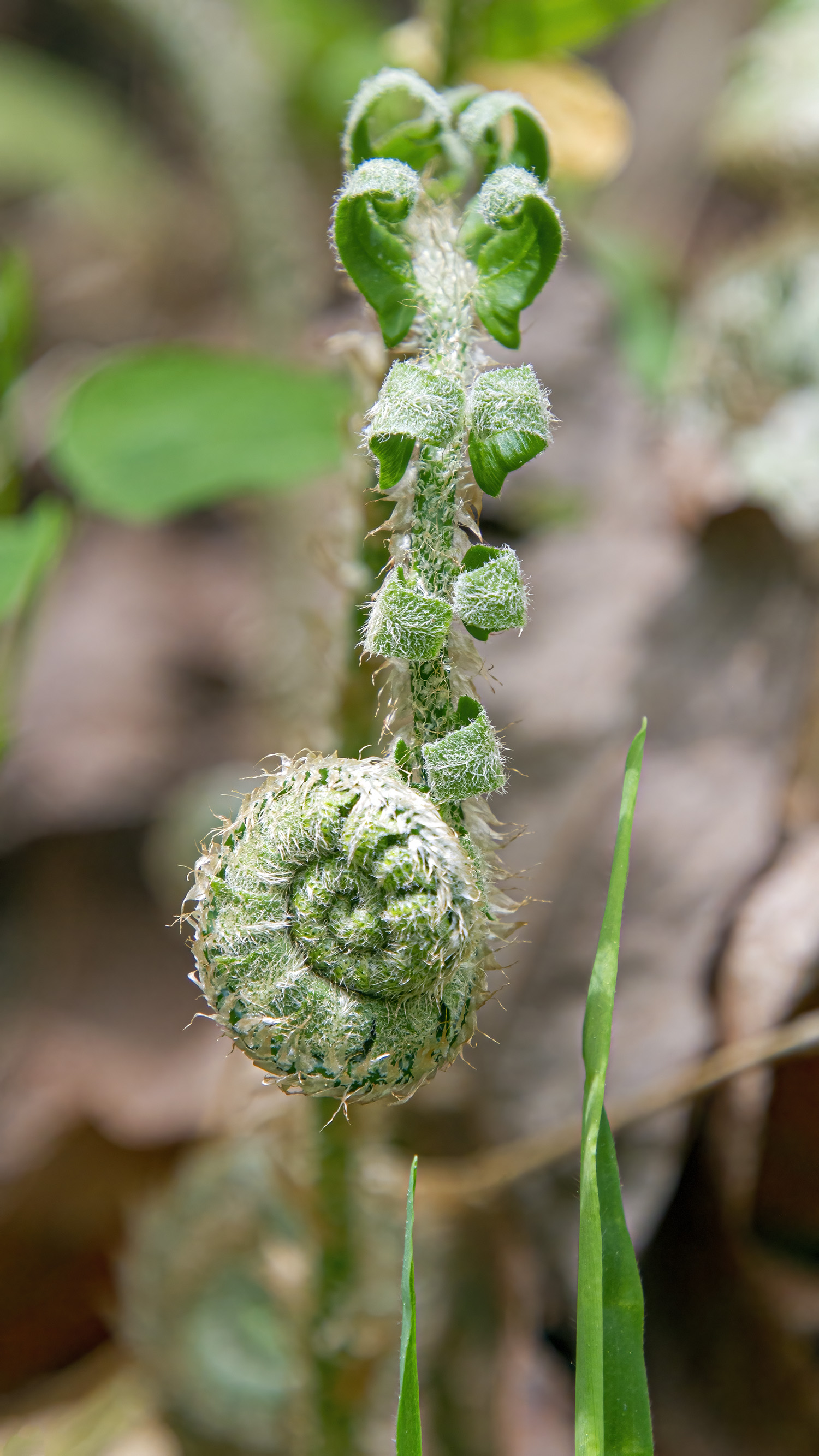
I love the spiral shape of fiddleheads, the furled fronds of fledging ferns, like these ones that I spotted last week at Prince William Forest Park. I have been told that fiddleheads are quite tasty when sautéed with garlic, olive oil, and lemon, but I have not yet tasted a fiddlehead.

fiddlehead

fiddlehead

fiddlehead

© Michael Q. Powell. All rights reserved.

Read Full Post »