Feeds:
Posts
Comments

Archive for the ‘Macro Photography’ Category

The coloration of this female Eastern Pondhawk dragonfly (Erythemis simplicicollis) helped it to blend in almost perfectly with the lush green vegetation this past Friday at Huntley Meadows Park. This species of dragonfly is not only beautiful, but it is also deadly. I was reminded of this latter fact when I realized why the dragonfly had stopped and perched—it was consuming a small moth that it had just caught.

Eastern Pondhawk

© Michael Q. Powell. All rights reserved.

Read Full Post »

Occasionally I complain that some species with names that include “common” are rare, but Common Whitetail dragonflies (Plathemis lydia) are in fact quite common. They are among the first dragonflies to appear in the spring and among the last to disappear in the autumn.

Even though I see them all of the time, I’ll frequently photograph Common Whitetails, with the hope of capturing a new or different view of the dragonfly. Yesterday was sunny and I knew that I would have trouble photographing male Common Whitetails, because their bodies are so white. Usually they end up overexposed with the highlights blown out.

To try to compensate for that problem, I set the metering mode on my camera for spot metering and I was able to capture this shot. The dragonfly is a male, but has not yet acquired the bright white of an adult male, which made things a little easier. I managed to get a proper exposure for the body and the rest of the image is a bit underexposed. The result was a kind of dramatic lighting effect that helps me to highlight the uncommon beauty of this common species.

Common Whitetail

© Michael Q. Powell. All rights reserved.


Read Full Post »

Necrophila americana—what a creepy Latin name for this beetle, known in English as the American Carrion Beetle, that feeds on dead and decaying flesh. Fortunately the backdrop was more pleasant for this specimen that I spotted on Monday in one of the fields at Huntley Meadows Park.

American Carrion Beetle

© Michael Q. Powell. All rights reserved.

Read Full Post »

It’s dragonfly season and this past Friday fellow dragonfly enthusiast and photographer Walter Sanford guided me to a new spot to search for the elusive beauties. Accotink Bay Wildlife Refuge is a nature preserve located on Fort Belvoir, a nearby military base in Fairfax County, Virginia.

We are in a lull period of sorts for dragonflies—some of the early dragonflies are gone and others have not yet appeared. As we were making one final swing through likely locations, having come up almost empty-handed in our search, Walter spotted a dragonfly. The wings were so clear and shiny that it was obviously a teneral dragonfly, one that had only recently emerged.

Identification (and photography) was a bit of a challenge, because the young dragonfly was perched inside of a tangled mass of vegetation, making it almost impossible to get an unobstructed view. Eventually we were able to find a visual tunnel and I was able to get the first shot below. It gives a pretty good view of the dragonfly, which after the fact I could clearly see is a Spangled Skimmer (Libellula cyanea), but I really wasn’t satisfied with it.

Eventually I managed to get a second shot. It doesn’t show the dragonfly’s entire body and many element are out of focus, but it has an artistic sense that I find really appealing. I’m not sure if it’s because of the more vibrant colors or the unusual angle—I just know I like that image a whole lot more than the first one.

Spangled Skimmer

Spangled Skimmer

© Michael Q. Powell. All rights reserved.


Read Full Post »

As I turned to photograph a tiny damselfly perched on an overhanging branch, it flew down to the water. Initially I was disappointed, but then I looked more closely through my camera’s viewfinder. The male Fragile Forktail (Ischnura posita) had landed on a floating leaf and had assumed a pose that made it look like he was riding a surfboard. As a bonus, I was able to capture a fascinating area of bubbles in the algae in the foreground of the image.

Fragile Forktail

© Michael Q. Powell. All rights reserved.

Read Full Post »

While I was hunting for dragonflies the past Friday at Meadowood Recreation Area in Lorton, Virginia, I managed to get this shot of a hoverfly (family Syrphidae) on what I was told was blue-eyed grass (Sisyrinchium) by some folks conducting a wildlife survey.

I had no idea what blue-eyed grass was, so I turned to the internet when I got home. It turns out that blue-eyed grass is not actually a grass, but a perennial plant of the iris family, and sometimes it is not blue. According to Wikipedia, the genus of blue-eyed grasses includes up to 200 species that may have blue, white, yellow, or purple petals.

hoverfly

© Michael Q. Powell. All rights reserved.

Read Full Post »

Most dragonflies like sunshine, so it’s been tough this month to find very many of them, given the almost constant cloud cover and frequent rain showers. Here are a few shots nevertheless of female Common Whitetail dragonflies (Plathemis lydia) from earlier in May. All of them appear to be young ones, in particular the one in the final shot, whose wings have not yet acquired their final coloration, indicating that it has only recently emerged.

Common Whitetail

Common Whitetail

Common Whitetail

© Michael Q. Powell. All rights reserved.

Read Full Post »

At this time of the year I love seeing irises growing in the wild at Huntley Meadows Park. I think these all are Blue Flag Irises (Iris versicolor), though I am not absolutely certain of this identification. These irises are not as big and showy as the ones growing in my neighbors’ gardens, but I find them to be equally beautiful.

Blue Flag Iris

Blue FLag Iris

Blue FLag Iris

© Michael Q. Powell. All rights reserved.

Read Full Post »

As I was wandering through the woods of Huntley Meadows Park last Friday, I came upon a giant Luna Moth (Actias luna) that seemed to be almost as big as my hand. I was trying to get a close-up of its really cool antennae when an ant crawled onto one of the moth’s legs. I thought the ant might become lunch until I learned that Luna Moths don’t eat—they have no mouths and they only live for about a week as adults, with a sole purpose of mating, according to a Fairfax County Public Schools webpage.

Luna Moth

Luna Moth

Luna Moth

© Michael Q. Powell. All rights reserved.

Read Full Post »

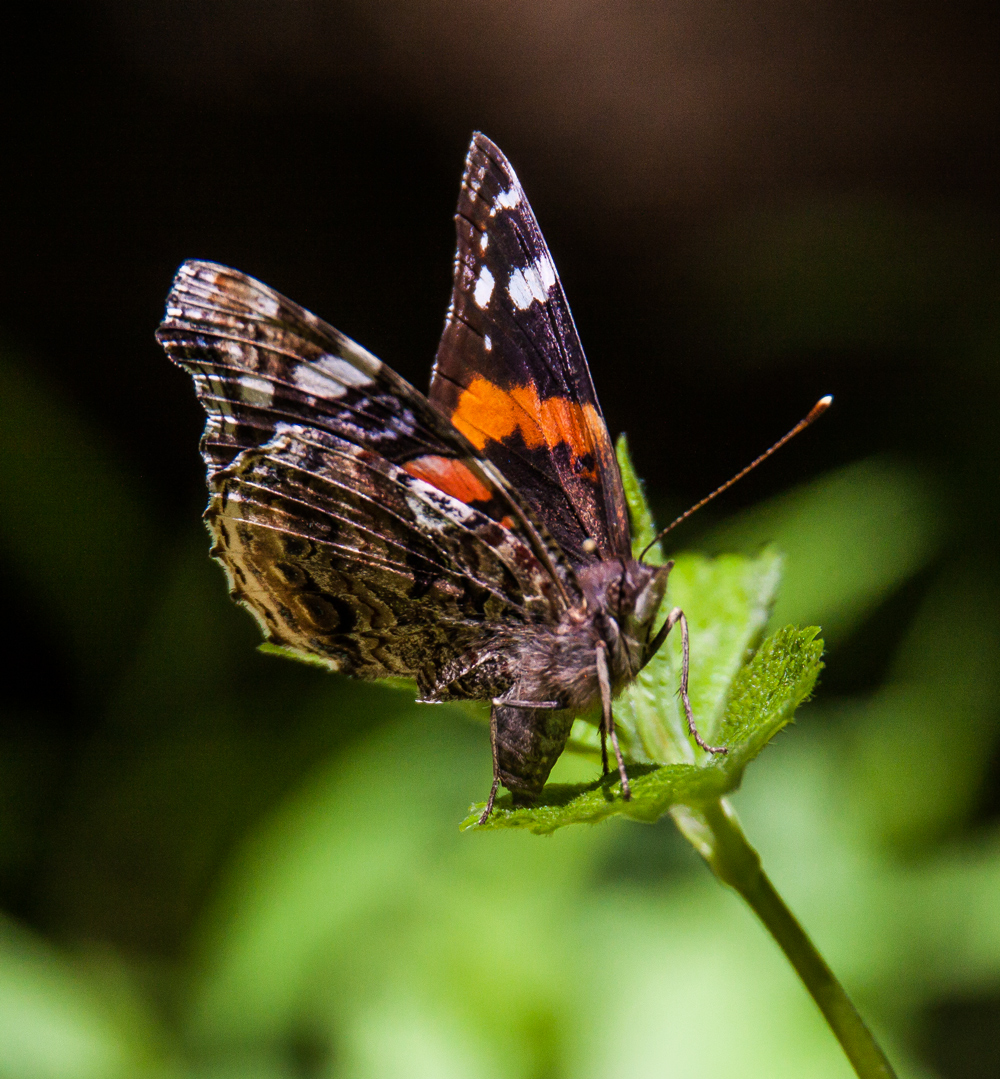
With the return of the sun, butterflies have started to reappear, like this handsome Red Admiral (Vanessa atalanta) that I spotted yesterday afternoon at Huntley Meadows Park.

It’s been gloomy and rainy for most of the past few weeks, so it was a particular joy when the sun was shining brightly yesterday. As I wandered through the woods and fields of my favorite park, butterflies flitted by a number of times, including several Red Admirals. Most of them kept moving and I was unable to capture them with my camera, but one of them perched a few times and gave me a chance to get some shots.

I’ve posted two of my favorite shots. The first is a little unconventional—the butterfly is upside down on a fallen log and I love the way it looks a bit like a heart. The second shot is a little more conventional, but it has a dynamic quality in the half-open wings and overall pose and I love the background blur.

Red Admiral

Red Admiral

© Michael Q. Powell. All rights reserved.

Read Full Post »

I was a bit surprised recently to spot an Eastern Garter Snake (Thamnophis sirtalis) with blue eyes at Huntley Meadows Park. Normally, a garter snake’s eyes are clear and bright and if I can get close enough, I can sometimes see my own reflection.

As I moved closer, I could see that the bluish covering over the eyes was somewhere between translucent and opaque, looking a little like cataracts. The snake was aware of my presence and flicked its tongue when I got too close, but did not try to slither away. A search on the internet revealed that the eyes turn this blue color when the snake is getting ready to shed its skin, a process that generally takes about a week.

When my macro lens is on my camera I feel drawn to move closer and closer to my subject, as you can see in the first image. This shot gives a good view of the blue eye, but doesn’t give you much a sense of the snake’s environment. When I pulled back to include the snake’s entire body, you get a look at the sinuous curves of the body, but the eye is almost lost. The final image here was a mid-range shot that was a kind of compromise—some of the body shows, but the eye has greater prominence than in the second image.

Which image do I like the most? It’s hard for me to decide, but I think it was a good idea to photograph the snake at different distances to give myself some options. I’m going to have to try that approach more often.

garter snake

garter snake

garter snake

© Michael Q. Powell. All rights reserved.

Read Full Post »

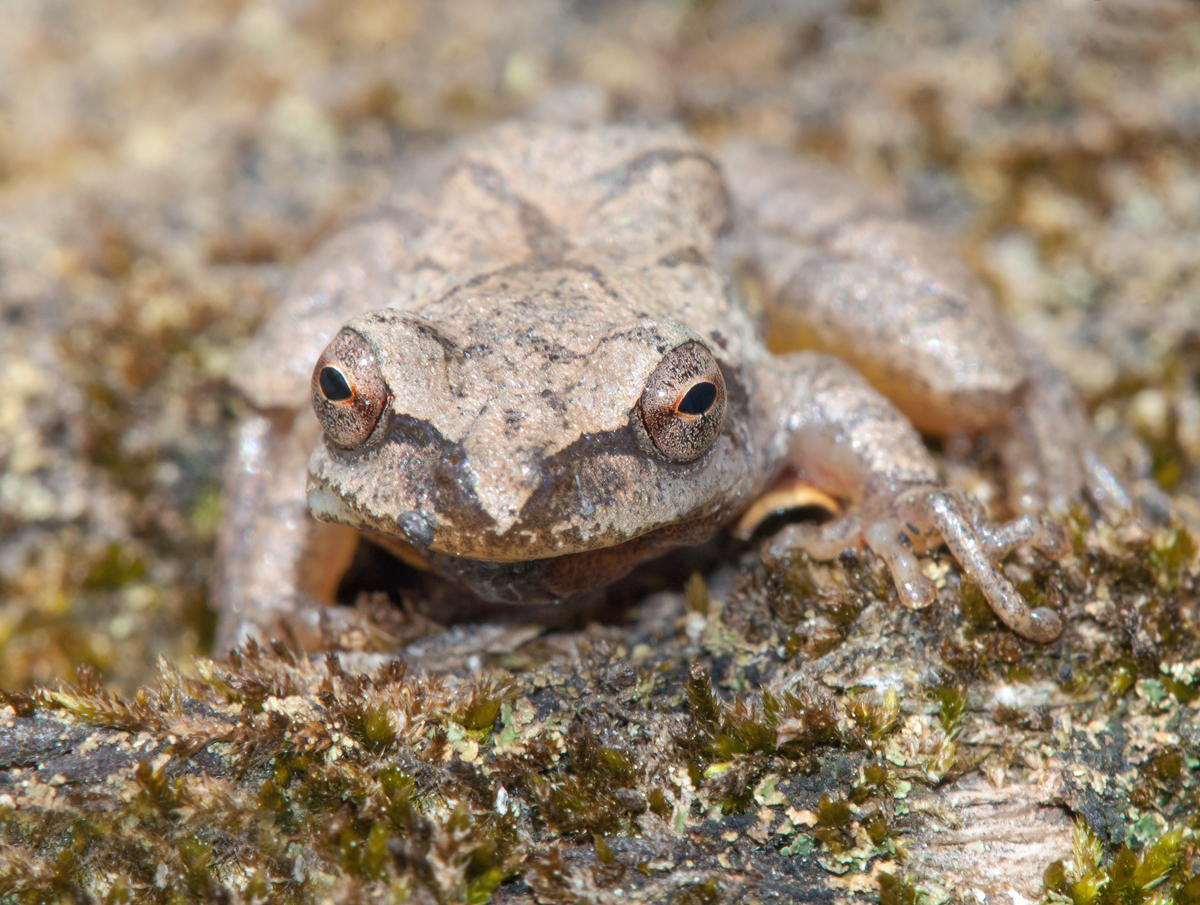
The high-pitched calls of the Spring Peeper frog (Pseudacris crucifer) are one of the harbingers of spring for many of us, but have you ever actually seen one of these diminutive songsters? Even when there was a loud chorus of Spring Peepers, these tiny frogs seemed to be invisible.

Last Friday, while hunting for dragonflies at Huntley Meadows Park with my friend and fellow photographer Walter Sanford, we almost literally stumbled upon a Spring Peeper near the edge of the water. As we were photographing one peeper, another jumped into view. The thing that struck me most about the spring peepers was how small they are, a bit over one inch and certainly less than two inches in length (about 3-5 cm). The other thing that I noticed was how low they were to the ground—it was tough getting a good viewing angle even when my elbows and knees were submerged in the marshy soil.

Here are three of my favorite shots of the Spring Peepers in a couple of different settings. You can’t help but notice how well the frog blends in with its surroundings, which helps explain why I had never been able to spot one previously. My one regret is that we never heard a peep from the frogs. Perhaps next time I will be able to get a shot of a Spring Peeper with its vocal sac inflated.

Spring Peeper

Spring Peeper

Spring Peeper

© Michael Q. Powell. All rights reserved.


Read Full Post »

Unlike many species with “common” in their names, Common Whitetail dragonflies (Plathemis lydia) actually are abundant and frequently seen during their peak season of June through September. In mid-April, however, they are much more rare and I was thrilled to spot this newly-emerged female this past Saturday at Huntley Meadows Park.

Members of this dragonfly species often perch on the ground, making them a bit difficult to photograph when they are in in area of heavy vegetation. This individual made it a easier for me to get some shots by perching almost vertically. My 180mm macro lens let me get some close-up shots without having to move too close.  I really enjoy trying to get somewhat “artsy” macro shots of dragonflies.

Mature female Common Whitetail dragonflies have distinctive dark patches on their wings. This dragonfly’s wings are mostly clear, which is why I judge that she is a teneral, i.e. she only recently underwent the transformation from living in the water as a nymph and emerged as an air-breathing acrobatic dragonfly. For comparison purposes I have included a photo from May 2014 of a fully-developed female Common Whitetail in which you can see the wing patches.

Common Whitetails are one of the first dragonflies to appear in the spring and they are around until late in the fall. I find them to be beautiful, especially this early in the season when they do not have to share the stage with very many other dragonflies.

Common Whitetail dragonfly

Common Whitetail dragonfly

Common Whitetail dragonfly

Common Whitetail dragonfly May 2014

© Michael Q. Powell. All rights reserved.


Read Full Post »

I have captured images of many beautiful dragonflies in the past, but I am not sure that any of them can quite match the spectacular colors and pattern of this female Springtime Darner dragonfly (Basiaeschna janata) that I photographed this past Friday at Huntley Meadows Park in Alexandria, Virginia.

Springtime Darners appear to be be pretty uncommon at our park—they are few in number and are active for only a very limited period of time early in the spring. Last year, fellow photographer Walter Sanford and I spotted the first known Springtime Darner at Huntley Meadows Park, but it was only a brief encounter and we never again spotted one.

Walter and I were determined that we would do better this year. Already this spring, he and I have separately explored likely locations for hours on end without success. On Friday, we decided to work together as a team. Our experience has shown that having an extra set of eyes really helps in spotting and tracking our elusive flying subjects.

After several hours of searching, we finally caught sight of a dragonfly in flight. It flew about a bit and then it finally perched—our moment had arrived for indeed it was a Springtime Darner. Springtime Darners will generally perch vertically on vegetation low to the ground. My view of the dragonfly was obscured, but fortunately Walter could see it and began to compose some shots.

I stood still for what seemed like an eternity, fearful of spooking the dragonfly, but finally was able to move forward to a spot with a somewhat clearer view of the dragonfly. The only problem was that I couldn’t pick out the dragonfly amidst all of the vegetation. I was shooting with my 180mm macro lens, which meant that I couldn’t simply zoom in to get a better view. Walter patiently described for me the specific location and I took some initial shots without actually seeing the dragonfly.

Eventually I was able to see what I thought was the dragonfly and captured a few shots before it flew away, though I never had a really clear view of it. Although we searched and searched, we were not able to relocate the dragonfly, nor did we see another Springtime Darner.

I was not very hopeful when I downloaded my images from my memory card to my computer and was surprised when I saw that somehow I had captured some of the beautiful colors and patterns of the Springtime Darner. Normally I like to try to isolate my subjects from the background and the background in these two images was unavoidably really cluttered, but I’m really happy with them.

I am happy with the images, but not quite satisfied—I’ll be out again soon to search for more Springtime Darners, hopefully including a male, as well as other dragonflies and damselflies. My dragonfly season has only just begun.

Springtime Darner

Springtime Darner

© Michael Q. Powell. All rights reserved.


Read Full Post »

This past Monday as I was exploring Huntley Meadows Park with fellow photographer Walter Sanford, he spotted an Eastern Garter Snake (Thamnophis sirtalis sirtalis). We both like to photograph snakes, so we sprung into action. Following my normal instincts, I moved in close to the snake. How close did I get? At a certain point in time I actually had to back up a little to make sure I included the snake’s entire head in the image.

Some readers of this blog may recall that Walter and I use different camera systems and approach our shots in different ways, partly because he is using a zoom lens and I am often using a macro lens with a fixed focal length. If you shoot side by side with another photographer, you’ll often get the same shots, but that’s usually not the case for Walter and me. We normally choose different angles of view and frame our shots differently—I am usually the one sprawled on the ground.

Walter and I have shot together often enough that he knows the “tricks” that I employ when shooting. From my earliest days, my photography mentor Cindy Dyer emphasized to me the importance of using a tripod. Frequently I carry a tripod with me, but for low-angle shots, I prefer to use my camera bag as a kind of improvised tripod to help steady my camera. In the past month I have used this techniques with varying subjects including a jumping spider and a beaver. Special thanks to Walter for allowing me to use one of the photos he shot of me in action with my improvised tripod.

The snake was amazingly tolerant of our presence. Unbelievably it stayed in place when I moved a stalk of grass next to its head that was getting in the way of a clear shot. The first shot below was shot with my improvised tripod and was not cropped at all. The other two shots, I believe, were handheld and cropped slightly, because the snake had changed positions and I did not have the luxury of stabilizing my camera. In all cases I tried to focus on the snake’s eye and I really like the way that I managed to capture a reflection in the eye.

Walter will soon be posting a companion post that I will reblog, so that you can contrast the images that we captured when shooting the same subject together.

Eastern Garter Snake

alternative tripod

Using my camera bag as an improvised tripod (Photo by Walter Sanford)


Eastern Garter Snake

He’s got lips like Jagger

Eastern Garter Snake

Environmental portrait of a garter snake

© Michael Q. Powell. All rights reserved.


Read Full Post »

Is it a bee? Is it a fly? It’s a Blotch-winged Bee Fly (Bombylius pulchellus). What?

I spotted this bee fly Monday afternoon at Huntley Meadows Park in Alexandria, Virginia and I have to say that it is one of the strangest insects that I have ever seen—it looks like Doctor Frankenstein pieced together an insect from the parts of other insects.

Its fuzzy body looks a bit like that of a bee and it has a similar proboscis, though the bee fly’s proboscis is outrageously long and looks a lot like it could be a stinger. Its long, spindly legs, however, are not bee-like and remind me of certain types of flies. The patterned wings and the way that it hovers are reminiscent of a hummingbird moth, though the bee fly is considerably smaller.

The helpful folks on bugguide.net were able to identify this insect for me and you can see shots by others of this type of bee fly at this link. I can’t find much information about this particular species, but the Bombyliidae apparently is a whole family of flies that feed on nectar and pollen.

Blotch-winged Bee Fly

© Michael Q. Powell. All rights reserved.

Read Full Post »

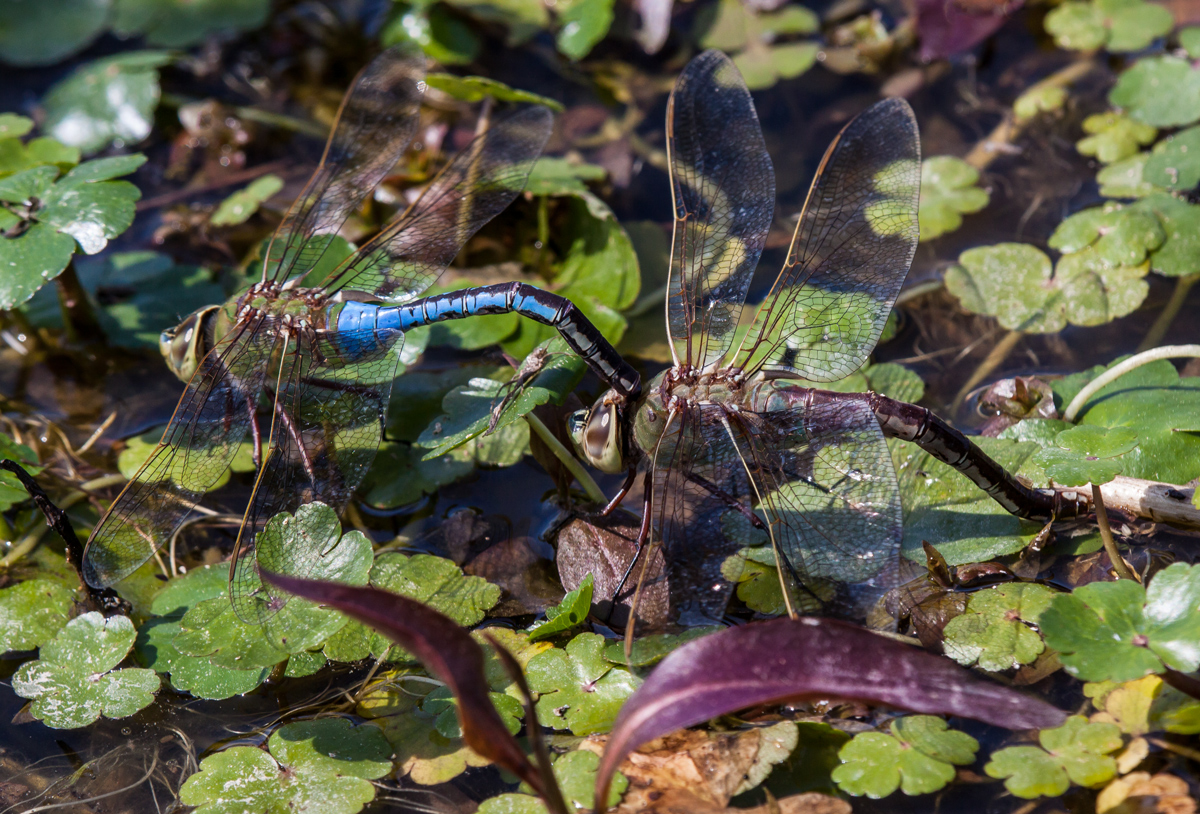
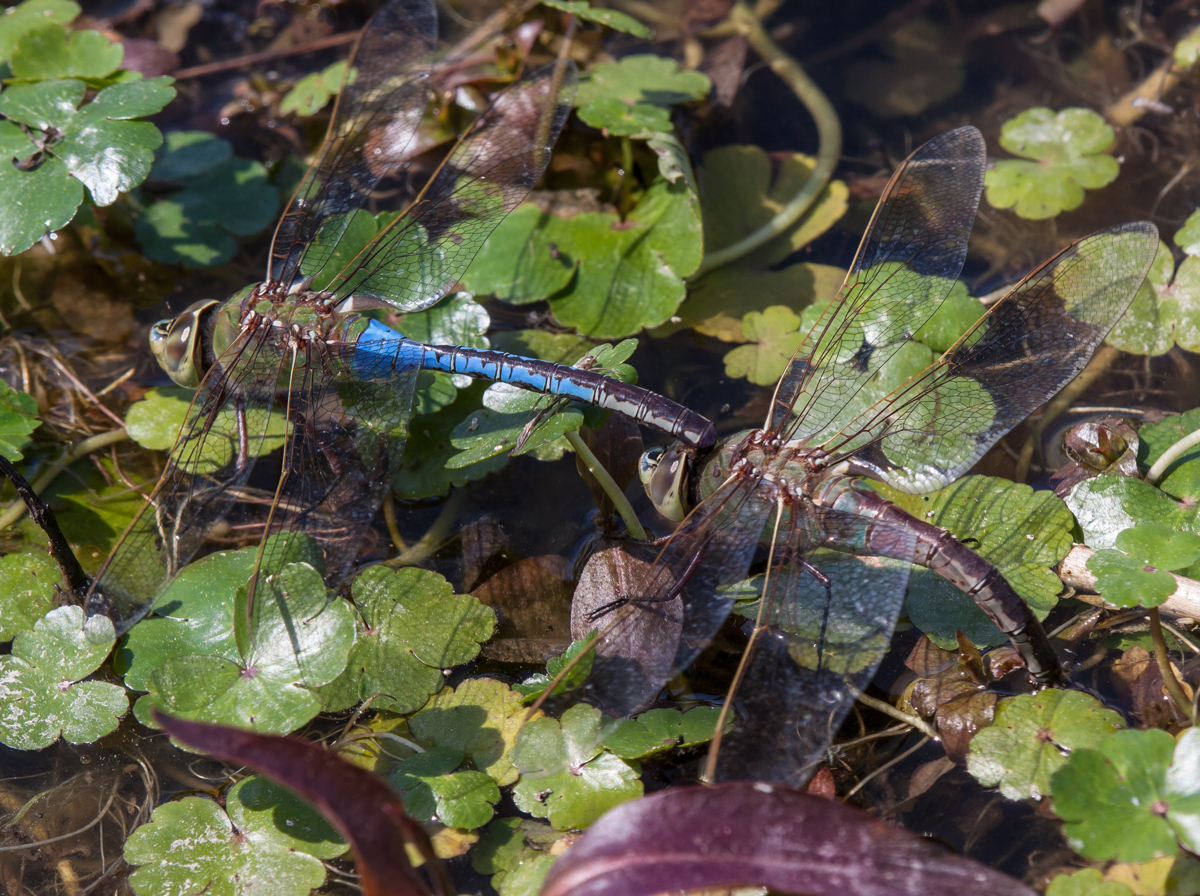
Now that the weather is warming up, I am searching in earnest for dragonflies, one of my favorite subjects to photograph. I am still having difficulties locating native-born species, but fortunately there are some migratory species in the area. Yesterday I spotted this Common Green Darner (Anax junius) dragonfly couple in tandem, with the male holding on as the female deposited her eggs in the floating vegetation.

In some dragonfly species the male will hover above the female as she oviposits, but in others, like the Common Green Darner, the male remains attached. I suspect that this method is one way of ensuring that the eggs that the male has fertilized are deposited before the female hooks up with another male.

Common Green Darner

Common Green Darner

© Michael Q. Powell. All rights reserved.

Read Full Post »

On Monday, I finally captured my first dragonfly shots of the season at Huntley Meadows Park, a recently emerged Common Basketttail dragonfly (Epitheca cynosura). For a couple of weeks I’ve been periodically seeing migrating Common Green Darners, but this is the first “native-born” dragonfly I have spotted.

The dragonfly is in a juvenile stage known as “teneral,” which initially confused me when I was trying to identify it. I looked through a lot of photos on the internet and they didn’t quite match up with some of the markings of “my” dragonfly.

Fortunately an expert came to the rescue when I posted the photos on the Northeast Odonata Facebook page and asked for help. Ed Lam, who literally wrote the book on odonata in the Northeast, replied that, “It’s a Common. It’s teneral so the stigmas and the hind wing patch will darken as it matures.” You can check out Ed’s book, Damselflies of the Northeast: A Guide to the Species of Eastern Canada and the Northeastern United States, on Amazon.

From my perspective, the dragonfly season has now officially opened. It is still really challenging, however, to find them this early, given that most species won’t emerge until much later in the spring and in early summer.

Common Baskettail dragonfly

Common Baskettail dragonfly

Common Baskettail dragonfly

© Michael Q. Powell. All rights reserved.


Read Full Post »

I know that spring has truly arrived when I start to walk around with a macro lens on my camera. I captured this shot of a Bold Jumping Spider (Phidippus audax) on the boardwalk yesterday at Huntley Meadows Park.

As I was walking into the park, a departing fellow photographer alerted me to the presence of the spiders, so I changed lenses in the hope that I would see one. Most of the winter months I have been using my Tamron 150-600mm lens to shoot birds and other wildlife, but I had my Tamron 180mm macro lens with me. It’s amazing how my field of vision changes with the shift in lenses. With the long lens, I am used to looking up and out, in part because it has a minimum focus distance of 8.9 feet (1.7 meters). With the macro lens, I am am scanning a much smaller area, primarily near my feet and just beyond.

Eventually I located a jumping spider. It seemed to be spending most of its time in the cracks between the synthetic boards of the boardwalk, but occasionally would venture out. Despite its name, the Bold Jumping Spider seemed to be pretty timid. In fact, I never did see it jump—it seemed content to crawl slowly.

The coolest thing about jumping spiders, of course, is their eyes. I am absolutely mesmerized by their multiple eyes and I was really happy that I was able to capture some reflections in the eyes. The reflections are most noticeable in the head-on shot, but they are also visible in the action shot. It’s a fun challenge to try to capture action when this close to a subject, but somehow I managed, though the higher shutter speed needed when shooting handheld meant that that my depth of field was pretty limited.

Bold Jumping Spider

Bold Jumping Spider

© Michael Q. Powell. All rights reserved.

Read Full Post »

Do you enter photo contests? I like to say that I shoot for myself, but I suspect that is not the whole truth. I know that I also derive pleasure from sharing my thoughts and my images with others. There is something really gratifying and uplifting about feedback that suggests that I have touched someone else in some small way, that I have caused them to stop for a moment to consider the beauty that surrounds us.

Several months ago I saw a notice that the Friends of Huntley Meadows Park organization was sponsoring a photo competition. Regular readers of this blog know that Huntley Meadows Park, a Fairfax County-run marshland area, has become my favorite place to photograph a wide variety of wildlife subjects and I post my photos regularly to a Facebook page for the park. The only stipulation for this contest was that the photos had to have been taken at the park.

Sure, I have taken a lot of photos in the park, but were they good enough? I had never before entered a photo competition, and I guess I sometimes feel a little insecure about my photography. The competition required me to submit matted prints and I hadn’t for the most part seen my work in printed form.

I decided that if there were ever a competition ideally suited for me, this was the one. My mentor, friend, and fellow photographer Cindy Dyer helped me to prepare my prints. I submitted four prints, the maximum number that I was permitted to enter. (I’ll probably do a post soon with the four entries, so that you can decide which one you like best.)

A reception was held last week to open the photo exhibition and announce the winners. I was in Vienna at the time, so I learned from a friend that I took second place in the competition with a macro shot of a Blue-faced Meadowhawk dragonfly (Sympetrum ambiguum) that I titled “Baby’s Got Blue Eyes.”

One of the coolest parts of the competition is that the judge shared his/her comments about the winning entries, including the following assessment of my image (check out the Facebook page of the Friends of Huntley Meadows Park for more details on the competition):

The contrast of colors is stunning, with the iridescent blues, greens, and reds of the dragonfly beautifully contrasted with the earth-tone browns and grays of the leaves behind. The use of narrow focus of this macro photo is done perfectly, bringing the eye and wing of the dragonfly into sharp focus that stands out from the pleasantly soft focus background. It gives the photo a great three dimensional effect. The composition is also compelling.”

Wow! I was worried when I heard that we probably had only a single judge for the contest, but if that was indeed the case, the judge really “got” what I was trying to achieve with the image. In some ways, I was surprised at the result. Insects have a kind of niche audience—some people just don’t like insects—and macro subjects sometimes have trouble competing head-to-head with stop-action wildlife shots.

My biggest takeaway from this competition, though, has nothing to do with the competition itself. I’ve learned that there is something really special about seeing my photos printed. The images look good on the computer screen, but it is much more exciting to be able to show someone a print, knowing that I have created that image.

As I think about this coming year, I see myself having a whole lot more of my images printed and maybe even having to courage to enter additional contests.

Blue-faced Meadowhawk

Baby’s Got Blue Eyes

At the exhibition. (Photo by Cindy Dyer)

At the exhibition. (Photo by Cindy Dyer)

© Michael Q. Powell. All rights reserved.

Read Full Post »

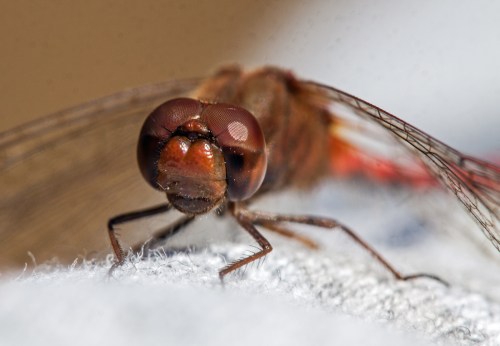
Autumn Meadowhawk dragonflies, the sole survivors at this time of the year, are very friendly and it’s not unusual for them to perch on you. It took some contortions, but I managed to get these shots recently of an Autumn Meadowhawk (Sympetrum vicinum) perched on my arm and my leg.

The first shot, in which the dragonfly was perched on my arm between my elbow and my wrist,  was particularly challenging, because I had to shoot it one-handed. My Canon 50D and Tamron 180mm macro lens together weigh close to 4 pounds (1800 grams), so it was a little tough to hold steady. Additionally, the lens has a minimum focusing distance of 18 inches (470 mm), so I had to slowly stretch out the arm to gain the needed distance for the shot. By comparison, the second shot, in which the dragonfly was on my leg, was easier to shoot and I was able to capture the dragonfly’s entire body.

With a little luck, I’ll continue to see these pretty little dragonflies for a few more weeks, and then I’ll turn my attention to birds (and hopefully the occasional mammal).

Autumn Meadowhawk

Autumn Meadowhawk

© Michael Q. Powell. All rights reserved.

Read Full Post »

I am not particularly fond of mosquitoes and flies landing on me, but I love it when a colorful dragonfly chooses to do so. Autumn Meadowhawks are especially friendly in this regard and my friend Walter Sanford captured some fun images of these little red beauties that had landed on different parts of his body (and even included a few photos I took of him with his little friends). Check out his posting!

waltersanford's avatarwalter sanford's photoblog

The Autumn Meadowhawk dragonflies (Sympetrum vicinum) were especially “friendly” during a recent visit to Huntley Meadows Park, landing on me frequently as Michael Powell and I were searching for Great Spreadwing damselflies (Archilestes grandis).

My Photos

The following individual is a male, perching on the leg of my Columbia convertible pants. Regular readers of my photoblog know I’m especially fond of head-tilts in which the dragonfly seems to display some of its personality. Like this guy, who I imagine is thinking “What are you looking at? That’s right pal, I’m perching on your pants!”

An Autumn Meadowhawk dragonfly (Sympetrum vicinum) spotted at Huntley Meadows Park, Fairfax County, Virginia USA. This individual is a male, perching on my leg (Columbia pants). 11 NOV 2015 | Huntley Meadows Park | Autumn Meadowhawk (male)

The next photo shows two individuals perching on my pants, both females, as indicated by their coloration and terminal appendages.

Two Autumn Meadowhawk dragonflies (Sympetrum vicinum) spotted at Huntley Meadows Park, Fairfax County, Virginia USA. These individuals are females, perching on my leg (Columbia pants). 11 NOV 2015 | Huntley Meadows Park | Autumn Meadowhawk (male)

The last individual is another female. I shot this photo…

View original post 279 more words

Read Full Post »

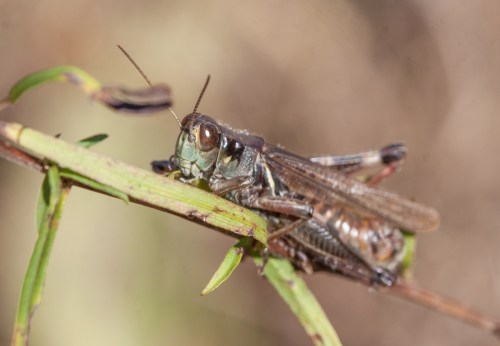
I’ve never really paid that much attention to grasshoppers, but I am starting to discover that there is an amazing variety of them in my local area in a wide range of sizes, shapes, and colors.

It’s hard to know where to start in trying to identify them, so for now I am content with trying to photograph their beauty, which is a pretty big challenge by itself. Not surprisingly, grasshoppers tend to hang out in the grass and heavy vegetation where they are hard to spot and almost impossible to isolate. Sometimes, though, they’ll hop out of the cluttered area to a more exposed perch and that gives me a change to photograph them.

The two photos here give you an idea of the kind of shots towards which I am aiming. In the first image, I was determined to focus on the eye and it ended up as one of the few areas in focus. I like the effect, however, because there is something special about eye-to-eye contact. In the second shot, I positioned myself to get more of the body in focus. As is the case with so many of my macro shots, depth of field was a real challenge.

I suspect that grasshoppers will never quite rise to the level of dragonflies on my personal list of favorite subjects, but they are on my list now and I will probably stop more often in the future to photograph them.

grasshopper

grasshopper

© Michael Q. Powell. All rights reserved.

Read Full Post »

I don’t really expect to see snakes in mid-November. Surely they are all holed-up somewhere, waiting for spring to come.

Last week, however, when I was concluding a successful search for a Great Spreadwing damselfly with fellow odonate enthusiast Walter Sanford, I spotted portions of the body of an Eastern Garter Snake (Thamnophis sirtalis sirtalis) as it slithered in an out of the fallen leaves that covered the path on which we were walking. Then we spotted a second one and a third.

I felt a little like Indiana Jones in the Raiders of the Lost Ark, when he dropped his torch into the well and saw that the floor below was covered with slithering snakes. “Why did it have to be snakes?” For all I knew, we might have been standing in the midst of a massive colony of snakes.

Unlike Indiana Jones, though, I don’t suffer from a fear of snakes, so the first thought that came to my mind was figuring out how to get some shots of the snakes. Walter and I got a good look at the third snake, which froze in place for an extended period of time.

I had my Tamron 180mm macro lens on my camera, so I knew that there was no way that I was going to capture a shot of the entire body of the snake. My initial shots were taken from above, looking down at the snake. I like the way that I was able to capture a glimpse of both eyes and a sense of the environment, filled with fallen foliage.

Eastern Garter Snake

I really wanted to isolate the snake better, so I decided to move to the side a bit and closer to the snake. I tried to focus on breathing slowly in order to steady my camera better as the snake grew larger and larger in my viewfinder. I got a shot that looks like a kind of autumn still life.

Eastern Garter Snake

Most people might have figured that there was no need to get any closer, but I decided I wanted to try to get a side view of the snake. So I moved in even closer, knowing that the closer I got, the harder it was going to be to get a shot in focus as the depth of field grew increasingly more shallow. The photo below is not cropped at all and gives you an idea how low to the ground I was when I took the shot. I know that I am really close when I get a really good reflection in the snake’s eye.

Eastern Garter Snake

I have commented several times before about my bodily contortions when getting shots like this and how happy I am that nobody was around to document them. In this case, though, Walter photographed me as I was getting the last shot.

If you want to see his shot of me (and, more importantly, his take on the snake), be sure to check out Walter’s blog posting. As a bonus, you’ll also learn more about how snakes brumate during the winter—they don’t actually hibernate.

I highly recommend shooting the same subject periodically with another photographer and comparing results. It’s fascinating and instructive to get a sense of how a single situation can be interpreted and how each photographer makes a whole series of creative choices that result in very different images.

© Michael Q. Powell. All rights reserved.

Read Full Post »
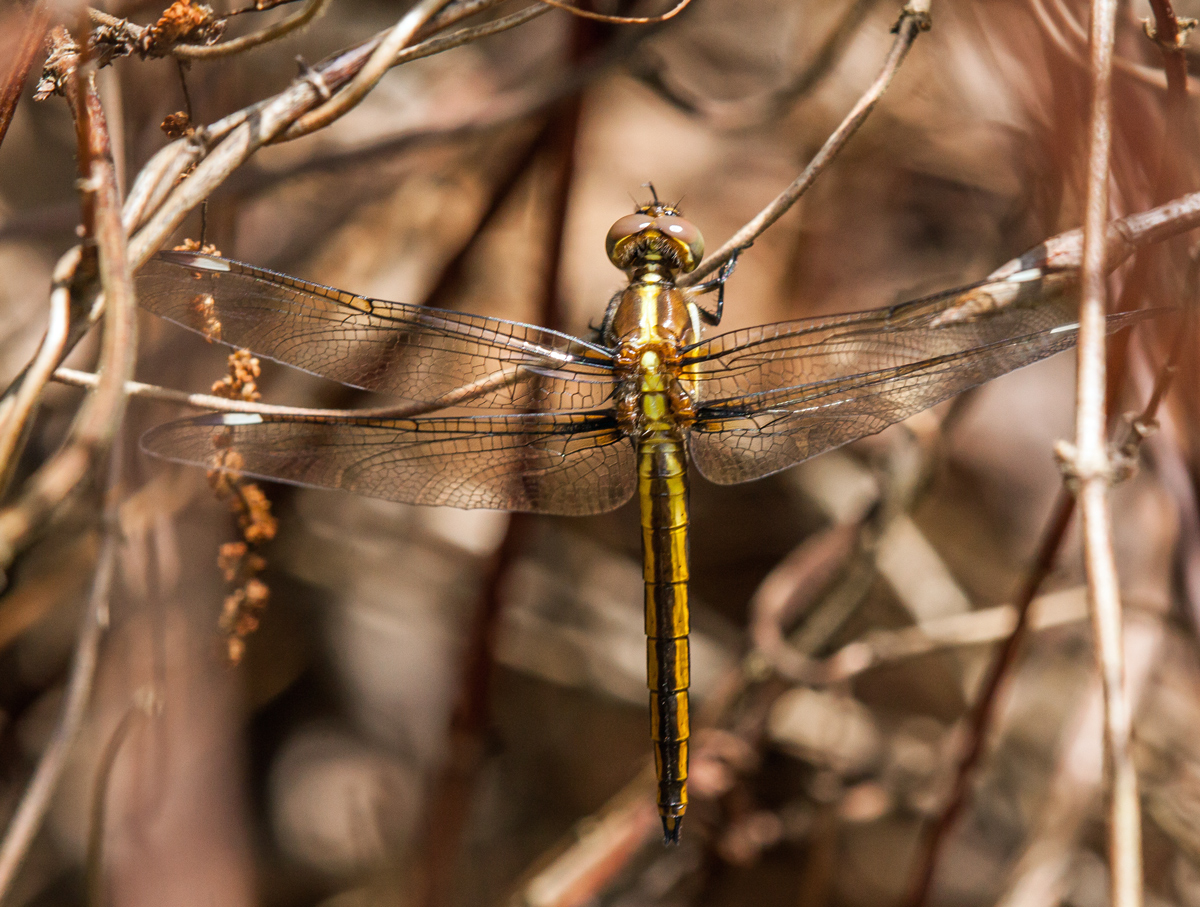
I sometimes make up my own names for species that I have trouble identifying and I call this grasshopper that I observed this weekend the Dual-unicorn Grasshopper, because the shape and pattern of the antennae remind me of many of the depictions I have seen of the mythical unicorn.

What is it really called? Almost exactly a year ago, I posted some photos of a similar-looking grasshopper and considered the possibility that it might be a Slant-faced Grasshopper or a Cone-headed Grasshopper. Are those names any less outrageous than the one that I am suggesting?

I did manage last year to find some photos of grasshoppers that looked pretty much like mine that were identified on BugGuide as a Cattail Toothpick Grasshopper (Leptysma marginicollis).

Cattail Toothpick Grasshopper? I have to say that those three words make for an unusual word combination. I think I’ll continue to call it the Dual-unicorn Grasshopper.

Dual-unicorn Grasshopper

© Michael Q. Powell. All rights reserved.

Read Full Post »

Over the last month I have developed an unhealthy obsession with the Great Spreadwing damselfly (Archilestes grandis)—I think that I have turned into a stalker.

Normally I am a walker, not a stalker. I like to keep in motion, opportunistically scanning for new and different subjects to photograph. Increasingly, however, I have been spending endless hours at the same location, waiting and hoping that I will get yet another glimpse of a Great Spreadwing damselfly.

My friend and fellow fanatic Walter Sanford and I have been closely monitoring this one location, documenting in our photos the continued presence of these beautiful creatures and establishing new records for the latest date that they have been spotted in our area. It’s become harder and harder to find one of them and their population has shrunk to the point that there may be only one damselfly remaining.

That certainly seemed to be the case on 11 November (Veterans Day/Armistice Day), when for the first time this season, Walter and I hunted together for a Great Spreadwing. We have a friendly rivalry and push each other, but on this day it was complete cooperation as we searched for hours, uncertain if there were any survivors. Check out Walter’s blog posting today for an engaging narrative and wonderful photos of our adventures that day, which ultimately turned out to be successful in spotting a Great Spreadwing damselfly.

I too managed to get a few photos, although it was tough to frame a shot, because the  damselfly perched in the almost knee-high vegetation and I couldn’t move much from my crouching position for fear of scaring it away. I was shooting with my 180mm macro lens, so zooming from a greater distance was not an option.

Is this the final fall farewell? Are my days as a stalker coming to an end? When is it time to call it quits on a relationship?

The weather has turned cooler again and conditions continue to grow increasingly inhospitable. These may well be the last shots I get of a Great Spreadwing damselfly this season.

However, I’m heading out to the park in a short while and suspect that I will be drawn back inexorably to the damselfly’s habitat.

It’s so hard to say goodbye.

Great Spreadwing

Great Spreadwing

© Michael Q. Powell. All rights reserved.


Read Full Post »

Do you keep returning to the same places over and over again to take photos of the same subjects? For the last month or so, I have been going back repeatedly to a small pool of water in a secluded part of my favorite park, hoping to get another glimpse of a spectacular Great Spreadwing damselfly (Archilestis grandis).

Their numbers seem to have dwindled and it is possible that there is only a single damselfly of this species remaining. Yesterday, I watched and waited for quite some time before I was finally able to spot a male Great Spreadwing and it took several mini-encounters before I was able to get a decent photograph of the damselfly.

All of the female damselflies of this species seem to have disappeared several weeks ago, so it seems that any hopes he harbors for mating may be in vain. Indeed, the clock is definitely ticking for him—this species has never before been documented in Virginia this late in November.

I am cheering for this survivor and will try to find him again later this weekend. Despite my hopeful attitude, however, I can’t help but remember that yesterday I observed a large Shadow Darner dragonfly (Aeshna umbrosa) patrolling the pool and periodically chasing the damselfly, hoping to turn him into the main course of his lunch.

I’ve included two very different images of yesterday’s damselfly. The first shot is one that I framed very carefully, trying to get as parallel as I could with the damselfly and focusing manually. I like the way that it shows so many of beautiful details of the damselfly’s body. When I took the second shot, I was facing almost directly into the sun and I hurriedly played with camera settings to try to ensure that I did not get a mere silhouette. I really liked the way the sunlight was coming through the outstretched wings and used my camera’s pop-up flash to add a little light to the damselfly’s underside.

Great Spreadwing

Great Spreadwing

© Michael Q. Powell. All rights reserved.

Read Full Post »
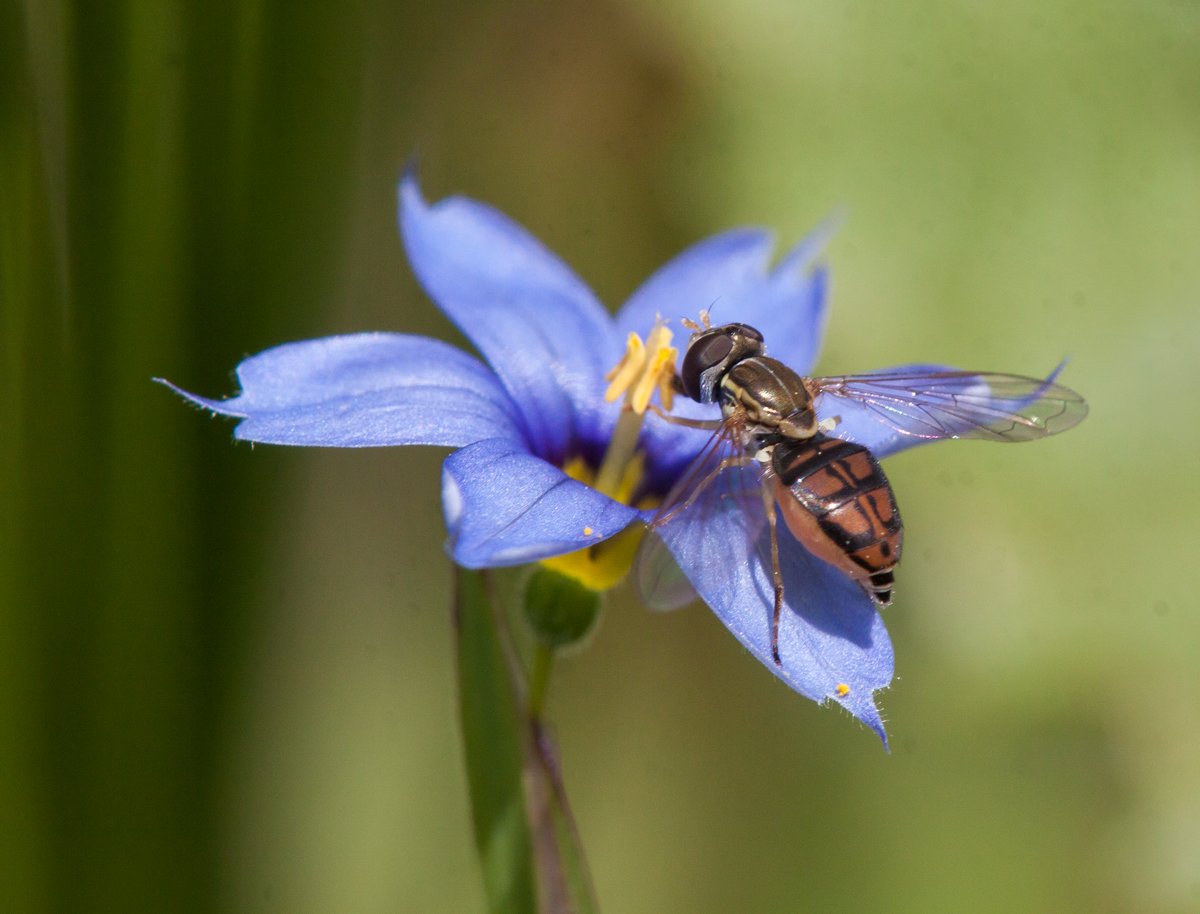
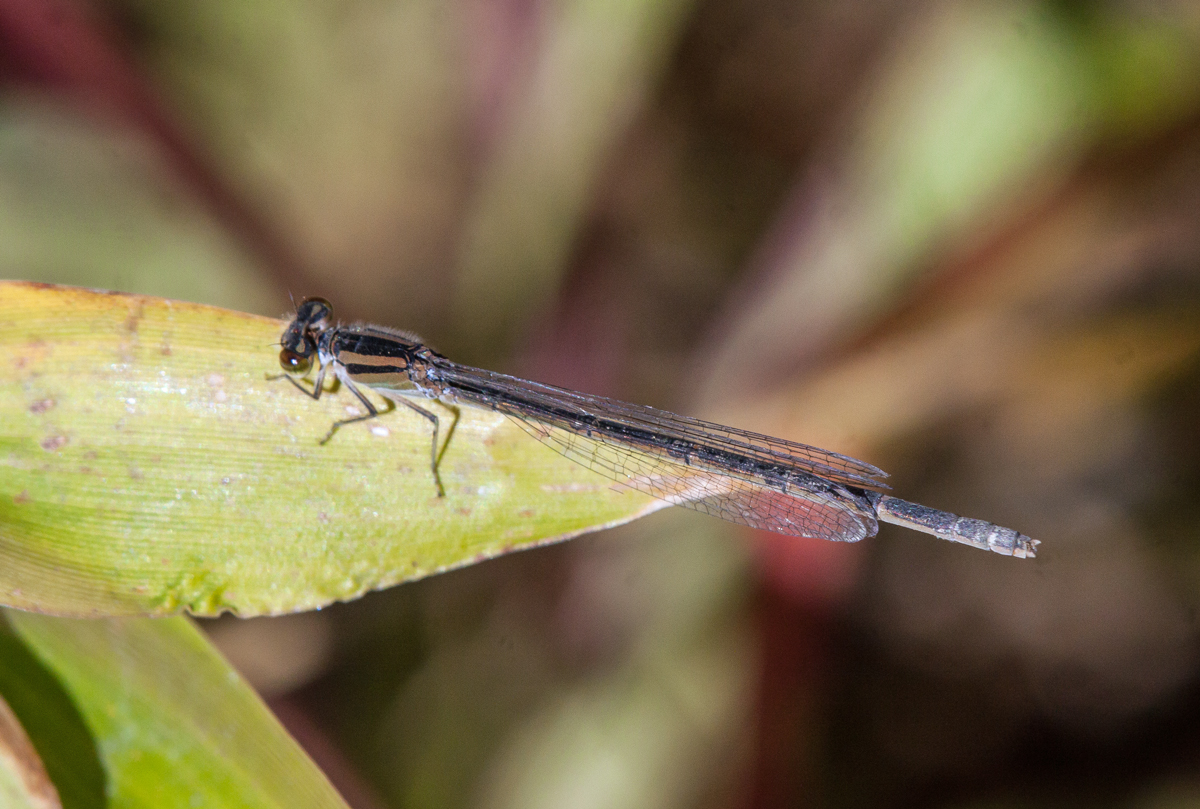
A bittersweet feeling at times envelops me at this time of the year as I photograph some summer species, never knowing for sure if it will be the last time I see them until next year.

This past Friday I spotted a tiny female Familiar Bluet damselfly (Enallagma civile), a species that I haven’t seen in months. I had almost forgotten how small these damselflies are, about 1.1 to 1.5 inches (29-39mm) in total length. Despite their diminutive size, they have wonderful colors and markings and I was thrilled to be able to be able to capture some of that beauty with my macro lens.

Will I see another Familiar Bluet? I will keep looking in familiar places, hoping for yet another rendezvous, for one more chance for a final farewell.

Familiar Bluet

© Michael Q. Powell. All rights reserved.

Read Full Post »

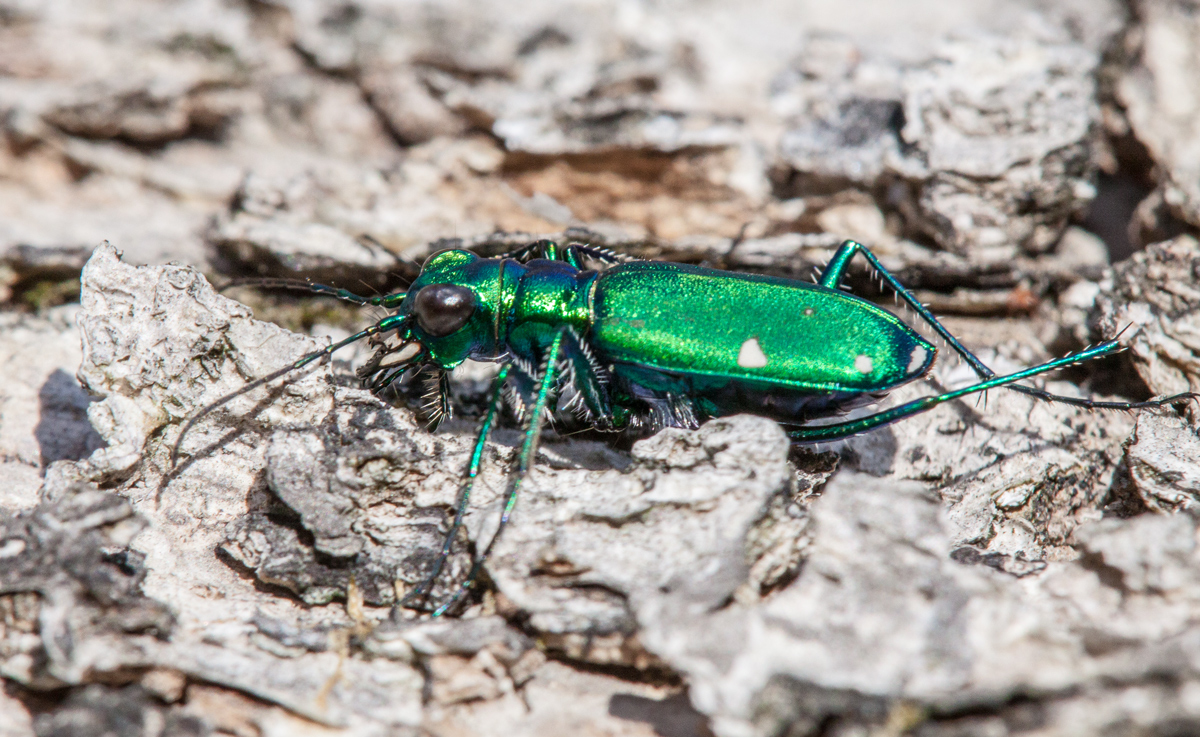
I’m happy to see that some insects are still with us despite the cooling autumn weather. On Friday, I spotted this gorgeous metallic green Six-spotted Tiger Beetle (Cicindela sexguttata) on a fallen log at Huntley Meadows Park in Alexandria, Virginia.

Six-spotted Tiger Beetle

© Michael Q. Powell. All rights reserved.

Read Full Post »

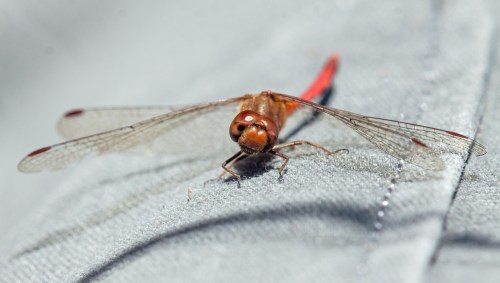
What do you do when a dragonfly lands on you? My first reaction, of course, was to take a photo when this Autumn Meadowhawk (Sympetrum vicinum) landed on my leg on Friday.

The good news was that I had a macro lens on my camera, so I knew that I would be able to focus on the dragonfly. The bad news was that it was a 180mm  macro lens, so I had to go through acrobatic contortions to try to achieve enough distance to fit the entire dragonfly into the frame. I also had to move like a ninja to keep from scaring away my subject.

In the end, I managed to get a decent shot of the dragonfly by standing as tall as I could and shooting straight downward, although my gray sweatshirt billowed out a bit and obscured the view of the dragonfly’s feet. For those of you who are not familiar with Autumn Meadowhawks, they are small dragonflies with bodies about an inch or so in length (25mm).

Autumn Meadowhawk

© Michael Q. Powell. All rights reserved.


Read Full Post »

Some of the damselfly species that I pursue are present in such limited numbers and in so well-defined areas that it is sometimes possible after time to recognize individual damselflies by their distinctive physical characteristics.

Earlier this month I was really excited when I spotted some Great Spreadwing damselflies (Archilestes grandis) after a tip from fellow dragonfly enthusiast Walter Sanford. I visited the location where he had seen them a few times and was able to get some good photos, which I included in several blog postings.

My efforts, though, pale in comparison with Walter’s—he virtually staked out that location and came to know some of  the damselflies there so well that he gave them nicknames. In messages to me, Walter noted he had named two of his favorites “Mr. Magoo” and “Bendy Straw.”  Check out Walter’s blog posting today for some wonderful images of these two damselfly celebrities.

As I reviewed my images of Great Spreadwings, I noticed that one of them had a peculiar bend near the end of his abdomen. Could this possibly be “Bendy Straw?” Walter and I were never at that location at the same time, so it seemed unlikely that I had seen one of “his” damselflies. After I sent him a copy of the image, he confirmed that I had in fact photographed “Bendy Straw.”

Great Spreadwing damselfly

As I continued examining my images, another damselfly stood out, because he had only five legs. It looked like one of his back legs had been completely severed, leaving a small stump. How could something like this have happened? I am used to seeing dragonflies with tattered wings, but an injury like this seems to be of a completely different nature.

Great Spreadwing damselfly

I usually try to identify the species of my subjects, but both of these damselflies help to remind me that I am not photographing species—I am photographing individuals. Each of those individuals has distinctive characteristics and has its own life story.

Somehow that seems to be a useful reminder and gives me a sense of perspective about what I am doing as a nature photographer.

© Michael Q. Powell. All rights reserved.

Read Full Post »

« Newer Posts - Older Posts »