Feeds:
Posts
Comments

Archive for the ‘Flowers’ Category

I came across this tiny damselfly yesterday when I was visiting a local garden in the late afternoon. Initially I spotted her when she was flying and I was thrilled when she chose to land in a spot where I could photograph her. I apologize to the experts for not identifying the type but I find it impossible to identify damselflies (and even dragonflies are not easy).

Damselflies are particularly challenging for me to photograph because they are so long and skinny. If I photograph them from the side, the eye is often out of focus and if I try to shoot head-on, depth of field is an issue.

I ended up with a photo that I shot from above and to the side. Somehow I managed to reduce the composition to the damselfly, the branch to which she is clinging, and a couple of leaves.

I find special beauty in that kind of simplicity in nature and in my photography.

Unidentified damselfly

© Michael Q. Powell. All rights reserved.

Read Full Post »

I have always been fascinated by light and shadows.

Shadows often hide or mask details of a subject, although they also may reveal elements of a subject that might otherwise be concealed. Sometimes shadows are an accurate reflection of the subject (like a silhouette), but other times they distort reality. Shadows intrigue me too because they often pick up characteristics of the surfaces on which they are cast in addition to those of the subject.

My musings on shadows were prompted by this photo of an unidentified wasp (I think it is some kind of wasp) that I shot yesterday morning. The wasp was back lit by the morning sun, causing a hidden part of his body to be revealed in the shadow.

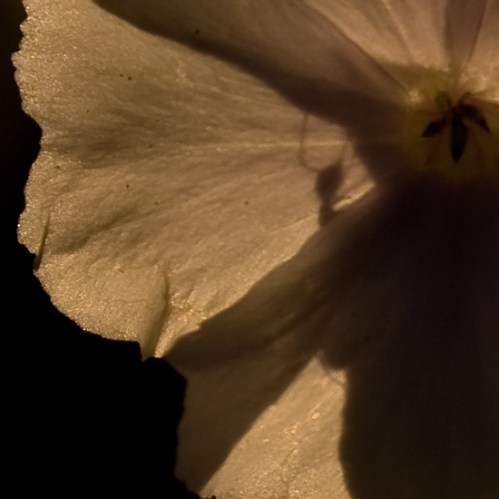
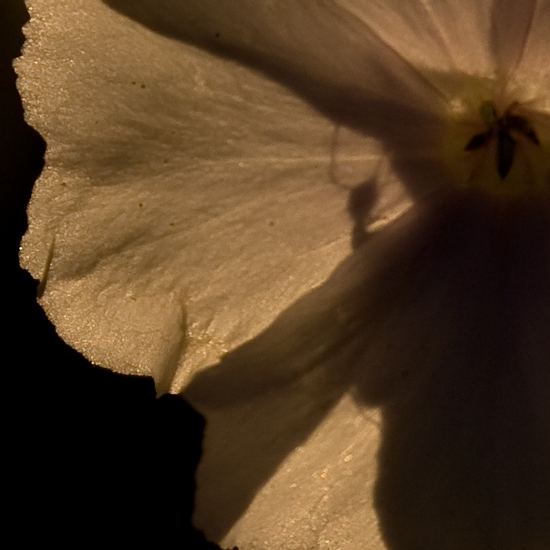
A few months ago I decided to photograph the morning light coming through a small flower in my neighbor’s garden. As I getting ready to shoot, an ant started walking across the back of the flower. It’s not a technically good shot but I like the effect that was produced by the ant’s shadow.
Folks who follow this blog know that I love dragonflies. In early June I took some photos of dragonflies on a sunny day, resulting in lots of shadows. The dragonfly’s shadow makes me think of the position of a person hang gliding and it even looks like the dragonfly is wearing a little helmet.

The undulating surfaces on which the shadow falls really make a difference in the shape of the shadow. I especially like how the shadows of the wings fall on a separate leaf from the shadow of the main body. The shadows of the leaves themselves make this image even more interesting for me.
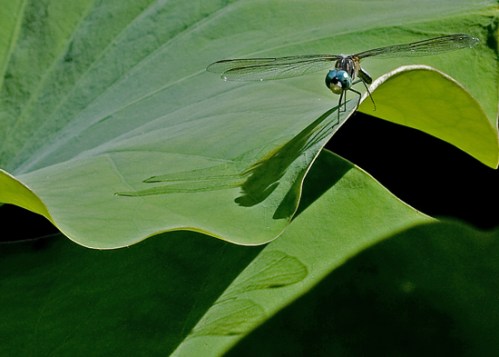
In this final photo a dragonfly literally is casting a long shadow. The distortion caused by the angle of the sunlight causes his legs to appear much longer and I find that this dragonfly looks much more menacing than is typical of a dragonfly.

Can a dragonfly actually look menacing?

© Michael Q. Powell. All rights reserved.

Read Full Post »

Painted Lady butterfly (Vanessa cardui) photographed today at Green Spring Gardens, Alexandria, Virginia.

© Michael Q. Powell. All rights reserved.

Read Full Post »

Female Eastern Tiger Swallowtail butterfly (Papilio glaucus) photographed today at Green Spring Gardens, Alexandria, Virginia.

© Michael Q. Powell. All rights reserved.

Read Full Post »

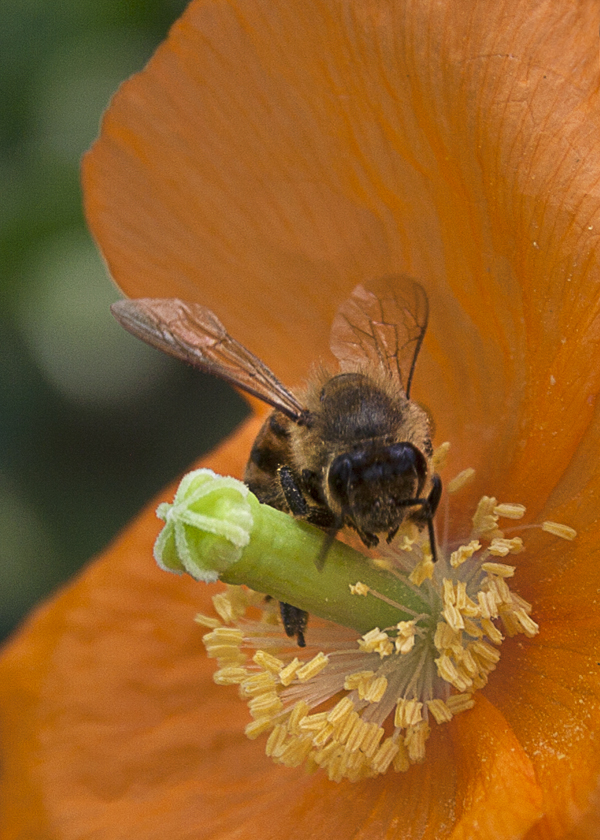
Do you ever get in the mood for a single color? This evening I am in an orange mood. (As a disclaimer I should mention that I drive an orange car, so orange plays a larger role in my daily life than it probably does for most others.) To scratch that itch, I decided to post some photos from late May of an orange poppy and some of the insects that visited it.

May was the month when I first started getting more serious about photography and these photos were an early indication to me that I was improving. I still enjoy looking at them, remembering some of the early twists and turns of the photography journey on which I have embarked.

As I think back, I feel like I was just learning to walk. Now I can walk with much greater confidence. I look forward to being able to run.

Visiting bee

Visiting hoverfly (flower fly)

Visiting ant

© Michael Q. Powell. All rights reserved.

Read Full Post »

This evening after work I returned to the site of yesterday’s adventures with the creature that I think is a bagworm caterpillar. Despite some heavy rain last night his sticks-and-silk abode was intact. I stood and waited, wondering if he would reappear.

After just a few minutes of waiting I watched as the bag started to shake and the caterpillar began to emerge from the bag. Unlike last night when he seemed a little coy, tonight he seemed to have shed all inhibitions (or was really hungry).

He rather quickly extended himself more than halfway out of the bag and began to chew on the lavender blossoms. That answered one of my questions from my last posting about whether lavender was a suitable host plant for a bag worm.

I managed to shoot him from a number of different angles to show some details of the caterpillar and the opening in the bag. I think that a couple of my shots captured the texture of the bag. My shooting time was really limited because after his brief snack the caterpillar returned to the comfortable confines of his sleeping bag.

I am sure that I will move on to other subjects eventually, but for the moment I remain utterly fascinated with my creature on the lavender plant. We are developing a relationship but I have not given him a pet name, at least not yet.

© Michael Q. Powell. All rights reserved.

Read Full Post »
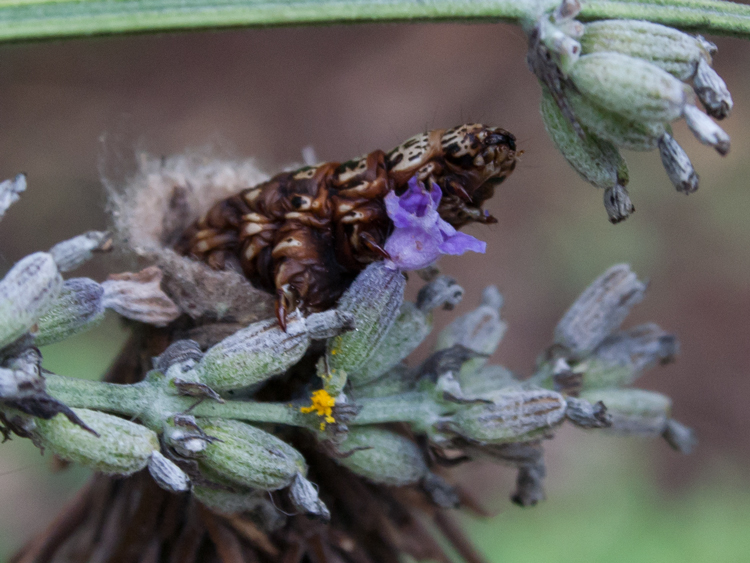
This evening I spotted something unusual hanging from a lavender plant in my neighbor’s garden. I like to visit her garden when I come home from work in the evening because there are always flowers and insects to photograph, many of which she photographs and features in her blog.

The strange object looked a little like a misshapen pine cone and seemed to be covered in pine needles and little twigs. It was hanging from the lavender plant, swinging in the gentle breeze.

Suddenly in front of my eyes the “pine cone” thing began to shake a little, an opening appeared in the top, and a caterpillar (I think that’s what it is) began to emerge. Fortunately I had my camera in my hand because I had been taking some shots of bees.

The caterpillar emerged only partially and then returned to the homemade structure. The opening closed shut, leaving no evidence that there was a living creature inside.

My preliminary research suggests this is a kind of bagworm, although it seems a little unusual for it to make its home on a lavender plant. Wikipedia indicates that there are many species of bagworms, including one whose pupae are collected as a protein-rich food.

I don’t know if you noticed the claws on this caterpillar in the close-up photograph, but I may now have nightmares about giant clawed caterpillars (to go along with the soul-sucking robber flies of a few days ago).

Close-up of bagworm caterpillar emerging

Stepping back to see the whole “bag”

Caterpillar has gone back inside

© Michael Q. Powell. All rights reserved.

Read Full Post »

Let me begin with a disclaimer—no actual stabbing of bugs took place in the making of this posting. Believe it or not, this bug really is called the Twice-stabbed Stink Bug (Cosmopepla lintneriana). Why? The namer of bugs (whoever that is) decided the two red spots on the bug’s back look like stab wounds.

Yesterday I spotted this little bug while photographing with my friend and photo mentor Cindy Dyer. Cindy has a wonderful posting with a sharper photo of this specific bug and some fun information about him, including the fact that he is also known as the Wee Harlequin Bug. For additional information on the bug, check out his page at Bugguide.

I like the overall effect of this photo, acknowledging that it is far from perfect technically. I’m looking forward to improving my skills as I practice and learn new techniques.

© Michael Q. Powell. All rights reserved.

Read Full Post »

It’s pretty cool to photograph big, gaudy butterflies but today I photographed the smallest butterfly I’ve ever seen. I was shooting photos with my mentor Cindy D. and her husband when Cindy spotted this little guy. He seemed too small to make a good photo and they needed to leave.

Undeterred I lay on my stomach and got as close as my lens would permit me (I did not have time to switch to my macro lens and had to make do with the 18-55mm kit lens that happened to be on the camera). To give you an idea of his size, note that he is perched on a single clover flower.

I’m pretty happy with the result and hope eventually to figure out what kind of butterfly he is. For now, though, I am content to have gotten this shot.

Image

Tiny butterfly on a clover flower

© Michael Q. Powell. All rights reserved.

Read Full Post »

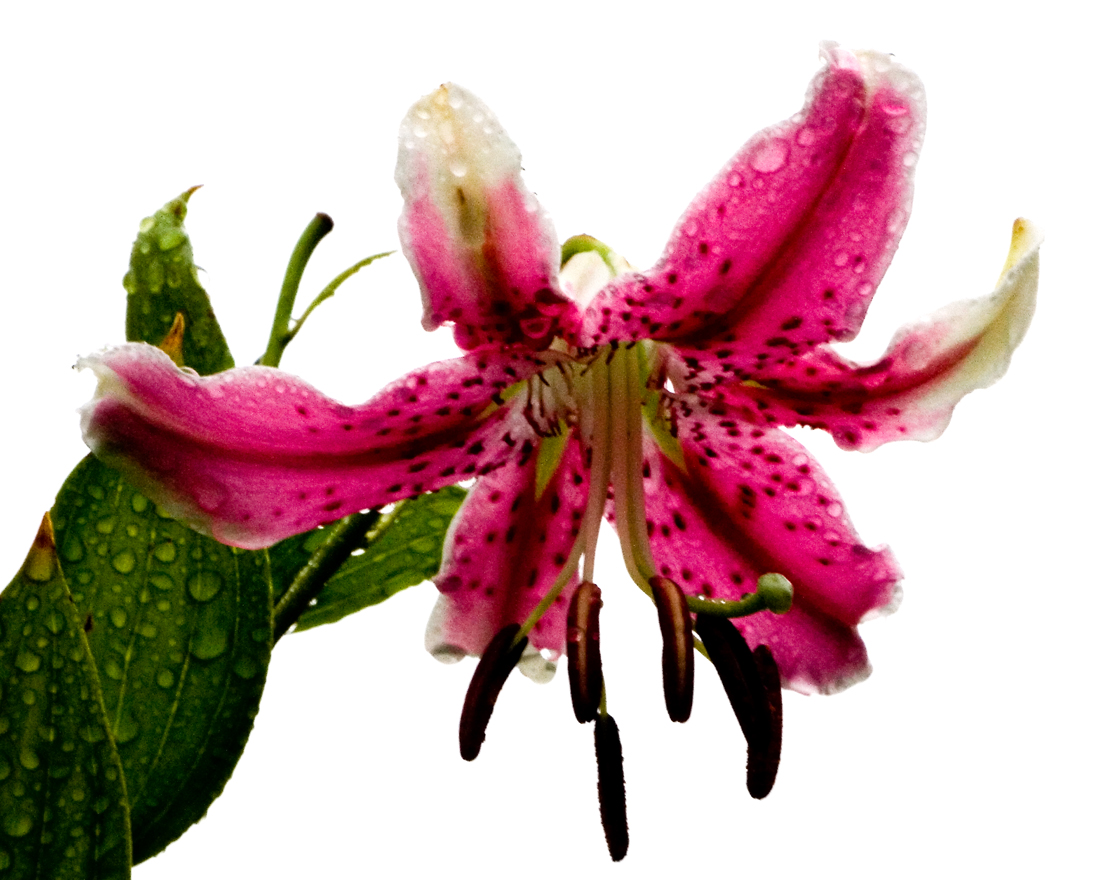
It rained for most of today and was overcast the entire day. Late in the afternoon I decided to go out to a local garden to see what I could shoot. The light was less than optimal but I managed to photograph some flowers.

My favorite ones are of the red speckled lily (I don’t know its real name). I got really low and shot it against the backdrop of sky (which was white). The other flowers included two hibiscuses, another kind of lily, and two unidentified little purple flowers. I love the effect of raindrops on flowers and most of the shots I took include them.

© Michael Q. Powell. All rights reserved.

Read Full Post »

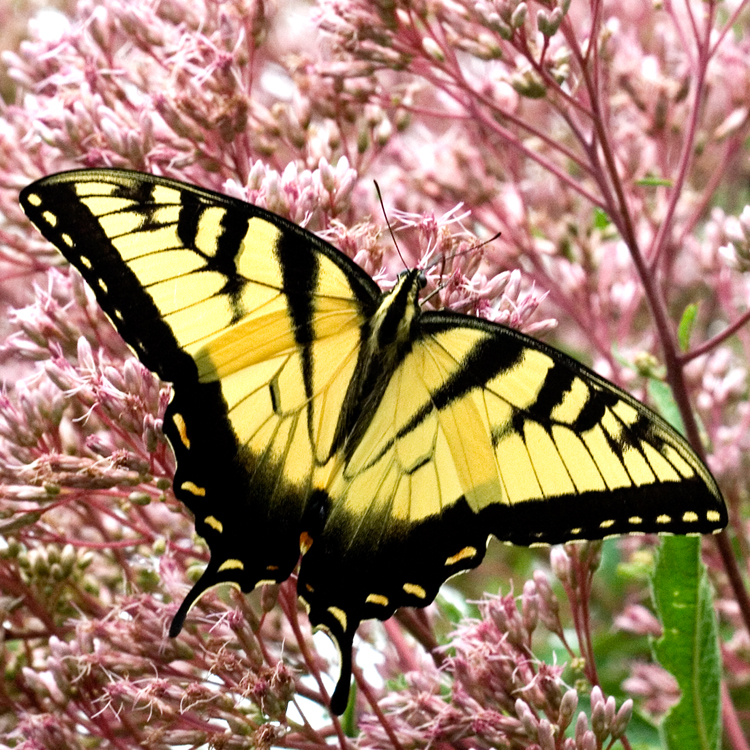
I haven’t seen too many butterflies yet this season so I was happy yesterday to encounter several Eastern Tiger Swallowtail (Papilio glaucus) butterflies at a local garden. The few that I have seen during the past few weeks have been pretty damaged but the male I photographed was in great condition. The female had some damage to one of her “tails” but otherwise was almost perfect.

Eastern Tiger Swallowtail male in perfect condition

Eastern Tiger Swallowtail female with damaged tail

© Michael Q. Powell. All rights reserved.

Read Full Post »

What do bees do when it’s raining? I never really gave the question much thought until this morning when I saw a really cool photo by the unUrban Studio showing a bee seeking shelter in an orchid in an early morning rain. In an earlier post today I showed a bee clinging to the underside of a leaf for protection from the rain.

During a walk in the light rain this afternoon I was pleased to also discover the bee shown below, sheltered inside of a red hibiscus flower. He appeared to be completely protected and may have been napping. As you can probably tell, I had to lighten the image a little to reveal the bee more clearly. This caused the sky, which was light already, to go totally white and produced an effect that I really like.

I enjoy walking in the rain and sometimes carry my camera under an umbrella if it is not raining too hard. From now on I’ll make a point of peeking into flowers and under leaves to discover more secret hiding places of the bees.

© Michael Q. Powell. All rights reserved.

Read Full Post »
What do bees do when it’s raining? I never really gave the question much thought until this morning when I saw a really cool photo by the unUrban Studio showing a bee seeking shelter in an orchid in an early morning rain.

When I took a walk in the light rain earlier this afternoon I decided to look carefully to see if I too could find bees hiding from the rain. Much to my surprise I found the bee shown below, clinging to the underside of a leaf. Apparently it protects him pretty well, though you can see a couple of drops of water on his lower body. The moisture also seems to have caused his hair to frizz a little.

I remember when I too had hair that frizzed when it was humid but those days, alas, are long gone (as is my hair).

© Michael Q. Powell. All rights reserved.

Read Full Post »

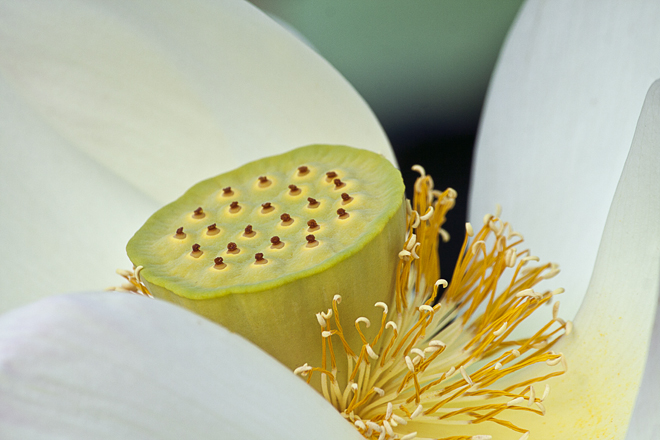
The petals of the lotus flower are delicately beautiful and I love to drink in their beauty. What I enjoy the most, though, is peeking past the petals of the open lotus flower into its very center, the home of its seed pod.

The solid, cylindrical shape and the contrasting color of the seed pod—sometimes green and sometimes yellow— provide for me a nice contrast to the texture and coloration of the petals. These is something intriguing to me about the protruding pod parts that gradually dry out and sink into the pod itself. (I’ll probably do another posting that focuses exclusively on the pods themselves, as they appear after the petals have fallen.)

I took these photos a little over a week ago at Kenilworth Aquatic Gardens in Washington DC, a wonderful setting run by the National Park Service.

That same day I ran into my friend Cindy D. and her husband Michael at Kenilworth and they too were shooting photos.  Cindy later posted a gorgeous lotus photo on her blog and she also included amazing information about the lotuses at this garden, some of which are descended from ancient plants whose seeds were recovered in 1951 from a dry Manchurian lake bed. Check out her blog for the rest of the story.

© Michael Q. Powell. All rights reserved.

Read Full Post »

Yesterday I took this shot of a bee on a purple cone flower.

The subject matter is pretty ordinary; everyone with a camera has probably taken a similar shot. Somehow, though, the different elements of the photo—the colors, the shapes, the background, and even the bee—worked together to create an image that I really like.

What it beauty? In this case, I find beauty in the simplicity of a photo like this one. The photo is not perfect. That does not bother me, however, for my experience has shown me beauty too is rarely flawless.

© Michael Q. Powell. All rights reserved.

Read Full Post »

One evening this past week I was photographing lotus flowers at a local pond in a quasi-meditative state, enjoying the calm after a thunderstorm had passed.

The life cycle of the lotus, from bud to flower to seed pod

Suddenly a woman screamed out in my direction, “Snake, there’s a snake right behind you.” My first reaction was one of disbelief, because I was standing on a flat rock partially surrounded by water that was flowing rapidly between two man-made ponds. All at once I saw the submerged snake swimming strongly against the current. Then to my surprise the snake lifted his head out of the water.

My next reaction was to spring into action to take his picture. My camera was already on my tripod and I swung it around and snapped a couple of shots without having time to adjust my exposure or shutter speed. The image below is far from perfect but it gives you an idea of the cascading water and the snake poking his head above the surface.

Swimming snake lifts its head above water

After that brief photographic opportunity I returned to my peaceful pursuit of the lotus flower.

Sidewards-facing lotus (a variation of the lotus position)

It was only much later that I wondered whether I had encountered a poisonous snake. An article entitled “Snake Mistake” by Christine Ennulat in Virginia Living helps readers distinguish between the harmless brown water snake (Nerodia taxispilata) and the venomous water moccasin (Agkistrodon piscivorus). I am pretty confident the snake I saw was “only” a brown water snake.

Maybe I will react more quickly the next time someone tells me there is a snake right behind me. I might even get a better photograph!

© Michael Q. Powell. All rights reserved.

Read Full Post »

The world seems changed after the rain. The falling rain stripped some of the delicate petals from this lotus flower but left behind a glistening trail of water.

From the perspective of beauty it seems like an equitable trade—the transformed flower still takes my breath away.

© Michael Q. Powell. All rights reserved.

Read Full Post »

I simply love the beauty of the lotus flower.  I feel a sense of tranquility when I look at this image showing the lotus flower in dramatic lighting with a fully exposed seed pod.

I shot this image last weekend at Kenilworth Aquatic Gardens in Washington DC, a wonderful location of the National Park Service.

© Michael Q. Powell. All rights reserved.

Read Full Post »
« Newer Posts