Feeds:
Posts
Comments

Archive for the ‘Flowers’ Category

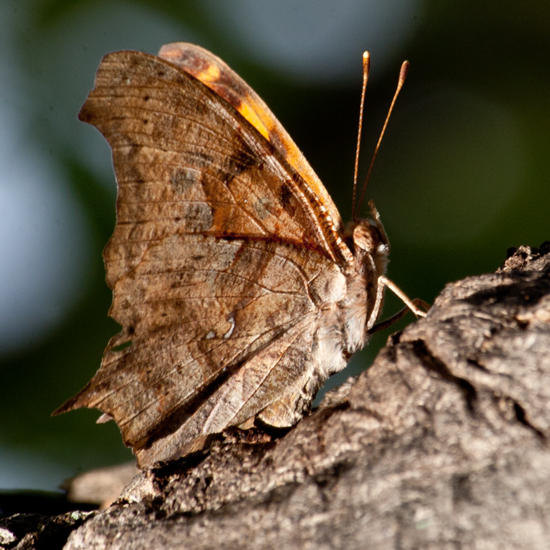
Back and forth I went as I tried to answer a simple question, “Comma or question mark?” You’re probably imagining that I was caught in some kind of punctuation dilemma, but that was not the case. No, I was not stuck in some special hell reserved for grammarians and editors, nor was I sweating out a standardized English test. Instead, I was trying to make a decision on the identity of this unusual looking butterfly that I encountered this past weekend.

Comma or Question Mark?

The colors of this butterfly almost perfectly matched the tree on which he was perched, facing downward in a way that almost perfectly camouflaged him. I rotated the image for the ease of viewers, hoping they will avoid the sore neck that I got as I turned my head trying to make out the details of the butterfly. In addition to the unusual color, the shape of this butterfly was pretty distinctive. What kind was he? As I was pondering that question, the butterfly—who had flown away and returned—opened his wings a little and I got a glimpse of the brilliant orange concealed inside his drab exterior.
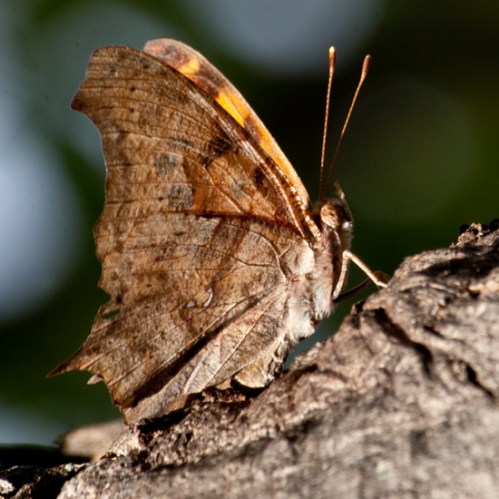
A glimpse of orange

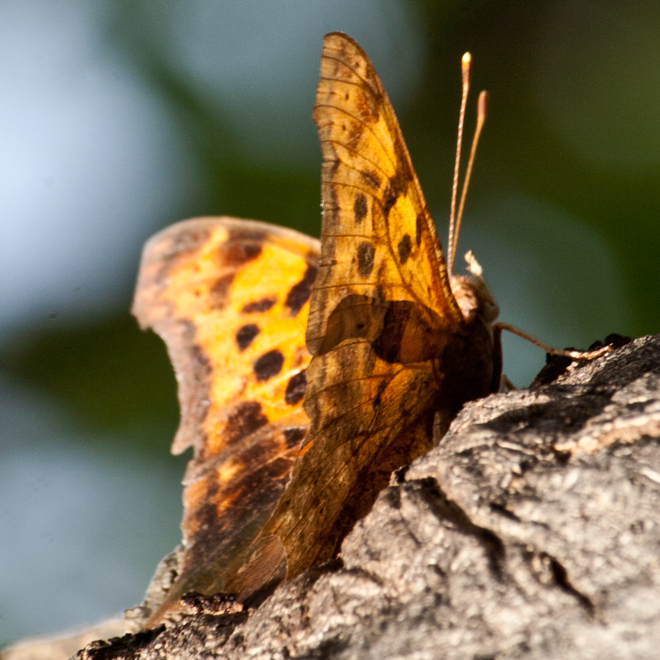
As he slowly opened his wings, more of more of the inside of his wings was revealed. The light shining through his wings made the colors glow like those of a back-lit stained glass window.
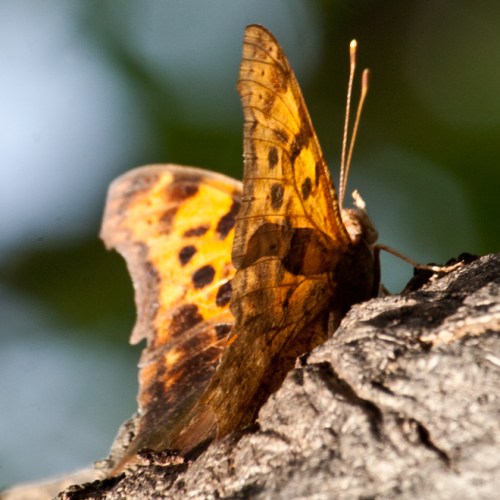
Back-lit wings

The butterfly flew away again, but amazingly returned once more and treated me to a full view of his open wings—his breathtaking beauty was revealed in full.

Beauty revealed

He sure was beautiful, but I wanted to know his name. Previously I had read about a butterfly called the Eastern Comma butterfly (Polygonia comma) and I had a vague recollection that he looked like this one. Wikipedia’s article on the Eastern Comma also helped explain why he was on a tree rather than some beautiful flower, like most of the butterflies that I have encountered. “This butterfly seldom visits flowers, but rather feeds on sap, rotting fruit, salts and minerals from puddling, and dung.”

I was still not sure of his identity, so I continued to search for clues. It turns out that there are two butterflies with similar shapes and colors. One is the Eastern Comma and the other is the Question Mark (Polygonia interrogationis), really. I feel like I am in some kind of Abbott and Costello style routine akin to their famous “Who’s on first?” routine. (Here’s a You Tube link to the classic routine if you are not familiar with it. It is definitely worth watching.)

The key to distinguishing the two is the shape of the little white markings on the wings and whether the markings are in two parts or one. If you think back to punctuation, you can probably guess that the one in two parts is the question mark and the unitary one is the comma. The website Gardens With Wings has an article with side by side photos of the two butterflies in case I have confused you.

So, which one did I photograph? I think I saw at least two different butterflies, but the one in the initial two photos and the one below all seem to have the white marking in two parts, which make them Question Mark butterflies (Polygonia interrogationis).

Question Mark butterfly

To be honest, though, the marking looks more like a semicolon than a question mark. Why isn’t there a Semicolon Butterfly?

© Michael Q. Powell. All rights reserved.

Read Full Post »

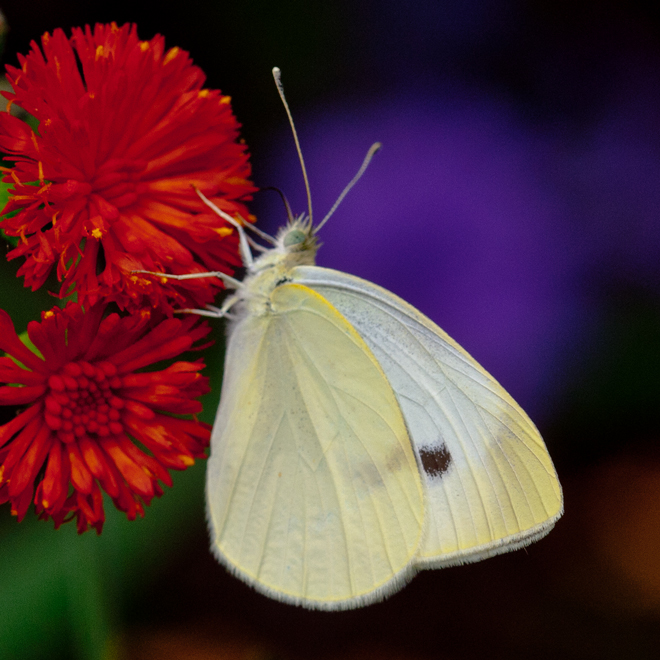
Cabbage White butterfly (Pieris rapae) on unidentified flower today at Green Spring Gardens, Alexandria, VA. Cabbage White butterflies are very common, but I find them to possess a delicate beauty in their elegant simplicity.

Cabbage White butterfly on a red flower

© Michael Q. Powell. All rights reserved.

Read Full Post »

The cone flowers have lost their petals and have dried up in the summer heat, but the loss to my eyes seems to be a definite gain for the birds. The seeds in the cone flowers appeared to be the favorite food of an American Goldfinch (Carduelis tristis) that I spotted today at Green Spring Gardens.

Normally I see the goldfinches only as a flash of bright yellow zooming past my eyes. In the past when I tried to photograph them they seemed to startle very easily at the slightest movement. Today I was able to creep up closer and got some relatively unobstructed shots of a goldfinch.

I may post some more photos later, but here is one of my initial favorites.

American goldfinch on a cone flower (click to see the photo at a higher resolution)

© Michael Q. Powell. All rights reserved.

Read Full Post »
All this summer I have been waiting and hoping that I would have a chance to see lots of Monarch butterflies (Danaus plexippus). There is something so classically beautiful about the Monarch, from the white-dotted body to the gorgeous orange and black. So far this summer I had seen only an occasional Monarch.

Today, however, my wishes finally came true and I saw quite a few Monarch butterflies at Green Spring Gardens in Alexandria, VA. That does not necessarily mean that I had an easy time getting good shots of the Monarch, because the Monarchs today did not seem to like to linger very long on a flower. Consequently, more of my shots were rushed than I would have preferred.

Here is an assortment of my shots from today. None of them is spectacular, but I nonetheless am pleased I was able to capture some of the majesty of the Monarch in my images.

© Michael Q. Powell. All rights reserved.

Read Full Post »
I took this shot of a Red Admiral butterfly (Vanessa atalanta) at Green Spring Gardens in Alexandria, VA on 17 August 2012. It was a little surprising to me that the butterfly chose such a shriveled up, dead leaf as the place to stop, rather than a flower or bush. In a lot of ways, though, I like the simpler setting. It allows me to focus on the beauty of the butterfly without any competing attention from a colorful flower.

The colors and patterns of the Red Admiral butterfly would look good on a necktie. The colors are bright, but not gaudy, and the abstract patterns convey a sense of sophistication.

Red Admiral butterfly (Vanessa atalanta)

© Michael Q. Powell. All rights reserved.

Read Full Post »

This is a shot of a green heron in the third different location where I have seen a green heron within the past month or so, all within a five mile radius of where I live in suburban Northern Virginia, outside of Washington DC. I came upon this little guy while I was walking down a stream bed and he flew into a tree when he became aware of my presence. Luckily he was still very visible in the foliage and, in fact, the green leaves serve as a nice backdrop to highlight the beauty of this green heron.

Green Heron in a tree

© Michael Q. Powell. All rights reserved.

Read Full Post »

Sometimes when I open my images on my computer I am pleasantly surprised. I was going through my images from yesterday afternoon and came upon this one.

Click on the image for greater resolution and details

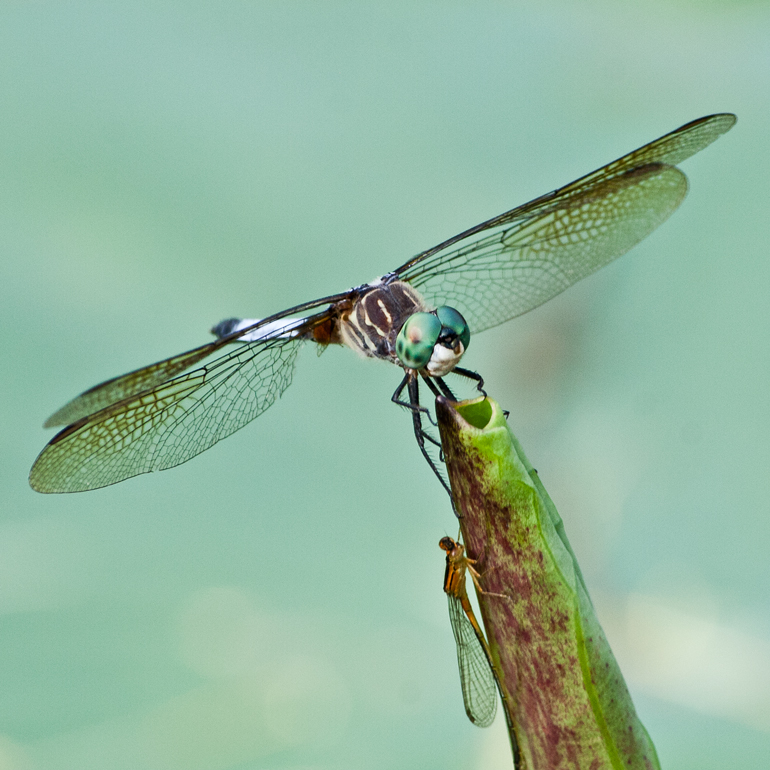
I had been focusing on shooting dragonflies that had stopped to pose on various objects. In this case I am certain that I was looking at the Blue Dasher dragonfly (Pachydiplax longipennis) perched on the rolled-up leaf of a lotus plant and never noticed the damselfly in the photo. The damselfly appears to be scaling the leaf, ready to do battle with the dragonfly. The dragonfly seems to be looking down with a little concern, wondering who is trying to challenge his position. When I compare the relative sizes of the two insects, I can’t help but think of the Biblical story of the boy David taking on the giant Goliath. In this case it would essentially be a family feud, since both dragonflies and damselflies are part of the Odonata family.

It’s a lesson to me to check my images carefully when I process them—there may be all kinds of hidden treasures waiting to be discovered.

© Michael Q. Powell. All rights reserved.

Read Full Post »
My friend and photography mentor Cindy Dyer and I went out yesterday to photograph dragonflies at Green Spring Gardens in Alexandria, VA, a local garden that is my favorite place to go when the urge to shoot some photos overwhelms me. We were often taking photos side by side. I was really beneficial for me to watch how Cindy, an experienced professional, approached the  photographic task, what things drew her attention, and the way in which she composed her shots. At one point I even got to put my memory card into her camera, a Nikon D300 with a Tamron 180mm macro lens, and shoot for a while. It was definitely a big change from my Canon Rebel XT with a 55-250mm telephoto with which I was shooting at the time. Her set-up was a lot heavier but had a much brighter, bigger viewfinder, and faster focusing.

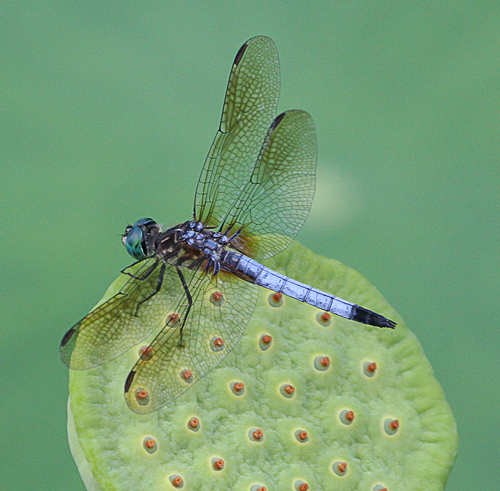
We were both excited when one Blue Dasher dragonfly (Pachydiplax longipennis), the most common dragonfly that we saw all day, decided to use a lotus seed pod as his home base. He would periodically fly away, but always seemed to come back to the seed pod. She and I were both able to get shots of this dragonfly against the backdrop of a lotus leaf. The light colored circular object you can see is the center of that leaf. I love the crimped edges of this particular pod—it reminds me of a home-made pie crust.

This photo came out so good that I though it probably had been shot with her camera. However, when I checked out the RAW file information I realized it was from my camera. For those who might wonder about the exposure, it was shot at f11, 1/125 sec, ISO 800, at 163mm of the 55-250mm zoom lens. If you are interested in checking out Cindy’s comparable shot (her’s is even sharper) as well as some other wonderful shots she’s taken of dragonflies the last couple of days, check out her blog postings.

Blue Dasher dragonfly on a lotus seed pod

© Michael Q. Powell. All rights reserved.

Read Full Post »

Yesterday I was at a nearby pond photographing mostly dragonflies. After shooting them I decided to make a quick walk around the pond (it’s only a small man-made pond) to see what other subjects I could find. I managed to find a colorful butterfly, a small green heron, and some lotus flowers that I will post later, assuming the photos came out ok.

The subject that really caught my attention, though, was a frog. Really? Yes, really.

I was leaning over the green-colored pond water, gazing at a distant dragonfly when I happened to glance down to my right. There, almost camouflaged in what my friends say is duckweed, was a semi-submerged frog. I was able to get my camera’s lens down pretty low and got in close and captured an image I really like. The frog’s gold-ringed eyes shine out clearly amidst all of the individual particles of duckweed that cover much of his expressionless face.

There are a couple of blades of grass that were partially blocking my view to the frog but they blurred out and are not really much of a problem.  After I took some shots, though, I decided to try to carefully remove one of those offending blades. As I made the effort,  the frog, who had remained motionless up to then, literally leaped into action. He sprung powerfully into the air and skipped across the surface of the water, like a rock throw by a dad showing his son how to skip rocks.

I was so startled by his sudden motion that I almost fell over into the water. Later in the day I did end up getting wet when I belatedly noticed that one foot was planted in the water while I was intently focusing on composing a shot. I guess that’s the price of being a photographer.

Hiding frog

© Michael Q. Powell. All rights reserved.

Read Full Post »

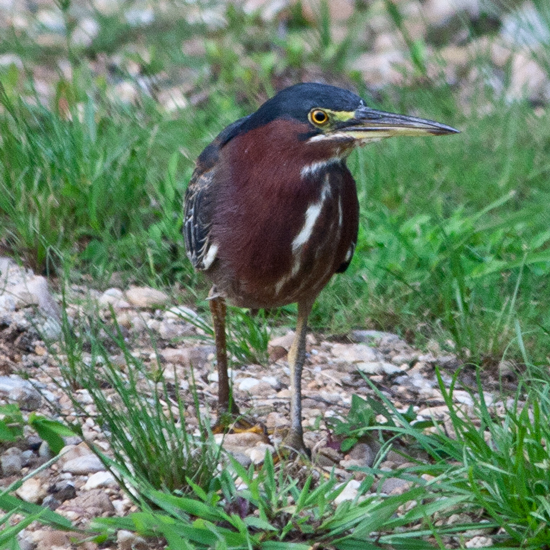
After I got home from work today I rushed to a nearby garden to get in a few shots before the light disappeared totally. I was happy to spot a green heron (I’ve photographed them before at the pond area of this garden) and managed to take a photo of him that I really like. The green heron is standing the edge of a rocky cliff and appears to be keeping watch.  (In reality it’s more like a rock wall).

Green Heron Sentinel

I decided to add one other photo of the green heron that I managed to take before he flew across the little pond to the rock wall. It is a little more of an unposed shot than the first one, which almost looks staged, and captures him in his more natural environment.

Candid shot of a green heron

© Michael Q. Powell. All rights reserved.

Read Full Post »

Almost everywhere that I have seen flowers the last few weeks I have seen skippers. One of the few varieties that I can identify is the Silver-spotted Skipper butterfly (Epargyreus clarus) which I feature in my first photo.

Silver-spotted Skipper

Many of the other skippers, however, look almost the same to me. Wikipedia says that there are more 3500 recognized species of skippers, so I don’t feel too bad about my identification difficulties. Here’s a photo of one of the 3499 non-Silver-spotted Skippers on a sunflower.

Unidentified skipper on a sunflower

This must be the season for the Eastern Tiger Swallowtail (Papilio glaucus), because I see them almost everywhere too. I’ve posted lots of photos of swallowtails recently, but I figure that the bright color of the swallowtails will complement the more muted tones of the skippers. Besides, the different lighting and angles of the shots makes them very different photos for me, even when the subject is the same.

Male Eastern Tiger Swallowtail against the sky

Looking downward at a female Eastern Tiger Swallowtail

© Michael Q. Powell. All rights reserved.

Read Full Post »

I have to admit that I am really challenged when it comes to identifying flowers. I just don’t know where to start in researching them. So I apologize in advance for not knowing the name of this flower.

I spotted this distinctive small flower when I was shooting with some friends at a local botanical garden. The outside of the flower was not really that unusual, but I was immediately attracted to the inside of the flower. The shape and unusual pattern on the inside reminded me of a pleated curtain installed by a designer who was color-challenged. The color and pattern of the inside did not seem to  go well with the outside (or maybe I just watch too much Home and Garden TV).

I like that I was able to isolate and photograph this unusual flower which for now remains nameless for me.

© Michael Q. Powell. All rights reserved.

Read Full Post »

Prior to this past weekend I had never seen an American Painted Lady butterfly (Vanessa virginiensis) and now it seems like they are everywhere, if you define “everywhere” as two separate locations within a few days.

Previously I posted a photo of the American Painted Lady butterfly in beautiful soft light in a shot taken from the side. On Sunday, just as I was getting ready to leave Meadowlark Botanical Gardens in Vienna, Virginia, I saw a flash of color and realized that it was a beautiful butterfly. Upon closer examination I recognized the now familiar coloration of the American Painted Lady.

She settled onto a plant and seemed to pose for me, as though she could put aside the normal activities of feeding for a moment. The late afternoon light was behind her and was still bright, causing some of the highlights to be blown out. However, the light also gave her a glow, partially illuminated her wings, and highlighted her reddish hair. The angle of he shot provides an unusual, but pleasing, view of this butterfly.

The shot may not be perfect, but you can’t help but admire the beauty of this American Painted Lady.

The lady is a redhead

© Michael Q. Powell. All rights reserved.

Read Full Post »

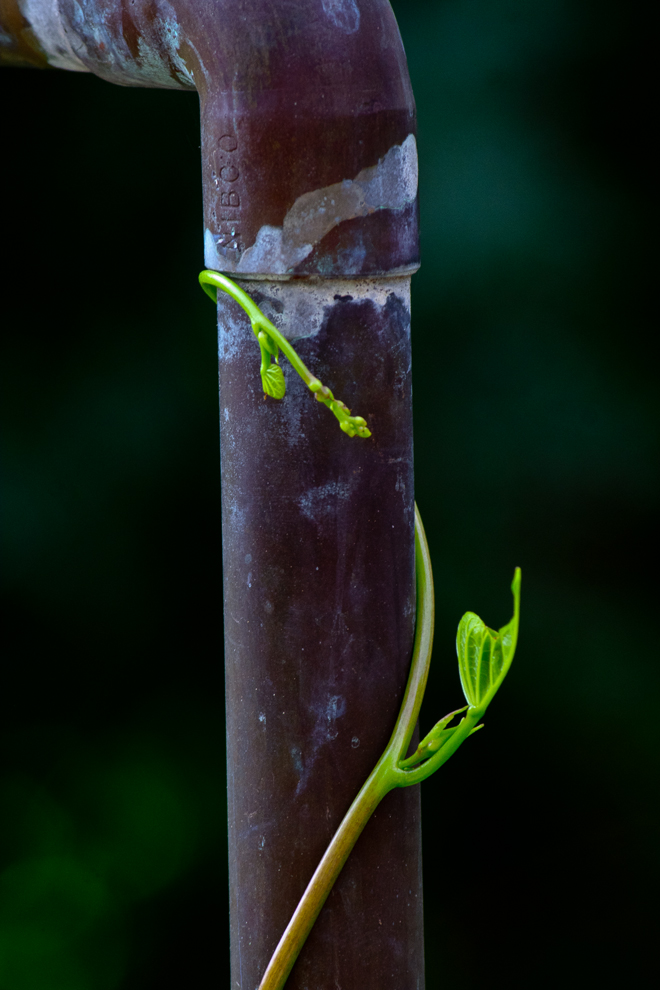
I was photographing my typical assortment of flowers and insects at a local garden yesterday when I came upon a scene that grabbed my attention. A delicate vine was starting to wrap itself around an industrial-looking pipe. I was struck by the juxtaposition of the new life of the tiny leaves and the rusty, scuffed-up decay of the pipe. The scale of the two subjects and their very different colors also provided a sense of contrast.

I did not fully manage to capture the image I had in my head. However, I decided to share my favorite image of the pipe and the vine. Usually I crop at least a bit, but in this case I decided to use the full image as it came out of the camera, with some minor adjustments to the exposure. I composed it in the camera pretty much the way I wanted it to look (and yes I know I’m supposed to do that all of the time).

This was an interesting experiment in shooting something totally different, all part of a learning process as I seek to express myself in my images.

© Michael Q. Powell. All rights reserved.

Read Full Post »

The angle of the lighting and the unusual framing of this photograph of a female Eastern Tiger Swallowtail butterfly (Papilio glaucus) set it apart from other photos I have taken of the same species. (See my postings from 8 August and 21 July for other shots of the Eastern Tiger Swallowtail.)

The light is uneven and there are areas that are not sharp, but I like the overall effect of the photograph.

Click on the image to see more details.

© Michael Q. Powell. All rights reserved.

Read Full Post »

Today I photographed an American Painted Lady butterfly (Vanessa virginiensis), which is also know as an American Lady.

At first I thought it was a Painted Lady butterfly (Vanessa cardui), a type that I had previously photographed (see my posting from 3 August). A closer examination and some internet research showed it was not the same butterfly.  You can find more information in Wikipedia but the easiest identification features for me were the eyespots on the ventral side—the American Painted Lady has two large eyespots and the Painted Lady has four smaller ones.

I learned a good lesson today too about the need to carry a camera with me as often as possible. I took this photo at the outdoor sales area at a local Home Depot store.

American Painted Lady butterfly (Vanessa virginiensis)

© Michael Q. Powell. All rights reserved.

Read Full Post »
Every now and then when I am focusing intently on an insect and trying to set up a shot, other insects creep into the frame. Only later, when I am looking at the photos on my computer screen, do I realize that they are there. My friend, Cindy Dyer, likes to call them “bonus bugs.”

This morning as I was looking at some recent wasp photos, I realized that there was a black shield bug in one of them. The shot is not that great technically, but I think that the combination of the two very different insects makes for an interesting photo, particularly because the wasp seems to have noticed the shield bug.

To me the moment is reminiscent of the bar scene in the Star Wars movie in which all kinds of different alien creatures are interacting. Click on the link to a You Tube video if you’ve never seen this classic piece of film history.

This photo really is begging for a clever caption and I’d welcome any suggestions.

© Michael Q. Powell. All rights reserved.

Read Full Post »
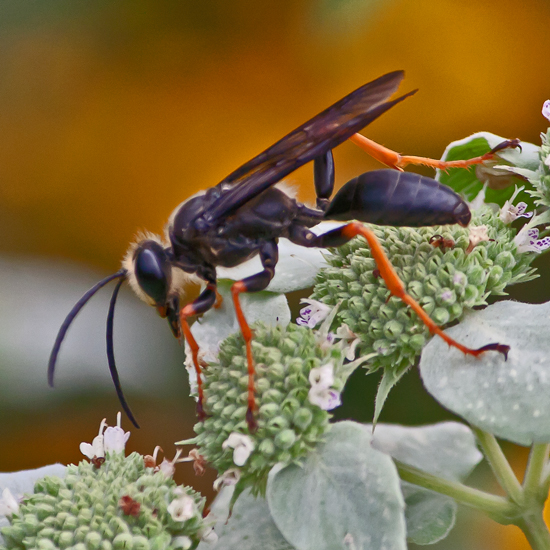
Bees and butterflies seem to get all the love. Where is the love for the lowly wasp? Maybe wasps need a public relations firm to give them a new image.

This photo from a recent shoot suggests one approach to that new image—an edgy, radical image. The wasp already appears to be sporting a mohawk hairstyle and large, dark sunglasses. Some piercings and a few tattoos and the new image would be complete.

The result—a cool new image for the wasp to match the attitude he already possesses.

© Michael Q. Powell. All rights reserved.

Read Full Post »

Whenever I am shooting flowers of any sort I am inevitably drawn to bees. I love watching them flying and hovering, back and forth and in and out of the flowers.  Sometimes a bee seems to be systematically covering a group of flowers and other times he seems to be choosing randomly where to touch down before moving on, relentlessly in motion.

Here are a couple of recent shots of carpenter bees on a plant that I have been told is called salvia. I love its deep purple color and simple flowers. The first shot is a closeup of a bee. The second one gives you a better idea of the shape of the flower. Note that in both cases the bee is getting the nectar from the side of the flower and is therefore not pollinating it.

© Michael Q. Powell. All rights reserved.

Read Full Post »

It was after 7:00 pm yesterday evening and my urge to take photos was still not satisfied. I had wandered through the garden of my neighbor, Cindy Dyer,  whose photographs and flowers are a constant source of inspiration, but had come up empty, except for some shots of a striped cucumber beetle.

I decided to check out her front porch herb garden to see if there were any interesting bugs to shoot, but there were none. My hope was fading along with the day’s light when I glanced down at a container next to her front door and saw some tiny pink and white flowers growing against a backdrop of darker leaves. I had a subject, though I was clueless about its identity.

I doubted that I would be able to capture the beauty of the little flower, but my tripod and macro lens came to my rescue. I was so excited when I pulled up the images on my computer that I immediately called Cindy to ask her what kind of pink flower she was growing on her porch. She seemed a bit confused by my question, because she couldn’t recall any flowers growing on her porch.

Open laptop in hand, I walked over to her house to show her the image and pointed out where I had shot it. All at once her eyes lit up as she realized what I had photographed. It was basil that had started to flower. I was a little incredulous, because I didn’t know that basil had flowers. Cindy then crushed a leaf and held it to my nose.

My nose revealed what my eyes and my mind had not—it was unmistakably basil.

Tiny basil flower

© Michael Q. Powell. All rights reserved.

Read Full Post »
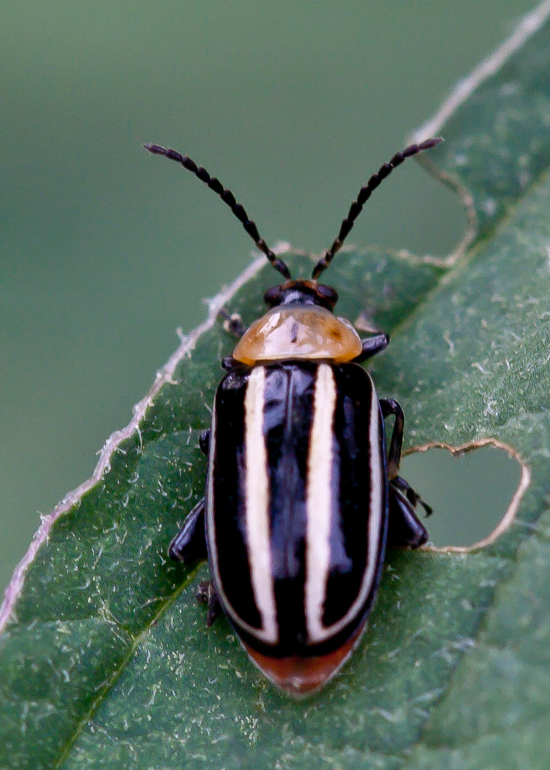
Last month I first encountered the Striped Cucumber Beetle (Acalymma vittata) in a neighbor’s garden. I was immediately taken by his cool, sophisticated, man-about-town look. The black and light yellow stripes down his back make him look like he is dressed formally. The translucent orange high collar, though, adds a splash of color to his ensemble and causes him to really stand out in a crowd. This well-dressed dandy, however, has a deep dark secret. Beneath the surface of this Dr. Jekyll lurks a Mr. Hyde.

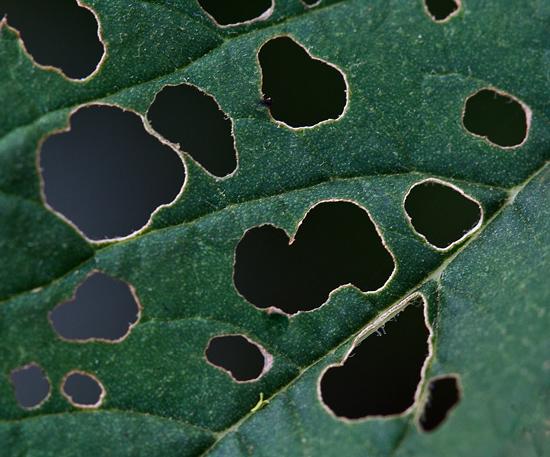
I ran into him today in my friend’s garden. Previously, the garden had been green and flowering. Now the garden looked like a war zone, with signs of devastation everywhere. The leaves of the plants had all been ravaged and looked like the image below.

So I confronted the striped cucumber beetle about what had happened to the leaves. I asked him to swear an oath to tell the hole truth, and nothing but the truth. Initially he resisted and then he admitted to a hole in one. Finally he confessed and named the other beetles who had participated. The judge, however,  may be lenient with him because he took personal responsibility for his actions and acknowledged that the hole thing had been his idea.

© Michael Q. Powell. All rights reserved.

Read Full Post »

The subject is simple and familiar, a bee and a flower. My eye was drawn, however, to the way this bee had latched on to the entire center of this flower in a full-bodied bee hug. The X-shape of the splayed legs and the radiating petals combine to produce a graphic effect that goes beyond the literal subject matter.

© Michael Q. Powell. All rights reserved.

Read Full Post »

Usually my photos are realistic, almost hyper-realistic in their macro details. Sometimes, though, I get excited by a portion of an image and the patterns and lines contained therein.

Yesterday I took some close-ups of a male Eastern Tiger Swallowtail butterfly. Thanks to my telephoto lens the butterfly more than filled the frame. After a bit of tweaking I ended up with an image that is almost abstract, with lots of interesting lines and shapes. You can still tell that it is a butterfly and a flower, but it has a different feel than my other butterfly shots.

I find it fun to try something completely different from time to time.

© Michael Q. Powell. All rights reserved.

Read Full Post »

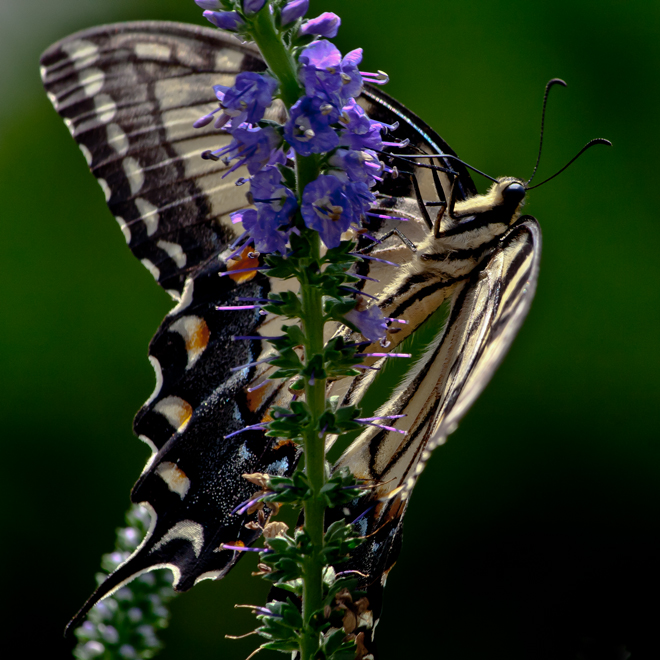
One of the coolest things about female Eastern Tiger Swallowtail butterflies (Papilio glaucus) is that they come in two distinctly different colors, black and yellow. According to Wikipedia, that characteristic makes them dimorphic. I’m no scientist, so I had to do some research  to see what “dimorphic” means. If I understand it right, it means that there are two different phenotypes (called morphs) that exist in the same population of a species and they have to be in the same habitat at the same time to qualify.

I was thrilled yesterday to observe and photograph both variants at a local garden. The yellow ones resemble the male, although the male is only yellow and black and has no additional orange and blue markings. I have seen a lot of the yellow female swallowtails this summer. The black swallowtails, which have black bodies as well as black wings, seem to be more rare, or at least I have seen them only rarely this summer.

Which one is more beautiful? I’ll leave that call to each of you.

black_swallowtail1_6x8blog

Female Eastern Tiger Swallowtail butterfly (black variant) UPDATE in 2020: I think that I misidentified this as an Eastern Tiger Swallowtail and now think it might be a Black Swallowtail, though the angle keeps me from being sure about the identification

© Michael Q. Powell. All rights reserved.

Read Full Post »

As I was wandering this past weekend through the local garden where I take a lot of my photos, I came across an enchanting scene. A child-sized wrought iron table and chairs were set in the shade, with a multi-colored teapot in center of the table. In the spout of the teapot was a single red, trumpet-shaped flower.

Had a child placed the flower there earlier in the day while serving tea to real or even imaginary friends? I like to think so. For a brief moment I was transported back to the days of my youth, carefree days when summers were full of dreams and exploration.

I captured this image as a reminder of the feeling of that moment, as a reminder not to let the “serious” cares of my adult life extinguish that child-like spark of innocence, sensitivity, and creativity. It is still very much a part of me, even if it struggles to find a way to express itself.

© Michael Q. Powell. All rights reserved.

Read Full Post »

Some bees are hairy and some bees are really hairy.

Seriously, this bee looks like he could use a beauty makeover. At a minimum he needs a trip to a barber or hair stylist to trim away some of that excess hair. Look at his legs, his forehead, and his neckline. Yikes! The worst area may be the swirly hair on his back. I haven’t seen anything that bad since the days when the comb-over was a popular hair style.

Maybe he is wearing his hair long to conceal the fact that he is going thin on his back. If that’s the case, I have news for you, Mr. Bee. “You’re not fooling anyone.”  It’s time to get with modern styles, perhaps, and shave it all off.

What would a bald bee look like?

Fuzzy Wuzzy was a bee…

© Michael Q. Powell. All rights reserved.

Read Full Post »

Monarch butterfly (Danaus plexippus) feeding on a marigold flower at Green Spring Gardens, Alexandria, VA on 6 August 2012.

Click on the photo for greater color and clarity

© Michael Q. Powell. All rights reserved.

Read Full Post »
Does a bee ever get stuck when he flies (or climbs) into a flower with a narrow opening?

This question arose this afternoon when I watched a bee enter a flower so deeply that only his legs were visible. He remained in that position for some time and then he somehow was able to get back out of the flower. I am still not sure if he was stuck or how he was able to extricate himself. From my perspective, it was a feat worthy of an insect Houdini.

I shot a series of photos that illustrate the whole process. In this case the old adage is true about a picture being worth a thousand words. You will notice that I changed my vantage point part way through the shoot. (I had plenty of time while the bee was inside the flower.) I would also draw your special attention to the details of the last photo in which the bee has to act like a contortionist to get his legs out of the tight spot.

Who knew that bees were so flexible?

© Michael Q. Powell. All rights reserved.

Read Full Post »
Wait a minute, that’s not a rose! You got me there, but raindrops on flowers are still one of my favorite things. Can I help it if I love “The Sound of Music?” The word “raindrops” immediately conjures up visions of Julie Andrews singing “My Favorite Things,” including “raindrops on roses.”

This photo is a couple of months old but is intended to be a response to the rainy weather we are finally having.  It is also a response to Another Perspective Photography’s posting asserting that she is not a bug photographer.

I am proud to state that I am a bug photographer who often shoots other elements of nature and only occasionally photographs people. That may change, but for the moment it’s where my interests lead me. This photo, however, is intended to be evidence that I am not “just”a bug photographer.

© Michael Q. Powell. All rights reserved.

Read Full Post »

You might think that I am going to talk philosophically about a bee, but my title is meant to be taken literally. If you click on the photo, you can actually see reflections of the sky and bushes on the shiny surface of the abdomen end of this bee.

I am pretty sure that this is a carpenter bee for two main reasons. First, the abdomen area is shiny and hairless, unlike a bumblebee who is more hairy. Secondly, the bee is sucking nectar out of the side of the flower rather than going in from the front, a process sometimes referred to as “nectar robbing.” Carpenter bees are notorious for circumventing pollination in certain plants by slitting open the side of the flower.

Perhaps others can see more reflections on the bee. It’s like looking at clouds and trying to see shapes—it’s a lot of fun and everyone sees something different. Life is like that sometimes.

Click the photo to see more details

© Michael Q. Powell. All rights reserved.

Read Full Post »

Is it really possible to find inspiration and motivation in an insect?

Take a really close look at this photo of an male Eastern Tiger Swallowtail butterfly (Papilio glaucus).

Do you see the delicate beauty of his colors and shapes or are your eyes drawn immediately to his infirmity? His wings are virtually shredded and there is a large portion of one of them missing.

Somehow, despite all of those limitations, he can still fly. He can defy gravity and the laws of aerodynamics.

I don’t know how he does it, but he is able to overcome adversity.  Some of the lyrics of the song “Defying Gravity” from the musical “Wicked” come into my head as I think about it.

“I’m through accepting limits ’cause someone says they’re so. Some things I cannot change but til I try I’ll never know….I’d sooner buy defying gravity. Kiss me goodbye I’m defying gravity and you can’t pull me down.”

Inspiration and motivation can come from many places, I would posit, even from insects.

Take these broken wings and learn to fly…

© Michael Q. Powell. All rights reserved.

Read Full Post »
« Newer Posts - Older Posts »