Feeds:
Posts
Comments

Archive for the ‘Flowers’ Category

The weathermen say that is is going to rain almost all day today. That is good news, because we have had a really dry summer. It means, however, that the colors of the day are more likely to be drab and subdued.

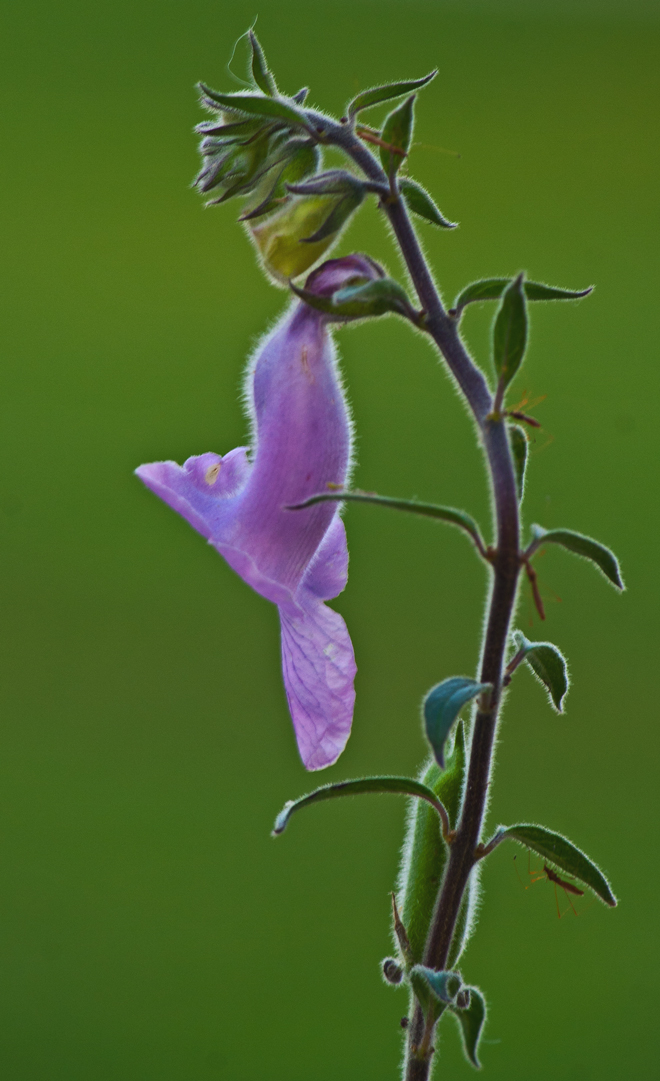
This weekend I visited Green Spring Gardens, a county-run, historical park, and was excited to see that new flowers are blooming as we move into fall. It is well-documented that I have trouble identifying my photographic subjects and flowers are no exception. I don’t know the name of this pink flower that I photographed, but I like the way the image turned out. The composition is simple and graphic and the fuzz on the leaves and the blossom cause them to glow a little.

It is my hope that this dash of pink will help to counteract the blues that sometimes creep in on rainy days. The Carpenters were not necessarily correct when they sang, “Rainy days and Mondays always get me down.”

Pink flower

© Michael Q. Powell. All rights reserved.
Read Full Post »

The weather is getting cooler and it’s getting darker earlier, but it’s nice to see that there are still lots of insects around to photograph. Here’s a recent shot of a bee, still busily at work in mid-September.

Bee in mid-September

© Michael Q. Powell. All rights reserved.

Read Full Post »

Do you ever take a photo and like the way the background turns out so much that the primary subject becomes of secondary importance?

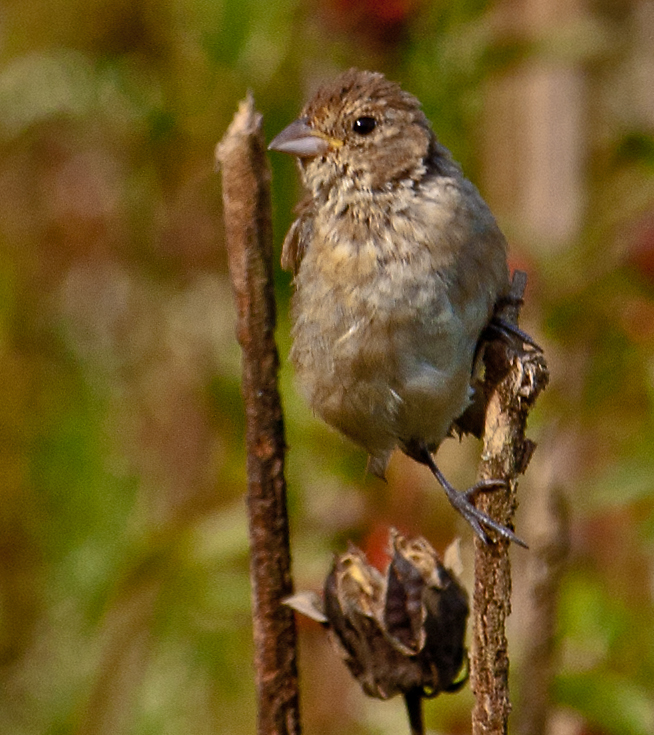
I mentioned in an earlier post the difficulty I have in photographing birds. This was a shot from the same day I photographed the cardinal. I’m not really sure what kind of bird this is, but I like the fact that I got a relatively clear shot of the bird. More than that, though, I like the impressionist look of the background.

Can anyone identify this bird?

Unidentified bird

© Michael Q. Powell. All rights reserved.
Read Full Post »

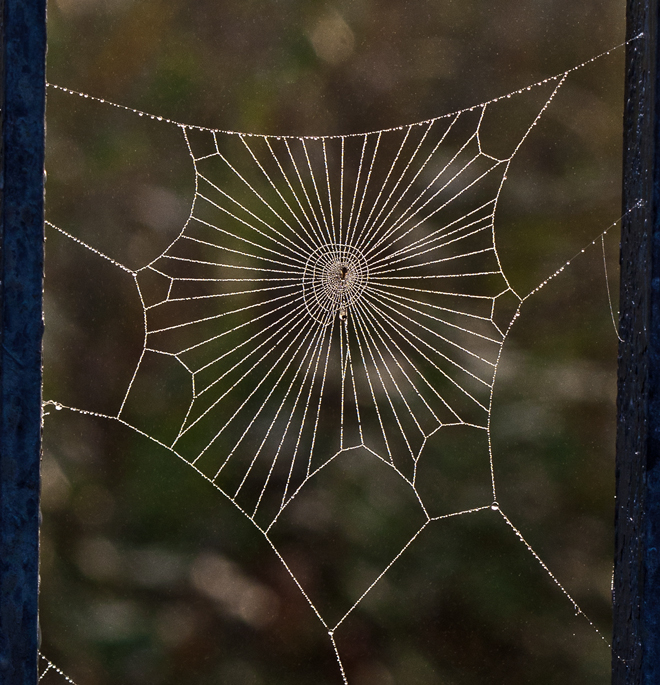
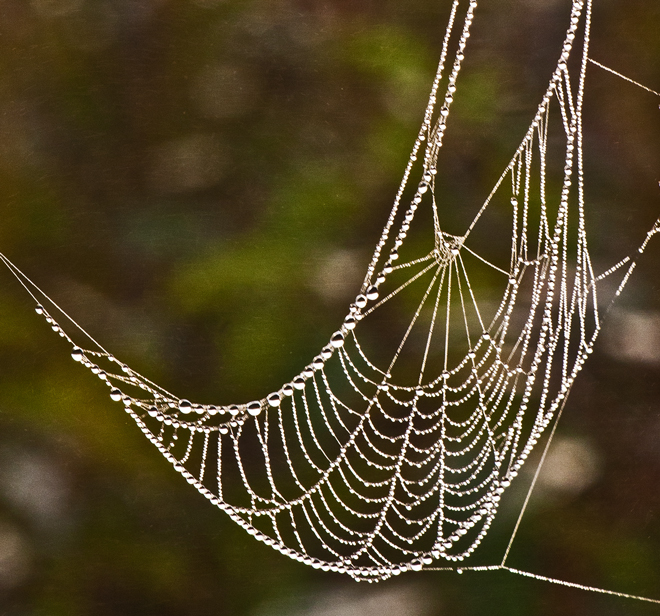
I’ve already posted some photos of spider webs from last Friday morning when I visited Huntley Meadows Park. When I looked over the photos again today, however, I realized I have some more pretty good ones. Once again I am struck by the complexity and the diversity of the webs. Some have primarily straight lines and others have mostly curves. Some are large and intricate, others are smaller and simpler.

All of them are breathtakingly beautiful to me.

A view from a jail cell (not really, but it almost looks like that)

An unusually-shaped spider web

An incomplete spider web

Scallop-curved web

© Michael Q. Powell. All rights reserved.

Read Full Post »

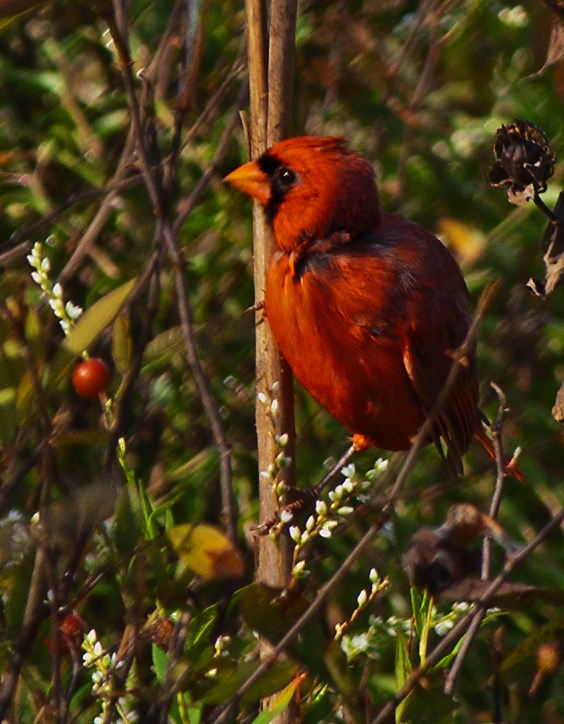
I have even greater respect for photographers who can capture clear images of birds after my experiences today. Previously I had shot a few photos of birds, but primarily in a garden setting. Today I tried to photograph some bright red birds that I think are Northern Cardinals in a meadow with lots of vegetation. Even though these birds are much bigger than the insects that I often photograph, they seemed to spook a lot easier and rarely placed themselves within the limits of my lenses. I think that I understand now why dedicated bird photographer need those huge lenses that I see them carrying. It also proved impossible for me to isolate the background (and foreground), which was often cluttered and blocked a clear view of the bird.

This is the best image I managed of the cardinal. The focus is not perfect and I had to do a mega-crop, but I like the overall look of the image and there is a clear view of the face.

Cardinal

© Michael Q. Powell. All rights reserved.
Read Full Post »

Why does this damselfly have its wings in an open position? That was the question that popped into my mind when I first spotted this pretty little damselfly. As far as I knew, damselflies folded their wings together when they were at rest. A little research on the internet showed that there is a family of damselflies called Lestidae (more commonly known as Spreadwings) that hold their wings at an angle from their body when they are at rest.

I decided to show the same photo in two different ways. The first image is a cropped close-up and it lets you seem the facial expression and some additional details of the body, including the drops of water on the chest and legs. As you can see, one of the disadvantages of wings that are spread is that depth of field is a problem. The second view is the image more or less as I composed it in the view finder. It shows how really long and skinny the tails are for this type of damselfly. I think that this may be a Southern Spreadwing (Lestes australis), but I am not certain of the identification because there are other varieties that look similar.

Close-up shot of spreadwing damselfly

Full-body shot of spreadwing damselfly

© Michael Q. Powell. All rights reserved.
Read Full Post »

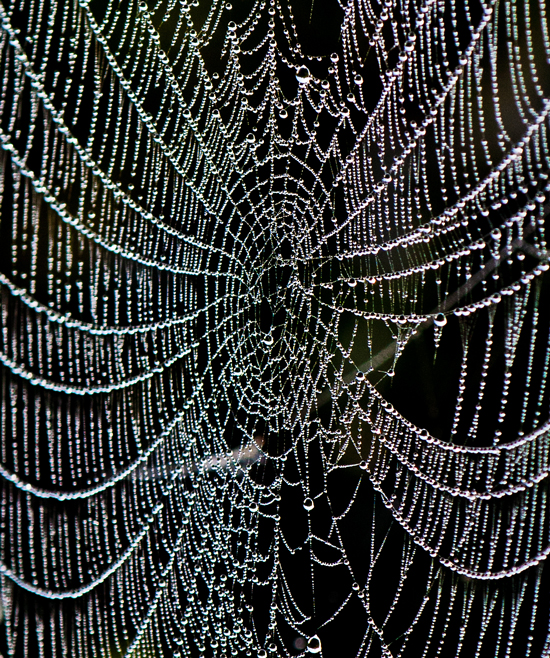
I have become hyper-attentive now when I walk through gardens, woods, and marshes. I have started to slow down and am more aware of my surroundings. A few months ago, for example, I would not have noticed this grasshopper climbing up the stalk of a plant. Now I can look with wonder at yet another fascinating creature, and my life is enriched by the experience.

Climbing Grasshopper

© Michael Q. Powell. All rights reserved.
Read Full Post »

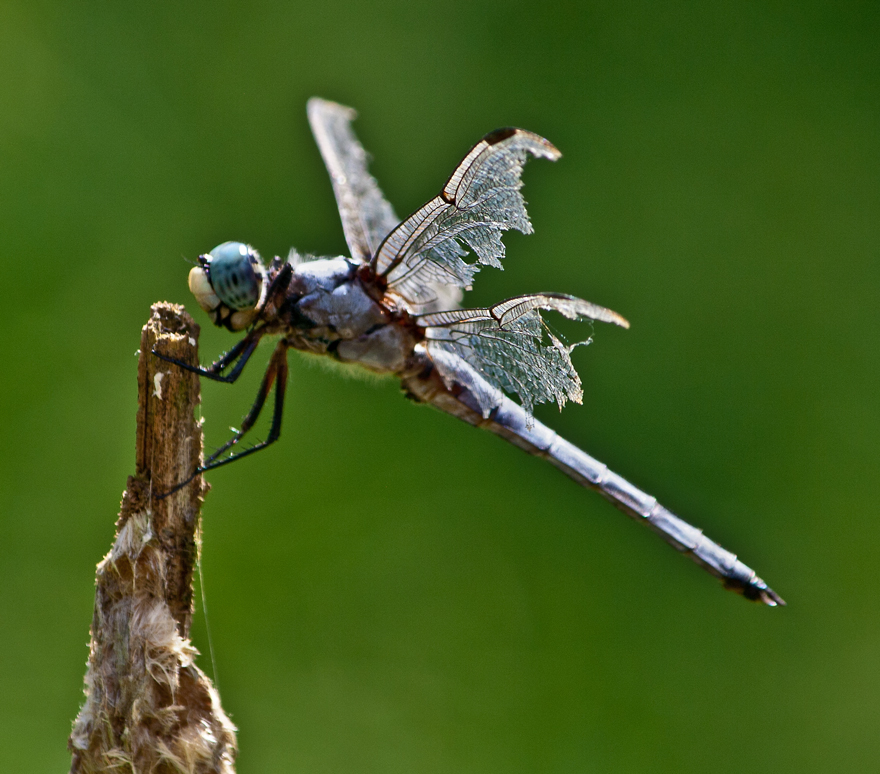
I don’t know if this Blue Dasher dragonfly is long in the tooth (do dragonflies have teeth?) or has simply had a tough life. How do you tell the age of a dragonfly? In any case, his wings are tattered and torn to such a degree that it is surprising that he can still fly. Yet I seem to detect a smile on his face, a reflection of contentment. (Yes, I know, I am guilty of anthropomorphism.)

Tattered wings,but still able to fly

I have been thinking about aging ever since Sunday when I read a wonderful column in the Washington Post by John Kelly entitled “You can learn a lot about growing old from a dog.” Kelly describes how the accelerated aging process of his dog has made him more conscious of the fact that he too is growing old. I recommend the article to all, but want to highlight the final paragraph of the column. Kelly concludes:

“Aging is unknown territory for each of us, despite the fact that humans have been doing it forever. I think there are worse ways to spend your final years than napping next to someone you love, dreaming of what was and what still might be.”

I doubt that this dragonfly will end his final days in peace and contentment like Kelly’s dog, but it is my fervent hope that we can accept the infirmities of growing old with grace and patience, and can focus—as this dragonfly appears to be doing—on the things that we are still able to do, on contributions that can make this world a better place.

© Michael Q. Powell. All rights reserved.
Read Full Post »

I love examining milkweed plants, because I always find interesting insects there to photograph. Yesterday I spotted a tiny caterpillar on a milkweed leaf that I was pretty sure was a Monarch butterfly-to-be (Danaus plexippus). The colored stripes were very similar to the one whose photo I previously posted, but this one was significantly smaller.

I decided to do some research on the life cycle of the Monarch to try to find out why this caterpillar was so small. The website butterflybushes.com has a wonderful article on the development of the Monarch. I learned that the larva is so small when it hatches that it can barely be seen, but it then consumes its body weight in milkweed leaves daily (Don’t try that at home!). During the 9-14 day larval stage, the caterpillar sheds its skin five times. Obviously this little guy is in a much earlier stage of development than the previous one, who was probably about ready to move to the pupal stage.

Here are a couple of shots of the little Monarch caterpillar that I took with my Canon 100mm macro lens.

Tiny Monarch caterpillar at rest

Tiny Monarch caterpillar eating milkweed

© Michael Q. Powell. All rights reserved.

Read Full Post »

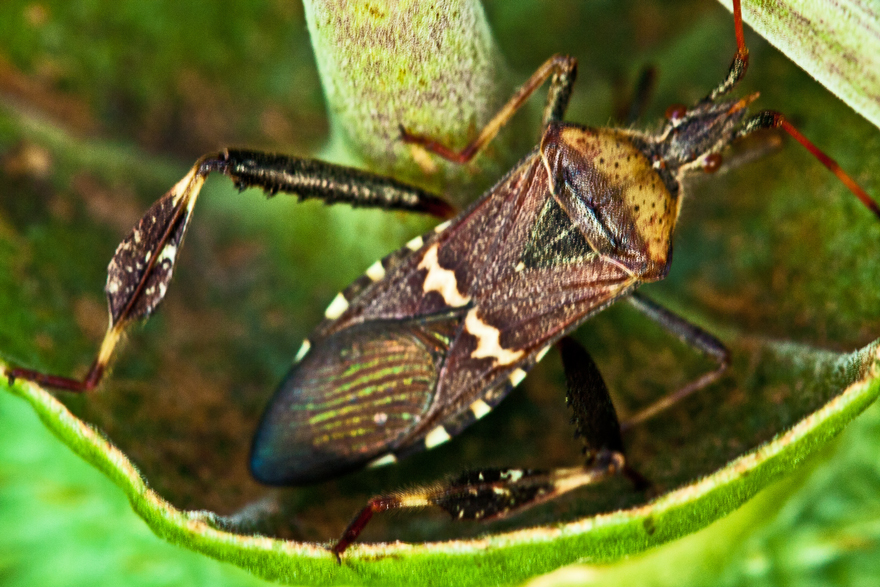
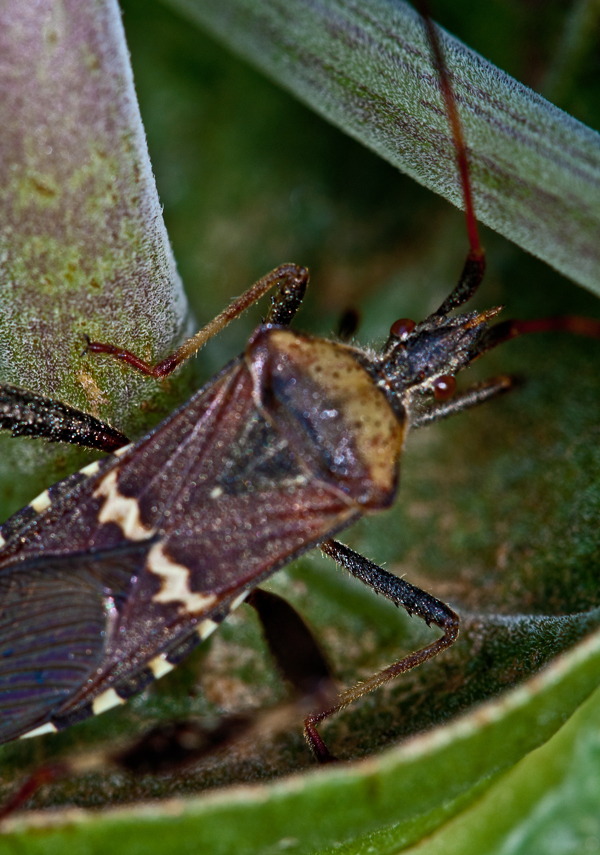
I was getting ready to wrap up my brief photo shoot at a local garden this afternoon when I happened to spot this interesting looking insect. Fortunately I had my macro lens on my camera and I had my tripod as well. I maneuvered as well as I could to frame the first shot and this is how I composed the image in the camera. I did a few tweaks in Photoshop Elements but did not crop at all. I cropped the second image slightly as I tried to move in a little closer. The eyes are in better focus, but I lost the sharper focus on the body.

I hope to figure out eventually what kind of insect he is, but for the moment I like the way the photos turned out.

UPDATE: Thanks to Jeremy Sell’s identification skills, I am pretty confident this is a Western Leaf-Footed Bug (Leptoglossus clypealis). Check out his blog at thelifeofyourtime.wordpress.com.

© Michael Q. Powell. All rights reserved.

Read Full Post »

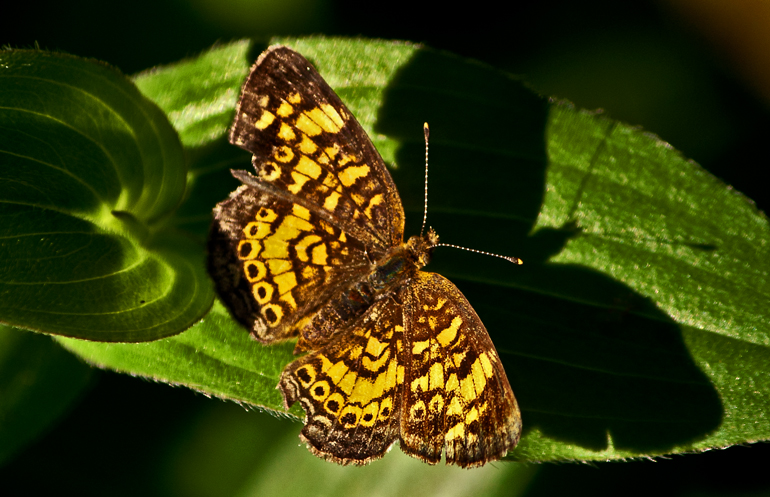
The sunlight was pretty bright late this afternoon, casting dark shadows everywhere, and I was not at all confident that I would get any decent shots. A butterfly flew into view in a partially shaded area, where he perched on a leaf. He was pretty cooperative as he kept his wings open as I made a few adjustments to my camera.

I like the interplay of light and shadows in the image below, even if the colors are somewhat muted and some of the highlights are a little blown out. I probably should admit that I love shadows almost all of the time—me and my shadows.

Butterfly shadow (click for higher resolution)

© Michael Q. Powell. All rights reserved.

Read Full Post »

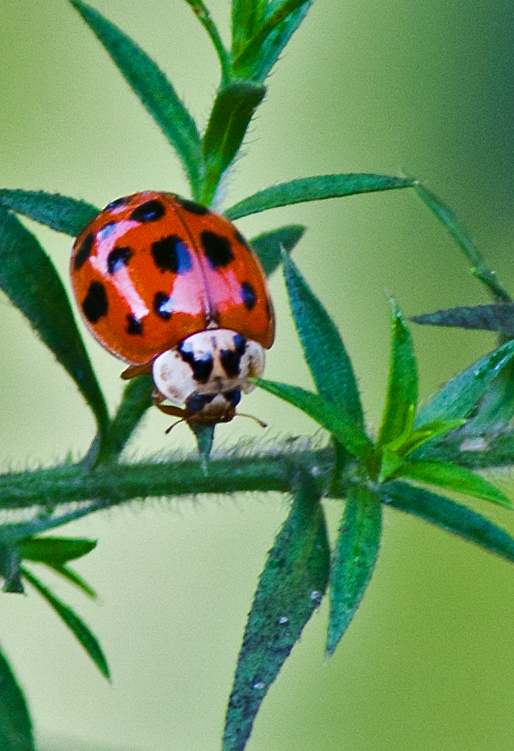
There is something about a ladybug that makes me smile. I don’t know if ladybugs trigger happy memories of my childhood, or if the bold patterns and bright colors simply appeal to my aesthetic sensibility. All I know is that I am happy when I encounter them and I am thrilled when I manage to capture their beauty in an image.

My photography mentor, Cindy Dyer, used to comment that a photo expedition was not a success for me if it did not include ladybug shots. By that modest standard, my photo shoot on Friday afternoon—just hours after a 8-hour transatlantic flight—was a definite success.

Sunday Lady

© Michael Q. Powell. All rights reserved.
Read Full Post »

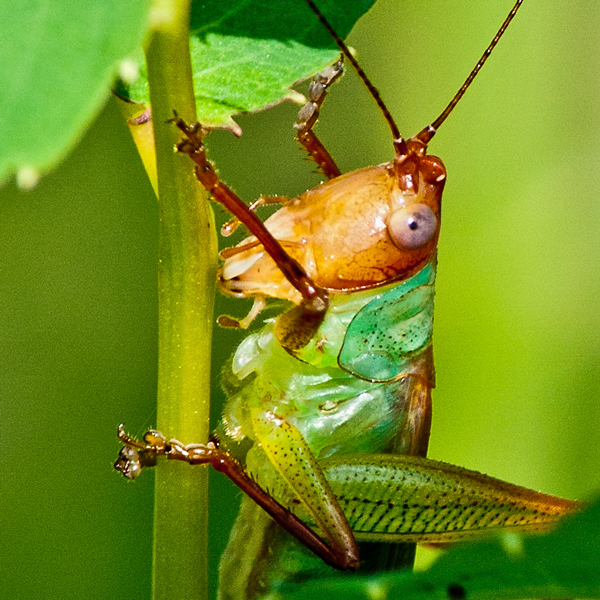
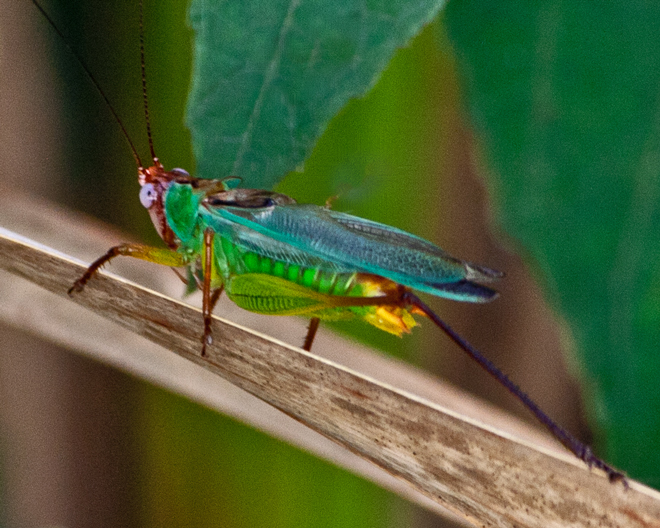
Early this morning I went out with my camera and I was happy to spot again the very colorful grasshoppers known as Handsome Meadow Katydids (Orchelimum pulchellum). As was the case the first time I spotted these neon-colored insects, I was at Huntley Meadows Parks in Alexandria, VA. I had a little trouble getting clear shots of the entire bodies of the katydids, but I managed to capture some good close-up shots of their faces. I especially like the first shot, taken looking down at him as he was munching on a leaf.

I continue to be amazed at the katydid’s vivid colors and blue eyes. Wow!

Handsome Meadow Katydid Munching on a Leaf

Close-up Shot of Handsome Meadow Katydid

Body Shot of Handsome Meadow Katydid

© Michael Q. Powell. All rights reserved.

Read Full Post »

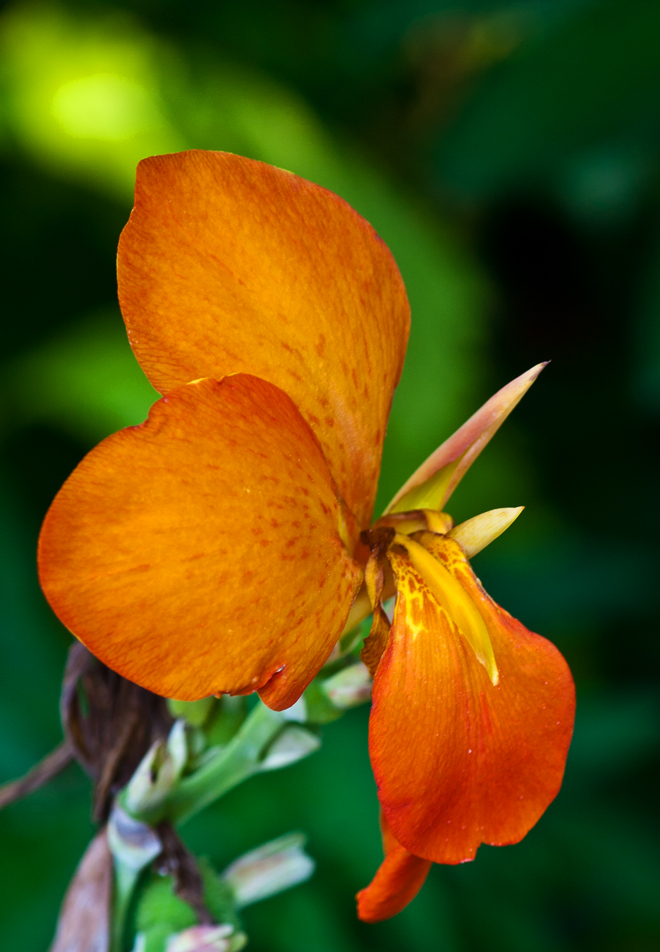
A solitary orange flower caught my eye. Its vivid color and asymmetrically arranged petals drew me in closer. Sometimes beauty is that simple.

Simply orange

© Michael Q. Powell. All rights reserved.

Read Full Post »

It felt good to have my Canon DSLR back in my hands after a week-long trip with only a point-and-shoot camera. After I arrived home from the airport this afternoon, I grabbed my camera and headed off to Green Spring Gardens, a local garden that is one of my favorite places to shoot.

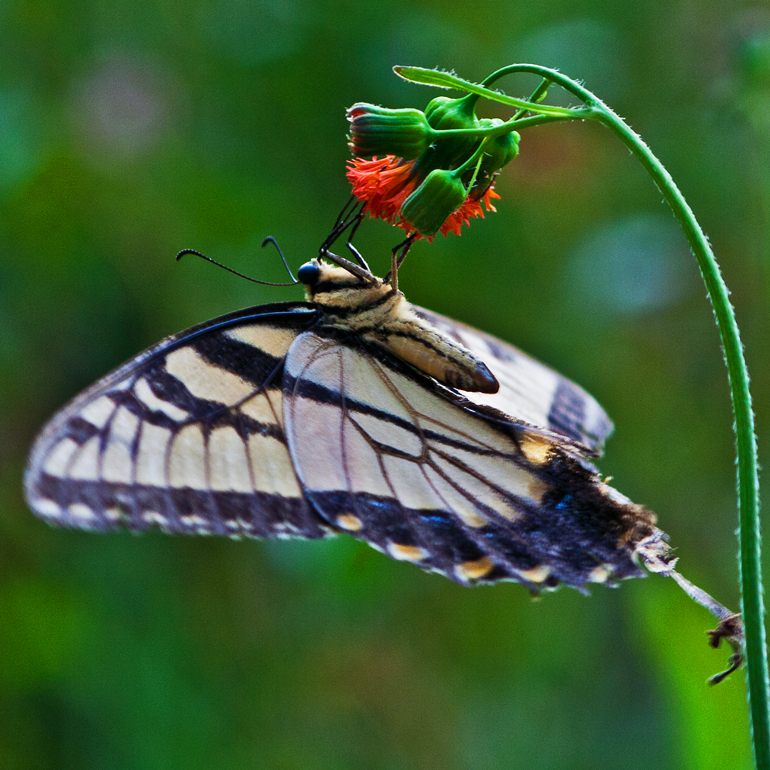
There were only some diehard flowers blooming, but there were quite a number of Eastern Swallowtail butterflies. I watched (and chased) several of them, but the one you see below was my favorite. He attacked this flower from below repeatedly, seemingly defying gravity. It just was not clear to me how he was able to suspend himself in mid-air like that. He must have been hanging on with his feet, though he seemed to be moving them constantly.

Eastern Tiger Swallowtail butterfly defying gravity

© Michael Q. Powell. All rights reserved.
Read Full Post »

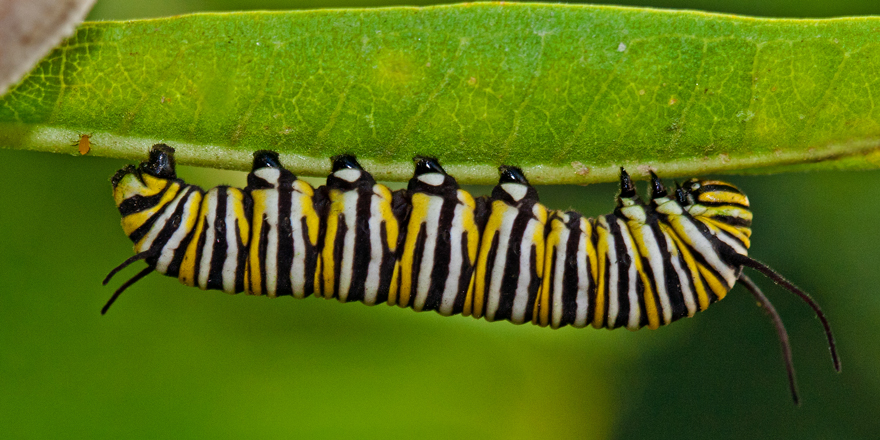
The day before I left for my recent trip I managed to get some photos of Monarch caterpillars with my macro lens. It was the first time that I had seen them live. Not surprisingly they were on milkweed plants and seemed to be chomping away with great appetite. I noted too that some of the milkweed plants were full of aphids (and some of them had lots of ladybugs too). I checked a number of sources on-line and they all suggest that the aphids are not directly harmful to the Monarch caterpillars during the two-week stage when they are caterpillars. I looked around today to see if I could see any chrysalis, the next stage of development, or more caterpillars, but found neither. I’ll keep looking!

Monarch caterpillar (click to see more details)

© Michael Q. Powell. All rights reserved.
Read Full Post »

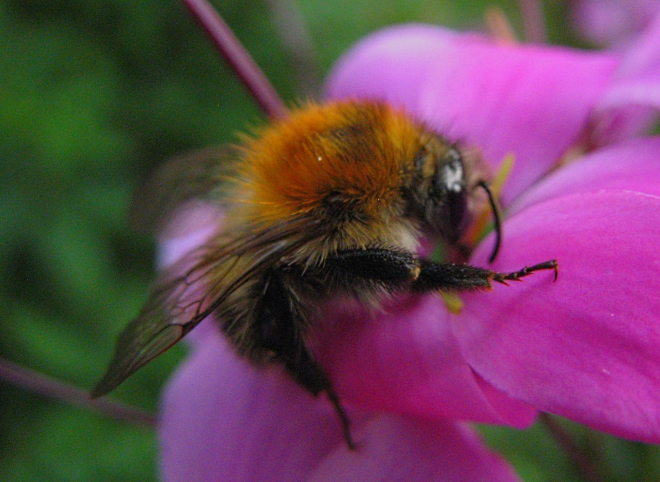
This bee is not as perfectly sharp as some that I have shot, but the softness of the image and the pink flower give this photo more of a romantic mood (if that is at all possible with a bee as the primary subject). I also like the beautiful colors in the bee’s fuzzy hair. Sometimes I feel like I would be content to photograph different kinds of bees every day, focusing at times on their hard work, at other times on their beauty, and at other times on their ferocity. It would take a long time for my fascination with bees to wear off.

Bee on a pink flower

© Michael Q. Powell. All rights reserved.
Read Full Post »

I am out of town at the moment and took along my Canon PowerShot A620, a somewhat glorified point-and-shoot camera. I had used this before for travel photos, but had never tried out the macro features of the camera. The manual claims that in macro mode you can get as close as 1 cm (.4 inches).

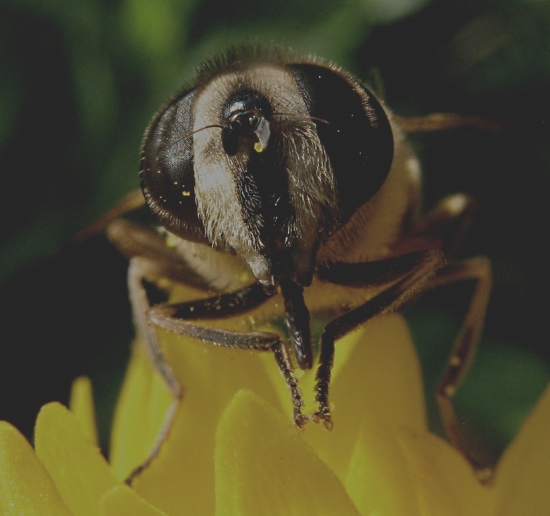
I decided to play around with macro on this camera by taking some shots of bees, one of my favorite subjects. The first photo is one of a bee taken straight on and I am surprised that I got the detail that I did. The other shots are pretty good as well. I would note that I had to get really close to the bees to get these shots. I also am feeling a little hamstrung, because I am producing these images on a netbook computer with somewhat limited capabilities and I am using Paint.Net to manipulate the images rather than PhotoShop or PhotoShop Elements.

Eye-to-eye with a bee

© Michael Q. Powell. All rights reserved.
Read Full Post »

This morning as I was walking along the boardwalk that runs through the marsh in Huntley Meadows Park, I happened to glance down into the muddy water and was surprised to see something that looked like a cross between a starfish and a spider. I always though that spiders lived in trees and on other types of vegetation, but today I learned that there are also spiders that hunt for their prey in the water.

This spider is from the Dolomedes family, probably a six-spotted fishing spider (Dolomedes triton). According to the Wikipedia article, they are often seen with their legs sprawled out by the water while they are waiting for prey (which is what this one seems to be doing). They eat other invertebrates, tadpoles and occasionally small fish (and the female may also eat male fishing spiders if she has already mated). According to fcps.edu, these spiders can walk on the surface water and can stay underwater for 30 minutes. Not surprisingly, they don’t make webs.

This has been quite the day for unusual insects, beginning with a neon-colored grasshopper and ending with a fishing spider. I can’t wait to see what’s next.

Fishing Spider Waiting for Prey (click for higher resolution)

© Michael Q. Powell. All rights reserved.

Read Full Post »

The water level in the marsh at Huntley Meadow Gardens here in Alexandria, VA has been getting lower and lower as the summer has progressed. I suspect that the situation had made it more difficult for some of the inhabitants to find food and may have increased competition for the available food.

Previously I posted photos of a Great Blue Heron catching a fish in the remaining water of the pond of the marsh. Last week I had the chance to watch a series of confrontations between a Great Blue Heron and a snapping turtle. It seemed to start when the  heron grabbed a fish out of the water just as the turtle was approaching him. I had the impression that the turtle might have been pursuing that same fish. The snapping turtle made a series of aggressive runs at the heron, getting really close to the heron’s legs. I have seen pictures on-line of a snapping turtle pulling down a Great Blue Heron, so I waited with fear and anticipation to see what would happen. The heron left the water this time without any bodily injury. (I have some photos of this initial confrontation that I might post later, but their quality is not as good as those of the second round of confrontations.)

The heron eventually went back into the water and it wasn’t long before the snapping turtle came at him again. (I could almost hear the music of the movie “Jaws” in my head as the turtle made a run at the heron.) Like a matador side-stepping a charging bull, the heron awkwardly avoided the turtle who was approaching him faster than I’ve ever seen a turtle move. The heron then turned his back on the turtle and started walking away, perhaps feeling the hot breath of the turtle who continued to pursue him. Finally, the heron took to the air, deciding that he had had enough of the persistent turtle.

I managed to capture the highlights of the confrontation with my camera. I continue to marvel at the wonders of nature as I observe new creatures and see familiar ones act and interact in new ways.

Snapping turtle approaches Great Blue Heron

Great Blue Heron steps to the side as snapping turtle gets aggressive

Great Blue Heron walks away with snapping turtle in pursuit

Great Blue Heron decides to leave his problems behind

© Michael Q. Powell. All rights reserved.
Read Full Post »

Usually when I try to photograph this kind of flower I end up focusing on the petals and the stigmata (I think that’s what those five purplish things at the end of the stalk are called) are out of focus. This time I made a concerted effort to have the stigmata in focus and let the rest of the flower—which I am pretty sure is some kind of hibiscus—take care of itself.

It seems to have worked out pretty well and as an added bonus the light caused the inside of the flower to glow a little, giving some depth and texture to the petal.

Glowing hibiscus flower

© Michael Q. Powell. All rights reserved.
Read Full Post »

I took this photo on an Eastern Amberwing dragonfly (Perithemis tenera)) about a week ago when I was shooting at Green Spring Gardens in Alexandria, VA with my good friend and photographic mentor, Cindy Dyer.

Cindy is always encouraging me to upgrade my photograph equipment. For comparison purposes, she put the Nikon D300 that she was using into my hands and had me shoot with  it for a few minutes. It was equipped with a Tamron 180mm macro lens that gave it a pretty impressive reach for the dragonflies that we were shooting. It’s interesting that I was able to use my Compact Flash memory card, which was formatted in my Canon, in her Nikon and the Canon photos and the Nikon photos peacefully coexisted in separate folders on the memory card.

I was especially happy that I got a decent shot of the Eastern Amberwing dragonfly. This type of dragonfly is very beautiful, but it’s very small and elusive. BugGuide notes that this dragonfly is normally about 21-24mm long (in case you’ve forgotten, 25.4mm is equal to an inch).

I’m probably going to remain a Canon guy, but I can definitely hear the Siren call of that 180mm macro lens, which comes in a Canon version too.

Eastern Amberwing dragonfly

© Michael Q. Powell. All rights reserved.
Read Full Post »

This past weekend when I was out taking photos I was startled when I heard the very loud “singing” of a cicada really close to me. I glanced down and could see the cicada right in front of me, clutching a plant and visibly vibrating. I managed to get this shot of the cicada.

Cicada singing

I decided to do a little research on the cicada because I really don’t know much about them, except for the panic we had a few years ago when the 17-year cicadas were here. In the Wikipedia article, I learned about the different types of cicadas and how they produce the noise that is associated with them that can go up to 120 decibels, among the loudest of all insect-produced sounds.

One of the most interesting statements for me in the article was that, “The cicada has represented insouciance since classical antiquity” and referred to a fable by Jean de La Fontaine. Why was this interesting to me? I love words and it’s fun to read words like “insouciance,” a word with which many people probably are not familiar. It comes from the French word for “care”or “concern” (souci) and “insouciance” usually refers to a carefree, light-hearted, nonchalant attitude.

Did I mention that I was a French literature major in college more than 35 years ago? In college I really liked the French classical literature of the 17th century and Jean de La Fontaine was a very well-known poet and fabulist of that period. (Now tell me, how often do you get to use the word “fabulist” (someone who writes fables)? “Fabulist”—it sounds like it should be something that you’d find in People magazine to know how a celebrity rates in being fabulous.)

I went looking for de La Fontaine’s fable about the cicada to learn more of its reputation for being insouciant. There are a lot of different translations from French into English of the short fable, but I decided to do my own translation to avoid copyright issues and to exercise my French skills.

Here is my translation of La Fontaine’s fable called the “La Cigale et la Fourmi” (“The Cicada and the Ant”).

“The cicada, having sung the entire summer,
Found herself strongly in need when the north wind blew,
Possessing not a single morsel of fly or worm.
She went to her neighbor, Madame Ant, to tell of her need,
Asking her to lend some grain so she could survive until the new season.
“I will pay you interest and principal before the harvest, animal’s oath,” she said to her.

Madame Ant, however, is not a lender, which is the least of her faults.
“What were you doing during the hot weather?” she asked the borrower.
—Night and day I sang to all those coming by, whether that pleases you or not.
—You were singing? I am so glad.
Well, dance now.”

We could have a fascinating intellectual discussion about the meaning of the fable, but I’ll leave that for another time. While I was doing research about the fable, I came across a really cool video of the fable on YouTube that was produced by Studio YBM. It’s a cartoon and is in French, but if you’ve read the fable it’s easy to follow. I don’t want to spoil the video for you, but I encourage everyone to watch it to see insects in snowsuits and hear the cicada performing as a hip-hop singer.

So, where do you see yourself in the fable? Are you more like the ants or the cicada? Are you insouciant or are you more like Madame Ant?

© Michael Q. Powell. All rights reserved.
Read Full Post »

I love to shoot photos after the rain (and sometimes even during the rain). The rain somehow transforms the world, adding drops of water to some surfaces when the water beads up and darkening others when the water is absorbed. Sometimes the weight of the accumulated water even causes shapes to change. That seems to have been the case with this lotus flower. The petals now hang down to the side, revealing the beautiful green seed pod. The glistening raindrops add to the distinctive look as does the yellow fringe hanging from the center.

I like the new-look lotus flower—it’s almost like it has had an extreme make-over, flower-style.

Lotus flower after the rain

© Michael Q. Powell. All rights reserved.
Read Full Post »

I love the graphic black-and-white pattern on this caterpillar that I photographed yesterday at Huntley Meadows Park in Alexandria, VA. The monochromatic pattern is wonderfully accented by the orange tufts with long white bristles. In this case, I am not too concerned about identifying this caterpillar—I am simply enjoying its colors, textures, and patterns.

© Michael Q. Powell. All rights reserved.
Read Full Post »

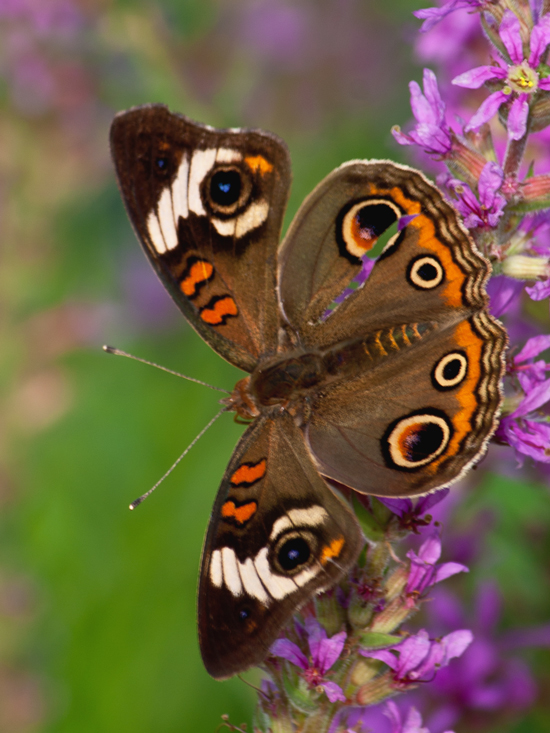
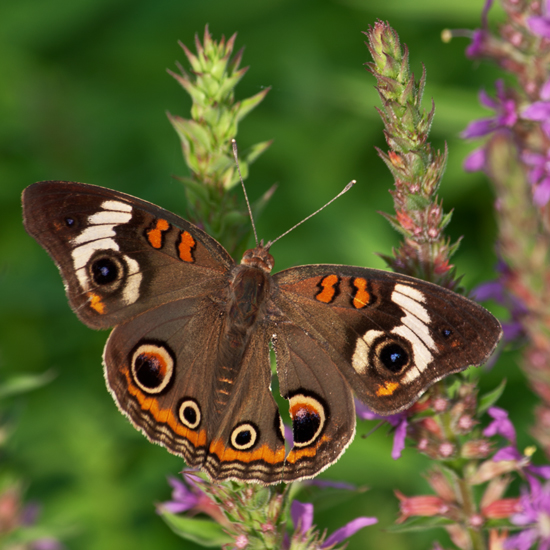
I continue to be mystified by the names of the insects that I photograph. Yesterday I spotted this very striking butterfly that I later learned is called the Common Buckeye butterfly (Junonia coenia).  What makes it common? If it’s so common, why have I never seen one before? The vivid colors and prominent eyespots make it anything but common to me.

Common Buckeye butterfly

Here’s another view of the butterfly. The internal tear in the wing makes it clear that it is the same specimen. If you want to learn more about the Common Buckeye, check out this article on the BugGuide website, which is rapidly becoming one of my favorite places to browse and research.

Common Buckeye butterfly

One interesting fact about the Common Buckeye is that it was featured on a 24-cent US postage stamp in 2006. If you want to see what the stamp looks like, visit the Arago website. Arago, named after François Arago, a 19th century French scientist and friend of James Smithson, is a resource of the Smithsonian National Postal Museum.

One of the nice things about living in the Washington, D.C. area is having access to the Smithsonian Museums, most of which have free admission.

© Michael Q. Powell. All rights reserved.
Read Full Post »

I remember my excitement the first time I saw a really cool dragonfly a few months ago that turned out to be a Halloween Pennant dragonfly (Celithemis eponina). He had a very distinctive look with brown spots and stripes on his wings and orange veins. That first time I was happy to get any shot of the dragonfly.

Today I think that I encountered a Halloween Pennant for a second time. I was still very much taken by his looks but I had the presence of mind to circle about a bit, trying to get a good angle for the shot. The shot below is the one that I like the best of those that I took.

As I think about it, I go through this cycle a lot. I’m so in awe and wonder when I encounter something new that photography is not my first priority. Instead I am living the experience. Maybe my photos the first time are not the best, but that’s ok for me, because living my life is more important than merely recording it in my photos. That may be why I like to go back to places a second time and then focus a bit more on getting good shots.

Halloween Pennant dragonfly (Click for higher resolution view)

© Michael Q. Powell. All rights reserved.

Read Full Post »

Have you ever gone through your photos so quickly that you missed your best shot?

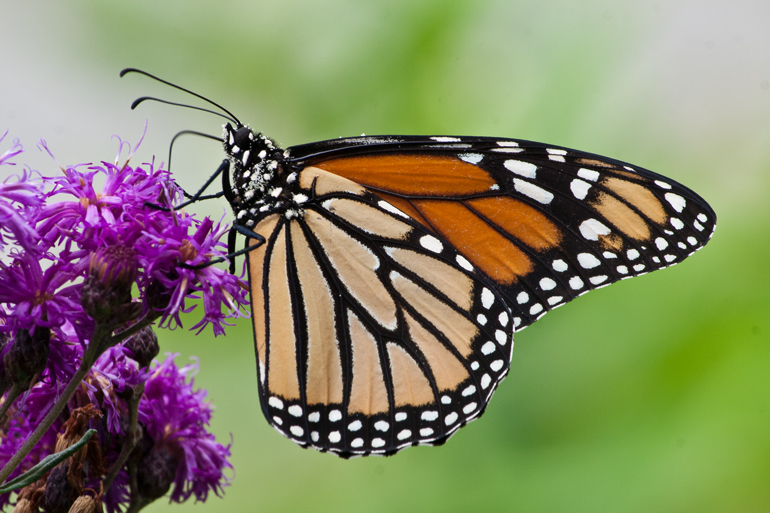
Earlier this week I was really excited because I had finally gotten some shots of Monarch butterflies and I posted a number of photos of them. As I looked over my photos from Monday again this evening, I saw a shot that surprised me. It surprised me because it was really good and it surprised me because I missed it the first time.

Other than using unsharp mask, this is the image that came out of my camera without any cropping at all. (Naturally I downsized the resolution for the blog.) I like the composition, I like the focus, and I like the background.

It doesn’t take much to make me happy.

Monarch butterfly (click for higher resolution)

© Michael Q. Powell. All rights reserved.

Read Full Post »

Here’s a shot from this past Monday of a Clouded Sulphur butterfly (Colias philodice) at Green Spring Gardens in Alexandria, VA.

Clouded Sulphur butterfly

© Michael Q. Powell. All rights reserved.

Read Full Post »

This unidentified little purple flower attracted my eye when I was shooting at a local garden with some friends. I had my macro lens on my camera and I had my tripod with me, so I carefully set up the shot the way my mentor, Cindy Dyer, has taught me to do. I tried to isolate my subject and keep a relatively unobstructed background. I shot at f16 to have a decent depth of field.

The final image is simple, modest, and pleasant, like the flower itself.

© Michael Q. Powell. All rights reserved.

Read Full Post »

I finally managed to get a shot of a Blue Dasher dragonfly (Pachydiplax longipennis) on a lotus flower bud this past weekend. Previously I had photographed Blue Dashers on various plants and stalks and other things, but I have always thought that it would be especially cool to get on perched on the tip of a lotus bud.

It’s nice sometimes to have your wishes fulfilled and, yes, I think the photo met my expectations.

Blue Dasher dragonfly on lotus bud

© Michael Q. Powell. All rights reserved.

Read Full Post »

« Newer Posts - Older Posts »