Feeds:
Posts
Comments

Archive for the ‘dragonfly’ Category

Whenever I see a dragonfly in flight when I am traipsing about with my camera, I can’t help but stop and try to get a photograph of the dragonfly in the air. My success rate in not high, but sometimes I am able to capture a good image as the dragonfly zooms by me.

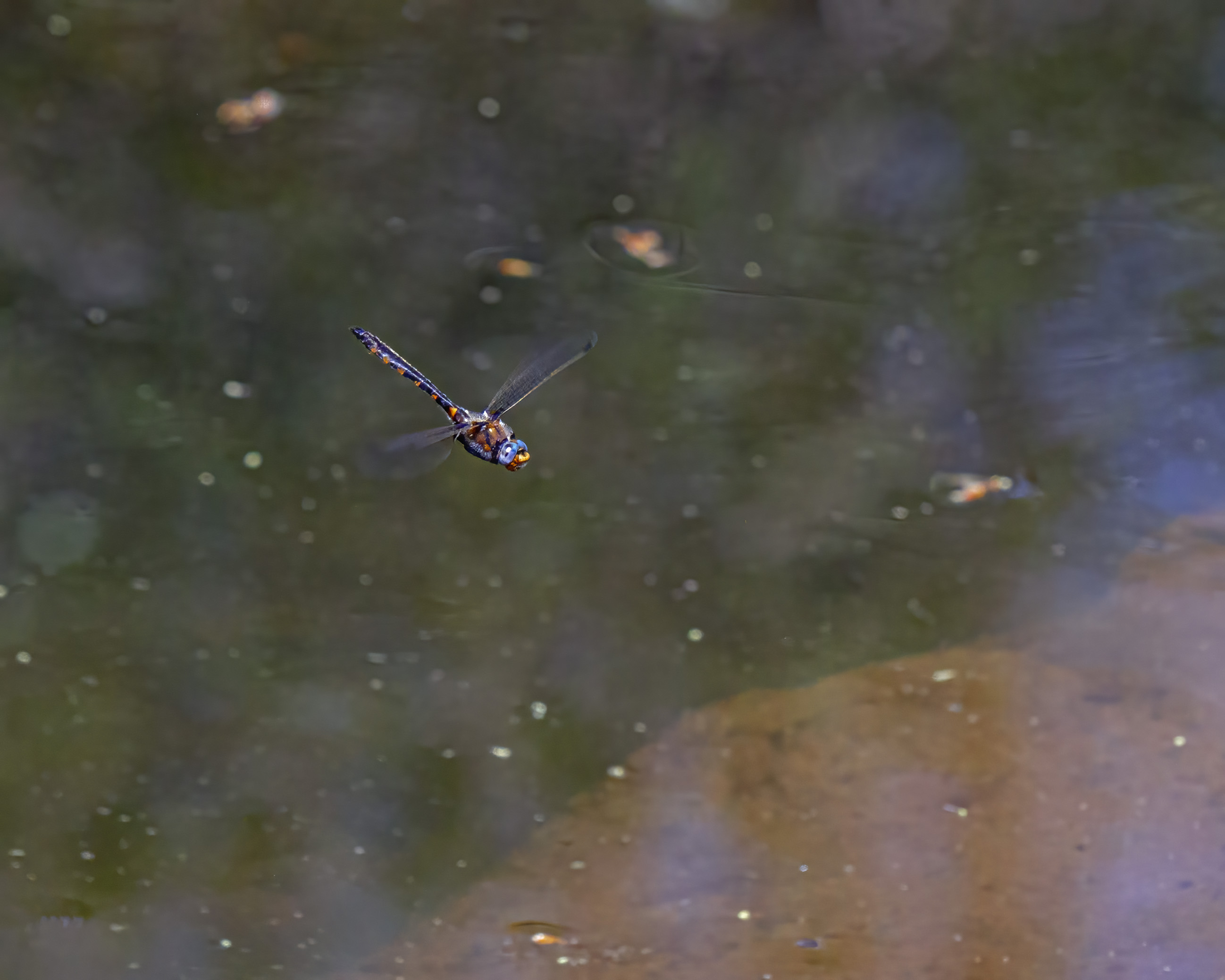
In mid-June I spotted a Common Baskettail dragonfly (Epitheca cynosura) as it flew back and forth over the pond at Jackson Miles Wetland Refuge. During one of its passes I managed to freeze its motion in this shot. I like the way that you can see all four wings and also the distinctive markings on its body. The bluish-green eyes really “pop” and if you look really closely, you can see the that the dragonfly folds its legs under its thorax (the torso part of its body) while it is flying.

I returned yesterday from my five-day trip up to Massachusetts and Maine to deal with a family emergency. Hopefully I will be able to get out this week and capture some new images. It’s hard to believe that it is already July.

Common Baskettail

© Michael Q. Powell. All rights reserved.

Read Full Post »

I just wanted to alert readers who may be used to me publishing a blog posting almost every day that I will be absent from this space for the rest of this week. A family emergency requires me to travel to Massachusetts and Maine and I will not have access to the internet for most of this time.

I decided though to leave you with a shot of a dragonfly facing away. While I was exploring Occoquan Regional Park earlier this month, I managed to get only a single angled view of this dragonfly before it flew away, but it was enough to confirm that it was my first Carolina Saddlebags dragonfly (Tramea carolina) of the season. Despite the odd angle, I was able to capture the patches on the hind wings that are thought to resemble “saddlebags” and its distinctive red color, so identification was not a problem.

I really like the colors and patterns of this shot, which has more of an “artsy” feel rather than a “scientific” one. Normally eye contact is desirable with a subject, but I look at that “rule” as more of a suggestion than a requirement.

Carolina Saddlebags

© Michael Q. Powell. All rights reserved.


Read Full Post »

As I was seated in my car at a stoplight, I glanced across the intersection at the traffic in the oncoming lanes and was delighted to spot a giant dragonfly on the side of a U-Haul truck. I grabbed my camera off of the passenger seat where it was seated and managed to take this photo before the lights changed.

In case you are viewing this and cannot read the words on the graphic, it say “#105 Venture Across Canada, British Columbia, A Secret Urban Wilderness/Un Coin Sauvage Et Secret En Ville, Burn Bog.” According to its website, Burns Bog is “a raised bog ecosystem covering approximately 3,000 hectares of the Fraser River delta between the south arm of the Fraser River and Boundary Bay” in the greater Vancouver area of British Columbia. The site claims that the bog is the largest undeveloped urban landmass in North America at 8,000 acres.

I think that my eyes are so finely tuned to recognizing the shape of a dragonfly that I manage to spot them in the most unlikely places, like on the side of a U-Haul truck.

U-Haul dragonfly

© Michael Q. Powell. All rights reserved.

Read Full Post »

This handsome Common Green Darner dragonfly (Anax junius) does not have all of the colors of the rainbow, but it does have many of them and I love its mix of vibrant colors. The dragonfly was perched vertically really low in the vegetation when I spotted it during a recent to Occoquan Regional Park. I ended up sprawled almost flat on the ground to get this shot—my position would have made for an amusing photo, but fortunately no one else was around to capture that moment.

Mature male Common Green Darners have bright blue abdomens. The reddish pink color of this dragonfly’s abdomen suggest to me that it is an immature male. Early and late in the season, the abdomens of male Common Green Darners may appear purple. Common Green Darners have dark-colored platelets in their blood that rise to the surface when it is cold, darkening their abdomen color and attracting more sun. On bright, hot days, those dark platelets sink, and the abdomen turns bright blue again, now reflecting light.

Common Green Darner

© Michael Q. Powell. All rights reserved.

Read Full Post »

This Gray Petaltail dragonfly (Tachopteryx thoreyi) was quite cooperative and let me take a close-up portrait last week as I was exploring a small pond in Fairfax County, Virginia. Gray Petaltails are known to be quite friendly and inquisitive and I have had one perch on me on multiple occasions. During one such encounter in 2019, fellow dragonfly enthusiast Walter Sanford snapped a couple of photos of one perched on me when I was wearing a gray sweatshirt that must have made me look like a tree to the dragonfly. If you want to see the photos, check out Walter’s blog post entitled “You look like a tree to me.

Most of the time I am not able to approach a dragonfly from this angle to get a close-up shot. Dragonflies have incredible vision and I am certain that this one could see me coming. However, he apparently did not see me as a threat and stayed in place while I took several shots. As you can see, the depth of field was incredibly shallow for this shot—only a small portion of the dragonfly’s body was in focus—but I was able to keep the striking gray eyes in focus and capture a lot of details that highlight their beauty.

Gray Petaltail

© Michael Q. Powell. All rights reserved.

Read Full Post »

There were lots of Slaty Skimmers (Libellula incesta) flying about on Tuesday at the small pond at Jackson Miles Abbott Wetland Refuge, but none of them were cooperative in perching within range. They seemed to content to buzz around over the lily pads and land occasionally in vegetation overhanging the water—I was willing to lean a little to get closer to the dragonflies, but did not want to risk falling into the water.

Slaty Skimmers are one of our most common summer dragonfly species and they find themselves at home in almost any habitat. The mature males are really easy to identify because of their dark bodies and eyes. Immature males and females are a lot harder to distinguish from a number of other species in the skimmer family, like the Great Blue Skimmer and the Bar-winged Skimmer.

Slaty Skimmer

Slaty Skimmer

© Michael Q. Powell. All rights reserved.


Read Full Post »

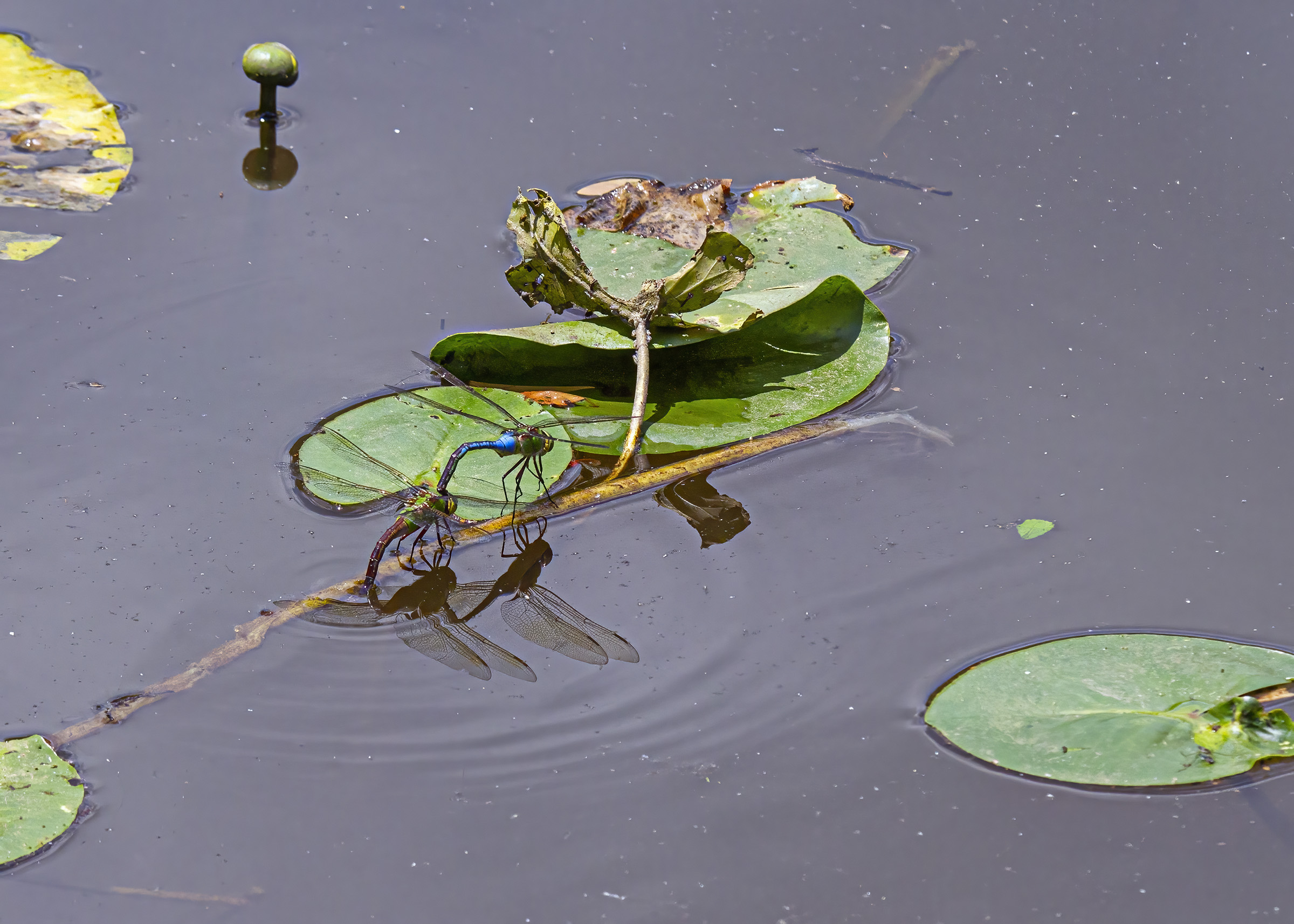
I spotted a female Common Green Darner dragonfly (Anax junius) as she was ovipositing while her male partner held onto her last Saturday at the edge of the small pond at Jackson Miles Abbott Wetland Refuge. Common Green Darners are large dragonflies—about 3 inches (76 mm) in length—so it was relatively easy to track the pair as they moved about placing eggs in various patches of vegetation in the water.

After mating takes place, the males of some species of dragonflies disappear.  In other species, the male stays nearby, guarding the female and fending off other males that might remove the initial suitor’s sperm and replace it with their own.  Some species, like this Common Green Darner, remain attached to the female in a position known as “tandem.” while egg-laying takes place.  The female Common Green Darner submerges her abdomen and lays her eggs in or on the aquatic vegetation, as you can see in these images. If you look really closely at the first image, you can see what I believe is the dragonfly’s curved ovipositor that she uses to make a little slit into the vegetation in which to place the eggs.

According to an article on Animal Diversity Web, there are two different lifecycles for Common Green Darners, one for the dragonflies that have migrated northward and one for the resident population. “Migratory adults mate and oviposit in June. Unlike resident populations, nymphal development for migrant offspring takes only 3 to 5 months, and they do not overwinter. They emerge as tenerals typically around late-August and September. They often begin their migration as tenerals, feeding along the way and developing into adults.” The timing of the activity that I observed suggests that these could be migrant Common Green Darners.

“For residents in the north, the adults mate and oviposit in late July to August. The resulting offspring hatch and develop to mid-instars and then overwinter when temperatures drop. Total nymphal development time can take 11 to 12 months for residents, as the nymphs finish development when temperatures warm in the spring and then emerge as adults in the following June and July.”

I highly recommend the article that I referenced, which has lots more fascinating information about this colorful dragonfly species.

Common Green Darner

Common Green Darner

Common Green Darner

Common Green Darner

© Michael Q. Powell. All rights reserved


Read Full Post »

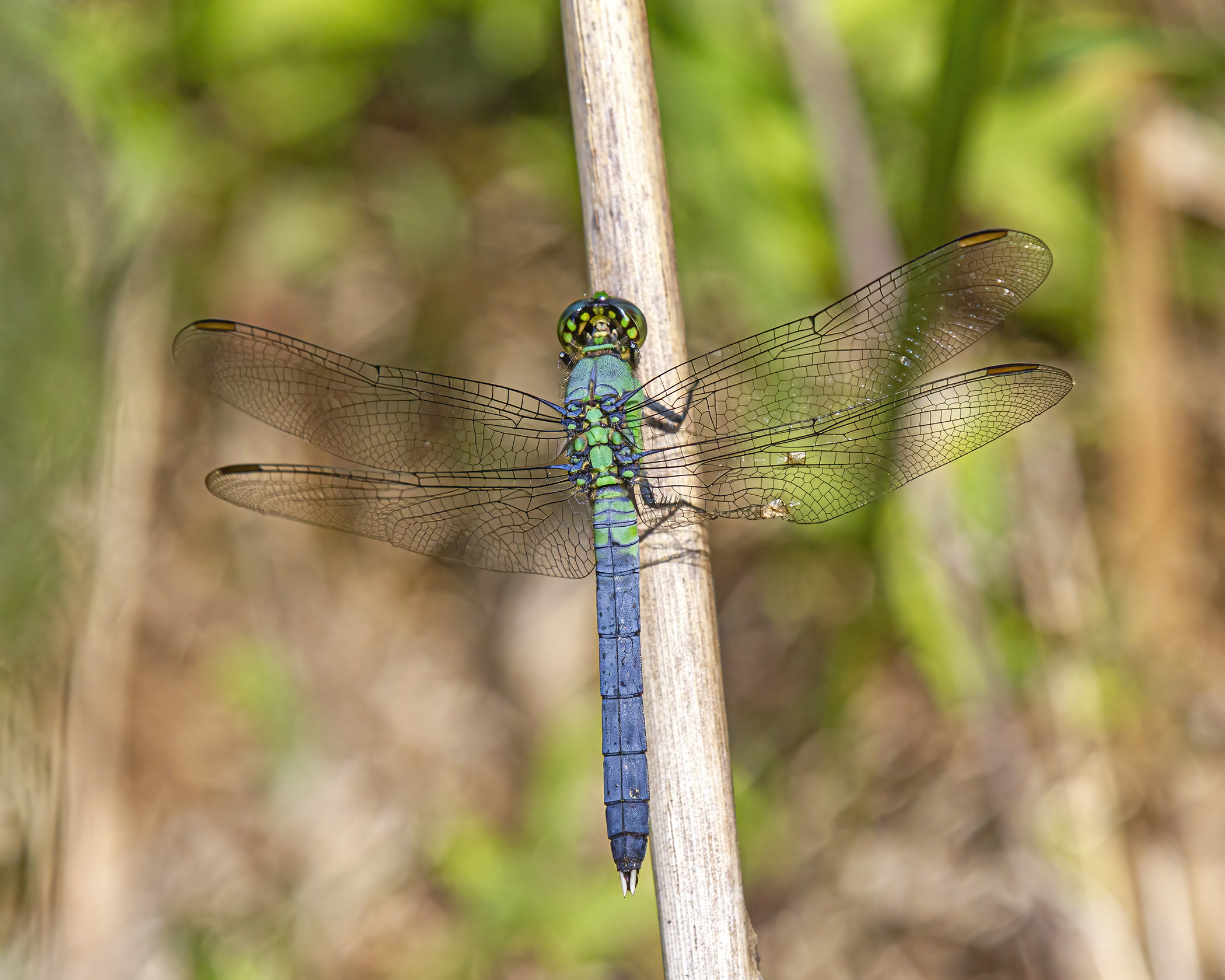
I love the look of male Eastern Pondhawk dragonflies (Erythemis simplicicollis) when they are transitioning to adults. When they are juvenile, male Easter Pondhawks have emerald green thoraxes and black striped abdomen, like their female counterparts. Gradually the body coloration shifts to blue as they mature. I really like their appearance when, as was the case with these pondhawks that I photographed last week at Occoquan Regional Park, their bodies have beautiful shades of both green and blue.

In the second and third photos, you get a glimpse of the pondhawk’s beautiful eyes that are also a combination of blue and green. Although you can’t see it very well in these photos, Eastern Pondhawks of both genders have bright green faces, which helps to distinguish the male Eastern Pondhawks from a number of other dragonfly species that have blue bodies.

Eastern Pondhawk

Eastern Pondhawk

Eastern Pondhawk

© Michael Q. Powell. All rights reserved


Read Full Post »

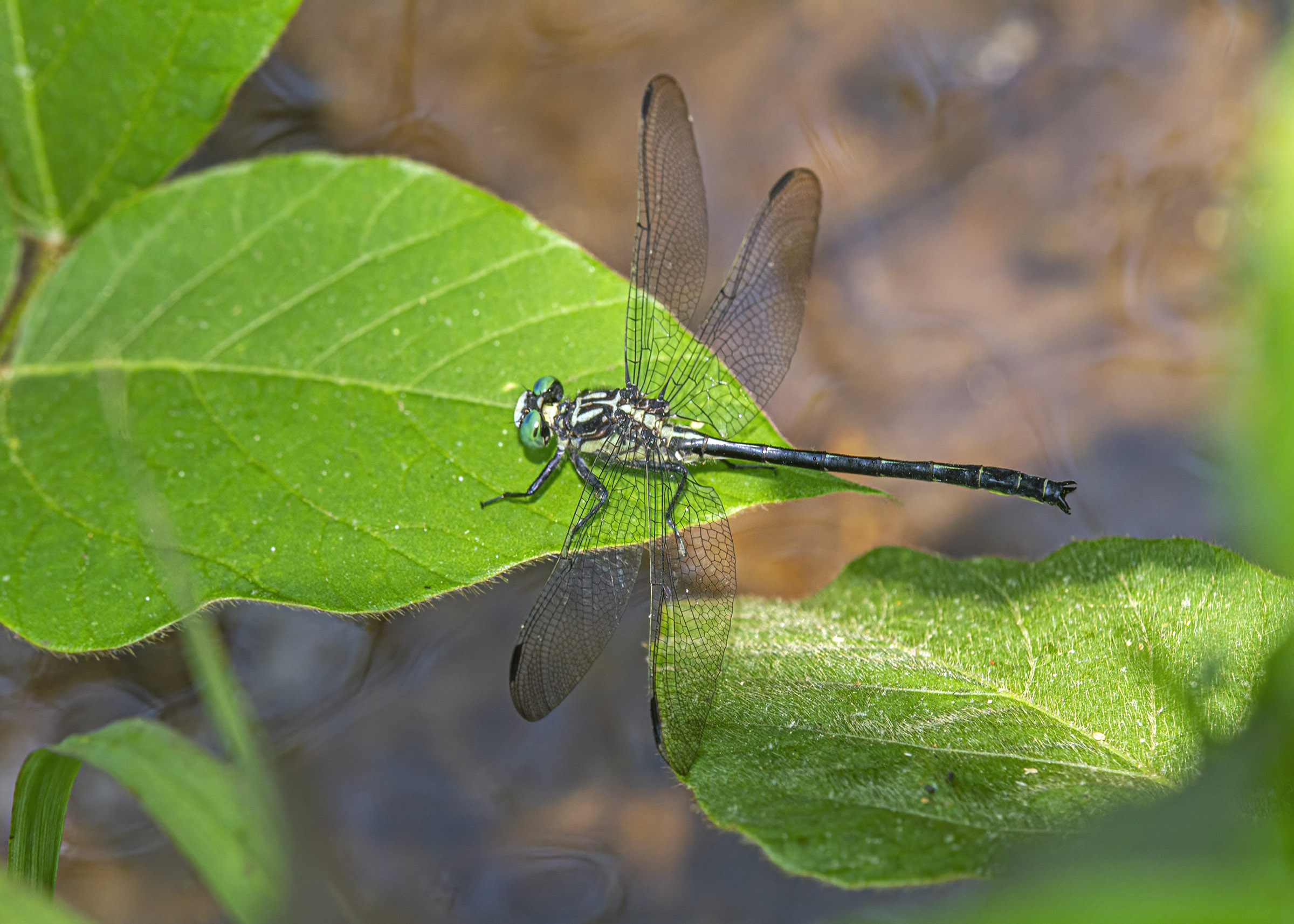
I was thrilled to spot at least one male Sable Clubtail dragonfly (Stenogomphurus rogersi) last Saturday while I was exploring a small stream in Fairfax County, Virginia. I visited that section of the stream several times during the day and had multiple sightings of a Sable Clubtail, but I am not sure if there was more than one of this species or if I was seeing the same individual each time.

As you can see from these two photos, Sable Clubtails like to perch low in vegetation just above the level of the water of the stream. As a result I had to crouch really low to be able to capture these images. The lighting was brighter for the first photo and you can see many of the details of the markings on the dragonfly, but I really like the cool shadow in the second image, which has a more “artsy” feel.

Sable Clubtails are rarein our area. Fellow dragonfly enthusiast Walter Sanford did extensive research and rediscovered this species in 2018 and I have been fortunate to see a Sable Clubtail at this stream in most years since then. If you are interested in the backstory of Walter’s efforts, check out his June 2018 blog posting entitled Off-season homework pays dividends.

Sable Clubtail

Sable Clubtail

© Michael Q. Powell. All rights reserved


Read Full Post »

Many summer dragonfly species are now emerging on the scene, like this immature male Widow Skimmer dragonfly (Libellula luctuosa) that I spotted last Tuesday at Occoquan Regional Park in Lorton, Virginia.

Anecdotally, someone thought that these dragonflies appeared to be draped in mourning crepe and that is the source of the “widow” in the name of the species. The Loudon Wildlife Conservancy website states that “This dragonfly got the “widow” name because, unlike most other dragonfly species where the male stays near the female after she lays the eggs, the male in this pair leaves her after the eggs have been laid.” Either explanation is plausible, though I have seen more references to the first explanation than the second one.

I was quite fortunate that the dragonfly chose a high perch that allowed me to separate it from the rest of the background. Quite a few of the dragonflies that I have photographed recently have perched on the ground or in dense vegetation and the backgrounds in those photos have been quite cluttered.

Widow Skimmer

Widow Skimmer

© Michael Q. Powell. All rights reserved

Read Full Post »

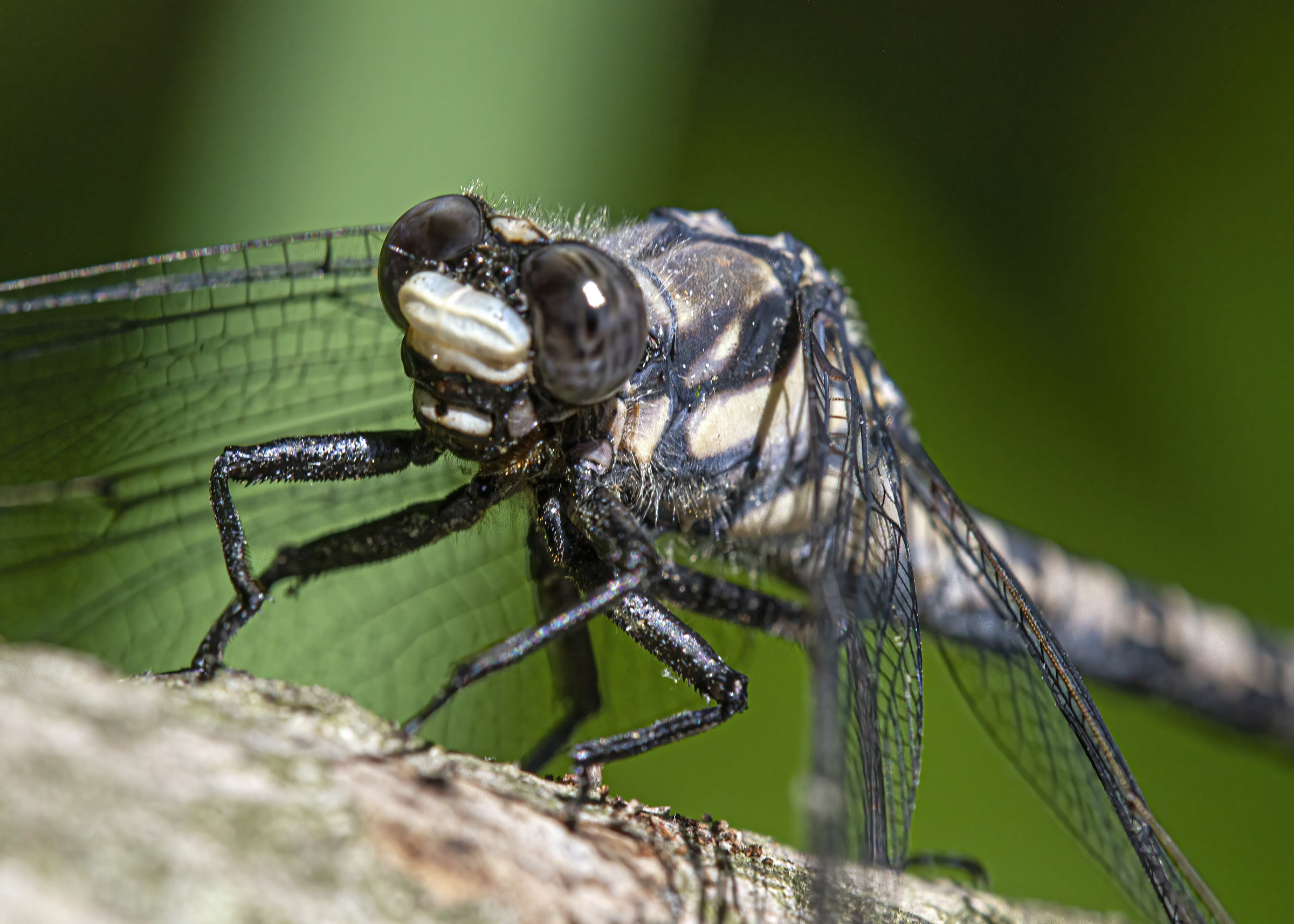
Usually I see Gray Petaltail dragonflies (Tachopteryx thoreyi) perched vertically on tree trunks, but this one perched horizontally on a fallen branch and stared at me after landing momentarily on my shoulder on Tuesday at Occoquan Regional Park in Lorton, Virginia.

I really like to get eye-to-eye contact with dragonflies—somehow it makes the encounter more personal and intimate. One of the consequences of shooting from this angle, though, is that much of the body of the dragonfly will be out of focus. I am ok with that and in fact it tends to pull the viewer’s eyes towards those bits that are in focus, particularly the dragonfly’s wonderful compound eyes.  Gray Petaltail

© Michael Q. Powell. All rights reserved.


Read Full Post »

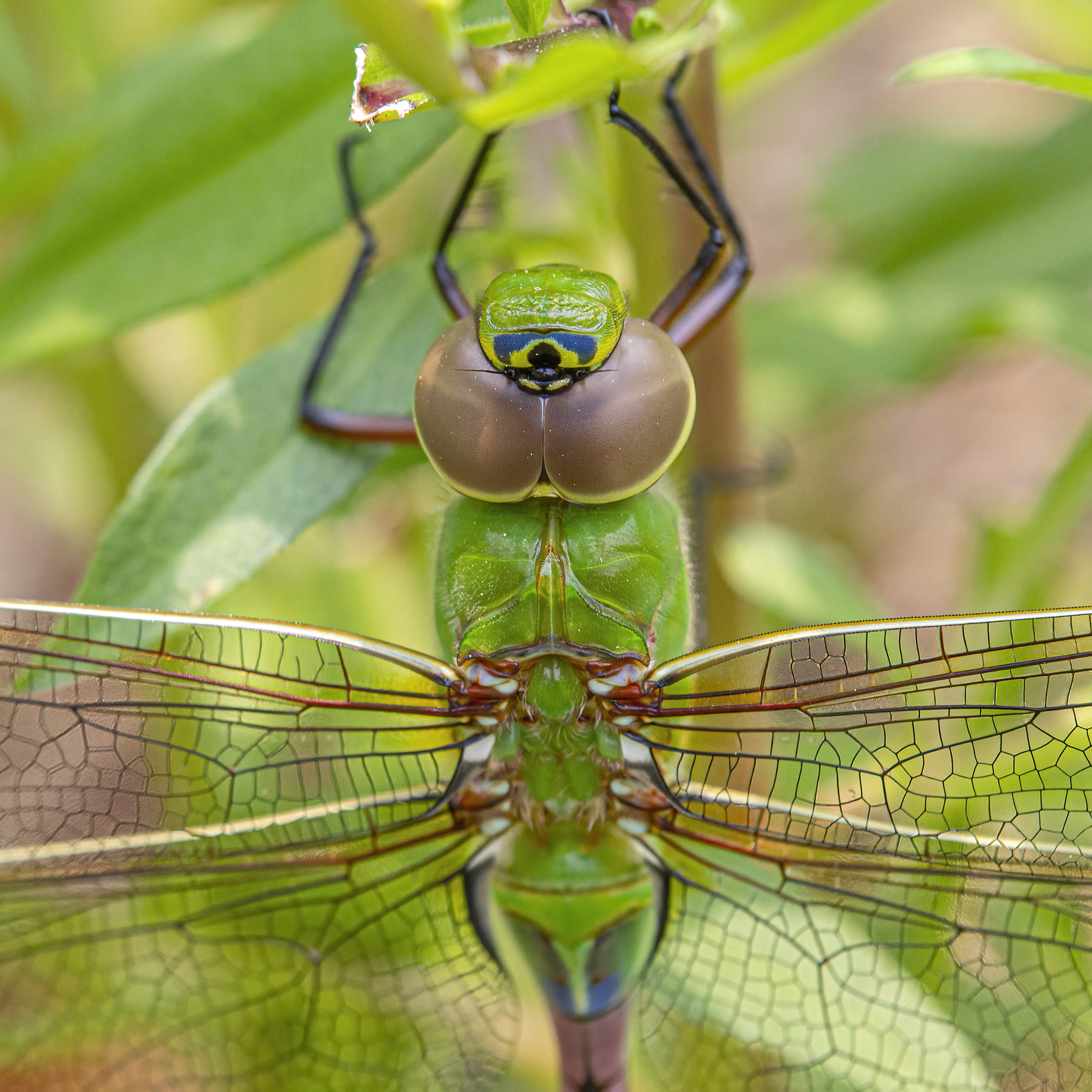
I am used to seeing Common Green Darner (Anax junius) dragonflies flying overhead, but on Tuesday I had the relatively rare chance to see one up close at Occoquan Regional Park. The Common Green Darner is a large, colorful dragonfly that is known for its long distance migratory flights. According to Wikipedia, “By attaching micro-radio transmitters to Common Green Darners, researchers have found them to be capable of migrating up to 140 kilometers in a day, though they typically cover less distance per day. ” Wow!

I spotted this dragonfly when I saw it fly to a perch in the vegetation just inches above the ground. I slowly made my way towards the vertically-perched Common Green Darner and surprisingly it did not move. I am not certain, but I had the impression that the dragonfly had newly emerged and was resting as its body parts dried out.

My 180mm macro lens gives you the impression that I was right on top of the dragonfly, but I was actually quite a bit farther away than it seems. After I took a few shots and moved away, the Common Green Darner remained in place. In fact, when I passed by the same area about twenty minutes later, it was still perched there.

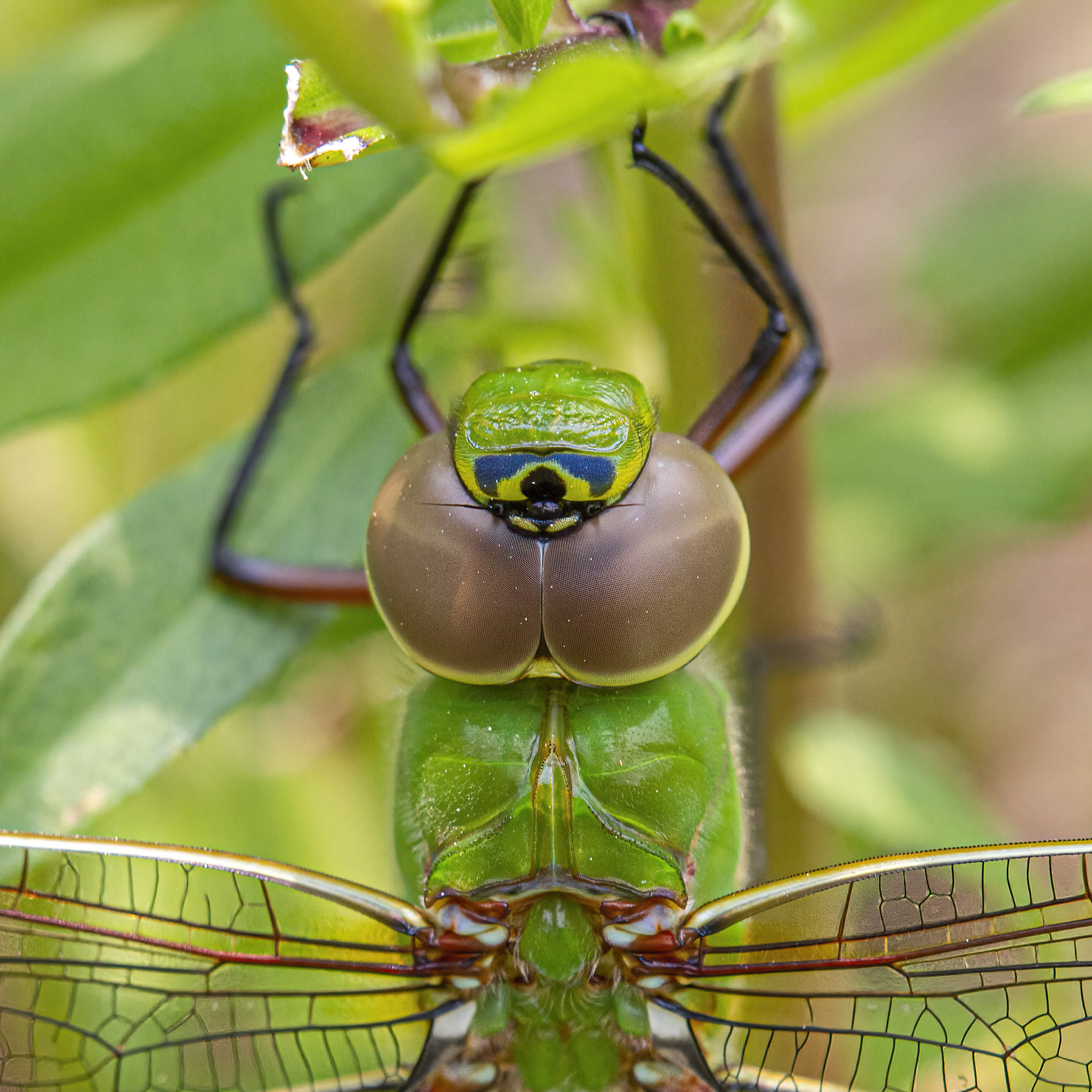
I was thrilled by the amount of detail that I was able to capture. You can easily see the distinctive “bullseye” marking, for example, on the “face” of the dragonfly. The second image is a closer crop of the first image and it helps you to see some of the ommatidia, the thousands of faceted optical units that make up the dragonfly’s amazing compound eyes. You may want to click on the image to make it larger on your screen.

According to an on-line article called Dragonfly’s Eyes, “Dragonflies have very large eyes and have very good vision. Vision dominates their behaviour, including predation and looking for mates. The compound eye is made up of ommatidia which is a visual unit consisting of a lens system and a group of light sensitive cells. A large dragonfly may have up to 30,000 ommatidia in each compound eye. Each ommatidium collects one visual information, together form a mosaic image in the dragonfly’s brain. It is believed that the insects’ compound eyes are not as high resolution as vertebrate eyes. However, the dragonfly’s visual system is extremely sensitive to movement and it points in almost all direction and gives the 360 degree visual field.”

Common Green Darner

Common Green Darner

© Michael Q. Powell. All rights reserved.

Read Full Post »

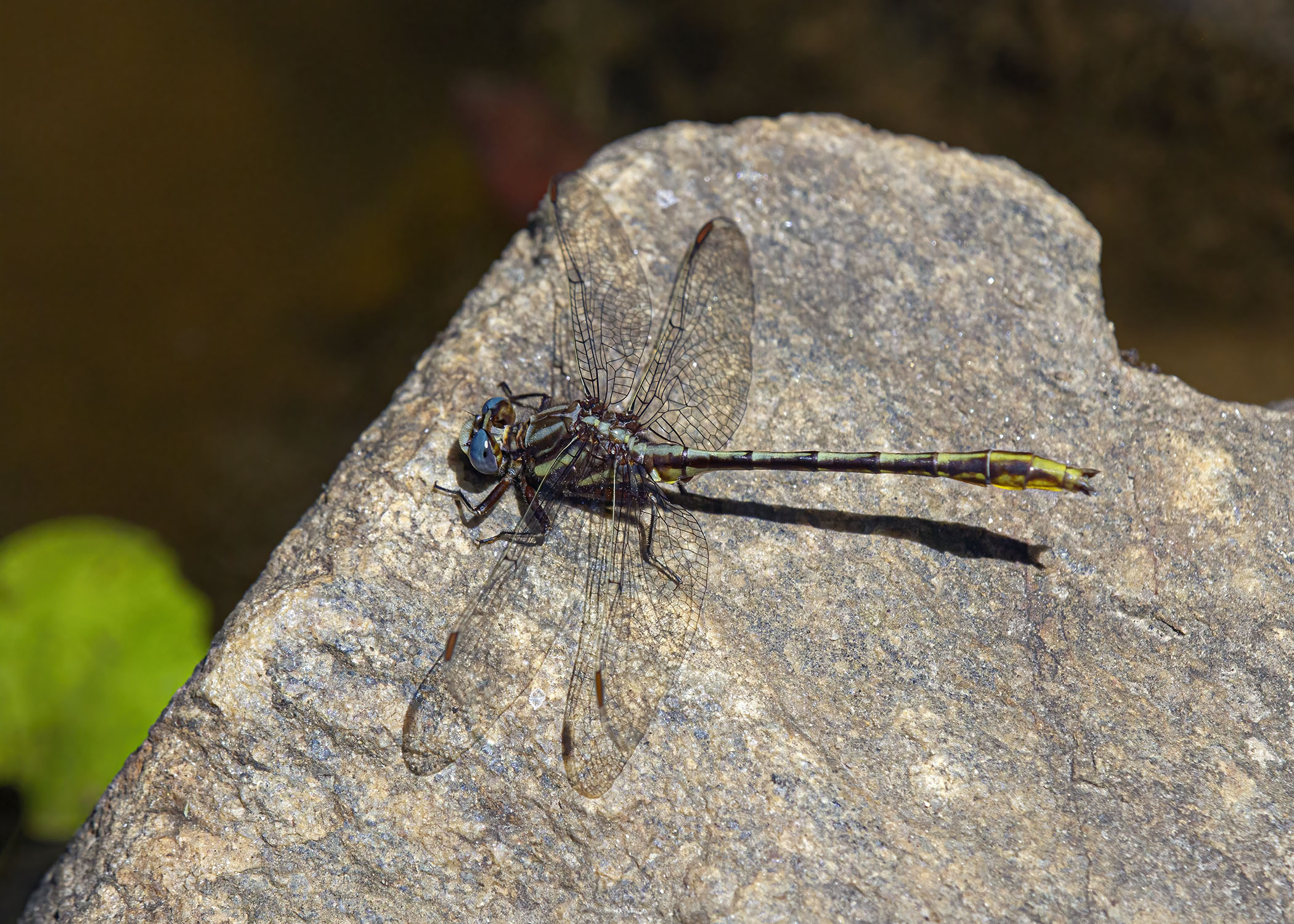
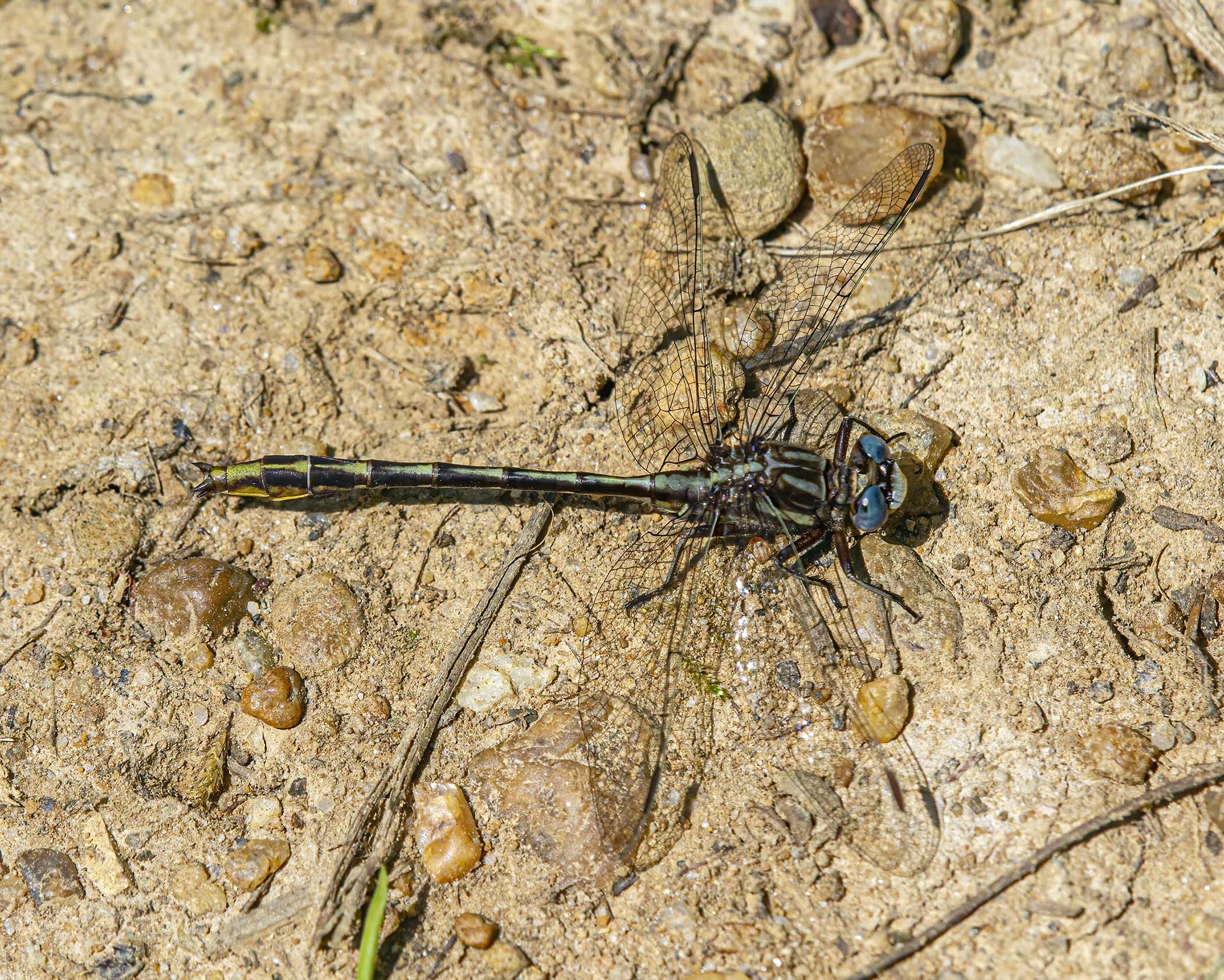
I was delighted to spot several handsome Lancet Clubtail dragonflies (Phanogomphus exilis) during a recent visit to Jackson Miles Abbott Wetland Refuge, my first sightings of this species this season. As you can see from these two photos, Lancet Clubtails like to perch flat on the ground and I spotted both of these near the edge of the pond.

I love the bright blue eyes of Lancet Clubtails and the yellow flange near the tip of the abdomen, a feature that helps to distinguish Lancet Clubtails from the visually-similar Ashy Clubtails. Some members of the Clubtail family have large and obvious “clubtails,” but the one on the male Lancet Clubtails is relatively small—you have to look at the proper angle to see it well. I like the way that the shadow in the first photo makes it easy to see the enlarged area near the end of abdomen that constitutes the “clubtail.”

Lancet Clubtail

Lancet Clubtail

© Michael Q. Powell. All rights reserved.

Read Full Post »

Can you spot the dragonfly in the first photo? Let me give you a clue—the large dragonfly is in the center of the image. Can you see it now?

Some dragonflies are easy to see, because of their bright colors or the way that they perch in the open on prominent stalks of vegetation. Others are a bit harder to see, because they perch on the ground or in dense vegetation (or they fly continuously and rarely seem to land).

The Gray Petaltail dragonfly (Tachopteryx thoreyi) is a bit of an anomaly—it perches in the open, but is still very hard to spot. Why? Its gray and black coloration is an almost perfect match for the rough bark of the trees on which it usually perches vertically. In the past I have watched a Gray Petaltail fly to a tree and perch and had trouble seeing it, even though I knew exactly where it was.

Last Wednesday I spotted my first Gray Petaltail of the season as I was exploring a small pond in Prince William County, Virginia. I had seen this dragonfly species at this location several times to the past, so I was carefully scanning the trunks of trees on which they sunlight was shining directly—Gray Petaltails seem to prefer direct sunlight, especially earlier in the day.

I often have to rely on movement to see dragonflies that are so well camouflage, but amazingly I spotted the dragonfly in the first photo while it was still perched. I cropped the image and made a few tweaks to make it a little more visible for you, but it was so tough to spot that I had to creep closer and look from a different angle to make sure that my eyes were not playing tricks on me.

For the second and third shots, I moved around the tree in an effort to better isolate the dragonfly from the tree. I think that approach worked especially well in the final photo in which the dragonfly had raised its wings a bit. Suddenly the Gray Petaltail was much more visible. I chose my angle carefully to try to get a bit of the sky in the photo—I was shooting at an upward angle—and I really like the way that the background came out in the final image.

Gray Petaltail

Gray Petaltail

Gray Petaltail

© Michael Q. Powell. All rights reserved.

Read Full Post »

Several Common Baskettail dragonflies (Epitheca cynosura) were patrolling over the pond at Jackson Miles Abbott Wetland Refuge last Thursday and I spent a lot of time trying to capture images of one of them as they zoomed by me. I made attempts with both my 180mm macro lens and my 18-400mm zoom lens, sometimes using focusing manually and sometimes using auto focus. Needless to say, there is also a lot of luck involved in getting a somewhat sharp photo of a dragonfly in flight

I spent a lot of time trying to track the dragonflies. They didn’t exactly fly in a pattern, but they seemed to have a territory that they were patrolling, so they came by me at irregular intervals. In the first two shots below, I was able to get a bit of the habitat in the photo, but most of the time I was focusing solely on the dragonfly and there is nothing in the background but the somewhat muddy water of the pond.

I was happy that I was able to get some shots from a number of different angles. In some of the shots, the dragonfly was flying by me, but in other cases I manage to capture images in which the dragonfly was flying towards me or away from me. The angle was often dependent on the speed with which I was able to acquire my target in the viewfinder of my camera and successfully track it as I tried to focus on it—hand-t0-eye coordination is critical.

I used to think that it was impossible to get shots like these. It has gotten a little easier over time as I have gained experience, but it still is pretty hard. No matter how skilled I get, patience and persistence are still the most critical factors in this type of photography.

Common Baskettail

Common Baskettail

Common Baskettail

Common Baskettail

© Michael Q. Powell. All rights reserved.

Read Full Post »

I can’t help myself. Whenever I see dragonflies flying over the water, I feel compelled to try to photograph them in flight. This past weekend I spotted several Common Baskettail dragonflies (Epitheca cynosura) flying patrols over a small pond in Orkney Springs, Virginia. The dragonflies flew by numerous times, giving me a lot of opportunities to take shots.

As is usually the case, most of my shots were out of focus or included only a portion of the dragonfly at the edge of the frame. However, as most of you know, I am quite persistent and eventually I managed to get some decent shots of the dragonflies.

Several of my sharpest shots show the dragonfly against a gray background, but lack a sense of the environment. The last three shots include patches of algae and give you a really cool perspective that reminds me of the view that you get from an airplane window when you look out and see another airplane along with the ground below.

Common Baskettail

Common Baskettail

Common Baskettail

Common Baskettail

Common Baskettail

© Michael Q. Powell. All rights reserved.


Read Full Post »

I was delighted on Wednesday to spot my first Eastern Pondhawk (Erythemis simplicicollis) dragonflies of the season while I was exploring the trails at Occoquan Regional Park. As we progress into summer, this species will become quite abundant, but it is always a joy to spot these little beauties.

Females, like the ones in these photos, are bright green in color and have a banded abdomen. I did not see any males that day, but they start out with coloration similar to that of the females and then gradually transition to having a blue abdomen and a blue and green thorax. Both genders have green faces, which, along with their coloration, make them easy to identify.

I love the way that the green spring foliage matches the colors of an Eastern Pondhawk and provides a beautiful backdrop for them, as you can see in these photos.

I will be away in the mountains this weekend on a church retreat, so will probably not be posting for the next few days. I will have my camera with me, though, so you may see a few photos from my adventures there in upcoming blog postings.

Eastern Pondhawk

Eastern Pondhawk

© Michael Q. Powell. All rights reserved.


Read Full Post »

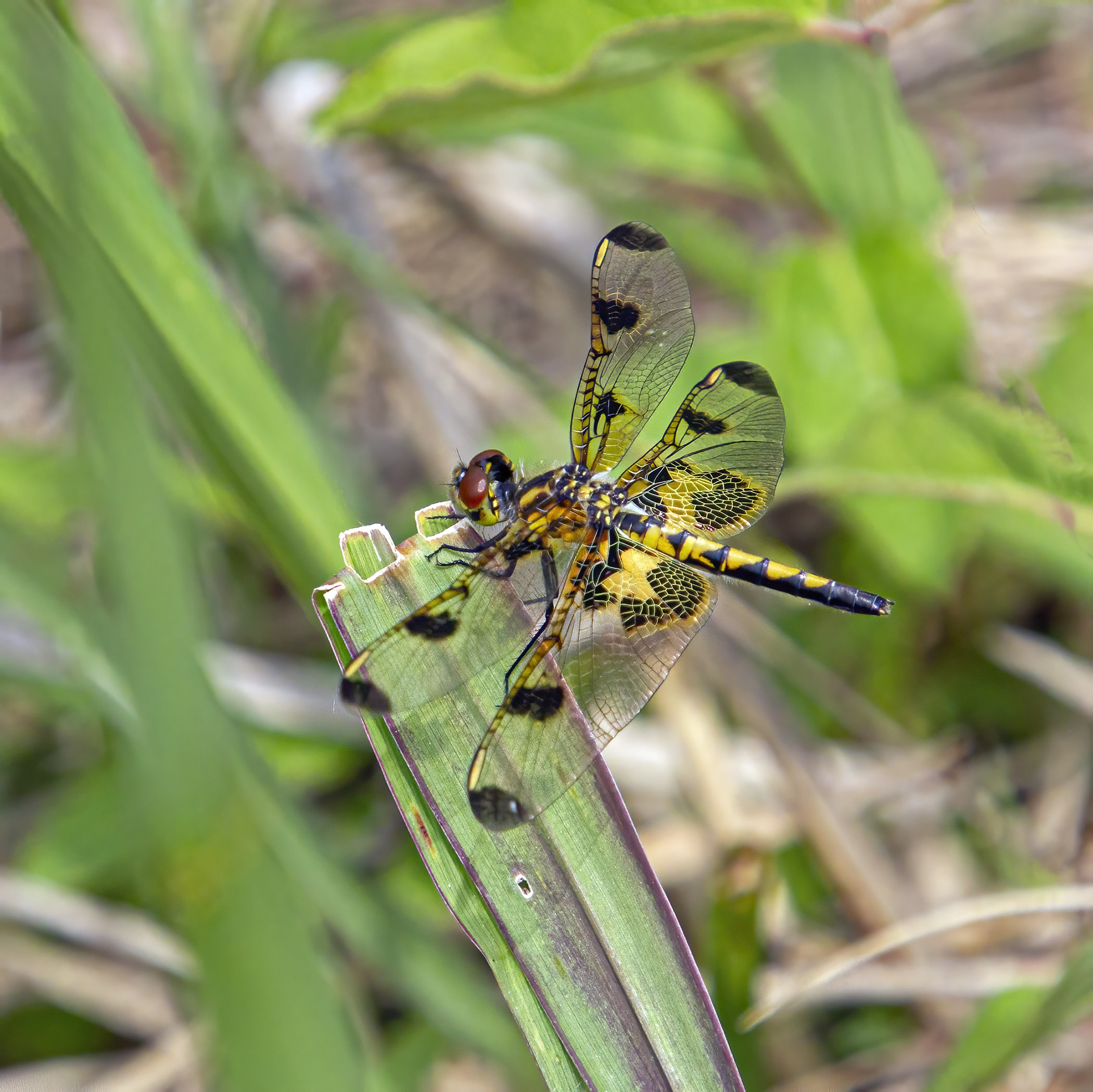
I was delighted last Thursday to see quite a few Calico Pennant (Celithemis elisa) dragonflies during a visit to Occoquan Bay National Wildlife Refuge. The markings and wing patterns on this species are really striking, making this one of the most attractive species that I see during the dragonfly season.

Some of the Calico Pennants appeared to have newly emerged—when dragonflies initially break through the exoskeleton of their water-dwelling larvae selves, their wings are really shiny and fragile and their coloration is often pale. The dragonfly in the first photo appears to be in that stage of development, which is sometimes referred to as “teneral.” It you look closely at the place where the dragonfly is grasping the vegetation, you can see what is quite probably its discarded exoskeleton from which it had recently emerged.

The Calico Pennants in the second and third photo are females, as was the one in the first photo. The patterns on the wings of these more mature females are more distinct and their yellow coloration is somewhat brighter. How do I know that they are females? If you look closely at the ends of their abdomens (the “tails”) you can see the terminal appendages that indicate their gender.

Female Calico Pennants have yellow markings on their abdomens, but that is not a reliable indicator of their gender, because immature males have that same coloration. The dragonfly in the fourth photo, for example, is an immature male Calico Pennant. If you compare the tip of the abdomen of this dragonfly with the one in the third photo, you may be able to see that there are differences.

What does a mature male Calico Pennant look like? I managed to spot only a single mature male that day, but fortunately was able to capture a shot of it. As you can see in the final photo, adult male Calico Pennants have red marking on their abdomens and the veining on their wings is pinkish in color.

We are gradually transitioning to the summer dragonfly species and some of the early spring ones are starting to disappear. I’ll be keeping my eyes open for the “new” species, so don’t be surprised to see more dragonfly photos in the upcoming months.

Calico Pennant

Calico Pennant

Calico Pennant

Calico Pennant

Calico Pennant

© Michael Q. Powell. All rights reserved.

Read Full Post »

As I was reviewing my photos of the past couple of weeks, I was a little surprised at the number of shots that I have taken of Blue Corporal (Ladona deplanata) dragonflies in wildly varying environments. Blue Corporals are an early-season species and won’t be around for too much longer, so I am happy to have had the opportunity to observe so many of them. Most of the time, Blue Corporals like to perch flat and, judging from the photos, it doesn’t seem to matter if there are rocks, vegetation, or even lily pads.

From the perspective of a naturalist, I like the way that the different photos give you a feel for the environments in which I found these dragonflies. As a photographer, I was also struck by the way that the colors and textures of the background interact with the subjects. Most of the backgrounds in these shots are somewhat cluttered, but I did my best to use framing and focusing techniques to keep the background from being too distracting.

If I had to make a choice, I would say that the first photo is my favorite of the Blue Corporal images. I love the juxtaposition of the dragonfly with the varied textures, shapes, and colors of the rocks. I also really like the way the background grows progressively more blurry towards the top of the image. Do you have a favorite?

Blue Corporal

Blue Corporal

Blue Corporal

Blue Corporal

© Michael Q. Powell. All rights reserved.

Read Full Post »

I tracked this Common Baskettail dragonfly (Epitheca cynosura) in the air for quite some time as it patrolled back and forth along one of the trails at Occoquan Bay National Wildlife Refuge, hoping that it would land. Fortunately I acted quickly when finally it did perch and was able to capture these shots.

The Dragonflies of Northern Virginia website provides the following description of the Common Baskettail, “Small, dark, constantly hovering. Fast, acrobatic flight. Often high above clearings and sunny paths/old roads. Also along pond, stream and river edges.” As you can tell from this description, it is pretty challenging to get a shot of a Common Baskettail dragonfly.

Occasionally I will try to capture an image of a Common Baskettail while it is flying, but that works better when the dragonfly is flying above a pond than when it is flying with a background of vegetation. If you are interested in seeing some shots of Common Baskettails in flight, check out my blog posting from May 2022 entitled “Flying Common Baskettail dragonflies.”

Common Baskettail

Common Baskettail

© Michael Q. Powell. All rights reserved.

Read Full Post »

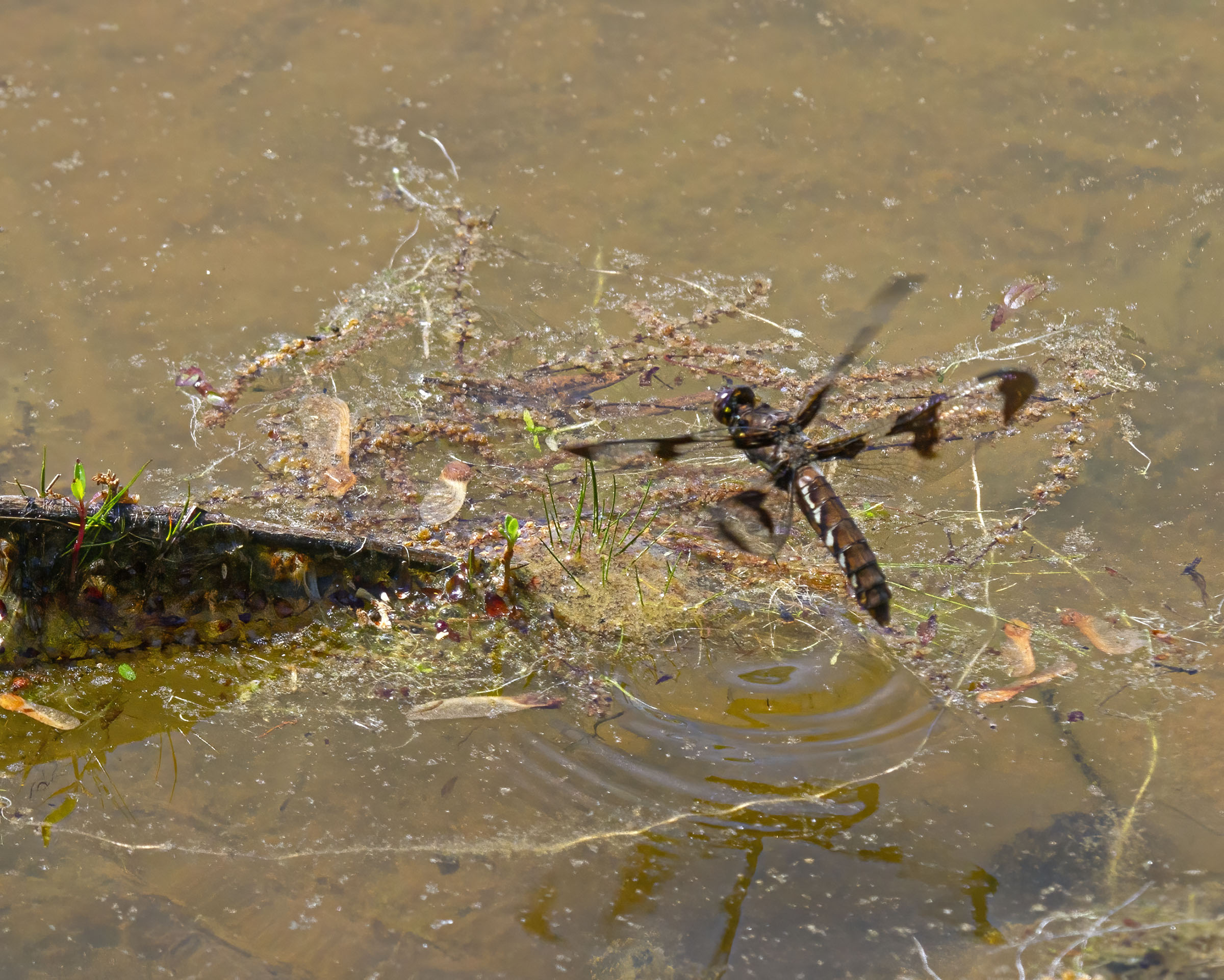
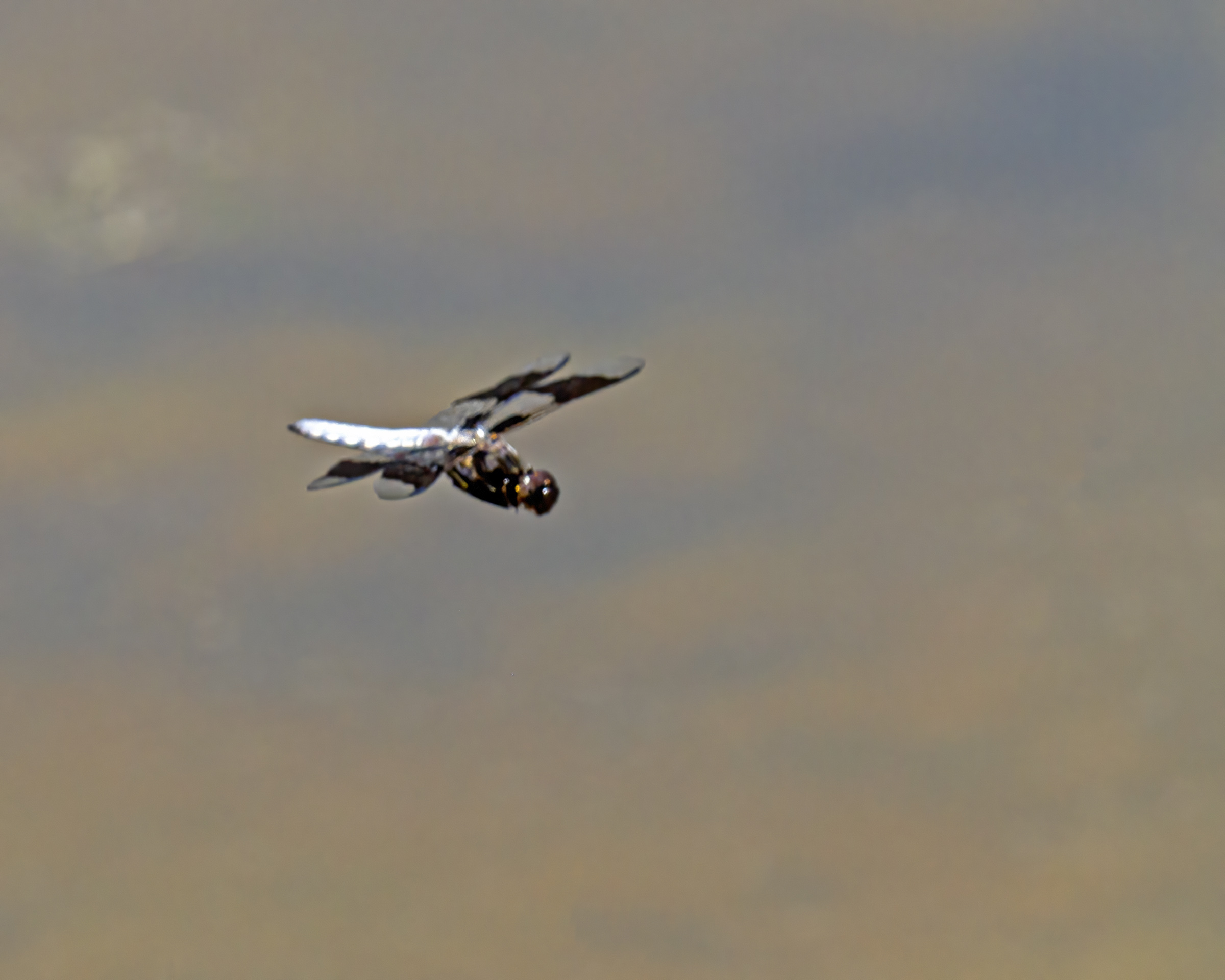
It is pretty early in the season for Common Whitetail dragonflies (Plathemis lydia), but one pair was already getting busy last Friday at Occoquan Bay National Wildlife Refuge. I did not see the actual mating taking place, but I captured this first shot as the female deposited eggs in the water as the male hovered overhead. The second image is a distant shot of the hovering male Common Whitetail.

Different dragonfly species deposit their fertilized eggs in different ways. Some will place the eggs directly into vegetation, while others distribute their eggs more generally into the water. Female Common Whitetails are in the latter group—they oviposit in flight, with guarding male hovering above, by tapping their abdomen into the water near floating vegetation or clumps of mud and often flicking water and eggs forward. According to

If you look closely at the first photo, you can see some concentric ripples where the dragonfly has dipped the tip of her abdomen in the water, releasing some eggs and creating some disturbance on the surface of the water. The male’s job is to fight off any potential rivals that might try to interfere with the process and mate with the female.

The eggs will develop into larvae that will spend most of their lives underwater. The adult phase of their lives, when they transform into dragonflies, may last only a few weeks or so, which is why perpetuation of the species through mating is such a critical biological imperative.

Common Whitetail

Common Whitetail

© Michael Q. Powell. All rights reserved.


Read Full Post »

On Tuesday I spotted this female Common Green Darner (Anax junius) dragonfly at Occoquan Bay National Wildlife Refuge, the first darner that I have been able to photograph this season. Like most darners, Common Green Darners are relatively large dragonflies—about 3 inches (76 mm) in length—that spend a lot of time patrolling in the air. In fact, Common Green Darners are one of a handful of dragonflies that migrate, so that the earliest ones that we see in spring are likely to have migrated from more southern locations before local Common Green Darners have emerged.

When I first spotted this dragonfly, she was patrolling over a field of tall vegetation. I watched her fly back and forth for quite a while. When she decided to take a break, I was lucky to see where she landed.

As you can see in the photo, Common Green Darners normally hang vertically. In this case the dragonfly perched relatively close to the ground, so it was a bit of a challenge to frame the shot, particularly because I was shooting with my long telephoto zoom lens. I am quite pleased, though, with the resulting image that shows off a lot of the details of this species, including the distinctive black and blue “bullseye” in from of the dragonfly’s large compound eyes.

Common Green Darner

© Michael Q. Powell. All rights reserved.

Read Full Post »

Different dragonfly species perch in different ways. Some perch high and some perch low; some perch horizontally, others perch at an angle, and others hang vertically.  I am always intrigued to look at the way a dragonfly is perched and, in particular, to see how the dragonfly is using its legs.

Last week I was delighted to spot a male Stream Cruiser (Didymops transversa) while I was exploring the edge of a creek in Prince William County, Virginia. The Steam Cruiser was perched low in the vegetation at an angle. Stream Cruisers have such long legs that they look somewhat uncomfortable when they are perching.

If you click on the image below, you can get a closer look at the dragonfly’s legs. The dragonfly does not seem to be using its front legs at all to perch and appears to be relying almost exclusively on its middle set of legs. The back set of legs look to be amazing long and are probably more useful for capturing prey than for perching.

Stream Cruiser

© Michael Q. Powell. All rights reserved.

Read Full Post »

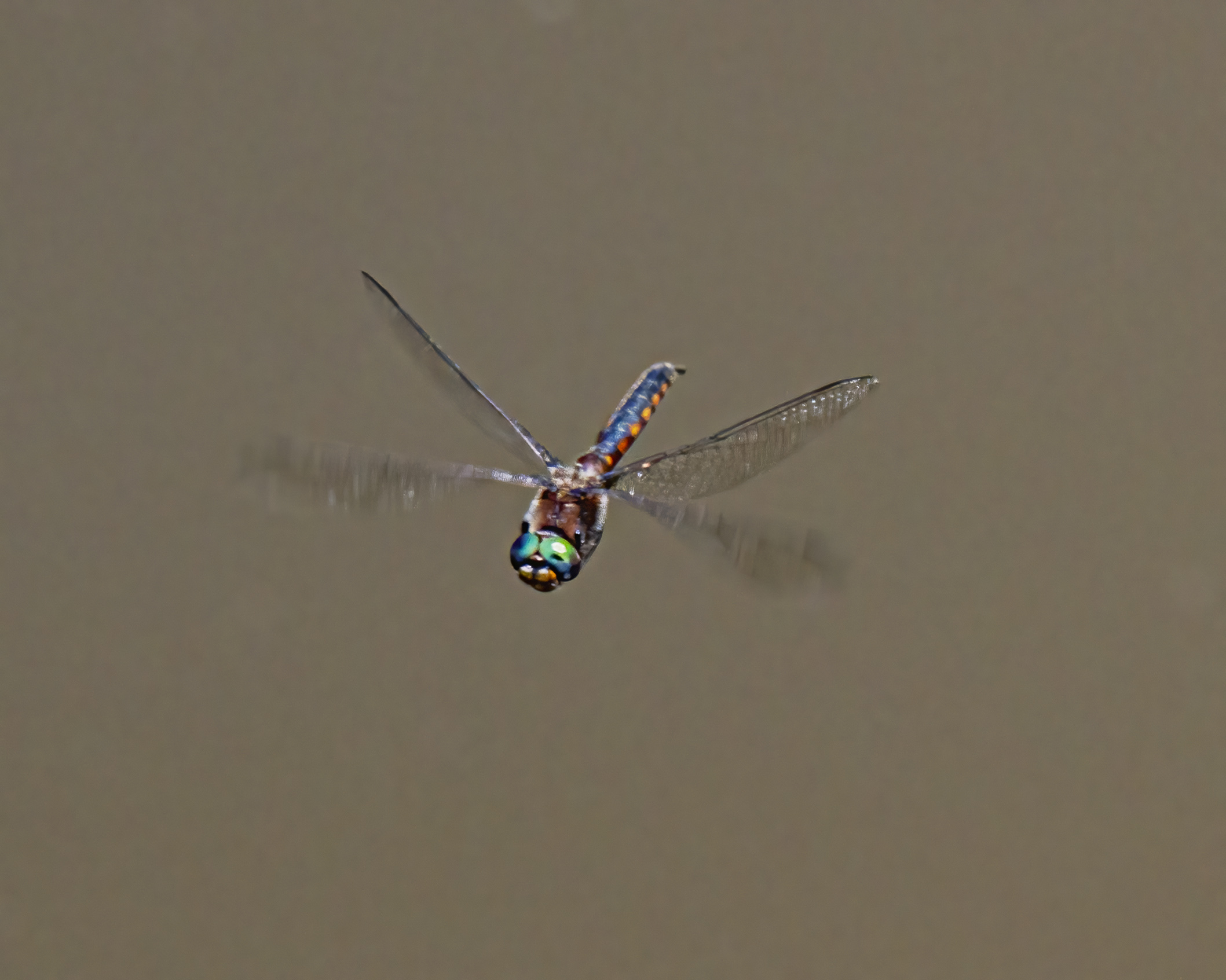
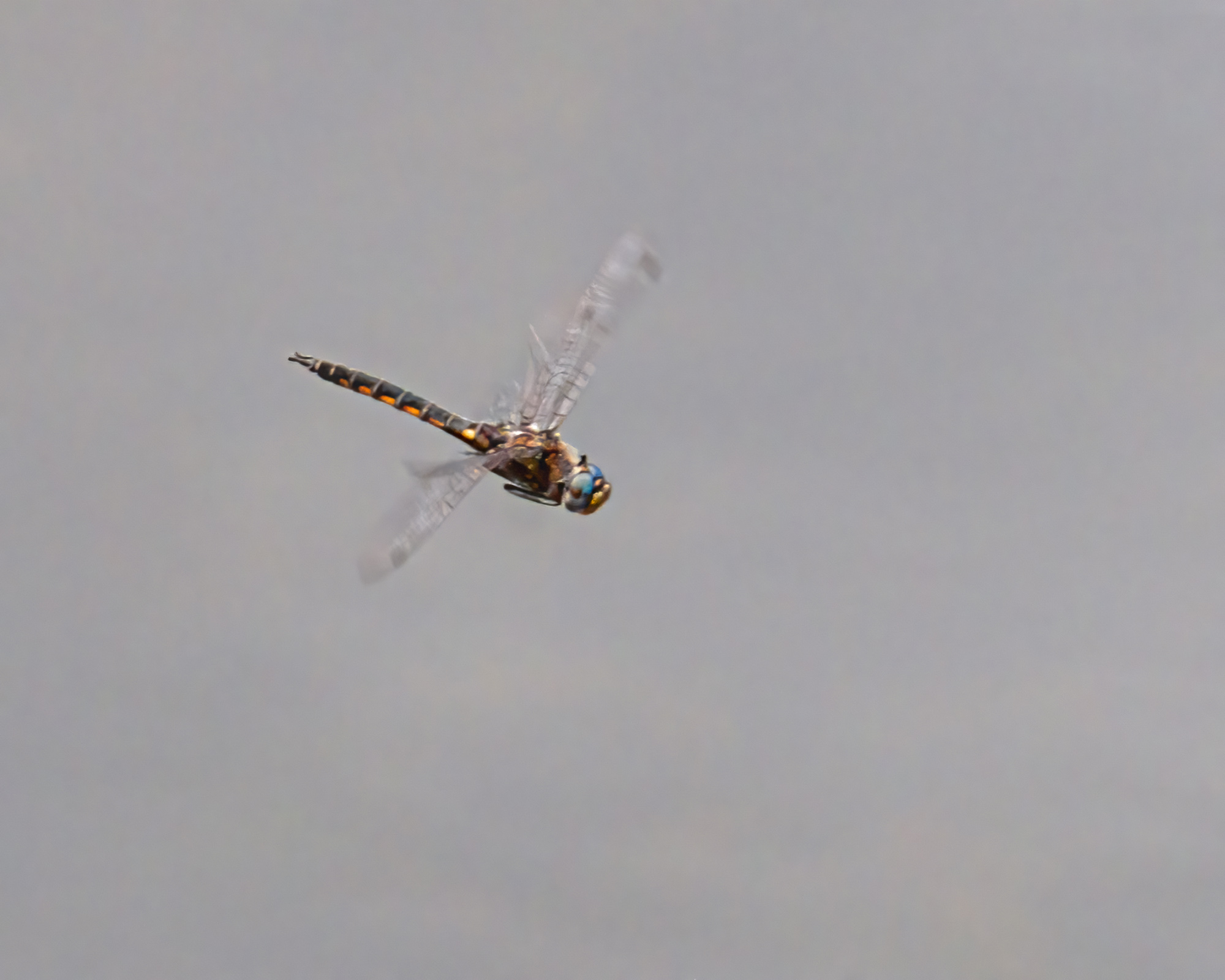
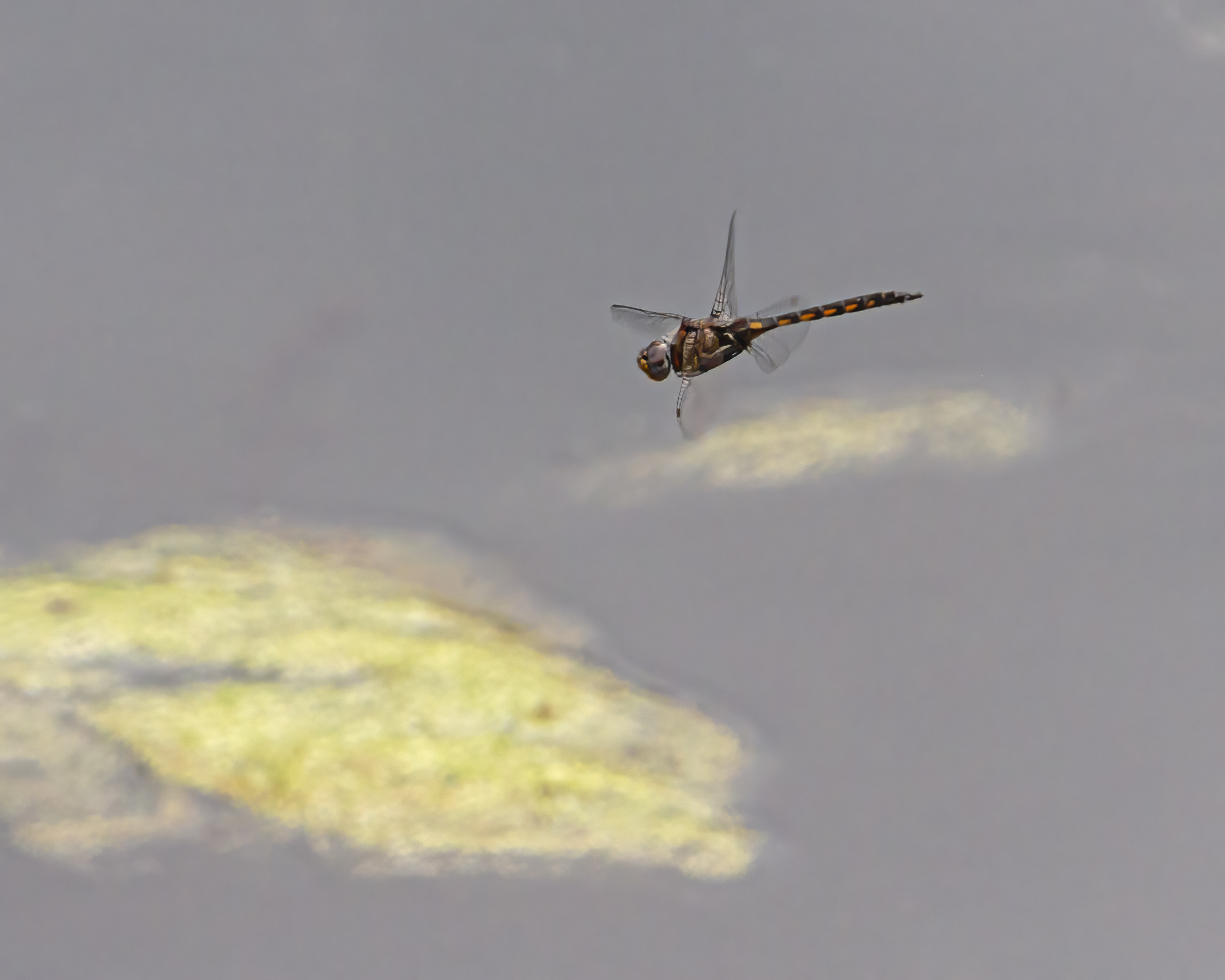
It is almost impossible, but I can’t help but try to capture images of dragonflies in flight. It is arguably the most difficult challenge of my ability to use my camera and also of my patience. None of the dragonflies in these photos flew close to the shores of the streams that I was exploring in Prince William County, Virginia, and I was using only a modest telephoto lens that I was focusing manually—the autofocus on my Tamron 180mm macro lens is relatively slow and could not focus on the dragonflies as they zoomed on by.

Last Wednesday I photographed the dragonfly in the first photo as it was patrolling over a creek. I believe that it is a Uhler’s Sundragon dragonfly (Helocordulia uhleri), which is about 1.8 inches (46 mm) in length. The dragonfly was not exactly following a pattern, but I was able to track it as it flew all around a small section of the creek.

The dragonfly in the second image may also be a Uhler’s Sundragon, though I am less confident of this identification. I really like the fact that the eyes of the dragonfly are in shart focus. It is probably just my imagination, but this dragonfly seemed to glance up at me and smile as it flew on by. In this photo, as in the first one, you really have a sense of the environment in which I found the dragonfly.

I captured the final image on Friday as I was exploring a different creek in Prince William County. The dragonfly in this photo was much larger than the ones in the other photos and was flying much faster and seemed to be conducting patrols over a much longer stretch of the creek. All the image was not completely sharp, I captured enough details to be able to identify it as male Stream Cruiser (Didymops transversa) dragonfly, a species that is about 2.2 inches (56 mm) in length.

Last year I did a short video on YouTube called Impossible Shots? Dragonflies in Flight in which I talked about one of my forays into the field and highlighted my approach to photographing dragonflies. Check it out if you want to see some more shots of dragonflies in flight or if you simply want to hear my voice and see my face. I included a link to the video in the title of the video (which should appear in color and underlined) and am also going to try to paste it into the end of posting, so you don’t have to go to YouTube to watch it. I am still just dabbling in video, but want to try to do more of it this year.

Uhler's Sundragon

Uhler's Sundragon

Stream Cruiser

© Michael Q. Powell. All rights reserved.

Read Full Post »

On Monday I was thrilled to photograph my first dragonfly of the year at Occoquan Bay National Wildlife Refuge, the location that I visit most frequently with my camera. The first prize goes to an immature male Blue Corporal dragonfly (Ladona deplanata)—males turn blue as they mature, but initially they have the same coloration as the females. Blue Corporals of both genders have two light-colored stripes on the front of their thoraxes, the traditional rank military insignia for corporals.

Later in the day I spotted a female Blue Corporal perched on some dry leaves, as shown in the second photo. Can you spot the differences between the dragonflies in the first and second photos? The male abdomen tends to be a bit thinner than the abdomen of the female. However, the biggest difference is in the terminal appendages, i.e. the specific parts at the very tip of their abdomens (their “tails”).

The following day I returned to the refuge and spotted another Blue Corporal perched in some vegetation—I think it is another immature male. Most of the time Blue Corporals like to perch on the ground, but this one looked like it had only recently emerged and may have been waiting for its wings to harden.

When dragonflies undergo their metamorphosis from water-dwelling nymphs to aerial acrobats, their wings are initially very clear and fragile and the creatures are very vulnerable, so I was careful not to disturb the dragonfly when I took a few photos. If you are interested to learn more, check out a 2016 blog posting  Metamorphosis of a dragonfly in which I documented the entire transformation process of a Common Sandragon dragonfly in a series of 15 photos. At the end of that series you will be able to see why I characterized the wings of a newly-emerged dragonfly as “fragile.”

Blue Corporal

Blue Corporal

Blue Corporal

© Michael Q. Powell. All rights reserved.

Read Full Post »

I was extremely happy yesterday to encounter several Twin-spotted Spiketail dragonflies (Cordulegaster maculata) during a visit to Occoquan Regional Park, a county-run recreational park in Lorton, Virginia. In the past I have occasionally seen Twin-spotted Spiketails at this location and I went there specifically to look for this species—I was hopeful, but realistic in my expectations of finding this relatively uncommon dragonfly.

Spiketails are a small family of large black or brown dragonflies with similar bright yellow stripes on their thoraxes and species-specific makings on their abdomens. Females have a spike-like pseudo-ovipositor at the end of their abdomens that is responsible for the “spiketail” name.

When I first encountered a spiketail yesterday, it was flying in the air and I was not sure what kind of dragonfly it was. Fortunately I was able to see where it landed and when I got closer, I was ecstatic, because I could actually see the dragonfly’s “spike,” as you can see in the first photo.

There are several other spiketail species in our area, but the Twin-spotted Spiketail is the only one that is flying this early in the season. The flight season for most of the early season dragonflies lasts for only a month or so, so I try to spend as much time outdoors as I can during April and May to maximize my chances of seeing these uncommon species. As you can probably judge, from the first photo, Twin-spotted Spiketails are large, almost 3 inches (76 mm) in length. Although you can’t really seen the markings in the first photo, there are a paired yellow spots or rounded triangles along the length of the abdomen.

I decided to hang around the area where I spotted the first spiketail to see if others would fly by and my patience was rewarded. I was able to capture shot of several other Twin-spotted Spiketails as you can see in the second and third photos. Both of these spiketails are males, I believe, and therefore do not have the visible “spike.” In those photos, though, you get a pretty good view of the pattern of the paired spots, which is why the species is called “twin-spotted.”

This dragonfly season is starting out with a bang and I feel blessed to have photographed several uncommon species already. Temperatures today are forecast to rise to about 84 degrees (29 degrees C) and I plant to continue my search for beautiful and elusive aerial acrobats, like these Twin-spotted Spiketails.

Twin-spotted Spiketail

Twin-spotted Spiketail

Twin-spotted Spiketail

© Michael Q. Powell. All rights reserved.


Read Full Post »

Have you ever looked closely at a dragonfly’s legs? A dragonfly has six legs that are attached in pairs to its thorax. The main parts of the leg are the upper leg or femur, the lower leg or tibia, and the foot or tarsus, which is made up of three segments and ends with a pair of claws. The legs are covered with spiky hairs and fulfill a variety of functions, including perching, catching and holding onto prey, and cleaning its mouth and eyes.

The first photo is a close-up view of a Uhler’s Sundragon (Helocordulia uhleri) that I spotted on 4 April near a creek in Prince William County, Virginia. You get a really good view of one of the middle legs of the dragonfly, including the way that it bends at two joints and the way the tiny claws are used to hold onto the perch. I can’t be sure, but I believe that the dragonfly may be using one of its front legs to wipe its large compound eye. If you click on the photo, you can see some of the thousands of ommatidia, the faceted optical units that allow a dragonfly to see in almost 360 degrees around itself.

In the second photo, you can see that the sets of legs are of different lengths. The back legs, which are the longest, are the ones that are most often used to catch and subdue prey. The front leg nearest us, does not seem to be used and the moment for perching and the “elbow” appears to be touching the eye. At first I thought that this was merely an awkward perch, but the more I look at the photo, the more I think that the dragonfly is cleaning its eye.

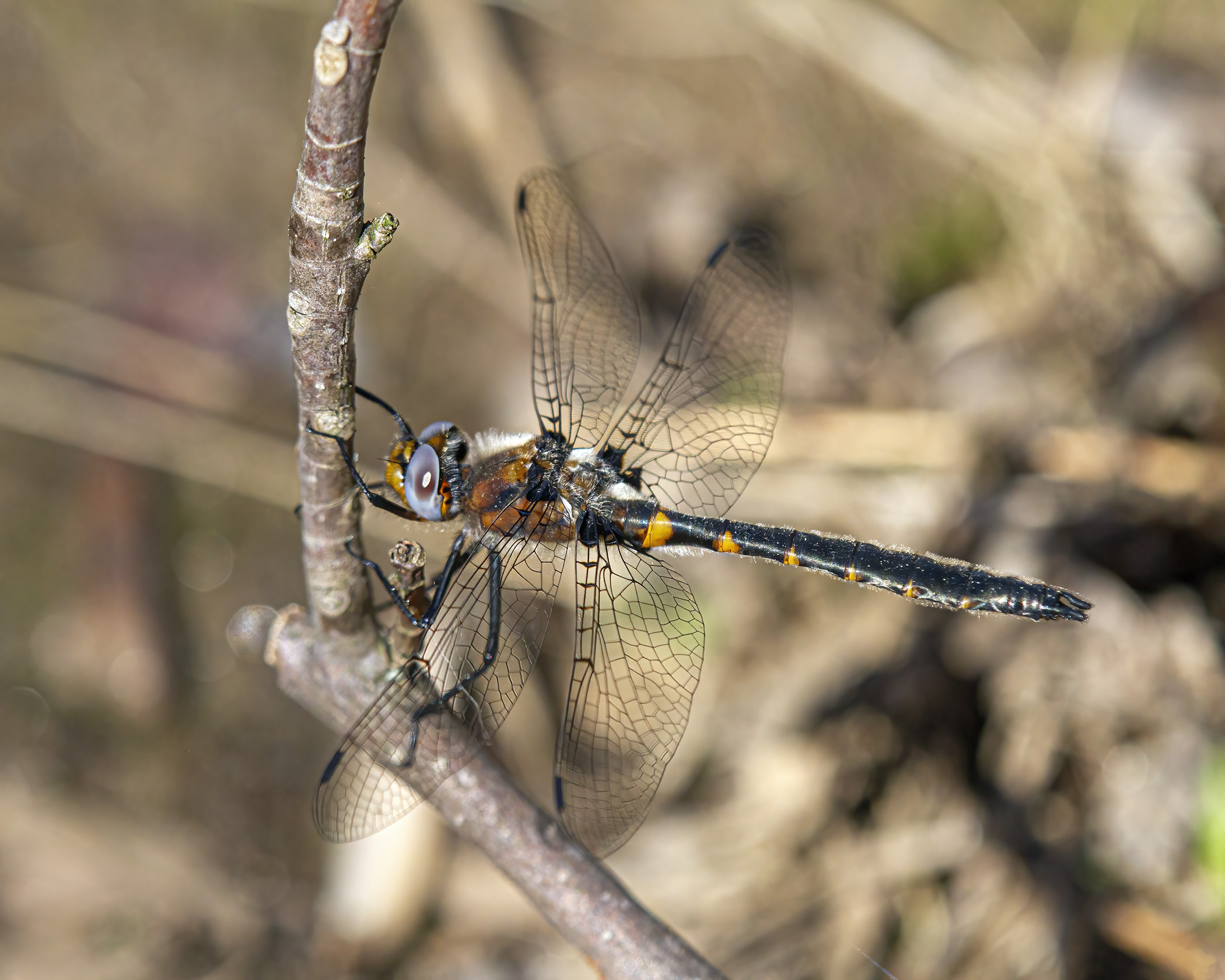
The final photo, which was actually the first of these photos that I took, shows the entire body of the Uhler’s Sundragon. The Uhler’s Sundragon is visually similar to the Selys’s Sundragon, the first dragonfly that I spotted this year, with the notable difference that the Uhler’s Sundragon has little orange patches at the base of its wings, as you can see in the photo, that are not present with the Selys’s Sundragon. If you look at the front legs, it appears to me that the dragonfly was using both of them initially for perching—its “elbow” does not appear to bent as it was in the middle photo.

This post was a little more “geeky” than usual, delving deeper into dragonfly anatomy than I usually do. I think it is fascinating to try to observe and understand the behavior that I see in my subjects and hope that you may also find these details to be somewhat interesting.

Uhler's Sundragon

Uhler's Sundragon

Uhler's Sundragon

© Michael Q. Powell. All rights reserved.

Read Full Post »

As I was exploring the edge of the same small pond where I photographed the newt featured in yesterday’s blog posting, I spotted my first damselfly of the season. Damselflies and dragonflies both belong to the order of flying insects known as Odonata. Damselflies tend to be smaller and slimmer that dragonflies and most damselflies hold their wings above their bodies when at rest, unlike dragonflies that perch with wings extended.

Identification of this damselfly was somewhat difficult for me. On the one hand, I saw the broken shoulder stripe that looks like an exclamation point, which suggests that this is a Fragile Forktail damselfly (Ischnura posita). On the other hand, my identification guide states that there is no blue at the tip of the abdomen (the “tail”) of the Fragile Forktail, making me think it might be an Eastern Forktail.

I posted the photo to a Facebook forum called Virginia Odonata and one of the experts there made the following comment, “This is quite an unusual Forktail. Easterns rarely have the split shoulder stripe, but I am still inclined toward Fragile even though the amount of blue on S9 is unusual.”  For your information, naturalists divide the abdomen of a dragonfly into ten segments and you start counting from the thorax area (the upper body), so S9 is the penultimate segment.

When it comes to identifying birds and insects, I have grown accustomed to living with some degree of uncertainty. Even experts will sometimes disagree, particularly if there is only a photo from a single angle, which was the case with this damselfly.

For me, the precision of my identification is not critically important—I can enjoy the beauty of this little damselfly without knowing its name. For the second day in a row, I am reminded of Shakespeare, who famously wrote in Romeo and Juliet, “What’s in a name? That which we call a rose, by any other name would smell as sweet.”


Fragile Forktail

© Michael Q. Powell. All rights reserved.


Read Full Post »

Yesterday was an unusually warm spring day, with temperatures soaring to 82 degrees (28 C). I suspected that I might find some early season dragonflies and I was right. Last week I saw my first dragonfly of 2023, but it does not really count for me, because I was not able to get a photograph of it.

My first “official” dragonfly of 2023 turned out to be an uncommon one, a Selys’s Sundragon (Helocordulia selysii). According to the Maryland Biodiversity Project, “Selys’s Sundragon is an uncommon, early-season corduliid which breeds in small streams in wooded areas through much of the southeast.” Corduliidae, also known as the emeralds, emerald dragonflies, or green-eyed skimmers, is the family of dragonflies to which the Selys’s Sundragons belong.

As far as I can recall, I have seen this species only twice in the past, both times in 2021. Check my 16 April 2021 blog posting entitled Selys’s Sundragon Dragonfly for details about my first encounter, including some photos that compare the Selys’s Sundragon with the very similar-looking Uhler’s Sundragon.

As many of you know, dragonflies are my favorite subjects to photograph during the warmer months. There is something almost magical about this beautiful aerial acrobats that inspires me. I love the challenge of spotting and photographing these tiny creatures—the Selys’s Sundragon in these photos, for example, is only about 1.7 inches (43 mm) in length.

During the summer, many common dragonfly species can be seen in a variety of habitats, but the early season dragonflies tend to be habitat specialists and have very brief flight season, often less than a month. For that reason, I usually try to go out with my camera as often as I can during the month of April.

Selys's Sundragon

Selys's Sundragon

© Michael Q. Powell. All rights reserved.

Read Full Post »

Despite our recent frigid weather, some Autumn Meadowhawk dragonflies (Sympetrum vicinum) are still with us, like this handsome male that I spotted on Monday at Occoquan Bay National Wildlife Refuge. Autumn Meadowhawks are invariably the last dragonflies of the season in my area. They are more tolerant of the cold than most other dragonflies and seem to be able capable of withstanding frosts and freezes if not prolonged or severe.

It is a real challenge to find and photograph Autumn Meadowhawks, because they are small—about 1.3 inches (33 mm)—and they tend to perch among the fallen leaves, where they blend in well with their surroundings. One additional challenge for me was the fact that I was shooting them at the 600mm end of my Tamron 150-600mm zoom lens. At that focal length, the minimum focusing distance for the lens is about 8.8 feet (270 cm), which means that I have to be a pretty good ways away from my tiny subject.

I hope to see these little red dragonflies into early December, assuming that the weather does not stay cool for too long a period and we do not have an extended period of cloudy weather—on cool days I tend to find Autumn Meadowhawks in areas where there is direct sunlight.

Autumn Meadowhawk

Autumn Meadowhawk

© Michael Q. Powell. All rights reserved.

Read Full Post »

I suspect that the species is gone for the season by now, but here are a couple of shots of a female Blue-faced Meadowhawk dragonfly (Sympetrum ambiguum) that I spotted at Occoquan Bay National Wildlife Refuge on 21 October 2022, before my trip to Texas. Many of the females are tan in color, like the one in these shots, which makes them hard to spot among the fallen leaves.  Some female Blue-faced Meadowhawks, however, are male-like in color, i.e. they are red, and are sometimes referred to as andromorphs.

Since my return from Texas, we have had cold temperatures that have often dipped below the freezing level. This week I will be out looking for some late season dragonflies. In the past I have sometimes seen Autumn Meadowhawks in November and occasionally even in December. It is quite possible, though, that I have seen my final dragonflies of the season and will switch to photographing birds most of the time.

Blue-faced Meadowhawk

Blue-faced Meadowhawk

© Michael Q. Powell. All rights reserved.

Read Full Post »

« Newer Posts - Older Posts »