Feeds:
Posts
Comments

Archive for the ‘dragonfly’ Category

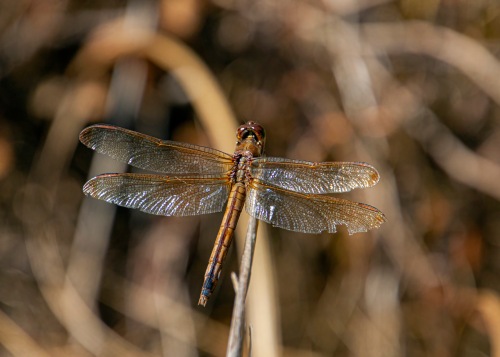
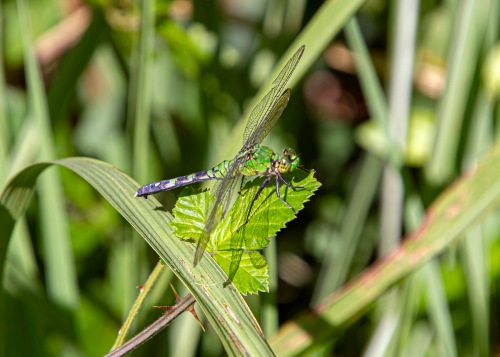
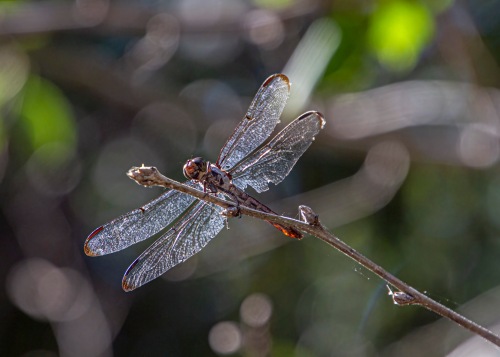
Some of the species of birds and dragonflies with the word “common” in their names are quite rare in my area. However, Common Baskettail dragonflies (Epitheca cynosura) have been quite common this month and I have seen them at a number of different locations, most notably at the small ponds that I like to visit. At these ponds, I usually spot the Common Baskettails as they conducted repeated low patrols over the surface of the water and I can never resist the chance to photograph them while they are in flight.

As I have noted in the past, it is very challenging to photograph a dragonfly while it is flight. Sometimes the dragonflies will hover a bit, giving me a better chance of getting them in focus, but often they whiz on by and I try to track them in my viewfinder. Occasionally I will manage to use auto-focus, but often I resort to manual focus, which, of course, is tough with a moving subject. I try to determine the flight track they are using and identify likely areas that they will pass through and then pre-focus on that area and wait for them to come by. Needless to say, you have to be very patient and persistent if you want to try this kind of photography.

I captured the first two shots at a small pond in Prince William County and was quite pleased with the images. The two shots were taken as part of a sequence and are quite similar with the exception of the position of the wings. Normally I am so thrilled to get a sharp shot that I am not concerned about the wing position, but in this case I had the luxury of having several variants of essentially the same shot.

The final two shots were taken at the pond at Jackson Miles Abbott Wetland Refuge. There was vegetation surrounding the water at the spot where I was standing and it sometimes would obstruct my view as I tried to track the dragonfly. In the third photo, I used one of the offending pieces of vegetation as a compositional element that makes it look like the dragonfly was approaching a finish line tape.

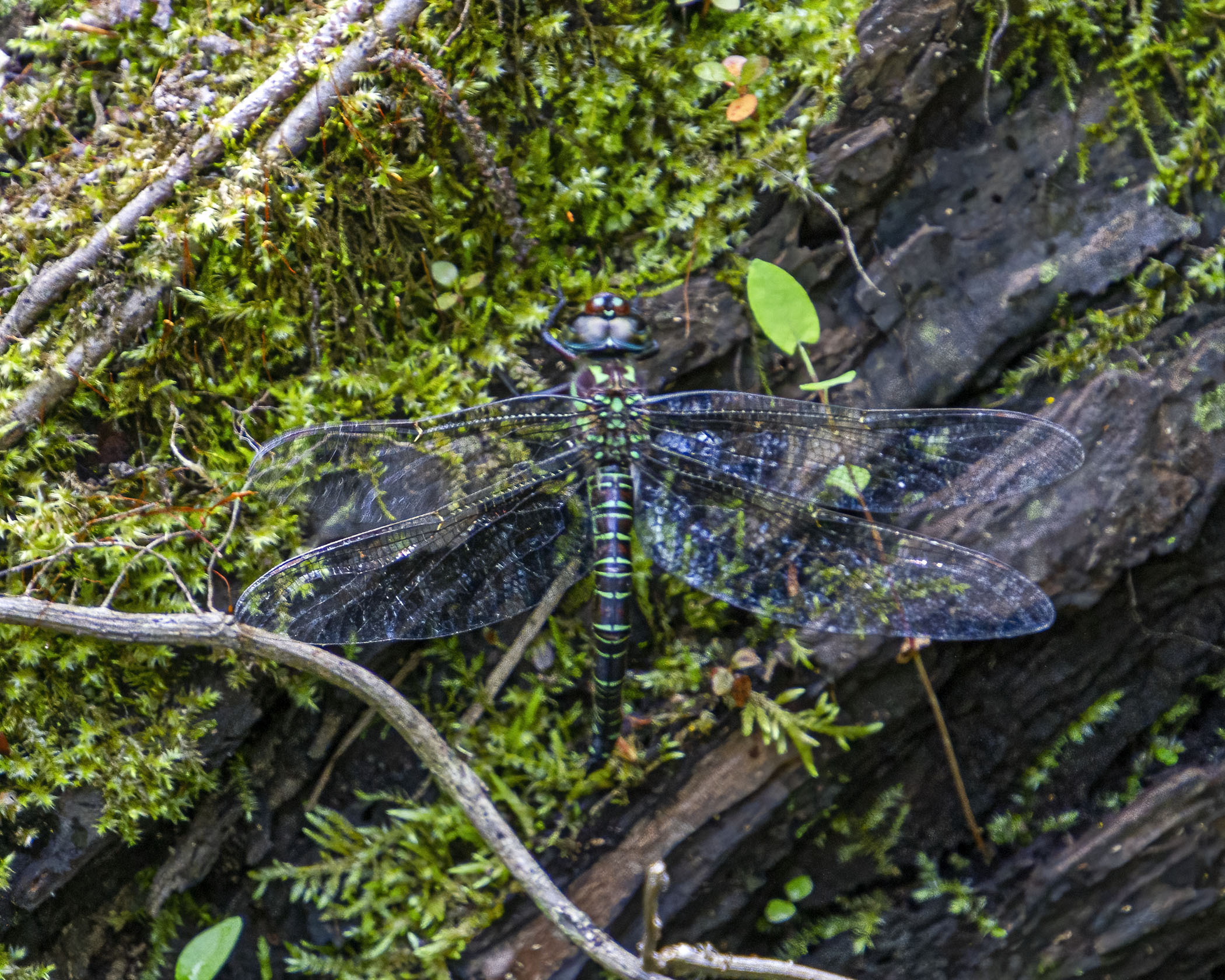
I included the final photo to give you a sense of the habitat. In several areas of the pond there were patches of lily pads and I tried to capture shots of the dragonfly flying over the lily pads. I was largely unsuccessful, but the photo gives you an idea of what I was trying to accomplish. (If this were a shot of a bird, it would definitely qualify as “butt shot,”but I am not sure that you can really say that a dragonfly has a “butt.”)

Common Baskettail

Common Baskettail

Common Baskettail

Common Baskettail

© Michael Q. Powell. All rights reserved.

Read Full Post »

On Monday I was happy to spot my first Stream Cruiser dragonfly (Didymops transversa) of 2024 in a field of ferns adjacent to a creek in Prince William County. Check out the length of those back legs. Wow!

I do not see Stream Cruisers at most of the usual locations where I search for dragonflies, because they can be found only in specific habitats. According to the Dragonflies of Northern Virginia website, “Stream Cruisers are habitat specialists. Look for them in stable, small to medium, forest streams, with good flow and rocks. The best place to find them is hunting in sunlit meadows near their wood-land waterways.”

Stream Cruiser

© Michael Q. Powell. All rights reserved.

Read Full Post »

Last week I photographed a female Swamp Darner dragonfly (Epiaeschna heros) depositing some eggs into a rotten log at the edge of a small pond at Occoquan Bay National Wildlife Refuge. Some dragonflies deposit a large number of eggs into the water or floating vegetation by tapping their abdomens rapidly and repeatedly at different locations, while others, like this Swamp Darner, deposit their larger eggs more slowly and deliberately by making a slit and inserting the eggs directly into wet wood and other debris with their blade-like ovipositors.

Swamp Darners are one of the largest dragonflies in our area, with a body length of about 3.4 inches (86 mm) in length. I love the description of this species on the Dragonflies of Northern Virginia website, “I often tell people on dragonfly walks that if they see a rhino with wings, it’s a swamp darner. Slight exaggeration, perhaps, but they are pretty impressive.” Some dragonflies are so nimble and acrobatic in their flight that they remind me of fighter aircraft, but the bulky size of the Swamp Darner makes me think more of bomber aircraft.

Swamp Darner

© Michael Q. Powell. All rights reserved.

Read Full Post »

I spotted this dragonfly during a recent visit to Occoquan Regional Park. I got a glimpse of the markings on its body as it zoomed past me, so I knew that it was a spiketail, but I was not sure about the species. I watched it patrol up and down a small stream and managed to finally get a shot of the dragonfly when it perched momentarily.

It turned out to be a Brown Spiketail (Cordulegaster bilineata), one of several spiketail species that I have seen in the past at this park. During most of my previous encounters with spiketails, they have been perching on vegetation in sunlit areas along a trail.

In this case, the area where the dragonfly was patrolling was mostly in the shade, so it was a real challenge to track and photograph the dragonfly. In case you are curious, I took the photo with my Canon 7D DSLR and my Tamron 18-400mm lens extended to 400mm with settings of ISO 800, F/8.0, and 1/320 sec. The settings were not optimal for getting a shot, but they worked well enough.

Brown Spiketail

© Michael Q. Powell. All rights reserved.

Read Full Post »

This dragonfly was perched on the ground on Monday at Occoquan Bay National Wildlife Refuge when I spotted it. I knew immediately that it was either a Lancet Clubtail (Phanogomphus exilis) or an Ashy Clubtail (Phanogomphus lividus), but these two species are so similar in appearance that it is tough for me to tell them apart.

I checked my identification guides and realized that I had to look at the dragonfly more closely and get a bit more geeky. The abdomen (the “tail”) of dragonflies  consists of ten segments traditionally numbered S1 through S10, starting from the point at which the thorax (the “chest”) meets the abdomen (S1) and going downward to the tip of the abdomen (S10).

The Dragonflies of Northern Virginia website notes that for Lancet Clubtails there is a “noticeable bright yellow flange on sides of S8 & S9 (male and female), while Ashy has almost no flange, and less bright yellow.” I knew about these differences, but couldn’t see them clearly enough when I was in the field.

The dragonfly was relatively cooperative and I was able to get a shot of it from almost directly overhead. The image is really cluttered, because of the vegetation, and  artistically is not a great photo, but it does provide the kind of details that are helpful for identification.

In the image I saw what appear to be yellow flanges on the sides of S8 and S9  and I could clearly see the appendages at the tip of the abdomen, which helps me identify the gender of the dragonfly. These elements suggested to me that it was a female Lancet Clubtail. I posted a photo in a Facebook group devoted to dragonflies and damselflies in Virginia and was delighted when one of the most experience members there agreed with my identification of this dragonfly.

I don’t expect most of my readers to delve this deeply into dragonfly anatomy, but I figured it might be interesting to learn about what some of the myriad considerations that swirl about in my mind as I seek to photograph and identify these beautiful little creatures. Sometimes I am successful in connecting the dots and coming to a conclusion, but at times the identities of my subjects remains a mystery.

Lancet Clubtail

© Michael Q. Powell. All rights reserved.


Read Full Post »

This female Eastern Pondhawk dragonfly (Erythemis simplicicollis) blended in so well with the vegetation that I almost missed seeing her yesterday at Occoquan Bay National Wildlife Refuge. Eastern Pondhawks are one of the most commonly seen dragonflies in my area during the summer, but this is the first one that I have seen so far this year.

I love the beautiful emerald color of female Eastern Pondhawks (as well as immature males of the species). They are not particularly large as dragonflies go, but they are very fierce predators. Several times each season I stumble upon Eastern Pondhawks gnawing on damselflies or other dragonflies that they have caught. Yikes!

Eastern Pondhawk

© Michael Q. Powell. All rights reserved.


Read Full Post »

During the summer it seems like dragonflies are everywhere, perching prominently in plain sight in all kinds of environments, but this early in the season there are a whole lot fewer of them and the ones that are around are relatively hard to find. Last week, though, I was blessed to encounter quite a few Ashy Clubtail dragonflies (Phanogomphus lividus) while I was exploring a creek in Prince William County, Virginia.

The Dragonflies of Northern Virginia website, one of my favorite on-line dragonfly resources, described well the environment in which to find this species. “To find Ashies, look for clean, stable, rocky forest streams and then search out the closest sunny clearing, stream-side meadow or sunlit path. Like Common Whitetails and Blue Corporals, Ashy Clubtails prefer to perch flat on bare-soil, fallen logs, rocks or leaf litter.”

Most of the Ashy Clubtails that I spotted were in fact perched in the middle of the trails that I was following, like the one in the final photo. Although the dragonflies are sometimes skittish, it is relatively easy to get a photo of one, albeit with a fairly uninteresting background. The Ashy Clubtail in the first photo has a somewhat more interesting pose, with a nice shadow to add some visual interest.

My favorite photo of this little group, however, has to be the middle one. I really like the confrontational pose of the female Ashy Clubtail as she perched on a leaf and looked right at me. In case you are curious, the dragonflies in the first and second photos are females and the one in the final photo is the male. If you look carefully at the tips of their abdomens (their “tails”), you can see that only the males have terminal appendages that look like a sidewards-facing parenthesis and are quite distinctive.

Ashy Clubtail

Ashy Clubtail

Ashy Clubtail

© Michael Q. Powell. All rights reserved.


Read Full Post »

One of the earliest dragonflies to appear in the spring in my area is the Blue Corporal (Ladona deplanata). Blue Corporals are relatively easy to identify because they have two stripes of their shoulders—two stripes is the traditional marking for the rank of corporal in the armed forces. When they first emerge, males and females have similar colorations, but the males turn blue as they mature.

The dragonfly in the first photo is an immature male Blue Corporal and was the first member of this species that I photographed on 10 April at Occoquan Bay National Wildlife Refuge. The shiny wings and pale markings suggest that this dragonfly was newly emerged. I believe that the dragonfly in the second photo is a female Blue Corporal, judging from her terminal appendages.

I usually try to get close-up shots of dragonflies, but when I can’t get near them, I am content to capture more “artsy” shots, like the final image below that shows a male Blue Corporal perched on some vegetation poking out of the shallow water of a pond.

Blue Corporal

Blue Corporal

Blue Corporal

© Michael Q. Powell. All rights reserved.


Read Full Post »

A small group of Common Green Darner dragonflies (Anax junius) was active on Monday at Occoquan Regional Park, including a couple that, after mating, was depositing eggs in the floating vegetation. The male (the one with the blue abdomen) holds onto the female while she does the actual work and then they fly off together still attached in the “tandem” position to another patch of vegetation.

Common Green Darners are a migratory species and I suspect that these particular dragonflies were part of that migration. Most people are aware of the migratory pattern of Monarch butterflies, but are unaware of the fact that Common Green Darners follow a similar pattern. The Science News website provides a good overview of that migration.

“At least three generations make up the annual migration of common green darner dragonflies. The first generation emerges in the southern United States, Mexico and the Caribbean starting around February and flies north. There, those insects lay eggs and die, giving rise to a second generation that migrates south until late October. (Some in that second generation don’t fly south until the next year, after overwintering as nymphs.) A third generation, hatched in the south, overwinters there before laying eggs that will start the entire process over again.”

I was quite fortunate that the patches of vegetation where the dragonflies were depositing the eggs were relatively close to the edge of the pond, so I was able to capture the shots of the dragonflies in action. The second shot was one that I snapped as the couple zoomed by—long-time readers of my blog know that I love to try to capture images of dragonflies while they are flying.

The final image shows one a male Common Green Darner that was flying all around the small pond, searching for food or a mate (or maybe both). It is a fun challenge to try to track and photograph a dragonfly in flight and I felt a little rusty after spending the winter photographing birds. I was therefore quite thrilled when this shot turned out so well. Some newer mirrorless cameras have tracking systems that lock focus on moving subjects, but my trusty Canon 7D DSLR has 2009 technology, so it is a little trickier for me to get shots in—it is definitely a “hands-on” process.

Common Green Darner

Common Green Darner

Common Green Darner

Common Green Darner

© Michael Q. Powell. All rights reserved.

Read Full Post »

Many people in the United States were excited to view yesterday’s solar eclipse. I too paused for a few moments in the afternoon to view the eclipse through solar glasses that I had obtained last week during a visit to the Air and Space Museum in the Washington D.C. area.

However, I must confess that I was more excited earlier in the day when I had multiple encounters with Uhler’s Sundragons (Helocordulia uhleri), the first dragonflies that I have been able to photograph in 2024. (Some of you may recall that I searched for dragonflies last week and think that I saw one flying over a stream. However, I did not get a photo of the dragonfly, so for me that first sighting does not really “count.)

I spent several hours yesterday looking carefully at the vegetation along a creek in Prince William County, Virginia where I had spotted Uhler’s Sundragons in previous years. This species appears in limited locations in the early spring and is usually gone by early May. Unlike many of the dragonflies that I will see during the summer that are habitat generalists, Uhler’s Sundragons require a specific kind of habitat, usually a mountain stream. According to the Dragonflies of Northern Virginia website, “Uhler’s need clean, small to medium, rocky forest streams with gravelly and/or sandy substrate, and a decent flow.”

I was fortunate to be able to photograph both female and male Uhler’s Sundragons. I have alternated genders in the photos below, with the females in the odd-numbered images and the males in the even ones. One of the ways to tell the genders apart is to look at the tips of the abdomens (the “tails”) and you can see that the terminal appendages are different. The lower portion of the abdomens of the males is also somewhat enlarged, as you can see in some of the photos.

Dragonflies perch in many different ways. Some species perch horizontally and some hang vertically. Uhler’s Sundragons most often perch at an angle, as shown in the first and last photos, though sometimes they may hang vertically from the vegetation.

The dragonfly season has now opened and I look forward to many more encounters with these amazingly beautiful aerial acrobatic insects that have a magical appeal for me.

Uhler's Sundragon

Uhler's Sundragon


Uhler's Sundragon

Uhler's Sundragon

Uhler's Sundragon

Uhler's Sundragon

© Michael Q. Powell. All rights reserved.

Read Full Post »

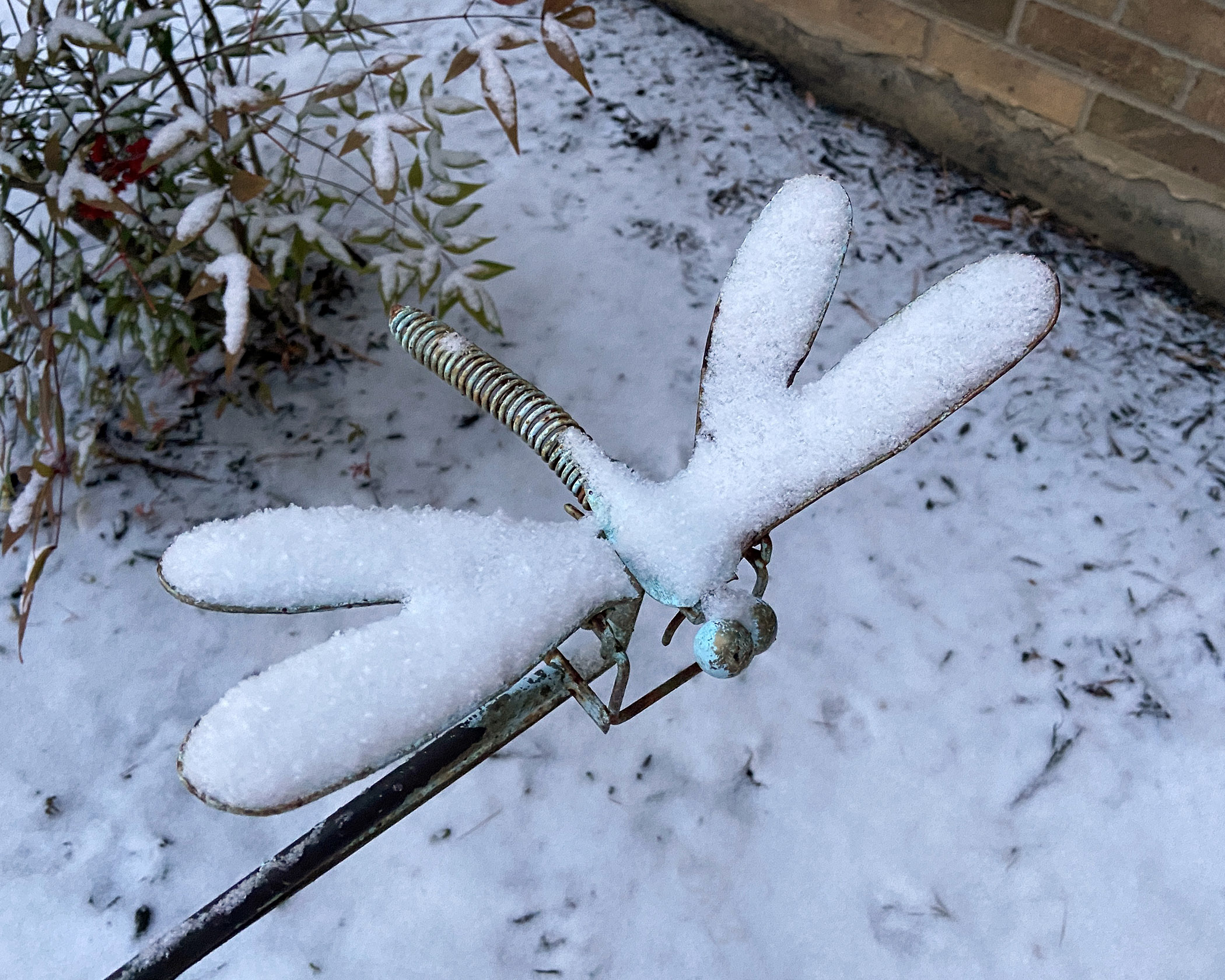
I have not been paying much attention to weather forecasts, so I was pleasantly surprised this morning to wake up to world covered with a dusting of snow. Normally this small amount of snow would not be newsworthy, but we have been in a snow drought for quite some time in my area. It has been two years since we last had an accumulation of two inches (50 mm) of snow in a single storm and for the entire winter last year we had a total of only about a half an inch (13 mm).

I probably did not need to do so, but I got out my snow shovel and cleared my steps and the sidewalk in front of my house.  I don’t really plan to drive anywhere, but I brushed the snow off of my car to keep it from freezing into any icy crust. Many of you know that I drive an orange KIA Soul and the final photo shows my BLESS MY license plate inside of a frame that says SOUL. I like this positive message and frequently get thumbs-up signs of approval from my fellow drivers.

Weather forecasters predict that we could get another 2 to 4 inches (50-100 mm) later today. I grew up in New England and that amount of snow would be a minor annoyance, but here in the Washington D.C. area, it will paralyze the area, undoubtedly resulting in numerous accidents and delayed school openings or even closures tomorrow. Some of the effects may be mitigated by the fact that today is a federal holiday, Martin Luther King Jr. Day, so traffic congestion should be lighter than usual, which will allow road crews to more effective clear and treat the roads.

Snowy dragonfly

Snowy lamppost

Snowy soul

© Michael Q. Powell. All rights reserved.


Read Full Post »

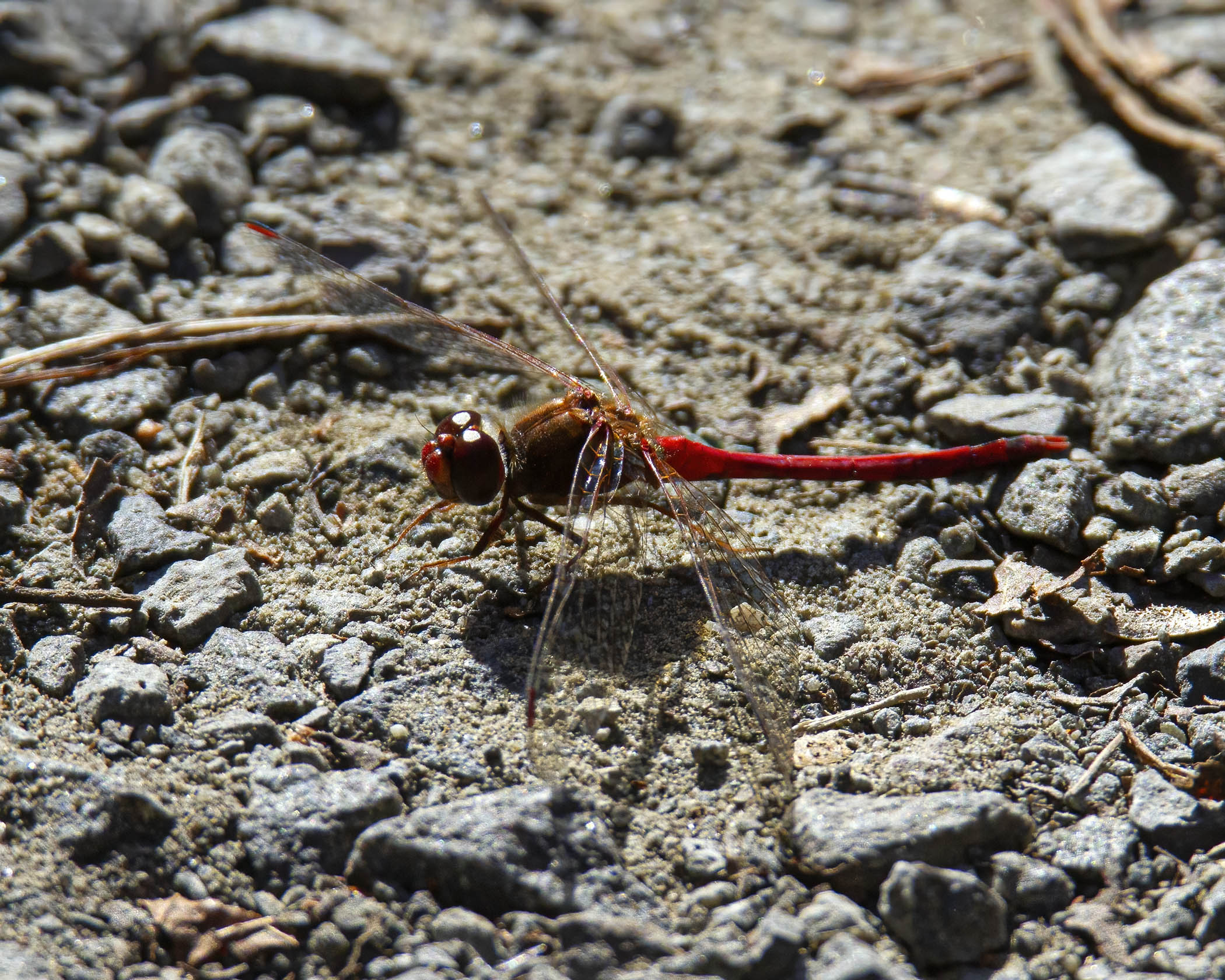
As we move into December, I am still managing to see a few Autumn Meadowhawks (Sympetrum vicinum), like this dragonfly on the rocks that I spotted on Monday at Occoquan Bay National Wildlife Refuge. Dragonfly on the rocks…sounds like a holiday adult beverage to me.

I suspect that the end is near for these little creatures. Although these dragonflies can tolerate brief periods of cold temperatures, it is difficult for them to survive during an extended cold snap. I will be keeping an eye out for these tiny red dragonflies in the upcoming weeks, but it is clear that the end of the dragonfly season is rapidly approaching.

Autumn Meadowhawk

© Michael Q. Powell. All rights reserved.

Read Full Post »

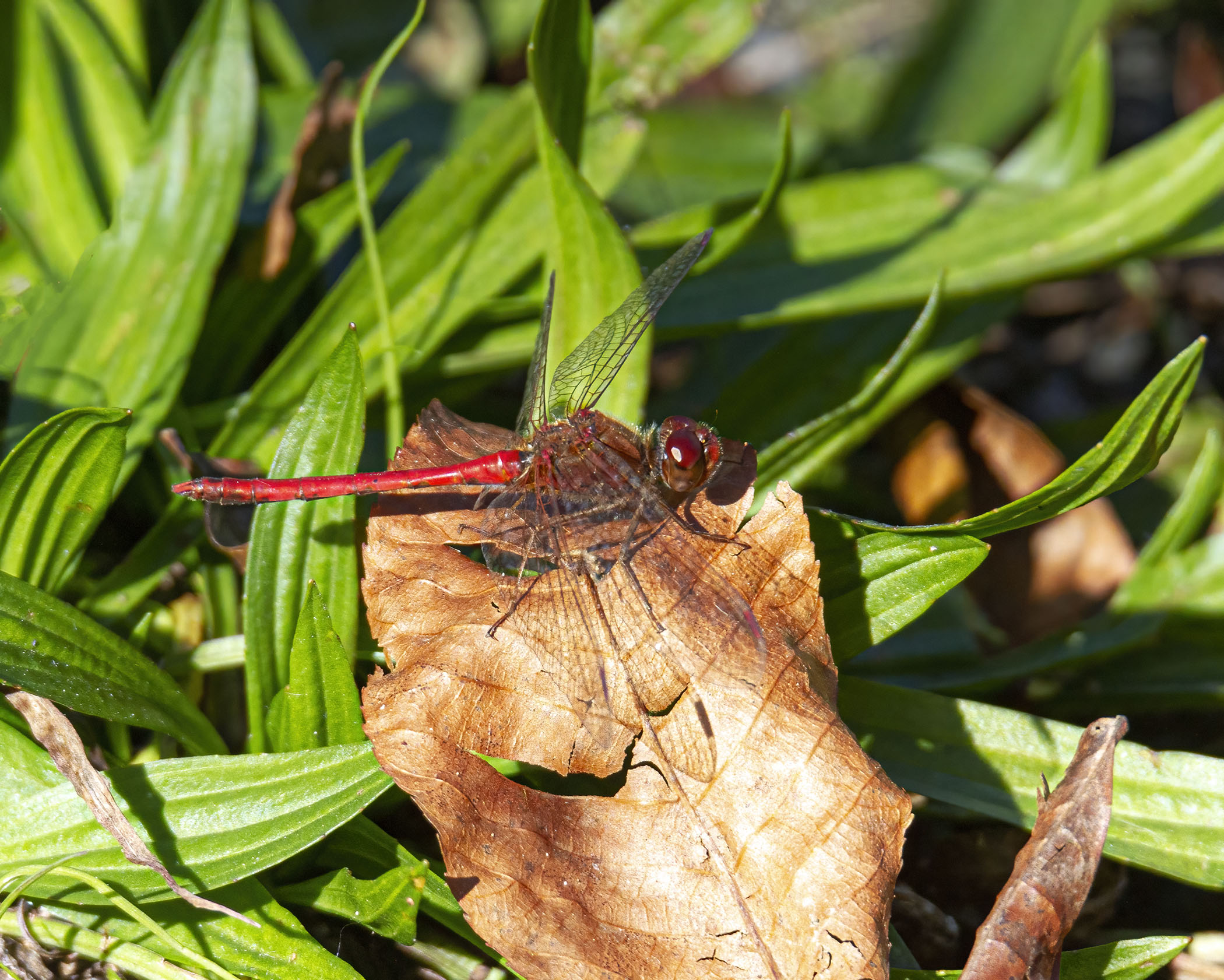
Autumn Meadowhawk dragonflies (Sympetrum vicinum) are still hanging in there as we approach the end of November. At other times of the year their bright red bodies would stand out, but there are lots of red and brown leaves on the ground now that help to camouflage them when they land. If the dragonflies remain still while on these perches, they are almost undetectable.

I photographed these little beauties on Wednesday at Occoquan Bay National Wildlife Refuge. Amazingly, I used the same telephoto zoom lens for these images that I used to capture shots of a Bald Eagle that same day—check out yesterday’s posting called What’s for dinner? that featured shots of an eagle with a duck that it had captured. The Tamron 150-600mm lens is a really versatile lens that, if I am careful, can capture a wide range of subjects ranging from an eagle in flight to a tiny perched dragonfly.

Autumn Meadowhawk

Autumn Meadowhawk

© Michael Q. Powell. All rights reserved.


Read Full Post »

“Take Flight 2023” has landed. I was thrilled yesterday when the post office delivered my copy of a just-published poetry anthology that has one of my dragonfly photos on the cover.

Since 2020 I have attended almost monthly Zoom poetry readings conducted by Flight of the Dragonfly Spoken Word, a UK-based poetry group, and feel blessed to be part of this community of incredibly talented poets and writers. Pre-pandemic, the group hosted poetry readings at a pub in Brighton, but during the pandemic its readings became virtual and its reach became worldwide.

Flight of the Dragonfly inaugurated a quarterly e-journal of poetry, prose, and flash fiction called Flights and is currently working on Issue 10 of the journal. “Take Flight 2023” is a printed anthology of selected poems from Flights issues five to eight. A little over a year ago Flight of the Dragonfly Press was founded and has already published a number of poetry collections.

In case you are curious, I captured the in-flight shot of the Migrant Hawker dragonfly (Aeshna mixta) in 2018 at the Botanical Garden in Brussels, Belgium during a work trip there. If you would like more details about the circumstances surrounding the capture of the image, check out my September 2018 blog posting entitled “Migrant Hawker in flight.”

I am one of the few non-poets who regularly attends the poetry readings—thought I have been encouraged on multiple occasions to start writing poetry. I believe that it is important to support the creative people who pour themselves into creating works that touch me deeply in so many different ways. I was deeply moved by the words in the “Thanks” section of the anthology that said, ” A very special thanks to Michael Powell, who has been turning up and cheering for the last three years and who has now allowed us to use one of his fabulous dragonfly photographs as the cover for this book.” Thanks, Darren and Barbara, the co-founders of Flight of the Dragonfly, for those very kind words.

I encourage you all to support your local poets, writers, and artists. The next Zoom poetry reading of Flight of the Dragonfly Spoken Word is on 28 November—click on the link at the beginning of this sentence to get details on how to sign up for this free event. The featured poets for this reading will be Gaynor Kane and Damien B. Donnelly, two of my favorite poets. For further detail on Damien, whom I met in Paris in 2019, check out this December 2019 blog posting and for information on the dynamic duo, check out my March 2021 posting entitled “I joined a cult.” I hope to see some of you at the event.

Take Flight

© Michael Q. Powell. All rights reserved

Read Full Post »

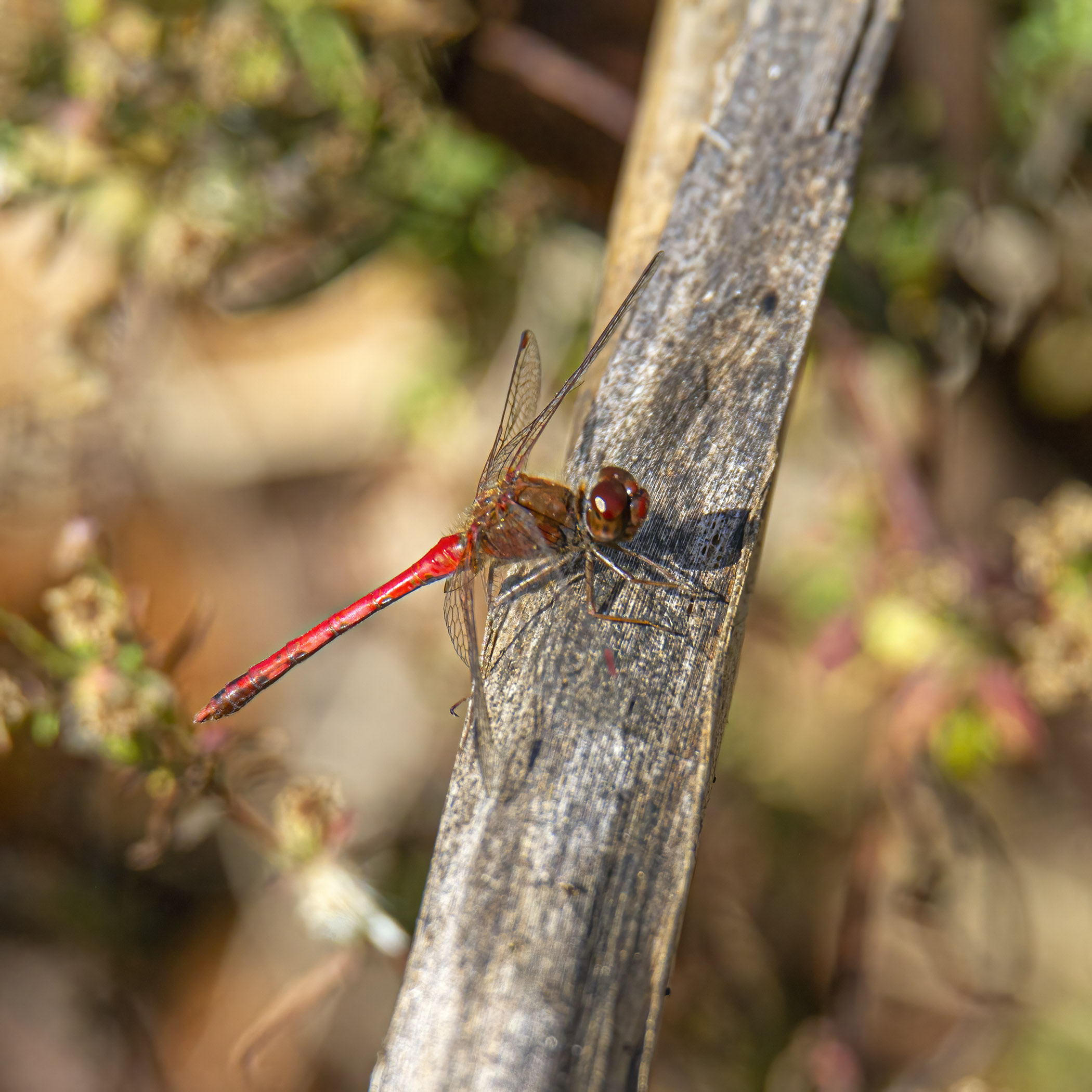
We have reached the point of the season when the only dragonflies remaining are the hardy Autumn Meadowhawks (Sympetrum vicinum). I try to photograph every one that I see, knowing that it could be the last one that I spot for the year. In past years I have sometime seen Autumn Meadowhawks in December, but their continued presence is dependent on a number of factors, including the weather.

I photographed this Autumn Meadowhawk last Friday at Occoquan Bay National Wildlife Refuge in Northern Virginia—it was one of a half-dozen or so that I spotted that day. The little dragonfly appeared to be staring right at me with a mixture of curiosity and defiance. The dragonfly was perched on a log and I was happy to capture some of the texture of the wood along with a bit of autumn color in the background.

I will continue to keep an eye out for these little red dragonflies, knowing full well that their time is rapidly coming to an end.

Autumn Meadowhawk

© Michael Q. Powell. All rights reserved.

Read Full Post »

It has been quite a while since I have seen any dragonflies other than Autumn Meadowhawks, so I was thrilled yesterday (17 November) when I spotted this Wandering Glider (Pantala flavescens) patrolling over a field at Occoquan Bay National Wildlife Refuge. I watched and waited for a long time and the dragonfly finally landed for a moment.

I captured the image below with my Tamron 150-600mm telephoto zoom lens extended all the way to 600mm on my Canon 7D DSLR. The dragonfly was perched only a few inches above the ground, so I had to crouch down quite low to get this shot. Although I had my camera on a monopod, it was tough to get into a steady shooting position and I had to focus manually, because my camera’s autofocus kept locking onto the vegetation. I took lots of photos and happily a few of them were in focus and were relatively sharp.

Wandering Gliders are a migratory species and are considered to be the most widespread dragonfly on the planet, with good population on every continent except Antarctica. According to Wikipedia, Wandering Gliders, also known as Globe Skimmers, “make an annual multigenerational journey of some 18,000 km (about 11,200 miles); to complete the migration, individual globe skimmers fly more than 6,000 km (3,730 miles)—one of the farthest known migrations of all insect species.” Wow!

Wandering Glider

© Michael Q. Powell. All rights reserved.

Read Full Post »

I can’t totally exclude the possibility that I may see a hardy survivor of another species, but it is beginning to look like Autumn Meadowhawks (Sympetrum vicinum) are the sole remaining dragonfly species. Last week I spotted quite a few of them during a visit to Huntley Meadows Park, a county-owned marshland not far from where I live.

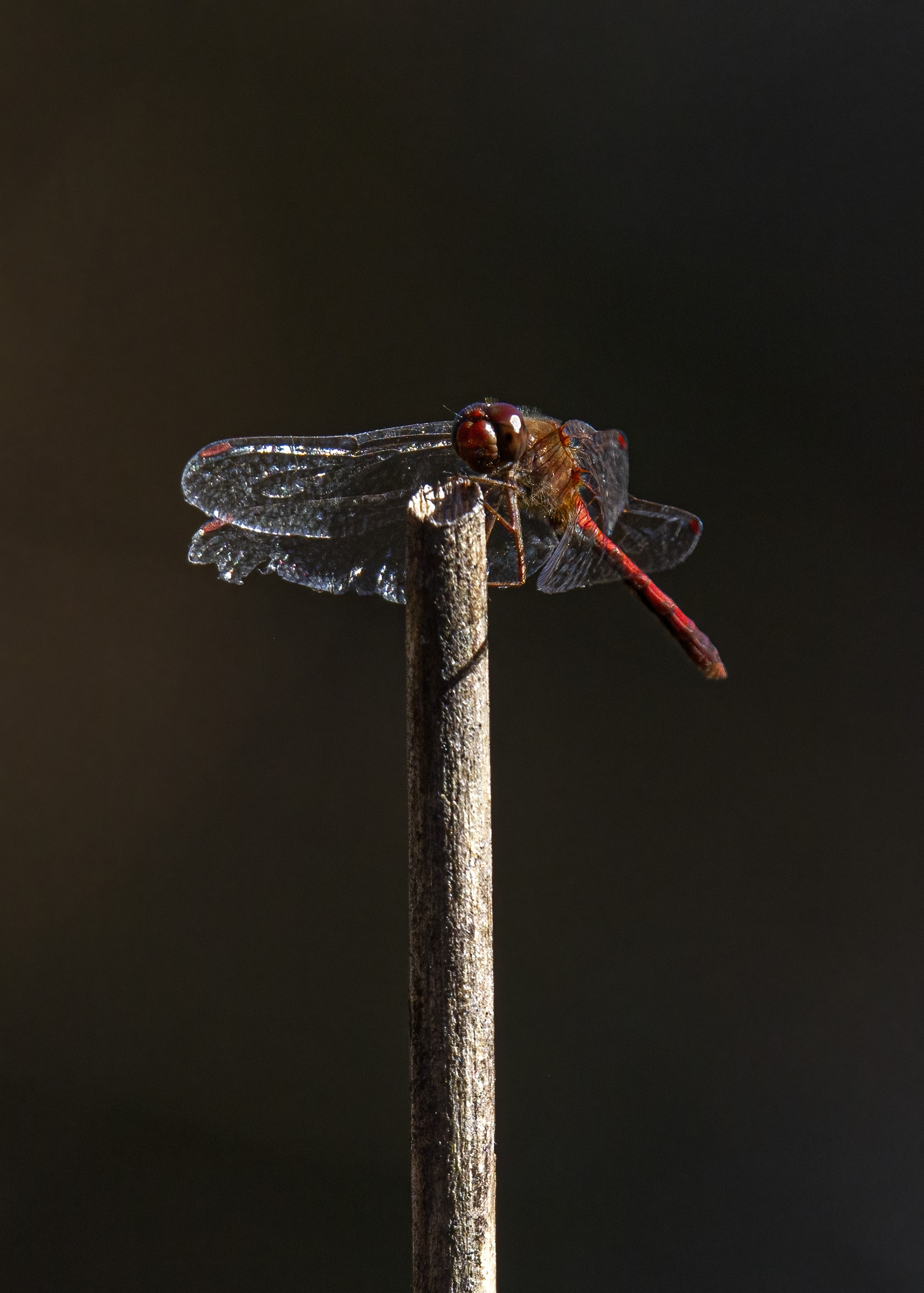
I tried to capture images of these bright red beauties in as many different environments as I could. Autumn Meadowhawks often perch on the ground, which does not provide a very interesting background, as you can see in the final photo. It is much more interesting if they perch on fallen leaves, or even better if they choose a more elevated perch.

The photos below give you an idea of how I try to “work” a subject. I try to shooting from different angles and distances.  When possible, I try to selectively include or exclude background elements by choosing the appropriate camera settings, as you can see in the fourth photo, where I caused the background to be totally out of focus. Paying attention to the direction of the light really helps too, as you can see particularly in the second image in which the light is so directional that it almost looks like a studio portrait.

Autumn Meadowhawks will probably be around for another few weeks or maybe a month or so, depending in part on the severity of the local weather. At that point, I will rekuctantly turn my focus to birds, landscapes, and other non-insect subjects. I also hope to devote a bit more attention to learning more about creating videos—I have a modest YouTube channel that I have allowed to languish this past year.

Autumn Meadowhawk

Autumn Meadowhawk

Autumn Meadowhawk

Autumn Meadowhawk

Autumn Meadowhawk

© Michael Q. Powell. All rights reserved.

Read Full Post »

And then there was one…

Now that the calendar has turned over to November, we have reached the point in the dragonfly season when there is essentially only one remaining species, the Autumn Meadowhawk (Sympetrum vicinum). There is a chance that I will encounter a hardy survivor from some of the summer species or a migratory dragonfly species passing through our area, but in all likelihood, the only dragonflies that I am likely to see this month are the tiny red Autumn Meadowhawks.

This past Thursday I visited Occoquan Bay National Wildlife Refuge and spotted a total of about ten Autumn Meadowhawks at various points throughout the refuge. Unlike some species that require specific habitats, Autumn Meadowhawks seem to be pretty adaptable and I have found them in a variety of different environments.

The dragonfly in the first photo is a female Autumn Meadowhawk—you can tell it is female by looking at her terminal appendages, i.e. the tip of her “tail.” She was perching more or less in the open, so I managed to capture an obstructed shot of her.

Most of the time, though, Autumn Meadhawks perch low to the ground on fallen leaves and dried-up vegetation, as you can see in the final two shots. Both photos show male Autumn Meadowhawks. I love the lighting in the penultimate shot, although the cluttered background makes the dragonfly a little hard to see. In the final photo, I really like the way that the dragonfly appeared to be looking up at me with a sense of curiosity.

Autumn Meadowhawk

Autumn Meadowhawk

Autumn Meadowhawk

© Michael Q. Powell. All rights reserved.


Read Full Post »

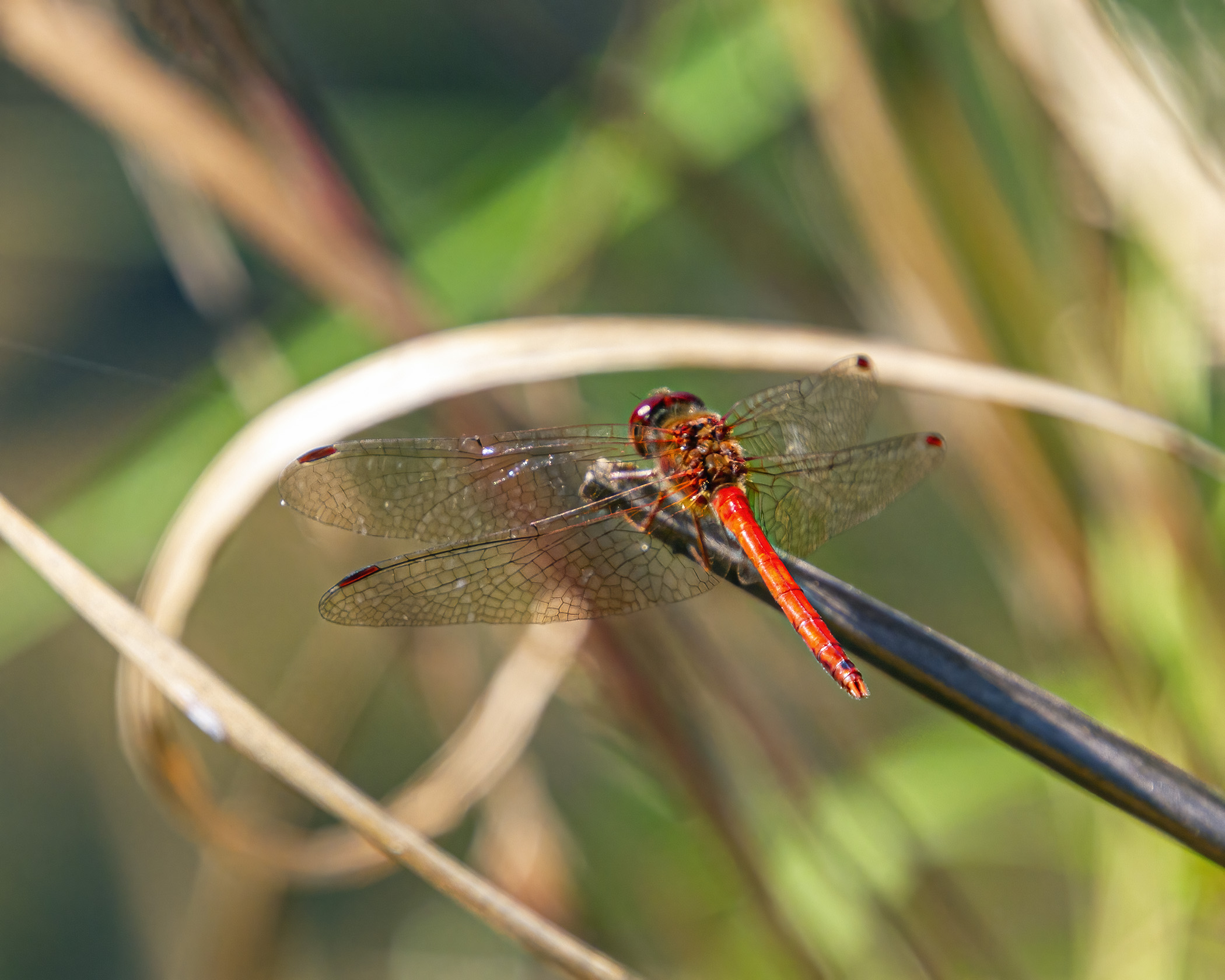
Now that Autumn Meadowhawk dragonflies (Sympetrum vicinum) have become the only dragonflies that I see regularly, I have been paying a great deal of attention to their perches when I am photographing them—when there are a limited number of subjects available, I try to make each encounter count. During a recent trip to Huntley Meadows Park, a county-run marshland park only a few miles from where I live, I managed to capture images of these colorful little dragonflies perching on a variety of different types of vegetation.

Often I have to choose between zooming in close to show the details of my subjects or pulling way back to show the environment in which I found them. In the case of these Autumn Meadowhawks, though, the images balance those competing priorities quite well, in part, I believe, because the dragonflies were so immersed in their environment, i.e. they do not choose high perches that produce “dragonfly on a stick” photos that isolate the subject too much from its surroundings.

Autumn Meadowhawk

Autumn Meadowhawk

Autumn Meadowhawk

© Michael Q. Powell. All rights reserved

Read Full Post »

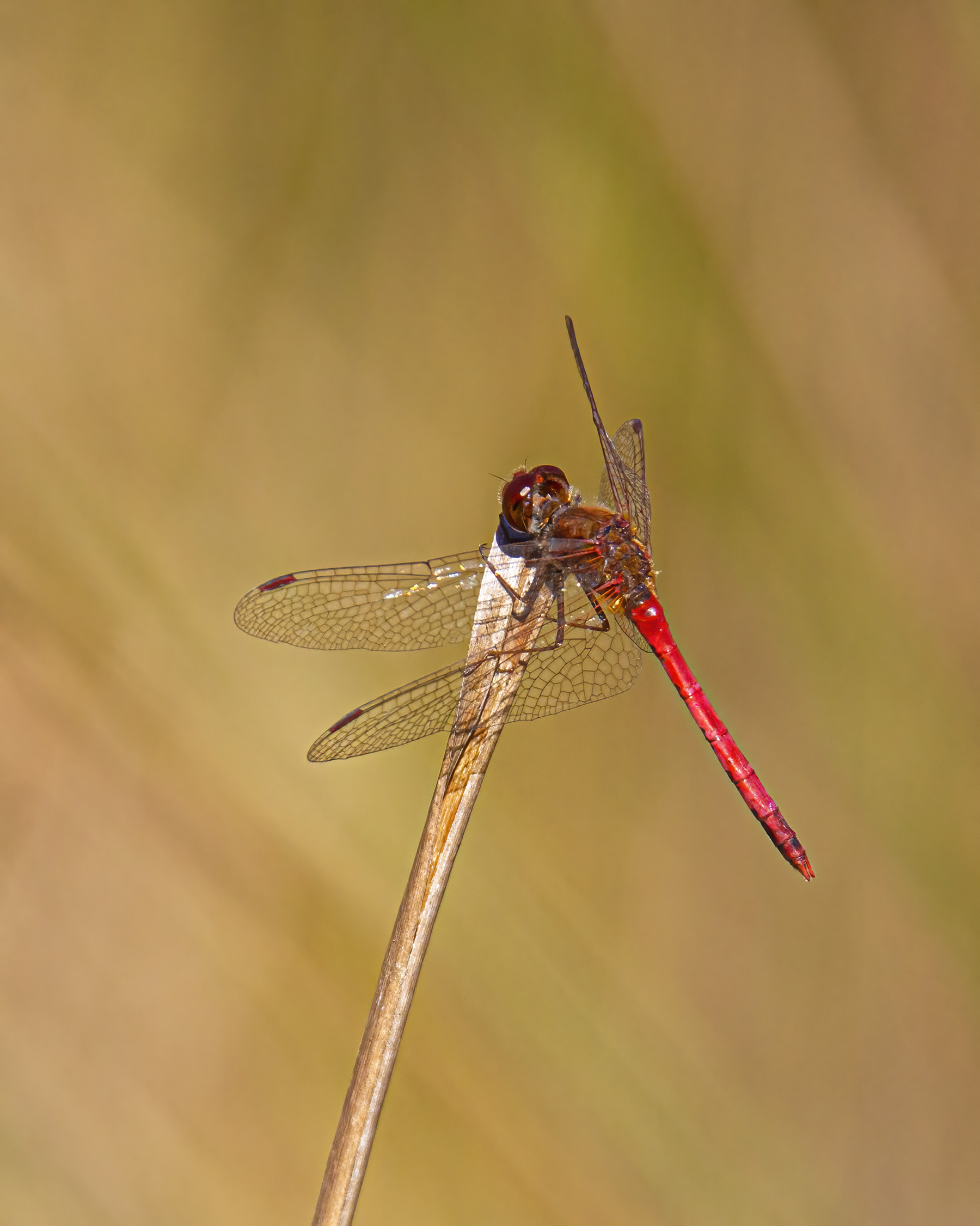
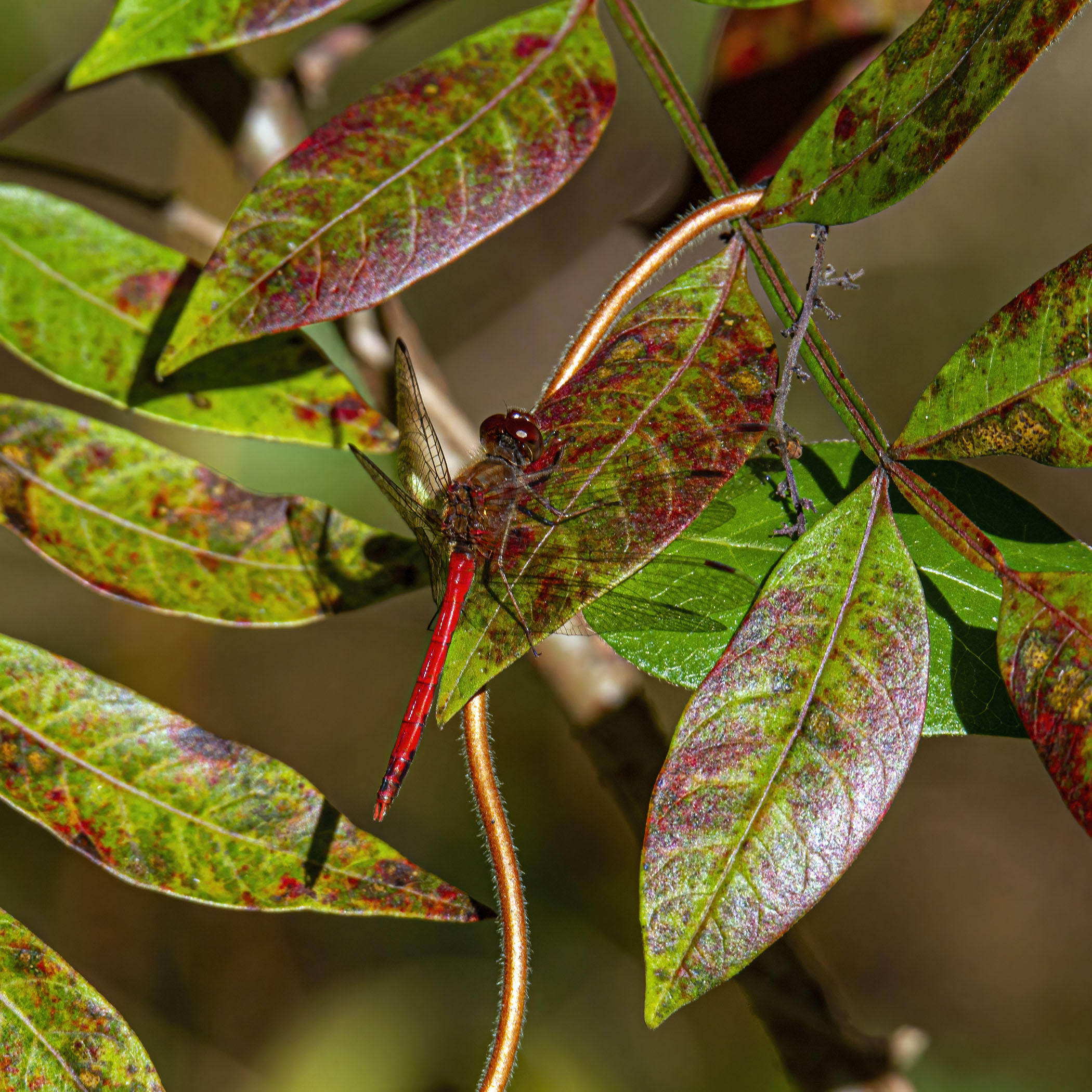
The red bodies of male Autumn Meadowhawk dragonflies (Sympetrum vicinum) make them relatively easy to spot.  However, when they choose to perch on foliage that matches their coloration, they can sometimes be well camouflaged.

The first photo shows an Autumn Meadowhawk perched on some kind of red vegetation (Virginia Creeper ?) at Huntley Meadows Park last Thursday. The red leaves really help to give the image a feel of autumn.

In the second image, the dragonfly stands out a bit more, but the dying leaves provide an artistically pleasing backdrop for the beautiful little dragonfly—I love this composition a lot.

Autumn Meadowhawk

Autumn Meadowhawk

© Michael Q. Powell. All rights reserved.


Read Full Post »

I was thrilled yesterday on Thursday at Huntley Meadows Park, a local marshland park, when I finally spotted some Blue-faced Meadowhawk dragonflies (Sympetrum ambiguum), a stunning species that is one of my favorites, after searching in vain for them at other locations for over a month. The Blue-faced Meadowhawk is a late-season dragonfly that is somewhat similar in appearance to the more common Autumn Meadowhawk—males of both species have bright red bodies, but the Autumn Meadowhawks have brown eyes.

The females of both species are more muted in their coloration than their male counterparts, as is often the case with many dragonflies and birds, so they have more natural camouflage and are frequently more difficult to find. The second image shows a female Blue-faced Meadowhawk that I managed to spot in the same general area as the male in the first photo. I love the way that the female dragonfly appeared to be singing a song as she basked in the sunlight on some dried-out vegetation.

Blue-faced Meadowhawk

Blue-faced Meadowhawk

© Michael Q. Powell. All rights reserved.


Read Full Post »

I walked about for a couple of hours on Wednesday at Occoquan Bay National Wildlife Refuge and visited some of my favorite dragonfly sites, but managed to spot only three dragonflies. Of those three, the only one that I managed to photograph was this pretty little Autumn Meadowhawk (Sympetrum vicinum).

Autumn Meadowhawks are quite small, about 1.3 inches (33 mm) in length, so they are not easy to spot, despite their bright red color. They tend to stay close to the ground, making short flights most of the time, so you have to be looking down to see them. At this time of the year, I focus a good amount attention on birds, so I end up alternating between looking up for birds and down for insects.

I really like the color and texture of the rocks on which the dragonfly chose to perch. Their cool muted tones contrast nicely with the red and brown colors of the dragonfly.

Autumn Meadowhawk

© Michael Q. Powell. All rights reserved.

Read Full Post »

There were several Common Green Darner dragonflies (Anax junius) flying overhead on 10 October at Occoquan Bay National Wildlife Refuge. One of them landed and perched momentarily low in the vegetation and I was able to capture this image.

I have been seeing fewer and fewer dragonflies on the ground as we move deeper and deeper into October, but in the air I have been seeing quite a few Common Green Darners, Black Saddlebags, and Wandering Gliders, the dragonfly species that migrate through our area. Many of the members of the surviving summer species appear to be faded and tattered, but the migrants appear to be bright and pristine.

The tangled grasses and vegetation where the dragonfly was perched were dried out and mostly void of color, which helps the green of the dragonfly’s thorax to really stand out in the photo. I also like the way that I was able to capture the transparency and details of the dragonfly’s wings.

Common Green Darner

© Michael Q. Powell. All rights reserved.

Read Full Post »

What signals the arrival of autumn for you? Perhaps it is the changes in the foliage, the cooling of the temperatures, or the shortening of the daylight hours. In recent years Autumn Meadowhawk dragonflies (Sympetrum vicinum) have become the harbingers of autumn, visible signs that the end of the dragonfly season is inexorably drawing near.

I spotted my first Autumn Meadowhawks this year on 2 October at Occoquan Bay National Wildlife Refuge. This species usually appears in late September and most years is the last dragonfly species to disappear—I have seen Autumn Meadowhawks as late as December some years and there have been some reports of them in early January.

A number of other dragonflies are still active, but by early November most of them will be gone. I will still be looking to photograph those hardy survivors in the upcoming months, but, as recent postings suggest, I will eventually be shifting a lot of my focus from insects to birds.

Autumn Meadowhawk

Autumn Meadowhawk

Autumn Meadowhawk

© Michael Q. Powell. All rights reserved.


Read Full Post »

The weather this past week has been cool, cloudy, and rainy, with high temperatures struggling to reach 65 degrees (18 degrees C). I fear that many dragonflies will not survive and so I celebrate each sighting of a dragonfly species, conscious that it could be the last one that I see this season.

Last Thursday I spotted this Needham’s Skimmer dragonfly (Libellula needhami) while I was visiting Occoquan Bay National Wildlife Refuge. Its wings are tattered and its colors have faded, but it was still active.

Autumn often makes me pensive and I become more aware of the passage of time. Our lives are just as fragile and limited as those of the beautiful little insects that I am so fond of photographing. May we all find beauty, meaning, and love as we live our lives.

Needham's Skimmer

© Michael Q. Powell. All rights reserved.

Read Full Post »

I was happy last Thursday when a Black Saddlebags dragonfly (Tramea lacerata) that I had been tracking overhead at Occoquan Bay National Wildlife Refuge perched for a moment, allowing me to capture this first image.  While it was flying, I attempted multiple times to get a shot of it, with minimal success. The second photo is my best one.

Some dragonflies spend a lot of their time perched, but Black Saddlebags are one of the species that spends most of its time in the air, so it is rewarding to be able to see one land and to get a shot of it. Black Saddlebags are also one of the few dragonfly species that are migrate although, according to the Dragonflies of Northern Virginia website, scientists do not fully understand why they do so and have been studying their migratory patterns.

Black Saddlebags

Black Saddlebags

© Michael Q. Powell. All rights reserved.

Read Full Post »

For the last few weeks I have been searching diligently for the late-season dragonfly species that appear on the scene in late August and early September. So far I have come up mostly empty-handed, but I was thrilled to spot this cool-looking Russet-tipped Clubtail dragonfly (Stylurus plagiatus) on 6 September at Jackson Miles Abbott Wetland Refuge. In my area, Russet-tipped Clubtails  are seen most often in August and September, but they are somewhat uncommon.

As some of you know, I dabble a bit with YouTube. At about this time last year I did a little video about Russet-tipped Clubtails that you might enjoy watching. It was one of my first videos and lasts about a minute and a half.  Click on this link to view the video in YouTube. I am also embedding a YouTube link at the end of this posting. Depending on how you are reading this blog, you may be able to watch the video from within the blog.

A year ago, I had aspirations of shooting more video footage during my photography outings. I have made only minor progress in that area, but it is still something that interests me a lot. I have learned the basics of making and editing videos, but am struggling to figure out what stories I want to tell and how a video can help me tell those stories.

Russet-tipped Clubtail

© Michael Q. Powell. All rights reserved.


Read Full Post »

In many of my blog postings, I concentrate on a single species of dragonflies, but today I want to celebrate the diversity of species that I have been seeing during the month of September. Despite my warnings in some earlier postings about the decreasing numbers of dragonflies, I continue to see a variety of species—Northern Virginia, where I live, is blessed to have an abundance of different dragonflies and damselflies.

The first photo shows a female Eastern Amberwing (Perithemis tenera), the smallest dragonfly in our area.  Males of this species hang out at ponds, but the females, which do not have amber wings like the males, are usually found in vegetation some distance from the water.

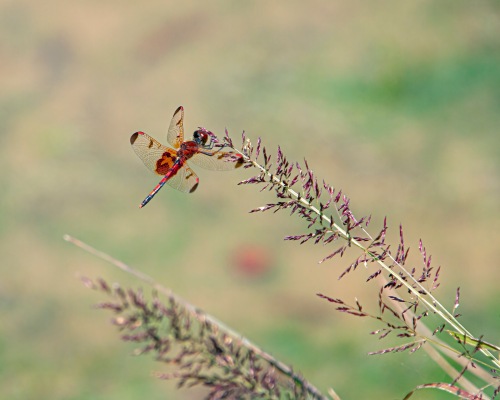
The second image shows a male Calico Pennant (Celithemis elisa), a beautifully colored dragonfly with distinctive patterns on its wings. The third image shows a mature female Needham’s Skimmer (Libellula needhami). Her wings show some damage and her color has fades, but she is still beautiful and the golden strands on the front edges of her wings were sparkling in the sunlight when I captured this image.

The fourth image shows a female Eastern Pondhawk (Erythemis simplicicollis), one of the most common dragonfly species in my area. I love the brilliant emerald color of the females (and immature males) of this species and the black markings on the abdomen.

The dragonfly in the last photo was the toughest one for me to identify. It had flown up into a tree and I was looking into the sun when I captured the image. However, I am pretty sure that it is a female Great Blue Skimmer (Libellula vibrans).

All of these dragonflies belong to the Skimmer family, the largest dragonfly family that includes the species most likely to be seen by a casual dragonfly watcher. The other families, which are generally harder to find, include Clubtails, Cruisers, Darners, Emeralds, Petaltails, and Spiketails. If I remember correctly, I have managed this season to photograph at least one dragonfly in all seven of these dragonfly families.
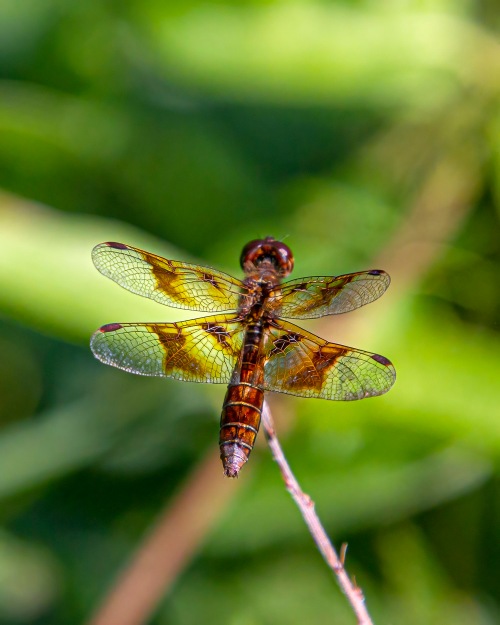
Eastern Amberwing

Calico Pennant

Needham's Skimmer

Eastern Pondhawk

Great Blue Skimmer

© Michael Q. Powell. All rights reserved.


Read Full Post »

Dragonflies were flying overhead at several locations at Occoquan Bay National Wildlife Refuge on Thursday, including a Common Green Darner (Anax junius), multiple Black Saddlebags (Tramea lacerata), and at least one Wandering Glider (Pantala flavescens). The Wandering Glider, alas, was elusive and I could not get an in-flight shot of it, but I did manage to get a shot of a Common Green Darner (1st photo) and a Black Saddlebags (2nd photo).

All three of these dragonfly species are migratory species. Migrating dragonflies will often fly in mixed swarms that are large enough that they are sometimes picked up by weather radars. For more details about this phenomenon, check out this September 2019 article in the Washington Post entitled “Weather radar is picking up swarms of dragonflies from the Midwest to the Mid-Atlantic.”

Common Green Darner

Black Saddlebags

© Michael Q. Powell. All rights reserved.

Read Full Post »
For those of us in the northern hemisphere who use the astronomical calendar, tomorrow (23 September) marks the beginning of the autumn season. In so many of the photos that I have taken during the past few weeks, I have noted signs of the changing seasons.

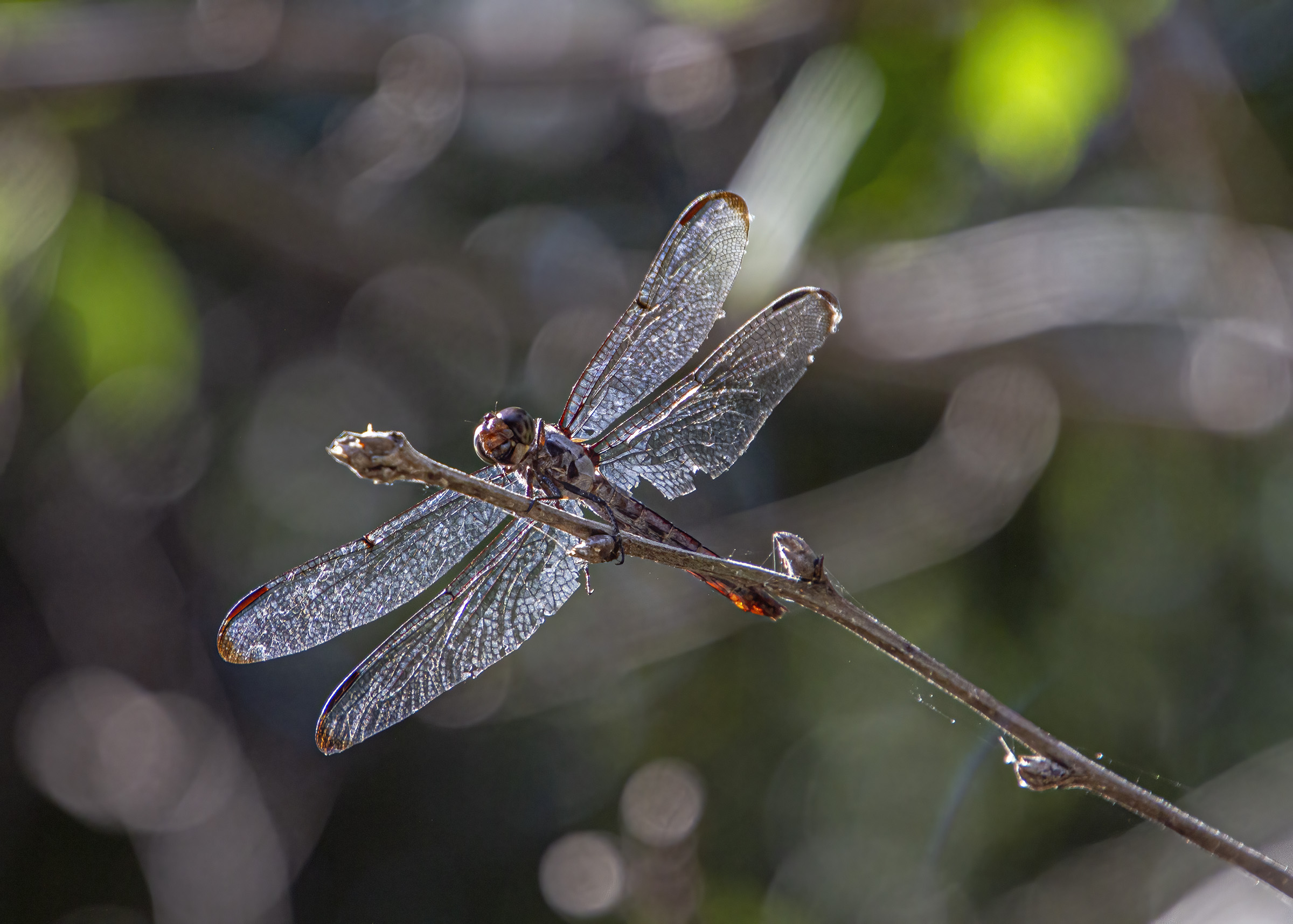
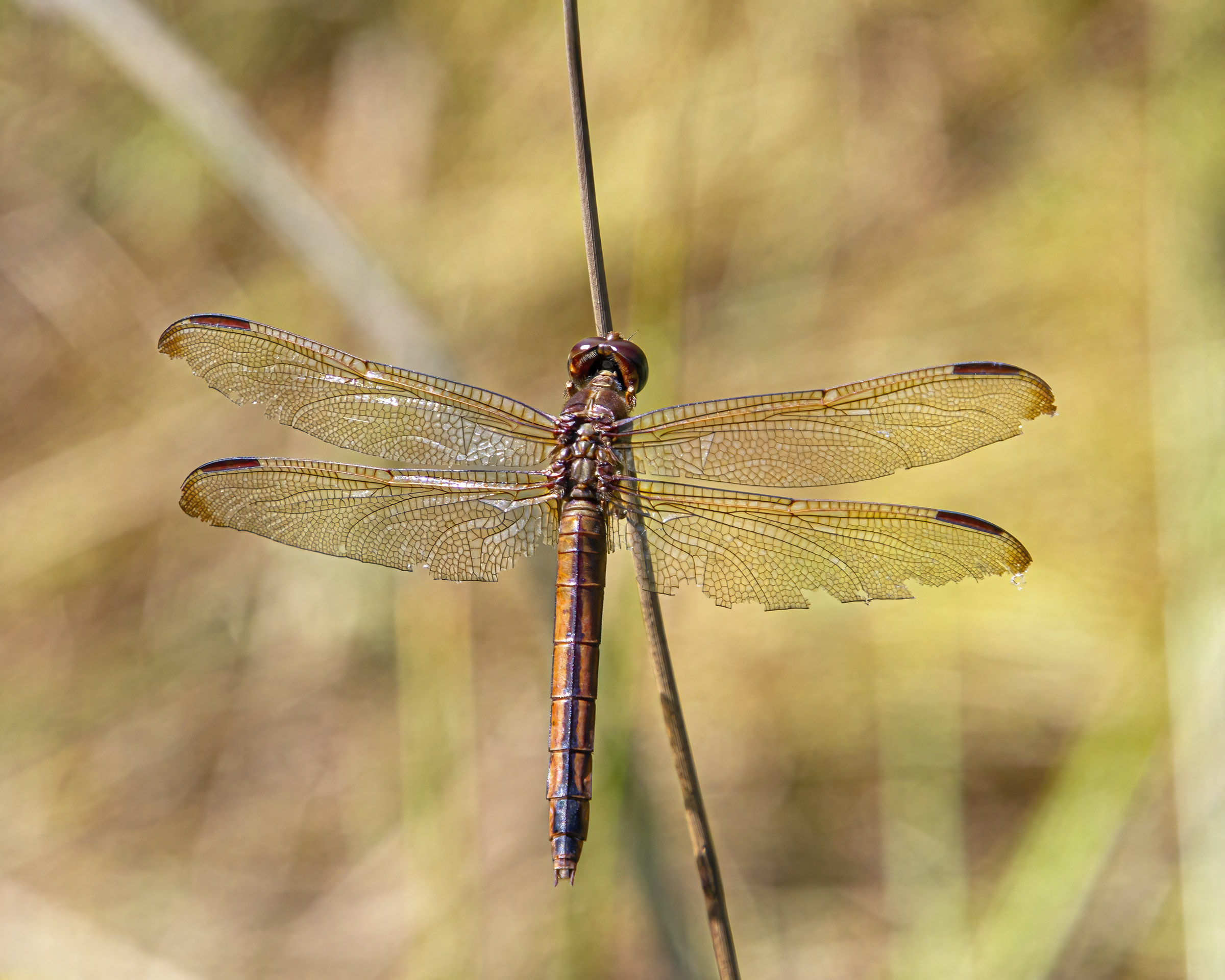
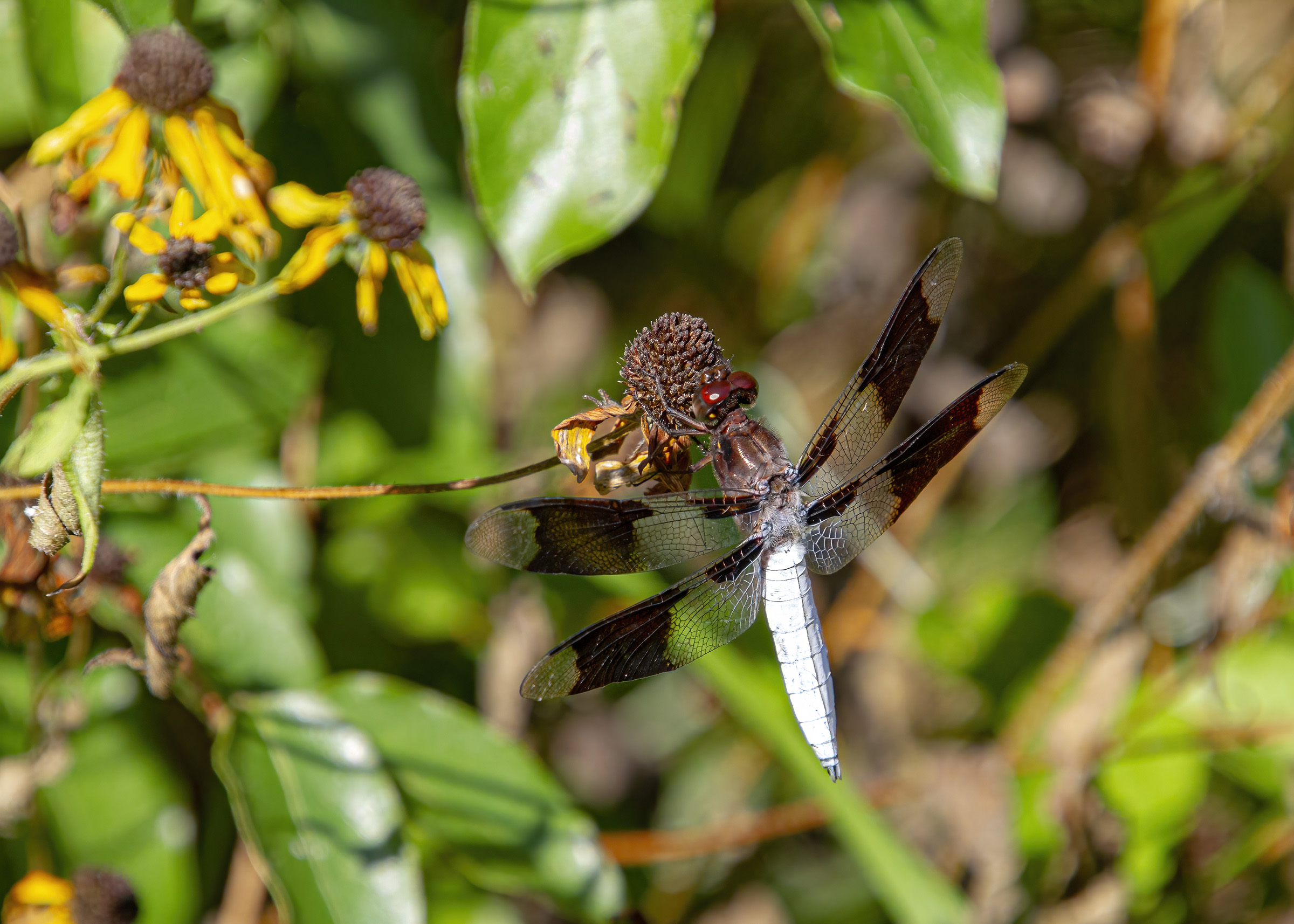
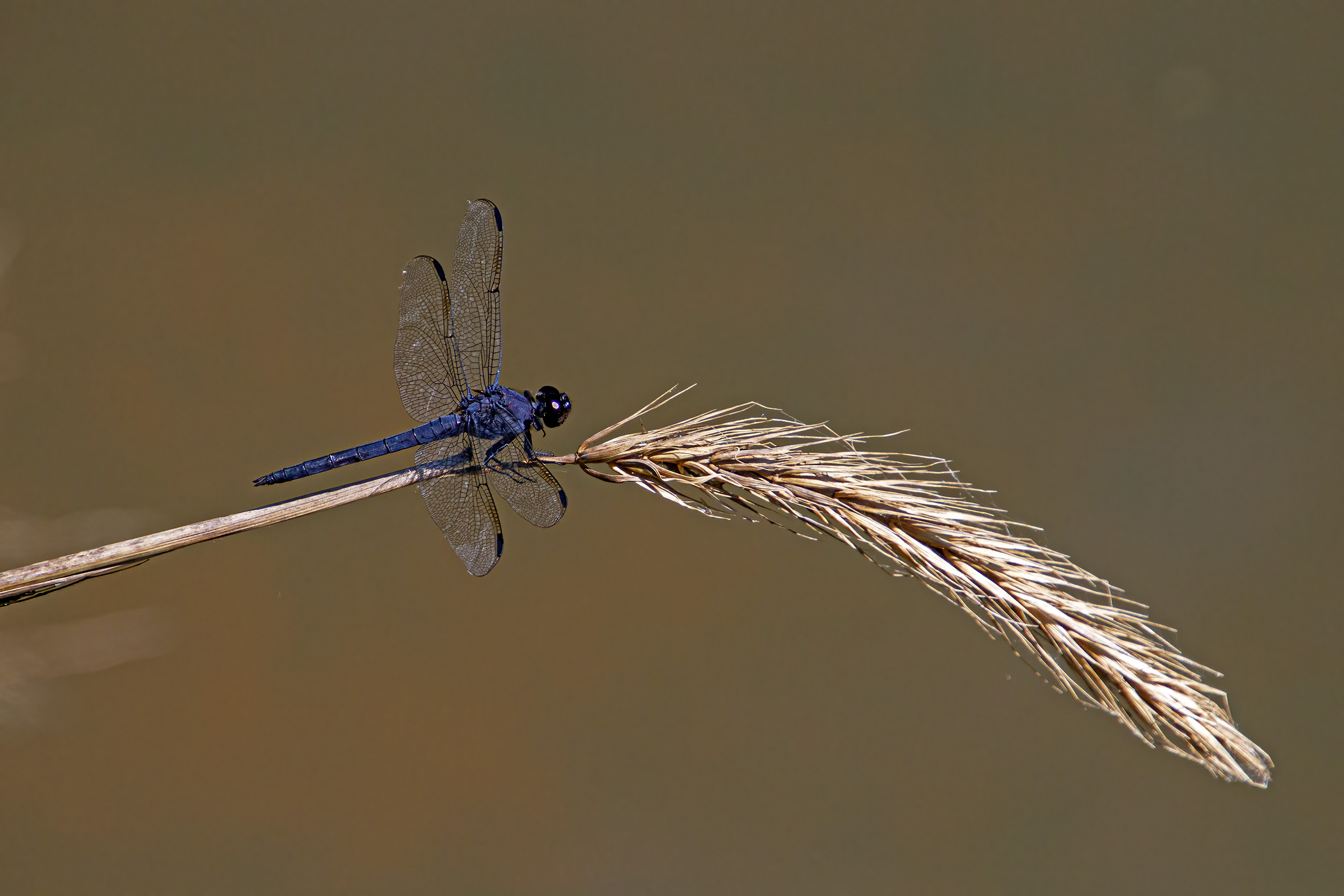
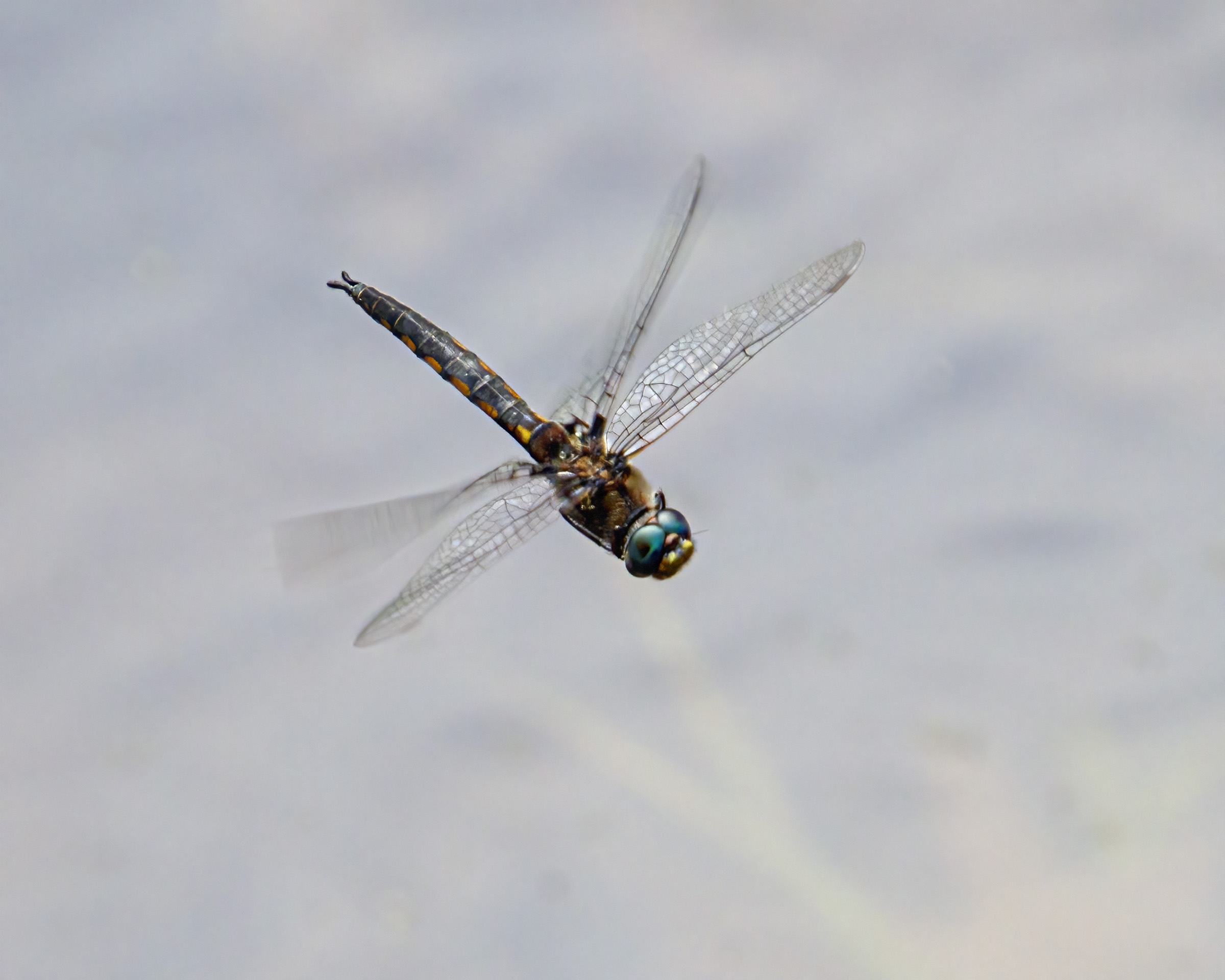
The warm orange tones in this shot of a female Needham’s Skimmer dragonfly (Libellula needhami) remind me of pumpkins and autumn leaves. The fading flowers in the photo of a male Common Whitetail dragonfly (Plathemis lydia) remind us that the growing season is coming to an end. The dryness of the stalk on which the Slaty Skimmer (Libellula incesta) dragonfly perch brings to mind the droughts and extreme weather that many have experience during this summer.

Embrace the new season and the opportunities is provides, whether it be autumn in the northern hemisphere or spring for those in the southern hemisphere.

Needham's Skimmer

Common Whitetail

Slaty Skimmer

© Michael Q. Powell. All rights reserved.


Read Full Post »

Wings are tattered. Flowers have faded. Summer is ending. (Blue Dasher dragonfly (Pachydiplax longipennis) photographed on 6 September at Jackson Miles Abbott Wetland Refuge.)

Blue Dasher

© Michael Q. Powell. All rights reserved.

Read Full Post »

« Newer Posts - Older Posts »