Feeds:
Posts
Comments

Archive for the ‘dragonfly’ Category

As I have mentioned previously, I have real difficulties in identifying many of the dark swallowtails that I encounter. However, sometimes I get a perfect view of one and the task is vastly simplified.

Last week at Occoquan Bay National Wildlife Refuge, for example, I spotted this Spicebush Swallowtail butterfly (Papilio troilus) feeding on a blooming thistle plant. I could tell it was a Spicebush Swallowtail because its row of inner orange spots was interrupted by a swoosh of blue that looks a bit like the tail of a comet. Additionally, the position of the butterfly made for a beautiful composition of the image that I was able to capture.

Spicebush Swallowtail

© Michael Q. Powell. All rights reserved.

Read Full Post »

I had not seen a Swift Setwing dragonfly (Dythemis velox) in several weeks at Jackson Miles Abbott Wetland Refuge and feared that they might be gone for the season. I was therefore thrilled when I spotted this one last Thursday. Most of the previous times when I have seen Swift Setwings, they have been perched with their wings pulled forward, but this one had its wings fully extended.
A bit later that same day, I spotted a Swift Setwing that appeared to be missing an entire wing, as you can see in the second photo below. I looked carefully at other shots of the same dragonfly and in a couple of them I can see at least a partial wing in that spot. It is interesting that I did not notice this problem with the wing while out in the field, and the dragonfly flew away without any issues whatsoever.

Swift Setwing

Swift Setwing

Swift Setwing

© Michael Q. Powell. All rights reserved.

Read Full Post »

Some dragonflies will look me straight in the eye, but others, like this male Blue Dasher dragonfly (Pachydiplax longipennis), seem to prefer sidewards glances. I spotted this cute little dragonfly last Thursday at Jackson Miles Abbott Wetland Refuge. Blue Dasher dragonflies are among the first dragonflies to appear on the scene in the spring and among the last ones to disappear in the autumn.

The vegetation at this time of the year is always interesting, a combination of new growth and dried-out stems. I love both the colors and textures of the perch that this dragonfly had selected and the visible cobwebs add a nice touch of visual interest to the image.

Blue Dasher

© Michael Q. Powell. All rights reserved.

Read Full Post »

How old does a dragonfly have to be to collect Social Security? OK, that’s a bit of a crazy question, but collecting Social Security is a sure sign that you are getting old. A couple of weeks ago, I received my first payment from the Social Security Administration, a sure sign that I am officially “old.” Last week I also stopped in a a Metro offices in Washington D.C. to sign up for a senior pass that allows me to ride Metro trains at a reduced rate—one of the few tangible benefits of becoming a senior.

Here in the United States, people are living longer than in the past and it is anticipated that the Social Security Administration will run out of money to pay full benefits in a decade or so of changes are not made. Politicians don’t want to deal with the issue and keep putting off coming up with a solution to the problem.

Comparatively speaking, dragonflies live uncomplicated lives. They hang on for as long as they can and then they die, hopefully after successfully procreating. Last week I spotted this elderly female Great Blue Skimmer dragonfly (Libellula vibrans) at Occoquan Bay National Wildlife Refuge. Her coloration was dark and faded and her wings were tattered, but she was still functioning. After spending a few quiet moments with her, I pushed onward, still lost in my thoughts about life and growing older.

Great Blue Skimmer

© Michael Q. Powell. All rights reserved.

Read Full Post »

I love to see dragonflies with patterned wings and so I was delighted to spot this male Twelve-spotted Skimmer dragonfly (Libellula pulchella) on Tuesday at Occoquan Bay National Wildlife Refuge. The males of this species have a beautiful combination of brown and white patches on their wings.

I used to be confused about the name of the species, because there appear to be a total of twenty-two spots. To make things worse, this species is also known as the Ten-spot Skimmer. What? It apparently depends of how you count the spots. If you count only the brown spots that are present on both males and females, you get twelve spots, but if you count the white spots that are present on only the males, you get ten spots. Yikes! Who knew that math was so important in dragonfly identification. 🙂

Twelve-spotted Skimmer

© Michael Q. Powell. All rights reserved.


Read Full Post »

Earlier this summer Needham’s Skimmer dragonflies (Libellula needhami) were among the most common dragonflies that I would see at Occoquan Bay National Wildlife Refuge. The last month or so, however, their numbers have declined significantly and they are now quite hard to find. I was delighted, therefore, to photograph this slightly tattered female Needham’s Skimmer on Tuesday morning.

Our weather has cooled off this week, with early morning temperatures in the 50’s (10 degrees C) and daytime highs struggling to get to 80 degrees (27 degrees C). I looked at the 10-day weather forecast and see that temperatures are not predicted to hit the 90’s (33 degrees C). Now it would be premature to declare that summer is over and we may well have some hot days in store for us, but the seasons are definitely changing.

So I will continue to search for remaining dragonflies while again, hopeful that I will spot some of the autumn species, like the Autumn Meadowhawks and Blue-faced Meadowhawks that should be appearing soon. Personally, autumn is my favorite time of the year, with cool nights and warm, sunny days, but I am not yet ready to bid farewell to the summer.

Needham's Skimmer

© Michael Q. Powell. All rights reserved.

Read Full Post »

The countdown begins. Now that we are into September, the number of dragonfly species is beginning to drop and many of the remaining ones are looking a little tattered. They seem to adapt and compensate for their disabilities while moving, perhaps, a bit more slowly.

Yesterday at Occoquan Bay National Wildlife I photographed a number of male Slaty Skimmer dragonflies (Libellula incesta). Their dark bodies and eyes make them pretty easy to identify. Some of them appeared to be in pretty good condition, like the one in the first photo, while others, like the one in the second photo, are showing the signs of a tough summer.

Aging in all species is inevitable. No matter how much we complain about it, we are fortunate if we are able to slow its effects—we cannot stop it. The 19th century French romantic poet Alphonse de Lamartine wrote about the passage of time in a famous poem called Le Lac (The Lake) that included these words:

“Just a few more moments, I ask — in vain, for time
Eludes me and takes flight.
I tell the night to pass more slowly, and dawn comes
To chase away the night.

“Then let us love! Then let us fill each fleeting hour
With joy and ecstasy!
Man does not have a port; time does not have a shore.
It passes, and so do we.”

Slaty Skimmer

Slaty Skimmer

© Michael Q. Powell. All rights reserved.

Read Full Post »

Early in the summer, Needham’s Skimmers (Libellula needhami) were among the most common dragonflies at Occoquan Bay National Wildlife Refuge. As the dragonfly season begins to wind down, their population size has been noticeably dwindling. I am still likely to see some of them, but I have to search a lot harder than I did a month or two ago.

Yesterday I captured this image of a female Needham’s Skimmer. She is in pretty good shape overall, with only a small portion of her wings looking a little tattered.

I like the way that this image shows the bright yellow veining near the leading edges of her wings, one of the distinctive identifying features of this dragonfly species. (The mature males are bright orange or red in coloration, making them even easier to identify.)

Needham's Skimmer

© Michael Q. Powell. All rights reserved.

Read Full Post »

I really like Blue Dasher dragonflies. They are quite common and visible throughout most of the summer. Unlike some other dragonfly species that require specific habitats, Blue Dashers (Pachydiplax longipennis) can be found almost anywhere.

I really like the description of the species on the Dragonflies of Northern Virginia website, one of my favorite resources for information about the dragonflies in my area:

“A very little guy in a big hungry world, Blue Dashers make up for their small size with plenty of moxie. Just about everything eats them…but it certainly hasn’t affected their numbers. The most abundant dragonfly in our area, they face their predator-filled worlds head on. Males aggressively defend their small, shore-line territories against larger skimmers, and spend a great deal of time with their black-tipped abdomens pointed high in the air – an aggressive threat display. It’s also a technique used to cool down by reducing surface area to the sun, called the obelisk position. However, Dashers use it more than other species, and half the time it appears to be done for the purpose of territorial display, rather than temperature control.”

I spotted this Blue Dasher on Monday at Jackson Miles Abbott Wetland Refuge. I couldn’t get really close to the dragonfly, but like the way that the abundant vegetation helped to frame the dragonfly.

Blue Dasher

© Michael Q. Powell. All rights reserved.

Read Full Post »

This female Slaty Skimmer (Libellula incesta) that I spotted on Monday at Jackson Miles Abbott Wetland Refuge has definitely seen better days. Its wings are growing tattered and its color has darkened with age. Nonetheless, the dragonfly is carrying on and compensating as it grows older. In fact, the dragonfly seemed to be feeding on some kind of insect when I photographed it.

A few weeks ago I turned 70 and I have become increasingly conscious of the passing of time. Tomorrow is not guaranteed, so I am trying to pay more attention to living my life in the moment, as perhaps this aging dragonfly is doing.

Slaty Skimmer

© Michael Q. Powell. All rights reserved


Read Full Post »

The countdown continues, but the dragonfly season is not over yet. I will undoubtedly continue to spot dragonflies for the next few months, but already their numbers seem to be diminishing as summer prepares to give way to autumn. We have had a series of cooler days this week, but I’m quite confident that summer is not quite ready to give up its hold and next week the high temperatures are forecast to return to the 90s.

I was happy on Monday to spot a Swift Setwing dragonfly (Dythemis velox) at Jackson Miles Abbott Wetland Refuge, the only one that I managed to photograph during my visit. I did have another sighting of a Swift Setwing that I was unable to photograph, but I am not sure if it was the same individual or a different one.

In the past, I have seen a Swift Setwing as late as September, but there are no guarantees that they will continue to be around that long this year. The population of Swift Setwing dragonflies is pretty well-established at this location, but it is quite small.

Each year I try to document my dragonfly sightings as we start to approach the end of the season, so I will probably return to this location again in the upcoming weeks. There are a few late-season species, like the Russet-tipped Clubtail, that will start to reappear, so I will keep my eyes open for them as well.

Swift Setwing

© Michael Q. Powell. All rights reserved


Read Full Post »

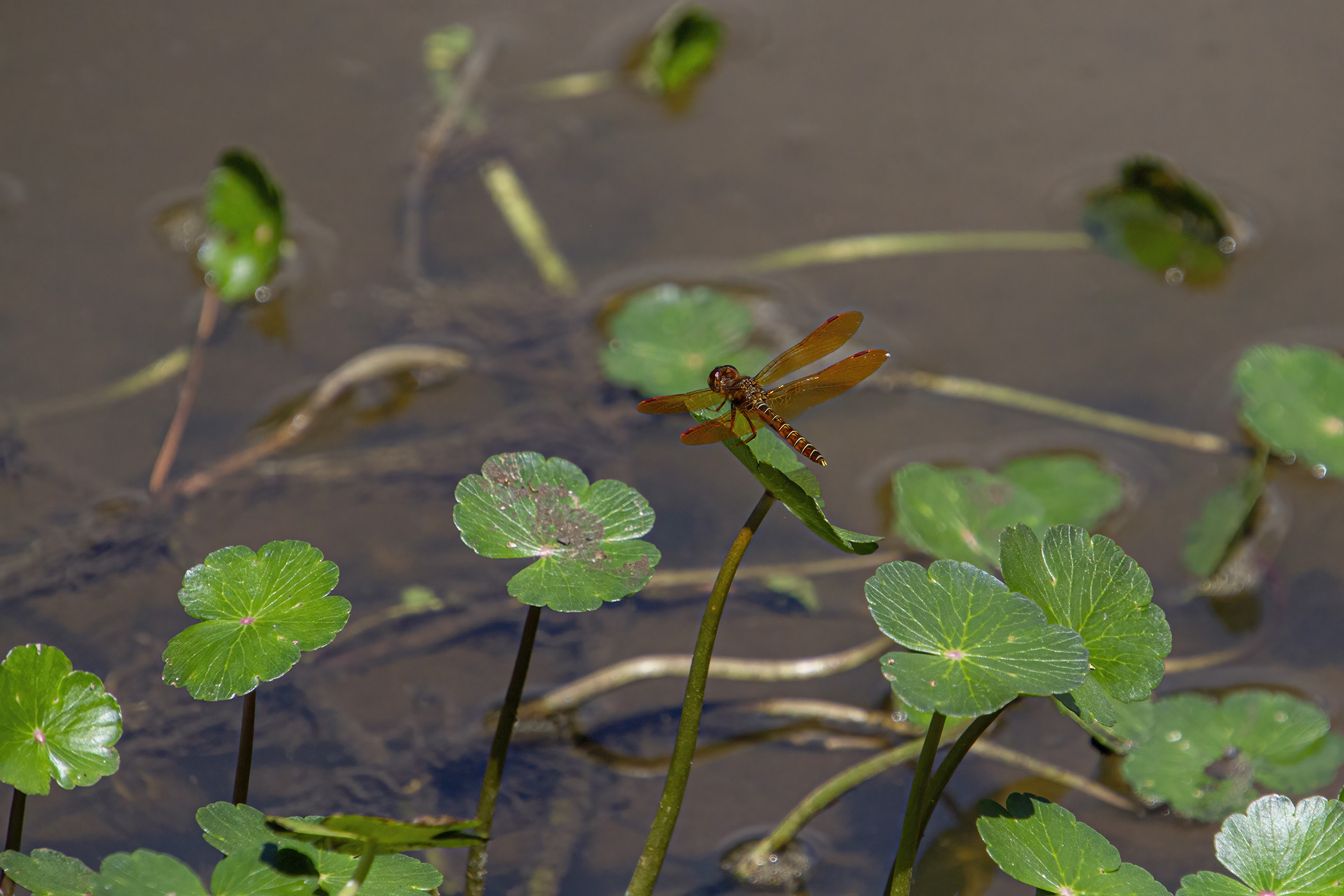
Eastern Amberwings (Perithemis tenera) are one of the smallest dragonfly species where I live—less than one inch (25 mm) in length. I often see the amber-colored males buzzing around at the ponds that I visit, but it is pretty rare for me to spot a female.

Yesterday I visited Jackson Miles Abbott Wetland Refuge and was a bit surprised to see a female Eastern Amberwing dragonfly in the vegetation near the edge of a small pond. Unlike the males, females of these species have patterned wings that are partially clear. I maneuvered around to composed a shot and managed to capture this image of the dragonfly.

According to the website Dragonflies of Northern Virginia, one of my favorite dragonfly websites, female Eastern Amberwing dragonflies are often found far from the water in meadows where they share perches with hornet and other wasps. When they are threatened, these dragonflies will rhythmically move their wings up and down while pulsing their abdomens in imitation of a wasp to scare off potential predators that believe they are about to be stung.

I don’t know if this female was checking out the males at the pond, searching for a suitable partner, or perhaps had just mated and was recovering from the experience. Whatever the case, I was delighted to spot this elusive little dragonfly.

Eastern Amberwing

© Michael Q. Powell. All rights reserved.
 

Read Full Post »

With most dragonfly species, the male is usually the one with the most distinctive coloration and females are often nondescript in appearance. That is definitely not the case with the Eastern Pondhawk dragonfly (Erythemis simplicicollis), where the female is bright green and has distinctive black bands on her abdomen. She also has a green face that makes it almost impossible to misidentify this species.

Immature males of this species have a similar coloration to that of the female, but they are gradually transformed into a duller shade of blue and finally a powdery bluish-gray. The terminal appendages of the male are different from those of the female and additionally the ovipositor of the female, the egg-laying organ, is frequently visible below the tip of her abdomen, as you can see in this photo that I took last week at Occoquan Bay National Wildlife Refuge.

Eastern Pondhawks are quite common in my area, though this year I have not seen as many as in previous years. Although other dragonflies are equally fierce predators as the Eastern Pondhawk, the majority of the times that I have seen a dragonfly with prey, particularly other dragonflies or damselflies, it has been an Eastern Pondhawk.

Eastern Pondhawk

© Michael Q. Powell. All rights reserved.

Read Full Post »

I thought that the Calico Pennant dragonflies (Celithemis elisa) might be gone for the season, so I was thrilled to spot this handsome male last Monday (12 August) at Occoquan Bay National Wildlife Refuge. Calico Pennants are among the most colorful dragonflies that I encounter, with beautiful patterned wings. Early in their development, male Calico Pennants have yellow bodies, like their female counterparts, but eventually they become a bright red in color.

When I captured this image of the Calico Pennant, he was perched at the very tip of the vegetation, a favorite perching spot for this species. Like other pennant species, Calico Pennants often occupy precarious perches that cause them to flap like a pennant when even the slightest breeze is blowing.

Calico Pennant

© Michael Q. Powell. All rights reserved.

Read Full Post »

If you want to photograph dragonflies for identification purposes, it is best to photograph them from the side. The side view gives you a good view of the head, thorax, and abdomen of the dragonfly, although the tips of the wings often are out of focus. If you are a scientist, the side view is probably the best one for you.

If you are are an artist, however, you are not so worried about having the entire dragonfly in focus. You focus on the beauty of the dragonfly and on different ways pf capturing that beauty. I personally really like head-on frontal shots of a dragonfly that provide an almost abstract view of the amazing creature.

This past Monday I encountered a Halloween Pennant dragonfly (Celithemis eponina) during a visit to Occoquan Bay National Wildlife Refuge. I carefully maneuvered around the dragonfly in order to get an almost head-on view of it.

Shooting at an upwards angle, I captured the image below. I really like the abstract feel of the shot—your mind has to do some quick processing to realize that the subject is a dragonfly. There is an abstract minimalism to the shot that I really like that was enhanced by the way that I had to shoot at an upward angle, which eliminated all of the clutter behind the dragonfly.

Halloween Pennant

© Michael Q. Powell. All rights reserved.

Read Full Post »

The end of the season is drawing near for many of the common dragonflies in my area. A month from now, some species will be gone entirely, with only a few hardy stragglers hanging on for a bit longer. Children return to school this coming week, which seems outrageously early to me—when I was growing up, school did not begin until after Labor Day.

I am starting to pay greater attention to the dragonflies that I encounter, never knowing for sure if I will see them again this season. Summer is not over yet, of course, but there are already signs that the seasons are changing.

I spotted this male Widow Skimmer (Libellula luctuosa) on Monday at Occoquan Bay National Wildlife Refuge. Many of the dragonflies that I see are showing signs of wear, with tattered wings increasing common, but this individual was beautifully intact.

I suspect that dragonflies live in the moment, focused solely on the present for as long as they live. I recently read an article that noted how much of life many people miss, because they are focused too much on the future, which, of course, is never guaranteed. Yes, it is good to plan for the future, but be sure to enjoy your present life too.

Widow Skimmer

© Michael Q. Powell. All rights reserved.


Read Full Post »

During several recent visits to Jackson Miles Abbott Wetland Refuge, I did not see any Swift Setwing dragonflies (Dythemis velox), so I feared that they might be gone for the season. I was therefore delighted last Thursday to spot several of them at the small pond at this refuge.

Swift Setwings like to perch at the very tip of vegetation that hangs over the water, which makes getting a profile shot of one a challenge without getting wet. These little dragonflies often perch in a distinctive pose with their wings pulled forward, which reminded some scientist of the “ready-set-go” position of a sprinter and is reportedly the reason for the name of the species.

On this day, a breeze was blowing periodically and it seemed like the Swift Setwings had to repeatedly readjust their wing positions to maintain their balance, which you can see particularly well in the second photo below.

Swift Setwing

Swift Setwing

© Michael Q. Powell. All rights reserved.

Read Full Post »

As I watched television coverage of the Olympic Games in Paris, I could not help but notice the numerous handstands in almost all of the gymnastic events for the men. There were handstands on the floor, on the rings, on the parallel bars, the high bar, and even on the pommel horse.

When I spotted this male Blue Dasher dragonfly (Pachydiplax longipennis) doing a handstand last Thursday at Jackson Miles Abbott Wetland Refuge, I immediately thought of those Olympic gymnasts.

This position is sometimes referred to as the “obelisk” pose for dragonflies. Many scientists believe that it is used as a form of thermoregulation to keep the body cooler by reducing the amount of surface exposure to direct sunlight. Several other dragonfly species use this pose, but I observe it most often with the male Blue Dasher dragonflies.

Blue Dasher

© Michael Q. Powell. All rights reserved.

Read Full Post »

Some dragonflies are openly curious and will look at me straight in the eye and even perch on me sometimes. Others will immediately fly away when they sense my presence.

This male Great Blue Skimmer dragonfly (Libellula vibrans) that I spotted during a recent visit to Occoquan Bay National Wildlife Refuge seemed to be a bit shy. He tolerated my presence well as I moved about to frame the shot, but gave me a sidewards glance instead of looking right at me. Was it shyness or maybe a little impatience that I was not taking the photo more quickly?

Whatever the case, I was happy to be able to capture his beautiful speckled blue eyes so well.

Great Blue Skimmer

© Michael Q. Powell. All rights reserved.

Read Full Post »

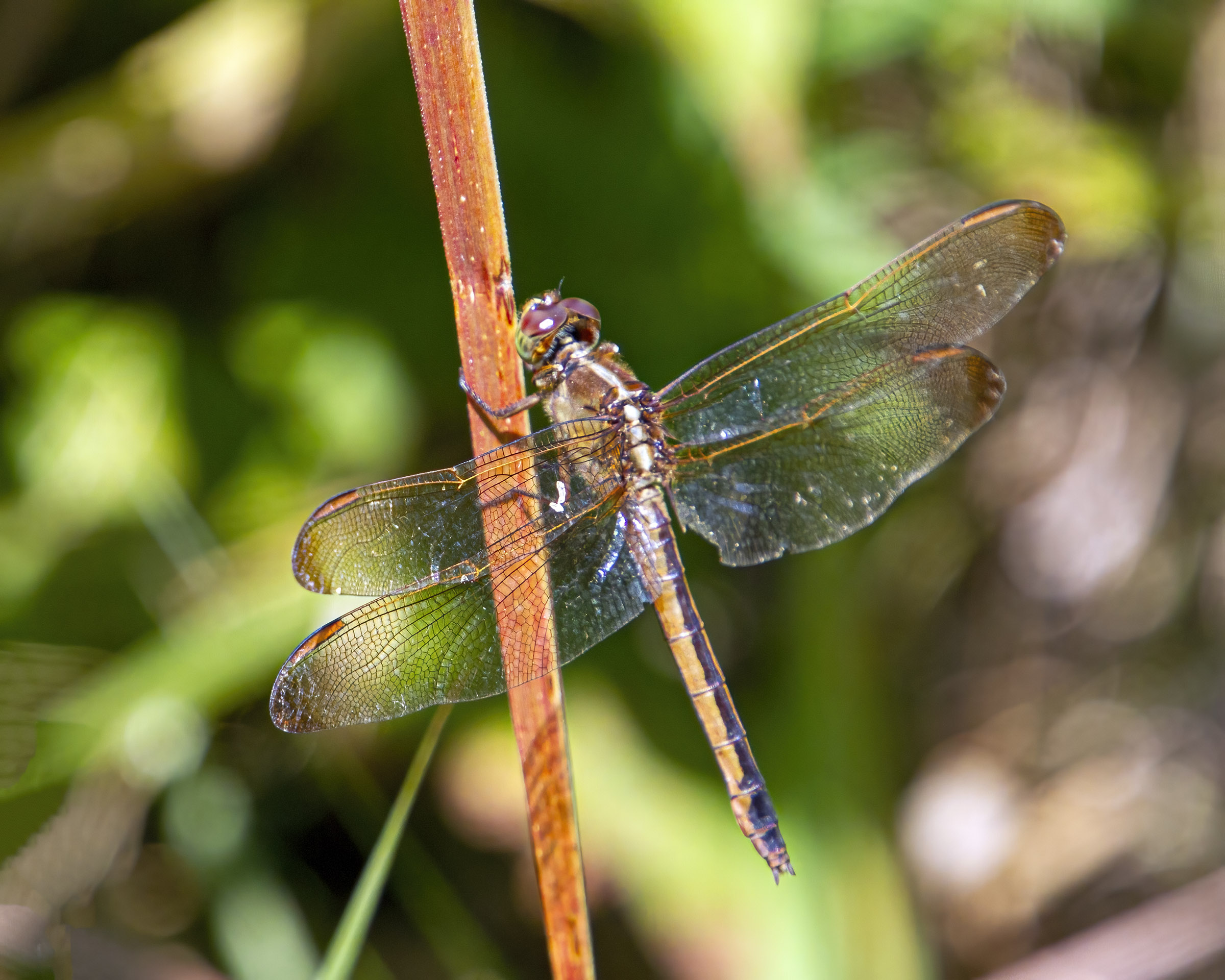
I am always looking for cool perches when I spot dragonflies. Sometimes I will try to communicate telepathically with the dragonflies to prompt them to move to photogenic perches, but, alas, I am rarely successful—I guess that my telepathic powers are weak.

I was delighted on Monday at Occoquan Regional Park when this dark male Slaty Skimmer (Libellula incesta) voluntarily perched on the flowering stalk of a beautiful dark red plant. I have no idea what kind of plant it is, but I really like the color combination of this dragonfly and the the vegetation. The twisting pattern of the flowers on the stalk were a nice bonus and add a bit of additional visual interest to the image.

Slaty Skimmer

© Michael Q. Powell. All rights reserved.
Read Full Post »

Inspired perhaps by the Summer Olympics in Paris, this female Halloween Pennant dragonfly (Celithemis eponina) was practicing her acrobatic moves last week at Occoquan Bay National Wildlife Refuge.

Yesterday I watched coverage of some of the men’s gymnastics competition and I was in awe of the ease with which the athletes were able to do handstands in the air on rings, on parallel bars, and on the ground. I have always been in awe of the combination of strength and balance of both human and insect gymnasts.

I’d give this dragonfly a perfect 10.0 as a score.

Halloween Pennant

© Michael Q. Powell. All rights reserved.

Read Full Post »

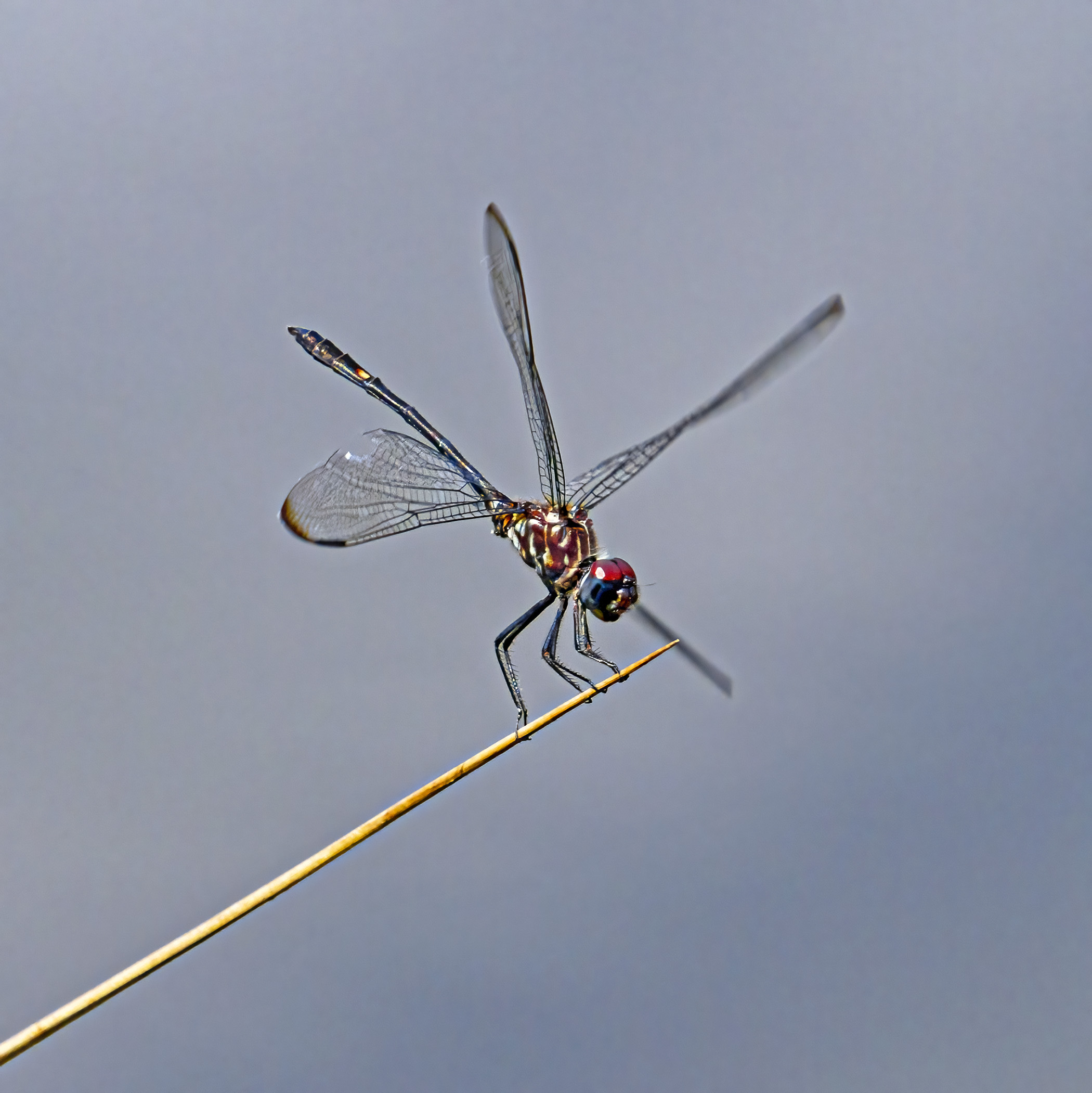
Halloween Pennant dragonflies (Celithemis eponina) perch so high in the vegetation that it sometimes seems like they are perching amidst the clouds, like this one that I spotted a week ago at Occoquan Bay National Wildlife Refuge. One of the advantages of this species’ perching preference is that it is often easy to get an uncluttered background. In addition, I frequently can get a shot like this one in which the light shines through the cells of the wings, illuminating them like a stained glass window.

Halloween Pennant

© Michael Q. Powell. All rights reserved.
Read Full Post »

Immature male Needham’s Skimmer (Libellula needhami) dragonflies are yellow and black in color, like the females of the species, but gradually turn into a wonderful shade of reddish-orange as the season progresses. I was delighted to spot this mature male Needham’s Skimmer last Thursday at Occoquan Bay National Wildlife Refuge and captured this image as he perched on a stalk of what appears to be Eastern Gamagrass.

Needham's Skimmer

© Michael Q. Powell. All rights reserved.


Read Full Post »

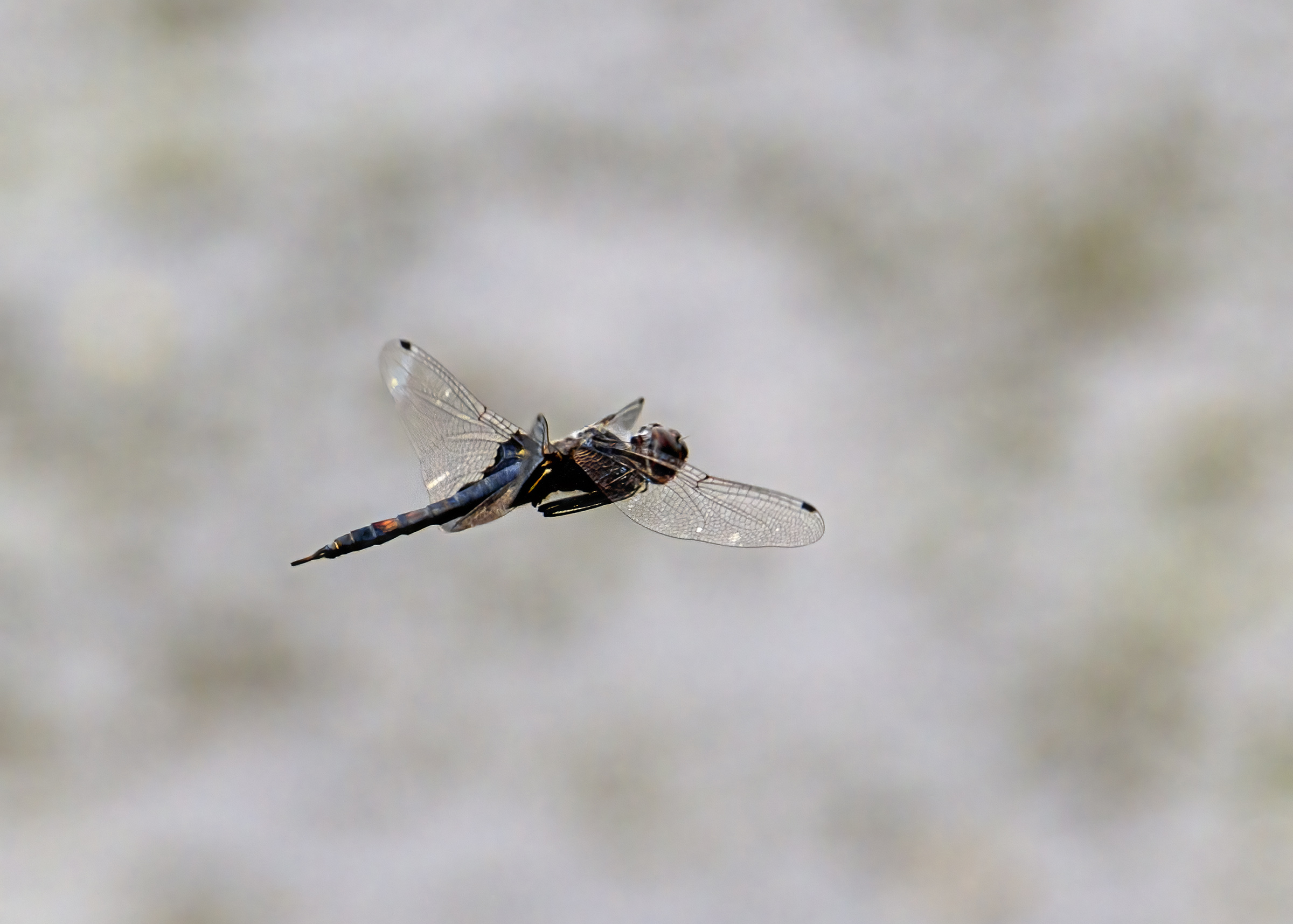
I do not tilt at windmills, but often find myself engaged in my personal quixotic quest of trying to photograph dragonflies in flight. It is such a challenging task that I titled a video that I posted on YouTube, “Impossible Shots? Dragonflies in flight.” Despite the almost overwhelming odds of getting a good shot of one of these aerial acrobats in flight, I feel irresistibly drawn to trying over and over again whenever I see a dragonfly in the air.

I spotted this Black Saddlebags dragonfly (Tramea lacerata) patrolling over the waters off of Occoquan Bay National Wildlife Refuge last Thursday and was thrilled to capture this shot of the dragonfly as it flew past me.Black Saddlebags dragonfly (Tramea lacerata). I love the way that you can see how the dragonfly had enhanced its aerodynamic profile by folding up its legs under its thorax, a bit like the way aircraft retract their landing gear after taking off.

In case you are curious, Black Saddlebags are only about 2 inches (52 mm) in length, so I have to be paying attention in order to even spot one. After years of pursuing my quest, though, my eyes are now calibrated to recognize the shape of a dragonfly pretty quickly and my hand-to-eye coordination has improved with practice, so that I am able to track these a lot better than when I started.

Black Saddlebags

© Michael Q. Powell. All rights reserved.

Read Full Post »

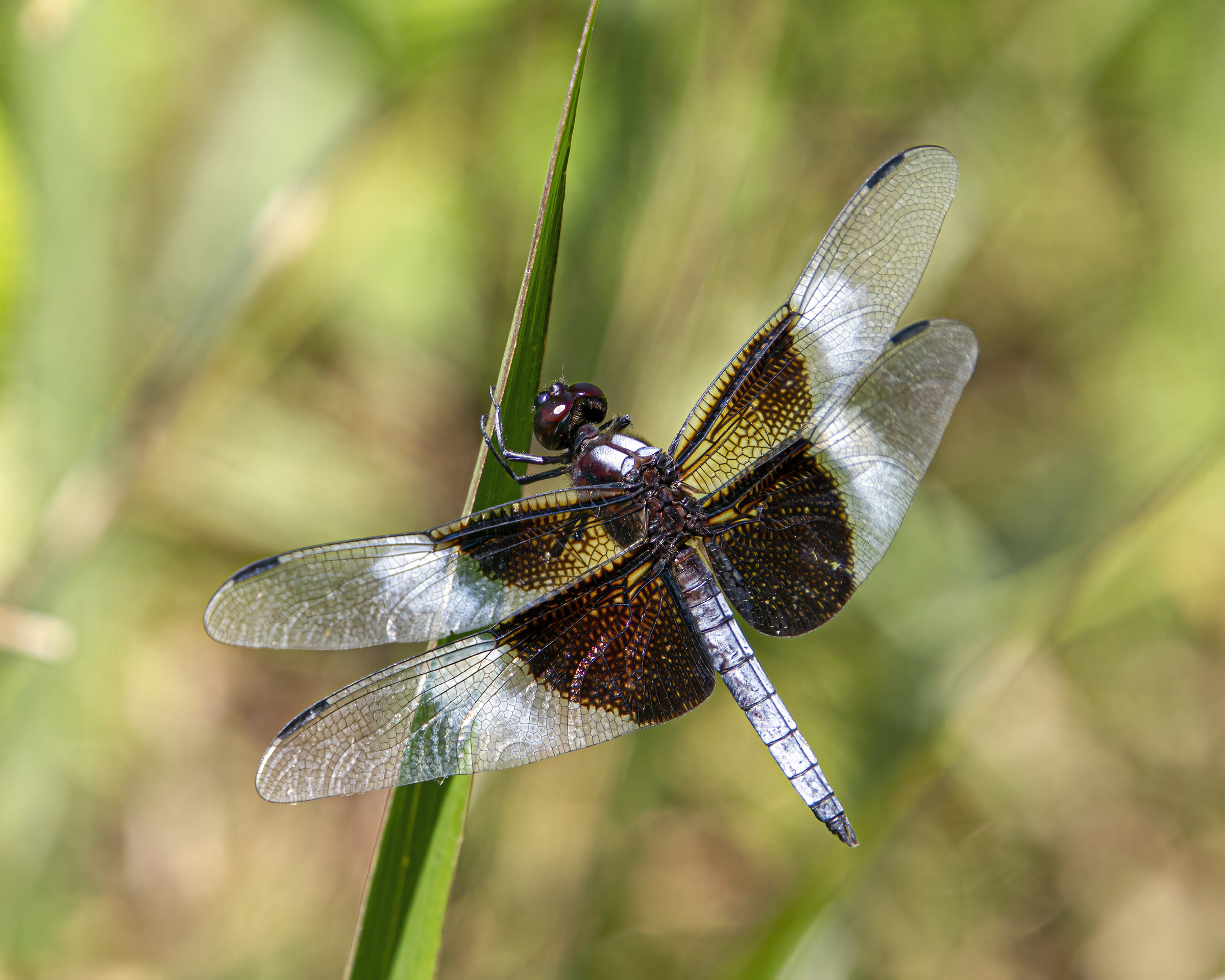
I love to look closely at dragonfly wings. I have a mental picture of the cells of a dragonfly wing as being made up of regularly-shaped squares, like those on a page of graph paper. When I examine them in real life, though, I am always delighted to see all of the different shapes and sizes of these tiny cells in intricate patterns that rival those of massive stained-glass windows.

I photographed this male Widow Skimmer dragonfly (Libellula luctuosa) last Thursday at Occoquan Bay National Wildlife Refuge. I love to see dragonflies with patterned wings and the males of this species have the added bonus of having both brown and white patterns on each wing.

This dragonfly was relatively cooperative and did not fly away as I moved slowly into a position that gave me a good view of the wings. I had to bend and crouch a little to get this shot that emphasizes the impressive wingspan of this handsome little dragonfly.

Widow Skimmer

© Michael Q. Powell. All rights reserved.

Read Full Post »

On occasion I have noticed a dragonfly that seemed to be smiling a little at me. Last week, though, I encountered a female Widow Skimmer (Libellula luctuosa) at Occoquan Bay National Wildlife Refuge that seemed to have an exceptionally toothy grin—she seemed delighted to pose for me. I love the way that the background blurred out, allowing viewers to focus on the details of this smiling dragonfly and hopefully producing smiles on their faces in response.

Widow Skimmer

© Michael Q. Powell. All rights reserved.

Read Full Post »

When dragonflies mate, they usually assume a “wheel” position, in which the male grasps the female by the back of her head and she bends her abdomen towards his thorax. The position appears to be both awkward and acrobatic, but amazingly the dragonflies are able to fly while in this position.

I was searching for dragonflies last week at Occoquan Bay National Wildlife Refuge when a pair of mating Calico Pennant dragonflies (Celithemis elisa) flew by me and landed in some nearby vegetation. Calico Pennants are some of the most spectacular dragonflies in our area, with bright colors and distinctive patches on their wings.

Feeling a bit like a voyeur, I moved a little closer to them and slowly crouched a bit to get a better angle for my shot. In the image below, you can see how the female grasps the abdomen of the male during this process.

I was happy to be able to get most of the two dragonflies in focus, which is always a challenge in situations like this.

Calico Pennant

© Michael Q. Powell. All rights reserved.

Read Full Post »

The entire East Coast of the United States is in the midst of a heat wave. Yesterday here in the Washington D.C. area we had a record high temperature for 15 July of 102 degrees (39 degrees C) with the heat index even higher. Yikes.

Following recommendations of doctors and weather forecasters, I stayed indoors for most of the day and worked on a few images that I captured last week at Occoquan Bay National Wildlife Refuge, including this shot of a Halloween Pennant dragonfly (Celithemis eponina).

Many dragonflies perch with their wings held stationary, but Halloween Pennants seem to move their wings about quite a bit to maintain their balance as they perch precariously on the very tips of tall stalks of vegetation. It is very easy to isolate the dragonfly from the background, because they are perched above all of the ground clutter, but it is a bit of a challenge to focus on the dragonfly as it is buffeted to and fro by even the slightest of breezes.

Halloween Pennant

© Michael Q. Powell. All rights reserved.
Read Full Post »

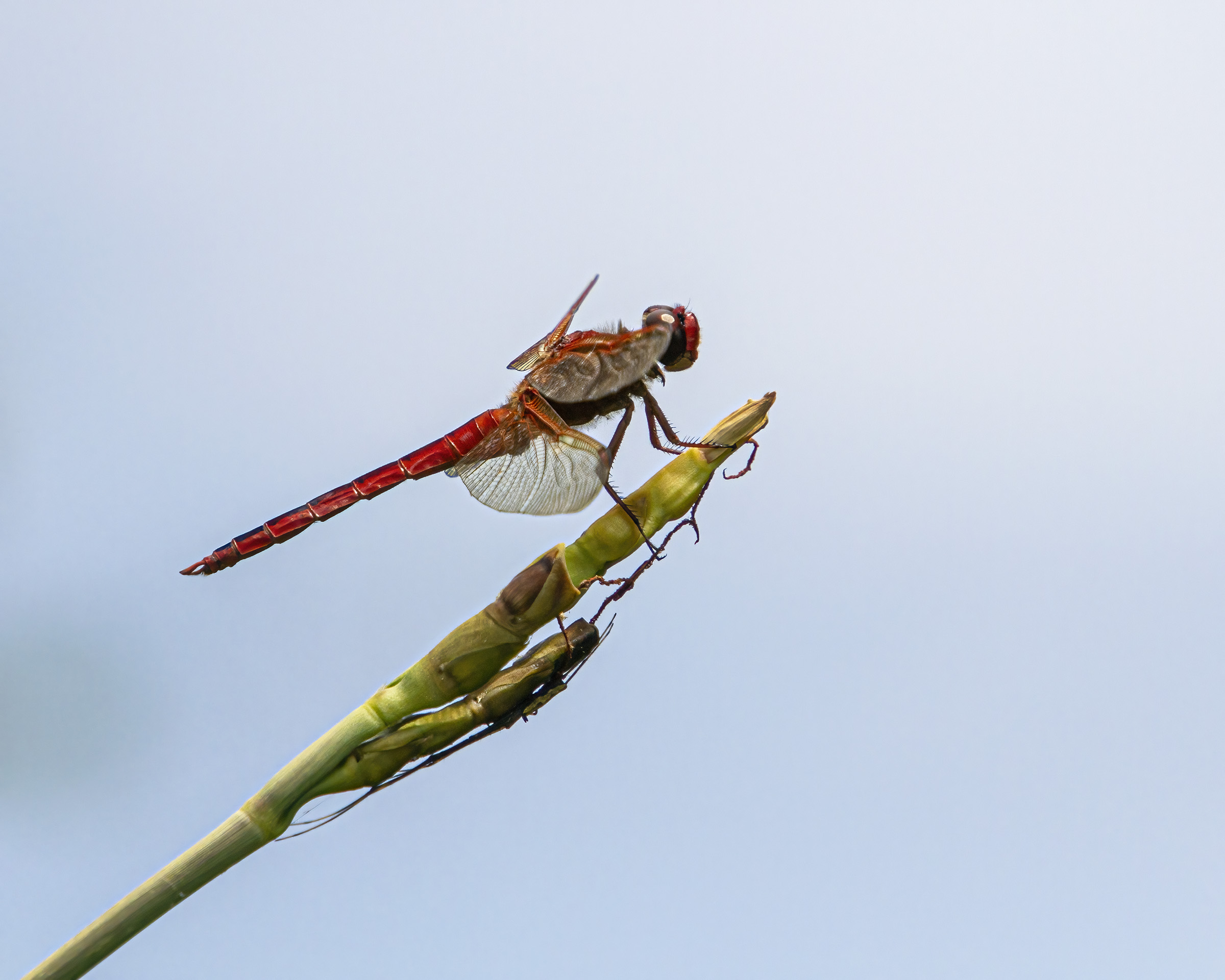
When it comes to color theory, red and green are viewed as complementary colors, i.e. they are on the opposite sides of a color wheel. When used together, complementary colors provide a high contrast and high impact color combination—together, these colors will appear brighter and more prominent.

A week ago I was delighted to post a photo of a perched Carolina Saddlebags (Tramea carolina) dragonfly, a species that is almost always in flight when I am fortunate to spot one. A few days later, I managed to get some even better photos of a perched Carolina Saddlebags during a visit to Occoquan Bay Regional Park.

The lighting was good and the background was far enough away that it became blurry. The complementary colors of the dragonfly and the background really make these images “pop.” The interesting poses of the dragonfly draw in the viewer as well—a breeze was blowing and the dragonfly struggled a bit to maintain its hold on the tip of the vegetation on which it was perched.

It is really cool when the elements of a photograph come together like this and I am able to capture the scene in a way that is both technically and artistically pleasing. It was a good day.

Carolina Saddlebags

Carolina Saddlebags

© Michael Q. Powell. All rights reserved.
Read Full Post »

Sometimes my photos convey the mistaken impression that dragonflies are large and are easy to find and photograph. Using telephoto and macro lenses and a stealthy approach, I try to isolate the dragonflies, so that viewers can focus on the beautiful details of these amazing aerial acrobats.

The reality though, is that most dragonflies are quite small—this male Eastern Amberwing dragonfly (Perithemis tenera) is only about one inch (25 mm) in length—and they often fly about amidst vegetation that conceals their movements.

This image gives you a sense of the vastness of the environment and some of the challenges in spotting the dragonflies. Of course, the second challenge is getting close enough to the subject without scaring it away, though in this case I was content to capture a wide-angle shot that shows this dragonfly in its preferred environment.

Eastern Amberwing

© Michael Q. Powell. All rights reserved.


Read Full Post »

Simple photographic compositions are often the most effective ones, like this image of a male Needham’s Skimmer (Libellula needhami) dragonfly that I captured last week at Occoquan Regional Park in Lorton, Virginia. All that is present in the frame is the dragonfly, the stem of the vegetation on which he is perched, and a blurred background—there is nothing extraneous or distracting. The limited color palette and the angled pose help to make the subject “pop.”

Sometimes photography can seem so complicated, but at other times it seems natural and intuitive and I am able to capture the beauty of nature without having to think consciously about what I am doing.

Needham's Skimmer

© Michael Q. Powell. All rights reserved.

Read Full Post »

« Newer Posts - Older Posts »