Feeds:
Posts
Comments

Archive for the ‘Dragonflies’ Category

I haven’t yet checked this week, but these Autumn Meadowhawk dragonflies (Sympetrum vicinum) that I spotted on 17 November at Occoquan Bay National Wildlife Refuge are likely to be among the last dragonflies that I see this season.

Autumn Meadowhawks frequently perch flat on the ground or on dried leaves on the ground. I was delighted when a male Autumn Meadowhawk perched almost vertically on a colorful fallen leaf and I was able to capture the first image below. By contrast, the female in the second photo chose a less interesting drab leaf on which to perch.

I’ll try to go out later this week to see if I can find some late season survivors, but it is becoming clear to me that this year’s dragonfly season is nearly over.

Autumn Meadowhawk

Autumn Meadowhawk

© Michael Q. Powell. All rights reserved.

Read Full Post »

I think that we may well be down to our last surviving dragonfly species. On 10 November I ventured out to Occoquan Bay National Wildlife Refuge to look for any remaining dragonflies or butterflies. I did not find any butterflies, but was delighted to spot close to a dozen Autumn Meadowhawk dragonflies (Sympetrum vicinum).

Our temperatures this past week have dropped down close to the freezing level, which most dragonflies cannot tolerate. Autumn Meadowhawks, however,  are hardy enough to survive a few light frosts as long as daytime temperatures remain relatively warm and sunny. Once we start receiving a few heavy frosts the remaining population starts to die off.

I was happy to capture some photos of Autumn Meadowhawks as they perched on the colorful leaves that litter many of the trails at the wildlife refuge. The dragonflies appeared to be content to remain in place soaking up the warmth of the sun as I approached and some even posed for me.

Autumn Meadowhawk

Autumn Meadowhawk

Autumn Meadowhawk

© Michael Q. Powell. All rights reserved.


Read Full Post »

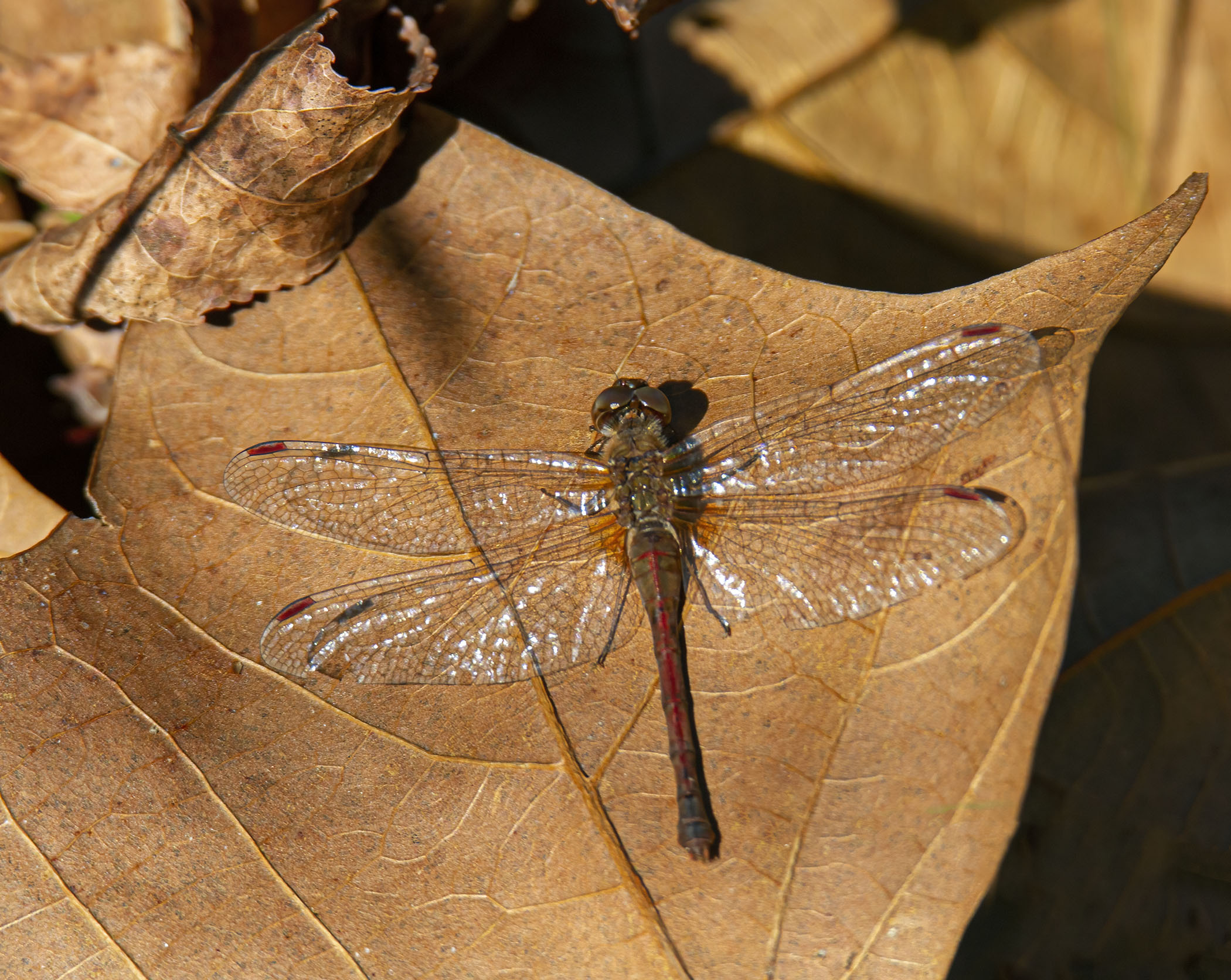
For a variety of reasons I did not manage to go out with my camera this past week, so I went through my photos from the previous week and was delighted to find this photo of a Blue-faced Meadowhawk dragonfly (Sympetrum vicinum). As I have noted in previous postings, Blue-faced Meadowhawks have such a wonderful combination of colors that make them one of my favorite dragonfly species.

I was quite fortunate that this particular individual landed on some leaves right next to one of my feet, so I was able to capture this cool image by shooting almost directly downwards. In fact, I had to digitally remove a bit of the boot I was wearing from the lower left edge of the photo to keep the viewer from getting distracted.

Several days ago we had some frost warnings, so I fear that more of the dragonflies will have disappeared for the season. Still, I hope to return to my local wildlife refuge in the next few days to see what I can find.

Blue-faced Meadowhawk

© Michael Q. Powell. All rights reserved.
Read Full Post »

It’s always fun to try to capture a shot of an Autumn Meadowhawk dragonfly (Sympetrum vicinum) with beautiful fall colors in the background, as I did last Friday (31 October) at Occoquan Bay National Wildlife Refuge. Autumn Meadowhawks are invariably the last surviving species of the dragonfly season. In past years I have spotted them as late as the middle of December, and fellow dragonfly enthusiasts have reportedly seen them in our area in early January.

Autumn Meadowhawk

© Michael Q. Powell. All rights reserved.

Read Full Post »

I was delighted to spot this stunning Blue-faced Meadowhawk dragonfly (Sympetrum ambiguum) on Halloween Day at Occoquan Bay National Wildlife Refuge. We have had a series of cool, damp days recently, so when I saw the weather was forecast to be sunny, I went out to see if I could find any dragonflies. As I suspected, most of the dragonflies are now gone, but I was delighted to find a couple of Blue-faced Meadowhawks, one of my favorite species, and also a few Autumn Meadowhawks. The dragonfly season is not over yet.

I absolutely love the striking coloration of the male Blue-faced Meadowhawks, like the one in the photo below. Their turquoise faces, blue eyes, and bright red abdomens are incredibly beautiful. On a day when many children would be focusing on their “trick or treat” adventures, I felt like I received my “treat” a little early.

Blue-faced Meadowhawl

© Michael Q. Powell. All rights reserved.


Read Full Post »

There are only a few remaining dragonflies as we move deeper into the autumn season. I was therefore delighted to spot this female Eastern Pondhawk dragonfly (Erythemis simplicicollis) during a recent visit to Occoquan Bay National Wildlife Refuge. Eastern Pondhawks appear in early May and generally hang around until the end of October.

The females of this species are quite distinctive in their appearance, with their brilliant green color and striped abdomens, so they are relatively easy to identify. Immature males, however, have the same coloration when young, so I usually check the terminal appendages before making a call on the gender of an Eastern Pondhawk.

Eastern Pondhawk

© Michael Q. Powell. All rights reserved.


Read Full Post »

We have now reached a point in the dragonfly season where Autumn Meadowhawks (Sympetrum vicinum) are the dragonfly species that I see most frequently. Most other species have gradually disappeared and I seen only occasional survivors that are still hanging on. There is something about the physiology of Autumn Meadowhawks that allows them to tolerate the cold better than other dragonflies and in past years I have seen them as late as the middle of December.

Last Friday I spotted over a dozen Autumn Meadowhawks at Occoquan Bay National Wildlife Refuge and was able to capture photos of several of them. Autumn Meadowhawks tend to perch flat on the ground, so it can be a bit difficult to spot them, especially when they choose to land on fallen leaves that camouflage them almost perfectly.

Female Autumn Meadowhawks are a mixture of red and brown colors, as you can see in the first photo below, while the males of the species are bright red, as you can see in the final photo. Both genders have beautiful brown eyes.

Autumn Meadowhawk

Autumn Meadowhawk

Autumn Meadowhawk

© Michael Q. Powell. All rights reserved.

Read Full Post »

The Blue-faced Meadowhawk (Sympetrum ambiguum) is a late-season dragonfly that is somewhat similar in appearance to the more common Autumn Meadowhawk—males of both species have bright red bodies, but Autumn Meadowhawks have brown eyes.

The females of both species are more muted in their coloration than their male counterparts, as is often the case with many dragonflies and birds, so they have more natural camouflage and are frequently more difficult to find. I was therefore delighted to spot this female Blue-faced Meadowhawk last Friday at Occoquan Bay National Wildlife Refuge, my first sighting of the species this season.

I am hopeful that I will spot the more colorful male Blue-faced Meadowhawk before this dragonfly season comes to an end.

Blue-faced Meadowhawk

© Michael Q. Powell. All rights reserved.


Read Full Post »

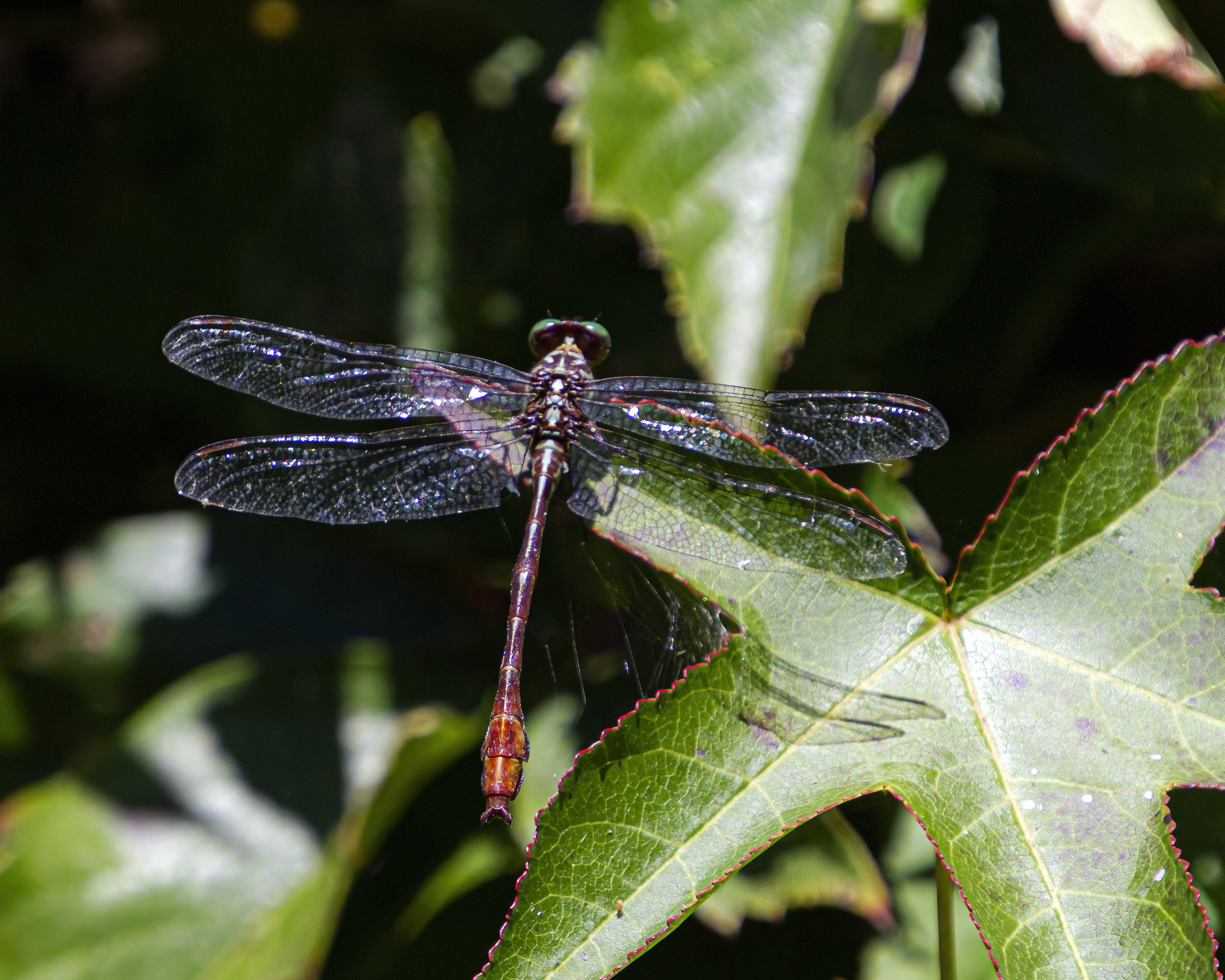
I was absolutely thrilled last Friday to photograph a Russet-tipped Clubtail dragonfly (Stylurus plagiatus) at Occoquan Bay National Wildlife Refuge, a somewhat surprising find this late in the dragonfly season. As I was walking along one of the trails, I encountered a fellow dragonfly enthusiast who was part of a group conducting a survey of butterflies and dragonflies at the refuge. After a brief conversation, we both continued on our way, heading in opposite directions.

A short time later I heard a voice calling out from a distance. I could not understand what was being said, but hurried back down the trail and was delighted to see that my friend had spotted a Russet-tipped Clubtail perched in the vegetation. Russet-tipped Clubtails are a late season species and are seen most often in August and September in my area. Unlike many of the dragonflies that I see regularly that seem to prefer pole-like perches or perch flat on the ground, Russet-tipped Clubtails like to hang from the leaves of vegetation at an angle or almost vertically—members of the genus Stylurus are sometimes called “Hanging Clubtails.”

The dragonfly was cooperative and remained perched as I took photos from several different angles. Before long, the dragonfly took off and our brief encounter ended. I continued on my way, content to know that the end of the dragonfly season, although near, is not here yet.

Russet-tipped Clubtail

Russet-tipped Clubtail

Russet-tipped Clubtail

© Michael Q. Powell. All rights reserved.

Read Full Post »

The countdown continues as we gradually move towards the end of the dragonfly season in my area. The Blue Dasher dragonfly (Pachydiplax longipennis) is one of the first dragonflies to appear in the spring and one of the last dragonflies to disappear in the autumn.

I spotted this tattered male Blue Dasher dragonfly during a recent visit to Jackson Miles Abbott Wetland Refuge. This was one of only a handful of dragonflies that I saw that day. The end is nearing, but I am not ready to call it quits quite yet for my dragonfly photography.

Blue Dasher

© Michael Q. Powell. All rights reserved.

Read Full Post »

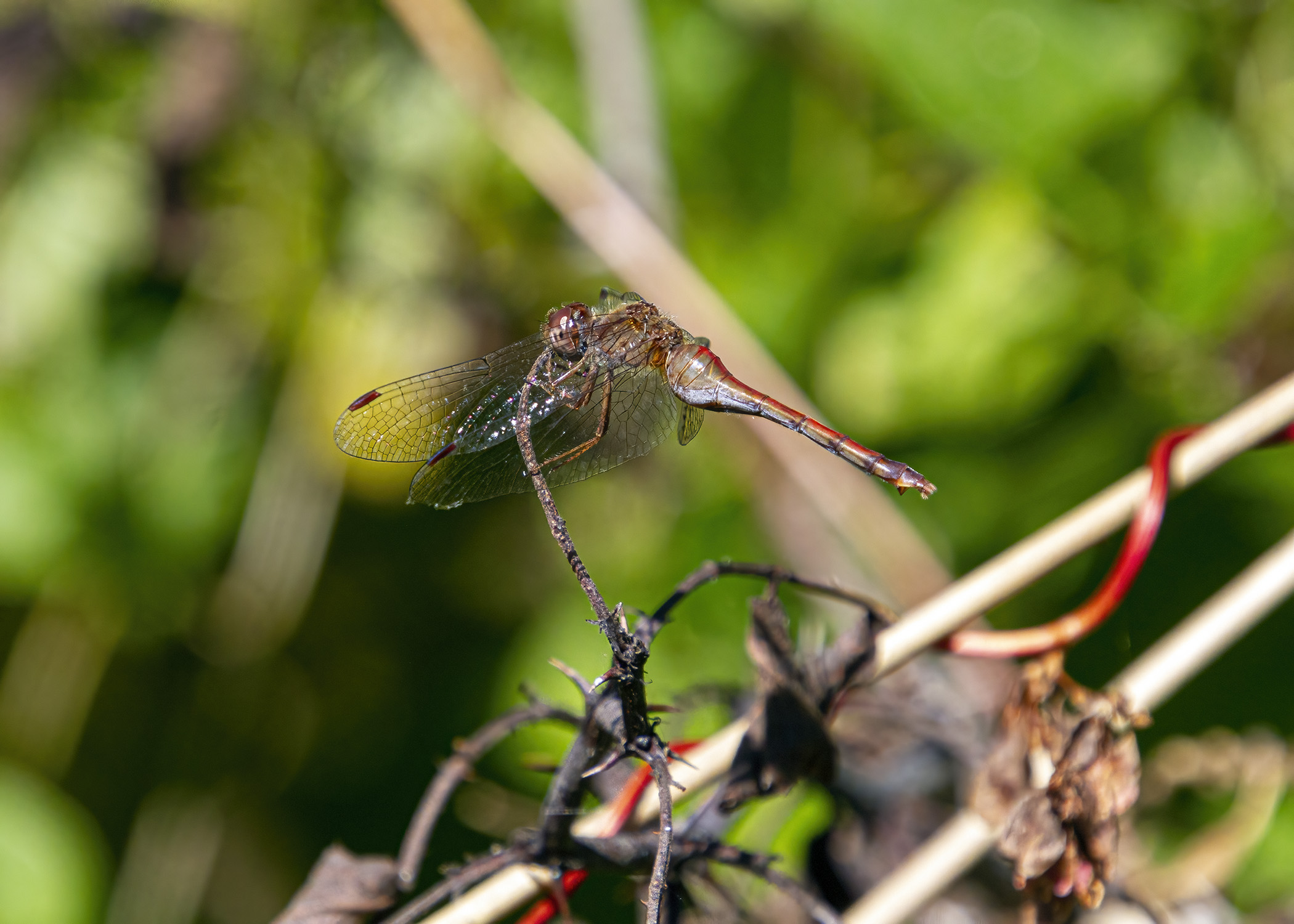
Its wings are a bit tattered and its colors have faded, but this male Slaty Skimmer dragonfly (Libellula incesta) was still hanging in there at the end of September, when I spotted it at Jackson Miles Wetland Refuge at nearby Fort Belvoir, Virginia. The nights have become considerably cooler the past week and I am anxious to get out in the wild with my camera to see which hardy surviving dragonflies are still flying.

Slaty Skimmer

© Michael Q. Powell. All rights reserved.
Read Full Post »

I spotted this Black Saddlebags dragonfly (Tramea lacerata) on Monday (22 September) at Occoquan Bay National Wildlife Refuge. Normally I see members of this species flying overhead, but this one cooperated by perching low in the vegetation. Black Saddlebags dragonflies, as you can see in the photo below, have distinctive dark blotches on their rear wings that some scientist decided looked like saddlebags.

Black Saddlebags are among the few North American dragonfly species that undertake migrations—other migratory species include Wandering (and Spot-winged) Gliders and Common Green Darners. Specifically, the offspring of the Black Saddlebag dragonflies migrate south in the fall, while some return north in the spring to breed. Did this one begin its journey at some location in the north and was stopping in as it heads south? It is hard to know for sure, but that is certainly a possibility. 

One thing I do know for sure is that Black Saddlebags spend a lot of their time in the air, patrolling back and forth over an area, so it was nice to have a chance to capture a shot of one on the ground. Unlike some other skimmer species, Black Saddlebags do not like to perch high up in the vegetation, so it is a challenge to find an unobstructed shooting angle when they are nestled low in the vegetation close to the ground.

Black Saddlebags

© Michael Q. Powell. All rights reserved.


Read Full Post »

I was thrilled last Friday at Occoquan Bay National Wildlife Refuge to  capture some images of Fine-lined Emerald dragonflies (Somatochlora filosa), a species for which I have been searching repeatedly this past month. Fine-lined Emeralds are one of several species that appear in the autumn, just as the number of most species of dragonflies is beginning to drop precipitously. I had spotted what I think were Fine-lined Emeralds several times earlier in September, but for me the sighting does not really “count” if I am not able to take a photograph.

Fine-lined Emeralds like to spend a lot of time patrolling, and a lesser amount of time perching. Unlike many of species that fly about high in the air, this species often flies at at somewhere between knee and eye-level, and that is how I usually first identify this species.

The dragonfly in the first photo appeared to be flying a patrol back-and-forth along a long stretch of one of the trails at the wildlife refuge. I stayed more or less in the same spot and over the course of a half hour or so, I watched and waited as the dragonfly zoomed by me. I was fortunate to track the dragonfly when it was flying and captured some shots when it occasionally perched vertically for a moment or two. The big challenge for me was focusing on the dragonfly’s thin body—my camera’s auto-focus had trouble acquiring focus, so I had to rely on manual focusing, which is a bit difficult with a digital camera.

Later in the day I spotted the dragonfly in the second photo, what appears to be a different male Fine-lined Emerald. It perched in the same, hanging from the vegetation in the same way as the earlier dragonfly. This dragonfly’s abdomen seemed to be a bit scuffed for reasons that were not readily apparent.

I encourage you to click on the photos to get a closer look at this elusive dragonfly species that the Dragonflies of Northern Virginia website describes as, “One of Northern Virginia’s most rare dragonflies, possibly our rarest, this species is seldom seen and little known throughout its range, from New Jersey to Florida, and west to Kentucky and Texas.”

Fine-lined Emerald

Fine-lined Emerald

© Michael Q. Powell. All rights reserved.

Read Full Post »

Seasons are noticeably changing as summer releases its hold on us (for those of us in the Northern Hemisphere). Children in my area have returned to school and the weather has cooled off quite a bit.

Many summer dragonfly species are starting to disappear or decrease in numbers. Fortunately, some new species appear late in the season to take their places, like this handsome Russet-tipped Clubtail dragonfly (Stylurus plagiatus) that I spotted on Monday at Occoquan Bay National Wildlife Refuge.

Russet-tipped Clubtails are a late season species and are seen most often in August and September in my area. Unlike many of the dragonflies that I see regularly that seem to prefer pole-like perches or perch flat on the ground, Russet-tipped Clubtails like to hang from the leaves of vegetation at an angle or almost vertically—members of the genus Stylurus are sometimes called “Hanging Clubtails.”

I am not quite ready to welcome “autumn,” but there are signs everywhere that the seasons are inexorably changing. Autumn is probably my favorite season of the year, but I am still holding on to the remnants of summer—this year autumn begins on 22 September.

Russet-tipped Clubtail

© Michael Q. Powell. All rights reserved.

Read Full Post »

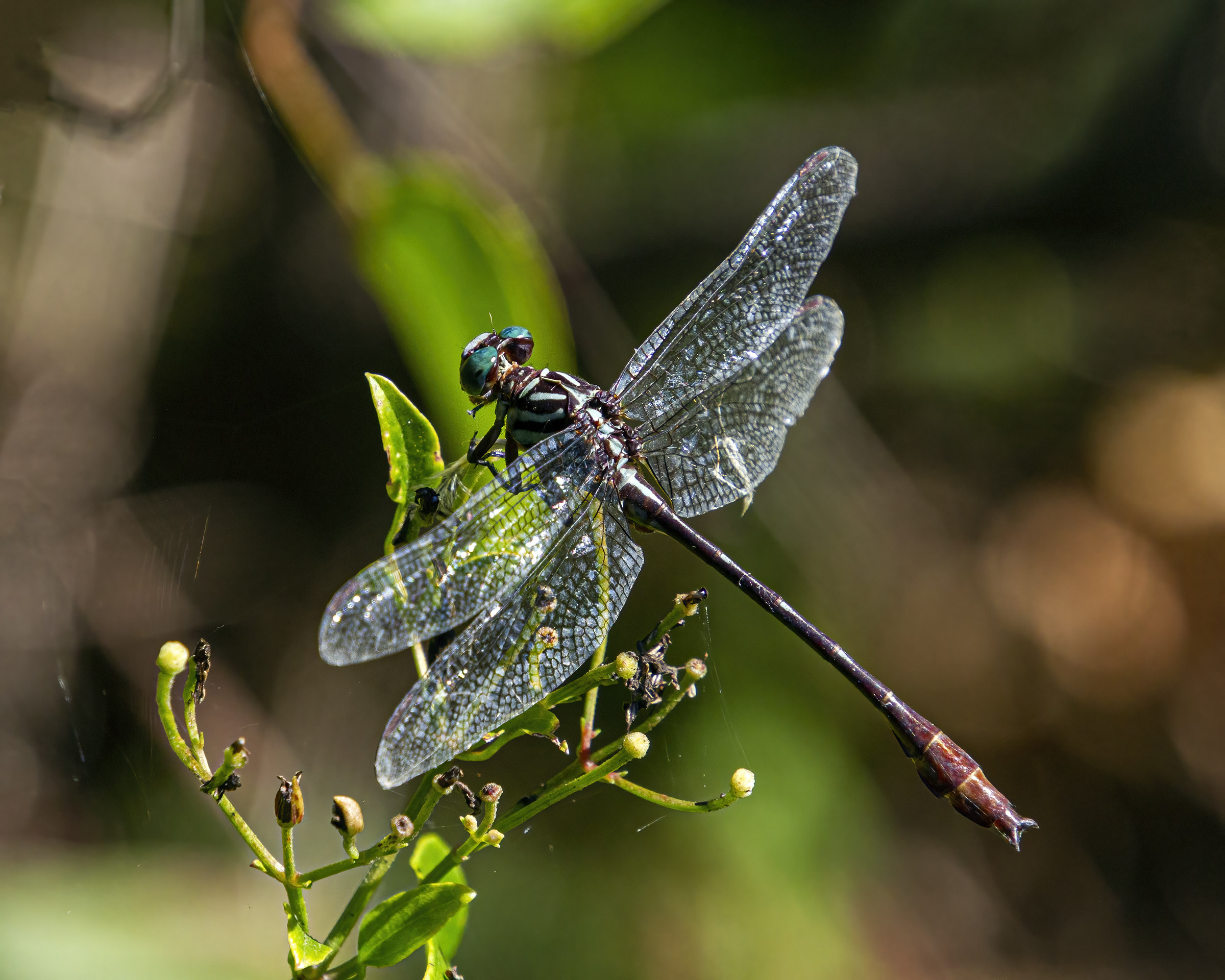
I spotted this gorgeous Twelve-spotted Skimmer dragonfly (Libellula pulchella) on Monday (8 September) at Occoquan Bay National Wildlife Refuge. I don’t see this species very often and think this might be the first one that I had photographed this season. The white spots in between the darker patches on the wings indicate that this is a male—females of this species have only the darker spots.

Most of the time when I am photographing dragonflies I have to shoot quickly before the dragonfly flies away. In this case, I had the luxury of being able to move around a bit to find a shooting angle that captured the details of the beautiful wings and the blooming wildflowers in the background. Why? When male Twelve-spotted Skimmers are flying, their patterned wings make them look almost like butterflies and I was able to track this dragonfly to the spot where he landed—most other dragonflies have transparent wings and therefore appear smaller when they are in flight.

Twelve-spotted Skimmer

© Michael Q. Powell. All rights reserved.
Read Full Post »

I was thrilled to spot this stunning male Calico Pennant dragonfly (Celithemis elisa) on Monday at Occoquan Bay National Wildlife Refuge. At this time of the year I am eager to search for the survivors of the summer species. The number of dragonflies continues to dwindle as we move deeper into September and I never know for sure when an encounter with one of the species will turn out to be the last one of the season.

I absolutely love the look of male Calico Pennant dragonflies. The beautiful patterning on their wings and the red heart-shaped markings on their abdomens really make them stand out. I guess that I am a bit romantic when it comes to those red hearts and I managed to find a shooting angle that allowed me to capture that detail really well in the image below.

Alas, this male was the only Calico Pennant that I spotted that day. Dragonflies spent a lot of their time looking for a mate and then doing their part to ensure the preservation of their species. Perhaps this solitary dragonfly will find a mate or maybe it is too late in the season for that. As I said, I am somewhat of a romantic and I choose to hope that love will find a way for him.

Calico Pennant

© Michael Q. Powell. All rights reserved.

Read Full Post »

It has been a long, hot summer and I welcome the cooler temperatures and lower humidity of the autumn. For me, this is part of a cycle of nature that is repeated each year. For dragonflies, though, the autumn signals that their lives are drawing near to the end. Dragonflies begin their lives as water-dwelling nymphs and when they emerge and are transformed into the incredible aerial acrobats that we see, their days are numbered in weeks and months.

Earlier this week I spotted this Halloween Pennant dragonfly (Celithemis eponina) that appeared to have survived several encounters with predators. Its wings were shredded, but somehow the dragonfly was still able to fly. It’s probably my imagination, but the Halloween Pennant seemed to be smiling, enjoying every minute of its remaining days, happy to be alive. As I get older, I feel like that sometimes.

Halloween Pennant

© Michael Q. Powell. All rights reserved.

Read Full Post »

Earlier in the summer Needham’s Skimmers (Libellula needhami) were one of the most common dragonflies that I would encounter at Occoquan Bay National Wildlife Refuge, but over the past month their numbers have dropped significantly as their flight season draws to a close. I was therefore quite pleased to spot this mature female Needham’s Skimmer on Monday at the wildlife refuge.

The dragonfly’s colors seemed a bit faded, but otherwise she appeared to be in good shape. I am not sure if the stalk of vegetation on which she was perching was comfortable, but it helped me to isolate her from the background and its pointy protrusions add visual interest to the image.

Needham's Skimmer

© Michael Q. Powell. All rights reserved.

Read Full Post »

As we approach the end of August, some of the more common dragonfly species are becoming much less common. Some autumn species will soon take their places. At the moment the Common Whitetail dragonfly (Plathemis lydia) is the species that I see most often. During a recent visit to Huntley Meadows Park, I spotted this young male Common Whitetail perched vertically on some vegetation.

How do I know that it is a young male? Females of this species have a different pattern of dark patches on their wings, as you can see in the second image below from earlier in the season, and different terminal appendages. Males start out with a darker coloration like that of their female counterparts and as they age they develop a white powdery substance on their abdomens called pruinosity. The dragonfly in the first photo is currently a bluish white and some of the markings are still showing through—eventually he will turn a bright white in color.

Common Whitetail

Female Common Whitetail

© Michael Q. Powell. All rights reserved.

Read Full Post »

As we near the end of August, I am seeing more and more reminders that Halloween is drawing near. Although we still have a couple of months before the 31st of October, store displays of candy and costumes and all other sorts of spooky merchandise have popped up everywhere.

Even when I was walking the trails of Occoquan Bay National Wildlife Refuge recently, I was reminded of the upcoming holiday when I spotted this Halloween Pennant dragonfly (Celithemis eponina) perched at the highest point of a patch of vegetation. Halloween Pennants have very distinctive markings on their wings that make then easy to identify. Unlike some other dragonfly species that perch on the ground and are therefore hard to spot amidst the fallen leaves, Halloween Pennants always seem to perch high above the ground and consequently are easy to spot. These perches often sway in the slightest of winds, causing the dragonflies to flutter in the wind, like pennants.

Halloween Pennant

© Michael Q. Powell. All rights reserved.

Read Full Post »

It is a bit early to be thinking of autumn, but early signs are beginning to appear. On Monday, classes begin for public school students in our county and traffic will be crazier than ever as commuters and school buses adjust to a changed dynamic.

Some species of summer dragonflies are beginning to disappear and I have begun to search for their autumn replacements. The trails at the wildlife refuges that I haunt are now littered with fallen leaves, making it hard to spot those species that perch on the ground.

This past Monday I captured this shot of a female Common Whitetail dragonfly (Plathemis lydia) at Huntley Meadows Park. This species is one of the most common in my area at this time of the year and I spotted a lot of them during my visit to the park. I particularly like the way that I was able to capture the texture and detail of the dried leaves on which the dragonfly was perched—I can almost hear the crunch of those leaves as I walked through them that day.

Truth be told, autumn is my favorite time of the year and I am patiently waiting for it to arrive. In the meantime, I am still enjoying the summer. “To everything there is a season, and a time to every purpose under heaven.”

Common Whitetail dragonfly

© Michael Q. Powell. All rights reserved.

Read Full Post »

How do you handle the heat? For those of us who live in the Northern Hemisphere, the last few months have seen a series of unrelenting hot days. High temperatures have frequently been in the 90’s (33 degrees C) and have occasionally pushed past 100 degrees (38 degrees C).

Despite the heat, I ventured out yesterday with my camera during the middle of the day and visited Huntley Meadows Park, a local wetlands area. Wildlife activity seemed quite low—many of the creatures seemed to be sheltering out of sight in the shade. I did manage to spot this female Eastern Pondhawk dragonfly (Erythemis simplicicollis) that was perilously perched on a flimsy bit of vegetation. I don’t know for sure if she was taking a siesta or was simply chilling, but somehow her actions seemed make a bit more sense for dealing with the heat than those of this intrepid photographer.

Perhaps the old saying is true—”Mad dogs and Englishmen go out in the midday sun.” Technically I am not English, so what does that make me?

Eastern Pondhawk

© Michael Q. Powell. All rights reserved.

Read Full Post »

I love dragonflies. There is something almost magical about these incredible aerial acrobats that never fails to fascinate and enchant me.

When I was attempting to compose a photo of this Great Blue Skimmer dragonfly (Libellula vibrans) last week at Occoquan Bay National Wildlife Refuge, I tried to use a leaf in the background to draw attention to my primary subject. It was only later, when I was review my images, that I realize that the leaf was heart-shaped, a perfect visual representation of my feelings towards dragonflies.

Great Blue Skimmer

© Michael Q. Powell. All rights reserved.


Read Full Post »

My mind sometimes works in mysterious ways. Often when I see a bright green female Eastern Pondhawk dragonfly (Erythemis simplicicollis), like the one in this image that I captured during a visit to Occoquan Bay National Wildlife Refuge, I can’t help but think of Kermit the Frog. Why?

Kermit the Frog has always been my favorite Muppets character. I have distinct memories of Kermit singing one of his signature songs, “It’s not easy being green” in which he laments his green coloration, expressing his concern that green “blends in with so many ordinary things” and wishing to be some other color.

“It’s not that easy being green;
Having to spend each day the color of the leaves.
When I think it could be nicer being red, or yellow or gold-
or something much more colorful like that.

It’s not easy being green.
It seems you blend in with so many other ordinary things.
And people tend to pass you over ’cause you’re not standing out like flashy sparkles in the water-
or stars in the sky.”

Have you ever felt that way, wishing you could stand out more from the crowd, uncomfortable in your own skin? I know that I have sometimes felt that way.

In the end, though, Kermit recalls positive associations with the color green, and concludes by accepting and embracing his color.

“But green’s the color of Spring.
And green can be cool and friendly-like.
And green can be big like an ocean, or important like a mountain, or tall like a tree.

When green is all there is to be
It could make you wonder why

But, why wonder? Why wonder?
I’m green and it’ll do fine
It’s beautiful, and I think it’s what I want to be.”

Life’s too short to worry and complain about all the things that we are not, to constantly compare ourselves with others, to become green with envy. It is so much more rewarding when you can boldly embrace who you are and ignore the views of the naysayers on the sidelines.

Eastern Pondhawk

© Michael Q. Powell. All rights reserved.

Read Full Post »

During a recent visit to Occoquan Bay National Wildlife Refuge I was delighted to spot some bright red male Needham’s Skimmer dragonflies (Libellula needhami). The combination of the golden accents on the edges of their wings with that reddish-orange coloration makes these dragonflies visually stunning. The Needham’s Skimmers often were skittish, flying away as I approached, I managed to capture a few shots of them when they perched momentarily within range of my telephoto lens.

At this moment, Needham’s Skimmers are one of the most common dragonfly species that I encounter at this wildlife refuge, along with Common Whitetails. Some of the species that were present in the spring have disappeared and the autumn species have not yet taken their place. In that sense, we are in the midst of the summer doldrums, when the air is heavy with heat and humidity and new activity has slowed down to a snail’s pace.

Needham's Skimmer

Needham's Skimmer

© Michael Q. Powell. All rights reserved.


Read Full Post »

There were lots of dragonflies, mostly Common Whitetails and Needham’s Skimmers, flying about on Monday when I visited Occoquan Bay National Wildlife Refuge along with an abundance of pesky flies and mosquitoes. The temperatures were marginally cooler than in recent days, but the high humidity made it feel like I was slicing my way through the water-laden air.

I was delighted to spot this male Widow Skimmer dragonfly (Libellula luctuosa), a species that I do not often at this location, perched in the vegetation adjacent to a small pond. Like female Widow Skimmers, male have dark patches on their wings, but they also have a white patch on each wing, which makes them easy to identify. These patches are visible when male Widow Skimmers are flying, causing them to look a bit like fluttering butterflies.

When I was processing this image, I was surprised to see what appears to be an ant attached to the tip of one of the back legs of this dragonfly—you may need to click on the image to see this detail. I am not sure if the ant had hitched a ride on the dragonfly from its previous perch or, more likely, was merely exploring this unexpected intruder that had landed on this stalk of vegetation.

Widow Skimmer

© Michael Q. Powell. All rights reserved.


Read Full Post »

The weather in my area this month has been mostly miserable. It has been hot and humid and we have had almost daily thunderstorms, resulting in a significant amount of localized flooding.

Some of the dragonflies in our are are also showing signs of the stresses of summer, like this male Calico Pennant dragonfly (Celithemis elisa) that I spotted during a recent visit to Occoquan Bay National Wildlife Refuge. The photo below shows a substantial amount of damage to the wings of this dragonfly. I can’t tell if the damage was caused by a predator or if it is part of the normal wear-and-tear associated with life as a dragonfly.

I hope to get out a bit more often with my camera during the second half of July, perhaps starting out a bit earlier in the morning before things heat up to miserable levels.

Calico Pennant dragonfly

© Michael Q. Powell. All rights reserved.
Read Full Post »

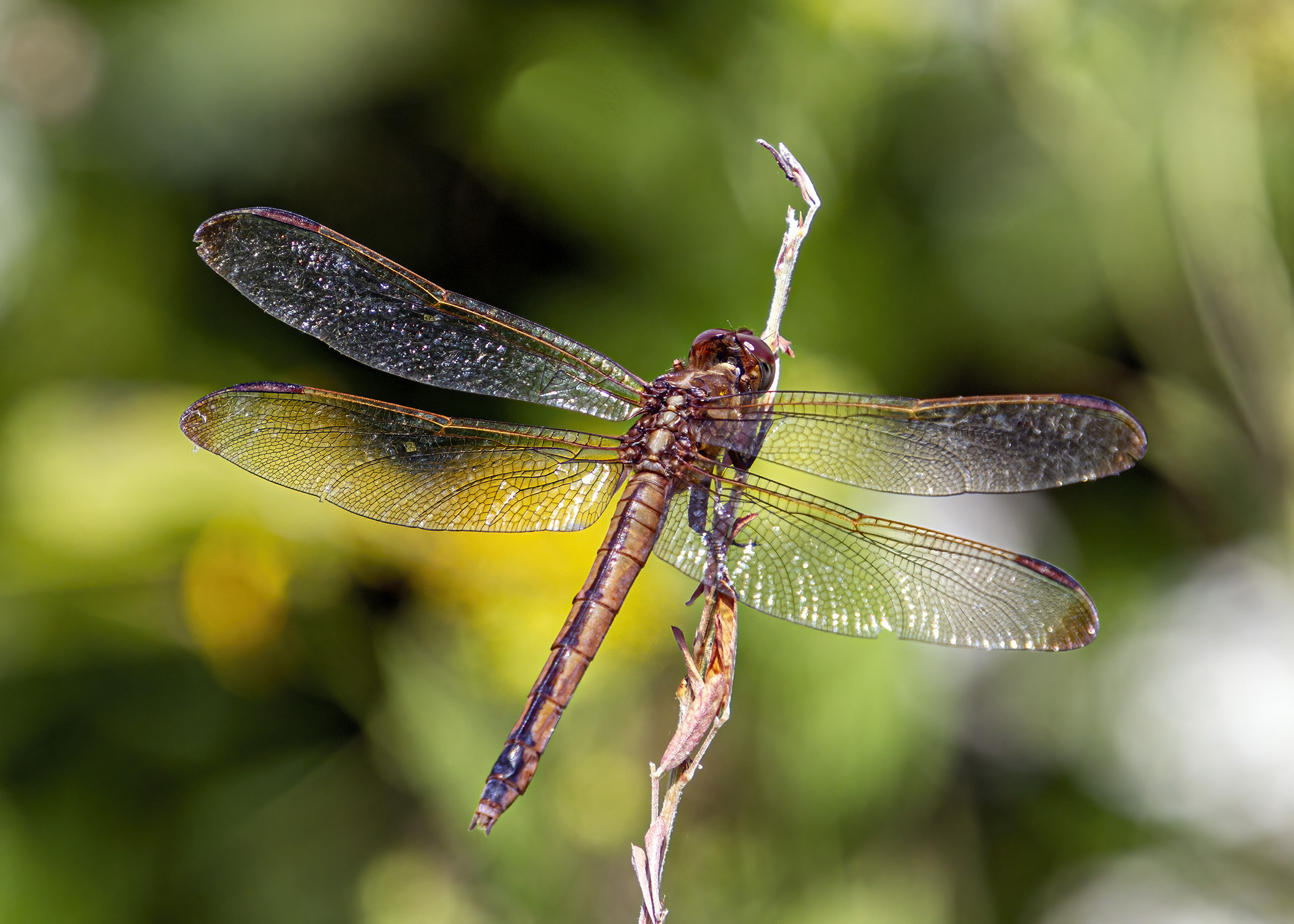
Last Saturday I inadvertently spooked this Great Blue Skimmer dragonfly (Libellula vibrans) while exploring Occoquan Bay National Wildlife Refuge and it flew up into some high vegetation. I was not hopeful that I would be able to get a shot of it, but I decided to try to do so anyways. I’m quite pleased with the result.

I really like the way that the light was shining through the dragonfly’s slightly shredded wings and the shape and structure of the branch draw in a viewer’s eyes too. Overall it’s a fun “artsy” photo that makes me smile.

Great Blue Skimmer

© Michael Q. Powell. All rights reserved.


Read Full Post »

Last Saturday I spotted this stunning female Eastern Pondhawk dragonfly (Erythemis simplicicollis) during a visit to Occoquan Bay National Wildlife Refuge. The thorn-like projection near the tip of the abdomen that helps her to lay eggs made it immediately obvious that this was a female. The bright green coloration, distinctive black bands on her abdomen, and her green face make it almost impossible to misidentify this species.

As I was checking my blog yesterday, I came across a notice from WordPress informing me that I had started my blog 13 years ago. Wow! It’s hard to believe that I have kept this blog going for that long. According to the statistics from WordPress I have had 524,468 views of 5,417 posts since I began posting.

It is a bit of a cliché but it is absolutely true that I could not have done this without all of the support, suggestions, and encouragement. Thank you to all of you. I remember my modest expectations when I started the blog, looking simply for a place to post my wildlife and nature photographs. Over time this blog has become a kind of diary in which I have been able to express a lot of what I think and feel as I experience the beauty of the natural world. I have come to enjoy expressing myself as much in my written words as I have in my photos, reflecting on many different aspects of my life, including religion, poetry, and various artistic pursuits.

I remember deciding on the subheading for the blog some 13 years ago, calling it “My journey through photography.” Though the path has often been meandering and full of detours and distractions, that journey still continues. Once again, I thank all of you who have chosen to walk alongside me and to experience the world in part as I see it.

Female Eastern Pondhawk

© Michael Q. Powell. All rights reserved.

Read Full Post »

I have spent a lot more time indoors this past month than I normally, as a result of our unusually warm and stormy weather. On Saturday I finally made it out to Occoquan Bay National Wildlife Refuge, my favorite place to explore with my camera, and was greeted by an abundance of dragonflies.

Many of the dragonflies I encountered were Needham’s Skimmers that were often perched at the tops of vegetation that seems to have grown a lot recently. A lot of other flies were common too and they pestered me incessantly by buzzing around my ears, but fortunately they did not appear to be interested in biting me.

I was delighted that many dragonflies seemed be smiling at me, like this cool-looking Needhams’s Skimmer (Libellula needhami). I also really like that I able to capture the beauty of the beautiful two-toned, speckled eyes.

Needham's Skimmer

© Michael Q. Powell. All rights reserved.

Read Full Post »

It is hot! It seems that much of Europe and the United States is currently experiencing sweltering heat. Here in Northern Virginia where I live, high temperatures are going to hover around 100 degrees (38 degrees C) each day this week. I might consider going out with my camera when there are heat advisories, but today there are extreme heat advisories and people are advised not to go out in the heat unless absolutely necessary.

This morning I went over my photos from an outing earlier this month and recalled my thought process when I was taking photos of Common Sanddragon dragonflies (Progomphus obscurus). I was trying to frame the shot in a way that showed the dragonfly’s face and body with an interesting background, which was a bit frustrating, because the Sanddragons tended to perch at the edge of the water facing the water.

I changed positions repeatedly and eventually I got the shot that I was imagining in my head. I love how the green of the dragonfly’s eyes matches some of the mossy vegetation and how the yellow and brown body matches the stones. The dragonfly also seems to be looking up at me and smiling, though I suspect that may be my imagination.

Stay cool and hydrated this week if you have to go outside this week!

Common Sanddragon

© Michael Q. Powell. All rights reserved.

Read Full Post »

Older Posts »