Feeds:
Posts
Comments

Archive for the ‘Butterflies’ Category

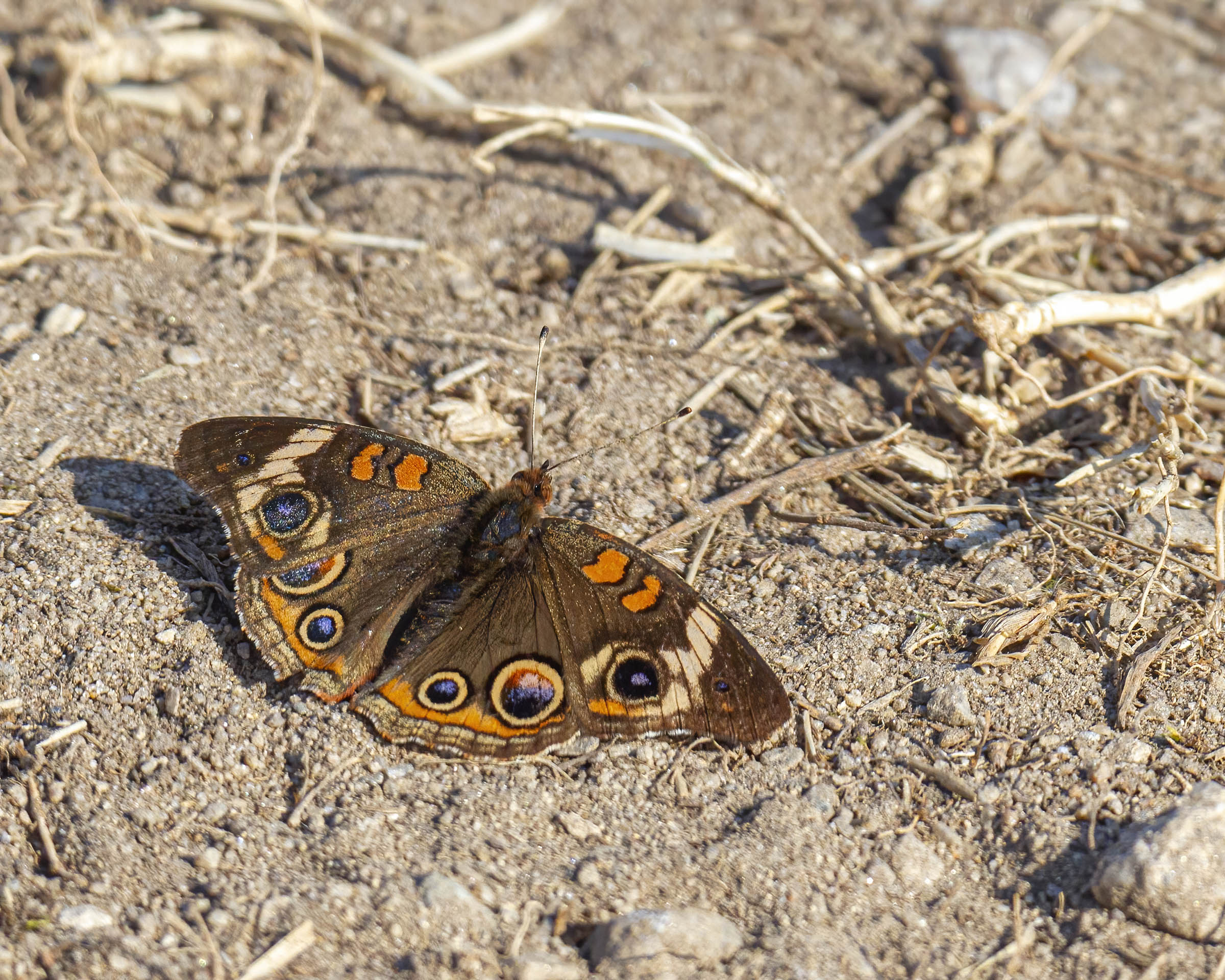
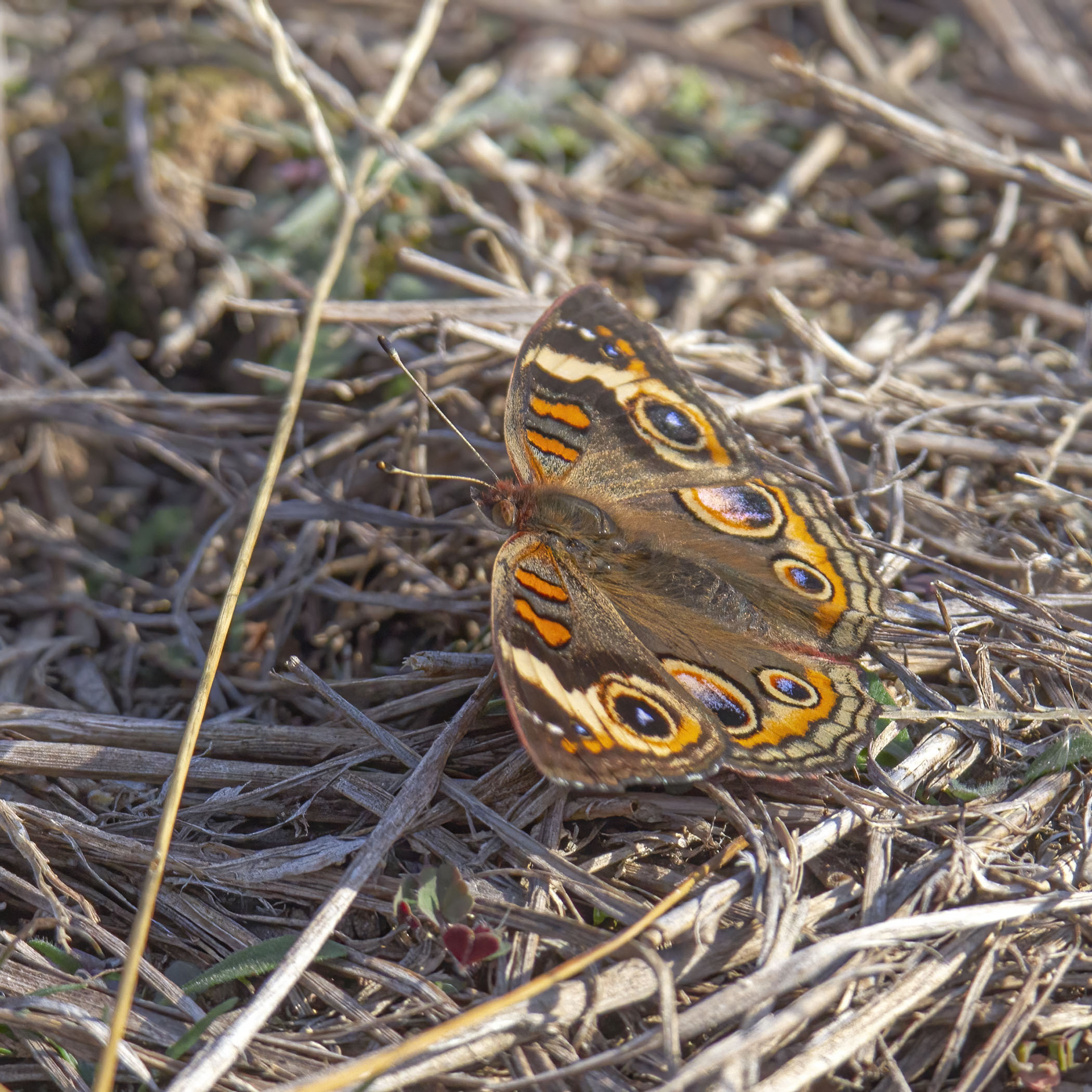
There were few insects flying last Thursday at Occoquan Bay National Wildlife Refuge, so I was a bit surprised to encounter several Common Buckeye (Junonia coenia) butterflies. The body color of this butterfly is pretty drab, but its markings are stunning in their beauty—I especially love its multi-colored eyespots. Wow!

I do not think that Common Buckeye butterflies overwinter in my area as adults, so I wonder if the butterflies that I observed are in the process of migrating southward. If not, then they are appearing on the scene quite late in the season, when we have already had several frosty nights. Perhaps they will hang around for a little while longer—I will keep an eye out for them on my next trips to my favorite local wildlife refuge.

Common Buckeye


Common Buckeye

© Michael Q. Powell. All rights reserved.
 

Read Full Post »

Most of the insects are gone by now, so I was a bit shocked to spot this Sleepy Orange butterfly (Eurema nicippe) last Thursday at Occoquan Bay National Wildlife Refuge. When I first saw it, I assumed that it was a Clouded Sulphur butterfly, a species that I photographed a few weeks ago. Upon examining my shot on my computer screen, I realized that it was an unfamiliar species, and a friend of mine who is more of an expert on butterflies helped to identify the butterfly for me.

I really like the way that the bright color of the inside of the butterfly contrasts with the brown tones of the dried leaves on which the butterfly was perched.

Sleepy Orange

© Michael Q. Powell. All rights reserved.
Read Full Post »

The sunlight coming from the back and side of this Clouded Sulphur butterfly (Colias philodice) produced a really dramatic effect in this image that I captured last Friday at Occoquan Bay National Wildlife Refuge. It looks almost like I had the butterfly posing for me in a photography studio, where I would have had full control over the power and direction of the light.

In situations like this, the settings on the camera are really important, because there is so much light that it threatens to blow out the highlights of the light-colored subjects. As a result, I deliberately underexposed the photo, which is why the background appears to be so dark, but I did retain a lot of the details in the butterfly and the asters.

For those of you who enjoy the geeky, technical aspects of photography, I was shooting with a Canon 7D DSLR and a Tamron 150mm-600mm telephoto zoom lens at 600m—I was using a monopod for additional stability. My camera was set to f/8.0, 1/1600 sec, and ISO 400 with negative 1.33 stops of exposure compensation.

Clouded Sulphur

© Michael Q. Powell. All rights reserved.

Read Full Post »

Lots of wildflowers still in bloom as we move deeper into autumn here in Northern Virginia. Last night we had our first frost warning of the season, but I don’t think there was any frost this morning in my neighborhood—a hard frost may speed the demise of many of the remaining butterflies and dragonflies. I was therefore delighted last Thursday to spot this Clouded Sulphur butterfly (Colias philodice) feeding on the flowers of what I believe is a White Heath Aster (Symphyotrichum ericoides) plant at Huntley Meadows Park.

Although part of the butterfly is obscured by the stem and the leaves in the foreground of this image, I like the way that I was able to capture the details of the butterfly’s green eyes and its extended proboscis.

Clouded Sulphur

© Michael Q. Powell. All rights reserved.

Read Full Post »

This late in the season, most of the large butterflies seem to be gone, but I continue to see some of the smaller ones, like this beautiful Variegated Fritillary butterfly (Euptoieta claudia) that I spotted on Thursday during a visit to Huntley Meadows Park, a county-run marshland park not far from where I live. Earlier in the year I encountered some Great Spangled Fritillaries, but I think this may well be my first sighting of a Variegated Fritillary in 2023.

The butterfly appeared to be basking in the sun as it perched with its wings wide open on some dried-out vegetation. I was using my Tamron 150-600mm telephoto zoom lens, which has a minimum focusing distance of almost nine feet (270 cm), so I was pretty far from the butterfly when I captured this image. I have read reviews that state that this lens is soft when fully extended to 600mm, but I have found that I can get acceptably sharp images if I pay a lot of attention to my focusing and shooting techniques, including remaining steady—in this case I was using a monopod.

Variegated Fritillary

© Michael Q. Powell. All rights reserved.


Read Full Post »

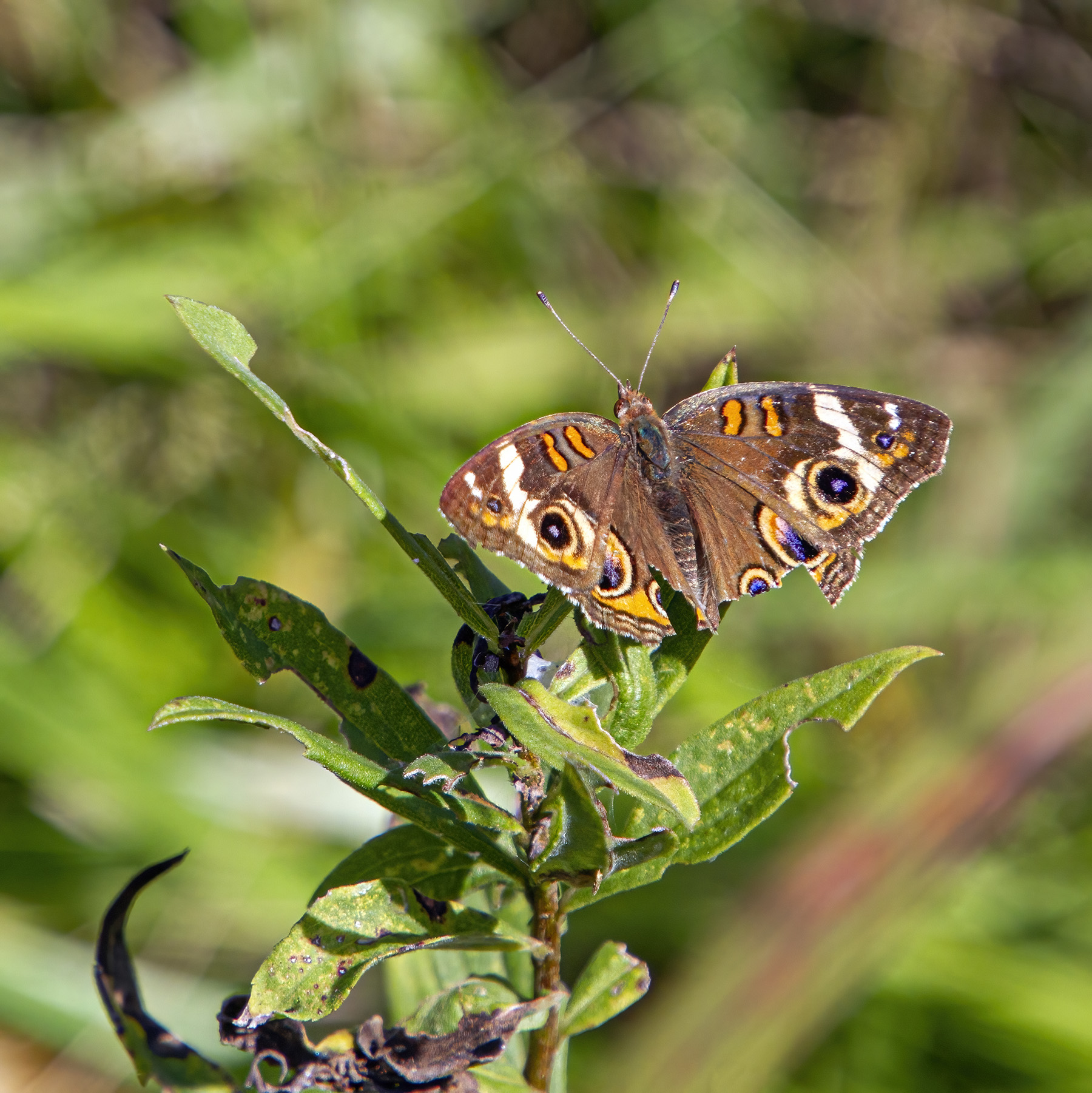
Many of the insects and plants that I now see show signs of the ravages of summer, like this damaged Common Buckeye butterfly (Junonia coenia) that I spotted atop an equally damaged plant during a recent visit to Occoquan Bay National Wildlife Refuge. Nonetheless the beauty of the butterfly shines through and it appears to be fully functional.

Autumn is a time for harvest celebrations as we rejoice in the bounty of the growth that has taken place, but there is also a tinge of melancholy as we experience a sense of loss and the feeling that our lives our changing. Change, of course, is a constant in our lives, but most of us—and I definitely fit into this group—become creatures of habit and have trouble dealing with changes at times. Yet we eventually adapt and may even learn to appreciate the results of the change, even if the process of change is a bit uncomfortable.

Common Buckeye

© Michael Q. Powell. All rights reserved.

Read Full Post »

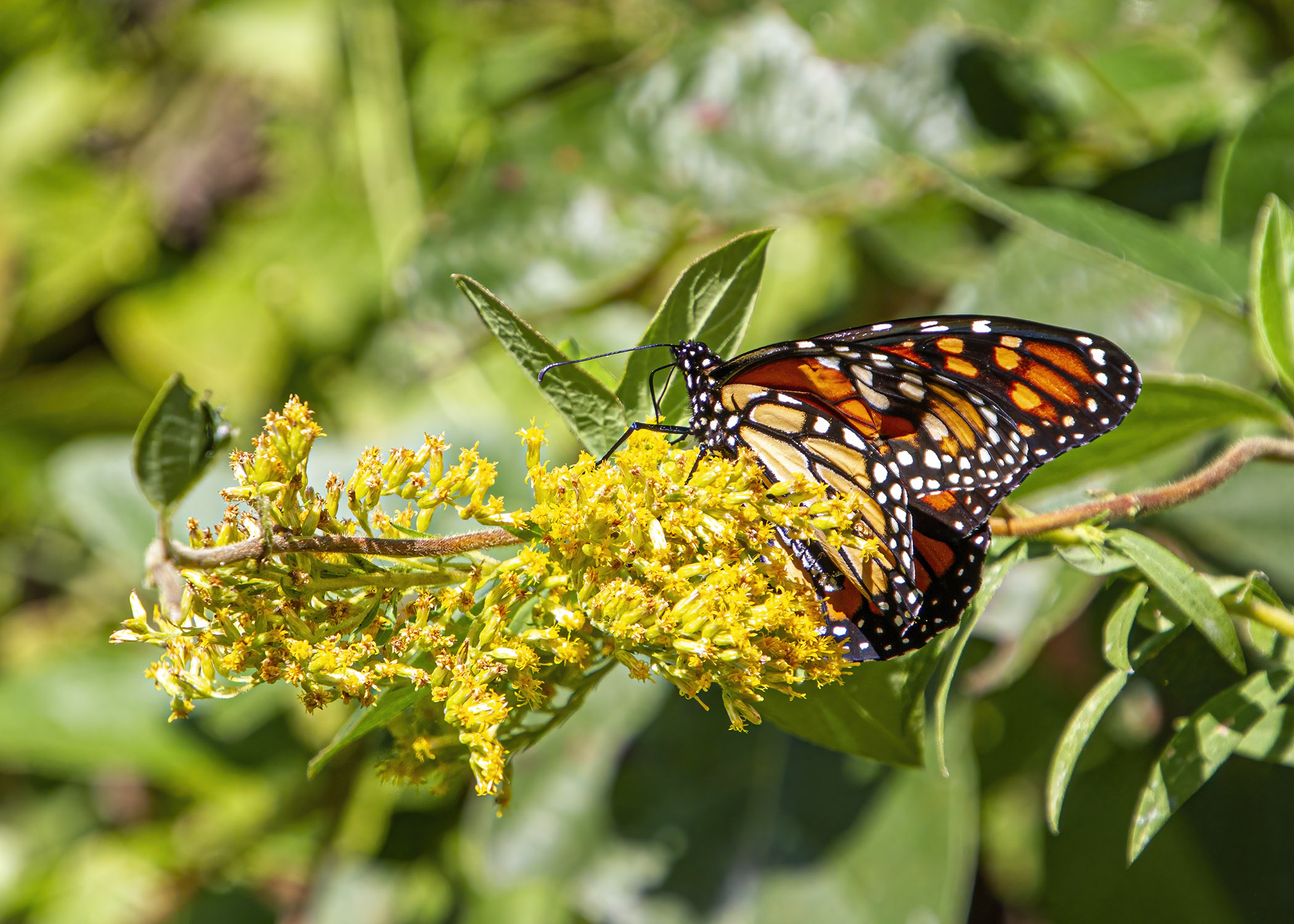
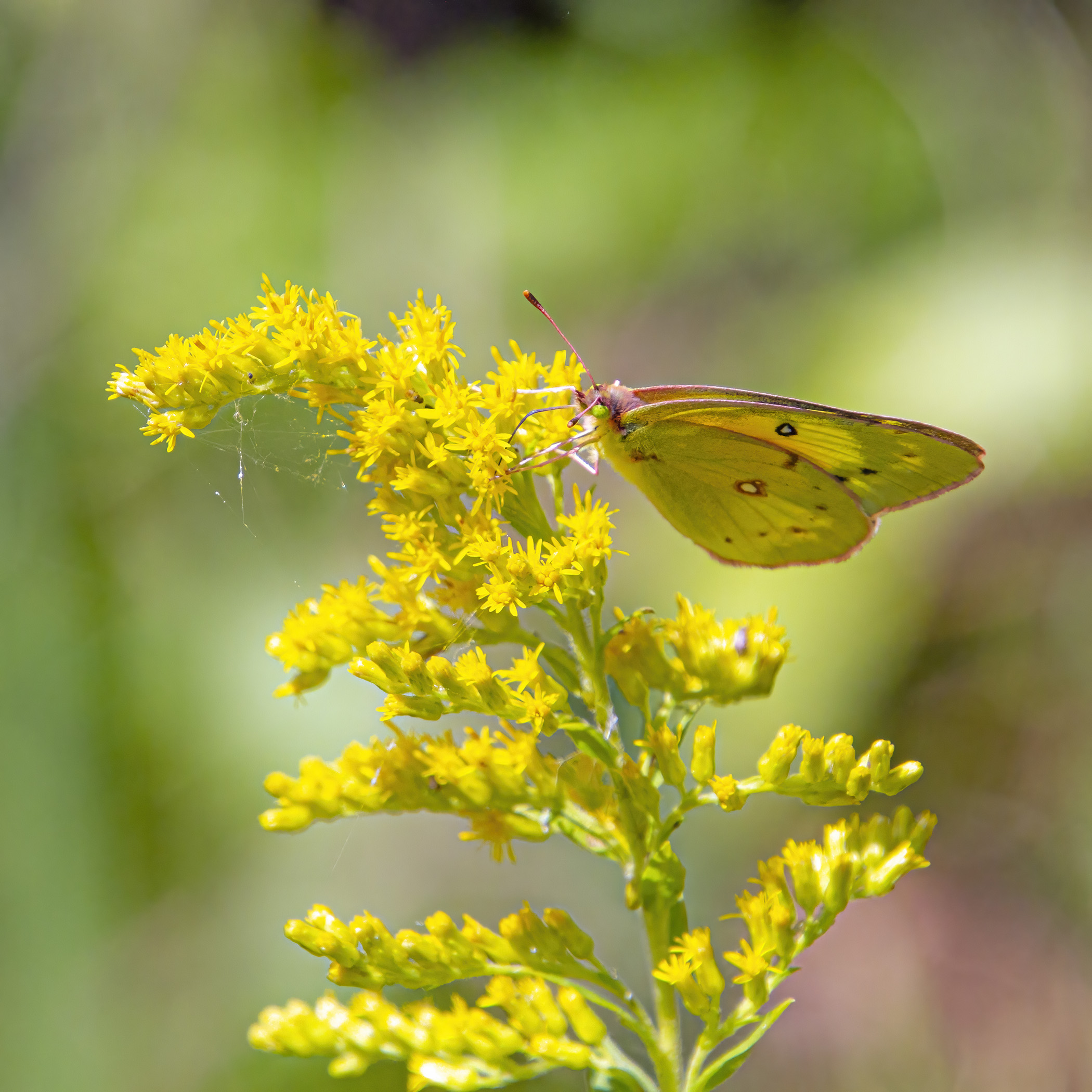
I love bright colors and instinctively smile when I see the large patches of goldenrod that are still in bloom at Occoquan Bay National Wildlife Refuge. The insects seem to love these flowers too and last Tuesday I spotted a large Monarch Butterfly (Danaus plexippus) and smaller Clouded Sulphur butterfly (Colias philodice) feeding on goldenrod.

Monarch

Clouded Sulphur

© Michael Q. Powell. All rights reserved.
 

Read Full Post »

At this time of the year, many of the butterflies that I see are showing the ravages of a long summer season. That, however, was not the case with several Monarch butterflies (Danaus plexippus) that I spotted last week at Occoquan Bay National Wildlife Refuge that appeared to be in perfect condition.

Perhaps these are newly emerged Monarchs that are now preparing for a long migration flight to warmer locations.

Monarch

Monarch

© Michael Q. Powell. All rights reserved.
Read Full Post »

On Monday I was thrilled to spot multiple Monarch butterflies (Danaus plexippus) during a visit to Occoquan Bay National Wildlife Refuge. The first shot is the typical kind of shot that I usually try to take, but I really like the third image that I captured of a distant Monarch butterfly in a field of flowers—so many flowers, so little time.

Monarch butterfly

Monarch butterfly

Monarch butterfly

© Michael Q. Powell. All rights reserved.
Read Full Post »

Certain creatures, like Bald Eagles (Haliaeetus leucocephalus) and Monarch butterflies (Danaus plexippus), never fail to thrill my heart when I encounter them. I remember dire warnings from my youth of their threatened extension and I consider it a real blessing that they are still around. The Bald Eagle population has really rebounded, but it is my understanding that the survival of Monarchs is still at risk as a result of the loss of Monarch breeding habitats.

I did not see any Bald Eagles during my visit to Occoquan Bay National Wildlife Refuge this past Thursday, but I was excited to spot this stunning Monarch butterfly. Its colors were bright and vibrant and it seemed to be in perfect condition. I suspect that this butterfly was preparing itself for its upcoming migration flight. According to an article by the National Wildlife Federation, “Beginning in late summer and continuing into early fall, monarchs that emerge from their chrysalides will be behaviorally and biologically different from generations that emerged earlier this year. Unlike their parents and grandparents, these late-season monarchs do not mate or lay eggs. Instead, the insects focus on feeding to fatten up for long migrations to their winter habitats: coastal California for monarchs west of the Rocky Mountains and central Mexico for those to the east.”

The Monarch butterfly was so focused on feeding that it did not fly away as I maneuvered into position to capture this image. I even had the luxury of attempting shots from several angles as the butterfly moved about from flower to flower.

Monarch butterfly

© Michael Q. Powell. All rights reserved.

Read Full Post »

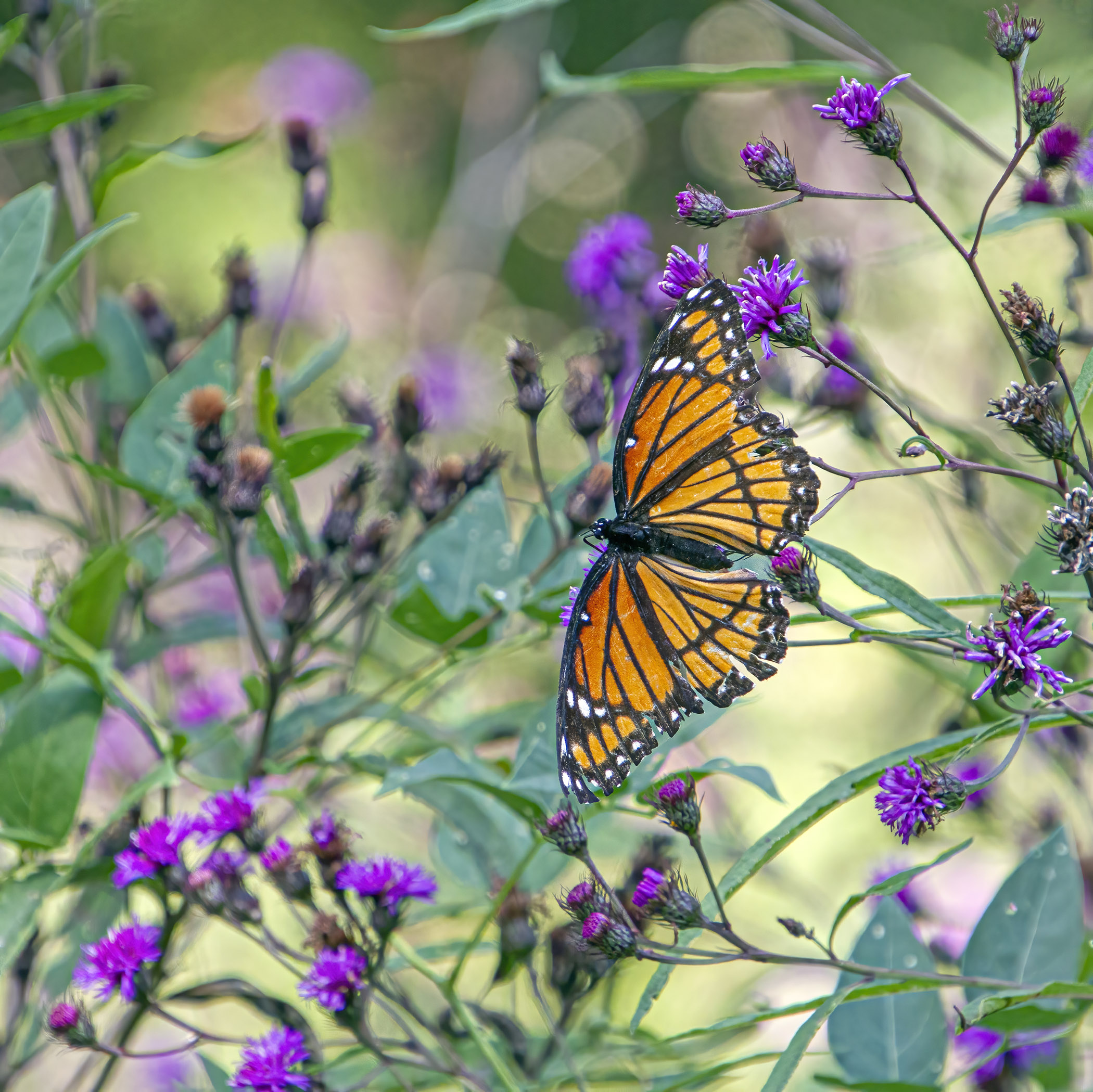
On Wednesday I spotted this beautiful Viceroy butterfly (Limenitis archippus) during a short visit to Jackson Miles Abbott Wetland Refuge. At one end of the refuge, there is a patch of wildflowers and I always make sure to check it out for birds, butterflies, and other insects. I am no expert on wildflowers, but I think the purple plant in the photo may be a variety of ironweed.

As you can probably tell, the Viceroy is considered to be a mimic of the somewhat larger Monarch butterfly. They are pretty easy to tell apart, however, because the Viceroy has a black line across the hind wings that is not found on the wings of Monarchs.

Viceroy

Viceroy

© Michael Q. Powell. All rights reserved.

Read Full Post »

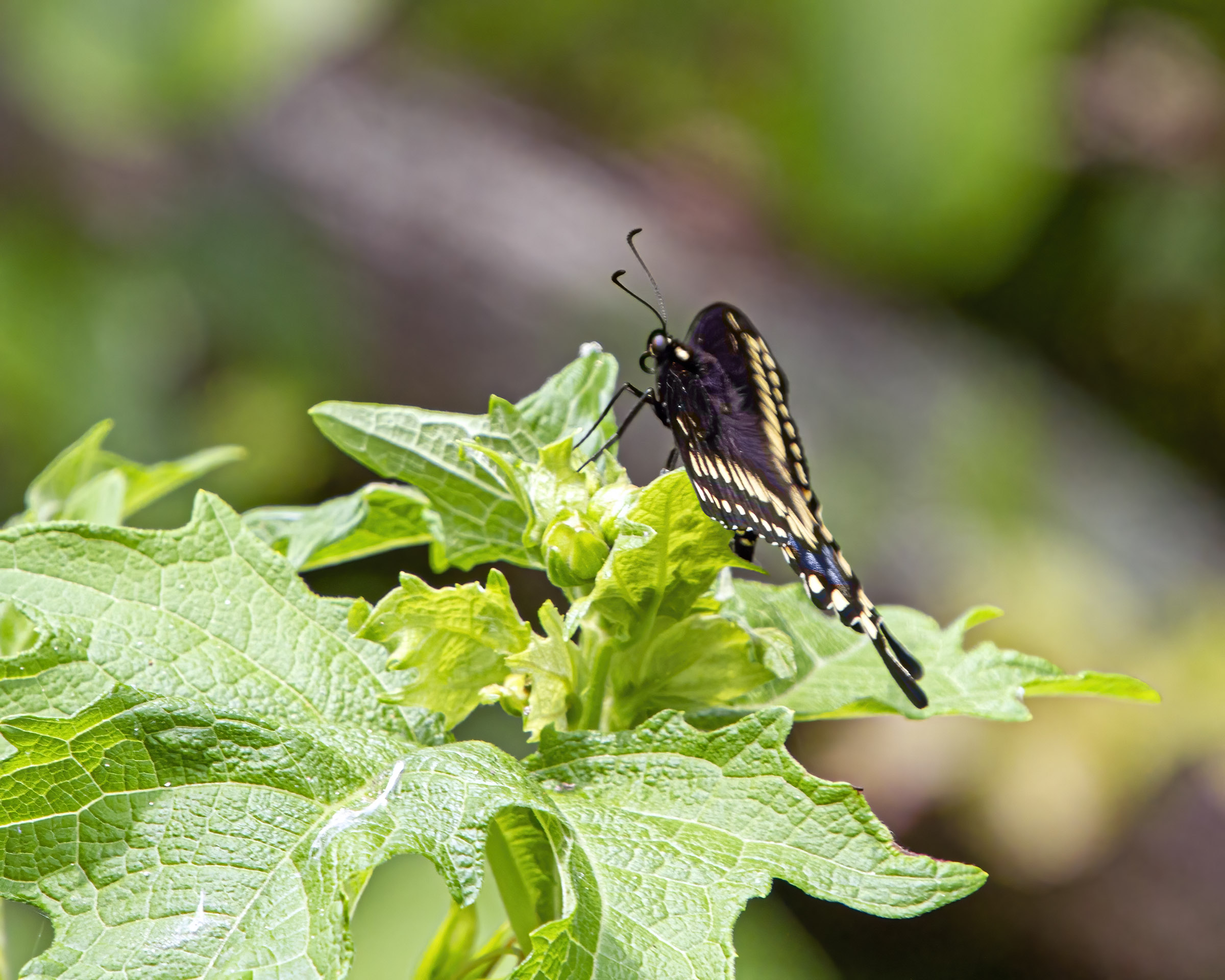
I am happy that I continue to see quite a few butterflies during my visits to Occoquan Bay National Wildlife Refuge. Summer is definitely not over yet—today’s high temperature is forecast to be 97 degrees (36 degrees C) with a heat index well above 1oo degrees (38 degrees C)—but increasingly I am seeing signs that the seasons are starting to change.

I spotted this Black Swallowtail butterfly (Papilio polyxenes) recently as it fed upon some kind of leafy plant. The butterfly’s “tails” were fully intact, but there seemed to be a little damage to its wings and the wings seemed to be strangely separated from its body in the first photo. I am not sure if this is normal or not.

I am trying to decide if I will venture out into the heat today, seeking some of the late season dragonflies, like the Blue-faced Meadowhawk and the Fine-lined Emerald, that emerge onto the scene in early September. If I do go out, I will be sure to bring lots of water and will stay in the shade as much as I can.

Black Swallowtail

Black Swallowtail

© Michael Q. Powell. All rights reserved.

Read Full Post »

I was excited to spot this beautiful Eastern Tiger Swallowtail butterfly (Papilio glaucus) on Monday at Occoquan Bay National Wildlife Refuge. Most years I spot lots of these butterflies, but for some reason I have not seen one in quite some time this summer.

I love the beautiful coloration of this Eastern Tiger Swallowtail and believe that it is a female. Males of this species are almost exclusively yellow and black, while females are more vividly colored, with strongly pronounced cells of orange and a greater degree of iridescent blue on the lower wings.

Eastern Tiger Swallowtail

© Michael Q. Powell. All rights reserved.

Read Full Post »

The milkweed flowers were just beginning to open, but this Silver-spotted Skipper (Epargyreus clarus) was already attracted to it. I spotted this butterfly, one of the only skipper butterflies that I can reliably identify, on Saturday during a short visit to Occoquan Bay National Wildlife Refuge. Usually I avoid visiting locations like this on the weekend, because they tend to be too crowded for my taste—I am a little selfish when it comes to sharing my wildlife experience with others and generally prefer a solitary pursuit.

Some other local photographers have already spotted some warblers, so I had my long 150-600mm lens on my camera when I encountered this butterfly. I am pretty happy with the amount of detail that I was able to capture with the lens fully extended—this lens has a reputation of being quite soft at the long end, but that has not generally been my experience.

Silver-spotted Skipper

© Michael Q. Powell. All rights reserved.

Read Full Post »

July is finally coming to an end, a month of endless hot, hazy, and humid days. It has been tough to get myself motivated to go out with my camera and I have been forced to keep my outings relatively short. Weather-wise autumn is my favorite time of the year, but we have a lot more summer weather to endure before the cooling temperatures of autumn arrive.

During a recent visit to Jackson Miles Abbott Wetland Refuge I was delighted to spot this Pearl Crescent butterfly (Phyciodes tharos). It was feeding in a patch of what looked to be Black-eyed Susan flowers (Rudbeckia hirta), although I must confess that I am not very good at identifying flowers, so my identification may not be accurate.

Initially the little butterfly perched with its wings only partially open, but I waited patiently and eventually it fully extended its wings and I was able to capture this image. It is a relatively simple composition, but I really like the way that it gives you a sense of the environment while also showing you the beautiful markings of the Pearl Crescent butterfly.

pearl crescent

© Michael Q. Powell. All rights reserved.


Read Full Post »

It seems like large butterflies have been more scarce than normal this summer. I was therefore thrilled to spot this Great Spangled Fritillary butterfly (Speyeria cybele) yesterday during a brief visit to Jackson Miles Abbott Wetland Refuge. Most of the time the butterfly had its head buried in the flower, but for a brief moment the butterfly raised its head, spread its wings, and let me capture this pretty little portrait image.

Great Spangled Fritillary

© Michael Q. Powell. All rights reserved.
 

Read Full Post »

Recently I featured some shots of a Monarch butterfly (Danaus plexippus) feeding on some milkweed. I feared that it might be the only Monarch that I would see this year, because there have been some years in the recent past when I have not spotted a single Monarch butterfly.

I was absolutely delighted this past Wednesday when I spotted another Monarch. I was walking along one of the trails at Occoquan Bay National Wildlife Refuge when my eyes were attracted by a flash of bright orange. I assumed incorrectly that it was “only” a Viceroy, but when I zoomed in, I could see that it was a Monarch.

I was using my long 150-600mm lens with a monopod, so I had to scramble a bit to get a good shooting angle. I was thrilled with the shot that I captured of the Monarch in action with its proboscis extended. I am not sure what kind of flower this is, but I really like the way that it was drooping a little as the butterfly perched lightly on it, helping to create a nice triangular composition.

Monarch butterfly

© Michael Q. Powell. All rights reserved.

Read Full Post »

I was excited to spot my first Monarch Butterfly (Danaus plexippus) of the season last Friday at Occoquan Regional Park in Lorton, Virginia. The milkweed was barely in bloom, but the Monarch nonetheless seemed to be really enjoying it.

I love the beauty of the Monarch, of course, but I am also very conscious of the fact that this species is considered to be endangered, threatened by the loss of habitat and by climate change. Some years I have not seen any Monarchs at all, so each sighting is special to me, reassuring me that Monarchs are continuing to survive.

As you can see, I attempted to get shots of the Monarch, the only one that I saw that day, from varying distances. When I first spotted the Monarch, I took several long distance shots like the third one below that show some of the habitat. Then I slowly moved forward, attempting to use the milkweed in my compositions.

It was a bit of a challenge to get good shots, because the butterfly was in almost constant motion, moving all around the little clumps of milkweed and changing its wing and body positions. I had to work quickly too, fully aware that the butterfly could fly off at any moment.

Monarch butterfly

Monarch butterfly

Monarch butterfly

© Michael Q. Powell. All rights reserved.


Read Full Post »

I was delighted to spot this Common Wood Nymph butterfly (Cercyonis pegala) this past Wednesday at the edge of the hike-bike trail on the back side of Huntley Meadows Park, a county-run marshland park in Alexandria, Virginia. I love the distinctive yellow patch on its wing and its really cool eyes with vertical stripes. Common Wood Nymphs usually like to hang around near the edges of the woods rather than in the fields that many butterflies seem to prefer.

Generally I like to get the plane of the sensor of my camera sensor as close to parallel as possible with my subject, so that the entire subject is in focus. In this case, though, a large mass of thorny vines kept me from being able to get my desired shooting angle and consequently the focus on the left-hand side of the subject is a little soft. That being said, I am nonetheless pretty happy with this shot of a cool-looking butterfly that I don’t see very often.

Common Wood Nymph

© Michael Q. Powell. All rights reserved.
 

Read Full Post »

It is always a joy to see butterfly weed (Asclepias tuberosa), a bright orange species of milkweed that is full of nectar and attracts lots of butterflies. On Monday I spotted what I believe is a Pearl Crescent butterfly (Phyciodes tharos) feeding on some butterfly weed at Huntley Meadows Park in Alexandria, Virginia. I spotted some regular milkweed earlier in the day and was hoping to see my first Monarch butterfly of the season, but, alas, I came up empty-handed this time.

I love bright colors and some of you may recall that I drive an Ignition Orange KIA Soul. I was delighted to be able to capture some of the beautiful details and color of the butterfly weed and also some details of the butterfly, including its striking eyes and extended proboscis.

Pearl Crescent

© Michael Q. Powell. All rights reserved.

Read Full Post »

Most of the times I am outdoors when I am photographing butterflies, but occasionally I have the opportunity to visit indoor butterfly gardens. One of the cool thing about these facilities is that they often contain tropical species that are not present in my local area.

Early in June I visited Lewis Ginter Botanical Garden in Richmond, Virginia and spent some time in the butterfly garden in an enclosed area of the large glass conservatory. Shooting in this environment challenges my composition skills and photography techniques as I try to hold my camera steady, focus on these moving subjects, and avoid including people and man-made objects in the backgrounds of the images.

Here are a few of my favorites from my time with these butterflies, several of which perched on me while I was exploring their environment. There is a double-door system that is sort of like an air lock to try to prevent the butterflies from escaping when people enter and exit. The staff folks also carefully check you when you are leaving to ensure that no butterflies are hitching a ride on you.

butterfly

butterfly

butterfly

butterfly

© Michael Q. Powell. All rights reserved.

Read Full Post »

There are lots of different species of skipper butterflies in my area and it is hard for me to tell them apart. I spotted this beautiful little butterfly last Wednesday at Green Spring Gardens, just a few miles from where I live. I think that it is a Zabulon Skipper (Poanes zabulon), although it might possibly be the similar-looking Peck’s butterfly. I’d like to say that there is a scientific reason why I chose Zabulon over Peck’s, but it really is because I think that Zabulon is the cooler name of the two—I love the exotic sound of the word “Zabulon.”

I tried to get down to eye-level with the butterfly when I photographed it so that the background would fall away into a pleasant green blur and was largely successful. I like too that I was able to capture some of the green striations in the leaf on which the butterfly is perched and those little lines help to lead the viewer’s eyes to the butterfly.

Zabulon Skipper

© Michael Q. Powell. All rights reserved.


Read Full Post »

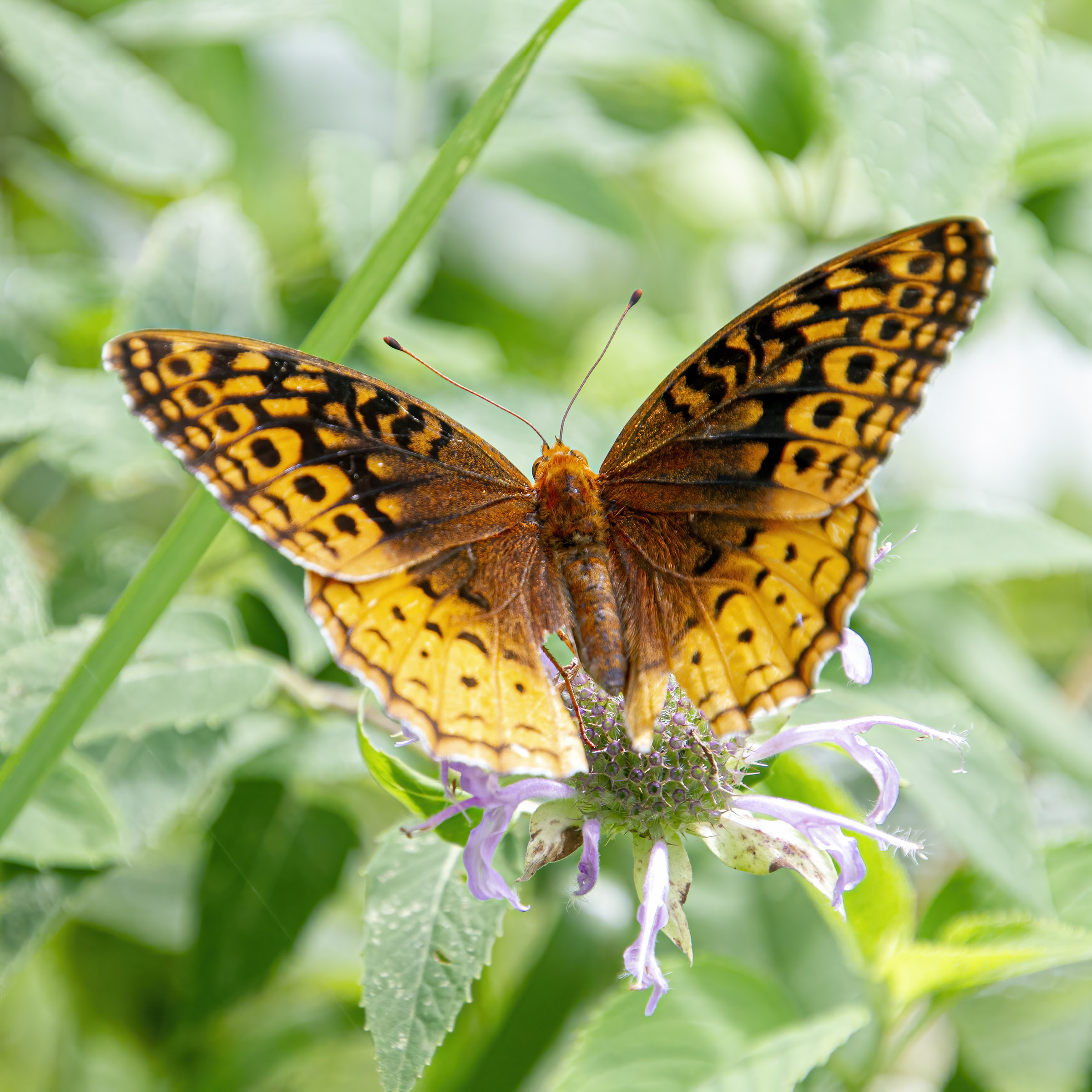
This tiny Cabbage White butterfly (Pieris rapae) paused for only a moment on a pink flower, but I managed to get a shot of it on Wednesday at Green Spring Gardens. If you look closely, you can just make out the butterfly’s stunning green eyes.

The composition of this image is pretty simple, but I think it is effective. I would have liked to blur out the background a bit more, but even though it is cluttered, it is not distracting. I think that is because the pink and white are so bright and distinctive that they “pop” against the green background.

Cabbage White

© Michael Q. Powell. All rights reserved.
Read Full Post »

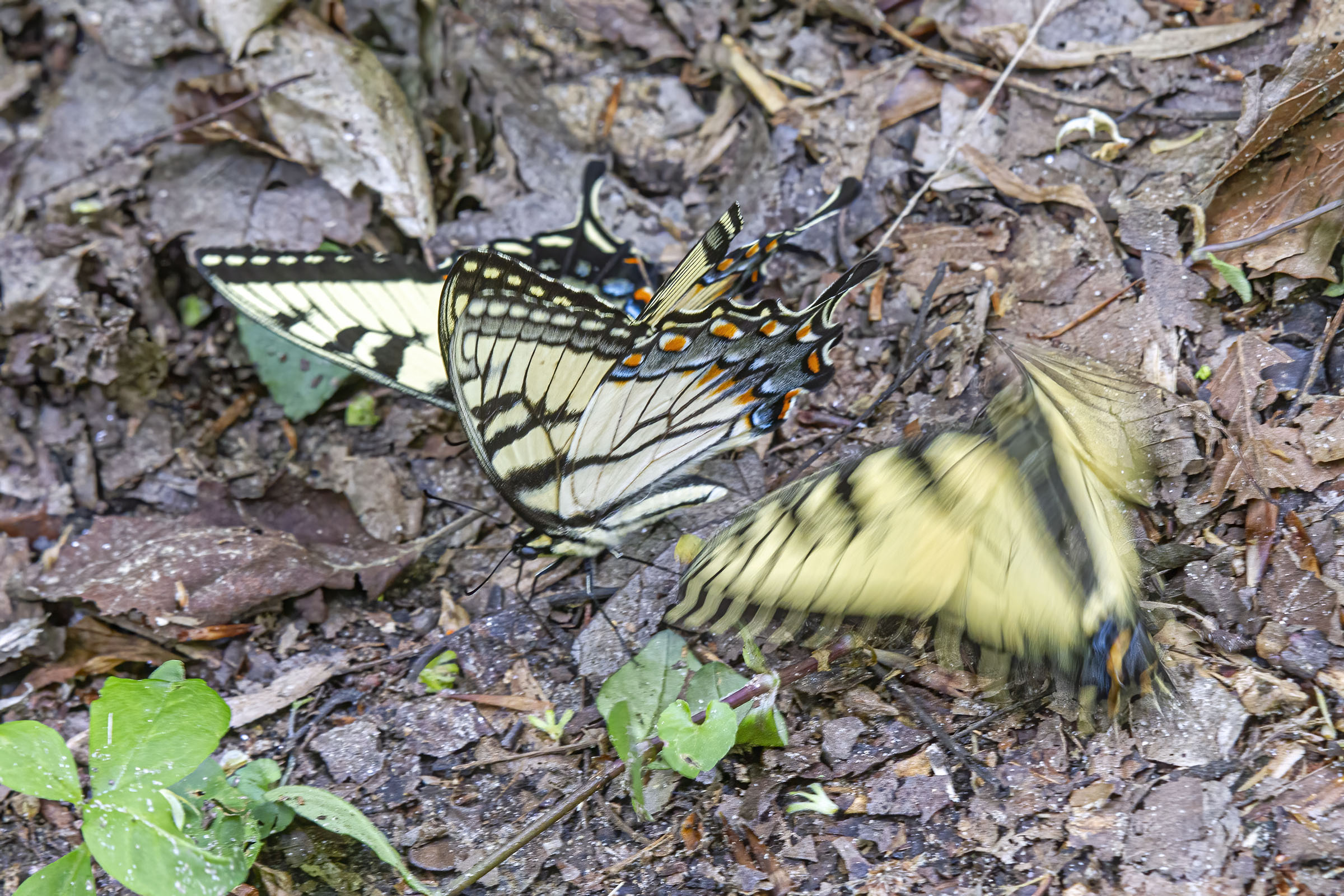
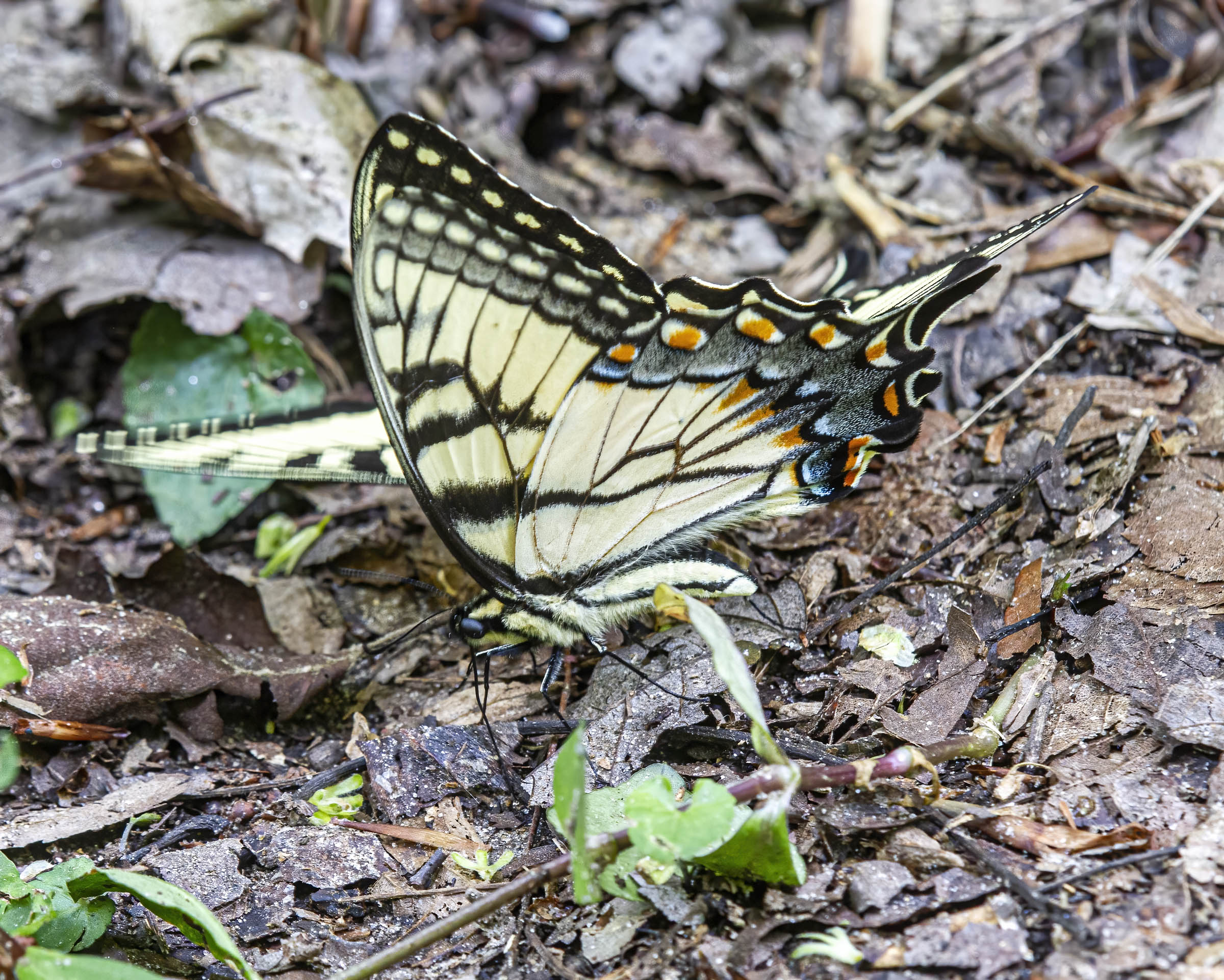
I usually think of butterflies drinking nectar from colorful flowers. Sometimes, though, newly emerged Eastern Tiger Swallowtails (Papilio polyxenes) will gather around  mud puddles or other damp spots—a behavior often referred to as “puddling”—to suck minerals and other substances out of the damp ground, like these butterflies that I spotted in early May alongside a creek in Prince William County, Virginia.

Butterflies were constantly moving in and out of a small group that seemed to be concentrated at one particular spot. As I was taking this shot, a new arrival “photobombed” me. I really like the motion blur of the arriving butterfly, which gives the image a dynamic feel and also a bit of whimsy. The second shot is a close-up view of one of the butterflies as it extracted nutrients from the moist area.

“Puddling” behavior is mostly associated with male butterflies.  According to an article at the Thoughtco website, “Nectar lacks some important nutrients the butterflies need for reproduction. For those, butterflies visit puddles. By sipping moisture from mud puddles, butterflies take in salts and minerals from the soil. This behavior is called puddling, and is mostly seen in male butterflies. That’s because males incorporate those extra salts and minerals into their sperm.”

Eastern Tiger Swallowtail

Eastern Tiger Swallowtail

© Michael Q. Powell. All rights reserved.

Read Full Post »

I was happy that I managed to get a shot of this tiny butterfly perched low in the vegetation at Occoquan Bay National Wildlife Refuge on Wednesday. I think it may be a Falcate Orangetip (Anthocharis midea), although the butterfly never opened its wings, so I was not able to confirm that the wings were tipped with orange.

I was a bit shocked that I was able to capture so much detail of this tiny creature, given that I was shooting with my Tamron 150-600mm zoom lens fully extended to 600mm. When I bought this lens in November 2014, I remember reading reviews about the lens that stated that it was soft at 600m. That has not really been my experience. If I pay attention to my techniques and use a monopod for additional stability (as I was doing for this shot), I can shots that are acceptably sharp to my eye.

For those of you who are especially geeky, for this shot I was shooting with a Canon 7D at f/8, 1/400 sec, and ISO 800 with an exposure compensation value of minus 1.33 stops. More important than the settings, though, is the fact that I like the image that I managed to capture—that is always my number one priority.

Falcate Orangetip

© Michael Q. Powell. All rights reserved.

Read Full Post »

One of the clear signs that we are moving through spring is the emergence of large numbers of full-sized butterflies. Last week I was delighted to spot multiple Black Swallowtail (Papilio polyxenes) butterflies. Dark swallowtail butterflies can sometimes be problematic for identification, because in our area we have Pipevine Swallowtails, Spicebush Swallowtails, and the dark morph female Eastern Tiger Swallowtail, in addition to the Black Swallowtail.

However, these butterflies were relatively easy to identify, because I could clearly see the black dot inside the orange dot in each of the photos, one of the field markers of a Black Swallowtail. I was quite struck by the unblemished state of each of these butterflies, which seemed to be fresh and bright with fully intact swallowtails. As the season moves on, some of the butterflies will become more and more tattered and faded.

If you are curious about the identifying marks for the different kinds of dark swallowtails, I highly recommend a blog posting by Louisiana Naturalist called Four Dark Swallowtails. In this posting, she does side-by-comparisons of the four species from different angles and points out the visible differences that are really useful in identification.

Black Swallowtail

Black Swallowtail

Black Swallowtail

© Michael Q. Powell. All rights reserved.

Read Full Post »

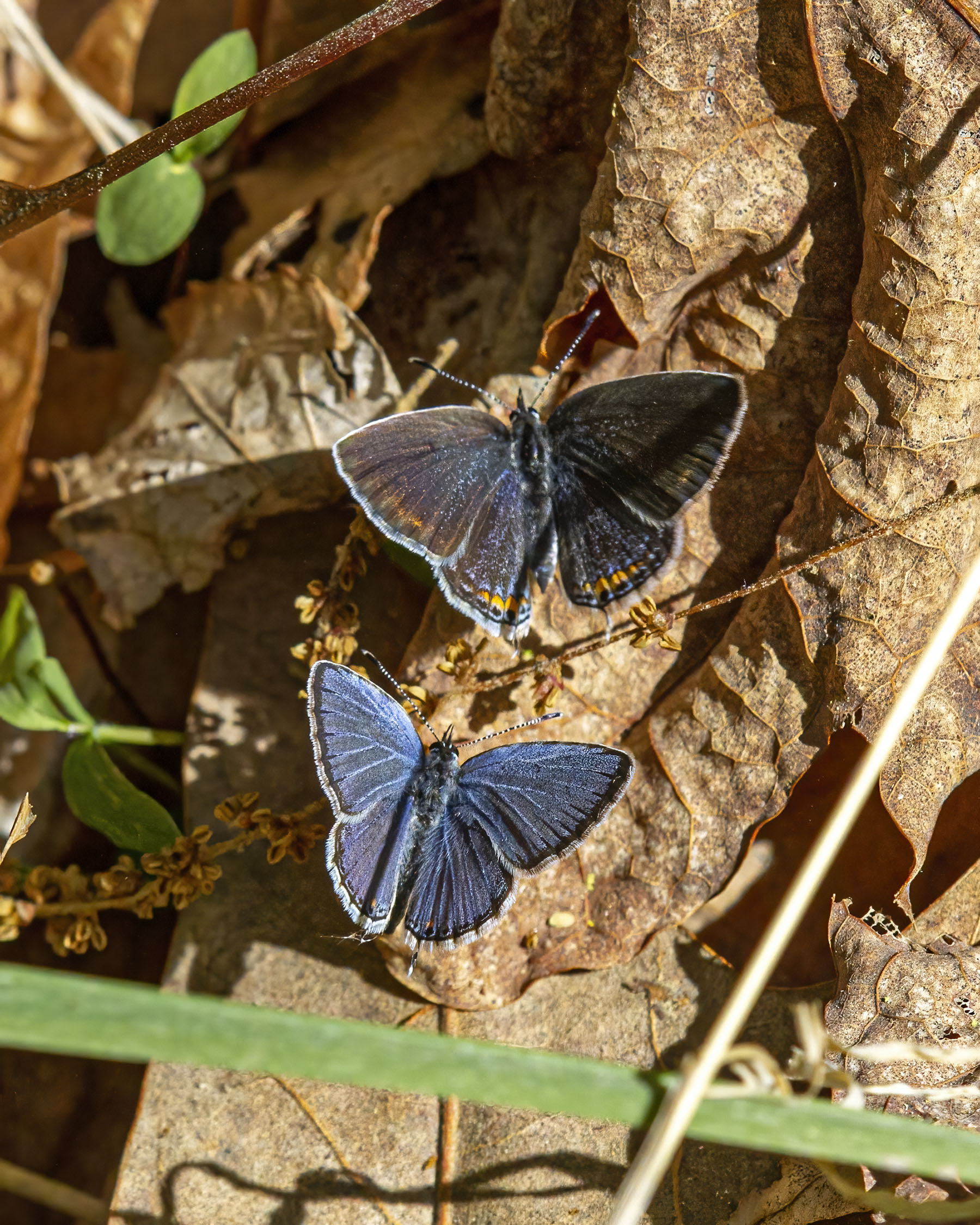
I don’t know much about the courting behavior of Eastern Tailed-blue butterflies (Cupido comyntas), but the male at the bottom of the photo was actively pursuing a female when I photographed them on Wednesday in Prince William County. Eastern Tailed-blues are tiny butterflies, with a wingspan of about an inch (25 mm), so you have to look really closely to see the single narrow tail on each hind wing. When their wings are closed, Eastern Tailed-blues are mostly grayish0-white in color, so it was a real visual treat to be able to capture them with their wings open.

Eastern Tailed-blue

© Michael Q. Powell. All rights reserved.

Read Full Post »

Yesterday was a beautiful spring day and I was delighted to capture this image of a Zebra Swallowtail (Eurytides marcellus), one of my favorite butterflies, at Occoquan Bay National Wildlife Refuge. I chased after this hyperactive butterfly and luckily was close enough to get a shot when it landed for a split second. I love the touches of red and blue on this mostly monochromatic butterfly and its distinctive long “tails.”

As I was doing a little research on this butterfly, I discovered that the Zebra Swallowtail has two seasonal forms, one occurring in the spring and the other in the summer. According to Wikipedia, the spring forms are smaller, more white, and have short, black tails with white tips. As you can see from the first photo below, yesterday’s Zebra Swallowtail was a spring form butterfly.

Summer forms of the Zebra Swallowtail are larger, have broader black stripes, and longer, black tails with white edges. For the sake of comparison, I reprised a photo from a 6 September 2021 blog posting. The butterfly in the second photo, a summer form butterfly, indeed looks darker than the one in the first photo and there are noticeable differences in the shape and coloration of the tails.

Zebra Swallowtail

Zebra Swallowtail

© Michael Q. Powell. All rights reserved.

Read Full Post »

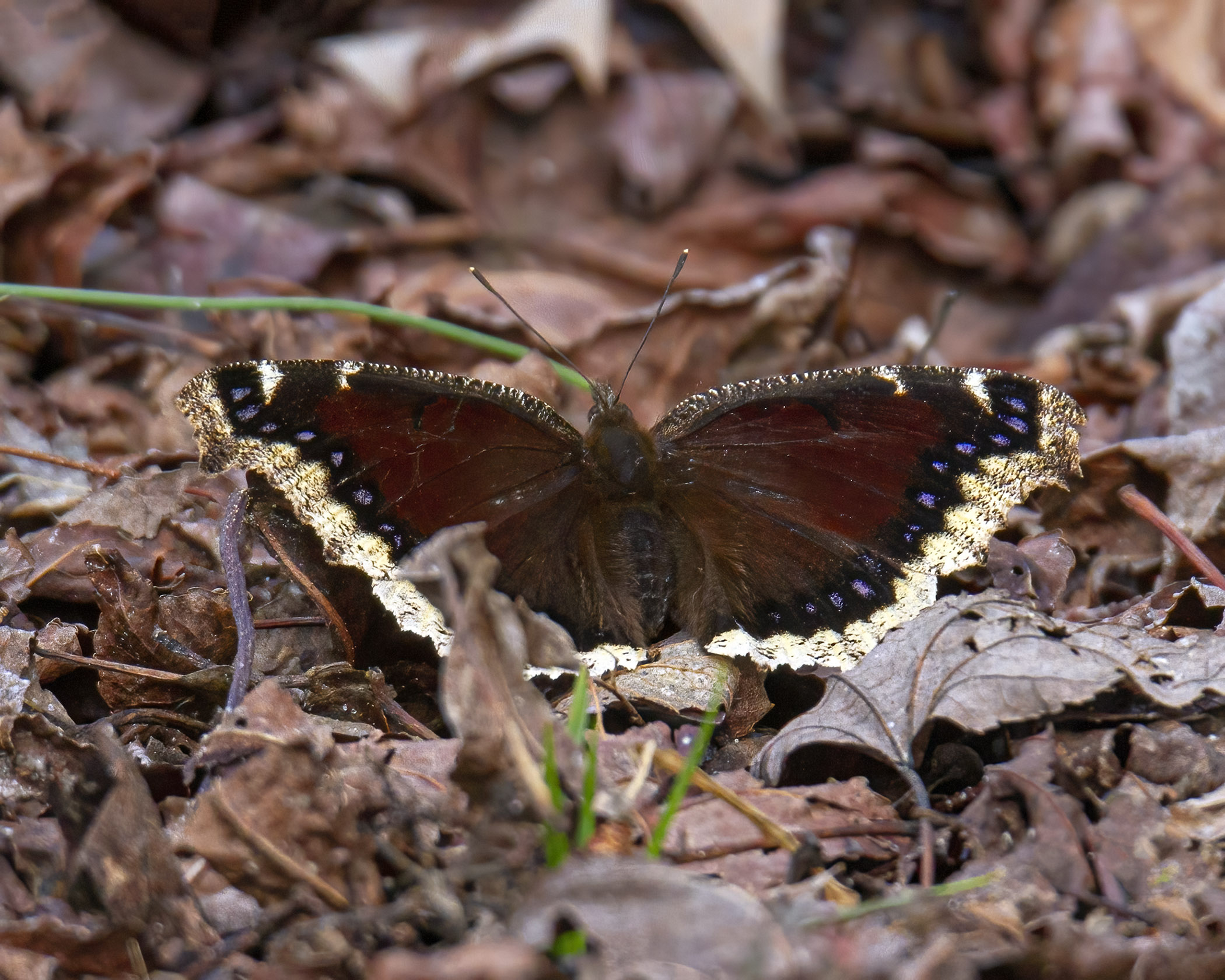
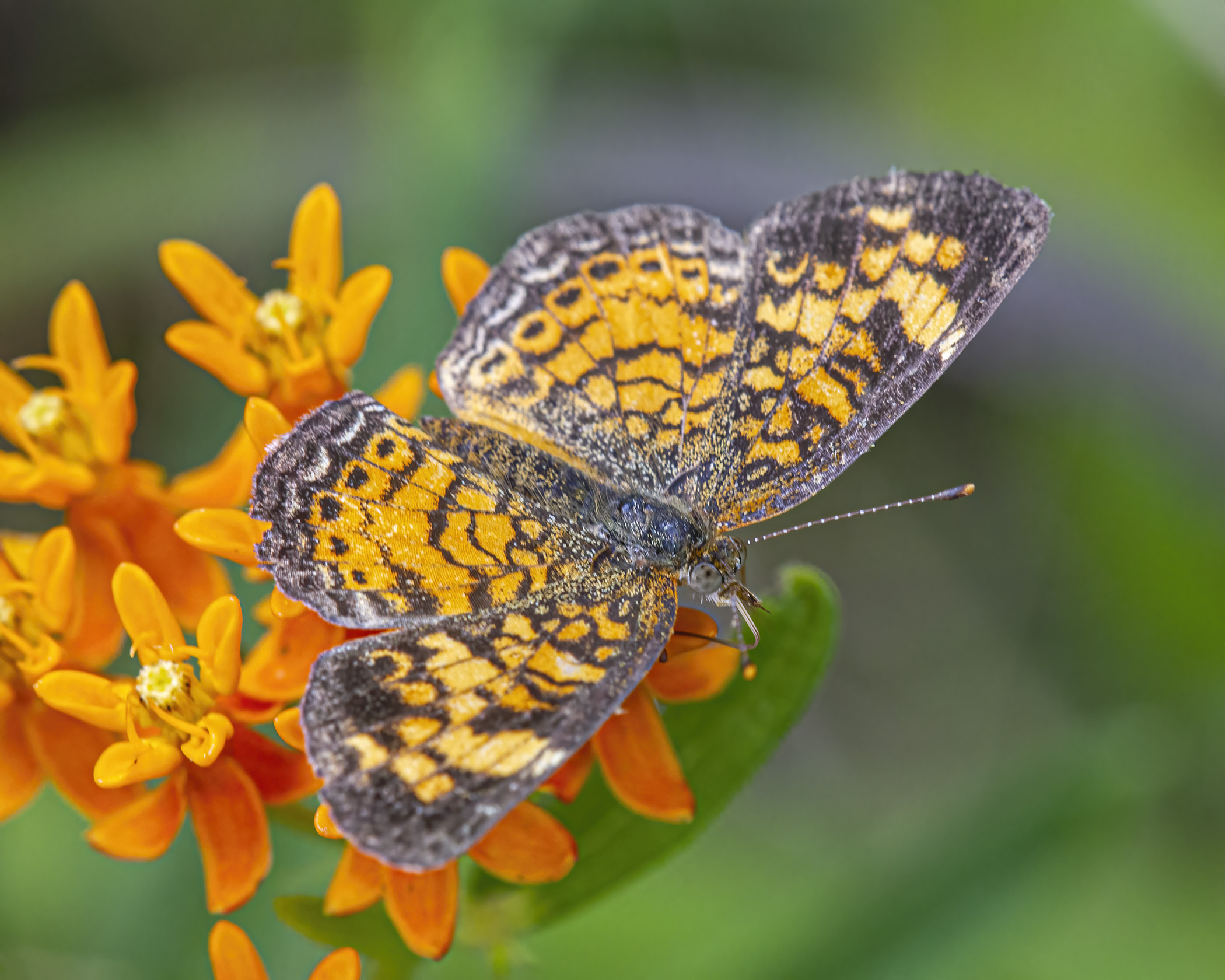
I finally spotted my first butterflies of the spring. As I was walking down one of the trails at Occoquan Bay National Wildlife Refuge on Wednesday, a fellow photographer excitedly pointed out this Mourning Cloak (Nymphalis antiopa) butterfly that was sunning itself on the trail. Mourning Cloaks overwinter as adults and are usually one of the first species to appear in the spring. According to Wikipedia, “These butterflies have a lifespan of 11 to 12 months, one of the longest lifespans for any butterfly.”

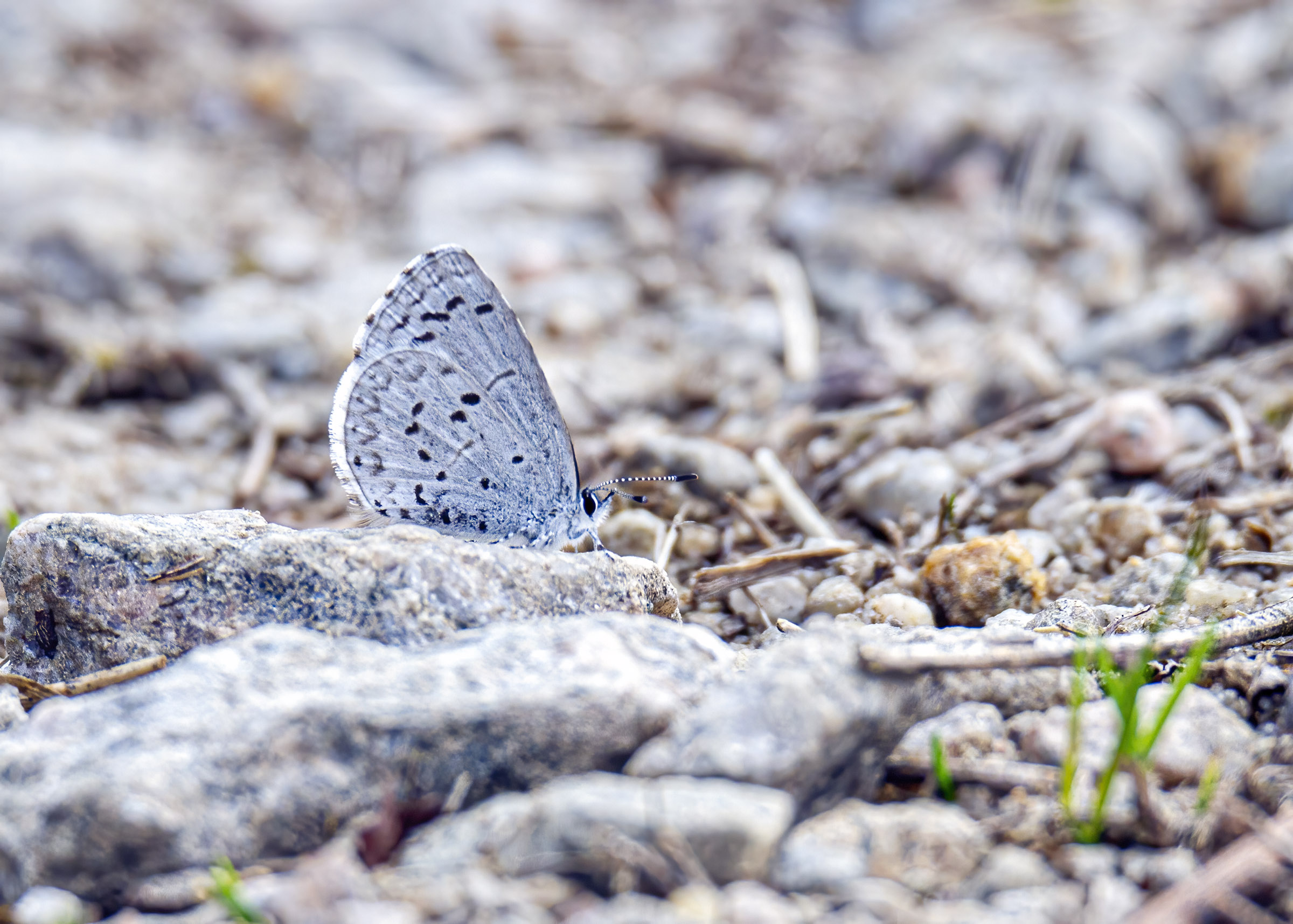
Later in the afternoon, I spotted a Spring Azure (Celastrina ladon) butterfly that was perched amidst the rocks on a gravely section of one of the trails. Spring Azure butterflies are very small—about one inch (25 mm) in size—and it was quite a challenge to get a shot of this one using the 150-600mm lens that was on my camera at that moment.

Yesterday I spotted an Eastern Tiger Swallowtail butterfly as I was searching for dragonflies at another location, but was unable to get a shot of it. I also briefly caught a glimpse of one dragonfly, but again was unable to get a shot. As the weather continues to warm, I’ll be out with my camera more often in search of these beautiful little creatures—it finally feels like spring is here.

Mourning Cloak

Spring Azure

© Michael Q. Powell. All rights reserved.
Read Full Post »

I spotted this colorful Gulf Fritillary butterfly (Agraulis vanillae) perched on a cactus last week as I was exploring some trails along the Colorado River in Bastrop, Texas. This is the kind of shot that it would be impossible to capture in my home area, since neither the butterfly nor the cactus is found in the wild in Virginia.

Gulf  Fritillary

© Michael Q. Powell. All rights reserved.

Read Full Post »

Here are a couple of shots of what I believe are American Snout butterflies (Libytheana carinenta) that I spotted on 2 November in Bastrop, Texas. Although you can’t see the butterfly very well in the first shot, I really like the “artsy” feel of the image. The second shot has a completely different feel to me, perhaps because of the coolness of the green background vice the warmth of the yellow in the first image.

American Snout

American Snout

© Michael Q. Powell. All rights reserved.

Read Full Post »

« Newer Posts - Older Posts »