Feeds:
Posts
Comments

Archive for the ‘Butterflies’ Category

I was surprised and delighted to spot this Cabbage White butterfly (Pieris rapae) as it was feeding on a newly sprouted dandelion on Tuesday at Occoquan Bay National Wildlife Refuge. I love chasing these elusive little butterflies that I used to think were moths.

Gardeners consider Cabbage Whites to be pests, because their caterpillars can do significant damage to plants, including cabbage, broccoli, cauliflower, and collard greens, but I find them to be beautiful. In that respect I guess I am a kind of dreamer who prefers to focus more on form than on function.

Cabbage White

© Michael Q. Powell. All rights reserved.

Read Full Post »

The number of butterflies continues to dwindle, so I was thrilled to spot this pretty little Variegated Fritillary butterfly (Euptoieta claudia) last Tuesday at Occoquan Bay National Wildlife Refuge. The weather has gotten cooler and it won’t be long before below freezing temperatures arrive, so I will be out chasing these last summer survivors until none remain.

Variegated Fritillary

© Michael Q. Powell. All rights reserved.

Read Full Post »

By mid-November most butterflies have disappeared in my area as the weather has cooled off. One notable exception, however, has been the Common Buckeye (Junonia coenia). I was delighted to spot numerous Common Buckeyes last week at Occoquan Bay National Wildlife Refuge.

The markings on these little butterflies are incredibly beautiful and I was happy to be able to capture some of that beauty in the photo below.

Common Buckeye

© Michael Q. Powell. All rights reserved.

Read Full Post »

Last Wednesday I was thrilled to spot multiple Monarch butterflies (Danaus plexippus) during a visit to Occoquan Bay National Wildlife Refuge, the most Monarchs that I have seen at one time this entire season. I do not know if these are local Monarchs that are preparing to migrate southward or if they are migrating Monarchs that are stopping by to refuel their bodies as they continue on their journey.

In either case, the butterflies were really active, in almost constant motion as they moved about the the open thistle flowers. I was hoping to get multiple butterflies in a single shot, but was never able to capture more than two of them in any photo, as you can see in the first image below.

The final photo shows the kind of photo that I was trying to take, a sidewards view of the Monarch in action. If you look closely, you can even see the butterfly’s extended proboscis. I also love the wonderful contrast between the orange of the butterfly and the pink of the thistle flower.

Monarch butterfly

Monarch butterfly

© Michael Q. Powell. All rights reserved.

Read Full Post »

I have seen quite a few Viceroy butterflies this summer, but have had real difficulties finding Monarch butterflies (Danaus plexippus). I have repeatedly heard warnings about how their habitats are threatened and fears that they might soon become extinct.

I was therefore quite thrilled when I spotted this bright orange butterfly on Thursday at Occoquan Bay National Wildlife Refuge. It seemed to be a bit larger that the Viceroys that I am used to seeing, so I chased after it, full of hope that it might be a Monarch. It landed for only a moment and I was able to capture this shot of the beautiful creature—it was indeed a Monarch butterfly.

The Monarch took off a few seconds later and flew out of sight. I stayed in place a bit longer, still filled with awe and wonder at the brief encounter, before I too moved on. It is amazing how much moments like this one lift my spirits.

Monarch

© Michael Q. Powell. All rights reserved.

Read Full Post »

Recently I have featured numerous large, beautiful butterflies feeding on blooming plants, especially thistles. Today, I decided to turn the spotlight to the smaller, more nondescript butterflies, commonly referred to as skippers, that have been equally active and visible in recent weeks.

According to Wikipedia, there are more than 3500 species of skipper butterflies in the world and many of the species are visually similar in appearance. For that reason, I am especially cautious in trying to identify one of these small butterflies. Sometimes I will request assistance in identifying specimens in one of many Facebook groups to which I belong. I have learned the “secret” to getting a response—if I make a misidentification, some experts who might not help me with an identification will feel compelled to correct me.

I spotted the little beauty in the photo below last week while I was exploring a patch of flowers at Jackson Miles Abbott Wetland Refuge. It might be a Peck’s Skipper (Polites peckius), but to me it looks a bit more like a Zabulon Skipper (Poanes zabulon). Whatever the case, I like the way that I was able to capture the butterfly in action, sipping nectar with its proboscis fully extended.

Peck's Skipper

© Michael Q. Powell. All rights reserved.

Read Full Post »

I spotted this spectacular Great Spangled Fritillary butterfly (Speyeria cybele) last week at Occoquan Bay National Wildlife Refuge. Although I usually have something to say about an image, in this case I will let it speak for itself. Suffice it to say that I love the wonderful combination of the pink of the flower and the orange of the butterfly. Wow!

Great Spangled Fritillary

© Michael Q. Powell. All rights reserved.

Read Full Post »

We are definitely in a period of time when butterflies are everywhere, especially in the patches of thistles that are blooming now. Earlier in the week I spotted this beautiful male Eastern Tiger Swallowtail (Papilio glaucus) at Occoquan Bay National Wildlife Refuge as he was feeding on a thistle. I was delighted to capture a shot when the butterfly had his wings fuly extended, showing off all the details of the wings.

In case you are curious, you can tell that the butterfly is a male because he lacks the band of blue spots along the hindwings that are found on the females of the species.

© Michael Q. Powell. All rights reserved.

Read Full Post »

There has been a relatively recent resurgence of butterflies in my area. In the past week or so I have seen more butterflies than at any other time this summer. Several of the dark swallowtail butterflies, though, are similar in appearance and are hard to tell apart, especially when wing damage hides some of the features that I rely on for identification.

Last week at Occoquan Bay National Wildlife Refuge, I spotted this beautiful dark swallowtail as it was feeding on a thistle plant. I can’t tell for sure, but I think that it may be a Spicebush Swallowtail butterfly (Papilio troilus). A chunk of the hind wing is missing, but otherwise the butterfly seems to be in good shape. It was moving around a lot on the thistle, but I was patient and eventually was able to capture a decent shot of this beautiful creature.

Pipevine Swallowtail

© Michael Q. Powell. All rights reserved.

Read Full Post »

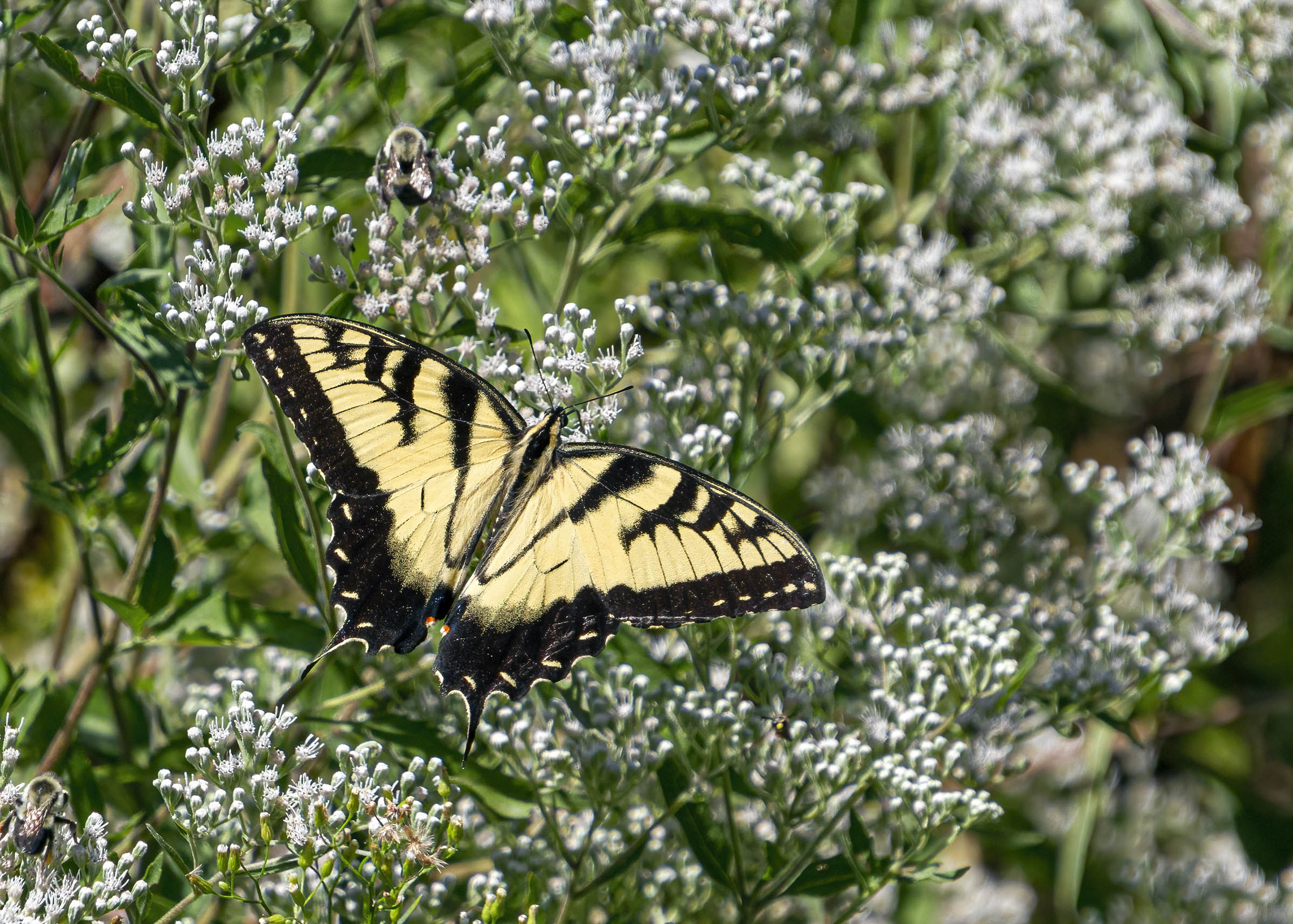
I’ve noted several times recently the tattered butterflies that I tend to encounter at this time of the year. However, not all of the ones that I see have suffered wing damage. Some of them appear to have recently emerged and are in perfect condition, like these Eastern Tiger Swallowtail butterflies (Papilio glaucus) that I spotted during a recent visit to Occoquan Bay National Wildlife Refuge.

Eastern Tiger Swallowtail

Eastern Tiger Swallowtail

Eastern Tiger Swallowtail

© Michael Q. Powell. All rights reserved.

Read Full Post »

On Tuesday I spotted a really cool-looking butterfly at Occoquan Bay National Wildlife Refuge, a Red-banded Hairstreak (Calycopis cecrops). This species has distinctive reddish-orange markings across its hind and forewings. I don’t recall seeing this species very often, though I have included photographs of the butterflies in some blog postings in the past.

The Red-banded Hairstreak is quite small in size, with a wingspan of just over an inch (25 mm), so I had to focus very carefully on the butterfly to obtain a sharp image. I was pleasantly surprised by the results with my Tamron 18-400mm zoom lens that did a pretty good job in capturing a shot of such a small subject.

Red-banded Hairstreak

© Michael Q. Powell. All rights reserved.

Read Full Post »

During a recent visit to Occoquan Bay National Wildlife Refuge I spotted quite a few Red Admiral butterflies (Vanessa atalanta), a fairly common species where I live. When I did a little research on-line, I learned that, according to Wikipedia, Red Admirals, also known as Red Admirables, are found in temperate regions of North Africa, North and Central America, Europe, Asia, and island regions of Hawaii, and the Caribbean. Wow!

I remember in the past that I sometimes referred to this species as a “patriotic” butterfly, because it had red, white, and blue areas in its coloration. I was happy to capture this shot of a Red Admiral with its wings partially open, because it gives you an idea of the interior colors as well as the exterior colors of the butterfly. As you can see, the inside of the wings feature wide reddish-orange stripes.

Red Admiral

© Michael Q. Powell. All rights reserved.

Read Full Post »

In those parts of the world that use a meteorological calendar, autumn arrived on the first day of September. The rest of us will have to wait until the 22nd of this month to mark the official changing of the season. As I have noted in some previous postings, I have already noted the decrease in several dragonfly species and the overall numbers of dragonflies will continue to drop during September.

It is also common for me to see butterflies with damaged wings at this time of the year. I marvel at the ability of butterflies to survive with a significant amount of damage to their wings. Last week I spotted this Common Buckeye butterfly (Junonia coenia) during a visit to Huntley Meadows Park. The butterfly was missing the lower portions of both of its wings, but somehow was still able to fly.

I recall reading somewhere that the purpose of the large eyespots on the wings of butterflies is to fool predators into attacking those portions of their bodies, thereby protecting their more vulnerable body parts. I don’t know it that was the case with this butterfly, but it may well be the cause of the damage that it has sustained.

Autumn often fills me with a vague sense of melancholy and I acutely feel the passage of time. Some aspects of life inexorably will come to a close or enter a state of dormancy.

I try desperately to hold on to the summer, but a part of me knows that change is inevitable. Enjoy the remaining portions of the season.

Common Buckeye

© Michael Q. Powell. All rights reserved.

Read Full Post »

I was delighted to spot this Great Spangled Fritillary butterfly (Speyeria cybele) feeding on a thistle flower during a recent visit to Huntley Meadows Park, a county-run wetland not far from where I live in Northern Virginia. I have not seen many of this species of butterfly this season, so I was happy to capture this artsy artsy shot of the Great Spangled Fritillary on the one open bloom of the thistle plant.

I love the way that they spiky unopened buds add visual interest to the image without drawing attention from the primary subject.

Great Spangled Fritillary

© Michael Q. Powell. All rights reserved.

Read Full Post »

There must be something irresistible about thistle flowers, because on Tuesday I encountered multiple clusters of thistles with butterflies feeding on them during a short visit to Huntley Meadows Park. Sometimes the butterflies seemed to be socially distancing themselves, but at other times they were feeding side by side with other butterflies, including those of different species.

Of course, butterflies do not remain still while feeding—they move about constantly as they change their positions and flap their wings, complicating my efforts to capture images of them. The first photo below is one of my favorites. It shows a dark morph female Eastern Tiger Swallowtail (Papilio glaucus) sharing a thistle flower with two Great Spangled Fritillary butterflies (Speyeria cybele). I love the contrast between the colors of these two species that together provide a foretaste of the autumn season that is almost upon us.

The second photo provides a closer view of the dark morph Eastern Tiger Swallowtail. The final photo is a shot of what I believe is another female Eastern Tiger Swallowtail that has a yellow coloration similar to that of a male, but has an additional band of blue spots along the hindwings. I think it is really cool that there are two different color variants of females—in many insect and bird species, the males have more color and variation and the females are drab by comparison.

butterflies

Eastern Tiger Swallowtail

Eastern Tiger Swallowtail

© Michael Q. Powell. All rights reserved.

Read Full Post »

I love to search for Monarch butterflies, but this year I have spotted only a few of them. I am more likely to spot the similar looking Viceroy butterfly (Limenitis archippus), like this one that I photographed last week at Occoquan Bay National Wildlife Refuge. It paused for a moment as it perched high in the vegetation at the edge of the water of the bay and I captured the moment as the butterfly looked out on the watery expanse.

What was the butterfly thinking? I sometimes wonder what it would be like to be able to fly freely like a butterfly. Perhaps the butterfly was imaging what it would be like to swim like a fish.

We always are a little restless, wanting to be different from what we are. Maybe we should spend more time celebrating who we are in the present moment, a unique combination of strengths and weaknesses. As one of my brothers likes to say, “Be yourself—everyone else is already taken.”

Viceroy

© Michael Q. Powell. All rights reserved.

Read Full Post »

I chased this small orange butterfly around for quite a while before it finally landed. Only then was I able to determine that it was probably a Variegated Fritillary butterfly (Euptoieta claudia), a species that I do not see very often. I looked over my old blog postings and discovered that most of my sightings of this species have been late in the season—earlier in the season I tend to see the somewhat similar-looking Great Spangled Fritillary more often.

We have had a decent amount of rain recently, so there is still a lot of green in the vegetation that provides a nice contrast with the orange and brown tones of the butterfly. Those colors somehow remind me of the imminent arrival of the fall season. There is still a bit of the summer to enjoy, however, so I am not quite ready to jump ahead to the autumn—I prefer to live in the moment and celebrate what is in front of me in the present moments.

Variegated Fritillary

© Michael Q. Powell. All rights reserved.


Read Full Post »

Last Friday I spotted this Black Swallowtail butterfly (Papilio polyxenes) as it was feeding on a thistle plant at Occoquan Bay National Wildlife Refuge. I love the shape, color, and texture of these thistle plants. I was a little shocked to see the excellent condition of the butterfly this late in the season.

When I returned home I did a little research and found out that this butterfly has at least two broods each year, with the second one flying at least until the end of August. Sometimes there is a partial third brood. Perhaps the butterfly in the photo recently emerged.

The later broods will lay eggs and winter is spent in a chrysalis stage. In the springtime, the adults will emerge and the cycle will continue. Nature is amazing!

Black Swallowtail

© Michael Q. Powell. All rights reserved.

Read Full Post »

Pearl Crescent butterflies (Phyciodes tharos) are quite common in my area, but they are small and skittish and often feed with their wings partially open, so it is hard to get a photo of one with its wings spread wide. Last week I spotted several Pearl Crescents in a large patch of Black-eyed Susans at Jackson Miles Abbott Wetland Refuge and I stalked them for quite some time. I was delighted when I finally managed to capture this image that shows wonderfully the beautiful details of this little butterfly.

Pearl Crescent

© Michael Q. Powell. All rights reserved.

Read Full Post »

Most of the time I see butterflies in the air or perched on vegetation, but some species, like this Red-spotted Purple butterfly (Limenitis arthemis astyanax) are low-fliers and spend a lot of time perching on the ground. I spotted this beauty on Monday during a short visit to Occoquan Regional Park in nearby Lorton, Virginia.

It was hot and humid and it seemed like most of the insects and birds were taking afternoon naps, so I cut my trip short and joined them in their siestas.

Red-spotted Purple

© Michael Q. Powell. All rights reserved.


Read Full Post »

We have a number of different dark swallowtail butterfly species in our area and sometimes I have trouble telling them apart. Recently I have seen Black Swallowtails fairly frequently and occasionally I will see a Pipevine Swallowtail. I know that there is also a dark morph version of the Eastern Tiger Swallowtail and a Red-spotted Purple butterfly sometimes looks almost like a swallowtail.

Are you confused yet? When I spotted this cool-looking butterfly on Wednesday at Occoquan Bay National Wildlife Refuge, I was not sure what it was. Rather than endlessly speculating while in the field, I follow what I call the “Law of the Wild West”—shoot first and ask questions later—and wait to identify my subjects until after I have loaded my images onto my computer.

I have grown accustomed to using a blog posting by the Louisiana Naturalist to help identify dark swallowtails—it provides side-by-side photos of four different species. On the basis of that posting and some other research, I have concluded that “my” butterfly is probably a Spicebush Swallowtail (Papilio troilus) butterfly, a species that I don’t recall seeing the past few years.

The background of the photo is not particularly interesting, but I was patient enough to wait for the butterfly to open its wings, so you get a good look at the wonderful markings of this Spicebush Swallowtail butterfly.

Spicebush Swallowtail

© Michael Q. Powell. All rights reserved.

Read Full Post »

I spotted quite a few beautiful Zebra Swallowtail butterflies this past Tuesday at Occoquan Bay National Wildlife Refuge. The all seemed to be in constant motion, rarely perching for more than a split second and flying in unpredictable patterns.

Eventually I was able to capture a shot of a distant Zebra Swallowtail when it stopped to sip from a milkweed plant. I really like the composition of the photo, despite the fact that the main subject occupies only a small portion of the frame.

I could not help but notice that the butterfly is looking a bit tattered, with its long swallowtails already gone. Later in the season, I am sure that I will see many more butterflies and dragonflies with damage to their wings from the wear-and-tear of daily life. I am always amazed by the way that they are able to compensate and continue to survive. As I get older and slow down a bit, I try to remind myself to focus on those things that I can do and not on the ones that may be becoming increasingly challenging for me.

Zebra Swallowtail

© Michael Q. Powell. All rights reserved.

Read Full Post »

I haven’t seen any Monarch butterflies yet this season, but I did spot this similar-looking Viceroy butterfly last week at Occoquan Bay National Wildlife Refuge. Viceroy butterflies are generally much smaller than Monarchs, so I can often tell them apart from a distance. When I get closer though, the most obvious distinguishing feature is that Viceroys nave a thin black line across their hind wings that Monarchs do not have.

Viceroy butterfly

© Michael Q. Powell. All rights reserved.


Read Full Post »

I spotted this beautiful Black Swallowtail butterfly (Papilio polyxenes) last week at Occoquan Bay National Wildlife Refuge. The orange circle with the black dot in between the wings helps to distinguish this species from several similar-looking dark butterflies in our area.

I chased this butterfly around for quite some time before it finally stopped for a moment on this vegetation—I often get a good workout when photographing butterflies. I am quite happy with the way that I was able to capture the varying shades of green surrounding the butterfly that add a lot of visual interest to this simple composition.

Black Swallowtail

© Michael Q. Powell. All rights reserved.


Read Full Post »
On Monday I spotted this beautiful Red-spotted Purple butterfly (Limenitis arthemis astyanax) in a sea of ferns adjacent to a creek that I was exploring in Prince William County, Virgnia. I love the iridescent blue color on the wings and the little red spots that provide a nice accent color. Although I see a slight purplish tint to the wing on the right, I really don’t see very much purple on this butterfly’s body despite the fact that “purple” is a prominent part of the name of this species.

The color and texture of the ferns make for a beautiful backdrop for the butterfly and add a bit of visual interest without being distracting.

Red-spotted Purple

© Michael Q. Powell. All rights reserved.


Read Full Post »

On Monday I spotted this cool little butterfly at Occoquan Regional Park in nearby Lorton, Virginia. I was a little surprised to learn that it is a Falcate Orangetip butterfly ( (Anthocharis midea), given that the butterfly has not a single visible spot of orange. Apparently only the males have the orange tips for which the species is named and this one is a female.

When I first spotted this tiny butterfly flying about, I assumed that it was a Cabbage White. However, I quickly noticed the colored pattern on the outside of the wings and realized that my initial impression were wrong—Cabbage Whites are all white except for some black spots. When I looked even closer I noticed the butterfly’s gray eyes and scallop-edged wings, unlike the Cabbage Whites that have green eyes and more even-edged wings.

Falcate Orangetip

© Michael Q. Powell. All rights reserved.

Read Full Post »

When this little butterfly flew by me last week at Prince William Forest Park, it looked a bit like a nondescript brown moth. However, when it landed on the ground and I was able to zoom in on it, I was amazed by its variety of colors, textures, and markings. I was pretty sure that I had never seen one like this. When I returned home, I did some searching on the internet and concluded that this is a Henry’s Elfin butterfly (Callophrys henrici).

Every time I use the butterfly’s name, I smile, because there is just something whimsical about the word “elfin.” I love the idea of magical woodland creatures that blend in so well with their surroundings that you have to look carefully to spot them.

I encourage you to click on the image to see all of this creature’s wonderful markings, including the little white stripes on its antennae and legs and the beautiful scalloped edges of its wings.

Keep your eyes open today and you too may spot some magically whimsical creatures.

Henry's Elfin

© Michael Q. Powell. All rights reserved.


Read Full Post »

I went on a pretty long hike yesterday in Prince William Forest Park—just over 18,000 steps (7.1 miles or 11 km) according to my iPhone—and was delighted to spot this beautiful Eastern Tiger Swallowtail butterfly (Papilio glaucus), my first of the season.

When I first spotted the butterfly, it appeared to be sucking moisture and minerals from the wet soil, as you can see in the first photo. The butterfly flew to a nearby location and resumed its efforts and I was able to maneuver around to get the second image that shows the markings of the butterfly a bit better.

Personally I prefer the first photo that is more dynamic and gives a better sense of the activity of the butterfly. From a purely scientific perspective, the second one might be preferable because it shows more of the butterfly’s identification features. I am more of an artist than a scientist, though, so capturing all of the details with clinical precision is not as important to me.


Eastern Tiger Swallowtail

Eastern Tiger Swallowtail

© Michael Q. Powell. All rights reserved.

Read Full Post »

Yesterday I went on a hike at Prince William Forest Park, the largest protected natural area in the Washington D.C. area at over 13,000 acres (53 square kilometers), that is located about 27 miles (43 km) from my home. Unlike the wildlife refuge that I usually visit, which is on a coastal plain, Prince William Forest Park, as its name suggests, is heavily wooded and it is quite hilly. I love to walk along the many creeks and streams that crisscross the park—the sound of the flowing water always has a therapeutic effect on me.

I was thrilled to spot this beautiful Question Mark butterfly (Polygonia interrogationis) as it perched on some leaves in a marshy area adjacent to one of the creeks. I could not tell for sure, but it looked like this butterfly was sipping water, possibly gathering nutrients from the soil. Question Mark butterflies and their punctuation “cousins,” the Eastern Commas, overwinter as adults, so they are among the earliest appearing butterflies in the spring.

Question Mark and Eastern Comma butterflies are quite similar in appearance. When the wings are fully open, as in the photo below, you can see a brown dash near the top of the upper wings that is not present on the wings of Eastern Comma butterflies.

Question Mark butterfly

© Michael Q. Powell. All rights reserved.

Read Full Post »

Yesterday I was thrilled to spot several Spring Azure butterflies (Celastrina ladon) at Occoquan Bay National Wildlife Refuge. This early-appearing butterfly is one of the tiniest butterflies in our area, with a wing span of about an inch (25 mm). Unlike Mourning Cloak butterflies—like the I featured last week in a blog posting—that overwinter as adults, Spring Azures overwinter in the pupal form, safe inside their chrysalis.

All of the Spring Azures that I saw yesterday were extremely skittish, spending most of their time in flight. Occasionally one would fly near the ground and come close to landing and then abruptly resume its flight. When they did land, the little butterflies almost disappeared into the abundant leaf litter and were tough to photograph.

Nature is coming alive as flowering trees begin to pop and new wildlife species reappear on the scene as we move deeper into March. It won’t be long before osprey, green herons, and great egrets return to our area and I hope to be seeing dragonflies within the next month. It is an exciting time of the year.

Spring Azure

© Michael Q. Powell. All rights reserved.


Read Full Post »

I was delighted yesterday (7 March) to spot this beautiful Mourning Cloak butterfly (Nymphalis antiopa) at Occoquan Bay National Wildlife Refuge, my first butterfly sighting of 2024. Mourning Cloaks, known as Camberwell Beauties in the Great Britain, overwinter as adults and are usually among the first butterflies to appear each spring.

Mourning Cloak butterflies, according to Wikipedia, have a lifespan of 11 to 12 months, one of the longest lifespans for any butterfly. As I noted, these butterflies spend spend the winters in us as adults, by “hiding away in cracks in rocks or holes in trees, and are able to shut down their bodies all winter long, effectively hibernating, in a manner known in insects as torpor,” according to the One Earth website.

Mourning Cloak butterflies have a distinctive look that some scientist thought looked like the traditional cloak worn in mourning. I was happy that I was able to capture the row of blue spots on the wings—another one of its identification features—in the photo of “my” butterfly.

The butterfly spent most of its time flying up and down, in and out of some trees. Eventually it perched for a moment on the ground and I was able to capture this image. It will be at least a few more weeks before I see my first dragonfly of the season, but I will soon begin to keep my eyes open for them. As many of you know, dragonflies are one of my favorite subjects to photograph and I look forward to the start of “dragonfly season” each year.

Mourning Cloak

© Michael Q. Powell. All rights reserved.


Read Full Post »
« Newer Posts - Older Posts »