Feeds:
Posts
Comments

Archive for the ‘Butterflies’ Category

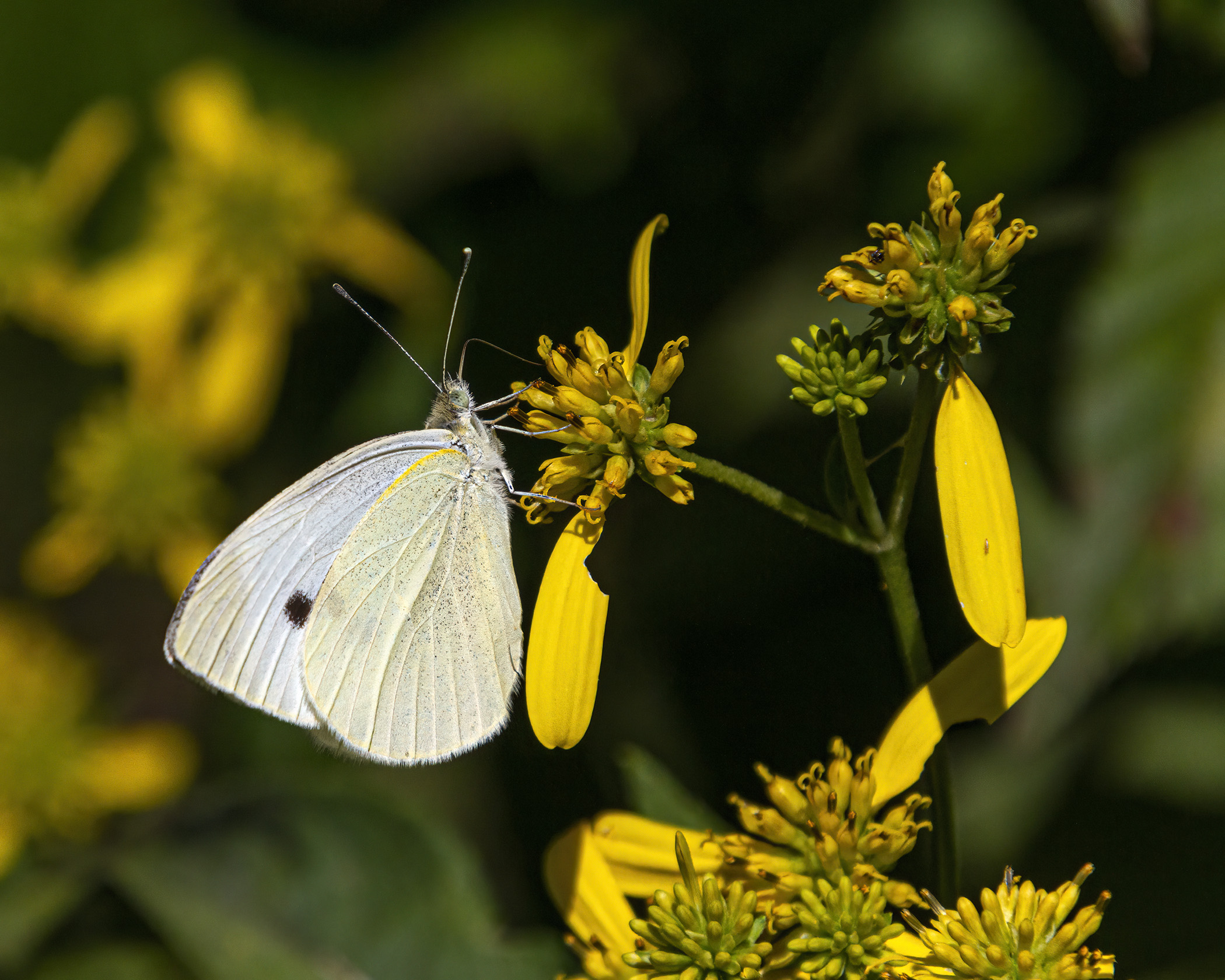
I spotted this pretty little Cabbage White butterfly (Pieris rapae) on 31 October at Occoquan Bay National Wildlife Refuge. This is a relatively common butterfly that has a natural range across Europe, Asia, and North Africa. According to Wikipedia, it was accidentally introduced to Quebec, Canada, around 1860 and spread rapidly throughout North America.

Most of the time Cabbage Whites flit about so much as they forage that it is hard to get a good photo of one. This Cabbage White, however, paused for a moment to feed on a flowering plant and I was able to capture an action shot. If you click on the image, you can get even see the extended proboscis that the tiny butterfly was using to suck nectar from the center of the flower.

Cabbage Whites are one of the earliest butterflies to appear in the spring and generally are still in flight in the fall until we have a hard freeze. The weather has cooled considerably, but so far the temperatures have not fallen below the freezing level.

Cabbage White

© Michael Q. Powell. All rights reserved.

Read Full Post »

During transitional periods throughout the year, I like to capture images that include elements of the season that is ending and of the season that is beginning. Last Friday I took this photo of a Common Buckeye butterfly (Junonia coenia) that has some foliage in the background that was in the process of changing colors. Though the leaves on which the butterfly is perched are still green, the reds and oranges of the background provide a foretaste of the future, a foreshadowing sign of what is yet to come.

Common Buckeye

© Michael Q. Powell. All rights reserved.


Read Full Post »

Our weather has definitely turned cooler, and the number of insects is definitely decreasing. I therefore treasure each encounter that I have, knowing that it could be the last one of the season.

I spotted this beautiful Red-spotted Purple butterfly (Limenitis arthemis astyanax) during a recent visit to Jackson Miles Abbott Wetland Refuge. It seems to have suffered a bit of wing damaged, which did little to damage its beautiful colors. I believe that this butterfly species has two broods, one in the spring and one in late summer, which may help to explain why this butterfly’s colors are still so vibrant—some of the other butterflies that I see have colors that are worn and faded.

Red-spotted Purple

© Michael Q. Powell. All rights reserved.

Read Full Post »

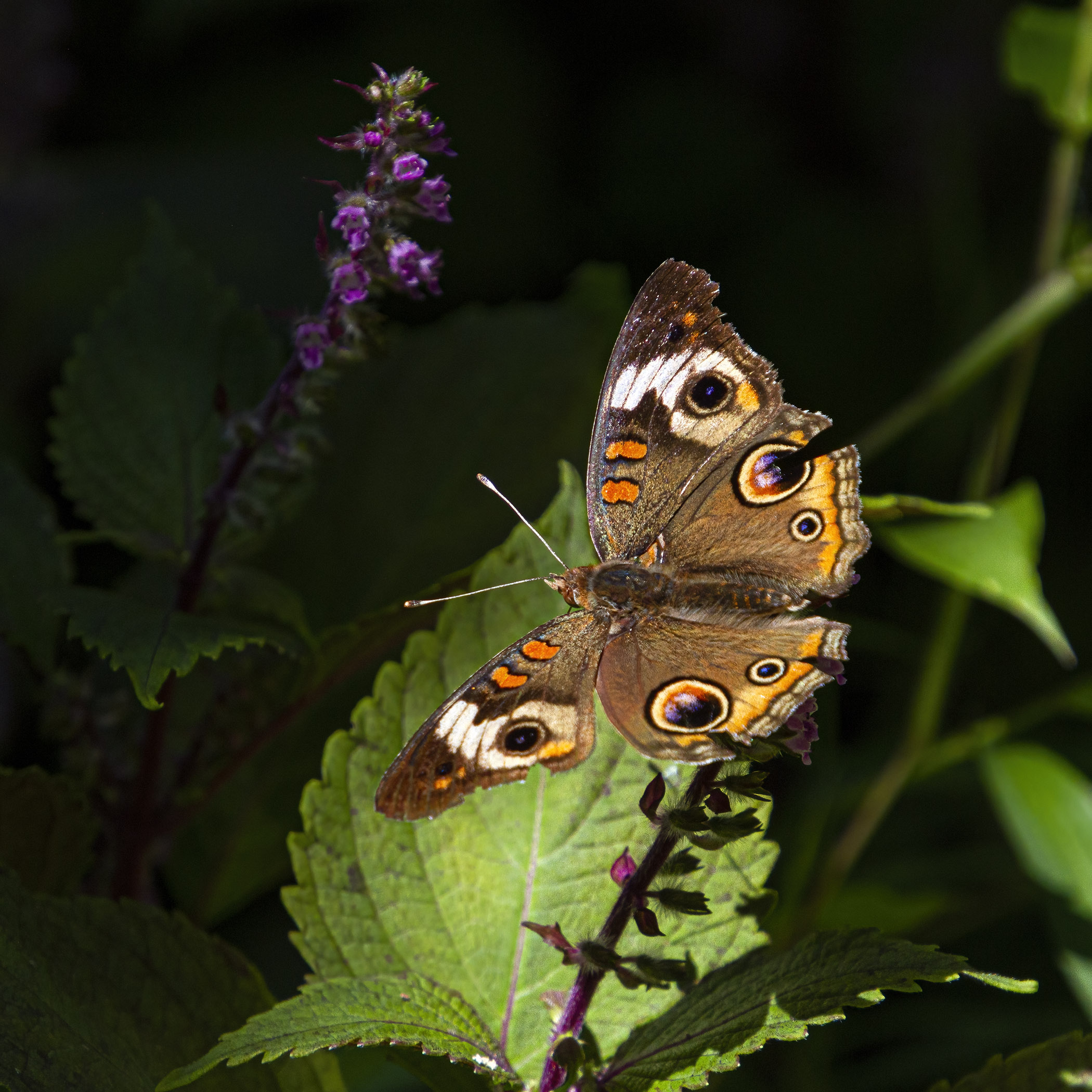
It was wonderful to see so many butterflies still active last week at Occoquan Bay National Wildlife Refuge, including this spectacular Common Buckeye butterfly (Junonia coenia). This butterfly was so feverishly feeding on these flowers that it scarcely seemed aware of my presence, which made it possible to capture shots of this magical creature from various angles. The challenge for me was to time those shots to capture the spectacular colors and patterns of the butterfly when its wings were fully opened.

Common Buckeye

Common Buckeye

© Michael Q. Powell. All rights reserved.


Read Full Post »

Flowers are slowing giving up their colors and fewer insects will flying as we move deeper into September. It lifts my spirits to see the survivors, like this Cabbage White butterfly (Pieris rapae) that I spotted during a a visit last week to Occoquan Bay National Wildlife Refuge. The Cabbage White, which gardeners consider to be a pest, may appear to be completely monochromatic, but if you double-click on the image, you can get a look at its beautiful speckled green eyes.

Cabbage White

© Michael Q. Powell. All rights reserved.

Read Full Post »

Skipper butterflies received their name because of their quick, darting flight habits. Many species look very much alike and I invariably have trouble identifying them.

Last week I spotted this little skipper butterfly as it was feeding on some wildflowers at Occoquan Bay National Wildlife Refuge. I was really happy to capture this image of the butterfly with its proboscis extended, sucking up the nectar from a flower. What species is it? If I had to guess, I’d say it might be a Fiery Skipper butterfly (Hylephila phyleus), but my eye is not as attuned to the subtle differences in skippers as it is to dragonflies, so this is really just a guess.

Even it I can’t identify the butterfly, I can enjoy and celebrate its beauty. I encourage you all to slow down and take in the beauties of nature whenever you can.

skipper butterfly

© Michael Q. Powell. All rights reserved.


Read Full Post »

What does “common” mean to you? For many of us, the descriptor “common” is used for ordinary, everyday things to which we tend to pay little attention. Their purposes tend to be functional and utilitarian and beauty is often of secondary importance, assuming that it is considered at all.

I rebel against the use of “common” in the name of many wildlife species. Even if “common” is meant to suggest the likelihood of encountering a species, it is usually related to geography—what is “common” in one area may well be “uncommon” in another area. I think that the folks who name species should be a bit more creative in choosing names for species.

On Monday I encountered this Common Buckeye butterfly (Junonia coenia) during a visit to Occoquan Bay National Wildlife Refuge. Take a close look at the colors and markings on this little butterfly and I’m sure that you will agree that it is uncommonly beautiful.

Common Buckeye

© Michael Q. Powell. All rights reserved.

Read Full Post »

During a recent visit to Occoquan Bay National Wildlife Refuge I noticed that the thistle plants were attracting a lot of butterflies. I managed to photograph what I think was a Spicebush Swallowtail butterfly (Papilio troilus) as it was feverishly feeding on the thistles.

The butterfly had sustained a significant amount of damage to its wings, which made identification of its species a little difficult—it is possible that this is actually a Black Swallowtail or one of the other dark swallowtails in my area.  Whatever the case, I was once again amazed that, despite the damage to its wings, the butterfly seemed to be able to fly and feed without any obvious limitations.

Spicebush Swallowtail

Spicebush Swallowtail

© Michael Q. Powell. All rights reserved.


Read Full Post »

Throughout the summer I have did not spot very many butterflies—maybe they were as uncomfortable in the midday heat and humidity as I was. Now that we are in September I seem to see them all of the time. One of my favorites that I managed to photograph on Monday at Occoquan Bay National Wildlife Refuge was this beautiful Eastern Comma butterfly (Polygonia comma).

As many of you know, the Eastern Comma is one of the two “punctuation” butterflies in my area—the other is the Question Mark butterfly (Polygonia interrogationis). The two species are quite similar in appearance, with the arrangement of spots on the wings being the chief means of distinguishing between them.

I love the beautiful orange color of this butterfly, a color that seems to be a perfect match for the autumn season that is either imminent or already upon us, depending on whether you use the astrological calendar or the meteorological calendar. Meteorological autumn begins on September 1 and ends on November 30, providing a consistent three month period for data analysis. Astrologically the autumn season begins at the Autumn Equinox (in the Northern Hemisphere) that is between September 21 and September 24—in 2025 it falls on September 22.

Eastern Comma

© Michael Q. Powell. All rights reserved.

Read Full Post »

Surprisingly I have seen more Monarch butterflies this year than Viceroy Butterflies (Limenitis archippus), so I was delighted last week to spot this Viceroy last week at Occoquan Bay National Wildlife Refuge when it spread its wings. When an orange blur first moves across my sight line, I can’t tell the species apart. However, when the butterfly lands and I am able to look closely at the wing patterns, I can usually see the thin black stripe across the hindwings of Viceroys that is absent in Monarchs.

Viceroy butterfly

© Michael Q. Powell. All rights reserved.

Read Full Post »

A simple composition and an ordinary subject—sometimes that is all that it takes to capture a beautiful image. I spotted this little Common Buckeye butterfly (Junonia coenia) on Monday at Occoquan Bay National Wildlife Refuge. The Common Buckeye kept perching on the ground and would fly away a short distance every time that I approached it.

Eventually it perched in the vegetation at the edge of the trail and I was able to capture this image. Although the background is a bit cluttered, it was far enough away that it blurred into a series of shapes that do not distract from the central subject. Yes, the subject is mostly a dull brown in color that most viewers may not find to be very visually pleasing. However, the eyes are really drawn to the orange stripes on the butterfly’s body and then to the interesting shadow that the legs of the butterfly are casting.

For me, there is a real beauty in the simplicity of this photo and I like it a lot. Photography does not always have to be complicated to be effective.

Common Buckeye

© Michael Q. Powell. All rights reserved.


Read Full Post »

When I try to take photographs of a butterfly, I usually have multiple objectives. First, of course, I’d like to be able to capture some images that are more or less in focus. Ideally, I like to get an interesting wing position, which often means that I try to catch the butterfly with its wings open. Finally, I love to catch the butterfly in a visually attractive habitat or doing something interesting, though these variables are the ones over which I have the least amount of control.

On Monday I chased after this Eastern Tiger Swallowtail butterfly (Papilio glaucus) when I spotted it in flight and tracked it when it landed in some nearby vegetation. There did not seem to be any flowers there, so I was a little surprised that the butterfly had chosen to perch at that spot. I carefully chose my shooting angle and was pretty pleased that I was able to capture a lot of the habitat. Although there is still a lot of greenery, the dried-up leaves help to give the image an interesting autumn vibe.Eastern Tiger Swallowtail

© Michael Q. Powell. All rights reserved.


Read Full Post »

On Monday I managed to photograph this elusive Zebra Swallowtail butterfly (Eurytides marcellus) during a visit to Occoquan Bay National Wildlife Refuge. When the butterfly was in motion, I had no idea that it was damaged, but when it paused for a moment, it was immediately obvious that it was missing its tails.

Somehow the butterfly was able to compensate for their loss by adjusting its flight and its feeding behavior did not appear to be adversely affected. As we get older, we often worry about the things that we can no longer do as well as when we were younger, instead of adjusting our behavior to focus instead on all of the things that we are still possible.

Maybe we should take a cue from this damaged butterfly and live our lives positively, rather that wallow in our “what ifs…” or “if only…” mindsets.

Zebra Swallowtail

Zebra Swallowtail

© Michael Q. Powell. All rights reserved.

Read Full Post »

I was thrilled to spot this pristine Eastern Tiger Swallowtail butterfly (Papilio glaucus) last week at Occoquan Bay National Wildlife Refuge. Many of the butterflies that I see this late in the season are tattered and damaged, but this one appeared to be in a perfect condition as it hungrily fed on some blooming wildflowers.

Eastern Tiger Swallowtail

© Michael Q. Powell. All rights reserved.


Read Full Post »

I was absolutely thrilled to spot several Monarch butterflies (Danaus plexippus) yesterday during a visit to Occoquan Bay National Wildlife Refuge. Every year I worry that I will not see any Monarchs due to a reported decrease in suitable habitats, although I don’t think that Monarchs are officially on the endangered species list at the present time.

The Monarchs that I saw were very much focused on a particular patch of wildflowers, so I had a chance to move about a bit to frame my photos, as you can see below.

I have fond childhood memories of seeing photos of migration of Monarch butterflies in National Geographic magazine, and every time that I see them, it brings back those memories.

Monarch butterfly

Monarch butterfly

Monarch butterfly

© Michael Q. Powell. All rights reserved.

Read Full Post »

It is tough to get a proper exposure during the harsh midday sunlight—all too often the image will be overexposed. I sometimes will deliberately compensate by underexposing the subject, which has the effect of significantly darkening the background of the image. This doesn’t always work, but I like the dramatic result that I got when I photographed this little skipper butterfly during a visit earlier this week to Huntley Meadows Park.

As I have noted in multiple post over the years, skipper butterflies are really tough to identify. I looked over lots of images on-line and have concluded that this might be a Zabulon Skipper butterfly (Poanes zabulon) or possibly a Peck’s Skipper butterfly (Polites peckius).

Why did I go with “Zabulon” in the title of this post rather than “Peck’s?” The answer is quite simple is not a scientific determination—I think the name “Zabulon” is a lot cooler than “Peck’s.”

Zabulon Skipper

© Michael Q. Powell. All rights reserved.

Read Full Post »

I was delighted to spot this Common Wood Nymph butterfly (Cercyonis pegala) during a recent visit to Occoquan Bay National Wildlife Refuge. I love the distinctive yellow patches on its wings that make it pretty easy to identify.

Common Wood Nymphs usually like to hang around near the edges of the woods rather than in the fields that many butterflies seem to prefer and consequently I do not see this cool-looking butterfly very often.

Common Wood Nymph

© Michael Q. Powell. All rights reserved.


Read Full Post »

On Monday I spotted this little Silver-spotted Skipper butterfly (Epargyreus clarus) feeding on a buttonbush (Cephalanthus occidentalis) at Jackson Miles Abbott Wetland Refuge. I love the distinctive spiky flower balls of this plant that have always reminded me of medieval maces.

A few years ago, however, I came to associate the shape of the balls with depictions of the COVID virus. Recently the number of COVID cases has reportedly been on the rise and I fear that they will increase even more when summer ends and people begin to spend more time indoors. Since I am over 65 years old and therefore considered to be “vulnerable,” I hope that I will be able to get an updated COVID shot (and a flu shot too) in the upcoming months. Neither offers 100% protection, but the shots will hopefully lessen the severity of symptoms if I do get sick.

Silver-spotted Skipper

Silver-spotted Skipper

© Michael Q. Powell. All rights reserved.


Read Full Post »

Out of the more than 3500 species of skipper butterflies worldwide, there is only one that I can reliably identify, the Silver-spotted Skipper (Epargyreus clarus). I remember when I first started taking nature photos that I mistaken believed that all of the little, mostly brown butterflies were moths. Somehow I had done a kind of color sorting in my mind and had reserved the name “butterfly” exclusively for the large, colorful species.

As I look back, I realize that my initial oversimplified identification schema was a bit naive and incorrect. That does not necessarily mean that I am able to identify all of the skipper species now, but I can look at them more carefully and see the differences in their colors and patterns that will help me to find them in my identification guides.

I spotted this beautiful Silver-spotted Skipper during a recent visit to Occoquan Bay National Wildlife Refuge. The butterfly was skittish and elusive, but I eventually managed to capture this shot of it by peering through a “window” in the vegetation.

Silver-spotted Skipper

© Michael Q. Powell. All rights reserved.

Read Full Post »

It’s always fun to see how different certain butterflies look with their wings open vice closed, like this pretty little Pearl Crescent butterfly (Phyciodes tharos) that I photographed last week at Occoquan Bay National Wildlife Refuge. Most of the time when I see Pearl Crescents, their wings are mostly or fully open, so it was really nice to see one with its wings closed long enough for me to get a shot of it.

Pearl Crescent

Pearl Crescent

© Michael Q. Powell. All rights reserved.

Read Full Post »

I was thrilled to see this beautiful Zebra Swallowtail butterfly (Eurytides marcellus) last week at Occoquan Bay National Wildlife Refuge as it was feeding on some small wildflowers. Although it was missing the tip of one of its wings and one of its long “tails,” it seemed to be functioning perfectly well.

From a photography perspective I was really happy with the way that I was able to compose this image, with flowers in both the foreground and the background and the subject in pretty sharp focus.

Zebra Swallowtail

© Michael Q. Powell. All rights reserved.

Read Full Post »

When I first spotted this Black Swallowtail butterfly (Papilio polyxenes) last Saturday at Occoquan Bay National Wildlife Refuge, I thought that it was a fresh, newly-emerged specimen. It was only when the butterfly opened its wings fully that I realized that it was missing the lower portion of one of its wings. Although the butterfly seemed to fly quite normally, the significant damage to its wing was visually noticeable.

This encounter caused me to recall a conversation that I had with a fellow wildlife/nature photographer many years ago. This photographer told me that he only photographs “perfect” subject, i.e. those without damage or blemishes. I was a bit stunned at that approach, to be honest. Most aspects of our lives imperfect in one way or another, after all we are humans.

Is beauty to be found only in perfection? I don’t think so, and my general approach to photography (and to life) is to look for the beauty all around me, a beauty that can be found literally everywhere. So I endeavored to highlight the beauty of the damaged butterfly, a beauty that transcends its physical appearance.

Is your idea of beauty based on external, physical characteristics or does it include other aspects as well? Is beauty universal or is it individual and personal? I sometimes ponder and reflect on these kinds of “big” questions, not really seeking for definitive answers to them, but instead forcing myself to explore the limits of my understanding and consciousness and perhaps even expand those limits in the process.

Black Swallowtail

© Michael Q. Powell. All rights reserved.

Read Full Post »
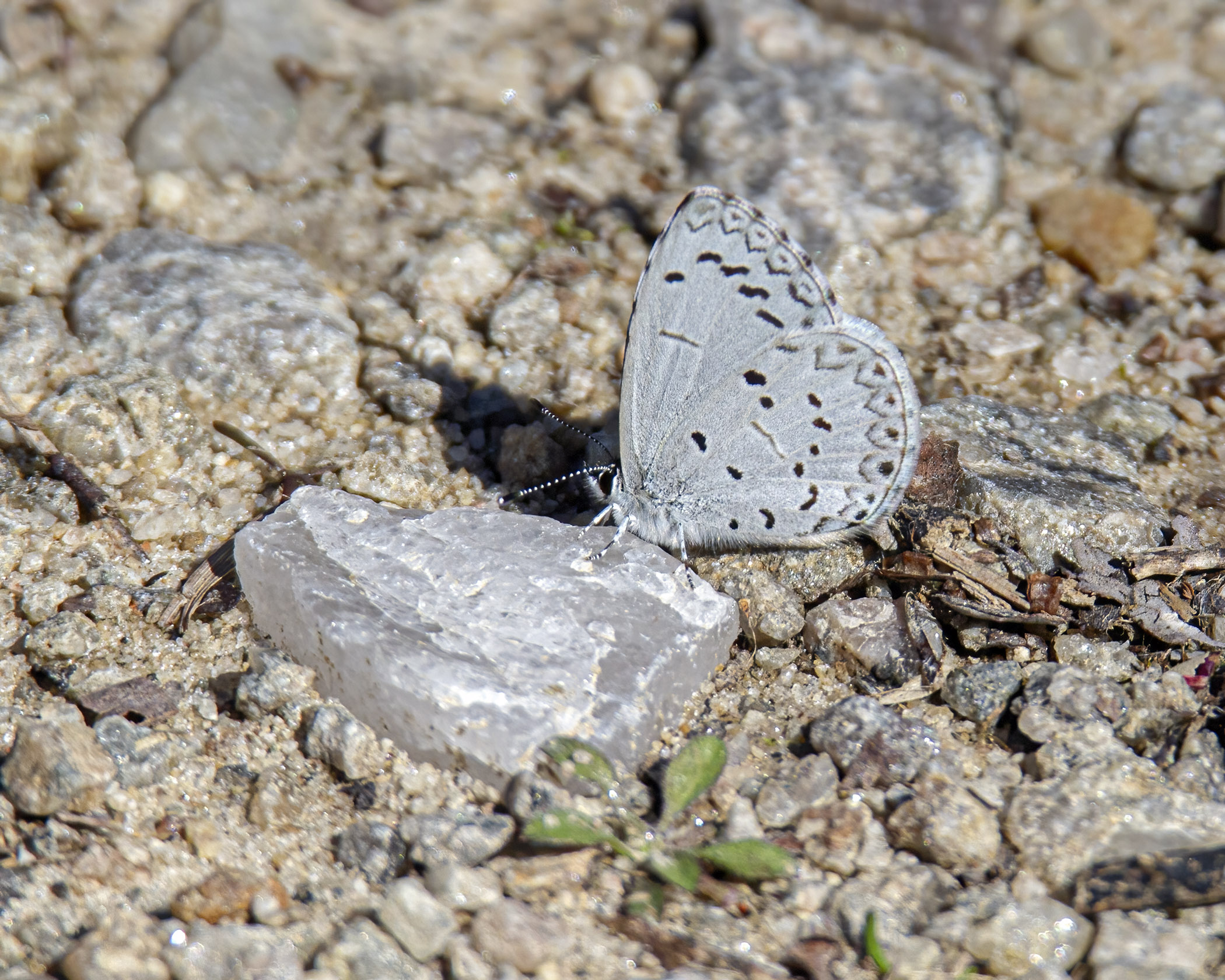
Mourning Cloak butterflies (Nymphalis antiopa) are often one of the first butterflies that I see in early spring, because they overwinter with us as adults in a kind of hibernation. According to Wikipedia, Mourning Cloaks, known in Britain as the Camberwell Beauty, have a lifespan of 11 to 12 months, one of the longest lifespans for any butterfly.

In the springtime, these butterflies mate and I suspect that the butterfly in the photo below that I spotted in early June at Occoquan Bay National Wildlife Refuge is part of the “new generation.” I don’t know a whole lot about the entire life cycle of the Mourning Cloak, but from what I have read, their lives include periods of activity followed by long periods of inactivity. During the summer, for example, they enter into a “dormant” stage, known as aestivation that is somewhat similar to hibernation, and then become active again in the autumn.

I love the markings of this beautiful butterfly and was thrilled when it held its wings open for a few seconds and let me see the stunning blue markings on its inner wings that stand out among the mostly subdued colors on its body.

Mourning Cloak butterfly

© Michael Q. Powell. All rights reserved.

Read Full Post »
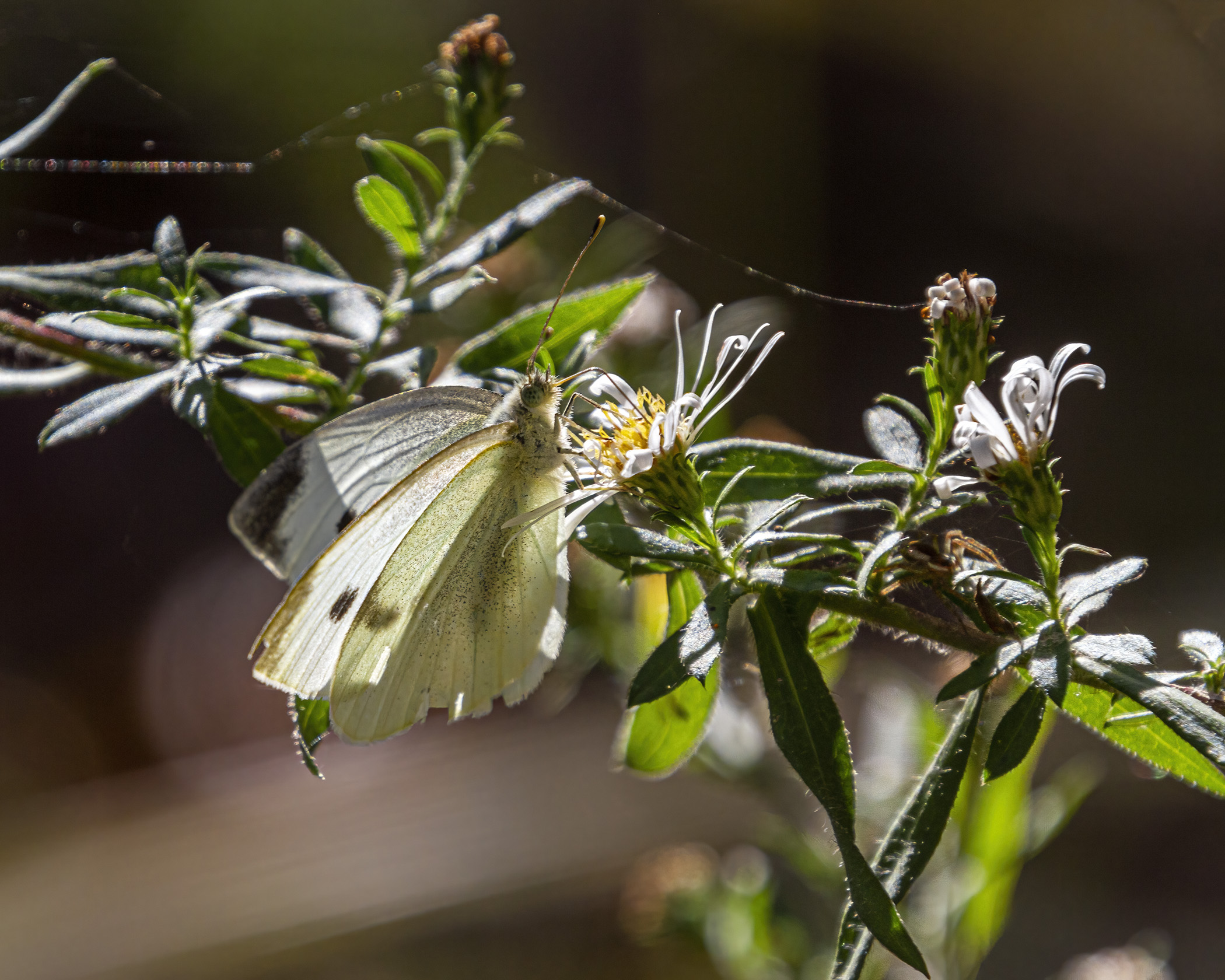
This Zebra Swallowtail butterfly (Eurytides marcellus) had its wings fully extended as it reached for nectar from an unidentified plant last week at Occoquan Bay National Wildlife Refuge. I love the way that the photo below shows the butterfly’s long “tails” that appear to be fully intact, making me wonder if this butterfly had recently emerged.

In my area of Northern Virginia Zebra Swallow tails tend to have at least two broods a year. According to the local Prince William Conservation Alliance, “The summer generation is larger and has proportionally wider stripes and longer tails than the spring generation.”

Zebra Swallowtail

© Michael Q. Powell. All rights reserved.


Read Full Post »

I was excited last week to see a lot of Great Spangled Fritillary butterflies (Speyeria cybele) that appear to have recently emerged at Occoquan Bay National Wildlife Refuge. Great Spangled Fritillaries are large orange-colored butterflies with dark-colored markings on the inner wings and prominent silvery white spots on the underside of the hind wings, i.e. the “spangles” in the name of the species.

Most of the ones that I saw appeared to be feeding on the trails, as you can see in the two photos below, rather than feeding on the nectar of flowers, as I have typically seen them do in the past. Perhaps they need minerals from the ground when they first emerge or were attempting to drink water from the damp soil.

Great Spangled Fritillary

Great Spangled Fritillary

© Michael Q. Powell. All rights reserved.


Read Full Post »

Although it is relatively early in the butterfly season, this beautiful Black Swallowtail (Papilio polyxenes) that I spotted on Wednesday at Occoquan Bay National Wildlife Refuge was already beginning to show signs of the wear and tear of everyday life, with damage to its wings and body and one missing “tail.” I don’t know what caused the damage to the butterfly’s wings, but suspect that it might have been attacks by predators or collisions with thorns or other sharp vegetation.

Black Swallowtail

Black Swallowtail

© Michael Q. Powell. All rights reserved.

Read Full Post »

This Eastern Tiger Swallowtail butterfly (Papilio glaucus) was sipping from a wet area at the edge of a forest creek (and maybe ingesting other nutrients) when I photographed it on 23 April at Prince William Forest Park in Triangle,Virginia. I used to associate this species of butterfly with gardens, because that is where I tended to spot them in the past. However, over the last few years, I have spent a lot of time in the spring in forested areas and have spotted Eastern Tiger Swallowtails regularly there, both individually and in small groups.
Check out my 2021 posting called “A Kaleidoscope of butterflies” to see a photograph of Eastern Tiger Swallowtails “puddling,” i.e. congregating together on wet sand and mud to drink water and extract minerals from puddles.
Eastern Tiger Swallowtail
© Michael Q. Powell. All rights reserved.

Read Full Post »

When this little butterfly flew by me last Friday at Prince William Forest Park, it looked like a nondescript brown moth. Fortunately it landed on some nearby vegetation and I was able to zoom in on it. Wow—what an amazing variety of colors, textures, and markings on this tiny butterfly. I was able to determine that it was a Henry’s Elfin butterfly (Callophrys henrici).

I was pretty sure that I had never seen a butterfly like this until I searched my blog and discovered that I had seen one last spring on almost the same date. I don’t think that I’m losing my memory yet, but I keep filling my head with so much information that it is almost inevitable that I will forget some things.

There is something so whimsical about the word “elfin” that I can’t help but smile whenever I use it. I love the idea of magical creatures like elves and nymphs, drawn from the works of Shakespeare or perhaps from Tolkien’s Lord of the Rings.  These creatures blend in so well with their surroundings that you have to look carefully to spot them and I should warn you that you may become blissfully enchanted by them.

Henry's Elfin

© Michael Q. Powell. All rights reserved.


Read Full Post »
Happy Easter to friends and family who are celebrating today. This past week has been a whirlwind of activity and services for me at my church as we have commemorated Christ’s last days, beginning with his entry into Jerusalem on Palm Sunday, through his last supper, and finally his crucifixion and burial. Today we celebrate Jesus’s triumph over death with a joyous Easter service.

I photographed this beautiful little Pearl Crescent butterfly (Phyciodes tharos) during a recent visit to Occoquan Bay National Wildlife Refuge. Butterflies have always been special for me as symbols of the amazing transformations that can take place in this world, even when the situation seems hopeless and sad.

I offer my prayers for all of you, believers and non-believers alike, that your lives will be full of joy, hope, and peace.

Christ is risen!

Pearl Crescent

© Michael Q. Powell. All rights reserved.

Read Full Post »

I was delighted to spot this Falcate Orangetip butterfly (Anthocharis midea) on 15 April at Occoquan Bay National Wildlife Refuge. The butterfly is somewhat nondescript when its wings are closed, but spectacular when they open, revealing the orange tips for which the species is named.

I encourage you to click on the second image to get a closer look at the beautiful details of this tiny butterfly, including its speckled gray eyes and wonderfully marbled wings.

Falcate Orangetip butterfly

Falcate Orangetip butterfly

© Michael Q. Powell. All rights reserved.

Read Full Post »
I was absolutely thrilled last week to spot this Zebra Swallowtail butterfly (Eurytides marcellus) at Occoquan Bay National Wildlife Refuge. Zebra Swallowtails overwinter winter in the chrysalis (cocoon) stage before emerging as adult butterflies in the spring. A second brood is born later in the year and they are the ones that lay the eggs that develop into the caterpillars that will enter into cocoons and hibernate throughout the winter.

I love the beautiful colors of this butterfly, with its zebra-like stripes and pops of red and blue—I often think of the Zebra Swallowtail as a “patriotic” butterfly, because of its red, white, and blur coloration..

Zebra Swallowtail

© Michael Q. Powell. All rights reserved.


Read Full Post »

Older Posts »