Feeds:
Posts
Comments

Archive for the ‘Bugs’ Category

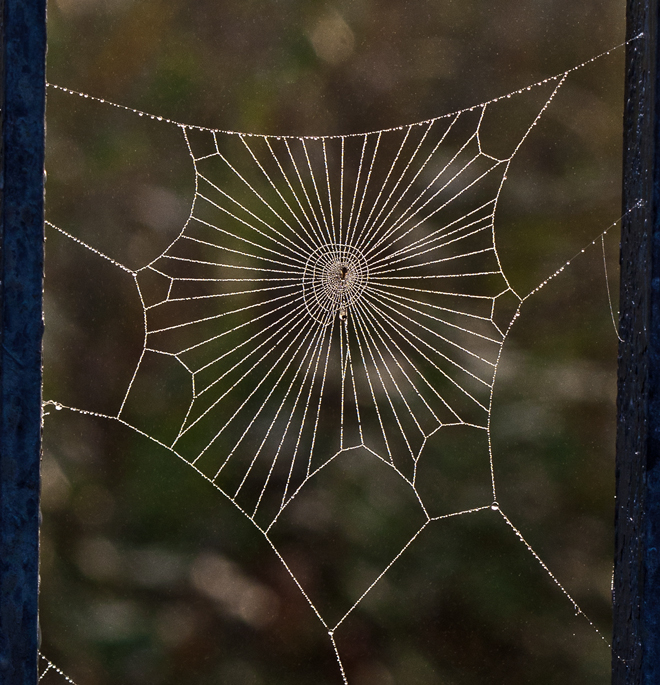
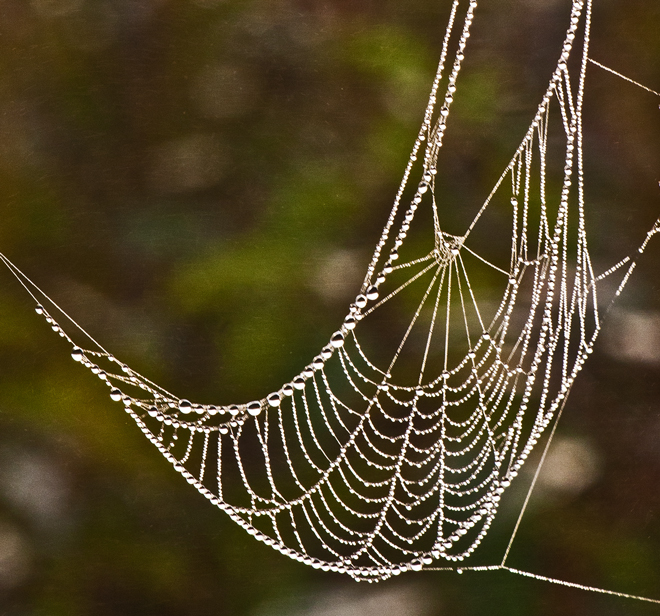
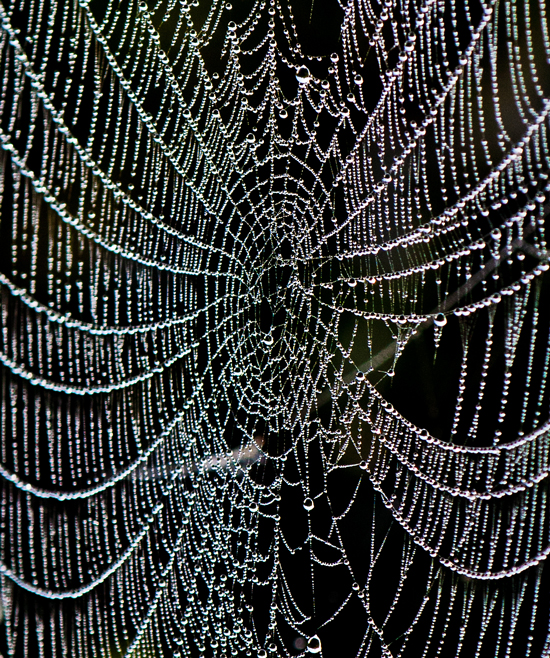
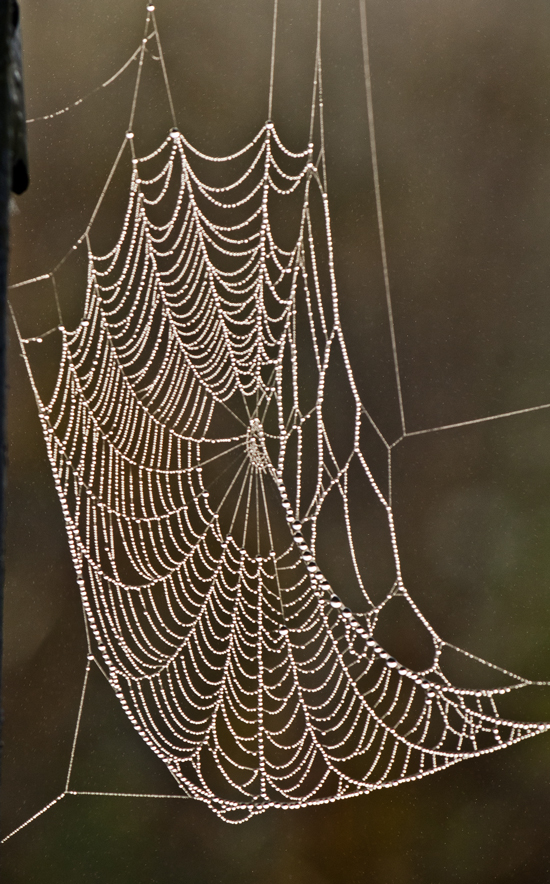
I’ve already posted some photos of spider webs from last Friday morning when I visited Huntley Meadows Park. When I looked over the photos again today, however, I realized I have some more pretty good ones. Once again I am struck by the complexity and the diversity of the webs. Some have primarily straight lines and others have mostly curves. Some are large and intricate, others are smaller and simpler.

All of them are breathtakingly beautiful to me.

A view from a jail cell (not really, but it almost looks like that)

An unusually-shaped spider web

An incomplete spider web

Scallop-curved web

© Michael Q. Powell. All rights reserved.

Read Full Post »

Yesterday morning I was out early with my camera and managed to capture photos of some amazing spider webs at Huntley Meadows Park. There was moisture in the air, so some of them have beautiful droplets of water. All of them, though, are incredible in their geometric complexity, in the skill of the craftsmanship, and in their individuality.

Spiders webs are incredible.

Circular spider web

Spider web between two railings

Spider web with dew

© Michael Q. Powell. All rights reserved.

Read Full Post »

As I was going through some photos this morning I realized that I have a lot of photos of the Yellow Garden Orbweaver spider (Argiope aurantia). I have posted quite a few photos, but most have shown the spider with a prey. I came across an image of the spider by herself and started playing with it in Photoshop Elements. This first image is the result of my experimentation—it is cropped and rotated and focuses on only part of the subject. I think it is a little more dramatic thank the original image. (You can get a higher resolution view of all of the images if you click on them.)

Creeping spider

You can see below the original image after a minor crop. I remember when I took the shot that I had to twist my body around to get the desired angle of view of the spider in the center of her web, waiting patiently for prey. This morning I initially liked the image a lot and was going to post it, but then decided to rotate it 90 degrees to see what it looked like.

Side view of spider

After the rotation, it looked like the image below. It seems to me that by simply shifting the plane of view, the spider appears like more of a predator, like she is more aggressively stalking her prey rather than waiting for it to arrive. I keep going back and forth in trying to decided if I like this image more than the cropped image that I started with. What do you think? Which of the three images do you like most?

Creeping spider (full body)

© Michael Q. Powell. All rights reserved.

Read Full Post »

I’m amazed at the size and intricacy of the webs of the Yellow Garden Orbweaver spiders (Argiope aurantia) whenever I see them at Huntley Meadows Park here in Alexandria, VA. This past weekend I had a chance to see how effective these webs are when a bee flew into the web of a spider that I was observing.

Previously I posted some photos of these spider with prey (a grasshopper and a cicada) that had been captured earlier and wrapped up in silk, but I didn’t really understand how the spider accomplished this. In this case, as soon as the bee touched the web, the spider moved quickly from the center of the web and in a few seconds had wrapped up its newest victim. I was so fascinated by what was happening in front of my eyes that my reaction time was delayed and I missed photographing those initial actions. However, I stayed and observed (and photographed) the spider’s subsequent actions.

The first photo below shows the spider as she is wrapping up the wrapping up of the bee. It’s a little hard to believe that the long package is just a bee, but I’m pretty sure that’s all that there is inside. (With all three photos, you can click on them and get a somewhat higher resolution view.) After the bee had finished, she left the package at the periphery of the web and returned to the center of the web, where she usually resides, probably hoping for another victim.

After several minutes wait, she returned to the bee and and began to transport it to the center of the web. In the photo below, you can see how she held the wrapped-up bee with some of her legs as she crawled along the strands of the web. The zigzag portion of the web is part of the path that leads to the center.

Once she was back in the center, it looks like she was preparing to eat her newly captured meal. I really like the varied positions of her legs in this photo as she holds on to her prey.

You may have noticed the blurry contours of another, smaller spider in the upper portion of the final photo. There were two small spiders hanging around the web and they seemed to be fighting with one another. I tried to capture that dynamic and will post a photo if I find one that is clear enough. I suspect that one of them may have been the mate of the female spider. Bugguide notes that the male of this species is considerably smaller than the female. Not counting legs, the male is usually 5-6 mm in size and the female is 14-25mm. I am not sure who the “other guy” was. Maybe he’s another male competing for the affections of this “lovely” lady. Any ideas?

© Michael Q. Powell. All rights reserved.

Read Full Post »

I have become hyper-attentive now when I walk through gardens, woods, and marshes. I have started to slow down and am more aware of my surroundings. A few months ago, for example, I would not have noticed this grasshopper climbing up the stalk of a plant. Now I can look with wonder at yet another fascinating creature, and my life is enriched by the experience.

Climbing Grasshopper

© Michael Q. Powell. All rights reserved.

Read Full Post »

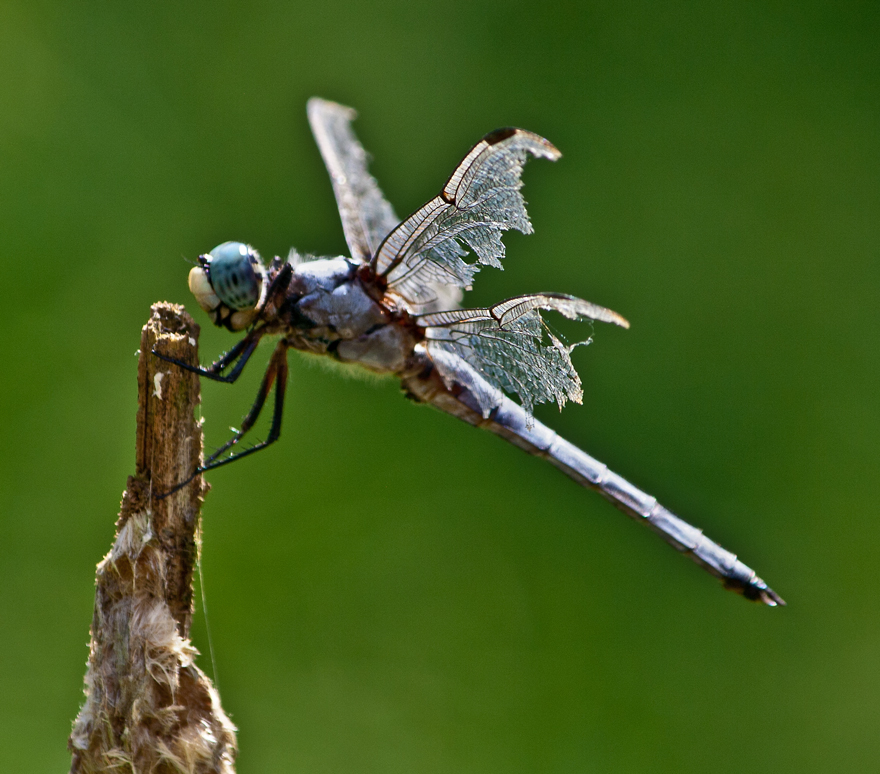
I don’t know if this Blue Dasher dragonfly is long in the tooth (do dragonflies have teeth?) or has simply had a tough life. How do you tell the age of a dragonfly? In any case, his wings are tattered and torn to such a degree that it is surprising that he can still fly. Yet I seem to detect a smile on his face, a reflection of contentment. (Yes, I know, I am guilty of anthropomorphism.)

Tattered wings,but still able to fly

I have been thinking about aging ever since Sunday when I read a wonderful column in the Washington Post by John Kelly entitled “You can learn a lot about growing old from a dog.” Kelly describes how the accelerated aging process of his dog has made him more conscious of the fact that he too is growing old. I recommend the article to all, but want to highlight the final paragraph of the column. Kelly concludes:

“Aging is unknown territory for each of us, despite the fact that humans have been doing it forever. I think there are worse ways to spend your final years than napping next to someone you love, dreaming of what was and what still might be.”

I doubt that this dragonfly will end his final days in peace and contentment like Kelly’s dog, but it is my fervent hope that we can accept the infirmities of growing old with grace and patience, and can focus—as this dragonfly appears to be doing—on the things that we are still able to do, on contributions that can make this world a better place.

© Michael Q. Powell. All rights reserved.

Read Full Post »

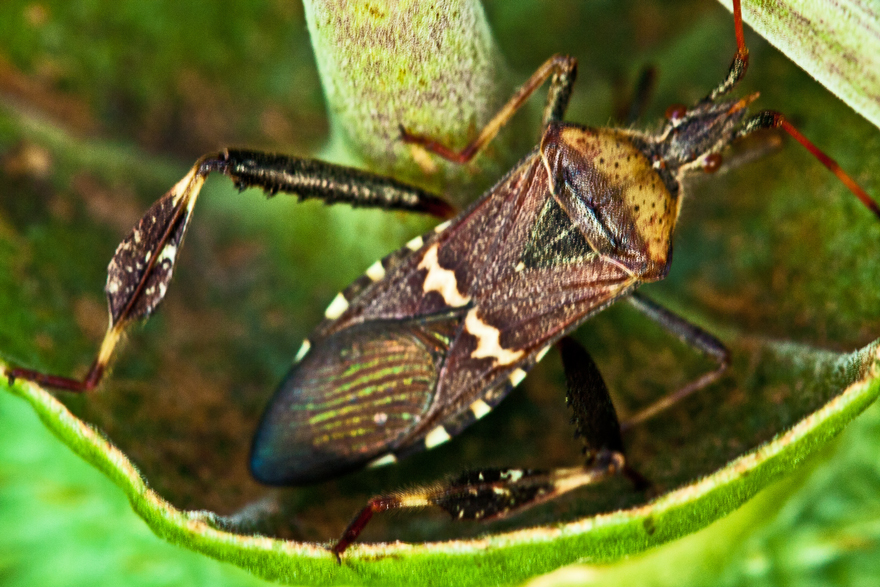
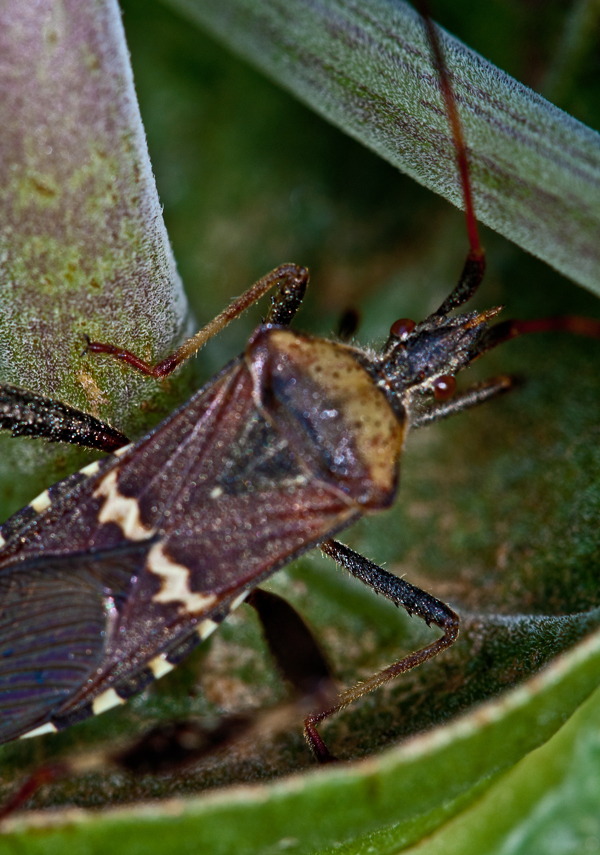
I was getting ready to wrap up my brief photo shoot at a local garden this afternoon when I happened to spot this interesting looking insect. Fortunately I had my macro lens on my camera and I had my tripod as well. I maneuvered as well as I could to frame the first shot and this is how I composed the image in the camera. I did a few tweaks in Photoshop Elements but did not crop at all. I cropped the second image slightly as I tried to move in a little closer. The eyes are in better focus, but I lost the sharper focus on the body.

I hope to figure out eventually what kind of insect he is, but for the moment I like the way the photos turned out.

UPDATE: Thanks to Jeremy Sell’s identification skills, I am pretty confident this is a Western Leaf-Footed Bug (Leptoglossus clypealis). Check out his blog at thelifeofyourtime.wordpress.com.

© Michael Q. Powell. All rights reserved.

Read Full Post »

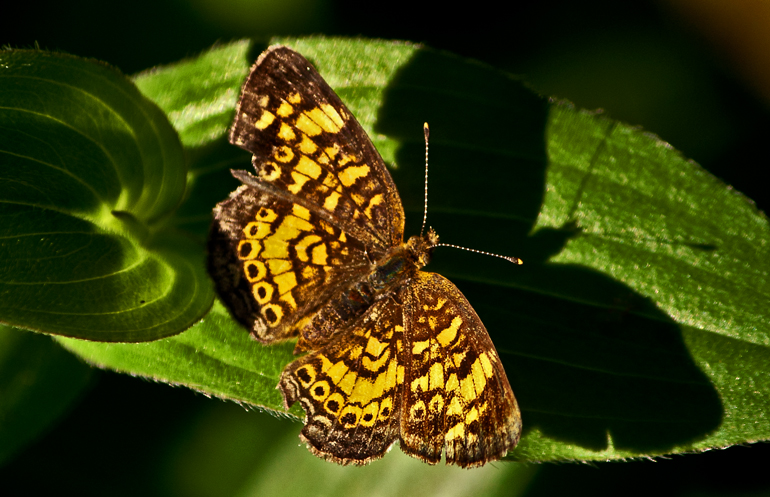
The sunlight was pretty bright late this afternoon, casting dark shadows everywhere, and I was not at all confident that I would get any decent shots. A butterfly flew into view in a partially shaded area, where he perched on a leaf. He was pretty cooperative as he kept his wings open as I made a few adjustments to my camera.

I like the interplay of light and shadows in the image below, even if the colors are somewhat muted and some of the highlights are a little blown out. I probably should admit that I love shadows almost all of the time—me and my shadows.

Butterfly shadow (click for higher resolution)

© Michael Q. Powell. All rights reserved.

Read Full Post »

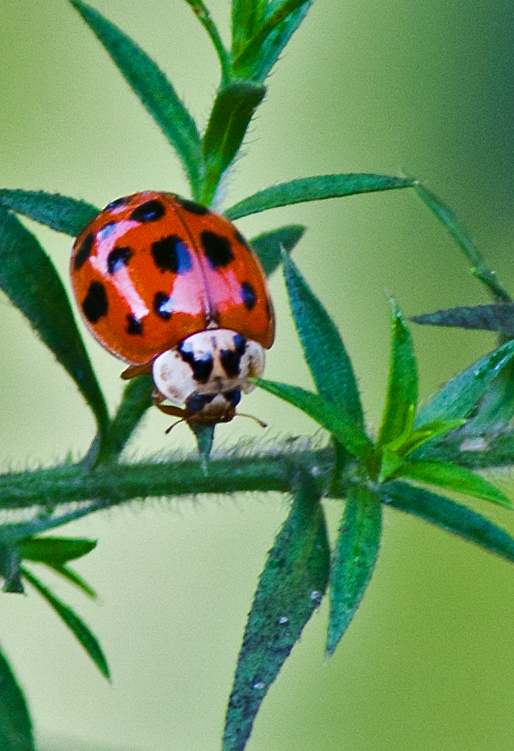
There is something about a ladybug that makes me smile. I don’t know if ladybugs trigger happy memories of my childhood, or if the bold patterns and bright colors simply appeal to my aesthetic sensibility. All I know is that I am happy when I encounter them and I am thrilled when I manage to capture their beauty in an image.

My photography mentor, Cindy Dyer, used to comment that a photo expedition was not a success for me if it did not include ladybug shots. By that modest standard, my photo shoot on Friday afternoon—just hours after a 8-hour transatlantic flight—was a definite success.

Sunday Lady

© Michael Q. Powell. All rights reserved.

Read Full Post »

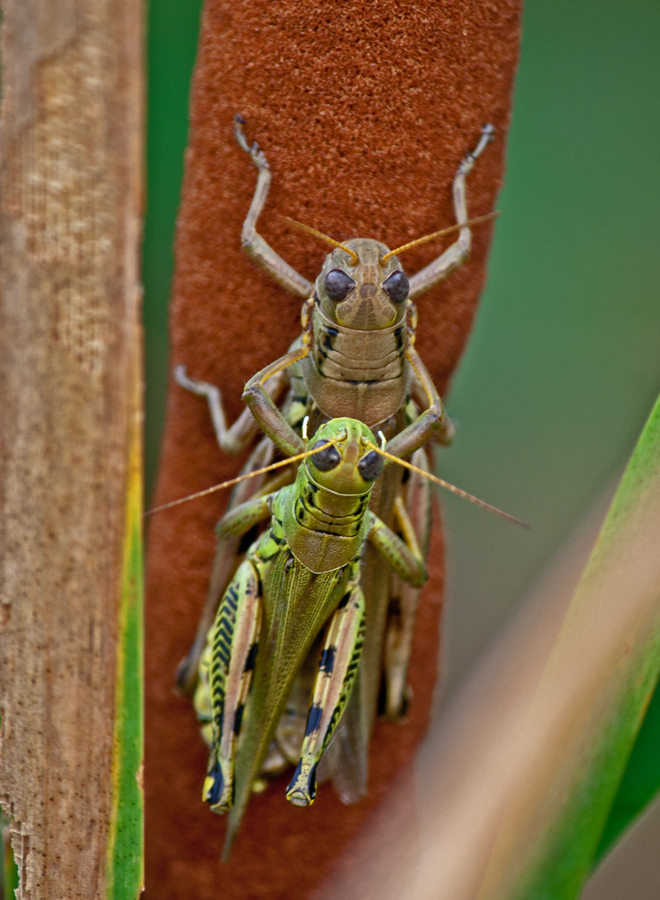
This morning as I was walking through the marsh area of Huntley Meadows Park, I happened to catch sight of this pair of grasshoppers. With any other kind of vegetation the grasshoppers would have been camouflaged, but that was certainly not the case against the backdrop of a cattail.

I was struck by the differentiation in color between the male and the female—it reminded me of my time in the Army, when there were different camouflage patterns for woodlands and for the desert.

Mating grasshoppers

© Michael Q. Powell. All rights reserved.

Read Full Post »

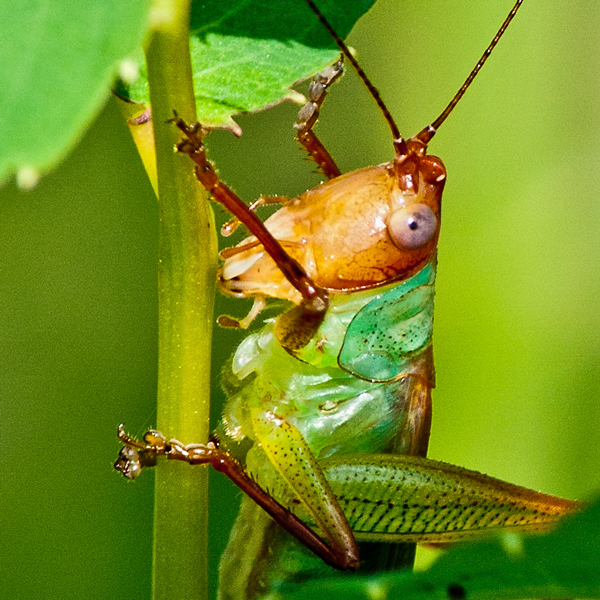
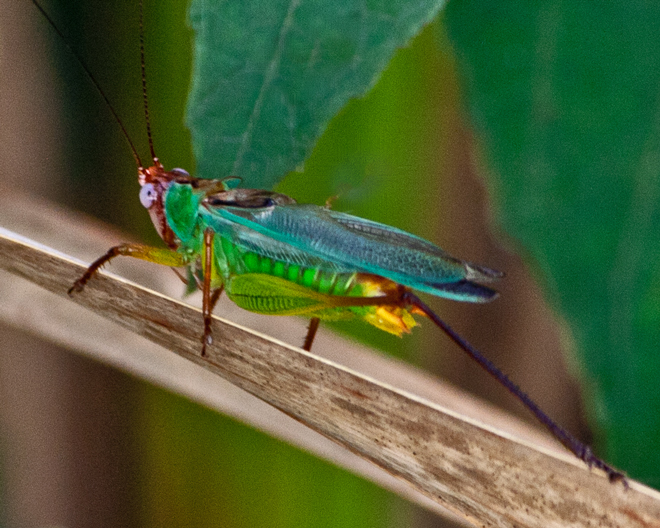
Early this morning I went out with my camera and I was happy to spot again the very colorful grasshoppers known as Handsome Meadow Katydids (Orchelimum pulchellum). As was the case the first time I spotted these neon-colored insects, I was at Huntley Meadows Parks in Alexandria, VA. I had a little trouble getting clear shots of the entire bodies of the katydids, but I managed to capture some good close-up shots of their faces. I especially like the first shot, taken looking down at him as he was munching on a leaf.

I continue to be amazed at the katydid’s vivid colors and blue eyes. Wow!

Handsome Meadow Katydid Munching on a Leaf

Close-up Shot of Handsome Meadow Katydid

Body Shot of Handsome Meadow Katydid

© Michael Q. Powell. All rights reserved.

Read Full Post »

It felt good to have my Canon DSLR back in my hands after a week-long trip with only a point-and-shoot camera. After I arrived home from the airport this afternoon, I grabbed my camera and headed off to Green Spring Gardens, a local garden that is one of my favorite places to shoot.

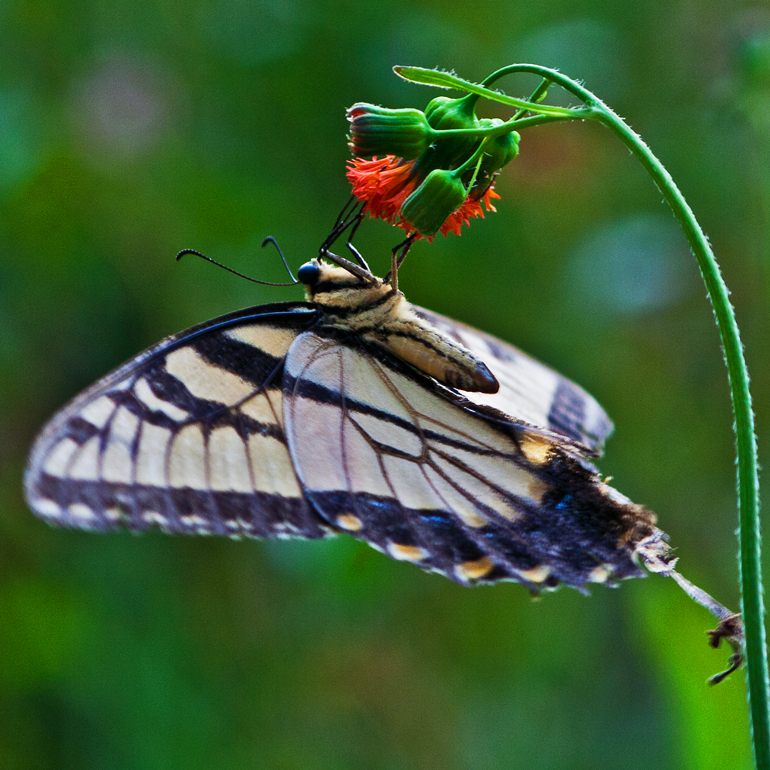
There were only some diehard flowers blooming, but there were quite a number of Eastern Swallowtail butterflies. I watched (and chased) several of them, but the one you see below was my favorite. He attacked this flower from below repeatedly, seemingly defying gravity. It just was not clear to me how he was able to suspend himself in mid-air like that. He must have been hanging on with his feet, though he seemed to be moving them constantly.

Eastern Tiger Swallowtail butterfly defying gravity

© Michael Q. Powell. All rights reserved.

Read Full Post »

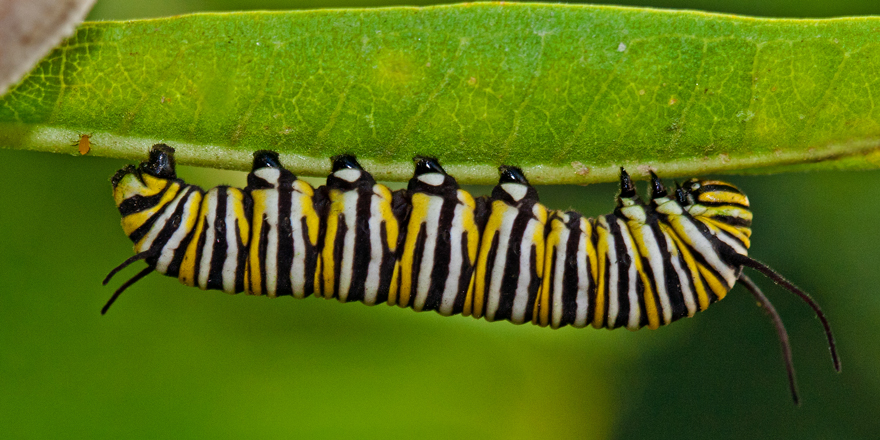
The day before I left for my recent trip I managed to get some photos of Monarch caterpillars with my macro lens. It was the first time that I had seen them live. Not surprisingly they were on milkweed plants and seemed to be chomping away with great appetite. I noted too that some of the milkweed plants were full of aphids (and some of them had lots of ladybugs too). I checked a number of sources on-line and they all suggest that the aphids are not directly harmful to the Monarch caterpillars during the two-week stage when they are caterpillars. I looked around today to see if I could see any chrysalis, the next stage of development, or more caterpillars, but found neither. I’ll keep looking!

Monarch caterpillar (click to see more details)

© Michael Q. Powell. All rights reserved.

Read Full Post »

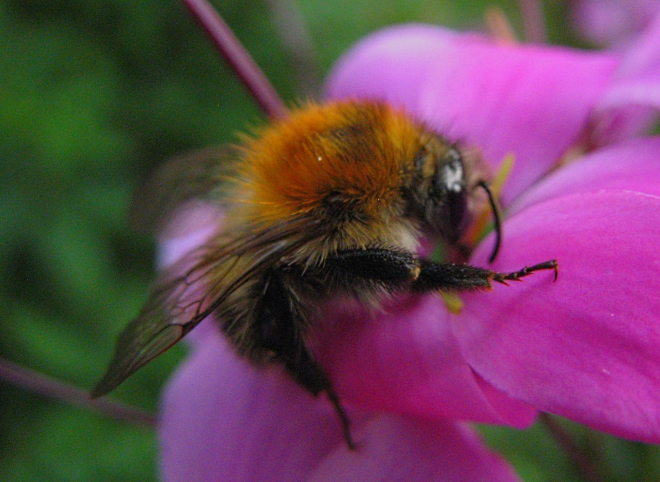
This bee is not as perfectly sharp as some that I have shot, but the softness of the image and the pink flower give this photo more of a romantic mood (if that is at all possible with a bee as the primary subject). I also like the beautiful colors in the bee’s fuzzy hair. Sometimes I feel like I would be content to photograph different kinds of bees every day, focusing at times on their hard work, at other times on their beauty, and at other times on their ferocity. It would take a long time for my fascination with bees to wear off.

Bee on a pink flower

© Michael Q. Powell. All rights reserved.

Read Full Post »

Just a few days after posting a photo of a neon-colored grasshopper (who turned out to a Handsome Meadow Katydid), I saw another one. Well, actually I encountered a giant sign for a toy store featuring a cool grasshopper that looked a lot like “my” grasshopper.

How many passers-by realize that there is an actual grasshopper with colors as bright (or even brighter) than the one on the sign?

© Michael Q. Powell. All rights reserved.

Read Full Post »

I am out of town at the moment and took along my Canon PowerShot A620, a somewhat glorified point-and-shoot camera. I had used this before for travel photos, but had never tried out the macro features of the camera. The manual claims that in macro mode you can get as close as 1 cm (.4 inches).

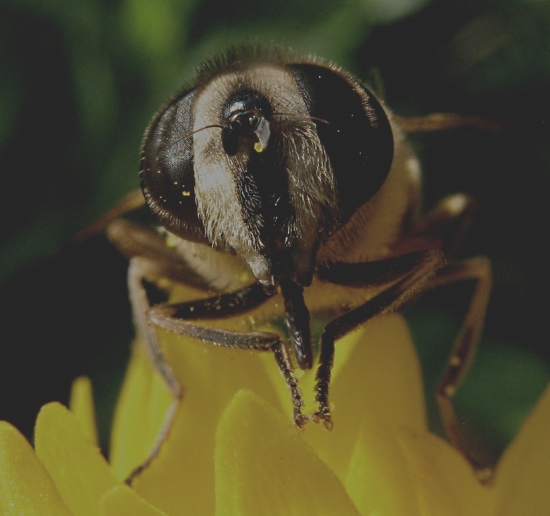
I decided to play around with macro on this camera by taking some shots of bees, one of my favorite subjects. The first photo is one of a bee taken straight on and I am surprised that I got the detail that I did. The other shots are pretty good as well. I would note that I had to get really close to the bees to get these shots. I also am feeling a little hamstrung, because I am producing these images on a netbook computer with somewhat limited capabilities and I am using Paint.Net to manipulate the images rather than PhotoShop or PhotoShop Elements.

Eye-to-eye with a bee

© Michael Q. Powell. All rights reserved.

Read Full Post »

This morning as I was walking along the boardwalk that runs through the marsh in Huntley Meadows Park, I happened to glance down into the muddy water and was surprised to see something that looked like a cross between a starfish and a spider. I always though that spiders lived in trees and on other types of vegetation, but today I learned that there are also spiders that hunt for their prey in the water.

This spider is from the Dolomedes family, probably a six-spotted fishing spider (Dolomedes triton). According to the Wikipedia article, they are often seen with their legs sprawled out by the water while they are waiting for prey (which is what this one seems to be doing). They eat other invertebrates, tadpoles and occasionally small fish (and the female may also eat male fishing spiders if she has already mated). According to fcps.edu, these spiders can walk on the surface water and can stay underwater for 30 minutes. Not surprisingly, they don’t make webs.

This has been quite the day for unusual insects, beginning with a neon-colored grasshopper and ending with a fishing spider. I can’t wait to see what’s next.

Fishing Spider Waiting for Prey (click for higher resolution)

© Michael Q. Powell. All rights reserved.

Read Full Post »

I just got back from shooting and couldn’t wait to post a photo of one of the coolest looking insects that I have ever seen. It appears to be be part of the grasshopper family, but its bright colors and blue eyes really made it stand out as I was walking through the marsh at Huntley Meadows Park this morning. I’m sure I’ll be able to identify him eventually, but want to share him now. Sometimes folks need a little extra pick-me-up on Fridays.

UPDATE: I am pretty sure he is a Handsome Meadow Katydid (Orchelimum pulchellum). I found a photo in BugGuide that looks quite a bit like this one.

© Michael Q. Powell. All rights reserved.

Read Full Post »

I was going through my recent dragonfly photos and this one really caught my eye. Somehow the combination of the dragonfly’s position and the long branch with the slight curve together made me think of a pole vaulter just before he clears the bar. It’s a little unusual that I photograph a dragonfly from below with the sky as a backdrop, but that’s what happened that day.

Maybe he’s preparing for the Dragonfly Olympics! What other events do you think they would have? I’m pretty sure they’d have gymnastics, given the frequency with which I see dragonflies do handstands.

Pole-vaulting dragonfly

© Michael Q. Powell. All rights reserved.

Read Full Post »

A few days ago I posted a photo of a Yellow Garden Orbweaver (Argiope aurantia) that I photographed at Huntley Meadows Park in Alexandria, VA. I was strangely attracted to those spiders and returned the next day to see if I could get a few more shots.

Here is one of my favorite shots from that day. The spider looks to be gnawing on the leg of a grasshopper that has been wrapped up and seems to be a little dried out. The grasshopper actually looks like he has been battered and deep-fried, but that seems to be a bit over the top, even for a Southern spider. You can also see a little of the zigzag pattern of the web at the bottom of the photo that is typical of the webs of this kind of orbweaver.

Yellow Garden Orbweaver Spider and Grasshopper (click on the photo to see more details)

© Michael Q. Powell. All rights reserved.

Read Full Post »

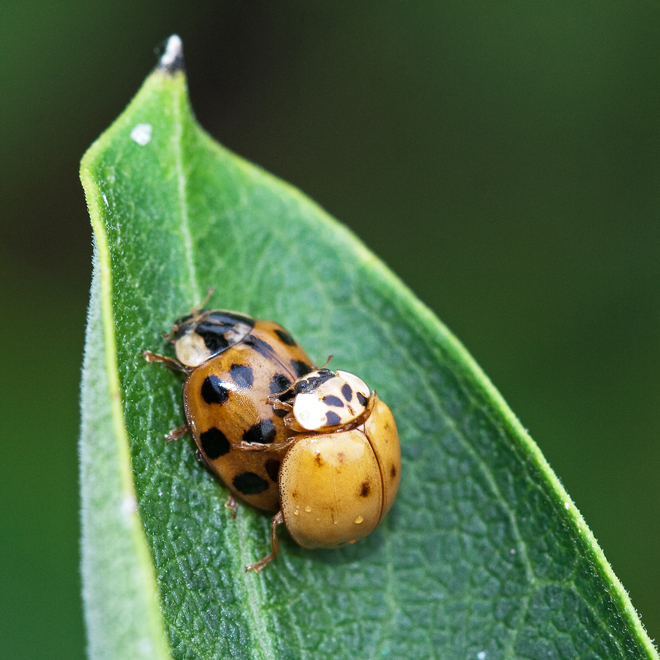
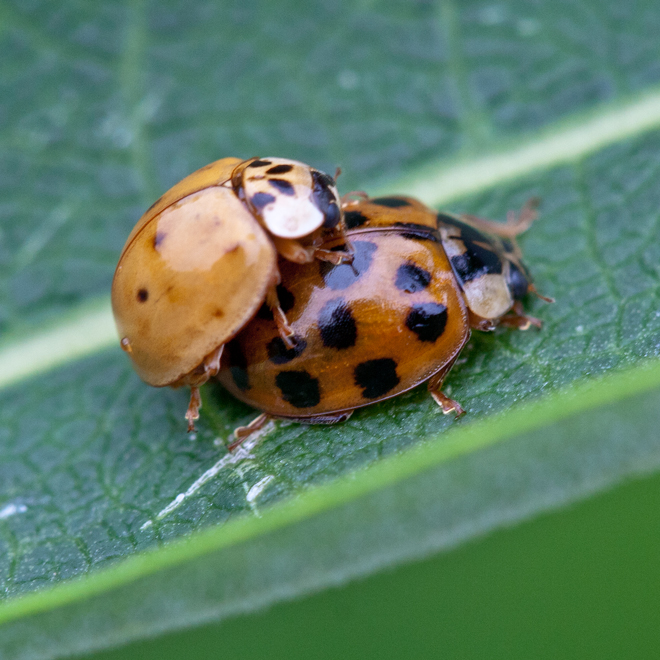
Last week when I was at a local garden I came across several pairs of ladybugs mating and several things really stood out to me.

First, the male ladybug is a lot smaller than the female. An article at ladybuglady.com (a great name for a website) points out that females are “usually” larger than males, but essentially it’s almost impossible for the average person to tell them apart until they are mating. If you really want to know how to tell male ladybugs from females the referenced article has photos from an electron microscope with detailed explanations.

The other thing that was obvious was the difference in color and spots between the two. The male is a medium orange with a few small light black spots and the female is a deeper shade of red with larger, darker spots. Wikipedia notes that there are more than 5,000 species of ladybugs (which technically are beetles and not bugs), with more than 450 native to North America. According to that article, the number, shape, and size of the spots is dependent on the species of ladybug. Does that mean these two ladybugs are different species?

Bugguide has some interesting factoids about names used elsewhere in the world for the ladybug. For example, “Ladybird” was first used in medieval England, perhaps because these beneficial predators of agricultural pests were believed to be a gift from the Virgin Mary—the “Lady.” Other European names have similar associations, such as the German Marienkäfer, “Marybeetle.” (Thanks to Gary for pointing out the correct spelling in German—I inserted the Umlaut to make it correct.)

So I am left wondering, will the little ladybugs that result from this coupling look more like mom or like dad?

© Michael Q. Powell. All rights reserved.

Read Full Post »

I took this photo on an Eastern Amberwing dragonfly (Perithemis tenera)) about a week ago when I was shooting at Green Spring Gardens in Alexandria, VA with my good friend and photographic mentor, Cindy Dyer.

Cindy is always encouraging me to upgrade my photograph equipment. For comparison purposes, she put the Nikon D300 that she was using into my hands and had me shoot with  it for a few minutes. It was equipped with a Tamron 180mm macro lens that gave it a pretty impressive reach for the dragonflies that we were shooting. It’s interesting that I was able to use my Compact Flash memory card, which was formatted in my Canon, in her Nikon and the Canon photos and the Nikon photos peacefully coexisted in separate folders on the memory card.

I was especially happy that I got a decent shot of the Eastern Amberwing dragonfly. This type of dragonfly is very beautiful, but it’s very small and elusive. BugGuide notes that this dragonfly is normally about 21-24mm long (in case you’ve forgotten, 25.4mm is equal to an inch).

I’m probably going to remain a Canon guy, but I can definitely hear the Siren call of that 180mm macro lens, which comes in a Canon version too.

Eastern Amberwing dragonfly

© Michael Q. Powell. All rights reserved.

Read Full Post »

This past weekend when I was out taking photos I was startled when I heard the very loud “singing” of a cicada really close to me. I glanced down and could see the cicada right in front of me, clutching a plant and visibly vibrating. I managed to get this shot of the cicada.

Cicada singing

I decided to do a little research on the cicada because I really don’t know much about them, except for the panic we had a few years ago when the 17-year cicadas were here. In the Wikipedia article, I learned about the different types of cicadas and how they produce the noise that is associated with them that can go up to 120 decibels, among the loudest of all insect-produced sounds.

One of the most interesting statements for me in the article was that, “The cicada has represented insouciance since classical antiquity” and referred to a fable by Jean de La Fontaine. Why was this interesting to me? I love words and it’s fun to read words like “insouciance,” a word with which many people probably are not familiar. It comes from the French word for “care”or “concern” (souci) and “insouciance” usually refers to a carefree, light-hearted, nonchalant attitude.

Did I mention that I was a French literature major in college more than 35 years ago? In college I really liked the French classical literature of the 17th century and Jean de La Fontaine was a very well-known poet and fabulist of that period. (Now tell me, how often do you get to use the word “fabulist” (someone who writes fables)? “Fabulist”—it sounds like it should be something that you’d find in People magazine to know how a celebrity rates in being fabulous.)

I went looking for de La Fontaine’s fable about the cicada to learn more of its reputation for being insouciant. There are a lot of different translations from French into English of the short fable, but I decided to do my own translation to avoid copyright issues and to exercise my French skills.

Here is my translation of La Fontaine’s fable called the “La Cigale et la Fourmi” (“The Cicada and the Ant”).

“The cicada, having sung the entire summer,
Found herself strongly in need when the north wind blew,
Possessing not a single morsel of fly or worm.
She went to her neighbor, Madame Ant, to tell of her need,
Asking her to lend some grain so she could survive until the new season.
“I will pay you interest and principal before the harvest, animal’s oath,” she said to her.

Madame Ant, however, is not a lender, which is the least of her faults.
“What were you doing during the hot weather?” she asked the borrower.
—Night and day I sang to all those coming by, whether that pleases you or not.
—You were singing? I am so glad.
Well, dance now.”

We could have a fascinating intellectual discussion about the meaning of the fable, but I’ll leave that for another time. While I was doing research about the fable, I came across a really cool video of the fable on YouTube that was produced by Studio YBM. It’s a cartoon and is in French, but if you’ve read the fable it’s easy to follow. I don’t want to spoil the video for you, but I encourage everyone to watch it to see insects in snowsuits and hear the cicada performing as a hip-hop singer.

So, where do you see yourself in the fable? Are you more like the ants or the cicada? Are you insouciant or are you more like Madame Ant?

© Michael Q. Powell. All rights reserved.

Read Full Post »

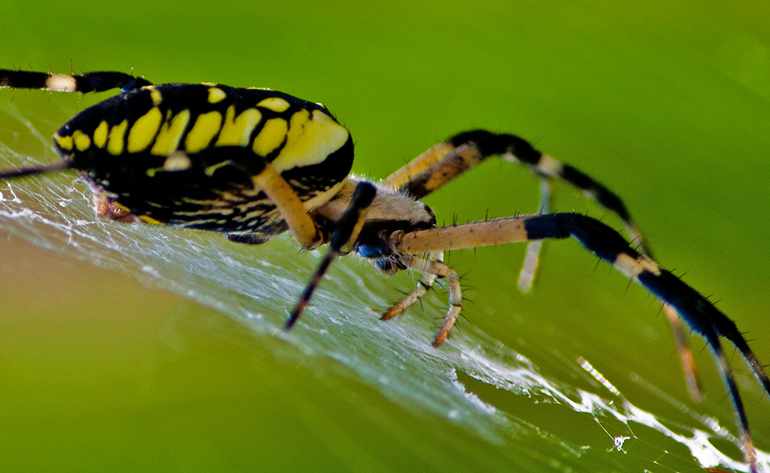
This weekend a fellow photographer (Christy T.) pointed out some really interesting looking spiders while we were at Huntley Meadows Park in Alexandria, VA. They were very colorful and big (at least they seemed really big, especially when looking through a telephoto lens). I had walked by the area where they were located (and there were probably at least ten of them), but had not noticed them until she prompted me to look more closely.

The spider (Argiope aurantia) goes by many different names including Black and Yellow Argiope, Yellow Garden Orbweaver, Writing Spider, and Yellow Garden Spider, according to BugGuide. These spiders had large webs with a very distinctive zigzag pattern in the center, which I learned from Wikipedia is called a stabilimentum. (I’m still going through my shots from yesterday when I returned to visit the spiders and may post a shot showing the zigzag pattern in a later post). Nobody seems to know for sure why they make that zigzag pattern, perhaps for camouflage or to attract prey.

One of the other really cool things about this spider is that it oscillates the web really vigorously when it feels threatened. My fellow photographer demonstrated this when she touched a web with a tripod’s leg (she did not want to get any closer). It was amazing to see the elasticity of the web as the spider moved—it reminded me of a slingshot being pulled back.

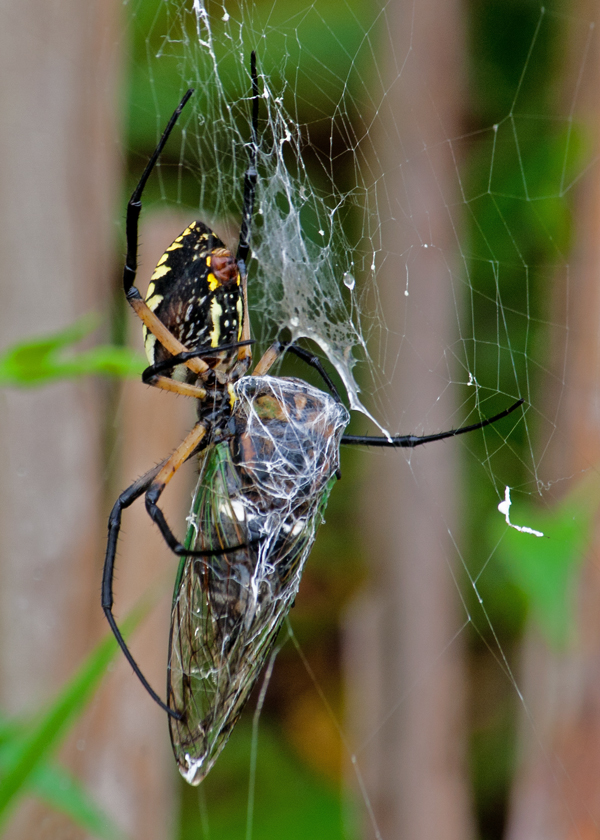
These spiders seem to catch some pretty big prey. There were grasshoppers in some of the webs and in the photo below the spider has captured a cicada. The Wikipedia article notes that the spider kills the prey by injecting its venom and then wraps it in a cocoon of silk for later consumption (typically 1–4 hours later). I think the spider in the photo may be in the process of wrapping up the cicada.

I continue to be amazed by the fascinating things that are in front of me that I have never seen before. It’s clear to me that my photographic journey is causing me to see the world differently, more attentively. That’s a good thing.

© Michael Q. Powell. All rights reserved.

Read Full Post »
Who knew that the spots on a ladybug’s shell were water-soluble? That seems to be the case with this ladybug, who has only one remaining spot and a few drops of water, perhaps where other spots used to be.

Spotless ladybug–well almost spotless

© Michael Q. Powell. All rights reserved.

Read Full Post »
I love the graphic black-and-white pattern on this caterpillar that I photographed yesterday at Huntley Meadows Park in Alexandria, VA. The monochromatic pattern is wonderfully accented by the orange tufts with long white bristles. In this case, I am not too concerned about identifying this caterpillar—I am simply enjoying its colors, textures, and patterns.

© Michael Q. Powell. All rights reserved.

Read Full Post »
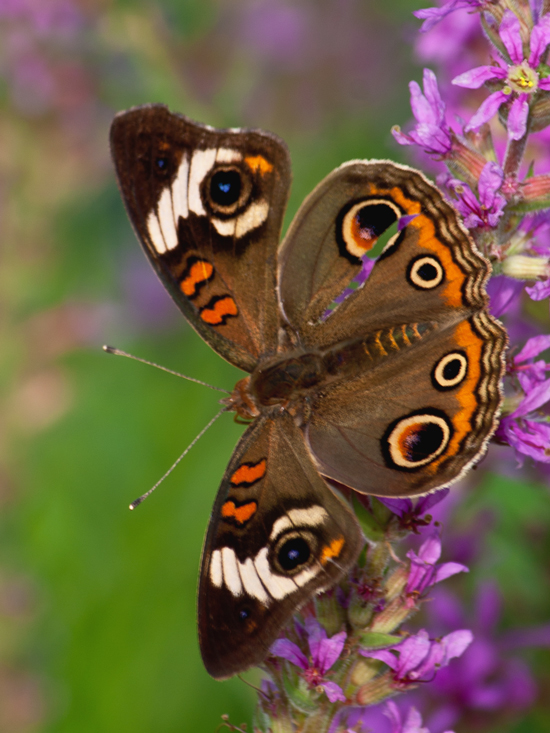
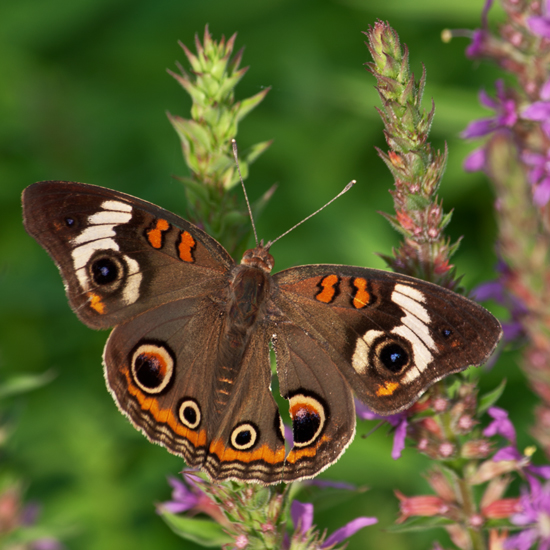
I continue to be mystified by the names of the insects that I photograph. Yesterday I spotted this very striking butterfly that I later learned is called the Common Buckeye butterfly (Junonia coenia).  What makes it common? If it’s so common, why have I never seen one before? The vivid colors and prominent eyespots make it anything but common to me.

Common Buckeye butterfly

Here’s another view of the butterfly. The internal tear in the wing makes it clear that it is the same specimen. If you want to learn more about the Common Buckeye, check out this article on the BugGuide website, which is rapidly becoming one of my favorite places to browse and research.

Common Buckeye butterfly

One interesting fact about the Common Buckeye is that it was featured on a 24-cent US postage stamp in 2006. If you want to see what the stamp looks like, visit the Arago website. Arago, named after François Arago, a 19th century French scientist and friend of James Smithson, is a resource of the Smithsonian National Postal Museum.

One of the nice things about living in the Washington, D.C. area is having access to the Smithsonian Museums, most of which have free admission.

© Michael Q. Powell. All rights reserved.

Read Full Post »

I remember my excitement the first time I saw a really cool dragonfly a few months ago that turned out to be a Halloween Pennant dragonfly (Celithemis eponina). He had a very distinctive look with brown spots and stripes on his wings and orange veins. That first time I was happy to get any shot of the dragonfly.

Today I think that I encountered a Halloween Pennant for a second time. I was still very much taken by his looks but I had the presence of mind to circle about a bit, trying to get a good angle for the shot. The shot below is the one that I like the best of those that I took.

As I think about it, I go through this cycle a lot. I’m so in awe and wonder when I encounter something new that photography is not my first priority. Instead I am living the experience. Maybe my photos the first time are not the best, but that’s ok for me, because living my life is more important than merely recording it in my photos. That may be why I like to go back to places a second time and then focus a bit more on getting good shots.

Halloween Pennant dragonfly (Click for higher resolution view)

© Michael Q. Powell. All rights reserved.

Read Full Post »

Have you ever gone through your photos so quickly that you missed your best shot?

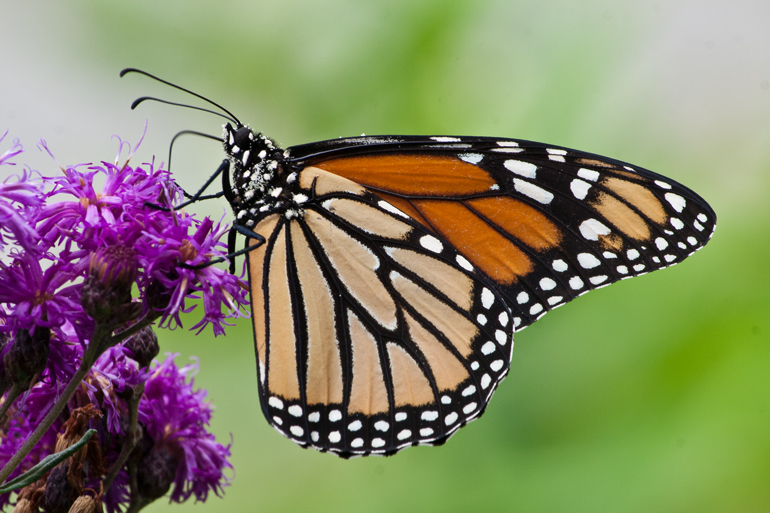
Earlier this week I was really excited because I had finally gotten some shots of Monarch butterflies and I posted a number of photos of them. As I looked over my photos from Monday again this evening, I saw a shot that surprised me. It surprised me because it was really good and it surprised me because I missed it the first time.

Other than using unsharp mask, this is the image that came out of my camera without any cropping at all. (Naturally I downsized the resolution for the blog.) I like the composition, I like the focus, and I like the background.

It doesn’t take much to make me happy.

Monarch butterfly (click for higher resolution)

© Michael Q. Powell. All rights reserved.

Read Full Post »
I finally managed to get a shot of a Blue Dasher dragonfly (Pachydiplax longipennis) on a lotus flower bud this past weekend. Previously I had photographed Blue Dashers on various plants and stalks and other things, but I have always thought that it would be especially cool to get on perched on the tip of a lotus bud.

It’s nice sometimes to have your wishes fulfilled and, yes, I think the photo met my expectations.

Blue Dasher dragonfly on lotus bud

© Michael Q. Powell. All rights reserved.

Read Full Post »
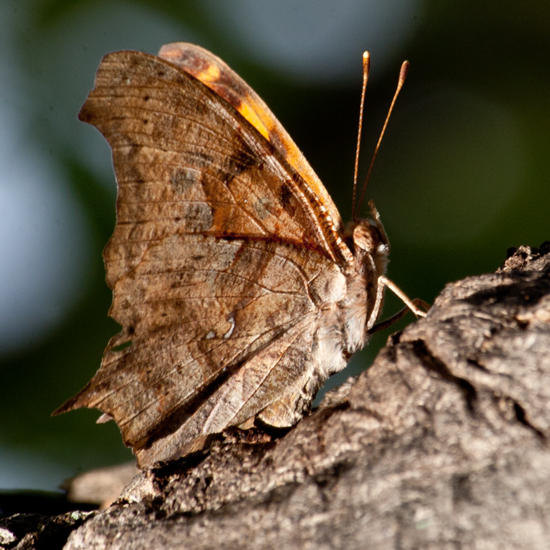
Back and forth I went as I tried to answer a simple question, “Comma or question mark?” You’re probably imagining that I was caught in some kind of punctuation dilemma, but that was not the case. No, I was not stuck in some special hell reserved for grammarians and editors, nor was I sweating out a standardized English test. Instead, I was trying to make a decision on the identity of this unusual looking butterfly that I encountered this past weekend.

Comma or Question Mark?

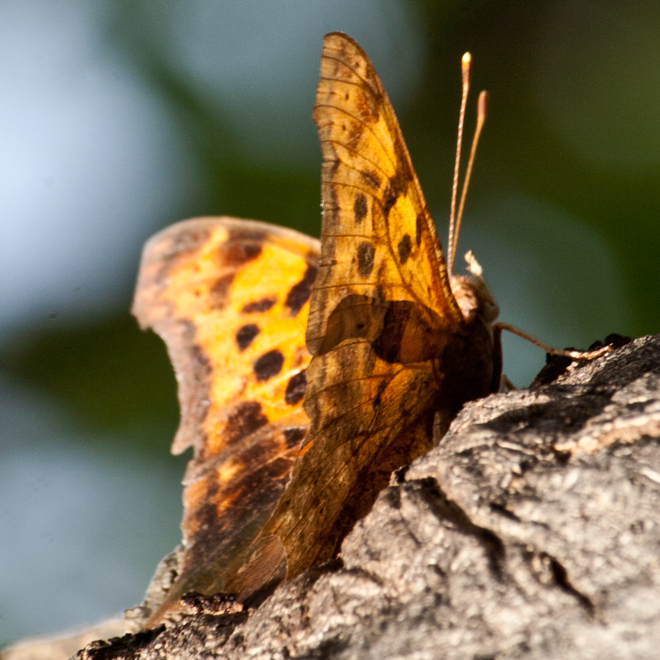
The colors of this butterfly almost perfectly matched the tree on which he was perched, facing downward in a way that almost perfectly camouflaged him. I rotated the image for the ease of viewers, hoping they will avoid the sore neck that I got as I turned my head trying to make out the details of the butterfly. In addition to the unusual color, the shape of this butterfly was pretty distinctive. What kind was he? As I was pondering that question, the butterfly—who had flown away and returned—opened his wings a little and I got a glimpse of the brilliant orange concealed inside his drab exterior.

A glimpse of orange

As he slowly opened his wings, more of more of the inside of his wings was revealed. The light shining through his wings made the colors glow like those of a back-lit stained glass window.

Back-lit wings

The butterfly flew away again, but amazingly returned once more and treated me to a full view of his open wings—his breathtaking beauty was revealed in full.

Beauty revealed

He sure was beautiful, but I wanted to know his name. Previously I had read about a butterfly called the Eastern Comma butterfly (Polygonia comma) and I had a vague recollection that he looked like this one. Wikipedia’s article on the Eastern Comma also helped explain why he was on a tree rather than some beautiful flower, like most of the butterflies that I have encountered. “This butterfly seldom visits flowers, but rather feeds on sap, rotting fruit, salts and minerals from puddling, and dung.”

I was still not sure of his identity, so I continued to search for clues. It turns out that there are two butterflies with similar shapes and colors. One is the Eastern Comma and the other is the Question Mark (Polygonia interrogationis), really. I feel like I am in some kind of Abbott and Costello style routine akin to their famous “Who’s on first?” routine. (Here’s a You Tube link to the classic routine if you are not familiar with it. It is definitely worth watching.)

The key to distinguishing the two is the shape of the little white markings on the wings and whether the markings are in two parts or one. If you think back to punctuation, you can probably guess that the one in two parts is the question mark and the unitary one is the comma. The website Gardens With Wings has an article with side by side photos of the two butterflies in case I have confused you.

So, which one did I photograph? I think I saw at least two different butterflies, but the one in the initial two photos and the one below all seem to have the white marking in two parts, which make them Question Mark butterflies (Polygonia interrogationis).

Question Mark butterfly

To be honest, though, the marking looks more like a semicolon than a question mark. Why isn’t there a Semicolon Butterfly?

© Michael Q. Powell. All rights reserved.

Read Full Post »

« Newer Posts - Older Posts »