Feeds:
Posts
Comments

Archive for the ‘Birds’ Category

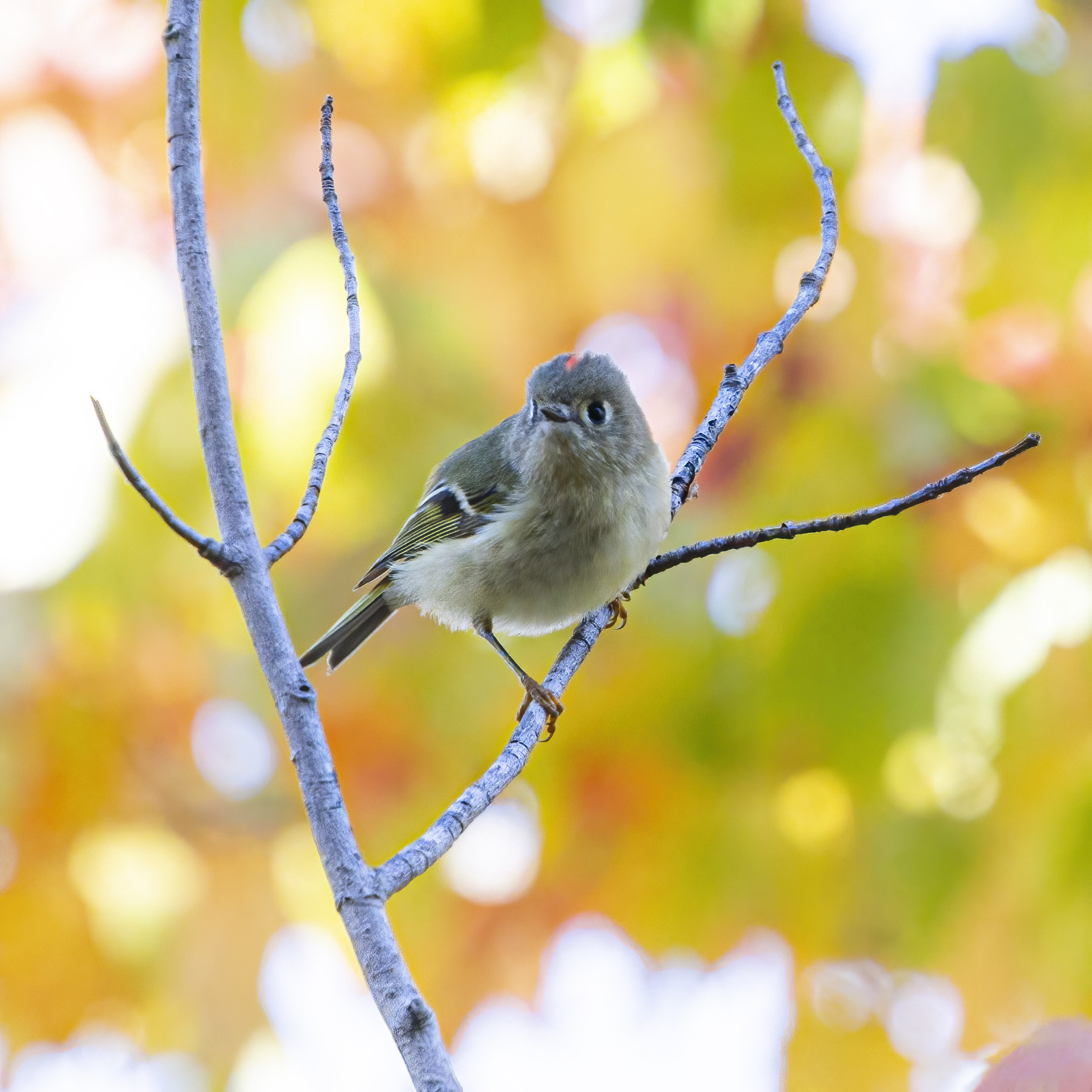
This tiny Ruby-crowned Kinglet (Corthylio calendula) glared down at me as I photographed it on Wednesday in a tree overhanging a stormwater retention pond in Kingstowne, a suburban community only a mile or so from where I live. The autumn foliage surrounding the pond had several patches of  impressively colorful leaves and I was delighted to be able capture some of the beautiful autumn color in the background of these two images.

In the first photo, you can see a portion of the kinglet’s “ruby crown,” a feature of the males that is often hidden from sight. The second image gives you a better overall view of the little kinglet, which only about four inches (10 cm) in length and weighs about .3 ounces (9 grams).

Ruby-crowned Kinglets are generally hyperactive, so it was unusual when this one paused for a moment in its foraging efforts and “posed” for me in the open.

Ruby-crowned Kinglet

Ruby-crowned Kinglet

© Michael Q. Powell. All rights reserved


Read Full Post »

I will often strive to photograph my wildlife subjects from as many different angles as I can in order to take advantage of the lighting or to highlight the details of their bodies. When I spot a subject, though, I initially try to capture whatever shot I can before I work to get a better shot—any of my subjects are skittish and there is always the chance that my initial shot will be my only one.

I spotted this perched male Belted Kingfisher (Megaceryle alcyon) last Thursday at Huntley Meadows Park in Alexandria, Virginia and one of my initial shots was the third one below. The perch was sticking out of a pond that was surrounded by a marshy wetland, so there was really no chance for me to get closer to the kingfisher—there was no way to work the angles in my usual way.

So what did I do? In the background I noticed there were some patches of colorful fall foliage, so I decided to see if I could include some of those colors in my images to give them an autumn vibe. By bending, twisting, crouching, and kneeling I was able to vary my shooting angle, while remaining more or less in the same spot, and eventually managed to get some photos that included portions of that autumn foliage. The kingfisher remained in place, but cooperated by changing his head position from time to time.

Belted Kingfisher

Belted Kingfisher

Belted Kingfisher

© Michael Q. Powell. All rights reserved.

Read Full Post »

This Great Blue Heron (Ardea herodias) was so well hidden that I could not tell if it was perched on a small raised portion of the ground or in a tree when I caught a glimpse of it during a recent visit to Occoquan Bay National Wildlife Refuge. My view of the heron initially was mostly obscured by the thick vegetation, but I managed to get a somewhat clear shot of it by climbing on top of a conveniently placed park bench.

Great Blue Heron

© Michael Q. Powell. All rights reserved.


Read Full Post »

This Bald Eagle was almost hidden in the foliage of a sweet gum tree when I spotted it on Thursday at Occoquan Bay National Wildlife Refuge. Normally I depend on the brightness of a bald eagle’s head to give away the presence of an eagle, but in this case the eagle’s head was in partial shade, making it stand out quite a bit less than it usually does.

The second shot shows a view of the eagle from a different angle. Even though this shot does not show as much detail as the first shot, which was actually taken after the second one, I like the way that it shows how the eagle was nestled on its perch amidst all of the branches.

In the upcoming months, many of the leaves will fall from the trees and it will become marginally easier for me to spot an eagle from a longer distance away. Of course, that will also make it easier for the eagles to spot me and my vision and reflexes are rarely a match for those of the eagles. Often my first indication of an eagle’s presence is when it takes to the air and flies away from me.

Bald Eagle

Bald Eagle

© Michael Q. Powell. All rights reserved.


Read Full Post »

I spotted this Bald Eagle (Haliaeetus leucocephalus) in a distant tree on Tuesday at Occoquan Bay National Wildlife Refuge at about the same time that it spotted me. I reacted quickly and managed to capture this first image as it prepared to take off. As you can see, there is already a bit of color in our autumn foliage, but the colors are relatively muted here in Northern Virginia, compared to what I would see when I was growing up in New England.

The second photo shows the eagle a few seconds after its takeoff as it rose above the trees. At that moment its feet were still dangling, but it raised its “landing gear” shortly after I captured the image.

It has been a while since I last posted eagle photos and it was wonderful to have a couple of sightings of these majestic birds on a beautiful fall day.

Bald Eagle

Bald Eagle

© Michael Q. Powell. All rights reserved.

Read Full Post »

I spotted this pretty little sparrow on Wednesday at Occoquan Bay National Wildlife Refuge. When I looked through my bird identification guide, I thought that it looked a little bit like a Chipping Sparrow. When I posted the photo below in a birding group on Facebook, however, some experienced birders identified this bird for me as a young White-crowned Sparrow (Zonotrichia leucophrys), a new species for me.

Sparrows can often be hard for me to identify, but the distinctive bill on this one helped me to narrow down the pool of potential species. A mature male White-crowned Sparrow has a black and white head and is easy to identify, but immature males and females of different species are often similar in appearance.

White-crowned Sparrow

© Michael Q. Powell. All rights reserved.


Read Full Post »

Each fall I face the same dilemma—I see the photos of other photographers indicating that migrating warblers are present in our area, but I have trouble spotting these elusive little birds. Part of the problem is that leaves are still mostly on the trees and I can often hear birds that remain invisible in the foliage. The other main problem is that many birds are now sporting their duller fall plumage, so they do not stand out as much as during the spring migration, when their  breeding plumage is much brighter.

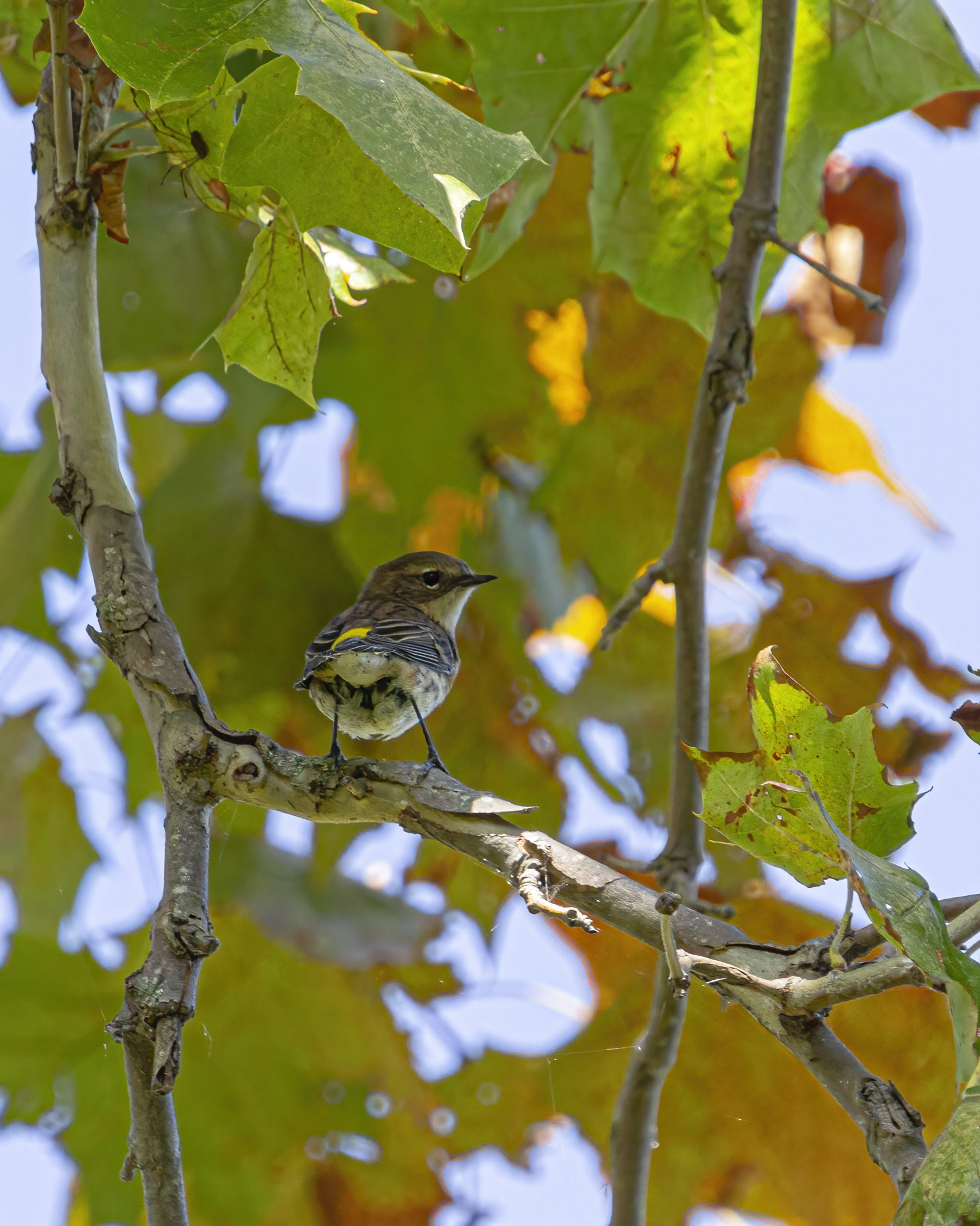
Given my normal experience, I was thrilled to spot several Palm Warblers (Setophaga palmarum) and Yellow-rumped Warblers (Setophaga coronata) during visits to Occoquan Bay National Wildlife Refuge earlier this week. The birds in the first two photos, I believe, are Palm Warblers, a relatively common warbler species that likes to poke around a lot on the ground.

The final two photos show Yellow-rumped Warblers, which are the most common warbler species in my area. In both of the photos you can see the yellow patch of feathers on the “rump” of the bird.

In a month or so I may switch over to my longest lens, a Tamron 150-600mm zoom lens, which will allow me to zoom in a little more on these tiny birds, but for now I am sticking with my Tamron 18-400mm lens, a more versatile lens that lets me get photos of butterflies and dragonflies as well as of birds. (The problem with the longer lens is that it has a minimum focusing distance of almost 9 feet (2.7 meters) and it is sometimes hard to focus on small subjects from that far away.)


Palm Warbler

Palm Warbler

Yellow-rumped Warbler

Yellow-rumped Warbler

© Michael Q. Powell. All rights reserved.

Read Full Post »

As I was leaving Occoquan Bay National Wildlife Refuge on Friday, I spotted this small band of Wild Turkeys (Meleagris gallopavo) foraging on the side of a small hill. I captured this image while I was seated in the driver’s seat of my car. I was stopped with my blinkers on and fortunately there was no other traffic. I like the way that the turkeys had spaced themselves out in a military-style patrolling formation.

Wild Turkeys

© Michael Q. Powell. All rights reserved.


Read Full Post »

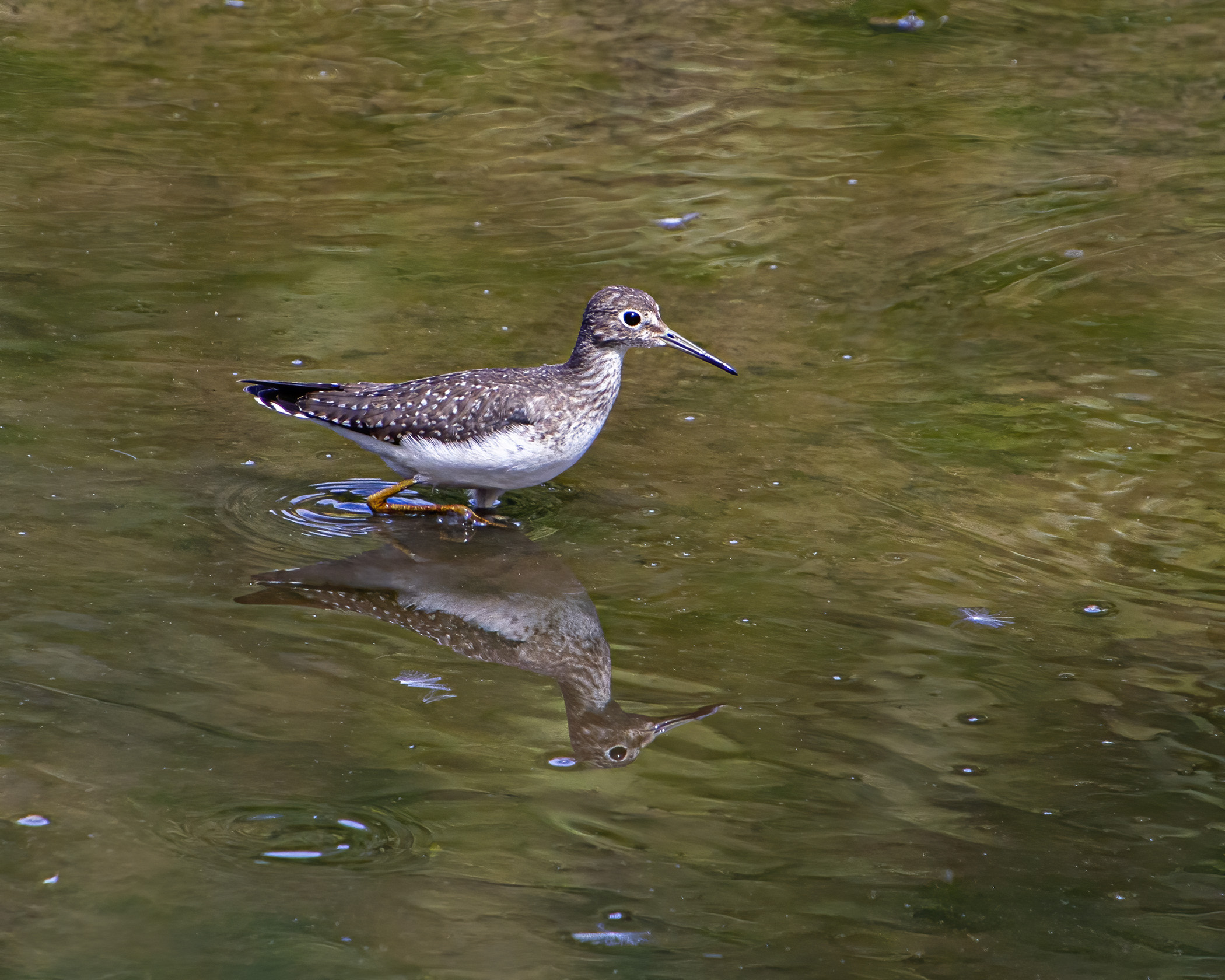
I almost always have trouble identifying shore birds, especially the different kinds of sandpipers. On Thursday, I spotted a single sandpiper-like bird in the shallow water of a pond at Occoquan Bay National Wildlife Refuge. Initially I thought it might be a Solitary Sandpiper, but when I got a good look at its legs, I leaned towards calling it a Lesser Yellowlegs (Tringa flavipes)—Solitary Sandpipers have greenish legs.

It was fascinating to watch the little bird move through the water, carefully raising its feet. On land, it seemed to prance a bit. In the final photo, the bird was flexing its wings as part of its grooming routine and seemed to be keeping an eye on me.

Lesser Yellowlegs

Lesser Yellowlegs

Lesser Yellowlegs

© Michael Q. Powell. All rights reserved.

Read Full Post »

When I stepped out of my car on Thursday at Occoquan Bay National Wildlife Refuge, I notice a bird pecking about in the grass at the edge of the parking lot.The lenght of its tail made me think of a Northern Mockingbird, but the coloration was more sparrow-like. As I tracked the bird in my camera’s viewfinder, the bird lifted its head and I caught a glimpse of its bright yellow eye and realized that it was a Brown Thrasher (Toxostoma rufum), a species that I have seen only a few times before.

I really like the basic description of the species on the Cornell Lab of Ornithology website—”It can be tricky to glimpse a Brown Thrasher in a tangled mass of shrubbery, and once you do you may wonder how such a boldly patterned, gangly bird could stay so hidden. Brown Thrashers wear a somewhat severe expression thanks to their heavy, slightly downcurved bill and staring yellow eyes, and they are the only thrasher species east of Texas. Brown Thrashers are exuberant singers, with one of the largest repertoires of any North American songbird.”

Brown Thrasher

© Michael Q. Powell. All rights reserved.


Read Full Post »

I was not able to get close to this Blue Grosbeak (Passerina caerulea) on Monday at Occoquan Bay National Wildlife Refuge, but was thrilled to get a shot that was good enough for me to identify the bird. As far as I know, this is the first time that I have photographed a Blue Grosbeak.

When I first spotted this bird, I thought that it was probably an Indigo Bunting.  When I got home and looked more closely at the images, however, I noticed the reddish wing bars that are not found on an Indigo Bunting, so I scoured my bird identification book until I came across the Blue Grosbeak.

These two shots illustrate well the dilemma I have in photographing small birds at this time of the year. Many of them like to perch high in the trees and the leaves often hide them from view. When I hear a bird singing, I try to locate it, but am usually unsuccessful in doing so unless the bird moves. In a month or so, many of the leaves will be gone, but so will many of the birds that are now passing through our area.

Blue Grosbeak

Blue Grosbeak

© Michael Q. Powell. All rights reserved.


Read Full Post »

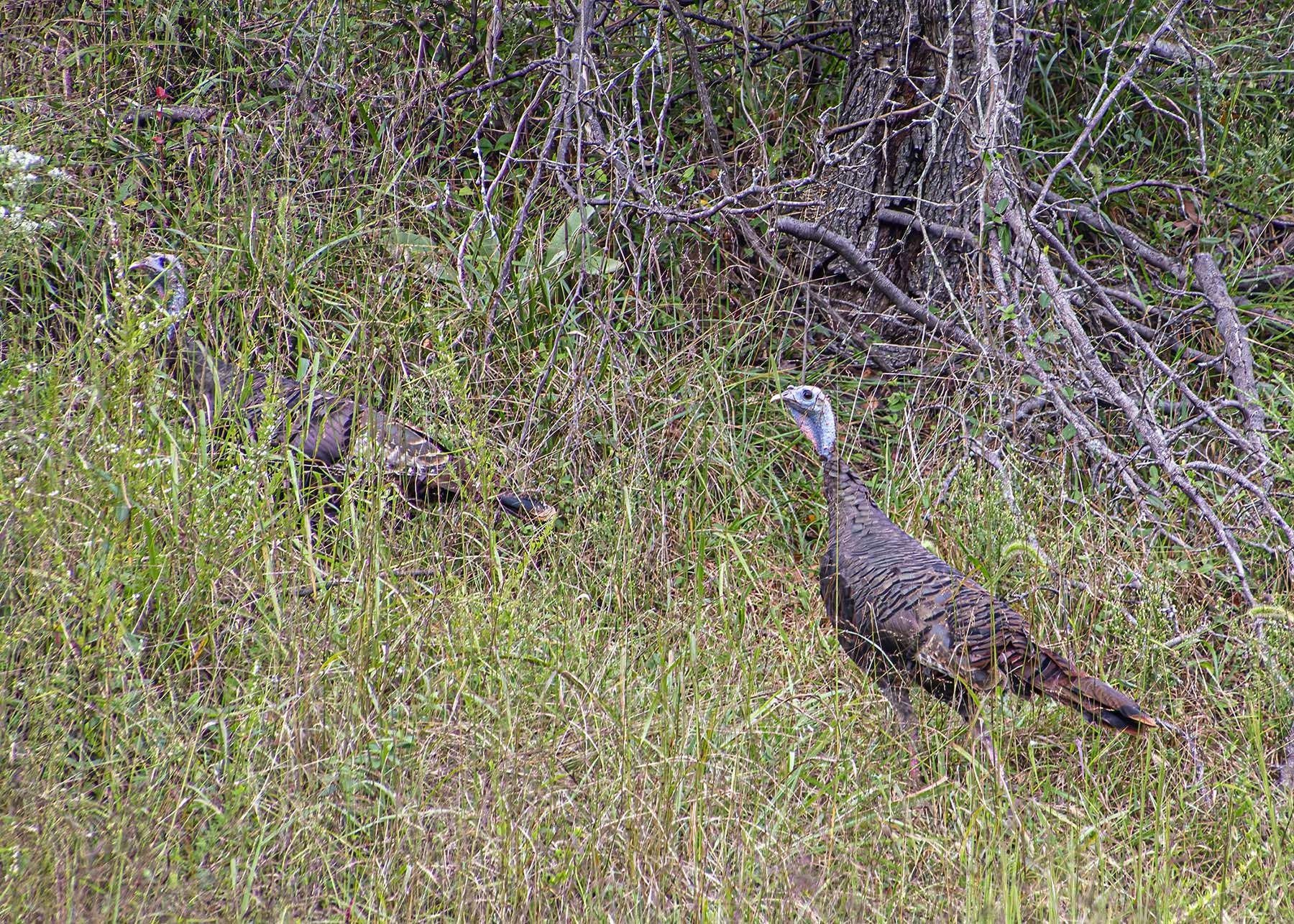
On Monday I spotted these two Wild Turkeys (Meleagris gallopavo) at Occoquan Bay National Wildlife Refuge as they climbed a small hill through some tall grass. They kept disappearing from view, but occasionally their heads would pop up and I was able to capture a few shots of them.

The bodies of the turkeys are partially hidden by the vegetation, but I really like the way that I was able to capture a sense of the habitat in which I saw the turkeys. Normally I spot turkeys in the open on the trails at this wildlife refuge, so it was cool to see them traveling “off-road.”

Wild Turkeys

Wild Turkeys

© Michael Q. Powell. All rights reserved.

Read Full Post »

On Thursday at Occoquan Bay National Wildlife Refuge I captured this image of a Great Blue Heron (Ardea herodias) at water’s edge. Heron’s are quite large and normally are easy to spot.

However, as I was approaching this area, this Great Blue Heron was initially hidden from view by the metal posts sticking out of the water, as you can see in the second photo. Fortunately the heron’s head was turned to the side and it was the bird’s large bill that gave away its presence. I had to walk farther down the trail and look back to get the viewing angle for the first photo in which the heron is somewhat separated from the posts and is more visible.

Great Blue Heron

Great Blue Heron

© Michael Q. Powell. All rights reserved.


Read Full Post »

At this time of the year we experience the change in seasons in many different ways. We feel the gradual cooling of the weather. We see the changing colors of the leaves on the trees. We hear (and see) the unmistakable sound of flocks of migrating Canada Geese (Branta canadensis).

Although we seem to have a resident population of Canada Geese in our area year-round, during the spring and summer large flocks of geese fly through our area and it is quite common to hear the loud honking of the geese as they fly overhead. Sometimes they fly in military precision in a v-formation, but more often than not they are in a looser formation, as was the case with these Canada Geese that I photographed last week while I was looking for dragonflies at Jackson Miles Abbott Wetland Refuge in Northern Virginia.

Canada Geese

© Michael Q. Powell. All rights reserved.

Read Full Post »

As I was observing some Wild Turkeys (Meleagris gallopavo) last Thursday at Occoquan Bay National Wildlife Refuge, one of them suddenly decided to stretch a bit and flapped his wings. In the past I have seen a turkey extend its wings like this only when running away from me. In this case, though, the turkey went back to pecking on the ground and either was not aware of my presence or was simply not bothered by it.

Perhaps he was just trying to cool off on what was a really hot, humid day.

Wild Turkey


© Michael Q. Powell. All rights reserved.

Read Full Post »

The vegetation seemed so thick in the marshland at Jackson Miles Abbott Wetland Refuge that I was surprised that a Great Egret (Ardea alba) was able to spot and catch a fish there last Monday. I have not seen many egrets this year, so I was shocked to see five of them that day.

Great Egrets leave our area and head to warmer locations when the weather begins to turn cooler, while their “cousins,” the Great Blue Herons, stay with us throughout the entire year.

Great Egret

Great Egret

© Michael Q. Powell. All rights reserved.


Read Full Post »

I inadvertently spooked a Great Blue Heron (Aredea herodias) on Wednesday at Occoquan Regional Park and captured this first image as it flew up to a perch high in a nearby tree. It was really cool to see the heron’s impressive wingspan as it came in for a landing in the tree. The second image shows the Great Blue Heron as it surveyed its surroundings from its new perch.

When I was just starting out in wildlife photography, I remember being shocked the first time that I saw a Great Blue Heron in a tree. I somehow had assumed that they spent all of their time in the shallow water or at the edge of ponds. Little did I know at that time that Great Blue Herons build their nests in the trees and often spend their nights roosting in trees to protect themselves from potential predators.

Great Blue Heron

Great Blue Heron

© Michael Q. Powell. All rights reserved.


Read Full Post »

The gloomy feel of this photo seems perfect for these two Black Vultures (Coragyps atratus) that I spotted in a dead tree on Monday at Occoquan Bay National Wildlife Refuge. Many people find vultures to be creepy, probably because they feed on the carcasses of dead animals. I remember too watching cowboy movies when I was growing up in which vultures would be circling overhead, waiting for people to die in the desert wastelands.

There were lots of vultures circling overhead on Monday and in situations like that, I jokingly tell people that I try to move about a lot, lest the vultures mistake me for a potential meal.  In my area, we have both turkey vultures and black vultures. They are pretty easy to tell apart, because turkey vultures have very distinctive red heads and black vultures have black heads. According to the Cornell Lab of Ornithology, “Whereas Turkey Vultures are lanky birds with teetering flight, Black Vultures are compact birds with broad wings, short tails, and powerful wingbeats. The two species often associate: the Black Vulture makes up for its poor sense of smell by following Turkey Vultures to carcasses.”

The light was coming mostly from behind the two birds, which created the silhouette-like effect that you see in the image below. I lightened the shadows a little, but I like the starkness of the almost monochromatic view of these birds in which most of their details are suggested, but hidden. I think it works well with the simple structure of the branches of the dead tree. Unlike most of my images that concentrate on detailed views of my subjects, this image is more about mood and shapes.

Black Vultures

© Michael Q. Powell. All rights reserved.


Read Full Post »

Two juvenile Ospreys (Pandion haliaetus) appear to almost grown up, but I believe they are still dependent on their parents to feed them. They made protracted cries of what appeared to be “Feed me” when they spotted an adult osprey flying in the distance last Saturday at Occoquan Bay National Wildlife Refuge.

Sometimes their movements seemed synchronized, as in the first photo, but at other times they expressed themselves in individual ways. In the second photo, you may notice that the two ospreys have speckled feathers and orange eyes, two signs that they are not yet adults, which have dark feathers and yellow eyes.

Osprey

Osprey

© Michael Q. Powell. All rights reserved.

Read Full Post »

Most of the time I hesitate to take photos of birds head-on, because the bills and other facial features can look distorted. However, I really like this image I captured of a jaunty little Blue-gray Gnatcatcher (Polioptila caerulea) during in visit in July to Occoquan Bay National Wildlife Refuge.

Blue-gray Gnatcatchers are tiny songbirds, about four inches (10 cm) in length, and are only slightly larger than Ruby-throated Hummingbirds. Their tails are really long and dark with white outer tail feathers. In this image, the tail is angled to the side—at first glance it almost looks like the green leaf behind the gnatcatcher’s head is the tail.

It is always hard to interpret the facial expressions of birds. At first I thought the expression in this photo was one of confrontation, but increasingly I have come to the conclusion that it more likely was one of curiosity.

In case you are curious, the gnatcatcher was in a shaded area, so I had to increase the exposure to try to pull the bird out of the shadows. The increased exposure caused the sky in the background to turn white.

Blue-gray Gnatcatcher

© Michael Q. Powell. All rights reserved.

Read Full Post »

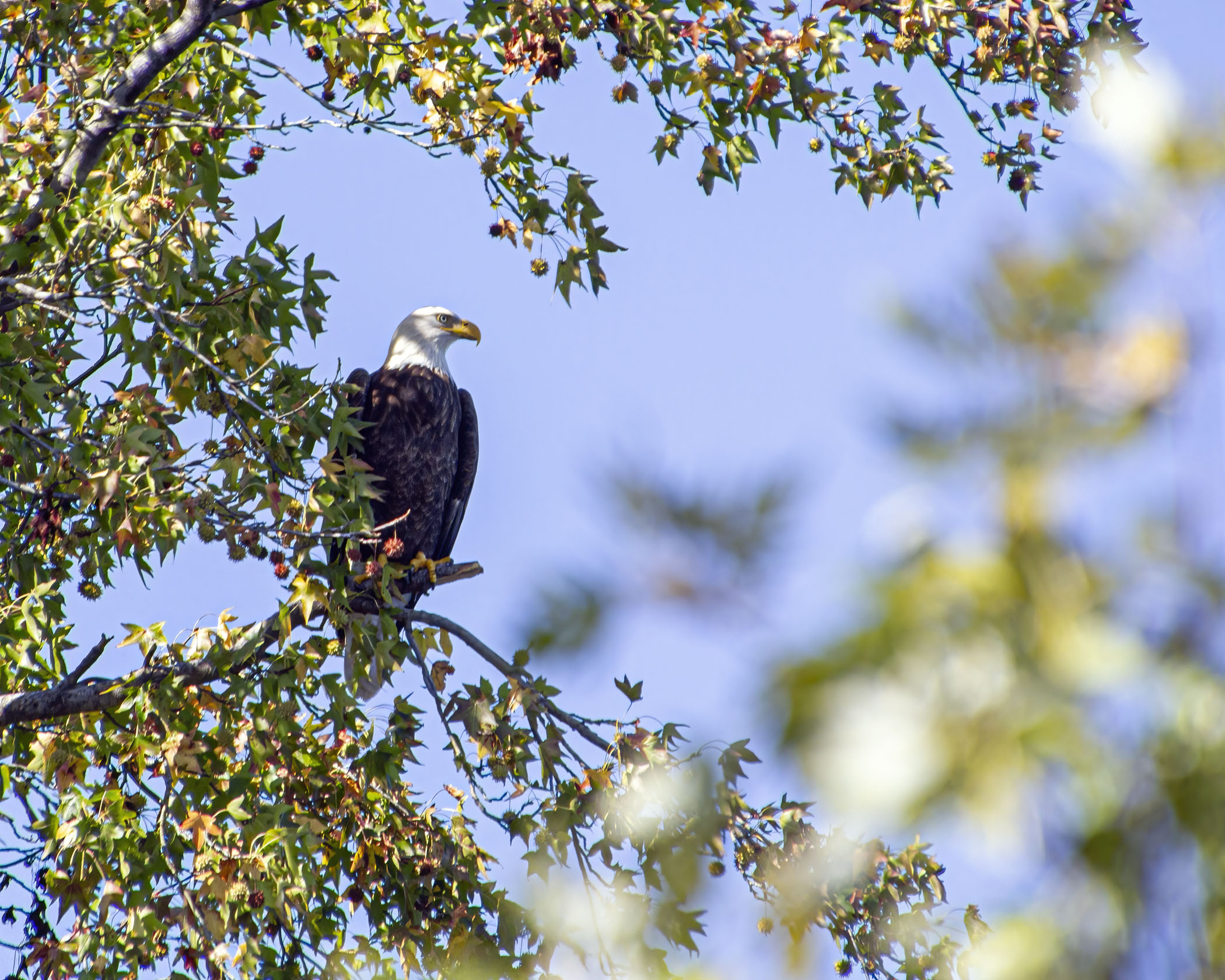
I have gotten so caught up in posting photos of insects and flowers, that I nearly forgot that I had managed to capture this shot of a Bald Eagle (Haliaeetus leucocephalus) a week or so ago during a visit to Occoquan Bay National Wildlife Refuge. I have a really problem spotting small birds because of the abundance of leaves on the trees, but this eagle cooperated by perching in the open on a branch where he was quite visible.

At certain times of the year I worry about oversaturating my blog with photos of eagles, but numerous readers have told me that they never get tired of seeing eagles. My oft-stated view is that any day that I spot a bald eagle is a good day.

Personally, I hold the same view about I dragonflies, which is why they appear in this blog more often than any other creatures during the warm months of the year.

Bald Eagle

© Michael Q. Powell. All rights reserved.


Read Full Post »

For the first time in a month or so, on Wednesday I put my 150-600mm zoom lens on my camera in place of my trusty 180mm macro lens and visited Occoquan Bay National Wildlife Refuge. Rather than focusing on insects, as I have been doing since early spring, I decided to try to get some shots of birds. Several local photographers have recently posted photos of the juvenile bald eagles at the wildlife refuge that are now much larger that when I saw them last and I was hoping that I might have a chance of seeing them myself.

As it turned out, I did not see the juvenile eagles that day, but I did catch a glimpse of at least two Osprey babies (Pandion haliaetus) that were in the nest with one of their parents. I don’t know how old the little ospreys are, but they seemed curious and energetic. One of them stretched out his wings a bit while I was watching, but the babies don’t appear to ready to fly on their own quite yet.

The rather loosely constructed nest has branches sticking out in all directions that often blocked my view of the trio of ospreys and this is one of the few photos that I took in which I had a clear view of all three of their faces. I did not have very much luck getting photos of other birds that day, many of which I could hear but could not see amidst the abundant foliage.

Osprey

© Michael Q. Powell. All rights reserved.


Read Full Post »

How many views does one of my blog posts need to get for me to consider it “successful” or “popular?” On a good day, my blog receives about 100 views, of which 60 may be related to that day’s post. If a post receives over a 100 views over time, I’ll consider it to be one of my top posts.

However, WordPress has a mind of its own, and the most-viewed postings, in my view, are not necessarily the best-written ones or the ones with my best photos. Some of the posts continue to receive views years after they were written thanks to searches on Google and other search engines. Even then, some subjects seem to go in and out of popularity on the search engines as a result of ever-changing algorithms.

For many years, my most popular blog posting was one from 4 November 2014 entitled Rescue of an Injured Bald Eagle that documented the rescue of the eagle by an a county animal control officer at my local marshland park. I was lucky enough to be present during the rescue operation and my photos (including a link to my blog posting) were picked up by several on-line news organizations in the Washington D.C. area. As a result, that posting has had 3,475 views to date, including 3,290 views during the initial month of the posting.

Bald Eagle rescue

This month, another blog posting has taken over the lead from the posting of the eagle rescue. My new top post is now a 9 May 2016 blog posting called Blue-eyed Garter Snake. Although this posting had only 70 views during its initial month, it now has had 3,512 views, including 438 views in 2023.

garter snake

Another posting may soon overtake the eagle rescue posting. The 3 August 2013 posting entitled Fuzzy White Caterpillar currently has had a total of 3,442, only 72 of which came during its initial month. Neither the writing or the photos in that posting are all that great, but I suspect that the title is so generic that it comes up often in Google searches.

fuzzy white caterpillar

One final contender for the top post is a 31 August 2013 posting entitled Red-footed Cannibalfly. This posting has had 3,169 views, of which 61 came in its initial month. For five years in a row it had over 350 annual views and appeared on the first page of Google results. Something changed, however, and it has fallen in the Google rankings since 2018, though it still appears as the fifth entry in a Bing search of “Red-footed Cannibalfly.”

red-footed cannibalfly

To be perfectly honest, I do not really care that much about views. I use this blog as a means to express myself creatively in my writing and in my photos. I am grateful for the modest success that I have enjoyed and even more thankful for the community of supportive people who have encouraged and supported me over the years.

I made my first posting on 7 July 2012, so I will soon be celebrating an anniversary. According to WordPress, my postings have had 403,801 views to date and I am thankful for each and every one of them and for all of you.

© Michael Q. Powell. All rights reserved.


Read Full Post »
In the United States, today is Memorial Day, a federal holiday. For some people this day marks the unofficial beginning of summer, but for me, as someone who served for twenty years in the U.S Army, this day has a deeper meaning, a day to reflect on the lives of the brave men and women who died in the defense of this nation. Yesterday, Facebook reminded me of a posting I made on Memorial Day 2018, and I decided to share it again today in this blog posting.

“I was prompted this morning to read again the challenges to us in the Gettysburg Address, which seem so appropriate today as we remember the sacrifices of so many brave men and women. “It is for us the living, rather, to be dedicated here to the unfinished work which they who fought here have thus far so nobly advanced. It is rather for us to be here dedicated to the great task remaining before us—that from these honored dead we take increased devotion to that cause for which they gave the last full measure of devotion—that we here highly resolve that these dead shall not have died in vain—that this nation, under God, shall have a new birth of freedom—and that government of the people, by the people, for the people, shall not perish from the earth.” ”

For those of you who might be curious, the photo below is from a November 2014 blog posting entitled “Rescue of an injured Bald Eagle” that documented the capture of an injured eagle by an officer of the Fairfax County Animal Control Services at my local marshland park. Some of the photos from that posting were reprised in Washington D.C. media outlets and the posting has been my all-time most popular posting with 3472 views.

Bald Eagle

© Michael Q. Powell. All rights reserved.


Read Full Post »

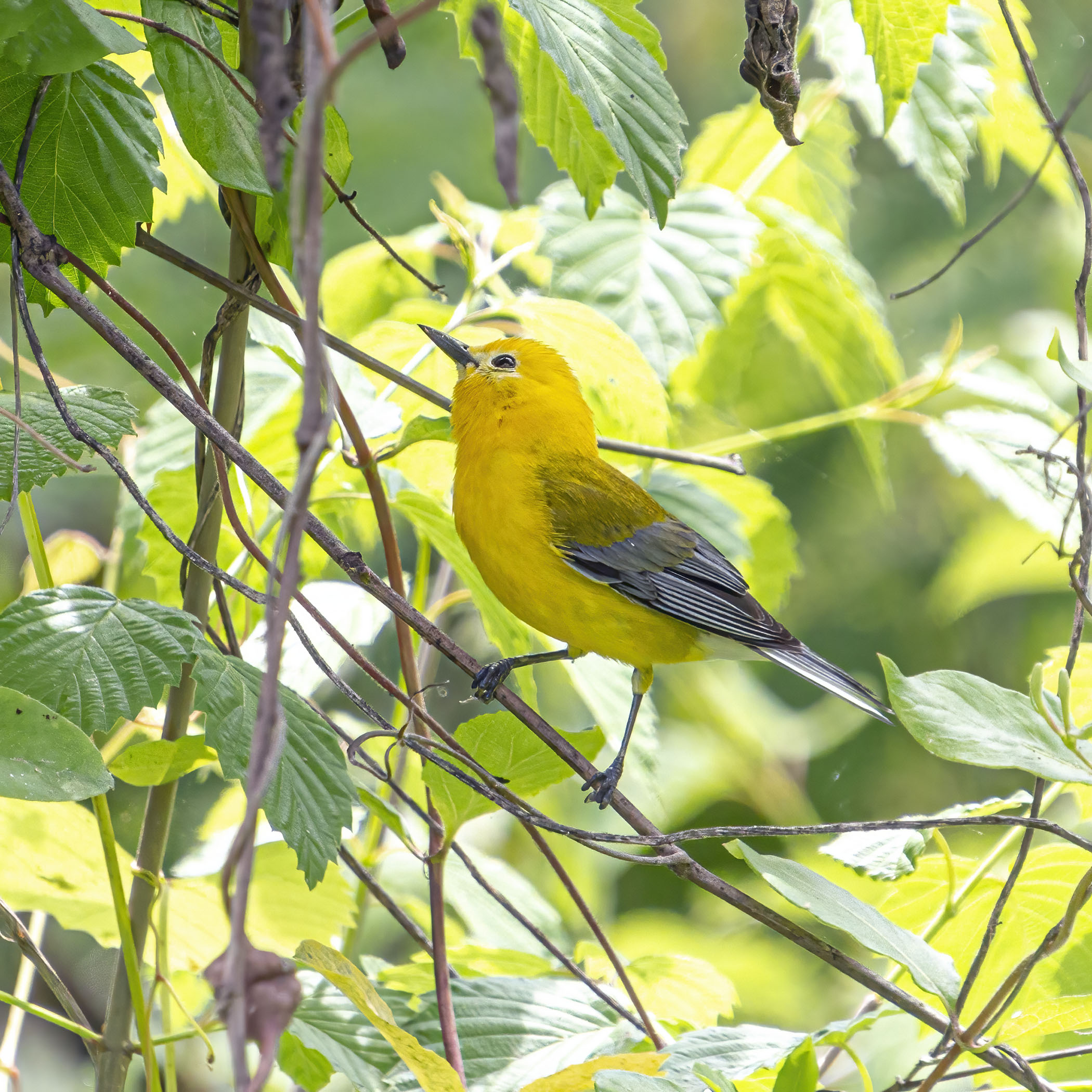
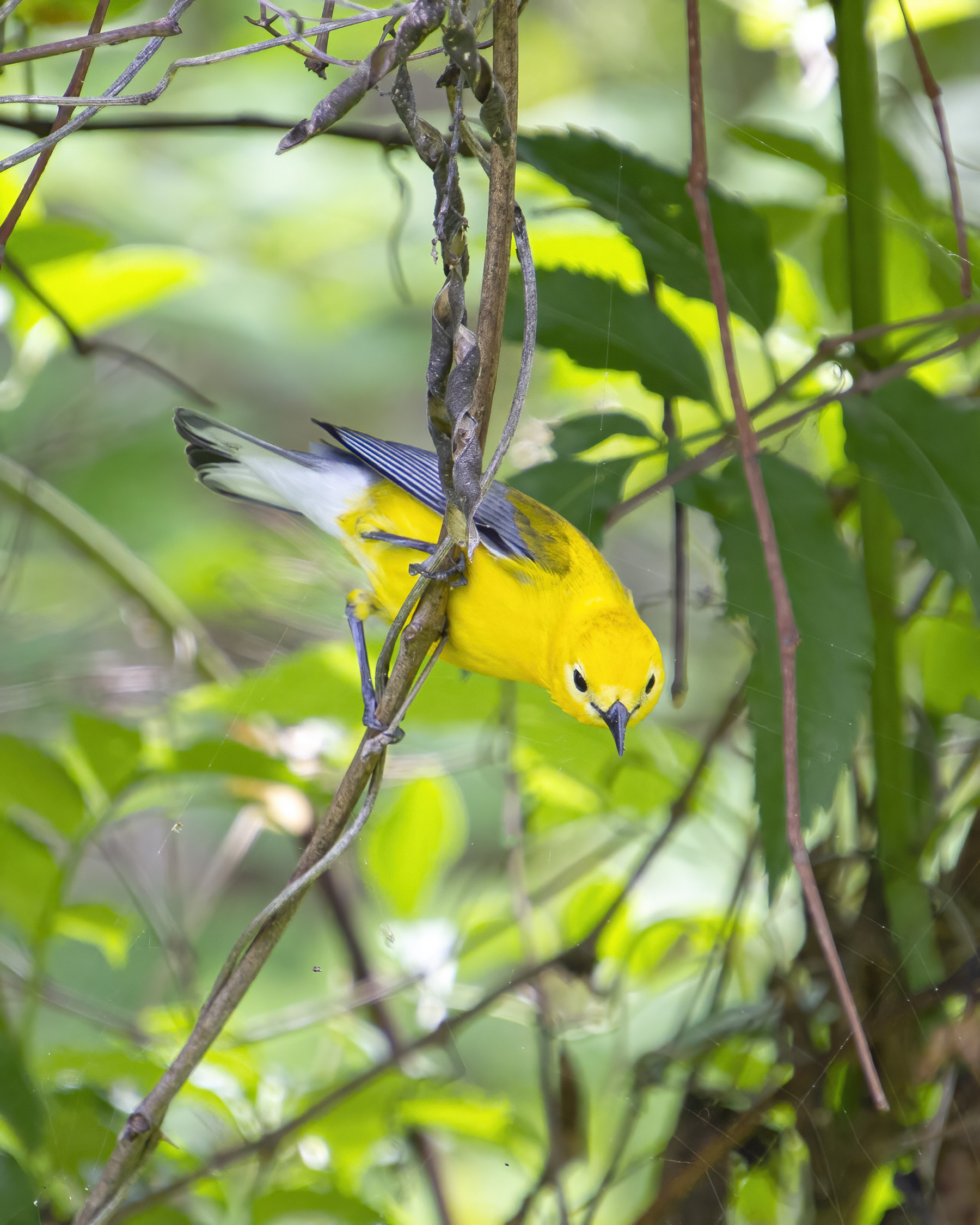
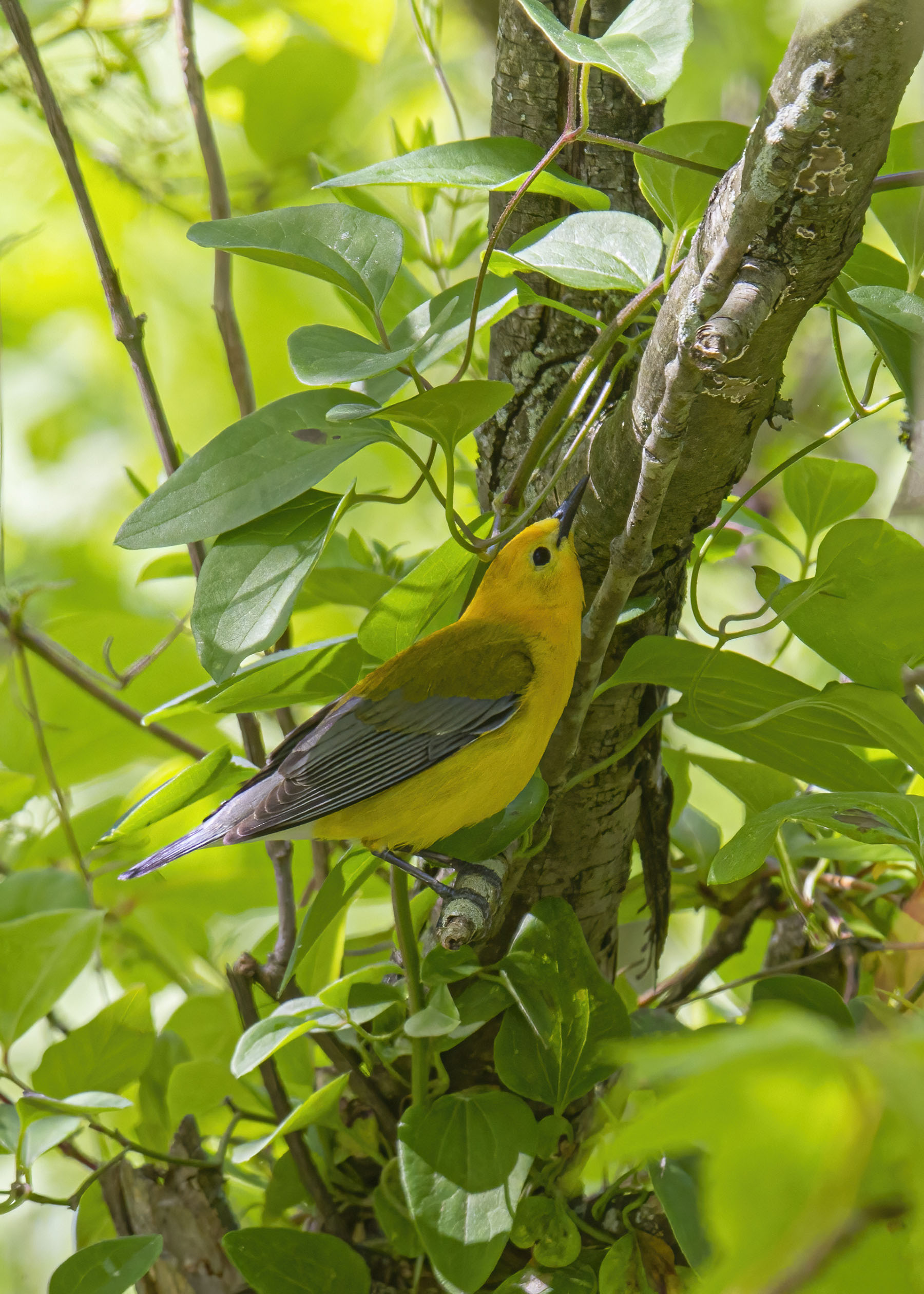
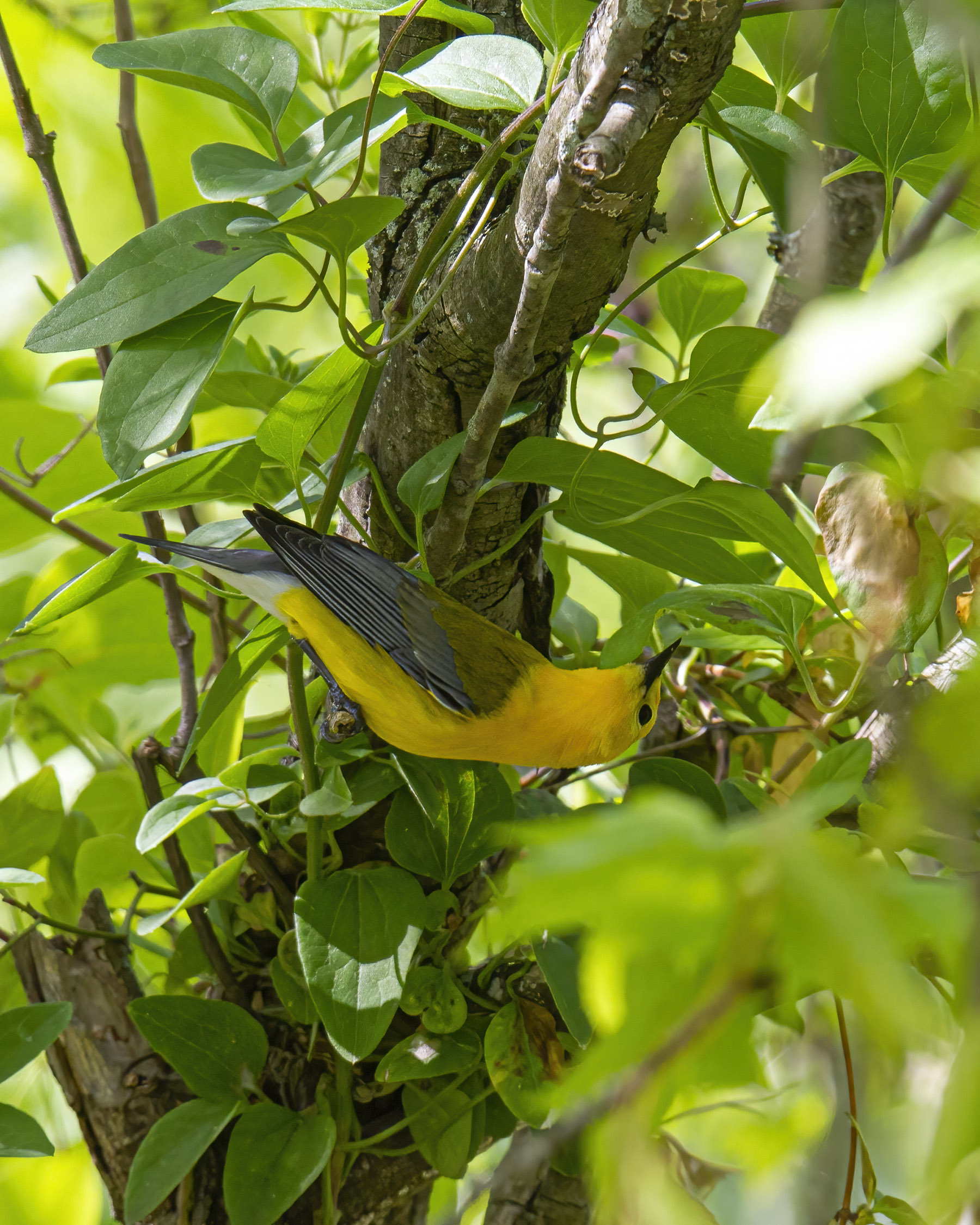
I love the poses of this bright yellow Prothonotary Warbler (Protonotaria citrea) that I spotted last Thursday at Occoquan Bay National Wildlife Refuge. The warbler was actively twisting, turning, and stretching as it foraged for food and amazingly was perched quite low in the vegetation—most of the times in the past I have seen Prothonotary Warblers high in the trees and was forced to shoot them from an unflattering sharp upward angle.

Quite often when I am focusing on a wildlife subject, it moves. Most of the time the result is a blurry image, but sometimes I end up with a really cool shot. The Prothonotary Warbler took off just as I pressed the shutter release and I was lucky to capture it in action, as you can see in the final photo.

The yellow plumage of a Prothonotary Warbler is startlingly bright and cheerful. Invariably the sight of a Prothonotary Warbler makes me think of Tweety Bird, a character from Warner Brothers Looney Tunes cartoons that I remember from my childhood. I think that Tweety was supposed to be a canary, but he didn’t really look like a canary. Often Tweety had adventures with Sylvester the cat, the subject of Tweety’s signature line, ” “I tawt I taw a puddy tat!””


Prothonotary Warbler

Prothonotary Warbler

Prothonotary Warbler

Prothonotary Warbler

© Michael Q. Powell. All rights reserved.

Read Full Post »

As I was scanning the trees for small birds last Thursday at Occoquan Bay National Wildlife Refuge, I spotted this Great Blue Heron (Ardea herodias) surveying its surroundings from its high perch. I have occasionally seen herons roosting in the trees in the past, but it has usually been earlier in the day—this heron might have decided that it wanted a mid-afternoon nap or at least a few peaceful moments.

Now that I am retired, I have rediscovered the pleasure of naps and a Sunday afternoon nap has become part of my weekly routine.

Great Blue Heron

© Michael Q. Powell. All rights reserved.

Read Full Post »

I patiently watched the large Bald Eagle (Haliaeetus leucocephalus) nest last Thursday at Occoquan Bay National Wildlife Refuge and eventually caught a glimpse of an eaglet. As some of you may recall, I have been keeping an eye on three eagle nests at this refuge and have already seen eaglets at the other two nests. This nest is significantly larger than the other two nests, as you can see in the second photo, and it is difficult to see activity in the nest.

I was zoomed in as close as I could with my telephoto lens and still had to crop the image in the first photo quite a bit so you can see the eaglet with its open mouth—I suspect it wanted to be fed. As you can see, one of the parents was in the nest with the eaglet and the other parent was perched in a nearby tree. It is possible that there are more eaglets in the nest, but I was really happy to spot one.

In case you are curious, I did not have my longest telephoto lens with me that day. Normally I use my Tamron 150-600mm lens when I know that I will be photographing birds. I was anticipating that I would be focusing on both large and small creatures, so I was using my Tamron 18-400mm lens on this occasion.  This lens gives me a great deal of flexibility in photographing dragonflies as well as birds and in capturing landscape shots like the shot of the nest—I was standing in the same spot for both photos in this blog posting.

Bald Eagle

eagle nest

© Michael Q. Powell. All rights reserved.

Read Full Post »

On Thursday I was blessed to photograph a beautiful little Prairie Warbler (Setophaga discolor) as it was singing in a small tree at Occoquan Bay National Wildlife Refuge. At this time of the year I can often hear the birds, but have trouble spotting them amidst the abundant foliage. Even when I am able to locate a warbler, it is usually perched really high in a tree, out of range of my telephoto lens. In this case, the warbler was almost at eye level when I took these photos.

Despite its name, the Prairie Warbler is not found on a prairie. According to the Cornell Lab of Ornithology, “Finding this bird during the breeding season is often as simple as finding the scrubby second-growth forests, young pine stands, and overgrown pastures that it prefers. In spring, listen for males singing from a mostly exposed perch in one of the tallest trees in its territory, a distinctive sputtering buzz that starts low and climbs high up the scale, beyond human hearing.”


Prairie Warbler

Prairie Warbler

© Michael Q. Powell. All rights reserved.

Read Full Post »

As I was observing a large nest last Friday at Occoquan Bay National Wildlife Refuge, I couldn’t help but notice that the Bald Eagle (Haliaeetus leucocephalus) in the nest was keeping an eye on me. The eagle seemed to be observing me through a gap in the branches at the top of the nest, as you can see in the first two photos.

After getting a few shots, I continued walking down the trail. When I looked back towards the nest, I could see the eagle’s head poking out of the top of the nest and it still seemed to be watching me.

As you can tell from the final photo, this is a really large nest and it is hard to monitor what is going on inside of it. Are there any eaglets yet? In two other nests at the refuge, I have already seen eaglets, but those nests were much smaller, so it was not hard to spot the babies. I’ll continue to monitor this nest and with a little luck I will see an eaglet or two in this large nest.

Bald Eagle

Bald Eagle

Bald Eagle

© Michael Q. Powell. All rights reserved.

Read Full Post »

It was fascinating to watch this acrobatic little Prothontary Warbler (Protonotaria citrea) last Friday as it twisted and turned, poked and probed while searching for tasty treats among the leaves of a tree at Occoquan Bay National Wildlife Refuge. We have reached a time of the year when most of the small birds are hidden by the leaves on the trees, so I was really fortunate to be able to spot this warbler and to track it as it moved about in this tree.

Prothonotary Warbler

Prothonotary Warbler

Prothonotary Warbler

© Michael Q. Powell. All rights reserved.

Read Full Post »
Although it is fun to try to photograph migratory species passing through our area, I am equally content to photograph the local species that are present throughout the year, like Wild Turkeys and Eastern Cottontail Rabbits. This rather rotund Wild Turkey (Meleagris gallopavo) seemed to be dancing the hokey-pokey when I spotted it last Friday at Occoquan Bay National Wildlife Refuge. “You put your right leg in, you put your right leg out. You put your right leg in and you shake it all about…” For the record, I did not join in the dance.

Later that same day I encountered this cute little Eastern Cottontail Rabbit (Sylvilagus floridanus). The rabbit was quite tolerant on my presence and calmly chewed on the grass while I took its picture. For several years I cared for a pet rabbit, so rabbits have a special place in my heart.

Turkeys and rabbits are quite common at this refuge and at certain times of the day I am likely to encounter them. Generally they slowly move into the undergrowth as I approach. I don’t think they necessarily view me as a threat, but they probably do not want to take chances.

Wild Turkey

Eastern Cottontail

© Michael Q. Powell. All rights reserved.

Read Full Post »

« Newer Posts - Older Posts »