Feeds:
Posts
Comments

Archive for the ‘Birds’ Category

Some birds return silently in the spring and you have to search hard to find them. Ospreys (Pandion haliaetus), on the other hand, make their presence known as they soar overhead, often calling out in their loud, high-pitched voices that the Cornell Lab of Ornithology compared to “the sound of a whistling kettle taken rapidly off a stove.”

I spotted only a few ospreys yesterday at Occoquan Bay National Wildlife Refuge, some of which I managed to photograph, but know from experience that they are only the advance guard of a larger group of osprey that will arrive soon and begin to build or repair their nests. As you may notice in the second photo, trees in our area are being to produce buds and it won’t be long before leaves begin to complicate my efforts to spot birds.

Osprey

osprey

© Michael Q. Powell. All rights reserved.

Read Full Post »

It was early in the morning when I spotted this Bald Eagle (Haliaeetus leucocephalus) on Tuesday at Occoquan Bay National Wildlife Refuge. Utterly fascinated, I watched the eagle methodically preening, moving from one area of its body to another, adjusting the feathers and removing some small wispy ones. When you are a national symbol, I guess you have to try to look majestic at all times.

This particular eagle was pretty relaxed and I managed to walk almost underneath the overhanging branch without disturbing it. If you look carefully at the final photo, you can tell that I was shooting almost straight up in order to get the shot. Remarkably the eagle remained in place when I continued on my way down the trail. I would like to be able to claim that I was really stealthy in my movements, but I think it was more likely that the eagle was simply willing to tolerate my presence, of which he was undoubtedly aware.

Bald Eagle


Bald Eagle

Bald Eagle

© Michael Q. Powell. All rights reserved.


Read Full Post »

It was great on Tuesday to see that some Tree Swallows (Tachycineta bicolor) have returned to Occoquan Bay National Wildlife Refuge. One was even checking out the local real estate market and was shocked at how expensive housing rentals are in this area.

In the wild, Tree Swallows nest in tree cavities, but they seem to adapt readily to using nesting boxes, like the one in the final photo. At this spot of the refuge there are two nesting boxes and each year there seems to be a competition between Tree Swallows and Easter Bluebirds for their use.

According to the Cornell Lab of Ornithology, “Tree Swallows winter farther north than any other American swallows and return to their nesting grounds long before other swallows come back. They can eat plant foods as well as their normal insect prey, which helps them survive the cold snaps and wintry weather of early spring.”

Welcome back, beautiful little swallows.

Tree Swallow

Tree Swallow

© Michael Q. Powell. All rights reserved.


Read Full Post »

I do not know about the reactions of the lady turkeys, but I was mighty impressed by the display of this male Wild Turkey (Meleagris gallopavo) early yesterday morning at Occoquan Bay National Wildlife Refuge. A lot of male birds go to great lengths to impress and attract females during the early spring, but this wild turkey’s presentation might take the prize for being so flamboyant and ostentatious. I guess he has truly embraced the motto, “Go big or go home.”

Wild Turkey

© Michael Q. Powell. All rights reserved.


Read Full Post »

When you look through the photos on my blog, you might get the mistaken impression that I have some magical power over birds, because your view of them is rarely obstructed by branches. I have a confession to make—those photos are not accurate representations of the way that I see birds most of the time. Today’s image of a beautiful little Golden-crowned Kinglet (Regulus satrapa) provides a more typical view of the way that I see birds in the wild as they move about in the thickets and underbrush foraging for food, rarely providing me with a good look.

Despite all of the branches that blocked my view, I managed to capture quite a lot of the kinglet’s details in this shot, including a sliver of its golden “crown,” a close look at its legs and feet as the small bird was hanging from a leaf, and some of the texture of the layers of feathers. I highly encourage you to click on the image to get a better looks at these wonderful detail. As you look at this bird, keep in mind that it is one of the smallest songbirds in my area, with a length of 3.1-4.3 in (8-11 cm) and a weight of 0.1-0.3 oz (4-8 g), according to the Cornell Lab of Ornithology.

I am fond of saying that beauty is everywhere, and I believe that to be true. Sometimes, though, you might not see it at first glance. If you slow down and look beyond those things that threaten to block your view, you may discover beauty hidden among the branches.


Golden-crowned Kinglet

© Michael Q. Powell. All rights reserved.


Read Full Post »

How good are you at identifying a bird by its silhouette? When you are shooting directly into the light, one of the challenges of photographing a bird is that many of the details, or even all of them, disappear into the shadows—you often have to rely more on the shapes than the colors to identify the bird.

I could not see the eyes or any of the facial features of this bird that I spotted last Saturday at Occoquan Bay National Wildlife Refuge, but its long bill and distinctive “punk rock” head feathers made it relatively easy to identify it as a Male Red-breasted Merganser (Mergus serrator), a type of diving duck that I see only occasionally. For the record, the white collar also helped in making the identification.

Red-breasted Mergansers are one of the bird species that spend their winters with us. I suspect that it will not be long before they depart for more more northern locations for the breeding season.


Red-breasted Merganser

© Michael Q. Powell. All rights reserved.

Read Full Post »

For the last six weeks or so, I have been monitoring two Bald Eagle couples (Haliaeetus leucocephalus) at Occoquan Bay National Wildlife Refuge as they have repaired and renovated two different nests. On Saturday morning I made my way to one of them and was delighted to see an eagle sitting low in the nest. I cannot be completely certain, but I think that the eagle is sitting on one or more eggs. If true, the eaglets should hatch in about 35 days or so.

This relatively small nest was damaged last summer when it looks like one of the supporting branches broke off and half of the nest fell to the ground. I observed some of the reconstructions efforts and documented it in an early February posting called Rebuilding the nest. It looks to me like the nest has grown considerably in size since that time.

This nest is located in a sycamore tree just off one of the major trails at the wildlife refuge. Each year the authorities block off all of the nearby roads to allow the eagles to nest in peace. The final photo shows the tree in which the nest is located and the current barrier across the trail from which I took the first photo. A telephoto lens tends to compress distances, so it is hard to judge exactly how far away the tree is from the barrier—I estimate that it is about a hundred yards (91 meters).

I will continue to keep an eye on this nest and hopefully will manage to get a glimpse of some eaglets in the upcoming months. Last year I believe that there was only a single eaglet (check out my May 2020 posting entitled One little eaglet), although in past years there were often two eaglets (check out this April 2018 posting called Baby bald eagles for a look at two adorable little eaglets).

Bald Eagle nest

Bald Eagle nest

© Michael Q. Powell. All rights reserved.

Read Full Post »

I really enjoy posting photos here on my blog because I have the freedom to post multiple images and spend as much time and text as I want talking about them—most other forms of social media have implicit or explicit limits on the content. I post a subset of my blog content on my personal Facebook page and in several Facebook groups.

Many of these Facebook groups are very specialized and are full of experts. I actually prefer to post to groups that are aimed more towards generalists who have a broad interest in nature and wildlife. One of my favorites is called “Nature Lovers of Virginia” and I was thrilled when one of my recent photos of a Bald Eagle (Haliaeetus leucocephalus) at Occoquan Bay National Wildlife Refuge was selected as the banner photo for the group for the month of March. The enclosed photo shows the banner photo as it looks in Facebook.

I take photos mostly for my own enjoyment, but do love to share them with others. It is a nice plus to get a little recognition from time to time.

banner image

© Michael Q. Powell. All rights reserved.

Read Full Post »

Sometimes you cannot get your subject to cooperate in posing and sometimes it simply does not matter, especially when you are focused primarily on capturing the mood of the moment, rather than the anatomical details of the wildlife creature.

On a recent early-morning trip to Occoquan Bay National Wildlife Refuge, I spotted a distant Great Blue Heron (Ardea herodias) perched in a tree. The heron was facing away from me and appeared to be basking in the sun, trying to warm up a little after what had been a frigid night. The morning light was beautiful as it illuminated the interlocking grid of branches—in many ways that light became the main subject of this image.

There is a kind of abstract feel to this image that I really like, though it is quite different from most of the photos that I normally take. Somehow it recaptures for me the serenity of that early-morning encounter in a way that a detailed close-up shot would not have been able to do.

Great Blue Heron

© Michael Q. Powell. All rights reserved.


Read Full Post »

Do you remember what it was like to be so totally in love that you wanted to be physically close to the other person every single moment of every single hour? That was the first thought that came to mind when I spotted these two Bald Eagles (Haliaeetus leucocephalus) close together in a tree last Tuesday at Occoquan Bay National Wildlife Refuge. I tend to think of eagles as being fierce, powerful, and independent, but this image suggests that they also have a tender, vulnerable side as well.

Look into the eyes of the eagle on the right, which I believe is the male. Doesn’t he look like he is totally smitten, wide-eyed and in love? This stage of total infatuation often happens when you are young, though it can strike you at any time in your life. It brings to mind a playground chant of my youth that was designed to embarrass the persons named in the song. Do you remember the song?

Imagine these two eagles were named Chris and Mike. It would go like this:

Chris and Mike
Sitting in a tree
K-I-S-S-I-N-G!
First comes love
Then comes marriage
Then comes baby
In a baby carriage!

Can you imagine an eagle with a baby carriage? Let your creative imagination run wild. If I had skills as a cartoonist, it would be fun to make a drawing with this eagle couple pushing a baby carriage. Alas, I have no such skills, but would encourage any of you who possess those skills to take on the challenge.

Have a wonderful weekend.

Bald Eagle

© Michael Q. Powell. All rights reserved.

Read Full Post »

The early morning sun was still low on the horizon last Tuesday when I spotted this Bald Eagle (Haliaeetus leucocephalus) at Occoquan Bay National Wildlife Refuge. The light at this time of the day is so warm, soft, and beautiful that I desperately wanted to get a shot of the eagle.

There was, however, one big problem—the eagle was looking away from me and the view of the back of its head was not very attractive. So I watched and waited and watched some more. Finally, the eagle made a quick glance over its shoulder, smiled, and seemed to ask if I was now satisfied. I was.

Bald Eagle

© Michael Q. Powell. All rights reserved.

Read Full Post »

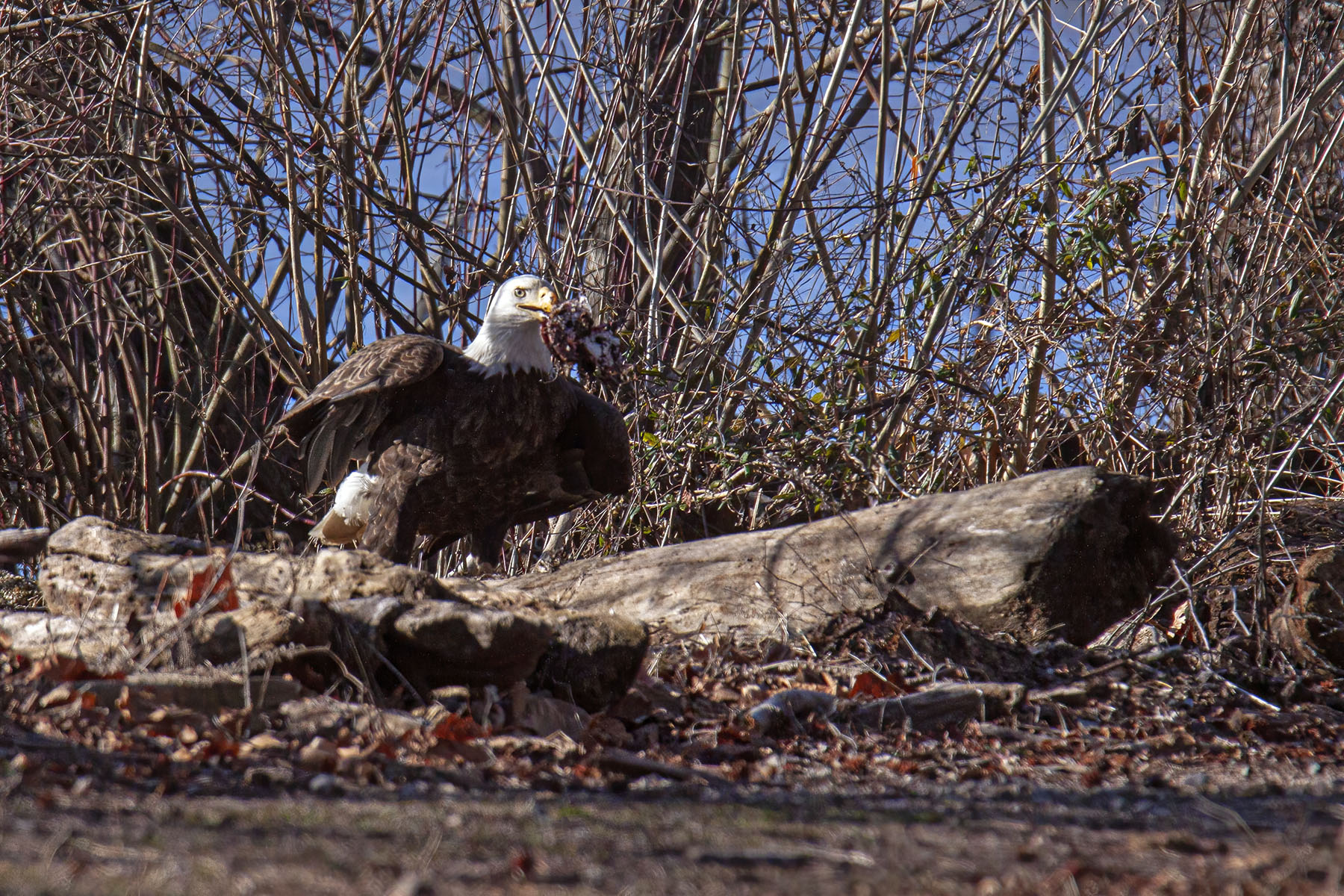
As I rounded a curve in a trail on Tuesday at Occoquan Bay National Wildlife Refuge, I saw a flash of white at ground level further down the trail. My eyes immediately registered the fact that it was a Bald Eagle (Haliaeetus leucocephalus), but my mind seemed to have trouble processing the presence of an eagle in this incongruous location. What was it doing there?

The second and third images suggest that I inadvertently interrupted the eagle as it was consuming its breakfast. I cannot identify the eagle’s prey, but it does not look like a fish to me. If you click on the images you can get a closer look at the remains of the prey and maybe you can tell what it is/was. Perhaps it was one of the many ducks that I could see on the waters of the bay that is visible through the vegetation.

As you can tell from the final photo, the eagle took off as soon as it sensed my presence, taking with it the remains of his meal. I never get tired of visiting this wildlife refuge as often as I can. There is an old adage that insanity can be defined as doing the same thing over and over again and expecting different results, so some might consider me to be a little crazy. The truth, however, is that each wildlife encounter is a unique combination of environmental factors and subject behavior, so each time there are new possibilities and opportunities to capture views of nature’s endless diversity.

Bald Eagle

Bald Eagle

Bald Eagle

© Michael Q. Powell. All rights reserved.

Read Full Post »

Hermit Thrushes (Catharus guttatus) migrate to my area for the winter, but I rarely see one, probably because they spend most of their time foraging out of sight in the underbrush. When I first spotted this one last week at Occoquan Bay National Wildlife Refuge, it was in the shadows and its shape made me think it was an American Robin, another member of the thrush family. However, when it hopped onto this branch and was better illuminated, the spotted breast and lighter coloration made it really obvious that this was not a robin.

I was a little disappointed that I did not hear this little bird sing. According to the Cornell Lab of Ornithology, “the Hermit Thrush’s beautiful, haunting song begins with a sustained whistle and ends with softer, echo-like tones.”

Hermit Thrush

© Michael Q. Powell. All rights reserved.


Read Full Post »

Northern Cardinals (Cardinalis cardinalis) often sport a Mohawk-style crest, but this female that I spotted last Thursday at Occoquan Bay National Wildlife Refuge seemed to have applied some extra gel to make her “hair” stand tall. Her outlandish look and defiant attitude make me think of a punk rocker. I looked closely at her body, expecting to see tattoos and body piercings, but as far as I could tell, there were none.

Rock on, my little punk rock cardinal, rock on.

Northern Cardinal

© Michael Q. Powell. All rights reserved.

Read Full Post »

I am not sure why the bottom feathers of this Bald Eagle (Haliaeetus leucocephalus) were in such disarray when I spotted it this past Tuesday at Occoquan Bay National Wildlife Refuge. Clearly something had ruffled its feathers, perhaps some mating activity. Spring is in the air and the eagles should soon be sitting on eggs in their nests.

The pandemic has turned our lives upside down this past year—there is something hopeful and reassuring about observing the inexorable movement in the seasonal cycles of nature. New life will soon be springing up all around us in the Northern Hemisphere with the arrival of spring. I can hardly contain my excitement.

Bald Eagle

© Michael Q. Powell. All rights reserved.


Read Full Post »

I couldn’t help but feel that this male Northern Cardinal (Cardinalis cardinalis) was irritated with me when he glared sideways at me as he momentarily ceased his pecking at water’s edge on Tuesday at Occoquan Bay National Wildlife Refuge. On the other hand, he might have simply been trying to pose in a way that minimized his double chin, about which he was very self-conscious. Have I committed a cardinal sin in my initial assessment?

What do you think? Have a wonderful weekend.

Northern Cardinal

© Michael Q. Powell. All rights reserved.

Read Full Post »

A small flock of Wild Turkeys (Meleagris gallopavo) disappeared into the underbrush on Tuesday at Occoquan Bay National Wildlife Refuge, but I kept on eye on them and managed to get this first shot as one of them made its way through the dried stalks of vegetation.

Later that same day, I had another sighting of turkeys and captured a familiar view of a turkey hurrying across the road. I like the way that the second shot shows the turkey’s “beard,” the tuft that looks a bit like a miniature horsetail dangling from its breast.

Wild Turkey

© Michael Q. Powell. All rights reserved.

Read Full Post »

Adult Bald Eagles (Haliaeetus leucocephalus) are easily identifiable because of their white heads, but it actually takes four years for them to grow “bald.” In earlier stages of development their beaks and eyes are dark and their feathers are mottled. Experienced birders can tell the precise age of a juvenile by bald eagle simply by its coloration.

This juvenile eagle that I was excited to photograph on Tuesday at Occoquan Bay National Wildlife Refuge appears to be about two to three years old. The beak has turned yellow excepted for the tip and its eyes, which are dark brown when they are really young, look like they are starting to get almost as light as those of an adult. If you want to learn more about the developmental stages of a bald eagle, check out this interesting article by Avian Report on Juvenile and Immature Bald Eagles.

The young eagle was flying above the water, apparently looking for fish, when I captured these images. I tracked it for quite a while, but never did see it pull a fish out of the water. Still, I was happy with my images and definitely enjoyed my time basking in the warmth of a sunny spring-like day as I watched and waited.


Bald Eagle

Bald Eagle

© Michael Q. Powell. All rights reserved.

Read Full Post »

I did not have much time to react yesterday when this Bald Eagle (Haliaeetus leucocephalus) zoomed past me, flying low over the waters off of Occoquan Bay National Wildlife Refuge, so I was thrilled to capture this image. I am not really sure where the eagle was headed, but it looked like he was fiercely focused on getting there quickly.

Photographing birds in flight is rarely easy. If you spot the bird when it is far away, you might have time to check your settings, calmly track the bird as it approaches, and shoot off a burst of shots at the decisive moment. That ideal situation almost never happens in my world. More often than not, the bird seems to come out of nowhere and I frantically raise my camera to my eye and try to find the bird in my viewfinder and focus on it, never knowing for sure if the camera settings will be anywhere near appropriate.

Yesterday, I managed to snap off only three shots of the eagle and only one came out in decent focus. I decided to include the second photo to give you an idea of what I was seeing through the viewfinder—it is slightly edited, but uncropped. I end up cropping most of my images, which sometimes gives the impression that I was closer to the subject than I actually was.

As you can see the eagle was quite large in the frame in this case, which meant that my heart was really racing as I scrambled to get the shot before it was too late. For those of you who might be curious, I captured the image with my Canon 50D and Tamron 150-600mm lens at 500mm with settings of f/8, 1/1250 sec and ISO 400.

In some ways I am just using a point and shoot technique when I photograph birds in flight, but it is much more sophisticated than what most people think when they hear the words “point and shoot.” After thousands and thousands of shots, I have built up reflexes and muscle memory that help me to react quickly and instinctively in situations like this. There are no guarantees of success, of course, but I have reached a point in my development as a photographer that I feel like I have a fighting chance of getting a decent shot in some pretty challenging shooting situations.


Bald Eagle

Bald Eagle

© Michael Q. Powell. All rights reserved.

Read Full Post »

How closely do you look at birds? There are some birds that are our easy for me to identify, often just by their shape. With other species, I rely on their coloration.

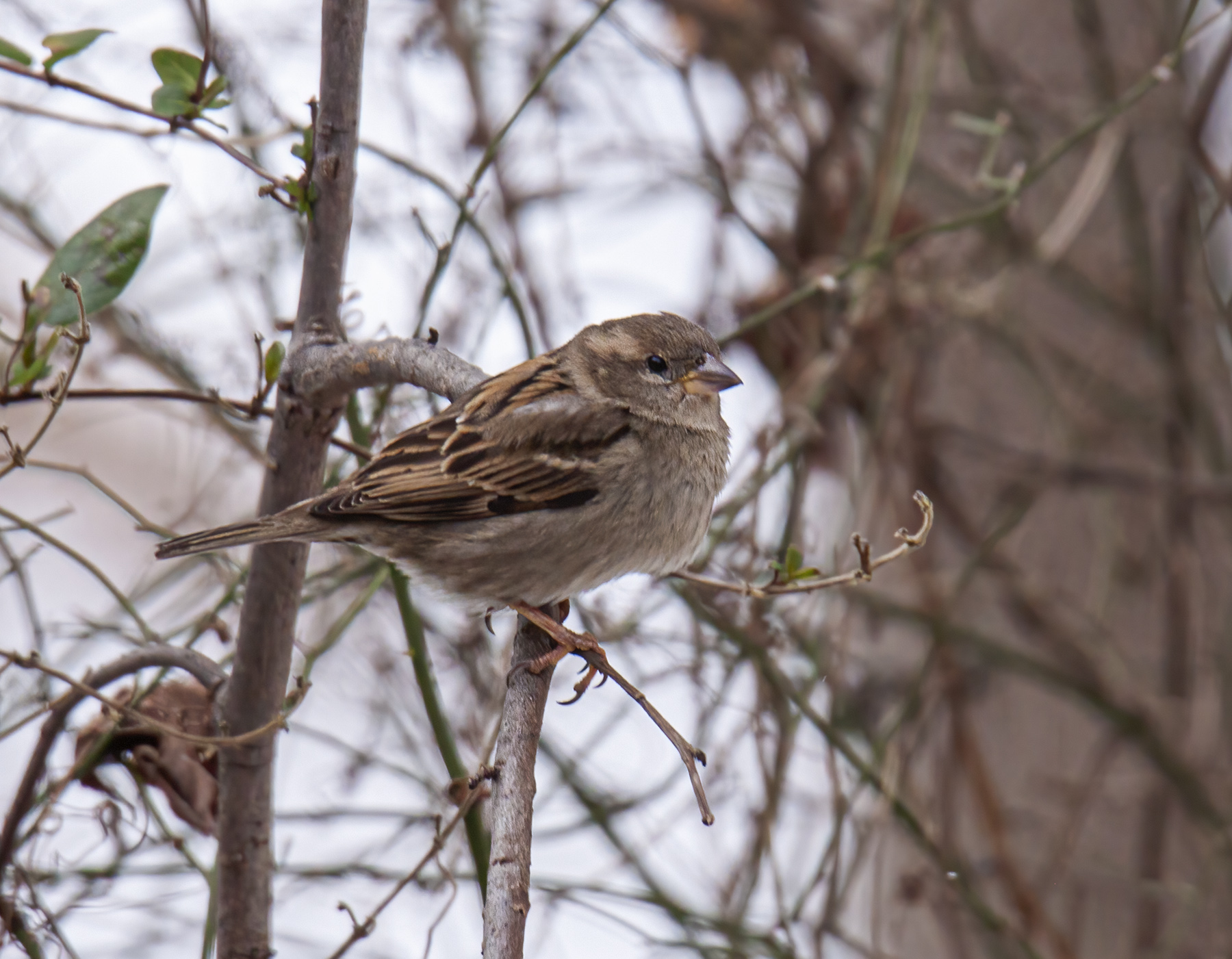
Then there are sparrows, which force me to look very carefully for subtle differences in the markings on their bodies in order to identify them. I thought that House Sparrows (Passer domesticus) were relatively easy to identify—I can readily tell that the bird in the second image is a House Sparrow, but what about the one in the first photo?

The markings on its the head are a different color and the bill is definitely lighter in color. The light orangish pink at the bill makes it look like the bird has lips. So, what kind of sparrow is it? It too is a House Sparrow, possibly a male like the one in the second shot. At different phases of their developments, the plumage of birds changes, which adds another level of complexity to bird identification.

So when I spot a bird, I have to take into consideration, its gender, age, and phase of development as well as the season of the year, habitat, and the geographic location. It sometimes feels like a miracle when I am able to identify any bird correctly.

House Sparrow

House Sparrow

© Michael Q. Powell. All rights reserved.

Read Full Post »

Sparrows are so industrious as they poke about in the underbrush that I rarely get a clean look at one. I was happy therefore that I managed to get a shot of this Song Sparrow (Melospiza melodia) when it perched momentarily on some vegetation amidst the thorny stalks recently at Occoquan Bay National Wildlife Refuge.

We have had quite a number of small snow and ice storms this winter, but it has proven difficult to capture images of bird against a snowy background. I am happy here that the sparrow chose to perch in a tiny patch of snow that adds a bit more visual interest to the shot. Several viewers yesterday commented that they like it when I show more of the bird’s environment in my photos, so I decided not to crop in too closely today.

Song Sparrow

© Michael Q. Powell. All rights reserved.

Read Full Post »

As I walked about in my neighborhood on Friday, I was reminded that we share our living spaces with some wonderful creatures, like this beautiful Red-shouldered Hawk (Buteo lineatus) that I spotted perched high in a tree. Fortunately I had my long lens on my camera and was able to capture these images. The first two images are cropped to give you a better view of the hawk, but I included the final photo to let you see the wonderful structure of the branches surrounding my subject.

People sometimes get a little freaked out by the the length of the telephoto zoom lens when it is fully extended, so I am usually reluctant to use it in a residential area—I do not anyone to accuse me of being a peeping Tom. I reserve that kind of voyeuristic behavior for wildlife.

In this case, I had stayed inside for too long because of snow and ice and felt an uncontrollable need for a photographic “fix.” Yeah, I am kind of addicted to my photography and have a codependent relationship with my camera.

Red-shouldered Hawk


Red-shouldered Hawk

Red-shouldered Hawk

© Michael Q. Powell. All rights reserved.


Read Full Post »

Sometimes my potential subjects are immediately visible and there are no obstructions between the us. In other cases, I have to look more deeply through the trees or vegetation to spot a distant subject.

Spotting the subject, though, is only the start. Oftentimes the bigger challenge is to find a visual tunnel that gives the clearest possible view of the subject. I frequently find myself leaning, kneeling, bending, and standing on my tiptoes as I consider my options.

When circumstances permit, I am able to capture images like this one of a perched Bald Eagle (Haliaeetus leucocephalus) that I saw a couple of weeks ago at Occoquan Bay National Wildlife Refuge. It is not as dynamic as some of my shots of the eagles building their nests, but I really like the mood of this little portrait and I am happy with the way that I was able to capture the ruffled feathers of this majestic bird.

Bald Eagle

© Michael Q. Powell. All rights reserved.

Read Full Post »

As the waves rhythmically struck the rocky shoreline, the Great Blue Heron (Ardea herodias) slowly moved forward, all of his attention focused on one small spot. It was lunchtime on Wednesday at Occoquan Bay National Wildlife Refuge and this heron was hungry. I watched and waited and finally the heron struck the water with a mighty thrust. When he pulled his bill out of the water, it was empty.

The heron paused for a moment and seemed pensive, wondering perhaps if he was looking for lunch in all the wrong places.

Great Blue Heron

© Michael Q. Powell. All rights reserved.

Read Full Post »

Timing is a critical skill in taking wildlife photographs (and in telling the lame jokes I so enjoy), and I was thrilled to capture this image last Friday as a Bald Eagle (Haliaeetus leucocephalus) was lifting off from its nest high in a tree at Occoquan Bay National Wildlife Refuge. I kept my wits about me and was able to track the eagle and get a few shots as it flew parallel to me  before turning and flying away.

If you remember yesterday’s posting with the singing eagle, you can’t help but notice the contrast in the sky colors. On Monday of last week, we had brilliant blue skies, which have been rare this winter, but when I took these photos a few days later, we had reverted to the gloomy, gray skies that are more typical.

Without the glare, I didn’t have to worry about blowing out the details of the eagle’s bright white head and tail, which was a definitely plus, but my camera and lens combination tends to work best when I have better light. Nonetheless, it is always a joy to successfully capture images of birds in flight, especially bald eagles.

I am particularly happy with the eagle’s wing positions in the final photo, though I dud have to crop it in an unusual way because it was near the bottom of the frame in the original shot—if the eagle had extended the wings, they would surely have been cut off in my shot.

Bald Eagle

Bald Eagle

Bald Eagle

© Michael Q. Powell. All rights reserved.

Read Full Post »

Bald Eagles (Haliaeetus leucocephalus) never seem happy and frequently look fierce or even angry. OK, I know that I am sometimes guilty of anthropomorphism, attributing human traits, emotions, or intentions to my wildlife subjects. How can you tell if an eagle is happy when their massive inflexible beaks make them physically incapable of a smile?

We often consider music to be a signal of happiness and songbirds sound happy. What about eagles—can they sing? I usually think of eagles as “screaming” rather than “singing,” but this image that I captured last week at Occoquan Bay National Wildlife Refuge makes me wonder if eagles can express their joy or their love in their songs.

What do you think? Does this eagle look happy to you?

Bald Eagle

© Michael Q. Powell. All rights reserved.


Read Full Post »

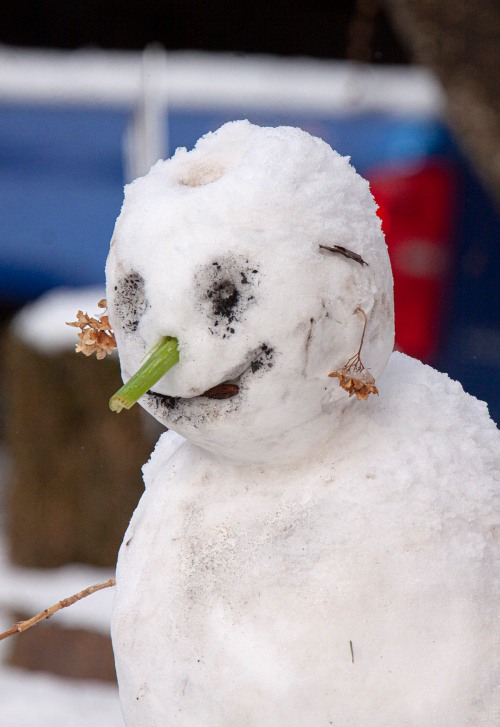
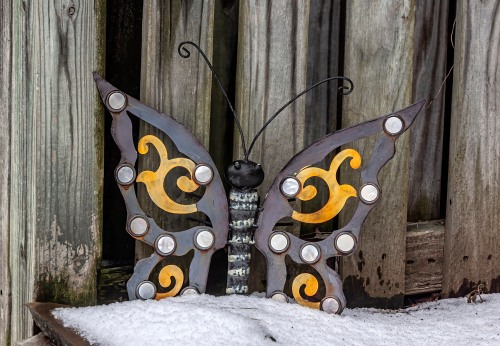
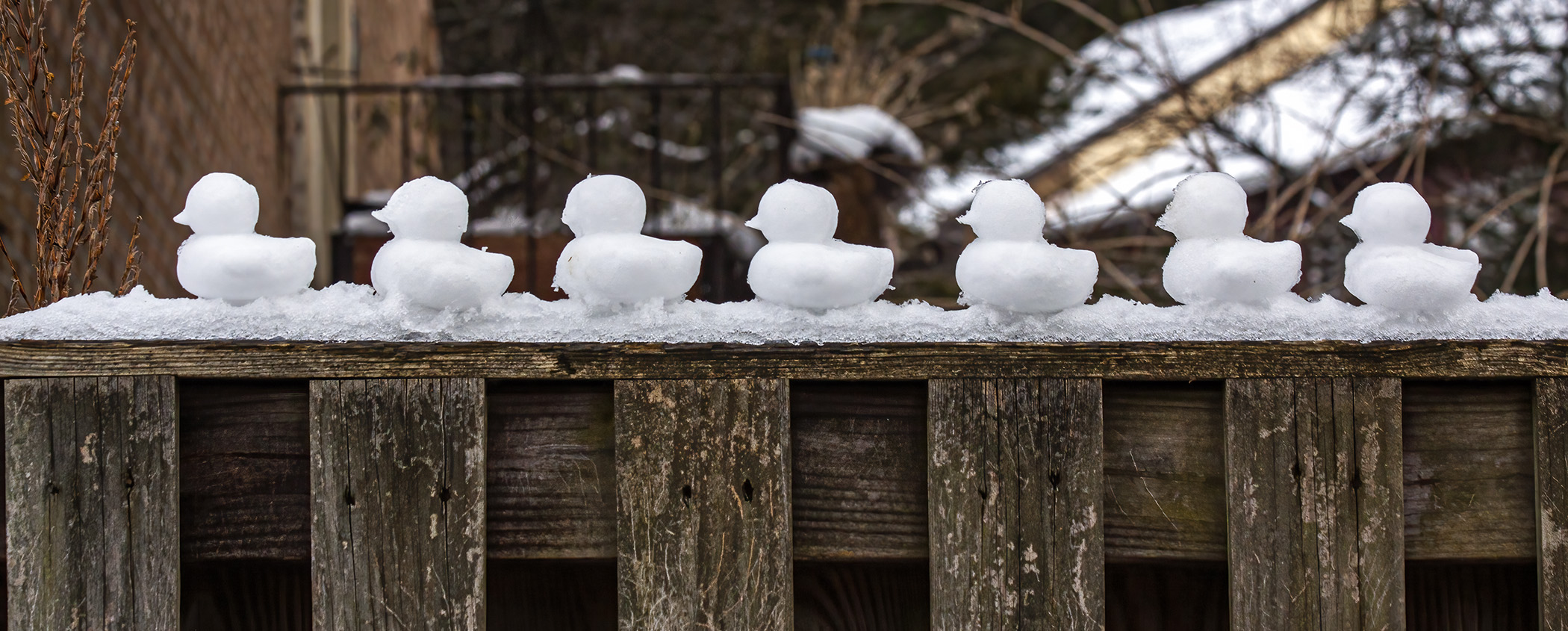
Do you have trouble getting your ducks in a row? Following a snow storm earlier this month, my photography mentor and neighbor Cindy Dyer and I played around in the snow with a device that makes snowballs in the shape of little ducks and arranged them atop her fence.

Cindy, her husband Michael, and I have made up our own little pod during this pandemic.  Cindy, Michael, and their three cats (Lobo, Queso, and Pixel) have helped keep me from going completely bonkers during our time of isolation. Zoom and other virtual communications means are good, but they can never completely replace physical contact with other humans or pets.

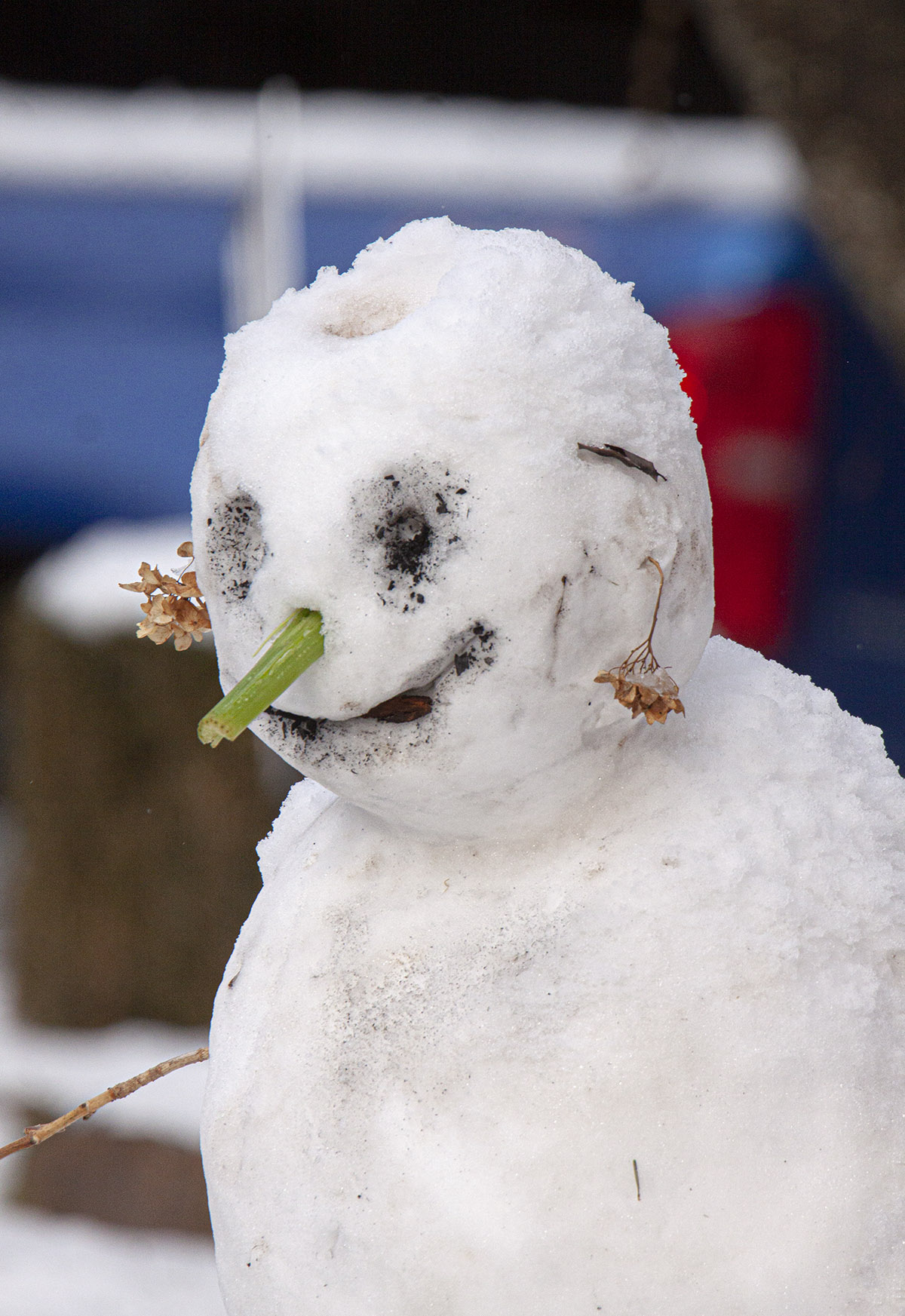
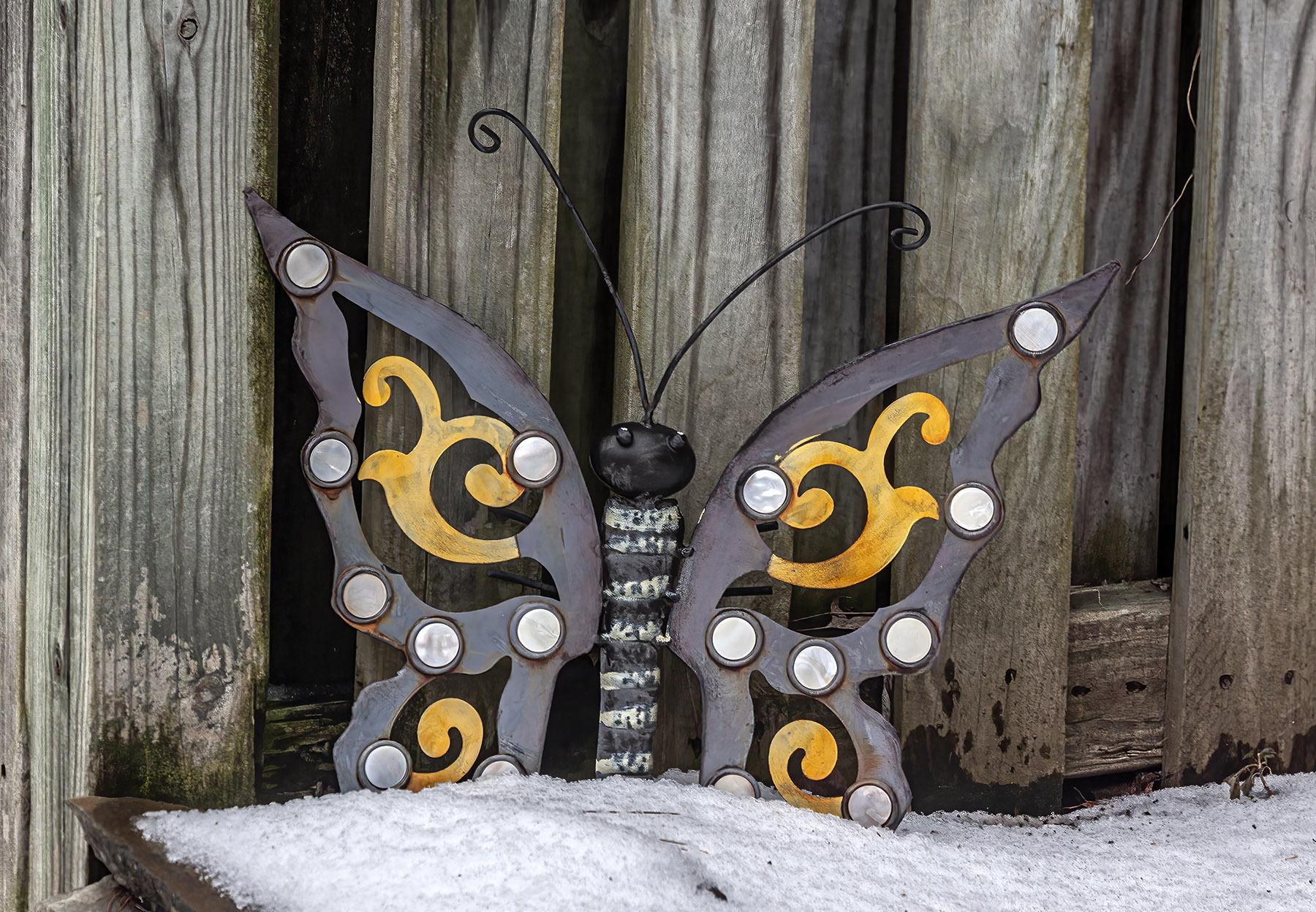
Humor helps too. When I walked through my neighborhood the day after the storm, I looked for subjects that were whimsical or simply made me smile, like the snowman with its leafy earrings and the butterfly in the snow. If you look at its nose, it is not hard to tell that the snowman is a celeried employee.

Many of you know that I have been attending a short virtual church service, called Compline in the Episcopal church, each weekday night at eight o’clock in the evening. It is a short service that, among other things, allows us to share our moments of thanksgiving and our personal prayer requests out loud or by typing them in the chat feature. After the service, we talk for a bit to see how everyone is doing and it has become traditional for me to share a daily Dad joke. If I forget, someone will usually remind me. What?

For Christmas, some dear friends sent me a daily calendar of bad Dad jokes, the kind of jokes that always elicit a combination of laughs and groans. It is a curious juxtaposition to tell jokes in the context of a church meeting, but it is a sign of how close we have become with each other—we can cry together and we can laugh together, sharing our unfiltered feelings.

How bad are the jokes? Here is a recent favorite, “I just bought a thesaurus and when I got home I discovered that all of the pages were blank. I have no words to describe how angry I am.” Sorry.

Happy Mardi Gras.
ducks in a row

snowman

butterfly

© Michael Q. Powell. All rights reserved.


Read Full Post »

There may not have been much snow on Friday at Occoquan Bay National Wildlife Refuge, but the whole world was a whiter shade of pale at water’s edge, except for this handsome male Northern Cardinal (Cardinalis cardinalis).

Northern Cardinal

© Michael Q. Powell. All rights reserved.

Read Full Post »

I spotted this Blue Jay (Cyanocitta cristata) high in the trees in my neighborhood on a day when my travels were grounded by the snow and the ice. Normally you know when there is a blue jay is in the area because their calls are really loud, but this one was surprisingly silent.

I was fascinated to read on the Cornell Lab of Ornithology website that, “The Blue Jay frequently mimics the calls of hawks, especially the Red-shouldered Hawk. These calls may provide information to other jays that a hawk is around, or may be used to deceive other species into believing a hawk is present.” I think that my neighborhood blue jays have deceived me on multiple occasions when I searched in vain for a hawk upon hearing one of its distinctive calls.

If you look closely at the feet of this bird you may notice that they are not in contact with any of the branches. There also does not appear to be any wing movement, so perhaps the blue jay was practicing its levitation skills. While that is certainly possible, I believe that the blue jay may simply have been hopping to another spot on the branch and did not want to bother with flapping its wings.

Blue Jay

© Michael Q. Powell. All rights reserved.

Read Full Post »

The Bald Eagle (Haliaeetus leucocephalus) was hunkered down in its large nest last week at Occoquan Bay National Wildlife Refuge but still managed to keep an eye on me through a peephole between the branches. (You may need to enlarge the first image to see the eagle, in what has been described by one of my friends as a “Where’s Waldo?” photo.) Earlier I had seen both of the eagles fly into the nest and they promptly disappeared from sight—one left a short time later.

As I watched and waited, I realized that I would have a tough time timing any shots of the eagle leaving the nest. When a bird is perched, I look carefully for indications that the bird is preparing to depart, hoping to be able to capture a decisive moment. The second shot below was the best that I could manage when I reacted to the appearance of a wing tip over the edge of the nest.

I have no way of judging the dimensions of the interior of the nest, but it looks to be really big and really deep, as you can see in the final photo. In the past, it has been hard to spot eaglets in this nest until they are old enough to climb around a little and pop their heads over the edge of the nest. I hope to see some little ones in this nest later this season.

Bald Eagle

Bald Eagle

Bald Eagle nest

© Michael Q. Powell. All rights reserved.

Read Full Post »

For almost a year now we have been taking defensive measures to minimize our risks—we now must cautiously consider our actions before we take them. “Spontaneity” has almost disappeared from our active vocabulary. Were we ever completely carefree?

When I first looked at this photograph of a Carolina Wren (Thryothorus ludovicianus) that I spotted on Monday at Occoquan Bay National Wildlife Refuge, I immediately saw it as a kind of visual metaphor for my life. Surrounded by thorns in an almost monochromatic world, this serious-looking little bird cautiously contemplates its surroundings. Is it safe yet?

No, it is not yet safe, but there are signs of hope that things are improving. Vaccinations have started and here in the Northern Hemisphere, there are already small indications that spring is on the way. The birds are preparing their nests and buds are appearing on the trees.

Our celebrations may still be muted, but even now there is joy to be found. Don’t forget to stop and look for it in today—joy in the midst of caution.

Carolina Wren

© Michael Q. Powell. All rights reserved.

Read Full Post »

« Newer Posts - Older Posts »