Feeds:
Posts
Comments

Archive for the ‘Birds’ Category

I spotted this juvenile Red-shouldered Hawk (Buteo lineatus) on Monday at Occoquan Bay National Wildlife Refuge as it perched high in a distant tree. It was cold and breezy, so I kept one of my hands inside the pouch of my hooded sweatshirt much of the time. Similarly the hawk appeared to be trying to stay warm by tucking one of its feet inside its puffed out feathers with only the tips of his talons exposed.

The hawk was very alert and soon sensed my presence and flew a short distance to a tree a little farther away. It perched there for only a few moments before it took off again and I was able to capture the second shot below. I was pretty lucky with the timing of the shot, because I managed to capture a relatively clear view of the hawk’s head in between the the branches of the tree. Serendipitously I also captured a tiny branch in midair that had been dislodged as the hawk pushed away from the branch—you may need to enlarge the photo to see the branch, but it is in the lower left-hand corner of the image.

I am pretty sure this is a Red-shouldered Hawk, but identification is sometimes a little tricky for me with immature birds. Earlier this season, for example, I spotted an immature Cooper’s Hawk that had markings similar to this hawk.  However that hawk seemed to have longer tail feathers and a slimmer body than this one. Here is a link to that 3 November 2021 posting entitles Cooper’s Hawk (immature), in case you want to do your own visual comparison between the two hawks.

Red-shouldered Hawk

Red-shouldered Hawk


© Michael Q. Powell. All rights reserved.

Read Full Post »

I always admire the agility and balancing skills of tiny birds—I know that I could not hold a position like that of this sparrow that I spotted last week at Huntley Meadows Park. I think that it is a Song Sparrow (Melospiza melodia), but I am always a bit uncertain when it comes to sparrows.

As for balance, I know that I can always use more of that in my life. When I was still working full-time, all my employers gave lip service to the importance of “work-life balance.” The sad reality was that most of us were workaholics devoting way too much energy to our work and neglecting our lives. It was only when I cut back on my hours during the final decade of my work life that I began to discover some of that mythical sense of balance.

Part of that process has been a deliberate cultivation of my creative side, which I have neglected most of my life. My photography and this blog have played a critical role in that journey of discovery and rediscovery. I really appreciate all of the support and encouragement that so many of you have provided over the years and continue to provide as my journey continues. Thanks.

Song Sparrow

© Michael Q. Powell. All rights reserved.

Read Full Post »

A Bald Eagle (Haliaeetus leucocephalus) was wedged in so tightly between the branches that it almost looked like it was hugging the tree last Thursday at Occoquan Bay National Wildlife Refuge. The eagle was perched in a tree just off of the trail that I was following. The sun was shining brightly, but it was not generating much heat and a breeze was kicking up periodically, ruffling the eagle’s feathers.

I realized that I had a problem when I first focused on the eagle—I was looking right into the sun and the eagle was nothing but a silhouette. On one side of me was thick vegetation and the water of the bay was on the other side, so my options for framing a shot were limited. I realized that the only way that I could get a decent shot of the eagle was to walk past it and then turn to face it with the sun to my back.

Sound crazy, right? I moved as slowly and cautiously as I could and amazingly my plan worked. As the first photo suggests, the eagle was aware of my presence, but did not immediately take off. I observed it silently for a few minutes as it adjusted its position and preened a bit.

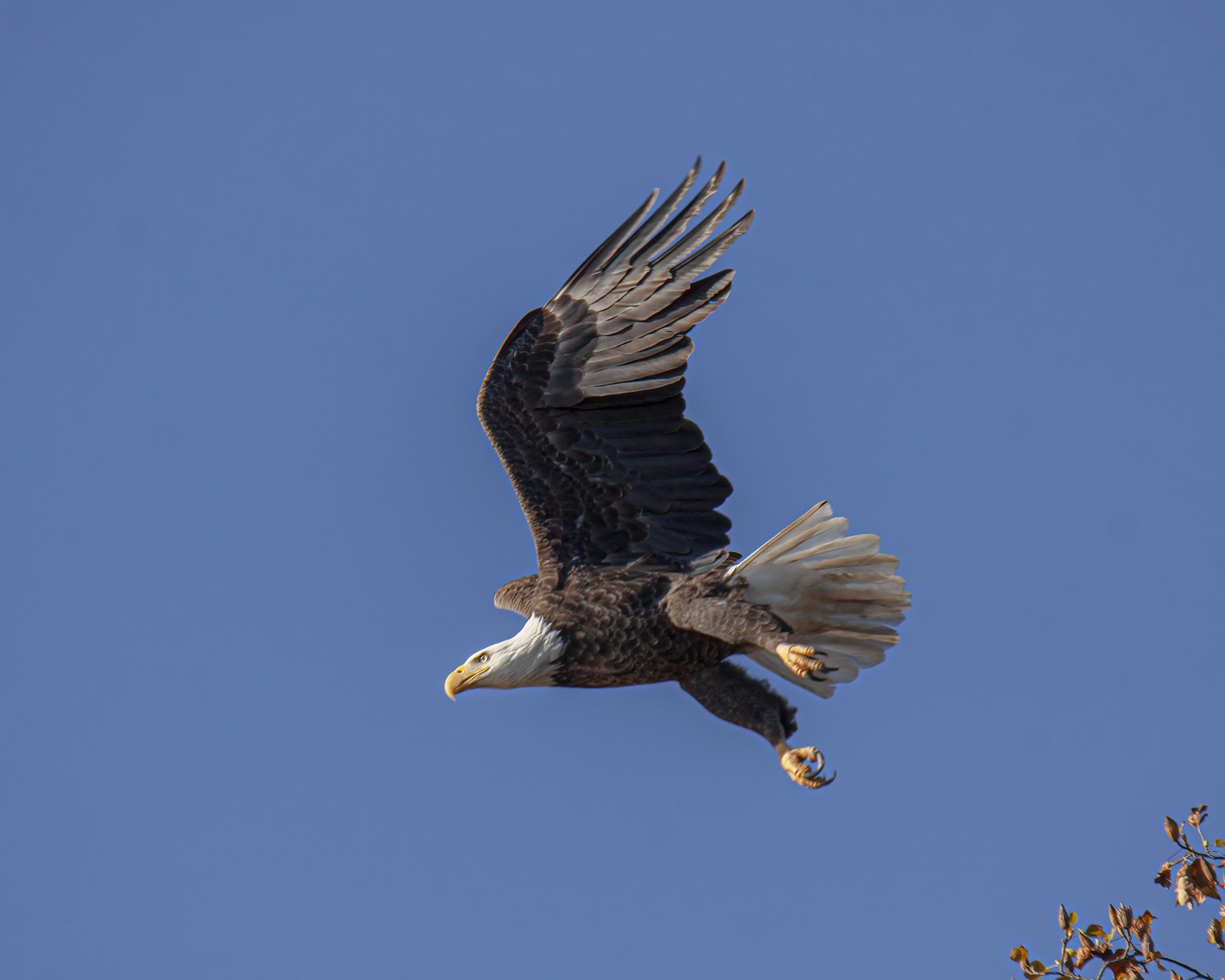
I was preparing to move on when suddenly the eagle took off. My camera was zoomed in all of the way, so I was not able to capture the eagle’s full wingspan when it flew almost directly over me as it cleared the sweet gum tree in which it was perched. I managed, however, to get a pretty good shot at the eagle’s body and especially its talons from this unusual shooting angle.

It is almost time for the eagles at the refuge to begin their nesting and authorities have already blocked the roads in some areas of the refuge. With a little luck, though, I will be able to get some shots in the upcoming of the eagle couples as they renovate the nests, albeit from a far greater distance than when I captured the images in this posting.

Bald Eagle

Bald Eagle

Bald Eagle

© Michael Q. Powell. All rights reserved.

Read Full Post »

I often have trouble identifying sparrows, with the possible exception of White-throated Sparrows (Zonotrichia albicollis). These colorful sparrows migrate to my area in the fall and overwinter with us in quite large numbers. Their prominent white “beards” help me to distinguish them from other sparrows and often remind me of Santa Claus, especially during the pre-Christmas frenzy of activity during December.

Sometimes, though, the white throat patch is not quite so prominent, as in the second image below. In cases like this, I rely on the bright yellow stripe between the bill and eye, an area known as the “lore,” to identify the bird as a White-throated Sparrow.

White-throated Sparrow

White-throated Sparrow

© Michael Q. Powell. All rights reserved.


Read Full Post »

Carolina Wrens (Thryothorus ludovicianus) are incredibly hard to see, because they spend a lot of their time moving through the underbrush in areas with heavy vegetation. However, it is not hard to know that one of them is around, because Carolina Wrens delivers an amazing number of decibels for their size.

These spunky little birds sing loudly and often—according to the Cornell Lab of Ornithology, one captive male Carolina Wren sang nearly 3,000 times in a single day. The Cornell Lab noted further that, “Only male Carolina Wrens sing—a series of several quick, whistled notes, repeated a few times. The entire song usually lasts less than 2 seconds and the notes are usually described as three-parted, as in a repeated teakettle or germany. Each male has a repertoire of up to several dozen different song variations. He’ll sing one of these about 15 times before changing his tune.” Check out this link to hear recordings of some of those sounds.

This past Thursday, I while I was at Occoquan Bay National Wildlife Refuge, I spotted some movement in the brush and heard the singing of a Carolina Wren. The bird was mostly hidden, but I managed to find a small visual tunnel through the vegetation that allowed me to get this shot of the wren when it hopped up onto a broken-off branch.

I was thrilled to be able to capture this image mid-song—it helps to show the personality of the wren. I also really like limited color palette—mostly various shades of brown—that give the image a really pleasant color harmony.

Carolina Wren

© Michael Q. Powell. All rights reserved.

Read Full Post »

I often see Turkey Vultures (Cathartes aura) soaring high overhead when I am exploring Occoquan Bay National Wildlife Refuge. I have always been amazed at the way that they effortlessly glide for long periods of time without having to flap their wings. I never really appreciated, though, how massive a wingspan Turkey Vultures have, because the the previous times I had seen a vulture at close range, they have generally been perched with their wings tucked in.

On Thursday, I managed to flush several Turkey Vultures that had been pecking away at something at water’s edge. They flew up into some nearby trees and began to preen themselves as they patiently waited for me to pass. I was quite surprised when one of them spread its wings wide open and then glanced back at me over its shoulder. The wing display was impressive.

I also took advantage of the situation to capture a portrait shot of one of the other vultures that was perched on a broken off tree. I not sure that I would call this bird “beautiful” in a traditional sense, but I do like the way that I was able to capture a bit of its personality in this shot—there is even a hint of a smile.

Turkey Vulture

Turkey Vulture


© Michael Q. Powell. All rights reserved.

Read Full Post »

Most woodpeckers have simple patterns of black and white feathers and sometimes a touch of red. Northern Flickers (Colaptes auratus), on the other hand, have a beautiful brown plumage that is richly patterned with black spots, bars, and crescents and also have brightly-colored wing and tail feathers that, alas, are often hidden from view when they are perched—I like to think of flickers as the “rock stars” of the woodpecker world.

I was fascinated to read on the Cornell Lab of Ornithology website that there are two variants of Northern Flickers, an Eastern one and a Western one. “The key difference is the color of the flight-feather shafts, which are either a lemon yellow or a rosy red. Yellow-shafted forms have tan faces and gray crowns, and a red crescent on the nape. Males have a black mustache stripe. Red-shafted forms have a gray face, brown crown, and no nape crescent, with males showing a red mustache stripe.”

The flicker’s flight-feathers are not visible in the photo below, but you can see the male’s black mustache stripe, indicating that he is an Eastern variant. I highly recommend clicking on the image to get a closer view of the fascinating patterns in the plumage of this beautiful bird that I spotted on Wednesday at Huntley Meadows Park.

Northern Flicker

© Michael Q. Powell. All rights reserved.


Read Full Post »

Chickadees are masters at staying hidden. These little birds seem to enjoy hanging out in the shadowy branches, where their lack of bright colors makes them hard to spot. It is amazing how often we tend to focus on colors to make something “pop” out of a scene.

I spotted this Carolina Chickadee (Poecile carolinensis) last week at Occoquan Bay National Wildlife Refuge when it perched momentarily on an open branch. I really like the way the image turned out—a pleasant little portrait with a simple composition and limited color palette. 

Carolina Chickadee

© Michael Q. Powell. All rights reserved.

Read Full Post »

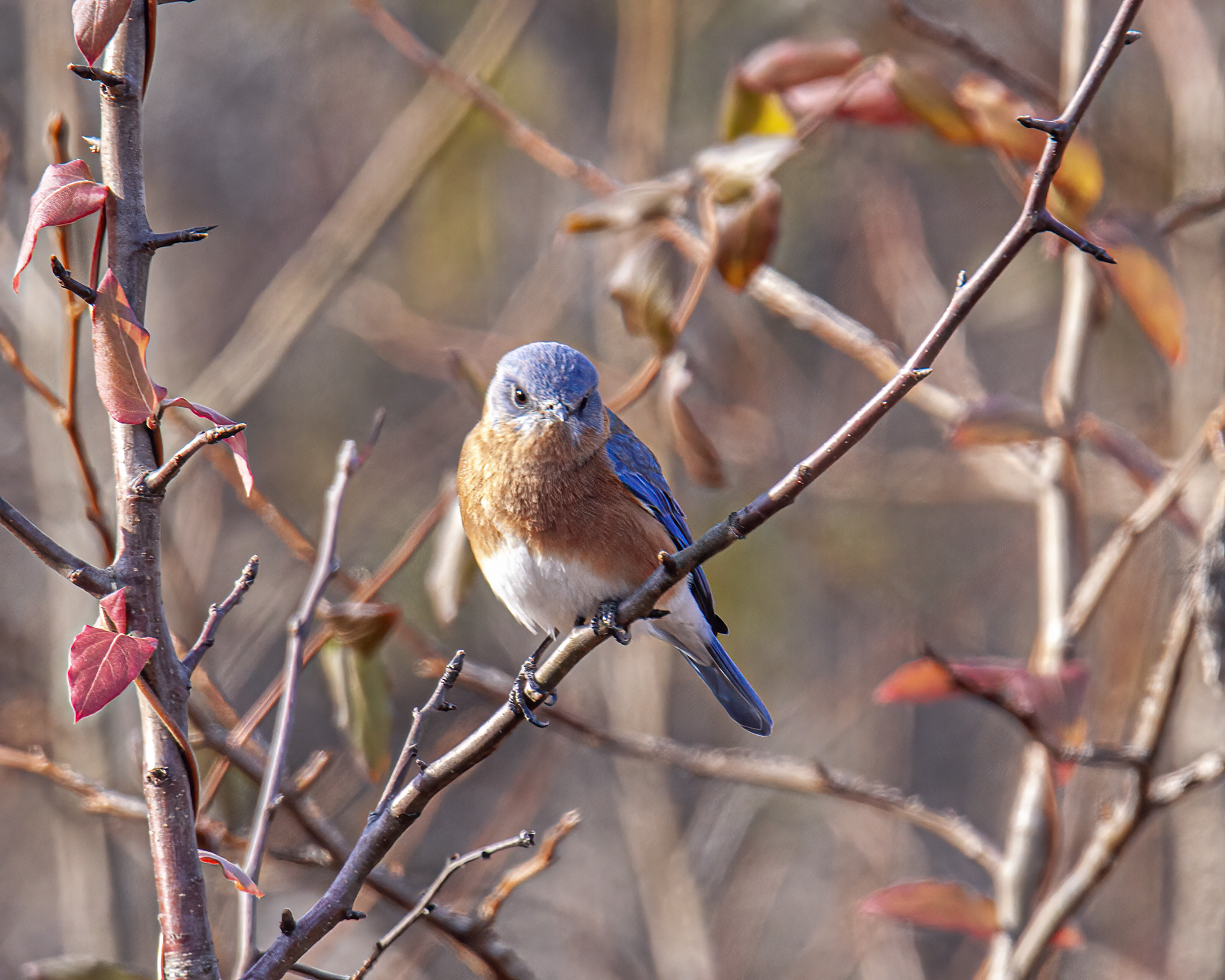
Do certain bird elicit an involuntary emotional response from you when you see them? Eastern Bluebirds (Sialia sialis) invariably make me feel happy—I can’t help but smile when I see one of these “bluebirds of happiness,” like the ones that I spotted last week at Occoquan Bay National Wildlife Refuge.

I have wonderful memories of watching The Wizard of Oz as a child and many times since then. One of my favorite moments in the movie is when Dorothy (Judy Garland) sings “Over the Rainbow.” I love to think of a place where the dreams that you dare really do come true, somehow symbolized by bluebirds flying.

“Somewhere over the rainbow, bluebirds fly
Birds fly over the rainbow
Why, oh, why can’t I?
If happy little bluebirds fly
Beyond the rainbow
Why, oh, why can’t I?”

Eastern Bluebird

Eastern Bluebird

Eastern Bluebird

© Michael Q. Powell. All rights reserved.

Read Full Post »

It was cold, cloudy, and windy last week when I visited Occoquan Bay National Wildlife Refuge—it definitely is beginning to feel like winter. I had bundled up, wearing a hooded jacket and gloves in an effort to stay warm.

On days like this, I often marvel at the ability of wild creatures to survive in harsh weather conditions. I was a little surprised when I spotted a Bald Eagle (Haliaeetus leucocephalus) nestled into the inner branches of a tree. Quite often when I see eagles, they are perched at the top of trees, majestically surveying their kingdom from on high.

This eagle, however, seemed to be hunched over a bit with its feathers puffed up, perched lower in the tree. The eagle’s feet with their massive talons were tucked in under the feathers, presumably to help them stay warm.

Vegetation kept me from getting very close to the eagle and I really did not want to disturb the eagle from its comfortable perch. So I framed my shots from a somewhat awkward angle, content that I had even spotted this handsome bird.

As I was preparing to move on, I noticed the eagle beginning to shift around a little. I correctly guessed that the eagle was preparing to take off, but did not react quickly enough to capture the action. I was still focused on the branch and when the eagle spread its wings and took to the air, I clipped its wings, not realizing in that split second that I had zoomed in too closely.

Still, I am pretty happy with the second shot below and the way that it caught the eagle in mid-air. There is a dynamic feel in this kind of action shot that is impossible to capture when a bird remains perched. The degree of difficulty though is significantly magnified when motion is involved, so I tend to judge myself a little less critically when photographing moving subjects, like this puffy bald eagle, vice static subjects.

Bald Eagle


Bald Eagle

© Michael Q. Powell. All rights reserved.

Read Full Post »

Even when the winter days are dark and gray and clouds cover the sky, I can usually spot some sparrows foraging about on the ground or in the trees. I used to throw all of the sparrow into the the category of “little brown birds,” but over time I have begun to be able to identify some of the individual sparrow species.

I spotted this sparrow last week as I was exploring Occoquan Bay National Wildlife Refuge and am pretty confident that it is a Song Sparrow (Melospiza melodia). I really like the streaky pattern on its chest feathers and the warm red-brown color on its head.

Normally I won’t try to get a head-on shot of a bird, because it tends to distort their features, but I like the way that I was able to capture the intensity of the sparrow as it glared at me when I was capturing the first image—it did not seem very happy with my presence. The second pose is a more traditional bird image from the same perch after the sparrow lowered its head and turned to the side.

I will usually try to take multiple photos in a sequence when a bird is perched like this, because, I have learned, birds change their positions really quickly and very frequently. I never know when I might be able to capture a more interesting pose as the bird shifts about, so I often keep shooting—it is amazing how many shots I end up of empty perches when my finger triggers the shutter a split second after the bird has flown away.

Song Sparrow

Song Sparrow

© Michael Q. Powell. All rights reserved.

Read Full Post »

I was thrilled when I spotted a flock of Cedar Waxwings (Bombycilla cedrorum) on Thursday at Occoquan Bay National Wildlife Refuge, because I consider them to be one of the coolest-looking birds in our area. I love their rakish masks, punk-style crests, and yellow-tipped tails. I do not see them very often, but when I do, the Cedar Waxwings tend to be part of a large group.

The Cedar Waxwings moved from tree to tree, devouring berries as they went along. According to the Cornell Lab of Ornithology, the Cedar Waxwing is one of the few North American birds that specializes in eating fruit and it can survive on fruit alone for several months. However, “Because they eat so much fruit, Cedar Waxwings occasionally become intoxicated or even die when they run across overripe berries that have started to ferment and produce alcohol.”

I was hoping to get some shots of these voracious birds in action, but they stayed high in the trees and were mostly hidden from view by branches. I am pretty happy, though, with the shots that I was able to get of these beautiful birds.

Cedar Waxwing

Cedar Waxwing

© Michael Q. Powell. All rights reserved.


Read Full Post »

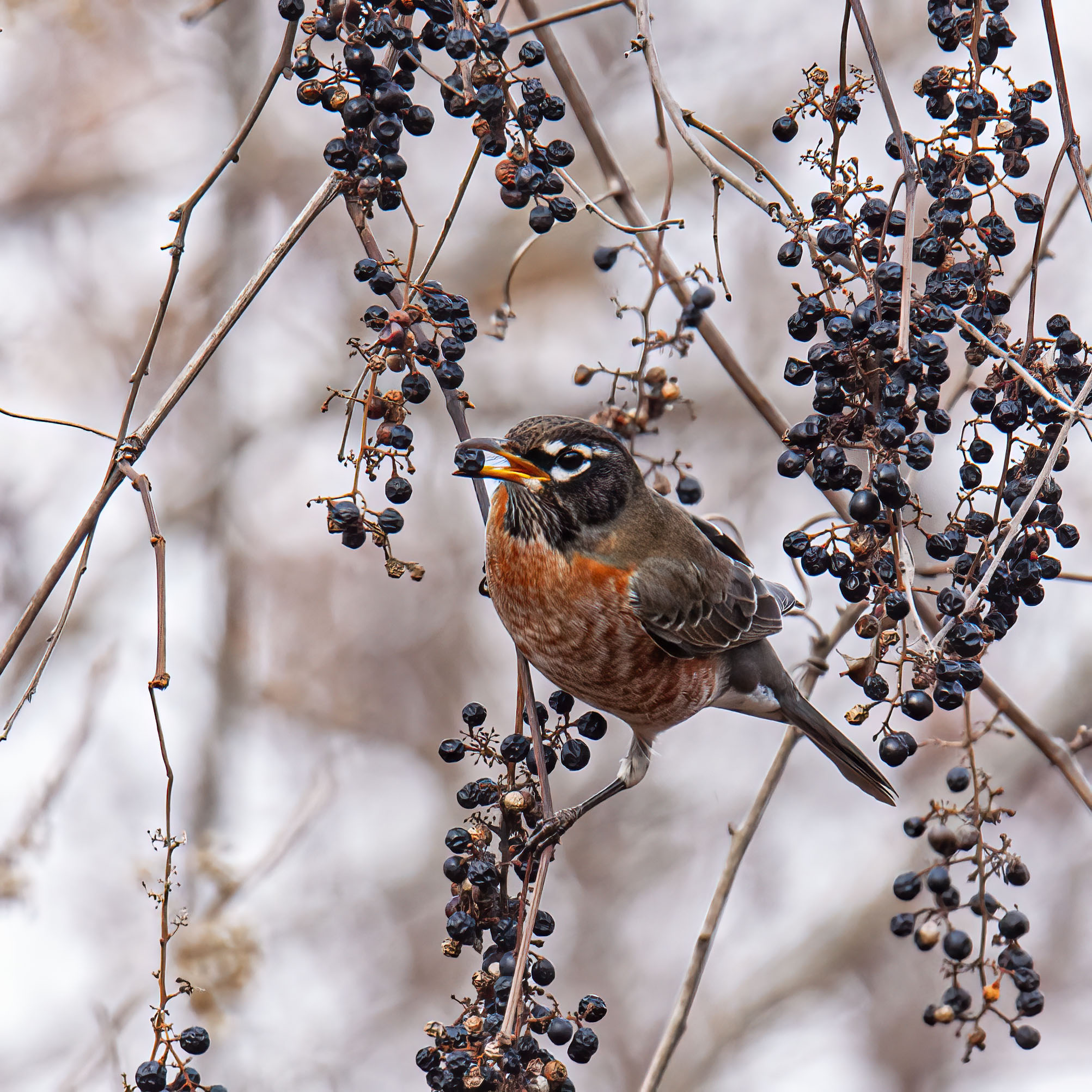
When I was growing up in Massachusetts, I always looked considered the appearance of an American Robin (Turdus migratorius) to be a harbinger of spring. In my mind’s eye I think of robins pecking about in the grass, pulling fat little worms out of the ground.

In Northern Virginia, where I now live, I am likely to see robins throughout the entire  year. This past Thursday I spotted a large flock of them at Occoquan Bay National Wildlife Refuge. Robins always seem warm and familiar to me and never fail to bring a smile to my face, in part because they bring to mind the song “When The Red Red Robin Comes Bob Bob Bobbin’ Along.” Check out this YouTube link to a wonderful version of that song by Al Jolson.

As we approach the start of winter, robins and many other birds start to eat increasingly larger amounts of fruits and sees, which is good, because it would be tough for them to find worms or insects. The robin featured in these photos was feasting on some berries. They kind of look like wild grapes, but I definitely do not know plants well enough to know if that is what they actually were. In any case, the robin seemed to be really enjoying them.

American Robin

American Robin

American Robin

© Michael Q. Powell. All rights reserved.


Read Full Post »

Many of the birds that I try to photograph are skittish, but the Belted Kingfisher (Megaceryle alcyon) may take the prize for being the most skittish. The kingfisher is amazingly energetic and exceptionally alert and will frequently fly away before I am even aware of its presence. As it zooms out of sight, the kingfisher will often make a distinctive rattling call, almost like it is taunting me.

Yesterday at Occoquan Bay National Wildlife Refuge, I spotted the distinctive silhouette of a kingfisher perched on branch overlooking the water. The small bird was a good distance away, but as I peered through my telephoto lens, I could tell that it had caught a fish and was busily subduing the fish—a kingfisher will pound its prey against its perch before swallowing it head first.

I was faced with a dilemma. Should I try to get a distant shot, knowing that I might scare the bird away, or should I try to move closer for a better shot and risk not getting any shots at all? In this case, I chose the safer approach and took this long range shot. The kingfisher did not fly away while I was taking the shot, but when I took  few steps down the trail towards it, the kingfisher immediately took to the air.

I am pretty happy with the image that I was able to capture. If you click on the photo, you will see that I was able to capture some of the detail of this beautiful little bird and even some details of the hapless fish.

Belted Kingfisher

© Michael Q. Powell. All rights reserved.


Read Full Post »

Although there are quite a few Wild Turkeys (Meleagris gallopavo) at Occoquan Bay National Wildlife Refuge, they tend to pretty elusive and I never quite know when I will encounter one. I spotted two large turkeys on Monday and was happy to be able to snap off a few shots before they disappeared into the underbrush.

The “beard” of this turkey is quite impressive in its length, so it is most likely a mature male—as is the case with humans, most female wild turkeys do not have beards. A turkey’s beard grows throughout its life and can reach a length of over 12 inches (30 cm).

Apparently you can also tell the age of a male wild turkey by the size of its spurs, the pointy protrusions on the lower portion of a turkey’s legs. If you click on the second image, you can get a better look at this turkey’s spurs that are quite prominent, again signifying that this is a mature male, probably at least a couple of years old.

Wild Turkey

Wild Turkey

© Michael Q. Powell. All rights reserved.


Read Full Post »

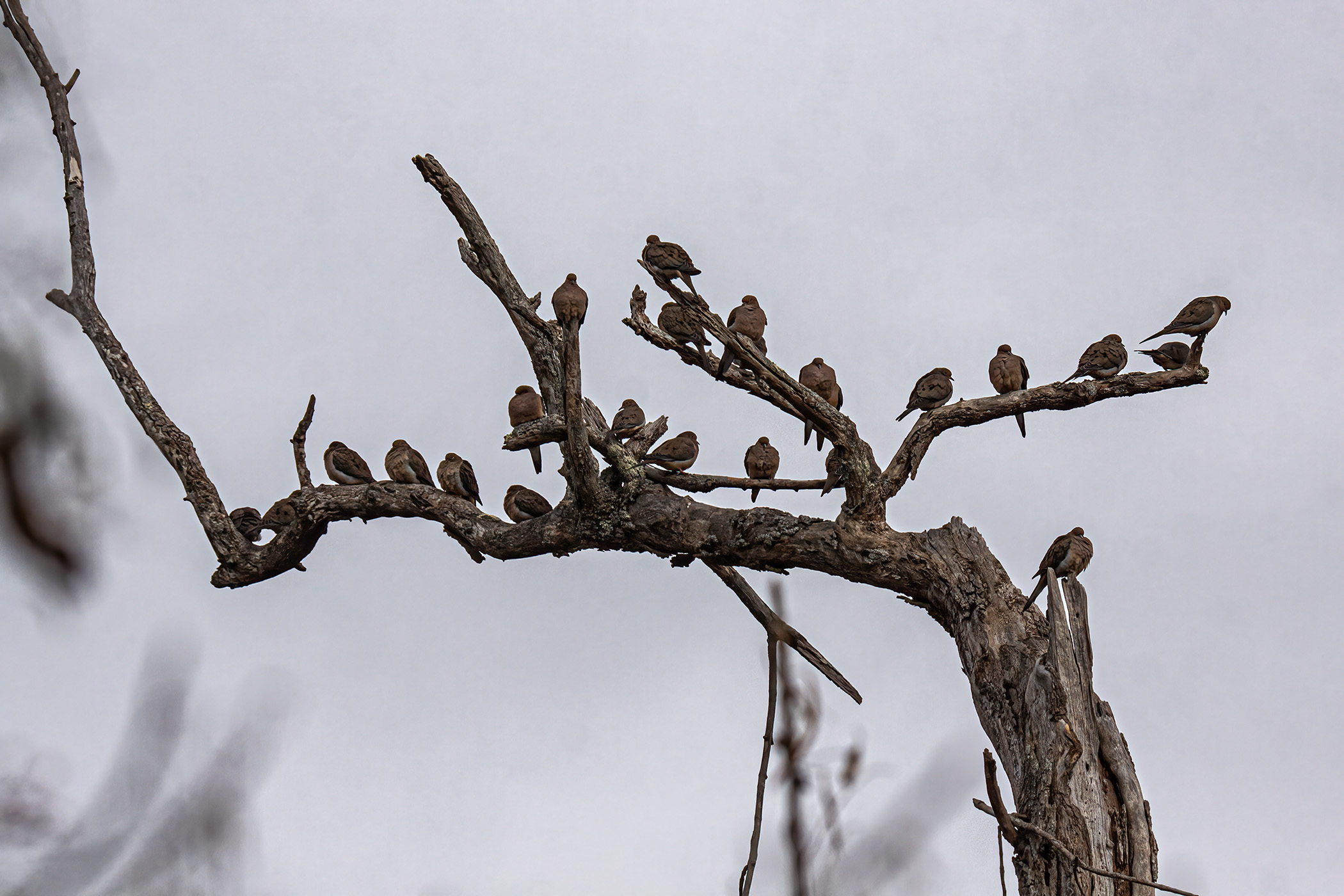
It was cold and gray the last time that I visited Occoquan Bay National Wildlife Refuge two weeks ago. I was bundled up to try to stay warm and some of the small number of birds that I did see had fluffed up their feathers. Others, like this small flock of Mourning Doves (Zenaida macroura) were huddled together on the branches of a distant dead tree.

There was not a lot of light and the birds appear almost as silhouettes in this image. The image has a stark, bare quality to it that captures well the bleakness of the moment. Although we are technically not yet in winter, this day offered a foretaste of the colorless days to come.

Since I took this photo, I have been to the West Coast and back. I still have some photos from my time there that I plan to post here, but decided to post this image today in an effort to reground myself on the East Coast. I am also planning to go out today with my camera and hope to capture some more cheery images than this one. Who knows, maybe I will even find a late season dragonfly.

Have a wonderful week.

Mourning Doves

© Michael Q. Powell. All rights reserved.

Read Full Post »

I have not had very many opportunities to take wildlife photos during my time here in the state of Washington, so I was particularly delighted when I spotted some birds during a trip to Anacortes on Wednesday.

There were quite a few cormorants hanging around a dock area, including the one in the first photo below. I think it is a Double-crested Cormorant (Phalacrocorax auritus), although I am aware that are some additional cormorant species on the West Coast of the US, so I am a little uncertain about my identification.

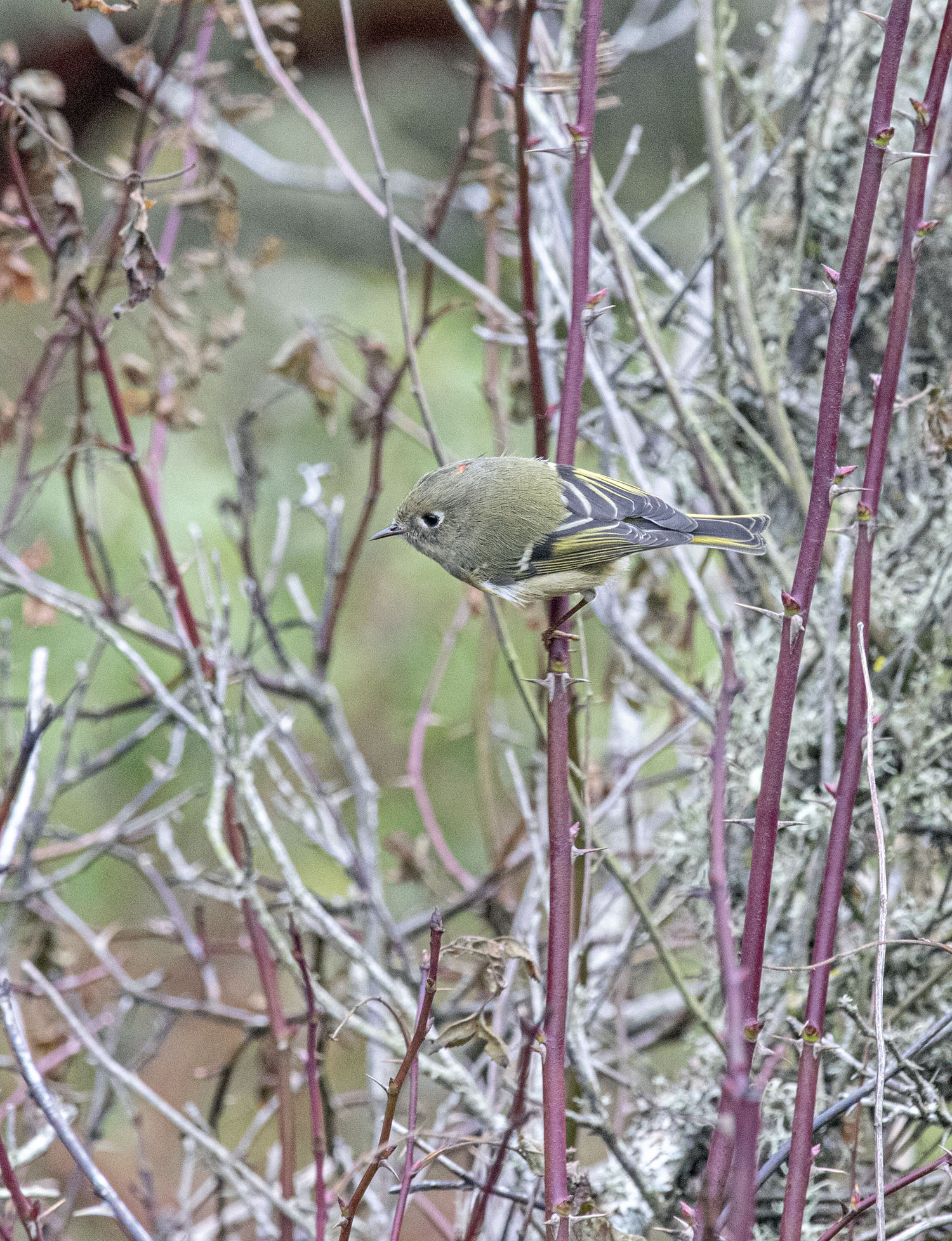
As I was exploring a lake a little later in the day, I spotted a tiny Ruby-crowned Kinglet (Regulus calendula) in the vegetation. I had a 55-250mm lens on my camera, the longest lens that I brought with me on this trip, so I did not think I would be to get a decent shot of the elusive bird—normally when I am photographing birds I use a 150-600mm lens. I was pretty happy with my kinglet shot, the second image below.

The bird in the final photo is a male Bufflehead duck (Bucephala albeola) that I spotted at the same lake. He was a good distance away, but I managed to capture a hint of his colorful iridescent plumage—you may need to click on the image to get a better look at his coloration.


cormorant

Ruby-crowned Kinglet

bufflehead

© Michael Q. Powell. All rights reserved.

Read Full Post »

I grew up in the suburbs, so farm animals still seem “exotic” to me and are fun to photograph. During my visit to Washington state, I have enjoyed observing the five chickens and one duck that my son Josh and his wife keep in a pen in their large back yard.

It was especially fun to watch them yesterday when the birds were free to explore the entire fenced yard while Josh cleaned their pen. I was initially concerned that the dogs would chase after the chickens, but they seemed fine together, though we did keep an eye on them to make sure there were no problems.

poultry

poultry

duck

chicken

© Michael Q. Powell. All rights reserved.

Read Full Post »

I was thrilled to spot this Great Blue Heron (Ardea herodias) last Saturday as it sheltered in the vegetation at the edge of a small pond at Occoquan Bay National Wildlife Refuge. Initially I took a photo from a distance, but then followed the trail along the edge of the pond and managed to get some closer shots.

Most of the time, Great Blue Herons seem stoic and impassive, but this one showed a lot of personality, especially in the first image. When I asked him to smile for the close-ups, though, he decided he wanted a more serious, dignified look, as you can see in the final two photos. I liked the resulting images and the think the heron would have been happy too.

Great Blue Heron

Great Blue Heron

Great Blue Heron

© Michael Q. Powell. All rights reserved.

Read Full Post »

It was cool and breezy last Saturday at Occoquan Bay National Wildlife Refuge and most birds seemed to be out of sight, seeking shelter to stay warm. I was thrilled therefore when I managed to spot this pair of Bald Eagles (Haliaeetus leucocephalus) perched together on a distant tree.

I suspect that this is an eagle couple and the two eagles appeared to be carrying on a spirited discussion. Although it is hard to be certain of their genders, female eagles tend to be larger than their male counterparts, so I suspect that the eagle on the right is the female one.

Bald Eagles

© Michael Q. Powell. All rights reserved.

Read Full Post »

A large raft of American Coots (Fulica americana) has been hanging out recently in the waters off of Occoquan Bay National Wildlife Refuge. The coots stay together pretty closely and have remained out in the deep waters, so getting a close-up shot of a single coot has proven to be impossible.

I have tried a number of different approaches to capturing a sense of this group of active water birds and here are some of the resulting images. The first image gives the viewer a feeling of the chaotic activity at the center of the group as one coot flaps its wings. The second image focuses on the coot in the foreground, facing in the opposite direction from most of the others in the foreground. The final photo is a more panoramic shot and includes more of the environment—I especially love the pops of color in it provided by the floating fallen leaves.

American Coots

American Coots

American Coots

© Michael Q. Powell. All rights reserved.
Read Full Post »

It was cold and breezy yesterday at Occoquan Bay National Wildlife Refuge and most of the birds seemed to have taken shelter and were hidden from view. There were large rafts of some kind of ducks visible in the distance on the bay, so periodically I would look out at the water, hoping that some bold bird had ventured close enough for me to identify it.

As I was scanning the surroundings, my eyes detected a bit of motion and I caught a glimpse of this Great Blue Heron (Ardea herodias). Normally I see herons in the water or occasionally perched in a tree. This heron, however, was perched atop a duck hunting blind a short distance from the shore. In some years this blind has been used by ospreys for nesting, so there always seems to be sticks piled on the roof that you can see behind the heron.

I am not sure why the heron chose this particular location, but maybe it felt secure and sheltered there. I noted that the heron was perched on one leg and recalled that herons will sometimes tuck the other leg underneath its feathers to keep it warm.

I was careful not to disturb the heron from its chosen spot while I grabbed a few shots and then I moved slowly down the trail in search of additional subjects to photograph.

Great Blue Heron

© Michael Q. Powell. All rights reserved.


Read Full Post »

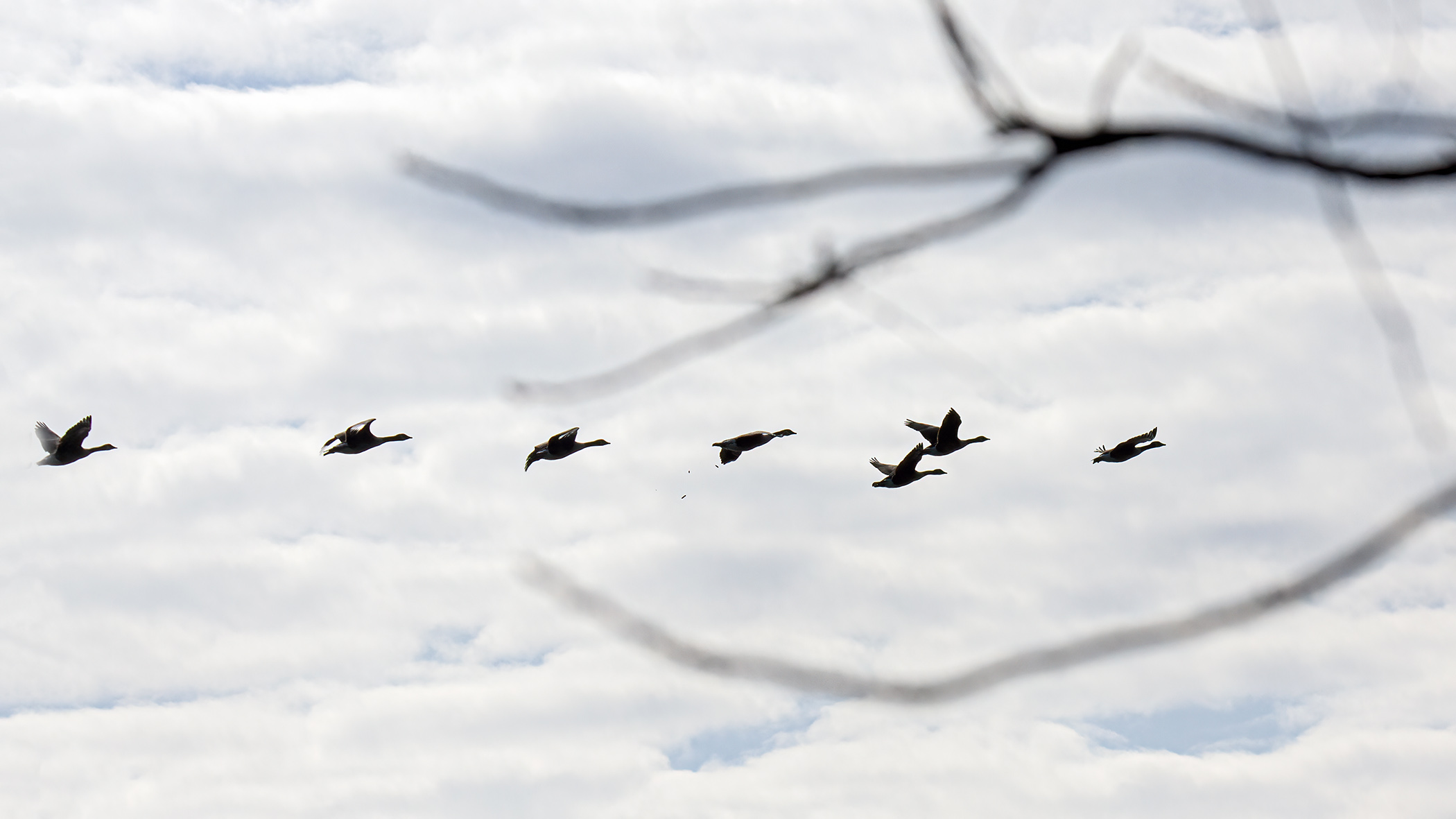
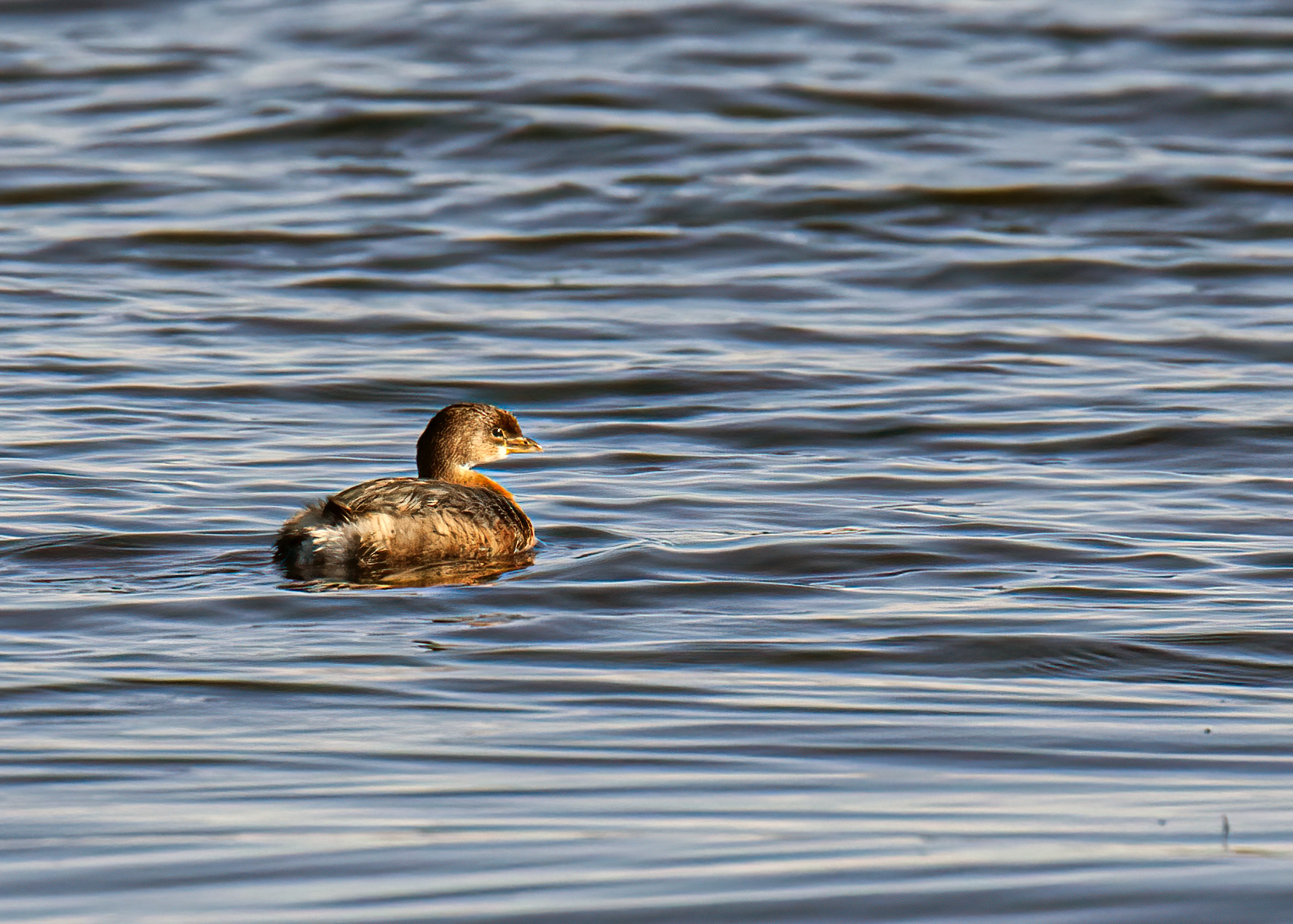
There was a lot of bird activity on Tuesday at Occoquan Bay National Wildlife Refuge both in the air and on the water. Unfortunately most of the action took place well out of the optimal range of my camera, so I had to be content with capturing long distance photos.

Flocks of Canada Geese (Branta canadensis) periodically announced their presence as they passed by. A large flock of crows was equally vocal as it harassed a pair of Bald Eagles (Haliaeetus leucocephalus) perched peacefully in a distant tree. Only the shy little Pied-billed Grebes (Podilymbus podiceps) were silent as they paddled about, periodically diving in search of food.

I spent several hours walking about, listening and observing, enjoying the fresh air and the beauty of natural surroundings, unconcerned that I was not able to capture amazing photos during this outing. That is the uncertain fate of a nature photographer. To borrow a line from Paul in his letter to the Philippians, I have learned to be content whatever the circumstances.

I returned home from this walk in the wild feeling renewed and refreshed—that was my biggest reward.

Canada Geese

Bald Eagle

Pied-billed Grebe

© Michael Q. Powell. All rights reserved.

Read Full Post »

On Tuesday at Occoquan Bay National Wildlife Refuge I watched this Red-winged Blackbird (Agelaius phoeniceus) try to balance itself on the tip of a small, broken-off branch. The bird teetered and tottered and extended its wings for balance before it finally gave up and flew to a less precarious perch.

Somehow the little bird reminded me of my childhood, when I enjoyed tiptoeing along on sidewalk curbs, trying to maintain my balance. On rare occasions when I felt really bold, I’d try the same balancing act on low brick walls. At an early age I concluded that I was not destined for a career in the circus as a high-wire performer.


Red-winged Blackbird

© Michael Q. Powell. All rights reserved.

Read Full Post »

I was thrilled to spot this Bald Eagle (Haliaeetus leucocephalus) at Occoquan Bay National Wildlife Refuge. The eagle was perched high in a tree, as shown in the final photo and kept looking from side to side, as though it was looking for its mate. I am not sure if the eagle was aware of my presence, but all of the sudden it took off and flew away—I should know by now never to underestimate the acuity of an eagle’s vision.

I managed to capture the first shot below as the eagle was really stretching itself out just prior to takeoff. It is an unusual pose that I really like. A split second later I captured the shot of the eagle in flight. There were several other shots in between the first and second images, but I did not track the eagle accurately enough and the eagle’s wings were cut off in those shots.

It has been a while since I last got good shots of a Bald Eagle, so I was particularly happy when this photo opportunity arose.

Here in the US, today is Veterans Day, a day when we honor all those who have served in our armed forces. Elsewhere in the world, today is commemorated in many different ways, including as Armistice Day, the day when World War I ended. Wherever you happen to live, I hope that you never forget the the brave men and women who have served and are serving on your behalf, safeguarding your freedom—we owe them all a debt of gratitude.


Bald Eagle

Bald Eagle

Bald Eagle

© Michael Q. Powell. All rights reserved.

Read Full Post »

It is a fun challenge to try to photograph tiny songbirds, like this Golden-crowned Kinglet (Regulus satrapa) that I spotted last Thursday at Occoquan Bay National Wildlife Refuge. Golden-crowned Kinglets are approximately 3-4 inches (80-100 mm) in length and weigh about 0.1-0.3 ounces (4 to 8 grams) and they move about continuously, often high in the trees.

If you look carefully just above the kinglet’s eye, you can get a tiny glimpse of yellow, a small portion of the yellow “crown” that gives this little bird its name.

Golden-crowned Kinglet

© Michael Q. Powell. All rights reserved.


Read Full Post »

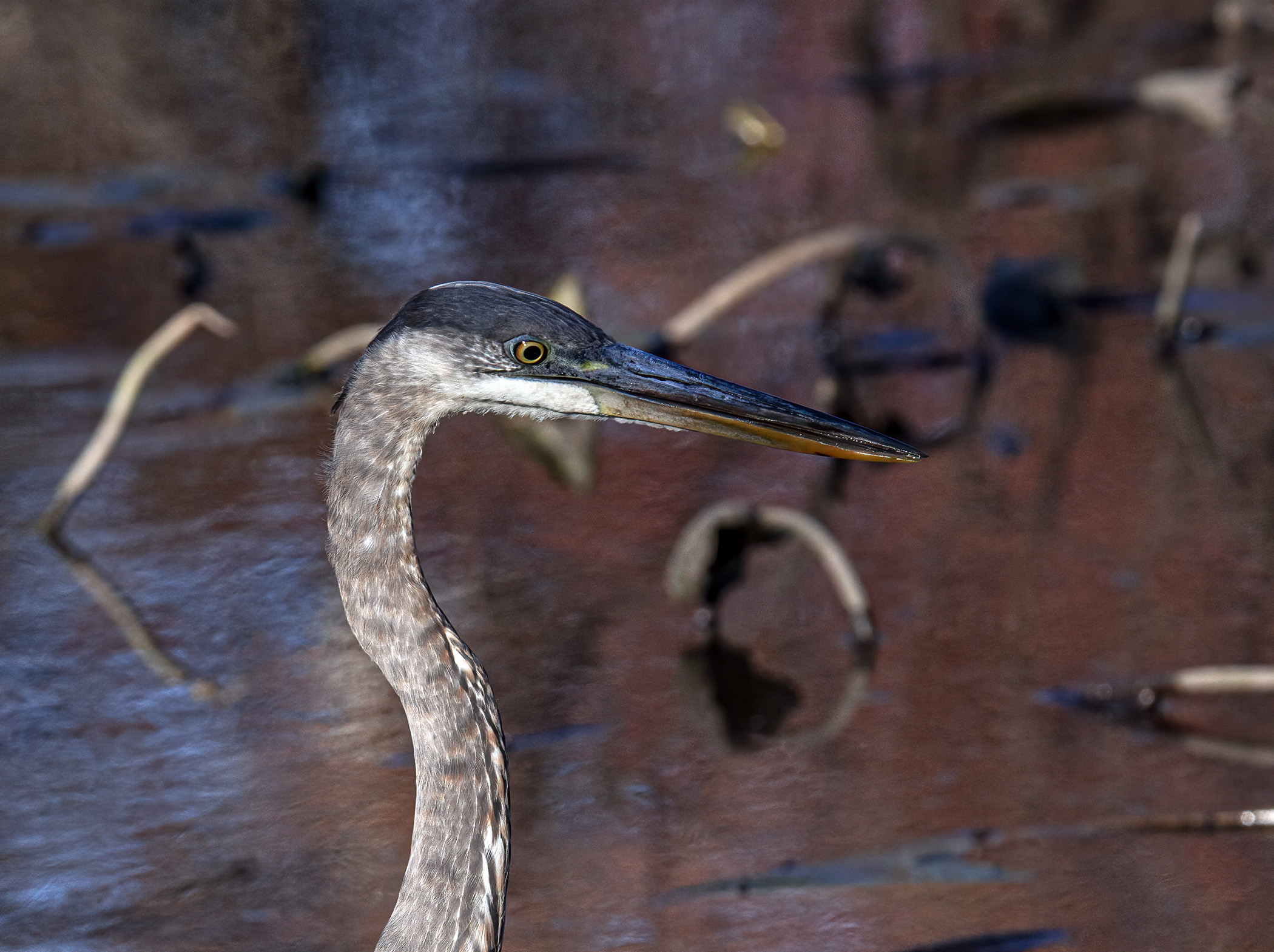
I was so close to this Great Blue Heron (Ardea herodias) yesterday at Occoquan Bay National Wildlife Refuge that there was no way I could fit its entire body into a shot. I decided to zoom in on its head and captured this little portrait of the heron as it walked slowly through the water. Ever vigilant, the heron kept its eyes focused on the water, looking for signs of potential prey, and ignored me, though I am sure that it was aware of my presence.

Great Blue Heron

© Michael Q. Powell. All rights reserved.
Read Full Post »

In the past I have seen Great Blue Herons (Ardea herodias) catch some incredibly large fish, but the tiny fish this heron caught on Thursday at Occoquan Bay National Wildlife Refuge may be the smallest prey that I have ever seen a heron catch.

Hopefully the fish was just an appetizer and not the main course.

Great Blue Heron

© Michael Q. Powell. All rights reserved.

Read Full Post »

Has anyone ever told you that you eat like a bird? This somewhat weird expression is based on the mistaken notion that birds don’t eat very much—many birds have high metabolisms and actually eat at lot, relative to their size.

Some birds also consume things that are hazardous to humans. This week at Occoquan Bay National Wildlife Refuge I have spotted multiple Yellow-rumped Warblers (Setophaga coronata) feasting on the abundant poison ivy berries. Poison ivy berries serve as an important food source for a variety of overwintering birds, including these warbler. One of the consequences of the consumption of all of these berries is that the seeds pass through the birds and are spread everywhere, guaranteeing future supplies of the poison ivy berries.

No matter how nutritious or tasty they are for the birds, there is no way that I am voluntarily going near poison ivy or tasting the berries. The berries may not kill me, but I am pretty sure they would make me really sick.

Yellow-rumped Warbler

Yellow-rumped Warbler

Yellow-rumped Warbler

© Michael Q. Powell. All rights reserved.
 

Read Full Post »

I have seen groups of American Crows (Corvus brachyrhynchos) harass eagles and hawks many times in the past, so whenever I hear the excited cawing of of crows, I immediately start to look for a large raptor. When this happened on Thursday at Occoquan Bay National Wildlife Refuge, I quickly spotted the dark shadow of a large bird in a tree and assumed that it was a Bald Eagle.

I was a bit shocked when I zoomed in on the bird and realized that it was a Black Vulture (Coragyps atratus), not an eagle. I had no idea that crows would chase vultures. Sometimes the crows would perch on branches of the tree close to the vulture and appear to try to convince the vulture to leave—this is what seems to be happening in the second photo.

At other times, the crows would aggressively buzz the vulture, flying right at the vulture and veering off only at the last second. I managed to capture the first image just as one of the crows appeared ready to attack the vulture from behind, but there was no collision. The vulture flapped its wings several times to try to scare off the crows, an action that did not seem to deter the pesky crows.  A short time later the vulture departed to search for a more peaceful perch.

Happy Halloween.

crow and vulture

crow and vulture

© Michael Q. Powell. All rights reserved.

Read Full Post »

It is a fun challenge to try to photograph little birds moving about in the trees. I managed to capture this shot of an American Goldfinch (Spinus tristis) on Tuesday during a visit to Huntley Meadows Park, a local marshland refuge.

I like how the muted colors of this bird seem to reflect the autumn colors of its surroundings. I am more used to seeing goldfinches in the spring, when the adult males are bright yellow in color and are really easy to spot.

American Goldfinch

© Michael Q. Powell. All rights reserved.


Read Full Post »

« Newer Posts - Older Posts »