Feeds:
Posts
Comments

Archive for the ‘Autumn’ Category

The leaves are still on the trees, which makes it tough for me to spot perched birds, which is one the reasons why I focus on insects in the summer months. Nonetheless, I tend to scan the trees when I am out with my camera, hoping to spot a bird perched in the open.

On Monday at Occoquan Bay National Wildlife Refuge, I spotted an unfamiliar shape through the foliage as I was hiking along one of the trails. As I moved a bit to the side to get a better view, I realized that it was a Great Blue Heron (Ardea herodias). Now I know that herons will roost in the trees at night, but it is a little unusual for me to see on in a tree at midday. The bird appeared to be keeping an eye on something, almost like a sentinel, though I have no idea on what its attention was focused.

I moved slowly and stealthily to get a better shooting angle and eventually captured this image of the heron. As you can see in the photo, the heron was definitely alert and paying attention—it did not appear to be relaxing in the tree. Maybe the heron felt like the king of the world and was taking a moment to survey his realm.

Great Blue Heron

© Michael Q. Powell. All rights reserved.

Read Full Post »

There has been a relatively recent resurgence of butterflies in my area. In the past week or so I have seen more butterflies than at any other time this summer. Several of the dark swallowtail butterflies, though, are similar in appearance and are hard to tell apart, especially when wing damage hides some of the features that I rely on for identification.

Last week at Occoquan Bay National Wildlife Refuge, I spotted this beautiful dark swallowtail as it was feeding on a thistle plant. I can’t tell for sure, but I think that it may be a Spicebush Swallowtail butterfly (Papilio troilus). A chunk of the hind wing is missing, but otherwise the butterfly seems to be in good shape. It was moving around a lot on the thistle, but I was patient and eventually was able to capture a decent shot of this beautiful creature.

Pipevine Swallowtail

© Michael Q. Powell. All rights reserved.

Read Full Post »

How old does a dragonfly have to be to collect Social Security? OK, that’s a bit of a crazy question, but collecting Social Security is a sure sign that you are getting old. A couple of weeks ago, I received my first payment from the Social Security Administration, a sure sign that I am officially “old.” Last week I also stopped in a a Metro offices in Washington D.C. to sign up for a senior pass that allows me to ride Metro trains at a reduced rate—one of the few tangible benefits of becoming a senior.

Here in the United States, people are living longer than in the past and it is anticipated that the Social Security Administration will run out of money to pay full benefits in a decade or so of changes are not made. Politicians don’t want to deal with the issue and keep putting off coming up with a solution to the problem.

Comparatively speaking, dragonflies live uncomplicated lives. They hang on for as long as they can and then they die, hopefully after successfully procreating. Last week I spotted this elderly female Great Blue Skimmer dragonfly (Libellula vibrans) at Occoquan Bay National Wildlife Refuge. Her coloration was dark and faded and her wings were tattered, but she was still functioning. After spending a few quiet moments with her, I pushed onward, still lost in my thoughts about life and growing older.

Great Blue Skimmer

© Michael Q. Powell. All rights reserved.

Read Full Post »

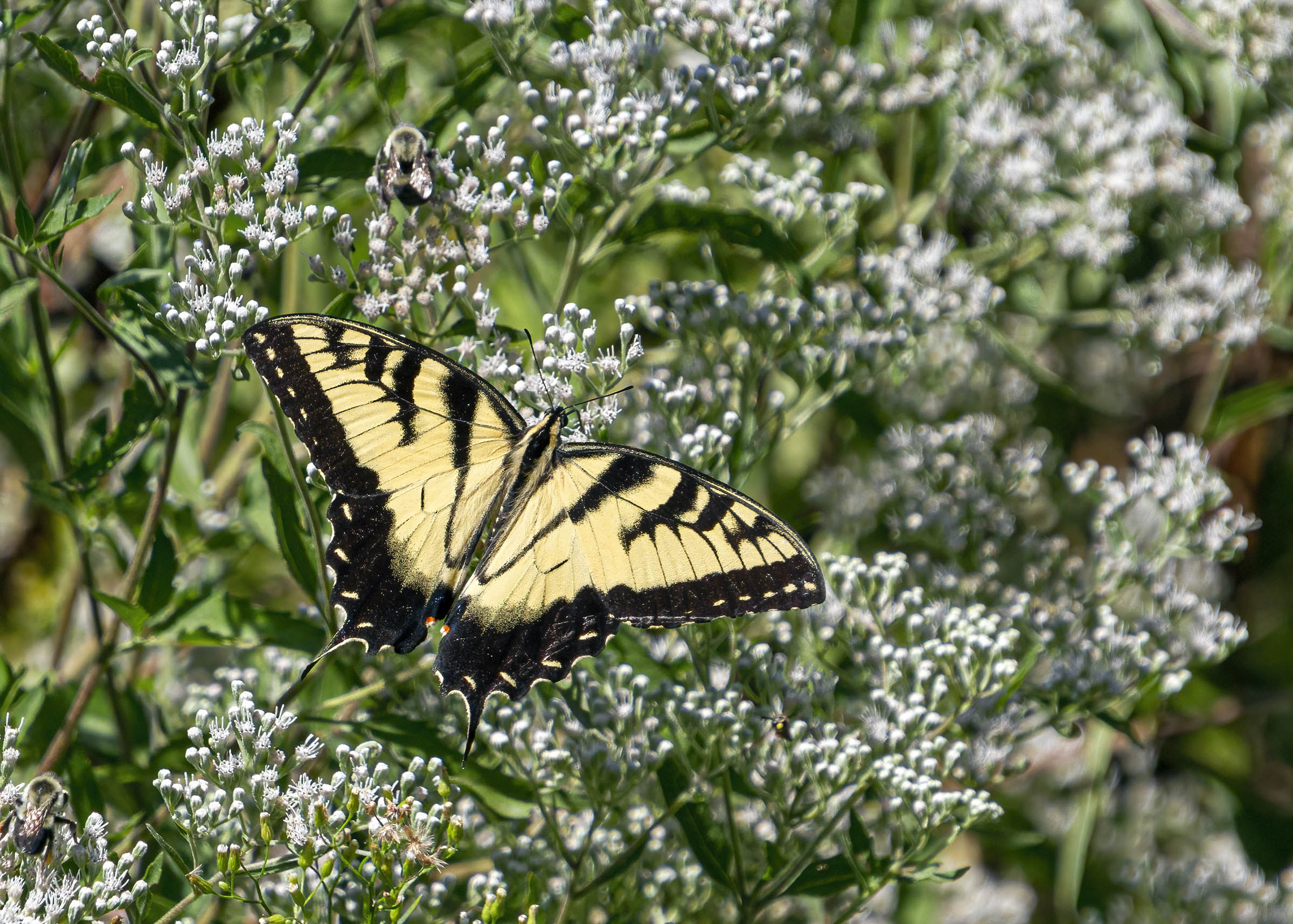
I’ve noted several times recently the tattered butterflies that I tend to encounter at this time of the year. However, not all of the ones that I see have suffered wing damage. Some of them appear to have recently emerged and are in perfect condition, like these Eastern Tiger Swallowtail butterflies (Papilio glaucus) that I spotted during a recent visit to Occoquan Bay National Wildlife Refuge.

Eastern Tiger Swallowtail

Eastern Tiger Swallowtail

Eastern Tiger Swallowtail

© Michael Q. Powell. All rights reserved.

Read Full Post »

I love to see dragonflies with patterned wings and so I was delighted to spot this male Twelve-spotted Skimmer dragonfly (Libellula pulchella) on Tuesday at Occoquan Bay National Wildlife Refuge. The males of this species have a beautiful combination of brown and white patches on their wings.

I used to be confused about the name of the species, because there appear to be a total of twenty-two spots. To make things worse, this species is also known as the Ten-spot Skimmer. What? It apparently depends of how you count the spots. If you count only the brown spots that are present on both males and females, you get twelve spots, but if you count the white spots that are present on only the males, you get ten spots. Yikes! Who knew that math was so important in dragonfly identification. 🙂

Twelve-spotted Skimmer

© Michael Q. Powell. All rights reserved.


Read Full Post »

Earlier this summer Needham’s Skimmer dragonflies (Libellula needhami) were among the most common dragonflies that I would see at Occoquan Bay National Wildlife Refuge. The last month or so, however, their numbers have declined significantly and they are now quite hard to find. I was delighted, therefore, to photograph this slightly tattered female Needham’s Skimmer on Tuesday morning.

Our weather has cooled off this week, with early morning temperatures in the 50’s (10 degrees C) and daytime highs struggling to get to 80 degrees (27 degrees C). I looked at the 10-day weather forecast and see that temperatures are not predicted to hit the 90’s (33 degrees C). Now it would be premature to declare that summer is over and we may well have some hot days in store for us, but the seasons are definitely changing.

So I will continue to search for remaining dragonflies while again, hopeful that I will spot some of the autumn species, like the Autumn Meadowhawks and Blue-faced Meadowhawks that should be appearing soon. Personally, autumn is my favorite time of the year, with cool nights and warm, sunny days, but I am not yet ready to bid farewell to the summer.

Needham's Skimmer

© Michael Q. Powell. All rights reserved.

Read Full Post »

On Tuesday I spotted a really cool-looking butterfly at Occoquan Bay National Wildlife Refuge, a Red-banded Hairstreak (Calycopis cecrops). This species has distinctive reddish-orange markings across its hind and forewings. I don’t recall seeing this species very often, though I have included photographs of the butterflies in some blog postings in the past.

The Red-banded Hairstreak is quite small in size, with a wingspan of just over an inch (25 mm), so I had to focus very carefully on the butterfly to obtain a sharp image. I was pleasantly surprised by the results with my Tamron 18-400mm zoom lens that did a pretty good job in capturing a shot of such a small subject.

Red-banded Hairstreak

© Michael Q. Powell. All rights reserved.

Read Full Post »

The countdown begins. Now that we are into September, the number of dragonfly species is beginning to drop and many of the remaining ones are looking a little tattered. They seem to adapt and compensate for their disabilities while moving, perhaps, a bit more slowly.

Yesterday at Occoquan Bay National Wildlife I photographed a number of male Slaty Skimmer dragonflies (Libellula incesta). Their dark bodies and eyes make them pretty easy to identify. Some of them appeared to be in pretty good condition, like the one in the first photo, while others, like the one in the second photo, are showing the signs of a tough summer.

Aging in all species is inevitable. No matter how much we complain about it, we are fortunate if we are able to slow its effects—we cannot stop it. The 19th century French romantic poet Alphonse de Lamartine wrote about the passage of time in a famous poem called Le Lac (The Lake) that included these words:

“Just a few more moments, I ask — in vain, for time
Eludes me and takes flight.
I tell the night to pass more slowly, and dawn comes
To chase away the night.

“Then let us love! Then let us fill each fleeting hour
With joy and ecstasy!
Man does not have a port; time does not have a shore.
It passes, and so do we.”

Slaty Skimmer

Slaty Skimmer

© Michael Q. Powell. All rights reserved.

Read Full Post »

A female Red-winged Blackbird (Agelaius phoeniceus) lifted her head as I approached her last week at Occoquan Bay National Wildlife Refuge, but then went back to work extracting seeds from the spiky sweetgum balls. The seedpods were so numerous that they reminded me of a well-decorated Christmas tree festooned with hanging ornaments.

Red-winged Blackbird

© Michael Q. Powell. All rights reserved.

Read Full Post »

The sun was so low at 3:15 in the afternoon last Friday that I cast a really long shadow as I wandered the trails at Occoquan Bay National Wildlife Refuge with my camera and telephoto zoom lens attached to a monopod. This is my favorite type of selfie, a genre of photos that I do not feel compelled to share daily, unlike several of my younger friends.

Happy Solstice Day! Astronomically speaking, today marks the beginning of winter in the northern hemisphere and of summer in the southern hemisphere. In the north, it is the shortest day and the longest night of the year while in the south it is the longest day and the shortest night of the year. Time moves slowly at this time of the year—the time of sunrise doesn’t change much over the next month, but gradually the time of sunset gets a tiny bit later.

I look forward to days when I see long shadows, for it means the sun is shining. For much of winter the sky is grey here, so moments of light are a welcome reprieve.

shadow

© Michael Q. Powell. All rights reserved.

Read Full Post »

I am always thrilled when I get a look at the “crown” of a Golden-crowned Kinglet (Regulus satrapa), one of the smallest birds in our area. I photographed this cute little kinglet last Friday at Occoquan Bay National Wildlife Refuge. Golden-crowned Kinglets are frenetically active, so it can be tough to get a decent shot of one.

Surprisingly, the kinglets overwinter with us. According to the Cornell Lab of Ornithology, “The tiny Golden-crowned Kinglet is hardier than it looks, routinely wintering in areas where nighttime temperatures can fall below –40° Fahrenheit (-40 degrees C).”

Golden-crowned Kinglet

Golden-crowned Kinglet

© Michael Q. Powell. All rights reserved.

Read Full Post »

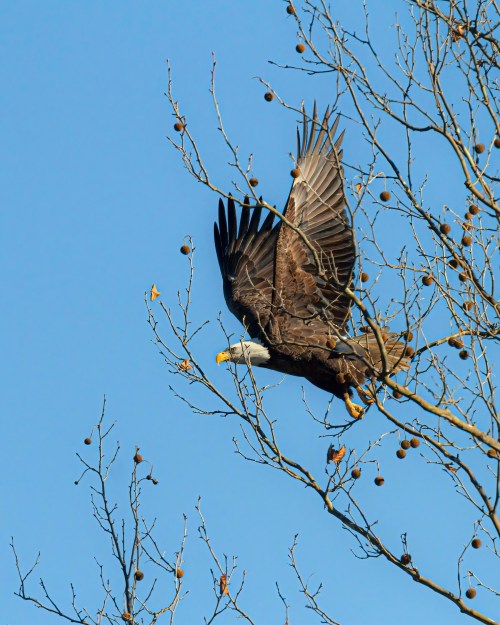
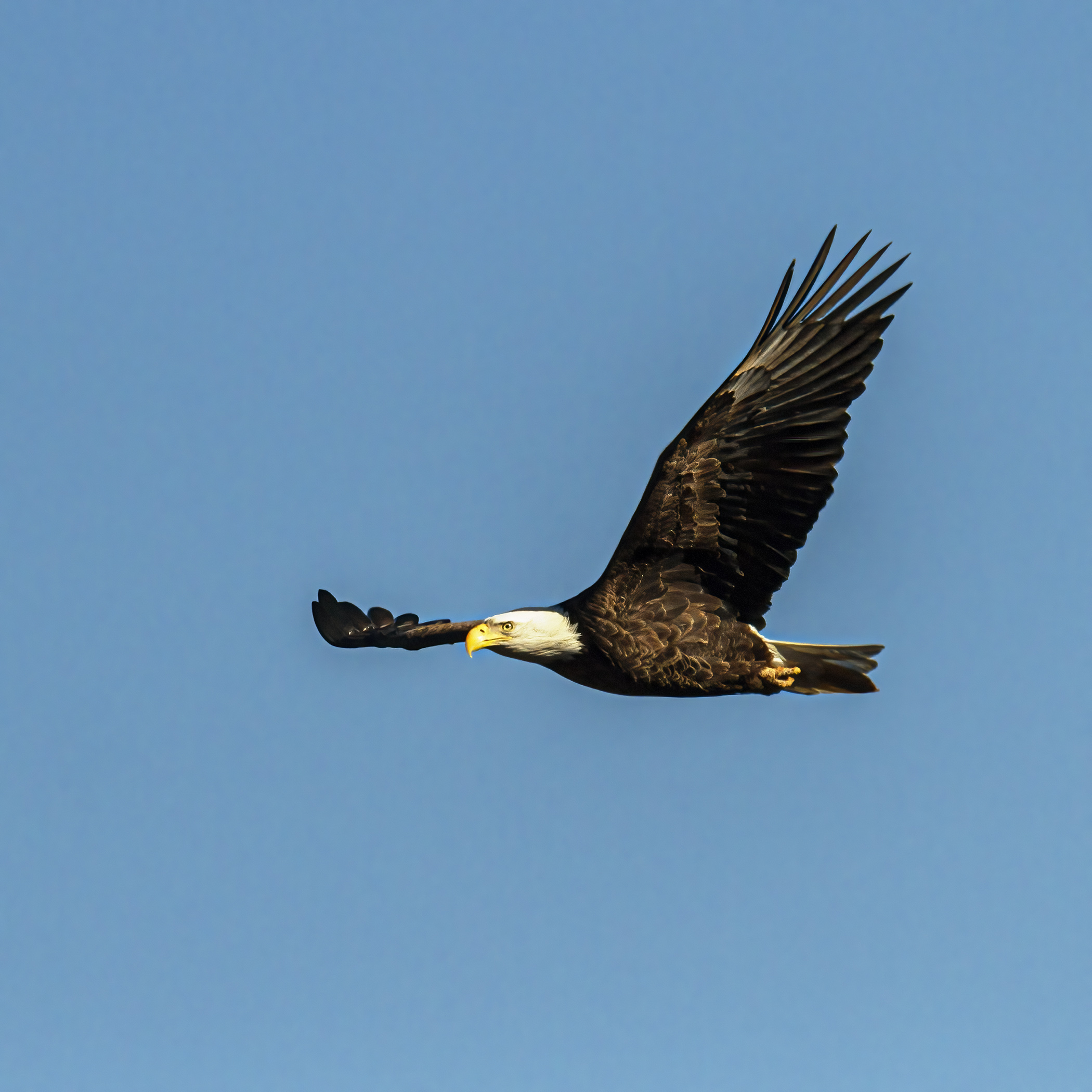
As I walking along one of the trails last Friday at Occoquan Bay National Wildlife Refuge, I spotted a Bald Eagle (Haliaeetus leucocephalus) perched in a distant tree. I had a pretty clear view of the eagle across an open, marshy area, but I couldn’t get closer without totally blocking my area. I decided to stop and to observe the eagle, hoping that the eagle would fly across the open area if it decided to take off.

In my experience, eagles generally fly away from me or behind trees, so many of my shots of flying eagles show their tail feathers or a blurry silhouette of the eagle with branches in focus. Getting a proper exposure can be a little tricky, especially when the light is bright, and it is easy to blow out the highlights in the white head or lose feather details in the shadow areas.

I watched and waited and was prepared when the eagle took off in my desired direction, flying across my field of view. Although the eagle initially flew behind some trees, I managed to keep my focus on the bird, as you can see in the last photo—amazingly the eye of the eagle is in focus. (As you can probably tell, the photos are presented in reverse chronological order.)

I continued to track the eagle as it flew into the open sky. In a number of my shots, the eagle’s wings blocked its head or hid it in the shadows—wing positions really matter, so I took a lot of shots. The second shot does a nice job of showing the interplay of light and shadows, which can be a particular problem in the middle of the day, when shadows are harsh, compared with the softer light near dawn and dusk.

This is one of the best sequence of images that I have managed to capture of an eagle in flight, but I will try to do even better in the upcoming months. In YouTube video reviews of some of the new high-end mirrorless cameras, I have seen pro photographers demonstrate amazing focus systems that allow them to lock and hold focus on the eyes of moving birds and animals.

I personally find it hard to justify spending that amount of money on a camera system—the combined cost of a top-end camera and long telephoto lens is about as much as I paid for my car—and am content for now to use a hands-on approach with my more “primitive” DSLR set-up. It’s a challenge, but a fun challenge, to try to photograph birds in flight and it is such a thrill when everything comes together and I am successful.

Bald Eagle

Bald Eagle

Bald Eagle

Bald Eagle

© Michael Q. Powell. All rights reserved.


Read Full Post »

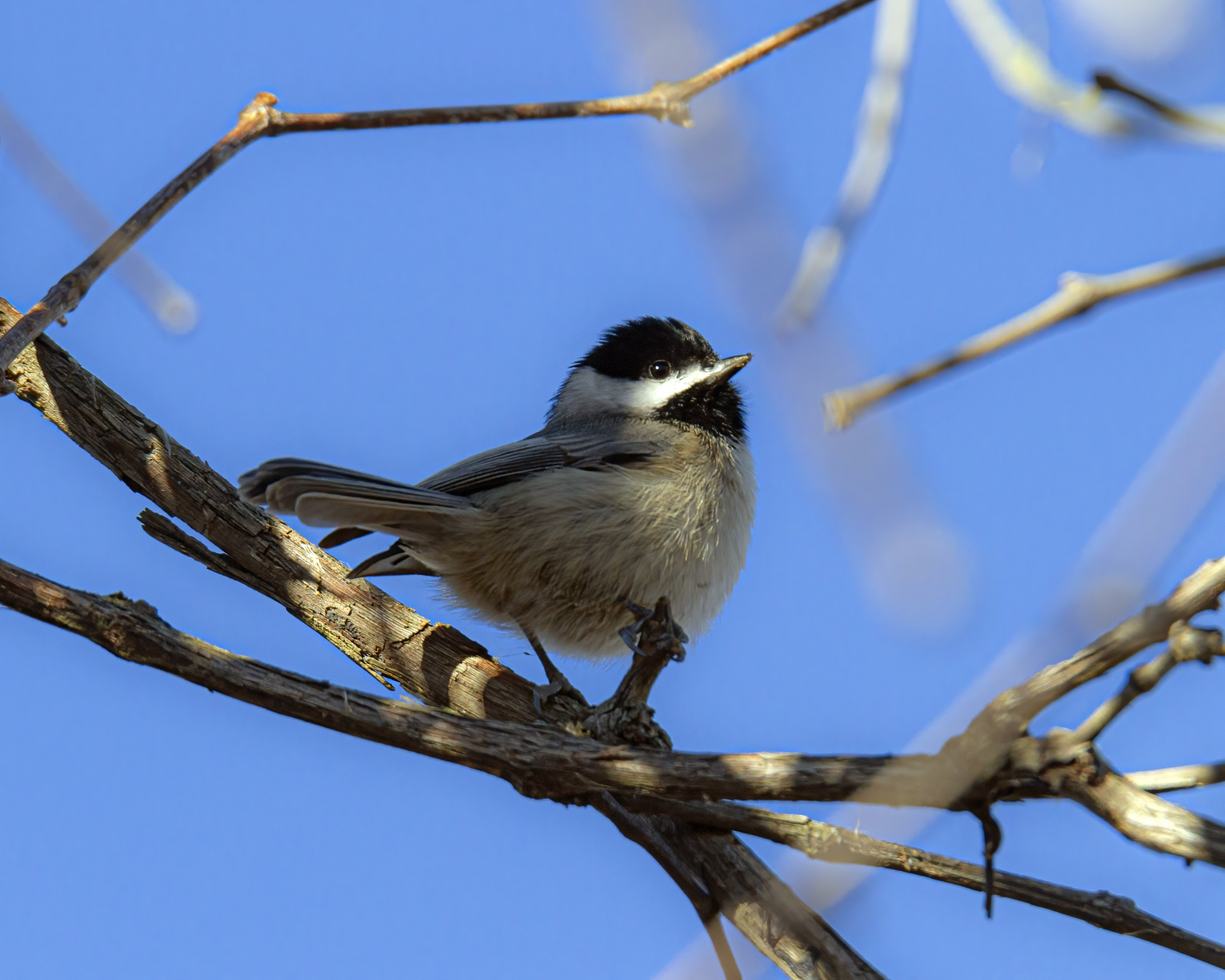
It is always a joy and a challenge to photograph tiny birds, like this cute little Carolina Chickadee (Poecile carolinensis) that I spotted last Friday at Occoquan Bay National Wildlife Refuge.

Even when they are perched, these chickadees are a bundle of energy and seem to be constantly changing head and body positions. As you can see from these two shots, the chickadee was surrounded by branches, so I had to bend and stretch a lot to get a clear shot. Lighting was also an issue, because the little bird often had its head pointed down and was covered with shadows.

I especially like the chickadee’s pose in the first photo, in which he was looking upward and the light was illuminating his face.

Carolina Chickadee

Carolina Chickadee

© Michael Q. Powell. All rights reserved.


Read Full Post »

I was delighted to spot this stunning male Redhead duck (Aythya americana) on Friday in the waters off of Occoquan Bay National Wildlife Refuge. I have seen this species only a few times, so I initially was not able to identify it. However, as I was capturing these shots, I was pretty sure that the duck’s stunning brown head, black-tipped bill, and  distinctive yellow eyes would make it easy to find in my bird identification guide—I was right.

According to the Cornell Lab of Ornithology, Redheads are exceptionally gregarious and gather in large flocks in the winter, especially in the Gulf of Mexico. On this occasion, however, this Redhead appeared to be by himself.

The Redhead was quite far away, so I had limited options for composing my shots as I walked along the water’s edge. I managed to incorporated some of the environmental elements to come up with a couple of images that I really like—although it may appear that the duck is perched on rocks, I think that they may be portions of a waterlogged tree trunk or stump.

Redhead duck

Redhead duck

© Michael Q. Powell. All rights reserved.

Read Full Post »

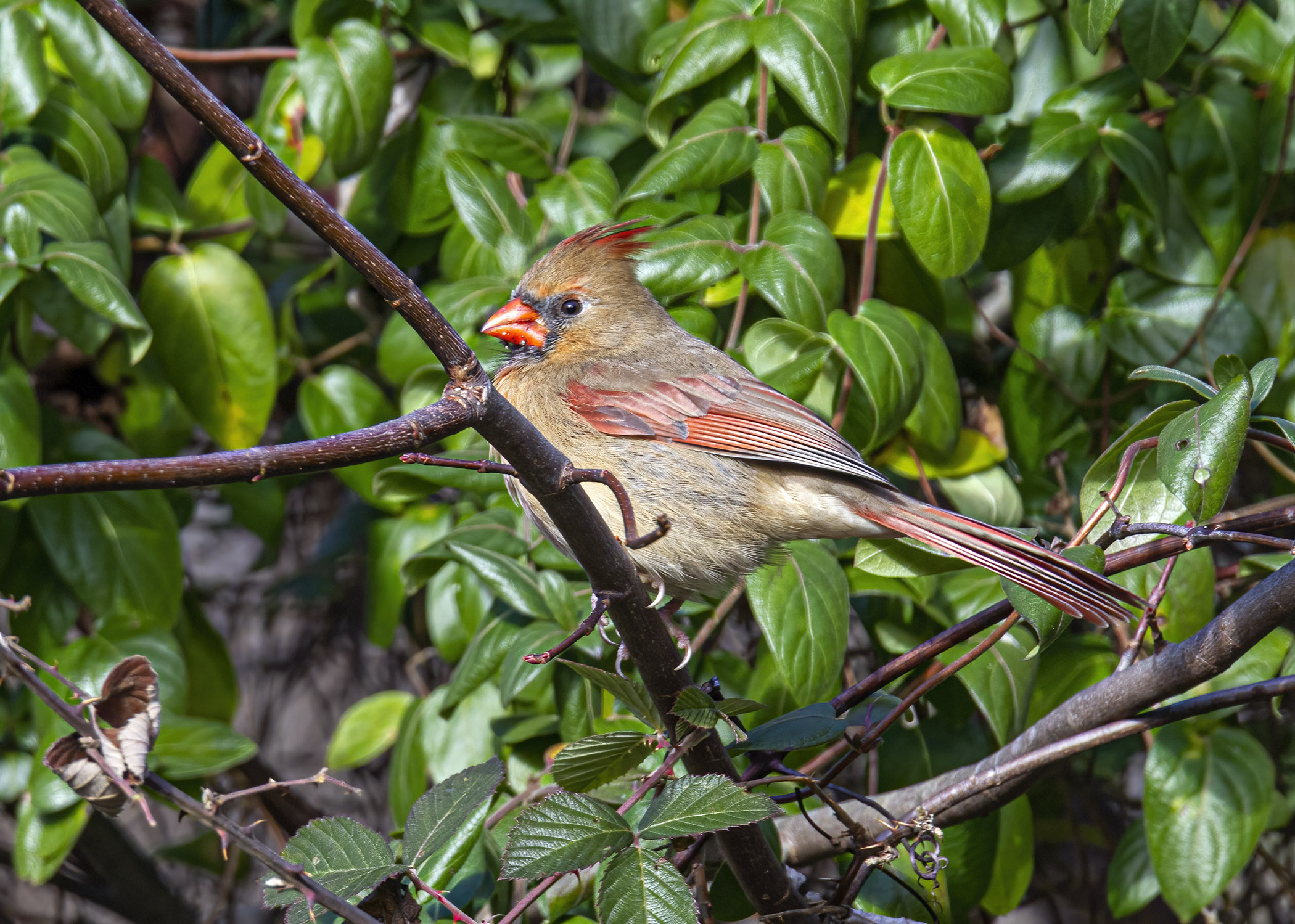
The coloration of female Northern Cardinals (Cardinalis cardinalis) is not as bold and flashy as their male counterparts, but I think they are equally beautiful, like this one that I photographed recently at Occoquan Bay National Wildlife Refuge.

I do love bright colors—I drive an Ignition Orange KIA Soul—but I think there is something more refined and sophisticated when those colors are used in moderation as accents. That is why I really like the way a female cardinal has reddish streaks in her crown and on the outer portions of her wings.

Northern Cardinal

© Michael Q. Powell. All rights reserved.


Read Full Post »
Birds have to work really hard to find food during the cold season. This female Red-wing Blackbird (Agelaius phoeniceus) decided that it was worth her effort to try to extract some seeds from the spiky seed pods of a sweetgum tree earlier this month at Occoquan Bay National Wildlife Refuge.

Some of you may be wondering how this can possibly be a Red-winged Blackbird. After all, this bird is not at all black and her wings are not red. When I first started getting serious about my photography more than 11 years ago, I would often go out shooting with my mentor Cindy Dyer, who loved to photograph flowers and sometimes insects. She rarely photographed birds and I had no experience identifying them.

During one such outing I photographed a bird on a rebar trellis at one a botanical garden. I assumed that it was one of the many types of sparrows that I lumped together as “little brown birds.” When I posted the shots in a Facebook birding forum, I was shocked to learn that it was a female Red-winged Blackbird. (Check out my 27 September 2012 blog posting called “Intense bird” for more details on that adventure, including my first ever shots of a female Red-winged Blackbird. I also remember that 2012 encounter well because I was shooting with a Nikon D300 that Cindy had lent me along with a Tamron 180mm macro lens. I did not switch from Canon to Nikon, but immediately orders the Canon version of the lens, which continues to be one of my favorite lenses.)

I am a lot more knowledgeable about birds now and have reconciled myself to the reality that many species derive their names from the males, who tend to be more colorful in appearance. As most of you know, I love to photograph insects, particularly dragonflies, but they have now completely (or maybe almost completely) disappeared from the scene, so I will be focusing my camera and my attention mostly on birds in the upcoming cold months.

Red-winged Blackbird

© Michael Q. Powell. All rights reserved.

Read Full Post »

One of the most distinctive ducks that migrates into my area for the winter is the Hooded Merganser (Lophodytes cucullatus). The male has a curious-looking head that is black and the white and the female has an orange-brown hairstyle that literally sticks out.

Sometimes Hooded Mergansers arrive in groups and I have seen some recent photos by local photographers of males competing for the attention of the females. In this case, cover, I spotted only one couple at the small suburban pond not far from where I live. The ducks dozed a bit and occasionally preened their feathers, so there was not a whole lot of action to capture. I was content to capture a few “record” images and hope I will have some more chances to see these little diving ducks in the upcoming months.

Hooded Merganser

Hooded Merganser

Hooded Merganser

© Michael Q. Powell. All rights reserved.

Read Full Post »

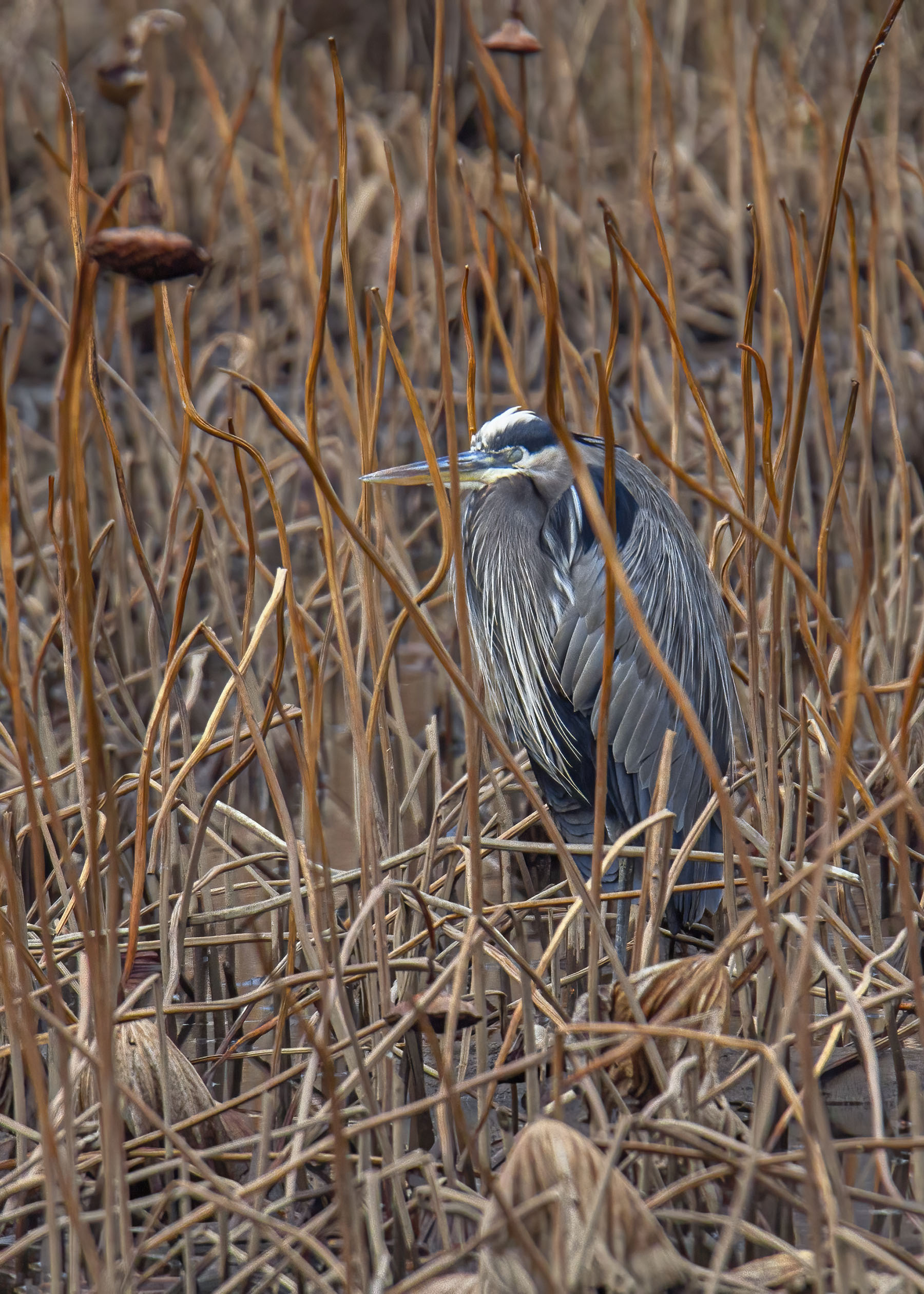
There are almost always a few Great Blue Herons (Ardea herodias) at Occoquan Bay National Wildlife Refuge. Most often I see them patiently fishing in the water, but sometimes I have to scan the tangled vegetation surrounding the ponds to find them, as was the case last Friday. Some herons are very skittish and fly away as soon as they sense my presence, but this heron remained in place while I carefully composed this image and continued silently along the trail.

Unlike the Great Egrets, Green Herons, and Ospreys that leave our area in the winter, Great Blue Herons are with us year round. Now that the weather is getting colder and we have already had our first snowfall (it was less than a half-inch (1 cm) or so), I suspect that it is getting harder for herons to find food. I am sure, though, that I will continue to see herons foraging for food, including in the frigid waters of the ponds and the bay—even when the surface of the water freezes, there is enough movement in the water that there are some open areas.

Great Blue Heron

© Michael Q. Powell. All rights reserved.


Read Full Post »

Luck often plays a role in my wildlife photography. This past Friday at Occoquan Bay National Wildlife Refuge, this male Northern Cardinal (Cardinalis cardinalis) was perched when I initially pressed the shutter release on my camera. A split second later, the cardinal took off and I captured this fun image as he flew right towards me.

I often shoot in short bursts, which helps explain how I managed to get this shot. The shutter speed was only 1/250 of a second and that is why the wings are blurred. Amazingly the head, which is the most important element in most wildlife shots, is in relatively sharp focus, especially considering the fact that I took the shot from a long distance away—my EXIF data indicate that I took the shot at 483mm, near the long end of my 150-600mm telephoto zoom lens.

Luck by itself, of course, does not guarantee good photos, nor does having expensive gear—I am fond of saying that patience and persistence are the most critical requirements for getting good shots. I have to be out as often as I can and remain constantly prepared to react appropriately to whatever fortunate circumstances in which I find myself. In that sense, I have to make my own luck.

Northern Cardinal

© Michael Q. Powell. All rights reserved.


Read Full Post »

What is the first thing that comes to your mind when you look at this photo? Are you attracted to the autumn colors in the background? Do you notice the texture in the rotten tree and how it matches the feathers of the little Song Sparrow (Melospiza melodia)?

The sparrow’s pose is what caught my attention. As my eyes examined the image, I was suddenly transported to a medieval era and imagined a sentinel positioned along the top of a castle wall, vigilantly keeping watch, alert to any danger.

Yes, I have an overly active, often child-like imagination. Wouldn’t it be fun to be able to experience the wonders of the world with the energy and curiosity of a child? Our adult lives are often way too complicated—I encourage you to find joy today in simple things.

Song Sparrow

© Michael Q. Powell. All rights reserved.


Read Full Post »

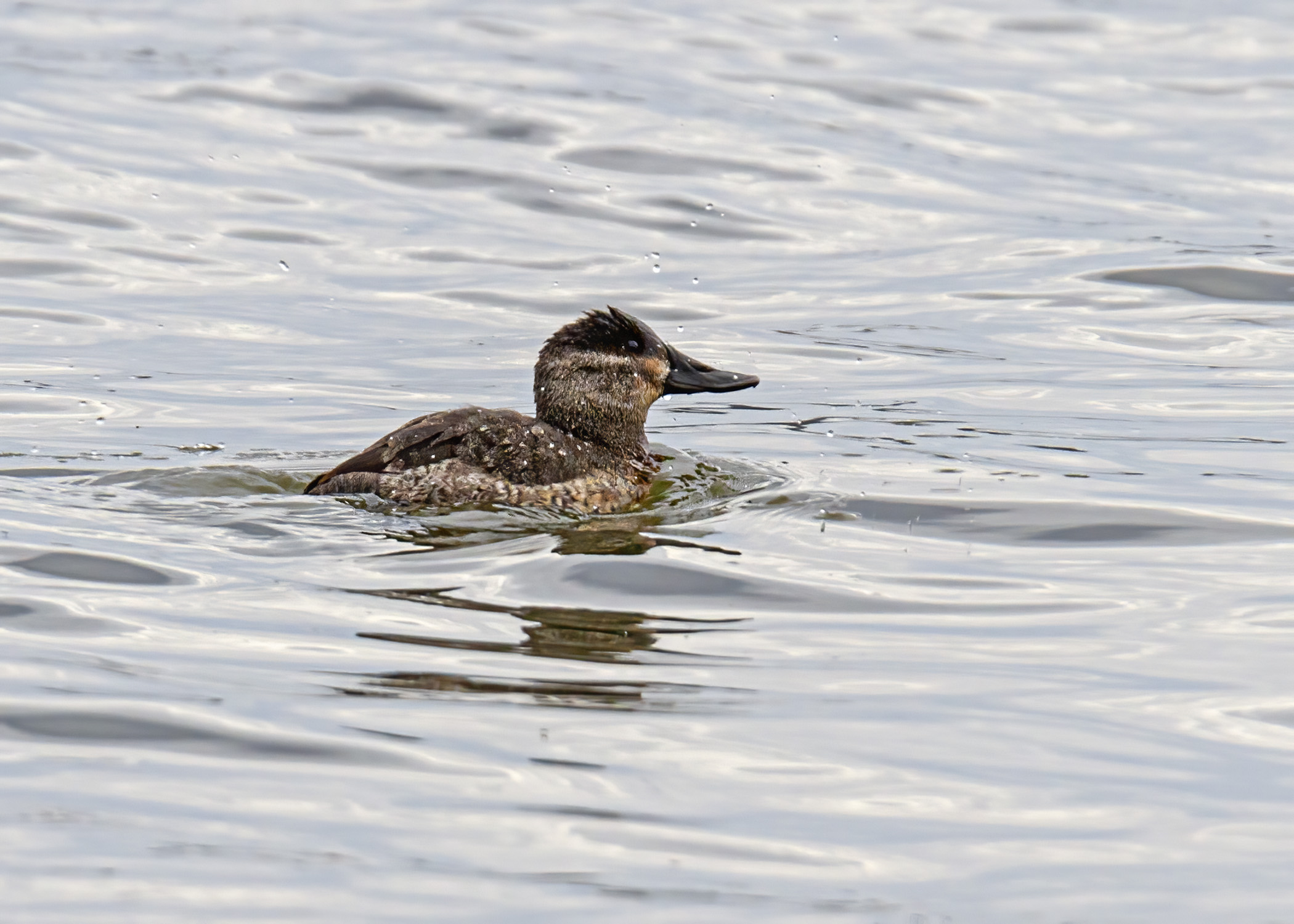
Ruddy Ducks (Oxyura jamaicensis) “feed most actively at night, so you’ll often see Ruddy Ducks sleeping during the day, head tucked under a wing and tail cocked up,” according to the Cornell Lab of Ornithology. I spotted a small group of them, including the sleeping male Ruddy Duck in the first photo, on Tuesday at a small suburban pond in Kingstowne, a community only a couple of miles from where I live.

Earlier this month I spotted a much larger flock of Ruddy Ducks in the waters off of Occoquan Bay National Wildlife Refuge. As you can see in the second photo, many of the ducks were sleeping. The ducks were quite a distance from shore, but the bright white cheek patches on some of the males made them easy to identify. Eventually one of the ducks swam a bit closer and I captured the final image—judging from its coloration, this appears to be either a female or an immature male.

I read on-line that the breeding colors of the male are spectacular, with a sky-blue bill, shining white cheek patch, and gleaming chestnut body, but I have never seen Ruddy Ducks during breeding season. As I read further in the entry for the species on the Cornell Lab of Ornithology website, I could not help but chuckle:

“The bright colors and odd behavior of male Ruddy Ducks drew attention from early naturalists, though they didn’t pull any punches. One 1926 account states, “Its intimate habits, its stupidity, its curious nesting customs and ludicrous courtship performance place it in a niche by itself…. Everything about this bird is interesting to the naturalist, but almost nothing about it is interesting to the sportsman.” ”

UPDATE: A sharp-eyed Facebook friend noted that the position of the duck in the first photo is a bit more upright than it would be if he were sleeping and suggested the duck was in the process of grooming.

Ruddy Duck

Ruddy Ducks

Ruddy Duck

© Michael Q. Powell. All rights reserved.

Read Full Post »

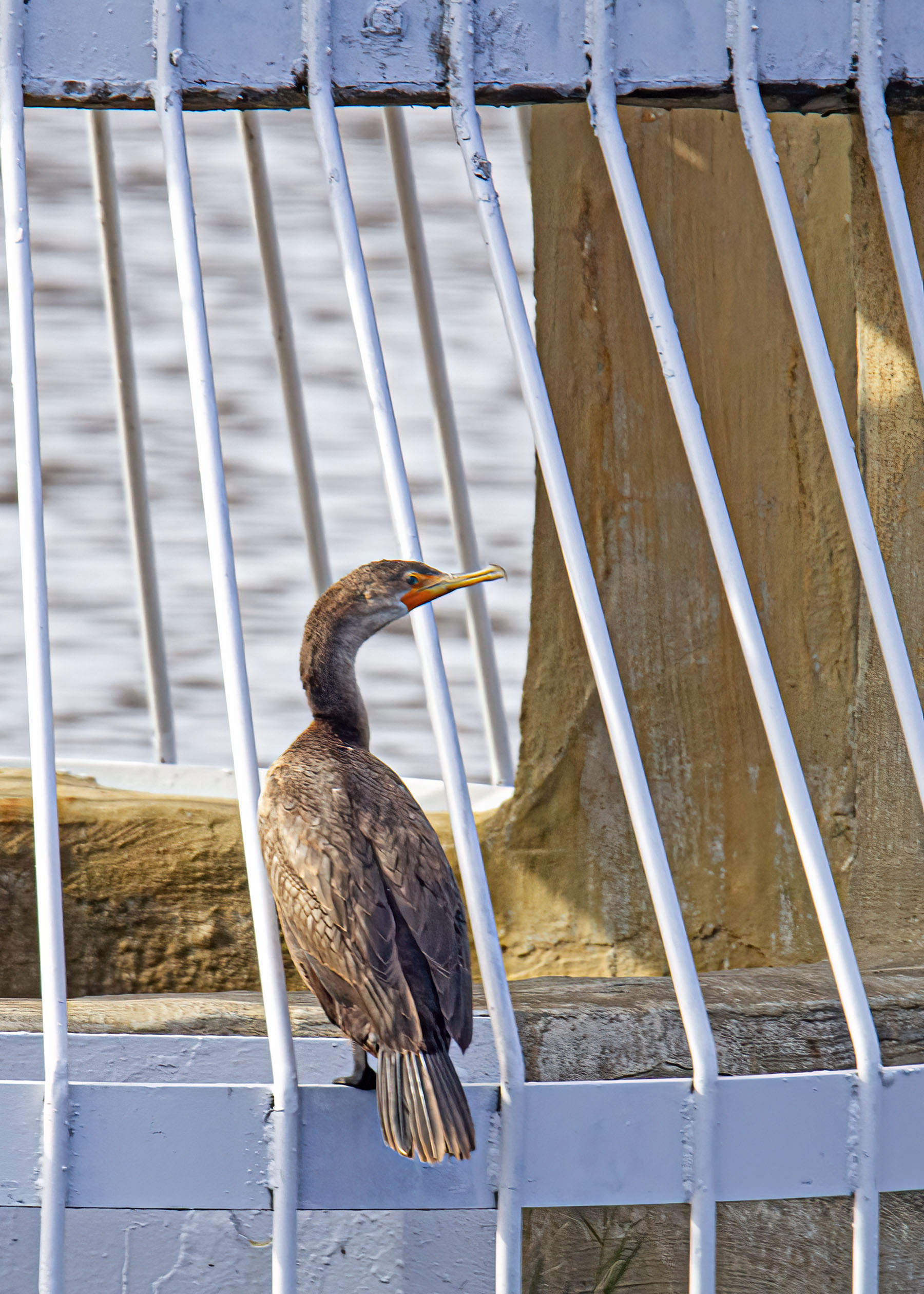
Most of the time when I see Double-crested Cormorants (Phalacrocorax auritus), they are actively fishing, repeatedly diving deep into the water and surfacing after and extended period time under the water. On Tuesday I spotted this cormorant at a small suburban pond and it seemed content to float about amidst a large flock of Ring-billed Gulls. As you can see in the first photo, it made for a strange pairing to have such different-looking birds together.

When I circled around the pond a second time the cormorant (or possibly a second cormorant) was hanging out on a man-made structure sticking out of the water in the pond that is probably part of the water filtration system. Often when I see cormorants out of the water, they have their wings spread wide to dry them out, but this cormorant had its wings closed and just seemed to be chilling out. Generally I avoid including man-made objects in my wildlife photos, but I like the juxtaposition of the curves and warm color of the cormorant with the straight lines and cooler cooler colors of the structure.

Double-crested Cormorant

Double-crested Cormorant

© Michael Q. Powell. All rights reserved.

Read Full Post »

It was cold and gray and last Friday at Occoquan Bay National Wildlife Refuge. Most of the birds seemed to be inactive, like this sleeping Great Blue Heron (Ardea herodias) that was partially hidden by the vegetation in a field adjacent to a small pond.

I have often wondered if birds sleep with their eyes closed. I do not have a definitive answer, but if you click on this image to enlarge it and look closely at the heron’s eye, it sure looks like it is closed. I wonder too how birds can sleep in trees without falling over, but this heron was on solid ground, so I do not think that it was at risk of falling. As for me, I think that I have dozed off while standing, but don’t think that I have fallen into a deep sleep.

Great Blue Heron

© Michael Q. Powell. All rights reserved.


Read Full Post »

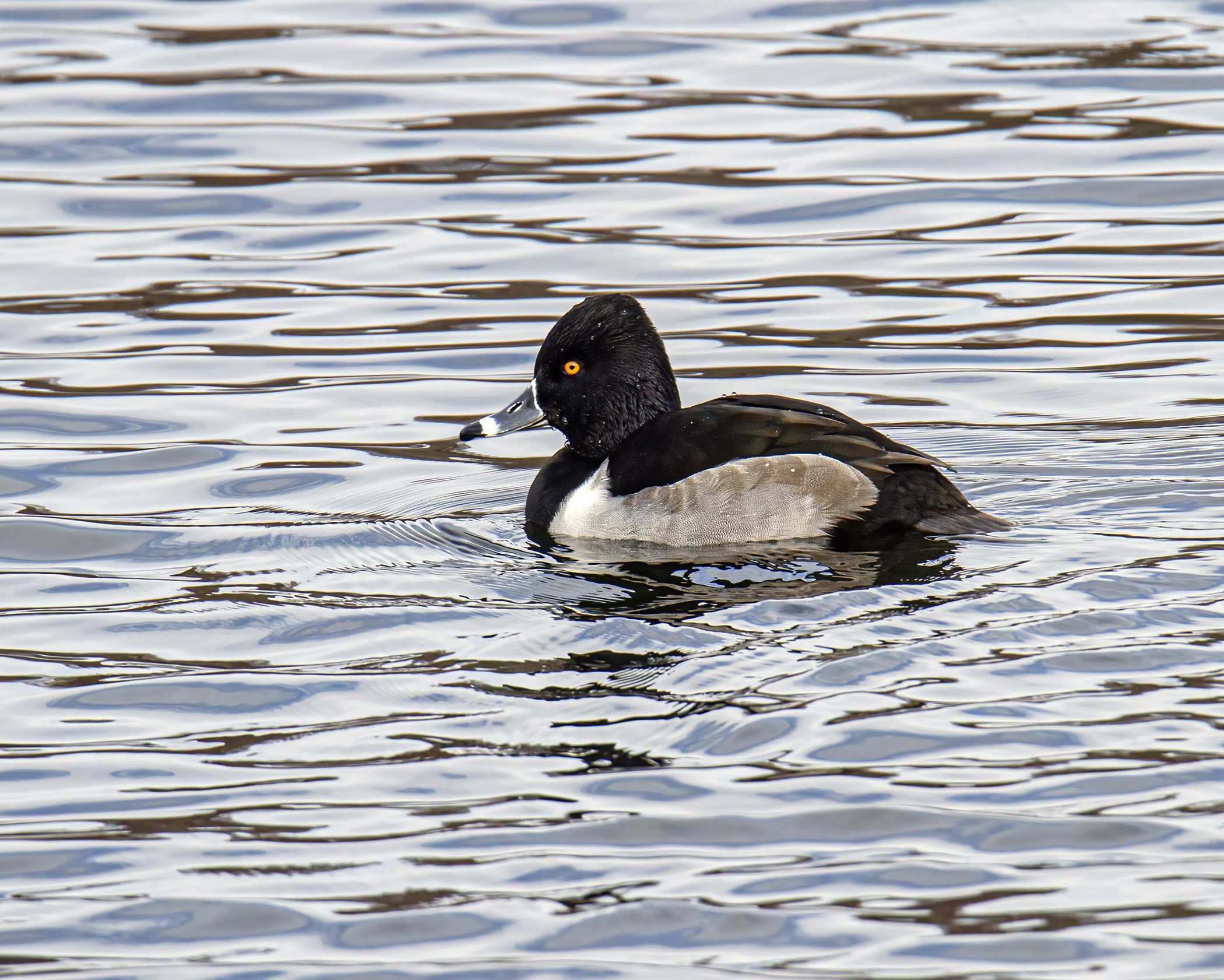
Yesterday I made a quick trip to a local suburban water retention pond, where several migratory bird species overwinter with us. I was shocked to see that no Canada Geese were there, but did spot two Double-Crested Cormorants, a few Ruddy Ducks, and several pairs of Ring-necked ducks (Aythya collaris). All of these are diving birds, so they mostly hung out near in the deeper waters at the center of the pond.

I spent a good amount of time watching one Ring-necked Duck repeatedly dive into the water and would try to guess when and where he would resurface. Male Ring-necked Ducks have a distinctive appearance, with yellow eyes, a striped bill, and a strangely pointed head.

Clouds would drift across the sun from time, causing patterns on the surface of the water to shift and change. I really got caught up in these reflections and these three photos give you a sense of the swirl of colors and patterns that provided an amazing backdrop for these cool-little ducks.

Ring-necked Duck

Ring-necked Duck

Ring-necked Duck

© Michael Q. Powell. All rights reserved.

Read Full Post »

It is hard to take good photos when the light is limited. It was heavily overcast on Friday at Occoquan Bay National Wildlife Refuge. In many of my photos, the sky looked white and the subjects looked like silhouettes. I made a few adjustments to my camera to increase the amount of light hitting the sensor, but the conditions were challenging.

I was excited when I came upon a flock of foraging Cedar Waxwings (Bombycilla cedrorum). Recently I had encountered only a few of these cool-looking birds, but this was the first time this year that I have seen a whole flock of them. Some birds are really territorial, but these waxwings seemed to have no sense of personal space and were almost on top of each other as they reached for the hanging berries.

These photos are a little flat and dull, but I like the way that I was able to capture a sense of this foraging activity. In the final photo, you can even see a bit of the waxy red secretion on the wings of the center bird that gave rise to the “waxwing” portion of the common name of this species.

Cedar Waxwings

Cedar Waxwings

© Michael Q. Powell. All rights reserved.

Read Full Post »

Male Buffleheads (Bucephala albeola), a type of sea duck, often appear to be black and white, but when the light is right, you can see the glossy green and purple feathers on their heads. I spotted a distant group of Buffleheads during a recent visit to Occoquan Bay National Wildlife Refuge and captured this image that shows two male and a female (or possibly an immature male). I encourage you to click on the image to see the beautiful colors of these Buffleheads.

At this time of the year, large rafts of ducks gather on the bay, usually a long way from the shore. So far I have seen Ruddy Ducks and Scaups, in addition to the Buffleheads shown here. In past years I have also spotted several kinds of grebes and other water birds. Throughout the winter, I try to keep an eye out for these groups of birds, hoping that some of them will drift within range of my camera.

Bufflehead

© Michael Q. Powell. All rights reserved.


Read Full Post »

I often find myself returning to the same spot where I have previously seen a bird or a dragonfly. Of course, these are winged species that can fly wherever they want, so there is no guarantee that they will remain in a single location. Perhaps they just happened to be at that spot or maybe there is something about that habitat that suits them well and will cause them to remain.

I revisited a spot at Occoquan Bay National Wildlife Refuge on Monday where I had spotted a few Eastern Bluebirds (Sialia sialis) almost a week earlier. When I arrived there, I was delighted to see that a small group of bluebirds and was even more thrilled when I was able to get close enough to capture some portrait shots of individual birds.

I really like the way that the background in the first photo is an almost perfect match for the colors of the bluebird. In the second photo, the evergreen tree helps to provide a sense of the environment and the berries below the bird help explain why the bluebird chose that tree. I like the framing of the branches in the final photo and the little pops of red on one of the branch and in the background.

I revisited that same spot again on Friday, but the skies were heavily overcast and, alas, I did not find any bluebirds that day.

Eastern Bluebird

Eastern Bluebird

Eastern Bluebird

© Michael Q. Powell. All rights reserved.


Read Full Post »
Some photographers are always searching for new and exotic species to add to their “life lists,” but I am generally content to photograph familiar species, primarily in my local area. No matter how many times I see these birds, each encounter is unique, and I never know when a photo may highlight one of these birds in a special way. Here is a selection of photos of birds that I spotted on Monday at Occoquan Bay National Wildlife Refuge.

The bright red color of male Northern Cardinals (Cardinalis cardinalis) makes it almost impossible for them to hide completely, but a lot of the time they forage in the dense undergrowth, making it tough to get a clear shot of one. In the first image, the cardinal was partially hidden by the branches, but I managed to focus on its face. If you look closely, you will notice that this cardinal is a bit of a messy eater—he has lots of seed residue on his bright orange bill.

Yellow-rumped Warblers (Setophaga coronata) are one of the only warblers that stay with us during the winter. They tend to stay high in the trees, which means that most of my photos show the underside of the birds’ faces in bodies. In the second photo, the warbler looked down at me and I was able to capture the little patch of yellow on the top of its head, a feature that I do not recall seeing before.

The final photo features a Cedar Waxwing (Bombycilla cedrorum), one of the coolest looking birds that I encounter on a fairly regular basis. I love its rakish black mask and its yellow-tipped tail. I was happy to be able to capture the beautiful wash of yellow on its breast in this shot. Of course, the colorful foliage in the background adds an additional touch of visual interest to this photo.

Northern Cardinal

Yellow-rumped Warbler

Cedar Waxwing

© Michael Q. Powell. All rights reserved.

Read Full Post »

As we move into December, I am still managing to see a few Autumn Meadowhawks (Sympetrum vicinum), like this dragonfly on the rocks that I spotted on Monday at Occoquan Bay National Wildlife Refuge. Dragonfly on the rocks…sounds like a holiday adult beverage to me.

I suspect that the end is near for these little creatures. Although these dragonflies can tolerate brief periods of cold temperatures, it is difficult for them to survive during an extended cold snap. I will be keeping an eye out for these tiny red dragonflies in the upcoming weeks, but it is clear that the end of the dragonfly season is rapidly approaching.

Autumn Meadowhawk

© Michael Q. Powell. All rights reserved.

Read Full Post »

Bluebirds have lots of acrobatic moves they can use to snag berries. On Monday I returned to a spot at Occoquan Bay National Wildlife Refuge where I had seen some Eastern Bluebirds (Sialia sialis) the previous week. I was delighted to see several bluebirds zooming in and out of a cluster of trees that had dark blue berries hanging high in them. I don’t think that the unidentified berries were part of the tree, but instead seemed to be growing on vines attached to the trees.

The dilemma for the bluebirds was that the berries were out of reach when they remained perched on tree branches, even when they stretched and reached as much as they could. The bluebirds therefore had to launch themselves into the air and attempt to snag a berry as they zoomed by the little hanging fruits. Yikes!

Needless to say, the degree of difficulty of this maneuver is quite high. It would be nice if bluebirds could hover like hummingbirds and pluck multiple berries while in mid-air, but I don’t think that they can.

The second photo shows an Olympic-level acrobatic move in which the bluebird launched itself into the air from a branch and swiveled its head a full 180 degrees. Wow! When I first looked at the photo, it took me a moment to realize that the bluebird’s body was facing me, but its head was facing in the opposite direction. I was fortunate to capture the moment when the bluebird had extended its wings fully to arrest its forward movement and give it an extra split second to grab a berry. The colorful foliage in the background was a nice bonus.

Eastern Bluebird

Eastern Bluebird

© Michael Q. Powell. All rights reserved.

Read Full Post »

As I was observing some birds on Monday at Occoquan Bay National Wildlife Refuge, a burst of bright yellow flashed across my camera’s viewfinder. I was not sure what kind of bird it was, but I definitely wanted to find out. I panned my long telephoto lens and eventually tracked the bird when it landed high in a distant tree.

I was delighted to see that it was a beautiful little American Goldfinch (Spinus tristis). Goldfinches are with us all year, but I am most used to seeing them during the summer months as they feed on sunflowers and other flowers. There is still a bit of warmth in the sun and some color in the trees, but we are moving inexorably towards the cold gray days of winter when bright colors will be in short supply.

Celebrate the color!

American Goldfinch

© Michael Q. Powell. All rights reserved.

Read Full Post »
« Newer Posts - Older Posts »