Feeds:
Posts
Comments

Archive for the ‘animals’ Category

I got down pretty low to take this shot of a beaver at my local marshland park as he swam in my direction. I especially like the the reflection of his face in the water and the fact that his tail is visible. The ice in the foreground helps to give some interesting context to the photo.

During other seasons, the beavers would immediately dive whenever they sensed my presence, but the last week or so the beavers have been much more wiling to tolerate me (and others). Maybe the ice on the pond forces them to stay closer to home and to venture out more during the daylight hours rather than at night.

swimming_blog

© Michael Q. Powell. All rights reserved

Read Full Post »

The beavers at Huntley Meadows Park, my local marshland park, have been unusually active during daylight hours the last few days and I managed to get some pretty good shots of them feeding. I am still going through my photos and probably will post some more later, but I thought I would give a sneak preview by posting this image. Spoiler alert—my photos today, which I am still uploading, included some shots of a beaver pushing its way up through the ice and I hope they look as good on my computer screen as they did on the back of my camera.

Here is a profile shot from this weekend of one of the beavers munching on a stick (more like a twig) in the icy waters of the pond outside their lodge. I love the delicate way the beaver is holding the twig in his front paws, which look a lot like hands to me. Be sure to check out the nails on the left paw—they look to me like they were manicured.

Who knew that beavers have lips (at least that’s what it looks like in this photo)?

beaver_profile_blog

© Michael Q. Powell. All rights reserved

Read Full Post »

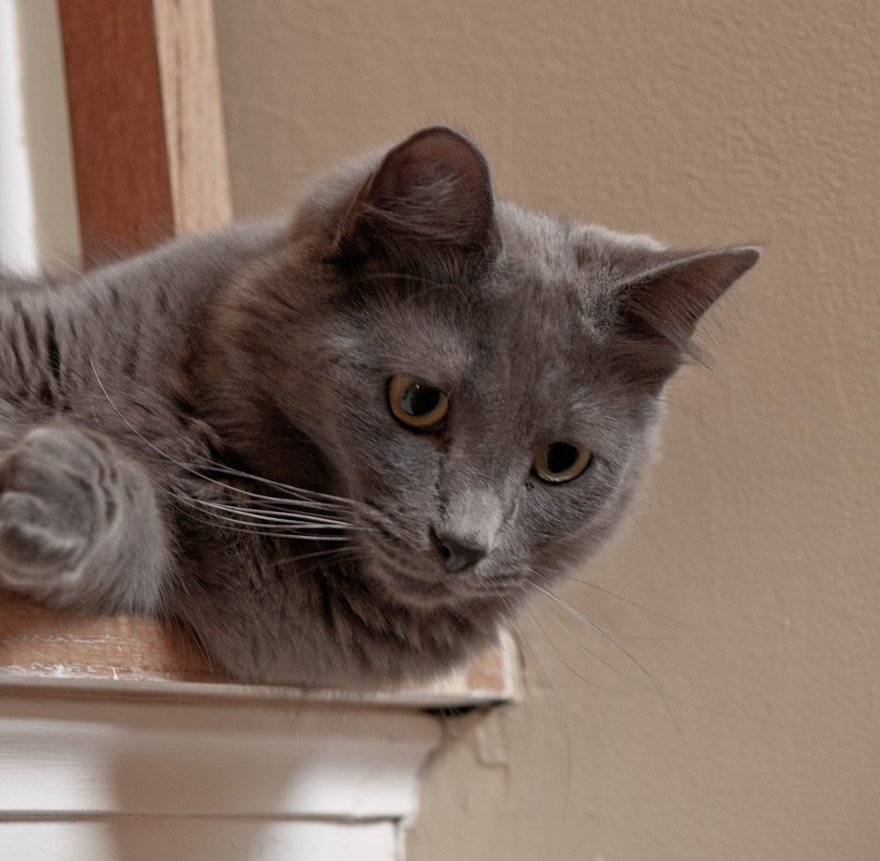
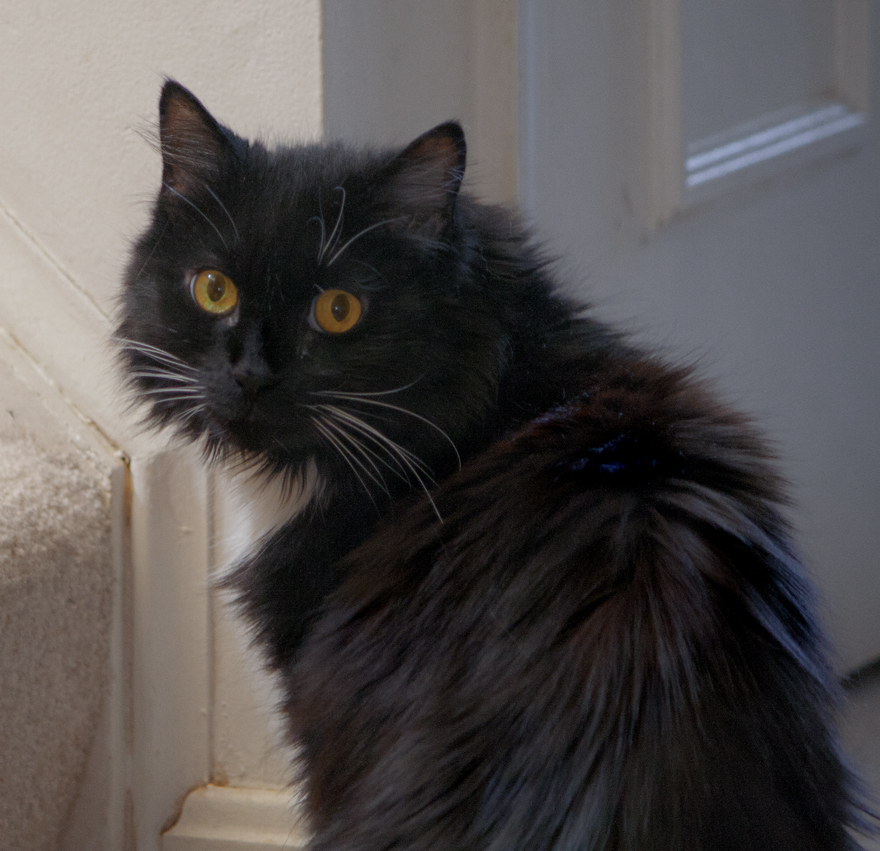
I am catsitting again for my neighbor and fellow blogger Cindy Dyer and her cats are amazingly photogenic.

Pixel was the most cooperative. He posed on windowsill this morning and was even willing to lift his head so that the light coming from the side would take away any shadows.

Pixel2_blog

Pixel’s brother, Lobo (Cindy was going to name him JPEG, but her husband objected), was a little less cooperative. I captured him in his favorite spot, looking down on the main entry from the second floor with his head dangling over the edge.

Lobo1_blog

The third and final cat, Zena, an older female, was even harder to photograph. She gave me a look that seemed to indicate that she was not going to put up with any nonsense from me.zena1_blog

© Michael Q. Powell. All rights reserved

Read Full Post »

Another squirrel photo? In the past few months I have posted a number of photos of Eastern Gray Squirrels (Sciurus carolinensis). yet I  continue to attempt to photograph them whenever I can. Each time, the light is different, the environment is different, and the squirrel is different.

I really like the colors in this photo, the shades of brown and red, especially the way the brown-red surrounding the squirrel’s eyes is repeated in the exposed wood of the branch. I also like the unique characteristics of this squirrel, his cute pose and his little notched ear.

Another squirrel? I’m sure that squirrels will be featured again in my blog. In my suburban lifestyle, many days they may be my only link to nature.

Squirrel in tree

© Michael Q. Powell. All rights reserved

Read Full Post »

I am not a cat person generally, but I am pet-sitting three cats for my friend and photography mentor, Cindy Dyer. You can read about some of the cats’ exploits on her blog.

Her striped cat is named Pixel (only a professional photographer would name a cat Pixel) and is very photogenic. Cindy featured him today in a posting entitled Happy holidays from Santa and Pixel. Here is a photo I took of him yesterday morning, with the soft light coming in from behind him.

Pixel

Pixel

Pixel’s brother is named Lobo, though he was originally going to be called JPEG until Cindy’s husband nixed the idea. He is a bit more friendly than Pixel and equally photogenic. Here is a photo of him, also from yesterday morning.

Lobo

Lobo

The third cat, an older female named Zena, is spending most of her time under the bed—she is irritated with me and seems to think that ignoring me is the best course of action.

These cats were my early morning companions today and we shared the start of a glorious Christmas day—they had their cat food and I had my coffee. Maybe I am starting to turn into a cat person.

© Michael Q. Powell. All rights reserved

Read Full Post »

Have you ever looked at your photos and realized that you captured two very different species in similar poses?

When I was reviewing my photos from this morning, I realized that a White-breasted Nuthatch (Sitta carolinensis) and an Eastern Gray Squirrel (Sciurus carolinensis) had each assumed the same pose as I photographed them. Strangely enough, they happened to be on the same tree at slightly different times.

I like how the lightness of the background matches the coloration of the bird. It wasn’t that long ago that I saw my first nuthatch, and I continue to be amazed by their acrobatic behavior and incredible flexibility. Imagine trying to hold yourself in a position like this!

White-breasted Nuthatch

White-breasted Nuthatch

The squirrel seems to be hyper-focused and intense, scanning his surroundings and ready to move at the sign of any danger. There are only a limited number of colors in this photo and I like it so much that I considered posting it separately with a title of Study in Gray and Brown.

Eastern Gray Squirrel

Eastern Gray Squirrel

The poses of the two wild creatures are similar, but their individual characteristics and the different color palettes of the two photos give each of the two images a distinctive feel.

© Michael Q. Powell. All rights reserved

Read Full Post »

A couple of weeks ago I finally got some relatively clear shots of the North American Beavers (Castor canadensis) at my local marshland and showed you one image in a posting called Beaver at dusk—the sequel. A brief overseas trip and other distractions have kept me from posting additional photos (as I promised to do in the original blog entry), but I finally have worked up a couple more photos.

The first image shows a shaggy, dark-haired beaver in profile. It was late afternoon, about an hour before sunset, and this beaver and the lighter-colored one that you can see in the background had emerged from their lodge and seemed to be grooming themselves and each other. Judging from the crying sounds that I have heard coming from inside the lodge, I suspect that there is a younger beaver in there too.

Shaggy beaver

Shaggy beaver

The second images shows the two beavers interacting. It looks like the lighter-colored one is giving the other beaver a massage, but I wasn’t close enough to determine for sure what they were doing. Could it be love or is he merely loosening up for a night of heavy lifting?

Beaver masseuse

Beaver masseuse

© Michael Q. Powell. All rights reserved

Read Full Post »

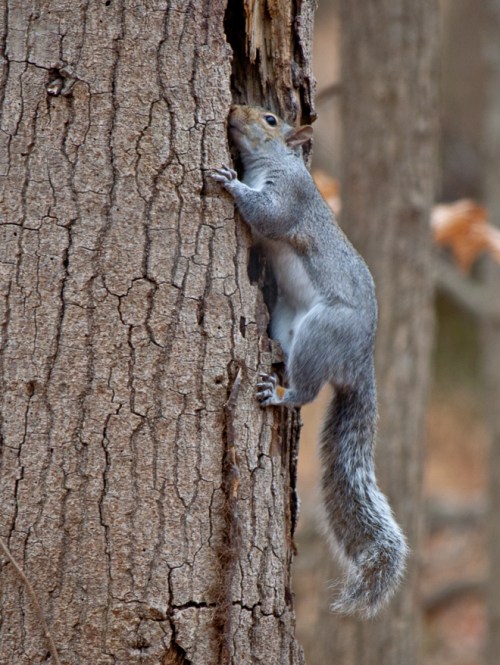
Do you ever find that you totally missed a cool element of a photograph during initial review because the element was not near the center of the image? Today I looked over some squirrel shots from a week and a half ago and realized that the photo of a squirrel perched on the trunk of a tree was a whole lot more interesting than I had previously thought.

Hide and seek

Hide and seek

My attention had been so drawn to the downward-facing squirrel (is that a yoga pose?) that I didn’t even notice the squirrel in the upper right corner, peering out from inside the hollow tree. That squirrel is so cute that I enlarged the corner of the photo so you can appreciate its cuteness even more.

Cute squirrel

Cute squirrel

By itself, the cute squirrel would have been worth posting, but in combination with the other squirrel, it’s a really fun image.

The lesson learned for me is that I need to look at my photos more carefully during my first review or take the time to look at them later a second time with fresh eyes.

© Michael Q. Powell. All rights reserved.

Read Full Post »

The photos in yesterday’s postings about Black Vultures were dark and gloomy and perhaps a little creepy. Today I am going to the opposite end of the spectrum with photos of a squirrel that are warm and cute.

I took these first two shots just outside of my house. Watching this squirrel through my kitchen window as he was digging in the grass, uncovering an acorn, I decided to try to take his photo. When I appeared, he slowly climbed up a tree and found a comfortable spot to enjoy his treat. The first image, my favorite, shows him posing before eating. I really like the effect of the light coming in from the side. The second one shows a more serious side as he seems to have adopted a more dignified pose.

squirrel1_blog

squirrel2_blog

Earlier in the morning yesterday I watched as two squirrels chased each other around—I think at least one of them had amorous intentions. Part of the time they went in an out of a hollow remnant of a tree. They would enter the tree at ground level and come out of the side of the tree. Here are a couple of photos of one of the squirrels as he vainly searches for his playmate.

squirrel3_blog

squirrel4_blog

© Michael Q. Powell. All rights reserved.

Read Full Post »

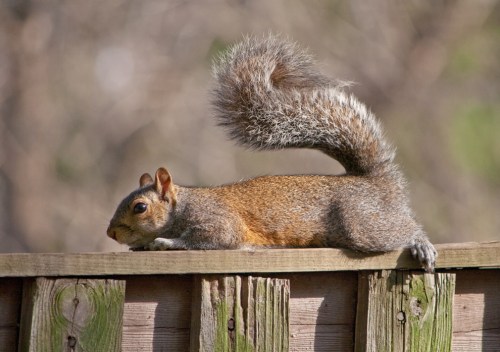
Gray squirrel on my backyard fence

Squirrels always seem full of energy. They run around much  of the time gathering food and for enjoyment chase after each other with the reckless abandon of children. It’s fun sometimes just to watch them in their frenetic activity as I was doing one afternoon this past weekend from the inside of my house. One Eastern Gray Squirrel (Sciurus carolinensis) seemed to especially enjoy running along the top of my fence. When he tired a little, he slumped down on the fence with his tail sticking up. I grabbed my camera and carefully made my way outdoors and was able to capture his pose. I like how it turned out, with the different shades of gray, green, and brown in both the foreground and the background. The squirrel’s pose suggests that he is still very alert, even if he is relaxing a little.

© Michael Q. Powell. All rights reserved.

Read Full Post »

Beaver at Huntley Meadows Park

Beaver at Huntley Meadows Park

This past Saturday I introduced you to one of the local beavers in a posting entitled Beaver at dusk. The photos of the beaver were shot at a very high ISO and were pretty grainy. Yesterday, I was fortunate enough to photograph the beaver in better light, when he came out of his lodge an hour or so before sunset. I’m still going through my photos and may work up a few more, but wanted to post one immediately.

He is a beautiful specimen of a North American Beaver (Castor canadensis). From what I’ve read, it is almost impossible to tell a male and female beaver apart, except when the female is nursing a kit (baby beavers are called kits), so I may be wrong in using male pronouns with this particular beaver.

© Michael Q. Powell. All rights reserved.

Read Full Post »

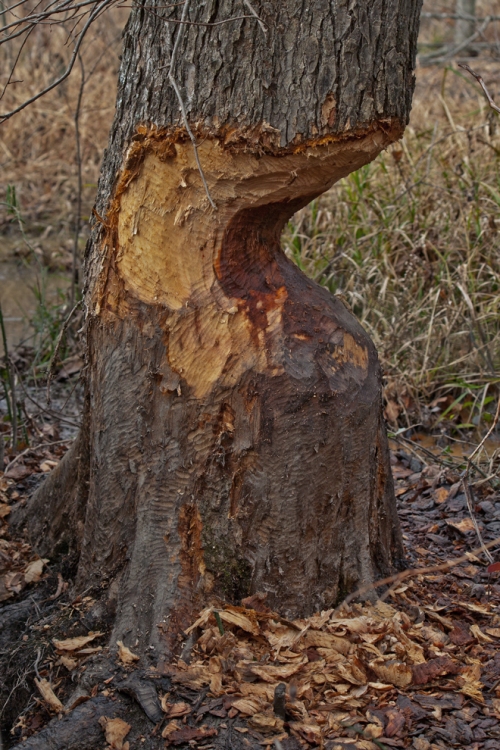
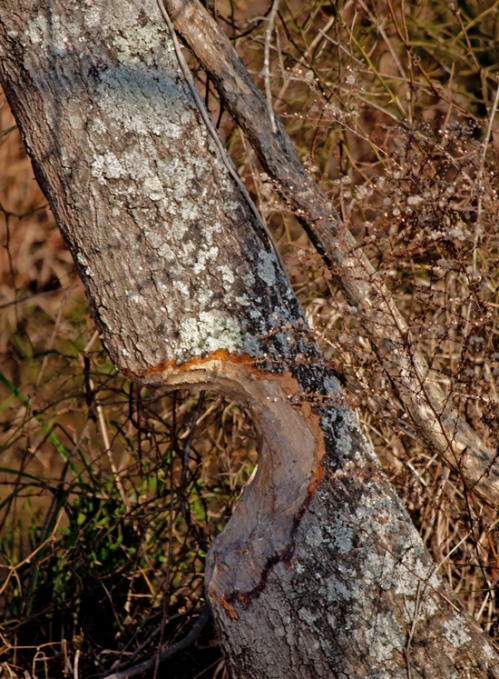
The beavers in my local marsh have been really busy recently as winter draws near (“busy as beavers,” you might say). Each time I visit the marsh I can see evidence of their handiwork. Hmm, “handiwork” is probably not the right word, since most of the evidence I see is work they have accomplished with their teeth. Maybe I should call it “dentalwork,” but that terms conjures up images of beavers with braces on their teeth. I’ll just call it “work.”

Over the past few weeks I have been noting their progress on chewing through a pretty large tree. First they chewed one side and then it looks like they gradually moved around the circumference of the tree. Circumference? Who says that high school geometry doesn’t have everyday applications? They now have gnawed (try saying that phrase quickly multiple times) into the center of the tree and I expect to see to see a fallen tree soon. I won’t be disappointed, and certainly not crestfallen.

On a slightly more serious note, I am genuinely amazed that the beavers don’t just take down small saplings. I confess that, as a result of living most of my life in the suburbs, I don’t know much about wildlife. It’s fascinating to me to look at all of the individual tooth marks in the wood that bear witness to the persistence of this industrious creature. I also see its work in the mud walls that have been built up along the edges of parts of this little pond and the ever-increasing amounts of mud that have been packed on the lodge.

The beaver is ready for a cold winter. Am I?

Let the chips fall where they may

Let the chips fall where they may

How do they gnaw this high?

How do they gnaw this high?

© Michael Q. Powell. All rights reserved.

Read Full Post »

The beavers at my local marshland park have built a lodge that spills onto a bench on the boardwalk and the entrance to the lodge appears to be in the waters underneath the boardwalk itself. There are signs that the beavers have been actively getting ready for winter with new mud walls and fallen trees each time I visit. I’ve only seen a beaver a few times and it has always been a time of reduced visibility, i.e. early morning or late in the day.

As I was walking back toward the park entrance yesterday evening after taking photos of the sunset, I heard noise near the beaver lodge and saw that a beaver was visible through the brush. I snapped a couple of photos, but realized that ISO 400 would not work, so I cranked up the ISO to 1600, the highest that my camera would go. This was uncharted territory for me, because I had already seen prominent grain when I set the ISO at 800. Even with the ISO set that high, the shutter speed was around 1/15 sec, so I tried to keep my camera on my tripod. The beaver was somewhat preoccupied and did not immediately dive, the normal reaction of a beaver when I see them, so I was able to get some shots of the beaver in action.

In many ways, these are aspirational shots, for they reflect photos that I want to take in the future with better results. I am sharing some of them, however, because I find them to be interesting, poor quality notwithstanding. It will definitely be a challenge to figure out a solution to the dilemma of getting quality shots in limited light.
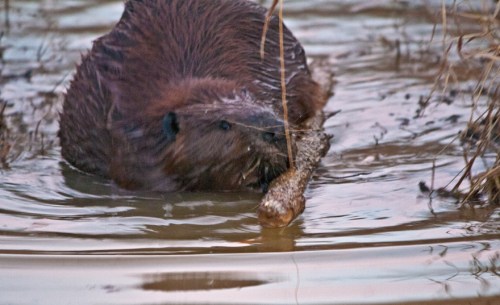
Gathering more sticks for his lodge

Gathering more sticks for his lodge

Beaver close-up

Swimming beaver

Beaver with open mouth

Beaver with open mouth

Beaver looking at me

Beaver looking at me

Swimming toward the light

Swimming toward the light

© Michael Q. Powell. All rights reserved.

Read Full Post »

After two days that were heavily overcast, we finally had some sunshine yesterday, although the day started out below freezing.A light sheet of ice covered then pond where I have been photographing ducks and geese, and they had all disappeared.

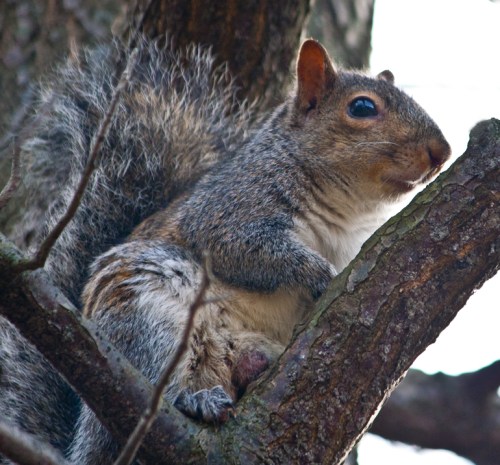
Eastern Gray Squirrels (Sciurus carolinensis) were very active, though, taking advantage of the weather to scamper about and gather food. It was fun to watch them run around, sometimes chasing each other like little kids playing a game of tag. I came upon this squirrel on a broken off limb, enjoying a snack. He was high enough up in the tree that he did not seemed to feel threatened by my presence.

There was some beautiful lighting from the side and the back that illuminated his underside when he turned in certain directions. My first few shots were really overexposed. If this had been a human subject, I might have tried using some flash to add some light, but that did not seem to be the right thing to do for a squirrel out on a limb. So I intentionally underexposed the image, blowing out the background (which was mostly sky, so it wasn’t a problem). I recaptured a little of the sky’s color in post-processing and played with the settings to try to bring out the texture and color of the squirrel’s fur. I guess that I never realized before that the fur is not a solid gray, but is a mixture of lighter and darker hairs.

I especially like how the light hits the upper portion of one of his ears and the tip of his bushy tail. The reddish brown tones of the wood also help to bring out the colors of his face.  It was nice to have a cooperative, photogenic subject.

Out on a limb

© Michael Q. Powell. All rights reserved.

Read Full Post »

Usually when I see a deer, it turns and runs away, sometimes stopping to gaze back at be from a distance just beyond the range of the lens that I have on my camera at that moment. Recently, however, I encountered a deer that seemed content to look at me as I looked at him. It sounds like a nature photographer’s dream come true.

The biggest challenge was that he was in the middle of a mostly dried-up marshy field full of cattails and other tall growth that made it impossible to get a clear view of the young buck, a white-tailed deer, I believe. It became pretty clear to me that auto-focus was not a viable option—the camera seemed to really want to focus on some arbitrary branch rather than on the deer—so I relied on manual focusing. It was also in the middle of the day, so shadows were pretty harsh. During the protracted period of time that the deer stayed in the same little area, I shot a lot of photos and these are two of my favorites. You’ll note that the deer blends in pretty well with the background. If he had remained absolutely still, I may very well have walked on by without seeing him.

Deer in the cattails

White-tailed buck in a field of cattails

© Michael Q. Powell. All rights reserved.

Read Full Post »

I was attempting to get a photo of a bird in the cattails, when suddenly I noticed that a deer had entered into the frame. Deer are pretty common and I have even seen them in my suburban neighborhood, but I have rarely seen them at a moment when I had my camera in my hand, so I was excited.

The lighting was a little uneven and harsh and it was difficult to get a completely unobstructed shot, but the deer cooperated and paused a few times, allowing me take a few relatively clear shots. I grew up in the suburbs of Massachusetts and even though my deer identification skills are not strong, I am pretty confident that this is a buck, probably a white-tailed deer (Odocoileus virginianus).

I am not a politician, but I am glad to affirm with great conviction,  “The buck stops here.”

© Michael Q. Powell. All rights reserved.

Read Full Post »
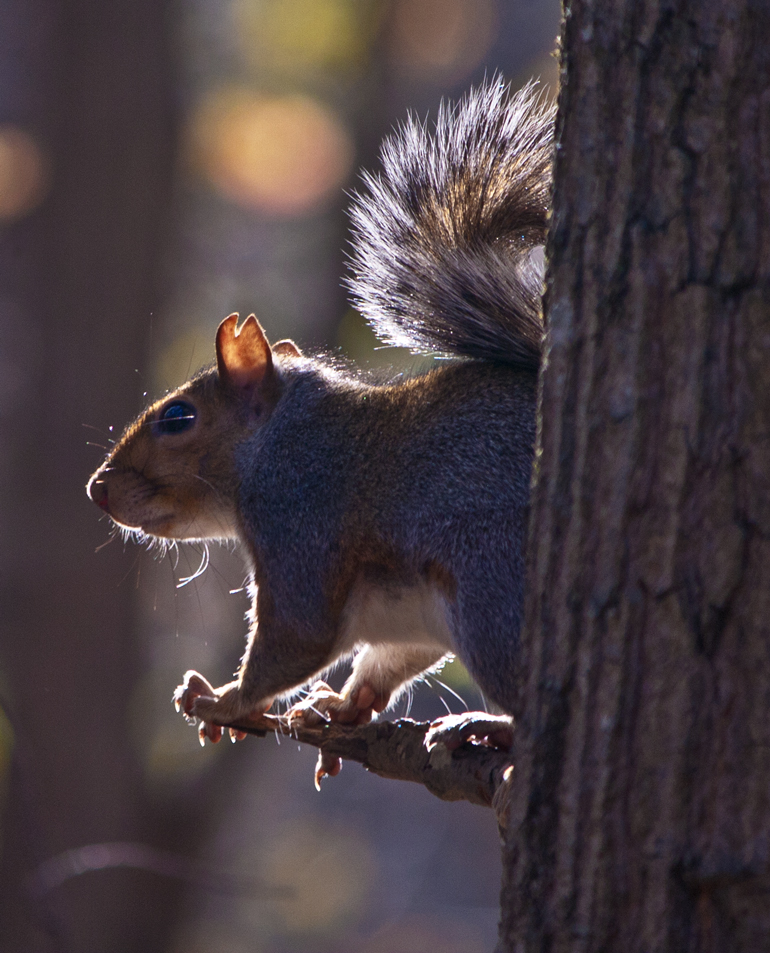
Backlighting adds drama and glamor, even when the subject is as ordinary as a squirrel.

I was almost done shooting photos today when I decided to try to capture a few images of squirrels. Usually they are too quick for me and I often end up with blurry photos. As I approached a squirrel, he climbed a tree and I stopped and waited to see if he would climb higher. Instead, he climbed out onto a tiny branch, offering me a profile shot with beautiful backlighting. I love the glow around the face and tail and the warmth of the light showing though the squirrel’s ear. Even the bokeh is nice.

Even a squirrel can look glamorous, under the right conditions.

Squirrel glamor shot

© Michael Q. Powell. All rights reserved.

Read Full Post »
On a cold and overcast morning, I walked through the marsh today, heading toward a little pond area where I was hoping to see migrating ducks and geese. As I arrived at that area, I realized there was a deer in the distance near the far side of the water’s edge. I didn’t have time to make many adjustments and got off only two shots. This is the better of the two, and I like the pose of the deer, as she back at me before taking off. To give you an idea of the limited light, this was shot at ISO400, f5.6, and 1/30 second. I was at the far end of my 55-250mm zoom lens (and still had to crop quite a bit).

Early morning deer

© Michael Q. Powell. All rights reserved.

Read Full Post »

I was observing three cheetahs at the National Zoo for quite some time when one of them decided to enter the dug out area of their habitat where two cheetahs were already lying down. Just before he entered it, he turned in my direction and stuck out his tongue. I have no idea what he might have been trying to communicate to me. Perhaps he was no longer interested in my antics and was trying to tell me so or maybe it was his way of saying goodnight. Whatever his intention, it makes for an interesting photo.

Cheetah sticking out his tongue

© Michael Q. Powell. All rights reserved.

Read Full Post »

I photographed this red panda (Ailurus fulgens) this past weekend in Washington, D.C. at the National Zoo. According to Wikipedia, red pandas are native to the Himalayas and southwestern China. Like the better-known giant pandas, red pandas eat mostly bamboo, although they may also eat eggs, insects, birds, and small mammals.

I will probably post a few more shots of this red panda in the next few days, when I have gone through my zoo photos. However, I wanted to make a preliminary introduction of this delightful animal, suspecting that many of you may be unaware of the existence of a red panda. (Previously red pandas were classified in the families of racoons and bears, but now they have their own family and are the only extant species of the genus Ailurus.)

Red panda at the National Zoo

© Michael Q. Powell. All rights reserved.

Read Full Post »

« Newer Posts