Feeds:
Posts
Comments

Archive for the ‘Amphibians’ Category

I love taking photos of frogs (I can blame the Muppets and Kermit the Frog) and captured this image of a Northern Green Frog (Rana clamitans melanota) this morning at my local marshland park. I am not sure what was floating on the surface of the water, but it provides a nice contrast to the color of the frog.

frog2_blog

Michael Q. Powell. All rights reserved

Read Full Post »

A blog about a frog on a log in a bog—is this how Doctor Seuss got started?

The subject is ordinary and the composition is simple, but I really like the result. The frog seems to be lost in a moment of contemplation as he stares out across the pond and I made sure not to wake him from his reverie as I quietly snapped his photo and moved on.

frog1_blog

Michael Q. Powell. All rights reserved

Read Full Post »

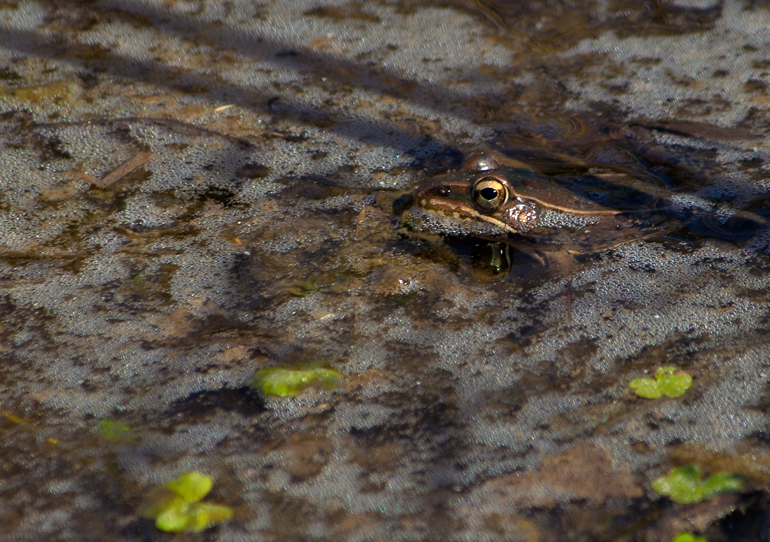
I have been hearing the sound of frogs for weeks, but I rarely catch a glimpse of one and was happy to spot this Southern Leopard frog (Lithobates sphenocephalus) on Monday.

I really like the view from the front, with the frog surrounded by little bubbles, his eyes reflecting in the water. The second view, however, lets you see better the positioning of his legs.

The frogs are active now and I even saw a pair of intertwined snakes. Spring is here in full force in Northern Viriginia.

Frog1_blogfrog2_blog

Michael Q. Powell. All rights reserved

Read Full Post »

I am finally posting some more photos of the Nine-banded Armadillo (Dasypus novemcinctus) that I spotted a couple of weeks ago when visiting the Phinizy Swamp Nature Park in Augusta, GA.

Previously, I posted a photo of the armadillo standing on his hind legs, but I thought it would be interesting to post some additional shots of the armadillo in action.

I grew up in New England, so the armadillo qualifies as an exotic animal for me, although there are probably folks in Texas and elsewhere that view armadillos as pests. I am completely fascinated by the texture of his shell, particularly the tail, and tried to highlight it in the photos.

The armadillo spent most of its time rooting about in the grass and most often his head was not visible, which was a challenge for photos. Even when I moved relatively close, the armadillo seemed so focused on what he was doing (or so near-sighted), that he paid no attention to me.

I actually had two mini-encounters with him. The first time, he scurried pretty back to the swampy field from which he had emerged when he sensed my presence. I retreated from the immediate area and returned to find him in the same location. This time, after getting his fill of insects (or whatever else he was eating), he lumbered back to the swampy field.

So far, there are no armadillos in my neighborhood in Northern Virginia, but Wikipedia notes the armadillo’s rapid expansion northward, primarily because of the lack of natural predators within the United States, little desire on the part of Americans to hunt or eat the armadillo, and the animals’ high reproductive rate. Eventually, armadillos are predicted to reach as far north as Ohio, Pennsylvania, and New Jersey.

As I studied up a bit on armadillos, I learned that armadillos can contract (and pass on) leprosy (yikes!), so you won’t see me handling any armadillos. Additionally, Nine-banded Armadillos have an unusual reproductive system, in which four genetically identical offspring are born, the only mammals in which polyembryony is reliably manifested, according to Wikipedia. This trait makes them particularly suited for certain types of scientific and medical tests that need consistent biological and genetic makeup in the test subjects.

armadillo5_blog

armadillo1_blogarmadillo4_blogarmadillo2_blog

armadillo3_blog

Michael Q. Powell. All rights reserved

Read Full Post »

Have you ever watched a frog as he was croaking?

Apparently he closes his mouth and nostrils, squeezes his lungs, and his vocal sacs expand, looking a lot like a bubblegum bubble.

Southern Leopard Frogs (Lithobates sphenocephalus) have a vocal sac on either side of their head, although some other frogs have only a single sac under their chin,

Here’s a shot I took on Monday of one as he was croaking. You can see the vocal sac bubble pretty wellif you look closely at the side of the head nearest the camera.

croaking1_blog

I am including this additional frog photo, because I really like the way that the bubbles surround his head.

bubbles1_blog

© Michael Q. Powell. All rights reserved

Read Full Post »

Yesterday I was out again in the marsh, hoping to photograph frogs as they were croaking.  Of course, the first problem was finding them. I could hear them throughout the marsh, but many of them were hidden from view in the cattails or far out in the water.

Eventually I was able to locate a few frogs that were within the range of my camera and I am still going through those images. What I was looking to capture was the vocal sacs that expand like little bubbles when they make the croaking sound. I am still not sure if I captured that phenomenon well enough, but plan to post some images later.

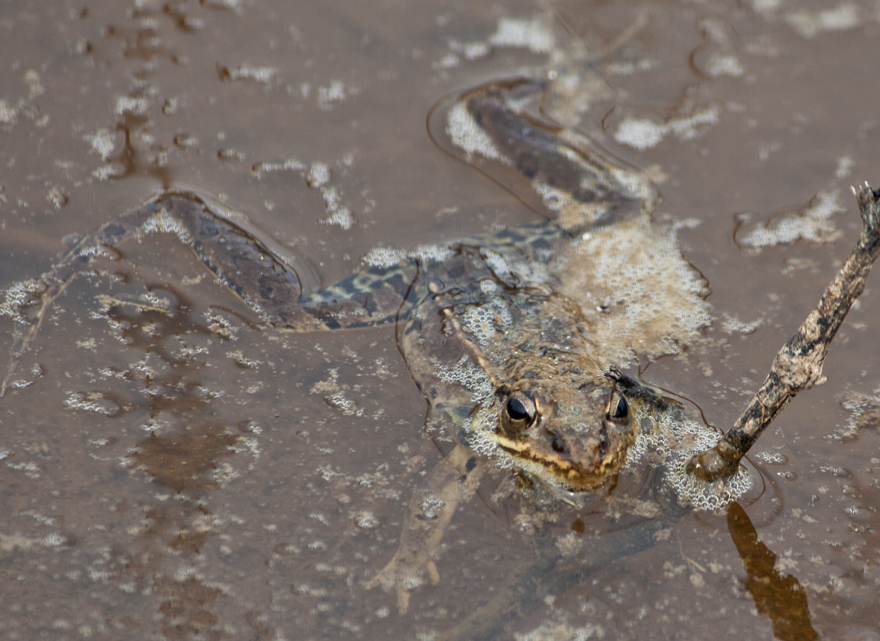
One of the frogs that I spotted, a Southern Leopard Frog (Lithobates sphenocephalus), was apparently unaware of my presence and began swimming slowly in my direction. He seemed to be trying to keep his head above the water and doing a version of what I used to call the “dog paddle”—I may start calling it the “frog paddle” from now on.

This photo shows the swimming frog in mid-stroke, surrounded by lots of bubbles. I am not sure if he is responsible for the bubbles, but they add a nice touch to the photo.

I’m pretty sure that I will be off again soon in search of frogs, snakes, and turtles as me move into spring. Stay tuned, there’s more to come.

frog_paddle_blog

© Michael Q. Powell. All rights reserved

Read Full Post »

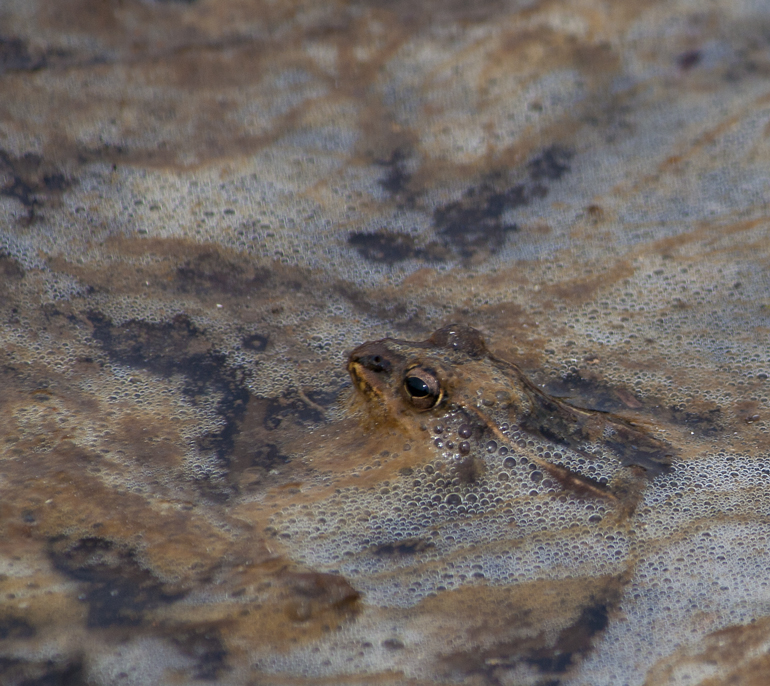
Yesterday, the marsh was alive with the sound of music, frog music. Entire areas of the marshland seemed to resound with waves of sounds, some it high-pitched and some of it lower in range. The warm weather, in the low 60’s (16 degrees C), seemed to have roused the frogs from their sleep and they were in the mood to sing.

Although I could identify the general areas of the frog activity, it proved to be very difficult to spot the frogs themselves. My eyes scanned and rescanned the shallow waters near the cattails until at last I spotted a frog.

I think this frog is a Southern Leopard Frog (Lithobates sphenocephalus), but I am not entirely sure of my identification. You can see from the photo how effectively he is camouflaged.

Frogs and turtles are starting to be active, can the dragonflies be far behind?

springfrog1_blog

© Michael Q. Powell. All rights reserved

Read Full Post »

« Newer Posts