Feeds:
Posts
Comments

Archive for October, 2025

There are only a few remaining dragonflies as we move deeper into the autumn season. I was therefore delighted to spot this female Eastern Pondhawk dragonfly (Erythemis simplicicollis) during a recent visit to Occoquan Bay National Wildlife Refuge. Eastern Pondhawks appear in early May and generally hang around until the end of October.

The females of this species are quite distinctive in their appearance, with their brilliant green color and striped abdomens, so they are relatively easy to identify. Immature males, however, have the same coloration when young, so I usually check the terminal appendages before making a call on the gender of an Eastern Pondhawk.

Eastern Pondhawk

© Michael Q. Powell. All rights reserved.


Read Full Post »

As I was hunting for dragonflies last week, I was surprised to come across this wonderfully patterned spider at Occoquan Bay National Wildlife Refuge. I had figured that spiders were gone for the season, so I was not expecting to see on crawling across a fallen log.

I realize that spiders are a divisive subject for photography—some people love and admire then, while others fear and hate them. As you might suspect, I am in the former camp. Although I had a 18-400mm zoom lens on my camera, I was able to capture quite a few details of this spider and encourage you to click on the image.

I am not really sure of the species of this spider, but suspect that it might be a wolf spider.

Somehow this spider gives off a Halloween vibe to me. Happy Halloween in advance to those of you who celebrate thing creepy and spooky on that day.

autumn spider

© Michael Q. Powell. All rights reserved.

Read Full Post »

We have now reached a point in the dragonfly season where Autumn Meadowhawks (Sympetrum vicinum) are the dragonfly species that I see most frequently. Most other species have gradually disappeared and I seen only occasional survivors that are still hanging on. There is something about the physiology of Autumn Meadowhawks that allows them to tolerate the cold better than other dragonflies and in past years I have seen them as late as the middle of December.

Last Friday I spotted over a dozen Autumn Meadowhawks at Occoquan Bay National Wildlife Refuge and was able to capture photos of several of them. Autumn Meadowhawks tend to perch flat on the ground, so it can be a bit difficult to spot them, especially when they choose to land on fallen leaves that camouflage them almost perfectly.

Female Autumn Meadowhawks are a mixture of red and brown colors, as you can see in the first photo below, while the males of the species are bright red, as you can see in the final photo. Both genders have beautiful brown eyes.

Autumn Meadowhawk

Autumn Meadowhawk

Autumn Meadowhawk

© Michael Q. Powell. All rights reserved.

Read Full Post »

The Blue-faced Meadowhawk (Sympetrum ambiguum) is a late-season dragonfly that is somewhat similar in appearance to the more common Autumn Meadowhawk—males of both species have bright red bodies, but Autumn Meadowhawks have brown eyes.

The females of both species are more muted in their coloration than their male counterparts, as is often the case with many dragonflies and birds, so they have more natural camouflage and are frequently more difficult to find. I was therefore delighted to spot this female Blue-faced Meadowhawk last Friday at Occoquan Bay National Wildlife Refuge, my first sighting of the species this season.

I am hopeful that I will spot the more colorful male Blue-faced Meadowhawk before this dragonfly season comes to an end.

Blue-faced Meadowhawk

© Michael Q. Powell. All rights reserved.


Read Full Post »

During transitional periods throughout the year, I like to capture images that include elements of the season that is ending and of the season that is beginning. Last Friday I took this photo of a Common Buckeye butterfly (Junonia coenia) that has some foliage in the background that was in the process of changing colors. Though the leaves on which the butterfly is perched are still green, the reds and oranges of the background provide a foretaste of the future, a foreshadowing sign of what is yet to come.

Common Buckeye

© Michael Q. Powell. All rights reserved.


Read Full Post »

I was absolutely thrilled last Friday to photograph a Russet-tipped Clubtail dragonfly (Stylurus plagiatus) at Occoquan Bay National Wildlife Refuge, a somewhat surprising find this late in the dragonfly season. As I was walking along one of the trails, I encountered a fellow dragonfly enthusiast who was part of a group conducting a survey of butterflies and dragonflies at the refuge. After a brief conversation, we both continued on our way, heading in opposite directions.

A short time later I heard a voice calling out from a distance. I could not understand what was being said, but hurried back down the trail and was delighted to see that my friend had spotted a Russet-tipped Clubtail perched in the vegetation. Russet-tipped Clubtails are a late season species and are seen most often in August and September in my area. Unlike many of the dragonflies that I see regularly that seem to prefer pole-like perches or perch flat on the ground, Russet-tipped Clubtails like to hang from the leaves of vegetation at an angle or almost vertically—members of the genus Stylurus are sometimes called “Hanging Clubtails.”

The dragonfly was cooperative and remained perched as I took photos from several different angles. Before long, the dragonfly took off and our brief encounter ended. I continued on my way, content to know that the end of the dragonfly season, although near, is not here yet.

Russet-tipped Clubtail

Russet-tipped Clubtail

Russet-tipped Clubtail

© Michael Q. Powell. All rights reserved.

Read Full Post »

The countdown continues as we gradually move towards the end of the dragonfly season in my area. The Blue Dasher dragonfly (Pachydiplax longipennis) is one of the first dragonflies to appear in the spring and one of the last dragonflies to disappear in the autumn.

I spotted this tattered male Blue Dasher dragonfly during a recent visit to Jackson Miles Abbott Wetland Refuge. This was one of only a handful of dragonflies that I saw that day. The end is nearing, but I am not ready to call it quits quite yet for my dragonfly photography.

Blue Dasher

© Michael Q. Powell. All rights reserved.

Read Full Post »

Its wings are a bit tattered and its colors have faded, but this male Slaty Skimmer dragonfly (Libellula incesta) was still hanging in there at the end of September, when I spotted it at Jackson Miles Wetland Refuge at nearby Fort Belvoir, Virginia. The nights have become considerably cooler the past week and I am anxious to get out in the wild with my camera to see which hardy surviving dragonflies are still flying.

Slaty Skimmer

© Michael Q. Powell. All rights reserved.

Read Full Post »

Our weather has definitely turned cooler, and the number of insects is definitely decreasing. I therefore treasure each encounter that I have, knowing that it could be the last one of the season.

I spotted this beautiful Red-spotted Purple butterfly (Limenitis arthemis astyanax) during a recent visit to Jackson Miles Abbott Wetland Refuge. It seems to have suffered a bit of wing damaged, which did little to damage its beautiful colors. I believe that this butterfly species has two broods, one in the spring and one in late summer, which may help to explain why this butterfly’s colors are still so vibrant—some of the other butterflies that I see have colors that are worn and faded.

Red-spotted Purple

© Michael Q. Powell. All rights reserved.

Read Full Post »

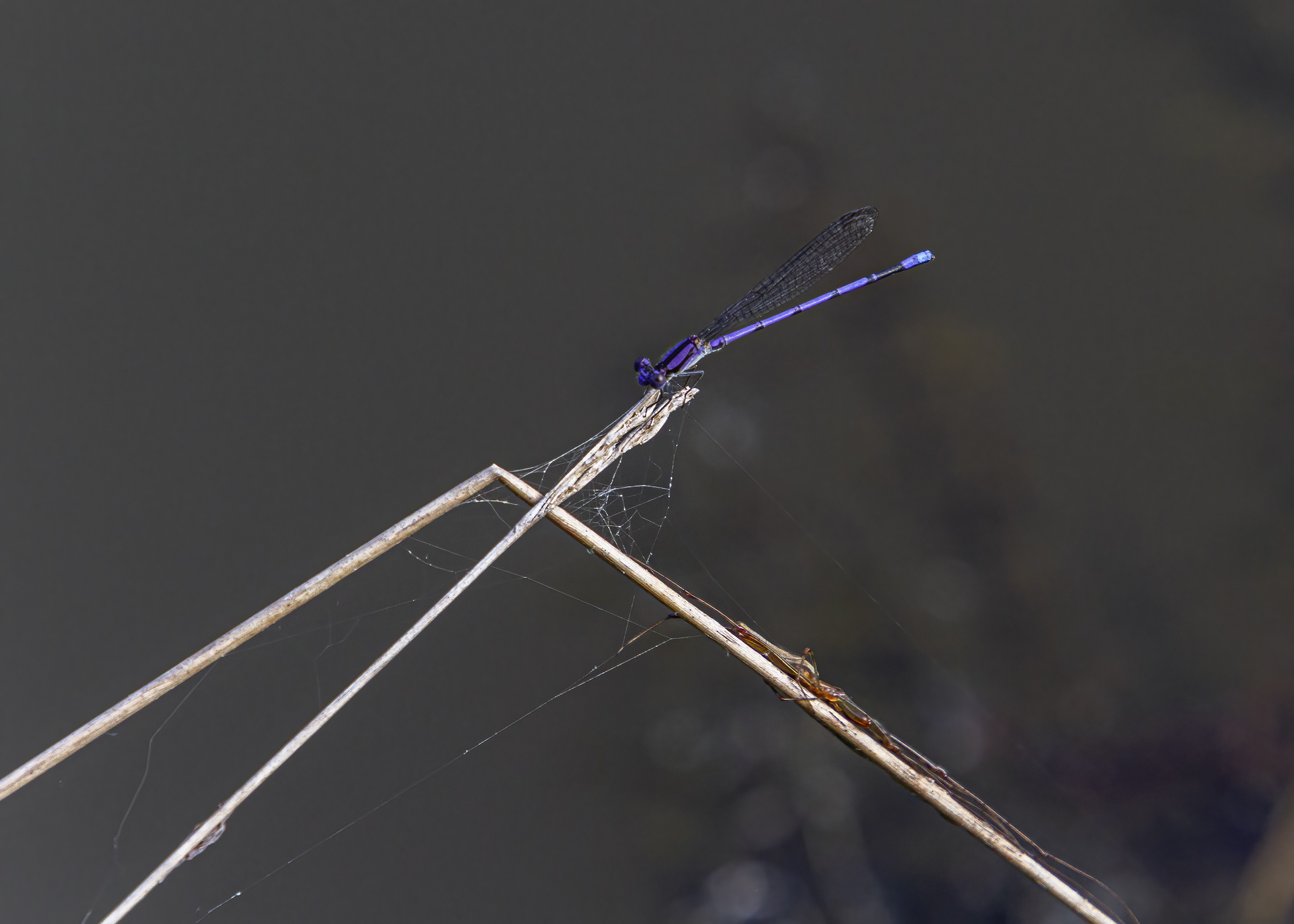
Do you have a favorite damselfly? I have had the opportunity to photograph some pretty spectacular damselflies, but I am irresistibly attracted to the unique coloration of the Violet Dancer damselfly (Argia fumipennis violacea), a subspecies of the Variable Dancer damselfly (Argia fumipennis). In fact the banner photo for my blog page includes a photo of a beautiful Violet Dancer, so my fondness for this species is not exactly a secret.

Maybe I am a little weird for having a favorite damselfly. If that is what you think, perhaps you have forgotten what it is like to view the world as a child as I try to do. Years ago I remember reading a Reader’s Digest article that included the following Tweet, “I like having conversations with kids. Grown-ups never ask me what my third favorite reptile is.” That Tweet (or whatever they are called now) captured my feelings really well

I spotted this colorful little damselfly last Friday (26 September) as I was exploring a small pond at Jackson Miles Abbott Wetland Refuge. I was a little surprised, but very much delighted to see the Violet Dancer so late in the season.

I did not dare lean over the edge of the pond for fear of falling in, but I really like the long distance shot that I was able to capture. The simple lines of the vegetation and the dark pond waters help to draw the viewer’s eyes to the Violet Dancer, even though it occupies only a small portion of the frame.

As I get older I find that I care less and less about what others think about me. Dare to be weird today!
violet dancer

© Michael Q. Powell. All rights reserved.

Read Full Post »