What does “common” mean to you? For many of us, the descriptor “common” is used for ordinary, everyday things to which we tend to pay little attention. Their purposes tend to be functional and utilitarian and beauty is often of secondary importance, assuming that it is considered at all.
I rebel against the use of “common” in the name of many wildlife species. Even if “common” is meant to suggest the likelihood of encountering a species, it is usually related to geography—what is “common” in one area may well be “uncommon” in another area. I think that the folks who name species should be a bit more creative in choosing names for species.
On Monday I encountered this Common Buckeye butterfly (Junonia coenia) during a visit to Occoquan Bay National Wildlife Refuge. Take a close look at the colors and markings on this little butterfly and I’m sure that you will agree that it is uncommonly beautiful.
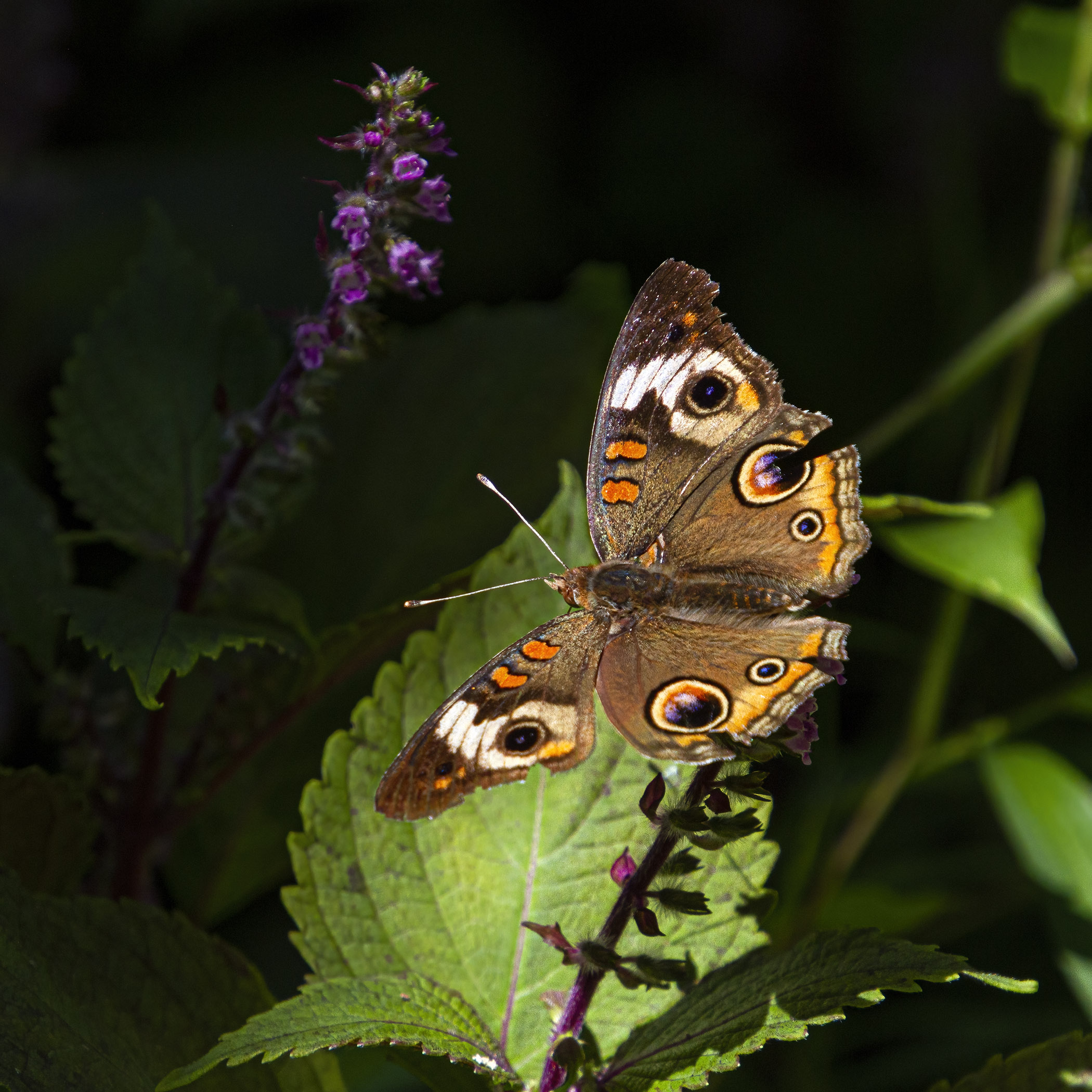
© Michael Q. Powell. All rights reserved.
 Mike Powell
It is a poor word for describing a species. Common and widespread should only be used to describe the range, distribution, and population size of a species. It creates confusion when used as a name (how can this thing be rare when it is the common such and such?). Junonia coenia, the common buckeye, is rare or uncommon in New England states and rare in Oregon, Washington, and Montana. Many common species are rare to uncommon at the fringes of their distribution.
Thanks, Gary, for your wonderful explanation of why “common” is such a poor word to use for a species. I also have issues with the names of some birds, like the Least Sandpiper–having a name like that damages its self-esteem. And who decides if a bird is “great,” like the Great Blue Heron? 🙂
Indeed, Mike! Is there a Second-best Blue Heron? Of course not. Some of these names do not help especially when species conservation is considered. I understand the the word “great” can mean “large” (I’m thinking the heron was called “great” because it was larger than some heron species) but most people today do not use that word in that way very often.
On different note there used be a great (!) blue heron or sometimes two that would visit the marshland o where I live probably to catch fish and frogs in the little stream that flows through it. Sadly, I have not seen this bird come back for many years. We always commented on how pterodactyl-looking they were. Even the sandhill cranes did come back this year.
I can always count on your posts to bring a few smiles to my face! Whilst smiles are certainly not uncommon to this old face, at times they seem in short supply. I must agree that the photo of this aging Common Buckeye is uncommonly beautiful. That said, it is the commentary which prompts more smiles. As John D. Rockefeller once said : “The secret to success is to do the common things uncommonly well.” The butterfly and yourself have done just that! Thank-you, Mr. Mike!!
Thanks, Ellen. You are very closely attuned to my “style” of both photography and writing, i.e. you know my “secrets.” Although I will occasionally search for somewhat rare species, most of the time I am content to photograph the same species in the same places, trying to photograph them as well as I can at different times of the year and in different micro-habitats. I remember someone once tell me that photographers generally like to live either broadly, trying to see the maximum number of species in as many different places as possible, or deeply, observing the same limited number of species in the same few places as the seasons change. I proudly count myself as a member of the latter group. I really am content to photograph the everyday creatures as well as I can, blemishes and all, and then share those photos with others to remind them of the beauty they may be missing by not paying attention to the world around them.
The common Buckeye isn’t so common in my area. I’ve only seen one in the past five years.
I’ve only seen one in my entire career as a field botanist, though I’m often tasked with rare insect species identification along with the plants. It was along the margins of a former cranberry bog in Wisconsin. It was in a patch of Agalinis purpurea and Agalinis tenuifolia, which I later learned are host plants for the buckeye butterfly. Managed to get a few photos with my cell phone before it flew away. What sort of habitat have you found them in?
I tend to see Common Buckeyes quite often along the trails at Occoquan Bay National Wildlife Refuge, a coastal plain/wetland where the Potomac and Occoquan Rivers intersect in Northern Virginia. I’m afraid that I can’t help in identifying the host plants-I am more knowledgeable about insects than about tplants.
I have link to my Flickr pages of the plants in flower where I saw the Buckeye if you want to see them. https://www.flickr.com/photos/reallysmallfarm/50326613517/in/album-72157632750320955/
Thanks for sharing the link. I’ll pay a bit more attention and see if I can get of a shot if/when I see more buckeyes the next time I visit this wildlife refuge.
The only one I’ve seen was in a hilly prairie area on Hoary Vervain. Which is a host plant for the Common Buckeye. That prairie area had lots of good looking Hoary Vervain that was in full bloom at the time. It flew away as I was trying to get a picture of it and I didn’t see it again after that.
I’ve got blue vervain growing wild on old beaver lodges here. I should check those out next summer. I did have hoary vervain as a garden plant but haven’t seen it for a while.
I was reading that the Common Buckeye does not survive winters up north and must migrate each year from southern populations. I wonder if that might have something to do with our seeing so rarely such not finding enough appropriate larval hosts as they move north.
Thanks, Randy, for responding. I occasionally forget that the species that may appear quite often in one area may be rare in other areas. In Virginia we are blessed to be at the intersection of the north and the south and have coastal plains and mountains, so within the state we have quite a variety of species.
They are beautiful