Feeds:
Posts
Comments

Archive for July, 2025

My mind sometimes works in mysterious ways. Often when I see a bright green female Eastern Pondhawk dragonfly (Erythemis simplicicollis), like the one in this image that I captured during a visit to Occoquan Bay National Wildlife Refuge, I can’t help but think of Kermit the Frog. Why?

Kermit the Frog has always been my favorite Muppets character. I have distinct memories of Kermit singing one of his signature songs, “It’s not easy being green” in which he laments his green coloration, expressing his concern that green “blends in with so many ordinary things” and wishing to be some other color.

“It’s not that easy being green;
Having to spend each day the color of the leaves.
When I think it could be nicer being red, or yellow or gold-
or something much more colorful like that.

It’s not easy being green.
It seems you blend in with so many other ordinary things.
And people tend to pass you over ’cause you’re not standing out like flashy sparkles in the water-
or stars in the sky.”

Have you ever felt that way, wishing you could stand out more from the crowd, uncomfortable in your own skin? I know that I have sometimes felt that way.

In the end, though, Kermit recalls positive associations with the color green, and concludes by accepting and embracing his color.

“But green’s the color of Spring.
And green can be cool and friendly-like.
And green can be big like an ocean, or important like a mountain, or tall like a tree.

When green is all there is to be
It could make you wonder why

But, why wonder? Why wonder?
I’m green and it’ll do fine
It’s beautiful, and I think it’s what I want to be.”

Life’s too short to worry and complain about all the things that we are not, to constantly compare ourselves with others, to become green with envy. It is so much more rewarding when you can boldly embrace who you are and ignore the views of the naysayers on the sidelines.

Eastern Pondhawk

© Michael Q. Powell. All rights reserved.

Read Full Post »

When it is really hot outside, birds try to avoid direct sunlight, like this Great Blue Heron (Ardea herodias) that I spotted last week during a visit to Occoquan Bay National Wildlife Refuge. The heron was relaxing in the vegetation at the edge of a small pond and appearing to be standing on a single leg, with the other leg probably tucked under.

In the winter months, I often see herons using this position as a way of conserving body heat, which obviously was not needed on this hot, humid day, so I am wondering if the “missing” leg was simply hidden by the vegetation.

Great Blue Heron

© Michael Q. Powell. All rights reserved.

Read Full Post »

It’s always fun to see how different certain butterflies look with their wings open vice closed, like this pretty little Pearl Crescent butterfly (Phyciodes tharos) that I photographed last week at Occoquan Bay National Wildlife Refuge. Most of the time when I see Pearl Crescents, their wings are mostly or fully open, so it was really nice to see one with its wings closed long enough for me to get a shot of it.

Pearl Crescent

Pearl Crescent

© Michael Q. Powell. All rights reserved.

Read Full Post »

I was thrilled to see this beautiful Zebra Swallowtail butterfly (Eurytides marcellus) last week at Occoquan Bay National Wildlife Refuge as it was feeding on some small wildflowers. Although it was missing the tip of one of its wings and one of its long “tails,” it seemed to be functioning perfectly well.

From a photography perspective I was really happy with the way that I was able to compose this image, with flowers in both the foreground and the background and the subject in pretty sharp focus.

Zebra Swallowtail

© Michael Q. Powell. All rights reserved.

Read Full Post »

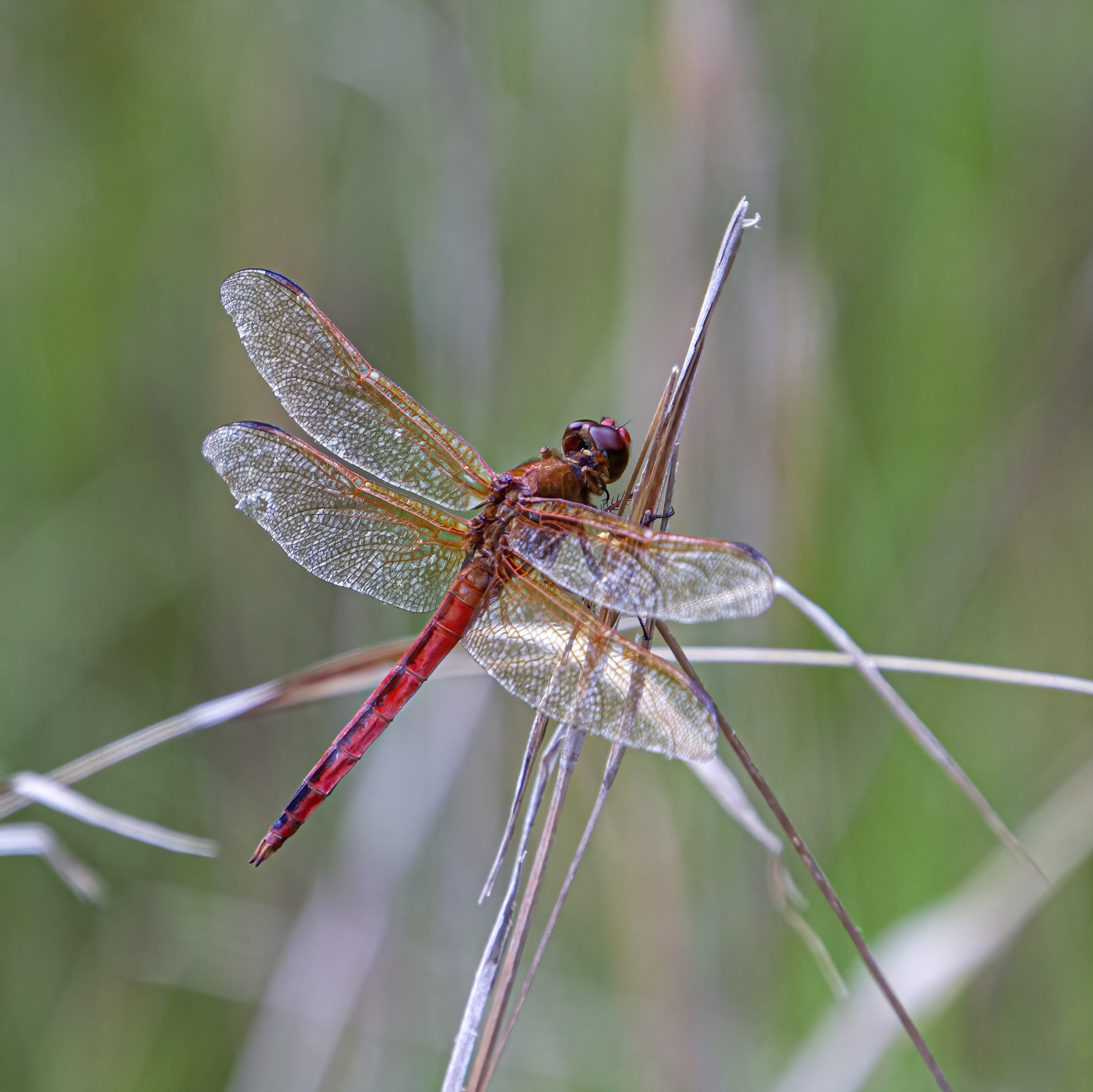
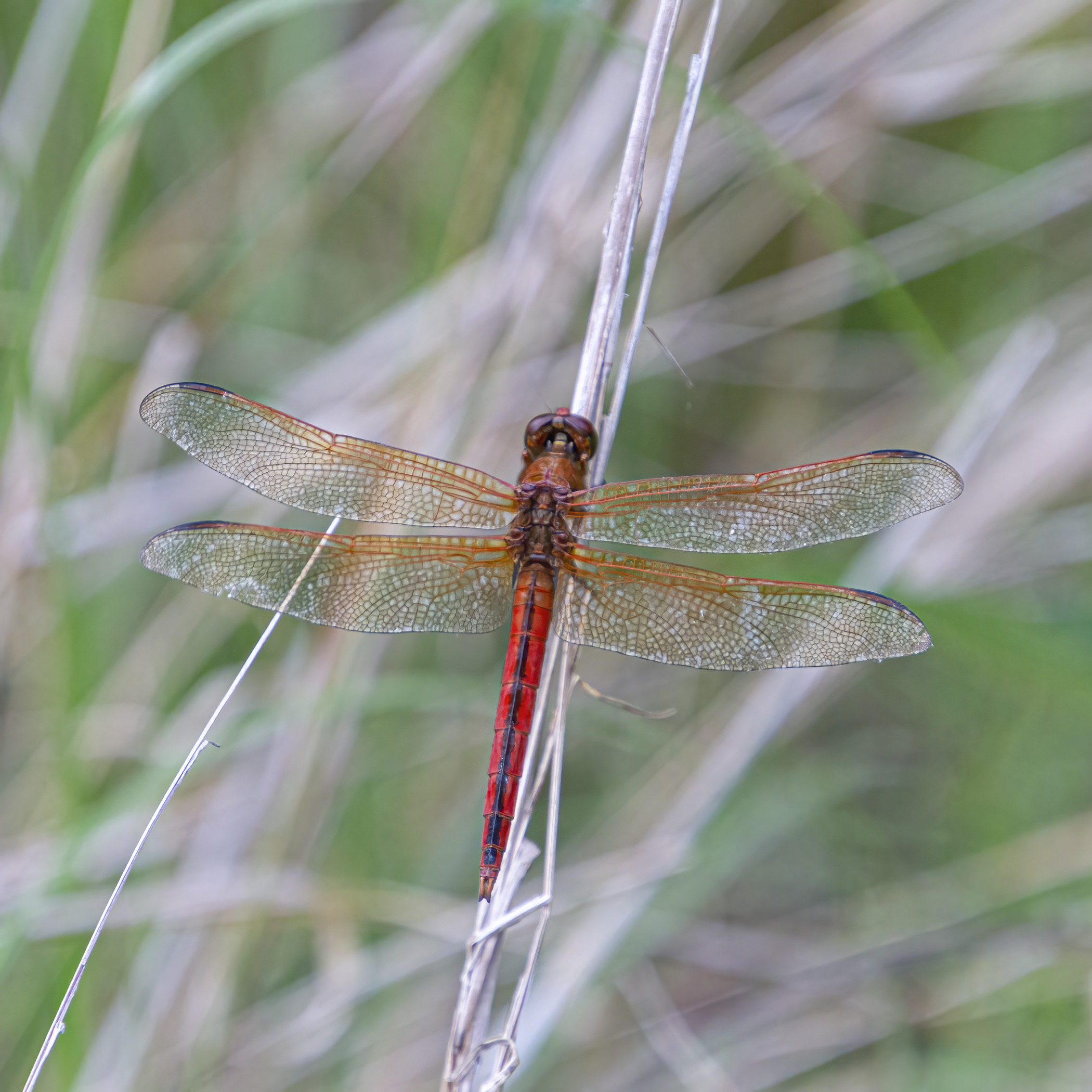
During a recent visit to Occoquan Bay National Wildlife Refuge I was delighted to spot some bright red male Needham’s Skimmer dragonflies (Libellula needhami). The combination of the golden accents on the edges of their wings with that reddish-orange coloration makes these dragonflies visually stunning. The Needham’s Skimmers often were skittish, flying away as I approached, I managed to capture a few shots of them when they perched momentarily within range of my telephoto lens.

At this moment, Needham’s Skimmers are one of the most common dragonfly species that I encounter at this wildlife refuge, along with Common Whitetails. Some of the species that were present in the spring have disappeared and the autumn species have not yet taken their place. In that sense, we are in the midst of the summer doldrums, when the air is heavy with heat and humidity and new activity has slowed down to a snail’s pace.

Needham's Skimmer

Needham's Skimmer

© Michael Q. Powell. All rights reserved.
 

Read Full Post »

There were lots of dragonflies, mostly Common Whitetails and Needham’s Skimmers, flying about on Monday when I visited Occoquan Bay National Wildlife Refuge along with an abundance of pesky flies and mosquitoes. The temperatures were marginally cooler than in recent days, but the high humidity made it feel like I was slicing my way through the water-laden air.

I was delighted to spot this male Widow Skimmer dragonfly (Libellula luctuosa), a species that I do not often at this location, perched in the vegetation adjacent to a small pond. Like female Widow Skimmers, male have dark patches on their wings, but they also have a white patch on each wing, which makes them easy to identify. These patches are visible when male Widow Skimmers are flying, causing them to look a bit like fluttering butterflies.

When I was processing this image, I was surprised to see what appears to be an ant attached to the tip of one of the back legs of this dragonfly—you may need to click on the image to see this detail. I am not sure if the ant had hitched a ride on the dragonfly from its previous perch or, more likely, was merely exploring this unexpected intruder that had landed on this stalk of vegetation.

Widow Skimmer

© Michael Q. Powell. All rights reserved.
 

Read Full Post »

During the past couple of months the weather has frequently been inhospitable for wildlife photography, either hot, humid, or rainy (or some combination of those three conditions). Some times in the past I have gone out anyways with my camera, but this year I have been increasingly staying indoors.

What have I done to keep myself occupied? During the mid-1980’s I was introduced to counted cross stitch. One of my friends used to stitch quite often and I commented to her that someday I should try it myself. I was a bit shocked the next time I saw her when she gave me a pattern, a needle, an a cross stitching kit. When I was growing up, I remember my Mom cross stitching some pillow cases, with the pattern printed onto the fabric. This “new” version that I was introduced to was counted cross stitch, i.e. the fabric was blank and I had to replicate the pattern with a series of x’s in the designated colors.

I discovered that I really liked this new hobby and found it to be both creative and therapeutic. I continued to cross stitch regularly throughout the late 1980’s and 1990’s. Cross stitching seemed to be really popular at that time and I remember subscribing to multiple cross stitching magazines (and accumulating a lot of cross stitching patterns and materials).

My life style changed when I retired from the Army in 1997 and my attention shifted to other aspects of my life. I gradually stopped cross stitching completely, though I never did get rid of my “stash.”

I returned to stitching a few years ago after I finally stopped working and had a bit more free time. Several ladies from my church work at a wonderful local needlework store called “In Stitches” that focuses exclusively on needlepoint and counted cross stitch and they encouraged me to get more involved in activities there, including stitching nights twice a month.

I’m discovering that cross stitching has had a kind of resurgence in recent years and there are numerous FlossTube channels on YouTube in which stitchers of all sorts showcase their works in progress (WIPs) and completed projects. More recently I’ve been involved with a number of cross stitching channels on Twitch. I used to think that Twitch was only for gamers that wanted to watch others play video games and only recently learned that there is a whole series of “Makers and Crafters” channels in which you can watch others working on their own projects and chat with them as they do.

On one of the Twitch channelsI was watching, the streamer @TheDaceman0 was working on a sampler called 100 Owls by Owl Forest Embroidery. I loved the pattern, which is available as a free download here, but did not want to commit to stitching all 100 Owls. I started with the Long-eared Owl (Asio otus) in the second photo below and recently stitched the Great Gray Owl (Strix nebulosa) that you see in the first photo below.

As you can see, my wildlife interests are sometimes reflected in the subjects of my stitching as well as in my photography. Last year I happened to stitch yet another owl pattern, shown in the third photo below, that was a bit more stylized and was included in the Halloween edition of Just Cross Stitch magazine. It’s fun to rediscover a dormant hobby and to see how it has evolved during the period when I was inactive. There are now a lot more options for fabrics and threads than in the past, but, for the moment at least, my tastes have not changed and I continue to use the same materials and techniques that I used in the 1980’s and 1990’s.


Gray Owl

Long-eared Owl

Owl

© Michael Q. Powell. All rights reserved.

Read Full Post »

The weather in my area this month has been mostly miserable. It has been hot and humid and we have had almost daily thunderstorms, resulting in a significant amount of localized flooding.

Some of the dragonflies in our are are also showing signs of the stresses of summer, like this male Calico Pennant dragonfly (Celithemis elisa) that I spotted during a recent visit to Occoquan Bay National Wildlife Refuge. The photo below shows a substantial amount of damage to the wings of this dragonfly. I can’t tell if the damage was caused by a predator or if it is part of the normal wear-and-tear associated with life as a dragonfly.

I hope to get out a bit more often with my camera during the second half of July, perhaps starting out a bit earlier in the morning before things heat up to miserable levels.

Calico Pennant dragonfly

© Michael Q. Powell. All rights reserved.

Read Full Post »

Last Saturday I inadvertently spooked this Great Blue Skimmer dragonfly (Libellula vibrans) while exploring Occoquan Bay National Wildlife Refuge and it flew up into some high vegetation. I was not hopeful that I would be able to get a shot of it, but I decided to try to do so anyways. I’m quite pleased with the result.

I really like the way that the light was shining through the dragonfly’s slightly shredded wings and the shape and structure of the branch draw in a viewer’s eyes too. Overall it’s a fun “artsy” photo that makes me smile.

Great Blue Skimmer

© Michael Q. Powell. All rights reserved.


Read Full Post »

When I first spotted this Black Swallowtail butterfly (Papilio polyxenes) last Saturday at Occoquan Bay National Wildlife Refuge, I thought that it was a fresh, newly-emerged specimen. It was only when the butterfly opened its wings fully that I realized that it was missing the lower portion of one of its wings. Although the butterfly seemed to fly quite normally, the significant damage to its wing was visually noticeable.

This encounter caused me to recall a conversation that I had with a fellow wildlife/nature photographer many years ago. This photographer told me that he only photographs “perfect” subject, i.e. those without damage or blemishes. I was a bit stunned at that approach, to be honest. Most aspects of our lives imperfect in one way or another, after all we are humans.

Is beauty to be found only in perfection? I don’t think so, and my general approach to photography (and to life) is to look for the beauty all around me, a beauty that can be found literally everywhere. So I endeavored to highlight the beauty of the damaged butterfly, a beauty that transcends its physical appearance.

Is your idea of beauty based on external, physical characteristics or does it include other aspects as well? Is beauty universal or is it individual and personal? I sometimes ponder and reflect on these kinds of “big” questions, not really seeking for definitive answers to them, but instead forcing myself to explore the limits of my understanding and consciousness and perhaps even expand those limits in the process.

Black Swallowtail

© Michael Q. Powell. All rights reserved.

Read Full Post »

Last Saturday I spotted this stunning female Eastern Pondhawk dragonfly (Erythemis simplicicollis) during a visit to Occoquan Bay National Wildlife Refuge. The thorn-like projection near the tip of the abdomen that helps her to lay eggs made it immediately obvious that this was a female. The bright green coloration, distinctive black bands on her abdomen, and her green face make it almost impossible to misidentify this species.

As I was checking my blog yesterday, I came across a notice from WordPress informing me that I had started my blog 13 years ago. Wow! It’s hard to believe that I have kept this blog going for that long. According to the statistics from WordPress I have had 524,468 views of 5,417 posts since I began posting.

It is a bit of a cliché but it is absolutely true that I could not have done this without all of the support, suggestions, and encouragement. Thank you to all of you. I remember my modest expectations when I started the blog, looking simply for a place to post my wildlife and nature photographs. Over time this blog has become a kind of diary in which I have been able to express a lot of what I think and feel as I experience the beauty of the natural world. I have come to enjoy expressing myself as much in my written words as I have in my photos, reflecting on many different aspects of my life, including religion, poetry, and various artistic pursuits.

I remember deciding on the subheading for the blog some 13 years ago, calling it “My journey through photography.” Though the path has often been meandering and full of detours and distractions, that journey still continues. Once again, I thank all of you who have chosen to walk alongside me and to experience the world in part as I see it.

Female Eastern Pondhawk

© Michael Q. Powell. All rights reserved.

Read Full Post »

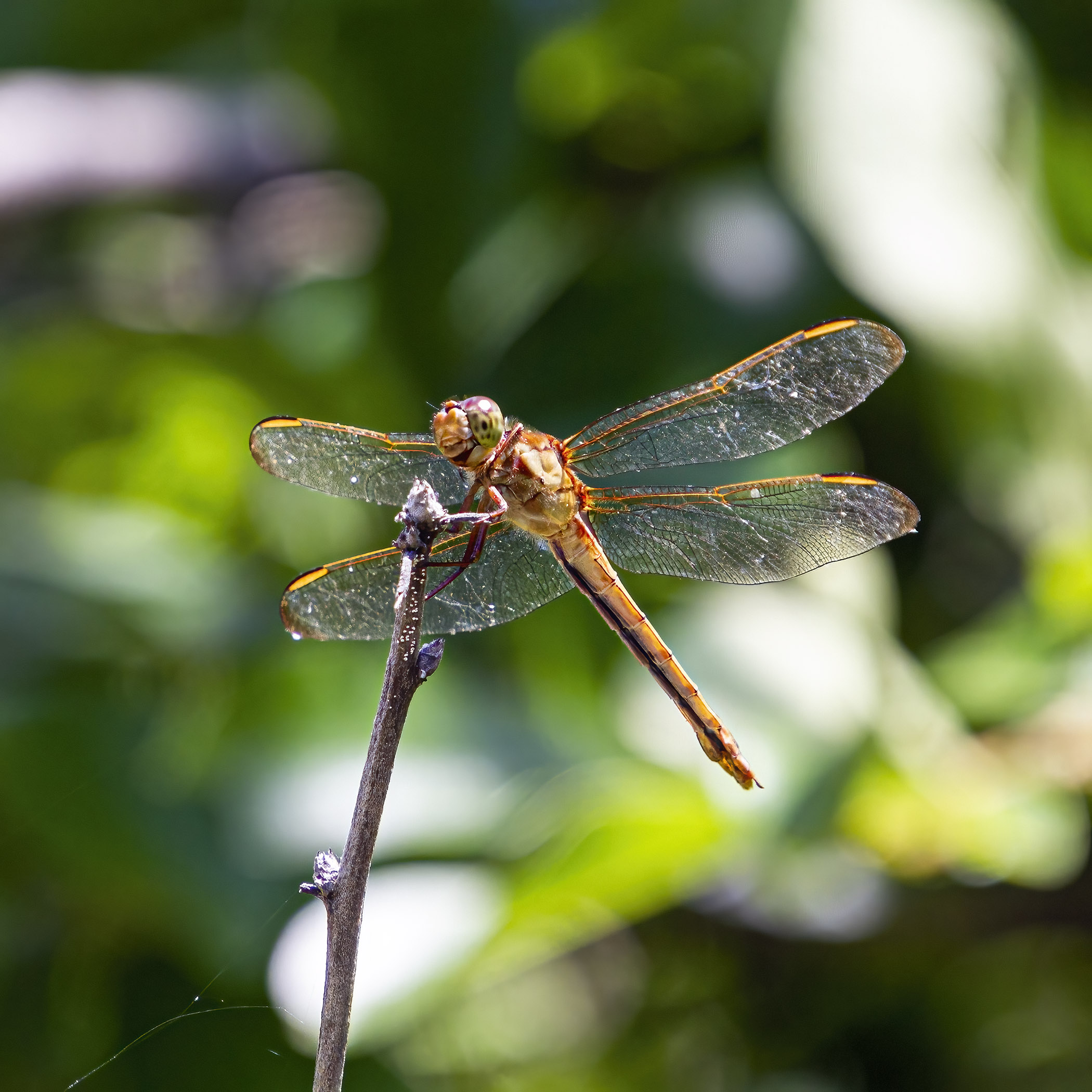
I have spent a lot more time indoors this past month than I normally, as a result of our unusually warm and stormy weather. On Saturday I finally made it out to Occoquan Bay National Wildlife Refuge, my favorite place to explore with my camera, and was greeted by an abundance of dragonflies.

Many of the dragonflies I encountered were Needham’s Skimmers that were often perched at the tops of vegetation that seems to have grown a lot recently. A lot of other flies were common too and they pestered me incessantly by buzzing around my ears, but fortunately they did not appear to be interested in biting me.

I was delighted that many dragonflies seemed be smiling at me, like this cool-looking Needhams’s Skimmer (Libellula needhami). I also really like that I able to capture the beauty of the beautiful two-toned, speckled eyes.

Needham's Skimmer

© Michael Q. Powell. All rights reserved.

Read Full Post »