Feeds:
Posts
Comments

Archive for June, 2025

On Saturday I attended a wonderful Pride Fair celebration in the City of Alexandria, Virginia on the plaza right outside of City Hall. Various civic, business, religious, and governmental groups and organizations were represented in the booths and there was a friendly, chill vibe, with lots of families attending.

Unlike the Washington D.C. Pride celebration earlier this month that I also attended that was a bit more militant, political and commercialized, this felt really supportive and comfortable. It was cool to see the face painting and balloon animals for children and I personally participated in filling in a community coloring page, using crayons for the first time in a lot of years. People were invariably friendly and reflected the widely shared sentiment that “all are welcome.”

The official Pride Month (June) is coming to an end, but I am hoping that we can continue to support and respect each other in our words and in our actions. We do not have to agree on all points, but I am hoping that we can turn aside the wings of hate and negativity that threaten to engulf us all. I am reminded of the quotation attributed to Saint Francis of Assisi that was on the inside door of a church that I used to attend, “Preach the Gospel at all times. Use words if necessary.”

Alexandria Pride

Alexandria Pride

Alexandria Pride

Alexandria Pride

© Michael Q. Powell. All rights reserved.


Read Full Post »

Shortly after waking up this morning, I walked over to my neighbor Cindy’s garden to see what was in bloom. The last time I checked, about a week ago,  there were lots of flowering day lilies, but I suspected that the recent heat had caused many of them to wilt and die. I am not sure if lilies close up at night, but I did not see any lilies in bloom in the early morning light—I was there about 6:15 today.

However, there were plenty of purple coneflowers and Shasta daisies open and I did my best to capture some their beauty with the short macro lens that I was using. I was delighted to spot a tiny insect creature crawling around on one of the daisies, as you can sort of see in the second photo. The limited light available forced me to open the aperture of the lens and created such a narrow depth of field that I could not get both the insect and the flower in focus.

Most of you know that I enjoy photographing wildlife and nature in more remote locations, but it is reassuring to know that I do not always have to travel far to find subjects—beauty is everywhere.

shasta daisy

Shasta daisy

coneflower

© Michael Q. Powell. All rights reserved.

Read Full Post »

I’m reluctant to go out in our current extreme heat here in Northern Virginia, so here’s a shot from earlier this month (11 June) of a Blue-tipped Dancer damselfly (Argia tibialis) at Wickford Park in Alexandria. This damselfly looks a bit like several other species, but the angle of this photo shows the distinguishing features of a Blue-tipped Dancer including its mostly black abdomen, the wide deep purple stripes on its thorax, and, of course, the blue color of the final two segments of its abdomen.

Some of you may recall a recent posting that featured a Common Sanddragon dragonfly perched on a leaf at this same location. Believe it or not, this is the exact same leaf. I am not sure that there is anything special about the leaf, other than the fact that it was the only on the sandy/rocky bank of the creek, but I was more than happy to capture images of both a dragonfly and damselfly separately perched on it.

Blue-tipped Dancer

© Michael Q. Powell. All rights reserved.

Read Full Post »

It is hot! It seems that much of Europe and the United States is currently experiencing sweltering heat. Here in Northern Virginia where I live, high temperatures are going to hover around 100 degrees (38 degrees C) each day this week. I might consider going out with my camera when there are heat advisories, but today there are extreme heat advisories and people are advised not to go out in the heat unless absolutely necessary.

This morning I went over my photos from an outing earlier this month and recalled my thought process when I was taking photos of Common Sanddragon dragonflies (Progomphus obscurus). I was trying to frame the shot in a way that showed the dragonfly’s face and body with an interesting background, which was a bit frustrating, because the Sanddragons tended to perch at the edge of the water facing the water.

I changed positions repeatedly and eventually I got the shot that I was imagining in my head. I love how the green of the dragonfly’s eyes matches some of the mossy vegetation and how the yellow and brown body matches the stones. The dragonfly also seems to be looking up at me and smiling, though I suspect that may be my imagination.

Stay cool and hydrated this week if you have to go outside this week!

Common Sanddragon

© Michael Q. Powell. All rights reserved.

Read Full Post »

I spotted these male Common Sanddragon dragonflies(Progomphus obscurus) on 11 June alongside a creek at Wickford Park, a small suburban park in Alexandria, Virginia. As their name suggests, Common Sanddragons prefer sandy beaches over the kinds of vegetation where many other dragonflies most often perch.

The Common Sanddragons were pretty skittish and would fly away as I approached, but would frequently return to “their” beaches a short time later. Most of the time, they would face the water, which made it problematic to get a side shot. However, one perched on a leaf a bit farther from the edge of the water and I was able to capture the first image below, my favorite image of the day.

You may notice that the Common Sanddragons in the photos have their abdomens (their “tails”) raised. I think that may be their normal way of perching or it may be a variation of the obelisk pose used by other species to regulate their body temperature by reducing the amount of their bodies exposed to the direct sunlight.

Common Sanddragon

Common Sanddragon

Common Sanddragon

© Michael Q. Powell. All rights reserved.

Read Full Post »

Variable Dancers (Argia fumipennis) are one of my favorite damselflies, as you may have guessed if you have seen the banner page of my blog that features a photo of a gorgeous violet-colored Variable Dancer. Technically there are three subspecies of Variable Dancers, but I think that all of the ones that I see in my area are members of the subspecies Argia fumipennis violacea, the Violet Dancer.

Last week I spotted several male Variable Dancers at Wickford Park in Alexandria, Virginia, as you can see in the second photo below, so I knew that they lived in that habitat. I was a bit confused, though, when I spotted the damselfly in the first photo and initially could not identify it. After poring over my reference guides and searching for the internet, I realized that the damselfly was probably an immature male Variable Dancer. Many immature male dragonflies and damselflies change colors as they mature, but this color change is particularly striking.

Today is the summer solstice for those of us in the Northern Hemisphere, officially marking the beginning of summer. (Technically it comes this evening at 10:42 where I live.) Happy Summer to all of you in the north and Happy Winter to those of you in the Southern Hemisphere.

Variable Dancer

Variable Dancer

© Michael Q. Powell. All rights reserved.

Read Full Post »

Mourning Cloak butterflies (Nymphalis antiopa) are often one of the first butterflies that I see in early spring, because they overwinter with us as adults in a kind of hibernation. According to Wikipedia, Mourning Cloaks, known in Britain as the Camberwell Beauty, have a lifespan of 11 to 12 months, one of the longest lifespans for any butterfly.

In the springtime, these butterflies mate and I suspect that the butterfly in the photo below that I spotted in early June at Occoquan Bay National Wildlife Refuge is part of the “new generation.” I don’t know a whole lot about the entire life cycle of the Mourning Cloak, but from what I have read, their lives include periods of activity followed by long periods of inactivity. During the summer, for example, they enter into a “dormant” stage, known as aestivation that is somewhat similar to hibernation, and then become active again in the autumn.

I love the markings of this beautiful butterfly and was thrilled when it held its wings open for a few seconds and let me see the stunning blue markings on its inner wings that stand out among the mostly subdued colors on its body.

Mourning Cloak butterfly

© Michael Q. Powell. All rights reserved.

Read Full Post »

Earlier in June I spotted this cool-looking bird at Occoquan Bay National Wildlife Refuge. I am not really sure what species it is, but I think it might be a Great Crested Flycatcher (Myiarchus crinitus). The bird was mostly hidden in the foliage, but I managed to get a couple of reasonably clear shots of it.

I love the wash of yellow on its belly that gradually fades into the gray of its throat. There are a few other birds in the flycatcher family that are somewhat similar in appearance, so I could be off in my identification, but this is the one that most closely matches the descriptions and images in my identification guides.

Great Crested Flycatcher

Great Crested Flycatcher

© Michael Q. Powell. All rights reserved.

Read Full Post »

I spotted my first Ebony Jewelwing damselflies (Calopteryx maculata) of the year last week during a short visit to Wickford Park, a small suburban park with a creek that runs through it. Members of this species have distinctive dark wings and are generally found in shaded streams where the mixed lighting makes it challenging to photograph them.

Female Ebony Jewelwings have small white patches (known as pseudostigmas) on their wings that along with their terminal appendages make them easy to identify. The damselflies in these two photos are both female. I am not sure why the eyes of the damselfly in the first photo are so red in appearance—perhaps it is a result of the angle of the light or maybe it is related to the age of the individual. Whatever the case, the red eyes give the damselfly a devilish look.

Ebony Jewelwing

Ebony Jewelwing

© Michael Q. Powell. All rights reserved.

Read Full Post »

On Wednesday I visited Wickford Park, a small suburban park a few miles from where I live that has a creek that flows through it. In the past I have spotted a variety of dragonflies and damselflies at this location and once again I was rewarded with some new sightings.

I was pleasantly surprised to spot a male Slaty Skimmer (Libellula incesta), the first one that I have seen this year. During the summer, Slaty Skimmers are quite common at a number of the locations that I visit. The dark slate blue of the mature males of this species and their brown eyes make this species pretty easy to identify.

I thought about cropping this image closer to give a better look at the dragonfly, but decided that I really liked the twisting vegetation on which the dragonfly was perched and ultimately decided to keep the crop loose. What do you think?

Slaty Skimmer

© Michael Q. Powell. All rights reserved.

Read Full Post »

A dragonfly couple in wheel formation flew by me during a recent visit Occoquan Bay National Wildlife Refuge and landed on some nearby vegetation. This acrobatic position is the one used by most dragonflies for mating—sometimes they will mate while in the air and other times they will “do the deed” while perched.

I am not totally certain but I believe that these dragonflies are Unicorn Clubtails (Arigomphus villosipes), a species that I see from time to time in my area.

Happy Friday the 13th!

Unicorn Clubtail

© Michael Q. Powell. All rights reserved.


Read Full Post »

Most of the time that I see damselflies, they are perched in the vegetation. Powdered Dancer damselflies (Argia moesta), like this one that I spotted last week at Occoquan Bay National Wildlife Refuge, however, like to perch on bare ground, emergent stones, and along trails. Immature male Powdered Dancers are tan to dark brown, turn darker with age, and becoming almost completely whitish at maturity.

The “powdered” color of this damselfly helped in to blend in almost perfectly with the sand and gravel on this trail at the wildlife refuge. If I had not seen it land, I suspect that I would have had real trouble spotting this Powdered Dancer damselfly.

Powdered Dancer

© Michael Q. Powell. All rights reserved.

Read Full Post »

This Zebra Swallowtail butterfly (Eurytides marcellus) had its wings fully extended as it reached for nectar from an unidentified plant last week at Occoquan Bay National Wildlife Refuge. I love the way that the photo below shows the butterfly’s long “tails” that appear to be fully intact, making me wonder if this butterfly had recently emerged.

In my area of Northern Virginia Zebra Swallow tails tend to have at least two broods a year. According to the local Prince William Conservation Alliance, “The summer generation is larger and has proportionally wider stripes and longer tails than the spring generation.”

Zebra Swallowtail

© Michael Q. Powell. All rights reserved.


Read Full Post »

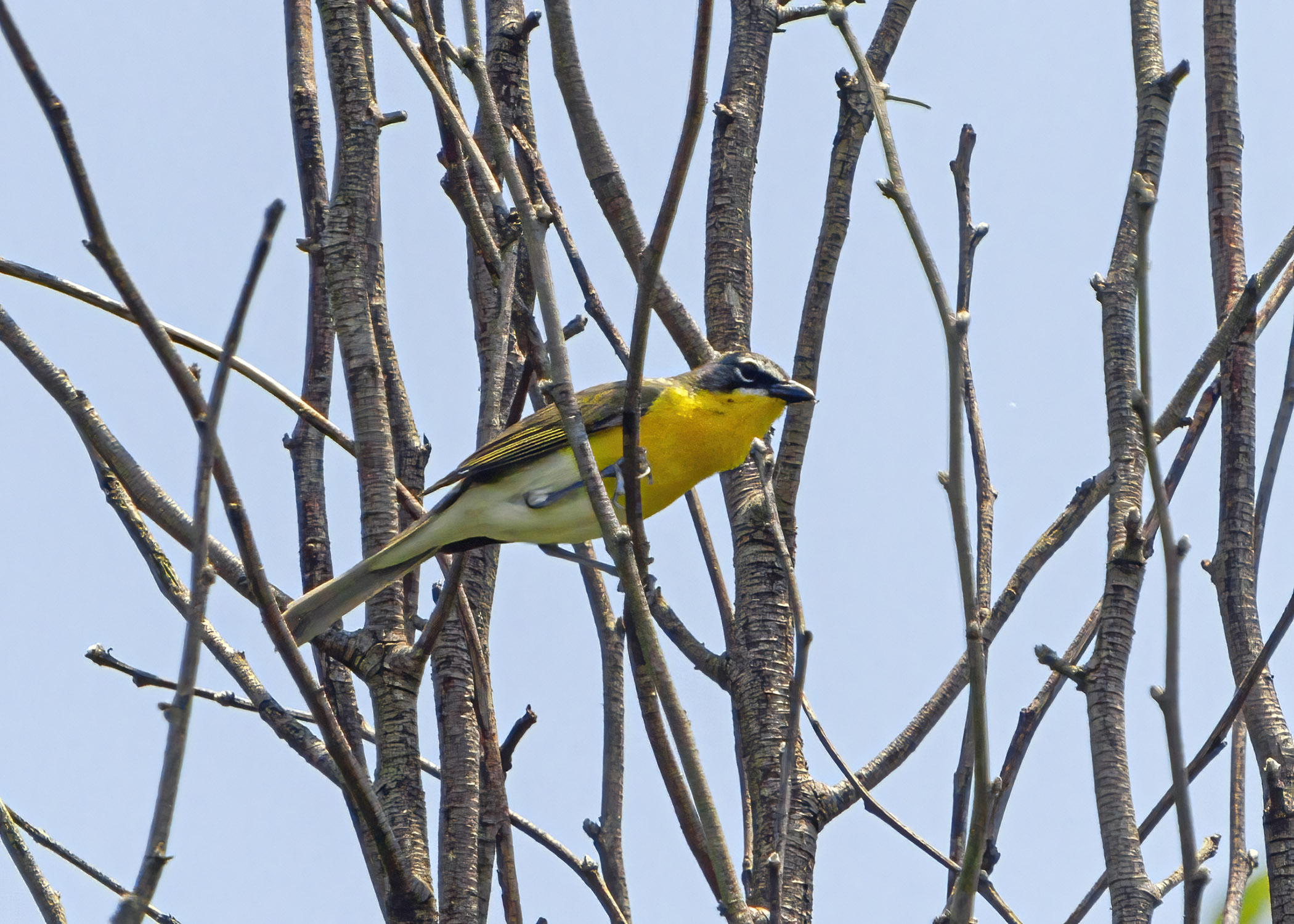
Last Monday I spotted this beautiful Yellow-breasted Chat (Icteria virens) at Occoquan Bay National Wildlife Refuge. I thought that this was my first encounter with this bird species, but a search of my previous blog postings revealed that I got some long distance shots of one in 2022.

Many of the migrating warblers that are passing through my area have various yellow markings, so I assumed that this was simply another warbler. The reality, however, is hardly simple. According to the Cornell Lab of Ornithology, “The Yellow-breasted Chat has always been a mystery to taxonomists—it looks similar to warblers but is larger, with a more varied repertoire of songs and calls, and also has other differences in behavior and anatomy. The species was placed in the warbler family (Parulidae) for decades, but in the late 2010s was given its own family (Icteriidae), in recognition of these differences.”

If that were not confusing enough, the name “chat” is used for a number of different birds throughout the world. According to Wikipedia, “Chats (formerly sometimes known as “chat-thrushes”) are a group of small Old World insectivorous birds formerly classified as members of the thrush family (Turdidae), but following genetic DNA analysis are now considered to belong to the Old World flycatcher family (Muscicapidae). The name is normally applied to the more robust ground-feeding flycatchers found in Europe and Asia and most northern species are strong migrants.”

All of this scientific explanation leaves me utterly confused. The only thing I know for sure is that the Yellow-breasted Chat that I photographed was a real treat for me—its bright yellow color immediately brought a smile to my face and lifted my spirits. For me, that is more than enough—I’ll leave the arguments about taxonomy and classification to others.

Yellow-breasted Chat

Yellow-breasted Chat

© Michael Q. Powell. All rights reserved.

Read Full Post »

When I photographed this bird last week at Occoquan Bay National Wildlife Refuge, I really had no idea what it was. Some aspects of its overall coloration reminded me a little of a Tufted Titmouse, but its shape and size were not right. Its mottled and patchy color suggested to me that this might be an immature bird and I wondered if it might be some kind of warbler.

When I returned home I searched though my identification guides and looked at lots of photos on-line and concluded that this was probably an immature male American Redstart (Setophaga ruticilla). Some folks on Facebook confirmed my identification, which was helpful, considering that I had never before seen this species. As I suspected, this Redstart is a  New World warbler—apparently there is also an Old World Redstart (Phoenicurus ochruros) that is completely unrelated to the one that I spotted.

Each spring I am absolutely delighted to find any warblers at all. Often I hear the warblers singing in the leafy trees, but only rarely do I manage to catch a glimpse of their beauty.

American Redstart

American Redstart

© Michael Q. Powell. All rights reserved.

Read Full Post »

I tracked this Black Saddlebags dragonfly (Tramea lacerata) in the air for quite some time on 2 June at Occoquan Bay National Wildlife Refuge until it finally landed and I was able to capture this shot of it perching in the vegetation.

Black Saddlebags are among the few North American dragonfly species that undertake migrations. Specifically, the offspring of the Black Saddlebag dragonflies migrate south in the fall, while some return north in the spring to breed. It’s impossible for me to know if the dragonfly in this photo started its journey somewhere to the south, but that is certainly a possibility. 

One thing I do know for sure is that Black Saddlebags spend a lot of their time in the air, patrolling back and forth over an area. Most of the time when I spot them, they are flying, so it was nice to have a chance to capture a shot of one on the ground.

Black Saddlebags

© Michael Q. Powell. All rights reserved.

Read Full Post »

I was really surprised to spot this immature Blue-faced Meadowhawk dragonfly (Sympetrum ambiguum) on Monday at Occoquan Bay National Wildlife Refuge. In the past I have seen this species only in late summer and early autumn and by the bodies of those dragonflies have always been red in color and the face has had a distinctive blue tinge.

This dragonfly appears to have only recently emerged and that is its the body is tan rather than red—the color will change as he matures. The stripes on the abdomen and the eye color, though, helped me to identify it as a Blue-faced Meadowhawk rather than the somewhat similar Autumn Meadowhawk that has brown eyes.

I was curious to understand why I happened to spot this species a lot earlier than usual and have heard some other dragonfly enthusiasts speculate that the immature Blue-faced Meadowhawks “hide” in the woods and make an appearance only later in the season. One of the experts in Virginia Odonata Facebook group to which I belong noted that “They appear to have two different emergence periods, one in spring and one in late summer/fall.”

Whatever the reason for the early appearance, I was delighted to see and photograph this Blue-faced Meadowhawk, one of my favorite dragonfly species. A few long-time subscribers may recall that I was awarded second place almost ten years ago in a local photography contest for a macro close-up of a Blue-faced Meadowhawk. If you are interested in learning more about that experience and seeing the “award winning” image, check out my blog posting from December 2015 entitled “Second place in local photo contest.”

Blue-faced Meadowhawk

© Michael Q. Powell. All rights reserved.

Read Full Post »

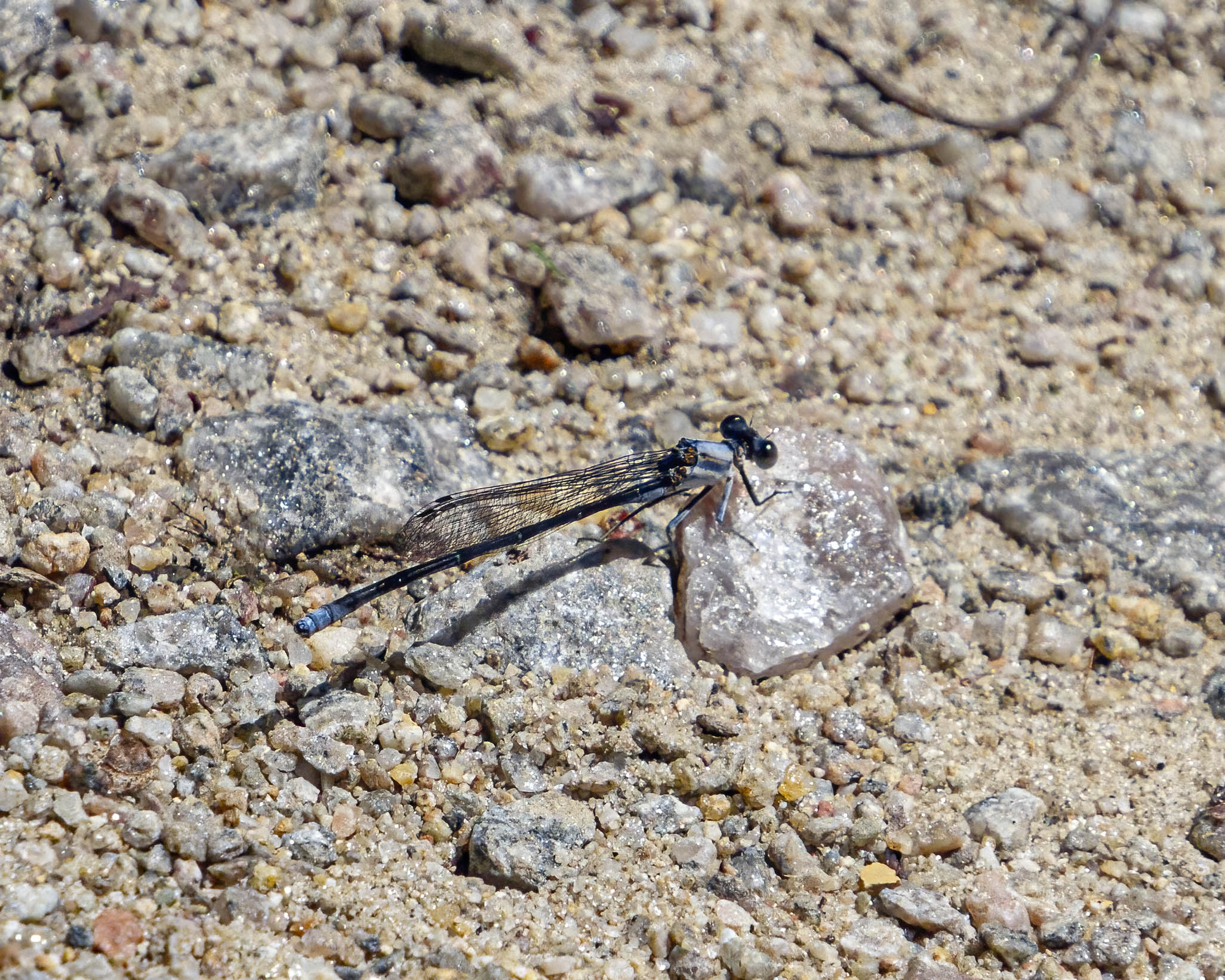
On Monday I spotted this female Widow Skimmer dragonfly (Libellula luctuosa), my first one of 2025, during a visit to Occoquan Bay National Wildlife Refuge. Widow Skimmers have very distinctive dark patches on their wings that reminded the scientist who named them of the dark mourning crepe worn by Victorian-era widows during their initial stages of mourning and even their Latin name “luctuosa” means “sorrowful.”

The weather in my area has warmed considerably this week and already it feels like summer. Gradually the summer dragonflies, like this Widow Skimmer, are starting to appear. The hot days of summer are a bit uncomfortable for me, but seem to be preferred by many dragonfly species.


Widow Skimmer

© Michael Q. Powell. All rights reserved.


Read Full Post »

When I spotted these damselflies last week I was not sure what species they were. Most of the damselflies that I had seen near this location at Occoquan Bay National Wildlife Refuge in the past were Big Bluet damselflies (Enallagma durum), but the coloration of this one was different enough that I was not confident in identifying it. I posted a photo in a Facebook group that specializes in dragonflies and damselflies and one of the experts there confirmed that this is in fact a Big Bluet.

I am happy to identify this species, but I must confess that I am even more happy with the images that I was able to capture. For all three images, I believe, I had to focus manually as I tried to compose the images, which can be a real challenge with a digital camera. When I first started taking photos back in the pre-digital age, I remember that my single-lens reflex film camera had a split prism area that you had to adjust and you knew that the subject was in focus when the two halves of the image aligned.

My telephoto lens was extended fully to 400mm, so I was a pretty good distance from the damselflies when I composed these shots. I particularly like the first image, in which the branch at the top third of the shot gradually falls out of focus, allowing the viewer to focus on the damselfly clinging to the leaf.

Big Bluet

Big Bluet

Big Bluet

© Michael Q. Powell. All rights reserved.

Read Full Post »

I was excited last week to see a lot of Great Spangled Fritillary butterflies (Speyeria cybele) that appear to have recently emerged at Occoquan Bay National Wildlife Refuge. Great Spangled Fritillaries are large orange-colored butterflies with dark-colored markings on the inner wings and prominent silvery white spots on the underside of the hind wings, i.e. the “spangles” in the name of the species.

Most of the ones that I saw appeared to be feeding on the trails, as you can see in the two photos below, rather than feeding on the nectar of flowers, as I have typically seen them do in the past. Perhaps they need minerals from the ground when they first emerge or were attempting to drink water from the damp soil.

Great Spangled Fritillary

Great Spangled Fritillary

© Michael Q. Powell. All rights reserved.


Read Full Post »

Last Friday I almost literally stumbled upon a young White-tailed Deer (Odocoileus virginianus) during a visit to Occoquan Bay National Wildlife Refuge. As I turned a corner, I suddenly spotted this little deer slowly coming towards me. I immediately stopped, but the deer initially kept on walking. I noticed that the deer had nubs on its head instead of antlers. Was this a buck who was too young to grow antlers or was this a somewhat older deer who was regrowing his antlers?

I grew up in the suburbs of Boston and confess that I know very little about deer. I do know that male deer shed their antlers during the fall and winter and then regrow them in the spring each year. According to the Fish and Wildlife Service, antlers are the fastest bone growth in the world and the antlers of an adult White-tailed Deer can grow 1/4 inch (6 mm) a day and those of an elk can grow an inch (25 mm) a day.

This deer seemed more curious about me rather than afraid of me and eventually moved only a few feet off of the trail to let me pass. I was happy to see this beautiful young animal in its natural habitat. In many parts of the suburban area surrounding Washington D.C. there is an overpopulation of deer and a variety of measures are used to try to control the population. At this wildlife refuge, for example, several deer hunts are conducted each year.

I personally am not a hunter, but I do recognize the dangers that deer overpopulation poses to the habitat, to the human population, and to the deer themselves. When I am out with my camera, though, I am not thinking about these things, but instead am focused on sharing the beauties of nature and peacefully coexisting with my fellow creatures, like this young deer.

White-tailed Deer

© Michael Q. Powell. All rights reserved.

Read Full Post »

This past Friday I was delighted to spot some mature male Calico Pennant dragonflies (Celithemis elisa) at Occoquan Bay National Wildlife Refuge. Earlier this season I had seem some immature male Calico Pennants who still had yellow bodies. As they mature, male Calico Pennants turn red in a pattern that looks like a column of little hearts, as you can see in the second photo below.

Like other “pennant” dragonfly species, Calico Pennants like to perch precariously on the very tips of vegetation. Even the slightest breeze will cause them to flutter, like pennants in the wind.

You can’t help but notice the beautiful patterning in the wings that makes this species stand out from almost all other dragonfly species. Wow!

I took the first two photos when the dragonflies were perched nearby in the vegetation. Periodically the dragonflies would fly out over the water of a small pond at the wildlife refuge and would perch at the water’s edge. The shoreline was really mucky, so I could not get close to these dragonflies. I was happy, though, to be able to capture the final photo below, an “artsy” minimalist view of a Calico Pennant perched at an almost right angle on a slim blade of vegetation.

Calico Pennant

Calico Pennant

Calico Pennant

© Michael Q. Powell. All rights reserved.

Read Full Post »