Feeds:
Posts
Comments

Archive for June, 2021

Many of the irises have withered in the garden of my dear friend and neighbor Cindy Dyer, but her lilies are now starting to open, like this beauty that I photographed early on Sunday morning. It is hot and humid today, so I did not feel much like venturing outside with my camera. Instead I decided to share this burst of bright color.

Have a wonderful Monday.

lily

© Michael Q. Powell. All rights reserved.

Read Full Post »

Directional lighting can add a lot of drama to a portrait—studio photographers spend a lot of time balancing the power and placement of multiple lights to create that sense of drama. When I am out in the field, though, I have almost no control over the lighting. However, I can vary my shooting angle and positioning and adjust my camera settings to take maximum advantage of the light that I do have.

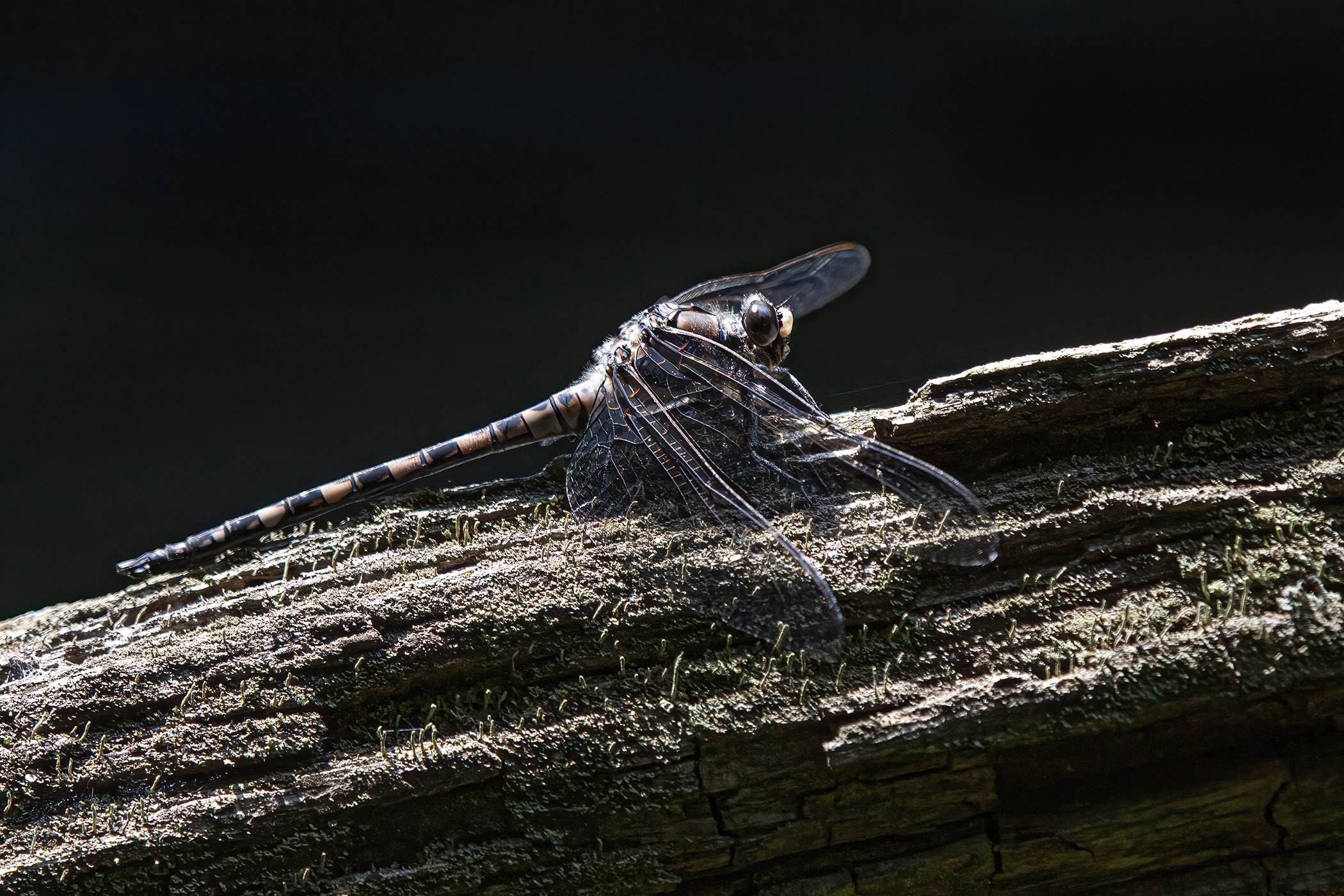
Yesterday afternoon about 3:30 in the afternoon (1530 hrs) I spotted my only Gray Petaltail dragonfly (Tachopteryx thoreyi) of the day while exploring Occoquan Regional Park. Most of the time Gray Petaltails perch vertically on the trunks of trees, where they blend with the tree’s bark. This dragonfly thankfully chose to perch horizontally on a fallen tree in front of me rather than fly off to a more distant tree.

The sunlight was strong, but I found an angle that made it serve almost as a spotlight, illuminating the dragonfly’s white face. I deliberately underexposed the shot to darken the background and deepen the shadows to create a sense of depth in the bark of the fallen tree. As I processed the image, I was really careful not to go too dark, though, because I wanted to maintain the color and the texture of the moss on the tree.

I must be in a bit of an “artsy” mood—I just realized that this is the second day in a row that I have posted an image that focused as much on artistry as on the wildlife subject itself. Of course, it is never strictly an either/or proposition. Like all photographers, I make a lot of creative choices before I press the shutter release and many of those choices are instantaneous and instinctive.

Sometimes, as was this case with this photo, I have the luxury of being a little more deliberate in my composition and settings, which increases the odds that I will create the photo as I imagine it. Nonetheless, there are never any guarantees in wildlife photography, so I cannot afford to hesitate too long or the subject may move away or the lighting may change completely.

Gray Petaltail

© Michael Q. Powell. All rights reserved.


Read Full Post »

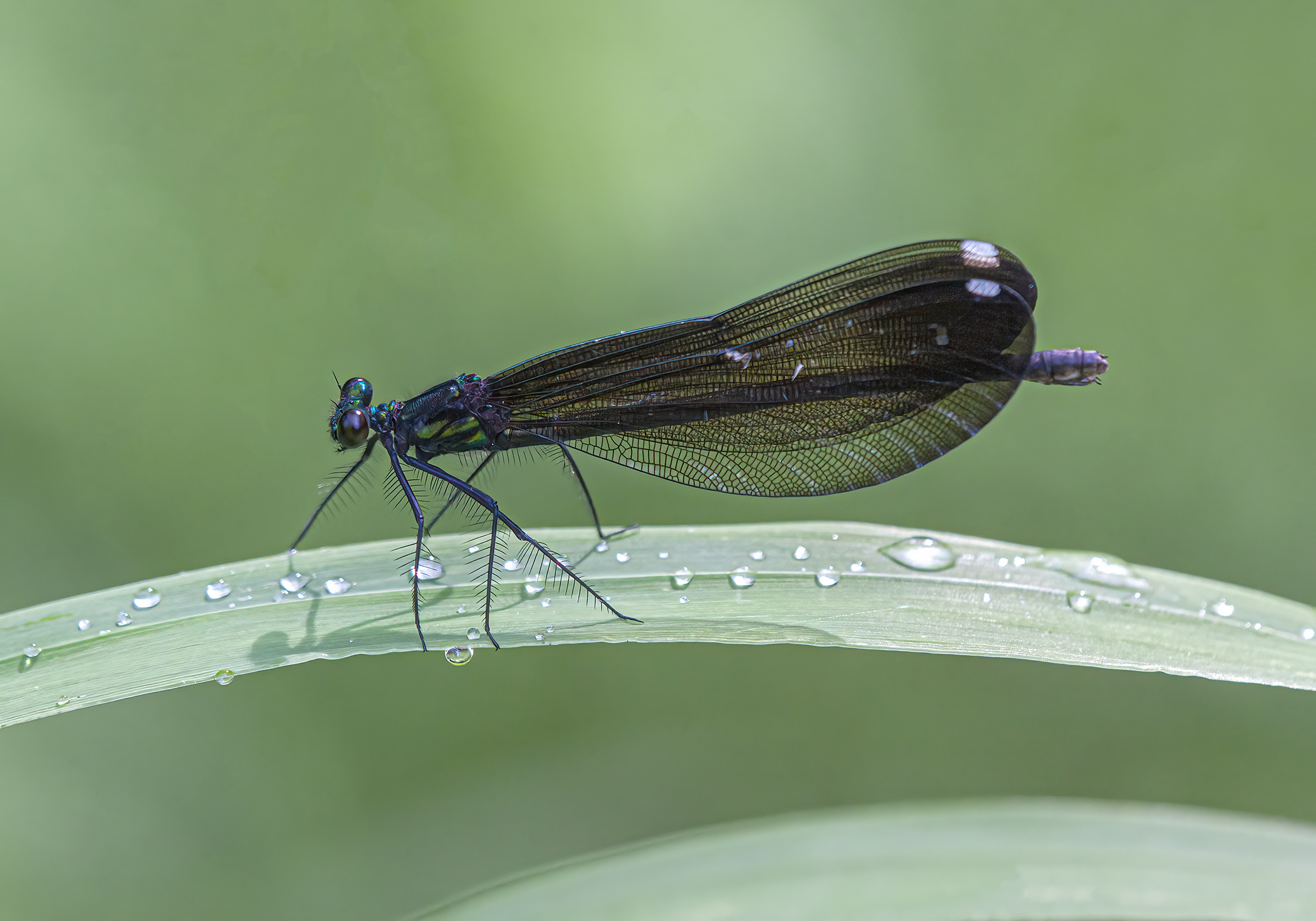
Some say that the secret to capturing an effective image is to eliminate all of the non-essential elements. This image is about as minimalistic as I can get. The raindrops on the vegetation provide a sense of what has been and the shadows a hint that the sun was shining again when I spotted this stunning female Ebony Jewelwing damselfly (Calopteryx maculata) at Occoquan Regional Park on Friday.

The image itself is simple, but I am amazed at the details that I was able to capture of this tiny creature and encourage you to click on the image. If you do, you may be as shocked as I was, for example, at the length of the “hairs” on the damselfly’s legs—clearly leg shaving is not practiced among the ladies of this species.

Ebony Jewelwing

© Michael Q. Powell. All rights reserved.


Read Full Post »

I spotted this beautiful American Lady butterfly (Vanessa virginiensis) yesterday morning as I was exploring one of the trails at Occoquan Regional Park. There is a similar-looking butterfly called a Painted Lady and I had to wait until I got home to figure out which one I had photographed. The American Lady has two large eye spots on each hind wing, while the Painted Lady has four. The second image below, I believe, shows only two eye spots.

I love to try to time my butterfly photos to get shots when the wings are fully opened, revealing the butterfly’s inner beauty. In this case, though, I think that the American Lady butterfly is even more stunning when its wings are closed. Alas, I couldn’t move fast enough to get a good side shot before she flew away. The second shot at least gives you a general sense of how pretty she is.

American Lady

American Lady

© Michael Q. Powell. All rights reserved.


Read Full Post »

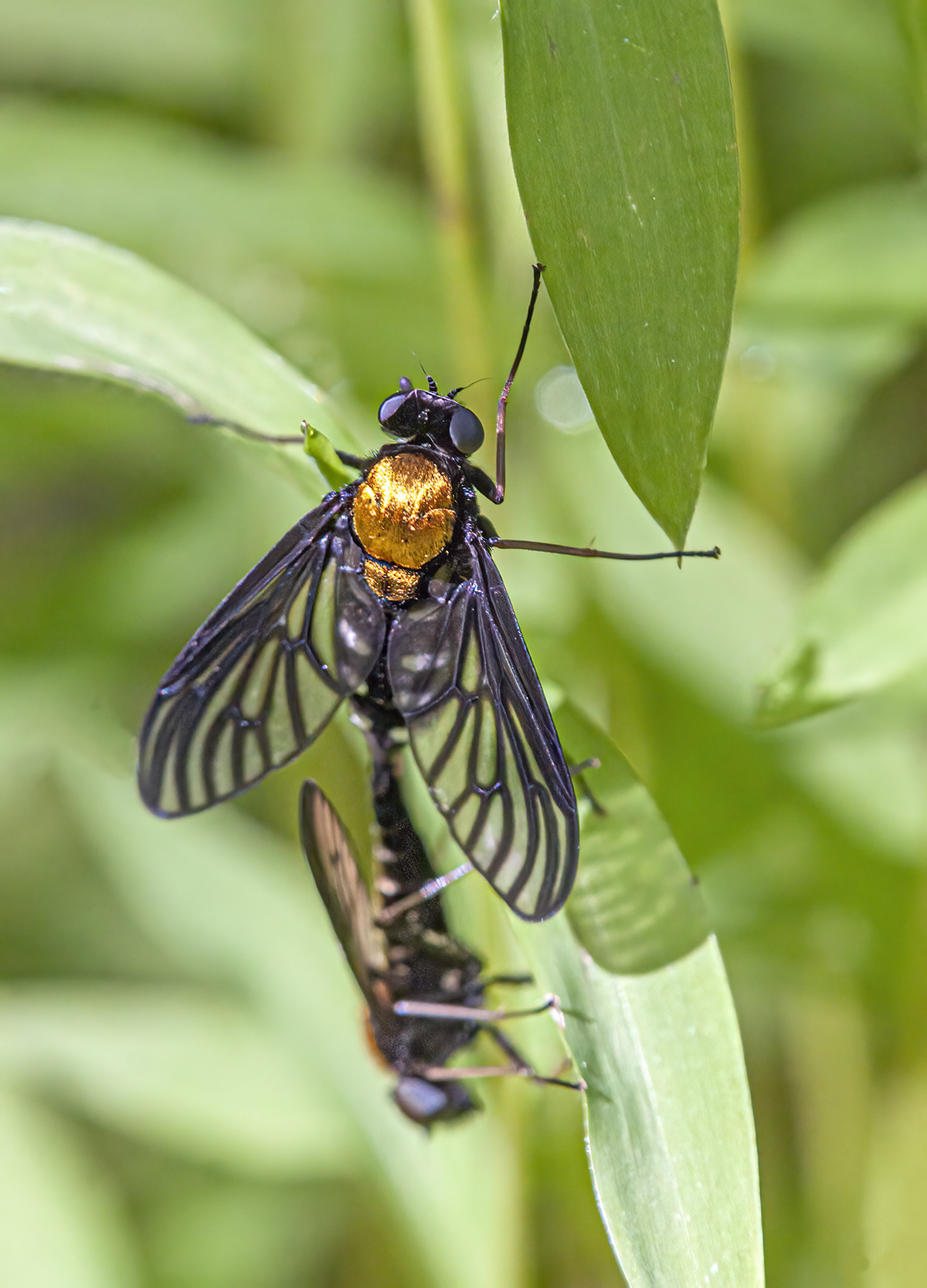
I see all kinds of flies when I am out in the wild with my camera, but I don’t think that I have ever seen one like this brightly-colored one that I spotted on Tuesday at Occoquan Regional Park. Some internet research suggests that it is a Golden-backed Snipe Fly (Chrysopilus thoracicus). It was hard to find detailed information about the life cycle of this species, but I did come across an amusing and informative article by Joe Boggs at The Ohio State University entitled Snipe Hunting, if you are interested in learning a little more about this unusual-looking fly.

Golden-backed Snipe Fly

© Michael Q. Powell. All rights reserved.

Read Full Post »

Some of the rarest dragonflies in our area are quite muted in their appearance, like this male Sable Clubtail dragonfly (Stenogomphurus rogersi) that I spotted on Tuesday while exploring a park in Fairfax County in Virginia, the county in which I live. Sable Clubtails are generally found only in very small numbers, have a short flight period, and require very specific habitats. My good friend and fellow dragonfly enthusiast Walter Sanford did an extensive amount of research and re-discovered the Sable Clubtail dragonfly (Stenogomphurus rogersi) at this location in 2018.

When a dragonfly population is so small and localized, there is always a fear that they could be wiped out by extreme weather conditions or by a change in their habitat. At this specific location, the stream habitat has been compromised somewhat by increased silt and higher levels of vegetation as a result of some imprudent dumping of dirt and the resulting runoff. (For additional information about the damage to the stream and some of the back story of Walter’s re-discovery of the species, check out his June 2020 posting entitled Sable Clubtail dragonfly (Male, No. 1).)

Each year since Walter’s rediscovery I have returned to the same stream with a certain degree of trepidation, unsure if I will be able to find any members of this relatively rare species. This year I spotted them further upstream than previously, suggesting the possibility that the small Sable Clubtail population has relocated. According to the Dragonflies of Northern Virginia website, Sable Clubtails appear “to prefer small, relatively clean, shallow and stable forest streams, with plenty of low vegetation and a gentle flow.”

Over the next few weeks, I will probably return to this stream multiple times to see if I can gain a better understanding of the state of this population. I am hopeful that there will be signs that the population has rebounded and it would be really cool to spot a female Sable Clubtail too.

Sable Clubtail

© Michael Q. Powell. All rights reserved.

Read Full Post »

I was a bit startled on Tuesday when I spotted this small, pale snake as I was walking along a trail at Occoquan Regional Park. In the first place, I am not used to seeing a snake at waist level, coiled up atop the vegetation. Secondly, I have never seen a snake that looked like this one. Was it a young snake of a familiar species?

I did some research and determined that it is almost certainly a DeKay’s Brown Snake (Storeria dekayi), a snake that on average is only 9 to 13 inches (23 to 33 cm) in length in Virginia. I had never even heard of this snake, so I headed over to the Virginia Herpetological Society for some information. According to the society’s website, “Dekay’s Brownsnakes are terrestrial, secretive, and seldom found in the open. They are nocturnal, but are most often found under surface objects such as boards, trash of all sorts, logs, and rocks. Their microhabitat may be described as the soil-humus layer.” I am not sure why this one was in the open, but the fact that this species spends a lot of time in the dirt, where it feeds primarily on slugs and worms, explains why I have never seen one before.

I was intrigued to note that this species is viviparous, which means that it gives birth to living young rather than lay eggs as many snakes do. The gestational period is 105 to 113 days and the average litter size is about 11, according to the Virginia Herpetological Society website, which also noted that “mating has not been observed in Virginia.” After the young are born there is no parental care involved, but sometimes young brown snakes will stay close with the parent, according to information on the Animal Diversity Web website.

I have visited this park dozens of times at different times of the year and it is exciting for me to be able to continue to spot new species there. It is humbling to think about how little I know about the diverse population of living creatures in this one location.

DeKay's Brown Snake

© Michael Q. Powell. All rights reserved.


Read Full Post »

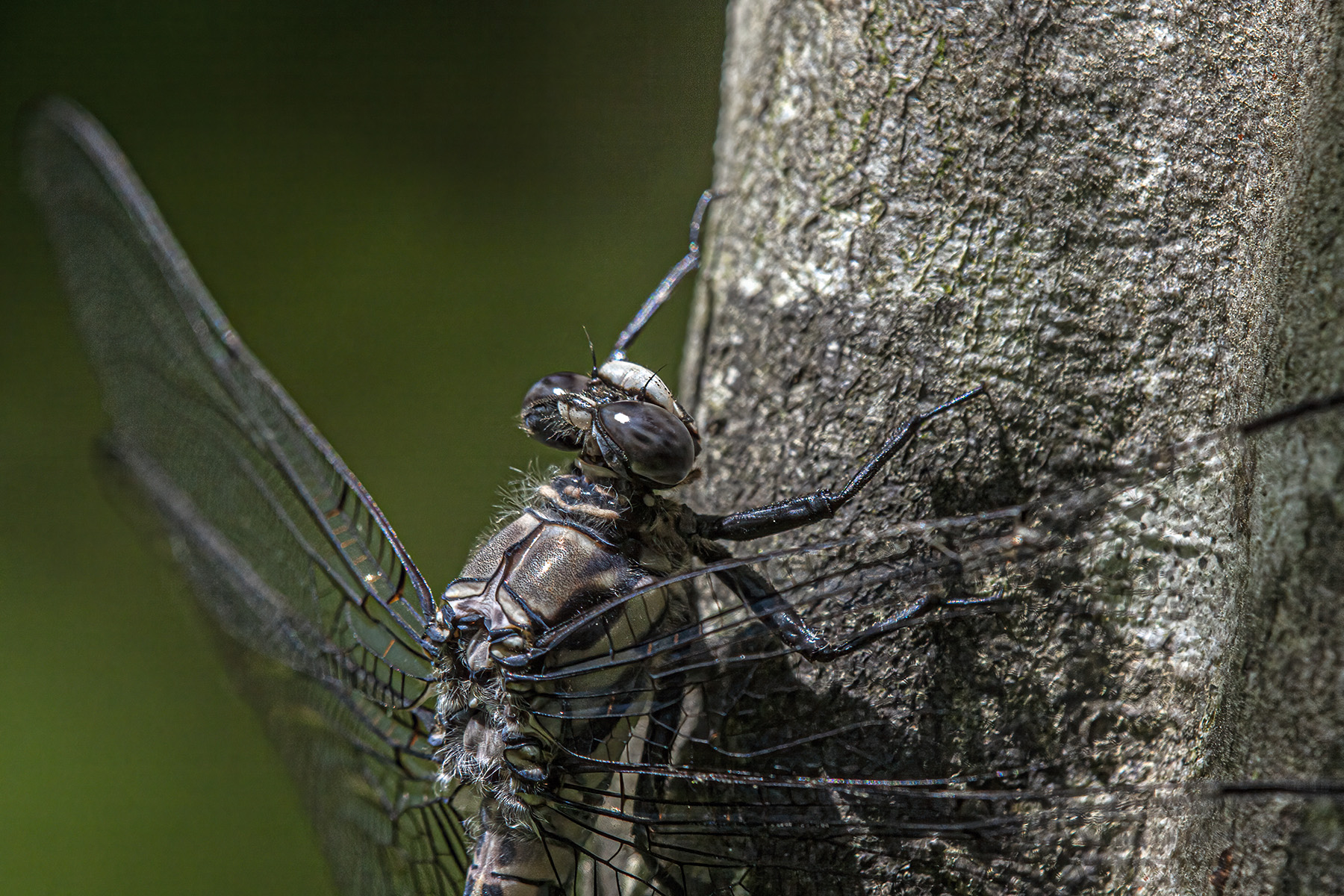
I was thrilled to encounter Gray Petaltail dragonflies (Tachopteryx thoreyi) multiple times on 27 May as I explored a stream in Prince William County, Virginia. There are no other dragonfly species in our area that look like Gray Petaltails, so they are easy to identify if you can spot them. It is a real challenge, though, to see them because they often perch vertically on the trunks of trees where they blend in with the bark of the tree. On several occasions last Thursday, my first indication that there was a Gray Petaltail on a tree right in front of me was when it flew away.

Many of the Gray Petaltails were quite skittish and I had to settle for long-distance shots, but in the case of the first image below, the dragonfly was accommodating and let me get close enough to look deeply into its stunning gray eyes. Often I would attempt to maneuver myself around for a side shot, like the second image below, to try to get a little separation of the dragonfly from the tree and allow the viewer to see its body better.

In the final photo, the Gray Petaltail was perching almost horizontally on a fallen tree. I like the way that both the lichen in the foreground and the out-of-focus ferns in the background give you an idea of the moistness of the area that I was exploring. I was often trudging through a sea of ferns that came almost up to my knees at time as I followed the path of the stream. Gray Petaltails usually originate in seepy area and I will usually scan the sunny side of trees when I am in such areas.

Gray Petaltails are unusual in a lot of different ways. I really like the list that Kevin Munroe composed for the Gray Petaltail page of the Dragonflies of Northern Virginia website:

“This wonderfully odd dragonfly stands out in several ways: 1) Their eyes, unlike most dragonflies, are widely spaced and don’t touch. Only clubtail dragonflies share this trait. 2) This is our only dragonfly with no bright colors that uses camouflage as a daily defense. 3) They spend most of their lives perched on, or vertically exploring, tree trunks. 4) Seemingly quite tame, petaltails often perch on people—perhaps they mistake us for trees. 5) They establish territories at tiny forest seeps, and their larvae can live out of water, among wet leaves on the forest floor in and around their seeps.”

I did not have a Gray Petaltail perch on me last week, but expect that it will happen sometime later this season, especially if I keep wearing gray shirts, which the Gray Petaltails seem to prefer. It was a little disconcerting the first few times that it happened, because these dragonflies are quite large, about three inches (76 mm), in length and sometimes they will perch on my head and shoulders. Now I am used to it and quite enjoy it when a dragonfly chooses to use me as a perch. In case you are curious, here is a link to a re-blog of a posting by my friend Walter Sanford entitled You look like a tree to me! with photos of a Gray Petaltail on my chest and on my shoulder.


gray petaltail

Gray Petaltail

gray petaltail

© Michael Q. Powell. All rights reserved.

Read Full Post »

I love the cool tones of this image of a male Eastern Pondhawk dragonfly (Erythemis simplicicollis) that I photographed last week at Occoquan Regional Park—the green of the vegetation seemed a perfect complement to the colors of this handsome dragonfly. In most dragonfly species the male stands out more than the female, but with the Eastern Pondhawk, it is the female who is more often in the spotlight with her emerald green thorax and the black striped abdomen, as some of you may recall from my posting last week entitled First Eastern Pondhawk of 2021.

A male Eastern Pondhawk starts out with the same bright green coloration as the female, but over the course of his adult life the green is gradually transformed into a duller shade of blue and finally a powdery bluish-grey. A number of other dragonflies have a similar shade of blue on their bodies, but it is fairly easy to identify male Eastern Pondhawks because they, like the females, have bright green faces and their terminal appendages at the tip of their abdomens (the “tail”) are white in color.

Eastern Pondhawk

© Michael Q. Powell. All rights reserved.

Read Full Post »
I spotted this beautiful female Turquoise Bluet damselfly (Enallagma divagans) on 27 May as I was exploring the edge of the woods adjacent to a small pond in Prince William County, Virginia. While I was out in the field, I recognized that it was a bluet, but could not determine its species. Even when I returned home and consulted resources in print and on-line, I quick became confused as I assesed the relative size of the eyespots on the the top of the damselfly’s head, the width of the occipital bars (the band that joins the eyespots), and the placement and size of the blue areas on the abdomen (the “tail”).

Fortunately I am a member of several Facebook groups focused on dragonflies and damselflies and the experts in those groups came to my rescue and identified this as a female Turquoise Bluet, a species that I had never before encountered. I was happy that I was able to capture a lot of detail in my photo and encourage you to click on it to see those details. For reference, Turquoise Bluets are 1-1.4 inches (25-36 mm) in length.

Turquoise Bluet

© Michael Q. Powell. All rights reserved.


Read Full Post »
« Newer Posts