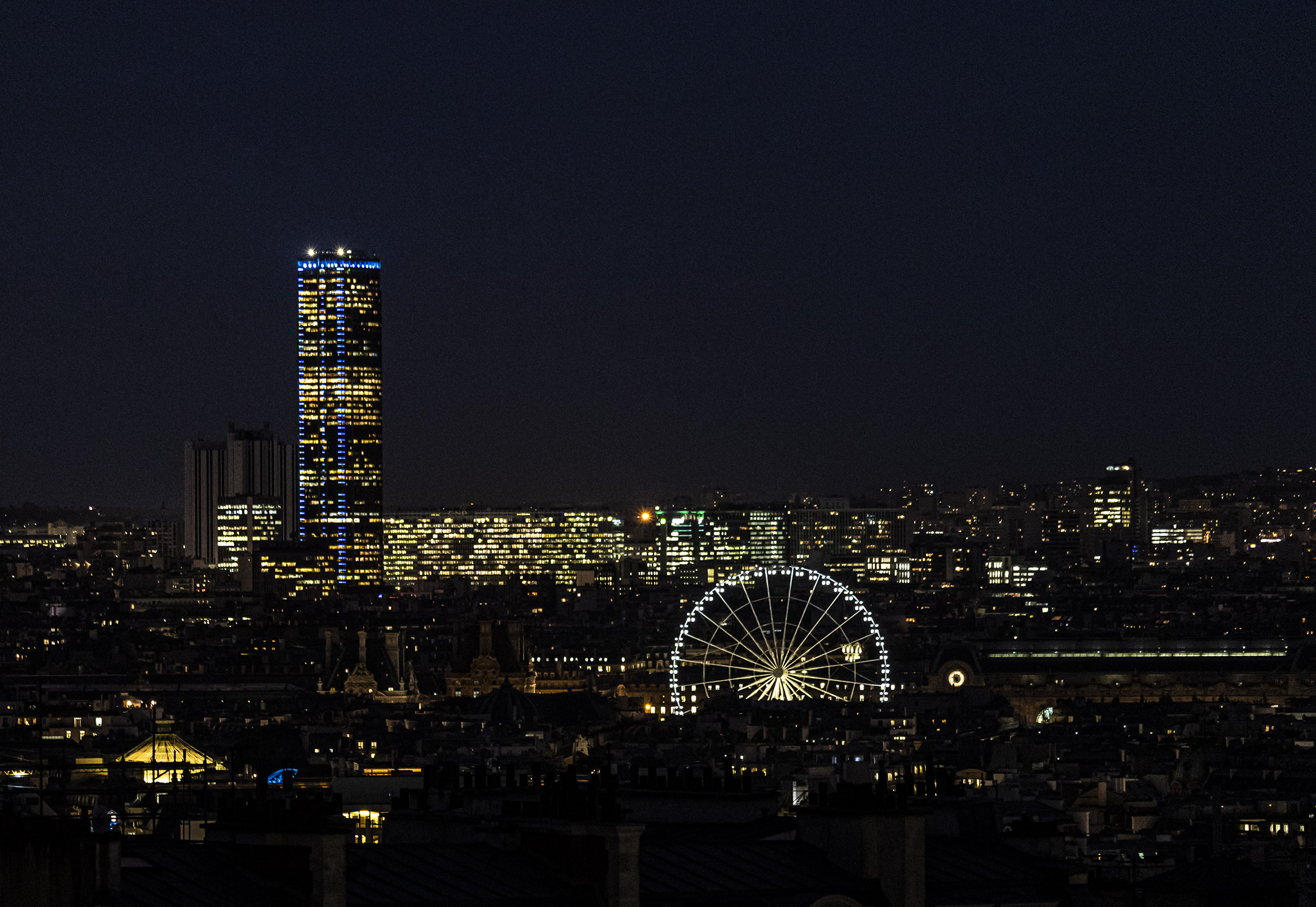
So much of Paris merges together when viewed from the step of Sacre-Coeur in Montmartre, in part because new construction in Paris was limited to 121 feet (37 meters) as of 1977. One notable exception is the Montparnasse Tower at 689 feet (210 meters), which is quite visible in this photo from yesterday evening—the height limitation was imposed in reaction to the construction of this building in 1973, whose size and appearance were loudly criticised. (By comparison, the Eiffel Tower is 1,063 feet tall (324 meters.)
In case you are curious, the giant ferris wheel is a temporary structure in the Tuileries Garden for what I think is a Christmas market. When I first arrived in Paris, the circular portion of the wheel was only partially completed. Since that time, the wheel was completed, cabins were added, and, as of yesterday, the wheel was moving, probably in test mode.
In recent years, the rules on construction have been relaxed and some taller buildings are planned, primarily on the outer edges of the Paris. I highly recommend an article at newweek.com entitled “Will Skyscrapers Ruin Paris?” that argues, in part, that the traditional architecture of the city is part of what sets the city apart from others in the world.
Here is one thought-provoking paragraph from the article:
“When a dense area has low buildings, it forces residents to interact and puts more life out on the streets—a large part of what gives Paris its character. According to Swiss writer and philosopher Alain de Botton, five stories is the ideal height of a city building because anything higher begins to make us feel “insignificant, small, and trivial”—all words rarely used to describe life in the City of Lights. It’s no wonder artists and scholars have flocked to Paris for years for inspiration. Would the same be true if the spirit of Paris were essentially locked away in modern towers?”
In the 1942 classic movie Casablanca (my all-time favorite movie), Rick (Humphrey Bogart) famously told his ex-lover Ilsa (Ingrid Bergman), “We’ll alway have Paris.” Will we?
© Michael Q. Powell. All rights reserved.
 Mike Powell
I think Casablanca would be our favourite movie too; if we haven’t watched our DVDs for a while it’s usually Casablanca that we reach for. Your night photo is lovely!
Thanks, Liz. In someways I am hopelessly romantic–how could I not love Paris? Yet there is an inevitable tension between the heart and the mind, between the world of dreams and the harsher reality of everyday life. Earlier today I was reading the preface to a book of essays by noted photographer Henri Cartier-Bresson. It characterized the world of impressionist painters as an endless Sunday as they propped their easels on a riverbank on in a meadow. By contrast, Cartier-Bresson provides us a look at the working days. In some ways, I try in my photography to straddle that divide, moving sometimes more towards the artsy side of photography, sometimes more toward the hyper-realistic.
I love that movie, too. We may always have Paris but I’m having doubts about that prospect for those being born today. That is a beautiful capture of the night scene with the tower and Ferris wheel, Mike. I’m enjoying your Paris visions.
Thanks, Ellen. You’ve seen enough of my “normal” photography to understand that I am way out of my comfort zone in shooting things like landscapes (or nightscapes). Still, it is cook to try to conceptualize some shots and then to attempt to achieve them. Some of my images are touristy type ones, but I try to make them a little bit different from so many others.