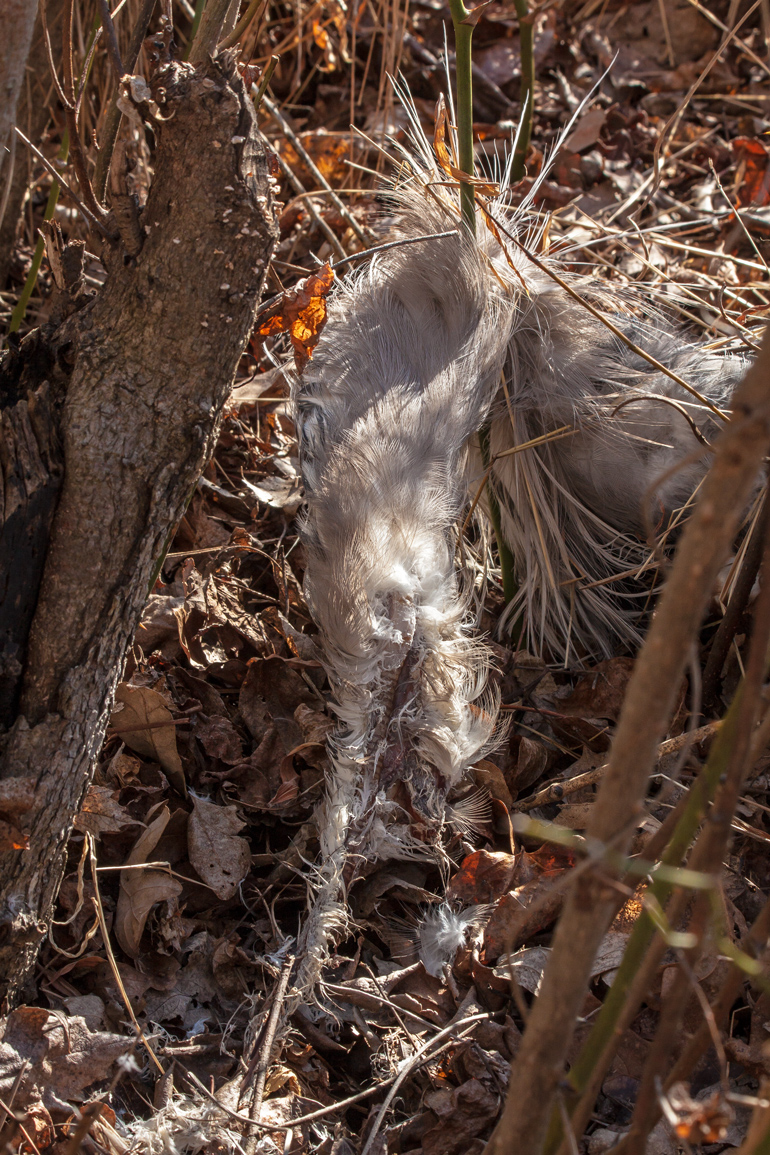
As I was walking about in a remote area of my local marsh, I came across a dead Great Blue Heron (Ardea herodias), with its body partially hidden in the undergrowth and its large feet prominently displayed. I couldn’t help but wonder about the cause of its death, though my sense of reverence for this beautiful bird kept me from poking about its body and examining it more closely.
According to a University of Michigan website , the average lifespan for a blue heron in the wild is 15 years, although 69 percent of those born in a given year die before they are a year old. Was this heron a young one who was unable to survive in our recent cold weather? Was it perhaps an older one which had lived a long life and died of natural causes? Was it killed by a predator? Known predators of young (and sometimes adult) blue herons include eagles, raccoons, turkey vultures, and red-tailed hawks, all of which I have seen in this marsh.
I struggled a bit in determining how to present these photos to avoid offending those who might find the subject too morbid or gruesome. In the end, I decided to lead with the photo of the large, weathered feet with the small talons. The next two shots pull out progressively to give a sense of the surroundings in which I found the heron. I took the final shot from the side, looking directly at the area where the head should be and quite frankly I am not sure what I am seeing in that image.
Life is a constant struggle for animals and birds in the wild and this little encounter reminded me of that sometimes harsh reality.


© Michael Q. Powell. All rights reserved
 Mike Powell
Sad story, but very well done.
It always amazes me how dinosaur-like birds feet are. I know this should not amaze me, as they are related. I guess what it is, is that birds have been here on this earth for so long, outliving those immense creatures with whom they share a gene pool. Your photos of this dead heron are quite tastefully done.
Thanks. Those enormous feet really stood out for me and there is certainly something almost prehistoric looking about them (I have the same reaction whenever I see snapping turtles). I was fortunate that there was not a lot of blood and gore–that would have made it tougher to photograph.
Heron today, gone tomorrow…. 😉
Had to get you back for the sheep pun on my post, interesting shots..:-)
I deserved that. Hopefully life with be easier for the deceased in the heron after.
A tough subject, but very tastefully thought out and presented. Those feet really are amazing.
You have done well with this difficult subject but you have communicated the sadness of the end of a lovely bird
Sometimes it’s important to tell more parts of the story, including the sad ones, to gain a fuller appreciation of what’s happening. I agree with the others that you did this well.
Were you the one who observed a juvenile GBH having no success fishing one day at your local marsh? In any case, mortality is very high in the first year, for most birds, so this is not unusual. Nice job of presenting it.
Interesting facts, I had no idea they could live for as long as 15 years (or more) and that such a high rate doesn’t make it through the first year. The other day I came across several (I counted 12 but there were probably more) heron nests (no pictures, they were high up in the trees), I wonder how many will make it.
Very compelling story told through your photographs. Somehow the shot of just the feet tugs at my heartstrings the most. Thanks for sharing.
Like the heron, we will all die one day…. Thanks for posting this.
This happens all the time but we rarely see it. I’ve been wondering this year how many birds and animals have died because of this brutal cold.
How sad. They are gorgeous animals. I photographed a hog that was dead once. Probably lost the images during one of the computer crashes I had years ago.
RIP lovely blue Heron. The photo of the feet is excellent. It really tells the story.
[…] many of you know from my posting last week, I recently came upon a dead body of a Great Blue Heron (Ardea herodias) and several of […]
Sad, but thanks for sharing.
so sad but thank you for sharing it my heart feels bad or that bird.
Thanks for sharing. Nature can be harsh and even cruel at times–it’s hard not to feel emotional about the difficult lives that some many of these creatures live.