When I spotted a fairly large bird soaring in the sky, I stopped talking in mid-sentence and pointed my camera to the sky. My fellow conversationalist might have thought it was rude (she is not a photographer), but I am always trying to capture images of birds in flight and will start shooting long before I have identified a bird.
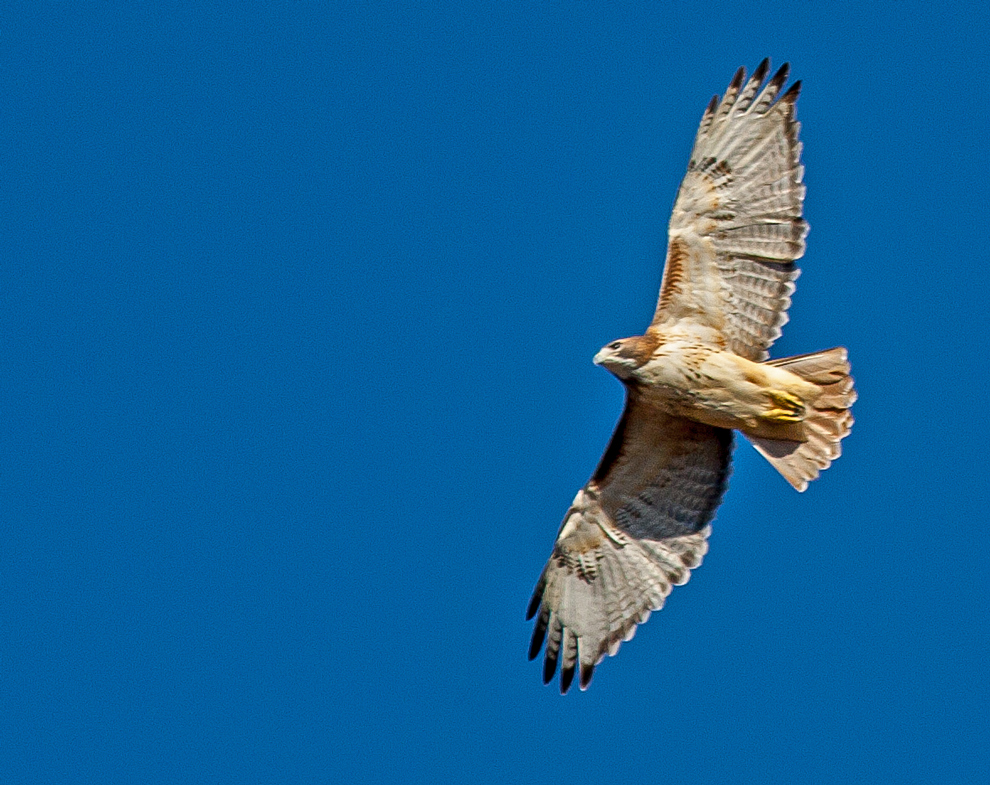
This bird looks to be a juvenile Red-shouldered Hawk (Buteo lineatus), though I am not certain about the identification and the hawk did not cry out at all, so I have only visual clues to go by. At first I thought it was just soaring for fun, but the intensity of the hawk’s eyes, especially in the second shot, suggest that it was paying attention to what was happening on the ground.
I was pretty fortunate when the hawk turned toward the light with its wings extended, providing a good look at the beautiful feathers of its wings and body. I am hoping that I will be getting better shots of hawks as we progress into winter, though, as with most wildlife subject, there are no guarantees.

© Michael Q. Powell. All rights reserved.
 Mike Powell
great picture!
Thanks. Like many photographers of birds, I always wish for a longer lens and better lighting, but I am pretty happy with what I managed to get this time.
Stunning shots. I am wondering: how much does your camera weigh with all that lens on it?
It’s not too bad. I shot this with a 70-300mm telephoto zoom lens and cropped the image. The guys with the monster lenses usually have to use a tripod.
Wow ! Beautiful shots ! Birds in flight are always full of grace !
Well done !
utham
Thanks so much. I love trying to photograph birds in flight and occasionally will get decent shots. There are so many variables in this type of photography that it’s hard to predict when an opportunity will arise for a shot like this.
Excellent shot, my camera with the big 175-500mm is a bear to freehand to get birds in flight..;-)
Thanks, Ed. I’m beginning to think that 400mm might be the maximum manageable size for shooting like this. I don’t mind using my tripod for macro shots, but I feel a bit limited when trying to follow birds when I am on a tripod and anchored to one spot.
There are no bars on the tail, and it looks pinkish from the underside, so I’m thinking the bird is an adult Red-tailed Hawk. The breast is also very pale, and that distinctive belly band says Red-tailed Hawk to me. Those are beautiful shots of a beautiful bird. Bright light sure helps!
Thanks, Sue, for the assist in identification of the hawk. We don’t seem to have many Red-tailed Hawks around, so I am not sure what identifying features to look for. The body seemed lighter in color than most of the photos that I could find on the internet.
These are great shots! Do you mind sharing the camera settings? They are so clear and with crisp details.
Thanks. My software shows the following settings: f/8, 1/400 sec, 170mm, ISO 160. My camera was almost certainly set on aperture priority and for burst mode. It’s a mystery to me why I was at 170mm on a zoom lens that goes from 70-300mm, but the appearance of the hawk caught me by surprise and I think I zoomed out to acquire the moving bird and didn’t zoom in as I tracked it. If I had a bit more time to change settings, I might have gone for f/7.1 or even f/5.6, which would have caused the shutter speed to be faster.
Just goes to show what can be done with a 300mm zoom lens. That’s also what I shoot with, although I’m hoping to use this year’s tax refund to get a larger lens. At any rate, your in-action flying shots are getting crisper and crisper each time you post. Congrats, because I know you’ve been working on just that!!
Thanks. I was fortunate with these shots that there was a lot of light, which let me keep the ISO down and made it easier for me to lock the focus on the bird. I keep trying to convince my self that I don’t need a 500mm lens and think a 400mm lens mroe likely might be in my future.
It’s interesting. In a way, it’s a good thing to have to be content with a smaller lens – at least for awhile 😉 . It’s taught me lessons in incredible patience, it’s made me be very aware of the small details in my immediate surroundings. Lots of light definitely makes the practice easier!!
It has been an interesting process to watch your photography continually improve. This must have been a great day.
By any definition, it was a wonderful day. As for my photography, a lot of practice and experimentation have helped me to improve and I know that I am getting some shots now that I would not have been able to get 18 months ago, when I was starting to shoot regularly.
The lighting on the undersides of the wings seems like it would be impossible to control, but it looks perfect in these shots.
It is impossible to control the light, though you can make a few adjustments with software to lighten or darken certain areas. Mostly, you have to be lucky to find yourself in the right position when the bird comes along.
Great shots! Loved them.
Thanks. I am working on improving my skills at capturing shots of birds in flight and hope to be posting even better shots this winter.