Feeds:
Posts
Comments

Archive for March, 2013

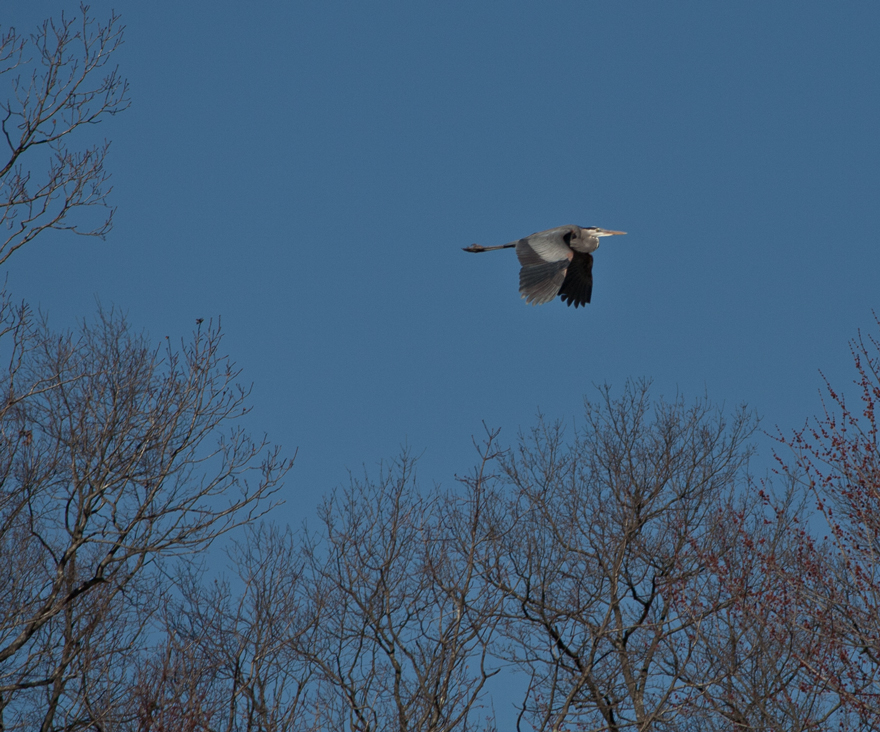
I was staring intently at some ducks in a secluded area of the marsh, when suddenly my eyes caught sight of movement in one of the trees overlooking the pond. The next think I knew a Great Blue Heron (Ardea herodias), who had apparently been perched on the tree,  was flying through the air.

This is the best of the shots that I was able to take. Most of the times that I have attempted a similar shot in the past, the white in the face has been totally blown out. I still need to work on getting a better exposure, but feel like I am making progress. Now if I can just find a cooperative heron.

heron_blog

© Michael Q. Powell. All rights reserved

Read Full Post »

Yesterday, the marsh was alive with the sound of music, frog music. Entire areas of the marshland seemed to resound with waves of sounds, some it high-pitched and some of it lower in range. The warm weather, in the low 60’s (16 degrees C), seemed to have roused the frogs from their sleep and they were in the mood to sing.

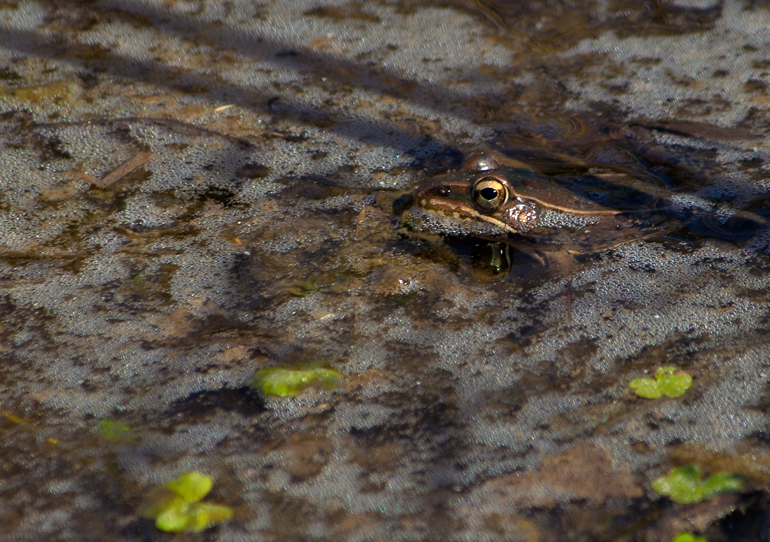
Although I could identify the general areas of the frog activity, it proved to be very difficult to spot the frogs themselves. My eyes scanned and rescanned the shallow waters near the cattails until at last I spotted a frog.

I think this frog is a Southern Leopard Frog (Lithobates sphenocephalus), but I am not entirely sure of my identification. You can see from the photo how effectively he is camouflaged.

Frogs and turtles are starting to be active, can the dragonflies be far behind?

springfrog1_blog

© Michael Q. Powell. All rights reserved

Read Full Post »

After endless gray winter days, the beauty of a sunny day seemed magnified and the vivid colors of this mallard duck looked even brighter. I love the shade of blue of the feathers that show through when the ducks are in flight, especially when they are taking off and landing.

mallard_blog

© Michael Q. Powell. All rights reserved

Read Full Post »

At the edge of a cattail patch, this male Downy Woodpecker (Picoides pubescens) was pecking away at the branches of a small tree, moving upward until he had reached the tip of the branch. For a short moment, he took a break from his work and turned his head to the side, which let me take a nice profile shot.

Perhaps he was searching for the next plant to peck, maybe the cattail in the distance.

downy1_blog

© Michael Q. Powell. All rights reserved

Read Full Post »

On a cool and windy day, this bright scarlet male Northern Cardinal looks like he chose to wrap himself in an old-fashioned cloak for protection from the elements.

I really was struck today by the sharp distinction between the coloration of the head and the rest of the body of this cardinal.

Do cardinals change colors in the spring?

cardinal_blog

© Michael Q. Powell. All rights reserved

Read Full Post »

Do you aspire to photograph extraordinary subjects in exotic locations or are you content to shoot ordinary subjects in nearby locales?

This past winter (well, it’s almost past), I have really enjoyed photographing birds. At times, I have longed to be able to capture awe-inspiring images of hawks and eagles, of ospreys and owls and have thought about the travel and equipment that might be required to do so. Does that make me an adrenaline junkie, always searching for more, someone who requires increasing amounts of excitement to be content?

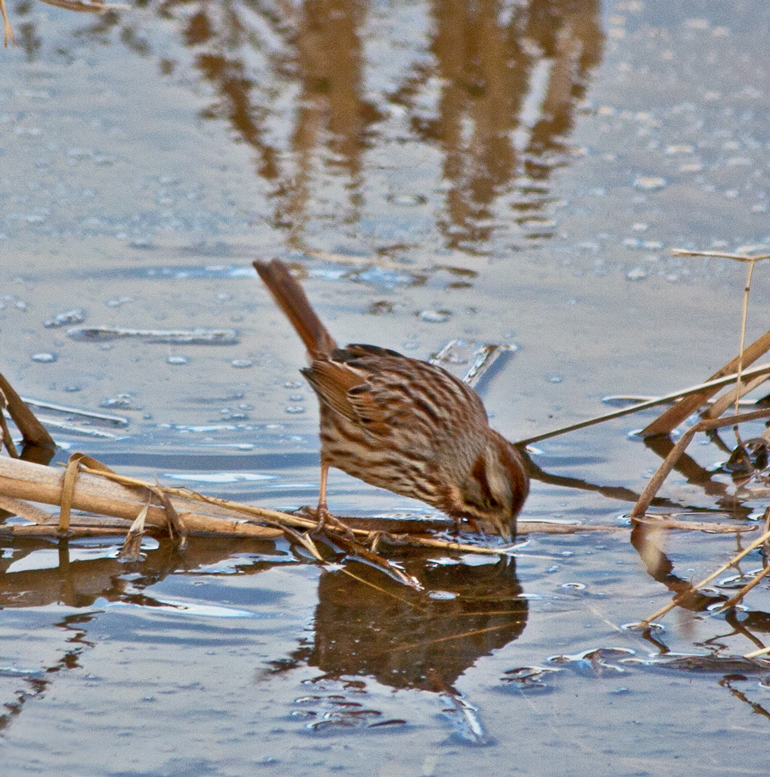
For the moment at least, I know that the answer is “no.” My pulse still quickens when I see a robin or a cardinal. I will take shot after shot of geese and ducks flying and landing. I am willing to kneel in the mud to try to get yet another shot of a sparrow. Here is one such shot of a Song Sparrow (Melospiza melodia) from earlier this week that I really like.

sparrow_blog

I am content with the ordinary and strive to capture and display its beauty. Cristian Mihai, a wonderful, easy-t0-read blogger, wrote a posting yesterday on beauty, entitled Beauty will save the world that I really recommend. It caused me to think more deeply about my photography, about my goals and motivations. What is is about beauty that prompts a desire to respond, to share it with others?

I started this posting with a false dichotomy, with alternatives that are not mutually exclusive to stimulate thought, the kind of inner examination that I have been conducting. There is no simple answer—sometimes it is sufficient to simply think about the question.

© Michael Q. Powell. All rights reserved

Read Full Post »

I stood and waited, camera at the ready, as I stared at a hawk in a tree overlooking a field, hoping that he would fly toward me when he spotted a prey.

I waited and waited and finally he took off from the branch. Unfortunately, he flew up in the air and away from me, rather than down and toward me. I tried to track him and snapped off a couple of photos.

I managed to capture him with his wings fully extended as he headed into the woods and was struck by the degree to which he blends in with his surroundings.

I am sure that I will soon find myself in a similar situation, watching and waiting—it’s the fate of those of us who choose to photograph wildlife.

hawk_woods_blog

© Michael Q. Powell. All rights reserved

Read Full Post »

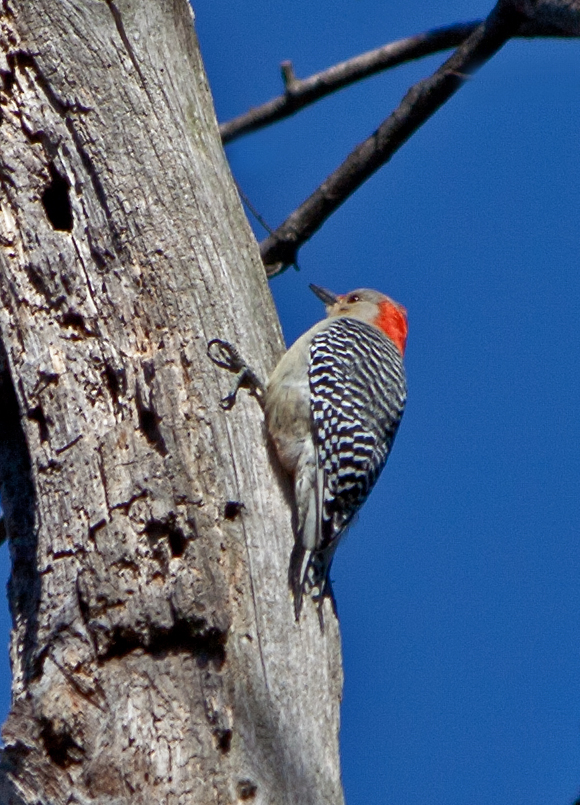
Walking through the woods on Monday, I heard the sound of a woodpecker and was pleasantly surprised to see that it was a Red-bellied Woodpecker (Melanerpes carolinus).

Most of the woodpeckers that I see are Downy Woodpeckers, which are cute in their own way, but I had been longing to see some of the bigger woodpeckers. Although the woodpecker was fairly high in the tree, I was happy that I managed to get some recognizable shots in different poses.

red_bellied4_blogred_bellied3_blogred_bellied2_blog

I stopped in the visitor center as I was leaving the park and happened to glance through the window at the bird feeders. The birds at the feeders tend to be fairly small, including nuthatches, chickadees and tufted titmice. Imagine my surprise when a big woodpecker showed up at the suet feeder—it was another Red-Bellied Woodpecker.

Although I was indoors, I decided to take a few shots of the woodpecker.  I think I ended up with a pretty cool image, in which the shadow of the wire cage imparted a striped pattern to the bird’s bill. When you first look at the image, you may not even realize that the stripes are added.

Now that I have photographed a medium-sized woodpecker, I will be in search of a Pileated Woodpecker—the superstar of woodpeckers.

red_bellied1_blog© Michael Q. Powell. All rights reserved

Read Full Post »

A flock of robins was really active in my neighborhood this morning, busily pecking the ground as the freezing rain gradually turned into snow. This American Robin (Turdus migratorius) didn’t even have time to clean up before I took his portrait.

robin_blog

Click on the photo to see a higher-resolution view

© Michael Q. Powell. All rights reserved

Read Full Post »

The sky was a spectacular shade of blue on Monday, providing a beautiful backdrop to this shot of a female Northern Cardinal (Cardinalis cardinalis).

I’ve posted quite a number of photos of cardinals, primarily of male cardinals, but one of my fellow bloggers commented that you can never have too many photos of these beautiful birds.

I agree.

cardinal1_blog

© Michael Q. Powell. All rights reserved

Read Full Post »

This past weekend, I made another trip to the orchid exhibit at Lewis Ginter Botanical Gardens in Richmond, VA, in part to hone my macro-shooting skills that have atrophied during the winter months.

I have grown accustomed to photographing birds and small mammals at the far end of my telephoto range in situations in which I don’t have much time for decision-making. If I am lucky, I am able to quickly check the direction of the light and adjust my camera’s settings, but sometimes there is insufficient time for even those rudimentary checks.

When I am shooting with my macro lens, my camera is usually attached to my tripod and, if I remember to do so, I have time to think about the exposure, the settings, and the angle before the shot. More importantly, I can look at the results and take a second shot. Birds and animals rarely give me a second chance.

Here are shots of a couple of the orchids that at the exhibition. I don’t know the names of the orchids, but one of my Facebook friends told me that the red one is from the Cymbidium genus. As I was working on the images, I noticed that I photographed both of them from almost the same angle. Perhaps I liked that angle, but most likely I was desperately trying to get an uncluttered background and this view allowed me to minimize distractions.

I can tell I need to retrain my eyes a bit to look at the tiny details as I prepare for the insect and flower season. Baseball is not the only activity that requires spring training.

orchid_red_blog

yellow_orchid_blog

© Michael Q. Powell. All rights reserved

Read Full Post »

I am not absolutely sure what this muskrat (Ondatra zibethicus) was doing when I took these photos yesterday, but it look to me like he was grooming himself.

I really like the way that you can see his two little front paws in the first photo—he almost looks like he is praying. In the second photo, it appears that he is rubbing something onto his cheek. Was he putting on make-up because he knew that I was photographing him?

I don’t know the beauty secrets of muskrats, but maybe rubbing cattails on your face helps to reduce wrinkles.

muskrat1_blogmuskrat2_blog

© Michael Q. Powell. All rights reserved

Read Full Post »

Yesterday was the first time that I was able to get some shots of a muskrat (Ondatra zibethicus) out of the water, eating and grooming.

The muskrat was at the edge of a patch of cattails that grow in the middle of the beaver pond at my local marshland park and I actually heard his feeding sounds before I was able to see him. He was a pretty good distance away, but the late afternoon sun illuminated the scene from the left and provided enough light for me to focus the camera.

I am going through the other shots that I was able to snap off before he slid into the water, but thought I’d share this image of the muskrat chewing on what looks to be a cattail stalk. I like the way in which the cattails help to frame the image, rather than block the view, which is usually the case.

I went to the marsh yesterday with the hope of getting some photos of the beavers, which did not make an appearance while I was there, but I ended up with something a bit better—one of the serendipitous joys of photographing wildlife.

muskrat3_blog

© Michael Q. Powell. All rights reserved

Read Full Post »

Although it is enjoyable and challenging to try to photograph large, colorful birds, I often find myself returning to photographing smaller, more ordinary birds. It’s a different kind of challenge capturing images of these little birds, who seem to be in constant motion.

This afternoon I was able to photograph this Song Sparrow (Melospiza melodia) when he stopped for a moment to get a drink of water.

sparrow_blog

© Michael Q. Powell. All rights reserved

Read Full Post »

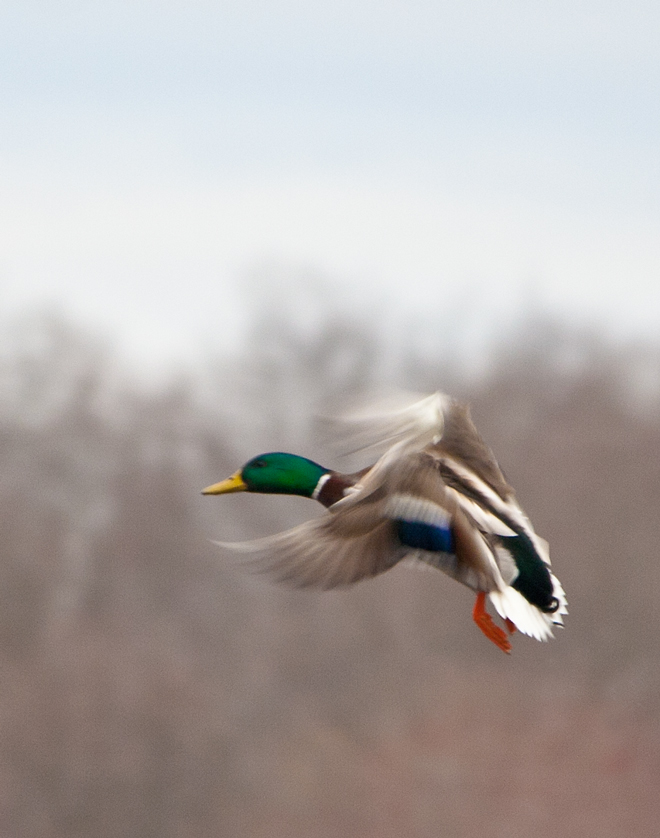
Capturing images of ducks in flight has been a lot more difficult for me that photographing geese. Geese are larger, fly more slowly, and are more predictable than their skittish duck counterparts.

My camera also seems to have a problem grabbing the focus of these smaller birds when they are moving. Nonetheless, I still spring into action whenever ducks take to the air and occasionally I manage to get shots that are pretty much in focus. Here are a few such images of mallard ducks from this past Friday.

ducks1_blogducks2_blogducks3_blog

© Michael Q. Powell. All rights reserved

Read Full Post »

Red-winged Blackbirds are one of the few birds that I can identify by their call. Yesterday I could tell that there were several blackbirds in the cattails at my local marsh long before I actually saw them, thanks to their very distinctive call. I tried several times to photograph the blackbirds while they were calling out and this was my favorite image.

red_winged_blog© Michael Q. Powell. All rights reserved

Read Full Post »

What is the best way to capture motion and have the subject in focus? Recently I have been experimenting with different camera settings and shooting techniques in trying to photograph birds in flight.

Yesterday I concentrated a large part of my efforts on Canada Geese (Branta canadensis). They make good test subjects because they are large and relatively slow-flying birds (and there are lots of them). I have done a number of postings of geese taking off and landing and in those cases I usually try to freeze the action. Getting the photo in focus is not always easy, but the action is usually taking place in a small geographic space and that helps a little with getting the focus locked in.

Capturing the geese before they being the landing process or after they are in flight has always been tough for me, but I think my skills are improving with practice. Generally I will try to focus on a single goose to make things easier. Yesterday, though, I decided to try to capture a group of geese flying together and had some success using a panning technique. The background blurred nicely, the necks of the geese are in focus, the wings have a bit of motion blur, and the geese themselves have assumed interesting poses. As I recall, I had my focusing point on one of the geese in the center. Some of the photographers I see with really long telephoto lenses have special mounts on their tripods that let the lenses swing freely as they track the birds, but for the most part I have been taking these shots hand-held.

panning_blog

I used a slightly different technique with a couple of geese that were closer. Using one of the first rules I learned about photographing people and animals, I tried to focus on the nearest eye of one of the geese. Well, actually I probably was trying to keep my focusing point on the goose’s head in reality, but I was thinking of the eye. As you can see, there was not a lot of depth of field, but things worked out well with the face of the nearest goose in pretty sharp focus. The blurry wings provide a nice contrast with the sharper elements and my eyes are drawn to the goose’s eyes and open bill.

goose_pair_blog

For me, experimentation is one of the best ways to learn new things and I am definitely learning more and more about my camera and my techniques, which will help me when I try to photograph subjects, like hawks, that are less cooperative than the Canada Geese.

© Michael Q. Powell. All rights reserved

Read Full Post »
In the orange glow of the sky, the trees cast their reflections on the black granite surface of the Vietnam Veterans Memorial wall.

It was a moment to reflect on the names of more than 58,000 men and women whose names are inscribed on the wall. I am old enough to remember the conflicted mood of the country at the time of that war.  In the late 1970’s I enlisted in the U.S. Army and served on active duty for twenty years. With that experience, I can’t help but be humbled by the memorial to the sacrifice of so many Americans for the common good.

Monuments_blog

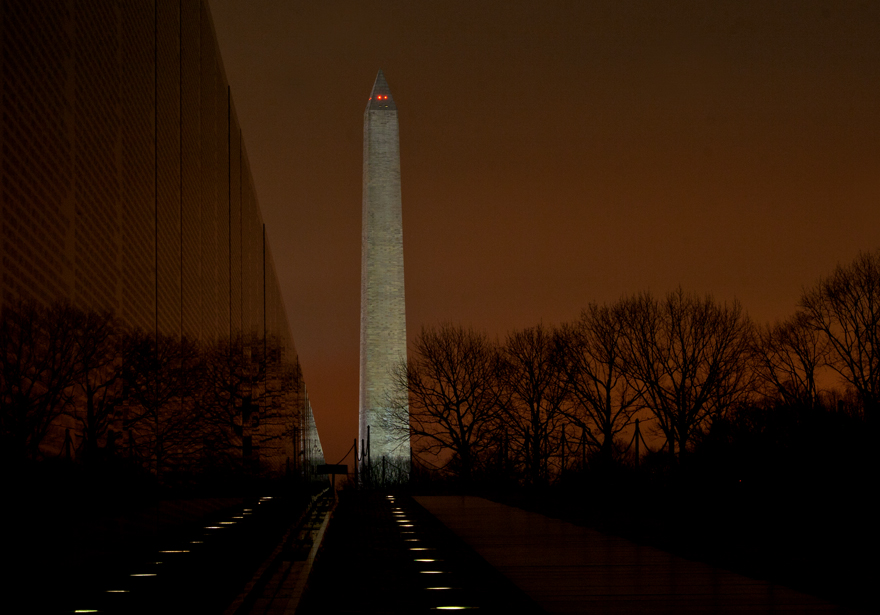
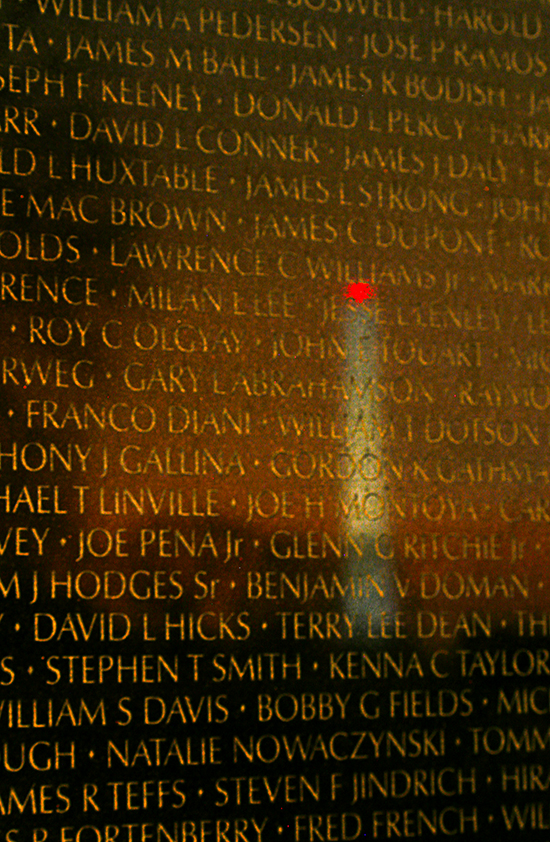
From certain angles, I could see reflections of the Washington Monument in the wall. It proved to be very difficult, however, to capture that reflection in a photograph. I used my tripod and a long exposure, but never quite captured the feeling of the moment. I am posting one of those efforts as a kind of aspirational shot, one that I hope to shoot better in the future.

WashMonuWords

© Michael Q. Powell. All rights reserved

Read Full Post »
« Newer Posts