Feeds:
Posts
Comments

Archive for August, 2012

Wait a minute, that’s not a rose! You got me there, but raindrops on flowers are still one of my favorite things. Can I help it if I love “The Sound of Music?” The word “raindrops” immediately conjures up visions of Julie Andrews singing “My Favorite Things,” including “raindrops on roses.”

This photo is a couple of months old but is intended to be a response to the rainy weather we are finally having.  It is also a response to Another Perspective Photography’s posting asserting that she is not a bug photographer.

I am proud to state that I am a bug photographer who often shoots other elements of nature and only occasionally photographs people. That may change, but for the moment it’s where my interests lead me. This photo, however, is intended to be evidence that I am not “just”a bug photographer.

© Michael Q. Powell. All rights reserved.

Read Full Post »

You might think that I am going to talk philosophically about a bee, but my title is meant to be taken literally. If you click on the photo, you can actually see reflections of the sky and bushes on the shiny surface of the abdomen end of this bee.

I am pretty sure that this is a carpenter bee for two main reasons. First, the abdomen area is shiny and hairless, unlike a bumblebee who is more hairy. Secondly, the bee is sucking nectar out of the side of the flower rather than going in from the front, a process sometimes referred to as “nectar robbing.” Carpenter bees are notorious for circumventing pollination in certain plants by slitting open the side of the flower.

Perhaps others can see more reflections on the bee. It’s like looking at clouds and trying to see shapes—it’s a lot of fun and everyone sees something different. Life is like that sometimes.

Click the photo to see more details

© Michael Q. Powell. All rights reserved.

Read Full Post »

It may sound like a new summer beverage sensation, but the title is meant to be literal.

I captured this shot of a green heron  just as the rain was beginning to fall this afternoon. I was at the same pond at a local garden where I had previously seen a juvenile green heron (and that was right after the rain). Maybe green herons like to come out to play in the rain—I’ll have to remember that in the future.

There really wasn’t enough light for a high quality image, but I think that I managed to capture the unique look and style of the green heron.

(I also got some photos of a juvenile green heron this afternoon but I’ll save them for another posting.)

© Michael Q. Powell. All rights reserved.

Read Full Post »

Is it really possible to find inspiration and motivation in an insect?

Take a really close look at this photo of an male Eastern Tiger Swallowtail butterfly (Papilio glaucus).

Do you see the delicate beauty of his colors and shapes or are your eyes drawn immediately to his infirmity? His wings are virtually shredded and there is a large portion of one of them missing.

Somehow, despite all of those limitations, he can still fly. He can defy gravity and the laws of aerodynamics.

I don’t know how he does it, but he is able to overcome adversity.  Some of the lyrics of the song “Defying Gravity” from the musical “Wicked” come into my head as I think about it.

“I’m through accepting limits ’cause someone says they’re so. Some things I cannot change but til I try I’ll never know….I’d sooner buy defying gravity. Kiss me goodbye I’m defying gravity and you can’t pull me down.”

Inspiration and motivation can come from many places, I would posit, even from insects.

Take these broken wings and learn to fly…

© Michael Q. Powell. All rights reserved.

Read Full Post »

I came across this tiny damselfly yesterday when I was visiting a local garden in the late afternoon. Initially I spotted her when she was flying and I was thrilled when she chose to land in a spot where I could photograph her. I apologize to the experts for not identifying the type but I find it impossible to identify damselflies (and even dragonflies are not easy).

Damselflies are particularly challenging for me to photograph because they are so long and skinny. If I photograph them from the side, the eye is often out of focus and if I try to shoot head-on, depth of field is an issue.

I ended up with a photo that I shot from above and to the side. Somehow I managed to reduce the composition to the damselfly, the branch to which she is clinging, and a couple of leaves.

I find special beauty in that kind of simplicity in nature and in my photography.

Unidentified damselfly

© Michael Q. Powell. All rights reserved.

Read Full Post »

Four weeks ago today my friend and mentor Cindy Dyer helped me to start this blog. She has been teaching me and encouraging me as I seek to express myself through my photography. I owe her my thanks.

Over the past month I’ve tried a lot of different things: short posts and long ones; serious posts and funny ones; scientific posts and artistic ones; and scarey posts and beautiful ones. Some have been successful and others less so. The best thing about this blog, however, is that I have encountered a wide array of fellow bloggers. You have taught me so much and supported me with words of encouragement and inspiration. Thanks to all of you.

My first blog posting featured a Blue Dasher dragonfly, one of my favorite subjects. It somehow seems appropriate to feature another one as I celebrate my four-week anniversary. I photographed this Blue Dasher dragonfly (Pachydiplax longipennis) in late June at Green Spring Garden, a county-run facility that has a pond as well as a garden. It is only a few miles from my house and has been a kind of laboratory for me as I have worked on my photography.

Today is a hot, humid day here in the Washington DC area and I have stayed indoors poring over some of my images from the past month or so. I came across this one and after I adjusted the exposure a bit I realized that it was a pretty good shot. The lighting and background help to make it stand out from some of my other dragonfly photos (and I have lots). I uploaded a higher resolution image to allow viewers to see some more of the details, including the “eyelashes” of the dragonfly. Be sure to click on the image.

Click on the photo for a more detailed view of the dragonfly

© Michael Q. Powell. All rights reserved.

Read Full Post »

It’s fun to share photos and thoughts with my fellow bloggers. Here’s is a posting that one of them, Another Perspective Photography, did in response to my recent creepy bug photos. She specializes in babies and weddings. The kind of pressure that comes with those subjects and the accompanying high expectations would terrify me.

Another Perspective Photography's avatarAnother Perspective Photography

So many other bloggers inspire me…. I LOVE looking at other peoples pictures, wondering how they got that light, or that angle, what lens they used, and then sometimes trying something new myself.  In this case, I went back through my archives to find some of my favourite bug pictures, inspired by fellow photog blogger Mike Powell – especially by his amazing pictures of the scary creepy creature on his lavendar plant.  Mine are not NEARLY as technically perfect- some of them were just spontaneous- “quick get that picture”, others were planned….and in the interest of time, I pulled a few from my personal facebook albums- which are in low resolution.  (who knows which hard drive I’ve got some of them on!!!)  Next time I’m feeling like a photo adventure, I might just go in search of BUGS in a more serious fashion.

Also, feel free to correct me…

View original post 41 more words

Read Full Post »

A few minutes ago I was vacuuming when I suddenly noticed that there was an insect on the screen of my sliding glass patio door.  Of course, I immediately stopped working and grabbed my camera (with macro lens) and tripod.

I decided to try some face-to-face shots, which was a little tricky for the insect (which I think is a katydid) was less that two feet above ground level. I am glad that nobody could see me as I contorted my body with considerably less grace than the Olympic gymnasts I watched earlier this week.

When I looked at my closeup shots of the eyes, I realized they were a little creepy. No, they were more than a little creepy. So, of course, I am sharing them with you. Hopefully this image does not cause anyone to lose sleep or have nightmares and I certainly would not advise blowing this up and hanging it on your wall. (And yes, I know my macro technique still needs work, but I am still just learning.)

Now I can return to my chores, unless some other photo opportunity literally falls at my door step.

© Michael Q. Powell. All rights reserved.

Read Full Post »

I have always been fascinated by light and shadows.

Shadows often hide or mask details of a subject, although they also may reveal elements of a subject that might otherwise be concealed. Sometimes shadows are an accurate reflection of the subject (like a silhouette), but other times they distort reality. Shadows intrigue me too because they often pick up characteristics of the surfaces on which they are cast in addition to those of the subject.

My musings on shadows were prompted by this photo of an unidentified wasp (I think it is some kind of wasp) that I shot yesterday morning. The wasp was back lit by the morning sun, causing a hidden part of his body to be revealed in the shadow.

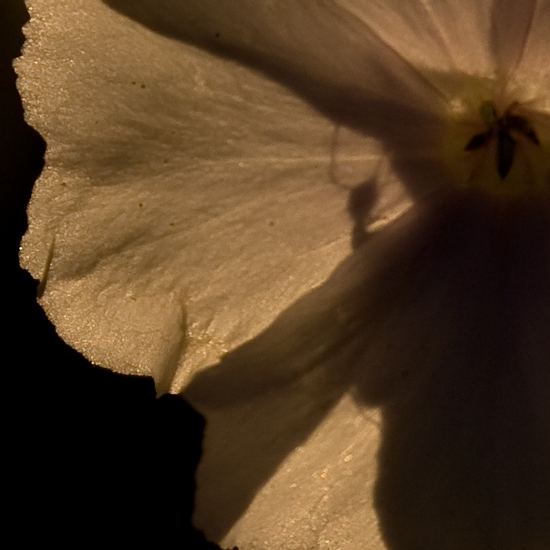
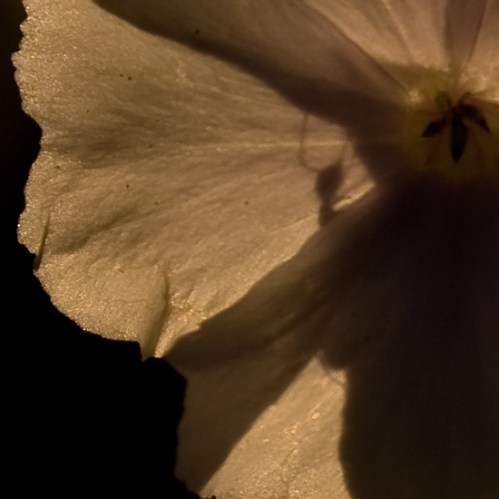
A few months ago I decided to photograph the morning light coming through a small flower in my neighbor’s garden. As I getting ready to shoot, an ant started walking across the back of the flower. It’s not a technically good shot but I like the effect that was produced by the ant’s shadow.
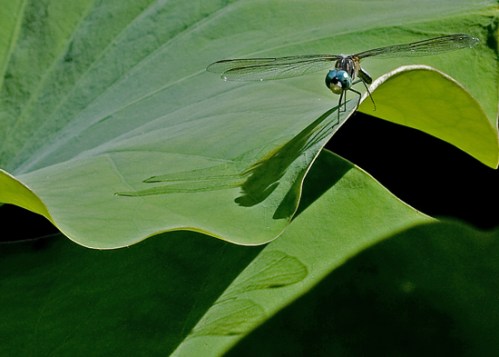
Folks who follow this blog know that I love dragonflies. In early June I took some photos of dragonflies on a sunny day, resulting in lots of shadows. The dragonfly’s shadow makes me think of the position of a person hang gliding and it even looks like the dragonfly is wearing a little helmet.

The undulating surfaces on which the shadow falls really make a difference in the shape of the shadow. I especially like how the shadows of the wings fall on a separate leaf from the shadow of the main body. The shadows of the leaves themselves make this image even more interesting for me.
In this final photo a dragonfly literally is casting a long shadow. The distortion caused by the angle of the sunlight causes his legs to appear much longer and I find that this dragonfly looks much more menacing than is typical of a dragonfly.

Can a dragonfly actually look menacing?

© Michael Q. Powell. All rights reserved.

Read Full Post »

Painted Lady butterfly (Vanessa cardui) photographed today at Green Spring Gardens, Alexandria, Virginia.

© Michael Q. Powell. All rights reserved.

Read Full Post »

Female Eastern Tiger Swallowtail butterfly (Papilio glaucus) photographed today at Green Spring Gardens, Alexandria, Virginia.

© Michael Q. Powell. All rights reserved.

Read Full Post »

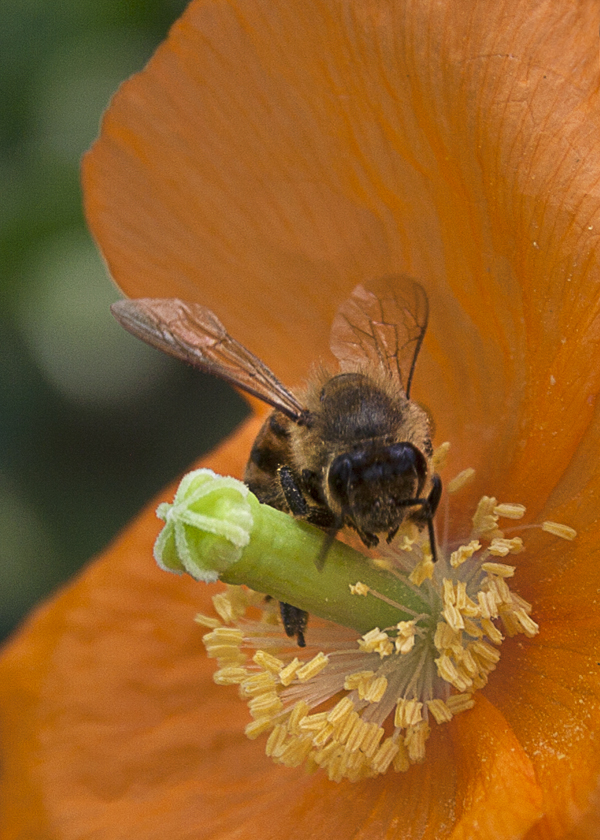
Do you ever get in the mood for a single color? This evening I am in an orange mood. (As a disclaimer I should mention that I drive an orange car, so orange plays a larger role in my daily life than it probably does for most others.) To scratch that itch, I decided to post some photos from late May of an orange poppy and some of the insects that visited it.

May was the month when I first started getting more serious about photography and these photos were an early indication to me that I was improving. I still enjoy looking at them, remembering some of the early twists and turns of the photography journey on which I have embarked.

As I think back, I feel like I was just learning to walk. Now I can walk with much greater confidence. I look forward to being able to run.

Visiting bee

Visiting hoverfly (flower fly)

Visiting ant

© Michael Q. Powell. All rights reserved.

Read Full Post »

This evening after work I returned to the site of yesterday’s adventures with the creature that I think is a bagworm caterpillar. Despite some heavy rain last night his sticks-and-silk abode was intact. I stood and waited, wondering if he would reappear.

After just a few minutes of waiting I watched as the bag started to shake and the caterpillar began to emerge from the bag. Unlike last night when he seemed a little coy, tonight he seemed to have shed all inhibitions (or was really hungry).

He rather quickly extended himself more than halfway out of the bag and began to chew on the lavender blossoms. That answered one of my questions from my last posting about whether lavender was a suitable host plant for a bag worm.

I managed to shoot him from a number of different angles to show some details of the caterpillar and the opening in the bag. I think that a couple of my shots captured the texture of the bag. My shooting time was really limited because after his brief snack the caterpillar returned to the comfortable confines of his sleeping bag.

I am sure that I will move on to other subjects eventually, but for the moment I remain utterly fascinated with my creature on the lavender plant. We are developing a relationship but I have not given him a pet name, at least not yet.

© Michael Q. Powell. All rights reserved.

Read Full Post »

This evening I spotted something unusual hanging from a lavender plant in my neighbor’s garden. I like to visit her garden when I come home from work in the evening because there are always flowers and insects to photograph, many of which she photographs and features in her blog.

The strange object looked a little like a misshapen pine cone and seemed to be covered in pine needles and little twigs. It was hanging from the lavender plant, swinging in the gentle breeze.

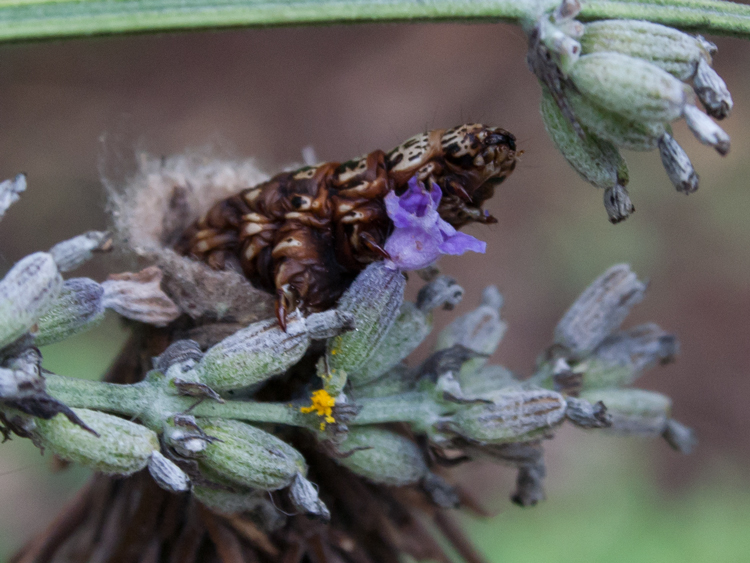
Suddenly in front of my eyes the “pine cone” thing began to shake a little, an opening appeared in the top, and a caterpillar (I think that’s what it is) began to emerge. Fortunately I had my camera in my hand because I had been taking some shots of bees.

The caterpillar emerged only partially and then returned to the homemade structure. The opening closed shut, leaving no evidence that there was a living creature inside.

My preliminary research suggests this is a kind of bagworm, although it seems a little unusual for it to make its home on a lavender plant. Wikipedia indicates that there are many species of bagworms, including one whose pupae are collected as a protein-rich food.

I don’t know if you noticed the claws on this caterpillar in the close-up photograph, but I may now have nightmares about giant clawed caterpillars (to go along with the soul-sucking robber flies of a few days ago).

Close-up of bagworm caterpillar emerging

Stepping back to see the whole “bag”

Caterpillar has gone back inside

© Michael Q. Powell. All rights reserved.

Read Full Post »

« Newer Posts