Feeds:
Posts
Comments

Posts Tagged ‘Yellow-rumped Warbler’

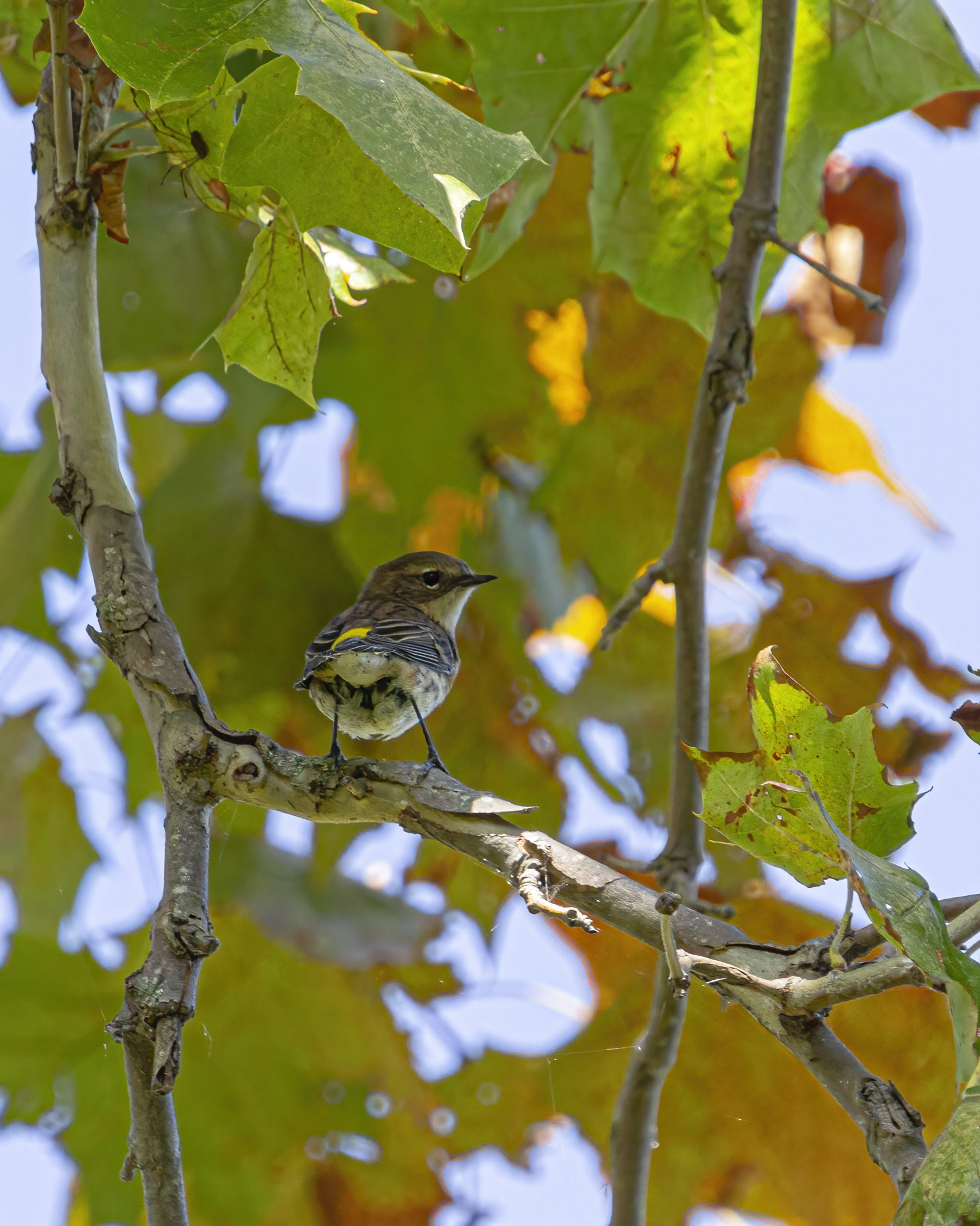
I had been lethargic and uninspired throughout December, but decided on Monday to visit Occoquan Bay National Wildlife Refuge to try to find some birds before the end of the year. As I walked along one of the trails, I spotted a small bird in the trees and tracked it as it moved about. I was not sure what it was, became a little excited when I thought I spotted a bit of yellow.

There are not many colorful birds in our area during the winter months, so I patiently kept tracking this bird. When I captured the first image below, I convinced myself that I would see traces of yellow in the breast of the bird. Eventually the bird turned and faced the opposite direction and I got a good look at the bright yellow patch on its rump—it was a Yellow-rumped Warbler (Setophaga coronata), one of very few warbler species that I might see during the winter months.

It was a nice treat for me at the end of the year. Happy New Years to you all and best wishes for a healthy and happy 2025.

Yellow-rumped Warbler

Yellow-rumped Warbler

© Michael Q. Powell. All rights reserved.


Read Full Post »

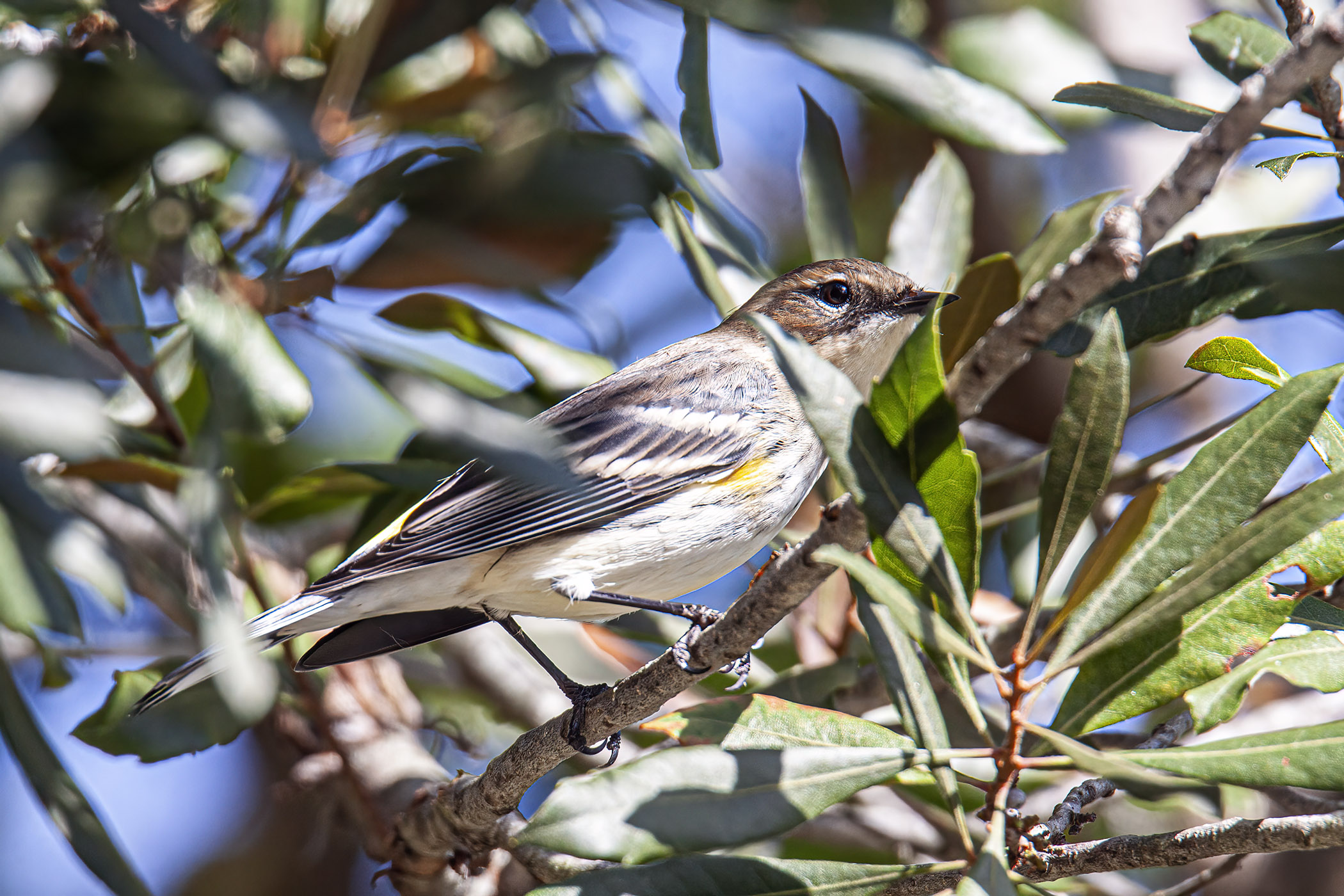
I don’t know if this Yellow-rumped Warbler (Setophaga coronata) that I spotted last week at Occoquan Bay National Wildlife Refuge was in a transitional plumage stage, but it looked awfully scraggly to me. The colors on the warbler’s face and body were mottled, but the yellow patches on its chest helped me to identify it as a Yellow-rumped Warbler.

I feel very fortunate when I am able to get any shots of a warbler. The trees are now covered in leaves and I can’t help but feel a bit of frustration when I can hear all kinds of birds singing, but can’t spot them. That’s the reality for a wildlife photographer—sometimes all I can do is watch, listen, and wait patiently, hoping that a subject will come into view.

Yellow-rumped Warbler

Yellow-rumped Warbler

© Michael Q. Powell. All rights reserved.

Read Full Post »

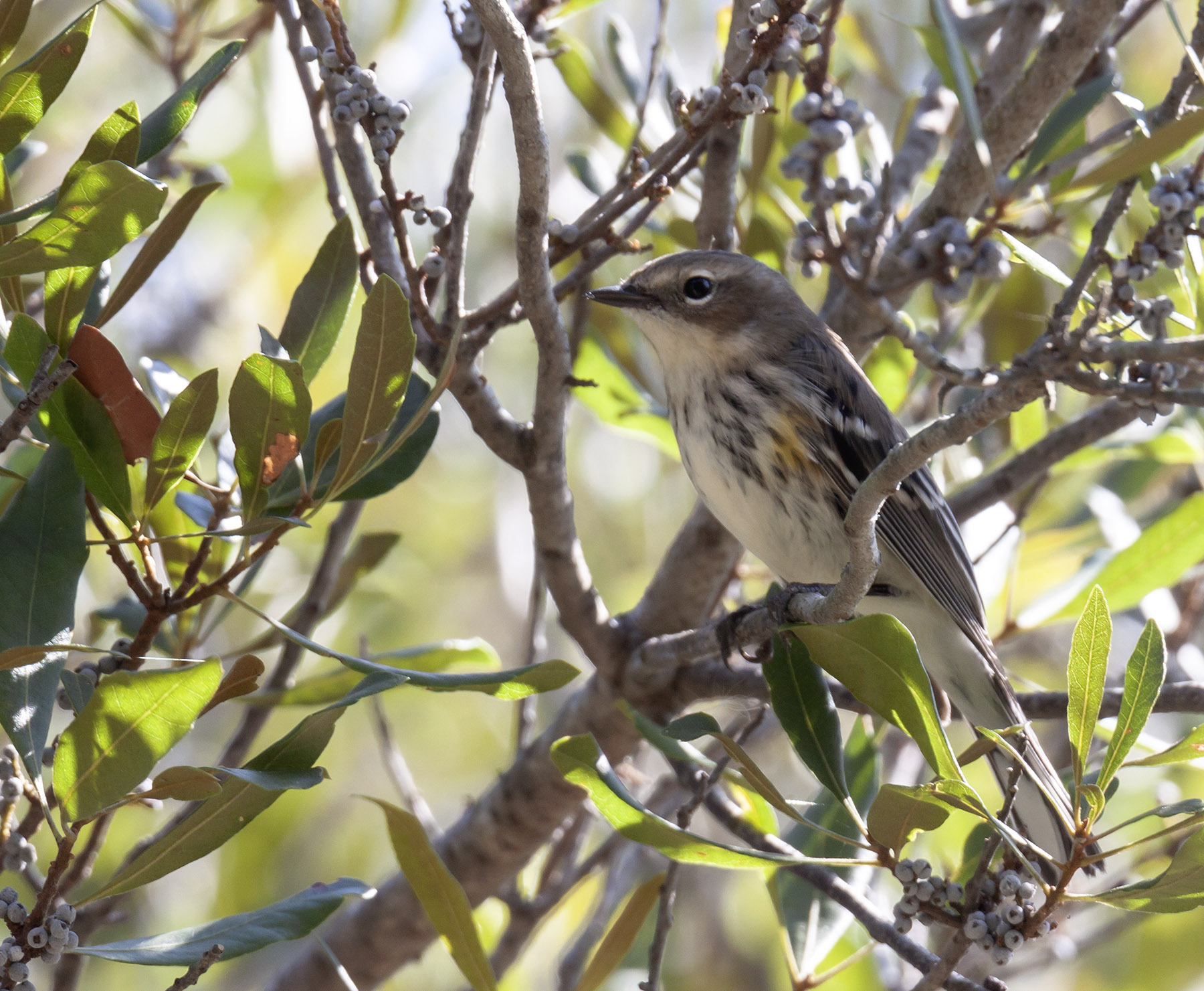
Some photographers are always searching for new and exotic species to add to their “life lists,” but I am generally content to photograph familiar species, primarily in my local area. No matter how many times I see these birds, each encounter is unique, and I never know when a photo may highlight one of these birds in a special way. Here is a selection of photos of birds that I spotted on Monday at Occoquan Bay National Wildlife Refuge.

The bright red color of male Northern Cardinals (Cardinalis cardinalis) makes it almost impossible for them to hide completely, but a lot of the time they forage in the dense undergrowth, making it tough to get a clear shot of one. In the first image, the cardinal was partially hidden by the branches, but I managed to focus on its face. If you look closely, you will notice that this cardinal is a bit of a messy eater—he has lots of seed residue on his bright orange bill.

Yellow-rumped Warblers (Setophaga coronata) are one of the only warblers that stay with us during the winter. They tend to stay high in the trees, which means that most of my photos show the underside of the birds’ faces in bodies. In the second photo, the warbler looked down at me and I was able to capture the little patch of yellow on the top of its head, a feature that I do not recall seeing before.

The final photo features a Cedar Waxwing (Bombycilla cedrorum), one of the coolest looking birds that I encounter on a fairly regular basis. I love its rakish black mask and its yellow-tipped tail. I was happy to be able to capture the beautiful wash of yellow on its breast in this shot. Of course, the colorful foliage in the background adds an additional touch of visual interest to this photo.

Northern Cardinal

Yellow-rumped Warbler

Cedar Waxwing

© Michael Q. Powell. All rights reserved.

Read Full Post »

I wouldn’t recommend adding poison ivy berries to your diet, but this Yellow-rumped Warbler (Setophaga coronata) seemed to be really enjoying them last Thursday at Occoquan Bay National Wildlife Refuge. Amazingly, poison ivy is a great source of nutrition to a variety of wildlife species. According to the Georgia Department of Natural Resources, a wide variety of “birds are especially fond of poison ivy berries. The plant’s waxy, white berries are loaded with vitamins and other nutrients. If that isn’t enough, they are available to south-bound migrants in mid-summer as well in winter when food is at a premium.”

It is incredible to me that such tiny birds can survive during the winter and finding nutrition like these little white poison ivy berries is one of the keys to their survival. Yellow-rumped Warblers eat mainly insects in the summer, according to the Cornell Lab of Ornithology, but during the winter they switch to a diet of mostly seeds and berries. Can you imagine being a carnivore for six months of the year and a vegan for the other six months?

Yellow-rumped Warbler


Yellow-rumped Warbler

Yellow-rumped Warbler

© Michael Q. Powell. All rights reserved.

Read Full Post »

Most warblers pass briefly through my area when they are migrating in the spring and in the fall, but Yellow-rumped Warblers (Setophaga coronata) stay with us for a good part of the colder season. This past Thursday I spotted quite a large number of Yellow-rumped Warblers as I wandered the trails at Occoquan Bay National Wildlife Refuge.

In the first photo, you can see a portion of the yellow patch that is responsible for the name of this species. Most of the time I see only the smaller yellow patches on their sides, because they tend to perch high above me and I am often shooting at an upwards angle.

I am amazed by the light weight of Yellow-rumped Warblers and their ability to perch on incredibly slender branches, as you can see in the second image. According to the Cornell Lab of Ornithology, these little birds weigh only 0.4-0.5 ounces (12-13 g).

In the final photo, the warbler is poised to move on to its next perch. Yellow-rumped Warblers are not quite as hyperactive as some other species that I see at this time of the year, like Ruby-crowned and Golden-crowned Kinglets, but they move around a lot as they forage for food.

Yellow-rumped Warbler

Yellow-rumped Warbler

Yellow-rumped Warbler

© Michael Q. Powell. All rights reserved.

Read Full Post »

Each fall I face the same dilemma—I see the photos of other photographers indicating that migrating warblers are present in our area, but I have trouble spotting these elusive little birds. Part of the problem is that leaves are still mostly on the trees and I can often hear birds that remain invisible in the foliage. The other main problem is that many birds are now sporting their duller fall plumage, so they do not stand out as much as during the spring migration, when their  breeding plumage is much brighter.

Given my normal experience, I was thrilled to spot several Palm Warblers (Setophaga palmarum) and Yellow-rumped Warblers (Setophaga coronata) during visits to Occoquan Bay National Wildlife Refuge earlier this week. The birds in the first two photos, I believe, are Palm Warblers, a relatively common warbler species that likes to poke around a lot on the ground.

The final two photos show Yellow-rumped Warblers, which are the most common warbler species in my area. In both of the photos you can see the yellow patch of feathers on the “rump” of the bird.

In a month or so I may switch over to my longest lens, a Tamron 150-600mm zoom lens, which will allow me to zoom in a little more on these tiny birds, but for now I am sticking with my Tamron 18-400mm lens, a more versatile lens that lets me get photos of butterflies and dragonflies as well as of birds. (The problem with the longer lens is that it has a minimum focusing distance of almost 9 feet (2.7 meters) and it is sometimes hard to focus on small subjects from that far away.)


Palm Warbler

Palm Warbler

Yellow-rumped Warbler

Yellow-rumped Warbler

© Michael Q. Powell. All rights reserved.

Read Full Post »

Bright colors are starting to emerge in the landscape as we move deeper into spring, a welcome sight after the long gray days of winter. I was delighted to see some equally bright colors in the feathers of several small birds that I photographed last Saturday in the vegetation surrounding a small suburban pond in Northern Virginia.

The first bird appears to be a female Yellow-rumped Warbler (Setophaga coronata). Normally I am not a big fan of a head-on shot of a bird, but in this case I really like the way that the photo shows both of the bird’s yellow patches on its breast (there is also a yellow patch on the warbler’s rump).

The bird in the second photo is a male House Finch (Haemorhous mexicanus). I was struck by the intensity of the red on the finch’s upper body, which reminded me of the color of a male cardinal.

In the coming months, warblers will be migrating northward through my area. Each year it is a real challenge for me to get shots of these colorful little birds, because they appear just as the trees begin to cover themselves with leaves—I often can hear warblers behind the leafy foliage without being able to see them.

yellow-rumped warbler

house finch

© Michael Q. Powell. All rights reserved.

Read Full Post »

I love to take photographs of large powerful raptors, like the Bald Eagle and the Red-tailed Hawk that I featured recently in blog postings. However, I am equally happy to capture images of the small birds that I often hear, but have trouble spotting. This past Monday I spotted these little birds as I wandered about at Occoquan Bay National Wildlife Refuge. None of the shots are particularly spectacular, but I find that there is incredible beauty in the details of these little birds.
I can’t help but be reminded of some of the words of a hymn that we occasionally sing at church called “All Things Bright and Beautiful” that was written by Cecil Frances Alexander.
“All things bright and beautiful,
All creatures great and small,
All things wise and wonderful:
The Lord God made them all.
Each little flower that opens,
Each little bird that sings,
He made their glowing colors,
He made their tiny wings.”
You may be familiar with some of these birds, but in case you need a reminder, they are an Eastern Bluebird (Sialia sialis); a Golden-crowned Kinglet (Regulus satrapa); a Yellow-rumped Warbler (Setophaga coronata); and a Carolina Chickadee (Poecile carolinensis).
Eastern Bluebird
Golden-crowned Kinglet
Yellow-rumped Warbler
Carolina Chickadee
© Michael Q. Powell. All rights reserved.

Read Full Post »

I have been pretty lucky recently in capturing images of birds in settings that include colorful fall foliage. On Tuesday I photographed a Yellow-rumped Warbler (Steophaga coronata) perched in a tree in full of persimmons at Occoquan Bay National Wildlife Refuge. I am not sure if the warbler was interested in the persimmons or if it was more interested in the poison ivy berries that you can see in the upper left portion of the image.

I do not know much about persimmons and can’t tell if the ones in the photo are ripe. I have been told that persimmons can be very tasty when ripe, but are very bitter when not yet ripe. To the best of my recollection I have never tasted one, but I know that the raccoons in another local park love to feed on these fruits.

Yellow-rumped Warbler

© Michael Q. Powell. All rights reserved.

Read Full Post »

Last Friday at Occoquan Bay National Wildlife Refuge I captured this fun little image of a Yellow-rumped Warbler (Setophaga coronata) in mid-air as it hopped to a new position on a tree with colorful fall foliage. I am pretty sure that the warbler was stationary when I clicked off a short burst of shots and luck played a big role in me being able to capture this moment. Yellow-rumped Warbler

© Michael Q. Powell. All rights reserved.

Read Full Post »

I almost never get an unobstructed view of a warbler. Most of the time I see them flitting about in the foliage, making it difficult to get a clear shot of one. If I am lucky, I manage to capture an image, like the final one, when the warbler pokes its head out of the brush for a moment.

Last Wednesday at Occoquan Bay National Wildlife Refuge, I was shocked and delighted when I was able to take a series of unobstructed shots of a Yellow-rumped Warbler (Setophaga coronata) as it was feeding on some poison ivy berries. The first three images shows some moments from that encounter.

As I look at these four images, I am strangely drawn most to the final one. Despite the clutter of the branches in that shot, the warbler stand out—the branches serve as a kind of frame for the central subject. Now I really do like the way that the first two images capture the action of the bird and the way the third shot provides the best view of the perching warbler, but someone the environmental shot appeals to me most this morning as I am composing this posting. What do you think?

Yellow-rumped Warbler

Yellow-rumped Warbler

Yellow-rumped Warbler

Yellow-rumped Warbler

© Michael Q. Powell. All rights reserved.

Read Full Post »

Warblers have tiny feet, though I usually can’t see them in my photos, because they are perched high in the trees. On Monday I was fortunate to capture a series of images of a Yellow-rumped Warbler (Setophaga coronata) at Occoquan Bay National Wildlife Refuge that was perched relatively low in the vegetation and you can actually see its feet.

The warbler was in almost constant motion and gave me a whole variety of poses in a very short period of time. Here are some of my favorites from my mini portrait session with this beautiful little Yellow-rumped Warbler.

Yellow-rumped Warbler

Yellow-rumped Warbler

Yellow-rumped Warbler

Yellow-rumped Warbler

© Michael Q. Powell. All rights reserved.


Read Full Post »

Warblers in the fall tend to be pretty drab, compared to those that pass through in the spring in their bright breeding plumage. However, the colorful fall foliage more than makes up for the birds’ lack of color when I am lucky enough to get clear shots of these little beauties.

On Monday I spotted quite a few Yellow-rumped Warblers (Setophaga coronata) at Occoquan Bay National Wildlife Refuge . Unlike most other warblers that are in our area for only a short period of time as they migrate, Yellow-rumped Warblers overwinter with us, according to a conversation I had in the past with a birder. I have photographed them, for example, in mid-January.

These three images show different types of autumn color. The first photo is full of bright pops of cheerful colors. The second one isolates a single color of the foliage and features a warbler feeding on what I believe are poison ivy berries. The final photo provides a more somber take on the autumn colors, evoking in me a wistful sense of the passing of the summer season.

I was quite happy with these shots of the warblers, especially considering my relative lack of success in the past, when I have often heard warblers singing, but have rarely been able to capture images of them.

Yellow-rumped Warbler

Yellow-rumped Warbler

Yellow-rumped Warbler

© Michael Q. Powell. All rights reserved.


Read Full Post »

Desperate times call for desperate measures. I am sure that this Yellow-rumped Warbler (Setophaga coronata) would have preferred to find the juicy insects on which it gorges during warmer weather, but they are off the menu for the season. Instead, like many other birds, this warbler has to settle for whatever berries it can find during the winter.

In this case, even the poison ivy berries seemed to be picked over, with only a few wizen berries remaining. The warbler had to work had to snag those berries, using all of its acrobatic prowess. Momentarily satisfied it moved on, hoping perhaps that the pickings would not be so slim at its next stop.

I am always shocked to see any warblers in the winter. Most warblers pass through our area during the spring and the autumn, but Yellow-rumped Warblers hang around for most of the winter. According to the Cornell Lab of Ornithology website:

“Yellow-rumped Warblers are perhaps the most versatile foragers of all warblers. They’re the warbler you’re most likely to see fluttering out from a tree to catch a flying insect, and they’re also quick to switch over to eating berries in fall. Other places Yellow-rumped Warblers have been spotted foraging include picking at insects on washed-up seaweed at the beach, skimming insects from the surface of rivers and the ocean, picking them out of spiderwebs, and grabbing them off piles of manure.”

In addition to its versatility in foraging, the Yellow-rumped Warbler has an amazingly robust digestive system. “The Yellow-rumped Warbler is the only warbler able to digest the waxes found in bayberries and wax myrtles. Its ability to use these fruits allows it to winter farther north than other warblers, sometimes as far north as Newfoundland.”

We may complain about poison ivy when we encounter it during the summer, but its berries serve as an important food source for birds like this Yellow-rumped Warbler that help them to survive the winter. Are you willing to put up with some minor inconvenience for the sake of these beautiful little creatures with whom we share this planet?

Yellow-rumped Warbler

Yellow-rumped Warblers

© Michael Q. Powell. All rights reserved.

Read Full Post »
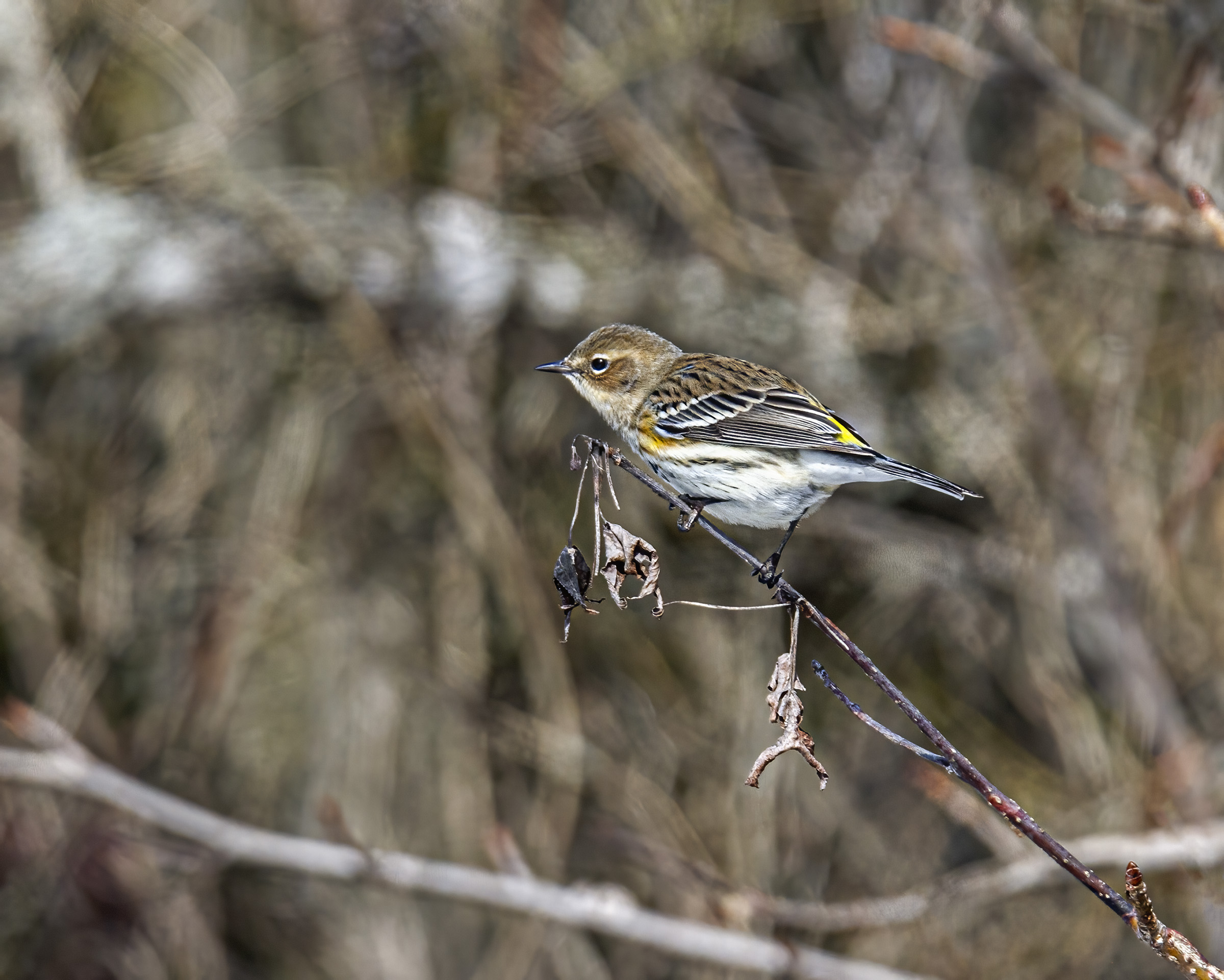
Has anyone ever told you that you eat like a bird? This somewhat weird expression is based on the mistaken notion that birds don’t eat very much—many birds have high metabolisms and actually eat at lot, relative to their size.

Some birds also consume things that are hazardous to humans. This week at Occoquan Bay National Wildlife Refuge I have spotted multiple Yellow-rumped Warblers (Setophaga coronata) feasting on the abundant poison ivy berries. Poison ivy berries serve as an important food source for a variety of overwintering birds, including these warbler. One of the consequences of the consumption of all of these berries is that the seeds pass through the birds and are spread everywhere, guaranteeing future supplies of the poison ivy berries.

No matter how nutritious or tasty they are for the birds, there is no way that I am voluntarily going near poison ivy or tasting the berries. The berries may not kill me, but I am pretty sure they would make me really sick.

Yellow-rumped Warbler

Yellow-rumped Warbler

Yellow-rumped Warbler

© Michael Q. Powell. All rights reserved.


Read Full Post »
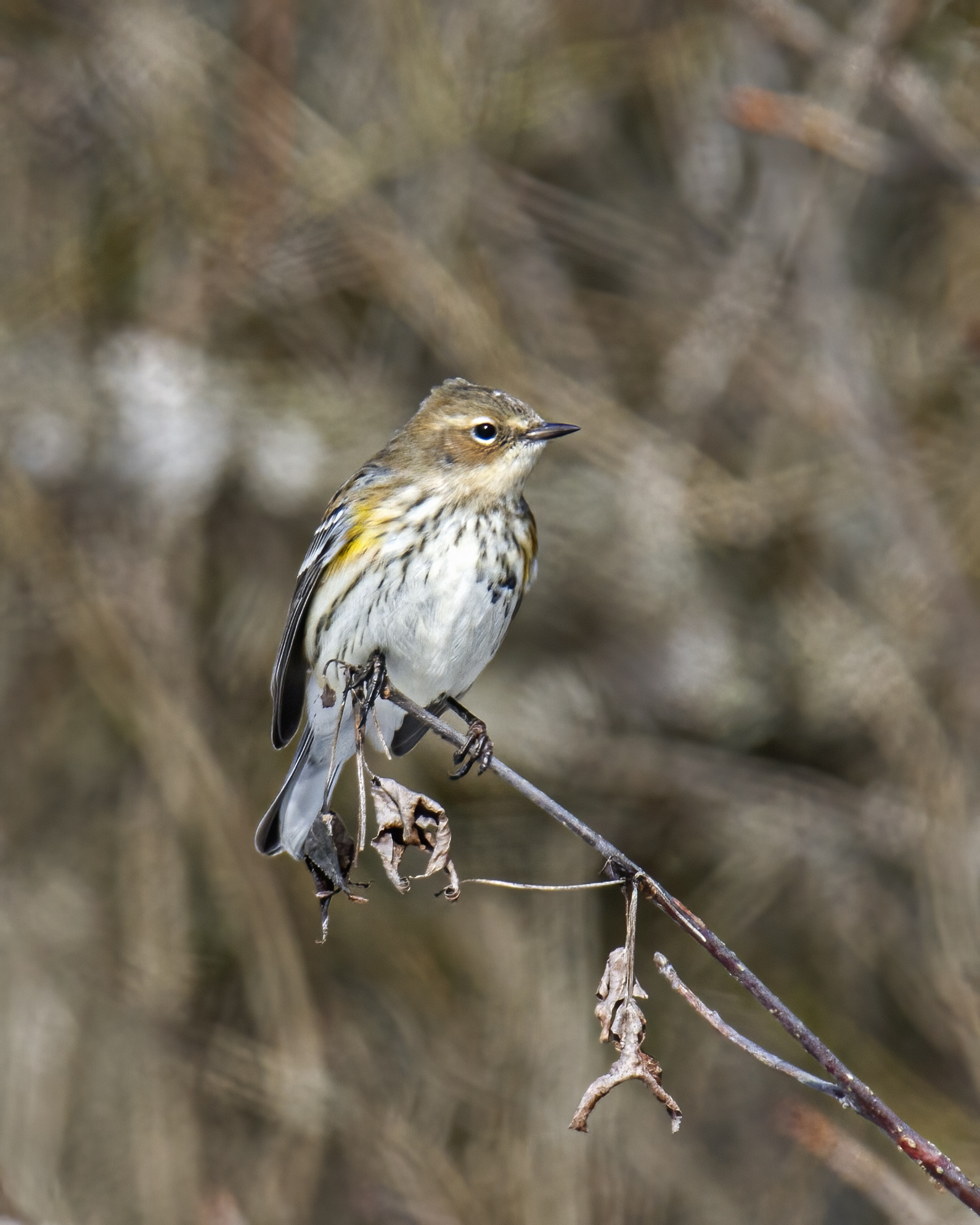
Most of the warblers that I encounter in the autumn are Yellow-rumped Warblers (Setophaga coronata). They always seem to be in motion, whether foraging in the trees or on the grass. During this time of the year, Yellow-rumped Warblers are a fairly nondescript mixture of gray and brown, highlighted by streaks of yellow under the upper portions of the wings. I captured these images during the last week or so during repeated visits to Occoquan Bay National Wildlife Refuge.

On rare occasions, as in the second photo below, I will get a glimpse of the patch of bright yellow on the “rump” that is responsible for this species’ common name. It also gives rise to a fairly common nickname among birders, who affectionately refer to Yellow-rumped Warblers as “butterbutts.” Unlike other warblers that merely pass through our area, Yellow-rumped Warblers tend to hang around for longer and I will sometimes see them during the early days of winter.

Yellow-rumped Warbler

Yellow-rumped Warbler

Yellow-rumped Warbler

© Michael Q. Powell. All rights reserved.

Read Full Post »
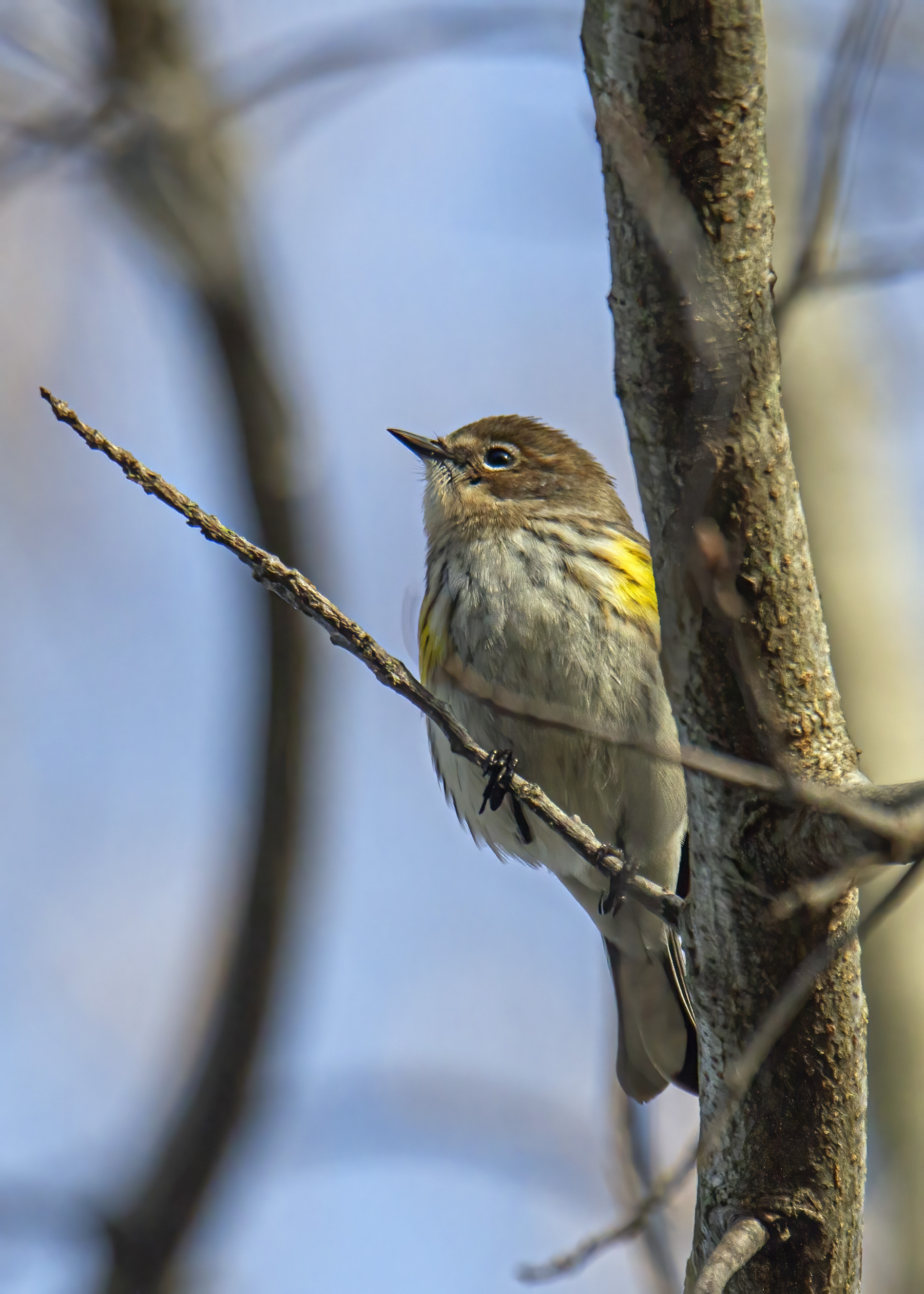
It was so cool last week to spot a few warblers at Occoquan Bay National Wildlife Refuge. Every spring and fall a variety of warblers migrate through our area. Quite often I can hear them twittering and tweeting in the trees, but it is rare for me to see one clearly. Usually I will see only a momentary flash of yellow that is quickly swallowed up in the sea of green foliage.

The bird in the first photo is a a Palm Warbler (Setophaga palmarum). Most of the time I see Palm Warblers foraging on the ground, but this one accommodated me by hopping up onto a tree and giving me an unobstructed shot.  The Yellow-rumped Warbler (Setophaga coronata) in the second shot was not quite so cooperative. It was buried in the vegetation and never fully revealed itself.

The migration season for warblers will be drawing down soon. I have only modest shots like these to show for it, but I am not disappointed—some years I have not been able to get any shots at all. In the fall, the colors of the warblers tends to be more muted than in the spring, when the males are sporting their breeding plumage. Somehow the muted tones of the birds matches the mood of the season, as colors fade and we gradually move towards the monochromatic days of the winter.

Palm Warbler

Yellow-rumped Warbler

© Michael Q. Powell. All rights reserved.

Read Full Post »

This Yellow-rumped Warbler (Setophaga coronata) seemed to be celebrating the fact that it had snagged one of the few remaining poison ivy berries when I spotted him in mid-November at Occoquan Bay National Wildlife Refuge. I decided not to crop this image too closely because I like the way that the autumn leaves and the gumtree seedpods provide a real sense of the environment in which I found this beautiful little bird.

Yellow-rumped Warbler

© Michael Q. Powell. All rights reserved.

Read Full Post »

The remaining leaves on the trees and other vegetation complicate my efforts to get clear shots of the numerous Yellow-rumped Warblers (Setophaga coronata) that I have seen and heard during my recent trips to Occoquan Bay National Wildlife Refuge. On Monday, however, I manage to capture two images of these colorful little birds, the only warblers that stay with us throughout the winter.

It is always a delight to catch sight of the colorful patches of yellow feathers on these birds. The second image shows the yellow rump that is responsible for the name of this species that is affectionately known to birdwatchers as “butterbutts.”

Yellow-rumped Warbler

Yellow-rumped Warbler

© Michael Q. Powell. All rights reserved.

Read Full Post »

On Monday at Occoquan Bay National Wildlife Refuge I spotted Yellow-rumped Warblers (Setophaga coronata) multiple times.  However, there is a huge difference between getting a glimpse and getting a shot of one of these hyperactive little birds, particularly when many of the trees still have their leaves.

I captured the first image when one of the warblers was feasting on clusters of poison ivy berries. I definitely was not complaining when he did not offer to share his “treats.” I was surprised to learn several years ago that these berries are a primary food source for a number of small birds during the winter months.

In the second image, I believe the warbler was getting ready to move to a new perch or may have just arrived at this one. In either case, I think it looks pretty cool to see the one wing partially extended.

The composition of the final photo is the simplest—it is just a shot of the perched warbler. However, I really like the way that some of the foliage shows through in the blurry background. You may have noted that the backgrounds are light-colored. On the day when I took these shots, the skies were completely overcast and appeared to be a solid white.


Yellow-rumped Warbler

Yellow-rumped Warbler

Yellow-rumped Warbler

© Michael Q. Powell. All rights reserved.

Read Full Post »

It is warbler season now where I live. This can be a frustrating time of the year for me, because the arrival of these colorful migrating birds coincides with the re-leafing of the trees. I can hear the warblers and occasionally get a glimpse of their bright colors through the leaves, but it is rare for me to get a clear shot of one.

Yesterday, I was thrilled to capture this image of a Yellow-rumped Warbler (Setophaga coronata) at Occoquan Bay National Wildlife Refuge. I started to track this bird as it was moving about in the foliage and was fortunate to be ready when it paused for a split second in the open. I did not plan this particular composition, but it worked out really nicely with the shapes of the branches on the right side of the image and the mostly out of focus leaves on the left.

This image speaks of spring to me. Happy Spring to those in the Northern Hemisphere and hopefully those experiencing autumn in the Southern Hemisphere will also enjoy the bright springtime colors.


Yellow-rumped Warbler

© Michael Q. Powell. All rights reserved.

Read Full Post »

Yellow-rumped Warblers (Setophaga coronata) have returned in force to Occoquan Bay National Wildlife Refuge. There are still lots of leaves on the trees, though, so it is a real challenge to get unobstructed shots of them. I catch sight of them moving in and out of the foliage, but only rarely do they pop out into the open. So I patiently watch and wait.

Here are pretty clear views of Yellow-rumped Warblers that I eventually managed to capture on Wednesday. Most warblers are in our area only briefly as they make their way north in the spring and south in the autumn. Yellow-rumped Warblers, however, remain with us for much of the winter, so I may have more chances to see them better as the trees gradually give up their leaves.

Yellow-rumped Warbler

Yellow-rumped Warbler

Yellow-rumped Warbler

© Michael Q. Powell. All rights reserved.

Read Full Post »

The colorful fall foliage has mostly disappeared and the natural world seems increasingly drab. At this time of the year, even tiny touches of bright colors are welcome, like the patches of yellow feathers on this Yellow-rumped Warbler (Setophaga coronata) that I spotted recently at Occoquan Bay National Wildlife Refuge.

On many of the Yellow-rumped Warblers that I see, the yellow markings seem pale and faded. I was really struck, though, by the intensity and saturation of the yellow on this particular bird. Yellow is one of those colors that never fails to lift my spirits, even when delivered in tiny doses.

Yellow-rumped Warblers

© Michael Q. Powell. All rights reserved.

Read Full Post »

When I spotted a small bird hanging from a branch, I zoomed in with my telephoto lens and discovered that it was a Yellow-rumped Warbler (Setophaga coronata). I could also see that there were numerous clusters of poison ivy berries on the branch, so I waited to see if I could capture an image of the warbler grabbing a berry.

The warbler turned its head away from me when it pulled the berry from the cluster, but fortunately turned back in my direction with the berry still visible in its mouth. I was really happy to get the shot and the warbler seemed to be berry contented.

Yellow-rumped Warbler

yellow-rumped warbler

© Michael Q. Powell. All rights reserved.

Read Full Post »

Leaves are now falling from the trees, making my walks though the woods increasingly crunchy. I feel like I am announcing my presence to all of the birds as I approach them. This little Yellow-rumped Warbler (Setophaga coronata) lifted its head for a moment to check me out, then returned to its foraging among the fallen leaves, probably having decided that I did not represent a threat.

Yellow-rumped Warbler

© Michael Q. Powell. All rights reserved.

Read Full Post »

It’s sometimes said that the camera adds pounds to a subject, so maybe these Yellow-rumped Warblers (Setophaga coronata) that I saw last week at Occoquan Bay National Wildlife Refuge are not quite as chubby as they appear at first glance.

I was trying to be funny, but it actually is true that the focal length of a lens can affect the features of a subject. Most of you have probably seen how a fish-eye lens can make a face look bloated in the middle and stretched out on the edges. Other lenses can produce less dramatic effects. Generally it is believed that you get the most flattering portrait of a human subject with a lens of 85mm to 135mm. Here’s a link to an interesting article at businessinsider.com that shows a series of images of a face that were shot with lenses from 20mm to 200mm.

In this case, I think the birds are taking advantage of the abundant food sources while they are still around. Some of these warblers may be continuing their journeys southward, but others may choose to spend part of the winter with us.

Yellow-rumped Warbler

Yellow-rumped warbler

Yellow-rumped Warbler

© Michael Q. Powell. All rights reserved.

Read Full Post »

Are you a risk-taker? How often do you go out on a limb?

If you were a Yellow-rumped Warbler (Setophaga coronata) you literally would be doing it all of the time. I love the texture, color, and shape of the branch so much that this image is as much about the branch as it is about the bird—that is the primary reason why I did not crop the image any closer.

Yellow-rumped Warbler

© Michael Q. Powell. All rights reserved.

Read Full Post »

Sometimes it is better to be lucky and to react quickly than it is to be skillful and systematic. As I was tracking a Yellow-rumped Warbler (Setophaga coronata) recently at Occoquan Bay Wildlife Refuge, it suddenly took off.

In and of itself, this was not unusual, because these small birds are in almost constant motion, weaving their way in and out of the vegetation. Instinctively I snapped off a short burst of shots. I thought I had missed the shot and the empty frames at the end of the sequence indeed showed that I was a bit late in reacting.

However, one of the initial shots was this fun image that shows the warbler raising its wings to prepare to provide propulsion while its feet are still attached to the branch. I was shooting in aperture-preferred mode, which meant that the camera chose the shutter speed. There was enough light that the shutter speed of 1/1600 froze most, but not all, of the bird’s motion.

Wouldn’t it be cool to be able to take off into the air like this little warbler, free to fly off to new destinations in search of new adventures?

Yellow-rumped Warbler

© Michael Q. Powell. All rights reserved.

Read Full Post »

Yellow-rumped Warblers (Setophaga coronata) eat mostly insects in the summer, but when the weather gets colder they switch to seeds and berries. This past week at Occoquan Bay National Wildlife Refuge I captured a number of shots of Yellow-rumped Warblers as they munched on what I think are poison ivy berries.

In the past, I have seen birds eating these berries only during the coldest days of the winter, leading me to think they were the only available food source. Who knows, maybe poison ivy berries are a real delicacy—though I am not will to try them to see if that is true.


Yellow-rumped Warbler

Yellow-rumped Warbler

Yellow-rumped Warbler

© Michael Q. Powell. All rights reserved.

Read Full Post »

At this time of the year Yellow-rumped Warblers (Setophaga coronata) are probably the most numerous warblers in our area. You can often seem them in constant motion flitting about high in the trees. They rarely stay still for more than a moment and it is unusual to get a clear view of the entire body of one.

I have spent a lot of time this week patiently tracking these little birds at several locations at Occoquan Bay National Wildlife  Refuge and managed to get a few shots that I really like. The first image shows a Yellow-rumped Warbler perched at ground level on the trunk of a tree that had fallen across the road and had been cut up and moved to the side. I particularly like that it shows the tiny feet of this bird that is about 5 inches in length (13 cm). The little yellow streaks just under the wings help to identify this as a Yellow-rumped Warbler.

The second image, possibly my favorite, shows the yellow patch on the bird’s rump that is responsible for its name. The intense focus of the warbler as it looks upward help to give this image a dynamic element that is absent in many images of perched birds.

The final image has a studio-like feel to it, because the sky was completely overcast and turned white as I was processing the image. I had tracked the bird when it entered into the vegetation and managed to get this shot when it finally popped up at the top of the tree and stretched its neck to look around.

Yellow-rumped Warbler

Yellow-rumped Warbler

Yellow-rumped Warbler

© Michael Q. Powell. All rights reserved.

Read Full Post »

“You look like an angel…” I am not sure what was so special about that particular spot on that specific tree, but this Yellow-rumped Warbler (Setophaga coronata) used all of its aerial and acrobatic skills to peck away at it on Monday at Occoquan Bay National Wildlife Refuge. From what I could tell, the warbler held on to the branch with its feet and used its outspread wings for balance. In the second image, it looks like the warbler was using a pendulum-like motion to generate momentum.

The bird’s body positions remind me of artistic portrays of angelic beings that I have a seen in multiple museums and books and I felt blessed to have had the chance to see this relatively common bird in an unusual way.

Yellow-rumped Warbler

Yellow-rumped Warbler

© Michael Q. Powell. All rights reserved.


Read Full Post »

Older Posts »