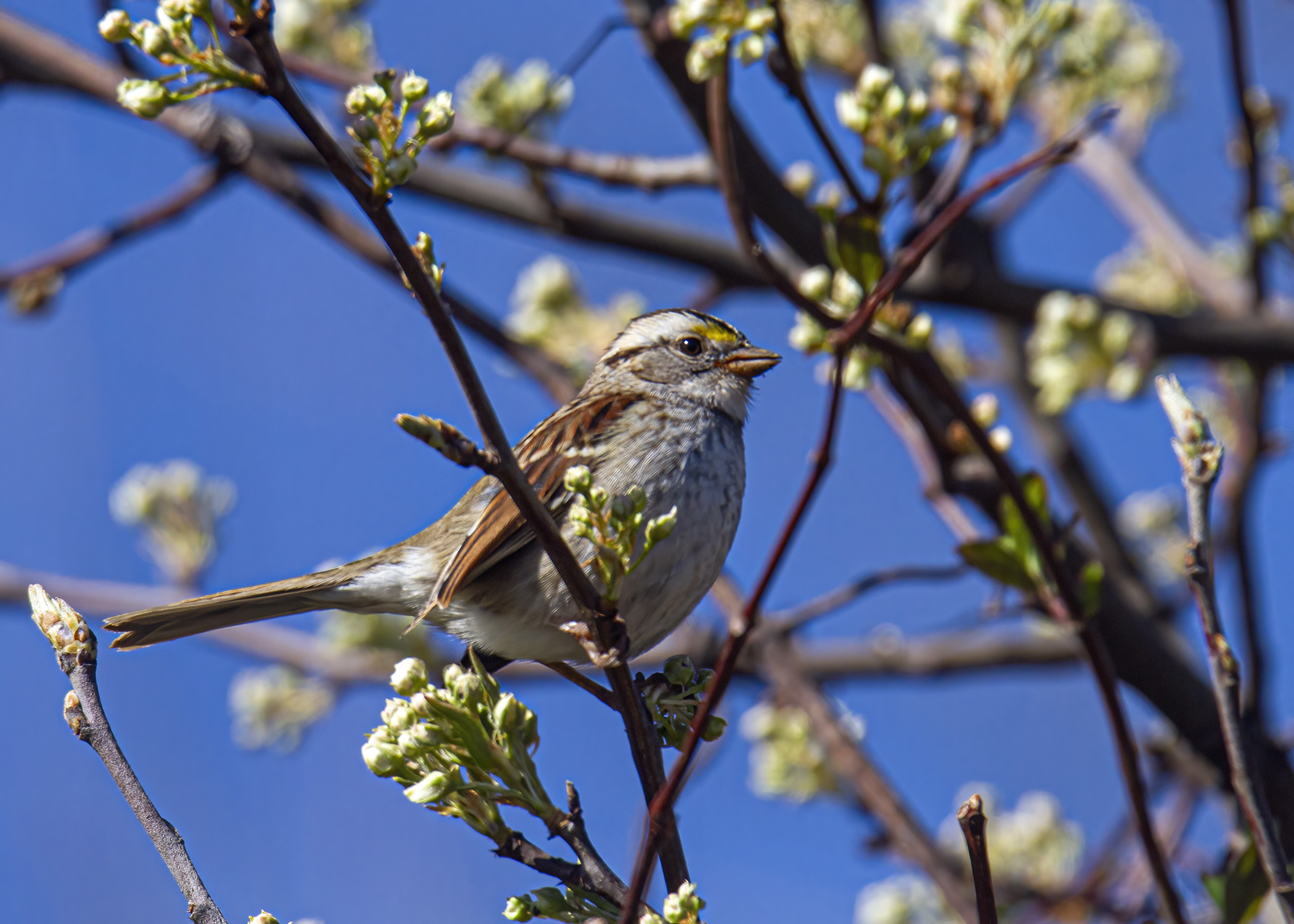
© Michael Q. Powell. All rights reserved.
Posted in Birds, Nature, Photography, spring, wildlife, tagged Canon 7D, Occoquan Bay National Wildlife Refuge, Tamron 150-600mm, white-throated sparrow, Woodbridge VA, Zonotrichia albicollis on March 29, 2026| 2 Comments »
Posted in Birds, Nature, Photography, wildlife, Winter, tagged Canon 7D, Occoquan Bay National Wildlife Refuge, sparrow, Tamron 150-600mm, white-throated sparrow, Woodbridge VA, Zonotrichia albicollis on February 19, 2026| 2 Comments »
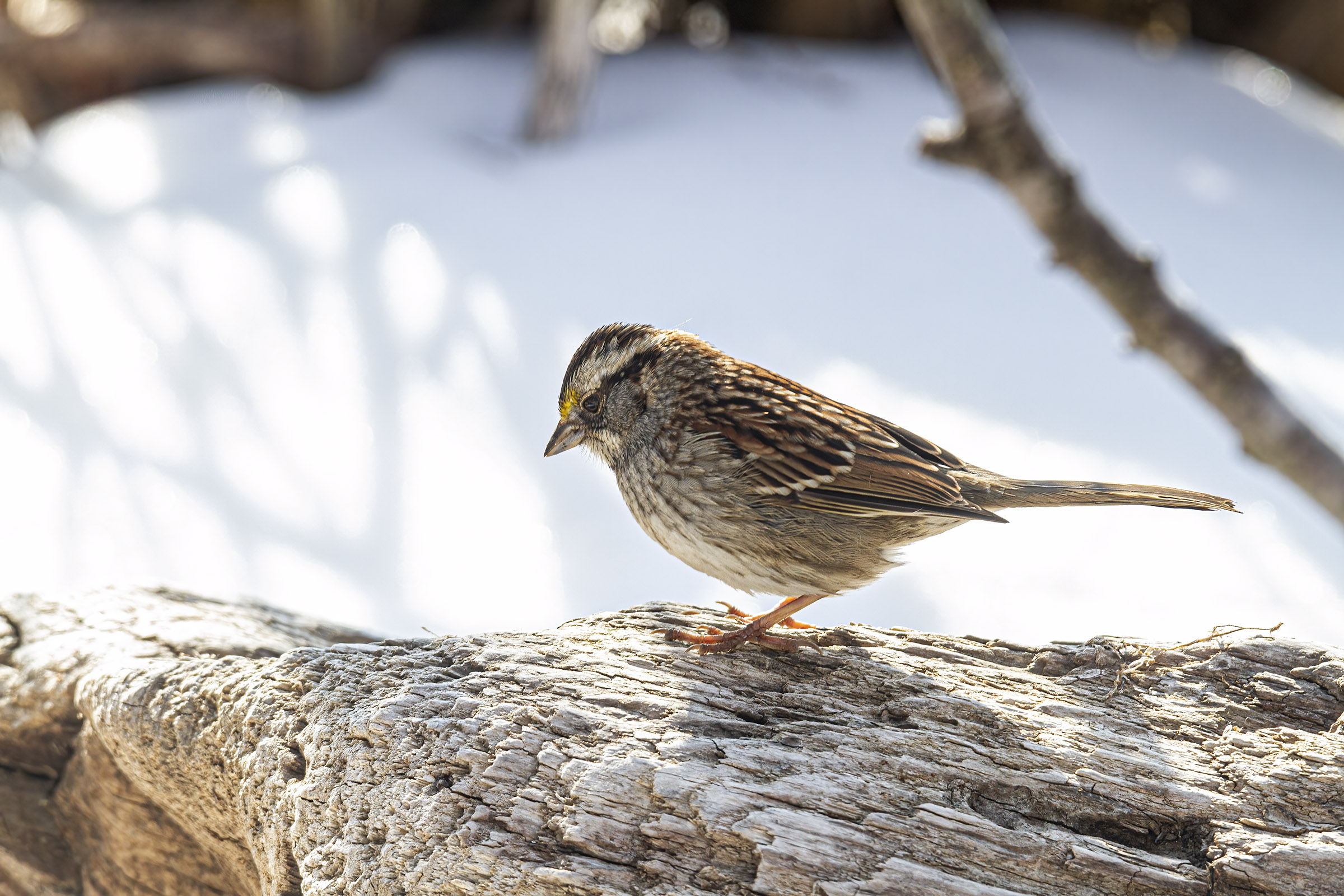
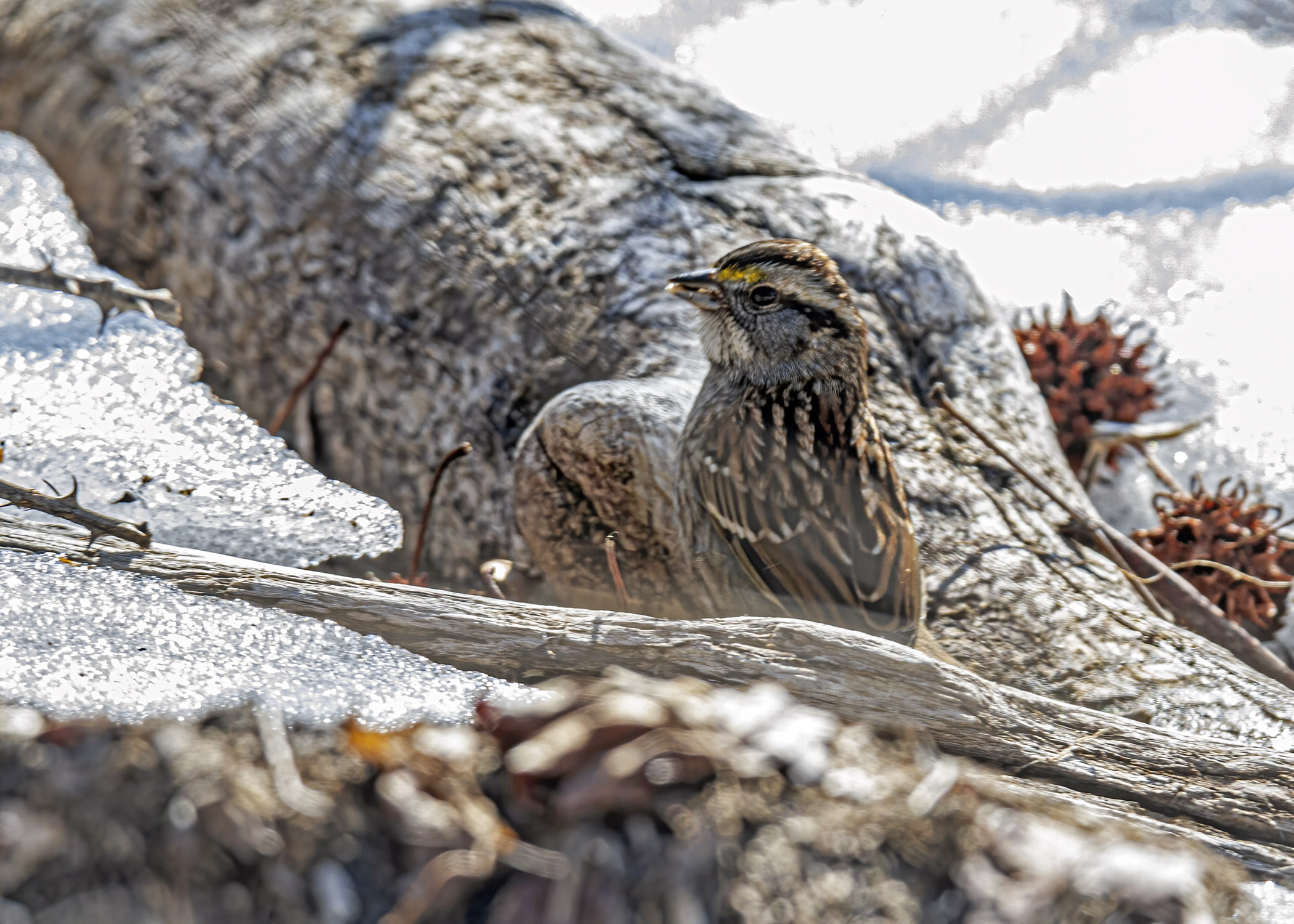
When birds are perched in the trees during the winter, you often do not have a sense of their environment when you look at photos of them. Some sparrow species, however, like to poke about on the ground and when I manage to capture some shots of them, you get much better sense of the harshness of their environment, as was the case with this White-throated Sparrow (Zonotrichia albicollis) last week at Occoquan Bay National Wildlife Refuge.
White-throated Sparrow overwinter with us, but disappear during the warmer months when they fly north to breed. One of my favorite identification features for this species is the bright yellow stripe in their lores (the area between their eyes and their bills). This particular sparrow was feverishly poking about in the snow as if foraged for food and I was particularly pleased when it hopped up onto a log and gave me a chance to capture an unobstructed shot of it.
© Michael Q. Powell. All rights reserved.
Posted in Autumn, Birds, Nature, Photography, wildlife, tagged Canon 7D, Occoquan Bay National Wildlife Refuge, sparrow, Tamron 18-400mm, white-throated sparrow, Woodbridge VA, Zonotrichia albicollis on November 12, 2025| 1 Comment »
This past Monday (10 November) I was delighted to spot my first White-throated Sparrows (Zonotrichia albicollis) of the season. White-throated Sparrows overwinter in my area of Northern Virginia and seem to have arrived fairly recently.
I love the distinctive markings of these little birds, with their white “beards” that remind me of Santa Claus and their bright yellow lores, i.e. the region between the eye and the bill. They are the only species of sparrows that I can reliably identify—for other sparrows I have to look closely at guide books in order to guess their species.

© Michael Q. Powell. All rights reserved.
Posted in Birds, Nature, Photography, wildlife, Winter, tagged Canon 7D, Occoquan Bay National Wildlife Refuge, sparrow, sparrows in the snow, Tamron 150-600mm, white-throated sparrow, Woodbridge VA, Zonotrichia albicollis on January 15, 2025| 6 Comments »
Many of the trails were still covered in snow (but passable) on Monday at Occoquan Bay National Wildlife Refuge, so I finally went trekking with my camera. Sparrows were feverishly foraging for tasty tidbits in the bare patches in the trail paralleling the water, including these White-throated Sparrows (Zonotrichia albicollis), one of my favorite winter birds.
These little birds were in constant motion, but it was a lot easier to track them when they were on the ground than in the trees (and I had a long telephoto lens). It was, however, a challenge to capture a moment when the sparrow’s head was not buried in the debris or pointed away from me.
These images may not be as impressive as ones of larger birds, like bald eagles, but I am nonetheless pretty happy to have captured these moment with the sparrows in the snow.


© Michael Q. Powell. All rights reserved.
Posted in Autumn, Birds, Nature, Photography, wildlife, Winter, tagged Canon 7D, messy eater, Occoquan Bay National Wildlife Refuge, Tamron 150-600mm, white-throated sparrow, Woodbridge VA, Zonotrichia albicollis on December 17, 2024| Leave a Comment »
Are you a messy eater? Do you feel a need to constantly wipe your face with a napkin? Do you wonder if you have visible food stuck between your teeth? If you are like most people, you are very self-conscious about your appearance.
Birds, on the other hand, don’t seem to mind it when the remains of their last snack remain on their faces. Of course, the absence of mirrors and selfie cameras on cell phones probably makes them less aware of how they look or they simply don’t care.
Last week I spotted this White-throated Sparrow (Zonotrichia albicollis) at Occoquan Bay National Wildlife Refuge with some berry residue on its upper bill. Perhaps I merely caught the sparrow taking a momentary break from the feeding that seems to occupy the sparrows for most of their waking hours during the winter.
I felt an impulse to pull out a napkin to wipe this little sparrow’s face, but resisted that impulse and continued on my way, happy in the knowledge that the sparrow had been successful in finding something to eat.

© Michael Q. Powell. All rights reserved.
Posted in Autumn, Birds, Nature, Photography, wildlife, tagged Canon 7D, Occoquan Bay National Wildlife Refuge, sparrow, Tamron 150-600mm, white-throated sparrow, Woodbridge VA, Zonotrichia albicollis on November 29, 2024| 4 Comments »
This past Tuesday I heard a lot of rustling in the underbrush as I walked about in Occoquan Bay National Wildlife Refuge. Sometimes the noise was caused by squirrels, but often it was the result of energetic White-throated Sparrows (Zonotrichia albicollis) foraging for food amidst the fallen leaves.
White-throated Sparrows overwinter in my area of Northern Virginia and seem to have arrived recently. I love the distinctive markings of these little birds, with their white “beards” and bright yellow lores, i.e. the region between the eye and the bill.

© Michael Q. Powell. All rights reserved.
Posted in Birds, Nature, Photography, wildlife, Winter, tagged Canon 7D, foraging, Occoquan Bay National Wildlife Refuge, Tamron 150-600mm, white-throated sparrow, Woodbridge VA, Zonotrichia albicollis on February 13, 2024| Leave a Comment »
No matter what the conditions or location, I can usually count on seeing sparrows foraging in the underbrush. I spotted this handsome White-throated Sparrow (Zonotrichia albicollis) during a recent visit to Occoquan Bay National Wildlife Refuge. I really like the way that I was able to capture his intense focus as he surveyed a spot right in front of him for a tasty tidbit.

© Michael Q. Powell. All rights reserved.
Posted in Birds, Nature, Photography, wildlife, Winter, tagged Canon 7D, Prince William Forest Park, sparrow in the thorns, Tamron 18-400mm, thorns, Triangle VA, white-throated sparrow, Zonotrichia albicollis on February 8, 2024| 3 Comments »
How do birds decide where they will perch? As I was reviewing my photos from a little hiking trip on Tuesday to Prince William Forest Park, I was shocked to see that a White-throated Sparrow (Zonotrichia albicollis) was perched in some prickly vegetation and was almost literally surrounded by thorns. I had encountered similar thorns earlier in the day and can attest to the fact that they are sharp.
I could not help but notice how closely the claws on the bird’s tiny feet resembled those thorny protrusions.

© Michael Q. Powell. All rights reserved.
Posted in Birds, Nature, Photography, Portraits, snow, wildlife, Winter, tagged bird in snow, Canon 7D, Occoquan Bay National Wildlife Refuge, Tamron 150-600mm, Twitter, white-throated sparrow, Woodbridge VA, Zonotrichia albicollis on January 25, 2024| 5 Comments »
Despite my best efforts, I could not get this White-throated Sparrow (Zonotrichia albicollis) to smile for me during a mini-portrait session on Tuesday at Occoquan Bay National Wildlife Refuge. The sparrow seemed to think that a serious look was more appropriate for his LinkedIn profile photo.
Birds were much more active on Twitter before its name was changed to X, but now are searching for new social media fora. Are postings on X still called “tweets?”

© Michael Q. Powell. All rights reserved.
Posted in Birds, Nature, Portraits, wildlife, Winter, tagged angry bird, Canon 7D, Occoquan Bay National Wildlife Refuge, Tamron 150-600mm, white-throated sparrow, Woodbridge VA, Zonotrichia albicollis on January 21, 2024| 2 Comments »
This White-throated Sparrow (Zonotrichia albicollis) seemed unhappy about something on Thursday at Occoquan Bay National Wildlife Refuge. Maybe it was complaining about my presence there or maybe it was calling out to its mate or expressing its displeasure about the cold, snowy weather. Who knows?
It is a real bonus when I can capture a bit of action in my photos of birds, even when it is hard to interpret what that action means. In many of my shots of sparrows, their heads are buried and out of view as they forage for food, so it was nice here to see the bird with its head lifted up. In this shot you actually get a glimpse of the inside of the sparrow’s mouth and a tiny tongue—you may need to click on the image and enlarge it to see these details.
We are still in the midst of a frigid spell, well below the freezing level all of today, but by Thursday we are supposed to warm up to 60 degrees (17 degrees C) and rain is in the forecast, so most of this snow will be gone in a week or so.

© Michael Q. Powell. All rights reserved.
Posted in Birds, Nature, Photography, wildlife, Winter, tagged Canon 7D, House Sparrow, Melospiza melodia, Occoquan Bay National Wildlife Refuge, Passer domesticus, song sparrow, Tamron 150-600mm, white-throated sparrow, Woodbridge VA, Zonotrichia albicollis on January 20, 2024| 1 Comment »
I finally got out of my house on Thursday and visited Occoquan Bay National Wildlife Refuge. Large numbers of sparrows were busily pecking on the ground alongside the trails, many of which were still partially covered with snow. The sparrows would scatter as I approached, often disappearing deep into the surrounding vegetation, but occasionally one would stay still long enough for me to take its photo.
The first image shows what I believe is a White-throated Sparrow, surrounded by a bounty of berries. The second image shows a Song Sparrow (Melospiza melodia), foraging in the snow-covered grasses. I photographed the House Sparrow (Passer domesticus) in the third image in my neighborhood, but decided to include it here among its fellow sparrows.
The last two photos show a rotund White-throated Sparrow—like so many birds at this time of the year, this sparrow has puffed up his feathers to try to stay warm in the frigid weather. The final photo shows a blurry Northern Cardinal foraging in the background, a visible indication of the peaceful coexistence of multiple species as they searched for food.


© Michael Q. Powell. All rights reserved.
Posted in Birds, Christmas, Nature, Photography, wildlife, Winter, tagged Canon 7D, Occoquan Bay National Wildlife Refuge, Santa bird, Santa Claus, Tamron 150-600mm, white-throated sparrow, Woodbridge VA, Zonotrichia albicollis on December 14, 2023| Leave a Comment »
White-throated Sparrows (Zonotrichia albicollis) always remind me of Santa Claus. They show up in the winter, have white beards, and are often chubby. I spotted this White-throated Sparrow last Friday at Occoquan Bay National Wildlife Refuge.
I thought that perhaps it was the angle at which I photographed this bird that made it look rotund, but the sparrow looked just as spherical when it changed its pose, as you can see in the second photo.
The bird reminds me of the time when the priest at my church remarked that he used to worry about getting into shape until he realized that round is in fact a shape. More recently I saw a meme that stated that Thanksgiving is the time of the year when many men decide to get in shape—in shape to play Santa Claus.
Have a wonderful day!


© Michael Q. Powell. All rights reserved.
Posted in Autumn, Birds, Nature, Photography, Portraits, wildlife, tagged Canon 7D, Occoquan Bay National Wildlife Refuge, sparrow, Tamron 150-600mm, white-throated sparrow, Woodbridge VA, Zonotrichia albicollis on November 19, 2023| 3 Comments »
White-throated Sparrows (Zonotrichia albicollis) are one of my favorite winter birds. During autumn they migrate into my area in great numbers and spend the winter with us.
Sometimes I complain that I have trouble identifying sparrows, but this is a species that I can reliably identify, thanks to the bright yellow lores (i.e. the area between the eyes and bills) and the white throat patch that always makes me think of Santa Claus.
Like many other sparrows, White-throated Sparrows like to forage deep in the bushes and the underbrush, so it is tough to get an unobstructed shot of one. As you can see in both of these photos, my view of the sparrow was partially blocked, but I was able to find a visual tunnel that let me get a good shot the head and most of the body of this beautiful little bird.

© Michael Q. Powell. All rights reserved.
Posted in Birds, Nature, Photography, Portraits, spring, wildlife, tagged Canon 7D, Carolina Wren, Occoquan Bay National Wildlife Refuge, Tamron 150-600mm, Thryothorus ludovicianuscarol, white-throated sparrow, Woodbridge VA, Zonotrichia albicollis on April 15, 2023| 5 Comments »
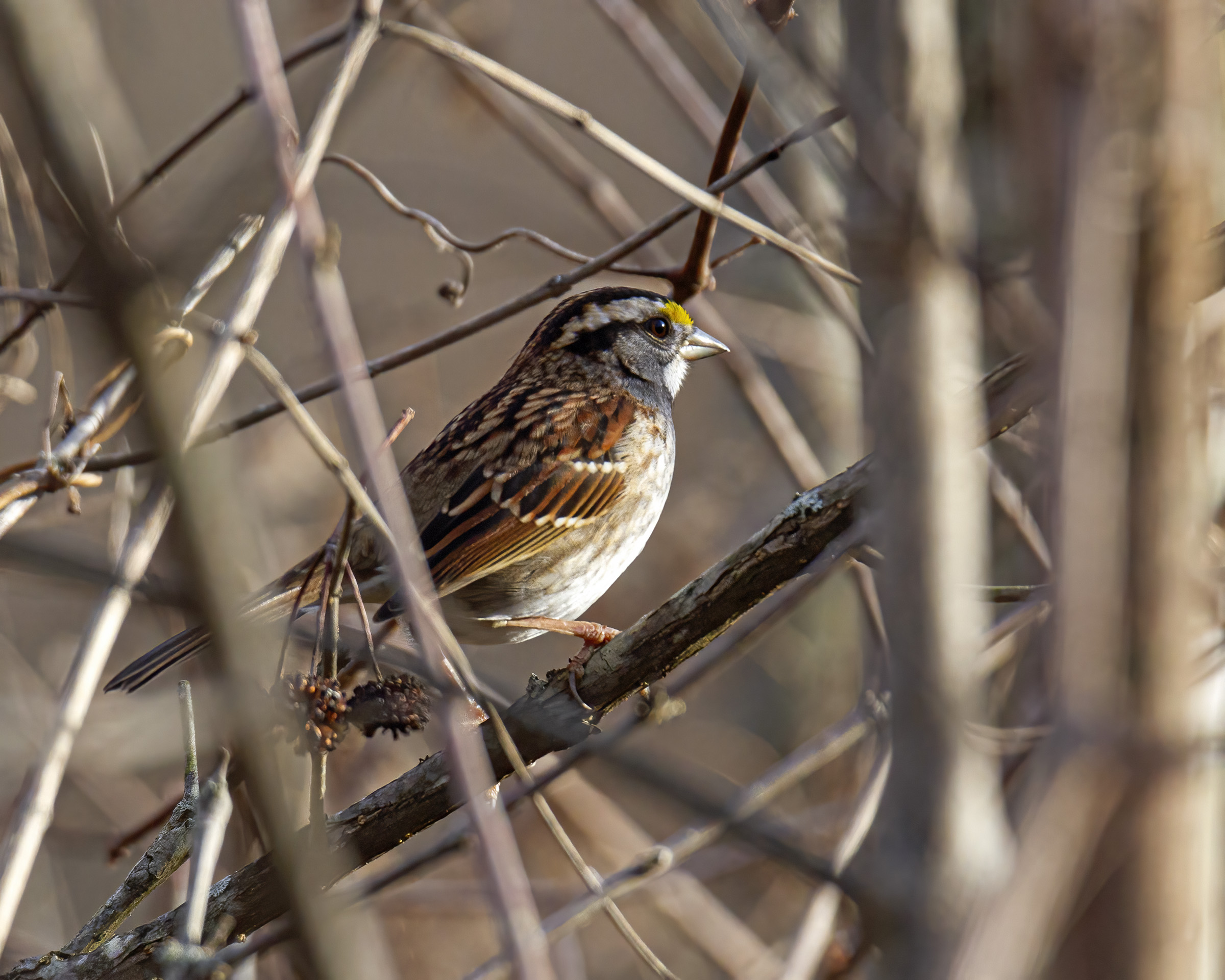
When it comes to photographs, do you prefer “pretty pictures” or “action shots?” If I were to judge from “likes” on social media platforms, “pretty pictures” are more popular, although I am often most proud of my “actions shots.” One of the coolest things about photography, of course, is that there is a wide latitude for individual styles and preferences and neither the viewer nor the photographer has to be forced into making false choices.
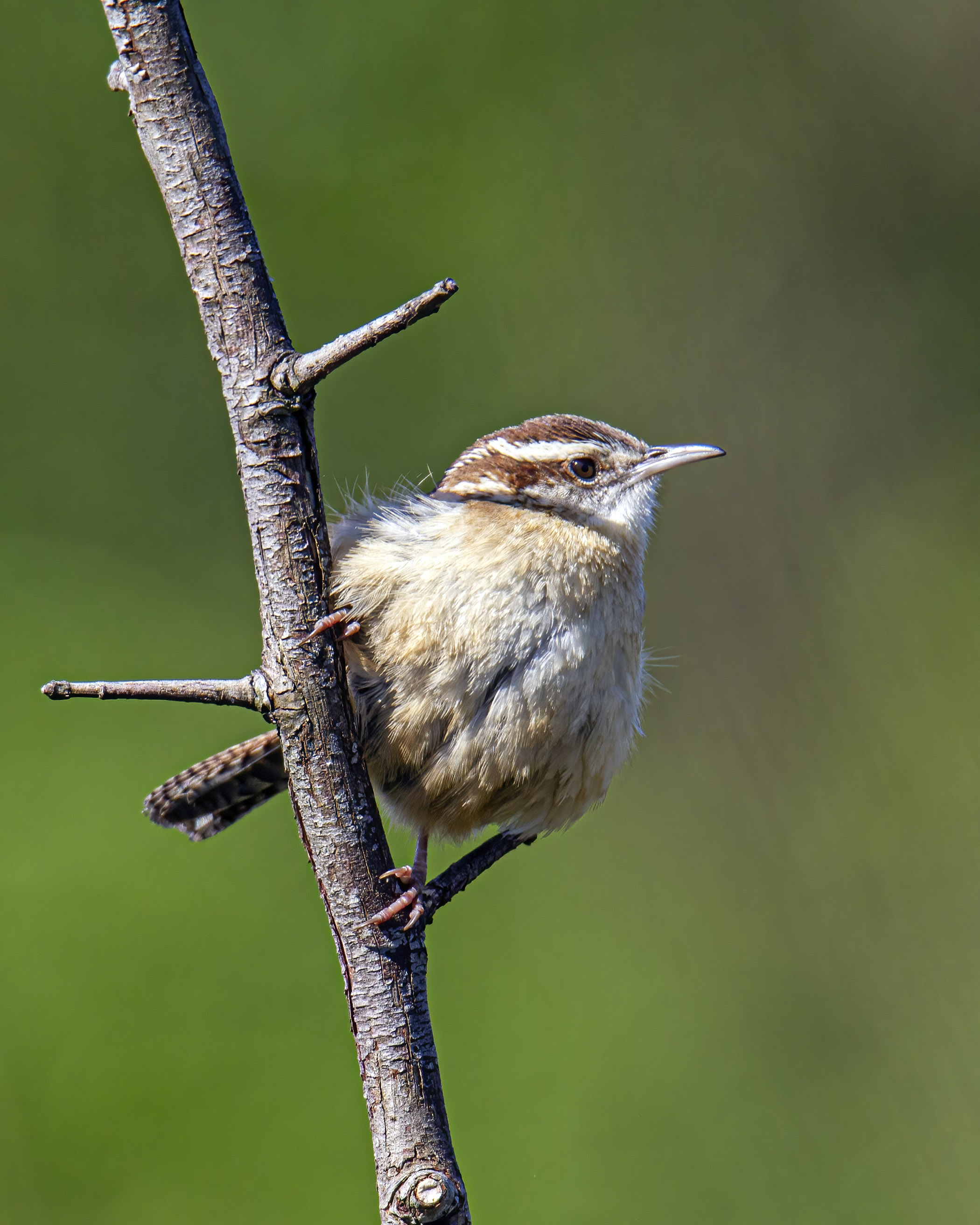
On Monday I took a couple of photos of small birds during a visit to Occoquan Bay National Wildlife Refuge. At this time of the year I am thrilled when I am able to spot the small birds that are often hidden by the increasingly dense foliage.
The bird in the first photo is an incredibly cute Carolina Wren (Thryothorus ludovicianus). Carolina Wrens frequently poke about in the undergrowth and I was delighted when this one chose instead to perch on a photogenic branch in the open. The result was this pretty portrait of the little wren that looks almost like it was taken in a studio environment.
The bird in the second photo is a White-throated Sparrow (Zonotrichia albicollis). It was not perched in the open and it was not stationary. The little sparrow was bobbing and moving as it attempted to grab some of the tender shoots growing on the tree. I was happy when I managed to get a shot in which the bird has one of the shoots in its mouth. The background in this image is cluttered and part of the bird’s body is hidden by a branch. However, I like the moment that I captured and the way that the image provides a sense of the bird’s environment.
When I am photographing wildlife, I am unconsciously making a series of creative choices in the way that I frame an image and the camera settings that I use, all of which affect the look and feel of the resulting images. Sometimes of those images will be “artsy” and others will be “documentary”—I love both styles of photography.

© Michael Q. Powell. All rights reserved.
Posted in Birds, Nature, Photography, wildlife, Winter, tagged Canon 7D, Occoquan Bay National Wildlife Refuge, sparrow, Tamron 150-600mm, white-throated sparrow, Woodbridge VA, Zonotrichia albicollis on January 5, 2023| 4 Comments »
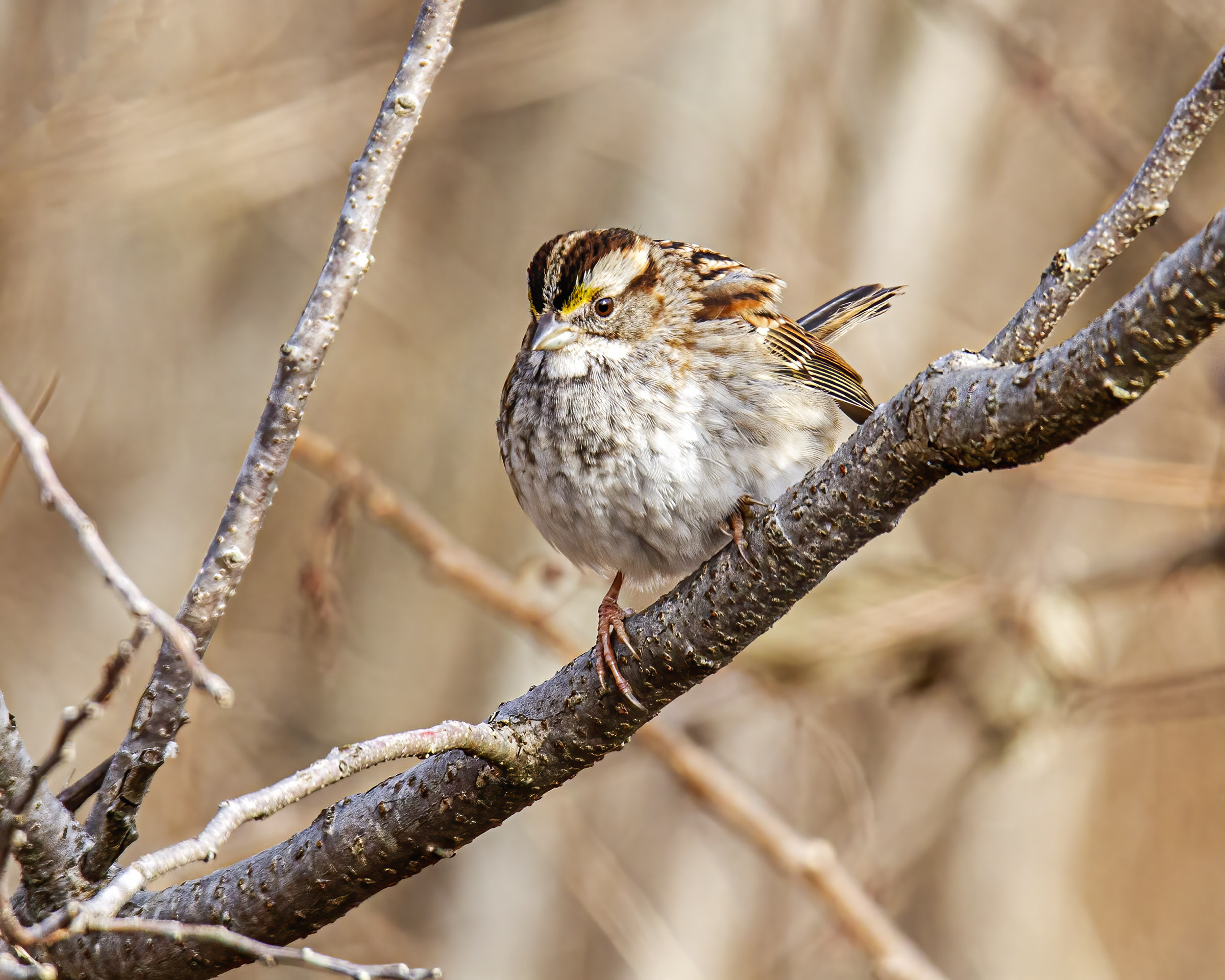
White-throated Sparrows (Zonotrichia albicollis) have such a distinctive look that I can usually identify them—many other sparrows are so similar in appearance that it is hard for me to identify them. Their little white “beards” always make me think of Santa Claus, but the bright yellow markings near their eyes are my favorite feature.
I photographed these two individuals during recent visits to Occoquan Bay National Wildlife Refuge. White-throated Sparrows are winter visitors to our area that return north in the spring.

© Michael Q. Powell. All rights reserved.
Posted in Birds, Nature, Photography, wildlife, Winter, tagged white-throated sparrow, Zonotrichia albicollis on February 22, 2022| 4 Comments »
Do you prefer static portraits or action shots? It is easy to see that my question is a false dichotomy that seems to limit this preference to and either/or choice. In real life, you can like both types of photos and most people would say that it depends on the merits of each individual photo.
Last week I spotted this White-throated Sparrow (Zonotrichia albicollis) in a patch of sumac at Occoquan Bay National Wildlife Refuge. Frequent readers of this blog will undoubtedly remember that I have featured a variety of birds in this same patch, which provides berries during a time of the year when food sources are severely limited.
In the first photo, the sparrow was momentarily perched and I had the luxury of being able to compose my shot somewhat carefully. I moved about to get the best possible angle and checked my focus to make sure that the eye would be sharp. I really like the way that the little portrait turned out, with the angular line of the sparrow’s body mirroring the stalks and the muted tones of the background helping the yellow eye stripe and red berries to really “pop.”
The second and third images were my attempts to capture the sparrow in action. It was tough tp frame the shots, because I did not know how or when the sparrow would reach to snag a berry. In many of my shots, the sparrow’s eye was not visible, because it had turned its head or it was buried it in the vegetation. I wanted very much to get a photo of the sparrow with a berry in its mouth, but that too was difficult because of the speed at which the sparrow swallowed its food.
If I were super critical of the second and third shots, I would say they are a little softer than the first image and the exposures might have been slightly off, in part because the lighting situation was not as good as for the first image. However, I think that the dynamic nature of the final two images more than compensates for the technical “issues.”
One of the coolest things about photography is that it is a mixture of the technical and artistic considerations—both aspects play a role in creating your overall impression of an image. I watched a lot of Olympic figure skating coverage last week and was struck by the way that the skaters received different scores for technical merit and artistic impression. I think that I use a somewhat similar system in my mind when evaluating my own photos—some are more technically challenging, like attempting a quad jump, while others reflect the beauty and elegance of the subject.


© Michael Q. Powell. All rights reserved.
Posted in Birds, Nature, Photography, wildlife, Winter, tagged Canon 50D, Occoquan Bay National Wildlife Refuge, sumac, Tamron 150-600mm, white-throated sparrow, Woodbridge VA, Zonotrichia albicollis on February 12, 2022| 4 Comments »
This White-throated Sparrow (Zonotrichia albicollis) was feasting on the abundant sumac berries when I spotted him on Tuesday at Occoquan Bay National Wildlife Refuge. In recent weeks I have repeatedly seen bluebirds in this patch of sumac and I always check it now whenever I visit this location.
I see White-throated Sparrows quite often during the winter months, but this was this first time I have seen them in this field. Normally I spot them when they are poking about in the undergrowth of bushes and other vegetation.


© Michael Q. Powell. All rights reserved.
Posted in Birds, Nature, Photography, wildlife, Winter, tagged Canon 50D, Occoquan Bay National Wildlife Refuge, Tamron 150-600mm, white-throated sparrow, Woodbridge VA, Zonotrichia albicollis on January 23, 2022| 26 Comments »
Quite often my most beautiful photos are of the simplest, most common subjects that I find in nature, like this White-throated Sparrow (Zonotrichia albicollis) that I photographed recently at Occoquan Bay National Wildlife Refuge. The elements of this image—the lighting, the pose, the framing, and the color palette—work together almost perfectly to create a harmonious, warm feeling for me that is hard to describe with words.
It is a bit of a cliché to say that beauty is in the eye of the beholder, but it is nonetheless true. Perhaps you’d dismiss this photo because the main subject is a nondescript little bird or maybe you prefer more colorful images with more “pop.” In my photography I try a variety of approaches to capture the beauty that surrounds us and have varying degrees of success in doing so.
For me, this one image is almost perfect. There is always the chance, however, that I will be able to capture something even more perfect in my next photos, so I’ll keep trudging on with my camera.

© Michael Q. Powell. All rights reserved.
Posted in Birds, tagged Alexandria VA, Canon 50D, Runnymeade, snow, sparrow, Tamron 150-600mm, white-throated sparrow, Zonotrichia albicollis on January 6, 2022| 7 Comments »
It was delightful on Tuesday to photograph cardinals with a brilliant blue sky as a backdrop, but many of the birds that I try to photograph do not perch high up in the trees. Birds like this White-throated Sparrow (Zonotrichia albicollis) spent most of the time near the ground, poking about in the undergrowth. If I am lucky enough to get a clear view of one of these birds, the background is likely to be cluttered and distracting.
Snow has a way of decluttering the image, obscuring some of the pesky background branches. This was the case in the first image when I was able to capture the intensity of the sparrow in mid-cry. His little white “beard” is a perfect for the match for the snow and I was happy to be able to capture his little yellow eye stripe.
The second image has a much more gentle feel to it. The blurred snowy background allows us to focus on the puffed-up sparrow perched on the tiny branch protruding from the snow. The sparrow seemed to be taking a break, resting and recovering as it contemplated its next moves. As is usually the case, the sparrow did not sit still for very long and resumed its foraging a short time later.


© Michael Q. Powell. All rights reserved.
Posted in Birds, Nature, Photography, wildlife, Winter, tagged Canon 50D, Occoquan Bay National Wildlife Refuge, sparrow, Tamron 150-600mm, white-throated sparrow, Woodbridge VA, Zonotrichia albicollis on December 20, 2021| 2 Comments »
I often have trouble identifying sparrows, with the possible exception of White-throated Sparrows (Zonotrichia albicollis). These colorful sparrows migrate to my area in the fall and overwinter with us in quite large numbers. Their prominent white “beards” help me to distinguish them from other sparrows and often remind me of Santa Claus, especially during the pre-Christmas frenzy of activity during December.
Sometimes, though, the white throat patch is not quite so prominent, as in the second image below. In cases like this, I rely on the bright yellow stripe between the bill and eye, an area known as the “lore,” to identify the bird as a White-throated Sparrow.


© Michael Q. Powell. All rights reserved.
Posted in Birds, Nature, Photography, Portraits, wildlife, Winter, tagged Canon 50D, Occoquan Bay National Wildlife Refuge, spherical sparrow, Tamron 150-600mm, white-throated sparrow, Woodbridge VA, Zonotrichia albicollis on February 5, 2021| 19 Comments »
A lot of birds puff up their feathers to stay warm in the cold weather, but I don’t know that I have ever seen a more extreme case than this spherical White-throated Sparrow (Zonotrichia albicollis) that I spotted yesterday morning at Occoquan Bay National Wildlife Refuge.
It was right around the freezing mark and I must confess that I was bundled up in multiple layers and also looked a bit more rotund than normal. It is well known that the camera adds ten pounds and makes you look heavier. When it comes to staying warm, all vanity goes out the window for me.

© Michael Q. Powell. All rights reserved.
Posted in Birds, Nature, Photography, wildlife, Winter, tagged Canon 50D, Occoquan Bay National Wildlife Refuge, poison ivy berries, Tamron 150-600mm, white-throated sparrow, Woodbridge VA, Zonotrichia albicollis on December 29, 2020| 12 Comments »
Homemade cranberry sauce made a wonderful complement to the turkey at the Christmas Day feast that I shared with the other two members of my “pod.” Many birds are also feasting on berries at this time of the year, though I cannot recommend that you taste the poison ivy berries that they are consuming.
Last week I spotted this White-throated Sparrow (Zonotrichia albicollis) at Occoquan Bay National Wildlife Refuge and watched as it picked berries one by one from a cluster of poison ivy and consumed them in place. Most of us do not like to have our photos taken while we are eating, but this pretty little sparrow was so focused on its feast that it did not seem to mind.

© Michael Q. Powell. All rights reserved.
Posted in Autumn, Birds, Nature, Photography, wildlife, tagged Canon 50D, Occoquan Bay National Wildlife Refuge, Tamron 150-600mm, white-throated sparrow, Woodbridge VA, Zonotrichia albicollis on December 1, 2020| 12 Comments »
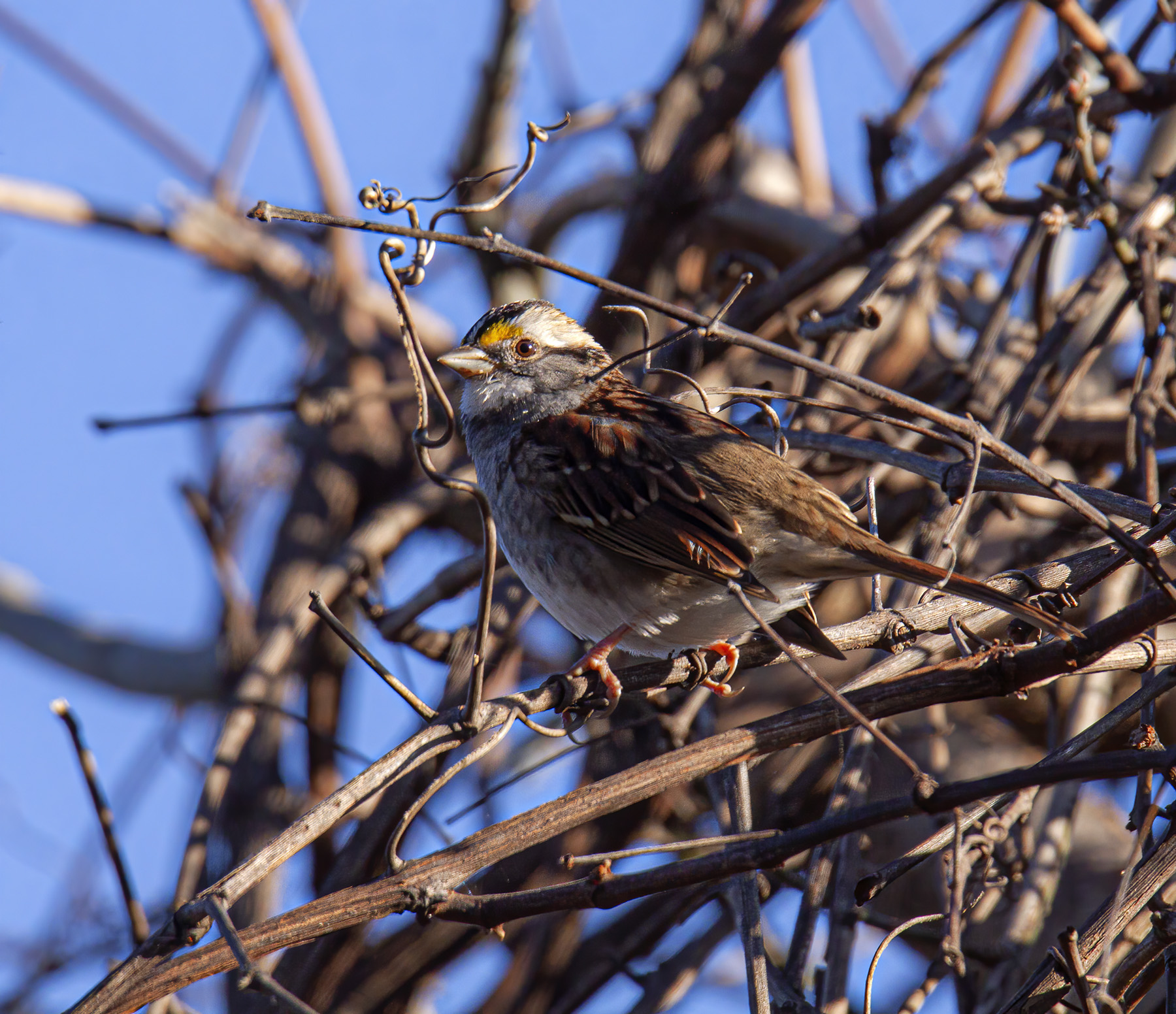
Although my eyes are sometimes drawn to patterns when scanning vegetation for birds, generally I require some movement to detect their presence. I spotted this beautiful little White-throated Sparrow (Zonotrichia albicollis) while it was hopping in and out of some heavy vegetation at Occoquan Bay National Wildlife Refuge.
I tracked the bird for a while, hoping to get an obstructed shot, and was thrilled to capture this image. Much of the bird’s body was in the shadows, but rays of sunshine spotlighted its head and highlighted its beautiful facial markings, including the distinctive yellow stripe between the base of its bill and its eye, an area known as the “lore.” Be sure to click on the image to get an enlarged view of these wonderful features.
© Michael Q. Powell. All rights reserved.
Posted in Birds, Flowers, Nature, Photography, spring, wildlife, tagged blossoming trees, blossoms, Canon 50D, Occoquan Bay National Wildlife Refuge, Tamron 150-600mm, white-throated sparrow, Woodbridge VA, Zonotrichia albicollis on March 23, 2020| 13 Comments »
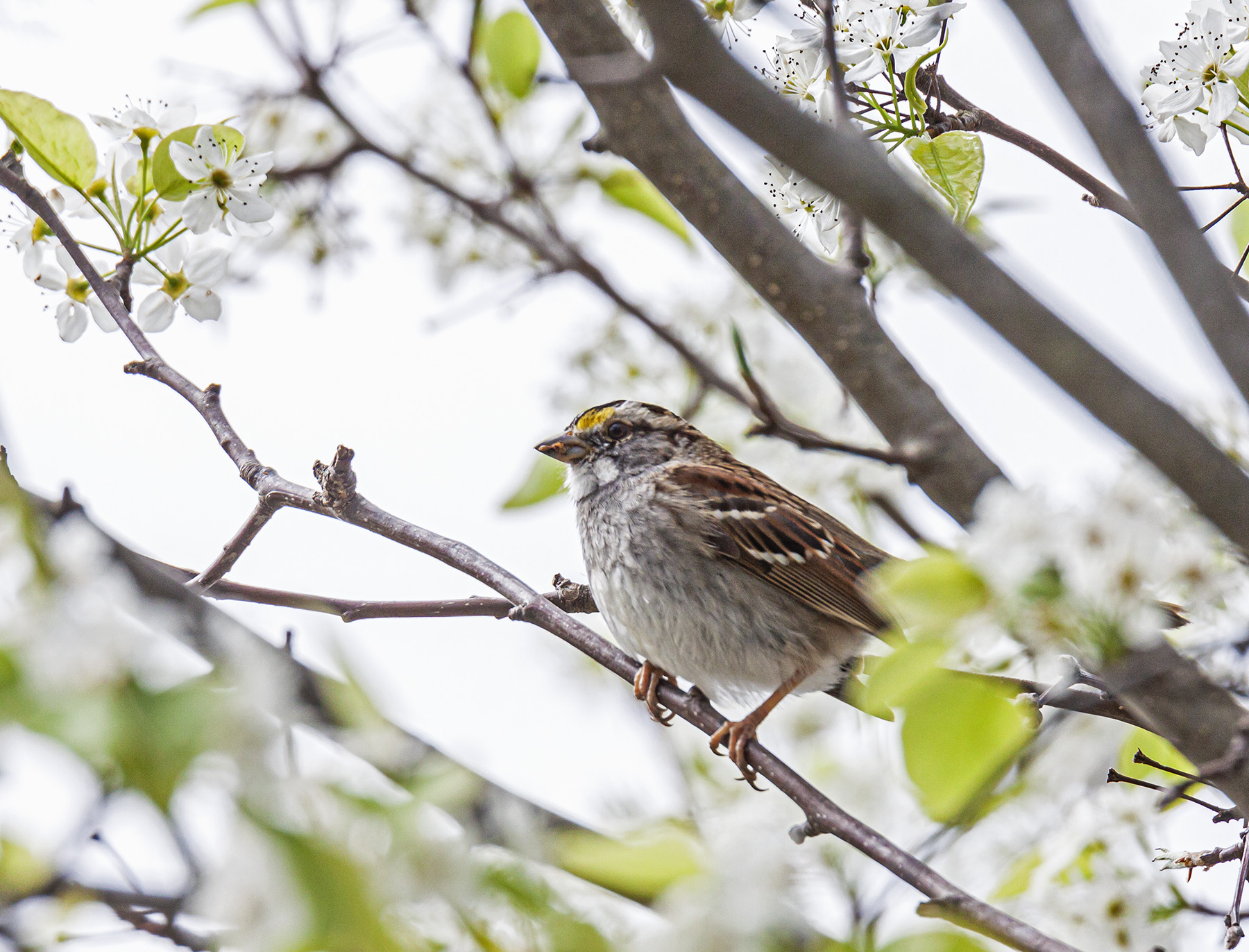
Each spring I try to get shots of birds perching in blossoming trees, but the birds rarely cooperate with me—they all seem more interested in foraging for food than in posing for me. On Saturday, though, a White-throated Sparrow (Zonotrichia albicollis) at Occoquan Bay National Wildlife Refuge paused for a moment and I was able to capture this image.
I chose not to crop this image any closer in order to give you a better view of the delicate white blossoms of a tree that I am not able to immediately identify.
© Michael Q. Powell. All rights reserved.
Posted in Birds, Nature, Photography, wildlife, Winter, tagged Canon 50D, Occoquan Bay National Wildlife Refuge, Tamron 150-600mm, white-throated sparrow, Woodbridge VA, Zonotrichia albicollis on February 8, 2020| 9 Comments »
White-throated Sparrows (Zonotrichia albicollis) are with us throughout the winter and I will usually attempt to photograph them during my winter forays into the wild. I tend to think of White-throated Sparrows as the “dandies” of the sparrow world—they have the same general coloration as other sparrows, but have a distinctive appearance with their white chin beards and bright yellow eyestripes. It is a real bonus when the lighting is good and the perch is photogenic, as was the case last week at Occoquan Bay National Wildlife Refuge.

© Michael Q. Powell. All rights reserved.
Posted in Birds, Nature, Photography, wildlife, Winter, tagged Canon 50D, Occoquan Bay National Wildlife Refuge, sparrow, Tamron 150-600mm, white-throated sparrow, Woodbridge VA, Zonotrichia albicollis on January 24, 2020| 16 Comments »
The lighting was so beautiful last week when I spotted this White-throated Sparrow (Zonotrichia albicollis) that I did not mind that there was a branch partially blocking my view of the bird. I especially love the way that the lighting highlights the bright yellow markings in the area between the eye and the bill known technically as the lores.

© Michael Q. Powell. All rights reserved.
Posted in Birds, Nature, Photography, wildlife, Winter, tagged Canon 50D, Occoquan Bay National Wildlife Refuge, sparrow, Tamron 150-600mm, white-throated sparrow, Woodbridge VA, Zonotrichia albicollis on January 9, 2020| 10 Comments »
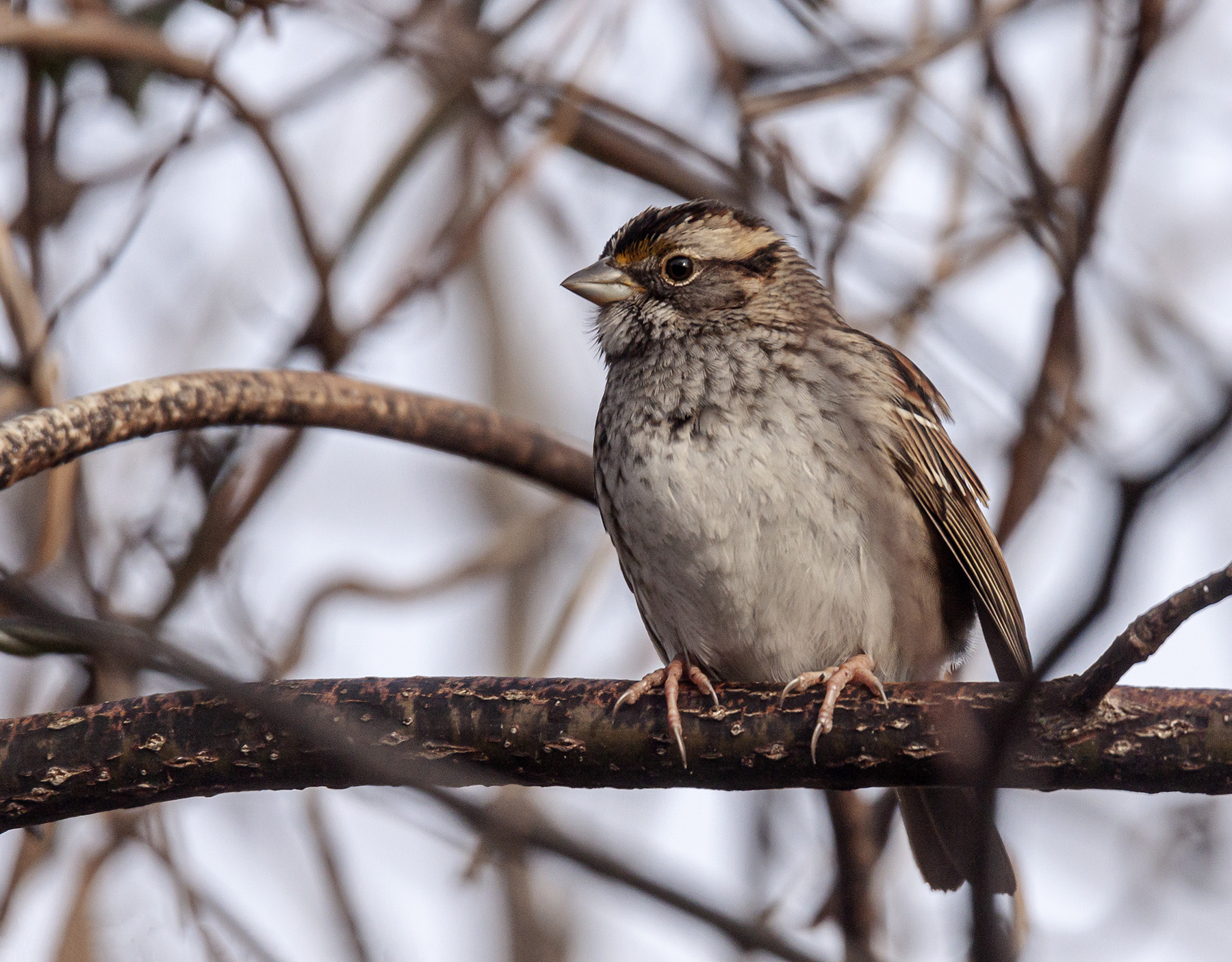
We have moved into a season of the year in which it is increasingly difficult for me to find birds to photograph. When the weather is cold and grey, birds seem to be less active and are certainly less visible. Photography, though, is not about efficiency for me—I have come to enjoy my long, mostly solitary walks in nature with my camera irrespective of the actual results.
Consequently I think that I value each of my interactions with wild creatures even more than usual during the winter. For example, last week I worked hard to capture this little portrait of a White-throated Sparrow (Zonotrichia albicollis) at Occoquan Bay National Wildlife Refuge. Sparrows are often ignored by many birders and photographers, because of their commonness and drabness, but I enjoy the challenge of trying to photograph them as they move about, scratching and pecking, often buried within bushes and other vegetation.
© Michael Q. Powell. All rights reserved.
Posted in Autumn, Birds, Nature, Photography, wildlife, tagged Canon 50D, kinglet, Occoquan Bay National Wildlife Refuge, Regulus calendula, ruby-crowned kinglet, sparrow, Tamron 150-600mm, white-throated sparrow, Woodbridge VA, Zonotrichia albicollis on December 1, 2019| 6 Comments »
At this time of the year I have to work hard to get photographs of birds. If I am lucky, I will spot a Bald Eagle or another raptor, but most of the time I walk slowly down the trails, looking and listening for small birds. I know that they are there, but even with the leaves gone from most of the trees, the birds often remain hidden from view.
One of my favorites is the White-throated Sparrow (Zonotrichia albicollis), like this one that I spotted last week at Occoquan Bay National Wildlife Refuge. Maybe it is the effect of the season, but this sparrow always makes me think of Santa Claus. With the white “beard” and the distinctive yellow stripe over the eye, this sparrow is also relatively easy to identify, a real plus considering how many sparrow species are similar in appearance to each other.
An even smaller bird is the tiny Ruby-crowned Kinglet (Regulus calendula), which is about 4 inches in length (10 cm) and weighs only 0.2-0.3 ounces (5-10 g). This one was bouncing in and out of the vegetation so much that I thought I would never get a clear shot of it. Eventually I was more or less successful. What a sweet little bird.


© Michael Q. Powell. All rights reserved.
Posted in Birds, Nature, Photography, wildlife, Winter, tagged Canon 50D, Occoquan Bay National Wildlife Refuge, Santa Claus, Santa sparrow, Tamron 150-600mm, white-throated sparrow, Woodbridge VA, Zonotrichia albicollis on December 28, 2018| 2 Comments »
White-throated Sparrows (Zonotrichia albicollis) always remind me of Santa Claus because of their white “beards.” The effect was magnified on a recent frigid morning at Occoquan Bay National Wildlife Refuge, when a White-throated Sparrow had fluffed up its feathers to retain heat and looked even chubbier than normal.

© Michael Q. Powell. All rights reserved.
Posted in Birds, Nature, Photography, Portraits, spring, wildlife, tagged Bald Eagle, Canon 50D, Haliaeetus leucocephalus, Occoquan Bay National Wildlife Refuge, Tamron 150-600mm, white-throated sparrow, Zonotrichia albicollis on March 23, 2018| 13 Comments »
Are you attracted more by something that is powerful and exciting or by something that is familiar and comfortable? When it comes to photography, it seems like I constantly face this dilemma. Should I be chasing after the large predators of the air, travelling, as some birders do, hundreds of miles in the hopes of photographing a rare species like a snowy owl? Should I be content to spend my time scanning the branches and bushes for familiar birds that some dismissively call “backyard birds?”
Fortunately, this is not an either-or proposition—it is what academics would call a “false dichotomy.” I don’t have to choose only one type of subject on which to focus my attention and my camera. The reality is that I want to photograph them all and find equal enjoyment in photographing a modest White-throated Sparrow (Zonotrichia albicollis) and a majestic Bald Eagle (Haliaeetus leucocephalus). I photographed both of these birds this past week at Occoquan Bay National Wildlife Refuge and for me they represent the two extremes that I mentioned earlier.
One image is a carefully composed portrait of a small bird at rest and the other is an action shot of a powerful predator in the air taken on the fly, relying on reactions. Is one “better” than the other? Maybe it is better to ask if you find one more appealing, one that speaks to you more.
It is a bit of a cliché to state that beauty is in the eye of the beholder—beauty is often subjective, but sometimes people talk of universal beauty. How can that be? Personally, when I think about beauty, I realize that it is inherently contradictory, that it is an elusive mystery that we can never fully understand, but that is worth pursuing.
Beauty can be found in many places and in many ways. As you prepare for the weekend, I hope that you too will find time to discover the beauty that surrounds you, in the familiar or the exotic or somewhere in between those two extremes.


© Michael Q. Powell. All rights reserved.
Posted in Art, Birds, Nature, Photography, Portraits, wildlife, Winter, tagged Canon 50D, Occoquan Bay National Wildlife Refuge, Tamron 150-600mm, white-throated sparrow, Woodbridge VA, Zonotrichia albicollis on January 8, 2018| 4 Comments »
Some birds may seek shelter when the weather is inhospitable, but sparrows seem to be active and busy all of the time, like this White-throated Sparrow (Zonotrichia albicollis) that I spotted in the snow this past Friday at Occoquan Bay National Wildlife Refuge.
It is a bit of a challenge to get a proper exposure when so much of the frame is filled with white snow. As I understand it, the camera would like to render everything to a neutral gray, so it is necessary to overexpose the image or adjust it in post-processing. In my initial RAW image, the sparrow was very much in the shadows and the snow had a grayish-blue tinge to it. I cranked up the exposure to the point that most of the snow turned almost pure white and I was left with soft bluish shadows that I really like. I am also pretty pleased with the sparrow’s pose as it paused for a moment to survey the landscape.

© Michael Q. Powell. All rights reserved.
 Mike Powell