Feeds:
Posts
Comments

Posts Tagged ‘Virginia Spring Beauty’

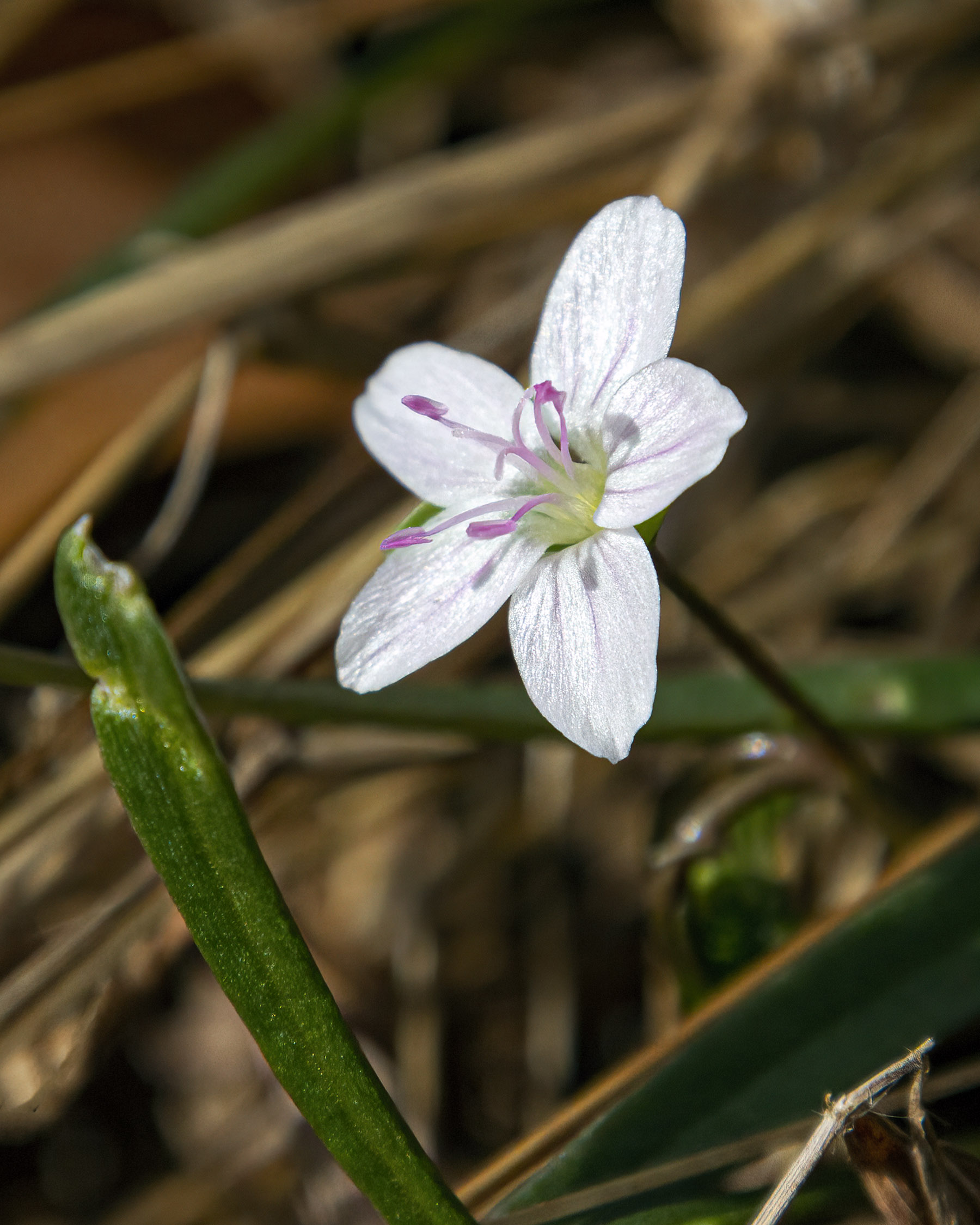
Spring is definitely here. I spotted my first Spring Beauty wildflower (Claytonia virginica) on 26 March during a hike at Prince William Forest Park in Triangle, Virginia. Before long I am sure that I will see large numbers of them in the forest, though they tend to be ephemeral and don’t bloom for very long.

The Spring Beauty plants have tiny underground tubers that Native Americans reportedly prepared and ate like potatoes, though I suspect that you would have to collect a lot of them to make a meal.

Spring Beauty

© Michael Q. Powell. All rights reserved.


Read Full Post »

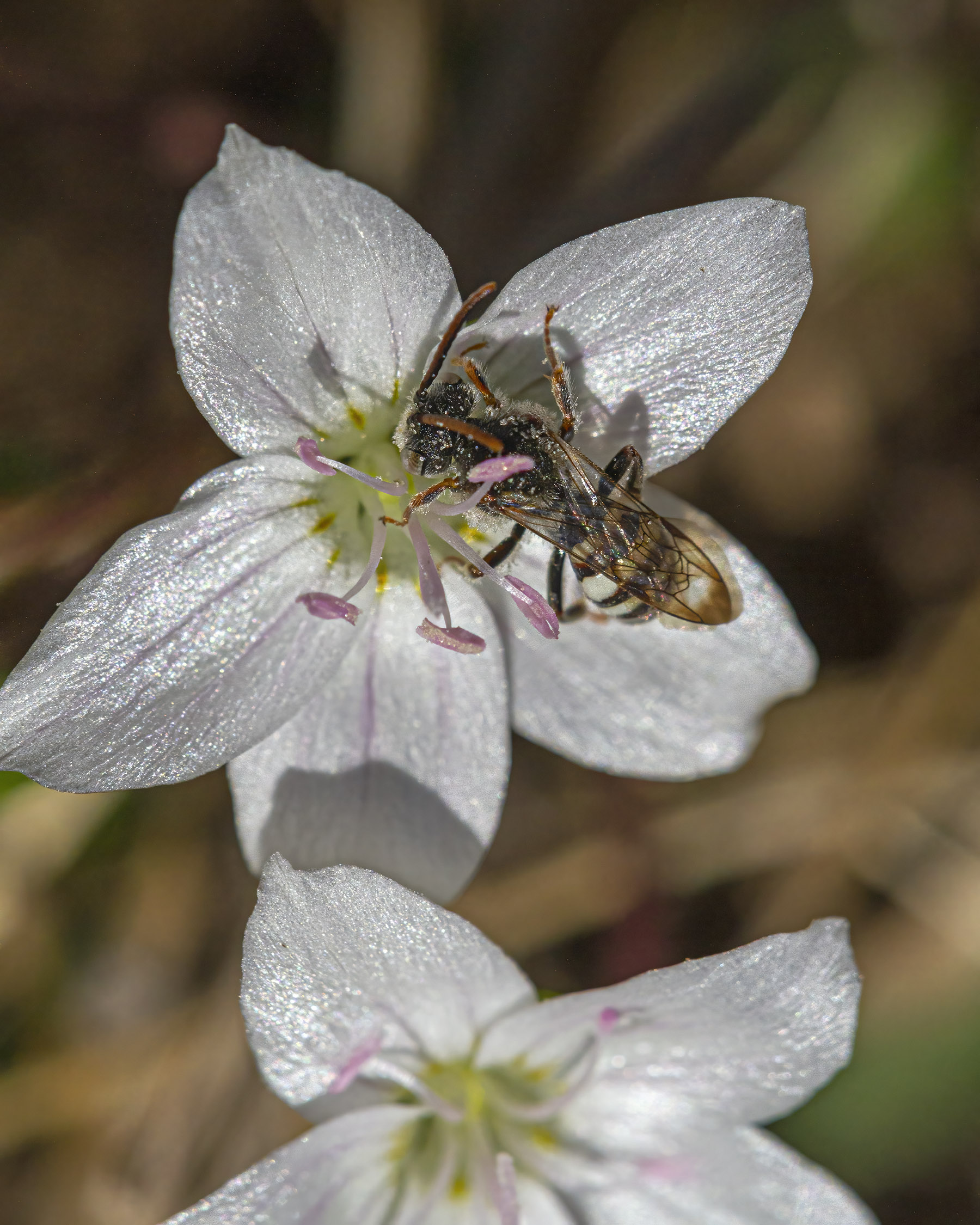
Most of the insects that I have observed feeding on Virginia Spring Beauty wildflowers (Claytonia virginica) have been equally small in size. I was a bit shocked, therefore, earlier this week to spot a large Eastern Carpenter Bee (Xylocopa virginica) gathering nectar and/or pollen from a small patch of Spring Beauties at Prince William Forest Park. The bee looked to be at least twice as large as each tiny flower. Wow!

The lighting was quite good and the bee was a bit distracted, so I was able to zoom in close and capture a lot of the details of the bee. I particularly like the speckled green eyes that look like they were carved out of a semiprecious stone. You can also see the bee’s tiny feet as it grasped the edges of the flower. I encourage you to click on the photos, especially the first one, to get a better look at the bee.

carpenter bee and spring beauty

carpenter bee and spring beauty

© Michael Q. Powell. All rights reserved.

Read Full Post »

Early spring wildflowers, like the Virginia Spring Beauty (Claytonia virginica), are an important source of food for a host of small bees and other insects. Many insects gather pollen from these flowers and in doing so help to pollinate the plants. One species, the Spring Beauty Miner Bee (Andrena erigeniae), is so specialized that it reportedly feeds only on this ephemeral flower.

According to the Bug of the Week website that featured this species in an article, “Using jaws and legs the female bees excavates a gallery in the soil, leaving a small pile of dirt near the entrance hole. This gallery can be as long as 15 centimeters and contain numerous lateral brood chambers. During the daytime she forages for pollen on flowers of spring beauties, which apparently are the sole source of food for her brood. Pollen from these blossoms is formed into balls and placed into brood chambers…As brood chambers are built and provisioned with pollen, the bee deposits a single egg on a pollen cake. During spring and early summer developing larvae consume the pollen, and later in summer they will form pupa. By late autumn development of the adult is complete and winter is spent in the adult stage within the brood chambers. Newly minted adults emerge each spring coincident with the appearance of spring beauty’s’ blossoms.” Wow!

On Monday I was fortunate to capture a shot of a Spring Beauty Miner Bee in action gathering pollen. If you look closely at the image, you will see how the tiny bee has collected pollen on its back legs.

Last year I posted an image of a Cuckoo Bee on the same kind of flower. That bee does not collect pollen. Instead it enters the nests of a host and lay eggs there, stealing resources that the host has already collected. From what I understand the cuckoo bee waits for the miner bee to leave its burrow and then lays its egg there. The offspring of the cuckoo bee eats the pollen in the burrow and then eats the larva of the miner bee. Yikes!

Spring Beauty Miner Bee

© Michael Q. Powell. All rights reserved.


Read Full Post »
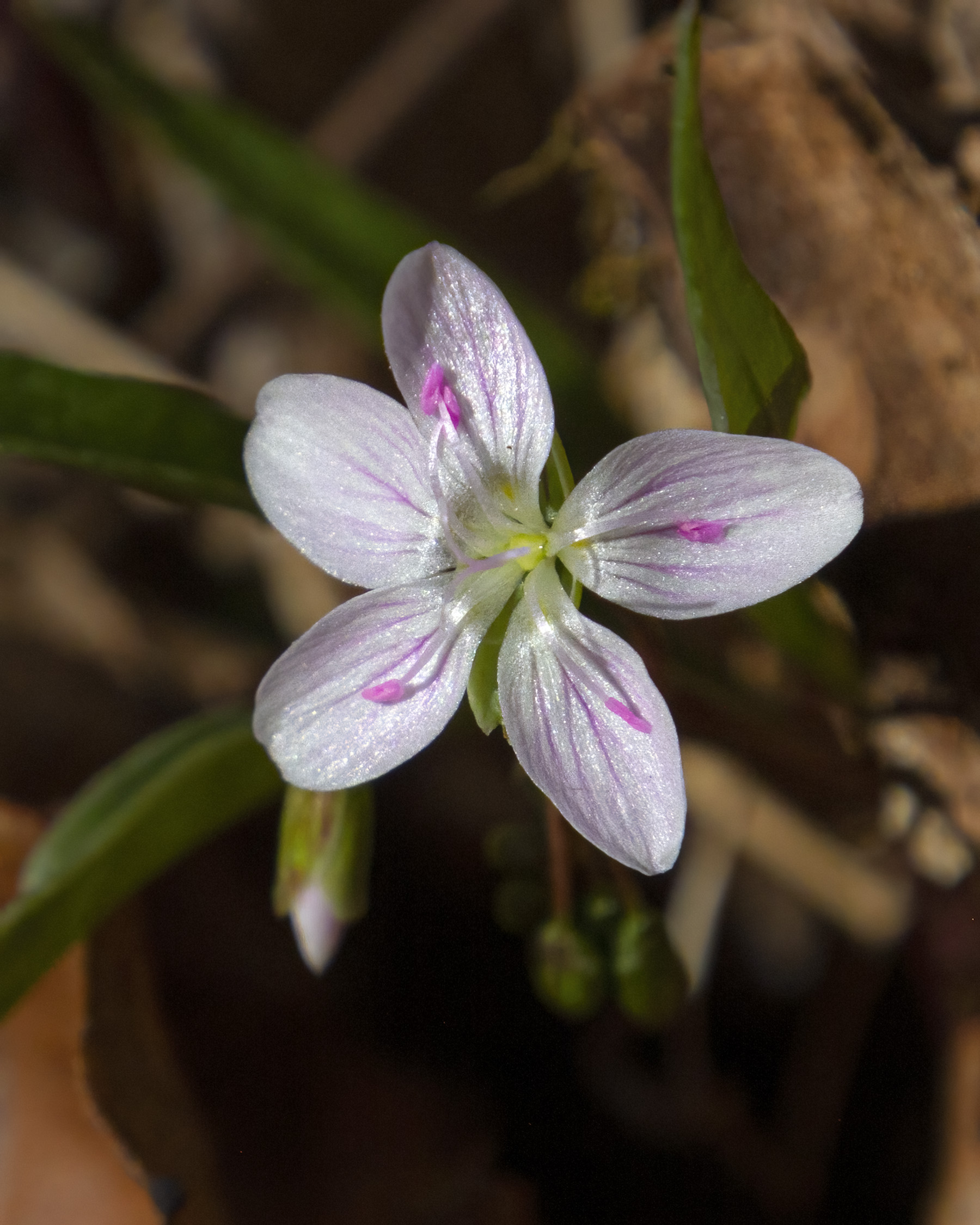
For a brief period in the spring, the forest floor is carpeted with wildflowers. It is still a little early for most of the wildflowers to appear but on Wednesday I spotted a few early blooming ones during a hike in Prince William Forest Park in Northern Virginia.

The little wild flower in the first photo is the appropriately named Virginia Spring Beauty (Claytonia virginica). I love the pops of pink in this flower, especially the stamens. According to Wikipedia, “The individual flowers bloom for three days, although the five stamens on each flower are only active for a single day.” Yikes! I guess the Spring Beauties qualify as being “ephemeral.”

The flower in the second photo is often referred to as a Quaker Lady Bluet (Houstonia caerulea)—it is also known as the Azure Bluet. Later in the spring I am certain to encounter large clusters of this cool little flower, but on this occasion there were only a few of them. I love the simple geometric pattern of the petals that someone decided resembled the traditional hats worn by Quaker ladies.

Virginia Spring Beauty

Quaker Lady Bluet

© Michael Q. Powell. All rights reserved.

Read Full Post »

Early spring wildflowers, like the Virginia Spring Beauty (Claytonia virginica), are an important source of food for a host of small bees and other insects. Many insects gather pollen from these flowers and in doing so help to pollinate the plants.

Some species of bees, though, lack  scopa (the pollen-collecting hairs) and do not collect pollen to feed their offspring. The genus Nomada, according to Wikipedia, is the largest genus of kleptoparasitic bees sometimes referred to as “cuckoo bees.” Kleptoparasitic bees are so named because they enter the nests of a host and lay eggs there, stealing resources that the host has already collected.

It is a little hard to see the body of the bee in the photo below, but if you look closely you can see its striped abdomen, which is wasp-like in appearance. I was not sure of the type of bee, so I posted it to BugGuide, a useful resource for insect identification, and one of the experts there identified the bee as belonging to the genus Nomada.

cuckoo

© Michael Q. Powell. All rights reserved.

Read Full Post »

I note the transition to spring in small ways, quite often in the reappearance of familiar species of plants, insects, and other living creatures. I was delighted on Monday to discover that tiny Virginia Spring Beauty wildflowers (Claytonia virginica) have already started to push their way up from the forest floor in Prince William County. According to Wikipedia, the individual flowers bloom for three days, although the five stamens on each flower are only active for a single day.

On the same day, I spotted an Eastern Comma butterfly (Polygonia comma), the first full-sized butterfly that I have been able to photograph this year. I was not able to get very close to the butterfly, but you can see the beautiful orange pattern of its inner wings in the middle shot below.

The final image shows a Spotted Turtle (Clemmys guttata) that I spotted last week. This species seems to be found only in shallow marshy areas and I rarely encounter one, so it was exciting to be able to photograph it.

We all celebrate different signs of spring at this time of the year (or of autumn if you live in the Southern Hemisphere). What indications do you look for that signal the change of the season?

Spring Beauty

Eastern Comma

spotted turtle

© Michael Q. Powell. All rights reserved.


Read Full Post »