Feeds:
Posts
Comments

Posts Tagged ‘Uhler’s Sundragon dragonfly’

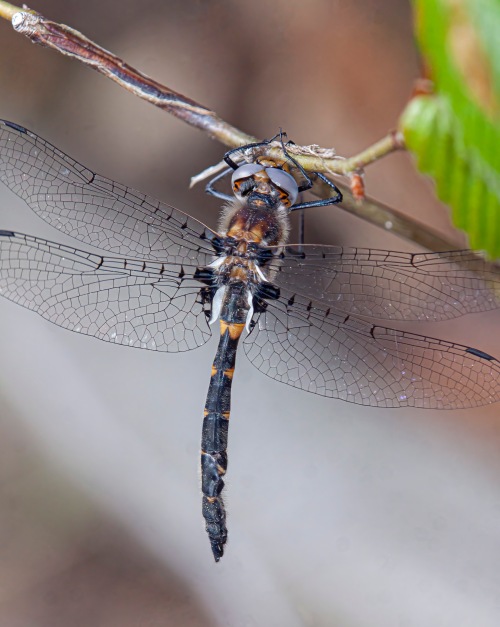
I was delighted to finally spot my first Uhler’s Sundragon (Helocordulia uhleri) of the year on 18 April near a small pond in Prince William County, Virginia. I went searching for these dragonflies, which are usually the first ones I see in the spring, on several occasions in late March and early April, but came up empty-handed. Uhler’s Sundragons are usually around for only about a month, soI was fearful that I might miss them this season.

I have a pretty good idea of the type of habitat that this early season dragonfly prefers and tend to begin my searches by returning to spots where I have photographed them in the past and then begin to widen my search. Quite often this means that I spend a lot of time walking and watching, trying to remain alert to any movement in the air or on the ground.

As you can see in the first photo, Uhler’s Sundragons often hang from a perch, rather than perch horizontally, which makes it a little easier to get a detailed shot. When the dragonfly perches low to the ground, as in the second photo when it hung from the stem of a fallen leaf, I end up doing some improvised acrobatics to capture an image.

Uhler's Sundragon

Uhler's Sundragon

© Michael Q. Powell. All rights reserved.

Read Full Post »

Many people in the United States were excited to view yesterday’s solar eclipse. I too paused for a few moments in the afternoon to view the eclipse through solar glasses that I had obtained last week during a visit to the Air and Space Museum in the Washington D.C. area.

However, I must confess that I was more excited earlier in the day when I had multiple encounters with Uhler’s Sundragons (Helocordulia uhleri), the first dragonflies that I have been able to photograph in 2024. (Some of you may recall that I searched for dragonflies last week and think that I saw one flying over a stream. However, I did not get a photo of the dragonfly, so for me that first sighting does not really “count.)

I spent several hours yesterday looking carefully at the vegetation along a creek in Prince William County, Virginia where I had spotted Uhler’s Sundragons in previous years. This species appears in limited locations in the early spring and is usually gone by early May. Unlike many of the dragonflies that I will see during the summer that are habitat generalists, Uhler’s Sundragons require a specific kind of habitat, usually a mountain stream. According to the Dragonflies of Northern Virginia website, “Uhler’s need clean, small to medium, rocky forest streams with gravelly and/or sandy substrate, and a decent flow.”

I was fortunate to be able to photograph both female and male Uhler’s Sundragons. I have alternated genders in the photos below, with the females in the odd-numbered images and the males in the even ones. One of the ways to tell the genders apart is to look at the tips of the abdomens (the “tails”) and you can see that the terminal appendages are different. The lower portion of the abdomens of the males is also somewhat enlarged, as you can see in some of the photos.

Dragonflies perch in many different ways. Some species perch horizontally and some hang vertically. Uhler’s Sundragons most often perch at an angle, as shown in the first and last photos, though sometimes they may hang vertically from the vegetation.

The dragonfly season has now opened and I look forward to many more encounters with these amazingly beautiful aerial acrobatic insects that have a magical appeal for me.

Uhler's Sundragon

Uhler's Sundragon


Uhler's Sundragon

Uhler's Sundragon

Uhler's Sundragon

Uhler's Sundragon

© Michael Q. Powell. All rights reserved.

Read Full Post »

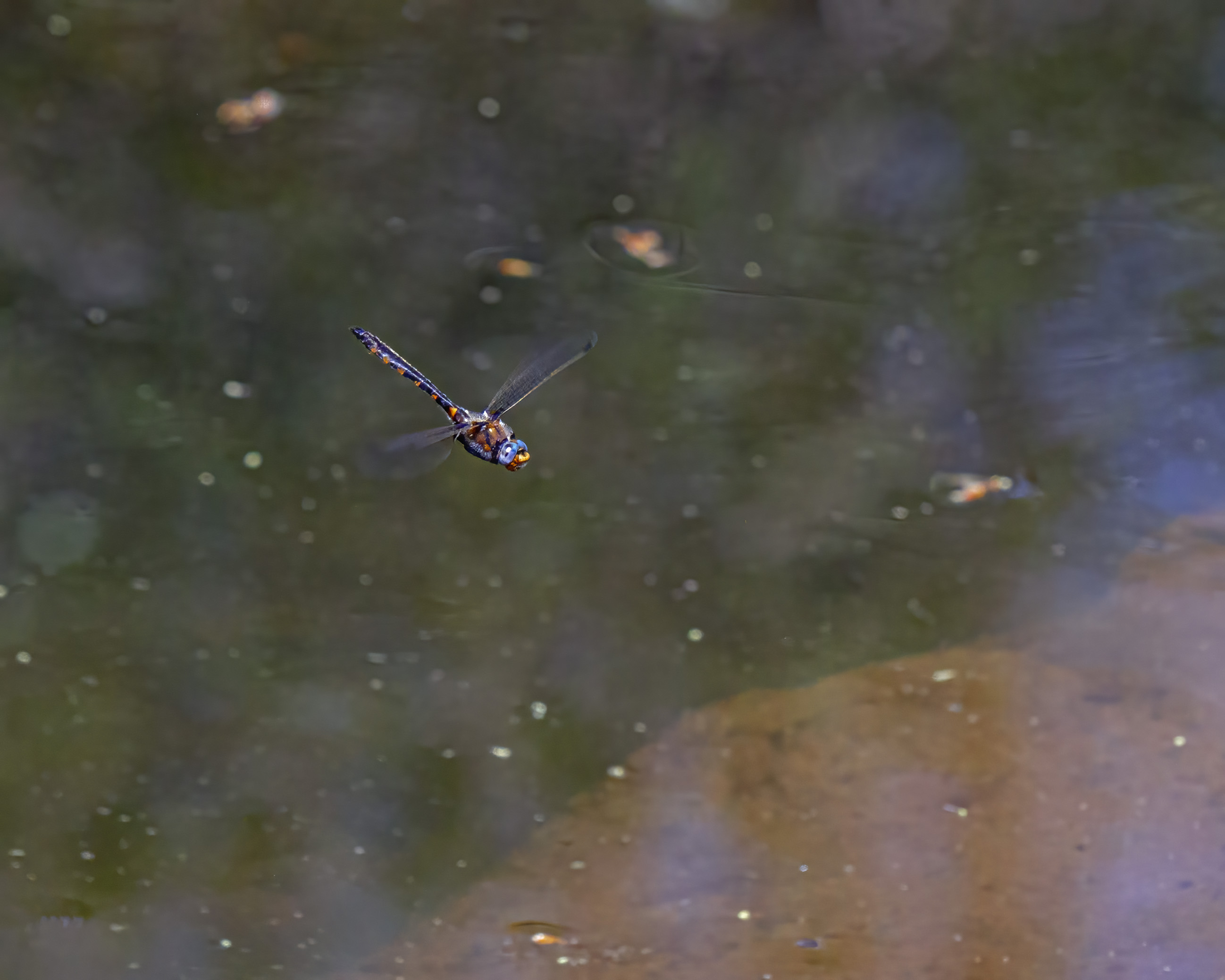
It is almost impossible, but I can’t help but try to capture images of dragonflies in flight. It is arguably the most difficult challenge of my ability to use my camera and also of my patience. None of the dragonflies in these photos flew close to the shores of the streams that I was exploring in Prince William County, Virginia, and I was using only a modest telephoto lens that I was focusing manually—the autofocus on my Tamron 180mm macro lens is relatively slow and could not focus on the dragonflies as they zoomed on by.

Last Wednesday I photographed the dragonfly in the first photo as it was patrolling over a creek. I believe that it is a Uhler’s Sundragon dragonfly (Helocordulia uhleri), which is about 1.8 inches (46 mm) in length. The dragonfly was not exactly following a pattern, but I was able to track it as it flew all around a small section of the creek.

The dragonfly in the second image may also be a Uhler’s Sundragon, though I am less confident of this identification. I really like the fact that the eyes of the dragonfly are in shart focus. It is probably just my imagination, but this dragonfly seemed to glance up at me and smile as it flew on by. In this photo, as in the first one, you really have a sense of the environment in which I found the dragonfly.

I captured the final image on Friday as I was exploring a different creek in Prince William County. The dragonfly in this photo was much larger than the ones in the other photos and was flying much faster and seemed to be conducting patrols over a much longer stretch of the creek. All the image was not completely sharp, I captured enough details to be able to identify it as male Stream Cruiser (Didymops transversa) dragonfly, a species that is about 2.2 inches (56 mm) in length.

Last year I did a short video on YouTube called Impossible Shots? Dragonflies in Flight in which I talked about one of my forays into the field and highlighted my approach to photographing dragonflies. Check it out if you want to see some more shots of dragonflies in flight or if you simply want to hear my voice and see my face. I included a link to the video in the title of the video (which should appear in color and underlined) and am also going to try to paste it into the end of posting, so you don’t have to go to YouTube to watch it. I am still just dabbling in video, but want to try to do more of it this year.

Uhler's Sundragon

Uhler's Sundragon

Stream Cruiser

© Michael Q. Powell. All rights reserved.

Read Full Post »

Have you ever looked closely at a dragonfly’s legs? A dragonfly has six legs that are attached in pairs to its thorax. The main parts of the leg are the upper leg or femur, the lower leg or tibia, and the foot or tarsus, which is made up of three segments and ends with a pair of claws. The legs are covered with spiky hairs and fulfill a variety of functions, including perching, catching and holding onto prey, and cleaning its mouth and eyes.

The first photo is a close-up view of a Uhler’s Sundragon (Helocordulia uhleri) that I spotted on 4 April near a creek in Prince William County, Virginia. You get a really good view of one of the middle legs of the dragonfly, including the way that it bends at two joints and the way the tiny claws are used to hold onto the perch. I can’t be sure, but I believe that the dragonfly may be using one of its front legs to wipe its large compound eye. If you click on the photo, you can see some of the thousands of ommatidia, the faceted optical units that allow a dragonfly to see in almost 360 degrees around itself.

In the second photo, you can see that the sets of legs are of different lengths. The back legs, which are the longest, are the ones that are most often used to catch and subdue prey. The front leg nearest us, does not seem to be used and the moment for perching and the “elbow” appears to be touching the eye. At first I thought that this was merely an awkward perch, but the more I look at the photo, the more I think that the dragonfly is cleaning its eye.

The final photo, which was actually the first of these photos that I took, shows the entire body of the Uhler’s Sundragon. The Uhler’s Sundragon is visually similar to the Selys’s Sundragon, the first dragonfly that I spotted this year, with the notable difference that the Uhler’s Sundragon has little orange patches at the base of its wings, as you can see in the photo, that are not present with the Selys’s Sundragon. If you look at the front legs, it appears to me that the dragonfly was using both of them initially for perching—its “elbow” does not appear to bent as it was in the middle photo.

This post was a little more “geeky” than usual, delving deeper into dragonfly anatomy than I usually do. I think it is fascinating to try to observe and understand the behavior that I see in my subjects and hope that you may also find these details to be somewhat interesting.

Uhler's Sundragon

Uhler's Sundragon

Uhler's Sundragon

© Michael Q. Powell. All rights reserved.

Read Full Post »

It is getting late in the season for Uhler’s Sundragon dragonflies (Helocordulia uhleri), so I was particularly happy when I spotted several of them last week while I was exploring a creek in Prince William County. Uhler’s Sundragons appear in early April and their flight period lasts for only a month or so, so it is always a challenge to find them and photograph them for the season.

Both of the dragonflies in the photos are males, judging by the appendages at the tips of their abdomens and their indented hind wings. I think that they are two separate individuals, but cannot be sure, since I spotted them in the same general area.

Some of you may have noticed that I did not do postings on Saturday and Sunday. I try to do a posting every day and during the past year “missed” only four days. I spent this past weekend in the mountains of Virginia at a church retreat and disconnected myself from the internet during that time. I had a wonderful time and feel uplifted emotionally and spiritually. After all of the covid-related travel limitations of the past two years, it felt good to get away and break out of my normal routine.

Uhler's Sundragon

Uhler's Sundragon

© Michael Q. Powell. All rights reserved.


Read Full Post »

When the dragonfly season first starts, I am content to get a record shot of each species, which is to say that I am looking primarily to document the species and am not all that concerned about the quality of the initial images or their artistic merits. After the first excitement dies down, I try to get better and better images and one of the things that I often try to do is to photograph males and females of each species.

How do you tell the gender of a dragonfly? In some dragonfly species, the mature males and females have different colors and are easy to tell apart. However, quite often immature males have the same coloration as the females, so color alone is rarely a reliable marker. I have found that the best way to determine the gender is to look at the tips of the abdomen (the “tail”)—I won’t go into the details of dragonfly anatomy, but suffice it to say that the males and females have different shapes in this area so they can fit together for mating.

Over the last two weeks I have had several encounters with Uhler’s Sundragon dragonflies (Helocordulia uhleri) and was able to get shots of both a male and a female. The dragonfly in the first image is a female. I can tell its gender by the shape of the “terminal appendages” and also by the curved shape of the hind wings where they join the body.

If you look closely at the second image, which is a shot of a male, you can see that the lower portion of the abdomen is slightly enlarged—the abdomen is more uniformly shaped with a female—and the shape of the tip of the abdomen is different. You might also notice that the shape of the hind wings is “indented” where they meet the body, unlike the smooth curves of the female.

With some species, you can find the males and the females in the same area, so it is not hard to get shots of both genders. However, with other species, the females hang out in separate areas and do not mingle with the males until the females decide it is time for mating, which forces me to search a much wider area to photograph males and females.

I apologize if I got a little “geeky” in this posting. I am a little obsessed with dragonflies and am endlessly fascinated by them, so it is easy for me to get a little lost in the details.

female Uhler's Sundragon

male Uhler's Sundragon

© Michael Q. Powell. All rights reserved.

Read Full Post »

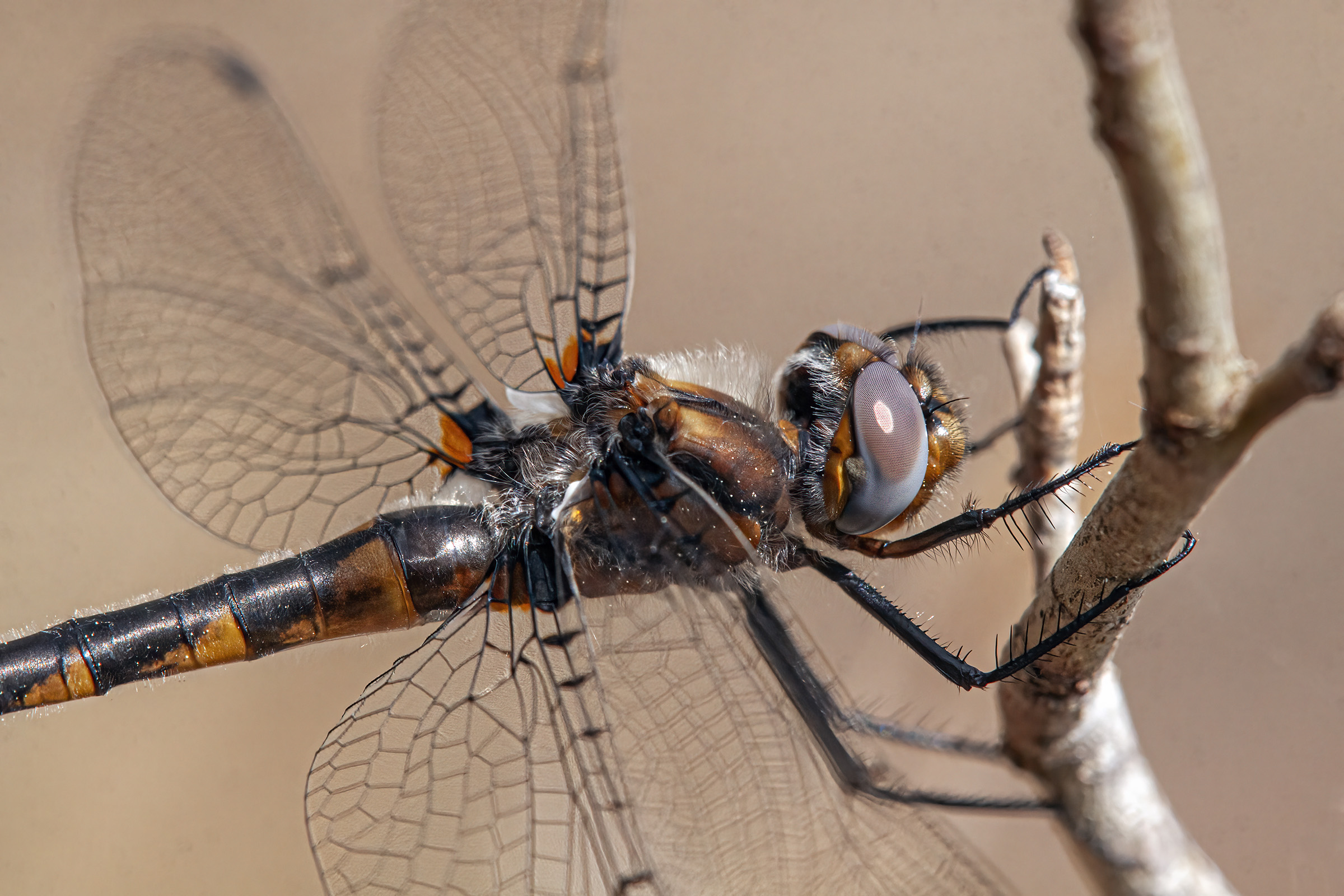
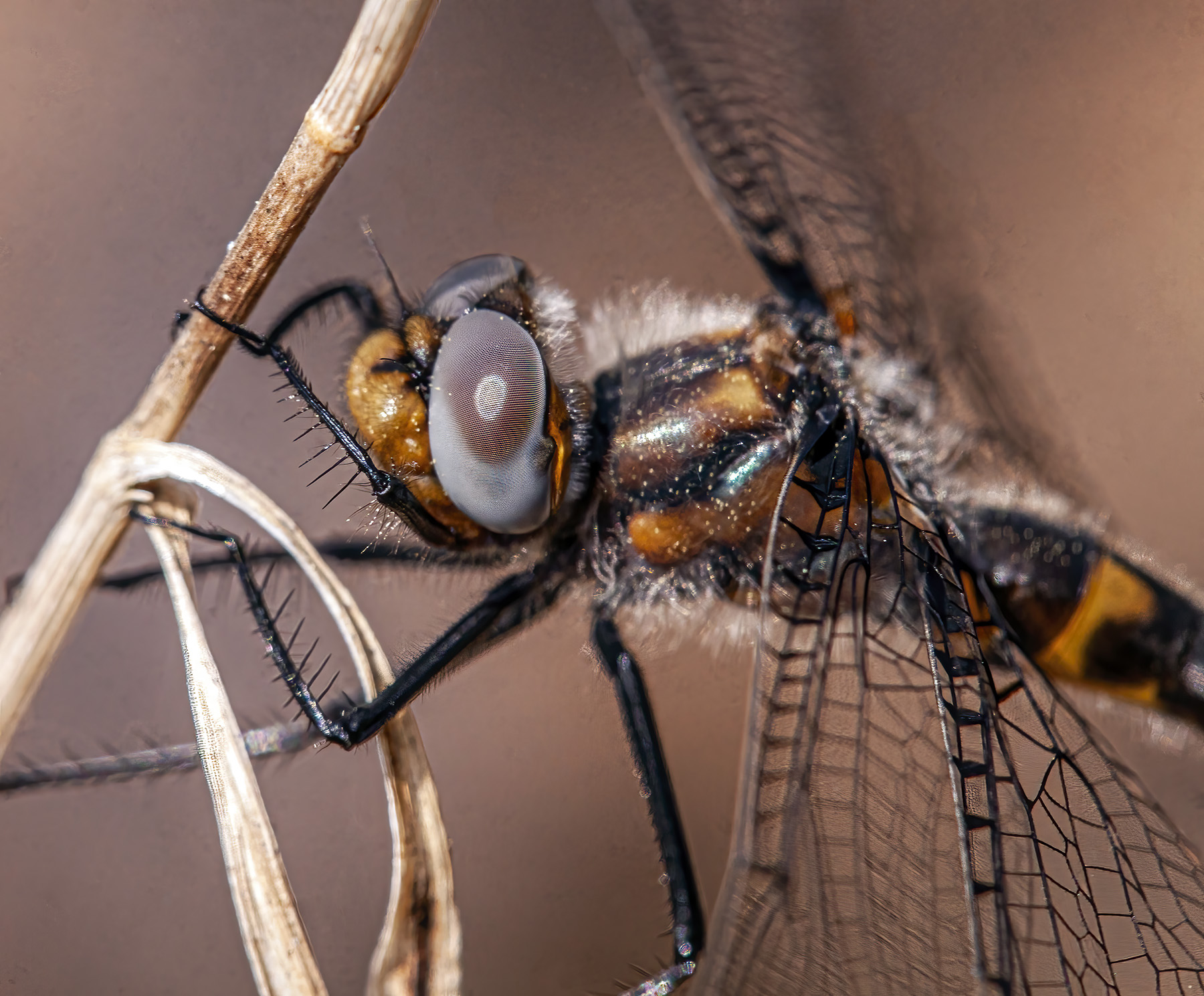
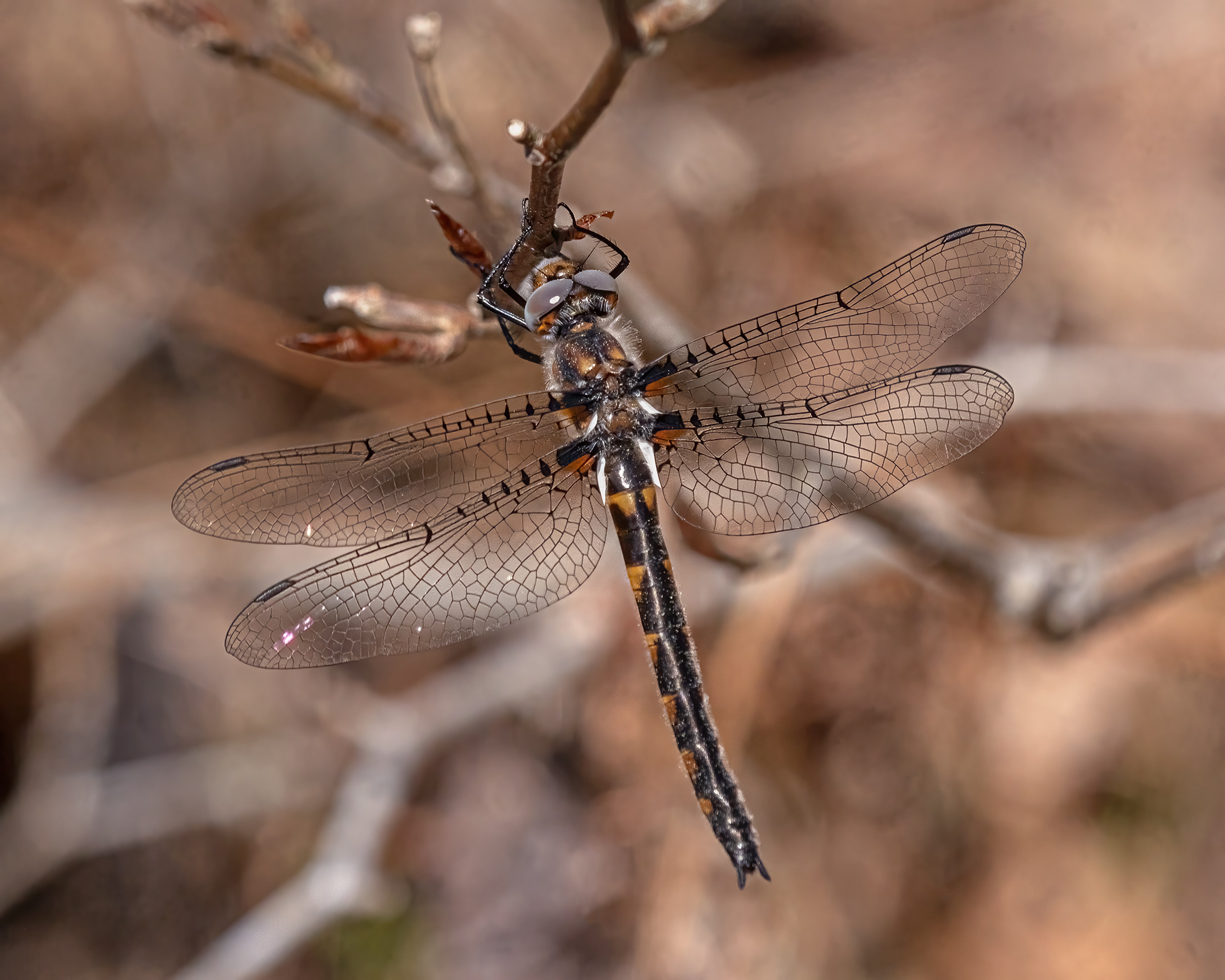
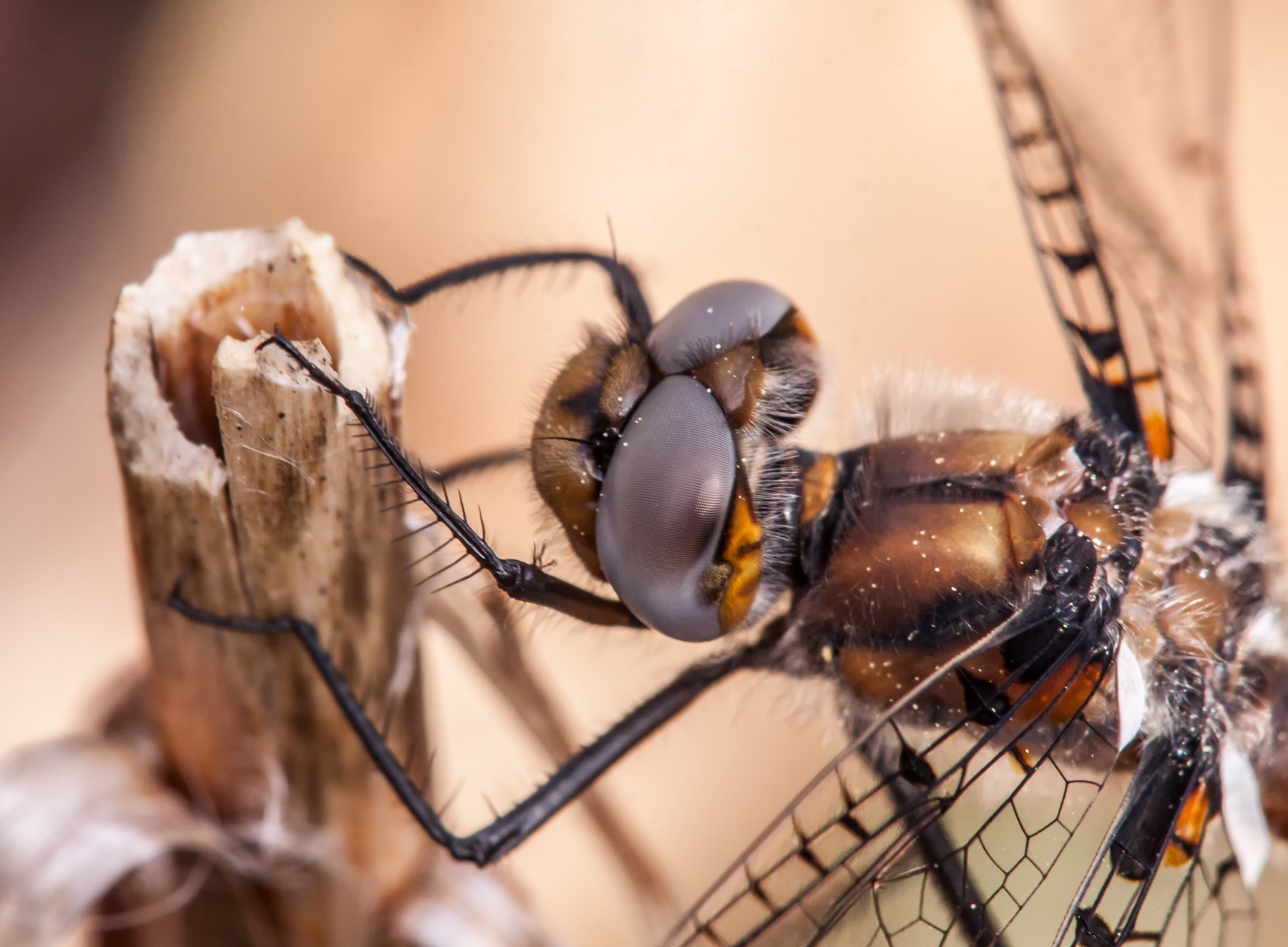
Have you ever taken a close-up look at a dragonfly’s amazing compound eyes? Dragonflies have the largest compound eyes of any insect; each containing up to 30,000 facets, and the eyes cover most of the insect’s head, resembling a motorcycle helmet. According to a wonderful article by GrrlScientist, “each facet within the compound eye points in a slightly different direction and perceives light emanating from only one particular direction in space, creating a mosaic of partially overlapping images.”

How exactly does that work? Scientists are still not sure how this visual mosaic is integrated in the dragonfly’s brain. If you can get close enough for a shot, you can actually see the individual facets, technically known as ommatidia. The first image below is a cropped image of an unusually cooperative Uhler’s Sundragon (Helocordulia uhleri) that I encountered last Friday while exploring a stream in Prince William County. If you click on the image, you can see the pattern of facets in the eyes.

The second image is an uncropped version of the first photo. I like the way that I as able to capture so many details of the dragonfly as it perched, like the spiky hairs on its legs and the stubble on its face as well as the pollen on its body.

The dragonfly in the third shot is another Uhler’s Sundragon that I spotted later in the day. From this angle, you can see the dragonfly’s tiny feet as it grasps the dried stalk of vegetation.

I love close-up images and will often try to capture them after I have taken some initial shots. When I am at close range, the angle of view is particularly important, because the depth of field is so shallow—some legs of the dragonfly, for example, will inevitably be out of focus, so I have to choose carefully what I want to be in focus.

Hand-holding and breathing techniques are also really important, because any movement will cause the fine details to be blurred. This is a bit of a challenge with the 180mm macro lens that I use because it does not have any built-in image stabilization.

Uhler's Sundragon

Uhler's Sundragon

Uhler's Sundragon

© Michael Q. Powell. All rights reserved.

Read Full Post »

I finally found my first dragonfly of the season yesterday—a female Uhler’s Sundragon—while I was exploring a stream in Prince William County. Uhler’s Sundragons (Helocordulia uhleri) are considered to be rare in our area. This species requires a very specific type of habitat and has an early and very brief flight period.

So where would you find one? According to the wonderful Dragonflies of Northern Virginia website, “Uhler’s need clean, small to medium, rocky forest streams with gravelly and/or sandy substrate, and a decent flow. They can be found in sunny clearings and forest edges near their streams.”

Fortunately I have found this species at a particular stream the last several years, so that is where I headed yesterday. I searched the spots where I had found Uhler’s Sundragons in the past, but came up empty-handed. I walked along extended lengths of the stream and eventually found the one in the photograph below—it was the only dragonfly that I spotted all day.

My hike yesterday lasted 4 hours and 42 minutes and covered 7.18 miles (11.55 km), according to my GPS app. My pace was pretty slow, partly because I was scanning for dragonflies, but also because the terrain was full of ups and downs. I pasted in a chart from the GPS readout to give you an idea of the type of terrain that I covered. According to my iPhone, I walked up the equivalent of 21 floors, which explains why my legs are a little sore this morning.

As many of you know, dragonflies are my favorite subjects during the warm months—there is something almost magical about these beautiful aerial acrobats. I am therefore super excited that the 2022 dragonfly season has officially started for me.

Uhler's Sundragon

Hike 11 April 2022

© Michael Q. Powell. All rights reserved.

Read Full Post »

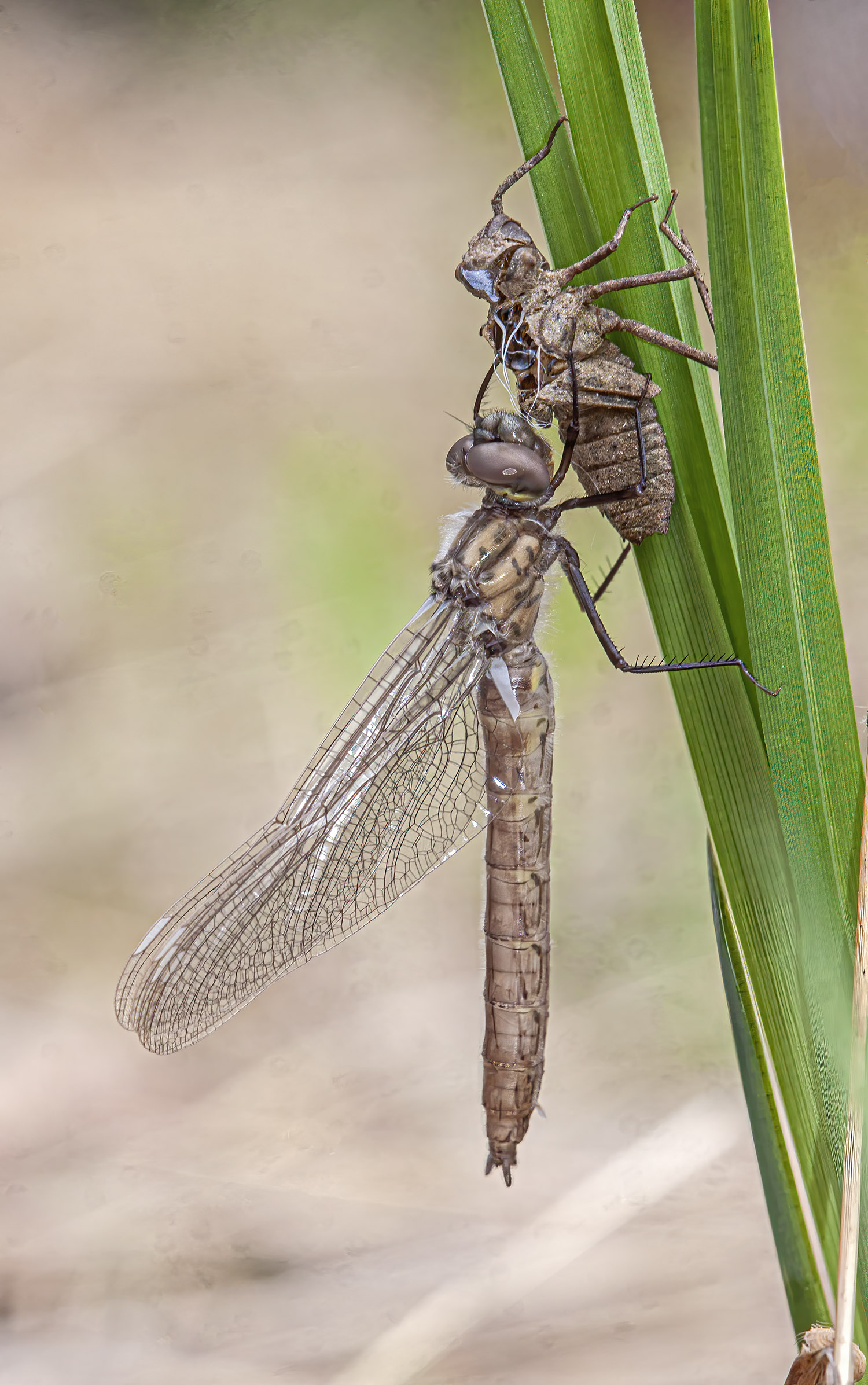
Have you ever watched a dragonfly-to-be break out of its exoskeleton and undergo a remarkable metamorphosis from a water-breathing nymph to an amazing aerial acrobat? It is an amazing and fascinating process that rivals (or maybe even surpasses) the more familiar transformation of a butterfly that many of us studied in school.

On a recent excursion to look for dragonflies in Prince William County, my good friend and fellow dragonfly enthusiast Walter Sanford excitedly called out to me that he had spotted a dragonfly that was midway through the process of emergence. We had not had much success up to that point in the day, so Walter’s news was especially welcome.

When dragonflies are in the process of emergence, they are very vulnerable. Their bodies are undergoing some incredible changes and they do not yet have the ability to fly. If you look at the first photo and compare the size of the exoskeleton (often referred to as an exuvia) to that of the dragonfly, you can get a sense of the magnitude of the changes that were occurring.

I moved a little closer for the second shot, being careful not to disturb the dragonfly, in order to capture some additional details. The exoskeleton shows, for example, little wing pads that are tiny when you compare them to the wings that are still closed over the dragonfly’s body. A little later in the process, the dragonfly will unfold the wings and will be be able to fly, albeit weakly at first.

At this stage, we could tell that the dragonfly was a female, because of the shape of the terminal appendages, but we could not determine its species, because its colors and markings were still really pale. Depending on the species, this transformation process can take as long as several hours and it can sometimes take a few days for the colors and markings to darken. (If you are interested in this whole process, I witnessed the it from start to finish several years ago and took a series of photos that documented the process in a blog posting called Metamorphosis of a dragonfly.)

Walter was eventually able to determine that this was a female Uhler’s Sundragon (Helocordulia uhleri). My final photo shows an adult female Uhler’s Sundragon that I photographed later that same day, so you can easily see that the dragonfly was not yet done with her transformation when we photographed her. 

How did Walter do it? For the answer to that mystery, check out Walter’s blog posting today called Uhler’s Sundragon dragonfly (emergent female) for the fascinating story of his detective work and additional photos and details of our encounter with this emerging dragonfly.

Uhler's Sundragon

Uhler's Sundragon

Uhler's Sundragonfly

© Michael Q. Powell. All rights reserved.


Read Full Post »

Normally when I photograph a new species of dragonfly I am immediately ecstatic, but that was not the case on Tuesday. After a long day of searching for Uhler’s Sundragons (Helocordulia uhleri) in Prince William County with fellow dragonfly enthusiast Walter Sanford, we were excited when we finally spotted a few of them. It had been an overcast day and it was only when the sun came out after noon that the dragonflies began to appear. Walter was thrilled, but my excitement was a little more muted, because I had photographed this species the previous week—check out my posting First dragonflies of the season for details and photos of my adventures that day.

After a while, Walter noted to me that all of the Uhler’s Sundragons that he had seen so far were female and that he hoped he would see a male. This may sound a little strange, but with some species of dragonflies, the females hang out in a separate area from the males until they are ready to mate, so you do not always see the genders intermixed.

I was wandering around the area a bit, as I am prone to do, when Walter called out to me that he had found a male. I rushed over and managed to get some shots of the specimen, including the first two images below. As it turns out, that was the only male that we saw all day.

The following day, Walter sent me an excited Facebook message informing me that the male dragonfly that we had both photographed was not a Uhler’s Sundragon, but was a Selys’s Sundragon (Helocordulia selysii), a similar species that neither of us had ever seen before. Walter did a records search and it looks the species had never before been documented in Prince William County. Finally I was ecstatic.

How did we not notice immediately that this was a different species? One of the primary differences between the species is that Uhler’s Sundragons have amber-colored markings mixed with dark ones at the base of their wings, while Selys’s Sundragons have only the dark markings. Given the small size of these dragonflies, these differences are hard to spot in the field, but are much easier to see when reviewing images afterwards.

For comparison purposes, I have included a photo of a male Uhler’s Sundragon that I photographed last week. If you look carefully, you can see the amber-colored markings in the final photo that are absent in the first two photos.

You may also notice that there is a spider on the branch in the final photo that appears to be reaching down and tapping the dragonfly on the “shoulder.” In this scenario, I am not sure which species would be the predator and which would be the prey. I have documented several cases in which dragonflies have been caught in spiderwebs and also a case when a jumping spider took down a much larger dragonfly (see my 2014 posting Spider captures dragonfly—the story for a fascinating series of images).

If you would like to see Walter’s account of our encounter with the Selys’s Sundragon, check out his blog posting today entitled Selys’s Sundragon dragonfly (male).
Sely's Sundragon

Selys’s Sundragon, 13 April 2021

Sely's Sundragon

Selys’s Sundragon, 13 April 2021

Uhler's Sundragon

Uhler’s Sundragon, 8 April 2021

© Michael Q. Powell. All rights reserved.

Read Full Post »

On Thursday I finally photographed my first dragonflies of the season. I had previously spotted Common Green Darners several time, but they don’t really “count” because I was not able to capture images of them. I initially checked out several locations at a stream in Prince William County, Virginia, where I had seen Uhler’s Sundragon dragonflies (Helocordulia uhleri) in recent years and came up empty-handed.

However, I was thrilled when later in the day I spotted Uhler’s Sundragons at several locations further upstream from my previous locations. Uhler’s Sundragons have a brief and very early flight period and are considered rare in our area. They also are habitat specialists and “they need clean, small to medium, rocky forest streams with gravelly and/or sandy substrate, and a decent flow,” according to the wonderful Dragonflies of Northern Virginia website.

These three photos are indicative of the types of photos that I often try to capture of dragonflies. I love to try to get as close as I can and take extreme close-up shots, like the first one. You can easily see the spines on the legs of the dragonfly and even some of the ommatidia, the optical units that make up the amazing compound eyes of the dragonfly.

The second shot of a female Uhler’s Sundragon is a good illustration of the way that I try to separate my subjects from the background. The final shot of a male Uhler’s Sundragon shows more of the habitat in which I found the dragonfly. The background is a little busy, but I like the way that the image shows the transparency of the dragonfly’s wings.

In case you are curious about how I can tell the gender of these dragonflies, one of the primary keys is to look at the tips of the abdomens (the “tail”)—you will probably note the different anatomical shapes if you compare the second and third images.

Uhler's Sundragon

Uhler's Sundragon

Uhler's Sundragon

© Michael Q. Powell. All rights reserved.


Read Full Post »

I wasn’t sure if Uhler’s Sundragon dragonflies (Helocordulia uhleri) would still be around when I set out exploring in Prince William County earlier this month. This species of dragonfly is one of the first to appear in the spring and generally is flying for only a month or so. I had spotted several females on the third of April—see my posting Female Uhler’s Sundragons for details and photos—so I knew that the clock was ticking.

I scoured all of the locations where I had seen them in the past and was about to give up hope when some movement low in the vegetation caught my eye. I was excited to see that it was a Uhler’s Sundragon, my target species. As I tried to control my racing heart and slow down my breathing, I maneuvered into position and was able to capture this image of a handsome male Uhler’s Sundragon. As it turned out,  this dragonfly was the only one of its species that I would see that day and I have not seen one since. In this case, though, one was more than enough.

Uhler's Sundragon

© Michael Q. Powell. All rights reserved.

Read Full Post »

I felt like I had hit the jackpot last Friday when I finally spotted several Uhler’s Sundragon dragonflies (Helocordulia uhleri) while exploring a stream in Prince William County, Virginia. Uhler’s Sundragons are a scarce and seldom seen dragonfly species with a brief and early flight period. There is a very active Virginia dragonfly group in Facebook that posts sightings and photos and it appears that my sightings of this species were the first in our state for 2020.

Last year I was able to do some reconnaissance of an area where this species had been spotted in previous years using information shared with me by fellow dragonfly fanatic and blogger Walter Sanford. Eventually I found and photographed some Uhler’s Sanddragons and he and I were able to spot them again several times.

This species generally is found in a specific type of habitat—”Clean, sandy or gravely forest streams with a mix of riffles and pools,” according to the excellent Dragonflies of Northern Virginia website. So Friday I scoured the locations where had spotted them last year and it was in one such location that I spotted the Ashy Clubtail and Common Green Darner that I featured recently in my posting First dragonflies of the season. I looked for Uhler’s Sundragons there but came up empty-handed.

It was at a second spot that I finally spotted one as it flew through the air and landed on a piece of vegetation. There is not much flying this early in the season and I could tell from the way that it perched that it was probably my target species. I think I was shaking a little bit and certainly my heart rate had accelerated, but I managed to get a shot of that one (the middle shot below), before it flew away. A few minutes later, I had another spotting and captured the last shot below—it might have been the same dragonfly or a different one.

Part of my long walk back took me along another stretch of the same stream and I was absolutely thrilled when I spotted yet another Uhler’s Sundragon and captured my favorite shot of the day, the first one below. It turns out that all of the Uhler’s Sundragons that I photographed were females. I am not sure if the males were all out patrolling or were simply in other locations.

Many of the locations where I might normally search for dragonflies are closed and some of the others are potentially crowded, so I am not willing to go there. As you can see from my recent postings, I am staying really close to home most of the time, with trips like this one to remote locations being a rare exception.

Uhler's Sundragon

Uhler's Sundragon

Uhler's Sundragon

© Michael Q. Powell. All rights reserved.

Read Full Post »

You know you are pretty close to a dragonfly when you can see individual grains of pollen on its head and body. I photographed this Uhler’s Sundragon dragonfly (Helocordulia uhleri) on 12 April alongside a creek in Northern Virginia. Ideally it would be best to stabilize macro shots taken at this close a range by placing the camera on a tripod, but in a field situation with a live subject, that is rarely possible.

If you click on the individual images, you will see some wonderful details, like the ommatidia, the individual optical units that make up the amazing compound eyes of these dragonflies.

Uhler's Sundragon

uhler's sundragon

© Michael Q. Powell. All rights reserved.


Read Full Post »

On Wednesday I finally photographed my first dragonflies of the season, some Uhler’s Sundragons (Helocordulia uhleri) that I spotted while exploring a creek in Northern Virginia. This was my first time seeing this species and I was particularly excited, because it is considered to be rare in my area. According to the Dragonflies of Northern Virginia website, this species is a “scarce and seldom seen member of the emerald family” and is a “habitat specialist with a brief and early flight period.”

Initially I took some medium distance shots with my 180mm macro lens and them moved in closer to get the first shot. In order for me to get such a close-up shot, the dragonfly has to be cooperative and this female Uhler’s Sundragon was quite accommodating.

As you probably notice in the first photo, only a limited amount of details are in focus when shooting a subject this close.  One of the biggest challenges is to ensure that the most important features are the sharpest. Following the usual rule for photographing live subjects, I attempted to focus on the eyes.

For me, dragonfly season is now open and I anticipate that I will be featuring different species of these beautiful aerial acrobats quite regularly in the upcoming months.

Uhler's Sundragon

Uhler's Sundragon

Uhler's Sundragon

© Michael Q. Powell. All rights reserved.

Read Full Post »