Feeds:
Posts
Comments

Posts Tagged ‘Tamron 18-400’

There are quite a few blue dragonflies where I live, so I can’t always rely on color to tell them apart. Fortunately, it is relatively easy to identify a male Spangled Skimmer (Libellula cyanea), because it has a lighter-colored spot beside a black spot on the outer leading edge of each wing—as far as I know, no other dragonfly in our area has multi-colored stigmata, the technical name for those spots.

The stigmata are not there for decoration, but reportedly serve an important role in the flight of dragonflies. I do not really understand the physics of flight, but have read that the stigmata are heavier than the adjoining cells and help to stabilize the vibrations of the wings.

I spotted this male Spangled Skimmer as he was perched in the vegetation at the edge of a small pond at Shrine Mont, an Episcopal Church retreat center, in Orkney Springs, Virginia. Most often I try to get side views of dragonflies in order to get most of the body in focus, but in this case I deliberately tried to focus on the dragonfly’s large, compound eyes, knowing that much of the body would fall out of focus. This allows the viewer’s attention to be drawn immediately to those eyes.

I encourage you to click on the image to get a closer look at the dragonfly’s amazing eyes.
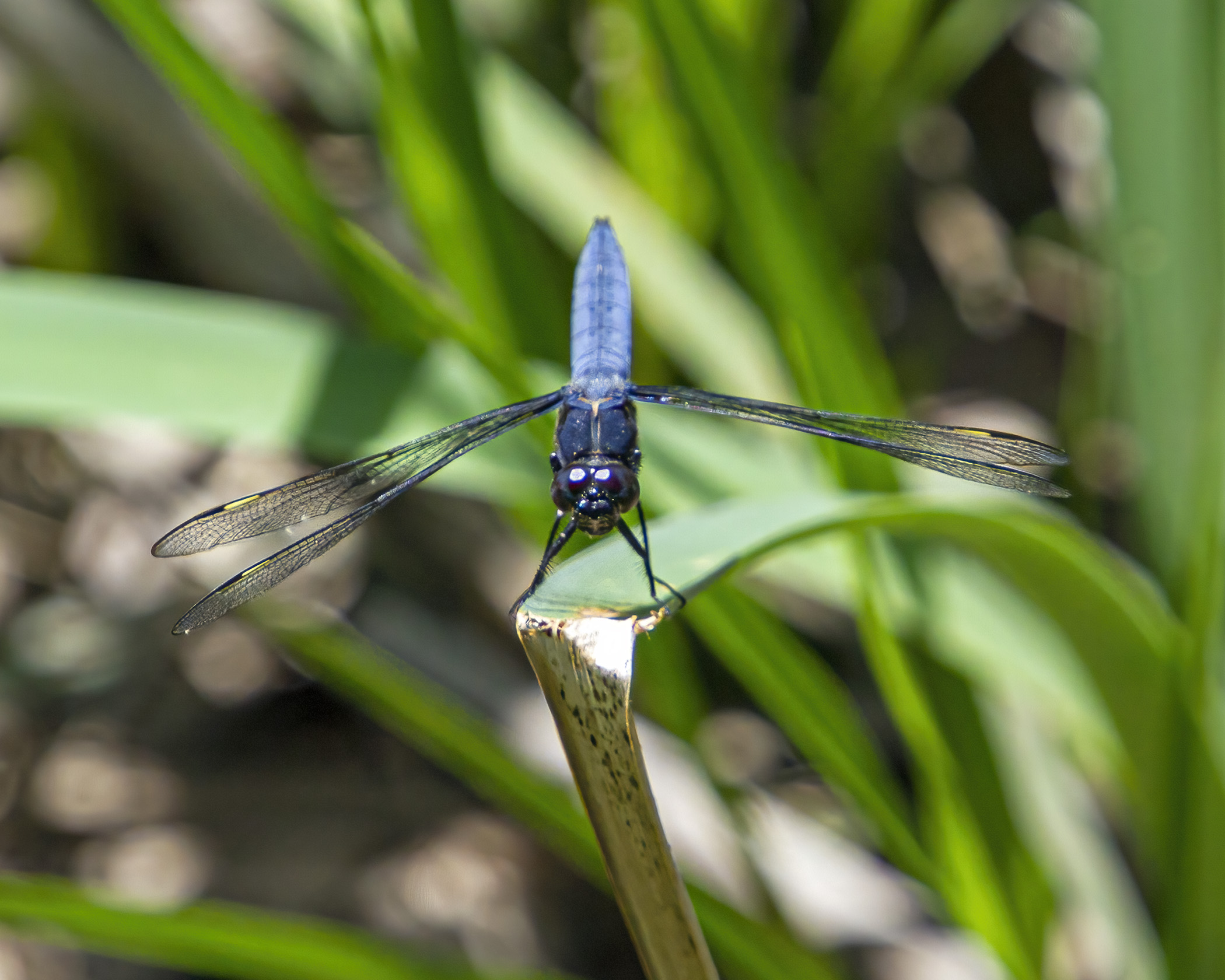
Spangled Skimmer

© Michael Q. Powell. All rights reserved.

Read Full Post »

As I prepared to take a step closer to a pond last Friday at Occoquan Bay National Wildlife Refuge, I suddenly saw that there was a large snake in the vegetation right where my foot was about to land. My mind quickly processed the information and came to the conclusion that it was probably “only” a Northern Water Snake (Nerodia sipedon), a non-poisonous snake that is quite common where I live.

Not wanting to disturb the snake, I backed off a little and captured this shot of the snake that was pretty well hidden in the vegetation. My mission completed, I continued on down the trail and the snake was able to resume its basking in the warmth of the autumn sunlight.

Northern Water Snake

© Michael Q. Powell. All rights reserved.

Read Full Post »

I don’t take selfies very often, but decided to make an exception on Saturday when I was seated on Dege Peak (elevation 6982 ft (2128 m)) with Mount Rainier prominently behind me. I must confess, though, that I started my hike at 6100 feet (1859 m), so it is not all that impressive, though my iPhone indicates that I climbed the equivalent of 54 floors that day.

On previous visits to Mount Rainier, I have always entered at the Nisqually entrance that allows you to go as far as the Paradise Visitor Center, which is located at an elevation of 5400 ft (1645 m). It is the most easily accessible entrance and is therefore crowded most of the time.

During Saturday’s trip, I entered the park via the Sunrise entrance, which is located 60 miles (97 km) from the Nisqually entrance. The Sunrise entrance is open only from the beginning of July, when the snow is finally cleared, to early September. The Sunrise visitor center, located at an elevation of 6400 feet (1950 m), is the highest point you can access by car in the park.

I never did make it to the visitor center parking lot, which was crowded. Instead I stopped at a parking area at 6100 feet (1859 m) and hiked along the Sourdough Ridge Trail that took me up even higher than the visitor center. The views were spectacular and I was alone most of the time.

The second image shows one of those amazing views of Mount Rainier from that trail. I felt like I was looking straight across at the snow-covered mountain, although in actuality the peak of Mt Rainier was much higher at an elevation of 14,411 ft (4392 m).

I captured the final image of Sunrise Lake by looking back in the direction that I had hiked. The beautiful little lake was located just below Sunrise Point, where my car was parked.

Mt Rainier

Mt Rainier


Sunrise Lake

© Michael Q. Powell. All rights reserved.

Read Full Post »