Feeds:
Posts
Comments

Posts Tagged ‘Tamron 150-600mm’

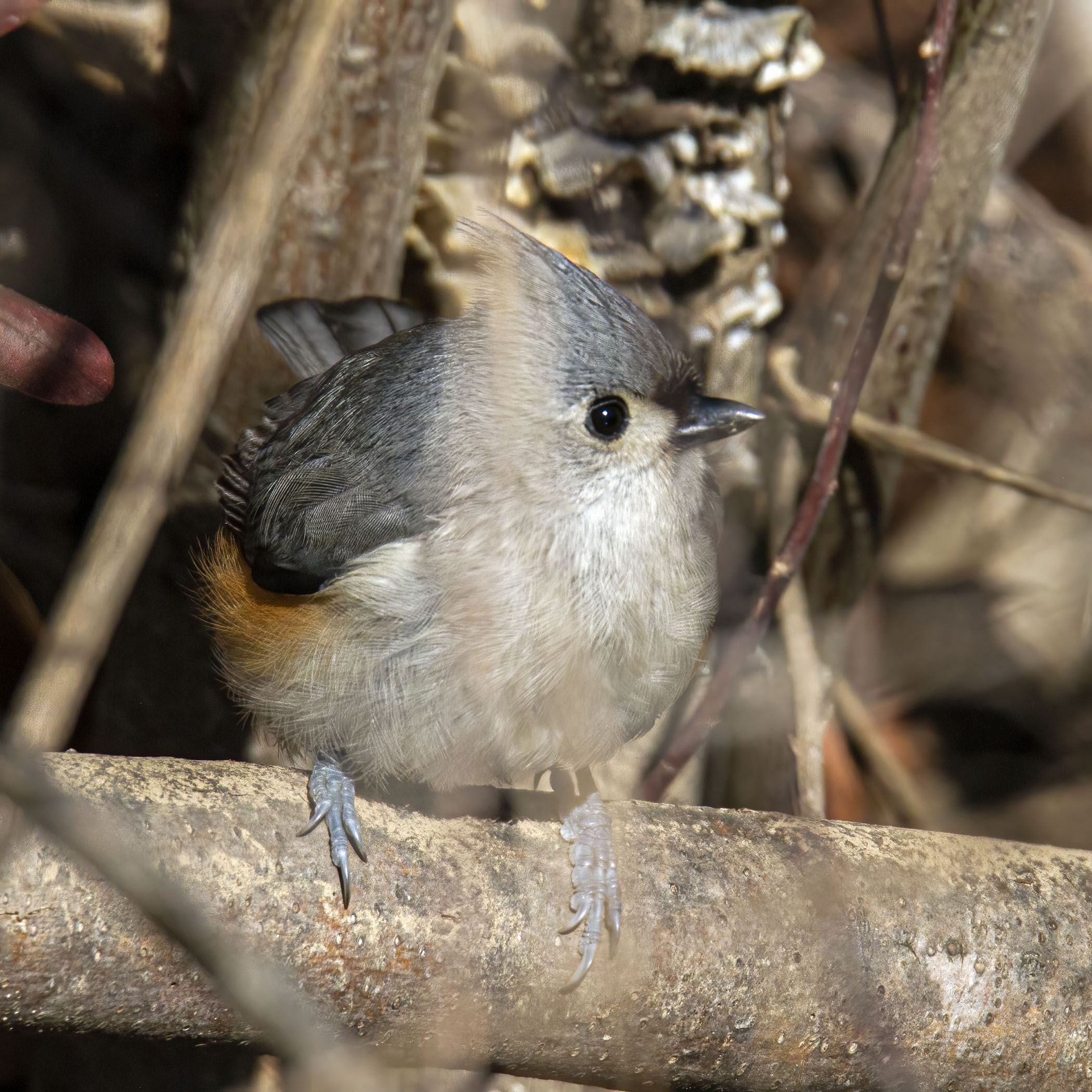
This acrobatic Red-bellied Woodpecker (Melanerpes carolinus) was twisting and contorting its body as it foraged last week in the trees at Occoquan Bay National Wildlife Refuge when I spotted it. In the first photo I managed to get a look at the bird’s red belly, a feature that is often hidden from view. The woodpecker seemed to be enjoying some success, though not surprisingly the pickings were fairly meager at this time of the year.

Red-bellied Woodpecker

Red-bellied Woodpecker

© Michael Q. Powell. All rights reserved.
Read Full Post »

This Great Blue Heron (Ardea herodias) was having pretty good success in catching some small fish one morning last week at Occoquan Bay National Wildlife Refuge. I personally do not like to have fish for breakfast, but am aware that some people like lox, mackerels, or other kinds of fish with their morning meals. As the old Latin saying goes, “De gustibus non est disputandum” (“There is no accounting for taste.”)

Great Blue Heron

© Michael Q. Powell. All rights reserved.

Read Full Post »

I had been lethargic and uninspired throughout December, but decided on Monday to visit Occoquan Bay National Wildlife Refuge to try to find some birds before the end of the year. As I walked along one of the trails, I spotted a small bird in the trees and tracked it as it moved about. I was not sure what it was, became a little excited when I thought I spotted a bit of yellow.

There are not many colorful birds in our area during the winter months, so I patiently kept tracking this bird. When I captured the first image below, I convinced myself that I would see traces of yellow in the breast of the bird. Eventually the bird turned and faced the opposite direction and I got a good look at the bright yellow patch on its rump—it was a Yellow-rumped Warbler (Setophaga coronata), one of very few warbler species that I might see during the winter months.

It was a nice treat for me at the end of the year. Happy New Years to you all and best wishes for a healthy and happy 2025.

Yellow-rumped Warbler

Yellow-rumped Warbler

© Michael Q. Powell. All rights reserved.


Read Full Post »

As I was exploring Occoquan Bay National Wildlife Refuge last week, I spotted a Bald Eagle (Haliaeetus leucocephalus) perched high in a sweetgum tree. The eagle seemed to be surveying the entire area, like a king keeping watch over his kingdom. I am pretty sure that he spotted me, but may have judged correctly that I was not a threat, and therefore the eagle remained in place as I passed on by.

bald eagle

© Michael Q. Powell. All rights reserved.


Read Full Post »

Do turtles show affection? If so, how do they overcome the obstacle posed by their hard shells?

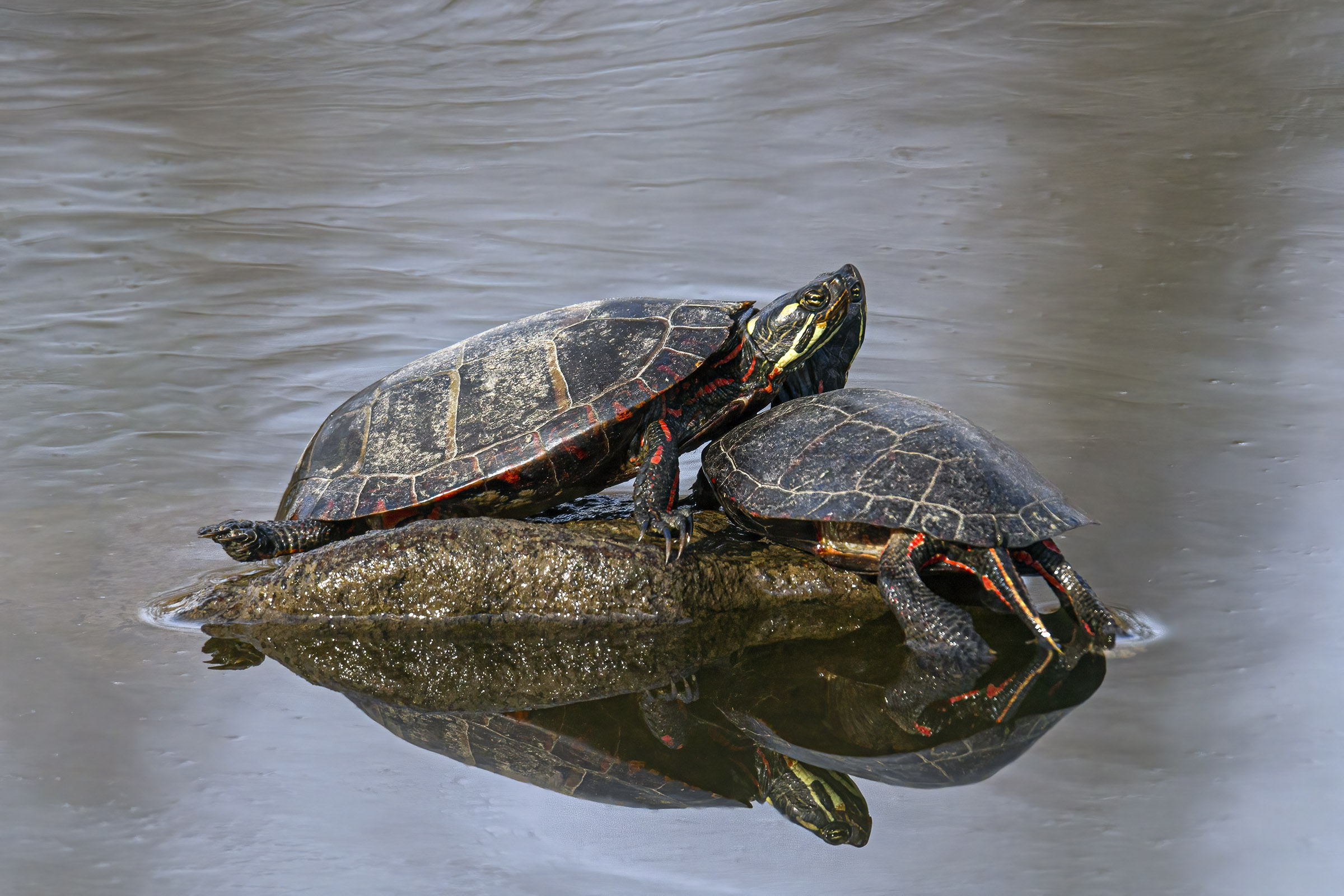
Last week on an unusually warm December day, I spotted two Eastern Painted Turtles (Chrysemys picta) sitting on a log in a small swampy pond at Occoquan Bay National Wildlife Refuge. They were sitting pretty close to each other, which was not unusual given the small size of the log. What really struck me, though, was the way that they appeared to be rubbing the sides of their faces against each other.

Was this a sign of affection? It certainly seemed that way to me.

I’ve met people who appear to have as tough an exterior as these turtles. How do you reach people like that? Persistent small act of unrequited kindness may help to penetrate those barriers. For me, that is what Christmas is all about, an attitude towards others that lasts a whole lot long that a single-day celebration.

A belated Merry Christmas to all of you who celebrated yesterday and best wishes for a happy and healthy 2025 to you all.

Painted Turtles

© Michael Q. Powell. All rights reserved.

Read Full Post »

Last week I spotted a Bald Eagle (Haliaeetus leucocephalus) couple perched near each other in a tree at Occoquan Bay National Wildlife Refuge. Although it is not quite nesting season here in Northern Virginia, the eagles were within eye sight of the large nest that you can see in the second photo below. It is hard to get a sense of the massive size of the nest from the photo, but it is so large that the eagles disappear from sight when they are sitting on eggs in that nest.

I suspect that the eagles will soon occupy that nest and, with a little luck, I hope to see some baby eagles in the next few months.

Bald Eagle

eagle nest

© Michael Q. Powell. All rights reserved.


Read Full Post »

The last time that I recall seeing an American Goldfinch (Spinus tristis) was during breeding season, when the goldfinch was bright yellow in color. That breeding season is long gone and the plumage of goldfinches is a lot drabber in color. I spotted this goldfinch on Tuesday at Occoquan Bay National Wildlife Refuge and captured this moment when the little bird was sticking out its tongue.

I am not sure if the bird was singing at the time or was merely clearing its throat. Whatever the case, it definitely was cool to be able to see the tiny tongue of the little goldfinch.

American Goldfinch

© Michael Q. Powell. All rights reserved.


Read Full Post »

This last week or so, I have had several opportunities to capture “artistic” shots of Great Blue Herons (Ardea herodias) at Occoquan Bay National Wildlife Refuge. In these cases the heron was not actively engaged in fishing and was standing in the vegetation a bit removed from the water.

In the first two photos, I was struck by the beautiful light that was falling on the heron. I particularly like the heron’s pose in the first image in which the heron has his neck stretched out, giving him a very slim profile. In the final photo, the heron was partially hidden by the reeds and is much more hunched over in an effort, perhaps, to retain his body heat.

Great Blue Heron

Great Blue Heron

Great Blue Heron

© Michael Q. Powell. All rights reserved.

Read Full Post »

Are you a messy eater? Do you feel a need to constantly wipe your face with a napkin? Do you wonder if you have visible food stuck between your teeth? If you are like most people, you are very self-conscious about your appearance.

Birds, on the other hand, don’t seem to mind it when the remains of their last snack remain on their faces. Of course, the absence of mirrors and selfie cameras on cell phones probably makes them less aware of how they look or they simply don’t care.

Last week I spotted this White-throated Sparrow (Zonotrichia albicollis) at Occoquan Bay National Wildlife Refuge with some berry residue on its upper bill. Perhaps I merely caught the sparrow taking a momentary break from the feeding that seems to occupy the sparrows for most of their waking hours during the winter.

I felt an impulse to pull out a napkin to wipe this little sparrow’s face, but resisted that impulse and continued on my way, happy in the knowledge that the sparrow had been successful in finding something to eat.

White-throated Sparrow

© Michael Q. Powell. All rights reserved.

Read Full Post »

I confess that I know almost nothing about boats, so I was not sure what I was looking at when I spotted this enormous floating object in the Potomac River off of Occoquan Bay National Wildlife Refuge last week. Eventually I figured out that it was a boat pushing some kind of barge up the river. It looked a bit like a tugboat, but instead of “tugging” the boat, it seemed to be pushing from behind.

I have seen the difficulties that some folks have in towing a trailer, so I can’t imagine how difficult it must be to steer something like this. Fortunately the tugboat seemed to be taller than the barge, so presumably the captain was able to see where he was going, and it appeared that he was able to stay on course pretty well.

barge

© Michael Q. Powell. All rights reserved.

Read Full Post »

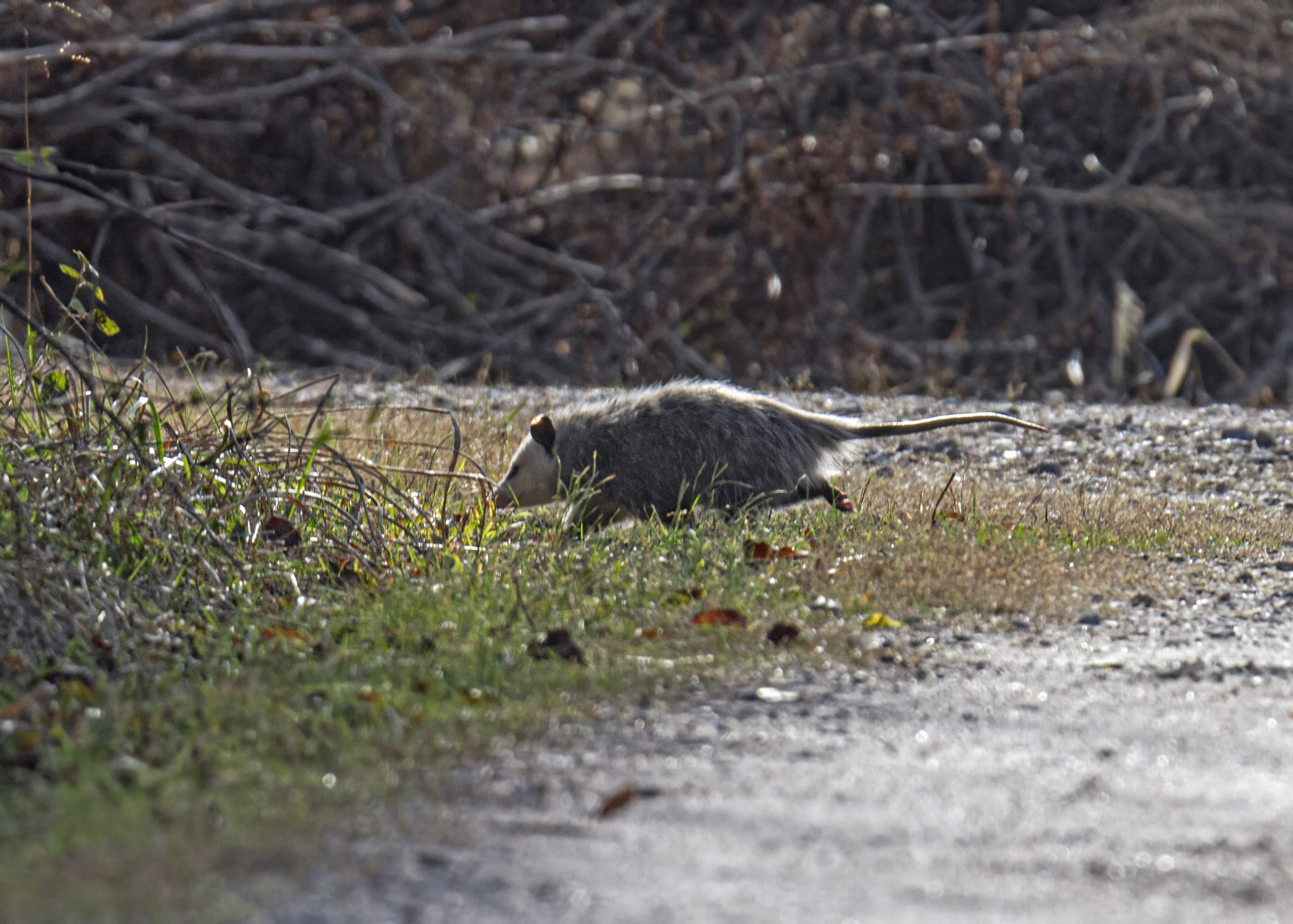
My mind was busy trying to identify the animal crossing the trail ahead of me on Thursday at Occoquan Bay National Wildlife Refuge, but my reflexes took over and I was able to capture these shots of what turned out to be an opossum (Didelphis virginiana), an animal that I rarely see. When I was doing a little research I learned that Virginia Opossums, also known as North American Opossums, are the only marsupial in the United States—most marsupials, including kangaroos, wallabies, and koalas, are found in Australia and New Guinea.

opossum

opossum

© Michael Q. Powell. All rights reserved.

Read Full Post »

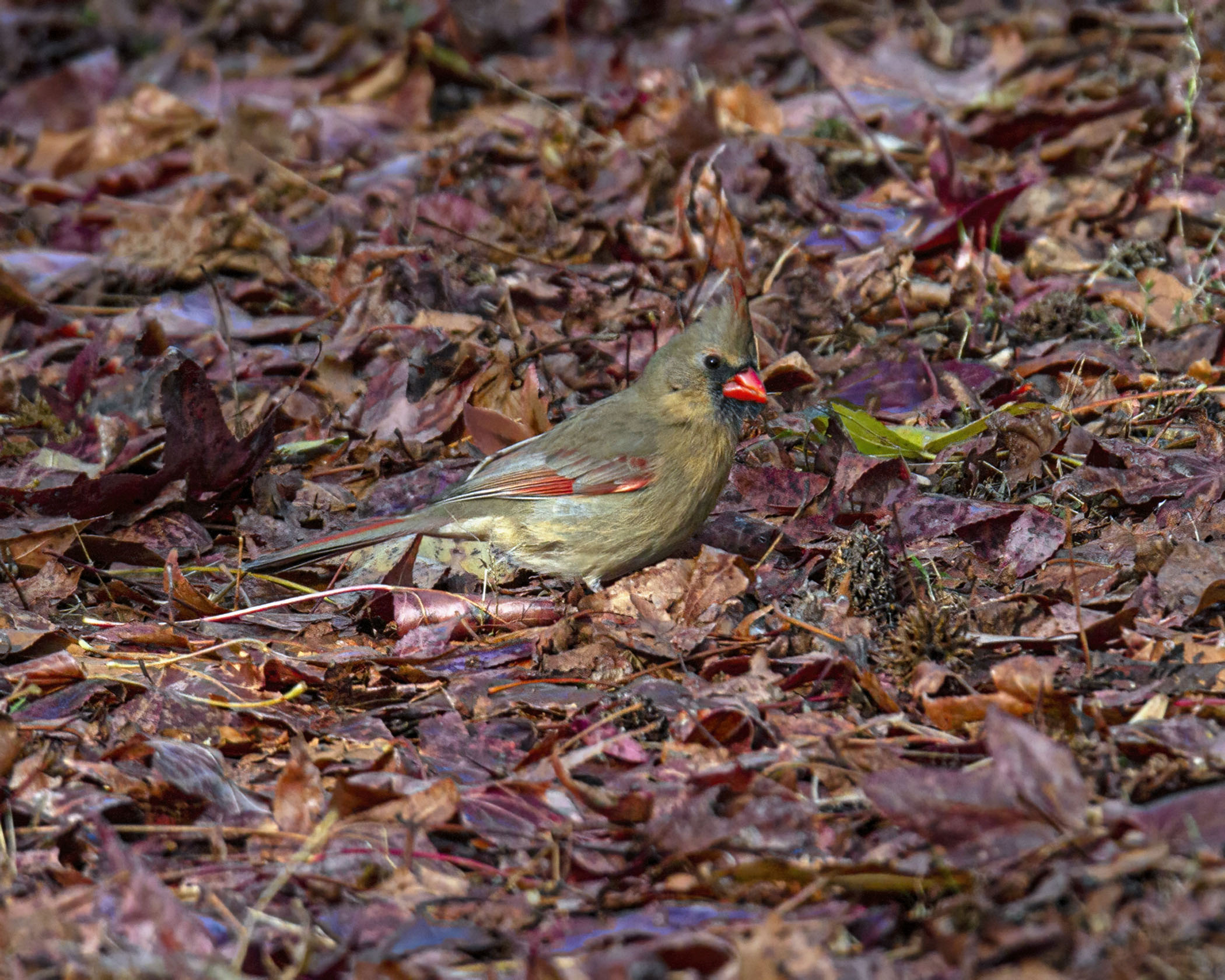
Most of the leaves have fallen from the trees by mid-December and the remaining birds have to work a lot harder to find food than in the warmer months. During a visit on Thursday to Occoquan Bay National Wildlife Refuge, I spotted a small group of Northern Cardinals (Cardinalis cardinalis) foraging among the colorful fallen leaves.

Unlike many other colorful birds that migrate out of our area, cardinals remain with us throughout the year, providing a pop of color in an often monochromatic winter landscape. Although the males, like the one in the final photo, are easier to spot, I often prefer the more subdued beauty of the females, like the one in the first photo.

female Northern Cardinal

Northern Cardinal

© Michael Q. Powell. All rights reserved.

Read Full Post »

Yesterday I watched a Great Blue Heron (Ardea herodias) fishing at Occoquan Bay National Wildlife Refuge. After an extended period of cold and cloudy days, it was a treat for both of us to be out in the somewhat warmer weather. Although the the heron was really focused on its task, its results were modest—the fish that it caught may well be the tiniest fish that I have ever seen a heron catch.

I am hoping that the heron was eventually more successful later in the day—it would take a lot of those tiny fish to satisfy its appetite.

Great Blue Heron

© Michael Q. Powell. All rights reserved.

Read Full Post »

At this time of the year I often see large groups of ducks, often referred to as “rafts” because the ducks gather so closely together, in the waters off of Occoquan Bay National Wildlife Refuge. Frequently there are different species of ducks intermixed, though in my experience there is usually a dominant species.

In later November, I spotted a large group of American Coots (Fulica americana) during a visit to the refuge, as you can see in the first photo below. Coots are pretty easy to identify because of the shape and color of their bills. In addition to the coots, a number of Ruddy Ducks (Oxyura jamaicensis) were part of the raft. I encourage you to click on the image to get a better look at the individual birds.

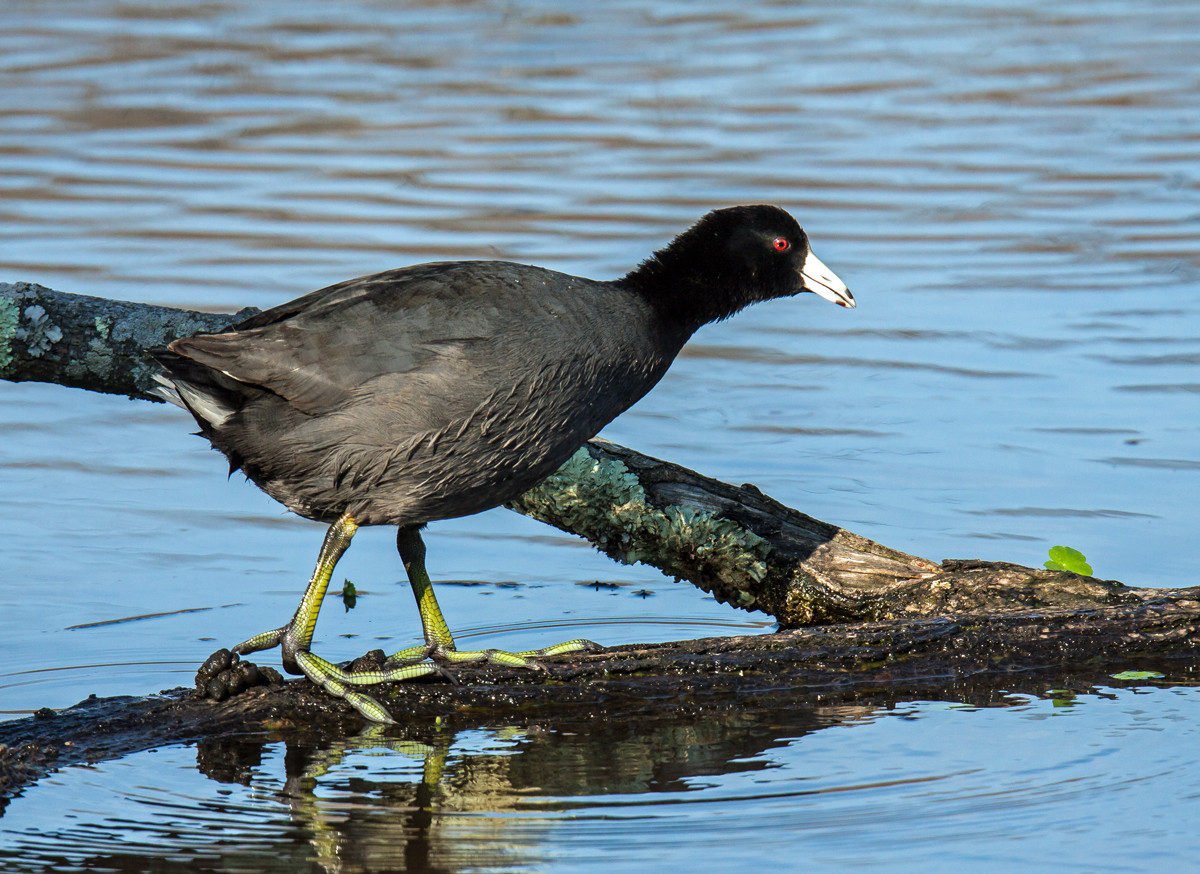
Technically, coots are not ducks, though, because they have lobed rather than webbed feet. The coots that day were too far away for me to get a shot of their feet, so I am instead including a photo I took in April 2017 that shows those lobed feet and the coot’s distinctive red eyes.

American Coots

American Coot

© Michael Q. Powell. All rights reserved.


Read Full Post »

Some birds, like the ospreys and Great Egrets, leave our area and migrate to warmer climates as winter approaches. Others, like Great Blue Herons (Ardea herodias), remain with us and have to work harder to find food.

Last week I spotted a heron standing in the shallow water of one of the tidal ponds at Occoquan Bay National Wildlife Refuge. In the past I have often seen herons wait patiently for extended periods of time to catch large fish, but this heron was content to strike often and pluck small fish from the water—every few minutes he would catch another fish, swallow it in a single gulp, and return to fishing.

I encourage you to click on the image to get a better look at the small fish in the heron’s bill and the visible spray of water droplets. I also really like the dynamism of the  heron’s pose that suggests both the energy and the focus of the heron.

Great Blue Heron

© Michael Q. Powell. All rights reserved.

Read Full Post »

It is still a little early for the Bald Eagles (Haliaeetus leucocephalus) to begin nesting at Occoquan Bay National Wildlife Refuge, but both members of an eagle couple were perched in a tree near a large nest last week when I visited the reserve. One of the eagles was partially blocked from view by the tree’s branches, but I was able to capture this image of the other one as it kept watch over the nesting site.

Bald Eagle

© Michael Q. Powell. All rights reserved.

Read Full Post »

During the winter I often see rafts of ducks in the waters off of Occoquan Bay National Wildlife Refuge. Usually they are gathered in the deep water, far from the shore and out of camera range for close-up shots, but I can usually identify them with my long telephoto lens.

On Wednesday during a visit to Occoquan Bay National Wildlife Refuge, I spotted a large group of mostly American Coots and Ruddy Ducks. When I examined the group really carefully, however, I noticed a pair of Ring-necked ducks (Aythya collaris) that were resting on a semi-submerged log. I have seen this species of diving ducks at other locations, primarily in ponds, but don’t recall seeing them in the open water like this.

I’m pretty sure that the duck in the first photo is a male Ring-necked Duck, thanks to his striped bill and distinctive yellow eye. I am a little less certain about the duck in the second photo, but I think it is probably a female Ring-necked duck because of the white eye ring. I am a little rusty with my bird identifications after a summer spent chasing mostly insects and mammals, but suspect that I will better as we move into winter.

Male Ring-necked Duck

Female Ring-necked Duck

© Michael Q. Powell. All rights reserved.


Read Full Post »

This past Tuesday I heard a lot of rustling in the underbrush as I walked about in Occoquan Bay National Wildlife Refuge. Sometimes the noise was caused by squirrels, but often it was the result of energetic White-throated Sparrows (Zonotrichia albicollis) foraging for food amidst the fallen leaves.

White-throated Sparrows overwinter in my area of Northern Virginia and seem to have arrived recently. I love the distinctive markings of these little birds, with their white “beards” and bright yellow lores, i.e. the region between the eye and the bill.

White-throated Sparrow

© Michael Q. Powell. All rights reserved.

Read Full Post »

I was delighted on Monday to spot multiple Autumn Meadowhawk dragonflies (Sympetrum vicinum) at Occoquan Bay National Wildlife Refuge. During the past couple of weeks I saw a few female Autumn Meadowhawks, but until this week I had not photographed a single male—I think that all of the dragonflies that I spotted that day were males. Females are mostly brown with touches of red, while the bodies of males are mostly red, as you can see in the photo below.

Autumn Meadowhawks are only about 1.2 inches (30 mm) in length, so they are difficult to spot, despite their bright coloration. At this time of the year when fallen leaves litter the ground, they tend to blend in pretty well with their surroundings.

I was using my Tamron 150-600mm lens with a monopod, my preferred combination for photographing birds, so it was a challenge to focus on such tiny subjects as dragonflies. I was persistent, however, and was successful in capturing some pretty detailed shots of them.

Autumn Meadowhawk

© Michael Q. Powell. All rights reserved.

Read Full Post »

Monday was a wonderfully sunny autumn day, so I headed out with my camera to Occoquan Bay National Wildlife Refuge. Suspecting that the insects were almost completely gone, I decided that I would primarily be searching for birds and switched to my longest telephoto lens, my Tamron 150-600mm zoom lens. This is a really versatile lens, but it has a minimum focusing distance of almost 9 feet (2700 mm), which makes focusing on small subjects problematic.

There were ducks on the bay, but they were too far away to photograph. I also spotted a few Bald Eagles as they flew away from me. Fortunately I had better luck with a Carolina Wren (Thryothorus ludovicianus) that I initially heard singing. I located the small bird and waited until it turned its head to the side and captured this wonderful little shot of the wren with its mouth wide open and its tail lifted up.

Carolina Wren

© Michael Q. Powell. All rights reserved.

Read Full Post »

I was looking for warblers last week when I visited Occoquan Bay National wildlife and this little bird with bright yellow coloration under its tail was one fo the very few that I was fortunate to spot. I don’t know my warblers very well, so my identification of warbler species is often incorrect. Nonetheless I pored over the images in my bird guide and on line and concluded that this might be a female Common Yellowthroat (Geothlypis trichas).

As is often the case, the male of the species is a lot easier to identify with his distinctive black mask, and females tend to me more nondescript. I’d welcome the views of more experienced birders if my identification is wrong. From my perspective, I am happy enough that I managed to capture this shot of the beautiful little bird.

UPDATE: One of my friends on Facebook identified the bird as a Palm Warbler. I really need to work on my identification skills.

Common Yellowthroat

© Michael Q. Powell. All rights reserved.

Read Full Post »

At this time of the year holiday preparations become intertwined at retail stores. I have already seen lots of displays for Halloween and suspect that I will see Christmas decorations for sale as well if I look a little harder. Indigenous Peoples Day and Thanksgiving Day are also part of this autumn blitz.

So I guess that it is not that surprising that I immediately thought of Thanksgiving Day when I spotted this Wild Turkey (Meleagris gallopavo) last week at Occoquan Bay National Wildlife Refuge. Turkeys are part of the lore of Thanksgiving and play a central role in the traditional feast, though commercial turkeys no longer bear much resemblance to their wild counterparts.

There are several flocks of wild turkeys at this wildlife refuge and I often encounter them foraging along the trails. When they see me, they usually move slowly into the undergrowth—I suspect that they have grown accustomed to the presence of humans, but do not want to interact with them most of the time. Strangely enough, that’s the same attitude that I display when I am out in the wild with my camera.

Wild Turkey

© Michael Q. Powell. All rights reserved.

Read Full Post »

I was delighted on Thursday to encounter my first Blue-faced Meadowhawk dragonfly (Sympetrum ambiguum) of the season at Occoquan Bay National Wildlife Refuge. A few minutes later I got a peek at a pair of mating Blue-faced Meadowhawks—spring is not the only season for love.

Blue-faced Meadowhawks are one of the prettiest dragonfly species that I have ever encountered. I love the contrast between their turquoise faces and their bright red bodies. Generally I spot them in the early autumn, just as most of the other dragonfly species are starting to disappear.

Blue-faced Meadowhawks will be around for a bit longer and then their “cousins,” the Autumn Meadowhawks will end up as the last remaining dragonflies of the season. In some years I have seen Autumn Meadowhawks as late as mid-December and a fellow photographer spotted one in early January one year. Autumn Meadowhawks also have red bodies, but have brown eyes.

Blue-faced Meadowhawk

Blue-faced Meadowhawk

© Michael Q. Powell. All rights reserved.


Read Full Post »

The weather forecast yesterday showed that there would be some sunshine, a welcome respite after a lengthy period of rainy and/or overcast weather, so I ventured out to Occoquan Bay National Wildlife Refuge. Some other photographers have recently posted photos of warblers there and I thought that I would try my luck, knowing that the still abundant foliage would hamper my efforts to spot them.

As I was walking along on one of the trails, I saw some flashes of yellow, a good indication of a possible warbler. I watched and waited and eventually managed to get a few shots of the bird. I vaguely recalled having seen this species before, but I couldn’t remember what it was. A short time later, I encountered a couple of birders with binoculars. I am usually reluctant to ask for help out in the field, but somehow I managed to overcome my inhibitions and showed them a photo. One of them suggested that it was probably a White-eyed Vireo (Vireo griseus), not a warbler.

When I returned home, I checked my blog and found that I had previously seen White-headed Vireos in the spring of both 2022 and 2o24. In those cases, the eyes of the vireo were much whiter than those of this bird, which somehow made those prior identifications a little easier.

This is a transitional time of the year for me, a time when I try to search for both birds and dragonflies. My head is moving almost continuously as I alternate between scanning the nearby ground area for insects and the more distant trees for birds.

Summer stragglers and migratory birds mean that I never know what I might encounter when I go walking with my camera, so I try to stay alert and ready at all times.

White-eyed Vireo

White-eyed Vireo

© Michael Q. Powell. All rights reserved.

Read Full Post »

I know that there should be more dragonflies still around, but this past Wednesday, this Blue Dasher (Pachydiplax longipennis) was the only dragonfly that I spotted during a visit to Occoquan Bay National Wildlife Refuge. The day was cool and gloomy with intermittent drizzle, which almost certainly contributed to the relative scarcity of dragonflies. This month the number of dragonflies will continue to drop, but there still should be some Autumn Meadowhawks and Blue-faced Meadowhawks flying into November.

Blue Dashers are one of our most common dragonfly species and are usually among the first species to emerge in the spring and to disappear in the fall. The dragonfly in this photo was perched at the edge of a small pond. I was happy to capture this shot, considering that I had switched to my longer Tamron 150-600mm lens, which sometimes is a bit soft when extended to 600mm. I had changed lens in anticipation of seeing more birds, which largely was not the case that day.

Blue Dasher

© Michael Q. Powell. All rights reserved.

Read Full Post »

It was cool and gray yesterday with intermittent periods of drizzle and I considered staying indoors. However, I had been cooped up inside for almost a week by teh daily rain showers, so I decided to venture out anyways. I did not see very many insects, only one dragonfly and one damselfly, but I did see a good number of birds. Actually, it is probably more accurate to say that I heard a lot of birds—most of them stayed hidden in the still abundant foliage or were visible from a long ways off.

During my time at Occoquan Bay National Wildlife Refuge, I encountered several flocks of American Robins (Turdus migratorius). Growing up in Massachusetts, I tended to think of American Robins as harbingers of spring, but here in Virginia they seem to be present throughout most of the year. I used to refer to thesr birds as simply “robin,” but ever since I started to photograph birds, I have been more careful in identifying them as “American Robins,” in order to distinguish them from European Robins that are somewhat similar in coloration, but quite different in overall appearance.

The American Robin in this photo was busily foraging in the debris on the trail alongside the water. Fortunately the tides had receded a lot since my previous visit to the refuge, so the trail was no longer under water. I love the way that all of the leaves and branches in the image are an almost perfect match for the colors of the bird, giving the shot a nice sense of harmony.

American Robin

© Michael Q. Powell. All rights reserved.

Read Full Post »

I spotted this spectacular Yellow-throated Warbler (Setophaga dominica) on Monday at Occoquan Bay National Wildlife Refuge as it perched amidst the hanging seed pods of what I believe is a sycamore tree. I love the round shape and texture of the seed pods and the warbler was much more in the open than he was when he was hidden amidst the foliage.

Yellow-throated Warbler

© Michael Q. Powell. All rights reserved.

Read Full Post »

I don’t know if this Yellow-rumped Warbler (Setophaga coronata) that I spotted last week at Occoquan Bay National Wildlife Refuge was in a transitional plumage stage, but it looked awfully scraggly to me. The colors on the warbler’s face and body were mottled, but the yellow patches on its chest helped me to identify it as a Yellow-rumped Warbler.

I feel very fortunate when I am able to get any shots of a warbler. The trees are now covered in leaves and I can’t help but feel a bit of frustration when I can hear all kinds of birds singing, but can’t spot them. That’s the reality for a wildlife photographer—sometimes all I can do is watch, listen, and wait patiently, hoping that a subject will come into view.

Yellow-rumped Warbler

Yellow-rumped Warbler

© Michael Q. Powell. All rights reserved.

Read Full Post »

There is one extremely large eagle nest (plus one or two smaller ones) that I monitor each year at Occoquan Bay National Wildlife Refuge. Earlier this year I spotted a lot of eagle activity around that nest and I assumed that the eagles would be nesting in it.

However, recently both members of an eagle couple were spotted on the outside of the nest and ospreys began to display a lot of interest in the nest. I assume that means that the eagles were not successful in incubating eggs, but I do not know for sure what happened.

Last week I photographed an osprey in the nest and captured a few shots of it. The osprey looks absolutely tiny in the nest and the nest is far larger than the typical ones that osprey use.

I will continue to keep an eye on the nest and see if I eventually see some baby ospreys there. The big challenge is that the nest is so large and deep that osprey (or eagles) are not visible when they are sitting on eggs.

osprey


osprey

© Michael Q. Powell. All rights reserved.

Read Full Post »

I was absolutely thrilled to capture some shots of this White-eyed Vireo (Vireo griseus) on Thursday at Occoquan Bay National Wildlife Refuge. It was a cloudy, overcast day and it seemed like the vireo was mostly in the shadows, which caused the first and last images to look a bit drab. Fortunately, though, I was able to catch the bird mid-song in the first shot, which definitely added some visual interest.

In many ways the second shot is my favorite of this set, even though the body of the vireo is partially blocked by the foliage. Somehow the colors in this image seem brighter and more true to life. In all of the shots, I really like the way that the light eyes of the subject pop, giving the vireo a very distinctive look.

White-eyed Vireo

White-eyed Vireo

White-eyed Vireo

© Michael Q. Powell. All rights reserved.

Read Full Post »

Real estate is at a premium in Northern Virginia, and new houses are jammed into the tiniest of spaces. Unfortunately, this channel marker did not appear to be quite big enough to support the nest of an osprey couple. During a recent visit to Occoquan Bay National Wildlife Refuge I watched the ospreys (Pandion haliaetus) carry a number of sticks to the marker as they unsuccessfully attempted to construct a nest—most of the sticks simply fell off the sides of the marker.

Osprey

Osprey

Osprey

Osprey

© Michael Q. Powell. All rights reserved.

Read Full Post »

« Newer Posts - Older Posts »