Feeds:
Posts
Comments

Posts Tagged ‘Tamron 150-600mm telephoto’

Some of the Eastern Gray Squirrels (Sciurus carolinensis) at my local marshland park are not gray—they are black. Some of them are pure black, while others, like this one that I photographed yesterday, seem to be a mixture of gray and black. What’s going on here?

According to Wikipedia, black squirrels are a “melanistic subgroup” of the Eastern Gray Squirrel caused by the presence of mutant pigment genes. If there are two mutant genes present, the squirrels will be jet black, but they will be brownish-black if only one such gene is present.

In a fascinating bit of historical trivia, the black subgroup seems to have been predominant throughout North America prior to the arrival of Europeans in the 16th century, as its dark color helped them hide in old growth forests which tended to be very dense and shaded. As time passed, hunting and deforestation led to biological advantages for gray-colored individuals.

Squirrels seems to be very active right recently, preparing for the colder days to come. They always seem to be in a big hurry and I was happy to be able to photograph this one as it took a short break from its frenetic activity.


Black Squirrel web

© Michael Q. Powell. All rights reserved.

Read Full Post »

As we have moved deeper and deeper into autumn, the number of dragonflies at Huntley Meadows Park has continued to drop and the sole survivor now  appears to be the Autumn Meadowhawk (Sympetrum vicinum).

During my most recent visit to the park on the 1st of December, I observed quite a few Autumn Meadowhawks, primarily perched on the synthetic boards of the boardwalk that runs through several portions of the marshland.

Some of them, however, seemed to really like one of the signs adjacent to the boardwalk that provides tips on wildlife watching at the park. The Autumn Meadowhawk in the first image seems to be fascinated by the photo of the crayfish at which it is intently staring. (This photo is an homage to fellow photographer Walter Sanford, who did a similar posting recently with the same sign and the same species of dragonflies.)

Autumn Meadowhawk

A month ago, I probably would have photographed the dragonfly with my macro lens, but now I have a telephoto zoom lens on my camera most of the time. I decided to use the dragonfly as a test for my new Tamron 150-600mm lens and took some shots at 600mm to see if I could capture any of the details of this small dragonfly, which is at most about 1.4 inches (35mm) long. If you click on the image below, which is a slightly cropped and lightly edited version of the original, you can see that the lens did a pretty good job with the details and you can even see the dragonfly’s tiny feet.

Autumn Meadowhawk

Autumn Meadowhawks frequently seem to be quite tolerant of the presence of people and sometimes will even seek it out and land on you. I will often try to coax one to perch on my finger and one of my fellow photographers, Lova Brown Freeman, took these wonderful shots of a successful attempt. Thanks, Lova. I like the fact that her final shot gives you an idea of  context in which you this activity took place. I am usually so anxious to zoom in close on the action, with macro or with telephoto, that I frequently forget to provide viewers with a view of the overall setting.

Autumn MeadowhawkAutumn Meadowhawk

© Michael Q. Powell. All rights reserved.

Read Full Post »

American Coots (Fulica americana) have strange-looking feet. I mistakenly assumed that coots had webbed feet, like ducks, and was shocked recently when I saw one out of the water to see that is definitely not the case.

The Cornell Lab of Ornithology website had this description of their feet ”

“Although it swims like a duck, the American Coot does not have webbed feet like a duck. Instead, each one of the coot’s long toes has broad lobes of skin that help it kick through the water. The broad lobes fold back each time the bird lifts its foot, so it doesn’t impede walking on dry land, though it supports the bird’s weight on mucky ground.”

Recently at the edge of the Potomac River in Alexandria, Virginia, I came upon this coot that seemed to be grooming itself. After a short time, it assumed a pose that reminded me of the crane kick position that featured so prominently in the movie The Karate Kid. Perhaps the coots have their own martial art.

Eventually the coot became aware of my presence and stopped what it was doing and looked in my direction. There was a disapproving look in its intense stare and it almost looked like it was giving me the evil eye.

American Coot

Practicing martial arts

American Coot

Giving me the evil eye

© Michael Q. Powell. All rights reserved.


Read Full Post »

Shortly after spotting the Great Egret that I featured yesterday, I caught sight of this Great Blue Heron (Ardea herodias), almost hidden in the trees. From his perch on a fallen tree, he had a view of the grass field that opened into the marsh and seemed to be keeping watch over it.

The heron’s upright posture somehow reminded me of the sentinels at the Tomb of the Unknowns at Arlington National Cemetery, just a few miles away from Theodore Roosevelt Island, where I took this photo. At the Tomb, elite soldiers of The Old Guard, a US Army unit, are on duty twenty-four hours a day, keeping watch over the monument dedicated to American service members who have died without their remains being identified.

It is important that we never forget the military, police, and other dedicated people who are conducting the often solitary duty of keeping us safe and free, while we are awake and while we are sleeping. During this Christmas season especially, be sure to keep in your hearts and prayers the men and women who will be on duty in distant lands, separated from their family and loved one.

Great Blue Heron

© Michael Q. Powell. All rights reserved.


Read Full Post »

I thought that all of the Great Egrets (Ardea alba) had left this area for warmer locations and haven’t seen one at my local marsh in weeks. However, I encountered one this past weekend on Theodore Roosevelt Island, a small island in the Potomac River opposite part of the District of Columbia.

Great Egret

The egret was initially foraging in a field of high grass in a marshy area of the park, as shown in image below. I tried to be as stealthy as I could as I crept bit closer to the egret, but it eventually sensed my presence and took to the air.

Great Egret

The bird circled around a little, but returned to its initial location after a very short period of time in the air.

Great Egret

I had some trouble getting in-flight shots of the egret. The changing light as the bird circled, combined with the bright white color of its body, made it tough to get a proper exposure. I liked the unusual body position of the flying egret in several of the shots well enough that I included them in this post, though I think the image of the egret on the ground is probably the one in sharpest focus.

During this transitional season, it’s fascinating to see which summer birds are still with us, which birds stop by as they migrate to more distant locations, and which ones arrive to overwinter here.

© Michael Q. Powell. All rights reserved.

Read Full Post »

I don’t know if they are going to stay for the winter or are just passing through, but yesterday, the first day of December, there were a dozen or so Hooded Merganser ducks (Lophodytes cucullatus) cavorting in the water at Huntley Meadows Park, my local marshland park.

I was first alerted to their presence when I heard the unmistakable frog-like croak of one of the males. The Cornell Lab of Ornithology states that these ducks are usually silent except during courtship, when the courting male “makes a deep, rolling sound like the call of a pickerel frog, earning it the nickname of “frog-duck” in Georgia.” Check out this link to hear the call of the courting male Hooded Merganser. It seems a bit early for courting to be taking place, but the males were bouncing around as I have seen them do in the spring.

The Hooded Mergansers stayed pretty far out in the water and this is the best shot I could get of one of the males paddling by. The comic-like appearance of these ducks always makes me smile and I love their shiny golden eyes.

Hooded Merganser

© Michael Q. Powell. All rights reserved.


Read Full Post »

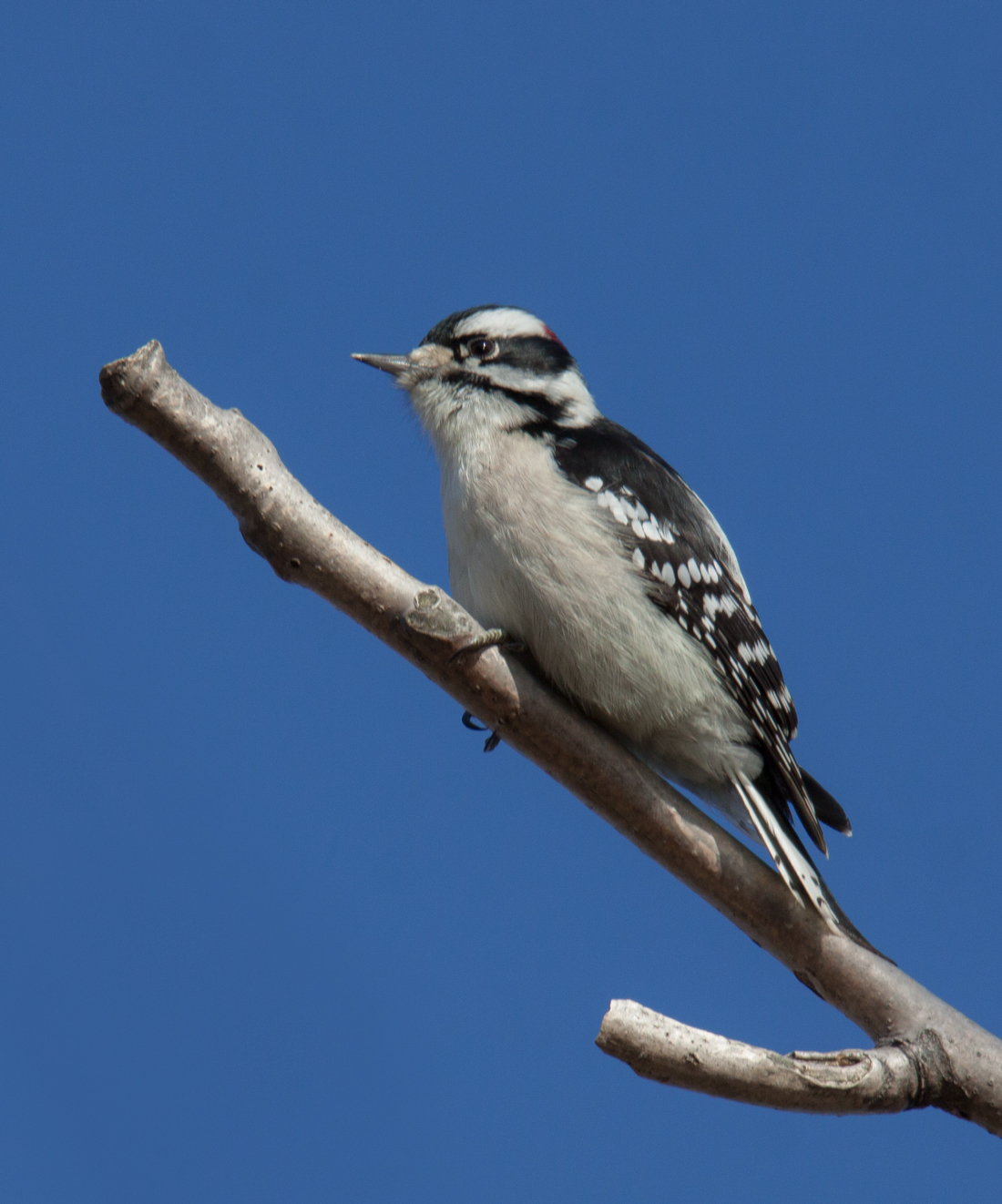
I admire the boundless energy of Downy Woodpeckers (Picoides pubescens). This weekend I watched as this male Downy Woodpecker climbed higher and higher in a tree, pecking along the way, until he ran out of branches.

He turned his body and looked up at a nearby tree and paused, which gave me a chance to get this shot of his downy white abdomen. There is a kind of tension in his position that I really like, as he clutches the branch and focuses intently on his next destination.

Downy Woodpecker

This second shot, which was taken before the first one, shows the Downy Woodpecker in a more conventional pose. He was inching his way up to the end of the branch and I was wondering what he would do next.

One thing that learned from this mini-shoot is that it is tough to hold a lens this heavy overhead for an extended period of time. I haven’t weighed the camera/lens combination, but the lens alone weights 4.3 pounds (1.95 kg).

I may have to start lifting weights to build up my arm and shoulder muscles

Downy Woodpecker

© Michael Q. Powell. All rights reserved.

Read Full Post »

Zooming a long telephoto lens while tracking a flying bird is like simultaneously patting your head and rubbing your tummy—it can be done but requires a lot of practice.

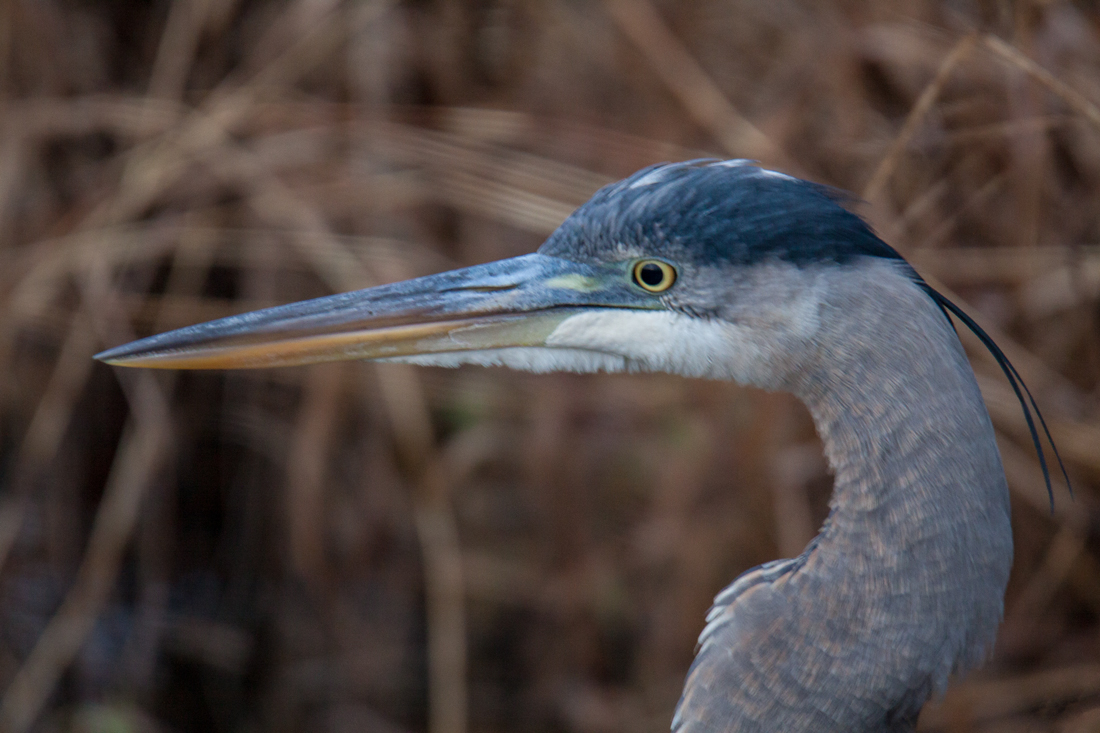
Yesterday as I was observing a Great Blue Heron (Ardea herodias) on the far side of a small pond, he unexpectedly took off. The heron flew towards me initially and then veered off to the side. My 150-600mm lens was fully extended at the start and as the bird approached, I frantically tried to zoom out a little. The EXIF data indicate that I was at 552mm when I took this shot and I just barely managed to keep the heron in the frame—I didn’t crop this image at all.

I’ve often been told to fill the frame with the main subject and this is one of the few times when I have been able to do so with a bird.

Great Blue Heron in flight

© Michael Q. Powell. All rights reserved.

Read Full Post »

Although I frequently catch a glimpse of them, it’s proven tough to get a shot of a Tufted Titmouse (Baeolophus bicolor).  These little birds are in almost constant motion and the Cornell Lab of Ornithology describes them as “acrobatic foragers.”

The coloration of the Tufted Titmice is subdued and quiet, but the spiky crest and huge eyes help them to stand out from the crowd. As I was stalking one of these birds, it flew over to a support piece for a bird feeder and perched for a moment, giving me the opportunity to snap off this photograph. Normally I try to have a more natural setting for my bird images, but the bird’s pose was so perfect that I decided to post the image.

A simple shot of a common subject can often reveal its beauty—photography doesn’t always have to be complicated.

Tufted Titmouse

© Michael Q. Powell. All rights reserved.

Read Full Post »

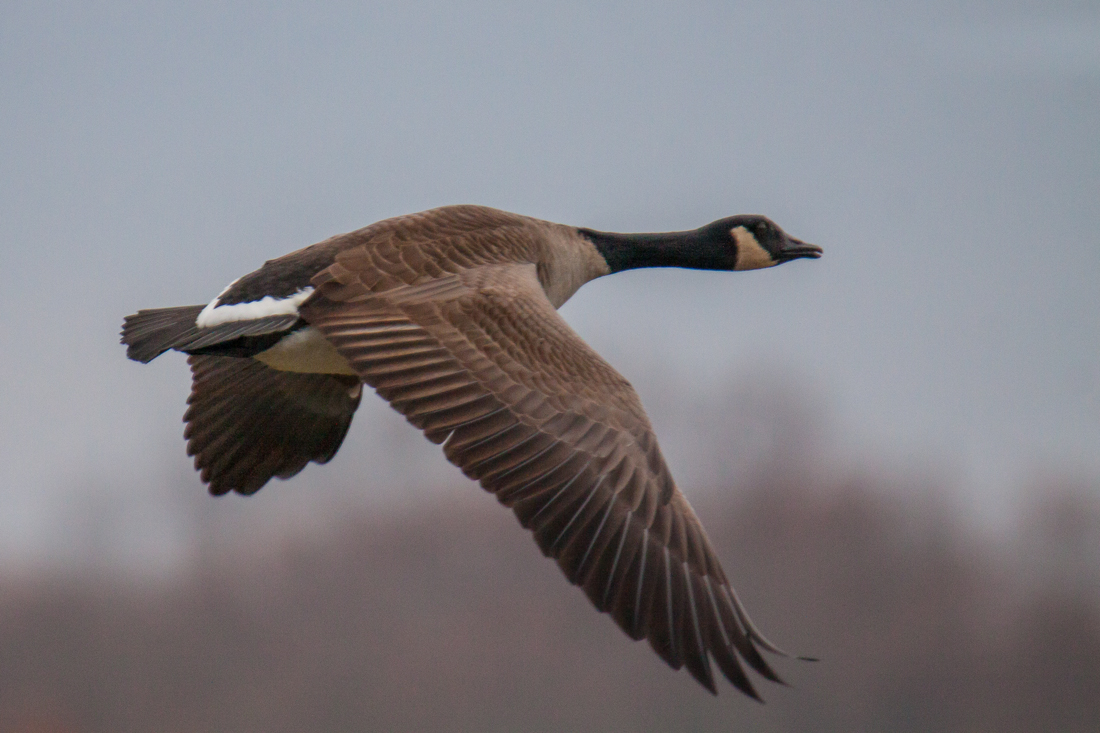
Canada Geese (Branta canadensis) have now invaded the ponds at my local marsh in full force, but the population seems mostly transient, with lots of arrivals and departures, particularly in the early morning hours.

Earlier this weekend, I continued to practice my skills in tracking birds in flight and took a couple of shots that I really like of geese flying in the early morning mist. In both cases I managed to capture a pretty good amount of detail on the goose and the background is a pleasing blur, especially in the first image, in which the hazy outlines of a distant tree line are visible. The goose in the second image was making a turn, preparing for an upcoming landing.

Canada GooseCanada Goose

© Michael Q. Powell. All rights reserved.

Read Full Post »

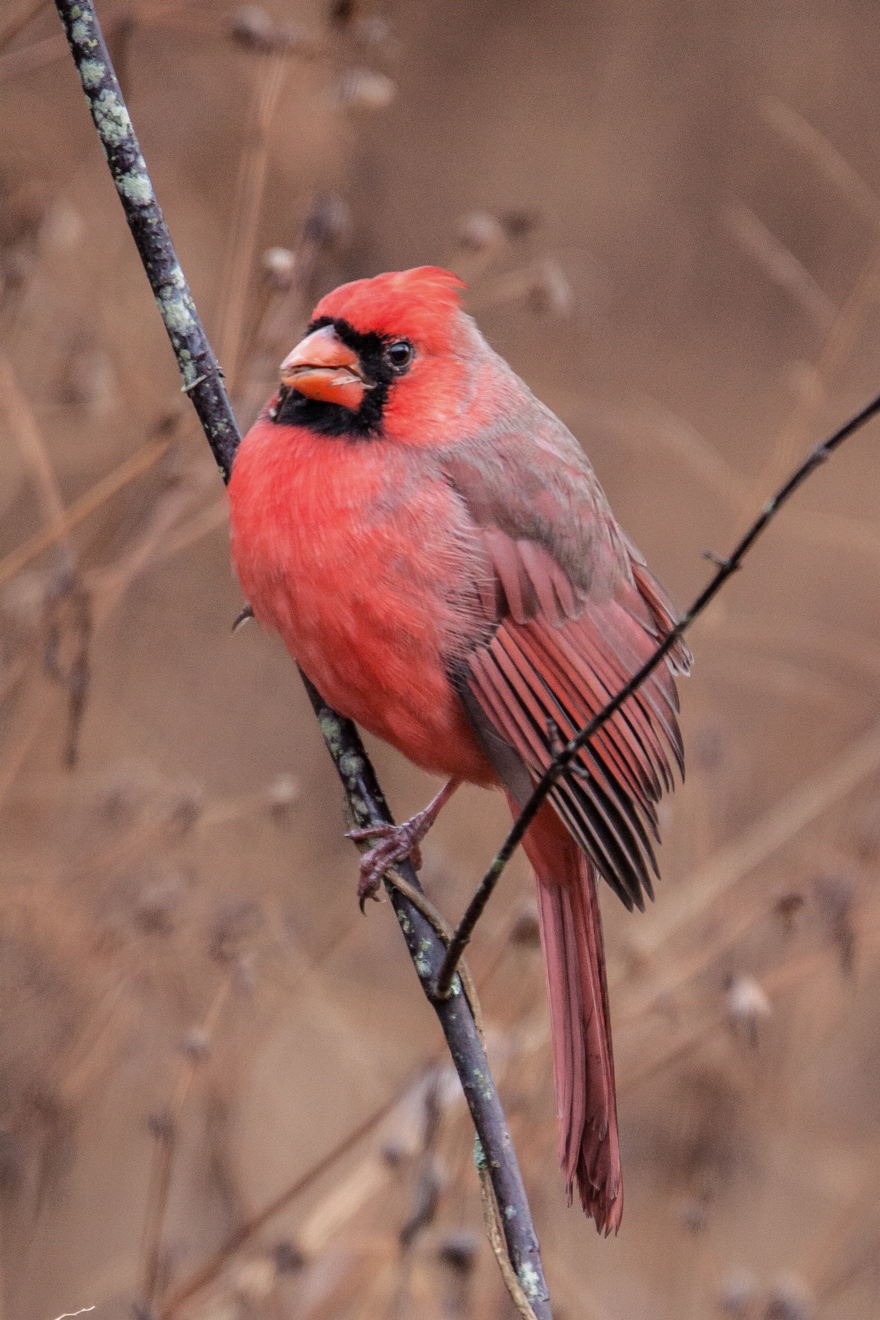
In the early morning mist yesterday at my local marshland park, the bright red color of this male Northern Cardinal (Cardinalis cardinalis) was even more distinctive than usual, shining like a beacon in the limited light.

The white-colored sky and the shadowy shapes of the trees in the distance provide a simple backdrop for this first image that gives it a lot of atmosphere. The wet, lichen-encrusted branch helps to tie the cardinal back to nature and keep this from looking too much like a studio shot, though it does look like the cardinal was posing for me.

When the cardinal moved to a different perch, the backdrop changed and the white sky was replaced by the dried-out vegetation of a field of cattails. Fortunately, the vegetation was far enough away from the subject that it softened up with the aperture wide open. In the second image, the cardinal seems to have become a little irritated with me and is scowling a bit. In both shots, the cardinal looks to have fluffed up its feathers, an indication that it was cold outside when I took these shots.

Northern CardinalNorthern Cardinal

© Michael Q. Powell. All rights reserved.

Read Full Post »

I started my Thanksgiving Day early with a big bird. No, I wasn’t preparing a turkey—I was sharing a quiet moment with this Great Blue Heron (Ardea herodias) at Huntley Meadows Park, the local marshland where I capture a lot of my images.

Happy Thanksgiving to all.

Great Blue HeronGreat Blue HeronGreat Blue Heron

© Michael Q. Powell. All rights reserved.

Read Full Post »

Some of the reviews of my new Tamron 150-600mm lens suggest that it has trouble capturing birds in flight, so I was anxious to test out its capabilities and the Canada Geese (Branta canadensis) coming and going from my local marsh served as my initial test subjects.

These five geese were part of a larger group that was departing from the marsh and I started tracking them as they flew past me. Initially thought that one of the geese has flown out of the frame in the second image, but then I looked more closely and realized that all five were still there—the formation was really tight (or at least the compression caused by the long telephoto lens made it look that way.

Sometimes in the past I have had problems in grabbing focus on moving subjects, especially when the background is cluttered and is competing for focus. I was happy to see that I was able to acquire and hold focus pretty well and the geese are separated from the trees in the background.

I am learning how to manage this longer lens and, for example, still have trouble sometimes pointing the extended lens at a subject and then finding the subject in the viewfinder—the field of view is not very wide at 600mm. I plan to check out the different focus options for my camera to see if any of them will improve my changes of getting clearer shots.

Does it show that I’m pretty excited with my new lens? I’ll be sharing more images as I continue to practice and learn with it.

Canada Geese in flight

Five guys in flight

Tight Formation

Tight Formation

© Michael Q. Powell. All rights reserved.
Read Full Post »

During this transitional time of the year there is often a thin coating of ice on the pond, especially when the temperature at night drops into the low 20’s F (-5 C).  On Friday morning, the ice was thick enough to support the weight of ducks most of the time, although the Canada Geese kept breaking through the ice when they tried to walk on it.

This female Mallard (Anas platyrhynchos) started out strutting confidently across the ice, but stopped for a moment at a place where the water had accumulated. I couldn’t tell if she was assessing the condition of the ice or was merely admiring her reflection—she is quite a beautiful duck after all and perhaps ducks have a sense of vanity.

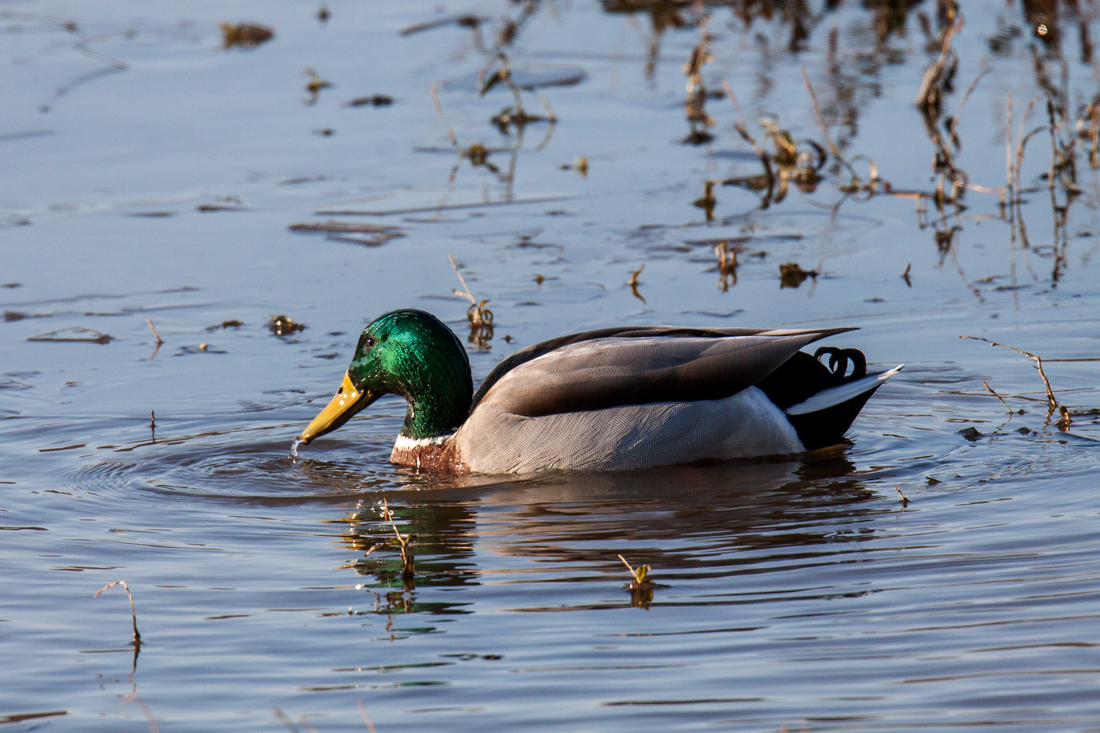
The male Mallard was more practical, remaining in the area of open water and foraging for food, content to leave the strutting and reflecting to his lady.

duck_walk_blogduck_reflect_blogmallard-male_nov_blog© Michael Q. Powell. All rights reserved.


Read Full Post »

As I wandered along the boardwalk yesterday at my local marsh, birds would periodically pop in and out of the eye-level cattails. Most of them were little sparrows that would bury themselves back down in the underbrush. At one point, though, a male Red-winged Blackbird (Agelaius phoeniceus) emerged and perched near the top of the cattails.

He was so close that I didn’t dare move from where I was standing and I tried to find a visual path through the vegetation to get a clear shot. I cropped this image slightly and made a few minor post-processing, but this is pretty much what I was seeing through the viewfinder as I tried out my new Tamron 150-600mm lens.

The photos were shot handheld at f/6.3, 1/400 sec, ISO 320, and 600mm. Recognizing that the image quality would increase a little if I closed down the aperture, backed off from the maximum focal length, and used a tripod, I am nonetheless pretty happy with the result and it’s definitely cool to more than fill the frame with a bird.

Red-winged Blackbird

Red-winged Blackbird

© Michael Q. Powell. All rights reserved.

Read Full Post »

« Newer Posts