Feeds:
Posts
Comments

Posts Tagged ‘song sparrow’

Now that I am focusing mostly on photographing birds rather than dragonflies or butterflies, I am having to reacquaint myself with my long telephoto lens (Tamron 150-600mm) and with the related differences in shooting techniques. During the warmer months, I spend most of my time looking downwards and scanning an area no more than 10 feet (3 meters) in front of me. When it comes to the colder months, I spend much more time looking upwards for bird activity, although some of the remaining birds forage on the ground, so I can’t totally forget to look down. I also scan areas that are much farther away from me, particularly because my long lens cannot focus on anything that is closer than 9 feet (2.7 meters) from me.

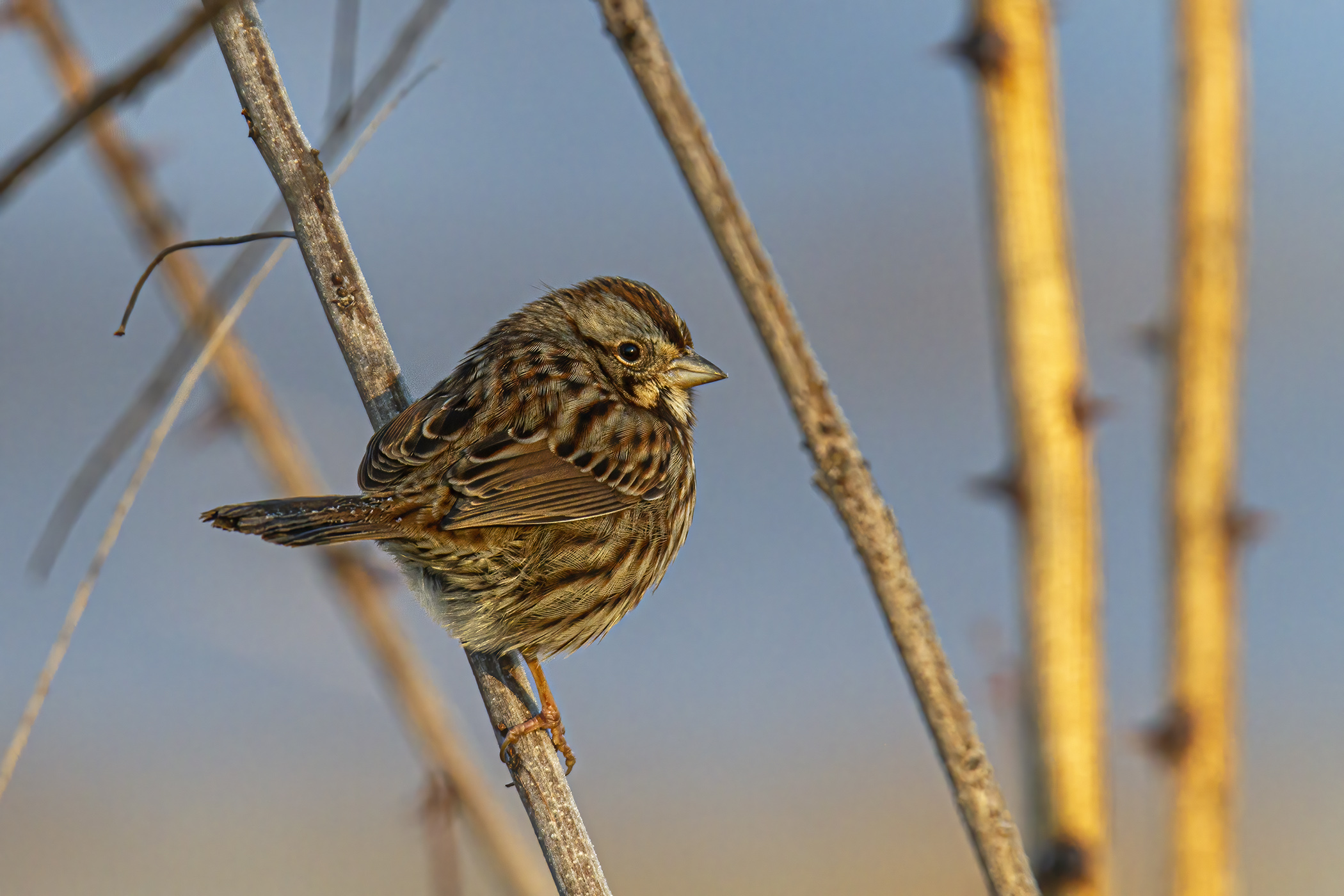
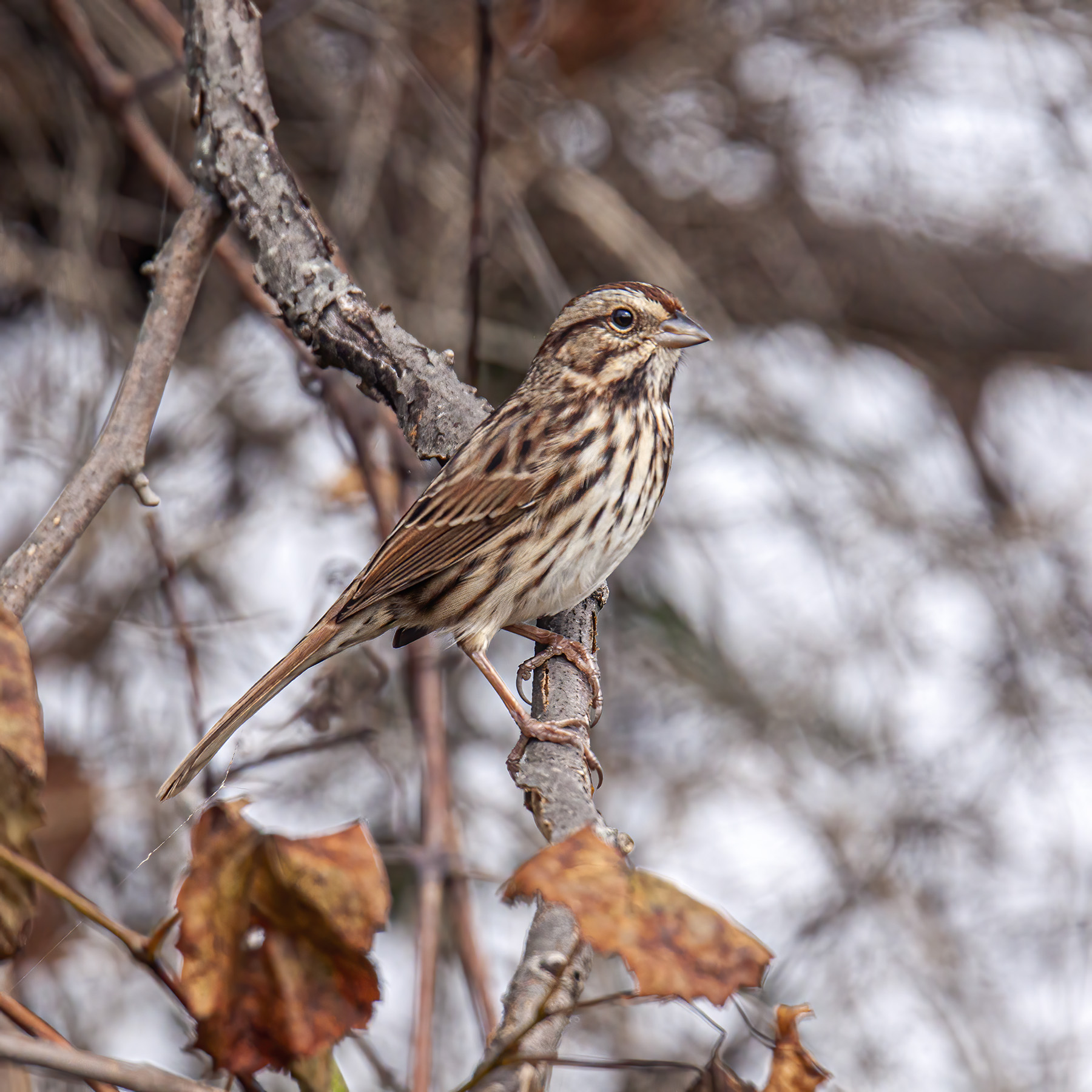
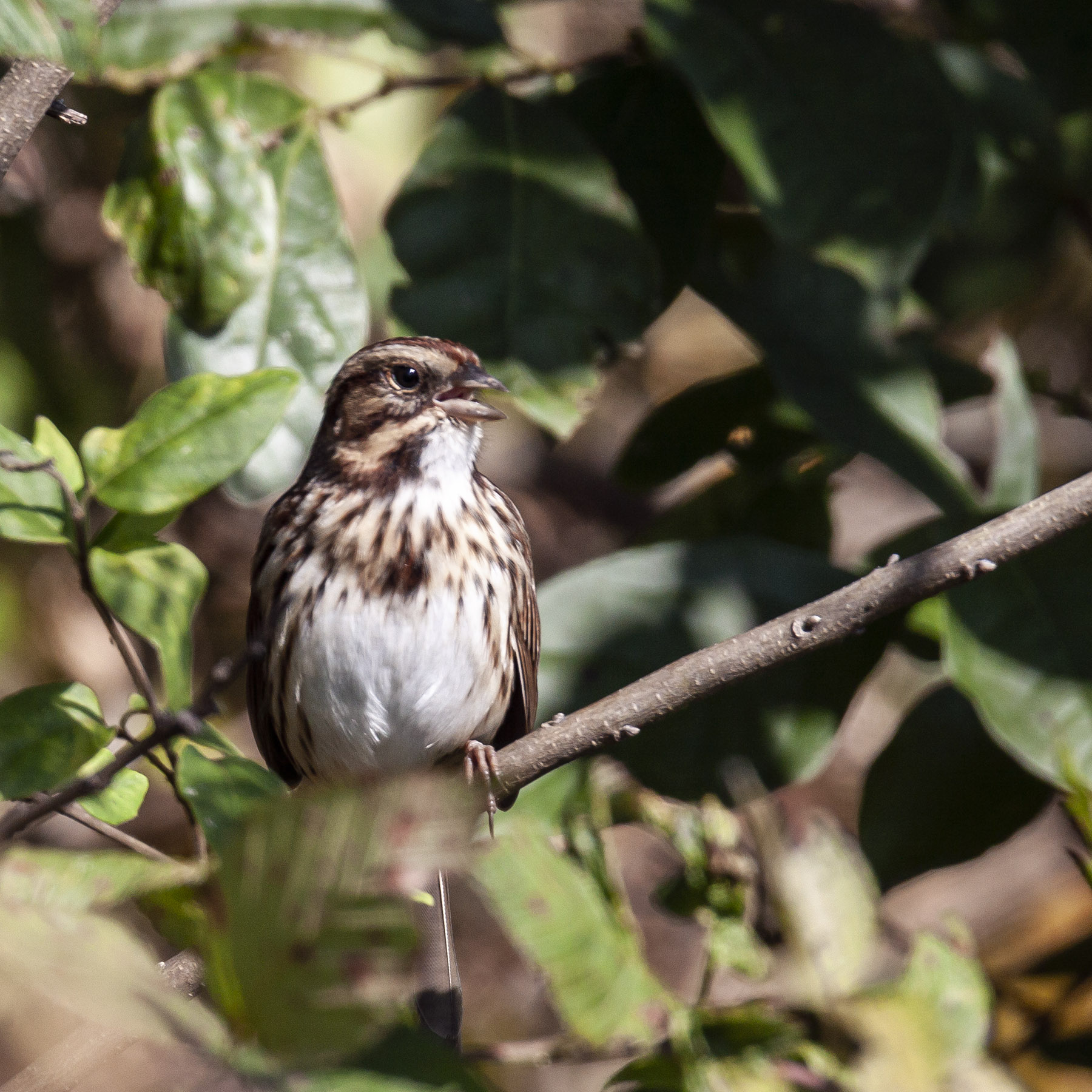
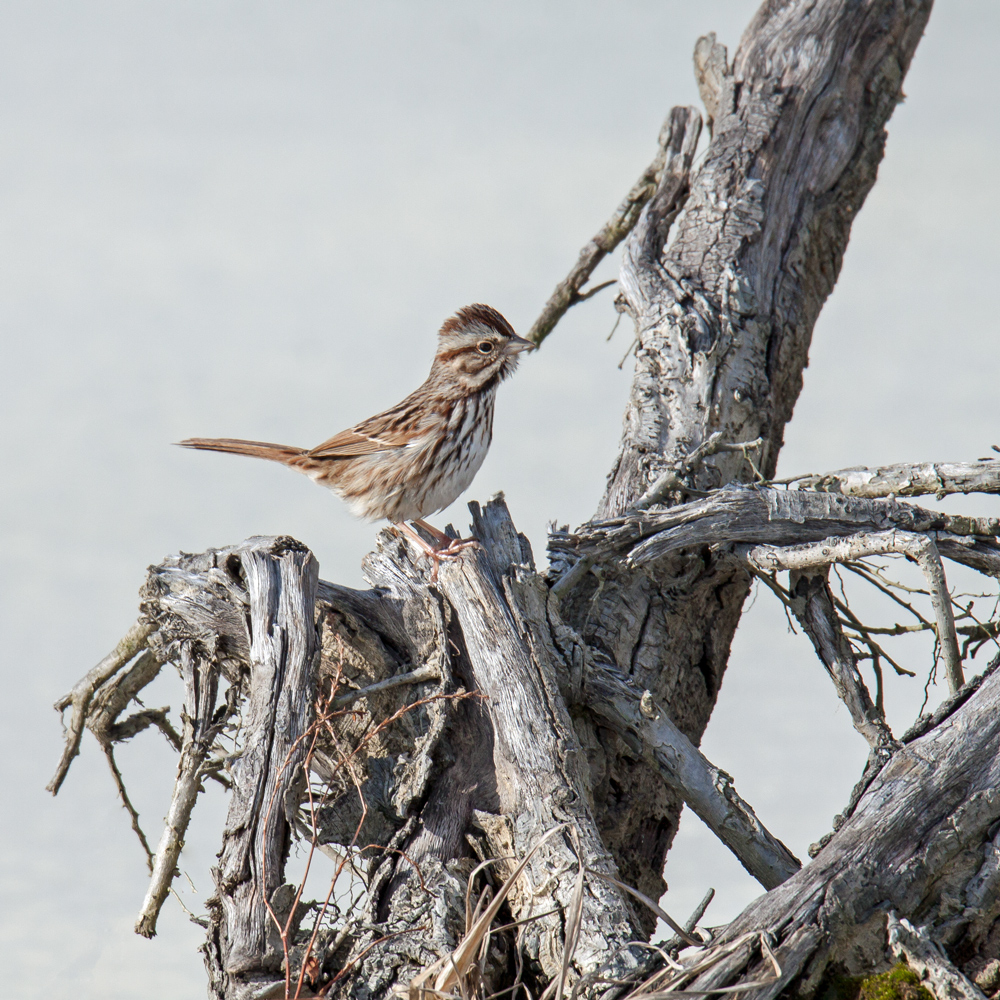
Last week I was delighted to spot this beautiful Song Sparrow (Melospiza melodia) at Occoquan Bay National Wildlife Refuge. I am gradually learning the differences in coloration in the various sparrows in our area, though I must confess that sparrow identification is an ongoing challenge for me.

Song Sparrow

© Michael Q. Powell. All rights reserved.

Read Full Post »

The weather this past week has been cold and windy, so I have not been able to get outdoors very much this past week. According to the weather forecasts, things should warm up next week, so hopefully I will be a bit more active.

When I last visited Occoquan Bay National Wildlife Refuge a week or so ago, I captured this image of what I believe is a Song Sparrow (Melospiza melodia). The little bird was perched on the bare stalks of some unidentified vegetation, which permitted me to capture an uncluttered shot—most of the time I see sparrows foraging on in ground in the cluttered underbrush.

Song Sparrow

© Michael Q. Powell. All rights reserved.

Read Full Post »

Many of the trails were still covered in snow (but passable) at Occoquan Bay National Wildlife Refuge when I visited the refuge after a recent snow storm over a week ago. Much of that snow is still on the ground and the temperatures continue to be well below the freezing level. Fortunately the weather forecasts predict warmer temperatures next week so eventually the snow will begin to melt away..

On the day of my visit small groups of Song Sparrows (Melospiza melodia) were feverishly foraging for tasty tidbits in the bare patches in the trail paralleling the water. In most of my shots the sparrow’s head was buried in the vegetation. Occasionally, though a sparrow would momentarily lifted its head to check me out, as I captured in the final image.

Song Sparrow

Song Sparrow

© Michael Q. Powell. All rights reserved.

Read Full Post »

When I spotted this Song Sparrow (Melospiza melodia) last Thursday poking about in a mass of floating vegetation in a small pond last Thursday at Occoquan Bay National Wildlife Refuge, I decided that I wanted to get a shot of it. That proved to be quite a challenge. The bird kept its head down and was blocked by the vegetation most of the time.

I kept waiting and shooting in vain and worried that the sparrow would eventually fly away and leave me empty-handed. Finally the bird starting moving toward one end of the vegetation and was almost in the open. I got ready and when the sparrow limited its head momentarily, I was able to capture the kind of image that I had imagined at the start.

I like the way that the sparrow is framed by the vegetation and the water that is visible throughout the image. I am not sure what it had in its mouth, but the sparrow had apparently found some kind of tasty tidbit. The partial reflection of the bird in the water was an added bonus.

It is not rare for me to imagine shots when I am out with my camera and it is really cool when I manage to bring those imagined shots to life.

Song Sparrow

© Michael Q. Powell. All rights reserved.

Read Full Post »

Have the rules changed or have I simply changed? When I first starting getting into wildlife and nature photography, one of the basic “rules” that I learned was I should try to fill the frame with my primary subject. I acquired longer lenses and worked to become more stealthy so I could get closer and closer to my subjects. My “ideal” shot was a sharp “portrait” image with a soft creamy background.

I still like those kind of images, but I began to realize that I was removing the birds and bugs from their environments. I am now pushing myself to try to include more of the relationship between the subject and its surroundings and ideally the interaction between the two. What that means is that I am growing increasingly comfortable with images in which the primary subject takes up only a small portion of the frame.

In the first image, for example, I could have easily cropped this shot of Song Sparrow (Melospiza melodia) much more tightly to draw the viewers’ eyes to the bird’s feather details. Instead, I limited the cropping in order to show all of the dried vegetation hanging from the branch on which the sparrow was perched.

In the second image, the Great Blue Heron (Ardea herodias) was quite far away. In the past, I might not have taken the shot, because I knew I would not be able to capture a detailed view of the heron. In this case, I instantly knew that I wanted to capture the mood of the moment by showing the heron in its environment. I was happy to be able to convey a sense of the peacefulness of the moments that I shared with this beautiful heron, a time for reflection both literally and figuratively.

Rules and guidelines are undoubtedly helpful for beginners, because they establish a general framework for understanding what makes a “good” photograph. Over time and after spending countless hours with my camera and my computer, I have learned that “good” is a relative term and that “beauty” is often subjective. Most importantly, however, I have developed a greater sense of what types of photos I personally like and become more skilled in creating these kinds of images.

Nothing is static, though, and I know that my tastes and preferences and those of my readers are likely to change over time. Artists of all types are prone to introspection and are more likely than most other people to explore their inner landscape for inspiration and understanding. Whatever output those artists create is often the result of the interplay between their inner world and the outer world—the “environment” really matters in understanding the context of a work.

Song Sparrow

Great Blue Heron

© Michael Q. Powell. All rights reserved.


Read Full Post »

I observed Song Sparrows (Melospiza melodia) foraging for food on the ground at multiple locations last Thursday at Occoquan Bay National Wildlife Refuge. Most of the time they would fly away as I approached, but occasionally one of them would choose a new snow-covered perch that was still within range of my long telephoto zoom lens.

The two photos below are mostly monochromatic, composed primarily of various shades of brown and white. The warmth of the browns helps to warm up the photos a little, despite the abundance of snow. I think the photos would have felt cooler and more stark if I had converted them to black and white.

Song Sparrow

Song Sparrow

© Michael Q. Powell. All rights reserved.


Read Full Post »

This Song Sparrow (Melospiza melodia) looks like it was buried in deep snow, but was merely hidden by a small snowdrift between the two of us as it foraged for food in a small open patch on Thursday at Occoquan Bay National Wildlife Refuge.

This photo reminds me of my childhood days growing up in New England. After a snowfall, we would build snow forts and have massive snowball fights. We would crouch behind the walls of our forts and periodically peer over the top of the walls (like this sparrow) before raising up to launch another volley of snowballs. These days I am more likely to build a snowman than a snow fort, although, alas, I did not take advantage of the opportunity to do so this past week.

© Michael Q. Powell. All rights reserved.

Read Full Post »

I finally got out of my house on Thursday and visited Occoquan Bay National Wildlife Refuge. Large numbers of sparrows were busily pecking on the ground alongside the trails, many of which were still partially covered with snow. The sparrows would scatter as I approached, often disappearing deep into the surrounding vegetation, but occasionally one would stay still long enough for me to take its photo.

The first image shows what I believe is a White-throated Sparrow, surrounded by a bounty of berries. The second image shows a Song Sparrow (Melospiza melodia), foraging in the snow-covered grasses. I photographed the House Sparrow (Passer domesticus) in the third image in my neighborhood, but decided to include it here among its fellow sparrows.

The last two photos show a rotund White-throated Sparrow—like so many birds at this time of the year, this sparrow has puffed up his feathers to try to stay warm in the frigid weather. The final photo shows a blurry Northern Cardinal foraging in the background, a visible indication of the peaceful coexistence of multiple species as they searched for food.

White-throated Sparrow

Song Sparrow

House Sparrow

White-throated Sparrow

White-throated Sparrow

© Michael Q. Powell. All rights reserved.

Read Full Post »

A new year begins, full of promise and possibilities. Perhaps for you it starts with fireworks and loud noise, but for me, it is more quiet and introspective, like this tender little Song Sparrow (Melospiza melodia) that I spotted on Saturday at Occoquan Bay National Wildlife Refuge. Normally Song Sparrows are quite frenetic, but this one paused for an extended period of time with its feathers puffed up to stay warm, seemingly lost in its thoughts.

Happy New Year! Best wishes for a happy and healthy 2024.

Song Sparrow

© Michael Q. Powell. All rights reserved.

Read Full Post »

What is the first thing that comes to your mind when you look at this photo? Are you attracted to the autumn colors in the background? Do you notice the texture in the rotten tree and how it matches the feathers of the little Song Sparrow (Melospiza melodia)?

The sparrow’s pose is what caught my attention. As my eyes examined the image, I was suddenly transported to a medieval era and imagined a sentinel positioned along the top of a castle wall, vigilantly keeping watch, alert to any danger.

Yes, I have an overly active, often child-like imagination. Wouldn’t it be fun to be able to experience the wonders of the world with the energy and curiosity of a child? Our adult lives are often way too complicated—I encourage you to find joy today in simple things.

Song Sparrow

© Michael Q. Powell. All rights reserved.


Read Full Post »

Some days it seems like most of the birds are hiding from me, but I can usually count on seeing at least a few sparrows. Last Thursday I spotted this little sparrow, which I am pretty sure is a Song Sparrow (Melospiza melodia), perched in the reeds at Occoquan Bay National Wildlife Refuge.

I still have a bit of trouble with identifying some sparrow species, but I am getting better at looking closely at the facial markings and other identifying features that help me to distinguish one species from another. Some experienced birders can identify birds by their calls, but with a few notable exceptions I am not at that level.

Song Sparrow

© Michael Q. Powell. All rights reserved.


Read Full Post »

On many cold winter days, sparrows are the most common birds that I see. No matter how inclement the weather may be, sparrows are busily foraging in the trees and on the ground. Last Tuesday at Occoquan Bay National Wildlife Refuge, on a day when it was sunny, but frigid, I was able to capture little environmental portraits of these three sparrows, all of which I believe are Song Sparrows (Melospiza melodia).

My favorite of these three images is definitely the first one, with its smooth background colors and the linear shapes of the vines. However, I also really like the way that the second and third images show the little birds in their environments, with one with a cool palette of colors and the other with a touch of sunshine and warmer tones.

Many of you know that I love to photograph large birds like hawks and eagles, but I equally enjoy capturing the beauty of smaller birds, like these sparrows. Beauty is everywhere.

A belated Merry Christmas to those of you who celebrate Christmas. I decided to turn off my computer yesterday and am starting to catch up today. On Christmas Eve, I played handbells in one church service and then sang in a choir for a second service. On Christmas Day, I ran the audio video portion of our service that we also broadcast on Zoom, so I have been pretty busy

In the Episcopal Church that I now attend, we have only just begun our celebration of Christmas and will continue to do so until Epiphany on 6 January, when we celebrate the arrival of the Three Wise Men. I grew up singing the song The Twelve Days of Christmas and thought that it referred to the twelve days leading up to Christmas. It was only later in my adult life that I learned that Christmas Day itself is the first day of Christmas. The radio stations may already have moved on from playing Christmas songs, but I will continue to do so for at least another 10 days or so (and I actually like singing Christmas carols throughout the year).

Merry Christmas and best wishes for a happy and healthy 2023.

Song Sparrow

Song Sparrow

Song Sparrow

© Michael Q. Powell. All rights reserved.

Read Full Post »

I can’t help but feel feel powerless and impotent as the brave Ukrainian people continue their heroic defense against Putin’s brutal invasion. Like this Song Sparrow (Melospiza melodia) at Occoquan Bay National Wildlife Refuge, many of us feel like we all are doing all we can by hanging on tightly, trying to stay focused and seeking ways to support Ukraine.

As human beings, we cannot afford to remain indifferent. Our leaders are pursuing various options and I call on you all to keep Ukraine in your thoughts and prayers.

Song Sparrow

© Michael Q. Powell. All rights reserved.

Read Full Post »

Is it better to stand out and be seen or to blend in and remain invisible? As with so many life questions, the answer to my simple query is complicated and depends on your personality, priorities, and perspectives.

The male Northern Cardinal (Cardinalis cardinalis) takes a bold approach—with his brilliant red plumage, it is almost impossible for him to hide. He want to be seen and often perches in the open. Perhaps that helps him to attract a mate, but does it also make him more visible to those that could do him harm? Is there a risk associated with being bold?

The sparrow in the second image, which I think is a Song Sparrow (Melospiza melodia), takes an almost opposite approach—you almost can’t see it, especially when it is buried in the underbrush. Its nondescript coloration allows it to blend in? Does this bird feel more vulnerable? Is self-protection its primary motivation? Must it rely on non-visual factors, like its singing, to stand out?

What about you? How do you live your life? For most of my life, I have tended to favor conformity and security—I lived like the sparrow, fearful of standing out. Over the last decade of so, however, I have increasingly decided that the opinions of others don’t matter much anymore. I am now striving to live my life in an unapologetically authentic way and I am much more willing to put myself out there as visibly as the male cardinal.

Be bold today and be yourself. As the old proverb says, “you might as well be yourself—everyone else is already taken.”

Northern Cardinal

Song Sparrow

© Michael Q. Powell. All rights reserved.


Read Full Post »

Sparrows are everywhere, it seems, but it is actually pretty difficult to get a clear of one. These little brown birds are hyperactive and super industrious, so they rarely seem to stop and pose. They also enjoy foraging in dense vegetation or in tall grass, further complicating my photographic efforts.

Last week I was happy to capture several decent images of sparrows. I think that they are both Song Sparrows (Melospiza melodia), though I have low confidence in my ability to identify sparrow species correctly.

In the first photo, the sparrow was foraging on the ground, where it blended in so well that I sometimes lost sight of it when it stopped moving. The second sparrow perched briefly on a branch and I was able to take a shot while looking up at the bird. The angle of view gives the sparrow’s head a distorted shape that somehow reminds me of Darth Vader’s helmet—the bird’s expression also looks a bit imperious as it surveys its surroundings.

Song Sparrow

Song Sparrow

© Michael Q. Powell. All rights reserved.

Read Full Post »

I always admire the agility and balancing skills of tiny birds—I know that I could not hold a position like that of this sparrow that I spotted last week at Huntley Meadows Park. I think that it is a Song Sparrow (Melospiza melodia), but I am always a bit uncertain when it comes to sparrows.

As for balance, I know that I can always use more of that in my life. When I was still working full-time, all my employers gave lip service to the importance of “work-life balance.” The sad reality was that most of us were workaholics devoting way too much energy to our work and neglecting our lives. It was only when I cut back on my hours during the final decade of my work life that I began to discover some of that mythical sense of balance.

Part of that process has been a deliberate cultivation of my creative side, which I have neglected most of my life. My photography and this blog have played a critical role in that journey of discovery and rediscovery. I really appreciate all of the support and encouragement that so many of you have provided over the years and continue to provide as my journey continues. Thanks.

Song Sparrow

© Michael Q. Powell. All rights reserved.

Read Full Post »

Even when the winter days are dark and gray and clouds cover the sky, I can usually spot some sparrows foraging about on the ground or in the trees. I used to throw all of the sparrow into the the category of “little brown birds,” but over time I have begun to be able to identify some of the individual sparrow species.

I spotted this sparrow last week as I was exploring Occoquan Bay National Wildlife Refuge and am pretty confident that it is a Song Sparrow (Melospiza melodia). I really like the streaky pattern on its chest feathers and the warm red-brown color on its head.

Normally I won’t try to get a head-on shot of a bird, because it tends to distort their features, but I like the way that I was able to capture the intensity of the sparrow as it glared at me when I was capturing the first image—it did not seem very happy with my presence. The second pose is a more traditional bird image from the same perch after the sparrow lowered its head and turned to the side.

I will usually try to take multiple photos in a sequence when a bird is perched like this, because, I have learned, birds change their positions really quickly and very frequently. I never know when I might be able to capture a more interesting pose as the bird shifts about, so I often keep shooting—it is amazing how many shots I end up of empty perches when my finger triggers the shutter a split second after the bird has flown away.

Song Sparrow

Song Sparrow

© Michael Q. Powell. All rights reserved.

Read Full Post »

Increasingly I find myself peering into trees as we move deeper into autumn, listening and watching for signs of small birds that may be hidden therein. The process can be somewhat maddening and often results in a sore neck, but my patience is sometimes rewarded and I manage to get a clear shot of one of the birds. Getting the shot, though, is only half of the challenge—identifying the bird can be equally frustrating.

Sparrow species can be particularly problematic, because so many of them are so similar in appearance. Last Thursday I photographed this sparrow at Occoquan Bay National Wildlife Refuge. As is generally the case, I did not worry about trying to identify the bird while I was in the field, but waited to do so at home. I went back and forth in my birding guide and concluded that it was probably a Song Sparrow (Melospiza melodia).

I have learned not to be overconfident in my bird identifications, though, and posted it to a Facebook birding forum. I felt gratified when a more experience birder confirmed my identification. It takes time, but I feel like I am gradually getting better at seeing the details that distinguish one species from another.

In many ways, my photography journey is focused on learning to see the world in new and different ways. As noted photographer Dorothea Lang so aptly put it, “The camera is an instrument that teaches people how to see without a camera.”


Song Sparrow

Song Sparrow

© Michael Q. Powell. All rights reserved.

Read Full Post »

Sparrows are so industrious as they poke about in the underbrush that I rarely get a clean look at one. I was happy therefore that I managed to get a shot of this Song Sparrow (Melospiza melodia) when it perched momentarily on some vegetation amidst the thorny stalks recently at Occoquan Bay National Wildlife Refuge.

We have had quite a number of small snow and ice storms this winter, but it has proven difficult to capture images of bird against a snowy background. I am happy here that the sparrow chose to perch in a tiny patch of snow that adds a bit more visual interest to the shot. Several viewers yesterday commented that they like it when I show more of the bird’s environment in my photos, so I decided not to crop in too closely today.

Song Sparrow

© Michael Q. Powell. All rights reserved.

Read Full Post »

I really love to capture images of common birds in cool poses or settings, like this Song Sparrow (Melospiza melodia) that I spotted on Wednesday at Occoquan Bay National Wildlife Refuge on the bank of a small stream whose water had receded with the low tide.

The sparrow was moving about searching for tasty tidbits on the wet ground strewn with tiny pebbles and shells.  I was happy when it paused for a moment at a spot where I could capture its reflection in the shallow water. Be sure to click on the image if you want to get a closer look at this handsome little bird and all of the snail and mussel shells that surround it.

Song Sparrow

© Michael Q. Powell. All rights reserved.

Read Full Post »

Sparrows seem so ordinary to most people and I enjoy the challenge of trying to capture images of them in ways that make this drab little birds stand out. On a recent trip to Occoquan Bay National Wildlife Refuge, I observed some Song Sparrows (Melospiza melodia) foraging in the middle of a large, heavily vegetated field. Occasionally one of them would perch on the top of the vegetation and I managed to get some shots.

I like the way that these two images, which are quite different, work together as a pair. In the first one, a viewer’s eyes are immediately drawn to the colorful autumn leaves and only afterwards do they move up to the perched sparrow—there is a sense of energy because of the bright colors. In the second image, the solitary sparrow is the sole subject and the plain background and simple perch create an almost austere feeling—there is a feeling of serenity and simplicity.

Song Sparrow

Song Sparrows

© Michael Q. Powell. All rights reserved.

Read Full Post »

When I first started photographing birds, all sparrow looked the same to me—they were all nondescript little brown birds. Over time I have come to appreciate the subtle variations in color and markings that help to differentiate the species, although identification is still a bit of a hit-or-miss proposition for me.

I spotted this handsome sparrow on Monday as I was exploring at Occoquan Bay National Wildlife Refuge. I believe that it is a Song Sparrow (Melospiza melodia), one of the relatively common sparrow species where I live. I really like the sparrow’s perch and the fact that it includes some of the dried leaves that will soon be falling from the branch. The white skies in the background give this image an almost wintry feel, though it is way too early for me to be even thinking of snow.

Song Sparrow

© Michael Q. Powell. All rights reserved.

Read Full Post »

Last Wednesday I spotted this little sparrow at Occoquan Bay National Wildlife Refuge. I thought it was a Song Sparrow (Melospiza melodia), but decided to check with some birding experts on Facebook who were able to confirm my initial suspicions. It did take me a little while longer to get a response than usual, however, because my proposed identification was correct. I tend to get quicker responses when I am wrong—folks will often jump in really quickly to correct me.

Although Song Sparrows are one of the most common sparrow species where I live, I love trying to get shots of them whenever I can.  In this case, I was happy with the simple composition and minimalist color palette that I was able to capture in this image—all of the different shades of brown give the image a harmonious feel that I find pleasing.

Song Sparrow

© Michael Q. Powell. All rights reserved.

Read Full Post »

Some experienced birders can identify a bird by its call, but, except with a few common birds, I am not one of the them. I need to be able to see a bird to identify it, and that is a challenge at this time of the year, when most of the leaves are still on the trees.

Last week as I was exploring a trail at Occoquan Bay National Wildlife Refuge, I heard a bird singing almost directly in front of me. As my eyes searched among the leaves, the bird kept on singing and eventually I located it. I could see that it was a sparrow and often that is an identification problem for me, because sparrows fall into the group of little brown birds that all basically look the same. However, in this case, I could see a dark spot on the breast of the bird, which usually means that it is a Song Sparrow (Melospiza melodia).

I was happy to be able to capture a few shots of the little Song Sparrow before it flew away. If you are curious about the sound of the Song Sparrow’s song, check out this page on the Cornell Lab of Ornithology website, where there are several audio and video clips of this birds songs and calls.


Song Sparrow

Song Sparrow

© Michael Q. Powell. All rights reserved.

Read Full Post »

Even when the weather is bad and other birds are hunkered down, sparrows are invariably active. Most of the time they are at ground level, but occasionally one will perch a bit higher off of the ground and give me a chance to get a decent shot.

That was the case this past Friday at Occoquan Bay National Wildlife Refuge, when a Song Sparrow (Melospiza melodia) took a break and posed for me briefly on the end of a log. I liked the composition when I took the shot and decided to post it without any cropping. I also couldn’t help noticing as I was working on the image that the sparrow’s colors are almost a perfect match for those in the background.

Sparrows are really special to me too because both on my parents loved His Eye Is On The Sparrow, a hymn that reminds us that God cares for each one of us. That is a message I think we all can use right now, at a time when so many of us are stressed out over the situation in our respective countries and in the world in general.

Song Sparrow

© Michael Q. Powell. All rights reserved.

Read Full Post »

Are sparrows cute? Normally I don’t think of them as “cute,” but this Song Sparrow (Melospiza melodia) that I spotted hopping around earlier this week at Huntley Meadows Park was simply adorable.

I really like the simple white background provided by the snow and the organic shapes and texture of the small stumps that were sticking out of the frozen waters of the pond. Those simple elements add interest to the images without detracting from the main subject, the cute little sparrow.

Song Sparrow

Song Sparrow

Song Sparrow

Song Sparrow

Michael Q. Powell. All rights reserved.


Read Full Post »

How do birds manage to survive when it is so cold outside? I asked myself that question early yesterday morning as I walked along the exposed boardwalk at Huntley Meadows Park. The wind was blowing hard and the temperature was about 20 degrees F (minus 7 degrees C).

The landscape was empty and desolate and seemed to have little to offer as potential sources of food. Suddenly I noticed a small group of sparrows.  They would fly to a spot together and then individually forage among the dried out plants, including those sticking out of the ice. After a short period of frenetic activity, they would move on to another spot.

Initially, I knelt and tried to get some shots of the sparrows that were standing on the ice and reaching up into the vegetation. A bit later, I was able to capture some images of a sparrow perched on some plants in a more exposed position.

I am not really sure what kind of sparrows these are. Earlier in the day I saw some sparrows that I could identify as White-throated Sparrows, but these birds seem to have a different set of markings. After looking at my guidebooks, I have concluded that these may be Song Sparrows (Melospiza melodia) and would welcome comments from more experienced birders on the identification, especially if I have misidentified the birds.

How do these little birds survive during the winter? From what I can see, they do their part by working hard as they forage for food and God provides for their needs.

Song Sparrow

Song Sparrow

Song Sparrow

Song Sparrow

© Michael Q. Powell. All rights reserved.

Read Full Post »

When you are walking or driving around, looking for subjects to photograph, which ones will actually cause you to stop, grab your camera, and take some shots? Does it take an impressive and relatively rare subject like the bald eagle that I featured in yesterday’s posting? Would you stop to photograph a sparrow?

Over the past few years, I’ve read a lot of blog postings and seen some amazing photos, but I must confess that only a few of them have made such an impression that I remember their content. In a memorable posting in July 2013, Lyle Krahn, an amazing photographer and thought-provoking blogger, put forward a concept called “stopping power. Here’s an extract from that posting:

“I think every beautiful scene has stopping power. That’s my term for the ability of a scene to make a person stop hiking or driving in order to pull out a camera and make images. Did you ever wonder what makes you stop? Do you ever hear the music?”

I hear the music almost all of the time and the threshold for my “stopping power” is really low—almost any sound or color or movement is enough to cause me to stop when I have my camera with me.

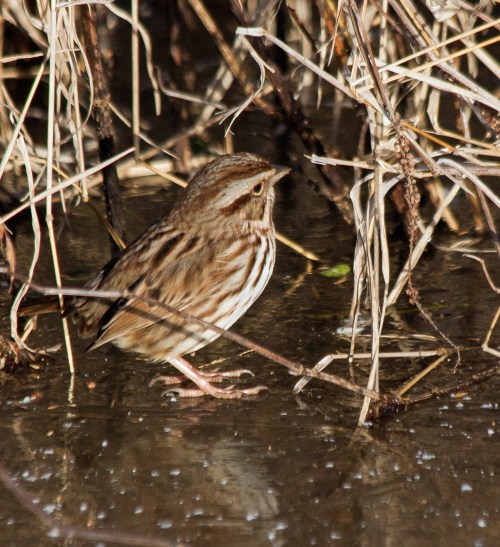
Do I really need more shots of sparrows? Last week, I spent some time watching and photographing this sparrow, which I think is probably a Song Sparrow (Melospiza melodia), as it pecked about in the shallow water at my local marsh. The light was coming in from the side and I had to wait and wait for the bird to lift its head to a position where it would not be in the shadows.

In the end, I got a couple of shots that I really like, images that show some of the beautiful details of this little sparrow, a bird that has “stopping power” for me.

Be sure to check out Lyle’s website, Krahnpix, for some incredible wildlife shots that are guaranteed to stop you in your tracks. His quirky humor and provocative prose will both entertain you and prompt you to think a little more critically about your photography and maybe even your life.
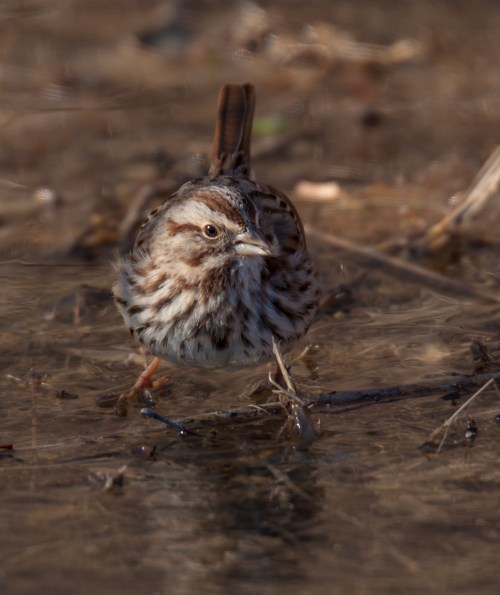
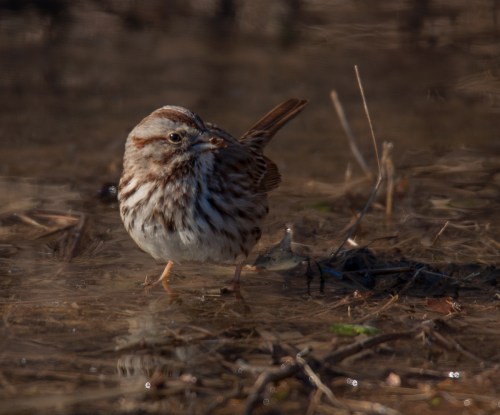
Song Sparrow

Song Sparrow

© Michael Q. Powell. All rights reserved.

Read Full Post »
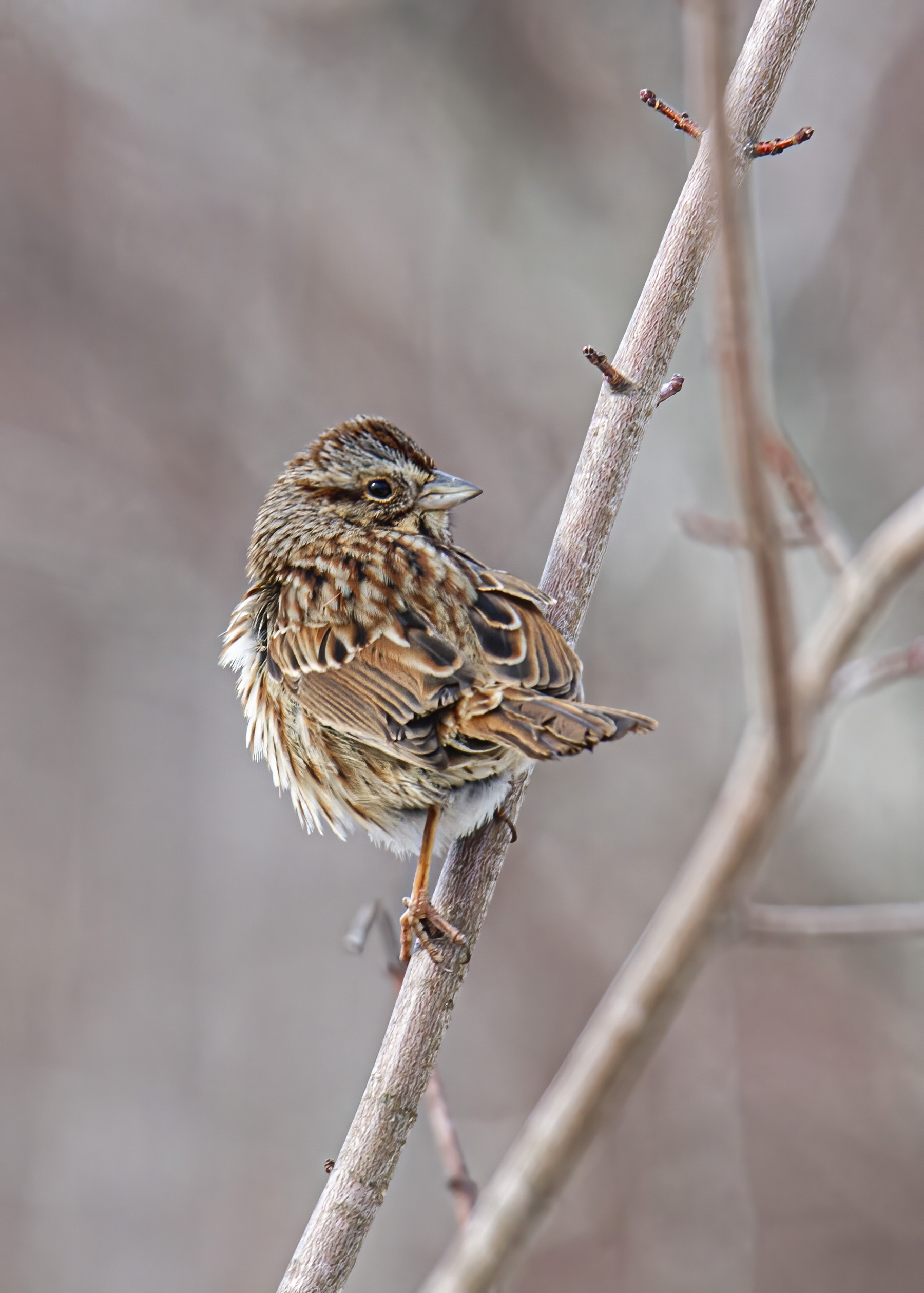
At this time of the year especially, I can usually depend on seeing ducks, geese, and sparrows at my local marsh—other birds may or may not be present, but these three species are my constant companions. The ducks and the geese are often loud and occasionally obnoxious, but when the sparrows sing, it’s generally a more melodious song. The ducks and geese will often fly away when I approach, but the sparrows will just take a hop or two and continue to forage for food.

I take lots of photos of sparrows. They are usually within range and have a surprising amount of personality. Yesterday, on a cold and windy day, I captured this image of what I think is a Song Sparrow (Melospiza melodia). The light was pretty good and the sparrow cooperated by lifting its head without turning, resulting in a pleasant little portrait of this pretty little bird.

CORRECTION: A number of more experience bird watchers have noted that this is a Swamp Sparrow (Melospiza georgiana), not a Song Sparrow. Sorry for any confusion—this is not the first time I have misidentified a species, and certainly not the last.

sparrow_shadow_28Feb

© Michael Q. Powell. All rights reserved

Read Full Post »
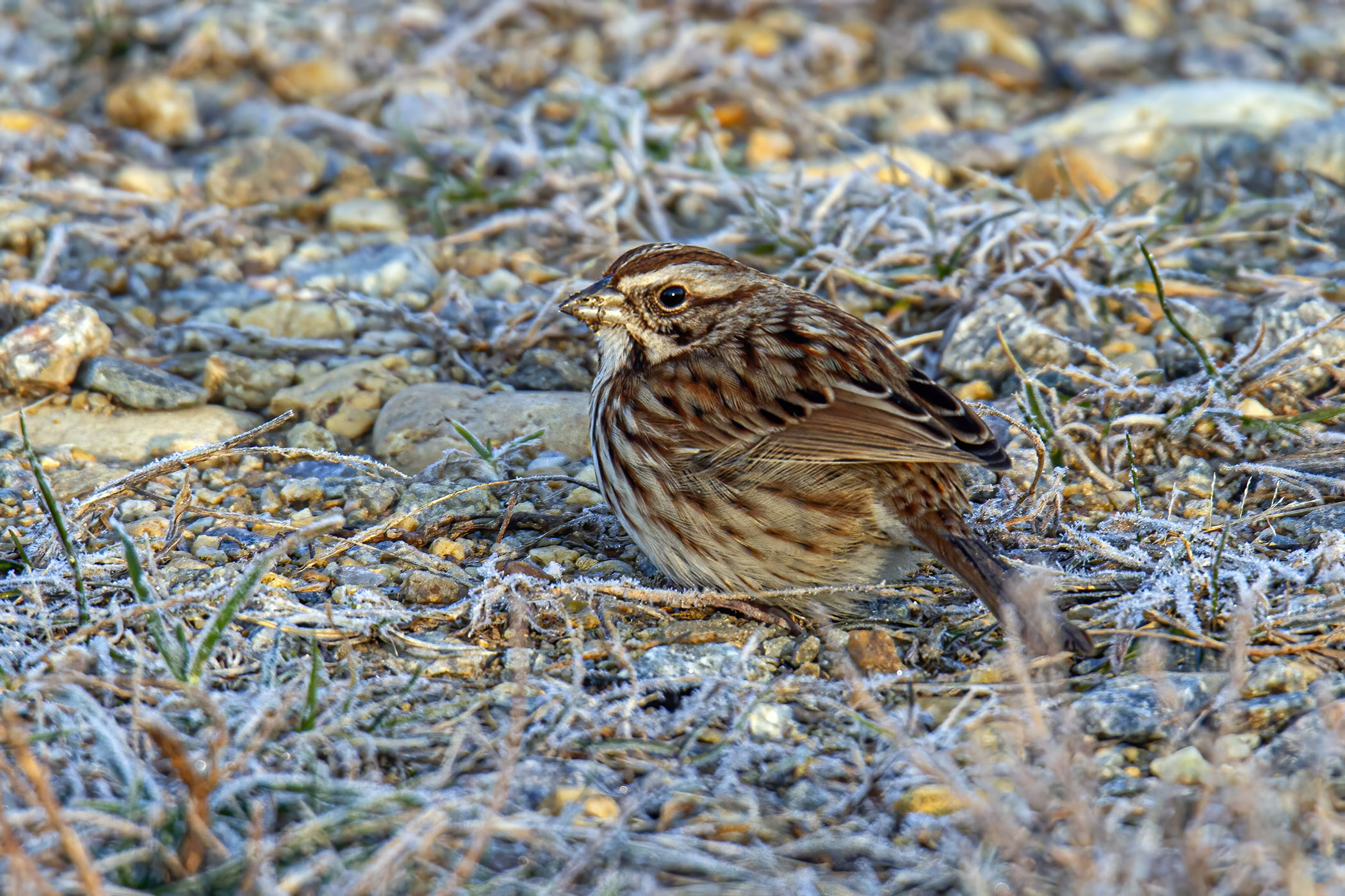
Sometimes the birds play games with me as I try to photograph them—usually it is “hide and seek.” This little Song Sparrow (Melospiza melodia), though, seemed to be playing “peekaboo,” as the bird would hide its head and then pop up and look at me, as if to announce, “Here I am.”

peekaboo1_blogpeekaboo2_blog

© Michael Q. Powell. All rights reserved

Read Full Post »

Although I already posted a photo earlier today of a Song Sparrow (Melospiza melodia) in the snow, I came across one I liked even more as I was going through yesterday’s images. This sparrow (and I am never certain of my sparrow identifications) seemed to be posing for me. Somehow I was able to capture details in its eyes that I have never seen before.

After our brief portrait session, the sparrow hurried back to work.

sparrow_snow2_blog

© Michael Q. Powell. All rights reserved

Read Full Post »
Older Posts »